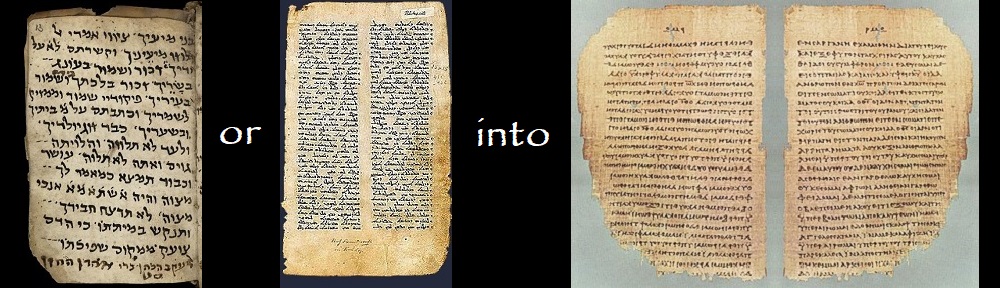
Introductory Sidenote
After a month of deep mourning along with bouts of sobbing, many sleepless nights, and daily depression due to the events of July 2nd, 2023, my Hat Burglar, I am forcing myself to blog again on subjects I am passionate about and have serious convictions over their truth and historical validity. This is one of those subjects: the fallacies and failures of ancient classical Christianity. Furthermore, it is also about modern-day versions of Christianity drifting out of any reasonable orbit of philological and historical accuracy. I hope my readers and followers find some (renewed?) interest in this blog-posts and my attempts to return to a bit more normalcy. At least, that’s my wish for the near future.
∼ ∼ ∼ § ∼ ∼ ∼
As some/many of you already know, I consistently argue for the unreliability of Christendom’s oldest copies—or Hebrew-Aramaic originals if they existed—of the Greek New Testament Gospels and the full Greek Septuagint Bible and the former’s misrepresentation of a (possible? probable?) historical character Yeshua bar Yosef, known in Greek as Iēsous Christós (Ιησούς Χριστός) or in English, Jesus Christ. Why do I make this argument? Why will I always make this argument?
For starters and for well over two millenia, the fact that there was historically stark, drastic contrasts with high levels of xenophobic sentiment in ancient Syro-Palestine and surrounding Judea and Jerusalem between Hellenistic people of the Greco-Roman Empire and that of Homeland Jews/Judaism during Late Second Temple Judaism (hereafter “LSTJ”). This known verifiable fact has been essentially ignored by modern traditional academia, by 19th–21st century scholarship, and most of all by Christian-American theological seminaries everywhere. It is frankly unforgiveable. This ignorance, whether innocent or willing, is a monumental travesty if not a catastrophic blunder by Christendom and its centuries of apologists.
“Romans found it difficult to distinguish between Jews and early Christians at first, it soon became evident that the early Christians, at least the majority of them, did not keep the same customs Jews did (e.g., circumcision). […]
…we see an inherent tension in early Christianity as it tries to simultaneously hold on to and yet distinguish itself from Judaism. […]
This dialectic process is evident when one looks at the early Christian interpretation of Jesus’ messianic theology. One can see the early Christian concern to connect itself with Judaism by believing that Jesus was the Messiah promised to the Jews and by adopting the terminology that was associated with that role. However, the meanings behind those terms shifted as they were transferred from a Jewish context into a Greco-Roman one. This is particularly evident with the titles “Son of God” and “Son of Man.” Early church fathers used these terms as a way of signifying Jesus’ divine and human natures.”
— Jordan Kassabaum, MDiv. Yale University & University of Florida College of Liberal Arts and Sciences Bachelor’s, ““Who Do You Say I Am?”: Second Temple Messianism and the Historical Jesus” 2013.
When one fully understands the comprehensive historical context of Homeland Torah-loving Jews living within the Hellenistic Roman Empire between 200 BCE, up to 70 CE with the total destruction of the Jewish Temple in Jerusalem by General Titus and his Legions, it becomes ever so clear there was serious animosity between three major, unyielding cultural groups: 1) Romans/Gentiles or Pagans, 2) Hellenistic (Herodian?) Jews or Diaspora, and 3) Homeland Torah-abiding Jews such as Jesus or Yeshua in Hebrew. These three groups clashed often with severe consequences employed by Rome’s Provincial authorities.
“Thus, we see a disconnect between the way Jesus would have understood these terms as a first century Palestinian Jew and the way the early church interpreted them as Greco-Romans.
Therefore, it would have been natural for an early Christian to assume that Jesus was the literal, divine Son of God rather than understanding that title as a designation for God’s Davidic Messiah, a title that we have seen did not imply any kind of divinity in 1st- or 2nd-century CE Jewish thought.”
— JORDAN KASSABAUM, MDIV. YALE UNIVERSITY & UNIVERSITY OF FLORIDA COLLEGE OF LIBERAL ARTS AND SCIENCES BACHELOR’S, ““WHO DO YOU SAY I AM?”: SECOND TEMPLE MESSIANISM AND THE HISTORICAL JESUS” 2013.

The widespread dominance of Hellenistic culture—that is, the philosophy, art, literature, architecture, prose or language, mathematics, geography, and cartology (Eratosthenes), astronomy and the heliocentric theory (Aristarchus and later Hipparchus), and medical science with advances in anatomy (Herophilus), physiology (Erasistratus), etc. —cannot be overstated. Long-standing Hellenistic ideas were all products of Alexander the Great’s Macedonian-Greek empire and its syncretic civilization despite its final collapse in 1453 CE. It was a cultural empire (versus literal empire) that lasted 19-centuries, and eighteen centuries after Alexander’s death! Let me repeat, nineteen centuries, from 336 BCE to 1453 CE with the end of the Byzantine Empire.
Perhaps the greatest paradox or deviation to this unprecedented global influence and assimilation by Hellenism, was Judaism, in particular Homeland Judaism, the astonishing rare exception to this historical dominance. The Jewish Virtual Library explains the significant contrast between LSTJ and Hellenism this way:
“Confronted with Greek ideas, some attempted to combine Greek intellectual values with Hebrew ones; such efforts were more successful in Egypt than in Judea. However, even in Judea the Hellenizing movement under Antiochus IV came near to prevailing. Ultimately the Jews organized their culture and their political life on their own terms, as witnessed by the rise of the Essenes and Pharisees. The independence of Jewish intellectual life in the Hellenistic age is partly explained by the fact that while Jews took a great interest in Greek ideas, the outside world took relatively little interest in Hebrew ideas. The translation of the Bible into Greek did not mean that the Greeks read the Bible. The isolation [as pure, holy, and righteous] in which the Jews lived, especially in Judea, was conducive to the creation of a style of thought and life which can be (and was) considered competitive with Hellenistic civilization.”
— jewish virtual library at https://www.jewishvirtuallibrary.org/hellenism-2, accessed August 4, 2023. emphasis mine.
I recommend reading the entire article on Hellenism at the Jewish Virtual Library for a more encompassing understanding of these two ancient, very conflicting cultures; a time-period directly involving and consuming Yeshua bar Yosef’s (Jesus) lifetime and purpose.

More On the Linguistic Cultural Troubles of Greek Transliteration Post-70 CE
Dr. Graham Davies and Robert Gordon, along with J.A. Emerton’s extensive work in Studies on the Language and Literature of the Bible, cover the many problems of vernacular Hebrew and Aramaic in 1st-century CE Palestine being later copied and/or translated into Koine Greek, the language of today’s Septuagint and Codex Sinaiticus, and subsequent later copies of the Greek New Testament. They and many other biblical Jewish and Roman historians indicate just how difficult Greek-speaking, Greek-reading copyists and translators of 2nd — 4th century CE Roman-Hellenist culture, would have had significant problems and errors going from Mishnaic Hebrew and Aramaic word-of-mouth sources or (non-existent) text-sources… into their Koine Greek.
This group of scholars includes Dr. Bart Ehrman of the University of North Carolina – Chapel Hill. Ehrman addresses the many grave problems of copying earlier copies of verbal “stories,” i.e. not recorded, about Yeshua bar Yosef (Jesus) forty to eighty years after his execution, and thornier still (pun intended) throughout some of the most unstable, tumultuous decades of the Roman Empire and the Jews of Palestine. Whether the Hebrew Bible, also known as the Miqra (מִקְרָא) in Hebrew, was changed intentionally or unintentionally by scribes, it’s almost certain that personal projections were written into the Gospels we have today. Problematic questions also increasingly apply to the Yeshua/Jesus stories better known as the canonical Gospels of Mark, Luke, Matthew, and John, in that order. Ehrman states:
“The text of the Hebrew Bible that is read today and that is at the basis of all modern translations is called the Masoretic Text. It is called this because the Jewish scholars who devised the rules for copying scripture are known as the Masoretes. The term “masorete” comes from the Hebrew word masorah, which means “tradition.” The Masoretes were the scholars who worked out ways to preserve the traditions of the Hebrew Bible. They were active between 500-1000 CE.
To understand what the Masoretes accomplished, you need to remember that ancient written Hebrew was a language that used only consonants, not vowels. Any language that is written only in consonants is open, obviously, to serious problems of interpretation. Imagine if you were to write English that way. Apart from context, you would have no way of knowing whether the word “npt” was “inept” or “input” or whether “mnr” was “minor,” “manor,” “moaner,” or “manure.””
— Bart d. ehrman at: https://ehrmanblog.org/the-copying-of-the-hebrew-bible/ , accessed August 5, 2023
Let me reiterate the active timeline of the Masoretes and their standardized copied texts: 500 — 1,000 CE. That is more than four and a half centuries after Yeshua’s/Jesus’ death; c. 467 years to be more exact! This poses many more suspicions about what was done with the Hebrew Bible stories prior to 500 CE? It gets worse…
“The not so good news is that [precise verbatim] is not the case with all of the books of the Hebrew Bible. Scholars had long noted, for example, that the Septuagint (Greek) text of the book of Jeremiah was about 15% shorter than the Masoretic text (i.e., it had that many fewer verses/words), and scholars had suspected that it was because the Hebrew version of Jeremiah known to the ancient Greek translators was significantly different from the Masoretic Text. As it turns out, one of the scrolls discovered at Qumran has a Hebrew text of Jeremiah that is closer to that lying behind the Septuagint version than the Masoretic text. 15% is a big difference. Other books of the Septuagint are also strikingly different from the Masoretic text, for example, in the books of Samuel and Kings. It is possible that the Hebrew texts of all these books were in serious flux before the text came to be standardized by the end of the first century.”
— Bart d. ehrman at: https://ehrmanblog.org/the-copying-of-the-hebrew-bible/ , accessed August 5, 2023
These problems beg further suspicions. For example, in these four questions posed to Ehrman on his blog address these linguistic retrospective obstacles and issues, he answers this way:
Question 1: “Did Christians from this period [1st-century CE] place less emphasis on the Hebrew Bible than they do today? Were they using the Septuagint instead and we have Greek fragments and scrolls from this period, but not Hebrew?”
Ehrman: “Yes, Christians read the Greek Old Testament rather than the Hebrew (or later, the Latin Old Testament). Hebrew was used only by Jews. And yes, we have lots more Septuagint fragments than Hebrew. (And more Latin of course.)”
Are you noticing the heavy use of Hellenic, or Greco-Roman languages, influences, and their own specific cultural contexts? It is not Yeshua’s (Jesus’) native culture or Mishnaic Hebrew and Aramaic, but instead the much later Roman Catholic Church Fathers projecting a non-Jesus or non-Yeshua perspective onto the (now convoluted) “gospel” stories.
Question 2: “Which type of transmission of text do you think is superior for ensuring accuracy and safeguarding against unauthorized changes, “Controlled” or “Uncontrolled”?”
Ehrman: “I”m afraid I don’t see how an uncontrolled situation is likely to produce more standard results than controlled situations. Think, for example, of the manufacturing industries!! In any event, the evidence is quite clear that when uncontrolled and unskilled, the earlier scribes made far more mistakes than later ones.”
Question 3: “What evidence do scholars have, that demonstrates that the text had not undergone significant changes, from about 100 CE to 500 CE, when the Masorites started working on the text?”
Ehrman: “It’s a great question! But I’m not sure why they’re so confident (and that it’s not simply wishful thinking).”
Question 4: “The Gemara—a rabbinical commentary on the Mishnah, forming the second part of the Talmud—bases its arguments on citations from Scripture. Do you know how much those quotes differ from the Masoretic texts? Also, do you have any thoughts on the Greek Septuagint’s provenance?”
Ehrman: “Ah! That is an enormous problem. We don’t have the evidence we need. It is a perennial issue of scholarship: what form of the Greek translation of the Hebrew Bible was available to Paul? Or to others at his time? Were there lots of Greek translations? How do we decide which form of the text was available where and when? Big problems!“

Be this as it may, why on Earth do modern evangelical, fundamentalist, Christian congregationalists, theologians, ministers, pastors, and many Christian biblical historians give the Septuagint and an incomplete 4th-century CE Codex Sinaiticus so much infallible authority? As Dr. Bart Ehrman’s answer alludes to for Question #3, that is the obvious million-dollar question. There’s very insufficient evidence, corroboration, or reasoning to support such a ridiculous “divine” conclusion regarding the Gospel “stories” much less about the purpose and nature of Yeshua/Jesus—again, due in large part with the many problematic transliterations from Mishnaic Hebrew and Aramaic… into Koine Greek.
Dr. Nehemia Gordon, PhD, of Hebrew University – Jerusalem and Bar-Ilan University in Ramat-Gan, Israel, believes the underlying hidden Hebrew “stories” of Yeshua can be uncovered in the first three Gospels, or Synoptic Gospels. But to Greek-learned readers, then or today, they cannot possibly decipher them. They are gibberish to Greek-readers today and they were gibberish to the 2nd– and 3rd-century Greek scribes then.
Hidden Hebrew Idioms or Hebraisms in the Synoptic Gospels
As Dr. Gordon continued his research career on the Dead Sea Scrolls of Qumran and ‘the writing, erasure, and correction of tetragrammaton in Medieval Age Hebrew Bible manuscripts,’ Gordon was discussing with a colleague who explained to him “some scholars were of the opinion that parts of the first three Gospels of the New Testament were originally written in Hebrew.” Asking how and why that was his colleague answered, “Because they are full of Hebraisms.”
Dr. Gordon elaborates on this…
“I knew all about Hebraisms from my study of the Septuagint, the ancient Greek translation of the Tanach. World-renowned experts in classical Greek find the Septuagint incomprehensible while any Israeli student can read it after only a couple of years of learning Greek. The reason is that the Septuagint was translated by very bad translators. Rather than translate the Tanach into proper Greek, they mechanically translated the words, leaving behind numerous Hebrew thought patterns. To someone who is familiar with the Tanach in Hebrew this Greek is relatively easy to read. But to a Classical Greek specialist who expects to find elegant Greek syntax it sounds like gibberish. And in ancient times it was no better.”
— Gordon, Nehemia. “The Hebrew Yeshua vs. the Greek Jesus” (p. 33). Makor Hebrew Foundation. Kindle Edition. [emphasis mine]
In the ancient shops, forums, and streets of Athens, Rome, or Alexandria the vast majority of Greek Athenians and Romans could not comprehend the Septuagint. To them the Septuagint was disjointed and perplexing, ironically foreign. Dr. Gordon expands too on this alien dynamic between the Homeland Jews and the Hellenistic worlds that I have been arguing for many years. Gordon says:
“For example, the Tanach often opens an account with the Hebrew word vayehi (ויהי) “and it was.” Of course in Hebrew “and it was” means, “it came to pass, it happened.” But the Greek reader sees kai egeneto (και εγγενετο) and says, “And it was?” And what was?! In Greek it’s gibberish! Very often the translators did not even know what they were reading and created nonsensical sentences by translating word for word.”
— ibid. Gordon, Nehemia.
As a footnote to this explanation of bad Hebrew-to-Greek transliteration, Gordon states:
“For example, in the Septuagint see LXX 1 Samuel 3:10 (compare LXX Numbers 24:1). Some interesting examples in the Greek Matthew are discussed by Grintz pp. 36-39. As one grammar of New Testament Greek puts it, “Major Semitisms… are not only bad Greek but are apt to cause difficulty in translation…”” (Whittaker p. 150).
— Gordon, Nehemia. “The Hebrew Yeshua vs. the Greek Jesus” (p. 97). Makor Hebrew Foundation. Kindle Edition.
These types of translation and transliteration mishaps are frequently found throughout the Septuagint, and by descending default, found as well in the canonical Synoptic Gospels. Dr. Gordon describes the regular mistakes by the scribes, but also their personal projections upon the Hebrew and Aramaic sources:
“[They were] an over-literalized translation by someone who is not entirely sure what he is translating. To complicate matters, numerous Greek copyists who did not know any Hebrew tried to “improve” what was clearly poor Greek. The result was a translation which at times mimics the Hebrew word for word and at other times wildly differs from it.”
— Gordon, Nehemia. “The Hebrew Yeshua vs. the Greek Jesus” (p. 34). Makor Hebrew Foundation. Kindle Edition.
Additionally, through ten editions (1896–1960) of A Greek Grammar of the New Testament and Other Early Christian Literature, compiled by German scholar and philologist Friedrich Blass and Swiss linguist Albert Debrunner, both renown scholars expound further on just how poorly the Greek New Testament was translated from Hebrew-Aramaic sources by the earliest Church Fathers and their Greek scribes:
“Many expressions which a Greek would not have used were bound to creep into a faithful written translation of a Semitic original. One [such] grammar of New Testament Greek, lists no less than twenty-three (23) separate categories of Semitisms [lost in Greek translations].”
— F. Blass and A. Debrunner. “A Greek Grammar of the New Testament and Other Early Christian Literature,” Revised Edition. University of Chicago Press, 1961.

Saving the Hebrew Yeshua from the Greco-Roman Christos
With the assistance of actual Jewish scholars and expert linguists of LSTJ Mishnaic Hebrew and Aramaic, NOT biased Christian theological experts, the more I have studied, examined, and earnestly sought the historical real figure of Yeshua/Jesus inside his proper, accurate Roman historical context and environment—and that is impossible without 1) his Homeland Hebrew, 2) his Tannaitic (LSTJ) background, and 3) his Torah-abiding sources—this is always my conclusion: in the Koine Greek versions Jesus is always terminating the Torah. But in the Hebrew-Aramaic versions Yeshua is consistently defending and safeguarding the Torah.
So why the sharp disparity during c. 129 BCE–70 CE, the LST period?
The answer(s) are not difficult to deduce. There are no less than two reasons for this, but certainly many more. For the sake of time and effort on my readers/blog-followers I have reduced the reasons to two primary ones introduced to you here, or for my long-standing readers further argued and explained:
- Anti-Hellenic sentiment and/or hatred by Homeland Jews such as Yeshua’s rural Jewish sect “The Way” and against the Roman Empire. And then by contrast…
- Anti-Semitism and Antinomianism. The former is well-known even today so no explanation is required. However, the latter part, Antinomianism is I think less known. In a nutshell, the latter means any view which rejects laws or legalism and argues against moral, religious or social norms. Since “Torah” are the Laws of Yahweh/God given to Moses—and are contained in the Pentateuch—this therefore goes against Yeshua’s Hebrew beliefs, reforms, teachings, and nature based on Hebrew-Tannaitic sources.

It is very much worth noting that a less known early Roman Church Father realized even in about 90–95 CE that some of the Gospel translations were inaccurate and problematic. Papias of Hierapolis, as quoted by Eusebius, stated this:
“Matthew collected the oracles [literally: “words”] in the Hebrew language, and each interpreted them as best he could.”
— Eusebius. “Ecclesiastical history” 3.39.14–17
“Each interpreted them as best he could!” Wow. So not only was it known by Roman Church Fathers that the gospels Mark and Matthew, sometimes referred to as the most Jewish of gospels, but also widely recognized among the 1st– and 2nd-generation Fathers that the Greeks and other non-Hebrews, i.e. Gentiles, Roman pagans, Greeks, notably had difficult times understanding, translating Mishnaic Hebrew and Hebraisms into Greek and other languages. That is a smoking gun if not a serious red-flag for the Septuagint and the descendant Codex Sinaiticus and later renditions of “Jesus Christos.”
Conclusion
As I’ve argued many times over the last twenty-years, one cannot know the actual, true, historical Jewish-Hebrew Yeshua/Jesus strictly through the existing error-ridden Koine Greek sources, i.e. Gospels, or Greco-Roman Hellenic sources. That is a Greek Apotheosis Christos foreign and completely fabricated by the retrograding, retrofitting early Church Fathers of Rome. Furthermore, what pagan and Gentile Romans fabricated decades and centuries after Yeshua’s execution about who he was and his nature and purpose cannot be corroborated independently or supported by Jewish-Tannaitic facts and evidence. And was not Yeshua/Jesus a Homeland Jew speaking and teaching in Mishnaic Hebrew and Aramaic? Of course he was. Yeshua (or the widely known “Jesus Christos”) was never a Hellenist nor a Greco-Roman (or Paulinist) as today’s bibles falsely portray.
∼ ∼ ∼ § ∼ ∼ ∼
For further broadening education on the disparity and lack of Hebrew sources of Yeshua versus Greek or Roman biased sources strictly on Christos, this video from TorahCentric is a good start. It is very worth it:

The Professor’s Convatorium © 2023 by Professor Taboo is licensed under CC BY-NC-ND 4.0
 The Professor's Convatorium
A long read, Mister D and somewhat above my pay grade, I must be honest.
But it comes with the overriding assumption – or it seems to- that Jesus was a genuine historical figure.
If it turns out he is simply a mythological figure what effect do you think this will have on the way such texts are viewed?
And congrats on the Community Shield.
Loved Trossard’s equaliser.
LikeLiked by 1 person
A very good question my Friend. But I will be just as elated, if not above the Moon, if he is merely a Greek caricature or myth via apotheosis, at least that will represent my point here: Jesus Christos is completely unrecognizable as a true LSTJ Hebrew. And yet, was he NOT a Homeland Jew of the 1st-century CE, as the unreliable Greek gospels portray? 😉
Ah! YEAH for my Gunners! Couldn’t watch the game, for reasons here in the U.S. you already know about, but I will go checkout the highlights! Many thanks for the mention Sir. 😁
LikeLike
Unfortunate about the US national squad and Rapino’s pen. miss.
Happens to the best of ’em.
Messi, Kane and remember Baggio in ’94?
Sad she is getting slated by a lot of twists in the media.
Smh
LikeLiked by 1 person
Yes, but the USWNT did not really deserve to advance further. They simply were not playing well enough, ESPECIALLY as great as those Womens National Teams of 2003 — 2015, the ones with Abby Wambach up front in the middle along with Megan Rapinoe on the left and either Alex Morgan or Amy Rodriquez up on the right. Those were our all-time BEST USWNT’s, hands down.
Yeah, sadly Rapinoe was not having a good tournament, not to the standards or HER standards in her prime. This WC tourney will go down as one of her poorest I think. 😟
I thought in the Group stage games SPAIN looked like the sure-fire favorites to win it all. But that 0-4 loss to Japan gave me doubts. The Netherlands will be a serious challenge for them if Spain does NOT play that beautiful Tika-Taka football they did play. So easy on the eyes to watch, eh? 🙂
LikeLike
Even the best have their off days/ games/ tournament.
Who will ever forget Germany trouncing Brazil 7- 1?
Just watched the highlights of the England Nigeria game.
Nerves got to some of the players here as well.
Missed the goal completely on a couple of occasions and ballooned over the crossbar.
Liverpool play their final warm up fame this evening but it’s not on the box.
And we’re on another 2 hour spell of load shedding at the mo until 2200 hrs.
F******g ANC!!
At least we have access to a genny.
Smh
🤦♂️🤦♂️🤦♂️
LikeLiked by 1 person
Oh my! Ark, I’m sorry about your nation’s incessant “load shedding” problems. That has GOT to get overly annoying. How many times have they done that to you guys? Sheesh! 🤦♂️
So far in our/my great state of Texas—where we don’t need ANY HELP from no one, not even the national power-grid 😄 —surprisingly we haven’t had any failures or rolling blackouts… YET. However, if these boiling triple-digit temps don’t let up soon I completely expect the power to go off or fail. Practically the entire month of July we sustained consecutive days of 100° — 108° Fahrenheit! 🥵 This is the WORST I’ve ever experienced the level of near-unbearable, sweltering heat! And August has traditionally ALWAYS been the hottest month of the year for Texans, and it is only the 7th day! WTF!?
LikeLike
Load shedding has been going on for two years already…on and off ( no pun intended) and I read a report this morn. it could carry on for up to a further five years.
Liverpool are currently ahead 2- 1 so that’s a wee bit of good news!
LikeLiked by 1 person
😄 It is VERY good news! 🥳
Sorry, I’ve had a pretty hard 5-weeks lately, but doesn’t the EPL begin Aug. 11? Am I correct?
LikeLike
Yep.
Can’t wait!
LikeLiked by 1 person
Ditto! Let’s go Reds and Gunners!!! 🍻
LikeLiked by 1 person
“why on Earth do modern evangelical, fundamentalist, Christian congregationalists, theologians, ministers, pastors, and many Christian biblical historians give the Septuagint and an incomplete 4th-century CE Codex Sinaiticus so much infallible authority?”
For me, as a former Evangelical pastor, it was decades of indoctrination and conditioning that led me to embrace certain beliefs about the Bible. My college “education” only reinforced and strengthened my beliefs about the Bible. I was never presented with any information that contradicted or challenged that which I was told was “truth.” It was only when I started reading books by authors outside of the Evangelical bubble that I realized I had been lied to. Did my pastors and professors deliberately lie to me. I don’t think so. They too were in the same bubble — that place where everything makes perfect sense.
LikeLiked by 3 people
Bruce, I too find that the case with the vast majority of Christians™ here in the U.S. especially. In fact, most all of the Xians I’ve ever known in my 5-6 decades of life—as well as on 4 of the 6 inhabitable world continents (missions)—were either heavily groomed that way by their own immediate and extended family OR by a life-altering very traumatic event, that would cause them to swing to the EXTREME other side of (and of life’s) pendulum. Funny how both those conditions work on humans, huh?
And THAT right there is the proverbial bull frog in the hot heating up frying pan and/or the ostrich head plunged into the sand, is it not? 😉
Thank you so much for stopping by here and commenting Bruce. It is much appreciated Sir. 🙂
LikeLike
No disrespect intended, Prof, but I believe none of this will matter in a few centuries, even if humanity somehow survives in modern enough form to contemplate ancient religions.
God was declared dead circa 1883, and Christianity and other Abrahamic reigions have been slowly dying ever since. The final death, I believe, is only a matter of time.
The more religious thinking spurs on Fascist world politics, the sooner that death will occur — of necessity!
LikeLiked by 2 people
I can’t seriously argue against your assessed sentiment rawgod of “their” Laissez faire postures to this overwhelming, INDEPENDENT evidence. I thing you are quite correct.
LikeLike
No need to argue. Your blog was kinda interesting, for a while, but being an atheist it went on far too long. Others might disagree.
LikeLike
I appreciate your blog-editing honesty rawgod. 😄
Yes, in person, when I’m with an evangelical-fundamentalists—and here in central Texas they are EVERYWHERE, around each corner and in EVERY place of business; it is impossible to not encounter them!—I too doze-off or turn-off mentally because what they erroneously claim to be “true” and real, is laughably quite boring. Or as you put it, “…it [goes] on far too long.” 😉
Well, at least you caught some Zzzz’s in the last half of my post. 🤭
LikeLike
Lol! No zzzs. After a while I just skim-read, looking for interesting keywords, but sadly found none “for me!” I figured you wrote it, you had something to say. But you weren’t talking to me this time. Simply put!
LikeLiked by 1 person
Re “Be this as it may, why on Earth do modern evangelical, fundamentalist, Christian congregationalists, theologians, ministers, pastors, and many Christian biblical historians give the Septuagint and an incomplete 4th-century CE Codex Sinaiticus so much infallible authority?”
I thought this was because when the Protestant Revolution took place, they wanted to supplant the “authority” of the Catholic Church (and its “traditions”) and only had scripture at hand, so Sola scriptura (sp?).
By doing so, they elevated the translational problems along with the “scriptures.”
LikeLiked by 1 person
All very correct and true Steve. I (happily? 😉 ) cannot add anymore to your fine comment Sir. 👍
LikeLiked by 1 person
Praise from the praise worthy is praise indeed! :o) Great piece that!
LikeLiked by 1 person
😄 Oh, the Gentleman doth praise to much! 😉 hehe
LikeLike
Oh, too much, you say? :o)
LikeLiked by 1 person
Yes, well, with the more correct “too” rather than the shortened “to”. 😉
LikeLiked by 1 person
Once an editor, always an editor . . . .
LikeLiked by 1 person
Ah Tildeb, your first paragraph is exceptional Sir, spot on! 🎯
As for your second paragraph, I will smile and let its veiled intention lie and hopefully go back to sleep, at least on THIS blog-post. Agreed my Friend? 😉 ❤️
LikeLike
🤦♂️ Tildeb, honestly… I could argue the exact same critique you allude to here against someone who uses their faith-based, Binary-Only world-view against those who do not align with their own. It goes both ways in this case my fine Friend. 😉
Anyway, enough of this on THIS specific blog. Thank you Sir. 🙂
LikeLiked by 1 person
Pingback: Paul, Acts, Forgeries & Marcion – Conclusion | The Professor's Convatorium
Pingback: Jewish or Christian Messiah? | The Professor's Convatorium