Our Better Angels

————

“We are not enemies, but friends. We must not be enemies.
Though passion may have strained, it must not break
our bonds of affection. The mystic chords of memory will swell
when again touched, as surely they will be,
by the better angels of our nature.”

President Abraham Lincoln First Inaugural Address,
Washington DC, March 1861

————

∼ ∼ ∼ § ∼ ∼ ∼

Back in the Fall of 2015 I had read some rumors and articles that one of my all-time favorite American, historical stories was being made into film. I was thrilled, elated this true event was finally making a screen-write then into full production. This true story is set during the 1970’s Civil Rights Movement throughout the old South, but for these two main characters the movie would begin exactly where it all began, Durham, North Carolina, 1971.

I thought about titling this blog-post Our Better Virtues, but decided against because Lincoln’s quote was just too spot on and appropriate for this subject and film. Although, “Virtues” would have inferred my own meaning, intention, and desires for human kind around the world. After all, every single living human on this planet has some virtues. They just have to choose to find them, bestow them liberally, and nurture as well as grow them. Oh well, “Our Better Angels” gets the point across just fine. 😉

I have blogged here several times about C.P. Ellis and Ann Atwater and the volatile, appalling events they both found themselves. In a February 2016 blog-post I wrote about expanding sympathy into deep empathy and how the two feelings, behaviors are actually quite different. The Golden Rule, “Do unto others” and so on, falls short of deep, impactful empathy. Real empathy requires much more than being self-centered or focused on one’s self. It requires putting yourself into their life, their shoes, and metaphorically (or literally?) walking in them 100-miles or more. It does not involve yourself.

This 2019 film, The Best of Enemies, starring Taraji P. Henson (as Ann Atwater) and Sam Rockwell (as C.P. Ellis), tells that story about finding and giving common, deep empathy for your fellow neighbor, your fellow human being. I finally had the opportunity to watch it and not soon enough! Here is one of the trailers:

Sadly and disappointingly critical reviews of the film have been average and unkind if not neutrally bland. Therefore, I am writing my own reviews and commentary everywhere I can. Why? Because I feel strongly it is important to point out a few things about historical, time-period films to less discerning audiences regarding authentic history, particularly scholarly history that seeks to gather all possible data, evidence, sources, and narratives… no matter their viewpoint. Now, for my personal review of the film, The Best of Enemies:

I imagine this film is horribly underrated and unappreciated by the majority of cinematic fans and specific “cultural” groups. BUT movie reviews will never change what Ann Atwater changed in North Carolina and the ripple-effects she and C.P. Ellis began afterwards during and for the Civil Rights in the 1970’s.

The fact that this film briefly portrays in two short hours what was accomplished in real life between Bill Riddick, Howard Clement, C.P. Ellis, and Ann Atwater—not to mention the Black community in Durham, NC—must be remembered. No matter what movie critics think about the film, and honestly, their trivial criticisms about its direction or production or script or acting do it injustice. Pffffft.

Real, accurate, authentic history is near impossible to translate/transcribe onto the silver-screen in a measly 2-hours or less. This unwinnable cinematic anomaly against movie producers, film-writers, film-budgets, then movie audiences and critics, should always be seriously considered when producing and releasing raw, historically accurate, socially-politically CORRECT and LEGALLY RIGHT Movements as the American Civil Rights, or other highly controversial subjects as the Holocaust or the U.S.’s 18th – 19th century treatment, extermination, and resettlement of Native American Indian tribes. Typically 2-hours or less will NEVER do these historical time-period subjects full justice.

Hence, when all considered, including reading and deciding the real worth/value of this film’s many bland or negative short-sighted or undeserved reviews, just remember this…

2-hours will NEVER be able to tell the full astonishing, real-life true story and relationship about and between Ann Atwater and C.P. Ellis… which required and evolved over three decades! Ignore movie critics, remember the core and marrow of what the film is telling, portraying!

5-stars and more, every time, every day!

Did I emphasize 2-hours enough? 😜

Seriously though, I hope you will make the time to watch, appreciate, and support these fine altruistic, humanitarian films like this one and the stories they tell. They will at least introduce to you a starting point to go further, dig deeper into the entire contextual narrative, facts, plausible facts, and plausible probabilities despite there often being degrees of cinematic license taken to appease corporate profits, severe time-constraints, and/or film productions at the expense of truth and full historical accuracy. Please keep this in mind.

————

Live Well — Love Much — Laugh Often — Learn Always

Creative Commons License
This work is licensed under a Creative Commons Attribution-NonCommercial 4.0 International License.
Permissions beyond the scope of this license may be available at https://professortaboo.com/contact-me/.

Winter Celebrating

Winter Celebration_breaker

blue nutcrackerDuring this time of year, the holidays or Christmas and New Years, have always been a jolly, entertaining time of year of expectancy, of buckle your seat-belts and brace for anything. Sixteen days or so of all things good, sparkle and wonderment, uplifting or mysterious it all was/is possible. Taking time for the less fortunate in a plethora of ways. Reuniting with family around meals, in the kitchen or living room for games, maybe telling stories past or present with traditional beverages and libations for cheer. Most things are fluid, undefined precisely, other things traditional, conventional, predictable, and new. The exception? Young children. Then holiday gatherings are certainly fluid, very undefined, traditionally loud, unconventional, unpredictable, and newly broken. Messy. Pass the broom and dustpan.

red nutcrackerThere is also a never-ending amount of wishing. Wishing everything was neat and tidy. We wish you this, we wish you that, we wished you’d come, we wished you’d leave! Lots of wishing everywhere, wishing some things were different. Wishing other things and people were all the same, maybe equal. Identical? Wish you were like me, like him or her or it. Or a very popular wish of the last couple of millenia: wishing things were meticulously, undeniably true.

Not the case.

green nutcrackerNo matter what time of year it is I find things are wonderfully messy. People of all ages are messy. Life is messy, past and present, and near certainly will be in the future. That’s what it means to be human among 7.7 billion other humans. We are all alike, but equally different, from just as many different places and backgrounds. Normality and paradox somehow coexist. Going against this truth will eventually drive you mad. Life plays and swims in paradox while the kill-joys go mad and the libertines live.” A quote from yours truly on my Favorite Quotes page. But enough with my rambling!

red-captain nutcrackerWhy do we celebrate this time of year? When and where did this celebration begin? Who should I ask? Or should I not ask and go find out for myself? Ahh, more messy answers from previous messiness. One is never served so well as by oneself as Charles-Guillaume Étienne coined. The common version is If you want something done right, do it yourself. There is some truthiness to either one, I think. Some will exhort the Golden Chalice exists and certainly can be found! Others will posit no such thing exists. Still others will have no answers of any import. Perhaps it’s wise to saddle both, or maybe all three? HAH! A ménage à trois beaucoup! Oui?

Apologies. Now I’ve slipped into delicious hédonisme and débauche as the French would say with a sly grin.

court nutcrackerThere are many wrong answers to those questions, mostly wrong… most likely. Yet, if one puts on their forensic hat and goggles, with some persistence, equitable examination without rash simplification and disassociation, 😉 the messy truth can and will be found. It’s not so scary. Much of this messiness is well-known, checked and rechecked. Nevertheless, here are a few starter-fireworks, kindling if you will, sure to light-up and excite your holiday bonfire, conversation, and show:

  • Christmas is a multicultural Pagan festival dating back to at least the late Neolithic and Bronze Ages, i.e. 5000 BCE to 600 BCE, as winter solstice festivals.
  • The year and precise date of “Christ’s birth” is unknown, but the time of year is estimated by scholars to be in Autumn, not any later than September.
  • Earliest Christians from Yeshua’s (Jesus’) The Way Movement never celebrated his birth; it wasn’t until the 16th or 17th centuries CE that Western churches in Europe incorporated popular Pagan winter festivals in December into their Catholic Christ’s Mass or Mass for Christ.
  • Several Protestant denominations throughout the world banned Christmas celebrations completely, English and American Puritans, for example. Quakers, Jehovah’s Witnesses, and the Church of Christ are three more examples.
  • Our familiar gift-giving charity originated in the Victorian Era (1800’s) and the traditional Christmas tree is Germanic-Teutonic in origin where greenery from outside is brought inside to cheer up the dormant, colorless, glumness of winter.
  • Christians of the mid-1st century to 2nd century CE celebrated Christmas in April to May; this greatly bothered the Church Leaders because Jesus’ place of birth, or death, or burial were completely uncertain, speculation and conjecture. Therefore…
  • Pope Julius I in 350 CE declared Dec. 25th as the official imperial birth-date of Jesus; it was the same time of Rome’s very popular Pagan Saturnalia festival.
  • Nativity stories, plays, and decor are taken from several Pagan celebrations and imagery, like the ideas of shepherds, wise men (Magi), and an illuminating star were all secular in origin.
  • In the modern era Christmas has taken on more diverse forms, various rituals, and commercially energized out Rudolph’s cold, red ass; I mean, nose!
  • Saint Nicholas was an obscure 4th-century philanthropist and turned into a chimney-diving Santa Claus with elves and flying reindeer, a mingling and mixing of the ancient German king of the gods Odin and his Yule celebration.
  • The story A Christmas Carol was a quick-buck publication by Charles Dickens in 1843 turning traditional Christmas scenes into heavy sentimental, heart-grabbing sharing and giving.
  • The Advent Calendar of the holidays was once just an unromantic invention by a weary 19th-century Munich, Germany housewife to silence her pestering children who would not stop asking Momma, how many days until Christmas!?
  • Yes, now is the time for some good song! Hit play (below), give hugs, find mistletoe, and be of good cheer because it is the most wonderful time of the year!

As it turns out, if truth be told historically, the Christmas holidays actually have nothing to do with the birth of the anti-Semitic Greek Jesus Christ, but instead is a winter celebration and festival of diverse, all-inclusive, ancient cultural Coming Together. A gathering of family, friends, and strangers from many messy traditions and perceptions to form a messier, melting pot of holiday mess! I vote to call the winter celebration Good-mess. Goodmess Eve, Goodmess Day, and have a cheerful Goodmess New Year. Yes? Say Ho ho ho if you agree.

————

Christmas_Lights

Creative Commons License
This work by Professor Taboo is licensed under a Creative Commons Attribution-NonCommercial-NoDerivatives 4.0 International License.
Permissions beyond the scope of this license may be available at www.professortaboo.com/contact-me/.

Visiting Our Cusp, Limits, Fearlessly

Sometimes during unsettled times when so many around us are disconnected, cold, detached, uncaring, and avoiding simple social kindness to one another, or hyper-charged looking for drama and some type of controversy—perhaps because they’ve been living too long in begrudging routine mediocrity or luxury—we lose sight of what really matters in life as simple human beings. We forget that there is very little difference between all of us. In fact, genetically less than 0.1%. If we would embrace this commonality, this intimate reality, our very fragility and vulnerability with each other in this daunting, life-giving Universe… then we are never alone. Never unwanted or not needed. Never without friend or family. This primal, very basic organic condition we all share will never, EVER change; at least not in the next 100,000 years or more.

Be that as it may, we do sometimes need reminding, refreshers in how very minuscule each of us are in this vast, never-ending, beautifully inhumane Cosmos that completely dictates our quality of life and death. Our time here is but a flash in the bucket in the biggest picture, BUT remarkably impactful for the ‘millisecond’ of life and memories with other loved ones. With so many things uncertain yet ready to experience, its marrow ready to be sucked down to the last molecule of our 80, 70, 50, 20, or 10-years of life, whatever it is to be, makes it… pure gold! Every second, every ounce! How will you spend it? How will others experience you and remember you?

I posted this years ago from Oriah Mountain Dreamer. I want to post it again, as a reminder… that we usually have only one chance to make the most of this short, mortal, beautifully remarkable gift called life really count the most. Oriah knows exactly how to best live and die in it:

It doesn’t interest me what you do for a living.
I want to know what you ache for
and if you dare to dream of meeting your heart’s longing.

It doesn’t interest me how old you are.
I want to know if you will risk looking like a fool
for love
for your dream
for the adventure of being alive.

It doesn’t interest me what planets are squaring your moon…
I want to know if you have touched the centre of your own sorrow
if you have been opened by life’s betrayals
or have become shrivelled and closed
from fear of further pain.

I want to know if you can sit with pain
mine or your own
without moving to hide it
or fade it
or fix it.

For the rest of Oriah’s powerful, to the bone and straight to the heart realism, go here.

If we do not test ourselves when life is good, plush for ourselves, and push our abilities our kind empathy, understanding, and what we can manage and gladly give, then how can we ever truthfully know how much our proactive help matters? How much does our charitable action count? How much does our voice count to help make other’s lives easier, happier in a purely humane way? It takes so much more to join the disadvantaged… raw in person and heart than simply saying words or writing a check. Joining all of humanity, the worst, the most unfortunate is where the most profound, deepest fulfillment of living is discovered. The alternative is a planet of unfeeling, insensitive, self-absorbed, non-humanity, as this song aptly describes…

————

Nigh, give me the living, the marrow of life any day, every day.

————

Live Well — Love Much — Laugh Often — Learn Always

Creative Commons License
This work is licensed under a Creative Commons Attribution-NonCommercial 4.0 International License.
Permissions beyond the scope of this license may be available at https://professortaboo.com/contact-me/.

21st-Century Humans More Peaceful

With utter fascination last Wednesday night Nov. 20th, I watched one of my favorite PBS shows, NOVA. The title of the show was The Violence Paradox. The one hour show investigated how over the last 200,000 years Homo sapiens as a whole are living and dying less violently. In other words, comparatively speaking in the 21st century by the compiled numbers most human beings are living and dying more peacefully than in our past.

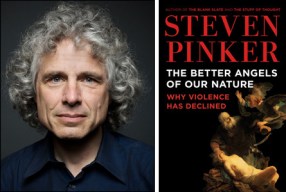
stevenpinkerIn his two published books The Better Angels of Our Nature: Why Violence Has Declined (2011) and its sequel Enlightenment Now: The Case for Reason, Science, Humanism, and Progress (2018), cognitive psychologist, linguist, and Harvard Professor Steven A. Pinker states on the show:

We’ve done something right. Let’s figure out what it is and keep doing it. The reality is that we may be living in one of the most peaceful eras in human existence. Violence has been in decline, but that just doesn’t count as news. You just never see a journalist saying, “I’m reporting live, from a country that’s at peace,” or “a school that hasn’t been shot up.” Once I stumbled upon this graph, I mentioned it in a blog post, and then I received correspondence from scholars in a variety of fields, telling me that I could’ve made an even stronger case. I saw data-set after data-set, all of which showed declines in violence, in different parts of the world, with different kinds of violence. And I realized there was a story that needed to be told.

Enlightenment Now_PinkerHowever, Pinker wants to be clear about the explicit and implicit meaning of his findings so as not to be painted as a deluded optimist.
To point out that things were worse in the past is not to say we should relax, our problems are all solved, quite the contrary. It’s by understanding how our predecessors were able to drive down rates of violence that we can be emboldened to try to drive them down even further.

And this is where I was personally intrigued! How. How has this downward trend of violence, on the global scale, been achieved? What various factors and events have contributed to humanity’s gradual increase to more peaceful existences with each other?

I found the entire 1-hour 53-minute documentary to be powerful and yes, hopeful with tangible solutions and methods offered and that are in fact tried and tested for success, offering more reasons to keep this peaceful trend rising. What I found especially intriguing from the scientific and statistical findings was of the many factors scientists have connected to violence or peace, seven modern societal conditions and their related sub-conditions which guided humans either toward, hate, prejudice, and violence, or on a path of peace, collaboration, and prosperity. They were:

  • Government or State — the rule of law kept better peace
  • The Civilizing Process — economic order went hand in hand with social norms and manners, etiquette, self-control, etc.
  • Equality — learning about others with the same experiences (with empathy below)
  • Literacy — not just reading, but how much could be read about from a diverse continent or around our diverse world (e.g. Uncle Tom’s Cabin)
  • Empathy — feeling deeply about someone else’s plight and/or prosperity (linked with equality)
  • Biggest World Powers — the top major powers/armies are not fighting, at the moment
  • Testosterone Levels — today violence is no longer an effective tool to get something done or achieve conquest as it was before. Non-violent movements are 2-3 times as successful as violent movements

However, without these seven conditions above or just two to four of them or one or more in fragile existence, the whole of a civilization could collapse, returning it/us right back to Medieval societal hardships when one ruler or small group of “Lords” could easily become sadistic tyrants willing, forcing their subordinates into heinous acts or genocide. From the show:

NARRATOR: At SWPS University, in Poland, Tomasz Grzyb and Dariusz Doliński are revisiting a famous experiment first conducted in the 1960s by the American psychologist Stanley Milgram. In the aftermath of the holocaust, Milgram wanted to understand how seemingly good people could follow terrible orders.

Just as Milgram did, the experiment starts by setting up a fake study.

TOMASZ GRZYB (SWPS University): There are two participants, and there is a guy who presents himself as a professor of psychology, and he says that, “Well, you are a participant in an experiment which is devoted to find out how memory’s working.”

NARRATOR: Grzyb is masquerading as a participant, the so-called “learner.” The other participant is the “teacher.” Grzyb pretends to memorize sets of letters, but his responses are scripted. The teacher is told that the student is hooked up to the machine, and they must administer a shock, if he answers incorrectly.

Because the experiment is highly stressful for the real subject, the so-called teacher, it’s controversial. So, it will be stopped at 150 volts, the 10th switch on the panel, which, if real, would be an extremely painful shock.

Will anyone go so high?

PBS NOVAThis experiment showed that with a powerful authority figure or figures ordering the “teacher” to commit this violence—by fear, coercion, or perhaps blackmail—of the 220 participants, about 90% of them obeyed the orders. Many of us think we would never commit such heinous crimes on another, a baby, child, or adult, but this test and others like it suggest otherwise. Similar to the soldiers of Genghis Khan or the Nazi SS of World War II, all of us have the capacity to commit heinous acts given our personal circumstances and surroundings. Peace and non-violence are not a forgone conclusion.

There were two other fascinating facts the show presented:  1) the Availability Heuristic, and 2) strong Gun Regulations, particularly on assault weapons, cut in half or more, crimes of homicide and mass killings.

Availability heuristic says that a diet of news stories will fool us into thinking that violence is much more prevalent than it really is. This is very much the case with social-media bombardments of a specific (viral?) topic. On the contrary, this very narrow propaganda or sensationalism (for revenues) does not factually represent the overall global or continental trends.

Gun regulations that are widespread and strong, e.g. in 1996 Australia, contribute to significant reductions in suicide, homicide, and mass-killing rates according to these studies, click here.

Cure Violence logoFinally, an international program called Cure Violence, ranked #9 in top 500 Non-Governmental Organizations (NGO’s) in the world, stops the spread of violence by using the methods associated with disease control. And cities around the world have turned to Cure Violence to prevent violence—from the United States to Latin America to the Middle East. One method utilized in Iraq (based upon Contact Theory) is through a football/soccer league where teams must have players of various ethnicities, religious beliefs, and/or social classes, even if historically opposed, in order to enroll and play the season. In football/soccer their are no national, ethnic or religious boundaries. Players and their families are also encouraged to socialize off the soccer pitch in restaurants and home-gatherings. The soccer league and additional off-field activities have been a huge success! How about that Ark! 😉

If you ever have the chance to watch this outstanding documentary, The Violence Paradox by PBS NOVA, I highly recommend you do it! It is well worth 2-hours of your time and undivided attention. Most of all, it shows us clearly how to understand our lesser nature for violence, but more importantly it gives us proven solutions and methods of stopping the spread of the violence disease and it becoming a repetitive epidemic.

————

Live Well — Love Much — Laugh Often — Learn Always

Creative Commons License
This work is licensed under a Creative Commons Attribution-NonCommercial 4.0 International License.
Permissions beyond the scope of this license may be available at https://professortaboo.com/contact-me/.

Patty – v.22

22nd century Automaton

Patty — 21st century Automaton, non-gendered, image from the 2014 film Ex Machina

Who is Patty you ask. Patty v.22 is the most human-like, human made automaton ever created to-date in the history of human ingenuity. Unprecedented. The prototype of Patty was actually designed, constructed, and finished in 1924. Naturally, Patty’s creator back then invested unbelievable, immeasurable time, care, love, exhausting hours, and sacrifice for Patty to become the most phenomenal automaton ever made. Or at least have the best chance of surviving. Patty-v.22 is undeniably and by far the highest standard of any automaton in the past, present, and foreseeable future. Patty-v.22 is indeed a creation and work of exquisite perfection! To appreciate just how perfectly engineered Patty-v.22 truly is let’s compare Patty’s predecessors.

Da Vinci’s Knight
Historical evidence suggests that Da Vinci may have actually built a prototype in 1495 while working under the patronage of the Duke of Milan. According to Da Vinci’s surviving sketches of key components, his knight was to be powered by an external mechanical crank and use cables and pulleys to sit, stand, turn its head, cross its arms and even lift up its metal visor. In 2002 NASA engineers built a rough resemblance of Da Vinci’s Knight based on extant notes and sketches. It was fully functional as designed.

The Mechanical Monk
According to legend, Phillip II’s son and heir suffered a head injury, and the King vowed to the heavens that he would deliver a miracle if the boy were spared. When the Prince recovered, Phillip II commissioned a clockmaker and inventor named Juanelo Turriano to build a lifelike recreation of beloved Franciscan friar Diego de Alcalá (later Saint Diego). Completed sometime in the 1560s, Turriano’s 15-inch-tall automaton is powered by a wound spring and uses an assortment of iron cams and levers to move on three small wheels concealed beneath its monk’s robe. Artificial feet step up and down to imitate walking, and the friar’s eyes, lips and head all move in lifelike gestures. Working together, these elements give the impression of a monk deep in prayer. The robot can walk in a square pattern mouthing devotionals, nodding its head and occasionally beating its chest with its right arm and kissing a rosary and cross with its left. The 450-year-old device is still operational today, and is held at the Smithsonian in Washington, D.C.

Al-Jazari’s Floating Orchestra
In the 12th and 13th centuries, Arabic polymath Al-Jazari designed and built some of the Islamic Golden Age’s most astounding mechanical creations. He invented a mechanized wine-servant, water-powered clocks and even a hand-washing machine that automatically offered soap and towels to its user. According to his “Book of Knowledge of Ingenious Mechanical Devices,” published in 1206, he also designed a water-powered automaton orchestra that could float on a lake and provide music during parties. The contraption included a four-piece band—a harpist, a flautist and two drummers—accompanied by a crew of mechanical oarsman who “rowed” the musicians around the lake.

The Silver Swan
The still-functional “Silver Swan” is an avian automaton originally constructed by showman James Cox and watchmaker John Joseph Merlin in 1773. Using a trio of clockwork motors, the piece recreates the scene of a preening swan floating in a babbling brook. Levers and springs allow the bird to bend its neck and open its bill with startling realism, and an assortment of camshafts and glass rods create the illusion of a moving body of water with swimming fish—one of which the swan appears to catch and eat.
Seven Early Robots and Automatons, the History Channel’s website accessed Nov. 13, 2019 at https://www.history.com/news/7-early-robots-and-automatons

And then there is David Roentgen’s the Dulcimer Player he created in 1784 for Louis XIV’s queen, Marie Antoinette.

These astonishing, unbelievable human creations clearly showed that a human being’s passion, ingenuity, creativity, and pure relentless commitment, then or now, to make and maintain, care for, even build a legacy for the ages… could/can outlive time itself, or close to it. But there is a major catch, a major condition that comes with these exquisite works of praise and creation and their timeless evolution through the ages.

They cannot survive or maintain their impeccable beauty and awe without the creator’s (or creators’) regular attentiveness and willing maintenance.

Imagine if you will your own, perfected, tested and retested by years of design experience, an incomparable automaton creation, that relationship, commitment, unwavering persistence for your best possible outcomes for your best automaton to survive and perform above and beyond expectations. Can that human creation of beauty be robotically wound-up, put out on the sidewalks, streets, and highways of life, and be expected to go out and survive unscratched, return home in mint condition, let alone navigate all of those endless moving variables, road-blocks, pot-holes, stop-lights, one-way wrong-way signs, or never be rewound during its LONG real-world trek when its mechanisms are eventually spent, out of energy, exhausted? Can works of art for the ages just be wound up, left alone and expected to survive out there, let alone thrive?

Is it possible for a 1-in-a-million creation, work of art between two people, two hopeless Lovers to wind-up their automaton then expect it to return home perfectly unscathed? How would the most beautiful, work of creation, Patty-v.22, function in 1-year, 3-years, 10-years of no regular mechanical attentiveness by its creator/designer?

Why does anyone today think that a neglected creation of perfection, they once helped make or contributed in huge ways, might survive the hard test of time and neglect over many months or years? Riddle me that.

Then there is a more humbling, possibly deeper penetrating, painful epiphany of existence too many human-creators tend to avoid or run away from—the 500 lbs gorilla in the room, the pink psychedelic elephant roaring in the room you supposedly cannot hear—which is… what is anything we build/create or passionately care for or neglect expected to last for eternity? HAH! That is one very jagged, sharp pill to swallow and pass like a kidney stone!

Perhaps realizing and humbly embracing the fact we are so very imperfect designers, so-so creative engineers, poor risk-assessors or underwriters that we then expect WAY TOO MUCH of our creations as contributors or designers is in fact… never perfect 24/7 over 365 days a year for 5, 10 or even 50-years. There is truly a lot to be admired and treasured for those who readily admit their imperfections, flaws, and lack of regular attentiveness to others. I think much of the time we are very self-consumed primates basking in our own creations of brilliance while oblivious to the constant change, wear and tear of time that constantly beset our fragile immortal works of creation and beauty. Neglect is the virus and cancer of all beautiful timeless legacies.

————

Live Well — Love Much More — Laugh Often — Be Humble — Learn Always

Creative Commons License
This work by Professor Taboo is licensed under a Creative Commons Attribution-NonCommercial-NoDerivatives 4.0 International License.
Permissions beyond the scope of this license may be available at www.professortaboo.com/contact-me/.