
Assuming that Jesus/Yeshua was an actual historical figure, let’s take a much closer look at the evidence available stating he was who the Gospels say he was.
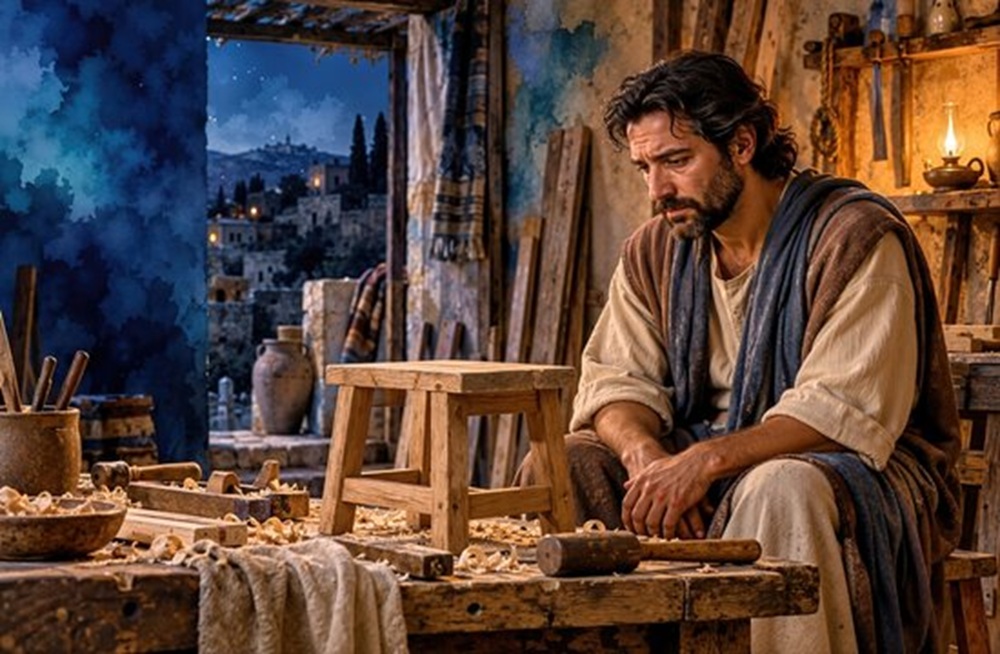
Was Jesus/Yeshua really a carpenter as the Gospels would have us believe? About 2-billion Christians assume he was a carpenter after Joseph, Mary, and Jesus/Yeshua fled surrounding Nazareth. For over 2,000 years Christians have just assumed he was a carpenter. Why? As it turns out there is very scant evidence, if not non-existent evidence, that Jesus was ever a carpenter, let alone Joseph. To date archaeologists have uncovered no indications whatsoever of any wealth there (e.g., nice kitchen ware, mosaics, large residences, etc.); no public buildings (synagogue, school, town hall, or whatever), and have concluded that it was—like so many other rural villages in Galilee—an agricultural community. Where is the convincing evidence there were carpenters present in Galilee?
The fact is there is none other than one verse in the ENTIRE New Testament:
“They said, “Where did this man get all this? What is this wisdom that has been given to him? What deeds of power are being done by his hands! 3 Is not this the carpenter, the son of Mary and brother of James and Joses and Judas and Simon, and are not his sisters here with us?” (Mark 6:3).
All Nazarenes—that is in a literal geographic sense, not the Jewish sect called the Nasara/Nazirites—would have had their own land to farm and harvest making their living this way. From Dr. Bart Ehrman, Professor of Religious Studies at the University of North Carolina – Chapel Hill, renown biblical scholar, critic of a historical Jesus, and of the origins and earliest movement of Christians states:
“Some people may have done other occasional work on the side: a community like that would probably need someone who worked with metal (they would need farm tools), and stone (to help in constructing the houses), and wood (for yokes, plows, gates, handles for tools, etc.) So there is nothing inherently implausible in Jesus being a wood-worker, even if he did spend most of his time working the fields. But was he?”
Dr. Ehrman goes on to dissect this assumption:
“There are lots of interesting questions raised by this passage [Mark 6:3]. For example, why are they asking if this is the carpenter (I’ll deal with the actual meaning of the word later: it could also mean stone mason or metal smith, e.g. But its specific meaning won’t be important for my assessment here)? He grew up in that very small community there, he worked among them for years, he left just recently: weren’t they his well-known neighbors and customers? Why are they asking if it’s him if he’s only been away for a few months? Also it’s odd that they never knew what a bright guy he was before this. Did he acquire this wisdom overnight after he had left town? Why is he also called “the son of Mary” – weren’t people normally identified as the son of their father? And these brothers and sisters – were they actually his biological siblings?”
The shotty, vague, ambiguous few verses about Jesus’/Yeshua’s life after 12-years old in Nazareth, Galilee, raises serious questions about veracity. It is almost as if the early Greco-Roman Church Fathers and their scribes/editors are dancing around the historical facts about WHO Jesus/Yeshua really is. Why? Is it because they don’t really know? Is it because the character in the Gospels isn’t really the super-human Son of God, born from centuries of Messianic prophecy, miracles, and bloodline? Is it because there is just a simple ordinary Jew somewhere in Galilee and Judea only trying to reform Late Second Temple Judaism?
Dr. Ehrman goes on to critique the Gospels with a fine tooth comb:
“It is interesting that the other Gospel writers all changed the wording. It’s also interesting that scribes who were copying Mark in the following centuries sometimes also changed it, into conformity with Matthew’s version, so in Mark too Jesus is called “son of the carpenter” rather than “the carpenter.” This was apparently the reading of our oldest manuscript P45 (from around 200 CE – I say “apparently” because there is a gap in the manuscript but by counting the number of letters it would have taken to fill the gap, the longer reading “son of the carpenter” appears to have been there), along with some manuscripts from later.
Why would scribes change Mark’s wording? It was not unusual. Copyists often conformed Mark’s Gospel to Matthew’s when there were small differences between them. This kind of scribal change is called “harmonization.” It is possible that later scribes wanted to harmonize the texts and this is what led to the alteration. But even before the scribes, Matthew and Luke both changed it as well. One wonders if there was something problematic about Jesus being “the carpenter,” motivating copyists (including Matthew and Luke!) to change it to say he was the “son of the carpenter.”
It’s a puzzling question for Matthew in particular because by making the change he created a problem in his narrative. The birth narrative of Matthew 1-2 goes out of its way to show that Mary conceived as a virgin, so that Jesus was NOT the son of Joseph (the carpenter). (If Luke originally had a birth narrative – i.e. chs. 1-2 – which, as I have pointed out, is debated, he created the same problem for himself). Why change a text that said nothing about the matter (Mark) to make it say something that contradicts your own account?”
Personally, I have always seriously doubted the Gospel accounts of Jesus/Yeshua after the age of twelve when he and his parents fled nearby Jerusalem for Nazareth in Galilee and then became a mere carpenter for 17-years, not doing a damn thing for the entire world. Why waste so much time with the blessings, forgiveness, and miracles of the Holy Yahweh or God with His ultimate plan of salvation for human-kind?
For a more expanded examination on Jesus’/Yeshua’s seventeen missing years and that grave scriptural oversight go to my March 2018 blog-post: The Incarnation of G-Man.
Here are the facts plain and simple from any secular evidence, of which there is essentially none, and the four Gospels of which there is hardly any corroborating hints or evidence of where and what Jesus/Yeshua was doing between the age of 12–29:
“Textual scholars have little doubt that Mark originally did say “carpenter” instead of “son of a carpenter.” That’s the reading of nearly all our oldest and best manuscripts (P45 is the apparent exception, and it can be a bit quirky in places); it is the reading that scribes would have been more likely to change (since scribes tended to harmonize toward Matthew, not to create disagreements with Matthew). We don’t, as a side note, have any manuscripts that change Matthew’s reading to “carpenter” in conformity with Mark – so the phrase “son of a carpenter” wasn’t a concern for scribes?
So, back to my question: why did Matthew, Luke, (potentially John), and some scribes decide to change Mark’s identification of Jesus as “the carpenter” to “the son of the carpenter.” I’ll pick up that question in my next post. Two of the questions I’ll be addressing is whether the Greek word translated “carpenter” necessarily meant carpenter, and if so, or if not, why it might have been seen as a problem by later Gospel writers and scribes.”
The severe lack of textual and archaeological evidence that a man named Yeshua/Jesus was a carpenter in Galilee is just not there. And to make matters worse the Gospels only convolute and confuse the question with too many occupational titles or patriarchal labels. And if the earliest Greco-Roman Church Fathers and their scribes/editors knew this, it explains the intentional motive to confuse readers. Therefore, to say that the Gospels are extremely short of validation is a monumental gross understatement. It just isn’t there. Period. Why believe in an intentional cover-up or flat out lie?
Live Well – Love Much – Laugh Often – Learn Always

The Professor’s Convatorium © 2025 by Professor Taboo is licensed under CC BY-NC-ND 4.0


I prefer the version of his life from the gospel of John Prine. His psalm is just as factually substantiated as any in the bible. If yer unfamiliar with the tune, it is on YouTube and the lyrics to “Jesus: The Missing Years” can be found here: https://genius.com/John-prine-jesus-the-missing-years-lyrics
LikeLiked by 1 person
Kamchak, I very much enjoyed the documentaries on Jesus’ Missing Years. Why? Because there is no other “story” or evidence otherwise so why not much more plausible stories, right?
LikeLike
The severe lack of textual and archaeological evidence — This statement alone speaks to the entire contents of the bible itself, let alone anything about Yeshua and his occupation.
LikeLiked by 3 people
Totally agree with you Nan! 🙂
LikeLiked by 2 people
If memory serves isn’t the word Tekon or Tekton? Besides, it’s all nonsense which is why the writer ostensibly made it up as they went along.
First, there was no place called Nazareth, described as a City in the gospel. That should be a red flag straight away but scholars have been reducing the size of this ‘city’ (based, I think, on the ‘interpretation’ of the word Polis,) right down to a few rough buildings a few miles from Sepphoris.
So, no Nazareth (itself a ham fisted error derived from Nazarene or Nazarite). Therefore no Jesus OF Nazareth.
Truly, it is just so tiresome to go over this time and time again. Football is much more fun!
😊
LikeLiked by 1 person
Can’t argue anything you’ve stated Ark. I am in complete agreement, ESPECIALLY the footbally part! Can’t argue anything you’ve stated Ark. I am in complete agreement, ESPECIALLY the footbally part! 😁
LikeLiked by 1 person
“Harmonization,” adjusting, polishing, reworking a story, cleaning up the mess of a text…
As an author, I can tell you that these words and phrases are used liberally during the editing process of works of FICTION. When creating a story from a writer’s imagination, let alone from multiple writers, INCONGRUENCE is a huge problem especially for very long or very intricate stories. In other words, a character named “Jane” can’t be a petite little flower in chapter 1 and a big stout beast in chapter 10, at least not without a credible explanation for some sort of dramatic transformation.
The editing process for NON-FICTION works is much simpler. It generally focuses on correcting grammatical and factual errors, and possibly removing some sections of text to streamline the story for publication.
It is quite apparent that the editing process for the Bible looks like the former and not the latter. Excellent research, Professor!
LikeLiked by 1 person
Sorry Robert for the long delay in responding. Things around the house have been quite busy with renovations in addition to our 2027 health insurance enrollments which can be incredibly time-consuming. Ugh.
Just to coat-tail off your excellent comment regarding Hellenistic Church Fathers (every single one of them), their scribes charged with transliterating—over many, many decades, some books of the GREEK New Testament authored a century later!—from extremely difficult original languages such as Mishnaic Hebrew and Syro-Aramaic, and the glaring fact that there are no extant Hebrew or Aramaic texts (how ironic is that?), that I will add this quote from Papias of Hierapolis, as quoted by Eusebius:
And Eusebius portrayed Papias as a poor interpreter of the stories of Jewish and Aramaic speaking travelers that claim to have known Yeshua/Jesus as his disciples and later elders. For me, is it ANY wonder why there are so many errors, mistakes, and misinterpretations from Mishnaic Hebrew, Syro-Aramaic, and then into Koine Greek? Geeezzz, this problematic transliteration has to be a huge reason why it took so many Ecumenical Councils (seven!) to canonize the NT (in Greek) followed by how many different denominations today in Christianity? Talk about a bible that is wholly unreliable, eh? 😄
LikeLiked by 1 person
House renovation sounds like fun! But, I’m sure the 2027 health insurance enrollment wasn’t. Mine was certainly not fun!
Thanks for that ecclesiastical history. The transliteration of ancient texts into the Bible seems in retrospect to have been an insurmountable task. Too much time had elapsed, too many disparate and obscure languages, and too many sources, writers, and editors.
The perspective of my original comment was that of a layperson, and as an author critiquing a book well after the fact. I do wish that we could discover the truth about the Bible because I do believe that it would greatly add to our collective human understanding.
BTW, how do you feel about Texas turning Blue? 🙂
LikeLiked by 1 person
Oh my! The Blue-nami that swept the country Nov. 3-4 and in Texas made our mouths drop most of the night and next day that we had to stick band-aids on our chins! 😄😉 It was THRILLING! And it was a direct gut-punch followed by a ball-sack kick in DJT’s privates and into MAGA’s! The wife and I celebrated with a few shots and adult libations. Much fun! 🥳
LikeLiked by 1 person
LOL!
LikeLike
Hi PT.
I missed another important post, and enough with the background history of the past few weeks…sounds like I am making up excuses.
Anyway since there has been such a delay and there are seven other comments (none of which my WP is letting me see…).
I’ll be brief:
Yes we have but two ‘definite’ alleged quotes from the Gospels in which the word ‘Carpenter’ crops up although by the time all the translations are done and misunderstandings of what the original word meant we could also have ‘stonemason’, ‘builder’ or general artisan in the construction and maintenance of dwellings (which would fit in with the parable of the two men one building a house on rock and the other on sand).
So, not so much important to the basis of the messages of the Gospels. Another of those instances where academics, linguists, historians and theologians go in deep as to the roots of the words and the contexts of the times.
Interesting though, nonetheless.
You can call me out in detail on not replying to the rest, feel free.
Best wishes
Roger.
PS: Texas eh, slight change in government. Yea team Democrat ✊! Congratulations you guys!!
LikeLiked by 1 person