“The greatest enemy of knowledge is not ignorance, it is the [willful] illusion of [divine] knowledge [and revelation].” — Stephen Hawking, modified by me
Actually I want to better clarify the title of this post: “Theological or Factually Historical?” No, no, no… better yet, “Theologically Canonical or Factually Historical & Widely Verified?” Yes, that is much better.
Agnotology. What is it? What does it mean? What is its significance to us today?
I think I can help you get a general, in-depth understanding of what agnotology is, what it means, and why it is very significant to us in the 21st-century and beyond. Just go to my 4-part series, Games of Unknowledging. However, if you are incredibly impatient with a lacking attention span, then here’s a simple quick definition of Agnotology:
Agnotology is the process of intentionally creating or encouraging doubt or ignorance (or lack of knowledge), for example by spreading false information, in order to influence opinion, sell an ideology, sell a product, or gain an advantage, or the study of these processes.
But keep in mind my impatient followers and readers, that may not be enough.
For the purpose of this blog-post I want to distinguish the growing chasm between religion (Abrahamic religions especially) and historical fact that is verified and corroborated by the majority of scholars and experts in all the many, many scientific fields of human history.
Christianity Cracking, Crumbling, and Collapsing as a Truthful Faith
The most significant of these failures is the historical reality of widely diverse “Christianities” or denominations, today over 40,000 plus. The political process of deciding the New Testament canon over a 400–700 year period, known as Ecumenical Counsels of the Early Catholic Church (circa 4th-century) by their highest ranking Greek priests, Greek bishops, Greek archbishops, and Greek cardinals caused immeasurable amounts of ambiguity. The first counsel you may have heard about was the First Council of Nicaea from May to July of 325 CE. After the Nicene Council it was followed-up by no less than seven (7) more counsels all the way into 754–787 CE last at the Palace of Hieria near Constantinople of the Eastern Roman Empire. Why so many counsels to decide what theology was correct, was truthful, was divine revelation over 400+ years after Jesus’ death and then everything that was later found wrong? What were the many disagreements, fractures, mistakes, false testimonies of the nature of “Christ the Messiah?” The still present enigma of Christ’s nature begs the bigger question of What was all of the mass confusion among the earliest Christian followers? Let’s get some historically verified background.
From the table above we see the major problem of earliest Christianity in the 4th-century and 5th-century was:
Divine Inspired Unity vs. Human (or Roman) Politics and Welfare — the traditional religious narrative suggests that Jesus established a single, clear doctrine passed down perfectly through his apostles. However, historical and archaeological discoveries—most notably the Nag Hammadi library found in 1945—proved that early Christianity was a chaotic web of competing groups with radically different beliefs about Jesus’ purpose.
The “Orthodoxy” — the heavy indoctrination we know today did not naturally emerge as the sole truth; it was codified through centuries of intense political maneuvering, theological debates, and Roman Imperial intervention by Greek-Roman men.
The Selection of Scripture Was Absolutely Political from the Start: The books of the New Testament were not bound together immediately after Jesus’s death. They were not tossed down from the heavens from God either. For the first few centuries after Jesus’ execution, different Christian sects used completely different gospels. The choice of which books to include (and which to burn or banish) into a codified Bible was a slow, human process finalized centuries later. Books like the Gospel of Thomas or the Gospel of Mary were rejected not because they lacked historical merit, but because their theology didn’t align with the specific authoritarian faction that eventually won political power.
Imperial Intervention (The Council of Nicaea): In 325 CE, the Roman Emperor Constantine the Great—a political ruler, not a religious prophet—convened the Council of Nicaea. He did this because Christian infighting was threatening the stability of the Roman Empire. The council voted on foundational doctrines, such as the exact nature of Jesus’s divinity (the Arian controversy). This solidified the reality that modern Christian orthodoxy was heavily shaped by Roman statecraft, not Jesus’ reform movement.
The “Synoptic Problem” and Textual Evolution: Textual criticism shows that the Gospels were not written by eyewitnesses as eyewitness accounts. They were written decades later (between 70 and 110 CE) by anonymous, Greek-speaking authors, not Mishnaic Hebrew-speaking Jews such as Jesus Christ. Furthermore, Matthew and Luke heavily copied from Mark and a lost source known as “Q,” changing details, theological emphasis, and even historical timelines to fit or retrofit their specific interests and audiences.
Ultimately, whether these facts “undermine” or dismantle Christendom as I think they do, it all depends on the individual faith-believer, not an All-knowing, All-present God and Son. For fundamentalists or Christian Nationalists today who require literal, historical inerrancy, these historical facts pose a severe challenge. For the progressive or mainline theologians, they simply show that God worked through the messy, complex reality of human history, a bit of a cop-out in my opinion. Why? Because if you collect the entire whole of everything related to Earliest Christianity up to the last seventh ecumenical counsel, which certainly includes Roman Empire recorded, extant history (of which they were obsessed with) and all Jewish literature such as the Dead Sea Scrolls and the Tannaim Period of Jewish rabbinic-sage literature—that does indeed still exist between 10–220 CE—and during the lifetime of Yeshua bar Yosef, or Jesus, they overwhelmingly show just how messy, erroneous, retro-fitted via hindsight to cover problematic (false?) theology of the new Roman Catholic Church, and how the person named Jesus or Iisoús in Koine Greek in the canonical New Testament, was in fact NOT the divine resurrected messiah the Roman Empire (via Greco-Roman tradition of Apotheosis) fabricated. For example, there were many, many regional pagan and Jewish historians of the time during Jesus’ lifetime or within less-than 100-years of his life that wrote NO INDEPEDENT RECORDS whatsoever of a “Jesus Christ.” That is damning of Christianity. Furthermore, within a century of Jesus’ life do any of these known authors/historians make any mention of the later twelve disciples or apostles. Who are they? They are:
So this begs the question, Why the literal hiding of such a supposed Lord and Savior for all humankind to the rest of the world? What’s the purpose of the cloak and dagger? The answer? There is none and it is very, very poor foresight for an All-knowing, All-present theological God.
The Stark Comparisons and Distinctions Within Christianity Then and Today
historical fact
Christian belief
historical reality
The New Testament
A divinely inspired, unchanging set of books.
A curated collection from dozens of competing texts by early church leaders/men.
Early Church Doctrine
A unified, universally agreed-upon faith.
A fractured landscape of Gnostics, Marcionites, & Ebionites who fiercely disagreed on the nature of Jesus Christ.
Rise of Roman Orthodoxy post-320 CE
The Holy Spirit naturally guided the “true faith” to world victory.
Roman Imperial enforcement outlawed, suppressed, and destroyed competing Christian sects.
To surmise, 1) the above table, 2) the lack of independent historical sources, 3) the widely diverse, disagreeing, sometimes fighting sects over the nature of who Jesus actually was from a Greco-Roman tradition, versus 4) the historical realities of the time-period between 63 BCE and 70 CE known as the Jewish Late Second Temple Period, all show as a whole that 5) the roots of earliest Christianity (i.e. The Way Movement) through the end of the Seven Ecumenical Counsels in 787 CE reveal at best Christianity’s flimsy foundation. At worst it clearly reveals no unified theology, doctrine, or orthodoxy of practices or faith. Why?
Plain and simply, the vast chasm that existed between imperial Greco-Roman (Hellenistic-Herodian) traditions, language (Koine Greek), and culture was factually incompatible with Jesus’ beliefs, his Jewish background, he and his people’s Mishnaic Hebrew language that also included Syro-Aramaic at times, and their long established Jewish literature and traditions on who, what, and why the Jewish Messiah was to arrive for them.
Because of these deep chasms mentioned between two clashing, adversarial cultures—Roman Empire vs. Judaism—when the earliest Roman Catholic Church began to ascend, the rewritten, hijacked, edited, redacted, ambiguous, suppressive manmade orthodoxy of forming the Biblical canon over seven Roman counsels in a 300-400 year period was failing and failing bad, particularly after the siege and sacking of the Jewish Temple in Jerusalem in 70 CE killing most Homeland Jews royally screwed any hope of total unity. As a result, the Christian canons became so heavily contaminated and contradictory later that it caused incessant confusion among all Christians then and to this day over a meager, simple 1st-century CE Jewish rabbi-reformer who failed to be the Jewish Messiah according to Jesus’ own people, then and today.
Live Well – Love Much – Laugh Often – Learn Always
It is the Christmas holidays now and we all know what takes place for the month of December, or actually immediately after Thanksgiving Day. No, check that. I am wrong: Christmas today as it has been for the last 2-3 decades in America now begins at Halloween, or weeks before then. Ugh. 🙄 So I thought this blog-post would be a good reminder to those who willingly choose to not do their historic homework about their own faith and beliefs.
At least once a month I receive Dr. Bart Ehrman’s blog emails on various subjects of Christianity, Jesus or Yeshua, and biblical history, particularly in regard to the four Gospels, Pseudographic, and non-Canonical manuscripts of Late Second Temple Judaism and earliest Christianity. One of his latest blog-posts was entitled, Why Should We Think Jesus Called Himself the Messiah? posted November 10, 2024.
I have always found this question to be of great intrigue and controversy. Why? Because so few modern Christians have an adequate knowledge and understanding of Jewish Late Second Temple Messianism during Jesus’ life, hereafter to be called Yeshua bar Yosef or Yeshua/Yeshuah. And without this Jewish knowledge and understanding there is no possible way modern Christians can truly know who their “Messiah,” their Yeshua actually was and who he thought he was to his fellow Jews and disciples at the time. Who Yeshua was and his role in Yahweh’s or God’s scheme of things in 20-35 CE were far from straightforward. It was all further muddled up and convoluted by the prevalent Hellenistic or Greco-Roman impositions, particularly from Saul of Tarsus, or Paul.
∼ ∼ ∼ § ∼ ∼ ∼
Dr. Ehrman clearly believes that Yeshua bar Yosef believed himself to be the long awaited Jewish Messiah. However, I am not so convinced. Following are two points Bart Ehrman makes for Yeshua considering himself “the Jewish Messiah”:
Jesus was considered the messiah by his followers after his death, so much so that “Christ” became the most common designation for him. Nothing about his crucifixion, or the belief in his resurrection, would have led anyone to think he was the messiah (since the messiah was not supposed to be raised from the dead, let alone humiliated and crucified). So he must have been called the messiah *before* his followers came to believe in his resurrection. But the question is: did Jesus himself tell his followers this? To get to *that* question we have to consider what we know about what Jesus told his followers in general.
Jesus’ proclamation was all about the coming kingdom of God. He was an apocalypticist who believed that God would soon intervene in the course of history, overthrow the forces of evil, and establish a good (and very real, political) kingdom here on earth. His listeners had to turn to God in preparation for this imminent end.
The immediate problem I have with Ehrman’s conclusion is that he bases it upon just one literary source: the Greco-Roman Synoptic Gospels of which were copied some 40–78 years after Yeshua’s execution in 31-33 CE. Ehrman does not utilize other very relevant Jewish sources of the same time period! For example, Ehrman makes the common grave mistake of sourcing strictly the Greek Septuagint which eventually passes down to us as the Greco-Roman Old Testament. However, the Greek Septuagint is not the Hebrew Tanakh and Yeshua was clearly Hebrew! There are significant differences. What are some key differences?
Jewish Requirements to be the Messiah
The literal and proper translation of the Hebrew Messiah is “Moshiach – מָשִׁיחַ.” It simply means “anointed” referring to the Jewish Bronze and Iron Age ritual of anointing and consecrating someone or something with oil. In the Hebrew Tanakh (1 Samuel 10:1-2) such as a Jewish king (1 Kings 1:39), Jewish priests (Leviticus 4:3), prophets (Isaiah 61:1), the Jewish Temple and its utensils (Exodus 40:9-11), unleavened bread (Numbers 6:15), and a non-Jewish or Gentile king (Cyrus king of Persia, Isaiah 45:1). However, “Moshiach” is never translated as a Messiah; it is always a verb describing an action or occurrence, it is never a noun. There’s the first major screw-up of the Greco-Romans and the Septuagint.
If Christians are going to lay claim to a Hebrew-Jewish heritage for their Christos, or Yeshua, then it is completely fair that we examine closely what the Hebrew-Jewish literature says about the Messiah, yes? The Hebrew Tanakh makes it explicitly clear what and/or how the “Moshiach” will be completely and correctly fulfilled:
He must be Jewish (Deut. 17:15, Num. 24:17). This is obvious.
He must descend from the Tribe of Judah (Gen. 49:10) and a direct male descendant of both King David (1 Chron. 17:11, Psalm 89:29-38, Jerm. 33:17, 2 Sam. 7:12-16) and King Solomon (1 Chron. 22:10, 2 Chron. 7:18).
He must gather the Jewish people from exile and return them to Israel (Isaiah 27:12-13, Isaiah 11:12).
He must rebuild the Jewish Temple in Jerusalem (Micah 4:1).
He must bring world peace (Isaiah 2:4, Isaiah 11:6, Micah 4:3).
He must influence the entire world to acknowledge and serve one G-d (Isaiah 11:9, Isaiah 40:5, Zeph. 3:9).
All of these written requirements for the true “Moshiach” are best summed up in Ezekiel 37:24-28:
“And My servant David will be a king over them, and they will all have one shepherd, and they will walk in My ordinances, and keep My statutes, and observe them, and they shall live on the land that I gave to Jacob My servant…and I will make a covenant of peace with them; it will be an everlasting covenant and I will set my sanctuary in their midst forever and My dwelling place shall be with them, and I will be their G-d and they will be My people. And the nations will know that I am the Lord who sanctifies Israel, when My sanctuary is in their midst forever.”
Therefore, according to Yeshua’s own scriptures, if the Jewish individual fails to fulfill even one of these requirements, he cannot be the “Moshiach.” Period, no exceptions. Being as well studied and versed in Mishnaic Hebrew scriptures of his people during fervent Messianism of the day as Yeshua certainly was… he would’ve known that he could not possibly be the fulfilled Moshiach or Messiah.
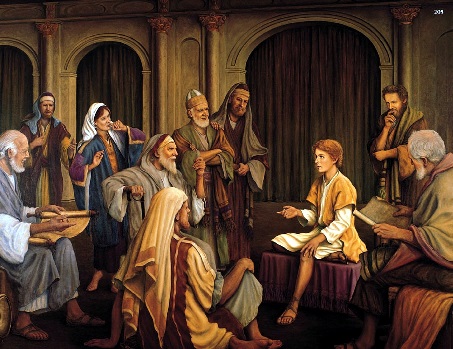
The 12-year old boy Yeshua bar Yosef (Jesus) at the Temple in Jerusalem astounding the priests, scribes, rabbis
“Jesus did think of himself as the messiah. But not in the sense that later Christians said. For Jews of his day, and Jesus himself, the messiah was to be the king of the coming kingdom. Jesus understood the coming kingdom in completely apocalyptic terms. That is the key. He did not think that the nation of Israel would rouse a military opposition to the Romans and drive them out of the Promised Land. God himself was going to bring destruction on his enemies by sending the Son of Man from heaven (a cosmic savior; Jesus did not think that he himself was this one). The Son of Man would establish God’s kingdom on earth. And he would appoint Jesus to be its ruler. Jesus was the messiah of the coming kingdom.”
But in my opinion Dr. Ehrman doesn’t go far enough with the distinctions between the authentic Jewish Moshiach and the later created (or hijacked?) Greco-Roman extrapolation of Messiah. Additionally, I don’t think Ehrman is giving Yeshua enough scriptural credit to know that he could NOT be the Greco-Roman version of Messiah/Christos. I am convinced that Yeshua knew he was not the Moshiach/Messiah. I also think that a critical question is overlooked in Ehrman’s portrayal of the Messiah/Christos: why did Yeshua not proclaim publicly, to his own people, he was the real Messiah. He only proclaimed it—at least according to the Gospels—to his twelve disciples. Why create more drama and controversy by keeping the anointed-elect a secret? That is a Pandora’s Box or can of worms that given how the Jewish people had been long suffering under Roman authority and oppression just did not need! Is that how you unite and “gather the Jewish people” into world peace? No, it is not, especially if G-d has ordained you as Moshiach.
Why Yeshua/Jesus Was Not the Jewish Moshiach-Messiah
Of the six (6) criteria above to fulfill the role and title of Moshiach-Messiah, Yeshua fulfilled only one, that he was Jewish. There are many problematic accounts of Yeshua’s (Jesus’) genealogy in fulfilling #2 above, i.e. from the Tribe of Judah, from King David and King Solomon. The immediate obvious problem, according to the canonical Gospels, is that Yeshua did not have a biological father. And if that wasn’t disqualifying enough, the Greco-Roman Gospels claim that Joseph was a descendant of King Jeconiah. In the Tanakh King Jeconiah was cursed to never have any descendants (Jer. 22:30). These Hebrew passages further disqualify Yeshua as the Moshiach-Messiah.
Closer examination of Yeshua’s (Jesus’) genealogy according to the Greco-Roman New Testament Gospels show that in Matthew 1 and Luke 3 cause more serious contradictory narratives about his genealogy. Here the later Greco-Roman Church Fathers jump through hoops to explain away these contradictions! Using Yeshua’s mother, Mary, as legitimate lineage is completely unfounded in Jewish Messianism. This is shown even in the Greek Septuagint. Jewish lineage for the Moshiach-Messiah is passed down strictly through the father, not through the mother. Furthermore, the same Gospels claim that Joseph was a descendant of King Jeconiah. This is more damaging to Yeshua’s lineage because of Jeremiah 22:30:
“As I live, says the Lord, though Coniah the son of Jehoiakim [Jeconiah], king of Judah, be a signet on My right hand, from there I will remove you. […]
So said the Lord: Inscribe this man childless, a man who will not prosper in his days, for no man of his seed shall prosper, sitting on the throne of David or ruling anymore in Judah.”
It is safe to assume that either 1) for this problem the Greco-Roman New Testament scribes and copyists chose to trace Yeshua’s genealogy through Mary his mother, breaking from long established Jewish Messianism, or 2) didn’t know about the passage in Jeremiah 22 until it was too late to change it. Then there is further problems tracing Yeshua’s lineage through Mary and that is Luke 3:23-38. For the sake of brevity I will focus just on verse 31:
“…the son of Melea, the son of Menna, the son of Mattatha, the son of Nathan, the son of David…” — NASB 1995
Mary, being supposedly a descendant of David through Nathan, Solomon’s brother, and not through Solomon himself as mandatory by long established Jewish Messianism and 1 Chronicles 22:10, then this further disqualifies Yeshua (Jesus) as the Moshiach-Messiah. It simply isn’t possible. And we have only examined the first two Jewish Messianic requirements above! The remaining four criteria above have never been fulfilled—not in Yeshua’s lifetime nor since. Any retrofit imposed upon these six criteria by Greco-Roman Christians, including the earliest Church Fathers, by a “Second Coming” are purely irrelevant because authentic Jewish Moshiach-Messianism has no scriptural basis of the anointed one coming twice. This is merely a later invention by the Early Christian Church, that by the way, is completely Greco-Roman, not Homeland Messianic Judaism or Yeshua’s heritage at all.
Early Greco-Roman Christian Church Fathers — notice they appear with pale skin & nothing like Jewish Rabbis or Priests and none of them were even half Jewish
The later Christian inventions and fabrications of the Messiah in Yeshua differ so much from authentic Jewish Moshiach-Messianism that they are not even in the same orbit or solar system. The stark differences developed as a result of the Church’s Greco-Roman influences, or superimposing, during the time of Emperor Constantine and the Council of Nicaea. This council eventually drew up the Nicene Creed in 325 CE and forced one central authority and doctrinal orthodoxy, thus making Greco-Roman Catholicism the official religion of the Empire.
Be that as it may, according to authentic Jewish Messianism of the time (Yeshua’s lifetime and prior), the Moshiach (or Greek Messiah) was never meant to be an object of worship. The “anointed one’s” primary mission and final accomplishment was/is to bring global peace and to fulfill the entire world with the knowledge and awareness of only one G-d, and no others. Period. Full stop.
If Not the Jewish Messiah, Then Whose Messiah?
Imagine a hypothetical scenario for a moment. Imagine that you want to take advantage of the recent reparations offered by the U.S. government to the Native American Indian descendants due to America’s harsh atrocities done to them during the early and mid-19th century. The benefits, grants, and return of sacred lands to all the various tribes you have recognized as very advantageous and gaining an economic edge and eventual wealth accumulation. You want a part of it all, however, you also know full well that you possess no DNA of any Native American Indian ancestors, only white Anglo European-American. But you really envy desire all the reparations and benefits being handed out. Hmm, what to do… how to finagle?
Ah-HAH! 💡You rewrite and change history as well as the main and secondary characters to fit your best interests and your own agenda. While doing so you trash and/or eliminate the factual history and characters; wipe it out completely. Rome often did precisely that, simply destroy or distort the conquered and their culture so much that it is unrecognizable in the end.
∼ ∼ ∼ § ∼ ∼ ∼
While traveling through a forest, a person noticed a circle marked on the tree with an arrow shot precisely into the center of the circle. A few yards away he noticed several more targets marked on other trees, each with arrows perfectly in the center of the circles. Eventually, the traveler met the talented archer and asked him, “How did you become such an expert archer that you always shoot your arrows into the very center of the bull’s eye?”
The archer replied, “It’s not difficult. First, I shoot the arrow into the tree and then I draw the circle around the arrow.”
When one unbiasedly and equitably scrutinizes 2nd thru 4th-century CE Christian “proof texts” of Yeshua (Jesus) being their promised Messiah, you must ask the question: Has an arrow been shot into a circle or has a circle been drawn around the arrow? To put it another way, has the passage or passages been mistranslated, wrongly extrapolated, misquoted, taken out of context, or completely fabricated? Let’s take a close look at the several common proof texts Christian Apologists offer for their Yeshua-Jesus being the foretold Messiah.
Matthew 2:23 and Nazareth: One of the easiest ways to fulfill a prophesy is one you yourself invented. The Gospel of Matthew claims that Yeshua was the Messiah because he lived in the town of Nazareth:
“…and [Jesus] came and lived in a city called Nazareth. This was to fulfill what was spoken through the prophets: “He shall be called a Nazarene.””
Because a Nazarene might be interpreted as a resident of Nazareth, vaguely he could be called a Nazarene. However, there is a huge problem with an actual town called Nazareth in the time period of the Jewish Tanakh; it did not exist. Hence, there are no references to Nazareth in the Hebrew Bible. Nowhere. This was later fabricated by early Church Fathers drawing a circle, as it were, around the arrow. What modern Christian apologists will offer is to work with crude English retranslations of earlier Greek mistranslations while avoiding the original, authentic Hebrew scriptures.
Romans 11:26 and Isaiah 59:20: The passage in Isaiah in several English translations states, “The deliverer will come from Zion, he will remove ungodliness from Jacob…” This is an attempt to establish Old Testament support for the Christian belief that their Messiah will take away our sins. But this is not what the original Hebrew Isaiah says. The correct translation from the Hebrew is “A redeemer will come to Zion and to those who turn from transgression in Jacob, declares the Lord.” No, in authentic Jewish Messianism the Moshiach-Messiah’s role is not to take away all our sins, but instead when we choose to turn away from our sins, the Moshiach-Messiah will then arrive on Earth. Christian apologists translate Isaiah 59:20 correctly, but mistranslate it in Romans 11:26. Why? The obvious reason is that Romans was written/copied in c. 55-57 CE by Saul/Paul. Isaiah was written/copied c. last half of the 8th-century BCE to the last half of the 6th-century BCE. A massive time-lapse there of later answering and rebutting many critics of early Christianity authenticity! Or as it were, drawing the circles around the arrows.
Matthew 1:22-23 and a Virgin Birth: In the Gospel of Matthew is states, “Now all this took place to fulfill what was spoken by the Lord through the prophet: “Behold, the virgin shall be with child and shall bear a Son, and they shall call His name Immanuel,” which translated means, “God with us.” Christian apologists claim this fulfills the prophecy of Isaiah 7:14 which says in the correct, original Hebrew: “Behold, the young woman is with child and will bear a son and she will call his name Emmanuel.”
The current Christian translation of this Isaiah verse is simply inaccurate for three reasons:
The Hebrew word, “almah -אלמה,” means a young woman, not a virgin. All Jewish biblical scholars recognize this fact.*1
The verse says “ha’ almah -הא עלמה” or “the young woman,” not a young woman, specifying a particular woman that was known to Isaiah during his lifetime; and
The verse says “she will call his name Emmanuel,” not “they shall call.”
Aside from these three inaccuracies above, if you read the entire chapter of Isaiah 7, from which this verse is taken, it is glaringly obvious that Christians have intentionally taken the verse out of context.
Prophecies or passages in the Hebrew Tanakh or Old Testament
Isaiah 7:16 and 8:4: Isaiah 7 speaks of a prophecy made to the Jewish King Ahaz to lessen his fears of two invading kings—those of Damascus and Samaria—both of whom were preparing to invade Jerusalem some 600 years before the birth of Yeshua (Jesus). Isaiah’s prophecy is meant for the very near future, not 600 years later as Christians wrongly claim. Verse 16 makes this quite clear:
“For before the na’ar (boy) shall understand to refuse the rah (evil), and choose the tov (good), the adamah (land) will be desolate, of whose two melachim (kings) thou art afraid.”
This can in fact be verified in the next chapter, Isaiah 8:4:
“For before the child shall know to cry, ‘My father and my mother’ the riches of Damascus and the spoils of Samaria shall be taken away before the king of Assyria.”
Thus, this verse completely rules out any possible connection to Yeshua (Jesus) six millennia later. The verse doesn’t even hint in the least it is meant for six millennia later. There is further proof in fact that the verse could not have referred to Yeshua.
2 Samuel 7:14 and Hebrews 1:5: Christian apologists often refer to 2 Samuel 7:14 to refer to Yeshua as the Son of God in Hebrews 1:5. But when the entire passage is examined it doesn’t end with the phrase of Hebrews 1:5, it goes on to say:
“When he commits iniquity, I will correct him with the rod of men.”
In 3rd and 4th-century CE Christian theology of Yeshua’s sinless birth and boyhood, this cannot possibly fit the doctrine of a pure, holy Son of God and Lamb of God. No, instead the verse is speaking specifically about King Solomon, as 1 Chronicles 22:9-10 refers. It must be remembered too that the Hebrew Tanakh frequently refers to individuals as God’s “son,” even to the entire nation of Israel:
“Israel is My son, My firstborn.” — Exodus 4:22
Once again, drawing the circle around the arrow to appear as it’s not.
Micah 5:2 and Bethlehem: Christian evangelicals and apologists frequently attempt to use Micah 5:2 as a proof-text of Yeshua fulfilling the prophecy that the Messiah would be born in Bethlehem. However, in the original Hebrew the passage simply states it has been preordained that the Jewish Messiah would trace his lineage back to Bethlehem. Being born there and being a resident there are not exclusively the same. This verse in Micah is consistent with the Messiah being a descendant of King David as properly read in 1 Samuel 16:18:
“And one of the young men answered and said, “Behold, I saw a son of Jesse the Bethlehemite, who knows how to play, a mighty man of valor, and a warrior, and prudent in affairs, and a handsome man, and the Lord is with him.””
That does not possibly mean the Messiah will be born in Bethlehem.
Furthermore, there is another major problem with this Christian proof-text. There is a huge difference between a scripture passage that serves as a proof, and one that serves as a requirement of the Messiah. A proof must be something so specific, so exclusive that only one individual can represent it or fulfill it. For example, one criterion of the Jewish Moshiach-Messiah is that he must be Jewish. If he is Jewish, like so many were at the time, then that is one and ONLY one requirement met. But in and of itself that doesn’t mean that one individual is the Moshiach-Messiah, for there were millions of Jews that met that criterion. Thousands of Jewish children were born in Bethlehem. That doesn’t prove a Messiah.
Conclusion: Not the Jewish Or the Christian Messiah
Because I have shown sufficiently that Yeshua bar Yosef (Jesus) could not have possibly been the foretold Jewish Moshiach-Messiah according to the original, authentic Hebrew Tanakh and Late Second Temple Judaism, then where does that leave Greco-Roman Christianity and all its tenets, inventions, and fabrications? The simple answer is Christianity is only as valid, or as factual as Greco-Roman mythology in Zeus and Quirinus, Mars and Venus, Jupiter and Juno, or Apollo and Diana. Nothing more. Why? I’ll briefly summarize.
Yeshua bar Yosef (Jesus) was not the fulfilled or foretold Jewish Messiah according to authentic Judaism.
Christianity lays claim to (or hijacks) Jewish Moshiach-Messianism, as their own. However, does so completely wrong based on authentic Judaism of the time and later invents their own Roman version.
If #1 is true (and it is), then #2 cannot be right or factually, accomplished or validated.
Therefore, Christianity’s basic core foundations of the fulfilled Messiah are invalid, bogus, and become Greco-Roman mythology at best.
Regarding Dr. Bart Ehrman’s blog-post Why Should We Think Jesus Called Himself the Messiah?, knowing well the Jewish history of the Late Second Temple Period, the Hebrew Tanakh in proper translation, and the contemporaneous Jewish literature of Yeshua’s time-frame, including the Dead Sea Scrolls, I’m convinced that Yeshua (Jesus) never admitted he was the hoped Jewish Messiah, not within Jewish sources—the Greco-Roman Gospels as only one source are nowhere near sufficient corroboration to Ehrman’s conclusion.
Yeshua bar Yosef (Jesus) is not the Jewish or the Christian Messiah. Period. He is no one’s Messiah.
* Some Christian apologists argue that in an ancient translation of the Bible called the “Septuagint,” 70 great rabbis translated the word “almah -אלמה” in Isaiah 7:14, as “parthenos –παρθενος ´ ,” and that this Greek word means a virgin. This claim is false for several reasons: 1) The 70 rabbis did not translate the book of Isaiah, only the “Pentateuch,” the five books of Moses. In fact, the introduction to the English edition of the Septuagint states concerning the translation, “The Pentateuch is considered to be the part, the best executed, while the book of Isaiah appears to be the very worst;” 2) In Genesis 34:2-3 the word “parthenos” is used in reference to a non-virgin, a young woman who had been raped; 3) The entire Septuagint version that missionaries quote from is not the original, but from a later, corrupted version. ↩︎
I have zero expectation that anything I ever say will end someone’s belief in their God. Not my goal or purpose. That alone belongs to the individual. ~ Zoe