When I was a small boy and with my family visiting Dad’s family in Galveston and Brazoria Counties, Texas, we always made a stop by my great grandmother at her rural small farmhouse for a full day, perhaps even late into the night if other aunts, uncles, and cousins would come by as well. They were fun times; lifetime memories. If all of us 12-20 cousins were also there, the time together was a circus complete with clowns of capers and their pranks. At grandma Konzack’s there were endless things to do, tinker with, play, and generally find as much mischief as possible.
My great grandmother Konzack had about 25-30 acres of land with 4-6 heads of cattle, a big hay-barn, and chicken coup near her 1900’s self-built, five bedroom antebellum home. She always had 2-4 dogs around, watch-dogs more less that were never allowed inside the house. They were somehow responsible for keeping guard of the house and policing wanted and unwanted animals outside during the night. Hours would fly by, but before we would leave, grandma Konzack would always pack us up with the family beef from her deep-freezer and literally the freshest eggs from her busy hens. She and my Dad always had strange, peculiar stories about the goings on with that hen-house. This is one of them… well, a version of one with my own allegorical twist. 😉
But first some quick background. Without going into a long revisit of my family heritage, suffice to say that many/most of my paternal ancestors were of Franco-German-Swiss heritage of Freethinking families. In other words, they often marched to their own beat not blindly following mainstream religion and yet without denying their strong convictions of family and civil service to community in the spirit of individual American freedom and liberty within the confines of our U.S. Constitution. This made many of my paternal family minorities in Texas given most Texans were Southern Baptists, Catholics, or Conservative mainline Protestants, or to say it diplomatically… all equally excitable. She was surrounded on three property-lines by Southern Baptists and Evangelical Protestants where over the years there developed a cordially silent, unspoken, public smiles of tolerance for each other. That’s how folks did it in 1940, 50, and 60’s rural America.
This is my allegorical tale called The Whereabouts.
∼ ∼ ∼ § ∼ ∼ ∼
Grandma Konzack had several hens in her coop, but six of them were very special, particularly reliable and productive hens. Their Latin names were Curiositas, Contradictio, Testimonium, Scrutinio, Aequalitatem, and the best egg producer Didicit. She was the queen over all other hens. The chicken coop had six levels on one wall and six more on the opposite wall. In a way, the eggs from grandma Konzack’s hen-house were, numerically speaking, the 666 hens with 666 eggs! 😈 I tell you, they were the most delicious eggs you’d ever have the privilege of putting in your mouth!
Curiositaswas probably one of the most elusive hens to keep track of at any given time, even with the door to the hen-house closed and locked did not mean she would be happily content inside her specific nest box! If she had half a chance to to get out and explore, near or far didn’t matter, then she was GONE before you could say Whoa Nellie. However, Curiositas became one of the smartest, wittiest hens. She learned fast the most efficient methods of escape, hiding, and the most ideal locations on Grandma’s property to perch and watch everything below. She also learned equally as fast all the worst methods of the same.
One day she was never seen again. Vanished.
Contradictiowas THE HEN that could challenge the patience of any wise owl and the cunning of the feline Margay. If you thought you’d anticipate where Contradictio would be or would behave, 9-times out of 10 you’d be wrong. What was MORE astonishing was that she could anticipate your behavior practically every single time. She could unravel your tricks or dishonesty before or by the count of five.
One day she was never seen again. Gone.
Testimoniumon the other hand was a very friendly, gregarious hen. She always wanted to a part of or in the center of the day’s action. Testimonium also had a very nosy streak always getting in your way or face seeing up close what you were doing. If there was ever any sort of unscrupulous behavior taking place in the hen-house or outside nearby she would know firsthand EVERYTHING that took place! The quintessential court room witness of poultry!
One day she was gone, never seen again. Egg dishes are showing up less and less on the kitchen table!
Scrutinio was the single no-nonsense hen. You messed with or changed her nest-box even the slightest, she would know and immediately return it to her standards. In fact, change the daily routine in the smallest of ways and she was going to go all rooster on your ankles or hands! You could not slip anything past her scrutinizing eyes and high standards. Nothing!
And then one day she too was gone. Never to be seen again. Now there seems to be a pattern going on, right?
Aequalitatem was undoubtedly the protectorate hen of all hens. She would not stand for any mistreatment of hen-femininity! If two hens wanted to sleep together in the same nest box, then as far as Aequalitatem was concerned it was no one’s business what two adult hens wanted to do in the privacy of their nest box. Her motto? If no chickens were being harmed in the acts of amore, consenting hens can do whatever THA F*CK their pretty feathers wanna do. Period! Yes, she was the Joan of Arc of bold hen-ness.
Then one morning she too had disappeared. This was now very serious. Only our honorable, most wise and intelligent Queen hen remained…
Didicit was the Queen for many reasons, but the one best reason was her wisdom and that she had come to us from Oxford, England. She had been a favorite hen of a number of Nobel Prize winning professors at Oxford University and had traveled the world with them as their lucky feathered Madame. It was reasonably rumored that she understood no less than five different languages! Many an avian university department requested her services for various scientific studies. Didicit’s eggs were never bothered for obvious reasons. Two of her chicks had thankfully survived.
When she had gone missing grandma Konzack was infuriated. She went to her three neighbors trying to determine if they had noticed any bizarre activity the last week or so. After chatting politely with all three neighbors, both Southern Baptist families and the Evangelical family, grandma noticed that all three families had the exact same painting on their living room walls (seen below).
Grandma Konzack asked her friendly neighbor about the familiar painting on the wall. They replied “Oh, we are big animal lovers, in particular foxes.” Curious, she asked why that particular animal. “They are remarkably stealthy, cunning canine carnivores. They keep all the unwanted trashy, disease-carrying animals away.” they answered with a sly grin. Grandma Konzack couldn’t resist and retorted back:
Yes, but they are not particularly honorable carnivores are they… sneaking up on their prey and always hiding, always fleeing scared of the slightest trouble. No wonder the British had so many fox hunts with their hounds!
Not amused her neighbors responded in a snide tone “Well that may or may not be true, but it’s always the end that justifies the means. If your survival depends on eliminating enemies with dishonorable stealth, then it deserves our favor.” Grandma was not particularly surprised by the logic. She had been around these type folks most of her life. It was why she enjoyed the company of others who enjoy life to the fullest. I’ll be on my way she said. “If you do notice anything out of the ordinary” she politely explained, “please let me know would you?” Their response was even more strange than their previous:
“We do not know the whereabouts of your fancy, expensive hens Mrs. Konzack.” The husband continued, “Perhaps they’ve simply runaway or perhaps tried and failed to cross the road.” His wife chuckled under her breath. Then, to show his “Christian politeness” he asked grandma:
We are having a weekend prayer-n-fellowship meal down at the church tomorrow afternoon if you’d like to attend. Do you know the whereabouts of our Fellowship Center? We’re having all sorts of goodies as long as the eye can see and the bellies can pack, including baskets of fried chicken!
“Thanks but no thanks” grandma replied quickly. “And yes, I know where the Fellowship Center is located” Knowing her welcome would not last much longer, she smiled in reciprocated charm and said:
“No one can miss it because it is as monstrous and gaudy as the Basilica of the Immaculate Conception” and as she opened the door to exit said in closing:
But nowhere near as beautiful, as naturally human, or as meaningful as The Temples of Khajuraho (see above video). But I am guessing you’ve never been outside Brazoria County, much less out of the United States have you? If you can put your bibles down for a day or find a quite spot other than your church sanctuary, read Mark Twain’s Innocents Abroad for an enlightening, delightful life-lesson of what it means to be truly human.
My grandma Konzack was a wonderful woman with a sharp, witty sense of humor. One would learn fairly soon too she did not appreciate any type of elitism from anyone, not the President, not the Queen of Britain, and damn sure not from any kuntry folk from rural Texas. She’s the one who taught me the meaning of “Right, but everyone sits on the pot the same for the same reason.” There were some other juicy tidbits she’d add, but I’ll skip those so not to offend the sensitive or faint-hearted. She was a tough, tough woman, but full of so much life!
I do miss my Grandma Konzack.
To my readers:Tell me in comments below what my allegorical story says to you. What happens to the Hen House and the future of flocks when the best hens (and their egg producing/teaching abilities) are silenced.
————
Live Well — Laugh Often — Love Much — Learn Always
One afternoon over the December holidays while my young son and daughter were visiting for a week in Kerrville, together with my Mom and sister, Ethan and I settled into the living room couch and one of the recliners to begin watching the 10-part series by HBO called Band of Brothers. My daughter Tori (Victoria) and Ethan had gone in together to buy this incredibly excellent production and historically precise production as my gift as it had already won several awards.
My kids and family had known I had always been a history buff, especially military history buff, and more so a WW2 buff since my boyhood. They had heard on numerous occasions — actually tolerated — how much I praised the astonishing historical detail that HBO’s Executive Directors with historical-military consultants, utilized Stephen Ambrose’s bestselling book of the same name which went into the making of the final cut of Band of Brothers. Ethan had been looking forward to watching it with me. He knew well how passionate I was about personal authentic history. At that time, he was a bit of a military fan too. Where he may have got his interest I couldn’t say. But I would be lying, wouldn’t I?
When Mom and sister saw what we were about to watch, they rolled their eyes, a bit put out and both essentially griped, “Dwain, why are you such a huge fan of war films, documentaries, graphic violence, and showing it to Ethan!? Do you love violence and war?” Later that evening when he and I were done with parts 1-3, I hoped I had answered their question and deep concerns for my son.
But I’ll share that at the end of this post.
Seventy-five years ago this morning at 5:50am Caen, France time, June 6, 1944 the Allied invasion of Normandy began. To this day, it is the largest amphibious military force ever assembled in history. The Allied invasion force consisted of around 346,700+ souls, comprising of almost 7,000 naval vessels crammed into a tiny French Bay (Seine) off the coast of northern France—about 900 sq. miles of sea and only about 50-miles of flat beach. A flat, sandy beach 3-5 football-fields long at low-tide, from waste-deep water to land, when the first wave of troops landed; meaning nothing to hide behind to protect yourself except narrow, German-landing obstacles (many booby-trapped) until the first natural or German-made obstacles… 500-yards ahead of you.
Omaha beach, Normandy, today — low-tide
Of the five different landing zones that morning at Normandy, Omaha beach was a slaughtering section on the first wave of the V Corp., 29th Infantry Division, 116th Regiment with Companies A-D, each with 230 men. Dog Green Sector where Company A of the 116th landed was the most horrific scene any human being could ever witness.
Much of the Allied’s intricate, precisely planned timing of Operation Overlord went wrong on many levels. For Company A (first wave) their section of the beach was nothing like they had been told or trained for back in England. With up to 60-75 lbs of gear, weapons, and ammunition to name only three, they had not trained for disembarking into waist-high or neck-high water with 200-yards in front of them until sand. Then the additional 200-300 yards on open beach and sand bars was supposed to have hundreds of bomb-craters from air force and naval bombardments to shelter for seconds or minutes to rally and organize before rushing forward to their objectives against a severely weakened or destroyed German defensive emplacements. None of this had happened when they lowered the landing-ramp of their LCI’s (Landing Craft Infantry) into 4-6 feet of water.
What lay ahead for these 230 young men of A-Company was a superbly designed defense by one of Hitler’s most brilliant combat Generals, Field Marshall Erwin Rommel. His objective was to inflict upon the Allied landing forces as many casualties as possible by slowing down landing craft and infantry getting to the beach, and then across 200-300 yards of flat sand before arriving at his first-line of gun emplacements, trenches, bunkers, and pillboxes. Rommel had 7-months preparation to build and reinforce this Atlantic Wall. He believed the only way to have a chance of repelling the invasion was to drastically slow the Allied forces at the beach making the losses so unacceptable for Eisenhower and Bradley the invasion would be unsustainable and abandoned. It almost worked. Against the 116th’s A-Company it did work, to appalling results.
Two of Germany’s most lethal weapons of WW2 and during D-Day were their 88-millimeter artillery guns and the MG-42 machine guns. All Allied combat soldiers and their commanders feared these weapons. In any engagement Allied units had to quickly disable or destroy them or they would wipe out entire platoons or more.
The earlier air force bombardments were suppose to pummel these German weapon units days/weeks before. The early morning naval bombardments were also suppose to pummel these targets. On D-Day the 116th Regiment and A-Company did not know they were still operational and waiting for them, particularly the combat experienced German 352nd Division defending Omaha Beach. Typically, each of this division’s 200 companies had a minimum of one or two MG-42’s per company, or about 250 deployed at Omaha Beach. This is a formidable slew of this weapon pointed at the incoming LCI’s landing-ramps when it opens and attempts to unload 36 men packed inside.
To get a proper feel for what the MG-42 (nicknamed Bone-saw by the Germans) could inflict on unsuspecting infantry, listen to the first 30-seconds of the video. It is not graphic, it just demonstrates by audio the large-scale lethality:
The MG-42 Bone-saw fired 900 – 1,500 rounds per minute. That is about two cartridges per second for 60-seconds when the barrel wasn’t overheated, fairly cooled, or just replaced. The 2-man crews usually had 4-5 barrels at their disposal to keep switching out.
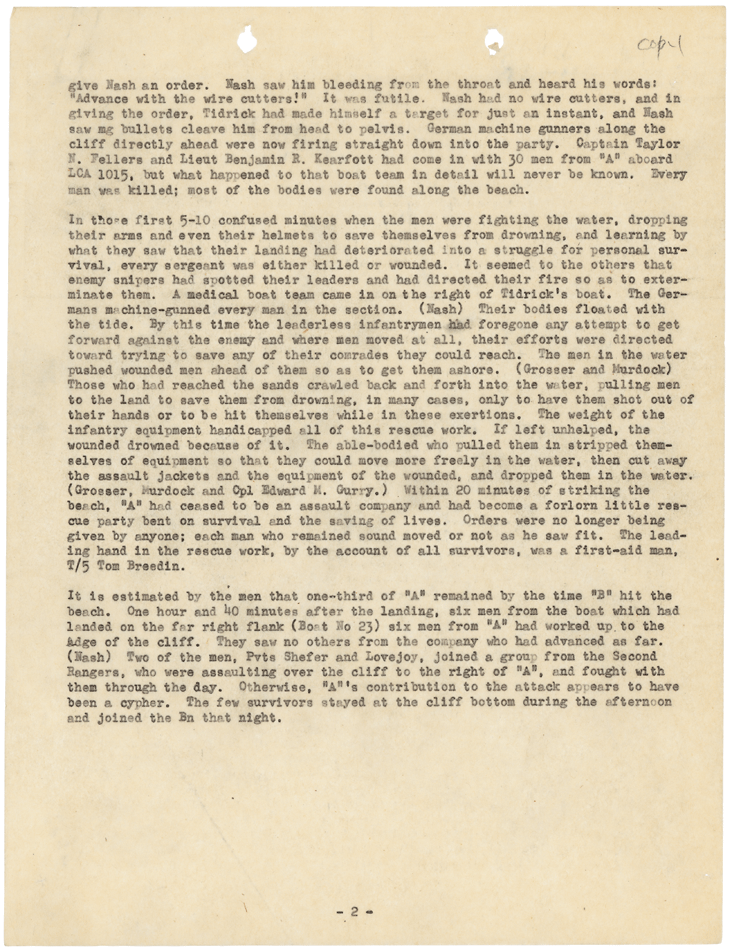
Of the 230 men assigned to A-Company first wave of the 116th Regiment, 7 survived. These seven soldier’s narratives below, collected shortly after the day ended, tell firsthand what happened to 223 men in less than eight minutes. When the German squads located A-Company’s surviving commanders that had reached the shoreline, they had all their experienced snipers take them out with one, maybe two shots in a matter of 7-10 seconds per American officer. The 88-mm gun’s fragmenting shells ripping to separate pieces human body parts along with the MG-42’s mowed down the rest of A-Company.
On this historic day 75-years later we remember, salute, and thank the veterans of D-Day still alive, but more importantly those who made the ultimate sacrifice to achieve victory. A victory that was enormously costly, particularly to the one Regiment that paid the most and one town, Bedford, Virginia of about 4,000 residents at the time, who lost 19 of their boys, more than any other town in America that day per capita, June 6th, 1944. Four more lost their lives during the remainder of the Normandy campaign. Director Stephen Spielberg was inspired by a book called The Bedford Boys which chronicled these 23 men’s sacrifice and it resulted in his multi-award winning 1998 film Saving Private Ryan. As most movie-goers know, the opening scene of the D-Day landings have been confirmed by most survivors of that day as ‘precise as any screen-portrayal ever made about Omaha Beach, June 6th, 1944.’ Some could never watch the movie again.
As the Allied forces proceeded inward through western Europe and toward Germany and Hitler’s Nazi Third Reich the next 11-months, started by the victory in Normandy, we’d eventually learn the horrid truth about their concentration camps. So now I have reached the point in my story where I answered my Mom, sister, or anyone who asks or questions me: “Why are you such a huge fan of war films, documentaries, graphic violence, and showing it to Ethan!? Do you love violence and war?”
I tell them if that ever makes me an advocate of war, a warmonger rattling his sabers or shooting off his personal arsenal of weapons on weekends, then please… you have my permission to shoot me.
No, on the contrary it is precisely BECAUSE it is so horrific, so insane, so life-damaging, and the worst of humanity’s behaviors—witnessed by combat soldiers returning home with PTSD, Holocaust survivors scarred for life by what they lived through—that I am stubbornly anti-war! I remind myself and any others I can by watching, reading, and understanding profoundly what really goes on at the front lines. And hence, I emotionally remember the harsh reality of what slaughtering looks and sounds like in order NOT to use war rashly and foolishly like many of our politicians or aggressively hyper-patriotic citizens—with no combat experience themselves—seem too ready to fight and too frequently oblivious of its cost! Its real and long-term human costs. Therefore, do everything humanly and diplomatically possible to avoid war before sending our men and women to exact it and pay with their lives.
As one of the scenes and parts in the HBO miniseries Band of Brothers impart, after they had liberated one of the many concentration camps, it’s why we fought. Let us never forget how precious life is before a violent conflict breaks out. It is never the same after… for any of the soldiers and their families.
Have you ever been in those situations as an adventurous kid or bold young teenager where your friends enthusiastically encourage you to do something you are not quite sure you want to do or should do?
This is what happened to yours truly one day with two boyhood friends testing our new streamlined modification on our self-built go-cart. The amount of time the three of us spent on R&D (research and development) for this brilliant enhancement had to have been at least 4-5 minutes! What could possibly go wrong?
∼ ∼ ∼ § ∼ ∼ ∼
The racing era? 1974 – 75. I and my race-buddies were 11 to 12 years of age. The BM-501 (Bat Mobile 500 v1) was a two-axle chassis with an old wooden toy-trunk nailed down to the wooden chassis. The toy trunk was 2-ft (H) x 5-ft (L) x 2-ft (W), and kept us Speed-Racers tucked fairly tight inside. It had 10-inch rear wheels (from common toy wagons) and 5-inch front wheels, typically found on lawn-mowers of the day. The front steering was cleverly accomplished by a rope attached near both front wheels with a 75-80 degree turning-range, centering hinge that held the front axle to the chassis. Pull the rope’s right-side, turn to the right. Pull the left-side, turn left. The engineering alone that went into this marvel of motion was the talk of the neighborhood, yes by parents, but most importantly the girls! We were heroes to be… in our own eyes!
Yes, we were truly becoming sexy Demons on Wheels.
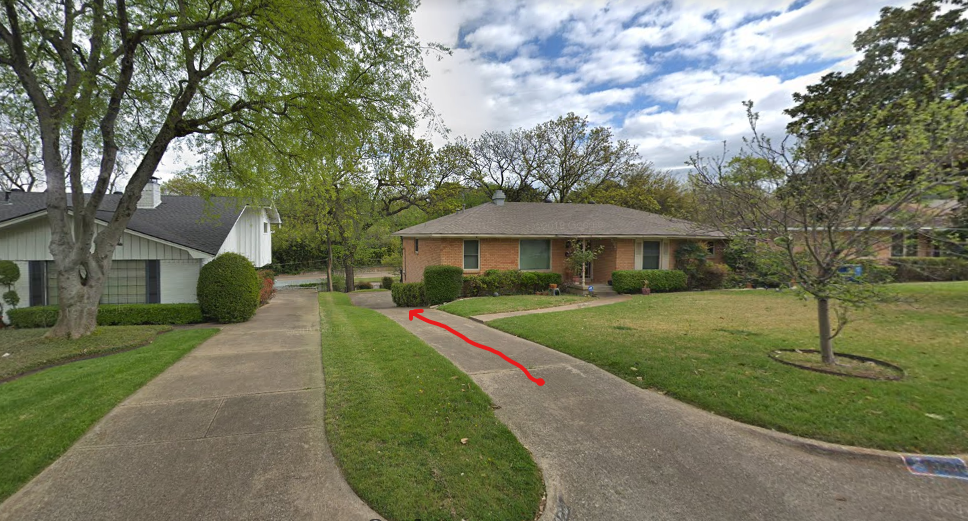
My childhood home was in a hilly neighborhood. Ideal for Demons on Wheels. My house was a two-story split level home where the driveway went from our street, down the side of the house, turning rightward to a larger driveway for two cars, garages underneath the first floor, and a grass lawn the remainder of the rear property (see image below).
My actual childhood home and driveway today – Google Maps 2019
After about 40-50 runs starting at the crest of our driveway (see red arrow), my racing teammates, Keith and Greg, and myself wanted a bigger challenge and more speed. We weren’t going to make legends for ourselves or to the girls unless we impressed. We pondered our choices and opportunities.
Keith had always been the bolder of us three. He had a gallant disregard to normal, whatever was convention he’d push it. There was one race on the lower BM-501/BMX track we thought he’d never recover or regain his courage, if it’s really courage. Some girls argued it was idiocy, but we couldn’t abandon our daring friend over some silly girls opinions. What do they know about soap box engineering and racing? Besides, doing things with Keith usually made Greg and me look and sound cool too. More on this later. Suddenly Keith had an ah-hah moment.
“What if we startin the Lowery’sdriveway,” he pointed, “cross our street, then onto our driveway and down?” Greg and I considered the path, the dual hills offering more speed, and likely much further in the grass through our rear lawn. Further than any man had gone before! Unanimously we yelled YES! It was an exceptional idea and we patted Keith on the shoulder and high-fives all around.
The new proposed race track to better speed and legendary fame!
After only about 10-15 runs between the three of us, hitting the street from the Lowery’s driveway, hopping the crest of our driveway, then making that sharp right turn to eventually slow in the grass to a stop, surprisingly the walls of our wooden toy trunk in which we sat began coming apart. The constant repeating G’s we wheeling demons were pulling in that right-hand turn was just too much force for that wooden box frame. A serious dilemma confronted our youthful, brilliant engineering and racing skills: A) Can the box be repaired? If not, B) do we find another lesser hill to ride affording driver safety, but sacrificing the roar of the crowds and girls wooing? Or C) do we just remove the four crumbling walls and sit on the flat bottom so that our fans could see every inch of our beautiful, skilled bodies? How were the new Niki Lauda, Jackie Stewart, and Mario Andretti of soap box racing going to handle this challenge?
It was determined by our consortium of advanced brains that the wooden trunk-walls were irreparable. We did not have the same carpentry skills, glue or nails to repair it to its original specifications. “A” is out of the question. What about “B”? It was soon deduced that if we moved to some other hill in some other neighborhood we would lose our fan-base—which were our giggling nearby girls and sisters. Also, we’d have to involve the Racing Commission and Safety Board, i.e. our parents. “B” was most certainly out of the question. It would have ruined our racing careers!
“C” it was! We went about refitting—rather dismantling—our fine machine of motion and in less than 20-minutes BM-502 was ready to roll into the annals of history.
Once the three of us topped the Lowery’s driveway, looked down to the street, down my driveway, and the back pavement off in the distance, a flashback took us all by the necks! “HOLD ON GUYS!” Greg mumbled with timidity. The three of us remembered when we once rode our dirt-bicycles with knobby-tires down my driveway, over different sized jumping ramps for Cool-points, and then skid our rear tires to screeching halts. Only the last time the three of us did that was when Keith didn’t stop with a screeching rear tire. Instead his chain came off his rear sprocket when he landed his jump.
Keith kept going and going, jumped our grass embankment Dad and I had built at that corner of the back pavement to deter eroding of our manicured grass and topsoil by rainstorms and runoff. Keith later told us, with some vehemence, he was not trying for double Cool-points as we accused, he was scared shitless. He jumped off his bike to save himself from almost certain death or a face-plant into our old, massively huge Oak Tree… just before our aluminum fence (see image below). Or if you avoided our Oak Tree, six to eight feet further was a very, VERY busy 6-lane Dallas Boulevard called Westmoreland Blvd. Make it that far into traffic and you have a serious mess moms and dads won’t be happy about. I would think the drivers of those cars too after glimpsing a flying kid go by, with bicycle (and parts?) or no bicycle, just before impact.
The jump and hill to death by oak or bodily dismemberment.
Keith then had another ah-hah moment! “This is different guys” he consoled, “I had 2-wheels and no chain.” He pointed down to the untried BM-502, “We have four wheels and no chance of a missing chain!” he said with confidence. Our three engineering brains acknowledged his well-made point. “Who’s going first?” Greg asked breaking the silent pause. More silence and looks at each other. Then Keith said “I came up with the idea of the faster better track. It’s you two’s turn.”
My sense of duty and honor began to gnaw at me inside. After all, it was my driveway, my street, my fast go-cart, and I knew this faster track like the back of my hand. I knew what had to be done. “I’ll go” I said with some sort of unknown cranial sharpness and courageous spirit.
A close resemblance of the legendary BM-502, but a totally flat seat and bigger rear tires not shown.
I mounted BM-502 for its maiden voyage. Keith went down to the street to monitor any traffic coming either way. Greg went all the way to the back of my house to witness racing history being made. I waited for Keith to give the all clear. In my head I imagined the transition from the Lowery’s drive into the street and that slight verge to the left much like Olympic bob-sledders do just before the starting gun or beeps go off. Up the crest of our drive and small lift off the ground, now the speed goes higher—must make that right-hand turn sooner and firmly at these speeds, I said to myself—and Keith yelled “CLEAR!” I moved my hips to get comfortable, lifted my feet onto the front axle with the steering rope in both hands and she began to roll immediately. Two seconds later and there was no turning back.
Before I knew it I was across the street and up the driveway crest with all four wheels off the ground! Keith let out a big roaring “YEAH!” as I came down. The girls gasped in awe. It seemed like slow-motion, but then I was at the next decline at the right-side bushes. No time to think of the past, girls, and what was behind me. My speed picked up quickly. It felt like 100-mph if not 45. I was at the large back pavement, time to turn right. It HAD to be quick and firm or else the oak of death or Westmoreland splat awaited me. I pulled the rope from the right, hard! That’s when everything went into a blur.
I no longer had my feet on the front axle. I no longer had the BM-502 under me. I did still have the rope tightly grasped in my right hand, pulling still I’m sure, hell… nothing else was as it should be or as I had just imagined it. The girls began screaming. About that time came the unbending, unforgiving, hard concrete on my left arm, then shoulder, then hip and butt. As if that wasn’t enough, then came the left rear wheel up my back, over my head and past me as I continued skidding, rolling across that aforementioned pavement. When my raggedy-Ann body finally came to a halt I wondered what have I lost, broken, and which time-space dimension had I entered. But suddenly that didn’t matter. The pain from all over my body started reaching my still foggy, oozy brain. I let out a few big screams of my agony and defeat.
I do remember up ahead of me the BM-502 had come to a rest upside down and wheels still spinning. The scene was sheer carnage I’m sure. The girls didn’t know what to do or what to say. They weren’t about to touch anything!
Greg ran into the house to get my Mom. Keith ran down from the top of the driveway to see what remained of this once great race driver. At least that’s what he told me later. When Mom hurriedly arrived she yelled “What on Earth happened!?” Greg and Keith very carefully and cautiously considered their answers as I laid there in pain and a trail of skin behind me. Mom checked my arms, elbows, butt thighs, knees, all the typical areas that get torn-up on concrete pavement crashes. “I need to get you into a baking soda bath and cleaned up. Come on.” she concluded. “What happened?”
Keith and Greg finally answered with their excellent, well-thought out account of events. “Dwain didn’t stay on the go-cart.” Even the NTSB would have been astonished by that crash-site assessment. Mom pressed them for a more… precise picture as she helped me to the bathroom for the tub and bandages. The two geniuses rethought their first answer, considered more and explained again. “Well Mrs. Miller, we didn’t consider what might happen when we removed the four walls of the toy-trunk and started up higher at the Lowery’s.” I think Mom responded with “Forget it. I’ll just ask the girls.”
Oh my god, that was the WORST possible thing she could do! Our reputations would go down the toilet, a worse fate than death-by-oak or the Westmoreland splat. How were we going to regain our former glory?
After the Day of Wipe-out the BM-502 lost its appeal along with more damaged parts. Nor did we dazzling mechanics have much motivation for a BM-503 GTE we had also dreamt. We learned in the end, it wasn’t the Oak Tree of death or launching into Westmoreland Blvd. traffic that was to be feared. It was our ignorance and inflated egos—and sketchy physics—that were to be most feared.
Like many a man before us our lofty self-perceptions for legendary racing status, below-average engineering skills, less than sufficient forethought and testing, and hordes of female race fans blinded us. We were no match against natural laws of velocity, gravity, distance, acceleration, deceleration or impact, and pain. The famous words of Captain Sully come to mind: Brace for impact.
Thus ended the three almost famous soap box racing careers of mini-Niki Lauda, mini-Jackie Stewart, and mini-Mario Andretti before they even got off the ground. Well… I guess in some cases into the air (what goes up) and into the ground (must come down) in a sundry of pieces and parts. An elusive concept for boys it seems. 😉
Live Well — Love Much — Laugh Often — Learn Always
Since the 1900 U.S. Presidential campaign and election the Red, White, and Blue stars and stripes firmly became the offspring of the colonial Imperialist family of powerful nations that were Belgium, Great Britain, France, Denmark, Holland, Spain, Portugal, Russia, and Sweden. After the victory of the Spanish-American War (Part I) it cemented our ‘divine right to prosperity and exploitation‘ of weaker people and put us at the same carnivorous dinning table as the other nine juggernaut nations. With the Monroe Doctrine enforced and the Spanish colonies of the Philippines, Guam, and Puerto Rico acquired from a defeated Spain, hungry insatiable American mercantilism then set out to “civilize and industrialize” Central and South America for the next two centuries (Part II) with very minimal to no investment back into local infrastructure or economies of those Latino countries.
Two hundred years of exploiting Central, Caribbean, and South American resources without significant reinvestment into those cultures saw the U.S. father and nurture the current Pan-American immigration crisis (Part III) which in turn fathered and nurtured our illegal domestic Grey and Black Underworld markets done primarily by American business owners/contractors and corporations. These two underworld markets—the white-collar grey market and the criminal black market—have sprouted a most inhumane insidious 14-tentacle monster of which I examined briefly five specific, toxic, anti-social markets (Part IV). In this final fifth part, with thousands and millions of Latinos fleeing their homeland and the U.S. created immigration crisis in Central America, why would these legal and illegal Latinos want to risk their lives, enter, and work for shitty wages in the United States when here in the American nightmare (not dream) there is an obnoxious, rising, threatening socioeconomic inequality and homeless problem for those very people? Is this simply transference of crises from one spot to another?
History has shown repeatedly that these are the very sociopolitical conditions that set in motion civil unrest and revolution. Was it not ironically the exact same despair the Latinos are fleeing in their homelands and more ironically, unless you are a Native American descendant, what most of our own ancestors in the 18th and 19th century escaped from in Europe to start a better, freer life in the United States? Bizarre? History repeating itself? A classic Euro-Asian socioeconomic stratification simply redressed then brought across the Atlantic Ocean.
Primary Causes of America’s Homeless/Housing Problem
Through mechanisms such as scapegoat contracting by American business owners, suppression of state minimum compensatory wages, skyrocketing tuition for trade-school, under and post-grad degrees, the persistent climb of housing and rent, all stimulate a corporate grey market followed by the criminal black market. The latter two markets exploit the chronic desperation of the struggling bottom percent of society. From Bloomberg Businessweek:
A toxic combination of slow wage growth and skyrocketing rents has put housing out of reach for a greater number of people.
The reason the situation has gotten worse is simple enough to understand, even if it defies easy solution: A toxic combo of slow wage growth and skyrocketing rents has put housing out of reach for a greater number of people. According to Freddie Mac, the government-sponsored housing giant, the portion of rental units affordable to low earners plummeted 62 percent from 2010 to 2016.
Rising housing costs don’t predestine people to homelessness. But without the right interventions, the connection can become malignant.
President Ronald Reagan dubiously argued that homelessness was a lifestyle choice. By the mid-2000’s, though, the federal government was taking a more productive approach. George W. Bush’s administration pushed for a “housing first” model that prioritized getting people permanent shelter before helping them with drug addiction or mental illness. Barack Obama furthered the effort in his first term and, in 2010, vowed to end chronic and veteran homelessness in five years and child and family homelessness by 2020.
Rising housing costs are part of the reason some of those deadlines were missed. The Trump administration’s proposal to hike rents on people receiving federal housing vouchers, and require they work, would only make the goals more elusive. Demand for rental assistance has long outstripped supply, leading to years-long waits for people who want help. But even folks who are lucky enough to have vouchers are increasingly struggling to use them in hot housing markets. A survey by the Urban Institute this year found that more than three-quarters of L.A. landlords rejected tenants receiving rental assistance. […]
Then there’s the moral argument for action. “It’s outrageous to me that in a country with so much wealth—and certainly enough for everybody—that there are people who lack even the basics for survival,” says Maria Foscarinis, founder and executive director of the National Law Center on Homelessness & Poverty. […]
But efforts to build are often delayed or blocked by people who don’t want homeless or lower-income people nearby. A strong undercurrent of Nimbyism—motivated by fear of falling property values, ignorance, racism, or concern over crime—can get nasty. Opponents of proposed homeless shelters took to the streets to protest in Koreatown and spewed boos and catcalls at a town hall in the beach community of Venice. (emphasis mine)
The poignant article goes on to say that “doing nothing isn’t doing nothing.” Doing nothing ends up costing everyone more money, more resources from law-enforcement, and drains an already strained, under-funded public mental-health and drug rehab system but continually feeds its (very profitable) prison system. Blaming those who are trying to get their feet back under themselves, back above water, is in fact the “least productive way to solve the crisis.” The fact that the U.S. is and has been the wealthiest, most capable nation on the planet to fix these 20, 50, or 100-year chronic socioeconomic problems is not just mind-boggling, but shamefully embarrassing.
Examining four indicators of U.S. income per capita, Kimberly Amadeo of TheBalance.com reports:
According to Zillow.com’s home value/price index, as of May 14, 2019, the median home value/price was $226,700 for an average 2,687 sq ft home. This however, is not the listing price. And the majority of American home-building corporations, for some not-so-mysterious reasons, construct single family homes around 2,500 sq ft—it’s more safely profitable for them and their lending corporations. To determine what it is state-by-state go here.
The U.S. Census Bureau’s latest numbers for median income per capita can be found here, but nationally as of 2017 it is just below $32,000 per year for legal U.S. citizens. Most loan-financing/home mortgage lenders require that applicants for a 30-year house mortgage earn between $58,200 to $64,400 minimum gross household income annually. However, this amount and interest-rate (5%) reflect an applicant(s) near excellent credit score(s). A large percentage of lower middle-class and lower-class Americans that have been living paycheck to paycheck (approx. 70% – 79.3% of the population) do not have excellent or even above-average credit ratings for such decent mortgages. This leads us to renting costs in America.
According again to Zillow.com’s indices, the median list-price rent index as of March 2019 in the U.S. was $1,675 monthly, or for a 12-month lease $20,100 annually. But here’s the catch. Most all private-sector leasing-management corporations require the renter(s) to earn 2- or 3-times that rental amount in net wages. Therefore, $1,675 jumps to either $3,350 to $5,025 monthly, or $40,200 to $60,300 annually. If some renters are on the cusp of their leasing requirements, then housing managers demand a hefty upfront deposit which ends up disqualifying many/most applicants living paycheck to paycheck.
We are back to reality, our chronic homeless dilemma and crisis as the wealthiest nation in the world.
America’s Chronic Homeless Problem Provides More Exploitation
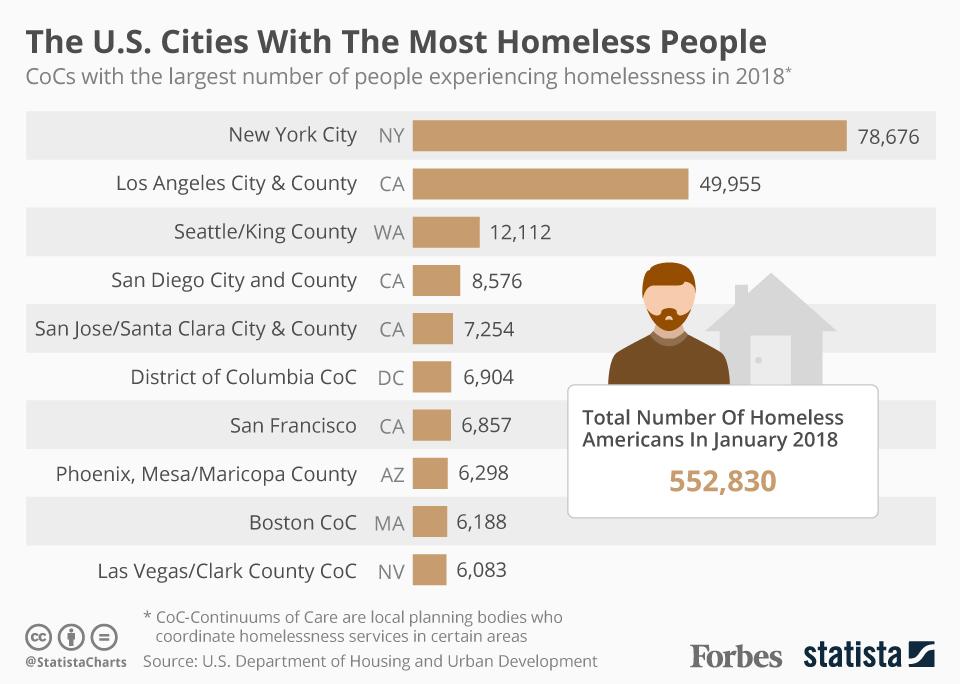
The 2018 Annual Homeless Assessment Report to Congress provided by the U.S. Dept. of Housing and Urban Development (HUD), reports that between 2016 and 2018 that instead of the downward trend since 2012, homeless and unsheltered numbers rose across the nation by 10% (p. 13, Exhibit 1.1). They are expected to continue rising under current unchanged socioeconomic and political conditions. However, this can be slowed or stopped in two to four years if changes are made in those same influencing factors, reversed and returned to pre-2016 trends in six years with significant changes.
My hometown of Dallas, TX is not listed in these 10 worst cities, however, as the state’s largest metroplex and one of the nation’s largest metropolises it has its serious homeless problems too. Our Metro Dallas Homeless Alliance reports to-date Dallas and Collin Counties (the latter is one of the wealthiest counties in Texas) have risen by 9% since 2016 with a 16% increase in Emergency-Sheltered homelessness. As mentioned at the end of Part III, I have three personal stories to share from homeless individuals within 1-mile of my home.
Faces of our homeless
Three Dallas Voices of Homelessness
One of my first impressions after briefly speaking with these homeless, sometimes just loitering before moving down the street, is that homelessness is not represented by one gender or one particular race. That’s one false notion those far removed from the struggle have of these unfortunate situations. The other impression I found which wasn’t much of a surprise to me were their backgrounds and stories.
The majority I spoke with came from situations of unstable families while children and/or teenagers. With one man I spoke with he had been abandoned by his biological dad and step-mother at the age of thirteen. For all the others I spoke with their backgrounds were all too familiar. Drug abuse and dealing, alcohol use and abuse, and often the two dysfunctions were accompanied by physical and sexual abuse/assaults.
Every single person I spoke to with drug, alcohol, and sexual/physical abuse histories had indeed been in rehab treatment programs, several times, but without the financial means to even complete a 30-day, much less 60-day program, facilities could not keep them more than 10-12 days. Some could only detox for three days and had to be discharged. And those facilities are the state- and federal-supported programs, not the highly expensive private clinics and hospitals with adequately staffed premier doctors, nurses, and counselors. Regarding those nice private hospitals, one homeless gentleman told me “those are the places and beds for the best insurance policies or rich parent’s kids.” I knew exactly what he meant. Mom and myself dealt with the same difficulties and oddities with my own sister the last 40-years. Still do. My sister has been homeless and living on the streets many times in her life.
Ricki
Originally from Ardmore, a small town in Oklahoma, Ricki was about 30-35 and when we talked on a partly cloudy, sunny day she had left a downtown shelter that had been overcrowded and her bed was infested with bed-bugs. She showed me her waist and stomach covered in bites and welts. I asked her how long she’s been homeless, “since I was 19.” Did you finish school, I asked. “No, because my momma was alcoholic, unmarried and I got tired of the abusive men that came and went.” Ricki had moved out as a teenager with no high school diploma to escape one or two domestic problems to take her chances on different bigger problems. Her older sister had done the same about three years earlier than she and not faring any better. Her sister has been in and out of homeless shelters and alcohol-drug rehab houses in Little Rock, AR.
Ricki was also manic depressive and recently diagnosed (inside a low-cost county hospital) with Type 1 diabetes. Most of the time she can’t afford both meds, sometimes neither of them. Her combination of emotional and medical problems—most likely other secondary psychological issues I’m assuming too—meant one med without the other kept her in constant volatility with one or the other for all these years. This was my guess anyway. “The low-wage jobs I was able to find and keep for a month or two,” she explained “the supervisor didn’t have any patience with my mistakes and knew nothing about mental-illness.” This was one primary cause for Ricki’s chronic homelessness for 11-12 years.
When I asked her if there was one wish she could have granted for the next 6-12 months, what would it be? She answered, “If they would just give us some place to go where we wouldn’t get run off every other night, or after a week or two, that would work for me to get on my feet.” She had a point. If you have to keep worrying about your next meal(s) and where you will sleep for the night or next week, it makes it much more difficult to be reliable for a boss at a low-paying job. I thought it pointless, probably an insult to ask if she had means of transportation to get to and from a job.
Adam or“Addie” Addie is a 34-year old male originally from Georgia, but recently from Mississippi, which was what struck up our first conversation. A military brat/kid, he moved around many times; four times before he was age twelve. In Mississippi was where the U.S. Marine Corp. recruiter talked him into enlisting, told him he would see the world and become a new man. During boot camp in San Diego, CA, Adam was smoking weed with other recruits, but he was the one busted and made the example to his recruit-class.
He moved back in with his dad in Mississippi, but being former military himself his dad soon kicked him out. “I tried for a couple of months living with an aunt in Ohio,” he shared “but she had too many strict rules.” Many friends-with-couches later and only a diploma, Addie eventually ended up in DFW, sometimes in a shelter, other times on the streets.
Everything has a long line at shelters that often takes an hour or two to stand in, and sometimes you don’t get what you wait for. Beds are often infested because they’re not regularly sanitized. Roaches everywhere getting into your stuff. The staff-workers have their favorites and don’t treat everyone equally. And temporary affordable housing for us takes a long, long time to obtain. Why? It’s non-existent or too expensive in DFW. I want to work, hold down a job, but it all seems like a Catch-22.
Bouts of alcoholism have crept into Adam’s hard times. When I saw him last he was considering drifting up toward Kansas City for the summer (cooler temps) if he was put off again or kept on the housing waiting list at two shelters a fifth time.
Walt inside the library
Walter
Walt is a former truck-rig driver from Ft. Worth, TX. He is about 47 – 50 years old, I’m guessing, and due to his high blood pressure from being severely overweight—he says from always being on the road/highway living in his rear cab for 330-days out of the year—lost his CDL (commercial driver’s license) because of those medical problems. In our conversation Walt exhibited several signs of depressive disorders so I asked if he has ever been seen by a psychologist or psychiatrist.
“Yes. Once right after I got out of prison and then through my caseworker at the shelter.” I asked him what they said. “That I needed both counseling [psychotherapy] and regular anti-depressant meds for at least two years.” Of course I asked how that was going. “I can’t afford it after a week or two.” Walter said it had been over a year since he has done any counseling or had meds. When I asked about family his entire affect changed. He started talking about his mother and father, in broken mumbled sentences, but then had to stop. He had no idea how they were or where they were—his mom disappeared when he was little. The last time Walt saw his dad was 1984 and of all places… Richardson, TX, just 10-minutes away.
I asked Walt that other than truck-driving, once he reacquired his CDL, has he been able to find work:
For the last two years I’ve been trying to get into a program for housing for the displaced. After you stand in line for your caseworker for hours, you are usually told it is pending or I’ve been told I don’t fit their requirements. At most shelters you must stand in line by 2:00pm to secure a bed. If you get to your caseworker by 4:30pm, you have much less time to walk everywhere seeking a low-wage job. But sometimes you have to choose between a bed for the night or a possible job you’ve already applied for months earlier. Because I don’t have semi-permanent housing I can’t clean-up and dress to look my best at any job interview. [he gave a half chuckle]
Though not all homeless cases are mental-illness related, America’s public mental-health, mental-illness infrastructure and operation is for the most part only one fragile cog in our nation’s dysfunctional three-cog public services. The second cog is our Homeless-to-Housing cog. It fluctuates greatly and is rarely the same from year-to-year or elections-to-elections. The third cog is thriving and over the last 2-3 decades has become profitably fat: prisons.
Should you want to view the other 94 – 95 U.S. companies clearing profits from county and state corrections facility services, click here. The grossly disproportionate social needs wheel above begs the question, What is the real priority for American businesses and their government constituents? Then ask yourself why can’t housing projects, and state/county mental-health programs keep up with a noticeably smaller (yet fast growing) percentage of the population? Any bets whether you are back to the first question of priorities?
There is another alarming ripple-effect of the U.S. corporate grey market and black underworld/market destabilizing the nation’s struggling middle-class and sinking lower-class: a falling life-expectancy. Neurosurgeon and Emmy-winning CNN chief medical correspondent Dr. Sanjay Gupta, hosted a special HBO documentary called One Nation Under Stress and examined the reasons for the historic decline in life-expectancy inside the world’s wealthiest country who ironically has spent the most on healthcare by any developed nation around the globe.
If you are unable to watch or stream the HBO documentary, here is a 25-min overview of Dr. Gupta’s findings. He reveals the multiple causes all pointing to one single epidemic: the chronic, prolonged levels of abnormal stress. I highly recommend watching this documentary and sharing it with family and friends. If you don’t have anyone close suffering from long-term stress and its many side effects, then watch it as an introductory briefing so you might recognize the many symptoms and one day help a stranger or acquaintance.
∼ ∼ ∼ § ∼ ∼ ∼
Now that this five part series is concluded and covered the entire historical spectrum from 1900 across the North, Central, South Americas and Caribbean, to recent and present-day criminal and corrupt back-office, domestic businesses, to the end product of an ill, decaying middle and lower socioeconomic class in the U.S., share your thoughts or questions below. I hope this series and the discussions will cause you to ask yourself, What more can I do? Then inspire to act.
I have zero expectation that anything I ever say will end someone’s belief in their God. Not my goal or purpose. That alone belongs to the individual. ~ Zoe
'Light thinks it travels faster than anything but it is wrong. No matter how fast light travels, it finds the darkness has always got there first, and is waiting for it' - Terry Pratchett












 The Professor's Convatorium