Nothing else needs saying, except this is just one colossal iceberg off the coast of Ilulissat, Greenland, among hundreds of others breaking off or calving at alarming rates over the last 10-20 years. This particular iceberg moved into Disko Bay, Greenland, after fracturing, melting and then became small enough to literally flip, doing a somersault and creating massive waves as it broke apart due to Climate Change.
Greenland, the world’s largest island, is also covered in one of the earth’s two ice sheets. The other cloaks Antarctica. Greenland’s encompasses around 80 percent of the nation’s land mass, spanning more than 650,000 square miles. But it’s also melting at an accelerating rate due to climate change, losing an annual average of 261 gigatonnes—one gigatonne is equivalent to 2.2 trillion pounds—contributing to rising sea levels that impact the rest of the world. And Greenland’s massive icebergs are a reminder of this exceptional scale. Once the ice sheets of Antarctica and Greenland erode past a specific amount of square miles, a point the Earth is reaching rapidly—unless the remaining superpower nations like the United States do more, A LOT MORE—the planet can no longer be saved. Most life as we know it, such as humans and most animals on land and in the seas, will perish. Us, we, and they will indeed go extinct. Guaranteed.
When 195 countries signed the Paris Agreement in 2016, the Copernicus Climate Change Service estimated that Earth would reach the 1.5 degrees threshold by 2042. But now, the European organization’s global temperature trend monitor predicts that Earth will hit 1.5 degrees Celsius in warming by 2029—just three years from now. No one country is doing enough, period. But for 2026 what 10 nations are doing the most to slow Climate Change?
Denmark — Overall score: 80.52
United Kingdom — Overall score: 70.8
Morocco — Overall score: 70.75
Chile — Overall score: 70.63
Luxembourg — Overall score: 70.45
Lithuania — Overall score: 70.3
Netherlands — Overall score: 67.27
Norway — Overall score: 66.83
Portugal — Overall score: 66.05
Sweden — Overall score: 64.91
Want to know where the United States ranks? Are you sitting down? The USA is #65 and dropping as of August 5, 2026, at 12:07pm CST (-5 hrs UTC).
Civilization must, I repeat MUST get off and stop burning fossil fuels and other gases and minerals causing Global Warming. It is so much worse than first predicted 40-60 years ago! What are you doing about it at home? What are you doing about Climate Change in your neighborhood, community, town, city, or state? What are you making your elected government officials address, and take action, not just hear their repeated lip-service?
Here’s the outlook, it’s bleak, very bleak if we continue with business-as-usual:
Not only will you, your spouse or partner suffer greatly from every imaginable disaster possible, severe food shortages, empty grocery stores, increased extreme temperatures, increased draughts more prolonged, increased flooding, more 1,000-year and 100-year Category 4 and 5 (and 6?) storms, hurricanes, typhoons, and tornadoes… but your own children, nieces, nephews, cousins, siblings, parents(?), and best friends, followed by your grandchildren and all of their relatives, will begin to die off from a wide variety of health issues, disease, malnutrition, and other problems yet unknown!
Doing nothing or very, very little, and too slowly has just ONE outcome for us all. It isn’t rocket science.
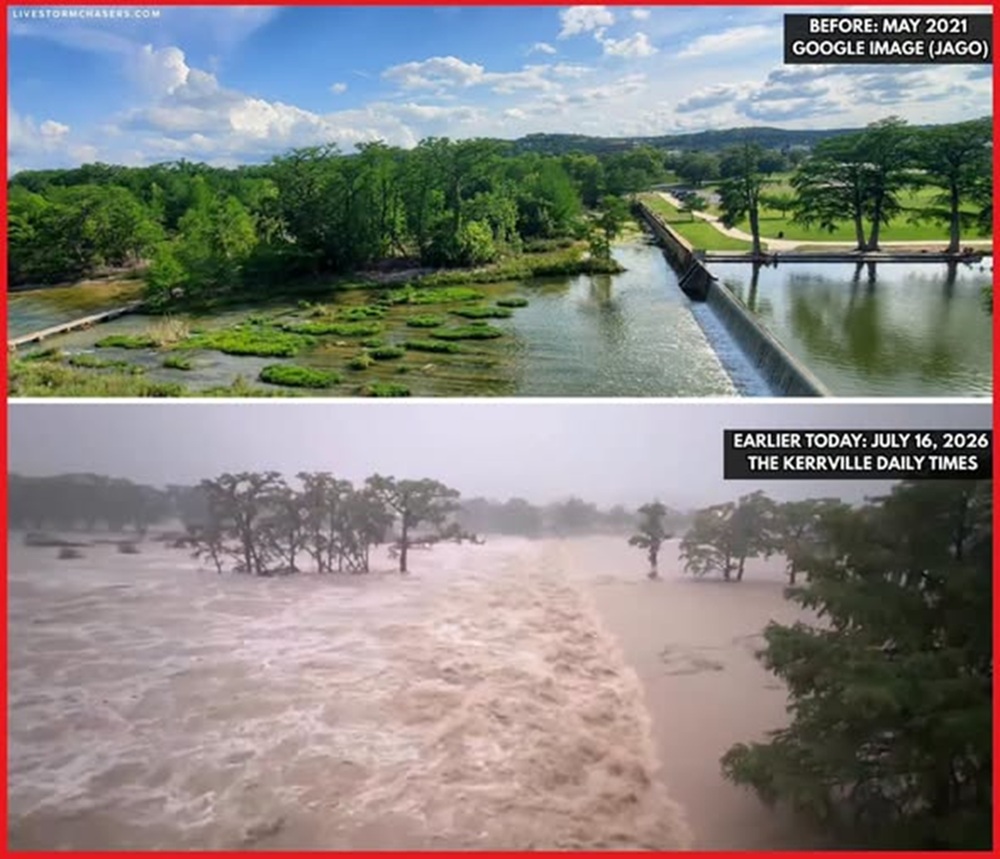
Yes, here we go again, just like in July 2025, but worse and faster. Some of you may have heard on national news broadcasts on July 16-18, 2026, that we here in Kerrville, Texas, and the Hill Country area once again experienced massive thunder showers from south of Center Point, Texas, up to Ingram, Hunt, Mountain Home, to south of Harper, Texas, and once again we suffered cataclysmic rainstorms and thunderstorms throughout the wee-hours of July 16, almost a year to the date of the major flooding here that took 139 lives, 117 of them just in Kerr County including the young girls at Camp Mystic in Hunt, Texas. So far this catastrophic flooding has taken 2 lives. What was this caused by? Was it the same weather event that happened July 4, 2026: a mesoscale convective vortex with enhanced tropical moisture? Yes, it was.
This highly unusual weather event only started last year, in 2025. In contrast, historically speaking, this sort of major flooding only happened rarely, on average about 20-40 years apart or more, if at all. Suddenly, it seems to be happening on a more regular basis. How can I say that? My Mom and her new second husband moved to Kerrville in 1997. I have been coming here to visit several times a year since then with my ex-wife and our two children. And of course, Mom and I would talk quite often on the phone when I was living up in Dallas, TX. That is practically 30-years for Mom and off-and-on for me. I am very, very familiar with the weather trends here in the Texas Hill Country. It was something my Mom’s generation often chatted about to people: how’s the weather(?), etc. They enjoyed talking about it frequently and Mom wouldn’t spare me the semi-trivial details. Therefore, I am practically a 3-decade encyclopedia of Kerrville weather trends since 1997. I also study historical data tables because just like the U.S. Stock Exchange, trends are significant for learning probabilities and possibilities… staying one-half step or a full step ahead of the game.
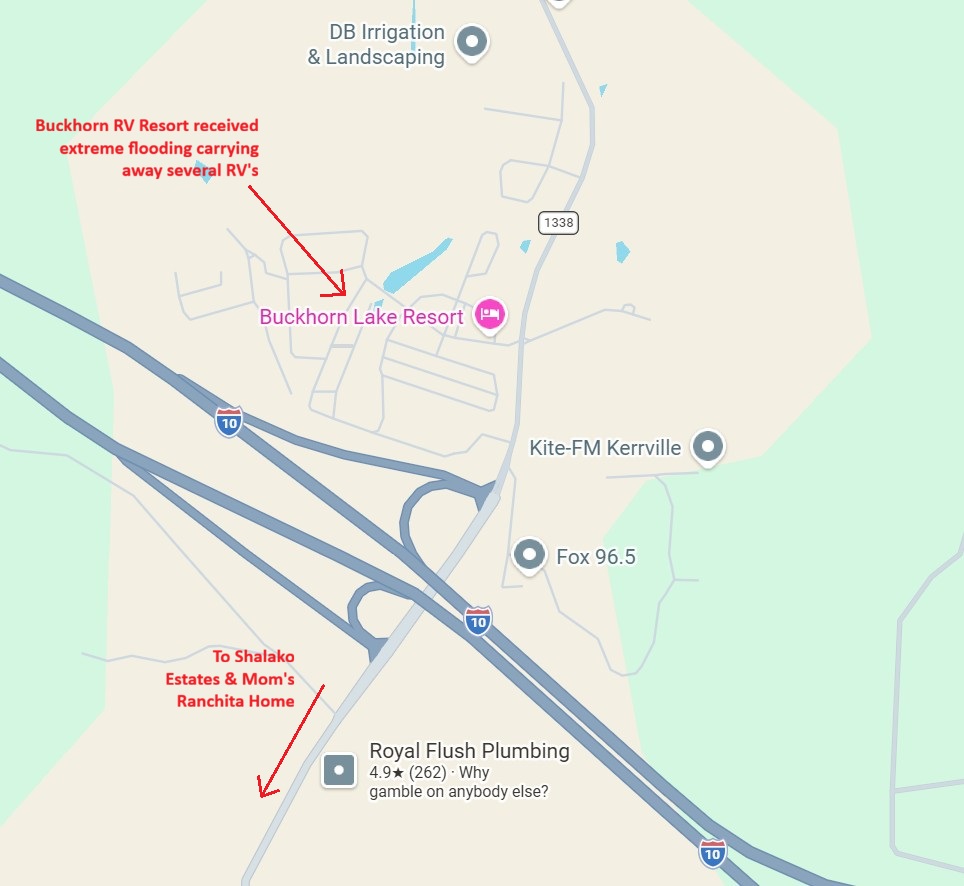
That said, Mom, her new second husband, and myself, knew what severe weather events can cause in Kerrville and the surrounding Hill Country. During those extreme storms Mom and Lloyd (husband) were sometimes locked in to their residential neighborhood sitting at the top of one of the highest hills in Kerr County, in Shalako Estates off Goat Creek Road or FM 1338. Goat Creek often flooded and was to high and powerful for them to exit the little spillway out of Shalako Estates.
Here is drone footage of the devastation at Buckhorn RV & Lake Resort close to us and caused by the early morning rise of surrounding creeks feeding into the Guadalupe River:
This same extreme creek-water rise to deadly rushing, powerful water carrying away even several (many?) White-tail Deer with it as well as cars, trucks, and RVs, all the way into the Guadalupe River is about 2.5-miles down FM 1338 and Goat Creek, south into the river. This low-ground toward the Guadalupe River runs under Junction Hwy or TX Hwy 27 only about 400-500 feet from our property. Here’s what it looked like at approximately 4:30am CST from a motorist on Junction Hwy/TX 27 right at the Mexican restaurant Taqueria Jalisco that has the bright neon sign at the entrance. Apologies if you are unable to view it; it was a private citizen on the spot atop his vehicle with his personal cell phone recording live:
Now, two years back-to-back (2025–2026) of extreme, deadly flooding in the Texas Hill Country and Kerr County isn’t quite a frequent trend, yet. We’ve had our share of severe deadly floods going back many decades. However, the difference of those in past compared to now are different, significantly different in the meteorological systems then and now. What has changed are the upward trending weather systems of mesoscale convective vortexes that simply sit or stall in this part of Central Texas dumping upward of 7-10 inches or more of heavy rain in a matter of one hour, or one-and-a-half hours. Historically in previous flooding years in Kerrville the cause was 3-7 days and nights of rainfall, much more time for residents to prepare, evacuate, and get to higher ground. In July 2025 and again this July 16, 2026 that was not the case. One is a fool if you only look with horse-blinders on and conclude, ‘It was a rare phenomena that randomly happens. A one- or two-off.’ No. These sort of extreme weather events are happening not only across the United States, but around the globe. The evidence is piling up and piling up fast!
According to the Hays Trinity Conservation District (HTCD) and the NOAA/National Integrated Drought Information System at Drought.gov over the last two decades in Texas, Central Texas Hill Country specifically, this area has experienced increase “weather whiplashes,” defined by NOAA as severe, alternating swings between intense droughts and catastrophic “1,000-year” flash floods compounded by a steady, long-term rise in baseline temperatures. The HTCD further reports:
Key Climate Trends (2006-2026)
Warming Temperatures: The Hill Country has seen its warmest summers and mildest winters on record, with average temperatures trending roughly 1.5 to 3 degrees warmer than mid-20th century averages. [citation]
Precipitation Volatility: Annual rainfall totals remain unreliable, but the intensity of rainfall events has increased. Federal precipitation models updated in recent years reflect a 30% to 40% increase in benchmark extreme rainfall estimates for the region just west of San Antonio. [citation]
Weather Extremes: The region is frequently pinned between prolonged La Niña-induced droughts (most notably 2011–2015 and subsequent mid-2020s dry spells) and record-breaking floods, such as the catastrophic Guadalupe River floods. [citation]
If there is just one or two things that I have learned in my many years in Kerrville, Texas, going back to 1997–to the present, and learned from my late mother it is this: everything here in Kerrville, and the Texas Hill Country is much more extreme than it was on average back in the late 1990’s, the 2000’s and up to now. Temperatures are noticeably more extreme, the wind and wind gusts are definitely more extreme—my outdoor plants and herb garden bare witness to the destruction—reaching some days up to 30-40mph! This has increasingly reeked havoc on my allergies and sinus problems. 🤧🤨 Of course the extremes in rainfall, or no rainfall, for extended weeks or months are noticeably more unstable, the UV indices are noticeably way up with more frequent UV warnings for outdoor activities.
And as a herb grower and small gardener what I’ve noticed every summer (July-to-mid-September) going back to 2020… the insects are very bad. The huge grasshoppers that feed on just about anything a gardener grows, aphids are on a significant rise every summer due to fewer and fewer ladybugs, beetles and other natural predators, and lastly but not conclusively, more and more weird fungi/bacteria on and in soils, then flies, mosquitos, and all the pesty insects that winter temps or freezes would typically reduce their numbers. They too are on the rise due to our (and the world’s) shorter and shorter winters. The tangible accumulating evidence has become overwhelming with each passing year.
But very sadly and worse still, the superpower and semi-superpower nations such as China, Russia, Brazil, Venezuela, Colombia, South Asiatic nations, many Eastern European nations, and the United States are still failing to do enough to slow Global Warming and Climate Change caused primarily by fossil fuel burning/consumption, rising CO2 (carbon dioxide), CH4 (methane gas), N2O (nitrous oxide), fluorinated gases, then other less heating atmospheric gases, much less stabilize it by 2030 or 2050 from the point-of-no-return tipping point. I don’t know about where you may live and have lived for many years, but here in Texas where I’ve lived most of my life—the now super hardcore Red state where environmental regulations and Climate Change movements and/or policies are essentially non-existent—it is getting worse while most Texans just go on daily with their busy lives, redundant lives of working, spending-consuming, all in an invisible bubble around family, coworkers, and friends, not paying any attention to how Earth is changing.
Here in Red State Texas we are all just huge, obese bull-headed-frogs relaxing in the pot of gradually boiling water as if nothing is happening or has happened. Meanwhile, our elected officials just keep drawing a salary and pension for doing just enoughor less to keep the economy as one of the best in the entire Union; money, money, money! Spend, spend, spend!
What a sad, sad condition we will leave this Earth for our young children, grandchildren, and their children and grandchildren. 😢
Live Well – Love Much – Laugh Often – Learn Always – Do It Better Fast!
Over the Easter, or Ēostre weekend I have often written about all those religious theological fallacies and rampant mistakes within Christendom that the ancient Greco-Roman Catholic Church covered up, changed, edited, omitted, etc., from the 1st-century CE Jewish reformer Yeshua bar Yosef and then passed down to 21st-century Protestant followers, churches, and seminaries. But this time I am going to skip all that. Why? Because verifiable, authentic history never changes. Why beat a dead horse into oblivion? Faith-followers will either be objective or not, equitable or not, brave and open-minded or not, or worse scared to death, or not. C’est la vie. 🤷♂️
No, today I want to write about things that really matter, pun intended. I want to share and comment on a few science subjects, in particular Earth’s physical status—another disruptive affect of Climate Change that is becoming disturbingly obvious—DNA sequencing discoveries, as well as recent atomic findings such as Quantum Entanglement.
∼ ∼ ∼ § ∼ ∼ ∼
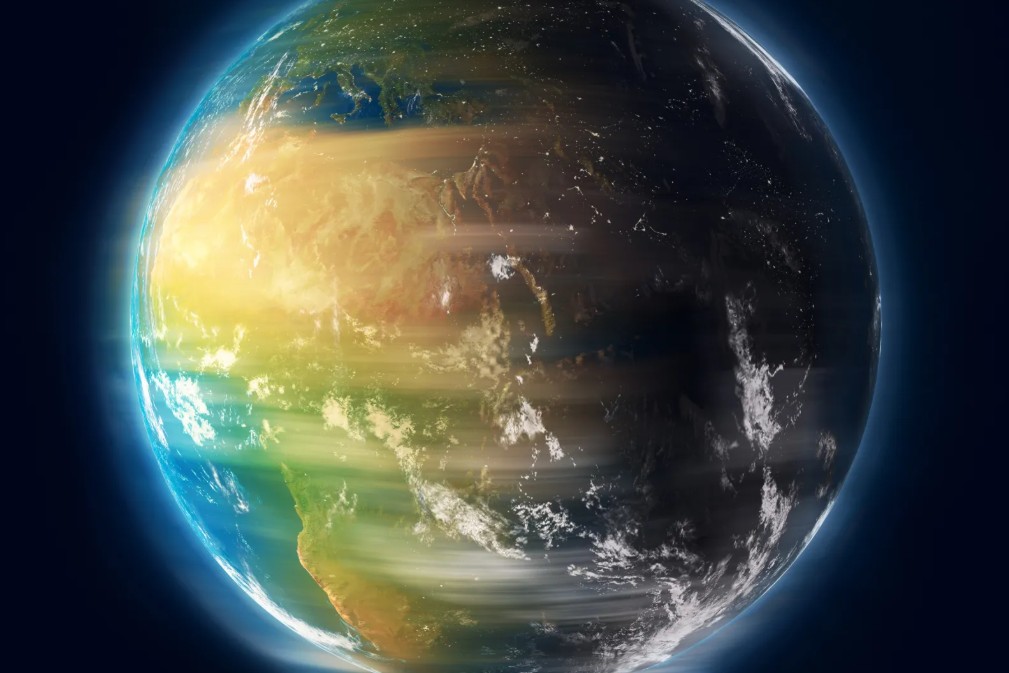
Have any of you noticed that the days on Earth are getting longer now? Yes, it is factually true. You might ask, How is that possible? Believe it or not, Climate Change or a warming planet is contributing to a slower rotation of Earth. Scientists say that this slower rotation has not been seen for at least 3.6-million years. Many decades ago, perhaps century ago, earlier research established an increasingly warming planet affects sea levels and consequently, Earth’s rotation on its axis. However, this change is in a geological context. Geodesist Professor Benedikt Soja of ETH Zurich, Switzerland, states:
“This rapid increase in day length implies that the rate of modern climate change has been unprecedented at least since the late Pliocene, 3.6 million years ago. The current rapid rise in day length can thus be attributed primarily to human influences.
By the end of the 21st century, climate change is expected to affect day length even more strongly than the Moon. Even though the changes are only milliseconds, they can cause problems in many areas, for example in precise space navigation, which requires accurate information on Earth’s rotation.”
One of Soja’s colleagues, Mostafa Kiani Shahvandi of the University of Vienna, explains that the effect is similar to a figure skater spinning more slowly after extending their arms. This is simple high school Physics 101. Ice sheets and glaciers across the planet are more dense and therefore heavier; a slower rotating Earth. However, a warm planet and much warmer seas are less dense, thinner, molecularly more active so less weight has less gravity which means a faster rotating Earth. Despite the simple physics though, what has been uncertain or never before seen was whether or not climate had ever lengthened the day this quickly before. To answer that puzzling question, the research team reconstructed changes in Earth’s day-length going back millions of years.
Relying on fossilized remains of benthic foraminifera, i.e. single-celled marine organisms that preserve chemical signals of past ocean conditions. This method of study, like polar ice-cores, has proven to be highly revealing of Earth’s climate history for many of her past millennia. First, by analyzing these fossils, scientists were able to infer ancient historical sea-level fluctuations and calculate how those shifts would have affected Earth’s rotation. Second, the researchers then applied a type of deep learning algorithm to their findings, designed to reflect sea-level change while accounting for the uncertainty that comes with ancient climate data.
“From the chemical composition of the foraminifera fossils, we can infer sea-level fluctuations and then mathematically derive the corresponding changes in day length,” Kiani Shahvandi said. “This model captures the physics of sea-level change, while remaining robust to the large uncertainties inherent in paleoclimate data.”
These findings strongly suggest that Earth’s day-length has varied significantly over the last 2.6-million years, in particular during the Quaternary Period, when large continental ice sheets repeatedly grew and melted. Those ice-driven sea-level changes caused Earth’s rotation to speed up or slow down in different eras of Earth’s history.
However, that said, scientists have found that today’s increase in day length is exceptional. More specifically, they found only one period, around two million years ago, showed a rate of change that came close to present-day levels, and even that episode was slightly slower than what has been observed between 2000 and 2020. This only leads scientists to one most plausible conclusion: the current climate trend reflects a broader pattern of unusually rapid climate and oceanic change. And these scientists predict that by the end of the 21st-century accelerated climate-driven domino effects on our length of days could surpass the gravitational pull or slowing by our Moon. In other words, the further ripple-effects upon Earth will be catastrophic.
∼ ∼ ∼ § ∼ ∼ ∼
Through the methodology of DNA Sequencing paleoanthropologists and geneticists have discovered that the last known remaining Neanderthals stayed totally isolated from other human groups, including Homo sapiens as well as Neanderthals nearby, which alters human history.
Researchers used part of a root of one of Thorin’s molars to determine that he was male and to generate a whole-genome sequence, revealing that he was part of an isolated, previously unknown lineage of Neanderthals. (Image credit: Ludovik Slimak)
Ludovic Slimak, the paleoanthropologist who made the remarkable discovery at Grotte Mandrin, a cave in Rhône Valley, France, had the jaw bone of Thorinanalyzed by geneticists and then sequenced showed that Thorin’s lineage managed to stay totally isolated from the rest of the Neanderthal population, “in spite of the fact that other human groups lived close by.” Slimak goes on to say:
“The population of Thorin had spent 50 millennia without exchanging a single gene with the classical Neanderthal populations.” The analysis showed that Thorin had “high genetic homozygosity,” which indicates inbreeding in the lineage’s recent past. It also offers no evidence of interbreeding with modern humans of the time.”
With this discovery everything about the Neanderthals and their extinction, and by default human history must now be rewritten. Also, with this discovery it further proves that diversity among human populations is highly advantageous if not simply for better immune systems. And those groups of inclusive only religious populations—not marrying or procreating outside of a specific faith—is known to be highly risky and disadvantageous for retardations, weaker immune systems, and higher survivability rates.
∼ ∼ ∼ § ∼ ∼ ∼
At the Australian National University Research School of Physics, tangibly observed for the first time a pair of atoms existing in two different places simultaneously, i.e. at the exact same time known as Quantum Entanglement. Quantum physicists at ANU said, “It’s really weird for us to think that this is how the universe works. You can read about it in a textbook, but it’s really weird to think that a particle can be in two places at once” when you see it with your own eyes on atomic instruments, says Dr. Sean Hodgman.
Dr. Hodgman goes on to say, “This result confirms the predictions of over a century ago that matter can be in two locations at once, and it can interfere with itself even in those locations.” This means massive, better knowledge of examining how small-scale Quantum Mechanics interact with gravity and General Relativity at the universal scale. This means physicists are one step closer to the “Theory of Everything.” It isn’t as unknown anymore.
Live Well – Love Much – Laugh Often – Learn Always
Nothing is so dangerous to the progress of the human mind than to assume that our views of science are ultimate, that there are no mysteries in nature, that our triumphs are complete and that there are no new worlds to conquer.
— Humphry Davy
(line break)
My youth soccer head coach obviously didn’t want me to leave our U-17 team or the south Dallas league in which I had played the last eight seasons accumulating notoriety, awards, and trophies both for myself, him, and the team. But the fact remained: in 1980 the OCSA paled compared to the NDCCCL of north Dallas-Plano. In south Dallas I was only a semi big fish in a small pond. I knew too well that if I were to have a chance to play at the highest levels possible, I had to travel over 20-miles there and back, 2-3 times a week and every weekend where the top flight players, teams, and coaches were competing; it had to be done.
If my parents and I had listened to many of the naysayers, I wouldn’t have achieved a sizable college soccer scholarship, been mentored and coached by two world-class former pro goalkeepers, started all four collegiate years, awarded MVP and All-Tournament Team in the 1982-83 NAIA National Championship tournament, awarded one NAIA Honorable Mention All-American (sophomore year), one NAIA second-team All-American (junior year), and two first-team All-American awards by the NSCAA and NAIA my final year, then I likely could not have gone on to a rewarding pro and semi-pro career the next 11-years on three foreign continents then back to the U.S., retiring in 1996.
I can gratefully and humbly say through firsthand experience that sometimes (many times?) the rewards are so worth the risks.
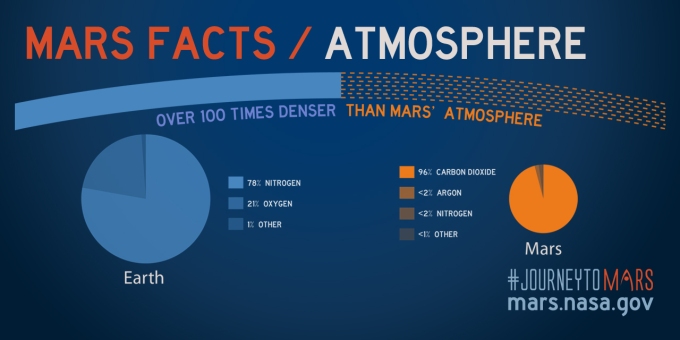
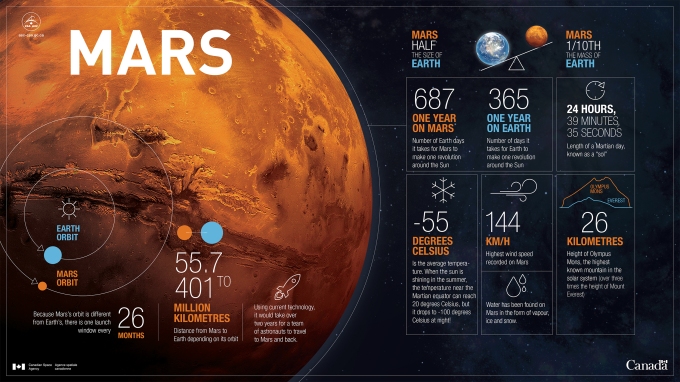
In the course of human endeavors of progress, better understanding, advancement, and evolving and promoting our species, we have reached another crossroads: interplanetary exploration and colonization. Mars. Should we do it? Should we stay put or should we go?
Because of the upcoming 6-part National Geographic Channel series “Mars“ premiering Nov. 14, 2016, I stumbled into an intriguing discussion with a good friend of mine about colonizing the nearby distant planet. Though he is a big Star Trek fan and all for space exploration, my friend had some valid points. Here’s how the banter went:
Friend: A crappy Earth with problems would be better than Mars, Moon Colonies, etc. The only viable solution is a nearby habitable planet very similar to Earth. If we had the technology to colonize & terraform, we certainly would be advanced enough to heal our own planet. There are too many things we are interdependent on to leave Earth behind just yet. Besides distance, even an Earth-like twin planet would have many hidden obstacles to colonization.
Professor T: Similar warnings were also given to Magellan, Dias, Drake, Vespucci, Pizarro, Erik-the-Red, Ulfsson, Herjólfsson, Zheng He, and several others. Why did they not listen? (wink)
Friend: LOL! That’s nowhere close to being equitable. Not apples and oranges! Apples and iPhones! It’s not a warning, it’s simply thinking ahead. I am by no means well versed but I know enough that Space is even less hospitable than Mother Nature here on Earth. If you saw The Martian, read the book, then listen to the author as he explains in interviews what he had to extrapolate technology wise and fudge(!) just to make that story work.
Professor T: Not really arguing your very valid points. But like the Serengeti wildebeests, gazelles, zebras, buffalos, etc, that annually cross the Grumeti River which they all know is FULL of hungry happy crocodiles and almost certain DEATH… yet they cross it, and many/most of those migrating animals cross multiple times in their lifetimes! Now explain to me why it is human nature and animal nature to constantly take risks, including paramount life-threatening risks!? (wink)
Professor T: Bwahaha! Are you implying that I enjoy children’s storybooks and such pleasure might reflect a similar intellectual capacity!!!!? Then if so, you’d be correct Sir. (wink)
Friend: Ha, ha! No, it’s a “thing”. Google Berenstain/Berenstein Bears, Mandela phenomenon, etc. I’m just joking though.
Professor T: By the way, as you know, I lovedThe Martian! Haven’t read the book yet, but the film was excellent!
Friend: If you lived closer, I’d let you borrow my copy.
The history of human exploration is indeed littered with many failed expeditions, fatalities and disasters. Perhaps the more notable ones just on Earth were The Narváez Expedition (1527), Hudson-NW Passage Expedition (1610), The Reed-Donner Party (1846), The Franklin Expedition (1845), and the 1996 Mount Everest Party to name just five. Moving out from Earth we have the doomed space disasters of several Russian Soyuz flights, NASA’s Apollo 1 (1967) and near disasters of Apollo 13 (1970) and Gemini 8 (1966), the 2003 Colombia Space Shuttle, and of course the 1986 Challenger Space Shuttle. Why haven’t we learned that stepping outside of our cozy, known (safe?) comfort zones could turn into a debacle or fatal tragedy? What is our malfunction? (laughing)
Is there really a need for further space exploration and interplanetary colonization at the risk of more deaths? Why or why not?
(paragraph break)
Live Well — Love Much — Laugh Often — Learn Always
I have zero expectation that anything I ever say will end someone’s belief in their God. Not my goal or purpose. That alone belongs to the individual. ~ Zoe




 Professor T: