Manifest Destiny, Lunar Style

It’s called the New New World of the 21st century. The Moon. That glowing white sphere in the night sky and all her virgin bounty, upon and within, will very soon become what was in the 14th and 15th centuries to the European and Asian naval empires of the time, the newest treasures of extreme profits awaiting today’s space-voyaging mega-corporations, their Boards of Directors and/or private owners and businesses, hunting with little to no restrictions… untapped, untold riches for the taking.

Fifty years after humans first set foot on the Moon, scientific discoveries within the last 3-8 years have fueled excitement to go back, particularly commercial fervor for private businesses to go to the lunar surface—this time, perhaps, to stay and mine profitable minerals and their byproducts. This therefore, for the sake of advancing humankind’s progress of interplanetary travel from Earth.

What has really stoked the flames for immediate lunar commercialization? Water.

But life’s necessary H2O isn’t the only precious treasure up there. The Moon has Helium-3, titanium in highly concentrated form, titanium ore (ilmenite), platinum group metals such as palladium, osmium, iridium, and of course platinum, as well as other rare Earth metals, including the big one: gold. Need we say anymore? Step right up, our next explorers, Lunar 49’ers, to blastoff and begin the Great Moon Rush! Que music

The New New World and History’s Lessons
————

When Europeans, and to an extent Asians, discovered the North and South American continents back in the 14th – 15th centuries, what was on their agenda? Why did they arrive? Why did they stay? Why did some return to their native lands? Had everyone benefited? Had everything benefited from the Age of Colonization like the ecosystems and animals? Does there always have to be the human behavior of take, take, take? Suck out, suck out, suck out until all value is zero… of whatever remains!? Will the Moon remain?

One of the corporations almost ready to launch to the Moon is called Moon Express. They are “Redefining Possible“! Their mission is to return “…to the Moon and unlock its mysteries and resources for the benefit of humanity. That sounds noble. I’m quiet sure the naval fleets and explorers of the 14th-15th centuries during the Age of Discovery promoted the exact same message, at least from their kings and queens. Moon Express calls the Lunar treasure chest the 8th Continent. The resources awaiting humanity are, they explain…

Like the Earth, the Moon has been enriched with vast resources through billions of years of asteroid bombardment. Unlike the Earth, these resources are largely on or near the lunar surface, relatively accessible. We are blazing a trail to the Moon to seek and harvest these resources to support a new space renaissance, where economic trade between countries will eventually become trade between worlds.

As a seasoned traveler myself, the unavoidable question at any crossroads of exploration, discovery, and the business of profitable resources at any time in history is this:  can we trust humanity and its leaders to do what is best for all of humanity AND the silent giver, the Mother of More Life or Profits? 

According to Moon Express co-founder and chairman Naveen Jain, Moon Express now has all the capital it needs to land its small robotic spacecraft on the surface of the moon in November or December of 2017. Obviously this did not happen. But the company’s goal is twofold: 1) mine the moon for valuable resources, such as Helium-3, gold, platinum group metals, rare earth metals and water; and 2) help researchers develop human space colonies for future generations. Simple, right?

Maybe not. How well have humans and humanity managed and regulated survival, the greater good for the greatest number, and the treatment of this life-giving planet over the last millenia or even the last century or two?

What are the long-term plans and condition of the Moon now that we will have two planets feeding us and our machines? With so much of Earth’s current ecosystems—e.g. high & low tides—to some degree reliant on the Moon—and some of those ecosystems now so fragile due to human activity and over-industrialization—is there a real danger/risk? In the future could OVER-MINING or unregulated, unfettered industrial consumption cause further damage or exacerbation to our lunar-dependent Earth systems? Consider the environmental and human impacts of our modern strip-mining or surface-mining and dredging.

And then there’s the fact that the Moon has countless craters! New ones about every 5 to 50-years. Now WHY are there craters all over the lunar surface? Does that pose a danger to Lunar-tics? 😉

Ponder this. The Moon is only 1/8th of Earth’s mass. It’s gravity is 1/6th of Earth’s. Is that 1/8th mass beneficial or dangerous to our planet and species? With aggressive, unregulated mining of materials, what will change about the Moon after one or two decades of building our lunar-space creations and putting them into orbit—or somewhere else other than the Moon? When does the Moon’s mass/gravity begin to significantly shift? How would it shift? What effect(s) would that have on Earth?

Losing our Moon or disfiguring it so drastically that it is clearly changed and changing things here on Earth may not have been a question 10-50 years ago, but it should be now. We have always known that our Sun will eventually turn into a Red Giant star and consume or utterly vaporize Earth and the Moon anyway, so take solace in that.

However, we have also always known that the Moon’s orbit is slowly moving away from Earth, by about 4-centimeters per year. A very small unnoticeable amount to 3 or 8 generations of humans. But to 100 generation descendants? Two hundred? Those are unavoidable consequences. Now, presented with the possibility of mining the Moon of all her resources—or to say, all her mass-causing gravity—with little to no forethought of that effect, do we need to concern ourselves NOT of our Sun becoming a Red Giant, but with humanity changing the Moon’s effect/benefit onto Earth? What will 30 or 50 years of aggressive mining and removal of lunar material do to the metaphorical rows and rows of gravity dominoes?

And without the Moon, or its perfect pull right now, Earth’s varying axis/tilt would be more severe, and climate effects would be a lot more severe than they’re already becoming! Does the Moon deserve a lot more respect and awe than we presently give her (and Earth actually) and less What can you give me right now for as cheap as possible or completely free!?

————

Live Well — Love Much — Laugh Often — Learn Always

Creative Commons License
This work by Professor Taboo is licensed under a Creative Commons Attribution-NonCommercial-NoDerivatives 4.0 International License.
Permissions beyond the scope of this license may be available at www.professortaboo.com/contact-me/.
Martian Laws

If the oxygenator breaks down, I’ll suffocate. If the water reclaimer breaks down, I’ll die of thirst. If the Hab breaches, I’ll just kind of implode. If none of those things happen, I’ll eventually run out of food and starve to death. So yeah. I’m fucked.

They say once you grow crops somewhere, you have officially colonized it. So, technically, I colonized Mars. In your face, Neil Armstrong!

I’m going to have to science the shit out of this.

I blew myself up. Everything went great right up to the explosion.

∼ ∼ ∼ ∼ § ∼ ∼ ∼ ∼

Botanist Mark Watney is a fantastic character in the 2015 film “The Martian.” The movie is one of my all-time favorites. Those are just a few of the classic lines Watney stated while stranded, alone, on Mars, trying to survive for another 4-years, minimum. Complicated? Daunting? Yeah, to say the least. And that’s strictly concerning the human needs of Martian explorers and colonists, which by the way were not just Americans.

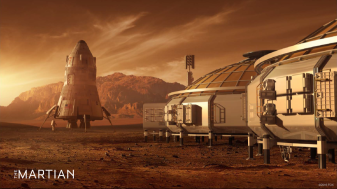
The Martian - base stationEarth-bound nations and their people have a long, long history of fighting each other and not getting along. What happens on Mars, or any celestial body, when Earthly independent nations with their own agendas start mixing with or conflicting with foreign foreign agendas? Watney indeed talked about those guidelines in the film, that applied back on Earth and Earth’s orbits, but what about on Mars?

In an October 2017 article on Smithsonian.com, writer Gbenga Oduntan probes into these issues with some questions regarding the governing of activity on and around Mars. I find it all intriguing because by 2022 and 2028 these manned Mars expeditions will become reality.

Psychological Factors

Mars is around 34.2 million miles away from Earth, which means it would take a manned spacecraft between 150-300 days — depending on the speed of the launch, the alignment of Earth and Mars, and the trajectory of the journey the spacecraft takes — to reach the red planet. The human physiological challenges of a year in spaceflight are numerous. If the trip doesn’t kill you or drive you insane, living on Mars might. The emotional stressors of being away from Earth are perhaps more numerous. Then consider living on an unforgiving, uncooperative alien planet and all sorts of further complexities compound manned expeditions.

[after Mindy has discovered that Watney may be alive]
“Can you imagine what he’s going through up there? I mean, he’s 50 million miles away from home. He thinks he’s totally alone. He thinks we gave up on him. What does that do to a man, psychologically? What the hell is he thinking right now?” — Vincent Kapoor, The Martian

Mars_Voyage_habitat

click here to enlarge

Experts at NASA’s Goddard Space Flight Center and Planetary Science Institute say helping boost the astronaut’s morale on the journey and on the surface of Mars would be the need to have enough living-space and good food for them to garden. Crops from “green walls” could supplement their space-food diet. Of course loading up the spacecraft with these pseudo-Earth human comforts and needs means a heavier payload, more fuel, and more cost considerations. Humans on Earth and in most governed states are required to pass tests to be issued operator licenses for autos and machinery. What sort of licensing tests should there be for Mars? These are only a few of the material, legal, and psychological challenges of manned spaceflights to Mars.

Policing and Martian Rights

The appropriate and safe activity on Mars and her two moons Phobos and Deimos will be practically endless. How should it be governed and policed? What should be permitted for states and corporations like Elon Musk’s SpaceX? Certain manufacturing of drugs and materials requiring sterile atmospheres could be done in space stations. Space and Mars discoveries under present laws can be patented and commercialized. Hence, what should be the legitimacy of Martian mining?

As laws stand now, conducting expeditions for the sake of science and sustenance for Martian missions are granted. However, creating property rights over celestial resources are not. This means the commercial extraction of resources back to Earth is illegal until international space treaties are updated. Unfortunately, history has shown that cooperation between opposing nations has often been hit or miss to put it mildly. It is likely that new laws and treaties for property and resources 34-million miles away will be ignored by Martian workers and their employers. Just ask the Native Americans of the U.S. Like the California Gold Rush of 1848 and the Oklahoma Land Rush of 1889, the U.S. and Luxembourg have made attempts already to gain appropriation of natural resources in space. Essentially the two countries are preparing to issue Carte Blanche to private companies for winner-takes-all acquisitions.

The Intergovernmental Agreements of 1988 and 1999 drawn up for the Columbus Space Station Project then the current International Space Station offer civil and criminal jurisdiction for all nations participating in space exploration. Parties to these agreements set out to govern the conduct and ramifications of international operating environments, particularly concerning the ESA’s (European Space Agency) eleven independent member states. Yet, even the totality of these agreements and policies in several instances are not fully elaborated, they do provide a compass for a comprehensive legal framework that can serve as an example for international space law and a forward-looking view to new developments.

Watney-Space Pirate

“Mark Watney:  Space Pirate.”

Nonetheless, it has become tradition that astronauts, cosmonauts, etc, are almost always subordinate to the hierarchical authority of one commander from their native registered country. That commander’s authority is usually cut-and-dry; final. Like in the naval traditions of hierarchy the ship’s captain has full and ultimate command and it is his/her responsibility for the care and safety of crew and passengers or “space colonists.” These past command traditions and roles will need modernizing however, for space travel and celestial population and survival.

Current Space Station Laws

“I’ve been thinking about laws on Mars. There’s an international treaty saying that no country can lay claim to anything that’s not on Earth. By another treaty if you’re not in any country’s territory, maritime law applies. So Mars is international waters. Now, NASA is an American non-military organization, it owns the Hab. But the second I walk outside I’m in international waters. So Here’s the cool part. I’m about to leave for the Schiaparelli Crater where I’m going to commandeer the Ares IV lander. Nobody explicitly gave me permission to do this, and they can’t until I’m on board the Ares IV. So I’m going to be taking a craft over in international waters without permission, which by definition… makes me a pirate.

Mark Watney: Space Pirate.

As Watney illustrates, there are a plethora of complexities not only aboard a space station orbiting Earth or Mars, but just as many complexities surround stations on the surface of Mars that need to be spelled out. According to the Outer Space Treaty, Mars belongs to everybody back on Earth. Nobody can “own” a celestial body. Today private companies on Earth can go to Mars whenever they choose, construct permanent habs, and start new Martian societies, as long as they do so under the Outer Space Treaty’s laws and bylaws. For good or bad this also includes weaponry. Those operations are not allowed to interfere with operations of others on Mars or in space. As Watney correctly alluded, maritime laws, at least for now, are applicable examples. But as was also touched on, including other independent nations to Martian activities and things are not so clear-cut, yet.

Here in the U.S. if you want to put a satellite into orbit, you must first obtain permission from the federal government. Depending on what activity will be done in space you must get further permission or license to do such activity. However, move outside of Earth-orbit and there are no current licensing agencies to supervise legal ramifications of celestial colonization. Space tourism by private companies has been on the rise for several years so governments are going to have to sort out licensing protocols very soon.

colonizing Mars - NGM

click here to enlarge

Like any new, untouched, pristine area or park, opening them up to the general public means human trash and contamination. The Outer Space Treaty specifically states this activity or behavior by humans or business entities is prohibited and it includes our contaminating microbes. Yet, here’s the Catch-22. Private or government spacecraft, by order of the OST, are required to decontaminate their ships as best as possible before sending and/or arriving on foreign planets. But humans are near impossible to decontaminate because our health depends on these microbes. Places on Mars or on other celestial bodies that may contain water or forms of frozen water and liquids or once did must receive the highest protections and laws possible. Even the most thoroughly decontaminated vessels may need banning from specific areas. Let’s keep in mind though that these laws, their jurisdiction, and enforcement in the end fall only under the U.S. flag. International space cooperation and collaboration among nations and peoples will see unchartered territory in the coming decades. Can it be made easier or harder? How so and how not?

Once again, there will always be titans of commerce who scream about “bureaucratic red-tape” and their (unfounded?) feeling of repression toward “human progress and developement” while their greed lurks in the wings waiting to pounce. History is saturated with these exploitations of resources at the expense of the bio-eco systems and/or the lives of lower-class vulnerable humans. Why would space, Mars, and beyond be any different?

Like 15th century European Empires discovering the New World bringing with them their way of life, materials, waste, and weapons, space debris around Earth-orbits today is already well past a point of substantial risks of collisions. It is only a matter of time before damage to a space station, human injury or loss of life caused by congested operations, overcrowding, trash, and debris will lead to legal and/or political conflicts. How soon should Earth’s international space community hash-out these very real future events? Is it even possible? Will it be easy or hard?


Live Well — Love Much — Laugh Often — Explore & Learn Always

Creative Commons License
Blog content with this logo by Professor Taboo is licensed under a Creative Commons Attribution-NonCommercial 4.0 International License.
Permissions beyond the scope of this license may be available at https://professortaboo.com/contact-me/.