“My definition of a free society is a society where it is safe to be unpopular.” — Adlai Stevenson
As of August 7, 2023, the Movement Advancement Project (MAP) released its annual scorecard for each of the U.S. state’s democracy rating. As I alluded to in my previous blog-post and its comments, my home state of Texas has been passing legislation over the last two–three years which suppress the votes of non-white, anti-conservative, less-advantaged Texans or making easy convenient access to voting stations, and actual voting, increasingly difficult. Over the last 5-7 years it has been ever harder for myself to vote and/or register to vote, and I am a well-educated white man! Now riddle me that one please!
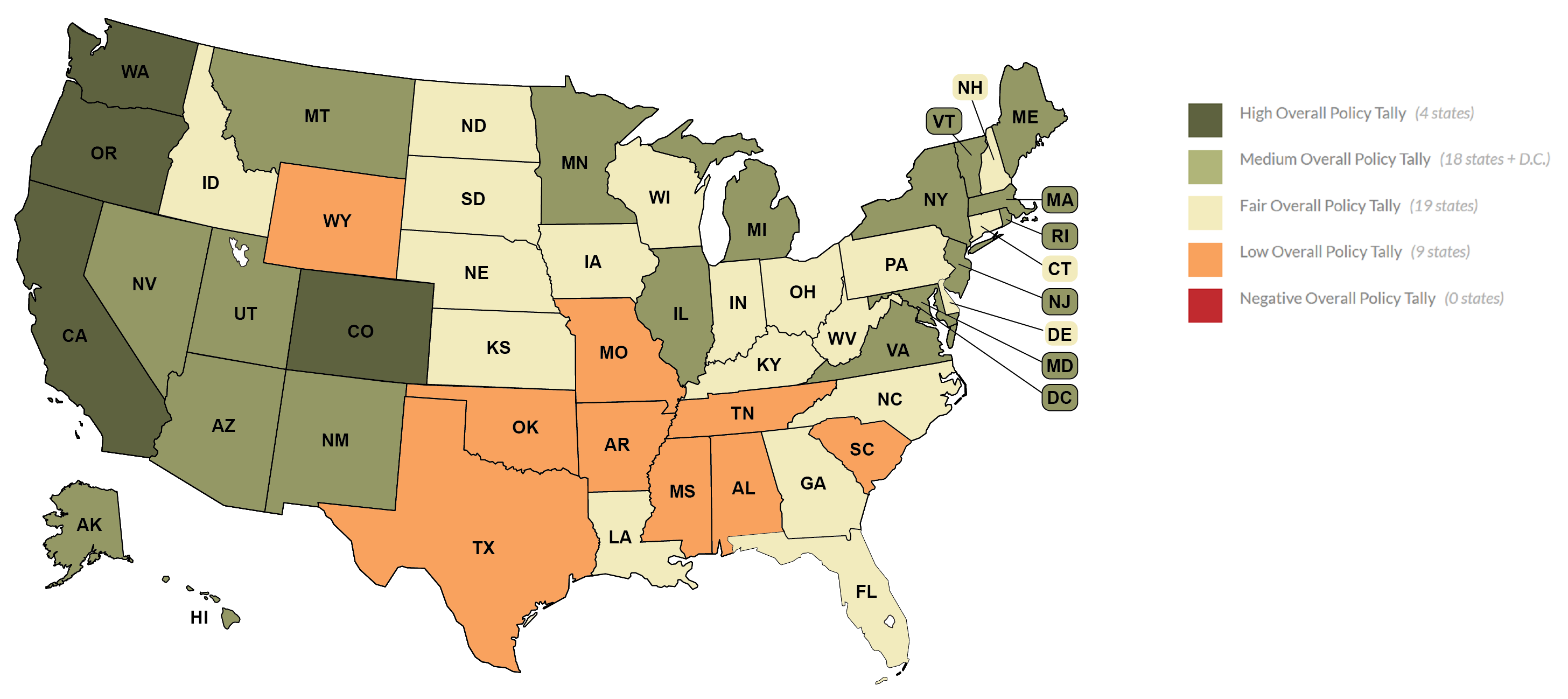
Nevertheless, I was quite interested in knowing what Texas’ scorecard reveals. Not much of a surprise to me our democracy tally has been rated “Low” (in the orange) scoring 6.5 out of 33.5 points. Personally, that’s a fair score given how noticeably more difficult it has become for me—a college educated white man—to vote or re-register to vote after my frequent moves between Dallas and Kerrville, TX for Mom’s declining dementia, and to get this year (as well as 4-yrs ago) a new renewed driver’s license. By the way, have I told you that I am an 8th-generation white Texan with no criminal record or outstanding warrants, fines, over 42-years of employment and paying my share of taxes over those 42-years? Eighth-generation means my family was here in Texas BEFORE it was annexed by the United States in 1845!
As far as MAP’s “Who Votes” and “How to Vote,” two of the three main metrics for scoring, yet again, no surprise whatsoever for Texas’ abysmal ratings: Who Votes — a -0.5/5 and How to Vote — a -0.75/5. Our highest ratings? “Election Security” 4 out of 6, and “Voting in Person” 2.5 out of 5.5. Both of those better scores, yet still weak, I have explained their difficulty mediocrity in detail over the last decade. “Election Security” is cryptic Conservative code for Much Harder to Vote and “Voting in Person” means Hard Registering to Vote, respectively.
Curious to know what four states rate the highest in democracy’s election laws and policies according to MAP? Yes, you read that correctly, only 4 states out of 50, or just 17% of our population of 332-million Americans reside in a state with high-levels of democracy. Let me repeat, just seventeen percent of Americans! Here are those highly democratic republic states:
Washingtonwith31out of 33.5
Coloradowith 30out of 33.5
Californiawith 29.5out of 33.5
Oregonwith 26out of 33.5
Let’s see who the last four states of the Union are with the most undemocratic elections and policies:
47. Tennesseewith 5.5out of 33.5 48. Arkansaswith 5.5out of 33.5 49. Mississippiwith 4.0out of 33.5 50. Alabamawith 3.25out of 33.5
What percentage of the American population do these four states make up? The answer: almost 6%of the American population.
The bottom-line is and what these numbers show when one reviews the entire fifty states on the MAP’s website is that a large portion of the American 50-states and their populations are NOT truly, purely democratic in their elections and policies. I don’t know about you, but I find these facts disturbing, alarming, and they need to be confronted and addressed not just by each individual (legal) American citizen, but also by your district’s House of Representatives and your district’s Senators! Are we not a Constitutional Republic democracy as written in our Charters of Freedom by all six (6) of the Core Founding Fathers? Yes, of course. Then WHY do twenty-nine (29) of our fifty states score a measly grand tally of just 16.75 (or lower) out of 33.5 democracy data-points? Those scores are abysmal!
What has happened to democracy in the United States to rate that horribly on the major points of what defines a TRUE democracy?
Try to Live Free – Love Much – Laugh Often – Learn Alot More
Since at least 1994 I’ve always been intrigued to know how my home state (Texas) ranks in Quality of Living tables compared to the other 50 U.S. states. Why? Very simple: affluent Texans, many of which are only first, second, third, or perhaps fourth generation Texans, arrogantly boast that Texas (at least politically) is hands-down THE best state in the Union. Yes, I hear this from fellow Texans quite often, mostly in the rural areas. I have heard these claims most all of my six decades of life while living here. It seems to be a personal source of deep-seeded pride whether justified or not.
But I have always been greatly puzzled by their expressed, audacious claim. Aside from one’s own biased personal opinion, by what metrics, by what standards could these whiteTexans possibly be referencing? I regularly check these quality of life criteria, every 1-2 years minimum, not just for the required oversight and civic duty/privilege by a concerned, caring citizen, but also to monitor how our Lone Star State is progressing: Is it thriving, stagnate, or declining?
According to US News & World Report, the data points collected in ranking the U.S. states overall are many. The two primary categories most all Americans most care about are healthcare and education for its residents. Secondary points are public safety, social and occupational opportunities, economy, roads, bridges, environment, internet access and other infrastructure.
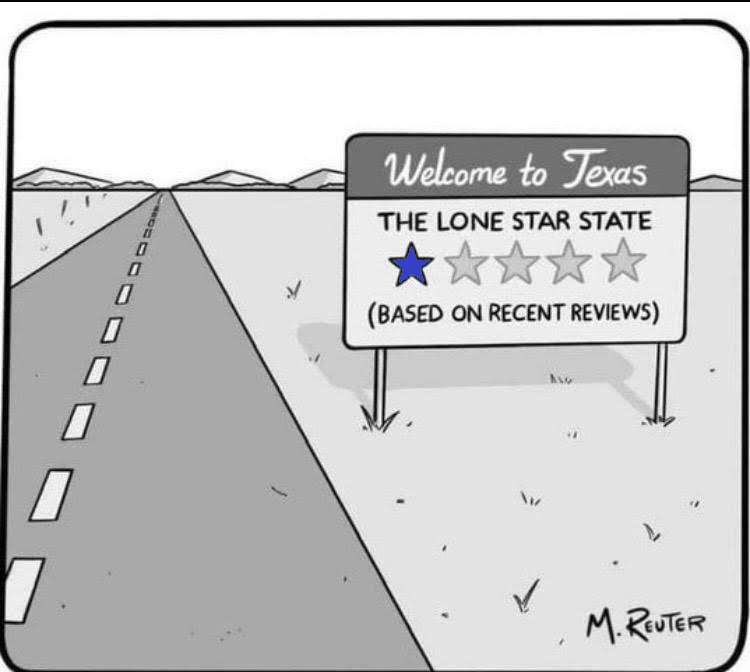
Well, sorry (again) Texas, the 2023 facts and data are not good at all for Texans and their “proud friendly” state. The overall quality of life in Texas is below average: ranked35thout of 50 states. In fact, Texas doesn’t rank #1 in any of the eight primary categories, much less the lower priority categories. In 2021 Texas ranked 31st overall, today down four places after two years. It ranked 36th in 2018 and 38th in 2017. There is however, one particular category Texas has always excelled in: its economy. There has always existed in Texas-economics very plush advantages for past and present wealth-accumulators to make much more excessive wealth; tax-codes and opportunities abound for Texas’ upper-class. This is exactly why Elon Musk, originally of South Africa, the founder/CEO of SpaceX, Tesla, present owner of Twitter, and a number of other mega-businesses, moved here and now calls Texas his home. He is just one of many of America’s wealthiest persons living in Texas.
Ironically, the one category Texas has never excelled in since these stats and data-points were first collected is its Individual Median Income—it is $38,059 for 2023 single-earner Texans. Sadly, according to SmartAsset’s study, individual Texans need to earn a minimum $44,865 per year and closer to $133,926 to be considered “middle-class,” or to only have a decent standard of living while working and alive, barring any unforeseen emergencies or catastrophes.
from “You Might Be From Texas If…” by author and cartoonist Nick Anderson
from “You Might Be From Texas If…” by author and cartoonist Nick Anderson
from “You Might Be From Texas If…” by author and cartoonist Nick Anderson
from “You Might Be From Texas If…” by author and cartoonist Nick Anderson
It becomes quite obvious why there is such a large disparity in the Lone Star States’ Quality of Life categories, like the economy versus all other categories. What is it? What drives this lopsided metric? It’s income and economic inequality. Severe? Probably. Improved? Not at all. Digressing, expanding? Most definitely.
So one must ask these (typically rural and far-suburban) Texans, What verifiable facts and data are you quoting to conclude that Texas is THE best state in the Union to live? My next two questions to them are 1) What zip code do you live, and 2) Where exactly have you and your family been experiencing Texas the last at least 30–40 years?
Care to guess what bewildering answers I usually get?
∼ ∼ ∼ § ∼ ∼ ∼
Addendum Aug. 22, 2023 — In conjunction with this post I am connecting or linking my next blog-post to this one as a follow-up. It is entitled “Rating Democracy in All 50 U.S. States.”
Try to Live Well – Love Much – Laugh Often – Learn Alot More
The Senate of the United States shall be composed of two Senators from each State, elected by the people thereof, for six years; and each Senator shall have one vote. The electors in each State shall have the qualifications requisite for electors of the most numerous branch of the State legislatures.
— 17th amendment to u.s. Constitution, ratified april 8, 1913
The main issue and problem for what the 17th Amendment attempted to correct for Congress, specifically for the Senate, was that Article 1, Section 3, Clauses 1 and 2 of the 1787 Constitution dictated that each state legislature appointed its own two state Senators for an initial six-year term. Regardless of the state’s population size, each state was entitled to two senators with two “equal” votes in the federal Congress. This helped reassure anti-federalists of the time, and previously covered in Part 5 of this series, that an overly centralized power-base like the federal government would not devour state’s powers but instead provide an oversight to the House of Representatives whose members were elected by popular vote by their state’s citizens.
Across the aisle, opponents countered the anti-federalist argument that within such a circle of powerful state legislatures, there existed two primary problems: 1) legislative corruption influenced by monetary gains and interests, and 2) electoral deadlocks paralyzing necessary legislations for all the people’s interests. And since the Amendments’ 1913 ratification another major problem now persists: no reelection term-limits for Senators (see Table below)—essentially an identical chronic problem today with Supreme Court Justices’ lifetime terms. Notice the lengths of service for these 25 Senators:
25 Longest Serving U.S. Senators To-Date*
senators
dates of service
length of service
Robert C. Byrd (D-WV)
Jan 3, 1959–Jun 28, 2010
51 years, 5 months, 26 days
Daniel K. Inouye (D-HI)
Jan 3, 1963–Dec 17, 2012
49 years, 11 months, 15 days
Patrick J. Leahy (D-VT)
Jan 3, 1975–Jan 3, 2023
48 years
Strom Thurmond (D, R-SC)
Dec 14, 1954–Apr 4, 1956 and Nov 7, 1956–Jan 3, 2003
47 years, 5 months, 8 days
Edward M. Kennedy (D-MA)
Nov 7, 1962–Aug 25, 2009
46 years, 9 months, 19 days
Chuck Grassley (R-IA)
Jan 3, 1981-present
42 years, 1 month, 7 days
Orrin G. Hatch (R-UT)
Jan 3, 1977–Jan 3, 2019
42 years
Carl T. Hayden (D-AZ)
Mar 4, 1927–Jan 3, 1969
41 years, 10 months
John C. Stennis (D-MS)
Nov 5, 1947–Jan 3, 1989
41 years, 1 month, 29 days
Ted Stevens (R-AK)
Dec 24, 1968–Jan 3, 2009
40 years, 10 days
Thad Cochran (R-MS)
Dec 27, 1978–Apr 1, 2018
39 years, 3 months, 6 days
Fritz Hollings (D-SC)
Nov 9, 1966–Jan 3, 2005
38 years, 1 month, 25 days
Mitch McConnell (R-KY)
Jan 3, 1985–present
38 years, 1 month, 7 days
Richard B. Russell, Jr. (D-GA)
Jan 12, 1933–Jan 21, 1971
38 years, 10 days
Russell B. Long (D-LA)
Dec 31, 1948–Jan 3, 1987
38 years, 3 days
Francis E. Warren (R-WY)
Nov 18, 1890–Mar 3, 1893 and Mar 4, 1895-Nov 24, 1929
37 years, 4 days
James O. Eastland (D-MS)
Jun 30, 1941–Sep 28, 1941 and Jan 3, 1943–Dec 27, 1978
As with the transgenerational power-hold Supreme Court Justices currently possess over the American people, the Senate and Senator votes today have an even more detrimental, anti-democratic effect than they did in 1788 to 1913. With modern and recent service-lengths averaging between 35–47 total years; about 45-years of one political (partisan?) ideology or covering about two generations of Americans. Consequentially, the U.S. Senate has become a major roadblock to effective, efficient, critical governing to protect the American people during times of economic and/or public safety and general health, even sometimes life or death, e.g. COVID-19. The Senate simply does not move fast enough for modern forms of crises management. Furthermore, the lethargic 21st-century Senatorial condition confers spurious political advantages to small tiny states, their senators, and their 18th-century Constitutional, economic-corporate and political dominance which is gifted in gratis by two equal votes regardless of state size.
During the 1787 Philadelphia Convention and the drafting of our Constitution, many of the Founders recognized what the Connecticut Compromise would do, at least over a period of time. They could not have been more correct. As the overall population of the U.S. has reached nearly 337-million today, it means the smaller, tinier states have gained more federal money and more authority in the Senate as well as more weight in the Electoral College over the last 235-years. Both James Madison and James Wilson ardently opposed the Connecticut Compromise, and Wilson specifically spelled out that ‘equal state Senate votes would mean that a minority of voters could block the will of the majority,’ or of the American people. And this is exactly what has happened in today’s Congress.
The twenty-eight smallest states of the Union today, representing 20% of the American population, have 56% of the votes in the Senate. This disparity and distortion over two centuries now is precisely why the increased voting strength between states with wealth and population versus those without and much smaller populations has occurred, and as a result, the majority receives less and less federal representation. This is also reflected in many state governments as well. With each passing decade the Constitution’s 18th-century “minoritarian” equal state-voting principle impacts national policies and allocation of funds more and more, too often at the expense of the greater American good.
A “New” Senate: Reflecting the Popular Will
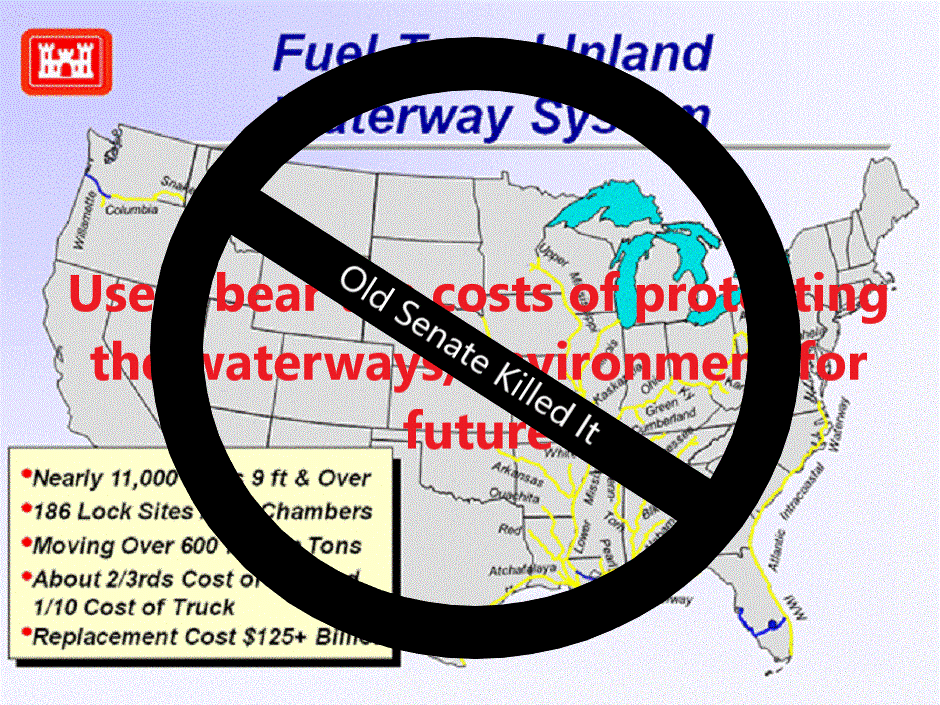
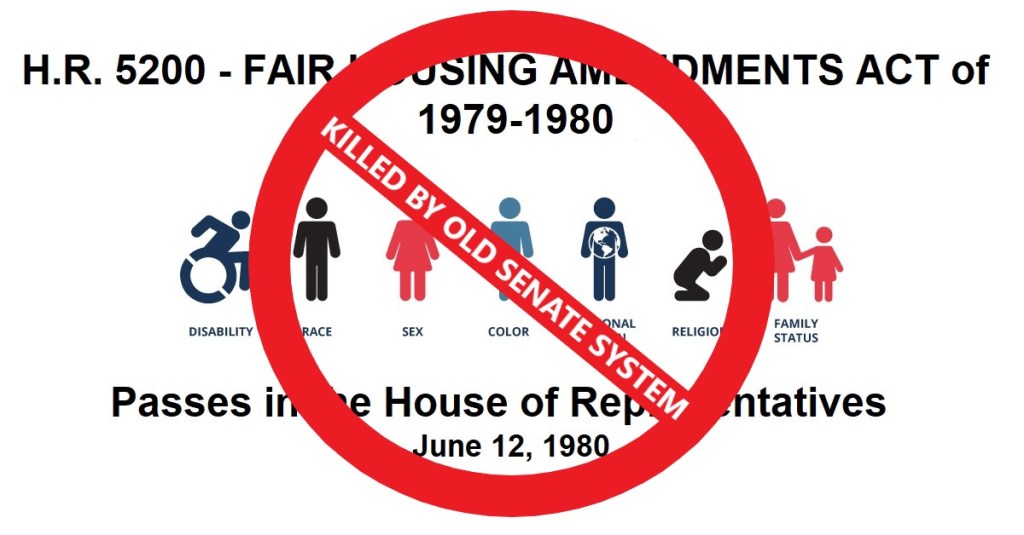
The better welfare of the greater national good and a more truer Republic democracy by a new Senate-voting system significantly outweighs the aforementioned flaws, disparity, and distortions of keeping the 18th-century system. If this New Senate were structured primarily on the state’s population, and to a lesser extent say the smaller-sized states’ X-quotient of wealth and resources toward the national well-being, surely this would offer a more equitable system assuring the overall national popular will was more realized. To demonstrate this reform, the following two slideshows illustrate just how a reimagined, past Senate voting would’ve substantially changed our last twenty-plus years of national policies, some of which our “Old Senate” system has had (very?) harmful consequences.
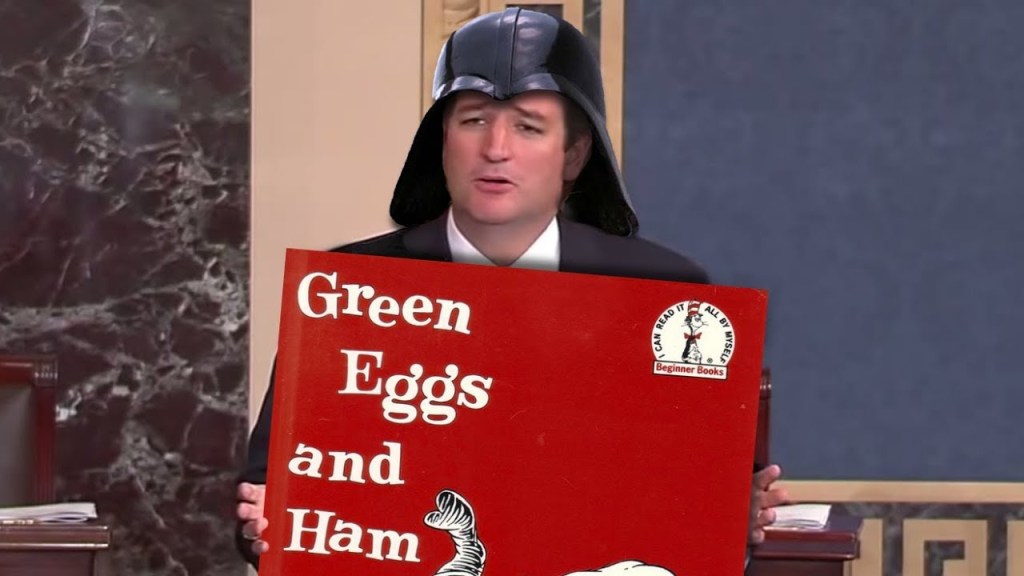
No Senate filibustering after John Calhoun (1840’s) or Ted Cruz (2013) stopping the Senate vote!
Moreover, several different variances in domestic and foreign policies (see following slides) would have certainly been enacted or rejected had a “New” 20th– or 21st-century Senate voting system been put in place in 1970:
Under the “New” Senate voting system, recently appointed and confirmed 53-year old Supreme Court Justice Brett Kavanaugh would have never been voted in. He would have lost by a sizable margin—approximately by 20% or more—by the twenty-two larger states (and Senators) that makeup about 80% of the American population. Justice Kavanaugh only received his confirmation because of the 28 smallest states and their (ultra) Conservative Senators’ votes. In a new Senate voting system reflective of Americans and their interests, Kavanaugh would’ve been easily rejected. To put it a different way, Judge Kavanaugh’s lifetime appointment to our highest court in the land—that will affect 2-4 generations of Americans—was accomplished purely by a fossilized relic of our 18th-century Constitution’s “equal state Senate voting rule.” No debate.
Proof the Electoral College is Undemocratic
In 2024 Americans will elect the next President and Vice-President using the antiquated Electoral College system created by the 18th-century mindsets held in the Constitution. By that system, all actual votes will be cast by “electors,” not the American people. This may come as a shock to some American voters. Despite their dismay, it is completely true; the U.S. is not a comprehensive democratic Republic.
The key justifications for the invention of our Electoral College imparted by Convention delegates in 1787 no longer exist today. One must remember the historical context of what the Philadelphia delegates were negotiating and fiercely debating at the time. Many of those delegates felt average American voters would not sufficiently know the candidates governing experience, educational level obtained, and much less their personal backgrounds. These conditions were further exacerbated by transportation and communication limitations for most all American voters, thus making well-informed decisions difficult at best. That scared the Ba-jebus out of nearly everyone of them—they could not risk a narcissistic demagogue President or administration getting naïvely elected, then worse become a tyrannical king or American Caligula/Caesar. Thus, the Electoral College was created for an 18th-century nationwide citizen-conundrum.
None of these problems exist today, nor is the modern Originalist argument for the Constitution’s (divine?) integrity a persuasive argument against a purely popular vote by the people. And here is the most damaging function of today’s Electoral College: the Underrepresentation of States and their Electors. (see following Table)
state
population 2023
% of total population
electoral now
proportionate electoral
disc
1. California
40,223,504
11.92%
54
64
-10
2. Texas
30,345,480
8.99%
40
48
-8
3. Florida
22,359,250
6.62%
30
36
-6
4. New York
20,448,194
6.06%
28
33
-5
5. Pennsylvania
13,092,796
3.88%
19
21
-2
6. Illinois
12,807,072
3.79%
19
20
-1
7. Ohio
11,878,330
3.52%
17
19
+2
8. Georgia
11,019,186
3.26%
16
17
+1
9. N. Carolina
10,710,558
3.17%
16
17
+1
10. Michigan
10,135,438
3.00%
15
16
+1
11. New Jersey
9,438,124
2.80%
14
15
+1
12. Virginia
8,820,504
2.61%
13
14
-1
13. Washington
7,999,503
2.37%
12
13
-1
14. Arizona
7,379,346
2.19%
11
12
-1
15. Massachusetts
7,174,604
2.13%
11
11
0
16. Tennessee
7,080,262
2.10%
11
11
0
17. Indiana
6,876,047
2.04%
11
11
0
18. Maryland
6,298,325
1.87%
11
10
+1
19. Missouri
6,204,710
1.84%
10
10
0
20. Colorado
5,997,070
1.78%
10
10
0
21. Wisconsin
5,955,737
1.76%
10
9
+1
22. Minnesota
5,827,265
1.73%
10
9
+1
23. S. Carolina
5,266,343
1.56%
9
8
+1
24. Alabama
5,097,641
1.51%
9
8
+1
25. Louisiana
4,695,071
1.39%
8
7
+1
26. Kentucky
4,555,777
1.35%
8
7
+1
27. Oregon
4,359,110
1.29%
8
7
+1
28. Oklahoma
4,021,753
1.19%
7
6
+1
29. Connecticut
3,615,499
1.07%
7
6
+1
30. Utah
3,423,935
1.01%
6
5
+1
31. Iowa
3,233,572
0.96%
6
5
+1
32. Nevada
3,225,832
0.96%
6
5
+1
33. Arkansas
3,040,207
0.90%
6
5
+1
34. Kansas
2,963,308
0.88%
6
5
+1
35. Mississippi
2,959,473
0.88%
6
5
+1
36. New Mexico
2,135,024
0.63%
5
3
+2
37. Nebraska
2,002,052
0.59%
3
3
0
38. Idaho
1,920,562
0.57%
4
3
+1
39. W. Virginia
1,775,932
0.53%
4
3
+1
40. Hawaii
1,483,762
0.44%
4
2
+2
41. New Hampshire
1,395,847
0.41%
4
2
+2
42. Maine
1,372,559
0.41%
2
2
0
43. Montana
1,112,668
0.33%
4
2
+2
44. Rhode Island
1,110,822
0.33%
4
2
+2
45. Delaware
1,017,551
0.30%
3
1
+2
46. S. Dakota
908,414
0.27%
3
1
+2
47. N. Dakota
811,044
0.24%
3
1
+2
48. Alaska
740,339
0.22%
3
1
+2
50. D.C.
715,891
0.21%
3
1
+2
51. Vermont
647,156
0.19%
3
1
+2
52. Wyoming
583,279
0.17%
3
1
+2
Reviewing the Table above, did you note how many states are under-represented and how many are (grossly) over-represented? Nine (9) states are (very?) under-representative of their people’s votes, and thirty-five (35) states are (very?) over-representative of fewer people’s votes! Even worse, those nine under-represented states are this nation’s most populous states, with real people, yet unreal Electoral votes! In a sense, the twelve (12) overly-represented states are/have been ghosting, or inventing unreal Electoral votes since at least 1960 and the Twenty-third Amendment.
Finally, the Electoral College promotes harmful, sometimes disastrously dueling, hyper-divisive politics or duopoly partisanship between the two major parties. This deadens civic-political discourse and impedes policy reforms and/or creation as we’ve seen over the last 2-3 decades with the chasm widening more and more every four-to-eight years. If that persists, it will be catastrophic for this country as well as democracy as a whole around the world.
∼ ∼ ∼ § ∼ ∼ ∼
In the Conclusion of this 7-part series, I want to cover more extensively Gerrymandering and the 2019 Supreme Court decision Rucho v. Common Cause and how that ruling has had very adverse affects on our Republic democracy and today badly distorts election outcomes. I will also get into HOW we must approach and construct a proportional representation system that actually DOES reflect a true democracy.
I hope those who are still following this series will find it helpful for your own civic benefits for yourself, your state, and our country. Thank you again everyone for your patience with me and my often slow writing and posting. Please feel free to leave your thoughts and comments below.
Live Well – Love Much – Laugh Often – Learn Always
“I know no safe depository of the ultimate powers of the society but the people themselves; and if we think them not enlightened enough to exercise their control with a wholesome discretion, the remedy is not to take it from them, but to inform their discretion by education. This is the true corrective of abuses of constitutional power.”
Thomas Jefferson, letter to W.C. Jarvis, 1820
The higher the education obtained by all American youth and young adults—in some cases, students in their 40’s or 50’s even—university studies have shown the more likely those citizens will be civically engaged and as a result regularly vote in national, state, and local elections with needed intellectual prudence.
the University of Texas – Austin Clock Tower
We now continue from Part 4. My hope in writing this series is to assemble or reassemble the vital links between civic virtues and privileges, initiate adequate literacy, and most importantly clarify and restore some historical and U.S. Constitutional literacy. In doing so, my vision and hope is that any who might read this series will find some tools and/or ideas that inspire them to become more civically understanding, thoughtful, tactful, more civically wise, respectful, and inclusively tolerant, engaged American citizens. This is truly my hope. And I am certain that our nation’s six core Founding Fathers would agree with and support this objective. First Lady Eleanor Roosevelt eloquently and profoundly put this mission into pristine focus:
“Our children [and adults alike] should learn the framework of their government and then they should know where they come in contact with the government, where it touches their daily lives, and where their influence is exerted on the government. [This] must not be a distant thing, someone else’s business, but they must see how every cog in the wheel of a democracy is important and bears its share of responsibility for the smooth running of the entire machine.”
Emphasis mine
Another hope and reason I am writing this in-depth series is really quite simple. It has already been summed up brilliantly by one of our country’s most famous prolific Presidents:
“The ballot is stronger than the bullet.”
Abraham lincoln
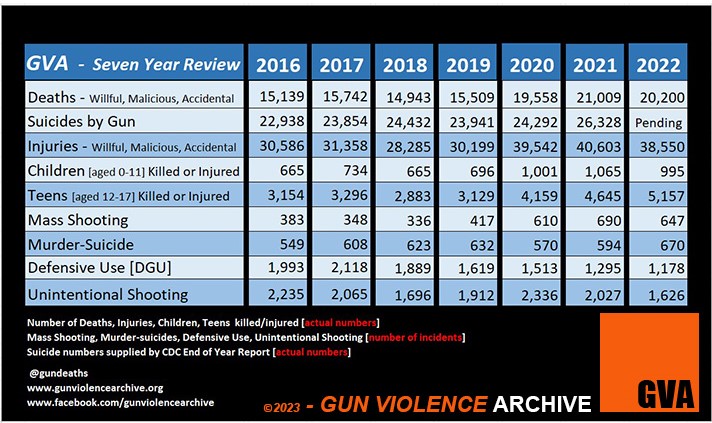
There is no debate whatsoever that since August of 1966, at the University of Texas Clock Tower and the random murder of 17 people, 33 wounded, gun-violence and mass shootings in the U.S. has only skyrocketed and today has become almost normal and expected. As of May 23, 2023, fifty-seven years later, domestic violence or homicide by guns in the U.S. resulting in death has already reached 16,652, of which 236 were mass shootings or mass murders. A staggering and appalling increase just in the last ten years; mindboggling really.
Obviously, during the last 20-30+ years Americans and their (representative?) Congress members are not comprehending the alarming, epidemic rise of gun-violence in their own country and townships, much less comprehending Lincoln’s famous, prophetic statement above. What has to be done? What must be done?
We have been doing NOTHING all this time, and why is it STILL not working!?
A very dear friend of mine
One of my strong recommendations or reply to those profound quotes are 1) do precisely what Eleanor Roosevelt lays out above, 2) once gaining an above-average or higher understanding of how your own government is legally bound by/to the U.S. Constitution, get engaged with it and assure your/our government officials perform their sworn duties strictly within the U.S. Constitution’s legal boundaries. Yes, I am saying become an aficionado or Constitutional para-legal. If all of us don’t do this, we see over the last 57-years the dire consequences! And finally 3) find inspiration and initial steps or action-plans from this series to implement #1 and #2.
We were never originally designed to be or become anAthenian-styled government! Though the delegates of the Philadelphia Convention in 1787 had fire-branded arguments over how the president should be elected and exactly how much voting power individual states should have in Congress, in the end they had constructed a near satisfactory balance—that is, for 1787 and the foreseeable future. They had not, however, satisfactorily resolved the glaring issue of elites, specifically the wealthy, controlling or heavily influencing government policy at the demise of equal influence by the ordinary, “surviving” citizens. This fervent, often nasty battle both then and today is/was really about elitism and populism. It still very much matters right now in the 21st-century and foreseeable future.
ancient Athenian government – fresco by Cesare Maccari (1889)
Many of us today might consider the importance of elitism vs. populism as critical to individual, political human rights. On the contrary, it was not so simple as that in 1787 during the convention in Philadelphia. The fact is that even though the original Founding Fathers believed in general civil equality, they were quite opposed to full political equality to the masses, yes, even lowly white-caucasian men, let alone non-whites or non-elites. Why?
Simple answer: pedigree and socio-educational status and merit.
Let me point out again: socio-educational achievements. That is exactly what Eleanor Roosevelt was also endorsing over 160-years later, perhaps on several levels in opposition to the original Founding Fathers’ concepts. Most of the Philadelphia delegates also felt gerrymandering was perfectly acceptable in gaining or maintaining one’s political party’s government control and interests. Believe it or not, most of the Founding Fathers felt it was quite normal to posses and to widely allow racist views/opinions, employ methods of wealth discrimination, exhibit (privately and publicly) prejudice toward non-heterosexuals, and freely show or verbalize misogynistic prejudices and behaviors. Yes, believe it or not this was indeed our lauded Founders and their well-known 18th-century mindsets. However, after one or two generations and by the 19th– and 20th-centuries this began to change. A much more inclusive view of truer political equality and representation for all Americans began to emerge.
For example, popular pressure pushed into legal adoption for the 17th Amendment:
The Senate of the United States shall be composed of two Senators from each state, elected by the people thereof, for [a term of] six years; and each Senator shall have one vote. The electors in each State shall have the qualifications requisite for electors of the most numerous branch of the State legislators. […]
Amendment Xvii, ratified April 8, 1913
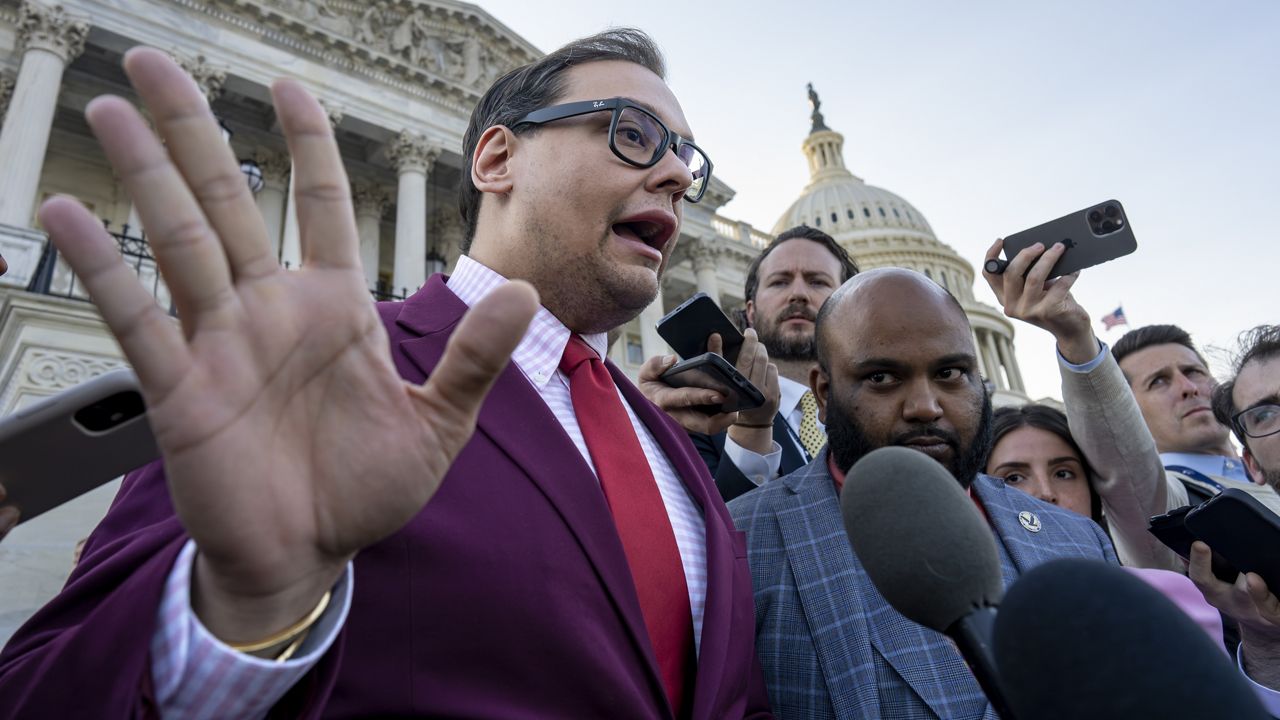
Sadly, in 2020 New York elected Republican House Representative, George Santos, somehow completely bypassed, undermined, and invalidated the entire 17th Amendment protocols and legal enforcement of our Constitution, including my emphasis of it above. How was this possible? This is the deteriorating distorted condition of our very own Constitution by our own (Republican?) elected officials not doing their proper, oath-avowed jobs. Period. No debate.
Rep. George Santos, R-N.Y., speaks to reporters outside after an effort to expel him from the House, at the Capitol in Washington, Wednesday, May 17, 2023. (AP Photo/J. Scott Applewhite)
Nevertheless, the popular movements of the early 20th-century were instrumental in increasing political equality for Americans. There has been a growing confidence and fact for the long-term effects of a truer representative government that can and will make better decisions when there is much less “elite” control of our institutions, specifically by the wealthiest that far too often govern or manipulate government to serve their own personal interests. The 19th-century progressive democratization of equal political rights in America improved the performance and duties of our representative government demanding its leaders to at least consider or truthfully represent its constituent’s broader interests and viewpoints in making legislative decisions. And more importantly, holding those government representatives accountableto their avowed office’s duties! This popular 20th-century movement had massively profound effects for the nation and its people.
For example, the public pressure directly induced our anti-trust laws that rightly control or manage massive concentrations of economic-political power such as the Rockefeller-founded Standard Oil Trust, that is now today known as ExxonMobil, the LARGEST investor-owned oil company in the entire world. Yet, this is to be expected. Truth be known of this uniquely American tradition: history has shown our government institutions often bow to controlling groups to change government policies to favor super wealthy mega-corporations.
Our Constitution’s Flaws and Failures
Contrary to these excellent 20th-century popular federal reforms, our antiquated 18th-century Constitution has two different, but equally fatal flaws written into it:
They undermine and consequently violate modern standards and definitions of republican political equality.
They also repeatedly have more anti-democratic effects than when they did when they were created.
What do I mean exactly by these two flaws? For one, Supreme Court justices receive lifetime tenures when appointed, an 18th-century mindset due to average lifespans then. Second, each state in the Union receives equal voting rights in the Senate and in the Electoral College, despite those with miniscule populations. Third, the Supreme Court’s 2019 landmark decisions stating the Constitution permits perpetual, partisan manipulations of upcoming elections via gerrymandering. Fourth, the incredibly obdurate Article V procedures for Constitutional amendments, which will be further addressed later in this series. Fifth, the Presidential powers of judicial review and veto being not just controversial, but anti-democratic as well.
The U.S. Supreme Court is often considered to reside outside of American politics, that it was originally designed to be the final arbiter of equal justice according to the Constitution and its laws. Hence, it should also act as guardian and interpreter of the Constitution and laws of the land. Though this impression of the nation’s highest court is correct in theory, it is not true in practice; never has been since 1787. Why is this? The quick simple answer is that it was never designed to be “outside” of civil or congressional-executive politics.
As mentioned earlier, justices are not elected by the general public. Justices, as also mentioned, are appointed by the standing President then confirmed by the current Senate. Justices serve on the Court for their lifetimes unless impeached by the House of Representatives, which requires a supermajority vote—i.e. 290 votes from 435 representatives—then followed by a conviction in the Senate. Obviously, impeachment is near impossible when Party-line favoritism and bias is rampant, as it is in today’s politics. Due to these 1787 design flaws, justices are literally unaccountable for their decisions by the very officials who are indeed very political!
From the very beginning, at the Philadelphia Convention, delegates imagined and drafted our Constitution for a Supreme Court composed of men chosen by a political leader, the President. And most often those personal political viewpoints of those selected men/justices aligned with that current President’s and his political party’s viewpoints. This has certainly been demonstrated since the late 1990’s but unequivocally began with President George W. Bush’s two terms.
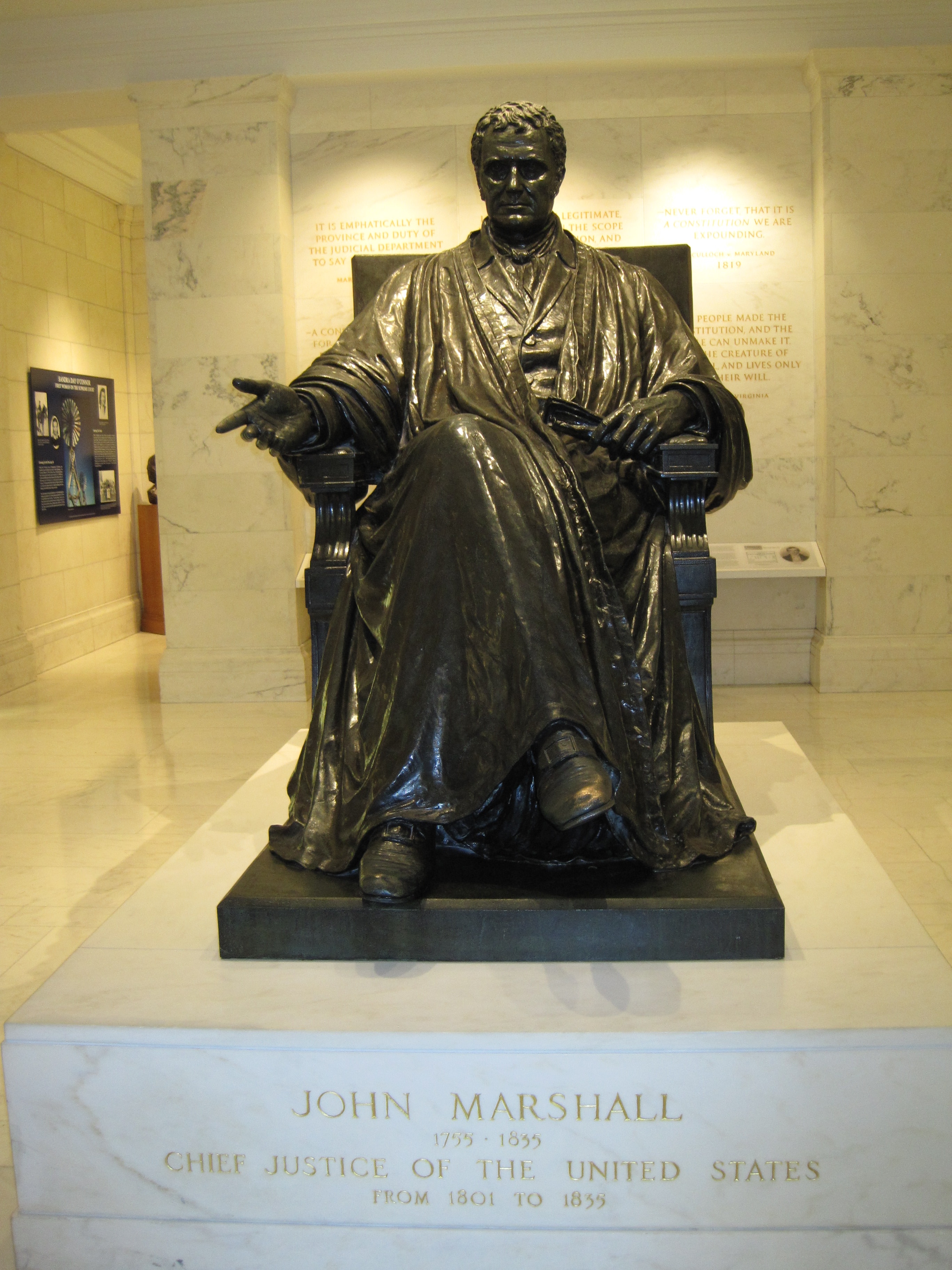
Going back to the early 1800’s, partisan court rulings and appointments were already raging. Chief Justice John Marshall and President Thomas Jefferson exchanged heated arguments over the Supreme Court’s judicial independence, or lack of, and its final authority. Their battle started with the last minute appointments, or “midnight appointments” of strictly Federalist judges by President John Adams, himself a Federalist. Knowing full well that Marshall despised Jefferson and his Republicans, John Adam’s very last act as President and perhaps in defiance to his once closest colleague, he appointed John Marshall as Chief Justice of the Supreme Court. Marshall swore in Jefferson as the nation’s third president surely under degrees of resentment by both men.
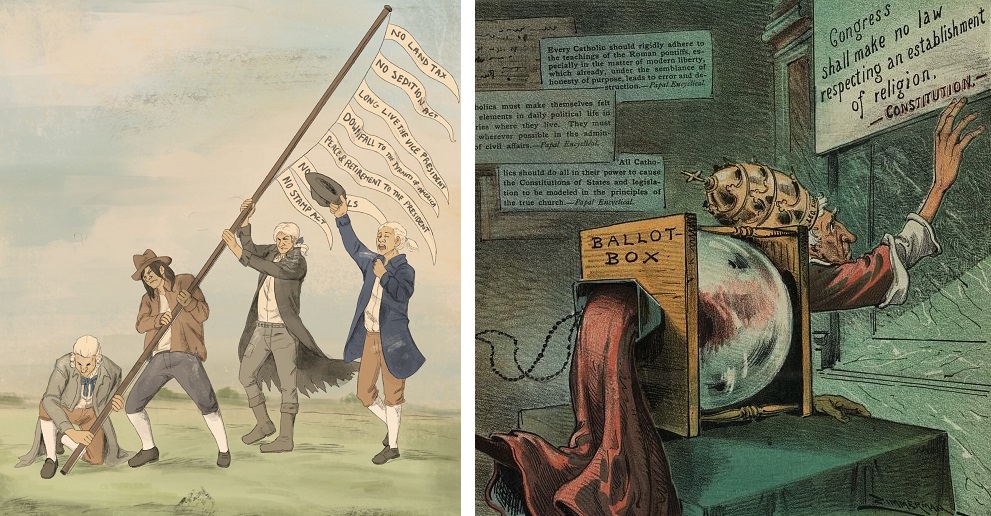
The campaigns and election of 1799–1800 went down in history as one of the most divisive, partisan campaign rancor and nastiest infighting between all three Branches of Washington D.C. in American history. However, the bitterness and power-struggles between Jefferson and Marshall did not end there.
Political cartoons of 1800 American Presidential campaigns – (left) First Amendment issues, (right) Separation of Church & State issues
Over the coming years legislative, executive, and judicial wars between opposed political ideologies—primarily Jefferson vs. Marshall—culminated in at least two paramount Supreme Court decisions:
Stuart v Laird — In this case, 5 U.S. 299 (1803), the U.S. Supreme Court upheld the repeal of the Judiciary Act of 1801, enacted by outgoing President John Adams and his Federalist Congress, which effectively abolished the existing circuit courts. The decision also affirmed the constitutionality of requiring Supreme Court justices to ride circuit.
Marbury v Madison — In case, 5 U.S. 137 (1803), the Supreme Court established the principle of judicial review—the power of the federal courts to declare legislative and executive acts unconstitutional. The unanimous opinion was written by Chief Justice John Marshall.
What did these two rulings mean and do exactly? In Stuart v Laird, Jefferson was able to purge all the Federalist circuit court “midnight” judges quickly appointed by former President Adams. In doing this Adams had hoped it would maintain some residual political control for his party as he departed—instead it was a win for Jefferson. In Marbury v Madison, by asserting the power to declare acts of Congress unconstitutional (which the court would not exercise again for over fifty years), Marshall (and the Federalists) claimed for the court an enormous authoritative position as interpreter of the Constitution independent of Congress and the White House—a win for Marshall and Adams.
As a result of these early 19th-century power-authority battles, today we see the same heated, divisive political wars continue over Supreme Court Justice appointments and those justices political backgrounds and affiliations, begging the question: are modern SCOTUS justices truly “independent” of Washington D.C.’s political hostility and influences?
As the Constitution now stands and has been practiced and/or protected for the last two-plus centuries, exactly how impactful and for how long are lifetime SC justice appointments affecting this nation’s governing? Furthermore, does the Supreme Court today adequately respond to the country’s popular will? Do lifetime appointments offer frequent decisions in favor of a minority party or group?
∼ ∼ ∼ § ∼ ∼ ∼
In Part 6: A New U.S. Constitution, I will address the problem of our modern Anti-democratic Senate and explore how we might restructure it into a more functional, civically responsive new Senate. I also plan in the next portion of the series to tackle the Electoral College, what it was designed for then, in 1804, and what it has become today. I hope all of you can join and share any thoughts or comments and feedback. Thank you as well for your continued patience with this drawn out series and understanding my daily, personal family-living situation while writing this series. My sincere gratitude to you all.
Live Well – Love Much – Laugh Often – Learn Always
As we near our 2024 U.S. federal-state elections and their ramping up political campaigns of patent rhetoric, of misdirected, or even audacious lies and disinformation, one primary target radical MAGA Republicans are obsessed with and annoyingly screaming about is …inflation. Inflation that technically began on February 24, 2022. They place all blame for this current hyper-inflation on President Biden and his political party. This is no surprise, of course, considering the next reasonable target they might have, and I use “reasonable” very loosely here, would be Hunter Biden’s laptop. HAH!
But let’s use our better, mature judgement and our critical-thinking and analysis skills we learned from middle- to high-school to perhaps under-grad to determine the true source of this inflation.
The above diagram basically illustrates the distribution chain of goods and services from crude or basic materials from Earth, to production, refining, or manufacturing, to transportation, to more distribution or delivery-transportation, to retailers, then finally to consumers or us average Americans. Study the diagram closely. What processes or stages make up the bulk of the distribution chain?
Take a moment to consider carefully.
Do you think you have it? It isn’t obvious with a Nano-second first glance like most super busy Americans do when listening to or reading about political campaigns or propaganda packed with deception, disinformation, diversion, or blatant lies. What is it that makes up the bulk of the world-wide distribution chain?
Movement.
It is the movement of these raw materials to production, refining, or manufacturing facilities, then movement to transportation hubs like sea ports, cargo trains and planes, or truck loading bays, then typically to large warehouses everywhere for (temporary) storage before those goods/materials are again loaded onto regional or local transportation-delivery vehicles or vessels to be unloaded at retail stores for us buying consumers. Now, how is all of this “movement” of materials and goods accomplished? What drives all this distribution forward from start to finish or from supply to demand?
Energy.
What type of energy for 21st-century transportation, typically?
You guessed it… fuel, gasoline, petrol.
Where does most of the world’s “energy” come from?
Ding, ding, ding! 🛎 Yep, you guessed it, crude oil. And what nations produce the most crude oil, oil-refining, and distribution or export of fuel, natural gas, and petroleum byproducts? Let’s take a look.
Investing News Network (INN) provides independent, trusted news and education for financial investors in over 40 targeted categories, including oil and petroleum production and export. According to their March 2023 update, the Top 10 Oil Producing Countries are as follows:
To further clarify the Brazilian question above in the table, the ❓ means: how will the newly elected President of Brazil align himself and how their government aligns itself with the U.S. and Western alliances against Russia’s war in Ukraine, will all determine their production, export, and prices of their 3,689,000 bpd for the West. It doesn’t require a lot of deduction and analytics from the above diagram to determine that the majority of energy production/export, which heavily influences the distribution chain of transported goods/fuel around the world, is squarely in the hands of Russian allies or closely tied nations to Russia, specifically Vladimir Putin and his Kremlin regime. Do the math for yourself from the above BPD numbers. Five of the top ten oil/fuel production countries are allied with Putin/Russia. Seven of the top ten are in increased close relations with Putin/Russia. These foreign economic and energy facts do not bode well for decreasing or relaxed (hyper?) inflation for Americans in 2022, much less for 2023.
But one undeniable fact remains true and steadfast. Our current inflation rate has NOTHING to do with President Biden or his political party and agenda. Period! Current and persistent (hyper?) inflation has everything to do with Vladimir Putin, Russia warring in Ukraine, Saudi Arabia, China, the UAE, and Iran. And it is no stretch to include Iraq—after how we shit on them during two deadly, destructive wars, the second war an illegal invasion and occupation—Kuwait who has become more friendly to Russia, and perhaps Brazil. These are the REAL factors behind our insane inflation rates, in addition to mega wealthy corporations just passing on (the buck) high-prices to average middle-class and poor-class Americans who cannot weather a full 2-3 years of hyper-inflation.
But one undeniable fact remains true and steadfast. Our current inflation rate has NOTHING to do with President Biden or his political party and agenda. Period!
Do not believe any of the increased political propaganda, disinformation, diversions, or blatant lies from radical MAGA Republicans screaming about who is responsible for this debilitating inflation we are in. It simply is not true, nor can it be justified. It’s simply wrong.
The numbers and facts above show clearly who is to blame. And on a side note and endnote, consider too the OPEC nations, who further drive the price of distribution chain fuel costs, effecting everything in the global economies and especially in the U.S. Besides, why would Joe Biden intentionally drive us into these hard, expensive times? There is no political gain for him to do so. No, get real and reasonable voting Americans. These hard times since February 24, 2022 have very, very little to do with the White House or one political party. They have everything to do with one man in Moscow and his oil producing allies.
I have zero expectation that anything I ever say will end someone’s belief in their God. Not my goal or purpose. That alone belongs to the individual. ~ Zoe
'Light thinks it travels faster than anything but it is wrong. No matter how fast light travels, it finds the darkness has always got there first, and is waiting for it' - Terry Pratchett



















 The Professor's Convatorium