Sunday, April 24th, I caught an exceptional interview on a global, international news-station that I found utterly resounding and spot-on with America’s recent dumbing-down of internet consumers. The interviewee was Johnathan Haidt, an American social psychologist, author, and Professor of Ethical Leadership at New York University Stern School of Business. Haidt also wrote an exceptional article on this subject for The Atlantic Magazine which I found poignantly true called, Why the Past 10 Years of American Life Have Been Uniquely Stupid: It’s not just a phase. He examines the uncanny similarity of an ancient Jewish biblical story with what James Madison, in 1786-1787 in Federalist No. 10, feared most about our Republic Democracy’s vulnerable, fragile Achilles’ Heel:
The story of Babel is the best metaphor I have found for what happened to America in the 2010s, and for the fractured country we now inhabit. […]
Babel is a metaphor for what some forms of social media have done to nearly all of the groups and institutions most important to the country’s future—and to us as a people.
jonathan haidt – The atlantic, april 2022
Jonathan Haidt further explains, the top five behemoth ‘Social-media companies [at the time] brought web-connected Americans into enhanced virality by 2009 to 2012 and deep into Madison’s nightmare.’ Madison’s prophetic knowledge of human nature was:
…the innate human proclivity toward “faction,” by which he meant our tendency to divide ourselves into teams or parties that are so inflamed with “mutual animosity” that they are “much more disposed to vex and oppress each other than to cooperate for their common good.”
jonathan haidt – the atlantic, april 2022
I have written a few blog-posts about this very topic and how it is a mystery to me, that ordinary internet-browsers seem to contract all too often Critical-thinking Amnesia once they get on social-media sites or the sensationalizing tabloid-news platforms known for conspiracy-theories and ill-repute, let alone spreading blatant misinformation. Suddenly their ability to think independently, question opinions or claimed facts or ideologies, or to do necessary fact-checking… just vanishes! Is it because we all desire confirmation bias? Are we afraid of what the real facts will be, challenging our tiny comfort-zones? Where did our U.S role-models and 1776 motto of E Pluribis Unum go?
A quick list of those posts before I continue to The Atlantic’s link to Jonathan Haidt’s article…
QAnon & Mass Digital Radicalization (borrowed from Lisa Schirch, a Senior Research Fellow for the Toda Peace Institute, Senior Fellow with the Alliance For Peacebuilding)
In a November 2019 issue of The Atlantic, Haidt wrote another equally exceptional article with Tobias Rose-Stockwell called The Dark Psychology of Social Networks: Why it feels like everything is going haywire. There is a link from the first Haidt webpage to this one with Rose-Stockwell. I highly recommend both articles, in any order.
But gradually, social-media users became more comfortable sharing intimate details of their lives with strangers and corporations. As I wrote in a 2019 Atlantic article with Tobias Rose-Stockwell, they became more adept at putting on performances and managing their personal brand—activities that might impress others but that do not deepen friendships in the way that a private phone conversation will.
Once social-media platforms had trained users to spend more time performing and less time connecting, the stage was set for the major transformation, which began in 2009: the intensification of viral dynamics.
jonathan haidt – the atlantic, april 2022
So here’s the link to Jonathan Haidt’s Why the Past 10 Years of American Life Have Been Uniquely Stupid. When you’ve read it, or both articles, feel free to share your own thoughts, point-of-view, or questions to startup a discussion. Hopefully a discussion of how we can better manage these private social-internet platforms without violating our Constitution’s First Amendment of free-speech—that is…while simultaneously upholding (in the public sectors) the legal accountability and any criminal/civic Accessory charges upon the (free-)speaker or writer. These are called Speech Crimes. After all, it is the latter case that most Americans forget or are ignorant of their own Constitutional laws.
A “free-speaker,” under our said comprehensive, federal Constitution, must be held responsible for what she/he publicly proclaims. Otherwise, defamation, threats, inciting violence, or obscenities can (and often do) run rampant without consequences. This is, in my opinion, a large untreated cancer that exacerbates our current U.S. sociopolitical stupidity, as Haidt puts it, and fuels our sinking into “factions” and severe polarization of which Haidt alludes and eerily James Madison foretold.
Live Well – Love Much – Laugh Often – Learn Always
“If you know the enemy and know yourself, you need not fear the result of a hundred battles. If you know yourself but not the enemy, for every victory gained you will also suffer a defeat. If you know neither the enemy nor yourself, you will succumb in every battle.”
― Sun Tzu, The Art of War
Yes, the title is correct: wordfare instead of warfare. It is intended to describe a commander’s art of non-warfare against a lethal, attacking enemy while diverting your country’s cannon-fodder by way of lies and deception to preserve your own self-interests and life. This was the true objective revealed by February 2020.
∼ ∼ ∼ § ∼ ∼ ∼
The magnitude of Tzu’s wisdom regarding war cannot be overestimated. Nor should it be underestimated. Prior knowledge of your enemy is so advantageous, so monumental for survival, and so utterly imperative really if one can better prepare for a war you could lose, and yet cannot avoid. As a Commander, being acutely naïve, unprepared, and refusing private counsel while acting in or portraying arrogance to your people, the timeless Sun Tzu says “you will succumb in every battle.” You will cost your country dearly in lives, resources, and hasten your defeat, or at least leave your nation dangerously exposed or irreparably weak.
Imagine for a moment you are the Supreme Commander of your nation’s advanced forces. They are formidable and at your disposal. They include not only traditional, highly-trained army, naval, and aerial units equipped with the most sophisticated weaponry available, but are also supported by an equally formidable intelligence, counter-intelligence and communication groups. All of these forces are made possible by your very advanced, domestic manufacturers in science technology, materials, research and development, and their various expert staffs. A cumulative force to be reckoned with, no doubt.
Would these exceptional resources offer you a level of security, confidence, and a fighting chance? They should, especially if you already know war is coming.
“It is a matter of life and death, a road either to safety or to ruin. Hence, it is a subject of inquiry [and preparation] which can on no account be neglected.”
Sun Tzu, The Art of War
Throughout history there have been many well-known, successful strategies and proven concepts for waging war. Though Sun Tzu’s work, known as The Art of War, is over 2,500 years old, it is referenced and often utilized in today’s conflicts by the shrewdest military leaders and their cunning foreign diplomats alike. One might say The Art of War, or The Art of Avoiding War, is common knowledge within the halls of command centers and their governments.
The causes and events leading up to war can and usually do present a defendant a critical window of time to prepare. In this initial window one can mobilize domestic resources and inventories as well as organize a preliminary defense, provided no surprise attack(s) wipes out all means of your opposition. A few widely known examples of emergency readiness strategies include:
DIME(FIL) – The elements of national power diplomacy, information, military, and economics, often included are financial, intelligence, and law enforcement (see MIDLIF).
OODA loop – Decision-making occurs in a recurring cycle of observe-orient-decide-act. An entity (whether an individual or an organization) that can process this cycle quickly, observing and reacting to unfolding events more rapidly than an opponent, can thereby “get inside” the opponent’s decision cycle and gain the advantage.
Weinberger-Powell Doctrine – eight questions that must be answered affirmatively before military action can be taken by the U.S., that is if not surprise attacked. This doctrine will be referenced later.
∼ ∼ ∼ § ∼ ∼ ∼
“If ignorant both of your enemy and yourself, you are certain to be in peril.”
Sun Tzu, The Art of War
With the above few models, concepts, and strategies for waging war introduced, I want you to return to imagining yourself as a Supreme Commander. You have just received a High-Priority Intelligence wire about an impending attack on your nation and civilians. The communique reads:
28 OCTOBER, 2019, 8:17AM EST
U.S. DEPARTMENT OF DEFENCE: INDO-PACIFIC COMMAND

By combining disparate lines of evidence, our intelligence committee and agents were able to put a time-stamp of an imminent threat of mid-October 2019 circulating and organized in the Hubei province of China and Wuhan. By December 2019 this threat will escalate into a scaled attack on the United States' Ports of Entry by mid-January 2020, progressing into a full-scale offensive of lethal, unacceptable proportions by April 2020 or earlier.

URGENT! MAKE ALL PREPARATIONS POSSIBLE IMMEDIATELY!
As Supreme Commander of your nation and the avowed sworn protector of your people, what would you do? What would Sun Tzu do or any other of history’s greatest commanders? Act or remain lethargic? Alarm or panic your people by publicly speaking without first confirming the facts? What are the forecasted consequences of immediate action or idle inaction?
WAR WITHOUT CASUALTIES?
Let’s flip roles. Now, imagine for a moment you are the aggressor, the attacking enemy upon the United States. Become your enemy so that you can anticipate their maneuvers and objectives. Find your enemy’s worst weakness, exploit it and without being discovered in so doing. What does the 2,500+ year old treatise by Sun Tzu recommend doing to expedite victory with minimal losses to your people and forces?
“The supreme art of war is to subdue the enemy without fighting.”
Sun Tzu, The Art of War
Would it be possible to defeat your enemy without fighting or while fighting, sustaining no casualties from your ranks? How might a feat that remarkable be pulled off?
Quick Disclaimer: Before I continue I want to make clear that I am in no way promoting any sort of conspiracy theory from this blog-post. I am merely proposing What If’s in the historical context of warring nations while examining and inquiring how best to wage war on your enemy. But precisely what I am denouncing in real-time from actual real events, I will soon reveal below.
The history of warfare is replete with victorious tactics and methods of the most sinister kind. From the 14th-century BCE Hittites to the 4th-century BCE Scythians, the 1st-century BCE Carthaginians and the Romans, the 14th-century CE Mongols and the 18th-century CE Russians, to the 19th-century Germans in World War I, biological warfare has been employed by combatants. A host of these diabolical tactics, many known and some unknown and unconfirmed, have been used with devastating effectiveness. And they were used with minimal-to-no casualties for the attacker. For the most inhumane, immoral, and bloodthirsty tyrant, that is a blueprint for victory indeed; victory at any cost by any means.
“Attack is the secret of defense; defense is the planning of an attack. Attack him where he is unprepared, appear where you are not expected.”
Sun Tzu, The Art of War
Attack your enemy where he is most unprepared, appear where he least expects, and where he is most vulnerable. In early 1941 when Admiral Isoroku Yamamoto of the Imperial Japanese Navy designed the attack on Pearl Harbor in Honolulu, Hawaii, Yamamoto followed Sun Tzu’s three principles above.
By accomplishing all three objectives in a surprise attack 11-months later, Yamamoto and Imperial Japan crippled America’s ability to stop or significantly oppose Japan’s South Asian and Pacific expansions until mid-1942. The loss of military and civilian lives on Dec. 7, 1941 were heavily lopsided: 64 Japanese personnel to 2,335 U.S. personnel and 68 American civilians lost. Over 1,100 Americans were seriously wounded.
When World War II officially ended, the total number of fatalities for the United States topped out at approximately 420,000 dead. The amount of lives lost from all involved warring nations and the civilian bystanders caught in the cross-hairs was astronomical by any standards. But I want to reiterate American losses: 420,000 killed. All of them premature, obviously. Think about that for a minute. Thousands upon many thousands killed were only teenagers, multitudes signed up without their mom’s or dad’s permission, with 60-70 more years ahead to live a life.
“When one treats people with benevolence, justice, and righteousness, and reposes confidence in them, the army will be united in mind and all will be happy to serve their leaders’.”
Sun Tzu
Imagine what Congress and President Franklin D. Roosevelt considered and knew too well would be the cost in American lives? The untold damage for families was felt for the next two or three generations to come. Children raised by one parent and perhaps the eldest sister; brothers old enough to fight were gone, many never to return.
The U.S. economy in wartime was fragile at best. There was no guarantee our Federal Reserve would hold out to the end, especially in the first two or three years of fighting, much less our civilian population. My family still has my father’s boyhood wartime rations card and stamps for all 1942 American civilians when they went to grocery, supply stores and other merchants. My Mom told me one day that Dad spoke modestly about how difficult the rationing was and on occasion he and his family of seven simply went without, sometimes for several months. But in order to win the war they had to and did it gladly.
Today, generations removed from a world war, we take for granted these American luxuries and abundance without any thought or gratitude as if we’re entitled royalty. In truth we don’t need so much lavishness to survive. In fact, when we do not or cannot get this opulent overabundance, I’d say we’ve demonstrated too often self-absorbed ugliness coming out in childish tantrums. We revolt, spit foul-mouthed insults, even become barbaric to our fellow Americans and leaders with little, if at all, civility, understanding, respect, or dignifying collaboration during national crises.
[There] “is a third strategy that States might employ to increase their relative power. This strategy involves causing two rivals to engage into a protracted [fight or] war, so that they bleed each other white, while the Baiter remains on the sideline, its military strength intact.”
John J. Mearsheimer – The tragedy of great power politics
In November and December 2019, however, America was not in a world war per se. It was to be a different type of war, and a “war” we had already waged numerous times before. The most costly of them was from February 1918 to April 1920. Much more, our enemy today warned us they were coming and would assault us by January 2020. Even more staggering, our enemy told us how they were going to attack!
To the severe detriment and death of ordinary, hardworking Americans this early announcement of war, biological war, came during the 2020 election year. As a result, hundreds of thousands of ordinary Americans’ safety and health were ignored, jeopardized, sacrificed, dead bodies of all ages turned into a number, then tossed aside—too many unable to be with dying loved ones in ICU—merely for political, ideological gains and one Party’s election campaign.
INCOMPETENCE REDEFINED
Now for the denouncements (D-x).
(D-1) Of all the forty-six United States Presidents, there stands only one who by most standards of foreign and domestic statesmanship, failed miserably to uphold not just the Constitution, but the Executive office’s sworn duties and responsibilities (oath) to the American people: Donald J. Trump. And there is one crucial measuring stick to be first applied: How many Americans were killed by the biological enemy’s relentless attack during Trump’s Administration?
From an initial broadstroke perspective, let’s examine the numbers. As of January 20, 2021, the date Trump officially left/lost the White House Oval Office, the cumulative COVID-19 deaths were 424,401 per the CDC, typically lower, delayed numbers than reported by other health organizations like Worldometer.info and others. However, when President Joe Biden took office, after 15-months of finally fighting back against enormous odds—in several cases not able to fight back offensively as one unified nation—America was still woefully unprepared, disorganized, and dragging its feet to counter-attack the biological enemy that had invaded our ports of entry as early as Jan. 13th in Chicago, IL. Later, the enemy was confirmed in nation Jan. 21, 2020 in Snohomish, WA, then Chicago, IL, Orange Co. LA and Santa Clara Co., CA, and Maricopa County, AZ all before February 1st. Therefore, how many American deaths should be fairly attributed to Biden’s charge at the helm?
Making the preposterous claim that more Americans have been killed by COVID during Biden’s Presidency than during Trump’s is not only wrong, but does not take into account all variables and factors involved during a campaign election year. This was followed by an uncooperative, belligerent transition from the old to a wholly new Administration. In fact, suggesting this claim would be like saying President Harry Truman single-handedly lead us to victory over Japan and Nazi Germany in 1945. It’s absurd. Only incompetent fools would count Truman as our heroic WWII president or Biden the killer of 337,480+ Americans. Read the facts-checked here.
[War, or being prepared for war] is a matter of life and death, a road either to safety or to ruin. Hence it is a subject of inquiry which can on no account be neglected. […]
Sun Tzu, The Art of War
(D-2) Earlier in the post I bulleted the Weinberger-Powell Doctrine. Within this doctrine are eight Sun Tzu “deliberation questions,” if you will, that must be answered affirmatively before military action can be taken by the U.S. This doctrine of deliberations outlines how to respond to a national security threat, in this case COVID-19. It’s considerations should have taken place at the nation’s highest levels preferably by mid-November 2019 and reasonably no later than December 2019. With answers following the eight deliberations are:
Did we have a clear attainable objective? YES, it was self-evident.a) To at least slow the death-rate of Americans as significantly as possible by b) preliminary and necessary pandemic mandates, while c) researching then determining a medically safe vaccine(s), d) expediting its speedy distribution to all Americans, and e) disseminating singular, factual information about #a–d in order to stop, repel, and eradicate this biological enemy.
Were the risks and costs fully and frankly analyzed? NO.As of Jan. 31, 2020, when President Trump took his first (inadequate) action by only denying foreign nationals entry into the U.S. who had traveled to China 2-weeks prior, the risks and full costs of a prolonged biological war were in full swing and devastating, hence, not frankly or realistically analyzed.
Were all other non-violent policy means [e.g. in this case PPE’s for frontline health & emergency workers, at the very least] fully exhausted? NO.Manufacturing capacities of PPE’s would’ve easily met demand.
Was there a plausible exit strategy to avoid endless entanglement? NO.By early 2021 the CDC and DHHS determined at least one follow-up booster shot would be required, possibly 2-3 more if the COVID virus was allowed to perpetuate and mutate into variants.
Were the consequences of our action fully considered? NO.See Trump disinformation slideshow below.
Is the action supported by the American people? MIXED.Due to inconsistent federal to individual state leadership & statesmanship regarding #2a, b, d, and e above, as well as highly polarized political rhetoric, about 163-million Americans chose indifference and/or passivity to the enemy’s invasion.
Did we have genuine broad international support? YES, OVERWHELMINGLY. However, because of #2 thru #7 it did not matter until February 2021, much too late.
The final Weinberger-Powell Doctrine scorecard for Jan. 20, 2021 and the outgoing Administration reads “An Unmitigated Disaster,” obviously. To confirm simply talk to any of the 424,400+ surviving American family-members of their premature loss(es) of loved one(s) or pandemic ER/ICU nurses to affirm this final score. The stories are gut-wrenching. One example from November 25, 2020:
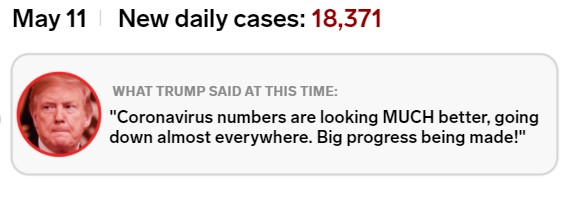
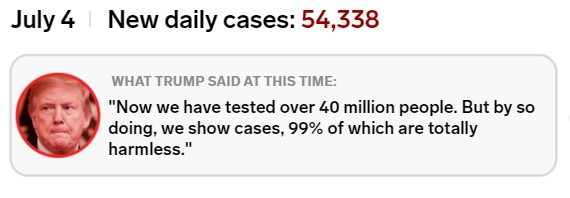
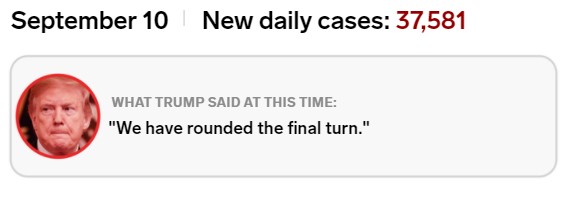
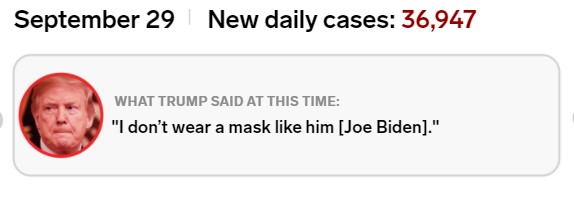
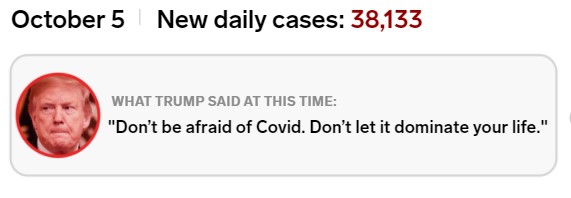
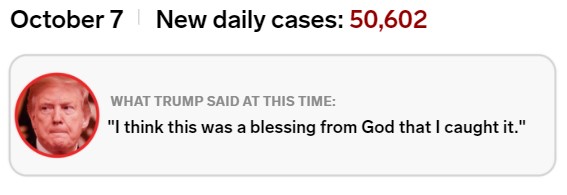
Furthermore, in relation to #2-e above, these were the reports Trump was disseminating to Americans on how the biological invasion and war was progressing. From my Nov. 2020 blog-post Delusional Incompetence; notice the dates of egregious disinformation:
(D-3) This all could have been made less devastating, so less deadly had immediate action by a declaration of war been made and all available resources mobilized. Instead, the total death-toll to date of American cannon-fodder, insolent indifference, and initial inaction and continued inadequate half-measures (or less) by the former President and his Administration is in context of American lives, prematurely (to put mildly) and unnecessarily lost, unthinkable and glaring:
The unnecessary reality of inaction, incompetence, and human loss.
(D-4) Since 1884 all U.S. Presidents, Vice-Presidents, Senators, H-Representatives, and other federal employees serving Americans take this sworn oath and promise We the People to abide by and fulfill them. Most all Presidents of Crises have served Americans with honor, distinction, and statesmanship (see the C-SPAN network 2021 Lincoln Forum’s Wartime Leadership – Lincoln & FDR and Abraham Lincoln’s Statesmanship for exact definition) in accordance to this Presidential Oath of Office:
“I do solemnly swear (or affirm) that I will support and defend the Constitution of the United States against all enemies, foreign and domestic; that I will bear true faith and allegiance to the same; that I take this obligation freely, without any mental reservation or purpose of evasion; and that I will well and faithfully discharge the duties of the office on which I am about to enter: So help me God.”
“I do solemnly swear (or affirm) that I will faithfully execute the Office of President of the United States, and will to the best of my ability, preserve, protect and defend the Constitution of the United States.”
That Constitution is for the People, all Americans, is the law of the land for all U.S. citizens and its employees, and therefore by implication denotes the same protection and defense for every U.S. citizen, all ages, all ethnicities, all creeds, all socioeconomic classes without exception. By this measuring stick former President Trump also failed miserably. He was unequivocally derelict in his duties he vowed to uphold on Jan. 20, 2017 at his inauguration.
“Rouse him, and learn the principle of his activity or inactivity. Force him to reveal himself, so as to find out his vulnerable spots. […]
Sun Tzu, The Art of War
BAIT & BLEED REVISITED
(D-5) Returning finally to the military concept of what Mearsheimer coined as baiting, bleeding out, or bloodletting, imagine once again you were the enemy aggressor on the United States. According to Sun Tzu and Mearsheimer, one subtle method of collapsing or weakening your enemy with minimal losses to your forces would be to pit, to radicalize and polarize your enemy’s inner factions against each other. For a prime example, divide (extremist) Republicans and (progressive) Democrats so fiercely that the U.S. as a whole cannot be of one mind, one objective to win the war. As the popular cliché goes, a house divided against itself cannot stand.
By pitting Americans against Americans, as the enemy aggressor you win over half the battles or better, and win the war. This tactic of Americans killing Americans (via biological virology) would make Sun Tzu and any prolific general, past or present, foaming at the mouth green with envy!
For all the arrogant incompetence we’ve endured, the wordfare vs. warfare, and indifferent inaction, we the American people, who put the historically worst leader into the White House from Jan. 2017 to Jan. 2021, beyond any doubt are suffering and have suffered the worst calamity, the worst socioeconomic impacts dominoed into every sector of our lives. Thus, it is the worst ongoing defeat in our nation’s two centuries of history. We were baited and blead by our own leader. And as if it could not be any worse, today that incompetent leader still cares less about our rising death-toll and might, just might weasel back into office because some 74-million Americans cannot distinguish between or recognize the manifestations and deceit of a megalomaniac versus exceptional statesmanship.
I learned a new definition and tag the other day: “Black Swan.”
What is a Black Swan? As best as I can decipher a Black Swan has three attributes:
The event is unpredictable (to the observer).
The event has widespread ramifications.
After the event has occurred, people will assert that it was indeed explainable and predictable (hindsight bias).
These three Black Swan components can comprise a positive or negative consequence, or both. But it is primarily the second component that makes the event historic for the ages.
The origin of the term “black swan” in order to characterize such events I found intriguing. Prior to 1697, not one Western civilization country had observed any black swans in existence. This gave rise to the blind notion that such creatures just didn’t exist. Hence, the term became used to describe situations of impossibility and in my own estimation, egocentric innocence.1And then it happened.
After a black swan was indeed observed in western Australia in 1697, the egocentric innocent assumption was disproved. Since then, “black swan” now describes situations where (premature) perceived impossibilities have later been disproven and those false egocentric paradigms have been shattered. Thank goodness for elapsed time and losing our supposed, imposed innocence.
If you think education is expensive, try ignorance.
And Robert Browning called it “sin.”
There are many Black Swan events throughout human history, more than you might think or that you were unaware of or not privy to and as it were was classified as “Strategic Subterfuge” by higher powers. The latter is much more prevalent than one might imagine. Some examples include:
Rise of the internet
The personal computer
The Georgia (1829) to the Black Hills (1874) Gold Rushes and others
Battle of Little Big Horn
World War I
Discovery of fossil fuels then electricity and AC vs. DC
Discovery of nuclear fission
The dissolution of the Soviet Union in 1991 or
The collapse of Spain’s global Empire over the 18th- and 19th-centuries
The 15th-century Columbian Exchange
The September 11, 2001 terrorist attacks on targets in the U.S.
COVID-2019
The inventor of the term “Black Swan,” Nassim N. Taleb, underscores the point that the black swan event depends upon the observer. A Thanksgiving turkey sees its demise as a black swan, but the butcher and guests dining do not.
It’s important to draw the distinction between a black swan event and a crisis. Not all black swan events are crises, any lottery winner will attest to that. And not all crises are black swan events. Terrorist attacks are an almost daily occurrence worldwide, but the terrorist attacks of September 11, 2001 were of unprecedented magnitude and unpredictability, hence their characterization as a black swan. Additionally, I have included COVID-19 because it meets all three criteria for being a Black Swan event. Yes, its ramifications are just as widespread as other black swan events and in hindsight it was obviously predictable and quite explainable; by all reputable, established, global medical experts. COVID-19 only became a global pandemic, especially lethal inside nations of defiant egocentric ignorance, and without question clearly fulfilling criteria #2 above as a direct result of defiant sectors of the human population. The fact that this pandemic is still not under control and behind us can only be blamed on our chosen, willing defiance and ignorance.
However, Mr. Taleb disagrees with me and anyone else calling COVID-19 a Black Swan. You can read his argument in The New Yorker entitled The Pandemic Isn’t A Black Swan But A Portent of A More Fragile Global System. It is an excellent article that I recommend reading. Though Taleb disagrees the pandemic is a black swan, he is correct in pointing out that there are clear reasons why humanity, nations, and governments are all too often repeatedly unprepared for them. This denial or chosen innocence/ignorance by populations gives more credence to the above framed quote on how costly the chosen apathetic mindset becomes.
Moving along now to the distant history in the ancient Levant.
~ ~ ~ § ~ ~ ~
I want to add another Black Swan event to the list that many in the Western Hemisphere and the U.S. will want to take exception. What is it? In a word: Christianity. Several of my regular blog followers will have a general idea as to how and why I add 4th-century CE (and after) Christianity. You’ve read enough of my blog-posts over these last 10-years to know how and why I would label it as a firm, strong holder of being a Black Swan. Listing all the verified, contextual evidence as well as the likely plausible conclusions based upon the said exhaustive interdisciplinary components, it is in my mind without question a Black Swan. Specifically the event? The 17-year disappearance of Yeshua bar Yosef from the Greco-Roman—not the Jewish account, but the Roman—canonized New Testament. This event caused and causes an entire host of many further problematic ripple-effects fragmenting and eventually destroying Christendom’s veracity.
If you did not know about or had not heard of a Black Swan event as I had not, now you know. What are some Black Swans you can recall or comprise as one? Feel free to share them below!
Live Well — Love Much — Laugh Often — Learn Always
There are different stories, legends, and narratives in popular culture today in Texas, and parts of the U.S., about events that took place over twelve days and nights at Misión San Antonio de Valero February 23 to March 6, 1836, otherwise known as the Siege of the Alamo. One such pop-narrative is from a southeastern Anglo-American viewpoint, post-Civil War. Another is from a later Anglo-Texian viewpoint about the new Republic begun in 1845. And still another much less popular or well-known narrative from an indigenous Tejano viewpoint begun in circa 1821. There is a fourth narrative that is so obscure and completely overlooked today that for the purposes of this blog-post, time, and word-count I shouldn’t mention it. But that would disrespect and defeat the virtues of Agnotology, something I personally hold very dear in our modern fight against disinformation, destitute scholarship in town squares, and partisan politics. Therefore, I will indeed mention the unsung fourth narrative of earliest Texas history: the Indian Nations of Taysha, or Texas.
It’s worth mentioning that part of Texas’ state and national identity is wrapped in what we call the Six Flags of Texas. Technically speaking this is not the full story. It should actually be at least “Seven Flags of Texas,” perhaps one representing the Indian Nations of Taysha. But unfortunately when Anglo-Americans write their victorious histories, peoples they’ve labelled “uncivilized” are omitted and made footnotes, maybe. But oh well, I digress.
Quietly woven throughout the narratives of the Southeastern Anglo-American and Anglo-Texian viewpoints, but rarely mentioned publicly or taught in Texas school classrooms today was slavery’s role in Texas’ fight for independence from Mexico and eventual willing annexation by the expanding United States. The deluge of Anglos immigrating from the Deep South slave-states which Mexico was against and trying to stop were, in the minds of Mexico’s government and empresarios, illegal incursions and seizures. At the very least, they were controversial, agitating, and enflamed tensions present between several clashes of cultures throughout the once vast (proclaimed) Spanish Territory of Tejas. Anglo-American immigrants did not wish to pay any taxes or tariffs to the Mexican government, particularly to Antonio López de Santa Anna who seized power himself in an insurrection against former President Bustamante. Many prevalent Tejanos of Tejas such as the very well-known José Antonio Navarro opposed Santa Anna’s dictatorship and by default Mexico.
What might surprise many Texans today is that several of Tejas’ Tejano elite such as the Navarro family also owned slaves, and by default and by way of economic motivations, Navarro and key Tejanos of Texas’ Republic also opposed Mexico’s recent independence from Spain and from the practice of slavery. However, these historical facts found on a Texas 1860 Census Slave Schedule for Atascosa County (location of Navarro’s San Geronimo Ranch) show he owned six to nine slaves indicating clearly that Texas’ fight was at least in part to keep slavery legal in the new Republic. Navarro and other famous Texas Tejanos with him fought Mexico for independence along with slave-owning Anglo-Americans…
…to protect the practice of slavery in Texas, upon which cotton farming relied heavily. It was not uncommon for families of this group to own slaves in the colonial period. Although the number of families holding slaves was small, it was a vital connection between Tejano elites and American cotton growers immigrating to Texas.
“Henry and Patsy Navarro” from Casa Navarro History at the Texas Historical Commission website, accessed 7/10/2021
Movie set of the 2004 film “The Alamo”
What is also commonly unknown about earliest Texas history is that those same Tejanos who fought, bled, and died for Texas’ independence from Mexico at the Alamo and other battle-fields eventually lost over the next decade their original land grants and rights as citizens of Texas. By 1860-61 they were “legally expunged” you might say when Texas officially joined the Confederate States of America and its fight to keep slavery alive.
Since the end of the American Civil War in 1865, the legendary fight at the Alamo twenty-nine years earlier was intentionally altered to emphasize the southern Anglo-American and Anglo-Texan narrative as a fight solely against Santa Anna, thus overshadowing all other narratives in the face of humiliated Confederate defeat. Confederate Texans wanted to save face then and were successful. Now today with the advent of reignited racial awareness and heated tensions, resident first-, second- and third-generation Texans (a few fourth-generation too) and politicians—many of whom trace their pedigrees to the Midwest and Deep South slave-states—want at any cost to protect and advance a more Anglo-narrative of Texas history. More precisely, Texas school curriculums are being further realigned to promote an anachronistic Republican narrative which is not comprehensive or contextual to verifiable Taysha–Tejano Texas history.
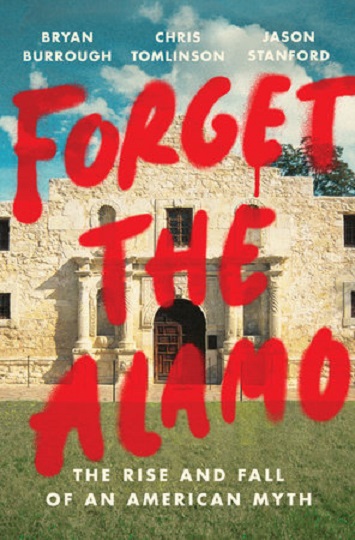
Over the past two-weeks of this month, Lt. Governor Dan Patrick, himself a first-generation Texan from Maryland, confirmed on his Twitter account that he personally called for the censorship and cancellation of a July 1st book promotion at the Bullock Texas State History Museum in Austin, TX. The name of the book and co-authors? Forget the Alamo: The Rise and Fall of an American Myth by Chris Tomlinson, Bryan Burrough, and Jason Stanford.
But this censoring tactic is part of a greater movement by GOP state officials like Gov. Gregg Abbott, Lt. Gov. Dan Patrick, Senator Ted Cruz, and other Republican officials regarding critical race theory and whether verifiable academic history has a place in Texas public school curriculums.
On June 16th, 2021 the Texas Legislature passed Senate Bill 797 requiring Texas schools to display the term “In God We Trust” across campus buildings if such signage is donated to them. House Bill 2497 was passed by the Texas Legislature in May 2021 giving a biased GOP committee the authority to promote our “official” state history—to residents receiving their driver’s license—from the aforementioned Anglo-narratives. House Bill 3979 is awaiting Gov. Abbott’s signature and it dictates how Texas teachers can talk to their students about current events and America’s as well as Texas’ history of racism and slavery. These legislative bills are just three of a number of other bills in a state-wide Republican campaign to teach reteach and promote a more narrow, patriotic version of our national and Anglo-Texan histories. Here in Texas it is called The 1836 Project and it plays off of and counters the acclaimed or controversial 1619 Project, but with a modern, intentional Texas GOP twist. From Gov. Gregg Abbott this past May:
“To keep Texas the best state in the United States of America, we must never forget why Texas became so exceptional in the first place.”
Personally I would argue that these recent campaigns to modify or omit established historical scholarship that is indeed verifiable, in Texas and other states, began as early as 2010, if not sooner. Though governmental officials like Lt. Gov. Dan Patrick are and have been censoring or obstructing democratic freedoms and liberties in Texas on public property, they have gone much further than book promoting events.
For those of you born prior to the year 2000, remember in your classrooms the concept of “Compare and Contrast“? Critical-thinking and analysis skills are paramount for students to learn and acquire for the overkill of today’s “Disinformation Age.” Beginning at least in 2010 and 2012 political campaigns within the Texas GOP began muddling up this vital concept and skill getting taught in our public school curriculums. From The Poynter Institute’s PolitiFact website:
Gail Collins[of the New York Times]says Texas GOP platform calls for schools to stop teaching “critical thinking.”
Sue Owen, PolitiFact.com, August 11, 2012 — accessed 7/11/2021
Nevertheless, the Texas GOP did muddled-up and confuse the issue. Deputy Executive Director of the Republican Campaign, Chris Elam, stated the platform subcommittee unintentionally and unknowingly implied opposition of teaching critical-thinking in schools. He and his party were correct about that as can be read here:
“We oppose the teaching of Higher Order Thinking Skills (HOTS) (values clarification), critical thinking skills and similar programs that are simply a relabeling of Outcome-Based Education (OBE) (mastery learning) which focus on behavior modification and have the purpose of challenging the student’s fixed beliefs and undermining parental authority.”
As Gail Collins wrote, the Texas GOP platform does state that the party opposes “critical thinking.” But Collins also leaves out some important context. The platform makes it clear that its opposition is centered on one type of education model: outcome-based education.
Whatever one wishes to call it and play complicated games with words and phrases, this past May and June 2021 in our Texas Congress, the confusion and muddling has been scaled up again. It seems it has taken on yet another form when it all begins to censor and omit significant facts that compose an exhaustive contextual historical picture. This new type of political manipulations upon verifiable, established academic scholarship—whether in classrooms or in the town square—has become a dangerous epidemic in 21st-century America. Allowing this epidemic to continue will only setup further future digressions into sociopolitical turmoil that is ill-equipped to correct, adapt, and progress itself into a truly healthy, thriving Constitutional democracy. I’m unsure how you my readers might feel, but this destitution of Agnotologybeing replaced by (hyper?) Patriotism over historical, contextual facts disturbs me greatly.
Live Well — Love Much — Laugh Often — Learn Always
Or perhaps “Rarely Sung Heroes” in these modern times of growing (or struggling?) decency in the United States. I say that with caution and some hesitation. Let me explain.
Back on June 6, 2019, the 75th Anniversary of D-Day in Normandy, France honoring all the Allied soldiers who participated, fought, died, and survived in that historic amphibious invasion to liberate Nazi Europe, I published my blog-post Five Hundred Yards. It was my attempt for readers to bring an acute perspective and emotion what the landings on Omaha Beach was like that June morning for the thousands of 17-, 18-, 19- and 20-year old boys had gone through as they hit the water or beach. If you have the opportunity to read or reread Five Hundred Yards, please do. It will set the stage and context for this post.
Some/Many caucasian Euro-American descendants born and living in our 50-states today have a generic, basic knowledge of how indigenous North American peoples/Indians were either exterminated, moved from their homelands, or abusively treated and deceived by the U.S. government, military, and new settlers between 1778 and 1911, during the official existence of the United States. Between 1539 and 1774 thousands upon thousands of Indigenous peoples were massacred by European colonists and their armed forces. By far the biggest killer of North American Indians were all the lethal diseases European colonists/invaders brought within them and spread. Ironically, similar to what former President Trump accused the Chinese of doing with COVID-19. Nevertheless, it is estimated that from the Pre-Columbian Era (1325–1492) to the final massacre in 1911 in Washoe County, Nevada, between 95,000,000 to 114,000,000 Native American people, that’s millions not thousands, were wiped out by Europeans.
Despite this horrific background and constant inhumane atrocities committed upon them by Europeans and Euro-American descendants, during our first and second European World Wars more than 12,000 Native American Indians fought in Europe for the U.S. in World War I. More than 44,000 fought for the U.S. in World War II. Keep in mind, this is only one to three generations after the exterminations and removals from their own ancestral homelands over a 600-year timespan. Think about that. The numbers of your own people gradually and drastically dying, massacred, and disappearing all around you. With that in mind, these Native American men who, like their African-American WW1 and WW2 military counterparts, volunteered to go fight and risk their lives on a far away continent for a nation who at the time and well before did not love them or treat them as equals and far from justly. Nor did this nation welcome their survivors home as heroes the same as their own caucasian Euro-Americans and yet still went and did their patriotic (tribal) duty and did it bravely, honorably as the warriors they had always been.
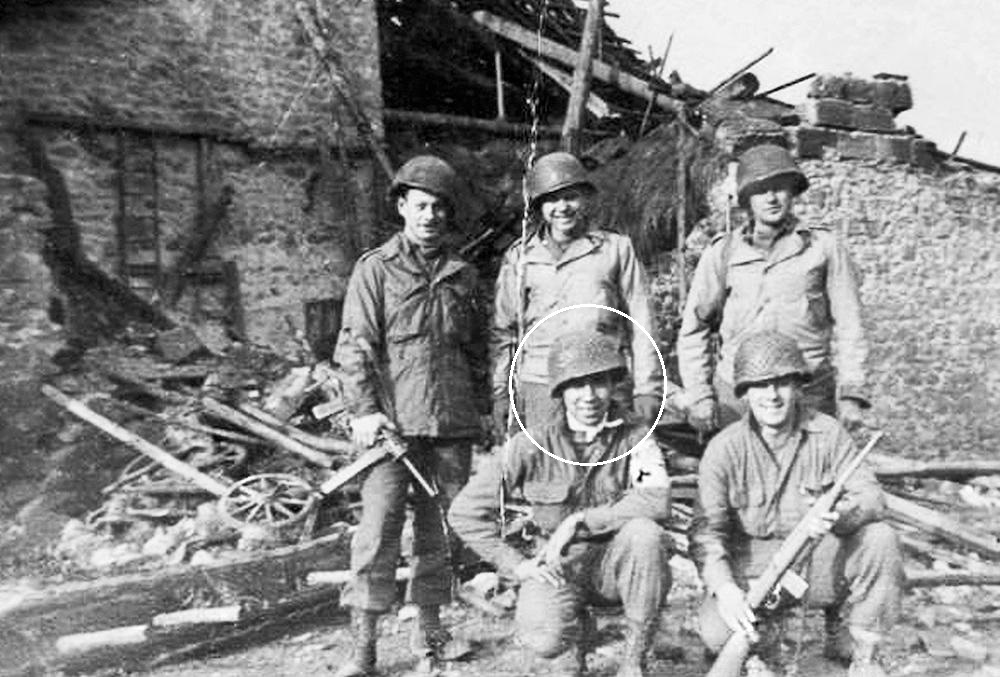
I want to commemorate in a small way those Normandy, D-Day Native American warriors who did not come home, those who were wounded and maimed, and those who survived the entire war who did come back home, but nonetheless were still scarred and mentally wounded by those 2–3 years in Nazi Europe. Scarred perhaps too by six centuries of war upon their people by Europeans and Euro-Americans. Here is one of many partial accounts of that June morning on Omaha Beach, 1944 by Army Medic and 19-year old Private of Fox Company in the 16th Infantry Regiment, 1st Division who were the first frontline units to hit Omaha Beach.
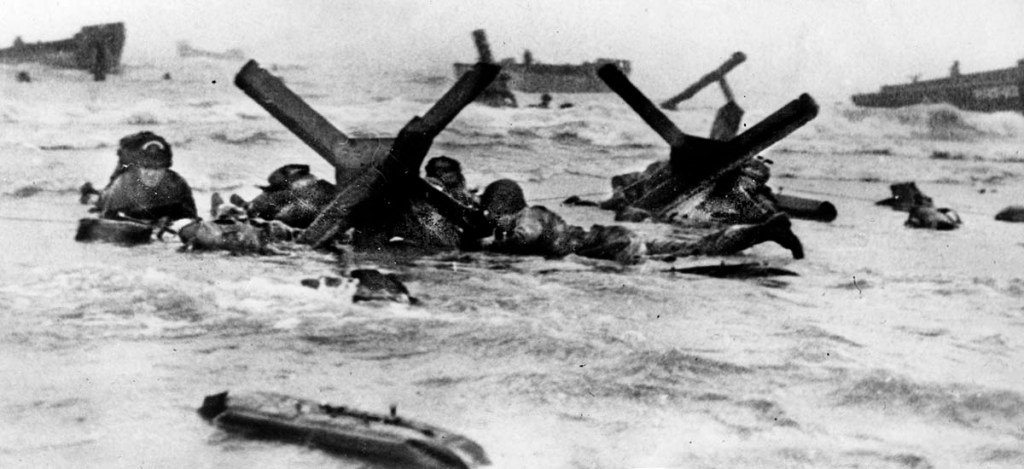
In my June 6, 2019 blog-post Five Hundred Yards, I wrote about how many casualties were sustained by the first wave hitting the beach or head-high water of Omaha in the first 15-minutes and hour of landing. What I didn’t mention in that blog-post was that decades later German Wehrmacht testimonies stated they were firing their MG-42’s, 5cm and 8cm mortars, and rocket-launching Nebelwerfers so much, non-stop that the barrels were all overheating, even when they rotated them with extra barrels they had, 3-4 extras in some units. The German gun-crews were astonished by how many Allied soldiers kept coming and falling, coming and falling, over and over, endlessly as they quickly exhausted their entire stores of ammunition. On the American side with the 1st Division known as “The Big Red One,” they sustained over 2,000 casualties in the first hour of landings.
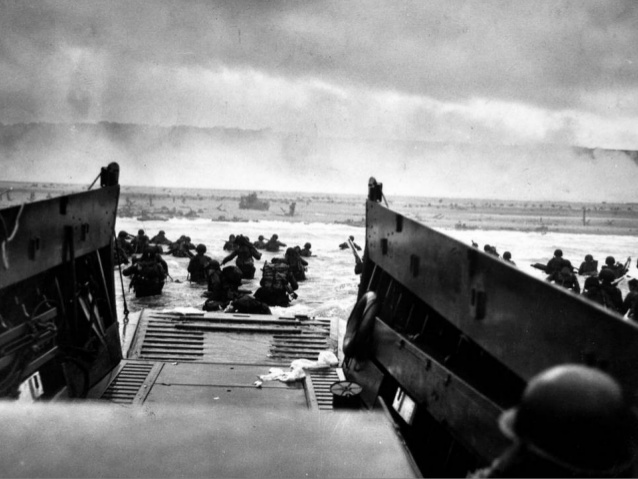
Photograph of American troops approaching Omaha Beach, Normandy, on D-Day. Dated 20th Century. (Photo by: Universal History Archive/UIG via Getty Images)
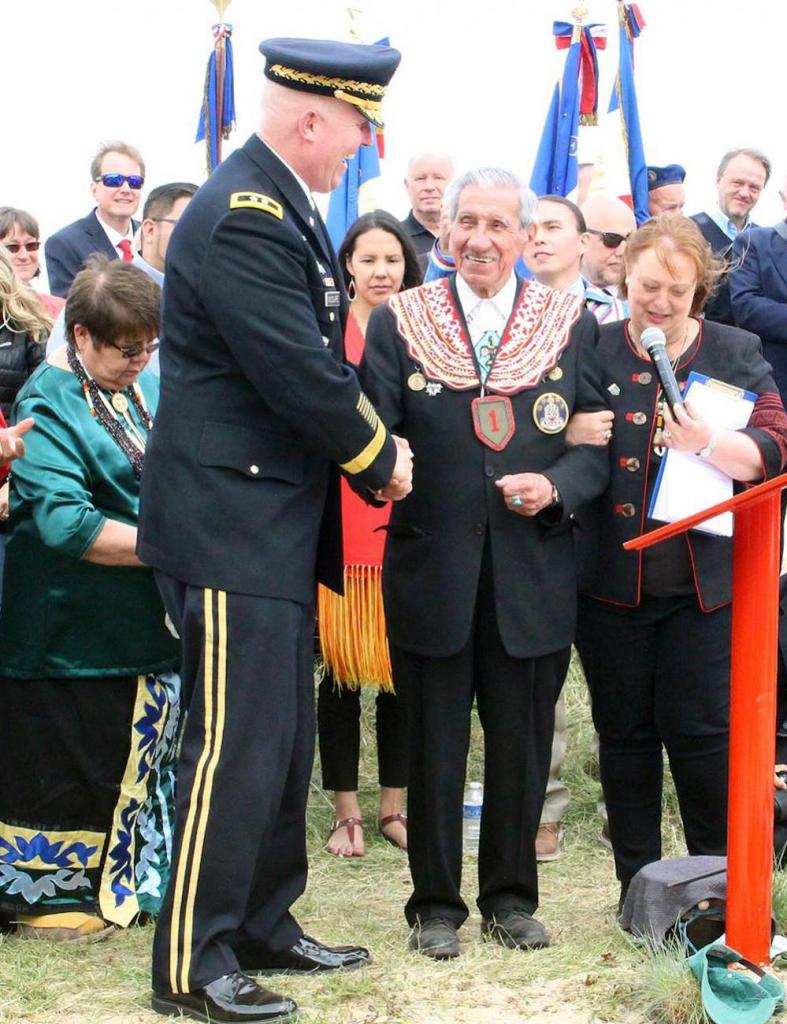
One particular Army Medic who was one of 14 total Medics in his regiment made it far enough up the 300-400 yards of flat beach and took cover. However, as he looked back from where he had come he realized he was all alone. No one in his company had made it safely as far as he had. He then noticed many of his fellow infantrymen lying on the beach wounded, screaming, and in the rising tide carrying their 60-75 lbs of gear, most were struggling or unable to pull themselves up the sand so as not to drown. Without hesitation he ran back some 300-400 yards again under heavy fire with his two satchels of medical supplies to those wounded and drowning, pulling many of them 10-11 yards up on the beach and began giving first aid. Another Corp man reported to his officers that this one Medic pulled about eighteen wounded out of the water that were twice or three-times his size and their uniforms and gear heavily soaked. Charles Norman Shay is a Penobscot Indian from the state of Maine and was that one remarkable Army Medic. He tells in his own words what happened:
“The seas were red with the blood. At the very beginning, it was difficult for me to witness so much carnage. I had to push what I was experiencing out of my mind, so I could function the way I was trained to function. Then I was able to operate effectively and even saved a few lives. I have always been proud to be a medic. It’s a special privilege.”
Shay remembers cradling those critically wounded to give them some comfort. When he found one he recognized, badly wounded with an open abdomen, he stayed with Private Edward Morozewicz, one of his closest friends, to ease him in his last few breaths. In 2017 Shay visited Morozewicz’s family, making sure they knew of Edward’s courage. Charles participated in a special ceremony honoring his fellow fallen medic. Shay still questions why he lived when Morozewicz and most of his unit were killed. “I knew [Edward] was slowly dying. I bandaged his wounds and gave him morphine. But I knew there was no help for him,” says a somber Shay.
Most of the American 1st and 29th Division’s first waves onto Omaha Beach perished, cut-down and slaughtered by the precise, heavily supplied and experienced 352nd German Infantry Division. The 352nd was assembled with many battle-tested soldiers pulled from worn-out or disbanded Wehrmacht divisions that had served on the Eastern front in Russia. By 12-noon on D-Day over half the men and most of the officers in Shay’s Company were either seriously wounded or dead. Up to 3,000 Allied troops died, and some 9,000 were injured or classified as missing that day, unidentifiable, or lost to the sea. Of Shay’s Regimental Medical Detachment of 42 medics, seven were killed and 24 severely wounded. After so many of his regiment and company fell or were killed, he later struggled many times with Survivors Remorse.
“My heart breaks for those mothers who prayed for their brave sons but never welcomed their sons home again,” says Shay wiping away a tear. “I can never forget the men who never had the chance to experience life as it was meant to be, a wife and a family, but instead were destined to depart this life in some far-off [European] land.”
Shay often says it was random, crazy luck that he survived D-Day, the rest of the war, and later the Korean War that he volunteered for service just five years later. After the war in Europe ended, the U.S. Army awarded Shay a Silver Star for his actions, and the French government appointed him a Chevalier of the Légion d’honneur, the highest honor given to non-citizens of France. But despite those medals this humble Penobscot Indian veteran always refers back to fellow warriors who paid the ultimate price and sacrifice for their country, homeland, Native tribes and family. Shay says there were many just like him.
Recently there has been new memorials and ceremonies finally recognizing the heroic contributions and sacrifices of Native American WW2 veteran warriors. Charles Shay makes annual trips back to Normandy to pay his ceremonial respects and honor his fellow Indians lost there with Eagle feathers, sage, and tobacco. He does so to bring heightened awareness to the younger public, particularly back in the United States. He lets his fellow Indian warriors lost, buried there under row after row of white crosses that they are not forgotten.
In the Normandy American Cemetery at least 29 Native American soldiers are buried. In the Brittany American Cemetery at least nine Native American soldiers are buried. And at the Utah Beach American Cemetery 30 Comanche soldiers, Code Talkers, from the Oklahoma Reservation are memorialized there. According to Dr. Harald E. L. Prins, an anthropologist and researcher at Kansas State University, 175 Native American soldiers landed on Omaha Beach on D-Day. Over 75-years later only around 55 have been identified.
For an extensive telling of Shay’s gallant service on D-Day go here. Many of the past stories of that day in June, a lot of the later accompanying military field narratives describing the Omaha ordeal are sanitized versions of the original field unit notes. And as S.L.A. Marshall writes for The Atlantic magazine in his provocative, transparently graphic article “First Wave at Omaha Beach,“ he says even “Cornelius Ryan’s epic film The Longest Day misses the essence of the unfiltered Omaha story.” I highly recommend his article.
It is my opinion, reflecting back this June 6th, 2021 anniversary of D-Day, given these Native American warriors pre-war histories they had every justifiable reason not to lift a finger for a white-man’s faraway war. They did not have to do any patriotic service for a 1940’s Euro-American country that treats them and had treated them as second- or third-class people without the same identical privileges and human rights afforded White America. Today, I think these Native American warriors are overdue, deserving the utmost respect, honor, and ceremony up to or beyond any other homage given to any Euro-American veterans of any U.S. wars! May they all receive many sacred Eagle feathers, burnt sage, and tobacco so all of their spirits rest in peace and receive (at minimum) equal remembrance and honor by all Americans; every single one of us without exception. Unmeasurable gratitude for all of you Native American warrior veterans of the U.S. Armed Forces, past and present.
I have zero expectation that anything I ever say will end someone’s belief in their God. Not my goal or purpose. That alone belongs to the individual. ~ Zoe