More great news for the 2024 Presidential ballots across the nation! What states are the lawsuits pending against Trump? Well, I for one was shocked by one state, my home state of Texas being included in the list. But I can guarantee everyone that the radical MAGAt Republicans in Austin and our heavily ultra-Conservative state Supreme Court justices will take less than 10-minutes to throw-out the lawsuit.
According to Lawfare, there are 14 more states reviewing cases to disqualify Trump from the 2024 Presidential ballot. Who are they? Here is the current list: Arizona, Alaska, Nevada, New Jersey, New Mexico, New York, Oregon, South Carolina, Texas, Vermont, Virginia, West Virginia, Wisconsin and Wyoming.
Now of course there are a few of these 14 other states besides Texas that won’t even seriously consider banning the Orange Orangutan from the 2024 ballot because they are strong, well-established, conservative Republican states with Red-majorities in too many key offices and court positions.
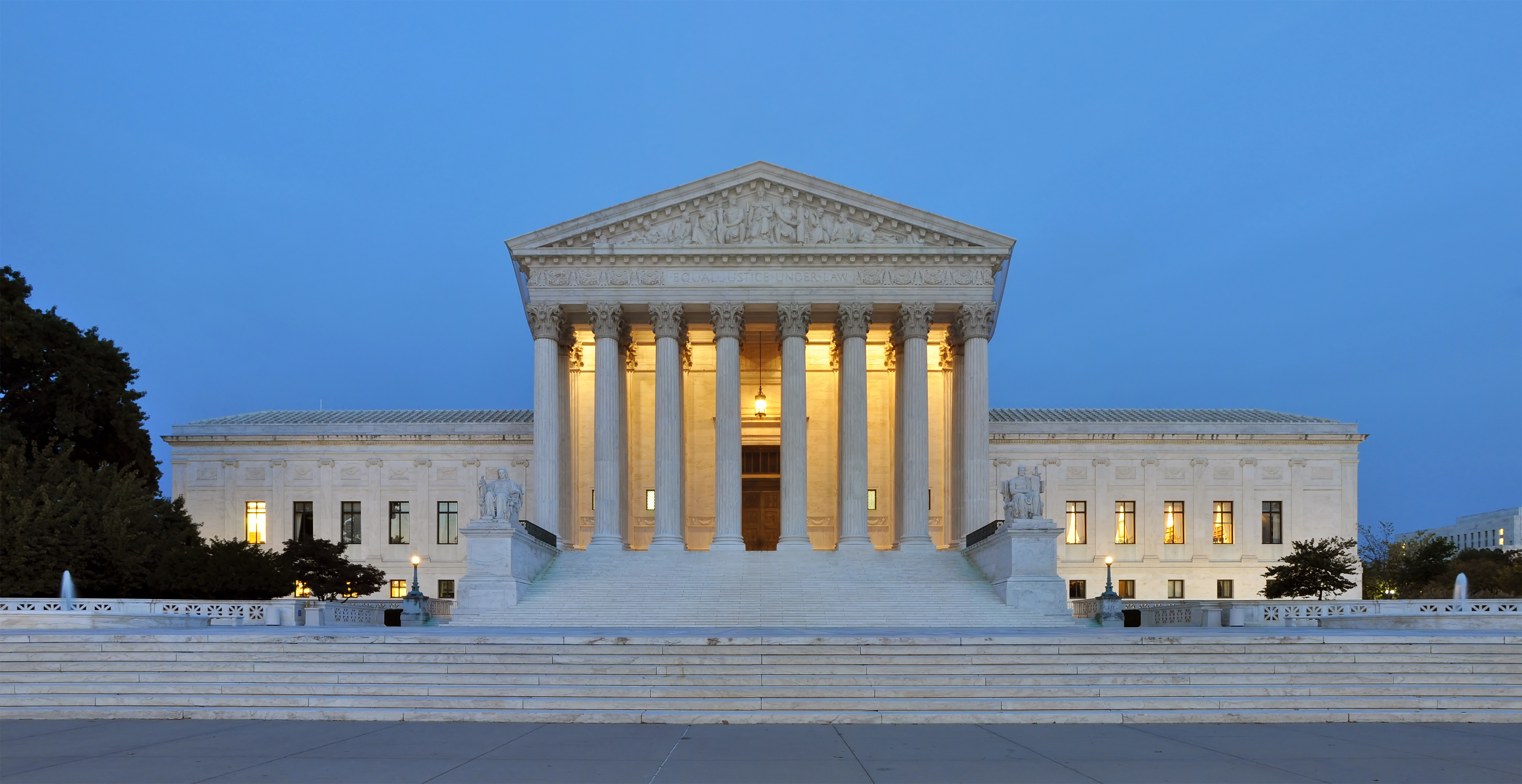
The U.S. Supreme Court, Washington D.C. will at some point make a decision as to Trump’s appeals
Some states have already dismissed on appeals or by the plaintiffs as these cases are ongoing as I write. Meanwhile, lets enjoy this growing trend in all these states and hope that they continue and perhaps one-third or half of them (and more later?) step up and SAVE this country and true democracy—run by laws, not a man or necessarily “voters”—from this narcissistic autocrat and his cult members, shall we?
It’s fantastic news! Finally, some supreme court justices rightfully “interpreted” our U.S. Constitution and it didn’t require an Originalist’s point-of-view or their narrow, wealth-driven bias. It seems some of our state justices have higher qualified deciphering skills and more qualified to understand the historical context of our six 18th-century Core Founding Fathers than several of our federal supreme court justices do today.
Outstanding Colorado SC Justices!
The Ralph L. Carr Colorado Judicial Center and Supreme Court of Colorado Building
Because it’s all over national news you probably know what the great news is about. Yes, the Colorado Supreme Court voted 4 — 3 to bar Donald Trump from Colorado’s Election Ballot in 2024! 🥳👏
“In a stunning and unprecedented decision, the Colorado Supreme Court on Tuesday removed former President Donald Trump from the state’s 2024 ballot, ruling that he isn’t an eligible presidential candidate because of the 14th Amendment’s “insurrectionist ban.””
An 1868 political cartoon following the American Civil Warthat writer Heather Cox Richardson recollects was the true purpose of the 14th Amendment, Section 3. That Section does apply to Trump.
In her usual upfront truthful reporting, Heather Cox Richardson, a renown history professor at Boston College and an independent author/educator, writes on this historic event:
“This evening, by a vote of 4–3, the Colorado Supreme Court decided that former president Donald Trump is disqualified from holding office and should be removed from the 2024 ballot in the state, citing Section 3 of the 14th Amendment to the U.S. Constitution. […]
Today the Colorado Supreme Court agreed that the events at the U.S. Capitol on January 6, 2021, constituted an “insurrection” and that Trump “engaged in” that insurrection through his personal actions, including his incitement of the crowd that breached the Capitol. But it disagreed that the 14th Amendment did not apply to the president.
“The sum of these parts is this,” the court wrote. “Trump is disqualified from holding the office of President under Section Three; because he is disqualified, it would be a wrongful act under the Election Code for the Secretary to list him as a candidate on the presidential primary ballot.””
You can read Richardson’s entire letter here. It’s well worth it.
Unsurprisingly, Trump and his crackpot team of attorneys are appealing this ruling and will likely ask SCOTUS to intervene. They are using the defense of presidential immunity which also comes as no surprise. And Trump has also gone on the offensive in all his usual ways to pick public fights with anyone who does not endorse him unconditionally.
I don’t know about you, but I really hope this is the start of a domino-effect on the state-level by state supreme courts and Secretary of States following suit with Colorado. If the former insurrectionist tRump isn’t in prison or not yet sentenced by the Spring 2024, then hopefully enough swing states and Blue states will come to the same ruling for the same reasons as Colorado and make it near impossible for the Orange Orangutan to be re-elected into the White House.
Fingers crossed people! 🤞
Update12-23-2023 — Listen to conservative attorney and CNN Legal Consultant George Conway’s interview with CNN’s Jake Tapper discuss the recent SCOTUS decision and rejection to hear Trump’s immunity plea. It is not bad news for us true American patriots and attorney Conway sees it as not good for Trump’s future. Here’s the link:
Earlier this month I was asked to write a guest blog-post regarding the Israel-Hamas Conflict that erupted (again) inside Palestine Oct. 7, 2023. I was very happy to do this for a good blogging friend and offer a less than popular viewpoint about the “recent” history of Israel inside Palestine since 1947-48. For the sake of brevity and at the expense of detailed historical facts since 1945, I was also restrictedonly to the “biblical-theological” justification or evidence for Israel being inside Palestine, if there was any. This position is impossible to defend on principles as well as biblical texts. Therefore, this was a major challenge for me, especially knowing beforehand that my personal viewpoint is NOT well received inside a generally Conservative, (hyper?) religious United States and typically pro-Israel primarily on religious evangelical and very narrow political reasons only.
During the blog-post I was heavily challenged by one or two commenters about my position on the conflict. Unfortunately, those ‘challenges’ were heavily moderated and not allowed for me to answer or rebut said challenges when I was perfectly prepared to do so. I also was debating the issue of what should be done over at Gary’s Escaping Christian Fundamentalism, primarily about history’s time-periods. But my counter-rebuttals on the first blog-post, before they were even allowed, were viewed as excessive, bordering on primate fighting, and feeding an irate lion attacking me. I completely and unequivocally disagree with this hasty, premature assumption. Hence, this post. I wish to show my civility and deep knowledge on this highly controversial topic inside the U.S.
Two primary points or challenges were asserted to me based upon false pretenses:
“Ancient” history cannot be corrected or rectified in the 21st century.
Invaded, conquered, and occupied land cannot be returned to the previous owners.
Both of these pretenses cannot be adequately defended and this is why they cannot.
On #1, this weak defense is ultimately irrelevant. Of course we cannot change things for the better today that took place well over 500–2000 years ago. This is a no brainer. I have never advocated for this to take place today, particularly inside Palestine. Anyone who throws this up at me is either NOT fully reading or comprehending my thorough, deeply researched “recent” history on the conflict, or they just want to ignore it all together. Period.
On #2, actually within “recent” history, this has been done on numerous occasions. When invading, conquering, occupying nations accept in remorse and see their wrong-doing, atrocious methods of land-grabbing by annexation, violence, massacring, and/or war, there has been plenty of cases where they returned the conquered land or the international community (the U.N.) made them give back the illegally seized land.
Before I give those examples, let me define what is the difference between “ancient” history, “modern” history, and “recent” history.
Ancient history is considered by most historical scholars today as the time-period before 1500 CE, or prior to the Middle/Medieval Age. This is a period where today it is near or completely impossible to forensically investigate and/or challenge “traditional” transgenerational oral or written narrations. Victors almost always write their own version of ancient events—today we have little to go on to verify their objective accounts of events. These attempts to use ancient history to justify current 21st century facts, is usually an exercise in foolishness. It’s a can of worms for sure.
Modernhistory is considered by many/most scholars today as the time from 1500 CE to 1945. I agree with this decision. Even verifying factually events between 1500–1799 can be extremely difficult. It takes years to plausibly draw definitive conclusions about world events, much less 100% certainty.
However, Recenthistory is a whole other ballgame. The time after 1945–present day is much, MUCH easier to forensically or evidentially, via multiple sources, verify and reverify. This absolutely applies to Zionist Israel from 1897–present. It also applies to Israel’s major ally, the United States, and how the U.S. was an evil bed-partner militarily and economically in accessorizing and aiding Israel’s illegal creation in a foreign land in 1946-47 inside an already occupied territory for several millenia.
Yes, the land that Israel illegally stole from Palestine with the major help of the United States absolutely CANbe returned to Palestine with the help of the General Assembly of the U.N. Why? Because reparations or returned land has been done numerous times in the past:
In 1988 Congress voted to extend an apology and pay $20,000 to each Japanese-American survivor of the internment. More than $1.6 billion was paid to 82,219 eligible Japanese-American claimants.
African-American survivors of police abuses in Chicago; victims of forced sterilization; and black residents of a Florida town that was burned by a murderous white mob, have been given reparations.
Many reparations have been made by the U.S. government to Native American Indians and the many injustices done by the U.S. government and its military in the 19th-century.
After World War II, Japan returned the territories it had invaded and occupied in China, Korea and Southeast Asia.
In 1956, Israel returned the Sinai Peninsula to Egypt as part of the Suez Crisis agreement.
In 1975, Spain returned the Western Sahara to Morocco and Mauritania.
In 1999, the United Kingdom returned Hong Kong to China.
In 2002, The United States returned control of the Panama Canal to Panama.
Therefore, I stand by my position on Israel-Palestine sternly, earnestly, and unwaveringly. Israel mustgive back what they have stolen from Palestine and the U.S., the U.K., and France mustbe the primary movers in making this happen pronto! Otherwise, there will never be lasting peace in Gaza-Palestine until Israel and the U.S. admit their horrible judgement and evil doing in 1946-47. Period.
Is that a realistic possibility? Odds are less than 2% to 0% because both Israel and the U.S. are highly arrogant, hyper proud, and consider themselves hyper-self-righteous and they’ve never done anything wrong to other peoples, ever in the history of humanity. Admitting wrong-doing and rectifying it is just not in the DNA of Israel or the U.S. Period.
Fair Warning for any Commenters — any incivility or personal attacks will not be tolerated. Please review my Professor’s Netiquette page for details. Thank you. 🙂
Never before in our country’s 247-year history has a Speaker of the House been ousted, removed, and forced to vacate. In a vote of 216 to 210, Speaker Kevin McCarthy has been (for the moment) terminated for NOTbeing the Speaker of the House chamber! He was not the House Speaker for the Republican party, but by bound duty the Speaker of the U.S. House of Representative to legislate and get bills, acts, and appropriations done. That was his sworn duty. Period. According to a majority of his own House Republicans, he failed and failed miserably.
Since this historic vote took place earlier this afternoon, I’ve watched and heard many interviews with Republican Representatives by the mainstream news outlets, and all of the Republican Reps kept trying to harp on the national debt of $31.4–$33 trillion. It is the typical deflect and divert tactic away from the sheer chaos today’s Republican party is in… and it is their own fault, their own catastrophe they themselves created in 2010–2016.
But nonetheless, let’s look much closer, much deeper into the context of their panicked response to McCarthy’s removal: the national debt and deficitthat supposedly, according to them, was caused by Democratic administrations. Grab the microscopes.
According to the Pew Research Center, a reliable established goliath in research reporting and objective fact-checking, there are five (5) facts about our accumulation of national debt that the mainstream news outlets rarely get in-depth about.
The federal government’s total public debt stood at just under $31.46 trillion as of Feb. 10th, 2023. Nearly all of that debt – about $31.38 trillion – is subject to the statutory debt limit.
For several years, the nation’s debt has been bigger than its gross domestic product (GDP). Read the Pew article for more in-depth details.
21.8% of the public debt, or $6.87 trillion, is owned by another arm of the federal government itself. This includes Medicare; specialized trust funds, such as those for highways and bank deposit insurance; and civil service and military retirement programs. But the biggest chunk of those “intragovernmental holdings” belongs to Social Security.
The Federal Reserve System is the single largest holder of U.S. government debt. The Fed bought Treasuries in massive quantities during the COVID-19 pandemic in an effort to keep the U.S. economy from buckling under the strain of shutdowns and quarantines.
Servicing the debt is one of the federal government’s biggest expenses. Most of this spending is on veterans’ benefits and services due to wars in Afghanistan and Iraq, which is more than it will spend on elementary and secondary education, disaster relief, agriculture, science and space programs, foreign aid, and natural resources and environmental protection.
The national debt has grown significantly since the early 1980s under both Republican and Democratic administrations.
The largest percentage increases to the debt occurred under Presidents Ronald Reagan and George W. Bush, both of whom enacted tax cuts that led to large deficits.[…]
Flashpoints that greatly contributed to the debt over the past 50 years include the wars in Iraq and Afghanistan, the 2008 financial crisis and the 2020 COVID-19 pandemic — the latter two prompting sweeping stimulus measures from Congress that cost trillions of dollars.
And let me add to the last point of the COVID-19 pandemic, our administration at that time, the GOP and tRump, did very little (if anything substantial) for the preparation of this country to go to WAR against a highly contagious, lethal biological virus! I repeat, tRump and his administration never took the pandemic and public health and safety measures seriously. Hence, look what happened.
Therefore my fellow Americans, when you are bombarded by political party rhetoric and propaganda on this nation’s debt and deficit like those heard today from the House chamber members scrambling and panicking to put out all the fires caused by their own Party, look deeper, look much closer into the factual data. THAT is where you will find the nectar and honey of what they speak about truthfully, or lie about, or divert with vague ambiguous half-truths.
Live Well – Love Much – Laugh Often – Learn Always
This is a continuation of the previous two blog-posts about Texas and white Texan’s extreme, delusional arrogance about how great it is to live in this hardcore Red state, particularly in the far suburban and rural areas and counties. By the way, just in the last two years or so Texas has surpassed Florida, Washington, Colorado, Nevada, and North Dakota as the third fastest growing population by state in the nation. Only Utah and Idaho are growing faster. As a result, Texas has for years now had very serious growing problems and they have not been improving.
As I alluded to in my previous post Best U.S. States to Reside, the Individual Median Income for Texans is $38,059 for a 2023 single-earner Texan. However, the sad disturbing statistical fact for Texans is that in 2021 the Average Cost of Living in Texas is $45,114 per year. I guarantee that cost has gone up noticeably. The largest cost for any Texan, by far and away, will be housing. A further breakdown of the average cost of living in various Texas cities compared to the national average can be found here.
Living conditions here are not improving, but instead will decline further over the next 5–10 years.
Dallas, Texas homeless encampment underneath an underpass of Hwy 75/Central Expressway
The other day I was waiting in line at my grocer’s pharmacy. I had to wait about 5-7 minutes because there was only one lady behind the counter/register for customers picking up their prescriptions. The gentleman she was helping was having issues with the man’s other missing prescription. This man causing the backup behind me was a white man, approximately 5’8″–5’9″ weighing maybe 220–230 lbs. with a large beer-gut, in kaki shorts, Walmart-brand sneakers, and wearing a black t-shirt. This is what the back of his t-shirt with a camouflaged square proudly advertised:
In my mind I was chuckling a lot, given my previous two blog-posts I just published at the end of last month full of actual facts and statistics about Texas and living here, not silly unfounded propaganda on t-shirts.
I thought, “Texas is only ‘great’ if…” you are of a very specific ethnicity and demographic, within a specific socioeconomic class like a business owner. Moreover, you have belonged to a specific political party your entire adult life in Texas or some likeminded state previously before moving here. Aside from this white man’s ridiculous t-shirt of arrogance, living here with the rocketing housing costs in Texas, it is about to get worse.
Today, Friday, September 1st, 2023, more than 770 new laws passed by the Texas Legislature, go into effect. The immediate effects and later ripple-effects of the new laws will impact untold millions of middle-class Texans in major urban and rural counties struggling financially during two straight years of hyper-inflation, let alone the lower-classes and disadvantaged Texans suffering the most. PBS station KERA of North Texas says more confusion and litigation is on the horizon:
“One example of this swirling confusion are rules in Dallas and Austin that that gives renters extra time to pay rent before a landlord can evict them. The ordinances ensure what some call a right for renters to “cure” the late rent before losing their home.
House Bill 2127, when it becomes law, blocks local governments from adopting, enforcing or maintaining any “ordinance, order, or rule regulating conduct….regulating evictions or otherwise prohibiting, restricting, or delaying” the eviction process. […]
At stake are countless city and county rules, ordinances, policies and practices, potentially including some humdrum policies that have been on the books for ages. That could include rules limiting fireworks, governing city and county contracts, water conservation and air quality efforts, payday lending limits, and more.”
— christopher connelly, kera (pbs) reporter for north Texas, august 29, 2023 for kera news
There are only two cities in Texas that offer the past COVID-19 counter measure called Right To Cure: Dallas and Austin. These have been city eviction regulations giving low-income or struggling renters a grace period to pay their rent and late fees before their landlord can start the eviction process. Ben Martin from Texas Housers, a low-income housing information service, says “These “right-to-cure” provisions are the norm in a majority of U.S. states.” Not so in Texas. House Bill 2127 went into effect today. To read more of Connelly’s reporting click here. What is essentially assured for struggling Texans is their protections for fair housing and a noticeably higher risk of becoming homeless after costly unforeseen events, disasters, or joblessness occur.
In other Texas and national political news, Texas is one of six (6) states at highest risk of Breakout of National Election Denialism in 2024’s Presidential election according to MAP. What are the two primary causes for this in Texas?
Given all the facts and stats about living in Texas over the last several decades and most of the 774 new legislative laws going into effect today, that man at the H-E-B pharmacy should’ve worn a t-shirt that said this:
Try to Live Safe – Love Much – Laugh Often – Learn Alot More
I have zero expectation that anything I ever say will end someone’s belief in their God. Not my goal or purpose. That alone belongs to the individual. ~ Zoe
'Light thinks it travels faster than anything but it is wrong. No matter how fast light travels, it finds the darkness has always got there first, and is waiting for it' - Terry Pratchett





 The Professor's Convatorium