The Sweet & Sour of Decembers

Nearing the end of the 1950 decade, a famous physicist named Albert Einstein said, It has become appallingly clear that our technology has surpassed our humanity.
(paragraph break)

Xmas portraitWith advances in medical cures and surgeries since Einstein’s era, many arguments can be made that technology has actually benefited humanity in many ways.  The U.S. Census Bureau now states the average life expectancy for Americans in the 21st century is almost 79-years old.  This is up from 47-years old in the 20th century.  Much of that increase is due to the advances in medical vaccinations and the scientific research and technology behind them.  It is very possible that devastating diseases such as diphtheria, polio, or Chicken pox could be completely eradicated from our planet by the year 2020 thanks in part to technology.

Today, a traveler can merely turn-on their mobile phone or GPS system and get not just precise directions to their destination, but rerouting directions, in case of up-to-the-minute construction detours or heavy traffic delays thus relieving to a degree human stress and anxiety.  That’s great, right?  And what about the new age of on-the-spot real-time cell phone video-recording?  Due to many spectators and runners at the last Boston Marathon, the two young bombers were later identified and one captured by law enforcement.  Once again, examples of technology benefiting humanity.

What then was Einstein alluding to?

There have been a few answers offered by historians, such as the 1945 creation and use of the atomic bomb:  an instrument of war and annihilation of unimaginable scales.  Yet others, like me, argue that his meaning was also metaphorical.  Technology can be abused, yes; but technology can also be a substitute, a decoy or diversion.  As much as Einstein was referring to the atomic age – when humanity was building weapons of death and destruction – this once brilliant man was probably referring to the decline of human interaction as well.

History of cell phone

History of cell phone

(paragraph break)
The Sour:  Parasites of Electronika!

The opening scene could go like this:  “The infestation began from the days of pin-ups, big bands, and blood and mushroom clouds.  From the ashes and debris of world wars came the legions of machines of every size…”  Technically, since the invention of the telegraph, telephone, and radio in the 1800’s and then the television in the 1920’s, every household in the Western hemisphere had at least one of these devices if not all of them.  Advances in mass manufacturing made these items easily available for most households.  At the same time another device or machine was being mass-produced:  the automobile.  By the 1980’s personal computers were becoming the next most common household machine.  And by 1995 the world-wide web, or internet, was in almost every single home.  Today, these historic machines and devices are part of every family member’s day and night.  During the holiday season the production and purchase of these machines and devices jump exponentially to mind-boggling amounts!

But don’t gasp yet; below are the 2008-2009 hourly averages of use per day in a year for American 8-to-18 year olds.  Once you read these results and tables, jack them way up for the holidays.

According to this survey by the Kaiser Family Foundation, the 8-to-18 year old youth group in America spent 7 hours and 38 minutes worth of electronic media time on these devices per day.  Note the study was done four years ago.  With all possible electronic devices and mediums available to American youth in 2013, here is a more up-to-date graphic:


kaiser_media_report_graph_hardware

1923 parking lot

1923 parking lot

The pie-chart above indicates that by 2010, American 8-to-18 year olds spend on average 10 hours and 45 minutes of electronic media time per day.  Granted the pie-chart is an average of just 2,000 students and I presume there is a margin of fluctuation given the demographic location of the students – i.e. rural youths are more likely to spend more time outdoors than urban or suburban youths – however, how much fluctuation would there be when comparing say my generation (1970’s and 80’s), or my parent’s generation (1950’s and 60’s) to these studies…the 8-to-18 year old generation of today?  Answer:  A lot!

When I was in my freshman and sophomore years in high school, the mobile phone was just becoming popular.  They were the size of small bricks!  There was nothing called the personal computer (yet), much less the internet.  Imagine what our grandparents had seen during their lifetimes.  My grandparents had grown up through the invention of flight and airplanes then jets, the Great Depression and World War II.  They witnessed all the technological advances:  the radio, television, and Model-T’s and Model-A automobiles!  What an era to live in, huh?

Let us pause though for a minute.  Let’s step back from the awes of technological invention and examine more closely what Einstein was talking about.  How does his epiphany apply to 2013?

Sour:  The Modern 24-Hour Day

50s-family-watching-tvConsidering all the technological machines and devices mentioned so far, how much of an adult’s 24-hour day is consumed by those machines and devices?  Starting with the personal automobile, how many hours do you think the average American adult spends inside a vehicle per day?  Is it more than a person in 1970?  In 1950?

At work, whether in an office or behind the counter of Starbucks Coffee, how many hours of a full work day might an adult spend in front of a computer?  During leisure time not at work or working, how many hours does an adult today spend in front of a laptop or desktop computer?  How many hours do they spend on an electronic cell phone, work or leisure?  What do you think the amount of time was in 1970?  And now for the mother-load…How many hours do you think an American adult spends in front of a television?  Be honest.

Whatever the amount of hours you guessed, subtract that from 24.  Next, subtract six, seven, or eight hours more for healthy sleep per night.  How many hours – maybe minutes – are remaining when we are NOT on an electronic device or machine, or in front of an electronic device or machine?  Getting the picture?

teenagers-and-iphonesWhen I figured my estimations of electronic device or technological machine (automobile) usage per day, it shocked me.  I had only about 4-hours remaining in the day without or outside technological-electronic usage.  And since I am a very social person, I know MY total hours are most likely a larger amount than many people.  That’s four hours out of a non-refundable 24-hours!

What might that indicate about the quality of human interaction per day?  If these amounts are exponentially greater during the winter holidays, particularly internet phones, what does that indicate about quality face-to-face human interaction in November, during Thanksgiving and after?  During mid and late December through the New Year – especially my Texas relatives where collegiate and NFL football is a bigger religion than God or church – most eyes and ears were on the television!?  Now today, it can be just as much internet cell phones too.  What is Thanksgiving and December like for your friends and family?

Albert Einstein was really on to something!
(paragraph break)

The Sweet Past of Human Interaction

I have a deep fondness for the Victorian Age (Britain), the Belle Époque (France & Belgium), and the Gilded Age (United States), all between the 1850’s to 1920’s.  From this era came some of mankind’s greatest works of art, music, literature, fashion, theater, scientific innovation, and political reform.  For the most part it was the pinnacle of refined sensibilities not seen since the Renaissance.  When I read such works by Ralph Waldo Emerson, Walt Whitman, and Oscar Wilde, I imagine myself in the same room transfixed on their dialogue and banter over glasses of cognac and wine in plush wing-back armchairs.  Oh to be a time-traveler.

I feel that must have been the Golden Age of Discourse and Articulation where every word, every gesture was weighted and packed with broad-brushes of wit, enlightened sophistication and bold adventure; truly, an age in the art of conversation.  There were very few automobiles and very few telephones to steal away their time from human interaction, so they excelled at those virtues and sensibilities.

Growing up as a boy in the late 60’s through the 80’s the television or stereo were the two electronic items that could take away time from my neighborhood friends.  My two best friends and I would always play games, build things, or tinker with things outside together.  During the Christmas-New Year holidays, my six to eleven different cousins and I would play in tree-houses, versions of hide-n-seek, or our favorite…bottle-rocket wars.  Those special times of year are some of my most cherished lasting childhood memories.  None of them, not one single memory involves any sort of electronics or machines, other than perhaps bicycles, zip-lines, garring spears (for garpike), fishing poles, and crab-traps.  Much of those holiday times with all my multiple cousins were full of tricks, gags, and bust-a-gut laughter.  Very little time was ever lost in front of the televisions.

Then in the 1980’s came the personal computer, mobile phones, and the world-wide-web.  The age of face-to-face youthful interaction in America was never again the same.  As if the personal automobile and home television didn’t eat up enough of our daily lives, the dwindling hours would become divided and diminished more by those inanimate devices and objects with ever-increasing sophistication and attention.

Post-1985

Now that I am a parent and some of my fellow schoolmates are grandparents, how much does current technology consume our busy lives?  Do you think it is much different or greatly different from the 1970’s and 80’s?  What about the 1950’s, or more in contrast the Golden Age of Discourse and Articulation of the 1890’s and 1900’s?  How would you describe the contrasting eras in terms of quality human interaction and daily consumptions?

christmas kids games

Non-electronic family games

As I reflect back on my many, many past holidays, I have seen, to put it mildly, a noticeable increase of bombardment by commercialism into and onto every possible electronic device in our homes and personal lives…all ferociously vying for our attention during our waning precious 17-15 conscious hours.  During November and December the veracity becomes like relentless swarming sharks attacking and devouring.  Unless one knows how to get out of the water completely so-to-speak, the insatiable sharks WILL take all twenty-four hours of your day and night, seven days a week, fifty-two weeks a year.  Sharks, like electronic devices or machines, have no moral or ethical conscience or shame.

It would be unrealistic for me to demand we return to the Beautiful Age of Human Discourse and Interaction, especially during the holiday season.  But how I long to see and hear the hours upon hours of face-to-face enjoyable, stimulating, funny, and challenging conversation WITHOUT any electronic device present or attention-dividing machine.

For me, those touchable face-to-face interactions are the sweetest times and memories a human being could ever have, especially when December brings good friends and family together.  Guard them.  Fight not only for their survival, but protect and fight for their value in human essence!

Wishing everyone the best and most significantly human interactive 2014 possible!

(paragraph break)

Creative Commons License
This work by Professor Taboo is licensed under a Creative Commons Attribution-NoDerivs 3.0 Unported License.
Permissions beyond the scope of this license may be available at https://professortaboo.wordpress.com.

After Dark – Part 2

For astronomers, cosmologists, astrophysicists, or the amateur stargazer, the years 2013, 2014, and 2015 are three of the more active years for Earth’s heavens, the Moon, and our solar system!  In Part One I covered some stargazing basics, how the night sky is arranged in our two hemispheres and some short history behind the naming of two constellations Orion and Virgo.  In this second part let’s explain why these next three years are so extraordinary.

The Celestial Shows Are Here!

The Imaginarium of Doctor Parnassus

The Imaginarium of Doctor Parnassus

The Ringmaster opens, “Ladies and gentlemen, boys and girls, turn your eyes to the heavens!  The most extraordinarily rare spectacular-spectacular is happening for the next three years!

2013

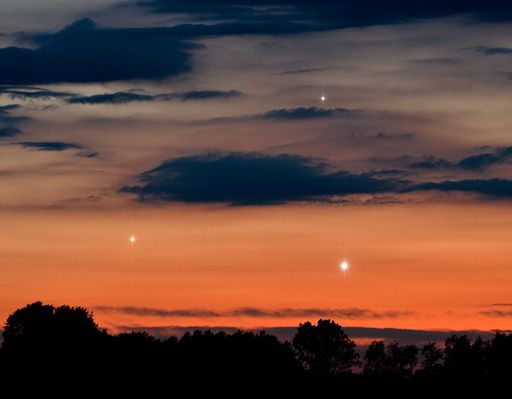
Earlier this year between March and April the comet Pan-STARRS was visible with a good pair of binoculars or amateur telescope.  However, in an area of medium-to-heavy light-pollution Pan-STARRS would have been hard to locate.  May 24th through 30th you would have watched Mercury, Venus, and Jupiter dance around each other in the west-northwest twilight sky shortly after sunset.  Every evening they were changing positions noticeably with Venus and Jupiter separated by about 1-degree on May 28th and Venus outshining Jupiter by six times.

On June 23rd at 6:00 a.m. CDT, the moon was as close to Earth as it will ever be in 2013 and at 6:32 a.m. it was brightest and fullest, known affectionately as a Super Moon.  Larger than normal ranges in ocean tides occurred for several days.  In 2014 it will arrive even closer than this year.

August 12th will be the annual Perseid Meteor Shower.  At a rate of up to 90-meteors-per-hour it is considered one of the best displays of meteors for a single observer.  Summer campers love the annual shower as it resembles a non-stop array of white bottle-rockets everywhere in the night sky.

Comet-ISON-peri-in-westMid-November through December is perhaps the biggest event in astronomy for 2013.  The Comet ISON will travel less than 750,000 miles above our sun’s surface, making it a very bright “sungrazer” on Nov. 28th, Thanksgiving Day in the U.S.  ISON could very well be easily visible in broad daylight at its closest point to the sun.  Then ISON will travel toward Earth getting as close as 40-million miles in December.  Because the comet will be ideally placed in the morning and evening sky from the Northern Hemisphere, it will most likely be one of the most watched and photographed comets of all time.

The entire month of December will be a stargazer’s extravaganza!  Venus will put on the most brilliant “evening star” show of 2013 and 2014 combined; evening or morning…doesn’t matter.  She fills the southwestern sky for 3 hours of bravos after sundown in early December, and 1.5 hours after sundown by New Year’s Eve.  And if that were not enough, a crescent moon will pass above and to the right of the goddess Dec. 5th and on the 6th she will give her grand finale!  She will not be as spectacular again until 2021.

On December 13th and 14th a most entertaining show will take place:  the Geminid Meteor Shower.  Most astronomers and meteorists give it top accolades as it surpasses even the brilliance and reliability of August’s Perseid annual showers.  Our near full moon will dilute most of the smaller fainter meteors, however, right after the moon sets (4:30 a.m. EDT), it will leave the sky completely dark for an hour or so, and that is your chance to witness as much as 2 meteor sightings per minute, or 120 per hour!  Indeed, the night sky will look like an American 4th of July fireworks show!

2014

March 27th Perihelion – Comet Holmes.  After almost two days in Oct. 2007, the Holmes comet became a half-million times brighter on its way to becoming the largest object in our solar system.  Yes, larger than our Sun.  Comet Holmes will be one of the more spectacular comets at its perihelion in 2014.

Path of Comet 209P/LINEAR

Path of Comet 209P/LINEAR

March 29th Perihelion – Comet Faye.  Discovered in 1844 by a French astronomer it is a periodic comet but will be minor in comparison to the year’s other comets.

May 6th Perihelion – Comet 209P/LINEAR.  If astronomers are correct, Earth will pass through the tail of 209P/Linear on its way back out from the Sun between 7:00 a.m. and 8:00 a.m. GMT on May 24th, resulting in a meteor storm of 100-400 meteors per hour.  Canada and the U.S. will have the best viewing.  This date is a must on your calendar!

August 10thSuper Moon.  “According to NASA, a full moon at perigee is up to 14% larger and 30% brighter than one at its farthest point, or apogee.  The full Moon, occurring less than one hour away from perigee, is a near-perfect coincidence that happens only every 18 years or so.” [Wikipedia]

Possible view of Comet C/2013-A1 from NASA Mars rover

Possible view of Comet C/2013-A1 from NASA Mars rover

August 12th – 14th will be the annual return of the Perseids Meteor Shower and its 60-meteors per hour at its peak on the 13th and 14th.  Some of the early and late meteors arrive from July 23rd through Aug. 22nd.  It radiant point, or source spot, will be in the Perseus constellation in the northeast sky after midnight.

October 19th – 25th is shaping up to be the biggest event of 2014:  Comet C/2013-A1, aka Siding Spring.  Astronomers currently calculate a 1 and 8,000 chance that C/2013-A1 will hit the surface of Mars on Oct. 19th.  The comet will pass, following its normal path, about 73,000 miles from the surface of Mars.  As the date nears and further observations are made, scientists will refine the orbit predictions.  Nevertheless, preparations are already being made to develop high-tech observations both around Mars as it approaches the planet, and on Earth as it approaches the Sun.  Mars vs. C/2013-A1 comet.

December 13th – 14th and the annual Geminids Meteor Shower won’t be as spectacular as 2013, but it will produce about 60 multicolored meteors per hour at the peak on the 13th and 14th.  The radiant point or source spot will be in the Gemini constellation in the eastern sky after midnight.

Rosetta European spacecraft.  In January 2014 Rosetta will awake from hibernation to fire-up its engines and get within 3,000 km of comet CG as it starts its return orbit back to our Sun.  In 2010 Rosetta flew within 3,000 km of asteroid Lutetia closely examining its surface and makeup.  Since then Rosetta has been cruising through the deepest parts of our solar system – a billion kilometers from the Sun – where that distance generates such little solar power she had to go into hibernation until comet CG approached.  In January 2014 after Rosetta nears CG, it will literally harpoon it so it can place the robot Philae on its surface.  As comet CG returns to our solar system to head towards our Sun, Philae will send scientific data back to Earth.

2015

January 30th Perihelion – Comet 7P/Pons-Winnecke.  The Pons-Winnecke comet is a Near Earth Comet (NEC) and will pass Earth’s surface only about 3.5 million miles away, or about fifteen times the distance to the Moon.  It probably won’t be visible by the naked eye, but a good pair of binoculars will assist in seeing this faint comet that comes around every 6.36 years.

February Dawn spacecraft.  NASA’s Dawn spacecraft is the first of its kind to use the highly efficient ion propulsion engine.  Ion thrust engines must be in an environment devoid of any other ionized particles – deep space is the perfect example of such an ideal environment for this engine system.  During February Dawn will rendezvous with one of two large asteroids (Vesta in 2012 and Ceres) classified as dwarf planets in the asteroid belt between Mars and Jupiter.  Dawn will spend several months examining Ceres and its surface sending back to Earth the first close-up images of a dwarf planet in our Solar System.

February 22ndThe Union of Venus and Mars.  Conjunctions of planets are rare events and occur only when the very long large planets and their orbits seem to join or cross.  Like lovers, Venus and Mars will be within a half degree of each other in the western sky just after sunset.

March 2nd Perihelion – Comet d’Arrest.  Discovered in 1851, the d’Arrest comet has an orbital period of 6.54 years around the Sun so it is a frequent visitor.  Like Pons-Winnecke it too will be very faint to the naked eye.

July 14thNew Horizons spacecraft.  Launched in January 2006, NASA’s spacecraft New Horizons arrives at the dwarf planet Pluto and its moons after a nine and a half-year journey.  It will capture the first close-up images of the planet and moons then continue out to the Kuiper-belt for images of icy objects at the outer edge of our Solar System.

August 12th – 14th is again the annual Perseids Meteor Shower.  See 2014 information above.

2015 conjunction will look like this May 2013 conjunction!

2015 conjunction will look like this May 2013 conjunction!

October 28thPlanetary Ménage à Trois.  A conjunction of three planets is very rare event and will be quite the spectacle in the early morning eastern sky before sunrise.  Venus, Mars, and Jupiter will be in a tight 1-degree triangle of consummation!

November 17th – 18th is the return of the Leonids Meteor Shower with an average of 40 meteors per hour at its peak.  During its 33-year cyclic peak hundreds of meteors are produced per hour.  This last occurred in 2001.  Some of its early arriving then late arriving meteors can be seen between Nov. 13th and 20th.  The radiant point can be found in the constellation Leo after midnight.

December 13th – 14th is again the annual Geminids Meteor Shower.  See 2014 information above.

(paragraph separation)

“Perchance to Dream”

It will be a 1-in-a-million lifetime jaw-dropping event to see.  Well, actually in less than 1-million years.  Yes, sadly we won’t be around to witness it, but the Betelgeuse Supernova will be brighter, much brighter than our own full Moon!  It will be easily visible in daytime for several months so don’t be fooled into thinking it’s the second coming with another Star of Bethlehem, but instead the wonder of the cosmos with the Star of Betelgeuse!

The star is well-known among avid stargazers because it is the second brightest star in the Orion constellation and because of its size, color, and placement.  It is the red supergiant star in Orion’s “right shoulder” and ranks as the eighth brightest star in our entire night sky.  For some perspective, Betelgeuse is so huge that if it were our own Sun, its outer edges would touch Jupiter!  It is approximately 640 light years away from our Sun.  If it were to explode at night in our lifetime, it might look something like this…

Cosmologists and astronomers predict it will go super-nova in 1-million years or less because it is a “runaway star”.  In other words, due to its super size and mass, it will burn-up, collapse on itself, and create such an explosion that from even 640 light years away, it will be well beyond the brightest super-nova EVER recorded in Earth’s history!  If you can imagine any major global event throughout all of history, Betelgeuse will dwarf that.  For those several months, Earth’s night sky will seem like endless twilight until sunrise!  Wouldn’t that be the most remarkable thing in life to witness?

* * * * * * * * * *

In the final part of this three-part series, I will explain how simple tools and methods can map the night sky, locate major seasonal celestial highlights and their historical backgrounds, and explain why and how humanity will gaze the heavens just as the ancients did without any man-made light-pollution.  If you have enjoyed this part, please let me know by commenting, and check-in every so often for Part 3.

Creative Commons License
This work by Professor Taboo is licensed under a Creative Commons Attribution-NoDerivs 3.0 Unported License.
Permissions beyond the scope of this license may be available at https://professortaboo.wordpress.com.

Hunters vs. Hunted

As part of the Alternative Lifestyles blog-posts migration over to the new blog The Professor’s Lifestyles Memoirs, this post has been moved there. To read this post please click the link to the blog.

Your patience is appreciated. Thank you!

After Dark

Milky Way in clear skies in remote America

When the sun’s light completely recedes, I bet you had no idea that with your naked eyes or a pair of inexpensive binoculars you can gaze upon constellations, nebulas, star clusters, planets, double stars, and even one galaxy that is only two million light-years away.  With summer approaching many might be traveling west to our National Parks where very little to no extraneous light washes out the splendor of our night-time cosmos.  This post is Part One of a three-part series.  Check back later for part two.

Our moon is one of the brightest objects to gaze, however, there are many others.  Our surrounding atmosphere has several phenomena and all the planets can be seen with the naked eye or binoculars except Pluto.  Asteroids, meteors, and comets can be detected as well.  And even further away you can spot star clusters, nebulas, and constellations including that one galaxy 2-million light-years away.  Yet, most star-gazers do not realize there is a nightly twilight phenomena which is closer than our moon.  It is closer than our own atmosphere.  It is Earth’s shadow.

Just as the Sun sets look opposite of it (easterly) close on the horizon.  Within minutes you will start to see a dark blue band begin to rise just above the horizon.  This is when the band is darkest.  As it starts to move upward, it will fade, until it disappears into the night sky at the ending of twilight.  This dark band marks the edge of the shadow of Earth’s horizon.  Red light from our Sun illuminates our atmosphere above the band.  The band is blue due to the blue part of sunlight which has been scattered into the shadow by dust particles.  If you see Earth’s shadow vividly, then there is little dust or humidity in the air.

We are of course inside the Milky Way galaxy.  The Milky Way is approximately 80,000 to 100,000 light-years across!  Our Sun rests 30,000 to 35,000 light-years from the center.  There are more than 1,000 clusters of stars within our galaxy, all of which are easily visible with binoculars.  Beyond the Milky Way is a bunch of empty space, and then a lot more galaxies.  The Milky Way is part of a group of galaxies called the Local Group and the flagship of this group is the Great Andromeda Galaxy.  The Andromeda Galaxy is so large and massive that it is the only galaxy we can see with the naked eye.  Out beyond our Local Group are more clusters of galaxies, as many as you could ever count in 50 lifetimes!  In fact, it makes no difference what direction you look with whatever size telescope you view, all you can see are galaxy upon galaxies.

Stargazing Basics

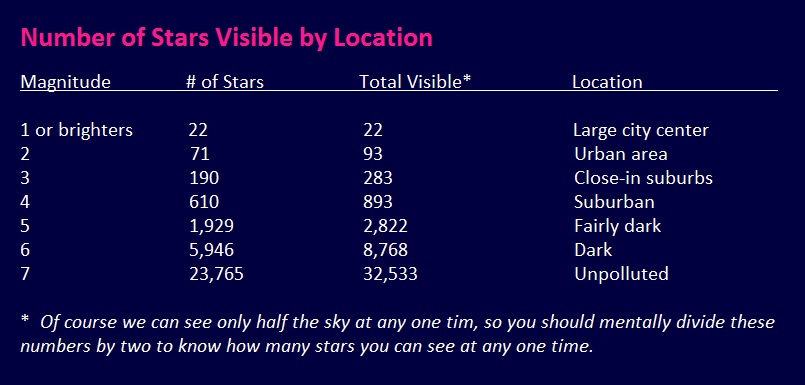
Visible Stars TableOne or three nights of viewing the night sky will not turn you into an expert astronomer.  However, there are four basic principles to help you and your fellow sky troopers understand what you’re viewing in the after hours.

BRIGHTNESS  The brightness of a particular star is measured by its magnitude.  Its magnitude is governed by how bright it actually is and how far away it is from Earth.  The brightest star in our night sky, Sirius, shines at a magnitude of 1.4, but its actual brightness is much less.  It is less because it is very close to Earth, just a mere 8.2 light-years away.  How exactly is magnitude determined?  It depends on your location.  If you are inside or near a large city, your 22 visible stars will be only a 1-magnitude or brighter.  On average, stars of the 2nd magnitude are actually 2.5 times dimmer than those of the 1st magnitude, and so on down the line.  In a moderately dark sky, you can view stars of about the 5th magnitude.  On super dark nights (no moon) we can most likely find 6th and 7th magnitude stars (see table above).

COLOR  A star’s color can reveal a lot about its nature.  Generally speaking, the more blue a star appears, the hotter it is, and the redder it is, the cooler it is.  We typically do not see stars easily with our naked eye, but the colors are a lot more obvious through binoculars.  And kids see star colors a lot better than adults.

EVERYTHING’S MOVING  It takes at least 15 minutes for our eyes to adjust to the darkness.  During that time, pick the brightest object you can see near one of the horizons.  Take note of its position relative to a tall tree, mountaintop, or building.  Once your eyes have adjusted, notice the object is moving up if you’re looking east, down if you’re looking west, or mostly left to right if you’re looking south.

DISTANCE  Because outer space is so unimaginably vast, it makes little sense to measure distances in miles or kilometers.  Instead, astronomers use how far the speed of light travels in an amount of time.  The Moon is about 240,000 miles away, but astronomers say it is 1 1/3 light-seconds away.  Our Sun is 93,000,000 miles away, but 500 light-seconds, or 8 1/2 light-minutes away.  When Jupiter is closest to Earth, it is 35 light-minutes away; in other words, when its reflection reaches us we are seeing 35 minutes into Jupiter’s past.  Now here is a mind-blower:  astronomers have determined that our Universe is approximately 13.8 billion years old.  What this means is we cannot see any further than 13.8 billion light years beyond Earth, because the light from whatever’s farther out hasn’t had time to reach our eyes yet!

Celestial Assembly

Looking up into the night sky it seems as if everything is painted onto an enormous black sphere that’s far away.  Astronomers call this the celestial sphere and find positions on it in similar ways we denote positions here on Earth.  There is a celestial equator too, just like the Earth’s equator but projected up onto the celestial sphere.

Image courtesy of burro.astr.cwru.edu

Seasonal Big Dipper. Image courtesy of burro.astr.cwru.edu

As mentioned earlier, objects appearing to move in the sky from night to night (or, in the case of meteors and man-made satellites, a lot faster), are all inside our Solar System.  To us, our Sun appears to move across the sky along a line we call the ecliptic.  This term is used because eclipses of the Sun and Moon are related to this line.  Tomorrow evening April 25th, 2013 there is a partial lunar eclipse.  Since the nine planets all move in nearly the same plane as the Earth’s orbit around the Sun, they too appear to move about the night sky near the ecliptic.  This is why on star maps they include the ecliptic as the narrow yellow belt.

Most modern astronomers do not use identifiable constellations such as the Big Dipper or Little Dipper to locate objects.  There are 88 recognized constellations that divide up the sky, many of which we never see here in the United States.  They are too far south.  Here in the northern hemisphere there is about 25% of the sky that is invisible to us.  For example, Americans cannot see the Southern Cross.  Only people close to the equator in tropical latitudes in the northern hemisphere can view the Southern Cross for a few brief hours during winter and spring.  Conversely, for viewers in places like Australia, they never see the northernmost 25% of our sky or the Big and Little Dippers which Ferris-wheel around Polaris, the North Star.

Cassiopeia as seen by naked eye

Cassiopeia as seen by naked eye

Just as southern constellations never rise above our horizon, others never set.  Even when the day’s Sun is drowning out the stars, there are constellations which despite the season never vanish.  These are called circumpolar constellations.  As seen in the image above, the Big Dipper is always visible to us in the northern hemisphere 24/7.  During the Fall it is just above the horizon and in Spring highest above the horizon.  For thousands of years ancient travelers of both land and sea used these circumpolar anchors to guide their way.  They too used the “dippers” to orient themselves, but often they included the constellation CassiopeiaCassiopeia is always opposite the Big Dipper and is noted for its “W” shape.

Most all of the constellations tell a story, a mythical story of the ancients.  This is why so many are fond of astronomy and stargazing:  you can impress your friends with stories of gods and goddesses behaving badly or saving mankind.

Well before the time of TV and video games, ancient cultures had to find their amusement wherever they could.  These myths, given by the stars to mankind, were most definitely the plots and schemes of the first “soap operas.”  Because most of Earth’s landmass lies in the northern hemisphere, the southern constellations represent scientific tools which seafaring navigators used.  And, of course, the 12 constellations that hug our ecliptic are the signs of the zodiac in astrology.

Some constellation figures like the Egyptian Orion, are fairly convenient to recognize, and others are simply “gap-fillers.”  And despite those old stories reminding us of a bunch of angry child-like behaving deities, they are fun to share and find in the night sky.  They connect us to our distant past.  And if your friends, spouse or romantic lover isn’t that impressed by your vast knowledge of the sky, these cultural backgrounds are certainly justification for learning the constellations.  No one should presume they can actually trace out a “reclining virgin” (aroused for an evening) when you are looking at the constellation Virgo!  One must know what you are looking at and how to find it if you are to be a true romantic lover!

* * * * * * * * * *

In Part Two of this series, I will give a quick guide to the remarkable celestial shows and events arriving between 2013 and 2015.  Grab your drinks, popcorn, lounge-chairs, and stargazing buddy.  It’s going to be quite a show!

Creative Commons License
This work by Professor Taboo is licensed under a Creative Commons Attribution-NoDerivs 3.0 Unported License.
Permissions beyond the scope of this license may be available at https://professortaboo.wordpress.com.

Rhythms

There is perhaps no other auditory rhythm or pulse that reaches me as deep as music and its beat.  The connection I feel, the alluring sound just captivates my senses like a euphoric drug!  It is and has been my drug-of-choice for some thirty-five plus years.  And then descending from a long line of family who religiously dance… it is no wonder why I spend hours upon hours on the dance floor.  As I write this post I am listening to one of my favorite DJ’s in Dallas:  Per, who is a regular at The Church.  Like Per, I too am moved by Synth-Pop or Future-Pop, a European industrial-electronic-trance genre.  Here is one of his sets he played at The Church:

I’ve had technical issues with the SoundCloud player so if it isn’t loading up, click here to go to Per’s set.

The ChurchHave you ever danced so much and for so long that by 4 or 5 a.m. you are so exhausted that seconds after you sit or lay down you just slip into a deep slumber?  If not, then I highly recommend you do it.  It is like the deepest restful sleep you’ve possibly ever had.  You lay there knowing you have been rebalanced, reconnected with Earth and the Multiverse.  Not only do you “return home” but, it is a fantastic cardio workout!  Something I’ve quoted before deserves repeating:

Here is the mystery: If the rhythm is right, if the translation between inner mood and the drum membrane are perfect, then you know it instantly. “Ah, this goes with my body tempo, this connects how I feel today, how fast my heart is beating, what my thoughts are, what my hands feel like.”

When the rhythm is right you feel it with all your senses, every corner of your soul and being. You don’t fight it, but instead allow yourself to be propelled and consumed by its insistent yet familiar feeling.  All sense of the present moment disappears, the normal categories of time become meaningless.

We live on a planet of rhythm and time.  A planet that completes its cycle around the sun every 365 days, with a moon that cycles around us every 28 days, and we rotate around our own axis every 24 hours.  These cosmic cycles and our bodily ones, all connected to the circadian dance of day and night.  The mystery of rhythm and time found for a moment in the soul’s drum.  When it is right, you feel it with all your senses, every thread of your being.  It is the ‘sweet spot’ of connection.

Let your soul and body be carried away with the rhythm; feel it…drift, move.  You will not regret it.  No matter what anyone thinks, it is natural, it is genetic.  Dance together as partners or dance solo.  It makes no difference.  Just connect.  Let the rhythm take over, close your eyes, and move, dance like no one is watching.

(paragraph separation)

Live Laugh Love

(paragraph separation)

Creative Commons License
This work by Professor Taboo is licensed under a Creative Commons Attribution-NoDerivs 3.0 Unported License.
Permissions beyond the scope of this license may be available at https://professortaboo.wordpress.com.