Untapped Worlds – An Intro

12.6-watts average. That is it. That is the average electric power (i.e. metabolic-energy) the human body must supply the brain for one “normal” day says Scientific American magazine. Want to know what sort of items can be powered with only 12.6-watts and for how long? To help better understand this comparison, let’s pretend we have a 12.6-watt battery to run some common household items. A basic clock-radio you might see on a bedside table in a cheap hotel will run for approximately 3-hours, if the radio volume is soft; maybe 4-hours if the radio is never used. A Nintendo Wii game-console can run on 16.8-watts for an hour. A standard 19″ CRT TV, 55-90 watts for an hour. A camping range-burner requires 800-watts for 1-hour. The average household coffee-maker requires 900-watts per hour. Getting the picture?

Perception-InterpretationThe human brain must conserve metabolic-power and run as efficiently as possible in order to function “normally” for a 14-16 hour day awake. Naturally, when asleep the brain is using much less metabolic-power, but still consumes small amounts. Power efficiency becomes critical in abnormal circumstances; either the body has enough metabolic-energy stored or it doesn’t. When the body does not, the potential for serious or traumatic harm increases proportionately to the danger, correct? Without the necessary brain-power for higher or acute cognitive and motor reactions, the greater the bodily harm or mortality. We see this organ-power equation illustrated in the animal kingdom every day. For example, animals falling prey to predators. Those animals with a higher healthier organ-power coefficient typically escape death, or their chances of escape are higher than those hunted animals with lower or less-healthy organ-power coefficients. Roadkills are another example. Animals with a low coefficient (i.e. tiny brains with tiny metabolic power to that tiny brain) typically cannot cross a busy highway 10-times without being hit.

In different more complex scenarios, humans are no different. Place an ordinary 20-something year old person who has been raised in a peaceful, quiet, unpopulated region all their life with absolutely no training or education of weapons or warfare, into a violent war zone for a 6-8 week period, their rate of survival — excluding mental health of course — will be extremely low, if not fatal. Too drastic? Then replace the war zone conditions with modern traffic rules and complex motor vehicles, multiply all that by ten(?) depending on the site’s population, and make it a teenager or 20-22 year old driver, and no driver’s education whatsoever. What might or probably will happen after 2-6 months? Ask an auto-insurance underwriter what the statistics would be.

Here’s the point in this so far:  humans are surrounded, no… constantly bombarded, with a never-ending supply of stimuli to the eyes, nose, ears, skin, and tongue in a 24-hour period! It is impossible for our brains to receive, process, store, and use all the available daily stimuli when it runs on only 12.6 watts per day. What does the brain do to compensate…to cope? It prioritizes. For millions of years our brains have slowly learned what is critical to survive, what is needed to increase survival-rate, what is unnecessary but nice, and what is utterly useless. And it does this prioritizing FAST, real fast! It has to; 12.6 watts runs out quick, or in other words, cognitive fatigue, let alone physical exhaustion, leads to collapse. Perhaps the only exception to this metabolic law is drug use or abuse. The reliability or unreliability of drug-induced cognition, heightened or otherwise, I will leave alone or for another time. 😉

Suffice to say, our human brains are quite prone/susceptible to various degrees of ambiguity, superstition, memory-errors, and deception.

Deception

When success, advantage, surprise, control, victory, or secrecy are sought, one method of better assuring that outcome is through deception. You find it in many team sports, you find it in multimillion dollar business tactics against competitors, you find it in card games, you even find it among verbal human interactions. Deception is especially useful in combat and wartime. Perhaps one of the best examples of this was Operation Bodyguard.

Operation Bodyguard and its seven sub-operations leading up to the 1944 D-Day Normandy invasion of Nazi Fortress Europe, were highly successful operations of deception saving hundreds of thousands of American, British, Canadian, French, and other Allied lives. For several months prior to the actual invasion into Normandy, France, the Allied High Command under Dwight Eisenhower flooded the Nazi airwaves, radar surveillance with well-planned misinformation, and even inflatable tanks, artillery, and supply trucks creating a completely fictitious Army Group to deceive German reconnaissance planes. By June 6 and 7, 1944, the operations were so successful that Hitler and his élite commanders waited 7 weeks before fully responding to the Normandy invasion forces, much too late to stop it. Oh the power and usefulness of deception.

History is laden with examples of armies, sports teams, gifted magicians, and large groups of people being duped by simple tricks designed to divert and/or confuse the brain. Take for example, this clever trick play by a high school baseball team…

Magic tricks are plentiful with deception, diversion, and confusion, so many that there is no need to list the thousands or embed their videos here. But one poignant example of people or large groups being utterly fooled would be that of the Peoples Temple in 1978 at Jonestown, Guyana where over 900 men, women, and children committed mass suicide/murder following orders from their cult leader Jim Jones. Until 9/11 this had been the greatest loss of American civilian lives by a single act or day. What is important to remember is that our brains can be led to misinterpret information. Our limited senses can cause the brain to construct false perceptions of people and in the world we live.

Memory Errors

Fact:  the human brain has difficulty recalling an event in the past, and details are often distorted or incorrect. This applies to every single brain on the planet. Scientific evidence shows this fact repeatedly no matter how mundane or monumental the event, our human memory is not as good as we’d like it to be.

Our memory is not as fixed as we might perceive, but much more fluid. What does that mean? Conceptualization is the norm, errancy is prevalent… along with egocentricity I would think. 😉 This 17-minute TED video from award-winning Dr. Elizabeth Loftus, a cognitive psychologist from Stanford University and UCLA, explains her ground-breaking research about the brain’s misinformation effect and its extremely imaginative capabilities for creating false memories. Dr. Loftus’ findings and talk are superb…

No matter how highly we hold our memory skills, the brain is simply not currently wired nor the metabolic wattage (12.6 watts) to be a precise 300-year DVR. Will it ever be? Ask that question in 10,000 or 100,000 maybe 1-million years. Right now the overwhelming scientific neurocognitive data suggests that our brain’s conceptualizing skills, including imaginative or experiential conjecturing, are far more dominant and gifted than fact-finding or fact-storing. Don’t despair though, we have the intelligence to improve this human condition…over a long, long period of course.

Superstition and Ambiguity

In my next post in the series Untapped Worlds — Departure, I will finish the Superstition and Ambiguity portions, establishing the/our brain’s faulty interpretations based on its limited (or very limited?) sensory feedbacks — it only learns what it is actually fed. Then move further (evolve?) to more impactful human experience. How can we upgrade our brains? How can we improve its immaturity before it’s too late?

Mmmm, we must leave port. To be well-traveled, more acutely aware, more precise, we must first depart from traditional cognition!

Live Well — Love Much — Laugh Often — Learn Always

(paragraph break)

Creative Commons License
Blog content with this logo by Professor Taboo is licensed under a Creative Commons Attribution-NonCommercial 4.0 International License.
Permissions beyond the scope of this license may be available at https://professortaboo.com/.
Machiavellian Meloidae

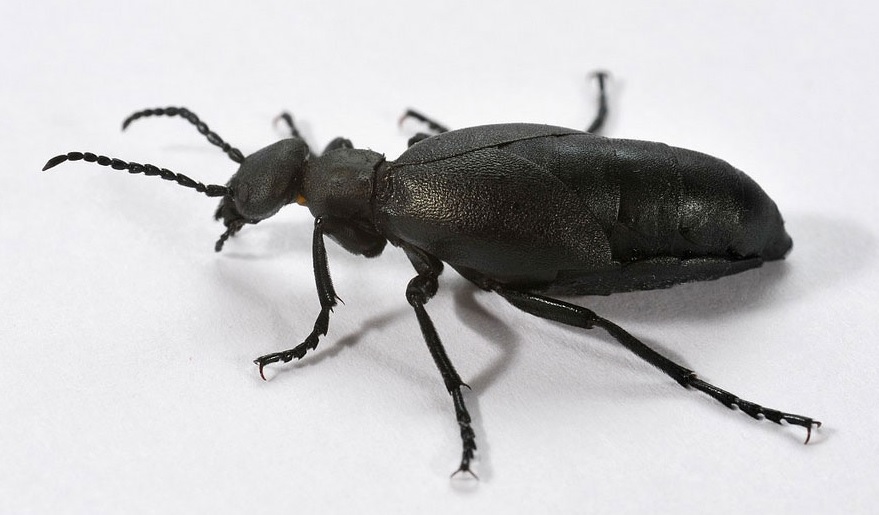
For those of you who are utterly fascinated (like me) with Earth’s most resilient creatures — no, humans are not even close — the Meloidae take survival and reproduction to an all new high… or rather a cunning, evil low may be the correct designation. If you think politicians or double-agents are unscrupulous, then you don’t know much about these ingenious Coleoptera. No, not Cleopatra, Coleoptera… though the behavioral similarities are clearly there.

Beware of Seductive Female…

Coleop

Coleoptera Meloidae

Bees. Yes, seductive fake female bees! Or perhaps I could have left-off “bees”. HAH! But let’s not go there, yet. But I do want to talk about perfumes… seductive perfumes!

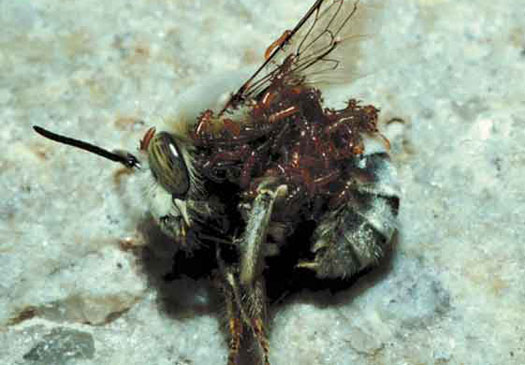
The larvae of the Blister Beetle, after they are hatched, must immediately seek food. But they do not seek out just any menu. They want a specific 5-star platinum dinning establishment with an unforgettable experience, AND they want and will be chauffeured there! Men, married men, husbands with a pregnant wife or newborns… does this sound familiar? How do these newly born larvae do it? As the below video will show, their genetic coding makes them work as one team, climb to the top of a blade of grass or leaf, clump together, then the Coup d’état… they lure an unsuspecting (horny) male Digger-bee, and do it with specialized perfume, or pheromones! Again, sound familiar? Talk about the greatest STD. Wow! Guys, this totally redefines the need for super safe sex!

(paragraph break)

What Can We Learn From Blister Beetles?

Having a background in psych counseling and assessment, as well as certified 4th through 8th grade teacher in all core subjects with a deep fondness for science and social studies (history), my students have always enjoyed relating or connecting Earth science and its creatures to self or to us. Invariably the bored middle school kids ask the question… How does this effect me or help me in life? Well my little unknowing enquiring mind, it does in many ways. Case and point: the Blister Beetle.

meloidae_beetle_larvae

Male Digger-bee with stowaways

Ever heard of the adage “If it seems too good to be true, then it probably is” or its gullible opposite “Never look a gift horse in the mouth“? Those two phrases and similar ones carry a lot of wisdom. As many a magician have demonstrated over the centuries, our eyes can be easily deceived. Our ears and nose can be fooled as well, to a lesser extent. Obviously, the “perfumed pheromones” these meloidae larvae ooze, cause much “male digger-bee intoxication” and I believe mimic other species’ perfumes! I’ve fallen prey to different parfums enivrants as many times as these male digger-bees! And I’d wager I have hit the ground, once or twice, much harder than these gullible lads!

Our judgement and perceptions (of self and others) can be quite flawed. Only through periods of time — sometimes years, and in the case of humanity, centuries or millenia — and through trial and error do we learn from events and our mistakes. Hopefully not fatal mistakes. Therefore, it really behooves us flawed humans (and hetero males?) to consider situations with as much cognitive examination as with emotion, especially impulsive emotion. Easier said than done, right? Particularly when some of us are genetically wired to feel and feel strongly, or to find and love, and love strongly. Believe me, I have wrestled with this advice for much of my life, as my recent posts about my daughter, marriages and divorces, and the nature of love can greatly attest!

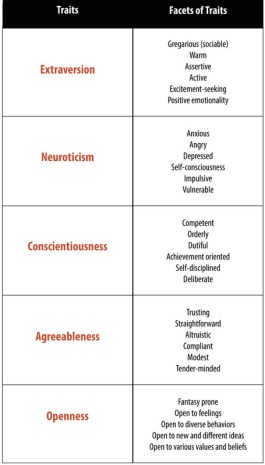
Five-Factor Model - courtesy of noboproject.com

Five-Factor Model – courtesy of noboproject.com

All of us, every single human being alive, are inextricably connected to this planet and its life-giving (and taking) environments and creatures. We absolutely can learn from all the animals, how they survive, adapt, evolve, and especially reproduce, even from the aversely simpatico relationship of Blister Beetles and Digger bees.

BigFive-sub

Subtraits of the Big Five – courtesy of noboproject.com

In modern psychology, Machiavellianism (and this beetle) is one of three personality traits of the Dark Triad; dark meaning malevolent manifestations. Essentially it is behavior exhibited by a high drive to achieve at the expense of or disregard to others. Clearly this is the female Blister Beetle’s — and her offspring’s — motivation and behavior. What I find fascinating is the question “Are there Blister Beetles among us as humans?” Is it simply genetic programming in order to survive and perpetuate the species and they cannot CHOOSE morality… the “higher road”? Or are there always choices between species; in other words, species who are inferior deserving of extinction and those as superior who deserve to live and survive? Are we talking about humans or beetles? Humanity’s long long history of wars and genocide speak volumes of this Genetics versus Morality judgement. As much as Blister Beetles have a very high regard for self and their offspring, I think humans do too… particularly certain males. By default I must reluctantly include myself in that gender. 😦

In Wikipedia’s description of Mechaiavellianism, the section on human relations with other personality traits, I found to be uncomfortably familiar. Are you familiar with the HEXACO model? I wasn’t until I began comparing this beetle’s behavior with similarities to other Earth species, which I typically like to do as a good (Freethinking Humanist) science teacher. See the three figures of the HEXACO “Big Five” tables.. Where do you think your (self?) personality falls?

BeyondBigFive-3

Traits beyond Five-Factor Model – courtesy of noboproject.com

Personally, I see the Blister Beetle’s Machiavellianism within several primate species, especially certain Homo sapiens. Would you agree or disagree? Why or why not? Are we products of our DNA or of our environment, or a little of both? Are you a Blister Beetle or a Digger bee. Or if you’d like to protect your true identity (like I do here!) you can simply comment about these cunning little insects and their larvae. 😈

(paragraph break)

Live Well — Love Much — Laugh Often — Learn Always

(paragraph break)

Creative Commons License
Blog content with this logo by Professor Taboo is licensed under a Creative Commons Attribution-NonCommercial 4.0 International License.
Permissions beyond the scope of this license may be available at https://professortaboo.com/.

New Perspectives

(paragraph break)

From 250-miles up in Earth’s orbit on the International Space Station, Russian cosmonaut Sergei Krikalev said while looking down at our home planet, “from space you do not see any borders… you feel yourself part of humankind, not just man from one country or one city.” National borders and racial-ethnic distinctions disappear when one looks down from way above. As if from a height of incredible omniscience, (from my Jan. 2013 post: Our Family Reunion) Sergei points out that Earth is not a child’s sandbox to be selfishly divided and toys hoarded by the biggest bullies. Humanity MUST join together in more collaboration than ever before to change Earth’s current life-giving warnings in which mankind has created and exacerbated over the last century.

Therefore, for this New Year of 2015, I am posting a large collage of images showing Earth’s wonders and human ingenuity in hopes that over the next twelve months and further, all of us will try to gain a few NEW perspectives of our existence. Open wide your minds and let the entire world and its fascinating creatures inside and begin in earnest a lifestyle of conservation. Do it not just for yourself, but for your children, your grandchildren, and their children!

Happy New Year everyone!

This slideshow requires JavaScript.

How big is your perspective? How much of your incredible planet have you yet to see and experience with others?

(paragraph break)

Live Well — Love Much — Laugh Often — Learn Always

(paragraph break)

Creative Commons License
Blog content with this logo by Professor Taboo is licensed under a Creative Commons Attribution-NonCommercial 4.0 International License.
Permissions beyond the scope of this license may be available at https://professortaboo.com/.
After Dark – Part 3

Did you know that if planet Earth were invaded by angry hungry aliens from a distant Death Star ship, the best offering to avoid possible violence or slavery believe it or not would be to hand over our silicon-based sand and rocks?  Which way do all of our planets in our Solar System rotate?  Have you ever wondered why comets such as Halley’s Comet, Pons-Gambart, and Ikeya-Zhang Comets take 75, 188, and 366 earth-years respectively to come around?

Questions like these and their answers fascinated me camping outside as a boy looking up into the night sky with astonishment.  How far away is that star, I would ask myself, which lead to another question and another.  Limitless.

* * * * * * * * * *

To enlarge click image

To enlarge click image

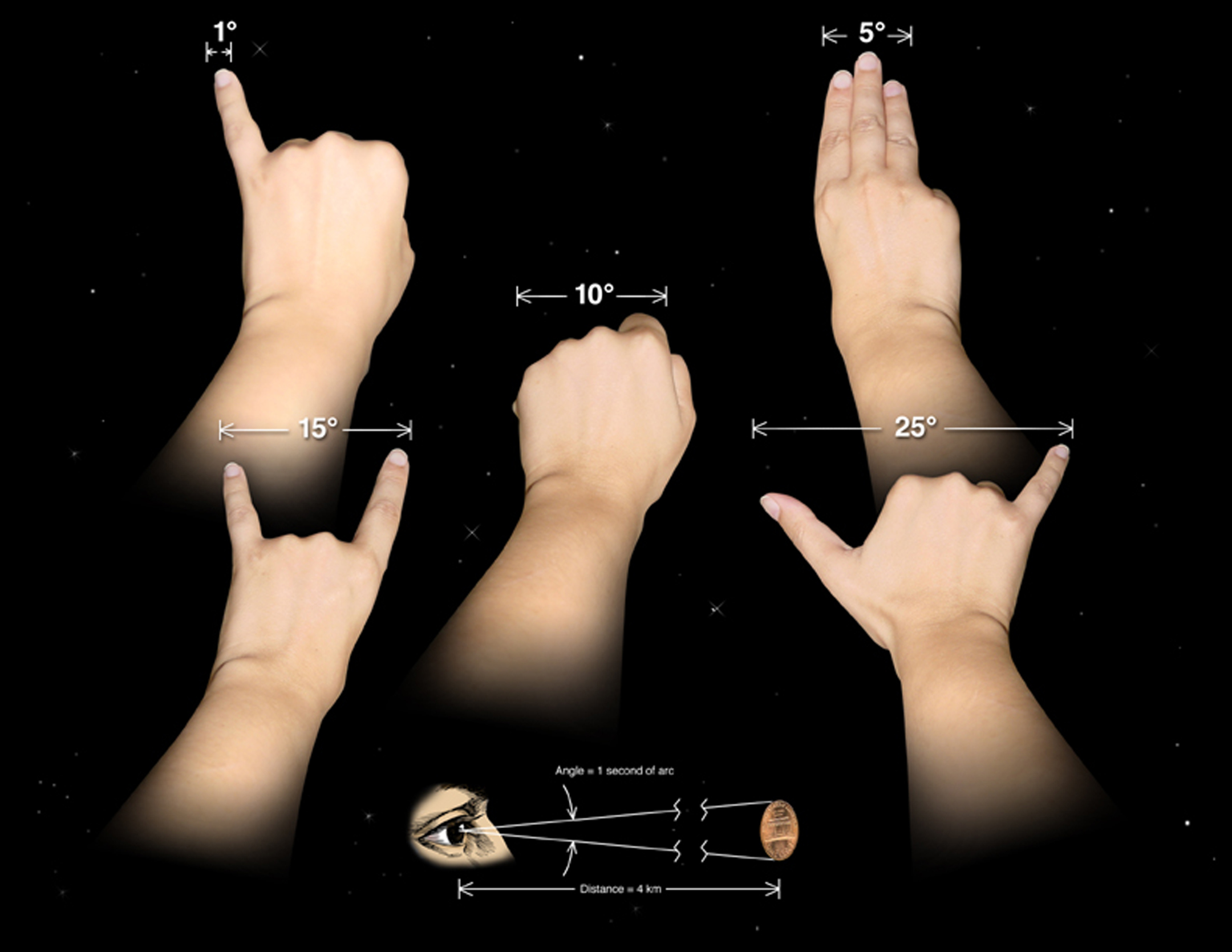
A 100-foot telescope and multi-million dollar observatory are not necessary to begin an intermediate knowledge of the celestial.  Your outstretched arm, hand and fingers can suffice in determining an object’s angular size.  Clamp your hand in a fist.  Across your knuckles is about 10 degrees.  Don’t believe me?  Taking that fist and starting at the horizon count how many “fisted-hands” it takes to count upwards to straight up, or zenith (the top of the sky).  It will be about nine hands, or 90 degrees.  Three fingers together are about 5 degrees across and one finger, like the pinky finger, will be about 1 degree.  A full moon then, when using this form of measurement will be about a half-degree (0.5°).

Finding the position of an object in the sky is a bit more difficult.  If you don’t carry around a Cross Staff, or Astrolab, or even what amateur golfers use today:  a GPS app; if you can find due north then you can still navigate the sky with your hand.  The azimuth, or angular measurement parallel to the horizon in a spherical coordinate system, determines the cardinal points:  north, south, east, and west.  North is of course 0 degrees, east will be 90 degrees, south is 180 degrees, and due west will be 270 degrees.  The angle above the horizon will be, you guessed it, altitude.  Keeping our basic sky-gazing simple, when measuring from the horizon to the zenith, only 0-90 degrees is needed.  Now you have the quickest most convenient tools to examine the never-ending sky.

A simple pair of binoculars can reveal more of the heavens beyond your naked eye.  If you surveyed the full moon, you could easily find many craters or the four brightest moons of Jupiter.  With the same binoculars you might be able to find Saturn’s brightest and biggest moon:  Titan.  If you want to see even more of the night sky, you will have to have binoculars stronger than 7x (times); in other words massively big and expensive type binoculars that will require a tripod or something steady and stationary to mount your 8x plus binoculars.  Beyond high-powered binoculars gets us into complex telescopes and well beyond the scope of this post.

* * * * * * * * * *

Under the Stars

Some star-maps, a flashlight, items to keep you comfortable or warm, and some patience will be all you need to find stars, constellations, and other sorted celestial performers.  The further away from light-pollution you can get (i.e. large towns or cities) the better.  Finding cardinal points is easiest with a compass or map; they both work fine.  If you can remember where on the horizon the Sunset took place, then you have a general idea which direction is west.  Keep in mind though the seasonal factors:  during winter the Sun recedes a little south of due west and during summer it sets a little north of due west.  In spring and fall, the Sun sets quite close to due west.

camping&stargazingIf you can view your sky maps with a red-lighted flashlight, then your pupils won’t close up in its light.  A normal white flashlight will cause your views from map-to-sky and back again to be greatly hindered by your widening and retracting pupils causing delays in their adjustments and testing your patience.  Having red-lenses to cover the bulb or flashlights using a “red-LED” bulb can be purchased at most camping-sporting stores.  Also, when you’ve been out a few times and can easily locate previous stars and/or constellations, moving on to unexplored areas becomes quicker and easier as your mapping-spotting skills improve.

One more star-gazing tip:  A clear sky is usually pretty cold relative to your latitude.  The further away you are from the equator, the colder the clear sky will be and the quicker your sitting-still body will get.  Dress warmer than normal, a toboggan or hat might be good, and even bring along a Thermos of hot soup or tea, or as I often do, a warm stout toddy!  If you want to “impress” a certain co-stargazer, bring along reclining folding-chairs and a quilt.  He or she will be in for a superb relaxing long evening of fun.

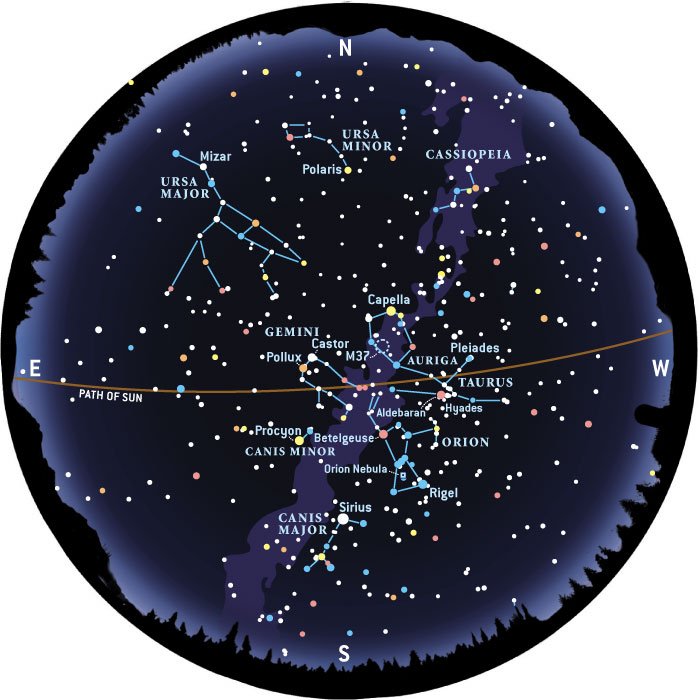
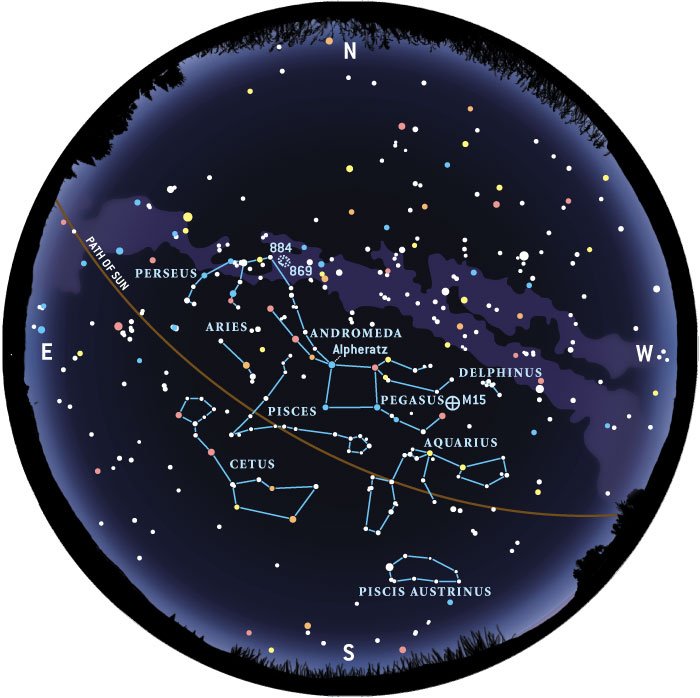
The following four seasonal sky maps are near 35 degrees north latitude in North America; in other words, a straight line from Lompoc, CA to Fayetteville, NC.  Sky maps from your particular location can be found on the internet or from a local nearby planetarium store.  The six bi-monthly descriptions below are incorporated into the flow or movement of the sky maps.

Sirius:  The Five-month King of Stars

thewintersky_700

This map shows the winter sky at 2am December 1; midnight January 1; and 10pm February 1. Image – Roen Kelly, astronomy.com

From late December through mid-April, in the southeasterly sky, the brightest star of all stars in our sky is Sirius.  It is the brightest because it is the closest star to Earth:  about 8-light years away and closing.  Yes, you read correctly, Sirius is getting closer to our Solar System and will be noticeably brighter in about 50,000 to 60,000 years.  After that it will begin moving away, but for the next 200,000 years or so it will always be the King of All Stars.  During winter and spring Sirius is a great reference point if you are just starting out as a new astronomer.

Serving King Sirius and moving to the west and slightly up is his Viceroy Rigel, then further up are Viceroys Betelgeuse (better known as Beatlejuice), Procyon to the east, and finally back toward the west and near straight up is  Aldebaran.  Straight up, or near zenith, and more north is his lone Viceroy Capella.  These five stars represent magnitudes about 2.5 times less than Sirius but are so bright they can all be spotted in a large city with light-pollution.  King Sirius’ “court” is the primary reason the winter skies are the favorite season for stargazers; they jump out to you!

Galaxies Galore and A New Prince

Heading into spring (March – early May) you’ll notice that Sirius and his viceroys have moved toward the western horizon.  Back to the southern horizon is a darker starless sky by comparison.  Yet due east near the horizon comes the newest viceroy or Prince:  Arcturus which has been led by the largest cluster of galaxies – almost halfway up to the zenith – called the Virgo Clusters.  They include more than 1,300 galaxies.  Off toward the north and halfway to zenith you can find the Big Dipper.

Another Viceroy and King Sirius Departs

thespringsky_700

1am March 1; 11pm April 1; 9pm May 1. Add one hour for daylight-saving time. Image – Roen Kelly, astronomy.com

While Sirius drops down behind the western horizon and Procyon and Capella soon follow, the newest member to the court arrives:  Viceroy Vega.  Almost to the northeastern horizon, Vega’s brightness equals that of his predecessors and brings with him the Northern Cross with Deneb (touching the horizon) as its crown.  It is now May through early July.  Move to the southeastern horizon close to Earth’s surface, and the claws of Scorpius have appeared with Antares as its heart.  Near the zenith sits Arcturus, 2nd in command for about two-plus months, while Sirius vacations in his summer palace doing “unseen” kingly jollies for the next four.

The Milky Way’s Majesty

thesummersky_700

1am June 1; 11pm July 1; 9pm August 1. Add one hour for daylight-saving time. Image – Roen Kelly, astronomy.com

July and August are the best times to see the center of our galaxy particularly with binoculars.  Like a following royal parade, Vega brings along in the eastern sky not only Altair, a star slightly brighter than the previous Deneb, but also the globular-cluster M13 near zenith, and the star-clusters M11, M39, and the best clusters M6 and M7.  And as if that wasn’t enough, the nebulas M8, M20, and M17 between Scorpius and Sagittarius to the south (about 10° up from horizon), round off the fat center of our majestic Milky Way.

Fall’s Tranquility?

The gaudiness of summer and the Milky Way drift into the southwest horizon causing many astronomers to say the night sky is the tamest from September through late October.  It is perhaps no coincidence then that fall and October are celebrated as Halloween, or hallow the dead and dying.  The Viceroy Arcturus has all but vanished behind the western horizon, leaving only Prince Vega near the zenith.  The return of Capella and the first of King Sirius’ court are probably not yet visible to the northeast.  A seemingly dark “blanket” ensues.

theautumnsky_700

1am September 1; 11pm October 1; 9pm November 1. Add one hour for daylight-saving time. Image – Roen Kelly, astronomy.com

Not to worry, as all great exciting events take place to the south – sexual overtones intended – magnitude 1.16 star Fomalhaut rises out of Earth’s vagina to remind us that with persistence comes birth… and for better or worse, MANY MORE THINGS to come!  Can I get an Amen!?  Because Fomalhaut is the lone bright star in this part of the sky, many space agencies and orbital spacecraft engineers use the star as a point of reference for their machines.  Their computerized satellites or crafts are programmed to find Fomalhaut and then align themselves.  There is less of a chance for other mistaken bright stars nearby; a computer optic no-brainer if you will.

Because the heavens are darkest during this time of year, many scientist and expert stargazers use their high-powered telescopes to search out darker phenomena.  This goes to show that a certain darkness is needed to truly see the stars.

The Mira and Algol Light Show

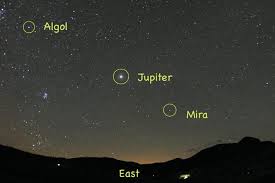
As King Sirius’ court of brightest stars rise again in the east, with a set of binoculars (certainly a telescope) a dance or battle can be seen more clearly between two stars; technically between the star Mira “The Wonderful” and the double-star system Algol “The Winking Demon.”

Mira_AlgolMira is in the middle of Cetus the Whale, a quiet faint constellation of stars about 45 degrees up from the southeast horizon between Aquarius (to the southwest) and Orion (to the lower east) and the returning Aldebaran, Rigel, and Betelgeuse.  Mira fades from a semi-bright magnitude 2 to a very dim magnitude 10 in less than eleven months.  Mira means “the Wonderful” in Arabic and signifies her dramatic leaving and return.  This happens due to her near-death lifespan and being unstable, pulsating prior to burn-out.  When Mira is big and cool, most of its light is only visible in the infrared spectrum.  When she is small and hot, she radiates most of her light at the far end of the visible spectrum; red in a telescope.  Mira has quite possibly already turned into a planetary nebula then white dwarf, but we won’t witness this for another 35,000 Earth-years because she is about 350-light years away.

Algol in Arabic means “the Demon” and they called the double-star system this because astonishingly one star eclipses the other every 2.87 days!  This makes its brightness dip from a 2.2 magnitude to a 3.5 magnitude creating the winking demons.  This change can be seen by the naked eye.  Algol can be located up about 60 degrees from the easterly approaching the zenith during mid-November to mid-January.

* * * * * * * * * *

Other Resources

As you may have noticed, it is impossible to include all the major fascinating parts of stargazing and our cosmos in a 1,000 word blog-post – the commonly recommended length.  This post is around twice that long.  Therefore, I am including further website resources to explore should you want to know more, even become a well-informed astronomer.

www.astronomy.com  The site I used for the sky maps.
www.darksky.org
www.science.nasa.gov
www.skyandtelescope.com
www.hubblesite.org

For the serious star-preneur, astronomy software for purchase:
Starry Nightwww.starrynight.com
The Skywww.bisque.com  for the mega-serious!

(paragraph break)

P.S.   To answer the two initial questions in the beginning all our planets rotate counter-clockwise around the Sun.  And about those once-in-a-lifetime comets and why they take so long to return and why they keep coming back… it is because of our Sun’s gravitational control.  It extends out to the Kuiper Belt which is well beyond the outer planet Neptune, or about 2.8 billion miles from our Sun.  Perspective:  and our Sun is one of the smallest Suns in the galaxy and cosmos!

(paragraph break)

Creative Commons License
This work by Professor Taboo is licensed under a Creative Commons Attribution-NoDerivs 3.0 Unported License.
Permissions beyond the scope of this license may be available at https://professortaboo.wordpress.com.

Inward with Outward

It is said in Quantum Connectivity or Quantum Entanglement that physical phenomenon occur when pairs (or groups such as the human body) of particles are generated or interact in ways such that the quantum state of each member must subsequently be described relative to the other.  These last weeks I have understood and experienced exactly how this works.  The peace it brings is exciting and immeasurable.

The best way perhaps to understand Quantum Entanglement is to explain light (or photons) and how light operates.  The utter bedazzlement happens when things or particles are observed.  In other words, the state of a photon is one way when observed, and another when unobserved; mere observation changes the state of particles – and get this – no matter their distance apart.  Albert Einstein was so intrigued by this he called it “spooky action at a distance.”  In the labs of Quantum physicists, this is what takes place:

“When observed, Photon A takes on an up-spin state.  Entangled Photon B, though now far away, takes up a state relative to that of Photon A (in this case a down-spin state).  The transfer of state between Photon A and Photon B takes place at a speed of at least 10,000 times the speed of light, possibly even instantaneously, regardless of distance.”

This interaction doesn’t just happen between photons.  It happens between bodies or groups of electromagnetic particles, including living intelligent systems.  Think about it.  As a crude example but nonetheless true, humans behave differently when they are being observed versus when they are not.  The changed behavior still takes place when no verbal interaction exists.  The interaction, or entanglement, is still happening because they are connected by observation made possible by invisible subatomic particles.  This state of interaction is no different than the state between photons.  The common denominators are the electromagnetic particles that make up the entities.  What I find interesting is that when the interacting photons entangle, they take on a state of polarization, or opposite states.  What is mind-blowing is that the distance between the bodies is irrelevant.

Red-shouldered hawk - Spirit Totem

My red-shouldered hawk

My attempts to join quantum mechanics with classical mechanics, such as psychology, philosophy, or biology, I’m sure would make the experts of both fields chuckle.  Nevertheless, what I understand in these current quantum theories is the unlimited potential of information being passed, realized or unrealized, and irrelevant to perception or time.  It is a question of observation; the state of being highly aware.  And if I am acutely aware of the infinite systems surrounding me, intelligent purposeful systems, then the more I understand my place.  And as such, I am more realized and less unrealized.

Many weeks ago, before my move back to the Dallas area, I had a red-shouldered hawk perch itself on a branch just yards from me.  I know it knew I was near because it looked straight at me, almost starring, several times.  For at least two-minutes it moved its head scanning, then always back to me.  If you know about red-shouldered hawks, they are solitary birds and in the wild keep their safe distance from humans.  For some reason this hawk was not bothered by my proximity.  I found its behavior a little extraordinary but concluded the encounter as randomly weird and moved on.  A few days later the same thing happened and I couldn’t discount its second visit as random chance; not within the mechanics of quantum entanglement.  Yes, I know; a big leap perhaps.  But stay with me a minute.

I have a deep fondness and admiration for indigenous people and their connection to nature and Earth.  Though they might appear as “uncivilized” by Western standards, they have an understanding of their environment that goes much deeper than our vocabulary and descriptions.  Native American culture is inextricably connected with natural systems, Earth-systems, and their culture places high regard and meaning for hawk visits.  For example, a hawk brings or confirms heightened vision, power, energy, and a rebirth.  It also brings or confirms heightened strategy, intensity, attention, protection, teamwork, intelligence, focus, and intuition.  I have noticed an increase in all of these traits over the last two months, many of them confirmed by coworkers and friends without my solicitations.

One website explaining hawk visits and totems says the following, which I found further confirms what has happened in my life these last few months.  Bear with me please:

“Hawk totems are extraordinarily effective at protection. They are kind of like raptor-angels. They keep watch over those who hold an affinity for them (and vice versa). They tend to arrange energy in such a way so that danger or bad choices are either made known to their people, or are avoided altogether.

If the hawk is your totem, you are extremely perceptive. You see things others miss. Your vision goes beyond the physical too – you have a knack for seeing into the souls of people you deal with. You might call it a gift of intuition. You just have a sense, or an ‘aerial view’ into what is going on in the hearts of people. This is a great trait, but the downside to hawk people with this gift is that you tend to be way too forthcoming with your observations. Being naturally direct and candid personality types, hawk-people will make pointed statements about very sensitive issues that they’ve picked up by their powers of perception. Word of advice: Be delicate and diplomatic with your deductions.

Perhaps it is their unyielding honesty that makes hawk-people admirable partners. People who have hawk as their totem make outstanding mates, friends, co-workers, lovers, sister, brothers etc. They are loyal, honest and direct. Typically, you always know where you stand with a hawk-person, and others find this refreshing in a world of mind-gamers. Hawk-partners are also very protective, and will defend their compatriots to a fierce degree.

Those with the hawk as their totem are also visionaries. They look above the problem (another ‘aerial view’), for solutions. They are expert problem solvers because they aren’t part of the problem – they aren’t stuck in the issue. Rather, they rise above it, and in an elevated state they are able to see answers most might overlook.”

Now many would argue that it is simply a hawk’s instinct to fly and perch in certain ways.  Many would argue there are logical environmental or predatory reasons the hawk perched in that particular spot.  I would not disagree one bit.  There is a waterfall and pond just under the two different branches it sat on.  The habitat of Red-shouldered hawks is indeed forests and streams where their food can be found.  Our pond has several goldfish and one or two leopard frogs.  What naysayers can’t explain away is their known behavior around humans:  solitude.  In the wild they do not seek out the company of humans!  Yet my red-shouldered hawk did just that, for long moments, and did so on two separate occasions within days.  I don’t believe I can ignore that.  And with an adequate understanding of the interaction between quantum atomic systems and macro-systems (themselves made up of quantum systems) demands at least examining the encounters, not ignoring them.

This I know:  my powers of intuition and observation are definitely heightened and I am doing no illegal drugs.  This has been evidenced in several life-decisions and reactions, or interactions with people over these last couple of months.  What is amazing for me is to see and understand how it all operates and coexists.  What is more astonishing is watching it all work without words.  The exchange of information takes place not only on obvious levels such as verbal communication, but just as much on subatomic levels.  One only needs to become more observant, more aware of the exchange method, if you will.  In fact, I would wager that much much more information is available and exchanged than the obvious five senses.  Quantum Entanglement is increasingly showing this phenomenon to exist.  We crudely call it intuition.

I wonder if we are to eventually know that the inward and the outward are never really separated, ever, by any distance?

(paragraph break)
Creative Commons License
This work by Professor Taboo is licensed under a Creative Commons Attribution-NoDerivs 3.0 Unported License.
Permissions beyond the scope of this license may be available at https://professortaboo.wordpress.com.