As part of the Alternative Lifestyles blog-posts migration over to the new blog The Professor’s Lifestyles Memoirs, this post has been moved there. To read this post please click the link to the blog.
Your patience is appreciated. Thank you!

As part of the Alternative Lifestyles blog-posts migration over to the new blog The Professor’s Lifestyles Memoirs, this post has been moved there. To read this post please click the link to the blog.
Your patience is appreciated. Thank you!
Did you know that if planet Earth were invaded by angry hungry aliens from a distant Death Star ship, the best offering to avoid possible violence or slavery believe it or not would be to hand over our silicon-based sand and rocks? Which way do all of our planets in our Solar System rotate? Have you ever wondered why comets such as Halley’s Comet, Pons-Gambart, and Ikeya-Zhang Comets take 75, 188, and 366 earth-years respectively to come around?
Questions like these and their answers fascinated me camping outside as a boy looking up into the night sky with astonishment. How far away is that star, I would ask myself, which lead to another question and another. Limitless.
* * * * * * * * * *
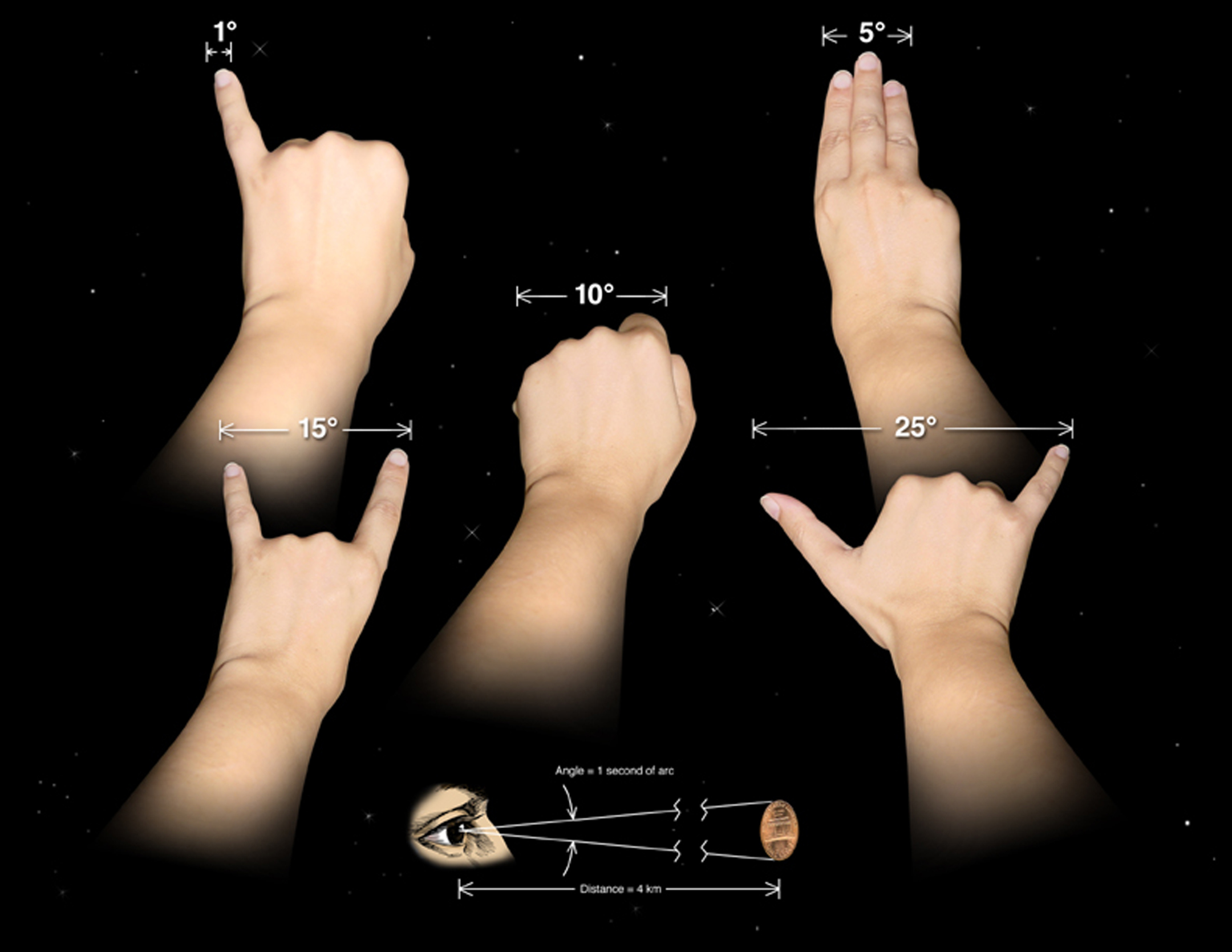
To enlarge click image
A 100-foot telescope and multi-million dollar observatory are not necessary to begin an intermediate knowledge of the celestial. Your outstretched arm, hand and fingers can suffice in determining an object’s angular size. Clamp your hand in a fist. Across your knuckles is about 10 degrees. Don’t believe me? Taking that fist and starting at the horizon count how many “fisted-hands” it takes to count upwards to straight up, or zenith (the top of the sky). It will be about nine hands, or 90 degrees. Three fingers together are about 5 degrees across and one finger, like the pinky finger, will be about 1 degree. A full moon then, when using this form of measurement will be about a half-degree (0.5°).
Finding the position of an object in the sky is a bit more difficult. If you don’t carry around a Cross Staff, or Astrolab, or even what amateur golfers use today: a GPS app; if you can find due north then you can still navigate the sky with your hand. The azimuth, or angular measurement parallel to the horizon in a spherical coordinate system, determines the cardinal points: north, south, east, and west. North is of course 0 degrees, east will be 90 degrees, south is 180 degrees, and due west will be 270 degrees. The angle above the horizon will be, you guessed it, altitude. Keeping our basic sky-gazing simple, when measuring from the horizon to the zenith, only 0-90 degrees is needed. Now you have the quickest most convenient tools to examine the never-ending sky.
A simple pair of binoculars can reveal more of the heavens beyond your naked eye. If you surveyed the full moon, you could easily find many craters or the four brightest moons of Jupiter. With the same binoculars you might be able to find Saturn’s brightest and biggest moon: Titan. If you want to see even more of the night sky, you will have to have binoculars stronger than 7x (times); in other words massively big and expensive type binoculars that will require a tripod or something steady and stationary to mount your 8x plus binoculars. Beyond high-powered binoculars gets us into complex telescopes and well beyond the scope of this post.
* * * * * * * * * *
Some star-maps, a flashlight, items to keep you comfortable or warm, and some patience will be all you need to find stars, constellations, and other sorted celestial performers. The further away from light-pollution you can get (i.e. large towns or cities) the better. Finding cardinal points is easiest with a compass or map; they both work fine. If you can remember where on the horizon the Sunset took place, then you have a general idea which direction is west. Keep in mind though the seasonal factors: during winter the Sun recedes a little south of due west and during summer it sets a little north of due west. In spring and fall, the Sun sets quite close to due west.
 If you can view your sky maps with a red-lighted flashlight, then your pupils won’t close up in its light. A normal white flashlight will cause your views from map-to-sky and back again to be greatly hindered by your widening and retracting pupils causing delays in their adjustments and testing your patience. Having red-lenses to cover the bulb or flashlights using a “red-LED” bulb can be purchased at most camping-sporting stores. Also, when you’ve been out a few times and can easily locate previous stars and/or constellations, moving on to unexplored areas becomes quicker and easier as your mapping-spotting skills improve.
One more star-gazing tip: A clear sky is usually pretty cold relative to your latitude. The further away you are from the equator, the colder the clear sky will be and the quicker your sitting-still body will get. Dress warmer than normal, a toboggan or hat might be good, and even bring along a Thermos of hot soup or tea, or as I often do, a warm stout toddy! If you want to “impress” a certain co-stargazer, bring along reclining folding-chairs and a quilt. He or she will be in for a superb relaxing long evening of fun.
The following four seasonal sky maps are near 35 degrees north latitude in North America; in other words, a straight line from Lompoc, CA to Fayetteville, NC. Sky maps from your particular location can be found on the internet or from a local nearby planetarium store. The six bi-monthly descriptions below are incorporated into the flow or movement of the sky maps.
Sirius: The Five-month King of Stars
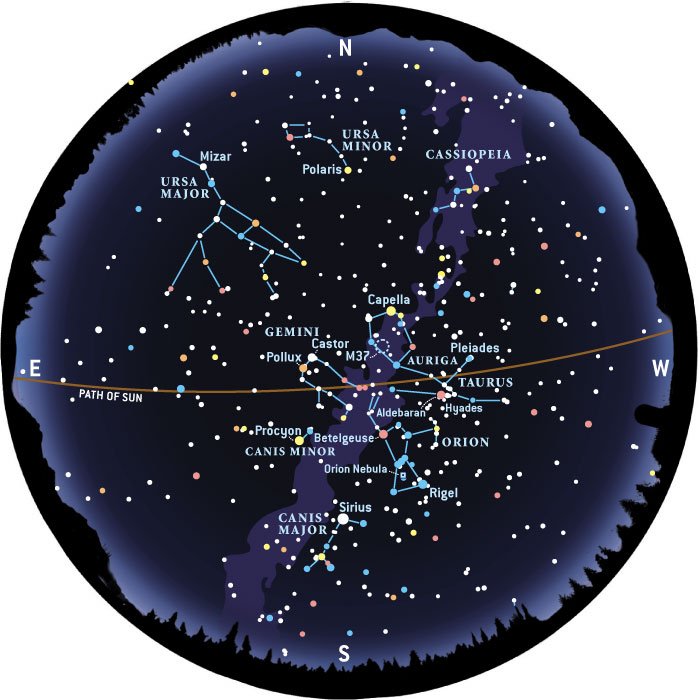
This map shows the winter sky at 2am December 1; midnight January 1; and 10pm February 1. Image – Roen Kelly, astronomy.com
From late December through mid-April, in the southeasterly sky, the brightest star of all stars in our sky is Sirius. It is the brightest because it is the closest star to Earth: about 8-light years away and closing. Yes, you read correctly, Sirius is getting closer to our Solar System and will be noticeably brighter in about 50,000 to 60,000 years. After that it will begin moving away, but for the next 200,000 years or so it will always be the King of All Stars. During winter and spring Sirius is a great reference point if you are just starting out as a new astronomer.
Serving King Sirius and moving to the west and slightly up is his Viceroy Rigel, then further up are Viceroys Betelgeuse (better known as Beatlejuice), Procyon to the east, and finally back toward the west and near straight up is Aldebaran. Straight up, or near zenith, and more north is his lone Viceroy Capella. These five stars represent magnitudes about 2.5 times less than Sirius but are so bright they can all be spotted in a large city with light-pollution. King Sirius’ “court” is the primary reason the winter skies are the favorite season for stargazers; they jump out to you!
Galaxies Galore and A New Prince
Heading into spring (March – early May) you’ll notice that Sirius and his viceroys have moved toward the western horizon. Back to the southern horizon is a darker starless sky by comparison. Yet due east near the horizon comes the newest viceroy or Prince: Arcturus which has been led by the largest cluster of galaxies – almost halfway up to the zenith – called the Virgo Clusters. They include more than 1,300 galaxies. Off toward the north and halfway to zenith you can find the Big Dipper.
Another Viceroy and King Sirius Departs

1am March 1; 11pm April 1; 9pm May 1. Add one hour for daylight-saving time. Image – Roen Kelly, astronomy.com
While Sirius drops down behind the western horizon and Procyon and Capella soon follow, the newest member to the court arrives: Viceroy Vega. Almost to the northeastern horizon, Vega’s brightness equals that of his predecessors and brings with him the Northern Cross with Deneb (touching the horizon) as its crown. It is now May through early July. Move to the southeastern horizon close to Earth’s surface, and the claws of Scorpius have appeared with Antares as its heart. Near the zenith sits Arcturus, 2nd in command for about two-plus months, while Sirius vacations in his summer palace doing “unseen” kingly jollies for the next four.
The Milky Way’s Majesty

1am June 1; 11pm July 1; 9pm August 1. Add one hour for daylight-saving time. Image – Roen Kelly, astronomy.com
July and August are the best times to see the center of our galaxy particularly with binoculars. Like a following royal parade, Vega brings along in the eastern sky not only Altair, a star slightly brighter than the previous Deneb, but also the globular-cluster M13 near zenith, and the star-clusters M11, M39, and the best clusters M6 and M7. And as if that wasn’t enough, the nebulas M8, M20, and M17 between Scorpius and Sagittarius to the south (about 10° up from horizon), round off the fat center of our majestic Milky Way.
Fall’s Tranquility?
The gaudiness of summer and the Milky Way drift into the southwest horizon causing many astronomers to say the night sky is the tamest from September through late October. It is perhaps no coincidence then that fall and October are celebrated as Halloween, or hallow the dead and dying. The Viceroy Arcturus has all but vanished behind the western horizon, leaving only Prince Vega near the zenith. The return of Capella and the first of King Sirius’ court are probably not yet visible to the northeast. A seemingly dark “blanket” ensues.
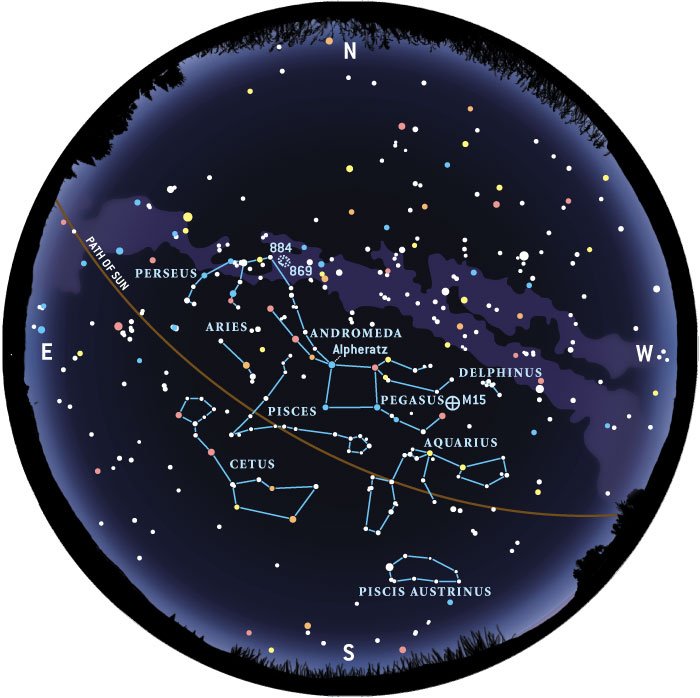
1am September 1; 11pm October 1; 9pm November 1. Add one hour for daylight-saving time. Image – Roen Kelly, astronomy.com
Not to worry, as all great exciting events take place to the south – sexual overtones intended – magnitude 1.16 star Fomalhaut rises out of Earth’s vagina to remind us that with persistence comes birth… and for better or worse, MANY MORE THINGS to come! Can I get an Amen!? Because Fomalhaut is the lone bright star in this part of the sky, many space agencies and orbital spacecraft engineers use the star as a point of reference for their machines. Their computerized satellites or crafts are programmed to find Fomalhaut and then align themselves. There is less of a chance for other mistaken bright stars nearby; a computer optic no-brainer if you will.
Because the heavens are darkest during this time of year, many scientist and expert stargazers use their high-powered telescopes to search out darker phenomena. This goes to show that a certain darkness is needed to truly see the stars.
The Mira and Algol Light Show
As King Sirius’ court of brightest stars rise again in the east, with a set of binoculars (certainly a telescope) a dance or battle can be seen more clearly between two stars; technically between the star Mira “The Wonderful” and the double-star system Algol “The Winking Demon.”
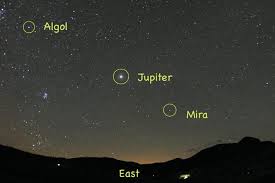 Mira is in the middle of Cetus the Whale, a quiet faint constellation of stars about 45 degrees up from the southeast horizon between Aquarius (to the southwest) and Orion (to the lower east) and the returning Aldebaran, Rigel, and Betelgeuse. Mira fades from a semi-bright magnitude 2 to a very dim magnitude 10 in less than eleven months. Mira means “the Wonderful” in Arabic and signifies her dramatic leaving and return. This happens due to her near-death lifespan and being unstable, pulsating prior to burn-out. When Mira is big and cool, most of its light is only visible in the infrared spectrum. When she is small and hot, she radiates most of her light at the far end of the visible spectrum; red in a telescope. Mira has quite possibly already turned into a planetary nebula then white dwarf, but we won’t witness this for another 35,000 Earth-years because she is about 350-light years away.
Algol in Arabic means “the Demon” and they called the double-star system this because astonishingly one star eclipses the other every 2.87 days! This makes its brightness dip from a 2.2 magnitude to a 3.5 magnitude creating the winking demons. This change can be seen by the naked eye. Algol can be located up about 60 degrees from the easterly approaching the zenith during mid-November to mid-January.
* * * * * * * * * *
Other Resources
As you may have noticed, it is impossible to include all the major fascinating parts of stargazing and our cosmos in a 1,000 word blog-post – the commonly recommended length. This post is around twice that long. Therefore, I am including further website resources to explore should you want to know more, even become a well-informed astronomer.
www.astronomy.com The site I used for the sky maps.
www.darksky.org
www.science.nasa.gov
www.skyandtelescope.com
www.hubblesite.org
For the serious star-preneur, astronomy software for purchase:
Starry Night – www.starrynight.com
The Sky – www.bisque.com for the mega-serious!
(paragraph break)
P.S. To answer the two initial questions in the beginning all our planets rotate counter-clockwise around the Sun. And about those once-in-a-lifetime comets and why they take so long to return and why they keep coming back… it is because of our Sun’s gravitational control. It extends out to the Kuiper Belt which is well beyond the outer planet Neptune, or about 2.8 billion miles from our Sun. Perspective: and our Sun is one of the smallest Suns in the galaxy and cosmos!
(paragraph break)

This work by Professor Taboo is licensed under a Creative Commons Attribution-NoDerivs 3.0 Unported License.
Permissions beyond the scope of this license may be available at https://professortaboo.wordpress.com.
Nearing the end of the 1950 decade, a famous physicist named Albert Einstein said, “It has become appallingly clear that our technology has surpassed our humanity.”
(paragraph break)
 With advances in medical cures and surgeries since Einstein’s era, many arguments can be made that technology has actually benefited humanity in many ways. The U.S. Census Bureau now states the average life expectancy for Americans in the 21st century is almost 79-years old. This is up from 47-years old in the 20th century. Much of that increase is due to the advances in medical vaccinations and the scientific research and technology behind them. It is very possible that devastating diseases such as diphtheria, polio, or Chicken pox could be completely eradicated from our planet by the year 2020 thanks in part to technology.
Today, a traveler can merely turn-on their mobile phone or GPS system and get not just precise directions to their destination, but rerouting directions, in case of up-to-the-minute construction detours or heavy traffic delays thus relieving to a degree human stress and anxiety. That’s great, right? And what about the new age of on-the-spot real-time cell phone video-recording? Due to many spectators and runners at the last Boston Marathon, the two young bombers were later identified and one captured by law enforcement. Once again, examples of technology benefiting humanity.
What then was Einstein alluding to?
There have been a few answers offered by historians, such as the 1945 creation and use of the atomic bomb: an instrument of war and annihilation of unimaginable scales. Yet others, like me, argue that his meaning was also metaphorical. Technology can be abused, yes; but technology can also be a substitute, a decoy or diversion. As much as Einstein was referring to the atomic age – when humanity was building weapons of death and destruction – this once brilliant man was probably referring to the decline of human interaction as well.

History of cell phone
The opening scene could go like this: “The infestation began from the days of pin-ups, big bands, and blood and mushroom clouds. From the ashes and debris of world wars came the legions of machines of every size…” Technically, since the invention of the telegraph, telephone, and radio in the 1800’s and then the television in the 1920’s, every household in the Western hemisphere had at least one of these devices if not all of them. Advances in mass manufacturing made these items easily available for most households. At the same time another device or machine was being mass-produced: the automobile. By the 1980’s personal computers were becoming the next most common household machine. And by 1995 the world-wide web, or internet, was in almost every single home. Today, these historic machines and devices are part of every family member’s day and night. During the holiday season the production and purchase of these machines and devices jump exponentially to mind-boggling amounts!
But don’t gasp yet; below are the 2008-2009 hourly averages of use per day in a year for American 8-to-18 year olds. Once you read these results and tables, jack them way up for the holidays.
According to this survey by the Kaiser Family Foundation, the 8-to-18 year old youth group in America spent 7 hours and 38 minutes worth of electronic media time on these devices per day. Note the study was done four years ago. With all possible electronic devices and mediums available to American youth in 2013, here is a more up-to-date graphic:


1923 parking lot
The pie-chart above indicates that by 2010, American 8-to-18 year olds spend on average 10 hours and 45 minutes of electronic media time per day. Granted the pie-chart is an average of just 2,000 students and I presume there is a margin of fluctuation given the demographic location of the students – i.e. rural youths are more likely to spend more time outdoors than urban or suburban youths – however, how much fluctuation would there be when comparing say my generation (1970’s and 80’s), or my parent’s generation (1950’s and 60’s) to these studies…the 8-to-18 year old generation of today? Answer: A lot!
When I was in my freshman and sophomore years in high school, the mobile phone was just becoming popular. They were the size of small bricks! There was nothing called the personal computer (yet), much less the internet. Imagine what our grandparents had seen during their lifetimes. My grandparents had grown up through the invention of flight and airplanes then jets, the Great Depression and World War II. They witnessed all the technological advances: the radio, television, and Model-T’s and Model-A automobiles! What an era to live in, huh?
Let us pause though for a minute. Let’s step back from the awes of technological invention and examine more closely what Einstein was talking about. How does his epiphany apply to 2013?
 Considering all the technological machines and devices mentioned so far, how much of an adult’s 24-hour day is consumed by those machines and devices? Starting with the personal automobile, how many hours do you think the average American adult spends inside a vehicle per day? Is it more than a person in 1970? In 1950?
At work, whether in an office or behind the counter of Starbucks Coffee, how many hours of a full work day might an adult spend in front of a computer? During leisure time not at work or working, how many hours does an adult today spend in front of a laptop or desktop computer? How many hours do they spend on an electronic cell phone, work or leisure? What do you think the amount of time was in 1970? And now for the mother-load…How many hours do you think an American adult spends in front of a television? Be honest.
Whatever the amount of hours you guessed, subtract that from 24. Next, subtract six, seven, or eight hours more for healthy sleep per night. How many hours – maybe minutes – are remaining when we are NOT on an electronic device or machine, or in front of an electronic device or machine? Getting the picture?
 When I figured my estimations of electronic device or technological machine (automobile) usage per day, it shocked me. I had only about 4-hours remaining in the day without or outside technological-electronic usage. And since I am a very social person, I know MY total hours are most likely a larger amount than many people. That’s four hours out of a non-refundable 24-hours!
What might that indicate about the quality of human interaction per day? If these amounts are exponentially greater during the winter holidays, particularly internet phones, what does that indicate about quality face-to-face human interaction in November, during Thanksgiving and after? During mid and late December through the New Year – especially my Texas relatives where collegiate and NFL football is a bigger religion than God or church – most eyes and ears were on the television!? Now today, it can be just as much internet cell phones too. What is Thanksgiving and December like for your friends and family?
Albert Einstein was really on to something!
(paragraph break)
I have a deep fondness for the Victorian Age (Britain), the Belle Époque (France & Belgium), and the Gilded Age (United States), all between the 1850’s to 1920’s. From this era came some of mankind’s greatest works of art, music, literature, fashion, theater, scientific innovation, and political reform. For the most part it was the pinnacle of refined sensibilities not seen since the Renaissance. When I read such works by Ralph Waldo Emerson, Walt Whitman, and Oscar Wilde, I imagine myself in the same room transfixed on their dialogue and banter over glasses of cognac and wine in plush wing-back armchairs. Oh to be a time-traveler.
I feel that must have been the Golden Age of Discourse and Articulation where every word, every gesture was weighted and packed with broad-brushes of wit, enlightened sophistication and bold adventure; truly, an age in the art of conversation. There were very few automobiles and very few telephones to steal away their time from human interaction, so they excelled at those virtues and sensibilities.
Growing up as a boy in the late 60’s through the 80’s the television or stereo were the two electronic items that could take away time from my neighborhood friends. My two best friends and I would always play games, build things, or tinker with things outside together. During the Christmas-New Year holidays, my six to eleven different cousins and I would play in tree-houses, versions of hide-n-seek, or our favorite…bottle-rocket wars. Those special times of year are some of my most cherished lasting childhood memories. None of them, not one single memory involves any sort of electronics or machines, other than perhaps bicycles, zip-lines, garring spears (for garpike), fishing poles, and crab-traps. Much of those holiday times with all my multiple cousins were full of tricks, gags, and bust-a-gut laughter. Very little time was ever lost in front of the televisions.
Then in the 1980’s came the personal computer, mobile phones, and the world-wide-web. The age of face-to-face youthful interaction in America was never again the same. As if the personal automobile and home television didn’t eat up enough of our daily lives, the dwindling hours would become divided and diminished more by those inanimate devices and objects with ever-increasing sophistication and attention.
Now that I am a parent and some of my fellow schoolmates are grandparents, how much does current technology consume our busy lives? Do you think it is much different or greatly different from the 1970’s and 80’s? What about the 1950’s, or more in contrast the Golden Age of Discourse and Articulation of the 1890’s and 1900’s? How would you describe the contrasting eras in terms of quality human interaction and daily consumptions?

Non-electronic family games
As I reflect back on my many, many past holidays, I have seen, to put it mildly, a noticeable increase of bombardment by commercialism into and onto every possible electronic device in our homes and personal lives…all ferociously vying for our attention during our waning precious 17-15 conscious hours. During November and December the veracity becomes like relentless swarming sharks attacking and devouring. Unless one knows how to get out of the water completely so-to-speak, the insatiable sharks WILL take all twenty-four hours of your day and night, seven days a week, fifty-two weeks a year. Sharks, like electronic devices or machines, have no moral or ethical conscience or shame.
It would be unrealistic for me to demand we return to the Beautiful Age of Human Discourse and Interaction, especially during the holiday season. But how I long to see and hear the hours upon hours of face-to-face enjoyable, stimulating, funny, and challenging conversation WITHOUT any electronic device present or attention-dividing machine.
For me, those touchable face-to-face interactions are the sweetest times and memories a human being could ever have, especially when December brings good friends and family together. Guard them. Fight not only for their survival, but protect and fight for their value in human essence!
Wishing everyone the best and most significantly human interactive 2014 possible!
(paragraph break)
This work by Professor Taboo is licensed under a Creative Commons Attribution-NoDerivs 3.0 Unported License.
Permissions beyond the scope of this license may be available at https://professortaboo.wordpress.com.
 It was known as the war to end all wars. In all the history of mankind the scale of destruction and death of World War I had never been seen or remotely imagined. From all the major world powers fighting in 1914, an estimated 65 million men put their nation’s uniforms on and set off to the front-lines to obliterate their enemies. In the end, more than 10 million men would be killed; 20 million would be maimed for life. Thirty-million families lost husbands, sons, fathers, brothers, or the return of their permanently disfigured bodies and minds.
From the very first shots fired the war spun quickly out of control. By the summer of 1914 European empires were realizing an era of unprecedented scientific and mechanized advancements as a result of the Victorian industrial revolution. The killing efficiency of these new 19th century national armies wiping out swaths of soldiers in a matter of minutes had never been seen on any battlefield at any time earlier. Central Europe was literally a 600-square mile butcher’s block of human and animal limbs and carcasses scattered everywhere in pools of mud, blood, and disease. The poet-novelist Robert Graves wrote:
“[the bodies] we could not get from the German [barbed]wire continued to swell…the color of the dead faces changed from white to yellow-gray, to red, to purple, to green, to black.”
The stench of death is unlike any odor known. I know; I’ve smelt it. Overlooking these unbelievable scenes one looses any remaining hope for humanity’s survival. None of the warring leaders and monarchs had any conception of what killing-machines were being set in motion. The fact that most of them thought the war would be ending by Christmas 1914, shows how arrogantly disillusioned they had become with their national status and power. Too few thought the apocalypse had arrived but watched as masses of ordinary people and soldiers were lead to their deaths.
In some of the darkest hours however, there are some that rise above their circumstances.
In a letter to his brother Nickolai in 1886, Anton Chekhov – thought by most historians to be one of Russia’s greatest writers – described eight simple principles of human decency.
 Chekhov would conclude that any level of pomp and arrogance was only as noble as the least of your fellow man. That was his standard of a true civilized human being and people.
On Christmas Eve December 24th, 1914 bitter enemies in opposite trenches of Europe’s Western Front despite the hatred their national leaders, families and military commanders felt toward their enemy, decided not to fight, but to sing. The Germans lit candles and in beautiful harmony sang “Silent night…Holy night.” So moved by their cheer, the British soldiers responded with carols of their own. This goodwill inspired many soldiers on both sides to toss gifts of food over into their enemy trenches. The German side applauded the British singing then the Brits cheered and applauded the Germans. One miracle act of goodness led to another, then another. By dawn Christmas Day, chivalry and kindness were as out of control as the war. They even played a football match together around the large cannon-shell craters and wired obstacles.
I often understand the causes of war and killing: it is the utter failure of peoples or their leaders to do everything humanly possible to resolve dispute, or it is merely the greed of egos and the ignorance of those who follow them. In the end, in every single conflict throughout all of mankind’s history, the price of war and killing is too high and never completely measured for generations to come. In certain obvious cases today it never ends.
 Yet on a small level, on an individual basis, when humans can step back and understand the person facing them on a personal level, not as a total stranger who is being led by a delusional greedy ego-maniac monarch or king, that spirit which Anton Chekhov speaks about can and will courageously step forward. The real miracle of this 1914 Christmas between “enemies” was that a few good men did not bow to the fear of a firing-squad or court-marshal by their superiors. Instead they recognized the moment was greater than themselves or their nations — as is almost always the case in any situation of dispute. When people view strangers as anything other than another human being, a human being who also has parents, husbands, wives, brothers, sisters, sons, daughters all with the same basic needs as you…the higher perspective, the higher road comes to focus. What remains is the decision to take it.
The Christmas Truce of 1914 was a supreme act of humanity and goodwill by a group of courageous men in uniforms surrounded by the most despicable acts of nations. Such a truce had never before taken place. And for no apparent intelligent reasons, has never happened again. Though I am not a Christian or a religious man during this time of year, I am the biggest fan-fanatic for humanity and the potential brilliance of the human spirit.
Peace on Earth, goodwill to all men and women. Happy holidays everyone.
(paragraph break)
It is said in Quantum Connectivity or Quantum Entanglement that physical phenomenon occur when pairs (or groups such as the human body) of particles are generated or interact in ways such that the quantum state of each member must subsequently be described relative to the other. These last weeks I have understood and experienced exactly how this works. The peace it brings is exciting and immeasurable.
The best way perhaps to understand Quantum Entanglement is to explain light (or photons) and how light operates. The utter bedazzlement happens when things or particles are observed. In other words, the state of a photon is one way when observed, and another when unobserved; mere observation changes the state of particles – and get this – no matter their distance apart. Albert Einstein was so intrigued by this he called it “spooky action at a distance.” In the labs of Quantum physicists, this is what takes place:
“When observed, Photon A takes on an up-spin state. Entangled Photon B, though now far away, takes up a state relative to that of Photon A (in this case a down-spin state). The transfer of state between Photon A and Photon B takes place at a speed of at least 10,000 times the speed of light, possibly even instantaneously, regardless of distance.”
This interaction doesn’t just happen between photons. It happens between bodies or groups of electromagnetic particles, including living intelligent systems. Think about it. As a crude example but nonetheless true, humans behave differently when they are being observed versus when they are not. The changed behavior still takes place when no verbal interaction exists. The interaction, or entanglement, is still happening because they are connected by observation made possible by invisible subatomic particles. This state of interaction is no different than the state between photons. The common denominators are the electromagnetic particles that make up the entities. What I find interesting is that when the interacting photons entangle, they take on a state of polarization, or opposite states. What is mind-blowing is that the distance between the bodies is irrelevant.

My red-shouldered hawk
My attempts to join quantum mechanics with classical mechanics, such as psychology, philosophy, or biology, I’m sure would make the experts of both fields chuckle. Nevertheless, what I understand in these current quantum theories is the unlimited potential of information being passed, realized or unrealized, and irrelevant to perception or time. It is a question of observation; the state of being highly aware. And if I am acutely aware of the infinite systems surrounding me, intelligent purposeful systems, then the more I understand my place. And as such, I am more realized and less unrealized.
Many weeks ago, before my move back to the Dallas area, I had a red-shouldered hawk perch itself on a branch just yards from me. I know it knew I was near because it looked straight at me, almost starring, several times. For at least two-minutes it moved its head scanning, then always back to me. If you know about red-shouldered hawks, they are solitary birds and in the wild keep their safe distance from humans. For some reason this hawk was not bothered by my proximity. I found its behavior a little extraordinary but concluded the encounter as randomly weird and moved on. A few days later the same thing happened and I couldn’t discount its second visit as random chance; not within the mechanics of quantum entanglement. Yes, I know; a big leap perhaps. But stay with me a minute.
I have a deep fondness and admiration for indigenous people and their connection to nature and Earth. Though they might appear as “uncivilized” by Western standards, they have an understanding of their environment that goes much deeper than our vocabulary and descriptions. Native American culture is inextricably connected with natural systems, Earth-systems, and their culture places high regard and meaning for hawk visits. For example, a hawk brings or confirms heightened vision, power, energy, and a rebirth. It also brings or confirms heightened strategy, intensity, attention, protection, teamwork, intelligence, focus, and intuition. I have noticed an increase in all of these traits over the last two months, many of them confirmed by coworkers and friends without my solicitations.
One website explaining hawk visits and totems says the following, which I found further confirms what has happened in my life these last few months. Bear with me please:
“Hawk totems are extraordinarily effective at protection. They are kind of like raptor-angels. They keep watch over those who hold an affinity for them (and vice versa). They tend to arrange energy in such a way so that danger or bad choices are either made known to their people, or are avoided altogether.
If the hawk is your totem, you are extremely perceptive. You see things others miss. Your vision goes beyond the physical too – you have a knack for seeing into the souls of people you deal with. You might call it a gift of intuition. You just have a sense, or an ‘aerial view’ into what is going on in the hearts of people. This is a great trait, but the downside to hawk people with this gift is that you tend to be way too forthcoming with your observations. Being naturally direct and candid personality types, hawk-people will make pointed statements about very sensitive issues that they’ve picked up by their powers of perception. Word of advice: Be delicate and diplomatic with your deductions.
Perhaps it is their unyielding honesty that makes hawk-people admirable partners. People who have hawk as their totem make outstanding mates, friends, co-workers, lovers, sister, brothers etc. They are loyal, honest and direct. Typically, you always know where you stand with a hawk-person, and others find this refreshing in a world of mind-gamers. Hawk-partners are also very protective, and will defend their compatriots to a fierce degree.
Those with the hawk as their totem are also visionaries. They look above the problem (another ‘aerial view’), for solutions. They are expert problem solvers because they aren’t part of the problem – they aren’t stuck in the issue. Rather, they rise above it, and in an elevated state they are able to see answers most might overlook.”
Now many would argue that it is simply a hawk’s instinct to fly and perch in certain ways. Many would argue there are logical environmental or predatory reasons the hawk perched in that particular spot. I would not disagree one bit. There is a waterfall and pond just under the two different branches it sat on. The habitat of Red-shouldered hawks is indeed forests and streams where their food can be found. Our pond has several goldfish and one or two leopard frogs. What naysayers can’t explain away is their known behavior around humans: solitude. In the wild they do not seek out the company of humans! Yet my red-shouldered hawk did just that, for long moments, and did so on two separate occasions within days. I don’t believe I can ignore that. And with an adequate understanding of the interaction between quantum atomic systems and macro-systems (themselves made up of quantum systems) demands at least examining the encounters, not ignoring them.
This I know: my powers of intuition and observation are definitely heightened and I am doing no illegal drugs. This has been evidenced in several life-decisions and reactions, or interactions with people over these last couple of months. What is amazing for me is to see and understand how it all operates and coexists. What is more astonishing is watching it all work without words. The exchange of information takes place not only on obvious levels such as verbal communication, but just as much on subatomic levels. One only needs to become more observant, more aware of the exchange method, if you will. In fact, I would wager that much much more information is available and exchanged than the obvious five senses. Quantum Entanglement is increasingly showing this phenomenon to exist. We crudely call it intuition.
I wonder if we are to eventually know that the inward and the outward are never really separated, ever, by any distance?
(paragraph break)
This work by Professor Taboo is licensed under a Creative Commons Attribution-NoDerivs 3.0 Unported License.
Permissions beyond the scope of this license may be available at https://professortaboo.wordpress.com.
Divergent Thoughts on Life, Love and Death
life and other weird stuff
Seeking Dialogue to Inform, Enlighten, and/or Amuse You and Me
Storytelling, short stories, fable, folk tales,...
Writing writing and more writing
Analysis & Discussion For Political Uncertainty
I have zero expectation that anything I ever say will end someone’s belief in their God. Not my goal or purpose. That alone belongs to the individual. ~ Zoe
A photo journal of my interests from one extreme to the other.
Cogito Ergo Sum
by Wendy Waters
Understanding the psychology that drives our politics
Ponder(verb) to weigh in the mind; to view with deliberation; to examine carefully; to consider attentively
'Light thinks it travels faster than anything but it is wrong. No matter how fast light travels, it finds the darkness has always got there first, and is waiting for it' - Terry Pratchett
writing on human security
Living and Learning
Some prefer the comfort of Faith. I prefer the cold, hard Truth.
By Keith Goode aka Ken Thackerey
I don’t want to start a class war; it started a long time ago and, unfortunately, we lost.
Searching for truth while leaving tradition behind.
Questioning the conventional wisdom
 The Professor's Convatorium