
Every year I like to keep track of how the United States’ levels of education obtained from all fifty states are ranked by comparison to other states in the Union. Why? Because it is an indicator of just how well (or poorly) the Stars and Stripes are performing with the rest of the world. I feel this is important not just from an competitive academic stand point, but critically important when compared to our foreign adversaries like China, Russia, and some Middle Eastern countries. I’d like to think readers and my followers feel the same way.
Some Americans consider an Associate degree or a Bachelor’s degree to be worthless, a waste of time, or at best far too expensive for the end result in career opportunities. However, despite that false thinking and perspective the numbers, simply put, don’t lie. Decade after decade after decade Americans 21–25 or older who have an under-grad degree, and more so a post-grad degree, land higher paying wages and a slew of further career paths beyond in the highly competitive U.S. job market. This is an indisputable fact.
Furthermore, there is another highly valuable ‘advantage’ to young Americans and 30-something Americans that are more subtle and beneficial for life: recognizing more quickly the covert motives and actions of the corrupt and powerful. Considering that often the upper most corrupt and powerful in the U.S. are typically highly educated, experienced, and spoiled brats because of their parents wealth, their circle of acquaintances, family inheritance, or gifted access/ownership to valuable mineral-rights or geological resources such as oil, natural gas, diamonds, or gold, to name only four, if you are not considered one of the aforementioned lucky ones but instead more disadvantaged due to your birth. Like it or not an under-grad or post-grad degree greatly levels the playing field in the U.S. job market.

By the way, another huge gain is in character: having come from a humble background at birth up to your latter teens typically makes a person broader minded and respectful of equality; that is, equality for all Americans without prejudice. Better character, better integrity, selflessness, and compassion for America’s disadvantaged at birth. Usually, not always, but usually these factors turn into better ethical and moral decisions as an adult. Why? For the simple reason that with a broader, higher education, above an associate’s degree, better equips one to avoid the many complex economic trappings of the country’s upper advantaged 1%–10% who did not come from humble beginnings. The stats and numbers from the U.S. Census Bureau bear this out.
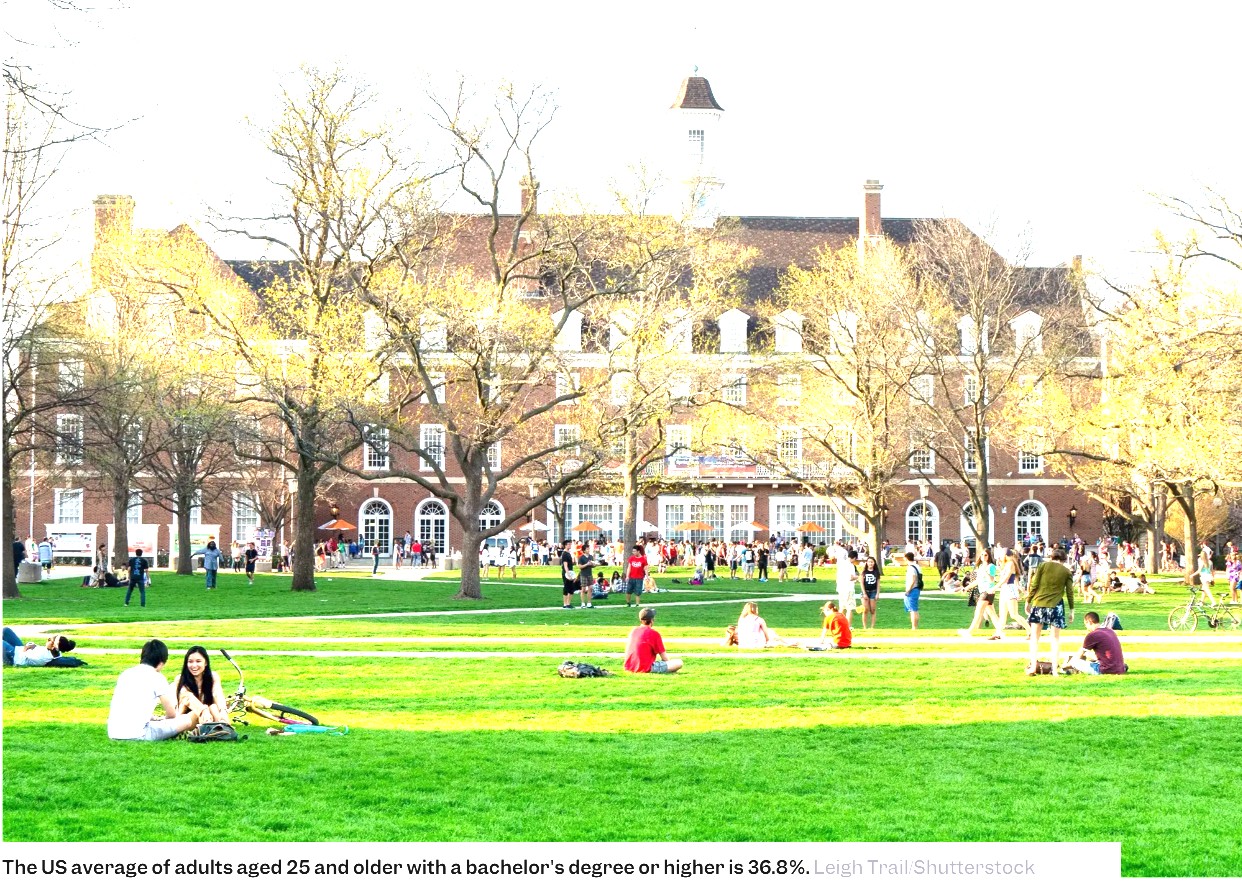
BusinessInsider.com took the data from the U.S. Census Bureau and analyzed it for the percentage of 25-years and older who attained a Bachelor’s degree or higher in all 50 states and ranked them according to those percentages from least educated states to the most educated states. Here is that 2025 ranking below. If you’re interested in a detailed explanation for the ranking, click the above link to Business Insider.
- West Virginia — Share of adults 25+ with a bachelor’s degree or higher: 24.4%
- Mississippi — Share of adults 25+ with a bachelor’s degree or higher: 27.0%
- Arkansas — Share of adults 25+ with a bachelor’s degree or higher: 27.1%
- Louisiana — Share of adults 25+ with a bachelor’s degree or higher: 27.8%
- Kentucky — 27.9%
- Nevada — 28.5%
- Oklahoma — 29.3%
- Alabama — 29.9%
- Indiana — 30.7%
- New Mexico — 31.8%
- Iowa — 32.1%
- Wyoming — 32.3%
- (tie @ 37th) Ohio — 32.4%
- (tie @ 37th) Tennessee — 32.4%
- Alaska — 32.8%
- Idaho — 33.0%
- (tie @ 33rd) South Carolina — 33.3%
- (tie @ 33rd) Michigan — 33.3%
- Missouri — 33.5%
- North Dakota — 34.0%
- South Dakota — 34.2%
- Wisconsin — 34.6%
- Arizona — 34.7%
- Texas — 35.2% (my home state, bottom half for over 35-yrs)
- Nebraska — 35.4%
- Florida — 35.8%
- (tie @ 23rd) Delaware — 36.0%
- (tie @ 23rd) Kansas — 36.0%
- (tie @ 21st) Montana — 36.3%
- (tie @ 21st) Georgia — 36.3%
- Pennsylvania — 36.4%
- (tie @ 18th) Maine — 37.1%
- (tie @ 18th) North Carolina — 37.1%
- (tie @ 16th) Oregon — 37.8%
- (tie @ 16th) Hawaii — 37.8%
- California — 38.1%
- Rhode Island — 39.0%
- Utah — 39.1%
- Illinois — 39.2%
- Minnesota — 40.0%
- Washington — 41.0%
- New York — 41.2%
- New Hampshire — 41.5%
- Connecticut — 42.6%
- Virginia — 43.3%
- New Jersey — 44.5%
- Maryland — 44.7%
- Vermont — 45.1%
- Colorado — 47.8%
- Massachusetts — 48.3%
The national average percentage of all Americans with a Bachelor’s or higher degree is 36% to 40%. Compared to nations in Europe, Asia, and parts of the Near and Middle East, this percentage is noticeably lower for U.S. citizens than those foreign countries. Good or bad?
Of course there are other minor factors involved in these percentages such as population density, land-mass of the state, and the number of large metropolitan cities in a state; example New York, California, and Illinois. For less densely populated states the percentage will reflect the low number of people, e.g. New Mexico and the Dakotas. These factors also indicate other components involved, such as state history and background. Examples? The former Confederate states of the American Civil War have had from their past large numbers of slaves as well as segregation and Jim Crowe Laws that made it extremely difficult for non-whites to obtain under-grad degrees. That also explains in part why several lower educated states are located in the South and Deep South.
What other factors are you able to deduce that contribute to your home state and other states in the Union? In the comments below briefly explain (or not) why the low or higher ranking exists. What are those state’s modern history, i.e. 1800’s to the present, that contribute to the state’s ranking?
Addendum — June 2, 2026:
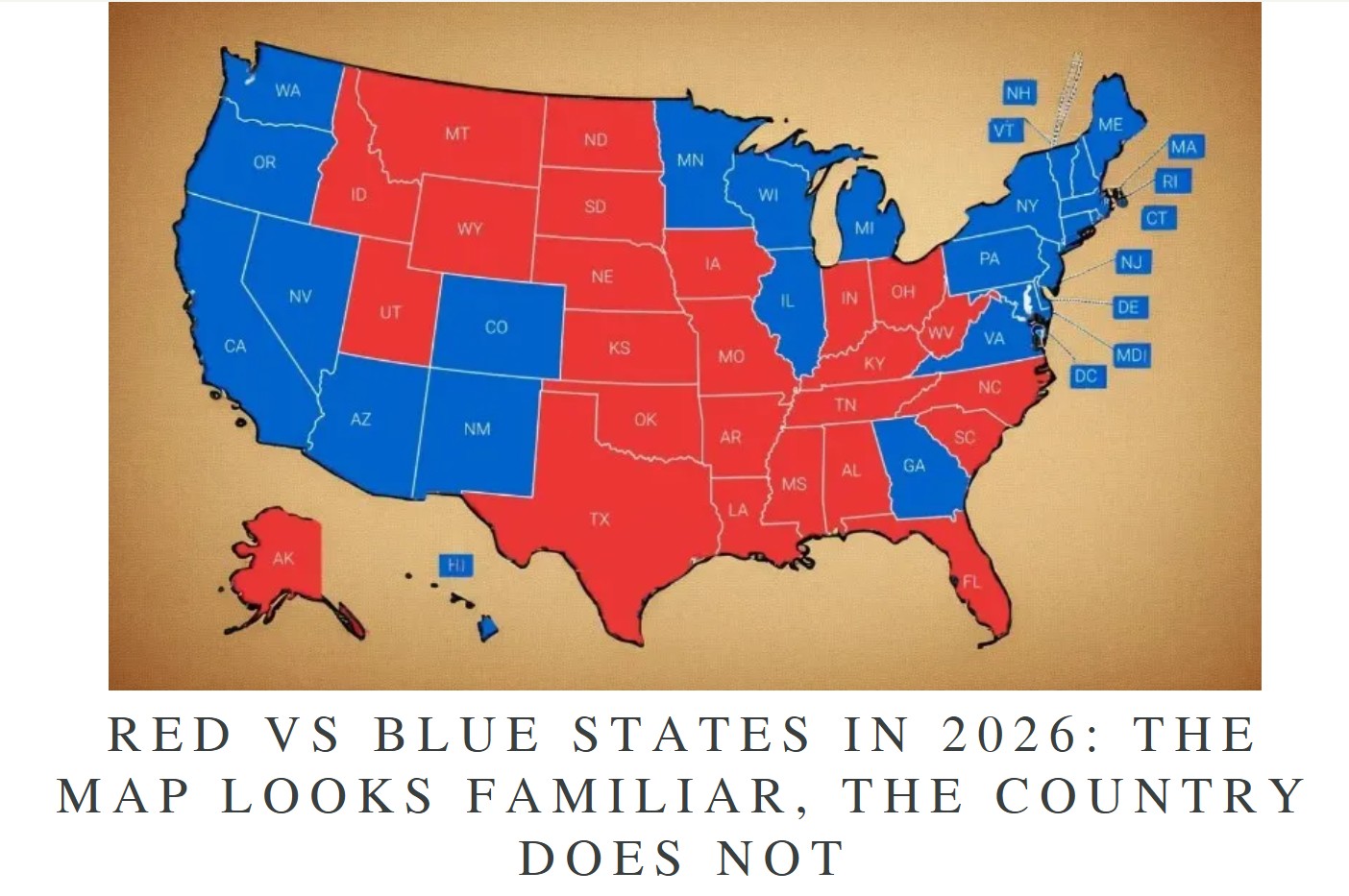
A good blog-friend I follow, Steve Ruis, broke down all the above 50-states according to their political dominance. Red = Hard Republican, Blue = Democratic, and Purple = in flux between Red and Blue. Here is a 2026 map of just Red or Blue states:
Live Well – Love Much – Laugh Often – Learn Always

The Professor’s Convatorium © 2025 by Professor Taboo is licensed under CC BY-NC-ND 4.0

