
I again continue this series from the last post, Untapped Worlds — Entries and the two previous to it.
(line break)
Do I contradict myself?
Very well then I contradict myself,
(I am large, I contain multitudes.)
— “Song of Myself“, Walt Whitman
(paragraph break)
Part of human nature, beginning at our very first breath, is to find identity, to feel loved, to feel a sense of value. Whitman poetically asks how is that achieved? By embracing equally, he replies, our ordinary and our extraordinary. Sounds liberating! Sounds easy, huh? If you are a child again, sure.
There are various reasons why it is not always as simple as Whitman’s monologue. But it doesn’t mean it’s impossible!
In my Introduction post of this series and the following Departure post, I covered just how truthful in 1855 Whitman’s poem describes us, “Very well then, I contradict myself…” In the next post Entries, I covered briefly how we humans probably became walking, talking contradictions; extraordinary contradictions over centuries and millenia to become one of the paradoxically dominant species on the planet. Four primary causes for this graduated progression were planetary resources, our physical bodies and brains, and our learned adaptation of more complex social collaboration. Yet, more paradoxical is that we’ve also made these remarkable leaps of advancement at a very staggering cost in human atrocities, deaths, and near extinctions. If we look more closely at these paradoxes on a group scale and personal scale, perhaps we can permanently exit our barbaric behaviours and fears, and begin to reside more permanently and safely in realized child-like kinetic, sharing creativity.
Power Management and the Grid – Planetary Resources
As I previously covered, the average human brain requires at least 12.6 watts of metabolic power to operate during an average 24-hours. The rest of our body requires about 50.4 watts for a total consumption of around 63 watts, or what nutritionists say is roughly 2,000 calories per day — 1,800 avg. for women, 2,200 avg. for men — and varies slightly due to height, weight, age, cultural region, and activity level. Care to be educated in what 2,000 calories or 63 watts looks like… for an entire day, all day? You might be surprised…
Though the food selections above are not the “healthiest choices,” that is as much as an average person requires for one entire day. Not much more, and less if desired. Multiply 2,000 calories (63 watts) by today’s approximate world population of 7.38 billion that comes out to 17.46 trillion calories per day, almost 465 million kW per day…a very, very manageable metabolic consumption rate for a planet brimming with caloric resources; a cornucopia of life-giving sustenance for everyone several times over. Yet, many regions, local or global, have persistent annual malnutrition and famine. From the U.N. Food & Agriculture Organization (2014):
The United Nations Food and Agriculture Organization estimates that about 805 million people of the 7.3 billion people in the world, or one in nine, were suffering from chronic undernourishment in 2012-2014. Almost all the hungry people, 791 million, live in developing countries, representing 13.5 percent, or one in eight, of the population of developing counties. There are 11 million people undernourished in developed countries.
As a fellow human being these facts slap me in the face. As an American living in one of, if not THE wealthiest nation on the planet, this hurts. This rips at my heart because daily I am surrounded, nagged, and ashamed by how excessively wasteful we are as a country. It’s everywhere here in Texas. I am not exaggerating.

The WEEE man statue, 7-meters of human electronics and electrical waste materials one human disposes in a lifetime.
It isn’t all bad news for us Yankees and Confederates, thankfully. According to the OECD the U.S. has ranked in the top three giving nations of the 28 member nations for the last fifteen years or more — because we do have so much excess. Do you think a lot more can be done?
Personal confession: my ideal body weight for a 6-foot man is 175-180 lbs. Today I weigh 196 lbs. This is not too healthy, both on a personal scale and nowhere close on a social scale! I’m changing it. The very first step I’m taking is saying “No” a lot more often. Repeating that wonderful word is not going to greatly effect my luxurious lifestyle either. It’s probably not near enough so I am doing more. I am reducing my food portions significantly and spreading out my two meals a day. Besides, much of what goes in my mouth never enters my body — what fat molecules remain get piled around the waist — and the rest is… as they say, returned to Earth. Typically, that is over half of what I ate in the first place. As I was learning more about the gastrointestinal tract, I was appalled by the waste and stunned by the body’s incredible efficiency to create metabolic-energy from so little.
Nevertheless, the minimal lean resources we humans actually need are relative to what Earth abundantly provides and what others, like myself, take away or waste.
The Beautiful Breakable Divergent Body and Brain
They are our first impressions. How the body looks, smells, and moves can reveal its general affairs and use. The body has several ways to let us and others know if it’s ill or well, surviving or thriving. It is perhaps one of the most sophisticated organic systems in the known universe. For the sake of time, here is a highly abbreviated idea of how sophisticated.
The Skin — Our body’s primary defense against the world’s microbial hordes is our skin; trillions of skin cells sacrifice themselves as shields absorbing invaders daily to soon fall off carrying would-be invaders with them. Then they are so rapidly replaced by new skin cells ready to repeat the carnage, it would make Joseph Stalin green with envy. Also, if you ever feel unattractive, consider this: Your body is so intensely appealing to trillions of tiny-stalkers they would like nothing better than to get all over you!
Immune System — It can be considered one of the most powerful array of defense weapons ever gathered in one organization. It can respond to attacks in broad or specific ways and due to highly sophisticated training, the system is like the body’s élite Special Forces in two basic Divisions: AB and CA. The AB, or antibody division, is led by B-cells handling most bacterial attacks. The CA, or cellular division, is made up of T-cells which are most effective against viral attackers. Both divisions derive their “special skills” from stem cells in bone marrow. Both can diversify as required by the battleground’s demands. Both divisions patrol the body far and wide. The immune system requires the effectiveness of the next system/buffet.
Amino Acid Buffet — About half of our organic material in our bodies is protein. It is usually connected to muscles, but protein is deployed in the body in a dazzling variety of ways and in tens of thousands of forms. Every day our bodies belly up to the amino acid buffet, creating thousands of proteins from 22 basic building blocks called amino acids. Some become muscle and sinew, some as hormones — messengers that stimulate growth, order organs to speed up or slow down, direct nerve traffic as well as manage how cells handle blood sugar. Others make up antibodies, the soldiers of the aforementioned immune system’s two combat divisions.

Sexual divergence illustrated
These three systems are only a tiny portion of multiple systems that make humans the most complex species on Earth. Yet, as covered in previous posts in this series, as remarkable as the design of the human body is it has flaws, weaknesses, and divergence. Compared to many other species which have retained and perfected their body configuration over tens or hundreds of millions of years, our hominid ancestors only started walking upright around 3-4 million years ago. This is barely enough time to sort out the imperfections, one of which we may feel every night or so in our lower back. Our spinal column comes from a model that evolved to better suit quadrupeds. Being bipedal results in gravity’s full force down our backbones, compressing vertebrae and squashing the disks that sit in between them: herniated disks. Perhaps it’s time to return to a lot more ‘horizontal‘ activity! 😈
The healthy and young suffer from evolutionary imperfections. Many pro athletes ask too much of their knees and shoulders than our current structures are mechanically able to perform. Youths suffer through acne, another probable evolutionary hangover. In other hairy animals, sebaceous glands disperse oil onto hair fibers aiding a supple and rain-proof coat. Oddly, Homo sapiens have become less and less hairy and those same oils clog and infect the sebaceous glands causing unsightly acne.
The Brain — A good deal of time was spent pointing out the human brain’s shortcomings in the first two posts. Now I wish to point out the nervous system’s astonishing control-room, the brain. Our skulls hold about a 2.8 pound tapioca-like goop holding about 100 to 200-billion neurons and many of them can interconnect with 10,000 or more other neurons throughout the entire body. This network means that the various pathways an impulse can take inside the brain can possibly exceed the number of particles in the Universe. The fact that some of us can hardly obey basic traffic laws or balance a checking account is not for the lack of tools!
As humankind faces known and unknown species-threatening biological diseases, social and planetary dysfunctions, any of which that could lead to near extinction, if not full extinction in the next fifty to one hundred years, it becomes utterly critical than ever before in human history that the human race begin thinking a lot more in terms of a species and not individuals. But wait! That is not all of it. Simple altruism will not achieve complete survival of our species. The journey and struggle for higher enlightenment, quicker evolution, and dynamic social ecological collaboration are ironically and equally an individual one as it also relates to the whole species. They cannot be separated. But more on this cognitive paradox later in the series.
Litmus and Human Chemistry – Our Social Life
“Don’t worry Wilson, I’ll do all the paddling. You just hang on!” Chuck Noland’s relationship with a volleyball, in the film Cast Away, sums up how much we need social interaction for identity, inspiration, and a functioning level of sanity in an otherwise apathetic daunting world.
 Around 3-million years ago hominids began sharing resources, probably because they witnessed sharing among other animal groups particularly with offspring. This activity facilitates what is known in modern neurology and psychology as parental attachment. This bonding has several supporting social and physiological dynamics, most notably cognitive and hormonal bonding. Studies on infants and toddlers infer an innate need for children to develop emotional attachments to increase their chances of survival. Parental attachment eventually expands with age into more complex bonding mechanisms of group and mating attachments and identity, again satisfying our innate needs of survival and hormonal rewards. When none of these cognitive and hormonal dynamics exist for an infant, toddler, or adult, the result is a higher increase in stress or the release of cortisol by the hypothalamic-pituitary-adrenal axis (HPA Axis) which if prolonged, leads to a rippling-effect into other negative health complications such as digestive problems, heart disease, sleep deprivation, depression, and memory-concentration impairment to name a few. In contrast though, positive social interaction is associated with increased oxytocin. Oxytocin and vasopressin are major deterrents against stress-hormones and in both toddlers, children, and to extents adults too, enhancing human motivation for curiosity and intellectual growth of expression, language, mathematical, and logic-cognitive growth… all wonderful contributions to a secure healthy emotional base.
Now that I’ve quickly touched upon what goes on inside our body and brain on the microscopic biological spectrum — there is just too much to cover in a few posts; a virtual multi-storied library — I move on to external influences, stimuli, nourishment or dis-ease that enter our brain and body through all five senses.
The Question of Free Experiential Learning
(paragraph)
(paragraph)
(paragraph)
(paragraph)
(paragraph)
(paragraph)
Many of you may have been raised in systemic public schooling like me. Every single school morning in 1st period the class would stand, and in unison verbally recite word-for-exact-word… “I pledge allegiance to the flag of the United States of America. And to the Republic for which it stands, one nation under God, indivisible, with liberty and justice for All.” Later as an adult and a teacher of several public school districts I was required to lead all my 1st period students in the Pledge of Allegiance, persuading each to follow suit if necessary. Why? What was the purpose of this oath?
When I was a boy I asked my Dad what the pledge was all about. Being a former Eagle Scout then U.S. Marine Corps soldier, my father explained in simpler terms a code and what I elaborate today as a code of honor, courage, and committment to live by and to guard our nation’s principles, as an élite noble warrior if necessary. This began my deep lifetime boyish admiration for military history, its valiant soldiers, leaders, and the powerful survival concept A Band of Brothers. The code of Semper Fidelis and what it means is something that for personal reasons quickly and embarrassingly brings tears to my eyes. Since 1990 I have continued to learn the stark contrast between freedom and license.

Real Madrid FC supporters
Nationalism, along with religion and sports fans, is one of civilization’s most potent methods of systemic taught and learned “beliefs”. What is most intriguing is that nationalism is everywhere around most of the world, yet it can be quite illusive to nail down what those beliefs are exactly that define nationalism or patriotism. One common form of nationalism is the odd belief that your nation is superior to others in particular ways. “Patriotism is your conviction” George Bernard Shaw notes, “that your country is superior to all other countries because you were born in it.” Indeed, even though one has no real control of where your mother births you, happenstance falsely gives you the conditioned right to proudly brag. Another form of nationalism is the perceived (and taught) duty to protect your nation when under threat, e.g. my father’s and my nation’s USMC code. This form of conditioning fascinates me and it can be found not only in the psyche of human groups, but also in many other species on Earth! I will address this phenomenon later in the series. Even more fascinating is that nationalism is a recent human endeavor, emerging only over the last three centuries!
Since the mid-1600’s nation-builders couldn’t simply use enthusiasm to unite people. Enthusiasm is too emotionally temporary; prolonged high levels of adrenaline, or epinephrine, exhaust the body’s hormonal and nervous system. This condition is associated with combat veterans suffering from PTSD or extended periods of the adrenaline-high “fight-or-flight” mode. The body needs to return to periods of standard hormonal levels to fully function.
No, instead nation-builders found a powerful more permanent tool: captive audience. In other words, a national education system teaching the nation-state’s “unique” ideology. In religion, it is and has historically been no different.
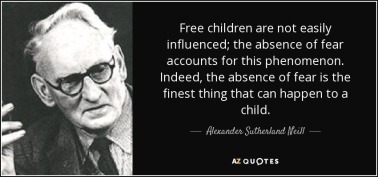
Should a national and/or religious education system be the one and only single form of teaching and learning? John Maynard Keynes was one of Western civilization’s prolific economists of the early 20th century. During the Great Depression (1929-1939) Keynes was popularly criticized for his M.O. of inconsistency. When forced to explain his fluidity, he replied “When the facts change, I change my mind. What do you do Sir?” Sherlock Holmes had a similar anecdote reminding Watson, “When you have eliminated the impossible, whatever remains, however improbable, must be the truth.” There is a profound ceaseless curiosity innate in our human psyche from our earliest days as a toddler. If free to explore and not ruthlessly confined and coerced, human cognition can brilliantly unlock mysteries of the subatomic to the macro-cosmic and everything in between, including the far reaches in ourselves. Alexander Neill also believed in this learning philosophy. In 1921 Neill believed “school should be made to fit the child, rather than the other way around.” The role of the parents and nation-states was simply to protect the integrity of that freedom and nurture liberating non-stop curiosity which fuels human ingenuity and the highest human virtues. Neill’s Summerhill School in Lyme Regis then Leiston, Suffolk, England, was and is a radical departure from traditional religious and national education systems. However, our species didn’t make evolutionary and revolutionary leaps or breakthroughs by remaining intellectually, physically, biologically, and philosophically stagnate. No, progress requires continual questioning, reëxamination, and possible-probable retooling — residing in fluidness if you will — even in the face of perceived contradictions or threats from establishments.
“Very well then I contradict myself,
(I am large, I contain multitudes.)”
(paragraph break)
* * * * * * * * * *
There is little doubt how much we truly need each other. The big question is how we need each other? What are the connections? Language, symbols, and physical expression are the acute methods of navigating our social soups. Mastering all of them could not be more urgent as our species confronts the biological, social, and ecological dilemmas and crises of the 21st century.
In the next post of this series Untapped Worlds — Retooling, I will explore what it means to be a part of a super-organism, what it means to be surrounded by endless biodiversity, and how more humans are finally catching up with other highly eusocial species on the planet, yet also highlight the coexisting paradoxes or contradictions that subtly distinguish us from other animals species, but never alienate us.
Live Well — Love Much — Laugh Often — Learn Always
(paragraph break)

Blog content with this logo by Professor Taboo is licensed under a Creative Commons Attribution-NonCommercial 4.0 International License.
Permissions beyond the scope of this license may be available at https://professortaboo.com/.





 The Professor's Convatorium