Untapped Worlds – An Intro

12.6-watts average. That is it. That is the average electric power (i.e. metabolic-energy) the human body must supply the brain for one “normal” day says Scientific American magazine. Want to know what sort of items can be powered with only 12.6-watts and for how long? To help better understand this comparison, let’s pretend we have a 12.6-watt battery to run some common household items. A basic clock-radio you might see on a bedside table in a cheap hotel will run for approximately 3-hours, if the radio volume is soft; maybe 4-hours if the radio is never used. A Nintendo Wii game-console can run on 16.8-watts for an hour. A standard 19″ CRT TV, 55-90 watts for an hour. A camping range-burner requires 800-watts for 1-hour. The average household coffee-maker requires 900-watts per hour. Getting the picture?

Perception-InterpretationThe human brain must conserve metabolic-power and run as efficiently as possible in order to function “normally” for a 14-16 hour day awake. Naturally, when asleep the brain is using much less metabolic-power, but still consumes small amounts. Power efficiency becomes critical in abnormal circumstances; either the body has enough metabolic-energy stored or it doesn’t. When the body does not, the potential for serious or traumatic harm increases proportionately to the danger, correct? Without the necessary brain-power for higher or acute cognitive and motor reactions, the greater the bodily harm or mortality. We see this organ-power equation illustrated in the animal kingdom every day. For example, animals falling prey to predators. Those animals with a higher healthier organ-power coefficient typically escape death, or their chances of escape are higher than those hunted animals with lower or less-healthy organ-power coefficients. Roadkills are another example. Animals with a low coefficient (i.e. tiny brains with tiny metabolic power to that tiny brain) typically cannot cross a busy highway 10-times without being hit.

In different more complex scenarios, humans are no different. Place an ordinary 20-something year old person who has been raised in a peaceful, quiet, unpopulated region all their life with absolutely no training or education of weapons or warfare, into a violent war zone for a 6-8 week period, their rate of survival — excluding mental health of course — will be extremely low, if not fatal. Too drastic? Then replace the war zone conditions with modern traffic rules and complex motor vehicles, multiply all that by ten(?) depending on the site’s population, and make it a teenager or 20-22 year old driver, and no driver’s education whatsoever. What might or probably will happen after 2-6 months? Ask an auto-insurance underwriter what the statistics would be.

Here’s the point in this so far:  humans are surrounded, no… constantly bombarded, with a never-ending supply of stimuli to the eyes, nose, ears, skin, and tongue in a 24-hour period! It is impossible for our brains to receive, process, store, and use all the available daily stimuli when it runs on only 12.6 watts per day. What does the brain do to compensate…to cope? It prioritizes. For millions of years our brains have slowly learned what is critical to survive, what is needed to increase survival-rate, what is unnecessary but nice, and what is utterly useless. And it does this prioritizing FAST, real fast! It has to; 12.6 watts runs out quick, or in other words, cognitive fatigue, let alone physical exhaustion, leads to collapse. Perhaps the only exception to this metabolic law is drug use or abuse. The reliability or unreliability of drug-induced cognition, heightened or otherwise, I will leave alone or for another time. 😉

Suffice to say, our human brains are quite prone/susceptible to various degrees of ambiguity, superstition, memory-errors, and deception.

Deception

When success, advantage, surprise, control, victory, or secrecy are sought, one method of better assuring that outcome is through deception. You find it in many team sports, you find it in multimillion dollar business tactics against competitors, you find it in card games, you even find it among verbal human interactions. Deception is especially useful in combat and wartime. Perhaps one of the best examples of this was Operation Bodyguard.

Operation Bodyguard and its seven sub-operations leading up to the 1944 D-Day Normandy invasion of Nazi Fortress Europe, were highly successful operations of deception saving hundreds of thousands of American, British, Canadian, French, and other Allied lives. For several months prior to the actual invasion into Normandy, France, the Allied High Command under Dwight Eisenhower flooded the Nazi airwaves, radar surveillance with well-planned misinformation, and even inflatable tanks, artillery, and supply trucks creating a completely fictitious Army Group to deceive German reconnaissance planes. By June 6 and 7, 1944, the operations were so successful that Hitler and his élite commanders waited 7 weeks before fully responding to the Normandy invasion forces, much too late to stop it. Oh the power and usefulness of deception.

History is laden with examples of armies, sports teams, gifted magicians, and large groups of people being duped by simple tricks designed to divert and/or confuse the brain. Take for example, this clever trick play by a high school baseball team…

Magic tricks are plentiful with deception, diversion, and confusion, so many that there is no need to list the thousands or embed their videos here. But one poignant example of people or large groups being utterly fooled would be that of the Peoples Temple in 1978 at Jonestown, Guyana where over 900 men, women, and children committed mass suicide/murder following orders from their cult leader Jim Jones. Until 9/11 this had been the greatest loss of American civilian lives by a single act or day. What is important to remember is that our brains can be led to misinterpret information. Our limited senses can cause the brain to construct false perceptions of people and in the world we live.

Memory Errors

Fact:  the human brain has difficulty recalling an event in the past, and details are often distorted or incorrect. This applies to every single brain on the planet. Scientific evidence shows this fact repeatedly no matter how mundane or monumental the event, our human memory is not as good as we’d like it to be.

Our memory is not as fixed as we might perceive, but much more fluid. What does that mean? Conceptualization is the norm, errancy is prevalent… along with egocentricity I would think. 😉 This 17-minute TED video from award-winning Dr. Elizabeth Loftus, a cognitive psychologist from Stanford University and UCLA, explains her ground-breaking research about the brain’s misinformation effect and its extremely imaginative capabilities for creating false memories. Dr. Loftus’ findings and talk are superb…

No matter how highly we hold our memory skills, the brain is simply not currently wired nor the metabolic wattage (12.6 watts) to be a precise 300-year DVR. Will it ever be? Ask that question in 10,000 or 100,000 maybe 1-million years. Right now the overwhelming scientific neurocognitive data suggests that our brain’s conceptualizing skills, including imaginative or experiential conjecturing, are far more dominant and gifted than fact-finding or fact-storing. Don’t despair though, we have the intelligence to improve this human condition…over a long, long period of course.

Superstition and Ambiguity

In my next post in the series Untapped Worlds — Departure, I will finish the Superstition and Ambiguity portions, establishing the/our brain’s faulty interpretations based on its limited (or very limited?) sensory feedbacks — it only learns what it is actually fed. Then move further (evolve?) to more impactful human experience. How can we upgrade our brains? How can we improve its immaturity before it’s too late?

Mmmm, we must leave port. To be well-traveled, more acutely aware, more precise, we must first depart from traditional cognition!

Live Well — Love Much — Laugh Often — Learn Always

(paragraph break)

Creative Commons License
Blog content with this logo by Professor Taboo is licensed under a Creative Commons Attribution-NonCommercial 4.0 International License.
Permissions beyond the scope of this license may be available at https://professortaboo.com/.
Machiavellian Meloidae

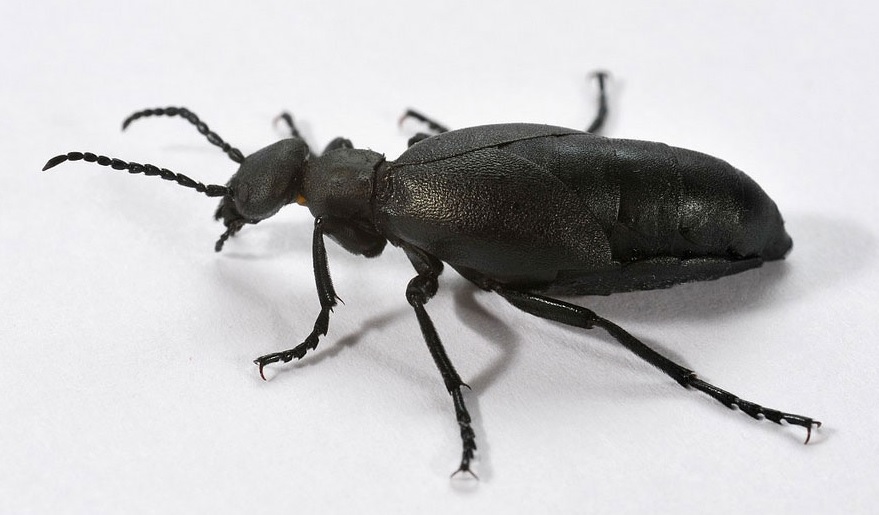
For those of you who are utterly fascinated (like me) with Earth’s most resilient creatures — no, humans are not even close — the Meloidae take survival and reproduction to an all new high… or rather a cunning, evil low may be the correct designation. If you think politicians or double-agents are unscrupulous, then you don’t know much about these ingenious Coleoptera. No, not Cleopatra, Coleoptera… though the behavioral similarities are clearly there.

Beware of Seductive Female…

Coleop

Coleoptera Meloidae

Bees. Yes, seductive fake female bees! Or perhaps I could have left-off “bees”. HAH! But let’s not go there, yet. But I do want to talk about perfumes… seductive perfumes!

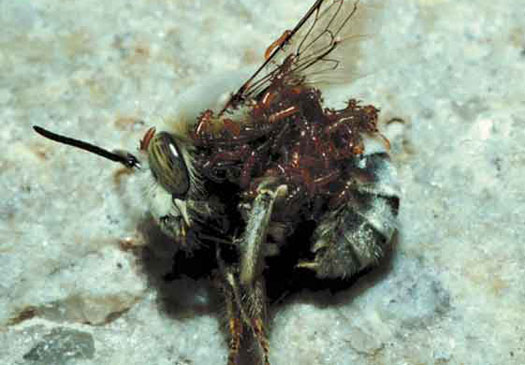
The larvae of the Blister Beetle, after they are hatched, must immediately seek food. But they do not seek out just any menu. They want a specific 5-star platinum dinning establishment with an unforgettable experience, AND they want and will be chauffeured there! Men, married men, husbands with a pregnant wife or newborns… does this sound familiar? How do these newly born larvae do it? As the below video will show, their genetic coding makes them work as one team, climb to the top of a blade of grass or leaf, clump together, then the Coup d’état… they lure an unsuspecting (horny) male Digger-bee, and do it with specialized perfume, or pheromones! Again, sound familiar? Talk about the greatest STD. Wow! Guys, this totally redefines the need for super safe sex!

(paragraph break)

What Can We Learn From Blister Beetles?

Having a background in psych counseling and assessment, as well as certified 4th through 8th grade teacher in all core subjects with a deep fondness for science and social studies (history), my students have always enjoyed relating or connecting Earth science and its creatures to self or to us. Invariably the bored middle school kids ask the question… How does this effect me or help me in life? Well my little unknowing enquiring mind, it does in many ways. Case and point: the Blister Beetle.

meloidae_beetle_larvae

Male Digger-bee with stowaways

Ever heard of the adage “If it seems too good to be true, then it probably is” or its gullible opposite “Never look a gift horse in the mouth“? Those two phrases and similar ones carry a lot of wisdom. As many a magician have demonstrated over the centuries, our eyes can be easily deceived. Our ears and nose can be fooled as well, to a lesser extent. Obviously, the “perfumed pheromones” these meloidae larvae ooze, cause much “male digger-bee intoxication” and I believe mimic other species’ perfumes! I’ve fallen prey to different parfums enivrants as many times as these male digger-bees! And I’d wager I have hit the ground, once or twice, much harder than these gullible lads!

Our judgement and perceptions (of self and others) can be quite flawed. Only through periods of time — sometimes years, and in the case of humanity, centuries or millenia — and through trial and error do we learn from events and our mistakes. Hopefully not fatal mistakes. Therefore, it really behooves us flawed humans (and hetero males?) to consider situations with as much cognitive examination as with emotion, especially impulsive emotion. Easier said than done, right? Particularly when some of us are genetically wired to feel and feel strongly, or to find and love, and love strongly. Believe me, I have wrestled with this advice for much of my life, as my recent posts about my daughter, marriages and divorces, and the nature of love can greatly attest!

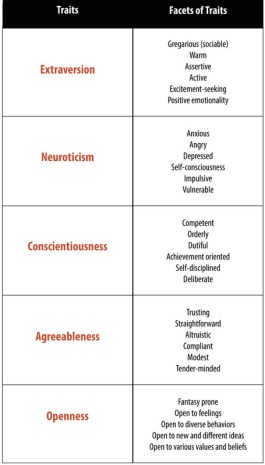
Five-Factor Model - courtesy of noboproject.com

Five-Factor Model – courtesy of noboproject.com

All of us, every single human being alive, are inextricably connected to this planet and its life-giving (and taking) environments and creatures. We absolutely can learn from all the animals, how they survive, adapt, evolve, and especially reproduce, even from the aversely simpatico relationship of Blister Beetles and Digger bees.

BigFive-sub

Subtraits of the Big Five – courtesy of noboproject.com

In modern psychology, Machiavellianism (and this beetle) is one of three personality traits of the Dark Triad; dark meaning malevolent manifestations. Essentially it is behavior exhibited by a high drive to achieve at the expense of or disregard to others. Clearly this is the female Blister Beetle’s — and her offspring’s — motivation and behavior. What I find fascinating is the question “Are there Blister Beetles among us as humans?” Is it simply genetic programming in order to survive and perpetuate the species and they cannot CHOOSE morality… the “higher road”? Or are there always choices between species; in other words, species who are inferior deserving of extinction and those as superior who deserve to live and survive? Are we talking about humans or beetles? Humanity’s long long history of wars and genocide speak volumes of this Genetics versus Morality judgement. As much as Blister Beetles have a very high regard for self and their offspring, I think humans do too… particularly certain males. By default I must reluctantly include myself in that gender. 😦

In Wikipedia’s description of Mechaiavellianism, the section on human relations with other personality traits, I found to be uncomfortably familiar. Are you familiar with the HEXACO model? I wasn’t until I began comparing this beetle’s behavior with similarities to other Earth species, which I typically like to do as a good (Freethinking Humanist) science teacher. See the three figures of the HEXACO “Big Five” tables.. Where do you think your (self?) personality falls?

BeyondBigFive-3

Traits beyond Five-Factor Model – courtesy of noboproject.com

Personally, I see the Blister Beetle’s Machiavellianism within several primate species, especially certain Homo sapiens. Would you agree or disagree? Why or why not? Are we products of our DNA or of our environment, or a little of both? Are you a Blister Beetle or a Digger bee. Or if you’d like to protect your true identity (like I do here!) you can simply comment about these cunning little insects and their larvae. 😈

(paragraph break)

Live Well — Love Much — Laugh Often — Learn Always

(paragraph break)

Creative Commons License
Blog content with this logo by Professor Taboo is licensed under a Creative Commons Attribution-NonCommercial 4.0 International License.
Permissions beyond the scope of this license may be available at https://professortaboo.com/.

What A Jerk!

I’ve just finished riding my mountain bike through park trails, up and down hills, and return home out of breath and very thirsty. I grab my water bottle craving a quench to my thirst, so I gulp, and gulp as fast as I can… too fast. I completely mess up my body’s breathing rhythm and BAAM! I hiccup…hard! It’s not only uncomfortable, sometimes painful and embarrassing in public, but it takes perhaps 2-3 minutes or more to rid yourself of them, right!? What is this malfunction and why does it even exist?

I want to know!

police_briefing

Sargeant Carter’s briefing

Later in the evening relaxing on my couch from a fabulous day teaching little Energizer Bunnies followed by that wonderful strenuous bike-ride, with a purpose I’m reading Tolstoy’s War and Peace before bed. About the third paragraph, page 2 I believe, I slip into what I think was Never-never-Land and suddenly jump, snapping out of sinking pure relaxation into a VIOLENT jolt! Ouch! What is this malfunction and why does it even exist!?

I want to know!

Knowing is the First Step to Prevention, Right?

Not so fast. Turns out that what your parents explained or grade school proposed as the menacing ailment and proven cure, may not be the whole story.

The Hiccup — The police Sargeant opens up the Jerkiness File, pulls out a 4×10 magnet and throws it up on the “Open Cases” investigation board. It sticks and reads “Diaphragm, T.” Our first accomplice! The young rookie cop asks, “What’s the T for Sir?” Sargeant takes a pause, “Pyle,” he grunts “it’s so your penile brain doesn’t make its normal sexist associations!” Who is this and what’s its function? Diaphragm…first name Thoracic, is the shifty muscle behind all the business. He sits just below your chest working perfectly and secretly as you breath; the Accountant of the operation, if you will. His function? He pulls down when inhaling to bring in business (air), and he relaxes so business is released when your lungs exhale. It’s a regular respiratory black-market!

diaphragm_tBut there’s a nastier side to Diaphragm. The room of officers fall silent…what? What could be more sinister? The Sargeant’s voice deepens, “Sometimes Diaphragm gets irritated and when he gets irritated, nobody is happy!” Apparently when he’s pissed, he pulls down hard and fast sucking air down your throat! When that rushing air hits your voice box, your vocal chords slam shut giving that hiccup jerk! “Accounting” just closes business down and everything becomes very uncomfortable until Diaphragm returns to normal.

That’s the school version, maybe your parent’s version too. There is another one; the medical community’s version. Respiratory doctors, gastrointestinal doctors, and gastroenterology call the hiccup Synchronous diaphragmatic flutter, or SDF. It has another alias too:  Singultus. The medical community says Singultus is somewhat unpredictable and an involuntary contraction of the diaphragm simultaneously with the contraction of the larynx and complete closure of the glottis…which basically is a shut-off valve for your air intake. Reasons for the “shut-off” are generally believed to be triggered by minor stomach upsets.

Then there is the Other more extensive version of Why the hiccup… the one I find fascinating. But first, all of you will meet our second fiendish criminal and crime-scene, street-name:  the Never-never-Land jerk.

My Tolystoy-Leap or Hypnic-Jerk — Sargeant Carter reaches into the Jerkiness File again. He pulls out the second magnet slapping it onto the board. This one reads “Brain, M.” Hah! The scoundrel of sleeplessness! Before Pyle, G. can open his rookie mouth Sargeant Carter nips “Do you have one of those Pyle” he asks. “Why don’t you demonstrate for everyone what the M stands for.” Once again the room falls silent, all ears upon Pyle, G. and his lethargic expression. Seconds turn into longer seconds. “I’ll save you the pleasure Pyle.” Sargeant Carter writes on the board with the marker…Monkey. “Our second felon is Monkey Brain!” exclaims the Sargeant “I want all of you to help Pyle find his so we can close this damn case, preferably this decade!

QUIET all of you! There’s more. Brain, M. is shifty too. The report is that Brain has a rather diverse personality and a huge creative ego; some say conflicted. He will not be easy to track down so listen up!

Thermogram_of_sleepThe medical experts say Brain’s most common shiftyness while asleep are rapid eye movement while the rest of the body and limbs stay still, making it difficult to know what’s going on in that head. If Brain is watching a fox chase a rabbit, the eyes will follow the chase (in his head) everywhere, but if he’s riding a bike or jogging, you would never know it. Stealthy S.O.B.! Fortunately, we’ve got a deep undercover mole inside the operation. They report that as Brain gives in to watching and listening to business inside and outside the “organization,” Brain begins to entertain himself and relaxation/sleep creeps in. That’s when things get weird. A struggle begins over control of the motor system between nocturnal operations and daytime operations; Brain splits into two different managers while the fight ensues. Both keep intruding on the other’s territory until the dreamy rest personality prevails. These are the preliminary reports from within and our ongoing investigation. However, as mentioned, there are Other developing versions and theories of why Diaphragm, T. and Brain, M. work this way.

OLYMPUS DIGITAL CAMERATadpoles and Diaphragm

There are those” Sargeant Carter’s voice raises “who might feel Paleontology is bogus, even illegal or demonic.” Carter gets firm, clinching his fist, “But in the field of crime and solving cases NOTHING is ever ignored! If you or I slip-up and miss a clue, that could be the difference between life or death for someone! This is why we call in forensic scientists.” The Sargeant stops, glares at every officer, leans over toward them and says, “You WILL listen to every word, every syllable they utter… especially you Pyle!

Carter turns on the overhead projector and begins.

Our first top forensic scientist and co-investigator, Neil Shubin of the University of Chicago and Natural History Magazine, says that Diaphragm and the hiccup are “a legacy of our “fishy” ancestry.” Pointing to the back of the room Sargeant Carter introduces, “Mr. Shubin, the floor and our undivided attention is yours.

shark_human_embryosThank you Sargeant Carter.” Shubin clicks the image-changer, up pops a side-by-side comparison of a shark’s gill area and a human’s jaw area. “Due to 3.5 million years of genetic tweaking and re-engineering, our human flexible throat that has led to our highly developed speech and communication, has also made us susceptible to modern sleep apnea, snoring, choking, and hiccups.” Dr. Shubin continues as he explains a, b, c, and d in the image:

Both shark and human embryos (a, b) have similar gill arches (the brightly colored elements). In sharks, the cells in these arches become bones, nerves, arteries, and muscles that support the gills (c); in humans, they form the jaw, ears, larynx, and parts of the throat (d).

The annoyance of [Diaphragm and] hiccups also has its roots in our fish and amphibian past. If there is any consolation, we share that misery with others. Cats and dogs, like many other mammals, also get hiccups. A small patch of tissue in the brain stem is thought to be the center that controls that complicated reflex.

The hiccup reflex is a stereotyped twitch that involves a number of muscles in the body wall, diaphragm, neck, and throat. A reflexive firing of one or two of the major nerves that control breathing causes those various muscles to contract. This results in a very sharp inspiration of air. Then, about thirty-five milliseconds later, a flap of tissue in the back of the throat (the glottis) closes the top of the airway. The fast inhalation followed by a brief closure of the air tube produces the “hic.”

Our tendency to develop hiccups is another influence of our past. There are two issues to think about. One is what causes the reflexive firing of nerves that initiates the hiccup. The other is what controls that distinctive hic—the abrupt inhalation and the glottis closure. The nerve action is a product of our fish history, while the hic is an outcome of the history we share with tadpoles.

[The theoretical conclusion is this:] The genes that control all of this structure [and restructuring] were originally used to build the bodies of ancient worms, flies, and fish. Every part of us tells this story: our sense organs, our heads, even our entire body plan.

Dr. Shubin stops and turns off the overhead projector. “The rest of my studies, data research, and theories can be found in your individual packets placed in front of you. Sargeant Carter?Click here for his article.

* * * * * * * * * *

Carter returns to the front, “Our second forensic co-investigator is Dr. Frederick Coolidge from the University of Colorado. He will enlighten all of you of more clues about Brain, M.” The Sargeant looks to the back of the room, “Dr. Coolidge, you have our undivided attention, including Pyle’s.

Primates from Trees and Monkey Brain

lemur_sleeping_treeThank you Sargeant” as Coolidge flips on the projector again to reveal an image of lemurs sleeping in a tree, he begins “Paleontology, more specifically Vertebrate Paleontology and Paleoanthropology, are suggesting that our ancient primate ancestors, following Dr. Shubin’s tadpoles of course, also had our hypnic jerk. They still do!” Dr. Coolidge changes the image to a fatigued woman asleep over laundry. “As Sargeant Carter spoke about earlier regarding the battle between Brain, his working fatigue, and nocturnal operations, the body slips into a limbo-like state and Brain doesn’t want to give up any control.” He flips to the next image, a man “falling” over his bed, but actually still lying in it.

Primates sleeping in trees also mimic this hypnic jerk which for them is an archaic reflex to the brain’s misinterpreting the muscle relaxation accompanying the onset of sleep as a signal that the sleeping primate is falling out of a tree. The reflex may also have had selective value by having the sleeper readjust or review his or her sleeping position in a nest or on a branch in order to assure that a fall did not occur.

female_fatiqueDr. Coolidge goes on to explain, “Sleep studies done at the University of Bologna in Italy have suggested the jerks are also associated with a rapid heartbeat, quickened breathing, sweat, and sometimes a peculiar sensory feeling of ‘shock’ or ‘falling into the void.’” Coolidge takes a moment, then paces back and forth staring at the floor. “Those behaviors and reactions are not unlike most primates, including ourselves. The behavior in the primate world is closely associated with what scientists call the Fight-or-Flight Response. As law enforcement agents, all of you are too familiar with this innate tendency.

hypnic-jerkSargeant Carter chimes in, “It is the reason society must always have law enforcement; some primate behaviors have changed or evolved little over millions of years.

— The author of this post so desperately wants to go into why some primate behaviors don’t evolve, but due to the fact that this post is already approaching 2,000 words, feels it might be suitable for another later post. Very sad face follows. —

Dr. Coolidge turns off the projector and begins passing out packets of his and his colleague’s study and theory… “Inside these folders you will all find mine and Dr. Thomas Wynn’s alternative theory of Brain, M. and his hypnic jerk behavior. Examine it closely.Click here for the study.

The Briefing Adjourns

Sargeant Carter returns to the front, “Agents, it would seem that Diaphragm, T and Brain, M. have been at large for a very long time, probably millions of years, causing rampant hiccups and hypnic jerking. That in no way implies we slack-up on the case and concede no arrests when there are obviously leads and clues galore! No, we will not; not on my watch!” The Sargeant walks over to the front board and points at the two names. “I want these two” he yells “understood like the back of your hands… that would be your free-hand Pyle… I want them identified, their accomplices identified, all cuffed and brought in!” He stares at his agents. They stare back. Three seconds later…

NOW you grunts!” All but one launches out of their chairs immediately…”Pyle, Gomer… damn it, that sure as hell includes YOU!

Live Well — Love Much — Laugh Often — Learn Always

(paragraph break)

Creative Commons License
Blog content with this logo by Professor Taboo is licensed under a Creative Commons Attribution-NonCommercial 4.0 International License.
Permissions beyond the scope of this license may be available at https://professortaboo.com/.
The Nature of Love

As part of the Alternative Lifestyles blog-posts migration over to the new blog The Professor’s Lifestyles Memoirs, this post has been moved there. To read this post please click the link to the blog.

Your patience is appreciated. Thank you!