Brain Secretion Byproducts

“God” is a secretion of the human brain, says Michael McGuire and Lionel Tiger.

 † † † § † † †

In their 2010 book “God’s Brain,” McGuire and Tiger strongly suggest and demonstrate that the concept of God, or a God, is a byproduct of human cerebral secretions. Historically the various divine tenets, revelations, traditions, and expressions of social orders around the world are encapsulated from that specific culture’s or civilization’s perceived, geographical, organizational needs not just for survival, but for their perceived perpetuation, then recorded and implemented in a Code of Principles relevant to their time-period. McGuire and Tiger state there is simply no compelling evidence for any type of cosmic, monistic Being manipulating us and Earth’s events.

Now that Homo sapiens are more evolved, at least intellectually and socially no matter the multitude of progressive and digressing methods, historically speaking have our cerebral secretions of Gods and religions been helpful? On a micro scale Tiger has an intriguing perspective on the question:

I found Tiger’s elaboration of the individual and social functionality of ‘optimism’ or hope — that it seems to be a useful tool for survival and perhaps for thriving throughout life — to be of special interest. Why? Because its use requires no patent or jurisdiction other than culturally, in a specific time-period to a specific locale. How is trust defined by those people and their circumstance? One thing is evident, none of this religious human behavior can be adequately or universally traced to one source.

On a macro scale E.O. Wilson of Harvard University (retired) goes in a different direction. Organized religion has a dark side and ugly track-record.

[Intent of religious deities have] “been perverted many times in the past — used, for example, to argue passionately for colonial conquest, slavery, and genocide. Nor was any great war ever fought without each side thinking its cause transcendentally sacred in some manner or other.”

Hence, this could beg the question:  Have we modern humans evolved or should we humans further evolve to a more practical, more progressive new social Code of Principles? What are/would those principles based upon? How many social affiliations should/can a human(s) be involved? Are the affiliations beneficial or detrimental to them and their family? Non-family? Do you already have affiliations and belief-systems that are more highly evolved than others?

(paragraph break)

 † † † § † † †

I think whether you agree or disagree with Tiger’s assessments of transcendental beliefs or empirical biological consequences concerning the origin of God and religions, it is paramount to develop and maintain a certain amount of scrutiny, or neutrality, or critical-thinking when considering this source or that source and its mechanisms.

Critical-thinking is not to be confused with agitation, or argumentative, or a personal attack upon someone. Critical-thinking actually helps us acquire more knowledge, expose ignorances, refines our theories, improves collaboration and construction, and strengthens or weakens premises for what they are. I feel one of the most beneficial aspects of applied critical-thinking is that it promotes “thinking outside the box,” a very healthy form of human empowerment and creativity. These two conditions are not achieved to their fullest in a restrictive or constraining closed-system typically preached and protected by religions. They are best achieved in environments of freedom of thought and scrutiny, as well as positive support for a person’s and all person’s natural-born abilities. Agree? Disagree? Why or why not? Share your thoughts below.

Live Well — Love Much — Laugh Often — Learn Always

(paragraph break)

Creative Commons License
Blog content with this logo by Professor Taboo is licensed under a Creative Commons Attribution-NonCommercial 4.0 International License.
Permissions beyond the scope of this license may be available at https://professortaboo.com/contact-me/.

No More Nation States?

Author, social philosopher, historian, and speaker Roman Krznaric is one of my most favorite writers. I have utilized much of his work in my blog-posts, especially his writing, theories, and organizations promoting a more significant, impactful life with friends, family, coworkers, and community. On Roman’s website he writes an intriguing, thought-provoking article about the modern signs of returning, rising city-states similar to that of 14th – 17th century Renaissance Era”s Venice and Florence, Italy. Are there more advantages than disadvantages to this possible/probable trend?

City-State vs. Nation-state

Britannica.com defines city-state as “a political system consisting of an independent city having sovereignty over contiguous territory and serving as a centre and leader of political, economic, and cultural life.” There is a large consensus that the term does apply to at least three different modern cities:  Singapore, Monaco, and Vatican City. What distinguishes the three city-states comparatively are their higher degrees of sovereign autonomy.

Singapore

Singapore is considered one of the most successful, happiest city-states in the world

A nation-state according to the Merriam-Webster dictionary is “a form of political organization under which a relatively homogeneous people inhabits a sovereign state; especially : a state containing one as opposed to several [ethnicities and] nationalities.” Naming examples of nation-states is not an exact science. It is hotly debated due to the many complexities that make up a nation or a state. Dr. Atul Kohli of Princeton University describes them as “Legitimate states that govern effectively and dynamic industrial economies are widely regarded today as the defining characteristics of a modern nation-state.” Perhaps what differentiates the nation-state from other forms of governing is to what degree it utilizes its complex social, cultural, and economic instruments in unison. Historically these factors morph and change, further fueling contrasting debates. For instance, does a culture of North and South or Confederacy/Union still exist today in the “nation-state” called United States? What does a current approval rating of only 17% for the U.S. Congress indicate?

John Fullerton, founder and president of Capital Institute and contributor to Huffington Post, explains our current nation-states this way:

Ideological rather than pragmatic, a political abstraction that has no grounding in the concrete reality of where and how we live and how life-supporting ecosystems function, the Nation State, together with its political party structure, is not well equipped for today’s most important globally interdependent challenges that cannot be solved through inter-State rivalries where self-interest and might rule the day.

The “City State” predates the Nation State; it endures. Rome is older than Italy, Alexandria is older than Egypt. Cities are expanding as we know. They are already home to more than half the world’s population, and 80% in the developed economies. They are home to 85% of the global economy (and associated greenhouse gas emissions) and much of the evolution of our culture. Like it or not, we have become an increasingly urban species. Visionaries like Jonathan Rose are showing the way to regenerative cities with his timely publication of A Well-Tempered City. At the same time, rural culture, small towns, and life-sustaining rural landscapes, historically understood as essential extensions of the City State, have never been more vital…

Film producer Sharon Chang is optimistic of a more pronounced city-state political, economic, and cultural movement that is more quickly in tune with its citizen’s needs and unleash their ingenuity.

Our political, educational, and industrial systems to date have been designed to operate with constraint rather than abundance. These systems encourage and reward behaviors defined by a zero-sum attitude. Even the most brilliant innovations have been limited within the mindset of arbitrary, war-born lines on centuries-old maps. For some reason, they’re untouchable. We’d never dare to think — let alone color — outside the lines.

[…]

When we put modern industry and technology into a new design of city-state, we cross-pollinate two extremely powerful concepts: exponential growth and diversity. We forge a path of least resistance to true abundance.

In Krznaric’s article The Return of the City State, he cites three contributing factors for the modern rise/need of the city-state. His last and most compelling factor is that nation-states are no longer well-structured for adaptability:

They have failed to deal effectively with issues arising from migration, climate change, wealth inequality and terrorism. This failure partly explains the declining faith in traditional political parties in many countries and in the value of democratic government itself. But it is also behind the rise of cities, which are much more effective at pragmatic problem-solving on issues ranging from flood management to dealing with increasing numbers of refugees.

These are all valid arguments for the removal or reduction of nation-states and the need for a modern return to city-states — that is “valid” in a perfect world of equality, extensive understanding, and overall peace.

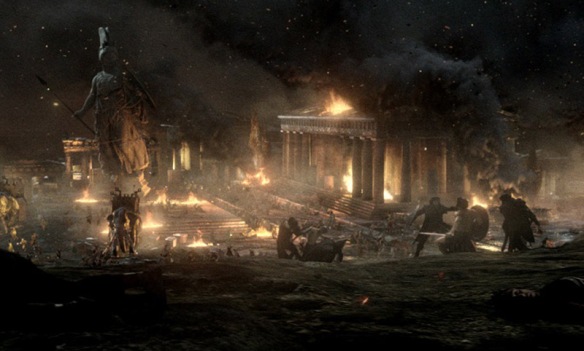
300: Rise of an Empire

Fall of Athens, 404 BCE

The Historical Record of City-States

Probably the most notable city-states in history were those of ancient Greece:  Athens, Corinth, Sparta, and Thebes. Others were those of Mesoamerica:  Chichen Itza, Copán, Monte Albán, Tikal, and then the cities, or metropoles, of Renaissance Italy like Florence, Genoa, Milan, Pisa, Venice and several others. Though it can be argued that these cities far outlasted their empires which surrounded them and subjugated them — several are still in existence today — they lacked the natural and human resources to defend themselves against large empires or nation-states. Almost every single historical city-state has fallen to mega-states or empires at least once, in certain cases several times.

If our modern world is to return to forms of city-states, hence allowing freer ingenuity and progress, yet weakening or hollowing out present nation-states, how do we avoid the envious big bullies around the corner or on the next continent? Do we make “unbreakable” alliances with all other progressive city-states around the globe to come quickly to our rescue if Goliath attacks? Is that even possible? Will there ever come a day when all imperialistic-minded, narcissistic megalomaniac males are extinct or psychologically pathologically reprogrammed and their potential gullible (like-minded?) masses or followers redirected?

As a diverse species, are we ready internationally for this sort of change or return to a much more localized form of mercantilism, culture, technology, and governing?

(paragraph break)

Live Well — Love Much — Laugh Often — Learn Always

Creative Commons License
This work by Professor Taboo is licensed under a Creative Commons Attribution-NonCommercial-NoDerivatives 4.0 International License.
Permissions beyond the scope of this license may be available at www.professortaboo.com/contact-me/.

Excursion to Perversions – II

This continued blog-journey from Part I was inspired by and liberally borrowed from a classic book and well-known 19th century American writer you may recognize. I’ve added some modernized twists.

EtP_divider

Pleasuring and Measuring Sea, Passengers, and Crew

All day and night our ship was anchored in the Upper Bay. Yes, our great pleasure excursion had traversed a full two (2 I say!) nautical miles so that we may take in the rain-drenched shores of Brooklyn to the portside, New Jersey to starboard. Ahead of us beyond the Lower Bay and out to sea the storm was not yet finished with its mayhem. Waves churned up hills of sud and seafoam at the harbor’s mouth, beyond there only the bold and daring would ascertain. Thus, with no quarrels from one single passenger it was “unanimously” decided the Quaker City’s second departure would begin the following day should the sea and weather accomodate.

stormy seas

Our Sunday view from our quaint restless cabin port

This idleness allowed for more heavenly prayer and church hymns making us all more idealy situated should any misfortune befall our voyage. Up at first light I briskly made my way to breakfast and with good reason.

“I felt a perfectly natural desire to have a good, long, unprejudiced look at the passengers at a time when they should be free from self-consciousness—which is at breakfast, when such a moment occurs in the lives of human beings at all.

I was greatly surprised to see so many elderly people—I might almost say, so many venerable people. A glance at the long lines of heads was apt to make one think it was all gray. But it was not. There was a tolerably fair sprinkling of young folks, and another fair sprinkling of gentlemen and ladies who were non-committal as to age, being neither actually old or absolutely young.”

As hoped, a day later we heaved anchor and set out to sea, the storm less than mighty than the day before, yet unwilling to subside entirely. It appeared we elustrious passengers would be “tested” first to measure what fibers we had during the self-conscious hours and the ruckus sea would oblige. Finally departing there was a cheerful sigh on deck:  we were headed eastward and the American coastline began to fade. The broad and rolling ocean ahead had a different sort of welcome in mind.

“One could not promenade without risking his neck; at one moment the bowsprit was taking a deadly aim at the sun in midheaven, and at the next it was trying to harpoon a shark in the bottom of the ocean. What a weird sensation it is to feel the stern of a ship sinking swiftly from under you and see the bow climbing high away among the clouds! One’s safest course that day was to clasp a railing and hang on; walking was too precarious a pastime.”

However, should you have in your possession a mess-hall serving tray and a bar of deck soap, given the present seas you could easily travel from one end of the ship’s corridor in the stern straight to the bow (almost) in a most expeditious and harrowing manner — if timed just right with the troughs and crests. But fair warning, ill-timed starts would result in ill-timed endings. One’s most astute calculus is recommended, for the safety of self, property, and select others targeted.

To my pleasant surprise and good fortune I was not seasick. I found great joy in their gastronomic state and my lack of — for I had not always been so lucky.

“If there is one thing in the world that will make a man peculiarly and insufferably self-conceited, it is to have his stomach behave itself, the first day at sea, when nearly all his comrades are seasick.”

Good morning SirIt was about that moment, while outside near the after deck-house door, that one of our esteemed travelers of some age and great wisdom, heavily wrapped like a mummy from chin to toe, lunged out with the ship’s downward plunge right into my arms:

Good-morning, Sir. It is a fine day.”

He put his hand on his stomach and said, “Oh, my!” and then staggered away and fell over the coop of a skylight.

Presently another old gentleman was projected from the same door with great violence. I said:

“Calm yourself, Sir—There is no hurry. It is a fine day, Sir.”

He, also, put his hand on his stomach and said “Oh, my!” and reeled away.

In a little while another veteran was discharged abruptly from the same door, clawing at the air for a saving support. I said:

“Good morning, Sir. It is a fine day for pleasuring. You were about to say—”

“Oh, my!”

I thought so. I anticipated him, anyhow. I stayed there and was bombarded with old gentlemen for an hour, perhaps; and all I got out of any of them was “Oh, my!”

I went away then in a thoughtful mood. I said, this is a good pleasure excursion. I like it. The passengers are not garrulous, but still they are sociable. I like those old people, but somehow they all seem to have the “Oh, my” rather bad.

While climbing up the stairs to the quarter-deck from the many rushing and thrown to the side rails to share the day’s meals with the sea, the bow of the vessel reaching up to the sky, I took a big puff of my cigar feeling quite bold that Poseidon kindly favored me rather than our geriatric Oh-my’ers, when someone shouted:  “Come, now, that won’t answer. Read the sign up there—NO SMOKING ABAFT THE WHEEL!” It was Captain Duncan, the excursion’s chief. I damped out my tasty tobacco, nodded in acknowledgement, and continued my way forward. In a pursuit to discover and understand ways of naval travel, I found a spyglass in an upper-deck state-room behind the pilot-house. Ah, another ship off the horizon. Then another shout:  “Ah, ah—hands off! Come out of that!” I exited as commanded, found a lowly deck-sweep and inquired:

“Who is that overgrown pirate with the whiskers and the discordant voice?”

“It’s Captain Bursley—executive officer—sailing master.”

I loitered about awhile, and then, for want of something better to do, fell to carving a railing with my knife. Somebody said, in an insinuating, admonitory voice:

“Now, say—my friend—don’t you know any better than to be whittling the ship all to pieces that way? You ought to know better than that.”

I went back and found the deck sweep.

“Who is that smooth-faced, animated outrage yonder in the fine clothes?”

“That’s Captain L****, the owner of the ship—he’s one of the main bosses.”

Wise deck-sweepRealizing that the port side of the Quaker City was overcrowded with more Don’ts than Do’s, I took my curiosity starboard. There on that side of the pilot-house lay a sextant on the bench asking for my close examination. I told myself, they look to the sun as such, and I had hoped to relocate that ship in the distance. With my eye and hands on the instrument no more than three innocent seconds, a tap on the shoulder followed by yet another detesting voice:

“I’ll have to get you to give that to me, Sir. If there’s anything you’d like to know about taking the sun, I’d as soon tell you as not—but I don’t like to trust anybody with that instrument. If you want any figuring done—Aye, aye, sir!”

I began deducing there was apparently very little a paying passenger could tinker with save your cabin’s lavatory toilet-tissue and soap, and perhaps there too one required first a full naval inquiry. I ventured to find the deck-sweep once more for more future Don’ts.

“Who is that spider-legged gorilla yonder with the sanctimonious countenance?”

“It’s Captain Jones, sir—the chief mate.”

“Well. This goes clear away ahead of anything I ever heard of before. Do you—now I ask you as a man and a brother—do you think I could venture to throw a rock here in any given direction without hitting a captain of this ship?”

The wise sailor advised against given that the Captain of the Watch — a vessel’s sheriff if you will — was standing just over there quite interested in my probing curiosity. With my tour of investigating dashed…

“I went below—meditating and a little downhearted. I thought, if five cooks can spoil a broth, what may not five captains do with a pleasure excursion.”

EtP_divider

Aristippus of Cyrene once said “The vice [of pleasure] lies not in entering the bordello, but in not coming out.” Let us hope there are not so many captains disembarking at our destinations. As a wise Irish friend once told me, some cause happiness wherever they go, and others whenever they go.

(paragraph break)

To be continued…

Creative Commons License
Blog content with this logo by Professor Taboo is licensed under a Creative Commons Attribution-NonCommercial 4.0 International License.
Permissions beyond the scope of this license may be available at https://professortaboo.com/contact-me/.

The Art of Enticement

The lightning-rods salesman, dressed in storm-colored clothes jangling and clanking with his peculiar bag of rods approached the two young boys, Will Halloway and Jim Nightshade, laying on the front lawn:

“Halloway. Nightshade. No money, you say?”

The man, grieved by his own conscientiousness, rummaged in his leather bag and seized forth an iron contraption.

“Take this, free! Why? One of those houses will be struck by lightning! Without this rod, bang! Fire and ash, roast pork and cinders! Grab!”

The salesman released the rod. Jim did not move. But Will caught the iron and gasped.

“Boy, it’s heavy! And funny-looking. Never seen a lightning-rod like this. Look, Jim!”

And Jim, at last, stretched like a cat, and turned his head. His green eyes got big and then very narrow. But Will was staring beyond the man now.

“Which,” he said. “Which house will it strike?”

“Which? Hold on. Wait.” The salesman searched deep in their faces. Some folks draw lightning, suck it like cats suck babies’ breath. Some folks’ polarities are negative, some positive. Some glow in the dark. Some snuff out. You now, the two… I–“

“What makes you so sure lightning will strike anywhere around here?” said Jim suddenly, his eyes bright.

Fury-Halloway-Nightshade

The salesman almost flinched. “Why, I got a nose, an eye, an ear. Both those houses, their timbers! Listen!”

They listened. Maybe their houses leaned under the cool afternoon wind. Maybe not.

“Lightning needs channels, like rivers, to run in. One of those attics is a dry river bottom, itching to let lightning pour through! Tonight!”

“Tonight?” Jim sat up happily.

“No ordinary storm!” said the salesman. Tom Fury tells you. Fury, ain’t that a fine name for one who sells lightning-rods? Did I take the name? No! Did the name fire me to my occupations? Yes! Grown up, I saw cloudy fires jumping the world, making men hop and hide. Thought: I’ll chart hurricanes, map storms, then run ahead shaking my iron cudgels, my miraculous defenders, in my fists! I’ve shielded and made snug-safe one hundred thousand, count ’em, God-fearing homes. So when I tell you, boys, you’re in dire need, listen! Climb that roof, nail this rod high, ground it in the good earth before nightfall!”
Ray Bradbury from his novel “Something Wicked This Way Comes”

There are a few different motifs and themes in this classic Bradbury novel, but the one I want to touch on here is belief, the psychological power and influence of what a group’s ideology can accomplish, for better or worse, when the right components are all in play.

The characters in Something Wicked This Way Comes are amazed and puzzled by “Cooger & Dark’s Pandemonium Shadow Show,” a strange carnival that has unexpectedly arrived in their small town. Word soon spreads that because it caters to people’s deepest desires and fears, it is viewed by the town as evil. Yet, Mr. Dark claims they did not arrive unannounced, or unwelcomed. Indeed, the people of the town invited them, ah, wanted them:

Mr. Dark:  “Your torments call us like dogs in the night. And we do feed, and feed well. To stuff ourselves on other people’s torments. And butter our plain bread with delicious pain … Funerals, marriages, lost loves, lonely beds that is our diet. We suck that misery and find it sweet. We can smell the young ulcerating to be men a thousand miles off. And hear a middle-aged fool like yourself groaning with midnight despairs from halfway round the world.”

The good people of Green Town handed over the power and will for Mr. Dark’s visit. Whether taught, or inherited, or both, they had long believed their lives were incomplete, intolerable, in the balance, and in grave danger. It wasn’t until Will Halloway’s father, Charles Halloway, embraced his age, occupation as a janitor, the paradox of life and death, and his gifted humanity that any “power” the Pandemonium Shadow Show could have wielded was gone, like a mist in the wind.

david-green-hobby-lobby

NeoConservative & owner Steve Green

When a story is told well, as was Orson Welles’ 1938 “War of the Worlds” radio broadcast, mountains can be moved and lives changed forever. Whether that canard is true or not often makes little difference. And when a captivating story is well performed, immersing its audience with spectacular effects, marketing tools, and endless millions of dollars, the spellbinding dopamine avalanche is near impossible to stop. Or can it?

With all the same dramatic components and controversy in play with the creation, development, and intent, the recent opening of the Museum of the Bible is no different.

“At the center of this [drama] is the word “non-sectarian,” which the Museum of the Bible uses often in its messaging. The term has a long history in the evangelist community dating back to the early 19th century. As Steven K. Green (no relation), the director of the Center for Religion, Law & Democracy at Willamette University College, explains, for the faith tradition, the concept is rooted in the belief that there are fundamentals of the Bible that are non-disputable and non-debatable. “It’s hard for you to realize it is representing a particular perspective,” says Green of the often well-meaning evangelical Protestants who clashed with Catholics firm in their own religious tradition in the 1800s.”

Museum-of-the-Bible

The museum opened its doors to the public today. Here is one article from Smithsonian.com magazine which elaborates on the museum’s promises, its biased funding, and the far-reaching controversy over its artifacts and narrative-slant all wrapped in an enticing Cooger & Dark’s Pandemonium Shadow Show.

I’m very curious to read what all of you have to say about “The Greatest Show Ever Told” and whether museum visitors are well-versed, or should be, in the much broader less known (untold?) stories, artifacts, and narratives of the Bible. What are your thoughts?

(paragraph break)

Live Well — Love Much — Laugh Often — Learn Always

Creative Commons License
This work by Professor Taboo is licensed under a Creative Commons Attribution-NonCommercial-NoDerivatives 4.0 International License.
Permissions beyond the scope of this license may be available at www.professortaboo.com/contact-me/.

Excursion to Perversions – I

This blog-journey was inspired by and liberally borrowed from a classic book and well-known 19th century American writer you may recognize. I’ve added my modernized twists.

EtP_divider


The Programme and Bombastic Hubbub

The travel itinerary had been released months earlier. The 163-day voyage would make port in The Azores, Britain’s Gibraltar, Marseilles, Rome, Athens, Constantinople, Odessa, Smyrna, Beirut, Jerusalem, Alexandria, Tangiers, Bermuda, and home to New York harbor. Only a few select passengers would be chosen for this fashionably grand journey across the Atlantic. It was to be a who’s who list of celebrities to far away places that most could only dream. Quickly the trip was the talk of the country as much as the names to be offered tickets of passage.

“It was a novelty in the way of excursions—its like had not been thought of before, and it compelled that interest which attractive novelties always command. It was to be a picnic on a gigantic scale. The participants in it, instead of freighting an ungainly steam ferry—boat with youth and beauty and pies and doughnuts, and paddling up some obscure creek to disembark upon a grassy lawn and wear themselves out with a long summer day’s laborious frolicking under the impression that it was fun, were to sail away in a great steamship with flags flying and cannon pealing, and take a royal holiday beyond the broad ocean in many a strange clime and in many a land renowned in history!”
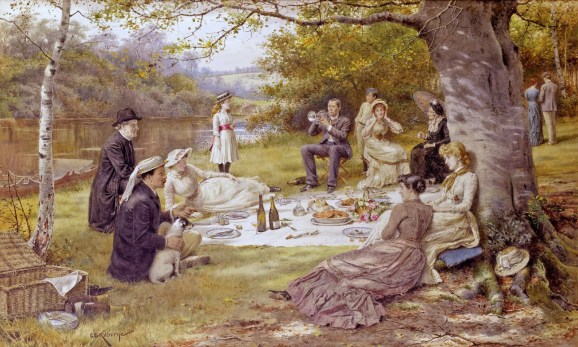
Victorian picnic

So how does one finagle himself past the stringent bowelless “Committee On Applications” and onto a prestigious vessel with numerous notable travelers? Voilà! Utilize a popular Shakespearian tactic known as inflated nothingness:

“I referred to all the people of high standing I could think of in the community who would be least likely to know anything about me.”

Having miraculously been selected as one of the traveling “select,” a supplemental programme arrived in the postal box. It informs the passengers boarding, the Quaker City will be graced by the celebrated Plymouth Collection of Hymns for heavenly song. A more joyous activity can scarcely be found. There were more pragmatic items to be addressed:

“This supplementary program also instructed the excursionists to provide themselves with light musical instruments for amusement in the ship, with saddles for Syrian travel, green spectacles and umbrellas, veils for Egypt, and substantial clothing to use in rough pilgrimizing in the Holy Land. Furthermore, it was suggested that although the ship’s library would afford a fair amount of reading matter, it would still be well if each passenger would provide himself with a few guidebooks, a Bible, and some standard works of travel. A list was appended, which consisted chiefly of books relating to the Holy Land, since the Holy Land was part of the excursion and seemed to be its main feature.”

Pilgrims excursionWith such acclaimed fanfare and America’s social prominents and acolytes, surely there was more ornation to be done! A renown physician and reverend upon the passenger list perhaps? Someone from the Ben Carson and Billy Graham family lines would conflate this voyage nicely and return America To Greatness in the eyes of the world, yes?

“Reverend [Carson] was to have accompanied the expedition, but urgent duties obliged him to give up the idea. There were other passengers who could have been spared better and would have been spared more willingly. Lieutenant General [Rex Tillerson] was to have been of the party also, but the [Russian deals and collusion] compelled his presence on the plains [of Siberia]. A popular actress had entered her name on the ship’s books, but something interfered and she couldn’t go. The “Drummer Boy of the Potomac” deserted, and lo, we had never a celebrity left!”

Alas, the August proportions of wonderous pomp and circumstance and snazzy names were pruned down or rescued despite the vivacious programme to the City of Amour, the Sultans of Constantinople, the enlightened Greek culture of Smyrna, the hallowed martyrs of Jerusalem and Jericho, concluding with native Bermudians. With such effervescent destinations, nay, what chance there be for any fuss?

EtP_divider

Final Preparations and Bon Voyage

Curious about the goings on at the slip where the Quaker City underwent some refitting, questions about the additions and non-additions were about and murmurings of why. As departure loomed the details of the steamer, amenities, and personalities of the “select” versus the unselective rattled ears and out of mouths. It seemed the adventure had already begun and the great ship had no more cargo than it had when her builders laid the keel, let alone cast off from port. What more could possibly add to the anticipation?

“I was glad to know that we were to have a little printing press on board and issue a daily newspaper of our own. I was glad to learn that our piano, our parlor organ, and our melodeon were to be the best instruments of the kind that could be had in the market. I was proud to observe that among our excursionists were three ministers of the gospel, eight doctors, sixteen or eighteen ladies, several military and naval chieftains with sounding titles, an ample crop of “Professors” of various kinds, and a gentleman who had “COMMISSIONER OF THE UNITED STATES OF AMERICA TO EUROPE, ASIA, AND AFRICA” thundering after his name in one awful blast!”

Clearly I have found myself outclassed and outgunned. If I hadn’t so little to offer, I would reconsider my risks among such company, but the allure and majesty of a Mediterranean excursion complete with all possible luxuries, history, spirit and drink had transfixed my compass beyond reason or caution. Why was this particular organic cargo necessary? How many enemies has this gaudy, trumpish man bred?

“I fell under that titular avalanche a torn and blighted thing. I said that if that potentate must go over in our ship, why, I supposed he must—but that to my thinking, when the United States considered it necessary to send a [trum-pity] dignitary of that tonnage across the ocean, it would be in better taste, and safer, to take him apart and cart him over in sections in several ships.

Ah, if I had only known then that he was only a common mortal [posing as an orange Zeus], and that his mission had nothing more overpowering about it than the collecting of seeds and uncommon yams and extraordinary cabbages and peculiar bullfrogs for that poor, useless, innocent, mildewed old fossil the Smithsonian Institute, I would have felt so much relieved.”

Soon enough the call went out, the Quaker City was ready to receive her illustrious seafaring men and women and those higher ranked. The pier was congested with carriages, luggage, porters, and hats of every sort all scurrying to unload, load, and embark. The traveling costumes were quite the unattractive sight as the rain and drizzle fell revealing molty wigs and toupees not even a Wall Street umbrella could hide. Even the glorious Stars-n-Stripes was limp along the ship’s flag pole. Yet, the time was nearer for casting the ties off the pier, the gangways retracting…

“Finally, above the banging, and rumbling, and shouting, and hissing of steam rang the order to “cast off!”—a sudden rush to the gangways—a scampering ashore of visitors—a revolution of the wheels, and we were off—the pic-nic was begun! Two very mild cheers went up from the dripping crowd on the pier; we answered them gently from the slippery decks; the flag made an effort to wave, and failed; the “battery of guns” spake not—the ammunition was out.”
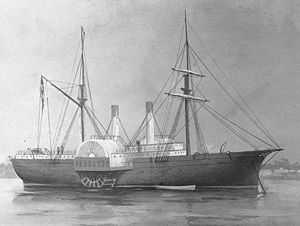
USS_Quaker_City

USS Quaker City

Apparently, while threatening the North Korean leader with never before seen fire and fury, someone forgot to first check the inventory of gunpowder and shot. It was too late. All bark and show, but no bite or brains. And if that shouldn’t clamp a bigly Chihuahua yap closed:

“We steamed [ten minutes?] down to the foot of the harbor and came to anchor. It was still raining. And not only raining, but storming. “Outside” we could see, ourselves, that there was a tremendous sea on. We must lie still, in the calm harbor, till the storm should abate. Our passengers hailed from fifteen states; only a few of them had ever been to sea before; manifestly it would not do to pit them against a full-blown tempest until they had got their sea-legs on. Toward evening the two steam tugs that had accompanied us with a rollicking champagne-party of young New Yorkers on board who wished to bid farewell to one of our number in due and ancient form departed, and we were alone on the deep. On deep five fathoms, and anchored fast to the bottom. And out in the solemn rain, at that. This was pleasuring with a vengeance.”

Pleasuring with a vengeance indeed. All the steamy, drippy expectations of a grand exit, a phenomenal finale had all the pow and distance of a little trum-pity cap-gun. So much hoopla for hasty idleness. You might imagine how utterly relieved I was to hear the ring and hail for the prayer meeting and hymns to soothe our drab, wanting souls — like intestinal gaseouness sitting on a Buloke-wood seat atop a trotting donkey — I was thrilled.

Lulled by the to-and-fro sway of the ship, and the wavering chatter of voices outside my cabin hallway…

“I soon passed tranquilly out of all consciousness of the dreary experiences of the day and damaging premonitions of the future.”

Would tomorrow hold more tantalizing surprises, more peculiar intrigue? Was more even possible and of what recipe, what flavor? Sweet or sour?

(paragraph break)

To be continued…

Creative Commons License
Blog content with this logo by Professor Taboo is licensed under a Creative Commons Attribution-NonCommercial 4.0 International License.
Permissions beyond the scope of this license may be available at https://professortaboo.com/contact-me/.