Last October I posted a six-part blog-series Untapped Worlds in which I shared the many abundant ways for humans to find, tightly grasp, and experience the marrows of life, a fuller more impactful, vibrant, attaching life. Today I want to address a very specific part of this human experience.
For a few different reasons in different settings both in the past and lately, I have been in conversations, listening, and reading about a subject that effects all of us, every single one of us. It is very intriguing to explore and examine the various perspectives of What makes quality human intimacy.Quantity inevitably enters the discussion in some form and this is where I find the most fascinating definitions and points of views about love, sex, intimacy, and the mindsets people create for themselves. More often than not, two love-models or paradigms eventually appear. Due to my schedule this weekend, I want to just share a lens to these two models from two excellent resources on the subject of love, sex, and intimacy…
Many traditional attitudes about sexuality are based on the unspoken belief that there isn’t enough of something — love, sex, friendship, commitment — to go around. If you believe this, if you think that there’s a limited amount of what you want, it can seem very important to stake your claim to your share of it. You may believe that you have to take your share away from somebody else, since if it’s such a very good thing, someone else is probably competing with you for it (how could they!). Or you may believe that if someone else gets something, that means there must be less of it for you.
We want all of our readers to get everything they want. Here are some ideas that might help you over some of the obstacles on the path.
We call this kind of thinking “starvation economies.” People often learn about starvation economies in childhood, when parents who are emotionally depleted or unavailable teach us that we must work hard to get our emotional needs met, so that if we relax our vigilance for even a moment, a mysterious someone or something may take the love we need away from us. Some of us may even have experienced real-world hunger (if you didn’t grab first, your brother got all the potatoes), or outright neglect, deprivation, or abuse. Or we may learn starvation economies later in life, from manipulative, withholding, or punitive lovers, spouses, or friends.
The beliefs acquired in childhood are usually deeply buried and hard to see, both in individuals and in our culture. So you may have to look carefully to see the pattern. You can see it in a small way in the kind of complaining contests some people engage in: “Boy, did I have a rotten day today.” “You think your day was rotten—wait till you hear about my day!”—as though there were a limited amount of sympathy in the world and the only way to get the amount due you was to compete for it. Or remember how you have felt looking at the last piece of a very good pie, the secret salivation that made you greedy and territorial and a “selfish” person. When is it okay to want anything? People may think that if you love Bill that means you must love Mary less, or if you’re committed to your relationship with your friend you must be less committed to your relationship with your spouse. And then how do you know if you’re Number One in a partner’s heart?
This kind of thinking is a trap. We know, for example, that having a second child doesn’t usually mean that a parent loves the first child less and that the person who owns three pets doesn’t necessarily give any less care to any one of them than the person who owns one. But when it comes to sex, love, and romance, it’s hard for most people to believe that more for you doesn’t mean less for me, and we often behave as if desperate starvation is just around the corner if we don’t corner some love right now. — The Ethical Slut: A Practical Guide to Polyamory, Open Relationships & Other Adventures
An additional lens…
When they approach romantic relationships, people often fall into one of two patterns. Some follow a starvation model, and some follow an abundance model.
In the starvation model, opportunities for love seem scarce. Potential partners are thin on the ground, and finding them is difficult. Because most people you meet expect monogamy, finding poly partners is particularly difficult. Every additional requirement you have narrows the pool still more. Since relationship opportunities are so rare, you’d better seize whatever opportunity comes by and hang on with both hands—after all, who knows when another chance will come along?
The abundance model says that relationship opportunities are all around us. Sure, only a small percentage of the population might meet our criteria, but in a world of more than seven billion people, opportunities abound. Even if we exclude everyone who isn’t open to polyamory, and everyone of the “wrong” sex or orientation, and everyone who doesn’t have whatever other traits we want, we’re still left with tens of thousands of potential partners, which is surely enough to keep even the most ambitious person busy.
The sneaky thing about both models is they’re both right: the model we hold tends to become self-fulfilling. If we have a starvation model of relationships, we may tend to dwell on the times we’ve been rejected, which may lower our self-esteem, which decreases our confidence…and that makes it harder to find partners, because confidence is sexy. We may start feeling desperate to find a relationship, which decreases our attractiveness further. So we end up with less success, which reinforces the idea that relationships are scarce.
When we hold an abundance model of relationships, it’s easier to just go do the things that bring us joy, without worrying about searching for a partner. That tends to make us more attractive, because happy, confident people are desirable. If we’re off doing the things that bring us joy, we meet other people there who are doing the same. Cool! The ease with which we find potential partners, even when we aren’t looking for them, reinforces the idea that opportunities for love are abundant, which makes it easier for us to go about doing what makes us happy, without worrying overmuch about finding a partner…and ’round it goes. We think our perceptions are shaped by reality, but the truth is, the reality we get is often shaped by our perceptions (Cognitive scientists talk about confirmation bias—the tendency to notice things that confirm our ideas, and to discount, discredit or not things that don’t.).
These ideas will also influence how willing we are to stay in relationships that aren’t working for us, both directly and indirectly. If we believe relationships are rare and difficult to find, we may not give up a relationship even when it’s damaging to us. Likewise, if we believe that relationships are hard to find, that may increase our fear of being alone, which can cause us to remain in relationships that aren’t working for us.
Naturally, there’s a fly in the ointment. Sometimes the things we’re looking for, or the way we look for them, create artificial scarcity. This might be because we’re doing something that puts other people off, or because we’re looking for something unrealistic. If you’re looking for a Nobel Prize–winning Canadian supermodel with a net worth of $20 million, you might find potential partners few and far between. Similarly, if you give people the impression that you’ve created a slot for them to fit into that they won’t be able to grow out of, opportunities for relationships might not be abundant either. — More Than Two: A practical guide to ethical polyamory
“The model we hold tends to become self-fulfilling.” I could not agree more!
Returning to the point of my six-part blog-series Untapped Worlds, the majority of scientists, especially sociologists and psychologists, postulate not as a “theory” but available mechanisms of innumerable abundant ways for an intrinsic and extrinsic nirvana if you will, WITH OTHERS! Getting there is not a myth or Mount Everest! Simply rewiring and remapping the mind and body in more balance is the first step. ❤
Would you agree, add to, subtract, or disagree? Share your comments below.
(paragraph break)
Live Well — Love Much — Laugh Often — Learn Always
My Mom and I have a chronic skit. Recently they are centered around the operation of her newest cell phone. The year before it was the operation of her new Dell desktop computer, the modem, router, printer, and the cosmic-concept of wifi communication. Before that, the new HD television and the list goes on. In a repeating rhetorical exercise over the years, one of my first questions to her is usually, “Have you read the manual yet?” She knows it’s coming at some point, so she intentionally tries to sound smart, using big techy words (that are a bit outdated), to divert the inevitable question. Numerous quippy comical jabs at each other follow, always ending in laughter. I’ve become comfortable and overly entertained with this predictable cycle. It’s always provided us several big smiles.
But that’s my mother. It doesn’t always go so well in the real world, does it? (line break)
* * * * * * * * * *
Understanding the mechanics has so many applications in life. One common and popular application would be with your automobile(s) and driving. To get from point A to point B it is important to understand the operation of your vehicle and traffic tips and laws. Many might say it’s critical, myself included. When instructing me on the extra tips, knowledge, and nuances of driving — the stuff the nearby DMV does not cover — my father would often preempt our lesson saying “a vehicle is a lethal weapon.” Stark perspective gained Dad, thank you. He used the same type of instruction about guns, rifles, firing them, and storing them.
Like myself, most of us men grew up learning and doing the outdoor chores: mowing, edging, trimming, etc. In one particular instance when I was 13-14 years old, my father saw the perfect opportunity to teach me about the love-hate marriage between me and forces bigger than me; unseen misunderstood forces that can really hurt. I posted about this lesson (Click here) if you care to read about it in more detail. To earn a little cash I would sometimes do our next-door neighbor’s yard while they were out-of-town. I had to use their lawn equipment unless I wanted to pay rent to use Dad’s. No way! Profit, profit, maximize profits was my youthful M.O.! Cha-ching!
Their grass-edger was mechanical, a 1-cylinder driven blade on the side, as opposed to our edger, a half-moon blade I’d have to step on every 8-12 inches in the gap between concrete and grass. Starting the neighbor’s mechanical edger was a breeze, as I imagined all the dollar bills being stacked in my hand. You pull the string just like our lawn mower. Turning it off, however, was a mystery to me. I went and got Dad to show me how. With their edger you had to push this L-shaped piece of metal onto the spark-plug to short out the electric current to the cylinder. Pffft, easy. I reached down to that piece of metal, pushed it firmly onto the spark-plug…WHAAM! I was nearly knocked to my ass! With the biggest white-eyes I looked up at Dad, bewildered. “What happened!?” I had done exactly what he told me! Dad pointed at the still running edger, “Turn it off.” I thought to myself, maybe I didn’t hold it on the spark-plug long enough. WHAAM! Once again I was nearly knocked off my feet. Now with tears in my eyes I looked up at Dad’s unphased expression… “Turn it off son.” The third time I tried to hold the metal-breaker down even longer — only making the pain worse and my muscles begin to quiver. I was on the verge of bawling when I looked at Dad’s unchanged expression.
I could not bring myself to try a fourth time. When Dad realized I couldn’t, he calmly pointed to my other hand holding the metal handle-bar. “Move that hand to the rubber-grip,” he explained “then turn it off.” The damn beast died immediately.
Forces unseen, misunderstood, and bigger than me. Check. (line break)
Medical doctors and EMT’s must understand the mechanics of the human body to prolong lives. Marriage, love, relationships are no different. In order to communicate well with our loved ones, not only must we learn the basics of language to be understood, equally we must understand the mechanics of how others use it. Honestly, we should want to be experts at it, both parts, and not just to get by and leave it in the grey! The mechanics of parenting and raising children are perhaps even more important and more demanding than communicating and understanding adults, do you agree? Dad was a hardened cattle-hand and rice farmer, degreed in mechanical engineering from U.T. in Austin, former U.S. Marine, and well versed in precise communication. In his own way, correct or not, my father also knew how to use non-verbal mechanics to teach me one invaluable (life-saving?) lesson about electricity that I can never forget. There are times when simple words will not convey the magnitude.
So why, in the settings of community, conversation, love, family, SOCIAL-MEDIA, or government and politics, are we ever content with just the bare basic mechanics of dialogue which often fall into the fog of ambiguity?
A recent example…
A good friend of mine posted on a popular social-media website (FB) a picture I felt, and obviously he did to, conveyed the absence or ineptitude of federal legislation to stay on top of Wall Street and the activity of billion-dollar interest-earning corporations. The image is above.
The message resonates deeply with me because I am and have been an educator — 5th thru 8th grade Generalist and passionate about Social Studies and Science. Our young students, primary, secondary, and certainly college, are our nation’s hope and future. They are the potential leaders for our own children and grandchildren! The image has a lot of truth to it. This was my comment about it to my friend:
“Many a wise man have stated correctly that you give a man too much power or money, sooner or later both WILL corrupt him. History has proven the same in organizations or empires, particularly those who grow obese and disengaged from the very hands who fed them. Perhaps it is time to promote the eternal value of collective virtues rather than beguiled individual “success” or wealth. Foolish is the CEO and 1-percent who believe their ivory tower was built solely by their hands alone. Everyone enters this world from the womb of need and then one day leaves it in hospice. Never forget your REAL place in this world.
That’s my version, the short one.“
Then a complete stranger to me chimed in… from here forward named Cymbal:
Cymbal: “So people aren’t successful because of their own efforts. Spoken like a true Marxist.”
Myself:“Strive not to be a success, but rather to be of value.” — Albert Einstein
Myself:“The difference between “success” and “value” is an ocean. Wouldn’t you agree Kelly?”
Cymbal: “Lol.. project much?”
Jax Jacqueline: “Most of the ppl now would be way better off going to one of the countries that now offers free college for Americans.”
Myself: “Jax, which not surprisingly explains why many nations, particularly the northern European countries, are ranked ABOVE the U.S. in a plethora of educational and quality-of-life tables. For example: http://www.oecdbetterlifeindex.org/“
Cymbal: “Yea I’m sure life is so much better in Poland than in the US. Or by quality of life do you mean tax payer provided services?”
Cymbal continued his snippy semi-rude remarks despite my words. For the complete debate-dialogue (if it can be called that), click here. Click the image to enlarge.
Whether someone had the more convincing argument or position is not my concern here. My point is the minefield created between foreign parties or people, including on social-media, when lazy content basic dialogue and mechanics exist. Furthermore, what vibrates and disturbs that minefield, making it more volatile, occurs when one or both parties fail to rebalance their talking with listening, or in this case reading the entirety. It follows that the level beneath a statement(s) on the conversation-blueprint if you will, is understanding the mechanics and dynamics of the whole machine to appropriately operate it. Or in my painful childhood case, knowing How To Operate A Mechanized Electrical Edger!
I could write several posts about the enormous importance of civil debate or dialogue. Its use carries over into a long list of daily, human interactions, and the acute awareness of self. But I will spare all of you the laborious hours (laughing permitted) and skip the list. I do, however, want to share some film clips from two Directors who more eloquently express what it is I am trying to communicate. First, Stephen Spielberg. The dramatic scene is in two separate YouTube clips, in the following order. I beg you, watch both fully…
Without a doubt, Thaddeus Stevens’ 1865 speech to the House regarding slavery is today a foregone conclusion: the majority of Americans prohibit it. Yet, almost 150 years later Americans and our judicial courts are still dealing with various forms of racism, e.g. Ferguson, MO., modern-day George Pendletons in the Lincoln clips. Representative Stevens might well exclaim today, “How can I hold that all men are created equal when here before me stands…the gentleman from Ohio, proof that some men are inferior, endowed by their Creator with dim wits…” but in the end, even Pendletons deserve some dignity and respect (before the law) if one must rip it from the deepest abyss of their human decency… it must be done! Right there, THAT is why professional, refined dialogue and the fortitude to understand ALL the mechanics and dynamics of a message or issue, are paramount to the survival and civility of a species… a species which is expected to be superior on this planet. Verbal abuse, violence, or war can never breach that sacred articulation.
In colonial America there was never a more charged, igniting relationship between statesmen which evolved into an endearing lifelong friendship than between Thomas Jefferson and John Adams. How did these two highly intelligent juxtaposed men coexist? By superb discourse and acute listening; skills requiring great effort, time, and exposure to diversity. Who is the other Director who so eloquently portrays this point? This is a scene from Tom Hooper of the HBO Mini-series and the Pulitzer Prize book, John Adams. Ben Franklin is played by Tom Wilkinson, John Adams by Paul Giamatti, and Thomas Jefferson by Stephen Dillane:
Adams and Jefferson were two gifted communicators and more gifted debaters, each giving deserved respect to the other.
When I happily watch this seven-part mini-series over and over, I sometimes ask myself, who else can I note with such remarkable oratory and writing talent? The late Nelson Mandela or Mahatma Gandhi come to mind. Another is former four-star General and Secretary of State, Colin Powell. Perhaps a no-brainer would be the 16th U.S. President, Abraham Lincoln. And not to forget great women, Eleanor Roosevelt and Marie Colvin, to name just two, stand out to me as superb speakers. How much more peaceful and enriched would our earthly experience be if 50, 60, or 80% of a population earned and acquired the same skills? Would more embarrassment or conflict be averted? I should think laughing would be more common, even epidemic, if human discourse were an art en masse and not an anomaly. (line break)
It has become my impression since the dawn of the internet, especially now with social-media addicts and a world fast becoming more Wifi connected, that an increasing number of people (at least in Texas and parts of America where I’m exposed) are lazily content with quick elementary dialogue and mechanics. For some time now I have been one of those nauseated with my speaking and writing skills, and trying to advance them in earnest. There is still much room for improvement. And what of acronyms? Unless mankind has mastered infallible telepathy or they are the codes of action used in live military combat where half-seconds count, acronyms are the epitome of lethargy anywhere else. I would be thrilled if proven wrong!
In a routine of convenience, impatience, and fundamentalism, mastering advanced language mechanics cannot be understated. Why? One noble reason is to have the ability of recognizing immoral and/or unethical rhetoric and manipulation — remind you of anyone or group in a particular field(?) — then protecting the greatest good for the greatest number. With each passing decade it is not enough to simply be free.
Two quotes I am fond of apply this idea…
“Patterning your life around other’s opinions is nothing more than slavery.” – Lawana Blackwell
“My definition of a free society is a society where it is safe to be unpopular.” – Adlai Stevenson
Whether it’s good or not, we are inextricably tied to our fellows, our countrymen, our colleagues, our bosses, our coworkers, on many levels. Obviously we are inextricably tied to our spouses, our parents, our children, our siblings, even extended family. But it goes further. Modern genetics and DNA research has all but proven this: globally there is less than a one-percent difference in all of us; every living human being. In many contexts we are all connected. What we choose to do with those vast similarities and their interactions hinges on how well or how poorly we express ourselves and strive to understand what we hear or read. We will either be progressive and ingenious with dignity given and received, or we will be digressing, destructive, divisive, and impatiently ignorant, subtly devoid of common decency. No matter how annoyed I might get with a “Cymbal,” I must strive to find the strength and patience to coexist with them, and the respectful (eloquent) dialogue vital in the temporary struggle, always.
What sort of world do you live for, fight for, are willing to die for? Is your World Operator’s Manual small and unchanging, or perpetually growing? Let me put a different lens on the question: Is your Family Operator’s Manual small and unchanging, or perpetually growing? Do you have a library of manuals? Is the library designed to expand or remain stagnate collecting dust? The word for today is Impermanence! Actually, is it not 365 days a year? Maybe the question should be “Are you and I keeping up?”
I have on my bathroom mirror this sticky note: WOMS? It means World Operator’s Manual Status. I pronounce it “WHUM-s”; what’s my WHUM-s status, to remind me daily to find more strength, energy, and patience to understand the mechanics. Do I want to be slammed to the ground in tears by a motorized-edger, or would I rather learn how to wisely operate it and create a beautiful lawn and garden?
Can you use an upgrade in your oral and writing skills, beyond the high school level? Name one or two specific areas and the context below.
(paragraph break)
Live Well — Love Much — Laugh Often — Learn Always
What is excessiveness? The dictionary defines it this way: exceeding a normal, usual, reasonable, or proper limit. Historians have sometimes defined it as out Herod Herod. Lord Salisbury in Shakespeare’s King John perhaps described it better as painting the lily:
Therefore, to be possess’d with double pomp, To guard a title that was rich before, To gild refined gold, to paint the lily, To throw a perfume on the violet, To smooth the ice, or add another hue Unto the rainbow, or with taper-light To seek the beauteous eye of heaven to garnish, Is wasteful, and ridiculous excess.
Every single human being requires a handful of necessities: water, food, climate-control, and shelter. To what extent or elaboration those four basic needs are fulfilled, can be averaged at any location, and thus a global standard can be determined. One and perhaps a minimum of two of these basic life-needs are in finite supply and crisis on our planet.
Fair warning for those who are sensitive to or bothered by grim facts of nature, our planet, and other human groups, self-discretion should be considered. What follows, in my opinion, needs to be at least made aware and considered by everyone on Earth.
(paragraph break)
* * * * * * * * * *
What do you think would happen if when you turned open your faucet and nothing came out? How long could you survive without water? Now, what do you think would happen if your entire city was without water or operating sewage? What would happen if a nation lost its water and sewage? There is no water to feed crops or gardens; no clean water to drink. Are you getting the picture? If not, let’s hear the alarming projections some scientists, scholars, and professional experts are reporting. Sorry this alarming documentary is an hour-and-a-half long, but it needs to be shared:
If you still feel this is not a problem for you and your children and grandchildren, you should have your ears examined. If you feel resource conservation is a form of socialism or communism, then you are in delusional denial.
Excessive opulence or resource hoarding is no different a global footprint than spending or consuming recklessly; they both accomplish the same singularity: proportionate risk. The more excessive, the more risk; the more risk, the more excessiveness to avoid it. As a species, if not as Americans, we need to…no, we must greatly refine our life-ambitions and the education of those ambitions and their purpose.
But let’s pause a moment and analyze where most Americans have headed since 1870 and are currently heading.
1870 – 1900: The Gilded Age
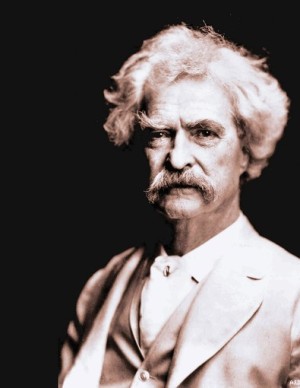
Mark Twain
Much pride and boasting has been made of America’s age of industrialization, that it was the catalyst that put the nation in the same discussion of the world’s greatest empires. Yet of our nation’s 12-million families then, 11-million earned less than $1,200 per year; of this group the average annual income was $380, well below the poverty line. In today’s CPI dollars (the purchasing power of goods and services produced in the 1890 economy) that is $9,890 per year per household. In his book The Gilded Age: A Tale of Today, Mark Twain wrote of the day’s barons and tycoons, “What is the chief end of man?—to get rich. In what way?—dishonestly if we can; honestly if we must.”
Though pre-1920 U.S. economic reports are less comprehensive as post-1920, Benjamin Schwarz of the World Policy Institute and Executive Editor of World Policy Journal writes in his 1995 New York Times article “By 1890, the richest 12-percent of households owned about 86-percent of the country’s wealth.”
1890 – 1920: Progressive Era
The Roaring Twenties
In 1910 the average annual household income was $574 per year. In today’s CPI dollars that is $14,300 per year per household. During this era America’s top 1-percent owned about 40-50 percent of the nation’s wealth and the top 10-percent fluctuated around 70-percent until President Theodore Roosevelt began his anti-trust legislation and wealth redistribution via progressive taxation.
1920 – 1929: The Roaring Twenties
The average annual household income was $1,407 per year in 1920. In today’s CPI dollars that is $16,100 per year per household. In 1922 America’s top 1-percent owned 37% of the nation’s wealth; a slight change in years following Teddy Roosevelt’s administration. America’s middle-class indeed experienced a relative age of prosperity during the Roaring Twenties due to the automobile industry which fed industries such as oil, road-construction, tourism, manufacturing, and electric-power.
1929 – 1941: The Great Depression
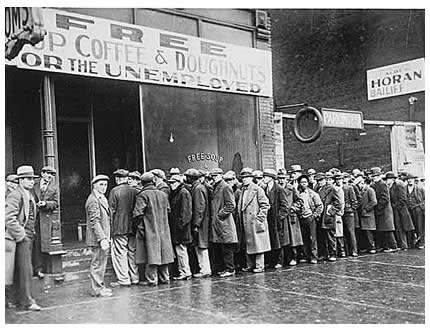
The average annual household income in 1930 was $1,388. By 1940 it had dropped to $1,315. In today’s CPI dollars that is $19,100 and $21,500 per year per household respectively. America’s top 1-percent in 1933 owned 33% of the nation’s wealth and 36.4% in 1939 demonstrated the upper-upper class comfortably rode out the stock market crash of ‘29. Unemployment for the nation’s middle class was at 25% and especially higher in heavy industries such as lumbering and agricultural exports in cotton, wheat, and tobacco. Fortunately, from a purely economic standpoint, another world war was on the horizon ready to put Americans, particularly women, back to work on a road to bigger prosperity than the Roaring Twenties.
1945 – 1973: Postwar Prosperity – The Golden Era
The average annual household income was $3,180 in 1950 ($30,300 in 2012 CPI) and $4,816 in 1960 ($37,300 in 2012 CPI), a significant increase in just 10-years. Middle-class Americans also enjoyed a bigger piece of the nation’s wealth: 70.2% in 1945 and 73% in 1949 while America’s top 1-percent saw their portion drop again to 29.8% and 27% respectively. Yet, it is this Golden Era that firmly placed the United States as a world power and dominant economy. As more and more Americans gained more wealth and more income, the nation experienced its most prolific prosperity to-date. How it happened will be examined shortly.
The American Dream. Notice the ethnicity?
When Dwight Eisenhower took office (1953-1961) the nation was going through another recession post-Korean War causing a decline in the nation’s GDP. This resulted in middle-America having less of the nation’s wealth over a 16-year period down to 65%, while America’s top 1-percent relished in increases back up to 34.4% of the nation’s total wealth in 1965.
By 1970 the average annual household income was $7,494 or about $44,300 in today’s CPI dollars; another notable increase in 10-years. As the Golden Era drew to a close and the Cold War and Vietnam festered, President Lyndon Johnson’s Great Society programs increased lower and middle-America’s wealth to 71% while America’s top 1-percent saw theirs fall to 29% of the nation’s wealth. However, hard times were just around the corner for most Americans.
1970 – 1976: Age of Stagflation
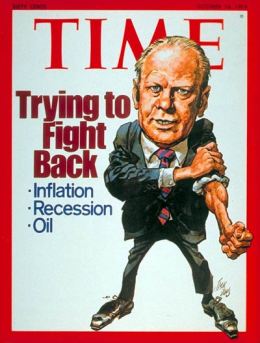
Image Time Warner
In 1973 the average annual household income was $9,037 or approximately $46,700 per household in today’s CPI dollars. The nineteen-seventies became known economically as the Age of Stagflation. The 25-year U.S. economic growth post-WW2 had stagnated to a crawl, and prices in goods and services rose annually in the double-digits from 10% in 1973 to 18% in 1979. Due to poor performances on Wall Street, America’s top 1-percent saw their share of the nation’s wealth drop to the lowest in history: 19.9%. Yet, middle-America enjoyed the highest ever share of the country’s wealth at 80%.
The eras of suburbanization in the 50’s and 60’s, however, had significant consequences in the 70’s. The migration of tens of millions of middle-Americans (most of them White), moving to newly developing suburban towns meant getting to work in cities went from public transit to private vehicles. This in turn caused America to become heavily dependent on foreign oil. The long-term varied ripple effect of suburbanization cannot be overemphasized, one of which is our bigger footprint on environmental and global issues.
1976 – 1992: Gilded Age Returns and Reaganomics
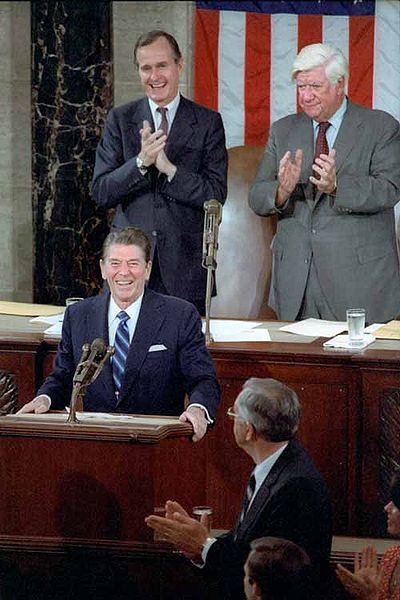
Reagan addresses Congress 1981 (Wikipedia)
From 1976 to 1988 the average annual household income was $11,080 or about $44,700 in 2012 CPI dollars – yes, a $2,000 drop from the previous 3-years – to $25,167 or about $48,800 in 2012 CPI dollars; just above break-even from 1976. To combat the stagflation of the 70’s, government deregulation along with personal and business tax cuts gained popularity. As it turned out most of the tax breaks, along with deregulating helped America’s upper-classes.
Additionally, defeats of labor unions – unions made possible by Teddy Roosevelt reforms with long histories of keeping big-businesses from corruption and abuse of workers – also fattened the pockets of America’s top 1-percent by going from 19.9% ownership of the nation’s wealth to having 35.7% by 1989. By 1992 the AAHI (average annual household income) was $28,870 or about $47,200 in 2012 CPI dollars; another drop from 1988. While middle-America struggled, the top 1-percent in America owned a rising 37.2% of the nation’s total wealth.
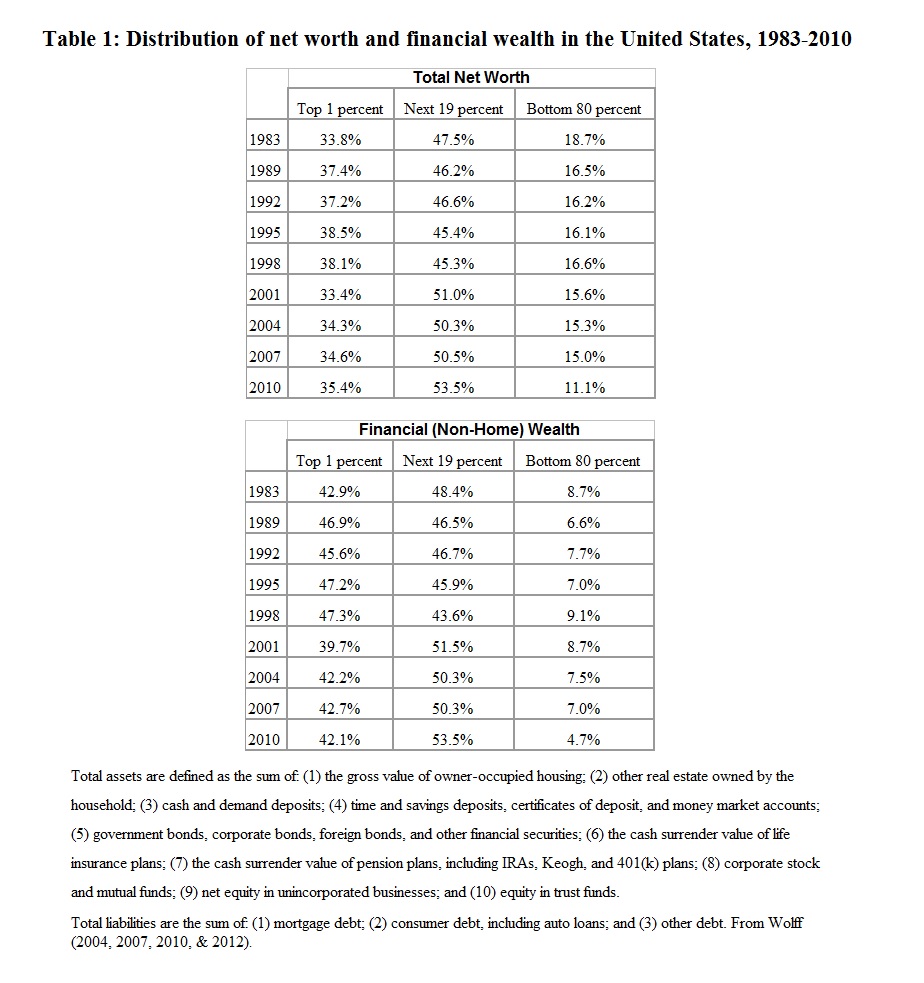
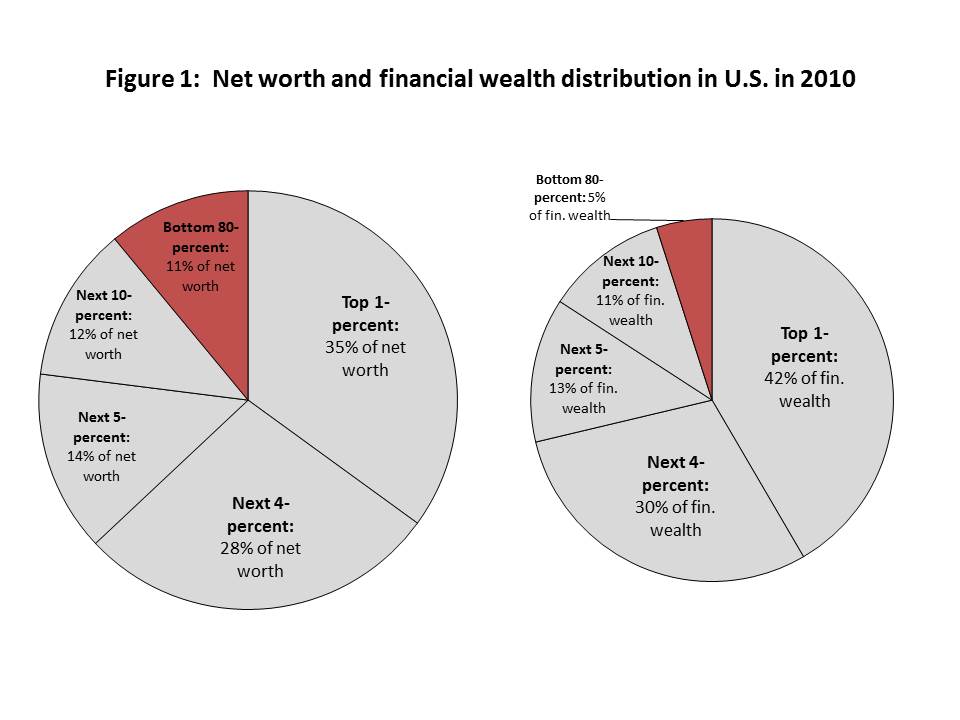
Beginning in 1983 economist Edward Wolff has tracked America’s net wealth and financial (non-home) wealth distributions. As Table 1 above and Figure1 below show, it is an increasingly bleak outlook for the majority of Americans.
Click image for larger view
1990 – Present: Globalization and World Superpower
The 1990’s will be compared to the prosperity of the 1920’s and the 1960’s. But as a whole is that what the data reveals? The AAHI was $32,558 in 1995 or about $49,000 in 2012 CPI dollars and America’s top 1-percent enjoyed another increase in the owned wealth of the nation at 38.5%. For six brief years (1994-2000) the economy saw rises in the national debt, the stock market, and the GDP while inflation plateaued and unemployment dropped below 5% because of the Dot-com Boom. Economist and civilians alike agree that the growth explosion was mostly a result of workplace computerization. But the good times would come to an end in 2001.
Map of the world wide web 1990-2000
A constant influx of immigrants seeking the American Dream, an American economy becoming one of the major players in a growing global economy, a false sense of security in the housing market, and numerous corporate scandals in the energy and finance sectors due to previous government deregulating, all contributed to the tipping-point by 2007. The AAHI in 2000 was at $40,418 or $53,900 in 2012 CPI dollars and the top 1-percent in America saw their portion in the nation’s wealth drop to 33.4% due to a sharp declining stock market worsened by the attacks of 9/11. There is another set of globalization dynamics that added to the plight of middle-America.
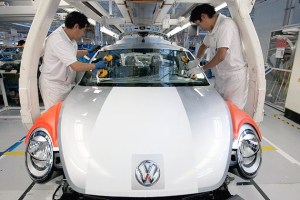
With the exodus of American jobs like cheaper electronics, fashion, shoes, and toys moving to developing nations, middle-Americans watched as their job and salary-leveraging also weakened with fewer lateral or upper employment positions. Then jobs in TV, auto, steel, and home-furnishing manufacturing followed. With those positions gone abroad, the American job-market went from high-paying management positions to simple service-industry low-paying positions which certainly need no college degree. This move marked the boom of trade-school certifications for a growing electronic blue-collar job-market.
Why Mexico is becoming a global manufacturing power – Bloomberg Businessweek article
The domino-effect of American digitization, the snowballing Internet, and high-speed networks spreading to all corners of the globe have combined to gorge the growing socio-economic gap wider and deeper. In 2007 the AAHI was $48,332 ($53,500 in 2012 CPI dollars) eaten-up by inflation and the cost-of-living. Meanwhile, the top 1-percent owned a steady 34.6% of the nation’s wealth. The lap of luxury doesn’t stop there. With the creation of a connected more global economy today, along with new multiple global opportunities and substantially lower-wages to foreign workers, it should come as no surprise what sector of the American population currently enjoys the fruits-of-foreign-labor.
The World’s 200 Richest People(s):
The most industrialized developed countries in the world by population-size are in Europe according to the 2013 United Nations Human Development Report. Of the top 10 nations with the highest Human Development Index (HDI), six of them are in Europe (see Report). One might infer from that list then that many of the world’s wealthiest people reside in those countries or at least in Europe. You would be wrong.
Of the 200 richest people in the world as of 2012, 61 of them (or 31%) are citizens of the United States. What is perhaps unexpected is where the second richest group of people call home. Of the next 139, 20 of them (or 10%) are Russian, ironically a former part of the old communist U.S.S.R. The next 26 richest people come from Germany (13) and Brazil (13) at 7% and 6.5% respectively. To see the world’s wealth and what portion of it is owned by the wealthiest 200, see the pie-chart below. For the most current world ranking of the world’s wealthiest as ranked by Bloomberg click here.
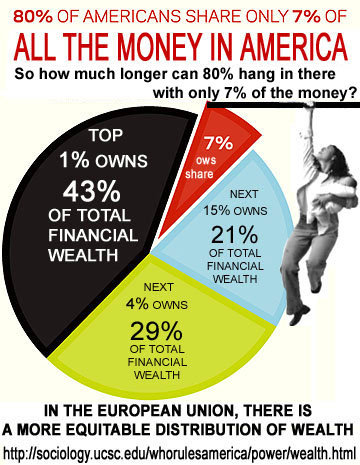
As the largest population of one of the most modern industrialized nations – currently 314 million and growing – the United States has the largest percentage of the population with the smallest percentage of the nation’s wealth. Since 1983, as seen in Wolff’s two Tables above, it has decreased every single year. To put this disparity succinctly, in terms of financial eggs-in-a-basket the top 1-percent own 35% of all privately held stock, 62.4% of all business equity, and 64.4% of financial securities in America. Is it any wonder why middle-American taxpayers were held for ransom in 2008 to bailout our own mega-banks and financial firms, mega-auto companies, and integral government-sponsored entities? The top 1 and 10-percent held the nation by the balls. Sit down, it get’s more alarming.
The top 10-percent own 81% to 94% of all American bonds, trust funds, stocks, and business equity, and nearly 80% of all commercial real estate. The real value of financial wealth is determined by control of income-producing assets; assets that can absorb recessions or devastating irreparable depressions. Therefore, it is reasonable to conclude that 10% of Americans own the United States. Talk about utter investment stupidity in placing the nation’s “eggs” in one or two baskets! There is no way to sugar-coat it. Perhaps Abraham Lincoln’s Gettysburg Address should be rewritten to reflect today’s socio-economic times: “Government of the 10-percent, by the 10-percent, for the 10-percent.”
Land of the Few, Home of the Lavish
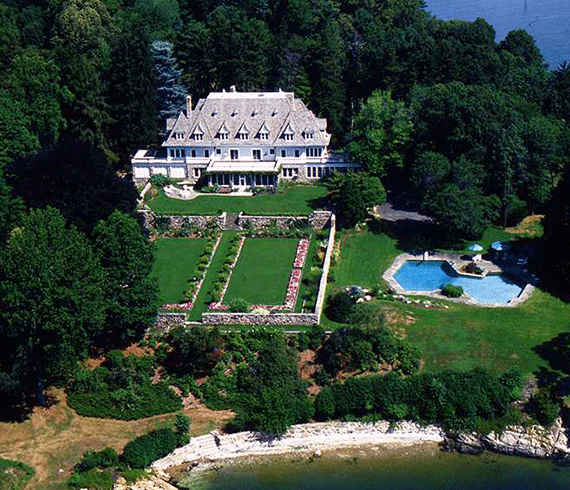
Listed at $190-million, Copper Beech Farm in Greenwich, Connecticut is the most expensive home in America. Built in 1896 and previously owned by the Greenway family of U.S. Steel with Andrew Carnegie as well as timber tycoon John Rudey, it has over 13,000 square feet on 50 waterfront acres with spectacular views of Long Island Sound. As a French Renaissance style home with 12 bedrooms, wine cellar, a 75-foot outdoor pool, a grass tennis court, a large formal arboretum, two greenhouses, and private apple orchard, accessible by a 1,800-foot private driveway. Oh, and the property includes two offshore islands.
Copper Beech – Greenwich, CT
Copper Beech Farm is simply one home of over 100 homes priced above $10-million. From 2005 through 2012 Greenwich, CT has been ranked as the best wealthiest place to live in the U.S., the “Biggest Earner” per household in the U.S., and #1 wealthiest residents per capita in the nation. Many of the residents are Wall Street hedge fund managers, writes Nina Munk of Vanity Faire Magazine, and “of the $1.2 trillion currently invested worldwide, approximately one-tenth, or $120-billion, is now managed out of Greenwich alone, according to Hedge Fund Research, Inc.” Munk also reports that four of the richest 400 Americans live in Greenwich and three of those are hedge fund managers. One Greenwich real-estate broker reported these four residents will drop five to eight-million dollars without a second thought. Some even a lot more.
“Almost As Big as the Taj Mahal – To judge by the number of swollen, over ambitious mansions rising from lots in Greenwich these days, you’d almost think we were back in the 1910’s and 20’s – except that this time round the lots are small, and the houses are almost on top of one another. “Years ago, wealthy houses were hidden in the rear of properties after long driveways…and no one ever built to the maximum allowable square footage,” remarked Diane Fox, long time director of Greenwich’s Planning and Zoning Department, in an e-mail to me. “Today all big houses want to be seen from the road.””
Munk’s article of Greenwich’s rich and lavish also mentions that one interior designer installed broadloom carpet at $74,000 for one bedroom, and drapes and curtains at $20,000 to $25,000 for one bedroom. You read it right, one bedroom.
Why is this level of wealth and excessive opulence worth mentioning?
Because today American legislation, political campaigns, and economic policies resemble little of what they did six decades ago. In 2010 the U.S. Supreme Court allowed American corporations, including those owned by the top 1 and 10-percent of the nation, the opportunity of donating vast financial resources for political candidates and their election campaigns; “resources” with millions of dollars beyond what any individual voters could organize. Remember, 80 to 90 percent of Americans hold or own just 4.7% of the nation’s financial wealth. The political phrase in the 1940’s and 50’s “one person, one vote” means today “one dollar, one vote.” That 2010 decision sets the stage for a class of super-wealthy political campaigners to push (as if a majority of individual voters) their one-dimensional political-economic interests: enhancing their profits and revenues.
A Communal America is Imperative
This four-part series has not been about political, economic, or social envy. It seems the bottom 99% or 90% are for the most part not jealous of America’s gazillionaires or their social contributions and hard-earned incomes. What this four-part series has been about though is political fairness, representation, and efficiency. As discussed in part two Productive Inequality, rent-seeking moves wages and wealth from the bottom and middle classes to the top 10 and 1-percent while distorting the “free market” in favor of some and to the detriment of most. More “efficient” policies of the market matter for a more equitable distribution of national wealth. Improper policies (e.g. of the last 32-years) lead to a less efficient economy and a growing divide between socio-economic classes.
Strength in lots of Einsteins!
It is a fairly simple overall concept. When our society is sufficiently (even abundantly) funded in infrastructure, education, research, and technology, these vital areas of a thriving economy offer hope and security to ordinary citizens. The majority of Americans, the bottom 90%, will actually SEE and experience for themselves what the U.S. Constitution, the Statue of Liberty, and all other symbols of democracy, equality and fairness are really made of… not just “promised” or rhetorically talked about on TV. Those principles would be available to a vast number in society in an efficient dynamic economy. Even the top 1-percent would benefit when the capabilities of so many quality workers and citizens are not wasted but fully utilized. It’s a concept of not just strength in numbers, but strength in well-educated, ingenious, motivated Einstein numbers! There is a huge difference between the two. The difference is not just inclusive, but very alien to exclusive.
In his superb book The Price of Inequality: How Today’s Divided Society Endangers Our Future, Nobel Prize winner in economics Joseph Stiglitz gives a superbly educated agenda on exactly how American government and her 314-million citizens can avoid falling into the same death-trap history’s great empires and their leaders fell into. If you would like to read an outline of his proposed extensive agenda, click here.
My own meek semi-educated ideas of how not to follow, for instance, the Roman Empire’s demise or the former Soviet Union’s, or the more recent countries of Egypt, Tunisia, and Syria… are this:
What is the reading on your/our Collective-Goodness-Gauge? What is the health of your/our common welfare, our passion for civic responsibility and the well-being of the persons near us?
These are NOT just social questions! More importantly they are political and economic questions too. As the French political philosopher Alexis de Tocqueville noticed about the nature of American society in 1835, freedom (or individualism) can be a tricky balancing act within democracy. Some “individualized” Americans independent of a majority often have the pragmatic realization that looking after the welfare of others is not only good for the soul, but is equally good for business and wealth. Stiglitz elaborates on this truth wonderfully:
“The top 1 percent have the best houses, the best educations, the best doctors, and the best lifestyles, but there is one thing that money doesn’t seem to have bought: an understanding that their fate is bound up with how the other 99 percent live. Throughout history, this has been something that the top 1 percent eventually do learn. Often, however, they learn it too late.”
…no matter class or status
The Roman Empire, Egypt, Tunisia, and Syria are just four examples to what Stiglitz refers. The former Soviet Union is an example of no individualism when no single “part” is allowed to reach its full brilliance and potential for the benefit of the whole; the other extreme. Both ends of the economic-socio-political spectrum REQUIRE resource investments and management from every single citizen. The stable “middle” if you will, has a steady balanced, efficient, fair, and equal flow of civic investment. Any one mechanism cannot efficiently coexist without the other efficient mechanisms. So…
If the United States wishes to return as one of the best symbols of freedom, liberty, democracy, and equality for all, then reaching that efficient balanced middle is an imperative collaborative, collective return to a well-managed, well-governed, wealth-balanced cause.
Is inequality necessary to provide people with incentive? Does the fear of failure, foreclosure, unemployment, bankruptcy, or government welfare and food stamps make people impassioned to succeed? Another way to ask this question is this way: Is the fear of shame, by family, by society, by the status quo a necessary motivator in a free-market society? No. Histories of great civilizations promoting inequality are laden with economic and societal collapses that show otherwise. Advocates of traditional free-enterprise, or capitalism, often argue that if a nation does not have total economic freedom and the correlated supporting government policies (small government), then that is a blatant step toward communism or socialism. These arguments cloud and grossly oversimplify our current crisis and the causes.
The Power of an Illusion
Having much less inequality does not equate to socialism or communism. On the contrary, less inequality (but not full equality) for the mid-term and long-term improves a nation’s gross domestic product (GDP). When citizens have incentives based on real hopes and realized achievements due to accessible social educational tools, workforce opportunities, and economic mobility, a country’s GDP is more stable and more efficient. Honestly, it is a simple sports concept: a well-oiled, concerted team is stronger and more successful than a fragmented, polarized team of hyper-competitive individuals. What makes this simple sports concept embarrassing, perhaps even deplorable, is when a team owner, or team captain claim and receive bonuses above and beyond the actual performance or decline – in some cases disaster – of the organization or team. Yet in the 2008 financial plunge, CEOs and their élite echelon did just that while the expendable lower workers lost their jobs and homes. Do not mistake this philosophy of the nation’s business élite as necessary incentive compensation schemes. It is merely guaranteed high compensation for good performance or bad performance; a handout for the CEO title, not the performance of his firm.
Political economists tend to place the fault of America’s growing inequality on various market or policy-factors not aligned with their own party. However, singling out one or two spokes in a failing wheel does not address the functionality or non-functionality of the remaining spokes, or the wheel as a whole. Yes, changes in computer technology created a change in skill-biased technology. Yes, the weakening of labor unions and less-scrutinized executive pay has contributed. The role of financialization in a global economy has contributed. Joseph Stiglitz, author of The Price of Inequality and Nobel Prize winner in economics feels, however, this tunnel-vision is missing the bigger picture. He states that if any of these factors were central:
“…we don’t have to sit idly by and accept the consequences. Greed may be an inherent part of human nature, but that doesn’t mean there is nothing we can do to temper the consequences of unscrupulous bankers who would exploit the poor [and uneducated] and engage in anti-competitive practices. We can and should regulate banks, forbid predatory lending, make them accountable for their fraudulent practices, and punish them for abuses of monopoly power.”
Stiglitz goes on to elaborate several other contributive forces and how to “temper” or punish abuses, but he later notes that growth in America’s financial sector as a spoke, or portion of the total U.S. income, has clearly added to increased inequality, i.e. “to both the wealth created at the top and the poverty at the bottom.” As I will point out below, the movement and growth of inequality and increased disparity was no accident; financial executives knew beforehand what was likely to occur.
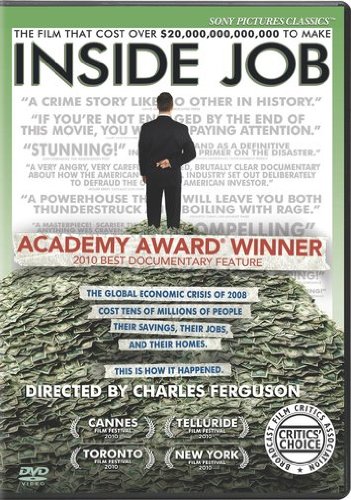
The exceptional 2011 film “Margin Call” which portrays the beginning hours of the 2008 crisis.
Is wealth always the reward of hard work and resilience? Is wealth always determined by an individual’s time-invested: 70-hour, 80-hour work weeks, or 7-days a week, 50 weeks of the year? Of course not! If this were true, then we could conclude that wealthy drug-cartels are wonderful “hard workers”. Yet, this is a logic still promoted and distorted by age-old political campaigns. In the kindergarten and elementary classrooms, these tales of rags-to-riches by hard persistent work ring true, but in the arena of highly intelligent, misguided or non-violent orators of political-business eloquence, it requires an equal amount of sleuth by 70% of a disadvantaged common population.
Less Inequality Equals Less Volatility
No matter what the various causes of our economic crisis, all of them must be addressed. Stiglitz references another accomplished economist, James K. Galbraith, professor from the University of Texas at Austin. Galbraith goes into detail about why instability is directly and closely linked with high inequality, particularly in global financialization. The U.S. economy is naturally a major component in the world market, and it follows then that U.S. economic policy-makers are also major components. After researching and compiling some 50-years of data, both European and U.S. economic data, his striking discovery shows that in economies that are more egalitarian have markedly lower unemployment and hence lower inequality. But I must allow Mr. Galbraith to explain his discovery in his own words. Below is his four-part interview series discussing his book, Inequality and Instability, which precisely explains why the United States must become more egalitarian to avoid future civil collapse and revolt.
Why does any of this matter? Of what importance or impact will this analysis have on my life and my family? That answer is simple: association. You are associated with this life, with this planet, with your countrymen, with your parents and with your offspring. And you have a choice to make that association better than when you found it or became part of it, or you have the choice to ignore it or oppose it. Either way, you are associated. The question then becomes what part, what role are you going to play?
Philosophical questions aside, the more related question here to this 3-part blog/post is Are you interested in perpetual wealth-accumulation for yourself, or are you interested in making this world and those around you a happier place? One outlook is egocentric, the other is altruistic.
The Fallacy of “Productive Inequality”
As I alluded to in my previous two paragraphs, everything is connected or associated. One person’s words and actions will affect or be felt by those around them. The interactions within a family will affect families next door, or coworkers, or fellow schoolmates. Naturally, this explains why the Department of Health & Human Services quarantines major viral infections: to decrease the outbreak. The point being here is that inequality (moral or economic) leads to instability, and instability leads to unemployment, and unemployment leads to weak local and national output, which in turn leads to weak demand or stagnation, which leads to recession…and that ironically, over the long-term increases the risks on the wealth the egocentrics accumulated. However, it is not enough for me to spout-off personal opinions, substantiated or not by history, facts, or reliable sources. I must show that I have done the homework, or at least a large part of the homework. Thus, let me again turn to Nobel Prize winner, Joseph Stiglitz.
“Beyond the costs of the instability to which it gives rise, there are several other reasons why high inequality – the kind that now characterizes the United States – makes for a less efficient and productive economy. We discuss in turn (a) the reduction in broadly beneficial public investment and support for public education, (b) massive distortions in the economy (especially associated with rent seeking), in law, and in regulations, and (c) effects on workers’ morale and on the[problematic myth]of “keeping up with the Joneses”[or a consumer-driven society].
Let’s look more closely at the three reasons Stiglitz puts forth.
Declining Public Investment and Support for Public Education
We all know that an automobile will not run without fuel. We know that without the apple there is no applesauce. Without the photon particle, there are no vibrant visible colors. A basic principle in economics 101 is that the private-sector cannot be successful without an efficient active public-sector, and vice-versa. However, these two sectors cannot fully function by themselves or necessarily in conjunction. There needs to be rules-of-the-game established to keep the markets and sectors playing fairly. This is where government is vital. It makes sure that the infrastructure stays fair and healthy.
A flourishing industrialized nation requires public investment: roads, scientific research, civil services such as ambulances and ER services, police and prisons, firehouses staffed with firemen, seaports, airports, and basic quality education. These are just a few of the investments needed for a modernized society to remain peaceful and progressive. Leaving these public-sectors to the whims of the “free-markets” or a private investor will and has led to declining investment. The consequences of public under-investment are a heightened risk and paranoia on the part of the private-sector, as I alluded to earlier. A neutral entity, the government, must be actively involved to keep the playing-field, the economy fair and efficient. There has to be a healthy stable balance between BOTH sectors. Otherwise, the common workers (the 70% population) have less incentive, perhaps no incentive to patriotically work for the whole, much less the upper percentile.
During the periods of good sufficient public investment, the United States as well as the world reaped the benefits of government-sponsored research, health, and education! Some examples in research during the 20th century: information technology, internet, and biotechnology. In health: immunizations, declines in heart disease, safer healthier foods, cleaner drinking water, public waste, motor-vehicle safety, family planning, healthier child-bearing and hence lower infant mortality rates, and infectious disease control. In education, these fields mentioned could not have been possible without good-to-great public investment. Yet, at the current rate of public investment these great innovations are becoming fewer and far between. Stiglitz warns:
“Our failure to make these critical public investments should not come as a surprise. It is the end result of a lopsided wealth distribution in society. The more divided a society becomes in terms of wealth, the more reluctant the wealthy are to spend money on common needs. The rich don’t need to rely on government for parks or education or medical care or personal security. They can buy all these things for themselves. In the process, they become more distant from ordinary people[ala Syrian President al-Assad or French Queen Marie Antoinette].
The wealthy also worry about a strong government – one that could use its power to adjust the imbalances in our society by taking some of their wealth and devoting it to public investments that would contribute to the common good or that would help those at the bottom[or their perceived competitors/threats?]. While the wealthiest Americans may complain about the kind of government we have in America, in truth many like it just fine: too gridlocked to redistribute, too divided to do anything but lower taxes.”
Public education, it’s funding and performance is one of the hottest most controversial issues in modern America. Although our nation’s educational system has evolved well since 1870, there is no silver-bullet policy or program – nor has there been a policy-program – that can get perfect results. Perfect, or near perfect results happen on an individual and family unit basis. The rhetoric of school reform frequently overlooks the impact of individual, family, business owners, and educators on determining educational results. If an adolescent chooses to play Xbox instead of doing homework or studying, no amount of educational reform or opportunity will meet the desired results – and sadly, parents let their/our future-citizens do this. Quality education requires personal and family initiative, a characteristic that is infamously difficult to create or impose.
Where individual or family initiative is not the problem, however, lays the construction area of public investment. Ignoring this resource has grave mid and long-term social and economic consequences. “When we diminish equality of opportunity,” writes Stiglitz, “we are not using one of our most valuable assets – our people – in the most productive way possible.” In the earlier blog-post, The Land of Opportunity?, I conveyed how bleak higher-education and wage-mobility existed in America for children of impoverished and middle-income parents. The cost of college tuition is rising faster than median incomes. This begs the question, are student loans the golden-brick road to opulence? No. Once again, the financial sector is wrought with oppressive interest rates and perverse incentives. And from this money-trap comes a slew of further unregulated abuses.
In 1976, and again in 1984, lawmakers in Congress made it increasingly harder for college graduates to discharge student loans in bankruptcy. This had the adverse affect of lenders executing no responsibility to decide whether the educational institutions would provide a degree that would truly enhance their future income. Still later in 2005 with the Bankruptcy Abuse Prevention and Consumer Protection Act, Congress made it near impossible to discharge any student loan – federal or private – unless the borrower was able to prove in court (more money expended) a severe health or work disability. This made student loan discharges the same debt as criminal fines or child support fines. These acts were all lobbied through by the financial sector. During these four decades the for-profit college and universities, with wealthy executives and endowments, blocked all attempts to regulate and hold accountable these same institutions to extensive countermeasures upon exploitative recruiting of students from low-educated poor families, thus making them ineligible for loans.
There is another after-shock of decreasing public education support and declining wage-mobility. Imagine yourself inside one of these low-income, low-educated homes just described. You naturally want your children to attend quality schools in order to have a reasonable chance, or better, to gain admission into a quality university, which in turn increases their chances of becoming a well paid worker or business owner. But to better these chances both parents must work more to make ends meet. As a result, the family spends less time together. Now you are unable to supervise this student or other children in their studies. These families must make difficult compromises, and often those compromises lead to social misconduct or crimes.
Distortions of the Economy
Many of our childhood games teach a basic concept: he who gains the most resources at their disposal has the best chances of winning. As we mature in life we realize that unlike the start of these childhood games, where all players begin on a level-playing field, this concept doesn’t reflect real-life circumstances. This series of blogs expands on this social reality. Our reality is very well documented throughout a plethora of historical civilizations during several centuries. And though our American heritage states “that all men are created equal….” even this famous document was written when slavery and slave-rights in America spoke otherwise. Equality, though the ideal, is most often created. In political marketing – also known as lobbying – it is no different. Gift-wrapped equality does not fall from the sky. It must be created and guarded.
OpenSecrets.org is a Washington D.C. research group which traces funds in federal politics and its correlation and effects on government policies and elections. Corporations, labor unions, and various organizations spend billions to lobby Congress and federal agencies. Since 2008 over $3.3 billion dollars have been spent compared to $1.44 billion in 1998; an average $1.66 million increase every year. And there have been no less than 10,408 lobbyists over this 14-year span; topping out so far at 14,849 in 2007. What industries or sectors are spending the most in lobbying? From first to sixth over the last 14 years, pharmaceuticals/health-products was the biggest spender (13 of the 14 years), followed by insurance, electric utilities, business associations, computers/internet, and oil-gas respectively. Reflecting on these spent resources, Stiglitz writes, “The main distortion to our political system [and consequently our inequality]; the main loser, our democracy.”
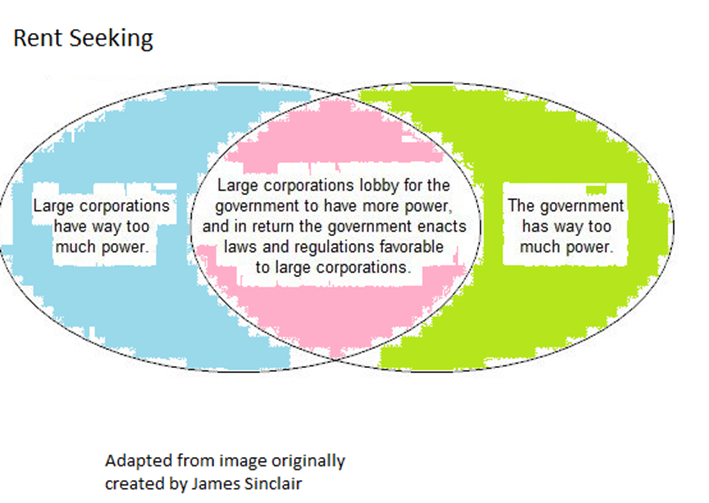
What happened to our economy was not unforeseen, uncontrollable market forces. This recession/depression was created. In order to better understand how it was created, an important business-tactic must first be explained: rent-seeking.
Investopedia.com is an internet-based group of writers from various economic and investment fields. Their website defines rent-seeking as such:
“When a company, organization or individual uses their resources to obtain an economic gain from others without reciprocating any benefits back to society through wealth creation. An example of rent-seeking is when a company lobbies the government for loan subsidies, grants or tariff protections. These activities don’t create any benefit for society, they just redistribute resources from the taxpayers to the special-interest group.”
Rent seeking distorts our real economy in several different ways. Executives and corporations who have learned well to rent seek, reap magnificent financial reward. The accolades and bonuses that they receive may be enormous, however this does not necessarily reflect the social contributions from these rewards; they may not even be beneficial. The distortions come in a variety of sectors in our economy: post-undergraduate talent, public services, technology and telecommunications, business finance, and one of the most subtle and maligned of distortions, the environment and its resource depletion to name just six.
Prior to the 2008 crisis the nation’s college graduates sought employment in many professions; such as, research and development, medicine, public services such as government, firemen or law enforcement, or teaching future generations in schools and universities. However, at the same time an increasing amount of bright graduates were recruited into business finance and investments. Released in February 2000, during the peak of the tech-boom, the U.S. Bureau of Labor & Statistics’ Occupational Outlook Handbook and Career Guide to Industries (USBLS) showed the five fastest growing occupations being projected from 1998 through 2008 were computer engineers (the most), then computer support specialists, systems analysts, database administrators, and desktop publishing specialists respectively. Financing and investments were ranked 20th. Business executives did not make the projection-list. The same report released in February 2004 showed the 21 of the 30 fastest growing occupations to be again in the computer-related fields but also in health-related fields. Yet, about this time the USBLS began reporting employment change by salary, i.e. movement in labor by salaries. In that 2004 report the professional management, business and financial services (including banking) projections were among the best and rising. The same reports released in December 2007 showed significant increases and rises in employment change by salaries projected in the business-financial services with the most in management at almost a 78% change, the highest of all.
Rent seeking is also prevalent in both the health care sector and the telecommunications sector. There is a pill for every imaginable ailment in existence. Pharmaceutical companies now spend enormous amounts of money on marketing to doctors to prescribe their pills and patients to consume them that research, by comparison, has become one of their smallest business expenses. The majorities of their “research” are spent in generic forms of their brand drugs with minor differences, but nonetheless divide the profits of their rival labs of the same successful drug. This rent seeking takes away huge amounts of salaries for real research, real investments, and real productivity and places it in the pockets of executives and shareholders. One quick example of rent seeking in telecommunications would be how “quickly” 10-month old, 1-year or 2-year old cell phones are simply outdated and can no longer function properly with “changing technology or services”. Therefore, the provider can “only offer a new and improved” phone or package, generally more per month with a new complex contract. The micro-processing company Intel has done this since at least Windows 3.1 was popular; a once industry-leading Microsoft product.
As mentioned before, rent seeking practices come in more subtle forms such as in environmental deterioration and depletion. Using the economic successes and profits of our nation’s environmental resources to pad the GDP (Gross Domestic Product) numbers does not reflect the costs to the environment over the long-term. Oil, water, natural gas, coal, and so on is not sustainable growth. There is most certainly a diminished wealth of the nation’s resources. Yet, as of today there is no metric indicator of this cost. Why? The oil, coal, or energy firms lobby and fight hard to block government reports, indicators, indices and green accounts because they would be invoiced for extracting a non-renewable resource from our country’s resources; a cost that would cut their excessive profits. But by not charging the oil, coal, and gas companies a non-sustainability charge, the American government (and average citizen) are giving the corporations an indirect subsidy, favorable tax treatment, and a valuable product well below fair-market prices! Therefore, one primary aim of rent seeking people and companies are to shape laws and government regulations to their own bottom-line. Once again, this distorts the true health of the economy.
Worker-morale and the Ever-Elusive Joneses
In order for a worker to labor most efficiently and most loyally, they must believe they are achieving a comfortable future. This means they must feel they are being treated fairly by their employer. Certainly one would agree that an unmotivated, under-nourished worker is less productive. Education experts and scientists have long known that hunger and inadequate nutrition hinder learning. These were the clear theories of the late 19th and early 20th centuries. But today, the efficiency of worker morale is more complex.
When the general population experiences anxiety over such worries as losing their home, or “Can I provide my children with a quality education to enable them a prosperous life?”, or “Can I survive beyond retirement age?” these questions reduce workplace efficiency. But not only does the psychology reduce workplace efficiency, it also impairs the impoverished to analyze properly the choices that might improve their situation. As the cliché goes, they are living from hand-to-mouth, firmly in the here-and-now. When one lives in this type of daily stress, it can and often does lead to desperate and irrational decisions. Harvard economist Sendhil Mullainathan and psychologist Eldar Shafir thoroughly explain this behavioral thinking:
Naturally, this expenditure of physical and cognitive energy by poor or middle-class workers will also hinder the achievement of new improved skills and knowledge. If this condition persists throughout a nation, productivity will grow slower, and hence the long-term growth of the economy is unstable as well as unsustainable. And too often over the last decade or so, if a corporation was performing unsatisfactorily, even near bankruptcy, the common worker, not the high-level executives/owners, bore the punishment of lay-off, pay-cuts, or termination.
Joseph E. Stiglitz describes more poignantly the importance of labor fairness in recent economic experiments:
“Or take another[experiment], involving a group of workers performing a similar job. One might have expected that increasing the wages of some and lowering that of others would increase productivity of the higher-wage worker, and lower that of the lower-wage workers in offsetting ways. But economic theory – confirmed by the experiments – holds that the decrease in productivity of the low-wage worker is greater than the increase in productivity of the high-wage worker, so total productivity diminishes.”
Yet is this experimental result all that surprising? When the greater good for the greatest number is continuously ignored or discriminated against in unfair free-market practices and deregulation, the final result is economic recession or collapse.
There is also deeper psychology involved with rent seeking practices within societal inequality that may not be clearly understood. When we were all young children, there was always some hero or heroes we aspired to be. When I was a youth and on into my teenage years, I was utterly fascinated and enthralled by the fighter pilots of World War II and their magnificent planes. To this day, I still have a very high regard for those daring men constantly putting their lives in harm’s way to preserve basic human rights around the globe, often for less fortunate people they had never met, nor would they meet.
In today’s American economic policy and politics, many tax-paying citizens aspire to the upper middle-class, or even the top 10% or 20% financially and their standard of living. We have seen so far in this article and my previous articles (Oversimplification 2012 and The Land of Opportunity?) how much inequality affects a nation’s economy and efficiency. Though the popular Trickle-down economic philosophy of many conservative élite is a fanciful fabrication and illusion, trickle-down psychology is tremendously real. The bottom percentile in our society know and accept that dreams of opulence in the top percentile are fantasies. However, those in the lower middle, center, and upper middle have serious hopes of attaining the American Success Dream; into the top 20%, 10%, or 1%. These dreams are sometimes referred to as keeping up with the Joneses.
There is a perfectly good explanation as to why on a scale of global comparison, the United States is one of the busiest and hardest working societies on the planet: consumerism. And to keep up appearances with those around us in our communities, many Americans must live beyond their means.
The April 2012 edition of the World Economic Outlook Databasepublished by the International Monetary Fund (IMF) reported the Top 10 industrialized, or advanced economies of the world. Of course, the U.S. was a member. However, this listing does not show all industrialized-advance economies in the world which provides a more balanced point-of-view. There are 35 nations classified as advanced economies. The United States ranks in the top four in most databases. According to theBusiness Insider, April 13, 2011 and the OECD (the Organization for Economic Cooperation & Development), the U.S. ranks 9th out of 35 nations as the hardest working nation in the world. With that said, Stiglitz offers refinements as to the differences between America’s work rate and the rest of the world:
“Many years ago Keynes[i.e. John Maynard Keynes]posed a question. For thousands of years, most people had to spend most of their time working just to survive – for food, clothing, and shelter. Then, beginning with the Industrial Revolution, unprecedented increases in productivity meant that more and more individuals could be freed from the chains of subsistence living. For increasingly large portions of the population, only a small fraction of their time was required to provide for the necessities of life. The question was, How would people spend the productivity divided?
The answer was not obvious. They could decide to enjoy more and more leisure, or they could decide to enjoy more and more goods. Economic theory provides no clear prediction, though one might have assumed that reasonable people would have decided to enjoy both more goods and more leisure. That is what happened in Europe. But America took a different turn – less leisure (per household, as women joined the labor force) and more and more goods.
America’s high inequality – and individuals’ sensitivity to others’ consumption – may provide an explanation. It may be that we are working more to maintain our consumption relative to others, and that this is a rat race, which is individually rational but futile in terms of the goal that it sets for itself. Adam Smith pointed out that possibility 250 years ago: “this general scramble for preeminence, when some get up, others must necessarily fall undermost.”[A mentality abundantly demonstrated in our American professional sports: victory at all costs, while heads roll soon after failure; screams of “clean house!” prevail]While there is no “right” answer to Keynes’s question according to standard economic theory, there is something disturbing about America’s answer. Individuals say they are working so hard for the family, but as they work so hard there is less and less time for the family, and family life deteriorates. Somehow, the means prove inconsistent with the stated end.”
Joseph Stiglitz, John M. Keynes, Adam Smith, and other economists point out an implicit warning. The U.S. population makes up between 3.8% and 4.5% of the world’s total population. Yet, as such a small percentage of the world, Americans consume the most electricity, the most corn, much of the coal (2nd to China), the most natural gas, fourth in wheat consumption, an inordinate amount of oil by comparison – leading in the depletion of energy resources. Not only is there no denying that the U.S. is an economy firmly driven in consumerism, we take the cake and the party too, yet make up a mere 4% of the world population. This is an ASTONISHING fact! That Americans are an Earth-devouring people might be an understatement.
We have touched on various causes of our country’s growing inequality and how distortions of our economic health has made it worse, and how declining public investment will further the problem, and how our illustrious free-market economy was supposed to be envied by the world…has become an illusion that is rearing its ugly head. In my next post/article on this subject: Unveiling Incentive-Opportunity Fallacies, it needs to be shown that the direction our social and economic state is headed, is eerily reminiscent of the decline and fall of Rome. As the gap between socio-economic classes widen, and proclaimed “opportunities” and “incentives” of the Right turn into a thin smoke, just like the upper Roman classes and the bottom Roman percentile polarized (e.g. the Occupy Wall Street movement) America will see its democracy crumble unless some well-proven social, political, economic regulations, and more progressive-taxation packages are implemented or revamped.
I hope that the 2012 November elections – and later elections – are seen this way by the 70% – 90% of Americans. Otherwise, there could very well be another second falling of “Rome” in North America.
For an excellent overview of America’s inequality and severe polarization, watch the documentary Patriocracy by Brian Malone. It is an accurate portrayal of how today’s American generation is no longer the greatest generation who adapted, compromised, and labored generally as United, but instead has become the greediest, egocentric generation rendering our government dysfunctional and society hyper-polarized.
I have zero expectation that anything I ever say will end someone’s belief in their God. Not my goal or purpose. That alone belongs to the individual. ~ Zoe
'Light thinks it travels faster than anything but it is wrong. No matter how fast light travels, it finds the darkness has always got there first, and is waiting for it' - Terry Pratchett

 An additional lens…


















 The Professor's Convatorium
