As part of the Alternative Lifestyles blog-posts migration over to the new blog The Professor’s Lifestyles Memoirs, this post has been moved there. To read this post please click the link to the blog.
Your patience is appreciated. Thank you!


As part of the Alternative Lifestyles blog-posts migration over to the new blog The Professor’s Lifestyles Memoirs, this post has been moved there. To read this post please click the link to the blog.
Your patience is appreciated. Thank you!
I read this post on Dr. Bart Ehrman’s blog yesterday — twice as a matter of fact — and there is just no way I can skip it and not let it follow-up my own post April 1, 2018: April Fool’s Everyone! Dr. Ehrman essentially echoes most everything I’ve posted and commented about Christendom, its very distorted and amputated history throughout its two millenia of existence, and how Christianity became the misguided monstrosity it is today. This is just too good to pass up. Therefore, I am simply going to repost what the acclaimed scholar wrote himself about Easter, or the modern myth that is the resurrection missing body of a Jewish reformer. Here is Dr. Bart Ehrman’s post:
∼ ∼ ∼ ∼ § ∼ ∼ ∼ ∼
“It is highly ironic, but relatively easy, for a historian to argue that Jesus himself did not start Christianity. Christianity, at its heart, is the belief that Jesus’ death and resurrection brought about salvation, and that believing in his death and resurrection will make a person right with God, both now and in the afterlife. Historical scholarship since the nineteenth century has marshalled massive evidence that this is not at all what Jesus himself preached.
Yes, it is true that in the Gospels themselves Jesus talks about his coming death and resurrection. And in the last of the Gospels written, John, his message is all about how faith in him can bring eternal life (a message oddly missing in the three earlier Gospels of Matthew, Mark, and Luke).
These canonical accounts of Jesus’ words were written four, five, or six decades after his death by people who did not know him who were living in different countries, and who were not even speaking his own language. They themselves acquired their accounts of Jesus’ words from earlier Christian storytellers, who had been passing along his sayings by word of mouth, day after day, year after year, decade after decade. The task of scholarship is to determine, if possible, what Jesus really said given the nature of our sources.
Fundamentalist scholars have no trouble with the question. Since they are convinced that the Bible is the inspired and inerrant word of God, then anything Jesus is said to have said in the Gospels is something that he really said. Viola! Jesus preached the Christian faith that his death and resurrection brought salvation.
Critical scholars, on the other hand, whether they are Christian or not, realize that it is not that simple. As Christian story tellers over the decades reported Jesus’ teachings, they naturally modified them in light of the contexts within which they were telling them (to convert others for example) and in light of their own beliefs and views. The task is to figure out which of the sayings (or even which parts of which sayings) may have been what Jesus really said.
Different scholars have different views of that matter, but one thing virtually all critical scholars agree on is that the doctrines of Jesus’ saving death and resurrection were not topics Jesus addressed. These words of Jesus were placed on his lips by later Christian story-tellers who *themselves* believed that Jesus had been raised from the dead to bring about the salvation of the world, and who wanted to convince others that this had been Jesus’ plan and intention all along.
My own view is one I’ve sketched on the blog many a time before. Jesus himself – the historical figure in his own place and time – preached an apocalyptic message that God was soon to intervene in history to overthrow the powers of evil and destroy all who sided with them; he would then bring a perfect utopian kingdom to earth in which Israel would be established as a sovereign state ruling the nations and there would be no more pain, misery, or suffering. Jesus expected this end to come soon, within his own generation. His disciples would see it happen – and in fact would be rulers of this coming earthly kingdom, with him himself at their head as the ruling monarch.
It didn’t happen of course. Instead, Jesus was arrested for being a trouble maker, charged with crimes against the state (proclaiming himself to be the king, when only Rome could rule), publicly humiliated, and ignominiously tortured to death.
This was not at all what the disciples expected. It was the opposite of what they expected. It was a radical disconfirmation of everything they had heard from Jesus during all their time with him. They were in shock and disbelief, their world shattered. They had left everything to follow him, creating hardship not only for themselves but for the families near and dear to them – leaving their wives and children to fend for themselves and doubtless to suffer want and hunger with the only bread-winner away from home to accompany an itinerant preacher who thought the end of history was to arrive any day now.
This reversal of the disciples’ hopes and dreams then unexpectedly experienced its own reversal. Some of them started saying that they had seen Jesus alive again. In the Gospels themselves, of course, all the disciples see Jesus alive and are convinced that he has been raised from the dead. It is not at all clear it actually happened that way. The accounts of the Gospels are hopelessly at odds with each other about what happened, to whom, when, and where. So what can we say historically?
One thing we can say with relative certainty (even though most people – including lots of scholars!) have never thought about this or realized it, is that no one came to think Jesus was raised from the dead because three days later they went to the tomb and found it was empty. It is striking that Paul, our first author who talks about Jesus’ resurrection, never mentions the discovery of the empty tomb and does not use an empty tomb as some kind of “proof” that the body of Jesus had been raised.
Moreover, whenever the Gospels tell their later stories about the tomb, it never, ever leads anyone came to believe in the resurrection. The reason is pretty obvious. If you buried a friend who had recently died, and three days later you went back and found the body was no longer there, would your reaction be “Oh, he’s been exalted to heaven to sit at the right hand of God”? Of course not. Your reaction would be: “Grave robbers!” Or, “Hey, I’m at the wrong tomb!”

The empty tomb only creates doubts and consternation in the stories in the Gospels, never faith. Faith is generated by stories that Jesus has been seen alive again. Some of Jesus’ followers said they saw him. Others believed them. They told others — who believed them. More stories began to be told. Pretty soon there were stories that all of them had seen him alive again. The followers of Jesus who heard these stories became convinced he had been raised from the dead.
Jesus himself did not start Christianity. His preaching is not what Christianity is about, in the end. If his followers had not come to believe he had been raised from the dead, they would have seen him as a great Jewish prophet who had a specific Jewish message and a particular way of interpreting the Jewish scripture and tradition. Christianity would have remained a sect of Judaism. It would have had the historical significance of the Sadducees or Essenes – highly significant for scholars of ancient religion, but not a religion that would take over the world.
It is also not the death of Jesus that started Christianity. If he had died and no one believed in his resurrection, his followers would have talked about his crucifixion as a gross miscarriage of justice; he would have been another Jewish prophet killed by God’s enemies.
Even the resurrection did not start Christianity. If Jesus had been raised but no one found out about it or came to believe in it, there would not have been a new religion founded on God’s great act of salvation.
What started Christianity was the Belief in the Resurrection. It was nothing else. Followers of Jesus came to believe he had been raised. They did not believe it because of “proof” such as the empty tomb. They believed it because some of them said they saw Jesus alive afterward. Others who believed these stories told others who also came to believe them. These others told others who told others – for days, weeks, months, years, decades, centuries, and now millennia. Christianity is all about believing what others have said. It has always been that way and always will be.
Easter is the celebration of the first proclamation that Jesus did not remain dead. It is not that his body was resuscitated after a Near Death Experience. God had exalted Jesus to heaven never to die again; he will (soon) return from heaven to rule the earth. This is a statement of faith, not a matter of empirical proof. Christians themselves believe it. Non-Christians recognize it as the very heart of the Christian message. It is a message based on faith in what other people claimed and testified based on what others claimed and testified based on what others claimed and testified – all the way back to the first followers of Jesus who said they saw Jesus alive afterward.”
∼ ∼ ∼ ∼ § ∼ ∼ ∼ ∼
Here was my comment and question for Dr. Ehrman. He usually gets back to me within a quick, reasonable timeframe:
Dr. Ehrman, a wonderful summary of today’s meaning of Easter in modern Christian churches. Well done. Thank you.
As your colleague, Dr. James Tabor has studied, written and published, Paul/Saul and his Christology is a major force in spreading and growing the Gentile/pagan side of the “faith.” When I super-impose the full context of the Hellenistic Roman Empire and geopolitical and socioreligious infrastructure over and onto Second Temple Judaism and the Messianic Era, to me personally the gradual and eventual overshadowing (and eventual success) of Paul’s “Neo-Religion” opened up to all Gentiles, with several Greco-Roman ideals of Apotheosis, throughout the Empire (endearing the social classes struggling to survive — blossoming welfare system) takes on an entirely DIFFERENT form than Jesus the Reformer had ever intended! Notwithstanding Jesus’ true pure teachings/reforms, the new Gentile religion was too far gone, popular, and honestly distorted — particularly when the Jewish-Roman War wiped out so many of the outlying sects and those in Jerusalem by 70 CE! Which might have been some of Jesus’ very Jewish 2nd generation followers? Perhaps?
And I am utterly challenged to find out WHY did Paul go to Arabia for 3-years and WHAT was it that he learned there (about Jesus)? Because when Paul returned from Arabia he obviously had a different version of “the Way” and the Kingdom of God than the disciples and the Jerusalem Council had, yes? Any thoughts?
We’ll see what his response will be. Personally, I find Paul’s/Saul’s business in Arabia for 3-years to be very significant in better understanding why and how a floundering Jewish reform movement led by Yeshua/Jesus, suddenly took off 200-300 years later to become the Western Hemisphere’s primary religion. Who better to ask about that than one of the renown experts in biblical history and that era, right?
…
4-4-2018 Addendum — Here was Dr. Ehrman’s reply to my question:
“I don’t think he went into the deserts of Arabia to meditate, reflect, and develop his views. I think he went to the cities of the Nabatean Kingdom (then called Arabia) to begin his missionary work. He claims that he realized the significance of Jesus for Gentiles as soon as he had his vision.”
(paragraph break)
Live Well — Love Much — Laugh Often — Learn Always

This work by Professor Taboo is licensed under a Creative Commons Attribution-NonCommercial-NoDerivatives 4.0 International License.
Permissions beyond the scope of this license may be available at www.professortaboo.com/contact-me/.
 Is magic real? Is it deception or slight-of-hand? Not since 1956 has this happened. It won’t happen again until April 1st, 2029. One thing is also certain; it has happened in the past many times and will keep happening in the future. But why will it not happen again until 2029 when (since 1900) it has only happened four times: 1923, 1934, 1945, and as mentioned 1956? Every 11-years for four cycles, then a 62-year cycle followed by the return to an 11-year cycle for four times. Why this peculiar pattern?
Questions are good in order to better understand. What is so special about today? It is indeed April Fool’s Day (April 1st), but it is also Easter Sunday. However, April Fool’s and Easter together won’t happen again until 2029. Finding answers or at least finding compelling or plausible answers are very good for better understanding our world, even understanding human nature (the observer) much better. Are we astute observers and astute inquisitors? Do we astutely reason and infer to formulate astute maps, astute blueprints, or astute subsequent questions?
I want you to try your best to answer these following questions about Easter and see how many you get correct:

Please feel free to leave your answers in the comments below to determine whether you are a fool on Easter-April Fool’s Day or an informed fool or neither. 😁
Footnote — read what acclaimed scholar Dr. Bart Ehrman has to say about the folklore of Easter, resurrection, and what Jesus did or did not teach in my follow-up blog-post: An Easter Reflection.
(paragraph break)
Live Well — Love Much — Laugh Often — Learn Always

Blog content with this logo by Professor Taboo is licensed under a Creative Commons Attribution-NonCommercial 4.0 International License.
Permissions beyond the scope of this license may be available at https://professortaboo.com/contact-me/.
Democracy. What does it mean? The Oxford-English dictionary defines democracy this way:
1.0 — A system of government by the whole population or all the eligible members of a state, typically through elected representatives. (1.3) The practice or principles of social equality.
Yet, it is more than that. In fact, it is a LOT MORE than that. Stanford University in a 2004 lecture for humanistic studies breaks down democracy with four pivotal elements.
It is #3 that is the focus of my post here. But it is not the advocacy of “protection” that I’m going to address. I like a process I sometimes call Reciprocal Comprehension, or examining the positive and negative aspects of an image, in this case principles. Here is Stanford’s breakdown of #3…
[emphasis mine]
There is also an inferred responsibility to all law-understanding and law-abiding citizens to be informed about and keen enough to understand the difference between rhetoric/propaganda and facts/truths regarding a subject. Just because someone has the right to say whatever they want, however they want, doesn’t make it right or true. Each of us, me included, are responsible to discern what the real facts are or what the probable or highly probable facts and truths are so as to properly identify bastard muses.
Cleanth Brooks is often referred to as one of the Fathers of New Criticism. He also is credited for composing formalist criticism of literature and poetry. While being the keynote speaker at the 2011 convention of History Makers in New York City, Bill Moyers spoke these words about literature, journalism, Cleanth Brooks, and to modern social-media:
…while “most of us like to believe that our opinions have been formed over time by careful, rational consideration of facts and ideas and that the decisions based on those opinions, therefore, have the ring of soundness and intelligence,” the research found that actually “we often base our opinions on our beliefs … and rather than facts driving beliefs, our beliefs can dictate the facts we chose to accept. They can cause us to twist facts so they fit better with our preconceived notions.”
These studies help to explain why America seems more and more unable to deal with reality. So many people inhabit a closed belief system on whose door they have hung the “Do Not Disturb” sign, that they pick and choose only those facts that will serve as building blocks for walling them off from uncomfortable truths.
[…]
George Orwell had warned six decades ago that the corrosion of language goes hand in hand with the corruption of democracy. If he were around today, he would remind us that “like the rattling of a stick inside a swill bucket,” this kind of propaganda engenders a “protective stupidity” almost impossible for facts to penetrate.
[…]
The late scholar Cleanth Brooks of Yale thought there were three great enemies of democracy. He called them “The Bastard Muses”: Propaganda, which pleads sometimes unscrupulously, for a special cause at the expense of the total truth; sentimentality, which works up emotional responses unwarranted by, and in excess of, the occasion; and pornography, which focuses upon one powerful human drive at the expense of the total human personality. The poet Czeslaw Milosz identified another enemy of democracy when, upon accepting the Nobel Prize for Literature, he said “Our planet that gets smaller every year, with its fantastic proliferation of mass media, is witnessing a process that escapes definition, characterized by a refusal to remember.” Memory is crucial to democracy; historical amnesia, its nemesis.
Against these tendencies it is an uphill fight to stay the course of factual broadcasting.
I would like to personally clarify Brooks’ three bastard muses of broadcasting, or social-media, and Milosz’s amnesia muse on democracy, and modernize, more specifically distinguish, those bastard muses as opposed to the nine inspirational Greek muses.
Propagat, or propaganda, is as most of you know a selling, marketing, or diffusion technique of hype and/or disinformation of an ideology, cause, product, or service that may not necessarily be factual or truthful. Who or what can you name, past or present, that was a masterful or sinister propaganda machinist? Here are six rules-of-thumb from one of history’s most successful propaganda campaigns by one of the world’s most elite, most notorious propagandist:
Who was this elite propagandist? He was Nazi Germany’s and Adolf Hitler’s propaganda minister Joseph Goebbels. He was also primarily responsible for much harsher discrimination policies across continental Europe including the extermination of Jews in the Holocaust. This is the power of unchallenged, unscrutinized propaganda.
Addendum — The Pink Agendist below in comments offered an exceptional article that further reveals the spine-chilling, remarkable power of propaganda. I highly recommend reading it. Thank you Pink.
Sentimentality, or as I’m calling her nostalgia, in my opinion is the most covert, the most misunderstood bastard muse. Brooks correctly describes above that it is unwarranted emotion and in excess of the occasion; it panders to a gullible human sentiment to “rewrite history” as this Vox video informs us:
Sadly, much of modern racism, discrimination, and segregation in America can be attributed to the United Daughters of the Confederacy. They’ve kept much of the old Confederate prejudices alive today.
Pornographos, or pornography, perhaps the antithesis of Erato, but only from a conservative, pious, or puritan viewpoint. She is derived from the Greek word Eros that in ancient Greece is historically just one of six forms of “love.” Modern-day conservatism rarely understands the full experiences of endearing Greek relationships of Antiquity.
Despite the fact that Brooks does indeed give in very few words the correct, yet truncated definition of pornography, I feel the fuller understanding of the muse Pornographos should be understood in her expansive form. Bill Moyers may have described her more fully at some other place and time, I’m not sure. But he did not elaborate or hint in this opening speech what he means by “total human personality.” That is what I wish to do.
Pornography, or Eros, belongs with another 5 or 6 siblings: Ludus, Agape, Philia, Pragma, and Philautia. The sixth sibling, in my opinion is the antithesis of jealousy: Compersion. It is unfair for societies and religious ideologies to separate out or orphan Eros (pornography). Though she can be the center of attention for a period of time and degrees of sublime endeavor, she will always be one of six sister muses. When her other six sisters are neglected, that is when habitual problems and implosion creeps in. When sexual organs and associated body parts are exploited and/or abused for the gains or pleasures of another, while at the expense or humiliation of the entire person/victim, then CLEARLY that is wrong, illegal, and detrimental to everyone involved. All become less human.
Based on what I know about Bill Moyers and what I’ve briefly read about Cleanth Brooks, this latter specified condition of an orphaned Pornography is more their “bastard” muse. It is still incomplete. Their description is the modern connotation of pornography within conservative-puritan society, but it does not represent her family of six sister muses.
Amnesia, or historical amnesia, is indeed an infection to democracy. On the distinctions of history, national or individual, known or unknown, there is probably no better an expert, a firsthand expert, than Czeslaw Milosz. While becoming an acclaimed poet, he survived ethnic cleansing, exiles, and two world wars in Europe and the constant annexations and occupations of his homeland by Russia/USSR twice and the Nazis occupation 1939 – 1945 during World War II. Plain and simple, the man knew much about history and truth. Milosz writes:
“The creative act is associated with a feeling of freedom that is, in its turn, born in the struggle against an apparently invisible resistance. Whoever truly creates is alone… The creative man has no choice but to trust his inner command and place everything at stake in order to express what seems to him to be true”
The 20th century culture surrounding him worshipped victorious power-versions of history, but Milosz is the artist who through his poetry worships truth. His craft allows him to save his and the reader’s soul. Perhaps the trick (or struggle) for all free citizens of democracy — the type of democracy Stanford describes above — should be which muse you fall in love with, which muse beguiles you and why, yes?
(paragraph break)
Live Well — Love Much — Laugh Often — Learn Always
Blog content with this logo by Professor Taboo is licensed under a Creative Commons Attribution-NonCommercial 4.0 International License.
Permissions beyond the scope of this license may be available at https://professortaboo.com/contact-me/.
A quick exercise. I want you to list all the iconic, famous, notable people of which you are aware that mysteriously disappeared, never to be seen again or found. Take a minute to think long and hard. How many can you list?
Amelia Earhart is one that first comes to mind for me. The famous pilot and her Lockheed 10-E Electra disappeared over the Pacific Ocean in July 1937. Jimmy Hoffa is another well-known American Teamster who disappeared in July 1975. Glenn Miller, the famous big-band musician and composer, disappeared over the English Channel in 1944 and Michael Rockefeller, the 4th generation member of the famous American aristocrats the Rockefellers, disappeared in 1961.
What about young children that are still missing? How many famous cases and names of children can you list? According to ListVerse.com here are 10 Cases of Missing Children. Why did those ten children make ListVerse.com’s list or why did Earhart, Hoffa, Miller, and Rockefeller have their disappearances make regional or worldwide news? Answer this: Why is it such an extraordinary news-event that these adults and children vanished? What’s the big deal? Was there something about those people who made their vanishing so dramatic? Was there controversy, wealth, or status surrounding those missing people? Is one of them anymore important than the other?
I want you to remember your answers to those questions as you continue reading. What if there had been a group of forecasters that weeks, months, years prior to all these vanishing adults and children said “Sound the alarms! Person A, person B, child A, and child B will vanish for a long time or forever!” And those forecasters (psychics?) explained how they would vanish. Would their foretelling make the disappearances more astounding? Of course they would. They would be predictions that would turn the world, or at least the local region upside down. Period. It would be as historical as mankind stepping on the Moon for the very first time.
∼ ∼ ∼ ∼ § ∼ ∼ ∼ ∼
No matter how many notable or controversial missing persons and children you can list, none of them will EVER matchup in fame or value to the one 12-year old boy I’m about to describe. No, correction. I am not the one who described him. The most famous book around the world — according to millions and billions of people past and present — will describe this one phenomenal 12-year old boy. Here is an introduction of this “boy” by Robert Deffinbaugh:
“There is nothing in fact or in fiction in the history of man which matches the mystery of the incarnation of our Lord Jesus Christ. Humanly speaking, no one anticipated God’s intervention into human history by the birth of a child, born in a manger. Not even Judaism was looking for Messiah to come in this way. Furthermore, we have become so accustomed to the biblical narratives of the birth of our Lord and the credal formulations of the doctrines involved that we have often ceased to appreciate the mystery of the incarnation.
If we are to properly appreciate the mystery of the incarnation, we must first come to recognize the importance of the coming of our Lord as God incarnate.”
— Robert Deffinbaugh, Th.M.- Dallas Theological Seminary and Bible.org
Indeed, “nothing that matches”. Nothing ever has and ever will match him… for the rest of time. A pretty lofty, magnanimous Earth-shattering claim, huh? And Mr. Deffinbaugh certainly isn’t the only minister or man-of-the-cloth or congregation member to make such a audacious claim. Some 2.4 billion professed Christians knowingly or unknowingly profess it as well. God incarnate is well-known, well-established, and fully understood, which makes it obviously true! Yes?
“In Christian doctrine the Incarnation, briefly stated, is that the Lord Jesus Christ, the eternal Son of God, became a man. It is one of the greatest events to occur in the history of the universe. It is without parallel.”
— Lehman Strauss, Philadelphia Bible Institute and Bible.org

One method 4th – 5th century CE Church Fathers used and now modern Christians and their apologists utilize to show doubters the divine will of their God and remarkable boy-Savior, are the “fulfillments” of many Old Testament prophecies about Jesus. According to these Fathers and subsequent preachers, bishops, cardinals, and ministers over the ages these passages that were spoken, taught, and scribed on papyrus centuries before Jesus’ birth plainly reveal Jesus as the coming Jewish Messiah. This simultaneously gives the biblical Scriptures of the Hebrew Bible and Christian Greek New Testament their divine, unmatched inerrancy and infallibility for Christendom. The game-changer!
I want to take a closer look at these prophecies and subsequent meanings.
There are four types of Messianic-Christian prophecies: 1) Birth, 2) Ministry, 3) Betrayal, and 4) Death. It must be diligently noted that some of these four prophesy types are actual historical events that transpired before the Old Testament books and passages were written. However, these a posteriori issues are not the critical topics of my post and should be addressed another time in another blog-post.
For now what is necessary to understand is how 50 – 400 predictions, the number, came true(?) and the miraculous impact of these Old Testament passages supposed support/prove at least to the faithful Christian, divine, incomprehensible odds of coming true when they were written and/or taught some 6 to 7 centuries before Jesus was born; that is the miraculous part. Most all radical Christians who immediately embrace past and present paranormal phenomena, will unequivocally admit that what the Bible says about Jesus’ nativity and the events surrounding his foretold birth are literally true. No ifs, ands, or buts. But for the sake of time, let’s consider just the popular birth prophecies. Addressing the other three taxonomies will have to be another two or three lengthy blog-posts at a later time.
1) Messianic Birth Prophecies — The most well-known, due to the widespread Roman Catholic Churches built between the late 5th-century to 16th-century, are these two about the virgin birth in Bethlehem:
“Therefore the Lord Himself will give you a sign: Behold, a virgin will be with child and bear a son, and she will call His name Immanuel.” — Isaiah 7:14
“But as for you, Bethlehem Ephrathah,
Too little to be among the clans of Judah,
From you One will go forth for Me to be ruler in Israel.
His goings forth are from long ago,
From the days of eternity.” — Micah 5:2
There are at least 12 more mainstream, supposed Messianic passages Christian apologists assert prove the phenomenal divine intervention through Jesus’ family, local events, his birth, and his time on Earth (click here if interested). The early Church Fathers, and all later Christian apologists today say this divine intervention by God was predicted some 6 to 7 centuries before Jesus. Christians claim today there are hundreds more passages proving Jesus’ mega-exclusive, spectacular arrival on Earth, not as a simple man, but as God’s one-and-only Son. I am not going to address every single one. Scrutinizing every single one would take months. The 12 passages I linked to above can suffice.
Though I will not examine all 50 – 400 of the remaining Messianic passages of Jesus’ adult ministry, betrayal, and crucifixion — they do not apply right now to the subject of ancestry, birthplace, and his first 12-years — it is nevertheless hard for Christians not to be conscious of them when the Synoptic Gospels are not placed in chronological order. Further complicating this matter, the four Gospels focus most of their narrations on Jesus’ final four-ish years, from 29 to 32/33 years of age. Hence, with all the decades of a posteriori hindsight, it is quite awkward for the modern Christian to not envision Jesus more than just a regular boy, a sinful boy from the seed of Adam. The intended Gospel diversion seems to be only his last 3-4 years. On the other hand, with all the hoopla of his “Messianic birth,” he is not just a common boy is he? He is “the One” from the Holy Father who embodies never-before-seen or heard… non-human abilities! Let’s add more hoop-lah. Enter the three Kings/Magi and the sensational celestial event over Bethlehem. How is all of this convergence possible?

There are three or four very plausible explanations for what the “star” might have been, but mathematically none of them would’ve happened around the approximate time of Jesus’ birth and Herod’s final two years of ruling. Hubert J. Bernhard, educator and lecturer at San Francisco’s Morrison Planetarium, composed a 4-part series of record LP’s called “The Planetarium Lecture Series.” One of the episodes in his series addresses the Star of Bethlehem. Bernhard, along with many Christian apologists over the last two millenia, explained the events this way:
“If you accept the story told in the Bible as the literal truth, then the Christmas Star could not have been a natural apparition. Its movement in the sky and its ability to stand above and mark a single building; these would indicate that it was not a normal phenomenon, but a supernatural sign. One given from on high and one that science will never be able to explain.” — Hubert Bernhard, The Planetarium Lecture Series.
Whatever created or moved the Star of Bethlehem, it was bright enough for the Magi to journey from start to finish some 500-miles from the Orient/Babylonia to Judea. This most certainly would have been an event that thousands or millions of other people, astronomers, and star-gazers would have seen. But for the time of Jesus’ birth, no one in that 500-1000 mile area (or beyond) recorded anything. Nothing. Zilch. And despite this widespread omission and silence, for miracle-believing Christians these synchronizations of prophetic Hebrew passages, their fulfillment, and the cosmological spectacle cannot be understated. It was an unprecedented, epic, historical phenomena according to the Gospels and implicit deduction.
Inside evangelical circles then, what do we have regarding God’s newborn Messiah/Christ? “One of the greatest events to occur in the history of the universe” Strauss shouts “without parallel”! Wow. “Without parallel”!
“When you read the record of the coming of Jesus into the world — born in a stable, born of a woman, reared in the woodshop of a poor Jewish carpenter — you could not grasp the truth that He was the God-man if the Scriptures didn’t reveal it.” — Billy Graham, Billy Graham Evangelistic Association
Yet suddenly and astoundingly the long-awaited foretold boy phenom known as Messiah-G-man vanished! Gone.
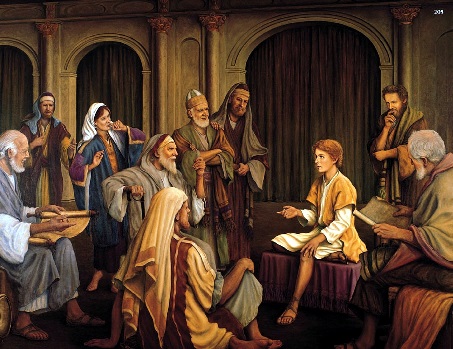
And when he was twelve years old, they went up as usual for the festival. When the festival was ended and they started to return, the boy Jesus stayed behind in Jerusalem, but his parents did not know it. Assuming that he was in the group of travelers, they went a day’s journey. Then they started to look for him among their relatives and friends. When they did not find him, they returned to Jerusalem to search for him. After three days they found him in the temple, sitting among the teachers, listening to them and asking them questions. And all who heard him were amazed at his understanding and his answers. When his parents saw him they were astonished; and his mother said to him, “Child, why have you treated us like this? Look, your father and I have been searching for you in great anxiety.” He said to them, “Why were you searching for me? Did you not know that I must be in my Father’s house?” But they did not understand what he said to them. Then he went down with them and came to Nazareth, and was obedient to them. His mother treasured all these things in her heart.
And Jesus increased in wisdom and in years, and in divine and human favor. — Luke 2:42-52
Those passages are the very last words written about the boy-wonder, Messiah-G-man for the next 17-years!
What is very odd, on the face very suspicious of his disappearance at this point in the Gospels is that with such apparent previous spectacle of the newborn King, heralded by a supernatural cosmic event — that summoned other kings/magi hundreds of miles away — forcing King Herod of Judea to slaughter hundreds or thousands of baby boys, of which is also not recorded by anyone in the province or region, especially by Roman historians or scribes, is that no one seems to care… with the exception of the Gospel copyists eight decades later. Obviously peculiar to say the least.
Those events also (three decades later recorded in the Gospels) have a 3-day 2-night lost Messiah-G-man (Luke 2:42-47), who mesmerized and dumbfounded Rabbis in the Temple, vanished and later into thin air with his parents Mary and Joseph supposedly to Nazareth, and did it right under the noses of hunting Roman authorities, Roman spies, and willing people to give up where this usurping King/Emperor of the Jews and enemy of Rome might hide for a hefty reward of sestertii or Roman coins. That was one of the common Roman ways to find criminals of the empire. Furthermore, Rome always, always got their criminals and would-be treasonous kings and queens. They were Rome’s and the emperor’s secret in the shadows eyes and ears: the Frumentarii. In the 1st-century CE they were otherwise known as well paid spies, henchmen, secret police, or undercover messengers, intelligence agents, if you will, and they were rewarded handsomely by giving up their target criminal(s). Here we have a very overlooked, unknown part of recorded Roman history going after would-be Jewish Kings to be.
Yet, this one single window of 17-years, but least understood and unprecedented failure of Roman authorities, spies, and willing rat-outs of a fugitive for sums of money, was in the history of 1st-century Roman policing, in reality renders the Gospels’ version of a young Jesus/Yeshua as bogus; it never happened, it couldn’t have happened, particularly in cases of major unrest or threats to the Emperor’s authority, e.g. the slaughter of infant-toddler boys, then the Roman army or a cohort would be deployed to apprehend criminals against the state! Jesus would’ve been no exception and soon discovered, arrested, and punished. Period.
Besides, by the time Jesus/Yeshua does return to Jerusalem according to the Gospels, there were already many Homeland Jews and Roman Gentiles who were more than happy to turn him in for money, lots of denarii from the emperor.
I cannot emphasize this tragic, historical, contextual mistake enough. I have studied the Roman Empire during the Late Second Temple period extensively for well over 30-years. This Messiah-G-man Gospel narrative is so highly improbable in the 1st-century Roman Empire or in its provinces that the Gospel narrative, or the lack of facts, simply makes the Gospels unequivocally unreliable. And the fact that the Gospels essentially (intentionally?) omit Jesus’ whereabouts is just more incriminating, damning evidence to their deceit. We are forced to dig deeper, more comprehensively into the historical Roman context surrounding this person/character Jesus/Yeshua because the four Gospels are (intentionally?) silent. Why?
Amazingly, all of this Earth-shattering Gospel news becomes un-news worthy! Basically, Messiah-G-man becomes the antithesis of starboy Messiah-G-man, the one and only Son of God who, as Billy Graham alludes, that the Scriptures revealed 6-7 centuries before! What is going on? Why would the Hebrews suddenly become completely apathetic to their coveted Messiah? Or more concerning, why do the Gospel authors ignore this anomaly numerous decades after Jesus’ birth and four more decades after his death? To cloud the story more the authors then offer vague, abstract fog where Jesus might have been and more puzzling… what he wasn’t doing!
There are five or six interesting theories of where and why Messiah-G-man, Jesus, deviated from his universal, divine mission. The fact that there are any theories at all speaks to the necessity for a theological (not logical) explanation for God’s one and only (not so busy) Son. Consider these theories by historical and biblical scholars:
All of these theories have one thing in common: conjecture. Yes, even the most popular explanation that Christian apologists offer — that he stayed in Nazareth as a normal ho-hum boy doing carpentry while greatly wasting his “divine” talents — is ultimately creative Greek imaginations with insufficient or the thinnest of any corroborations. For the reasonable, logical Christian this mystery should give serious pause even shock, to put it mildly.
Before one goes selling the farm, the kitchen sink, and all royalties for such a profound life-altering FAITH-future decision for Christ, let’s step-back, put on a neutral thinking-cap, look under the rugs and behind the curtains and consider everything. There are some major incongruencies, fallacious logic, Scriptural apathy, and distorted history with this monumental mind-numbing claim of incarnation. I want to cover it, or uncover it. It starts with a gross distortion of Hebraic history and principles within the pinnacle of the mighty Roman Empire.
Understanding earliest Judeo-Christianity, the movement named “The Way” by followers of Yeshua the Nasorean [sic] in the 2nd century CE, cannot be fully understood without first understanding the riff between Roman client-King Herod — with his and Rome’s harsh oppressive rule over unruly provinces and dissidents — and the obstinate Jewish sectarian people of Samaria, Perea, Galilee, Iturea, and Idumea. One could say these acute Roman policies created a powder keg atop matches and nitroglycerin. Let me set the scene.
Hebraic Principles Into Esoteric Obscurity
With Second Temple Judaism there existed unique principles and philosophies distinct from old Israelite Judaism (polytheism) and compared to other Near and Middle Eastern religions of the time. The Hebrew word Mâšîah or Messiah, could mean priest, prophet, or king. During the 6th-century BCE while exiled in Babylonia, the ancient Jews began hoping for, wanting, and anticipating a special Anointed One to restore them into Israel. Then in 539 BCE the Persian king Cyrus allowed them to return to Israel. In the early stages of the 1st-century BCE, Jews were once again conquered and suffered harsh repression at the hands of the Greco-Seleucid Empire. Bitterness, rebellion, and hope for that special Anointed One rose again desperate for an independent Jewish kingdom.
Next came the Roman Republic in 192 BCE pushing the Greco-Seleucids to the far-eastern reaches of Asia Minor. Jews were once again repressed, bitter, rebellious, and in desperate want of restoration to a sustained independent kingdom. During this period Jewish Messianism took on complex dual or triple meanings and interpretations because Israel (and their God?) was repeatedly defeated and kept falling under foreign rule. Some Jews believed the Anointed One would be a great military king. Others believed he would be a purifying priestly Son of Man to judge humanity, while still others believed he would have to be a prophet, teacher, and commander. Many Messianic forms developed during the four major Jewish exiles (i.e. a Personal Messiah), however, during these periods none of them are fully understood outside of Judaism. Jewish Messianism becomes increasingly esoteric and obscure to the rest of the world, especially the world of Greco-Romans. Enter a progressively heavier Hellenistic rule and influence on Judaism. Meanwhile, Jews everywhere are now gasping and craving their Anointed One.
Rome’s Rise: Republic to Imperial Apex
From 3,900 sq. miles in 326 BCE as a small Republic to 2.5 million sq. miles in 117 CE, the splendor and spectacle that was the Imperial Roman Empire reached its majestic pinnacle during the Five Good Emperors. Scholars of early Antiquity maintain that Rome’s ascendency to a Republic and world power is attributed to three sociopolitical developments and organization of the 1) Citizen Assembly and Military Assembly, 2) the Senate consisting of Patricians and Plebeian Tribunes, and 3) the prestigious Consuls. Until 27 BCE this Greco-Roman form of representative government with efficient support of military legions, navies, and generals prepared the way for Rome’s rise and expansion across the entire Mediterranean.
For our purposes here what is important to understand is the Republic of Rome’s established 500-year foreign provincial policy. The vanquished people and province under the victors remained free socially, if they remained peaceful, and paid regular tributes to Rome. In return they’d receive protection and social-political order. Riot or incite civil discord and Roman retribution was swift and severe. What did the Jewish people generally experience under Rome’s heavy hand? More historical context first.
Fall of the Hasmonean Dynasty
The collapsing Seleucid Empire to the Roman Republic and Parthian Empire created a balancing of powers surrounding the Hasmonean Kingdom from c. 140 to c. 116 BCE until they enjoyed full autonomy in 110 BCE. At that time the Hasmoneans consolidated Samaria, Perea, Galilee, Iturea, and Idumea forming what some scholars call the Kingdom of Israel. For around 70-years the Hebrews and orthodox Judaism flourished along side influences of Hellenic Judaism from Alexandrian rule, then Roman conquest in 63 BCE. Due to these theocratic sociopolitical differences between Hyrcanus II, Salome Alexandra, and Aristobulus II, the Hasmonean Dynasty sank into civil war and disintegrated, but not before some Hebraic principles and Messianism became fixed.
Maccabean-Hasmonean Judaism believed in one single, indivisible, unsynthesized God. It explicitly rejected polytheism, dualism, and trinitarianism, which are incompatible with pure monotheism as Judaism teaches according to their Tanakh. Hellenic forms of Judaism, e.g. Philo of Alexandria, are more liberal with attributes of God sometimes referred to as Shituf. These beliefs greatly distinguished Judaism away from the other Near and Middle Eastern religions.
Animosity, Death, and Herod’s Sons
On some small or great level most everyone is familiar with King Herod the Great. Whether one considered Herod I great or ruthless depends on the point-of-view. From a infrastructural and development standpoint, Herod accomplished many projects including his most magnificent, the port at Caesarea, considered a great engineering marvel, even by modern standards.
From a social standpoint, he was held in bitter contempt by his subjects, especially by the orthodox Jews for his everything-Greek appetite and favoritism and worse, his several transgressions of Mosaic Law. Though King Herod considered himself Jewish by his father and by politically marrying Hasmonean princess Mariamne and starting royal lines of Herodian Judaism, the orthodox Sadducees and Pharisees considered it suspect at best. Herod had also dissolved and curtailed the Sadducees influence within the Sanhedrin and had placed an unusually high taxation rate on the people and often reverted to violence and mercenaries to maintain civil order and thus fueling a deeper animosity toward him. By the time of Herod’s death in 4 BCE, civil peace was quite volatile and disobedience to Rome was fever pitched.
Herod’s three sons inherited a kingdom ready to boil over.
Rising Anti-Semitism: The Jewish-Roman Wars
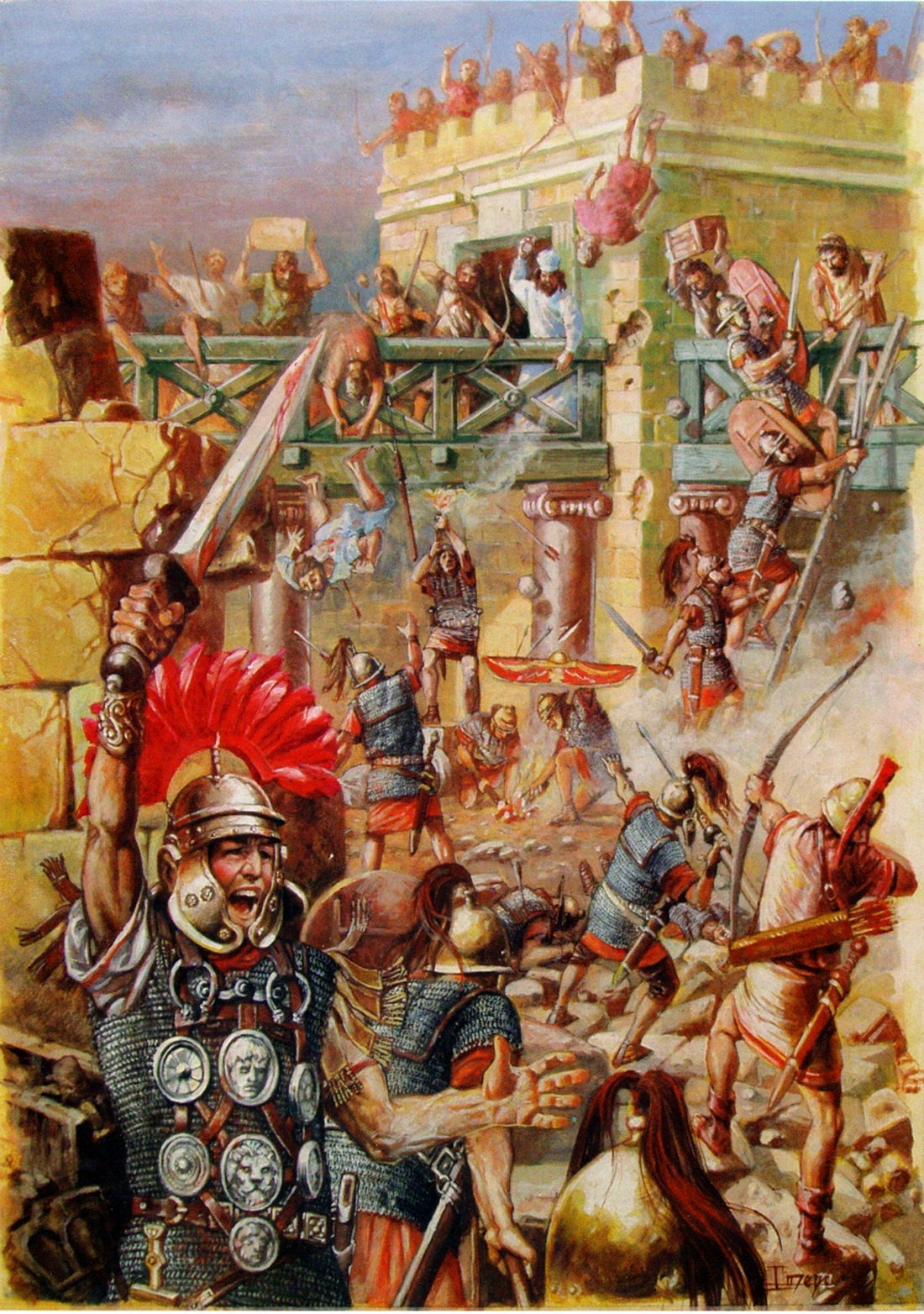
Disdain toward conquered barbarian cultures was not unusual in Antiquity so labeling earliest Jewish conflicts should be considered part of a wider military and sociopolitical picture. But from the time Roman general Pompey intervened in the Jewish civil wars in 66 BCE, sectarian Judea and Israel were in escalating conflict amongst themselves and with the Romans. Frustrated Prefects and Procurators could not comprehend the strange Jewish customs. Civil flare-ups and strife, which the Romans regarded as petty, would cause an uproar among the Jews. When Pontius Pilate moved his two Auxiliary Cohort units from Caesarea to Jerusalem to enforce order, in protest to effigies of Emperor Augustus on Roman military standards, a large group of Jews walked 70-miles to Pilate’s house in Caesarea to encircle it by laying themselves on the ground for five days. Why? It violated Moses’/God’s Second Commandment. It can be argued convincingly that the Jews never truly appreciated, felt they were, or intended to be under Roman command or rule. Anti-Semitism rises even more.
Although Rome clearly had every military, economic, and political advantage in suppressing rebellions and levying heavy taxes, orthodox and zealot Jews still wanted to fight. Discord, resentment, and revolt continued to rise in Galilee, Samaria, and particularly in Judaea, and still the Jews sought to fight. Between 19 CE and 160 CE Philo of Alexandria, Josephus, Suetonis, and Cassius Dio all report increased intolerances, punishments, and expulsions toward the Jews. The hostilities eventually led to the sacking of Jerusalem and destruction of the Temple in 70 CE followed by crushing of the Bar Kokhba revolt in 132-136 CE. The aftermath of these multiple Roman victories are what many scholars argue as the biggest historical, philosophical, and fragmentary swerve-threshold of all Judaism until the atrocities of 1933-45 Nazi Europe.
Meanwhile, Roman religions and cults had different interpretations of the divine, both in an afterlife as well as on Earth in this life.
If there is one concept that all ancient Mediterranean civilizations understood from the Bronze Age, through the Iron Age, Prehistory, to early Post-classical history, it was apotheosis. Call him Heracles, Hercle, Hercules, or Caesar, the deification of great demi-god men was very commonplace. The mixing and transformation of apotheosis over time and military conquests were also commonly practiced. This was the case with the sheer size of the empire the Roman Legions were vowed to protect and defend against foreign enemies. One of the popular cults of the eastern legions in contact with the Persian culture was Mithra.
Roman Mithraism
Despite there being no direct evidence that 2nd and 3rd century CE Christianity and Mithraism were influenced by each other, there are remarkable similarities. For example, most historians and biblical scholars know and agree that Jesus was not born in winter in late December. Mithra was born of a virgin December 25th and visited by Magi. There are also similar themes in doctrine and practices such as salvation, the symbolism of water/baptism, and followers had a sign or mark symbolizing Mithra like Christians had the cross or fish.

Other similarities between Mithraism and early Christians included pursuing abstinence, celibacy, and self-control to be among the highest virtues. Likewise, both had comparable beliefs about the world, eschatology, heaven and hell, and the immortality of the soul. Their ideas of battles between good and evil were similar (though Mithraism was more dualistic), included a great and final battle at the end of times, similar to Zoroastrianism and as will be explored next, similar to outlying Jewish sects (Qumrān) divergent from the Pharisees and Sadducees inside Jerusalem. Mithraism’s flood at the beginning of history was deemed necessary because, according to Mithraic eschatology, what began in water would end in fire. Both cults believed in divine revelation as key to their doctrine. Both awaited the last judgment and resurrection of the dead. Coincidence?
Roman Records and Qumrān Scrolls
Most modern historians, even non-Christian less-biased historians, agree that a great Jewish Rabbi/teacher and reformer named Yeshua, or Jesus, did exist. This is often referred to as the historical Jesus. However, where the historicity of Jesus is concerned — the consideration of non-Christian sources to construct who this controversial Jewish figure was and authenticate what his intent and reforms consisted of — there is no one single unanimous picture, and contextually not even from the Gospel accounts. Personally, I do not give as much credibility to Roman-Jewish (Hellenic) sources such as Flavius Josephus or Saul of Tarsus, another Roman-Hellenic (Herodian?) Jew. To align with the Historical Method, Jewish or Christian sources must be taken with a fair amount of caution. Therefore, what are we left with when Christian, Judeo-Christian, and Roman-Jewish-Hellenic sources are removed as biased or partially biased? Answer: purely Roman or non-Jewish, non-Christian sources.

Under these guidelines there exists only one purely Roman, valid, neutral source about a man named Jesus. It is by the Roman historian and senator Tacitus in his final work, Annals, completed c. 116 CE. It is essentially a short fact-sheet only, mentioning a wise Jewish king that was crucified by Pontius Pilate, and there were a small band of Hellenic-Christians living in Rome. However, as mentioned before this only validates a historical Jesus, but not the historicity or nature of Jesus. There are a handful of very minor references, but all of them concern Christians in general, or one dissident in Rome named Chrestus, and not the enigma, Rabbi/Reformer or failed Messiah named Jesus. For some relevant historicity about the man Jesus/Yeshua and his anti-Temple sectarian ties, we can however, utilize the Dead Sea Scrolls.
The historical background of the Qumrān Scrolls give us an unprecedented, invaluable broad context into Jesus’ critical last years in Judea and Jerusalem and a backdrop litmus-test to the canonical New Testament, namely the Gospels and Apostle Paul, and to all Jewish and Christian sources regarding Jesus.
[The Dead Sea Scrolls] further our knowledge of ancient biblical interpretation and the effect of historical events on religious life and ideas. The texts shed light on philosophical disputes about issues such as the Temple and priesthood, the religious calendar and the afterlife. More practical disputes were focused on everyday law and observance. — The Leon Levy Dead Sea Scrolls Digital Library
Of particular interest is Robert Eisenman’s theories drawn from the Qumrān Scrolls where he names James, the brother of Jesus, as the Teacher of Righteousness (from the Damascus Document), the Wicked Priest (from the Habakkuk Commentary) as High Priest Ananus ben Ananus, executioner of James, and Paul/Saul as the Man of Lying, or the one teaching false doctrines and misleading theology about a kingdom built with blood. Eisenman also labels Paul/Saul as Herodian, an influence that easily renders his Christology favorable to Hellenistic Gentile Rome instead of to James the brother’s Torah-based Messianic version, and evidenced by Paul’s numerous tensions and near-death encounters with the Pillars of the Jerusalem Council and Homeland Jews (Acts 9:23-25 in Damascus and Acts 21:26-32).
Another renown expert on the Qumran Scrolls and Second Temple Judaism is what Dr. Lawrence Schiffman has concluded after his life’s work. Being a leading scholar of the Dead Sea Scrolls he analyzed and surveyed the contribution of the Scrolls, compares the Jewish legal position of the authors of the scrolls to that of the Pharisees and early-Christians, then demonstrates how early-Christianity deviated from the fundamental beliefs of Judaism and why Christianity was rejected by Jews, but accepted only by Greco-Roman non-Jews. Here is the link to Dr. Schiffman’s outstanding lecture on the falsifying and hijacking of Jesus’ heritage, teaching, and reforms. Click here.
When external independent (non-Christian) sources are included in the overall picture of Judea, Rome’s impact and influence, along with the Dead Sea Scrolls, it becomes obvious why the Jewish-Roman War was building to a climax. This was Jesus’ world that you cannot read in the Gospels.
As alluded to above, Roman anti-Semitism was ever-present across the empire and its volatility was increasingly recorded in Roman literature as early as the 1st-century BCE. Politician and lawyer Marcus Tullius Cicero in his Pro Flacco writes derogatory remarks of Jews as “barbara superstitio” which translates, Jews were unpatriotic, sacrilegious, backward, and alien. Tacitus also writes his anti-Jewish sentiments during the Jewish Revolt of 70 CE saying they are perverse, corrupting, too wealthy, cliquish, and out-breeding true Romans!
Philo of Alexandria recorded that one of Tiberius’ lieutenants, Sejanus, was likely an instigator of anti-Semitism with many Roman soldiers. What is abundantly clear throughout the Roman and non-Roman records is that until the 3rd and 4th-century CE, Rome did not tolerate any level of rebellion or dissidence among her conquered foreigners. Consequently, with the incessant Jewish sectarian zealous elements in Syria-Palaestina and around Jerusalem (as the Jerusalem Talmud records), Roman legions destroyed the bulk of sectarian Judaism by 136 CE, including those opposed to the Temple Priesthood in Jerusalem, e.g. Qumrān and Masada. This little-known historical context is important to note because the outlying Jewish sects — indirectly mentioned in John 8:37-39; 44-47 and Acts 7:51-53 also alluded to in the Qumrān Scrolls — are the ones that offer modern historical and biblical scholars a required contrast to Hellenist-Herodian Judaism, which composes most of today’s Christian (anti-Semitic?) canonical New Testament.
“The original apostles and followers of Jesus, led by James and assisted by Peter and John, continued to live as Jews, observing the Torah and worshipping in the Temple at Jerusalem, or in their local synagogues, while remembering and honoring Jesus as their martyred Teacher and Messiah. They neither worshipped nor divinized Jesus as the Son of God, or as a Dying-and-Rising Savior, who died for the sins of humankind. They practiced no ritual of baptism into Christ, nor did they celebrate a sacred meal equated with ‘eating the body and drinking the blood’ of Christ as a guarantee of eternal life.
Their message was wholly focused around their expectations that the kingdom of God had drawn near, as proclaimed by John the Baptizer and Jesus, and that very soon God would intervene in human history to bring about his righteous rule of peace and justice among all nations. In the meantime both Jews and non-Jews were urged to repent of their sins, turn to God, and live righteously before him in expectation of his kingdom.” — James Tabor, Paul and Jesus: How the Apostle Transformed Christianity, pp. 24-25
Enter the Hellenist Saul of Tarsus. As everyone knows, Saul/Paul never met Jesus face-to-face or followed him or learned from him first-hand during Jesus’ ministry in Syria-Palaestina. Everyone also knows that when he arrived in 1st-century Judea and Syria he was there to persecute earliest Jesus-followers. Paul’s initial version of Judaism was from the Hillel school and it taught a Hellenistic balance between classical literature of the Stoics, philosophy, and ethics. This would have been frowned upon (loathed?) by the outlying Jewish sects such as the Essenes, Ebionites, and that preached by John the Baptist. For Saul/Paul that drastically changed while on the road to Damascus and his 3-years spent in Arabia. This is an odd mention; peculiar. Three years spent in Provincia Arabia during the reign of Tiberius (14-37 CE), a wealthy Nabataean client-kingdom for Rome with trade routes through Persia to India and China and obviously, according to Galatians 1:16-17, had some type of pivotal importance to Paul before beginning his own mission of Christology. To even be mentioned, it suggests it led to Paul’s overhaul of the failed Earthly Jewish Messianic kingdom (Jesus’ execution) into an other-worldly kingdom. And all of the disciples/Apostles, including pseudo-Apostle Paul, expected this other-kingdom to happen in their lifetimes.
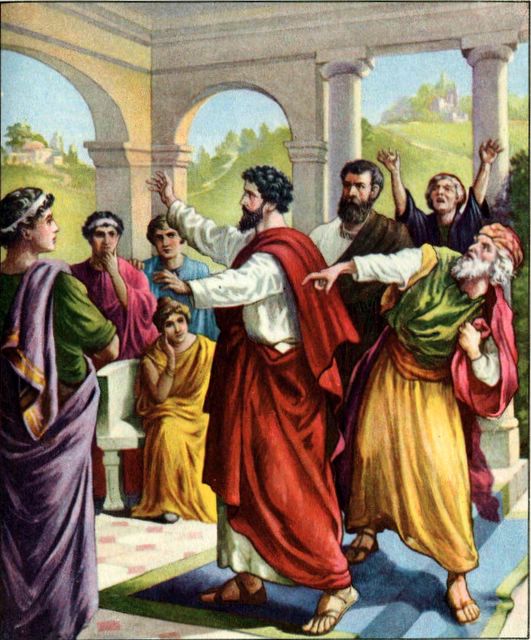
Was Arabia where the true pure kingdom of God and the nature of Jesus found? Personally, I think it requires consideration. In fact, the full spectrum of Roman, Jewish sectarian, Judeo-Christian, Hellenist Christian, and secular historical and archaeological sources (i.e. Independent sources) currently do NOT support it for lack of sufficient evidence. Although with Rome eliminating most outlying Jewish sectarians and annexing the Nabataean Kingdom in Arabia, Rome favoring Herodian-Hellenistic Judaism, and increased intolerance of earliest “the Way” Judeo-Christians, Pauline Christology was nicely poised to fill the voids for social peace. And along with the struggling hopes amongst despairing, over-taxed mainline Jews and their Diaspora brethren in the wake of brutal Roman legions, as well as lowly widowed or enslaved Gentiles (who never grasped Judean Messianic doctrines in the first place), an open, inclusive Pauline Christology more easily supersedes Jesus’ failed kingdom of God!
Let’s revisit Rome.
The pinnacle of the Roman Empire is considered to be 117 CE when it reached its largest in size and most prosperous economically. After the Five Good Emperors (96 – 180 CE), as it is known by scholars, the Empire began its slow and steady decline. From the Severen Dynasty, to the Imperial Crisis of the Third Century where over 20 emperors came and went in less than 50 years (235-284 CE), until Aurelian and Diocletian temporarily reunited the Empire until 285 CE when Diocletian split it in half — it was still too vast to efficiently administrate. Following the retirement and death of Diocletian in 311 CE, he had decreed two successors: Maxentius and Constantine. Both generals plunged the empire into chaos and civil war again. As most of us know, Constantine defeated Maxentius at the Battle of the Milvian Bridge in 312 CE. He became sole emperor of both the Western and Eastern Empires until 337 CE.
During the 3-plus centuries between Emperor Tiberius (14 CE) and Constantine (337 CE), the small floundering Jewish reform movement The Way, but transformed by Paul’s Christology was growing within the empire and with four contributing events became Rome’s official religion by decree of Constantine’s Imperial endorsement. This is the real factual catalyst of Christianity, or Pauline Christology.
Emperor Constantine I
Asserting that Christ was responsible for his victory at the Milvian Bridge, Emperor Licinius and Constantine began a series of laws (e.g. Edict of Milan) giving legal tolerance for all religions and favorably to Christianity. As many Roman emperors had done in the past, claiming deification to supplement their status and authority, Constantine chose the Hellenistic Christ in which the Apostle Paul promoted to Gentiles. At the First Council of Nicaea (325 CE), he officiated over the theological codifying and standardizing of Christianity with assistance from Church Fathers, and distinguished important issues of Jesus’ divinity, nature, and which testaments were more aligned with the God-Son.
Constantine was a cunning general and by reforming the military, revaluing the currency, enacting social-welfare and political reforms, building projects as well as renaming Byzantium to New Rome (modern-day Istanbul) which soon became Constantinople, he stabilized the Empire. Soon after his death, however, the Roman Empire sank into civil war and decline yet again.
Emperor Theodosius I

Three emperors later Theodosius (379 – 395 CE) reinstated Constantine’s and Jovian’s reforms and took them much further. He outlawed pagan worship throughout the empire, closed all schools and universities, and converted pagan temples into Christian churches. Theodocius’ religious reinstatements and reforms were controversial and unpopular among Rome’s aristocracy and middle-class who still held traditions in paganism. They saw the emperor’s edicts institutionalizing Christianity and removing the gods from the Earth and society and replacing all of it with one God ruling from heaven. While attending the Nicaean Council bitter debates ensued between Theodosius and disciples of the Nicene Creed (Christ is the same as God the Father), against other Arian groups in the empire. Highly motivated to promote orthodox Christianity, Theodosius surpassed the ecclesiastical authorities and stamped the binding Imperial creed of the consubstantiality of God the Father, Son, and Holy Spirit (Trinitarianism). Henceforth those followers were to be considered Catholic Christians. It is safe to say, Theodosius began the principle of religious intolerance at the second ecumenical council in 381 CE, or Niceno-Constantinopolitan Creed.
But the fight between Arianism vs. Trinitarianism was not over. The official canon of the Christian Bible was only finalized over three more progressions: 382 in Rome, 391 the Vulgate, and 397 CE in Carthage. The confusions and debates about Christ’s nature, particularly his Incarnation (Monophysitism vs. Dyophysitism), took another 34-years to legalize at the Council of Ephesus in 431 CE! And guess what? The fight did not end. By 451 CE the Hellenistic Christian Church split. In the Eastern portion of the remaining empire formed the Oriental Orthodox Churches and in the doomed Western portion of the crumbling empire formed the Roman Catholic Church.
A Quick Summary
By the end of the 5th-century CE in Western-Eastern Mediterranean history Jesus’ original Jewish Messianic reforms were so lost and convoluted by wars, Pauline Christology, sectarian genocide, and centuries of sociopolitical upheaval throughout the vast Roman Empire. In all directions from 2nd to 5th-century CE Jerusalem, the true nature and revelations of outlying Jewish sects opposed to the Second Temple Priests, such as the Essenes, Ebionites, Mandaeans/Nasoreans, and Samaritans (of which Jesus favored; Luke 10:33; 17:16; John 4:39), could not be glimpsed or gleaned until the 20th-century CE with discoveries such as Nag Hammadi, Qumrān, and more.

By the end of the 5th-century CE almost all of the ecclesiastical authorities in Christendom had forgotten, overlooked, or ignored the fact that this all-powerful, all-knowing God who wanted to reconcile and restore (Messianic undertones) all of humanity, not just the Jews, and came in the flesh in a human body under a phenomenal celestial Star seen for at least 500-miles in every direction, according to His perfect plan! But for only 12-years; as an impressive teaser, if you will.
This same God in the flesh then decides that 17-18 years of supposedly ho-hum nothingness, doing preparatory work of “carpentry(?)” in a tiny insignificant town, was more important than restoring and saving humanity. A change of divine plans? Why? You are the living God in the flesh with all the power in the known universe! Or was it Jewish bar Mitzvah traditions for a boy into a man? But that would be quite human, quite Jewish, and quite petty when considering the salvation of all humanity.
This begs the question or questions… was 1st-century Jesus/Yeshua — who John the Baptist, James his brother, and Simon/Peter knew well — not who he became to Saul/Paul in a blinding light on the Damascus Road and in Arabia? Was 1st-century Jesus/Yeshua not who he became after the deadly Jewish-Roman Revolts? Was 1st-century Jesus/Yeshua not who he became during the internal conflict, corruption and decline of the Roman Empire up to Constantine? And was 1st-century Jesus/Yeshua not who he had become to Theodosius and the many ecclesiastical Councils up to 451 CE? Given these widespread rampant controversies and confusion, wouldn’t a full 32-34 years of life for Jesus/Yeshua to clarify exactly his nature and what solution was needed to restore one’s self and all of humanity to God’s “loving kingdom” been a better approach? Why even waste 17-years? Or was there something about Jesus that required hiding?
Because the concept of Incarnation is a retro-active scriptural and ecclesiastical reacting to evolving conundrums. Jesus was not God Incarnate and not His one-and-only Son. The true verifiable, extant history of Jesus the man and Paul’s Christology (both explicit and implicit), contrasted with the torturous labyrinth of Hellenistic apotheosis theology, as I’ve hopefully shown here, has in the end shown itself to be quite outdated and bogus non-sense.
If there is no divine, miraculous God-man called Jesus Christ, then what is Christianity?
∼ ∼ ∼ ∼ § ∼ ∼ ∼ ∼
Further information — Dr. Richard Carrier is a renown historian, philosopher, and author specializing in contemporary philosophy of naturalism and secular humanism, as well as in Greco-Roman philosophy, science, and religion, particularly on the origins of Christianity. He attained a Master’s and Ph.D. in Ancient History from Columbia University and Bachelor’s from the University of California, Berkeley. He is also a prominent defender and advocate for American Free-thought and Intellectualism. What I like most about Dr. Carrier’s approach to Christian Fundamentalism and the origins of Christianity — e.g. his book “On the Historicity of Jesus” — is his meticulous use of historical methodologies and mathematical probabilities with incorporations of Agnotology, another discipline I am very fond about.
I thought his YouTube presentation here at the Center for Inquiry Canada in Toronto, CA about “Why the Gospels are Myth” would be a good final close. It is a 1-hour 28-min presentation and examination, but well worth it in my opinion because as I mentioned before he incorporates several various disciplines and sources.
(paragraph break)
This work by Professor Taboo is licensed under a Creative Commons Attribution-NonCommercial-NoDerivatives 4.0 International License.
Permissions beyond the scope of this license may be available at www.professortaboo.com/contact-me/.
Divergent Thoughts on Life, Love and Death
life and other weird stuff
Seeking Dialogue to Inform, Enlighten, and/or Amuse You and Me
Storytelling, short stories, fable, folk tales,...
Writing writing and more writing
Analysis & Discussion For Political Uncertainty
I have zero expectation that anything I ever say will end someone’s belief in their God. Not my goal or purpose. That alone belongs to the individual. ~ Zoe
A photo journal of my interests from one extreme to the other.
Cogito Ergo Sum
by Wendy Waters
Understanding the psychology that drives our politics
Ponder(verb) to weigh in the mind; to view with deliberation; to examine carefully; to consider attentively
writing on human security
Living and Learning
Some prefer the comfort of Faith. I prefer the cold, hard Truth.
By Keith Goode aka Ken Thackerey
I don’t want to start a class war; it started a long time ago and, unfortunately, we lost.
Questioning the conventional wisdom
Don't ask me to be an idiot
Exploring the mystical and rational while expanding common spiritual ground among caring people

