(paragraph separation)
 “What deeds of power are being done by his hands! Is not this the carpenter, the son of Mary and brother of James and Joses and Judas and Simon, and are not his sisters with us?” — Mark 6:2, 3
“[Mary] will bear a son, and you are to name him Jesus, for he will save his people from their sins. All this took place to fulfill what had been spoken by the Lord through the prophet: ‘Look, the virgin shall conceive and bear a son, and they shall name him Emmanuel,’ which means, ‘God is with us.’” — Matthew 1: 21-23
(paragraph separation)
(paragraph separation)
Like the day we discovered that our childhood belief in Santa Claus and his flying reindeer, or Peter Pan and Tinkerbell were really folklore and not real, archaeology has recently shown that the “Jesus” of the Christian New Testament has been greatly dramatized and intentionally mystified.
One spring afternoon in 1980, in Talpiot, south Jerusalem, construction workers uncovered a tomb dating from the 1st century CE. Archaeologists from the Israeli Department of Antiquities (IDA) and Israeli Antiquities Authority (IAA) were called-in to excavate the tomb, including then surveyor Dr. Shimon Gibson, today archaeologist and senior fellow at the Albright Institute of Archaeological Research. Found inside were ten ossuaries or limestone boxes used in 1st century Jewish burial practices to store the bones of deceased family members. This practice stopped in 70 CE after the Romans destroyed the Jewish Temple, Jerusalem, and slaughtered most of the Jewish inhabitants.
During this modern period of the 1980s, many ancient burial sites were being uncovered, and in some cases destroyed due to the widespread expansion and development of Jerusalem. Exposing such tombs was typically common and uneventful. However, this particular Talpiot tomb turned out to be quite different. When archaeologists began examining the ossuaries, they found inscribed on one the phrase “Yeshua bar Joseph” written in Aramaic. Translated, this means Jesus son of Joseph.

Talpiot Tomb Jerusalem in 1980
The IAA archaeologists would have found nothing extraordinary by this phrase. Yeshua was a fairly common name in 1st century Jerusalem and Joseph was even more common. Hence, the phrase does not necessarily mean this particular ossuary belonged to Jesus of Nazareth of the Christian gospels. A much more thorough examination and investigation of the coffin and family tomb was required. What other discoveries might make this tomb and Yeshua/Jesus ossuary more than ordinary?
The New Testament gospels tell us that Jesus/Yeshua was the son of Joseph and Maria (also Mary). What many do not know is that according to earliest Christian traditions, i.e. those decades just after the crucifixion and prior to canonization, Jesus had two sisters: Salome and Miriam. The Gospels of Mark and Matthew state that Jesus had four brothers: Joseph, Judah, Simon, and James. Jesus’ mother Maria/Mary died, according to early Christian traditions, in Jerusalem. Of known Jesus family names, six of them were found inscribed on six different ossuaries in the Talpiot tomb. On another ossuary in the tomb was found the name: Maria or Mary. Now these names combined make the family tomb more than ordinary!
Throughout 1st century Israel and Judea, Latin was the spoken and written language of the Roman Empire along with the native languages of Hebrew and Aramaic. Greek was also used – the region not only was placed in an ideal location of trade in the eastern Mediterranean Sea, but was also conquered several times by several empires of various languages. On the streets of 1st century Jerusalem one would have heard daily business conducted in any of these four languages. In the Gospel of Mark, the oldest of the four canonical gospels and written in Greek, the Virgin Mary or Jesus’ mother, was in only one form: Maria, a Latinized form of the Hebrew Miriam. Following the death of Jesus, his teachings were continued by family members including his mother Maria. As the teachings became more popular, more Roman converts joined the social-welfare movement. As a result, Mary’s name became Latinized. Written in Hebrew, the name Maria is extremely rare. Now the Talpiot tomb becomes even more intriguing.

Yeshua bar Yosef/Jesus son of Joseph ossuary and inscription
If archaeologists had uncovered a family tomb of ossuaries with inscribed names of Yeshua bar Joseph and Maria in the same tomb, what other names might be found on the other eight ossuaries that could tell us who the tomb’s family might be?
On a third ossuary was found the name Matia, a short-form or nickname for Matthew. At first glance this name wouldn’t quiet fit the genealogy of Jesus or his father Joseph. Jesus had no known brother named Matia. However, this only seems out-of-place if scholars strictly follow paternal generations. Over on the mother Mary’s side in the Gospel of Luke chapter 3, can be found many Matthew’s, or Matia’s, Matthat, Matthathiah, Maath, Mathathias, Matthatha, all representatives of Jewish priestly names. And not so coincidentally this correctly follows Jewish traditions of a kingly and priestly Messiah, or Saviour foretold in the Jewish scriptures. Finding an ossuary with the name Matia in the same family tomb as Maria is not at all unusual.
If an inscribed name of Isaac, Jacob, Daniel, Jonah, Zachariah, or some name that in no way fits the family of Jesus son of Joseph, and Maria, then the fascinating discovery of this Talpiot tomb would be over and there would be nothing shocking to report. This sort of name on just one of the ossuaries would disqualify it as the tomb of Jesus Christ of the gospels. However, there are no such names or ossuaries found in the tomb which seem out-of-place. The Talpiot tomb actually does deserve a more precise and thorough examination.
On a fourth ossuary from the tomb was found inscribed the name Jose, a very rare Hebrew nickname. As mentioned earlier, Joseph was a very common Jewish name. Yet, only in the Gospel of Mark, the first and oldest known written gospel of Jesus, is there mentioned a brother by the nickname Jose. Of all the ossuaries recovered during excavations and constructions sites for the last 25+ years in and around Jerusalem, only one ossuary has ever been found with the inscribed name Jose. It was found inside the Talpiot tomb and matches the same spelling found in the Gospel of Mark. Now four pieces of ten in the tomb fit logically together within the Christian gospels and early traditions. Is that coincidence?
The four names of Yeshua/Jesus bar Joseph, Maria, Matia, and Jose found on ossuaries from 1st century Jerusalem, by themselves or separate are again common names of the period. But up to this point what are the statistical probabilities of the four names being found in one tomb which also correlate with the Christian gospels and early Christian traditions? Dr. Andrey Feuerverger, a statistical expert at the University of Toronto’s department of mathematics and statistics addresses this question.

Dr. Andrey Feuerverger of the University of Toronto
Feuerverger has compiled every single name from all ossuaries and other sources in the region from the period of Jesus’ life. By calculating how often all the names are used Feuerverger can statistically test the names found in the Talpiot tomb. Dr. Feuerverger emphasizes that examining all the names individually, as if they were found in various locations, then in that way nothing at all strikes you as peculiar. But the correct way to look at this tomb is to take the names in unison. Feuerverger explains that according to statistics, if you were to shout out the name Yeshua/Jesus on the streets of 1st century Jerusalem, 4% of the men would respond. If you were to shout out Maria/Mary, about 25% of the women would answer. But if you were to shout out the name Jesus, with a father named Joseph and a mother named Mary, and a brother named Jose, the odds of that individual answering are remarkably low. Dr. Feuerverger explains these statistical probabilities further:
“From a statistical point-of-view, we don’t actually look at the incidences of the individual names, where we say each one of them is a very common name. We look at the way in which the factors combine with each other; so sure, a father by the name of Joseph is not a rare name. A son by the name Yeshua is not a rare name. But when you combine those two together it’s rarer; so it really is a possibility that this particular tomb-site is in fact the one of the New Testament family. It is a possibility that I think needs to be taken seriously.”
Up to this point we have at least 5 pieces of evidence that combined, logically gives plausible compelling weight that the Talpiot tomb could be the family tomb of Jesus from the Christian gospels.
- The tomb is in nearby Jerusalem, where Jesus was crucified and buried according to the New Testament.
- The tomb follows precisely 1st century Jewish burial practices, which over time include close family members.
- The ossuaries inside Talpiot are identified correctly as was Jewish law and practices of the 1st century.
- The four names identified so far on 4 of the 10 ossuaries all reasonably fit together according to the Christian gospels and known early Christian traditions.
- The statistical probability of the four New Testament names being all found in the same family tomb are very rare according to Dr. Feuerverger.
With these five strong pieces of evidence, anyone in their right mind must be compelled to examine Talpiot to its comprehensive conclusion. But there are bound to be fundamental denials that this is not, or could not be the bones, ossuary, or tomb of Jesus and his family, and they reach this conclusive denial before all the evidence is examined. Let’s be responsible and avoid that sort of tunnel-vision.
New Religion or Messianic Reform?

Roman destruction of Jerusalem 70 CE
For several decades now since the discovery of the Dead Sea Scrolls and other scriptures found from Antiquity, archaeologists, forensic scientists, and both secular and biblical scholars have argued whether Jesus intended to start an entirely new religion separated from and against his Jewish heritage, or if he merely intended to reform it – keeping it rooted in Judaism. This debate has been very heated because of two primary reasons: 1) In 70 CE the Roman authorities had grown especially annoyed with Jewish uprisings and civil rioting; they destroyed the Temple, Jerusalem, and wiped out those people participating in insurrections…including followers of the Jesus Movement. And 2) after the few remnants of the movement went underground, their written stories and worship-gatherings about Jesus were also hunted down and destroyed. This went on for some 200 years until Emperor Constantine legalized the Roman-Greco version of the Jesus Movement to unite his crumbling empire (see Constantine: Christianity’s True Catalyst/Christ for more details). Therefore, until the late 19th and 20th centuries when many “other” (non-canonical) stories of Jesus and his movement were found, the world had only ONE version, one story of Jesus and his first followers: Constantine’s Roman-Greco version.
Interestingly we find today in the canonical gospels that Jesus’ followers and disciples were often confused about what Jesus was trying to carry out for his people. Or were they? Historical and biblical scholars today agree that the four synoptic gospels in today’s New Testaments are simply testaments attributed to those four disciples, not literal quotes and single-authorship. In contemporary literature, that method of Roman-Greco writing would be categorized as inspired-from…and certainly for those authors and co-authors scribed through a Roman lens. Scholars and linguists know today any narratives, historical or contemporary, are from some level subjective.
Unfortunately for anyone living post-70 CE and pre-325 CE and listening to so many conflicting teachings, e.g. James the brother of Jesus versus Saul of Tarsus, or the Apostle Paul of Roman-Jewish heritage, was indeed confused about what Jesus was really trying to do! Yet, most scholars are in agreement now that there wasn’t necessarily confusion about whether Jesus was a Messianic Reformer or Son of God. All throughout Roman imperial history, emperors were commonly accepted as divine, straight from the gods, or in this case, the God. It is a well established Roman-Greco tradition. But 255 years of confusion and bickering among followers and “teachers” did not end until once again Roman authority exerted itself in the form of Constantine’s Council of Nicaea.

First Council of Nicaea in Bithynia 325 CE
It is quite plausible, perhaps even certain, that the last canonical versions of Jesus’ teachings and life that came down to us presently are heavily influenced Roman versions bearing intently the interests of Rome; e.g. patriarchal hierarchies. Constantine and his Roman bishops could not benefit from a floundering social-welfare movement if it wasn’t appealing to more Romans. Tweak it a bit and then give it full imperial backing! Resoundingly that was the obvious decision. Ironically or not, one of the largest churches in the world today is located in Vatican City representing Rome’s past sovereignty and glory into the 21st century.
The Remaining Six Ossuaries
Ossuary number five was studied next. Found inscribed on it were the Greek words Mariamne e Mara. We already know that Maria is another form of Mary. Linguistic and epigraphic experts of the period know that Mara means in Aramaic Master, or Great One. Today, in the Armenian section of Jerusalem a church leader or rabbi is called Mar Jacob or Mar Samuel in the masculine; a sign of respect and title. Mara is the feminine. If these two ossuaries, however, are simply labeled as two Mary’s/Maria’s in the same tomb, is that an unusual finding? Of the some 650 ossuaries uncovered the last 30 years with inscriptions of names, not a single ossuary has the name Mariamne e Mara.

Mariamene e Mara ossuary & inscription from Talpiot tomb
In the canonical gospels of today’s New Testament we read about several Mary’s. As mentioned earlier, Mary/Maria was a fairly common name in 1st century Jerusalem; about 25% of the women. What stands out about there being two Mary’s in the same tomb as Yeshua/Jesus bar Joseph is that according to the New Testament gospels, there were two women closely associated with Jesus’ life and teachings. Their names as we know it in English were the Mother Mary and Mary Magdalene. In the Gospel of Matthew (27:56, 28:1) and the Gospel of Mark (15:47, 16:1), the earliest written gospel, Mary Magdalene, who not only followed Jesus closely, stayed at his side during the crucifixion, and was also the first or one of the first to arrive at Jesus’ burial site. Considering only the canonical gospels, most scholars agree that these passages indicate the importance of Mary Magdalene to Jesus and his family. Yet, inferring anymore from this they consider to be speculation and cautiously put little credibility into it.
But what of the some forty-five “other” testimonies about Jesus’ life, death, and teachings – including three relevant to our two Mary’s – that Emperor Constantine’s closest bishops had hunted down and destroyed (or tried to extinguish) as heretical, not worthy of a traditional Roman-Greco son of God and patriarchal church? In keeping with the principle of responsible fair examination (and not tunnel-vision), let’s consider these “other” testaments.
The Acts of Philip
In 1974, Harvard Divinity School professor François Bovon discovered in a Greek monastery on Mount Athos a 4th century copy of a Gnostic gospel called The Acts of Philip. To date it is the only complete gospel known to exist from earlier texts. In this testament it describes the actions of three Jesus-followers: Philip, Bartholomew, and a female leader named Mariamne, commissioned by Jesus to spread his teachings. The Mariamne of the Acts of Philip is a bold, spiritually gifted leader given the title of Apostle, on level with Peter (i.e. their first Roman Catholic Pope), Philip, Bartholomew, and all the others. Mariamne is said to be the sister of the apostle Philip and she teaches, baptizes, and heals with the same authority as the other apostles.
Translating the Greek Mariamne into Hebrew it becomes Mariam, and into Latin it is Maria, or Mary in English. Dr. Bovon supports this line of translation based on the 3rd century writings of Origen, who consistently used Mariamne to mean Mary Magdalene.

Mary Magdalene and Jesus
The Pistis Sophia
In the Pistis Sophia, a Gnostic manuscript written as early as the late 2nd century, also spells in Greek the name of Mary Magdalene as Mariamne. It too gives high regard to female apostles having equal authority and status as the male apostles.
The Gospel of Mary Magdalene
There is some controversy over whether the Gospel of Mary refers to Mary Magdalene, but most historical and biblical scholars agree that given the growing library of 2nd and 3rd century Gnostic and Coptic (Asiatic-Egyptian) testaments of earliest Christianity, it is indeed Mary Magdalene of the 1st century town Magdala on the Sea of Galilee near Jerusalem. In this gospel it spells in Greek the name of Mary Magdalene as Mariamne. And it gives her very high regard as a leading apostle, similar to the previous two gospels mentioned.
Attempting to remain true to our principle of responsible fairness, finding somewhere within the known first, second, or third century Roman Empire another ossuary with the name Mariamne e Mara spelled in Greek, would certainly cast serious doubts on the Talpiot tomb being that of Jesus and his close family. But as of the date of this blog/article no such ossuary has been found. Perhaps not all “illegal or heretical” writings, teachings, and evidence of a real Jesus were put to the torch, but slipped through the jaws of Roman sovereignty?
The Remaining Ossuaries Continued
The sixth ossuary or what should have been the sixth was missing according to Dr. Shimon Gibson’s 1980 survey-blueprint. Why would this particular ossuary and not any of the others be missing? Did it have some sort of significance? Did it have some sort of value? Pursuing this line of questioning we can come up with at least two reasonable answers.
The Black Market or Underground (illegal) markets are very lucrative markets. Consider the legal or illegal drug market in the United States. Pharmaceutical companies spend extraordinary amounts of money to manufacture, market, and sell their prescription drugs. The illegal narcotic market in America is estimated to generate some $60 – $70 billion dollars in business for the cartels. Valuable irreplaceable archaeological artifacts can fetch thousands to millions in the Antiquities Black Market. This is easily an incentive for a construction-worker, truck driver, thief, or whomever of ill-repute to steal a 1st century ossuary.

James ossuary and “James son of Joseph brother of Jesus” inscription
Another possible suspect would be a well-informed high-ranking Israeli government official. You might ask why they would have any incentive to make disappear a specific 2,000 year old ossuary. In a January 2008 article by Time magazine said this:
“The widow of Joseph Gat, the chief archaeologist of the 1980 excavation electrified the conference by saying: “My husband believed that this was Jesus’s tomb, but because of his experiences as a Holocaust survivor, he was worried about a backlash of anti-Semitism and he didn’t think he could say this.”
Fear. Fear of the reaction of others, even nations, in positions of power and the length they might go throughout history had often put truth…put real life…into a locked closet or forced it underground; exactly what happened to Gnostic (or anything in disagreement to Constantinian-Roman Catholic laws) beliefs and worship in the 1st, 2nd, and 3rd century Roman Empire.
Since the creation of the Israeli nation in 1947-48, Israel has depended heavily on U.S. political, economic, and military support for its existence in a highly hostile region. The U.S. is a predominantly Christian nation. The Talpiot tomb has already provided significant evidence that the tomb is that of the Jesus family. You may ask, How does that relate to one ossuary disappearing? Well, it could have serious implications if the one ossuary turns out to be the final proof that the Talpiot tomb is of Jesus and his family, then it disproves the theological belief that Jesus’ full body ascended up to heaven, and it could dismantle other traditional Christian theological and biblical beliefs. Hence, a conscientious Israeli government, sensitive to maintaining the highest trust and relationship with its big brother has good reason to “assist” in the big brother’s…integrity and image to the world, especially to their mutual enemies. Therefore, if this one ossuary on some level damages that relationship, certainly the little brother will pause and rethink what he is about to make public.
Further Talpiot Challenges to Church Traditions
As I conveyed in my blog/article Constantine: Christianity’s True Catalyst/Christ, and has been eluded to here, after the death of Jesus there existed in mid 1st century Jerusalem Judeo-Christians and Early Neo-Christians. The former were those who firmly held to Jewish laws and customs and the teachings of James the brother of Jesus. And the Early Neo-Christians were those who had no heritage to Judaism; i.e. converted Gentiles who wanted ALL the physical and spiritual benefits of Jesus’ life, death, resurrection, and salvation as taught by the Apostle Peter and Jewish-Roman Apostle Paul.

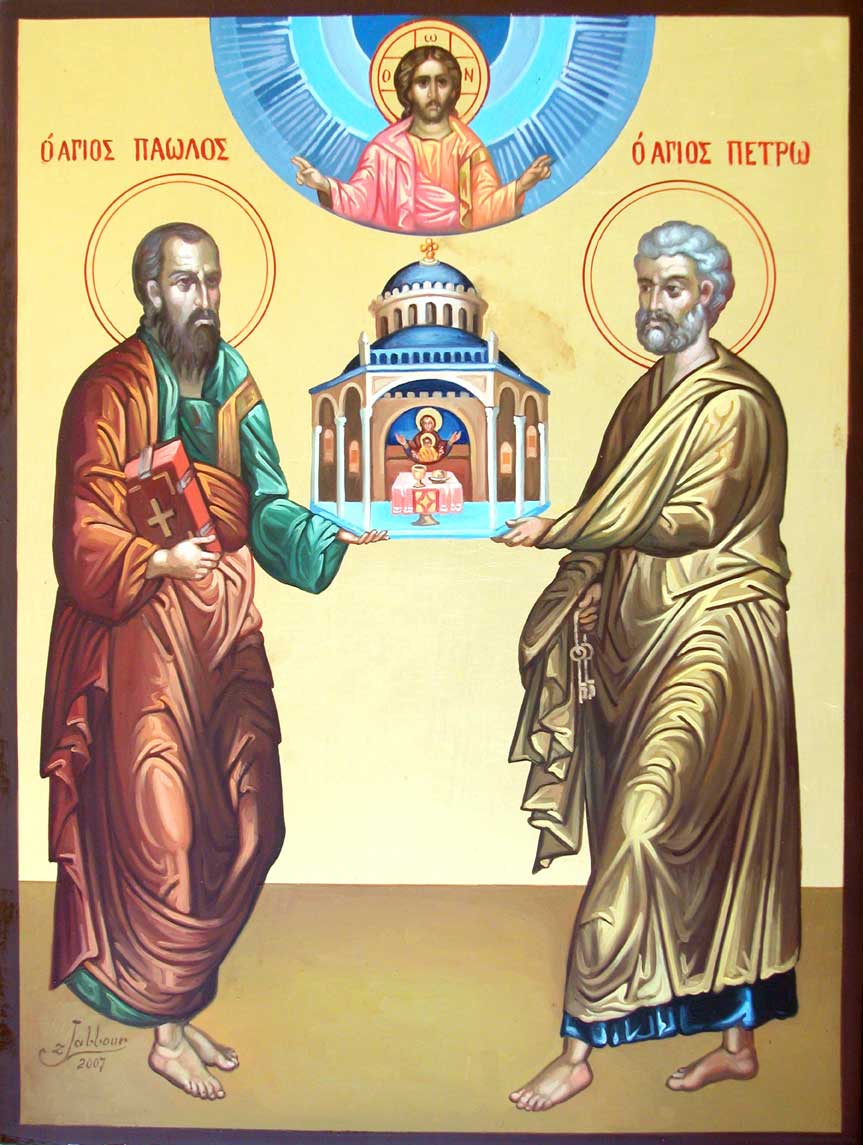
Peter and Paul – fathers of Roman Catholicism
Over many recent decades historical and biblical scholars have debated over the true significance of Jesus’ brother James (see Robert H. Eisenman‘s work) and Mary Magdalene (see Karen L. King‘s work) for one major reason. They draw into serious question WHO really had any single authoritative blessing of Jesus. Was it James, the life-long brother of Jesus, perhaps biological brother? Or was it Mary Magdalene, the closest and “most loved” of Jesus? Or was it Peter, the rock, of whom the Roman Catholic Church built its eminent kingdom on earth. Or would it be Paul from Tarsus, seen by some Jesus followers as too Roman and too Hellenistic, not of rabbinical Judaism? We haven’t been able to decipher the ancient evidence or draw reasonable conclusions until recent decades. The other lost testaments, “other” points-of-view like James, Mary Magdalene, Philip, or the Gnostics were all hunted down and destroyed between 70 CE and say 400 CE (or so the Roman church had hoped) by guess who: Roman armies, Constantine, and his closest bishops. These men eventually became Christianity’s Early Church Fathers and coincidentally, these Church Fathers were also the ones who decided which of all the 45 plus known testaments of Jesus and his apostles would make-up our modern New Testament. This strongly suggests that our modern New Testament is severely amputated.
Controversy over the James Ossuary
As it was from 1980 to 2005-06, the IAA and IDA chose not to pursue further examination of the Talpiot ossuaries or the whereabouts of the missing ossuary. When asked why, the usual response was general, vague and apathetic. It seemed the IAA and IDA was pleased that possibly the most astonishing discovery of Christendom went quietly on warehouse shelves.
When Simcha Jacobovici, Charles Pellegrino, James Tabor, and film producer James Cameron found out about the tomb’s discovery, unlike the Jewish authorities, they felt compelled to responsibly look at the tomb and ossuaries extensively. They all agreed, if only just the first four or five ossuaries had been found together in one tomb, statistically it deserves responsible archaeological and scientific investigation. The fact that one ossuary was now missing should also draw more persistent attention.
The hunt for the missing ossuary began. Locating the missing Talpiot ossuary, however, could prove almost impossible given the number of known ossuaries both in museums and in private collections – like a needle in a haystack. There are hundreds and hundreds of ossuaries with names on them common to the time period and as mentioned before, to Jesus family names. Yet, before the makers and contributors of the investigative documentary could go far in their search, in October 2002 an ossuary – unlike the hundreds of others – surfaced in the Antiquities market with a name inscribed on it that would logically belong to the Jesus family. On it written in Aramaic was Ya’akov bar-Yosef akhui diYeshua, or “James son of Joseph brother of Jesus”. Once again, the Talpiot tomb cannot be ignored!
 How possible is it that the inscription and ossuary are a forgery? Furthermore, what are the possibilities that this particular ossuary even came from the Talpiot tomb? These two questions fuel the controversy.
There are two well-established accepted methods used by modern scientists and archaeologists to decide whether an ancient relic is a fake and what time-period it comes from: epigraphy and long-wave ultra-violet patina tests.
Dr. André Lemaire, researcher and respected epigraphic specialist of the Sorbonne in Paris, France, states the percentage this inscription is a modern forgery is practically a 0.1% chance. He goes on to say that all the words and letters are accurate representations of the Second Temple period, i.e. decades prior to the destruction of Jerusalem in 70 CE, and that “it seems very probable that this is the ossuary of James in the New Testament.” Lemaire and the Canadian Royal Ontario Museum commented that according to established scientific methodologies of epigraphy and dating “nothing suspicious” about the ossuary or its inscriptions exists.
The other established method of determining fake relics and their time-period is long-wave ultra-violet patina tests. Patina is a layer of particles or tarnish formed on the surface of metal or stone surfaces (called cortification) over long periods of time. Under an electron-microscope the layer/tarnish reveals the oxidation process of molecules from the relic’s specific environment which also helps in elapsed time similar to carbon-dating methods. This and the epigraphic study are reliable methods of determining the ossuary’s authenticity.
Patina tests can decide the likelihood of where the ossuary was found and/or located prior to discovery; in other words, for our purposes here it will find a mineral fingerprint of whether the ossuary was originally inside the Talpiot tomb or whether it was buried somewhere else in Israel, or if it was buried at all.
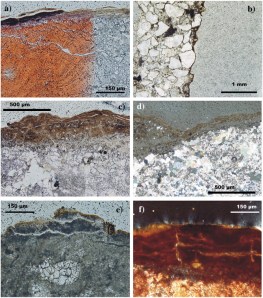
Patina layers on various stones
Charles Pellegrino, a forensic archaeologist, sent the patina samples to the Suffolk Crime Lab in New York State for analysis. The patina off the James ossuary had trace minerals such as titanium and iron that are unique to it. In addition to samples from the Talpiot tomb, many other random samples of patina were gathered from all over Jerusalem and surrounding excavations to further identify samples from other tombs and see if the Talpiot tomb had distinguishing elemental traces. After the Suffolk Crime Lab finished its complete analysis of all samples, ossuaries from the Talpiot tomb were the only ossuaries to have contained exact traces and levels of titanium, iron, phosphorous, magnesium, and potassium which matched the same elements off the James ossuary samples. The electro-microscopic materials match in almost every elemental class with a margin-of-error of less than ten percent.
With the conclusion of the Suffolk Crime Lab’s electro-micrometer analysis, it is compelling evidence that the James ossuary is the missing ossuary of the Talpiot tomb. With this probability, Dr. Andrey Feuerverger modifies his previous statistical calculations this way:
“If it has been possible to determine that the James ossuary is the missing ossuary, then this would have a very strong additional degree of evidentiary value. I would say that would be an absolute slam-dunk, if that were shown to be the case, that we have found the tomb of Jesus and his family.” [the statistical probabilities are shown in the two graphics bottom right]
Naturally Feuerverger’s statistical model has come under fire by opposing scholars and statisticians. The most common counter-argument to his model is that the names apparently found in the Talpiot tomb were all very common names during the time. However, as Feuerverger stated, it is the four or five names found in unison, all found in one tomb that makes it exceptional in contrast to other tombs. Simply considering each ossuary name independently would indeed make the finds much more meaningless. But the fact remains that at least four names were found in the same family tomb. It is this grouping which makes the Talpiot tomb so extraordinary. If in further scientific examination it is found that five or six names do match known family groupings from both canonical and accepted non-canonical sources, and they are found to come from this specific tomb, then it must be seriously considered that the Talpiot tomb is undoubtedly that of Jesus of Nazareth and his close family.
 For a broader reading on this debate, see the March 2007 article in Scientific American magazine “Special Report: Has James Cameron Found Jesus’ Tomb or Is It Just a Statistical Error?” and the October 2002 New York Times article “’Jesus’ Inscription on Stone May Be Earliest Ever Found”.
GIS Mapping
During the last two and a half decades several tombs in this area of south Jerusalem have been uncovered. During the Second Temple period (530 BCE to 70 CE) members of the same movements or ideologies often knew each other and so were often buried in the same areas. In a nearby tomb just about 60 meters from the Talpiot tomb are found several undisturbed ossuaries with elaborate drawings on their sides biblical scholars and archaeologists feel are representative of known Judeo-Christian groups of the 1st century. Dr. Natalie Mesika, a geographic information systems (GIS) mapper brought in to analyze and map the area, concludes that the Talpiot tomb and nearby tombs have a spatial relationship with each other. “In this area there are” she explains “tombs that differ from normative tombs. The members of ideological groups often knew one another. They were less ‘mainstream’ and so they were buried together in specific areas. There was a large Essene cemetary on this expanse in the area of the Armon Hanatziv ridge [the Talpiot tomb area]. This may have been where groups that were not connected to the mainstream, such as groups of early Christians, were buried.” What this means is that much more can be gleaned from the group-movement by extensive research and examination of the area’s ossuaries which may lead to more intriguing challenges and enlightenment of earliest Christianity.
Tabor and Jacobovici meanwhile have inferred that so far the findings in both tombs can open a theological can-of-worms for both Christianity and Judaism and those modern impressions of their earliest roots. If the evidence is found to further support a resurrection-concept as the inscribed symbols seem to imply, then it also implies that these Judeo-Christians “did believe in Jesus’ ability to rise from the dead, but — and this is a significant but — he had not yet done so. If this is really the case, then it is a major deviation from contemporary Christian beliefs.” See the May 2012 issue of ERETZ Magazine of Israel article Who’s Afraid of the Tomb of Jesus?
Judah son of Jesus Ossuary
In Aramaic it reads Yehudah bar Yeshua, meaning Judah son of Jesus. This inscription on a seventh ossuary found in the Talpiot tomb probably causes the biggest firestorm of debate. And it is with good reason.
The Rise and Birth of the Final Holy Church – At Least until the Protestant Reformation
Since the 4th and 5th centuries CE, the earliest Roman-Greco Christian traditions portray Jesus of Nazareth as a divine Son of God. Following all historical imperial traditions of authority in Antiquity and after, there could be only ONE king; a king straight from the ONE God or Gods if your empire was polytheistic. The supreme ruler was divine and anything opposed to that law was treason, heretical, and punishable by death. This is a well-known fact about Roman rule and sovereignty. The bloodline of these divine rulers had to be the purest of pure. Otherwise, civil revolts and ambitious challengers to the throne would disintegrate the kingdom. There could be no doubts of purity whatsoever.
We also know that Roman patience was extremely short with volatile belligerent groups. One such group was the Jews with their constant fervor of a new king, called Messiah, which would rescue and revive the true Kingdom of God’s People from the tyranny of Rome. By 70 CE and later, Rome was utterly fed-up with these Jews and their nagging revolts. It was time to annihilate everything about these people, most of all their theological doctrines as taught by the Judeo-Christian leaders. Yet after some 200 years, the social-welfare-Christ-movement kept popping up in various provinces where inequality, poverty, and civil abuses by Rome’s elite were high. By the year 315 CE, the Caesars would have to ask again and again, how can we defeat these people?
Some four centuries of Roman oppression and social tyranny upon its vanquished finally brought the mighty empire to its knees. Unknowingly, her rulers accomplished the exact opposite of what they egocentrically dreamed of: an empire of superior people (Romans) ruling over inferior people (non-Romans) for a thousand centuries. Enter one of the greatest social-welfare movements of history, which no longer requires you to convert to Judaism! It is open to all (see Constantine: Christianity’s True Catalyst/Christ), even the lower social-classes and outcasts.

Judah son of Jesus?
In a world long governed by one king, one ruler, one emperor, how would it be socially possible to have multiple, even hundreds of leaders, many of them women! Roman-Greco thinking could never fathom this type of social order. Therefore, what Constantine and his archbishops decided was to merge the social-welfare movement into a Roman sanctioned social order, or universal church. They called it the Roman Catholic Church and it would represent, as closely as was possible, a mixture of the grass-roots Christ-movement tenets, bits of ancient Jewish prophetic traditions of the Messiah-Christ adding mystery and miracle, but also firmly inline with Roman rule and traditions. Those opposing this commencement would be branded heretics and punished by law. Thus began the destruction of Gnostic testaments. This included Judeo-Christian testaments portraying Jesus of Nazareth, his family, and his apostles in such a way as to appear normal or realistic, or furthermore in a way not sanctioned by Constantine’s bishops.
Two thousand years later, when an ossuary turns up with the inscription Judah son of Jesus, obviously it will fly in the face of fundamental Christendom, and hence must be discredited at all costs reminiscent of 1st century Rome and the medieval church.
Removing the Horse-Blinders
In light of known Roman punishment to insurrection, naturally the son of a rival-king would be in grave danger. Anyone connected with the Jesus-movement was open to Roman prosecution. Perceived treason was never tolerated by those in power. John the Baptist, Jesus’ cousin, beheaded. James the brother of Jesus stoned to death. Simon brother of Jesus crucified. And most certainly, the son of Jesus the Messiah would be in horrible danger.
There is expert biblical speculation that the “beloved disciple” mentioned in the Gospel of John, might be Judah son of Jesus to hide his bloodline. In John 19:26-27, minutes before Jesus took his final breath while hanging on the cross, according to the passage it reads “When Jesus saw his mother and the disciple whom he loved standing beside her, he said to his mother, ‘Woman, here is your son.’ Then he said to the disciple, ‘Here is your mother.’” Anyone well-versed in the four original synoptic gospels – not later renditions – knows that identifying specific relatives, disciples, and women associated with Jesus is a rabbit-trail at best. Arguably, the confusion was intended.
 Protecting the son of the 1st century crucified Messiah-Christ, or protecting the later 4th century Roman-Greco Christian tenets of pure divinity or a clever mixture of both to give the impression of miraculous truth… finding Judah the biological son of Jesus of Nazareth, James the biological brother of Jesus, Mary Magdalene the wife of Jesus, Mary the biological mother of Jesus, Jose biological brother of Jesus, and finally the Jesus of Nazareth all in the same tomb would most certainly call from fundamental radical followers their most unforgiving opposition. Two thousand years of doctrine and tradition just cannot change or be challenged, right? Do not ask that same question of the Roman Catholic Church (or modern Protestant churches) in regard to Nicolaus Copernicus’ heliocentric model of the heavenly bodies!
Perhaps not surprisingly, the IAA forced the documentary scientists, archaeologists, and researchers to stop and seal the Talpiot tomb before any further examinations could be concluded.
Professor James Charlesworth, respected scholar of New Testament Language & Literature at Princeton Theological Seminary, helped put together in Jerusalem in January 2008 a panel of 31 international scholars to reopen the case of the Talpiot tomb and its ossuaries. The results of the symposium are now published and available to the public (click on the book cover above to purchase). These 31 expert essays vindicate the 2006 examination of the ossuaries and tomb and the 2007 documentary by Cameron and Jacobovici, and conclude that to a very high degree the tomb of Jesus of Nazareth and his close family has indeed been located. Furthermore, the probabilities of the specific names found inside the tomb and grouped together casts many basic Christian gospel foundations as folklore or personal faith, but not systemic fact. It turns everything upside down.
Santa Claus, Peter Pan, and Tinkerbell Revisited
Why does a person hold on to faith-based beliefs so staunchly? There are some understandable answers. Some would say because present comfort and security are vital to life and survival. Some would answer because evil exists, and there are evil-doers in the world and nether-world who are determined to harm and destroy you; thus a form of miraculous protection is needed. Some might simply answer it was my parents way of life, they taught me the same, and it worked for them, it works for me. Others would claim another theological reason, that mankind is in a state of total depravity and has only one form of hope or escape from eternal damnation. Still others might claim that the “key” to mortal happiness, redemption and eternal bliss have been firmly and convincingly offered for the taking for over 2,000 years; we only need to accept it. Are these answers much differently than when we found that our childhood hero(es) was/were mythical? And so what was the purpose of those grand stories anyway?
 The grand stories offer dramatic hope in a world and life that is often difficult, even brutal. Perhaps most of all they offer a soothing antidote to the reality of death and beyond. The good-feeling hope or faith-stories are most popular among the impoverished and struggling lower and middle-classes of society, just like it was in the conquered provinces of Rome’s oppressive rule before, during and after Jesus’ life. And just like our uplifting childhood stories of Santa Clause, Peter Pan and Tinkerbell and the like, from a purely altruistic and humanitarian perspective, they are good for a person’s, a society’s, and a civilization’s composite mental and emotional health, whether they are based wholly or in part, in fiction or fact. For those who mentally or emotionally are struggling most severely, the stories bring great relief!
If this article has upset or struck an emotional nerve, then I respectfully ask you to please read my earlier five blogs/articles: Canaanites Killed & Removed From Native Lands, The Suffering Messiah That Wasn’t Jesus, Hyper-Social Anxiety Over Sex, Collaborative Ineptitude, and Constantine: Christianity’s True Catalyst/Christ. These articles collectively give a balanced picture of why divisive hyper-polarized systems and institutions (but not charitable or philanthropic) eventually disintegrate a society’s cohesion and progress, e.g. America’s gross socio-economic and educational inequality today.
Personally, I do not want to remove anyone’s individual dreams and hopes. Who wants to give up that sort of feeling? Good feelings indeed do our mind, body, and soul good! Instead, my intention is to bring into serious question the validity (or invalidity) of staunch, discriminatory oppressive, systematic institutional abuses of societal control or misinformation. History has shown time and time again, that accepted or forced fear-based myths and folklore on people are most successful when the powerless, uneducated, gullible, or illiterate are exploited. If anything, I hope this article spurs more determined responsible biblical archaeology that presents the unbiased comprehensive evidence, and NOT foregone conclusions supported by selected evidence.
Therefore, I write this and other blogs on the subject. Reject radical fundamentalism in whatever religious divisive form it takes is my mantra. Let us simply put folklore on the shelf of “Folklore”, healthy self-help stories on the shelf of “Self-help”, and scientific archaeology on the shelf of “Scientific Archaeology” and allow an individual the freedom AND dignity to choose wisely what suits them best.
(paragraph separation)
Footnote: This blog/article was inspired by the 2007 documentary The Lost Tomb of Jesus by Simcha Jacobovici and produced by James Cameron and other sources.
April 2015 Update — “Geologists Claim Stats, Science Prove Jesus Buried In Jerusalem with Wife and Supposed Son,” Ariel Cohen, The Jerusalem Post.

(paragraph separation)

(paragraph separation)
 This work by Professor Taboo is licensed under a Creative Commons Attribution-NoDerivs 3.0 Unported License. Permissions beyond the scope of this license may be available at https://professortaboo.wordpress.com.

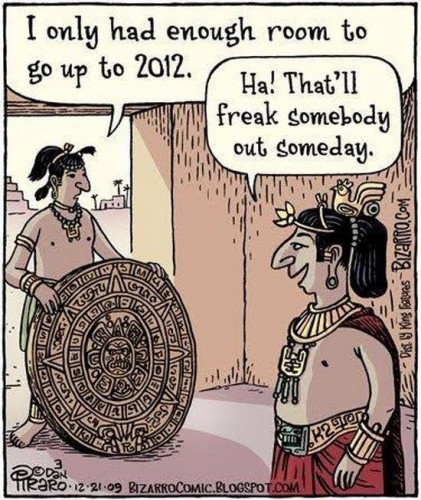 Friday, December 21st, 2012 has come and gone without any apocalyptic event, and perhaps to the chagrin of many hyper-dooms-dayers. Much of the fears and predictions are fortunately based in the misunderstanding of the Mayan calendars and how they worked within the 250 – 900 BCE civilization. Attempting to project contemporary ideas of time onto the ancient Mayan methods of time would be like attaching square wheels to your car — it is a show of ignorance.










 The Professor's Convatorium