“My definition of a free society is a society where it is safe to be unpopular.” — Adlai Stevenson
As of August 7, 2023, the Movement Advancement Project (MAP) released its annual scorecard for each of the U.S. state’s democracy rating. As I alluded to in my previous blog-post and its comments, my home state of Texas has been passing legislation over the last two–three years which suppress the votes of non-white, anti-conservative, less-advantaged Texans or making easy convenient access to voting stations, and actual voting, increasingly difficult. Over the last 5-7 years it has been ever harder for myself to vote and/or register to vote, and I am a well-educated white man! Now riddle me that one please!
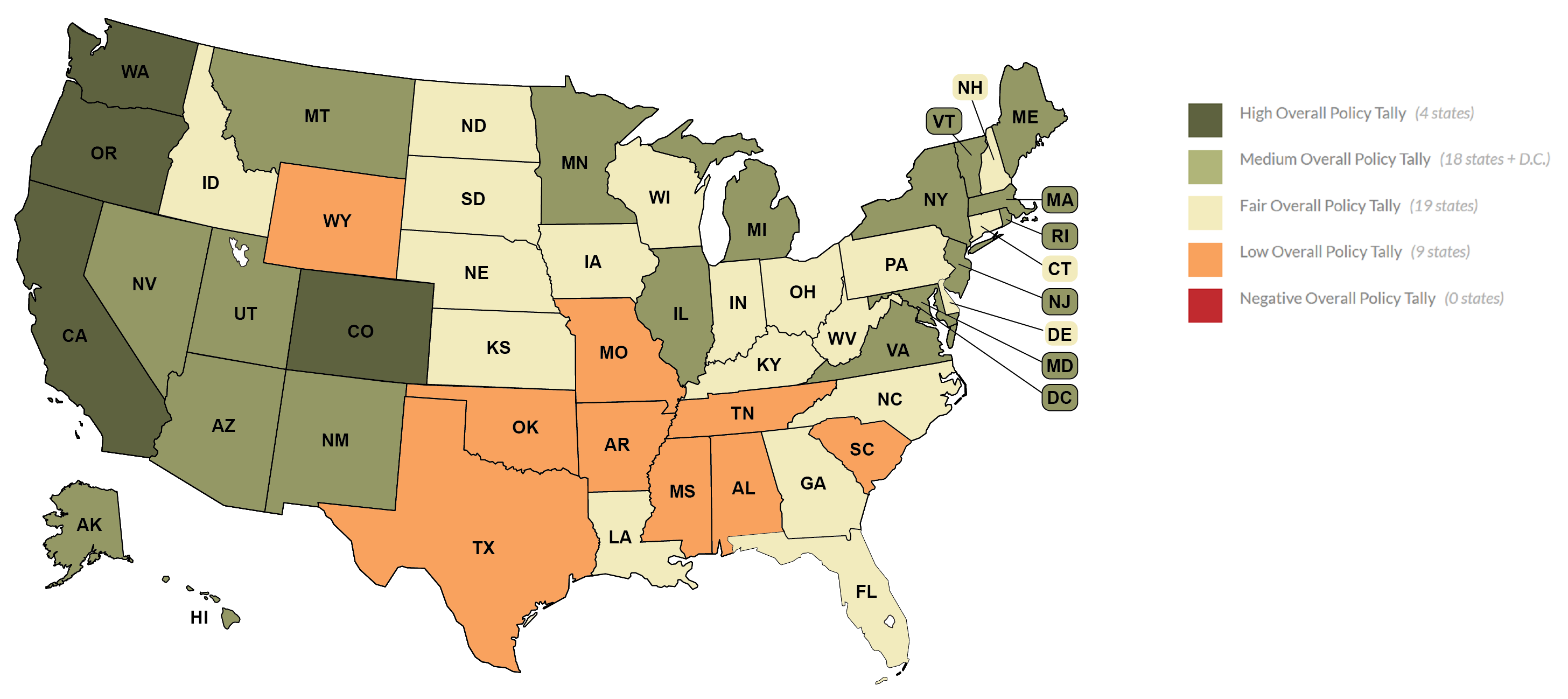
Nevertheless, I was quite interested in knowing what Texas’ scorecard reveals. Not much of a surprise to me our democracy tally has been rated “Low” (in the orange) scoring 6.5 out of 33.5 points. Personally, that’s a fair score given how noticeably more difficult it has become for me—a college educated white man—to vote or re-register to vote after my frequent moves between Dallas and Kerrville, TX for Mom’s declining dementia, and to get this year (as well as 4-yrs ago) a new renewed driver’s license. By the way, have I told you that I am an 8th-generation white Texan with no criminal record or outstanding warrants, fines, over 42-years of employment and paying my share of taxes over those 42-years? Eighth-generation means my family was here in Texas BEFORE it was annexed by the United States in 1845!
As far as MAP’s “Who Votes” and “How to Vote,” two of the three main metrics for scoring, yet again, no surprise whatsoever for Texas’ abysmal ratings: Who Votes — a -0.5/5 and How to Vote — a -0.75/5. Our highest ratings? “Election Security” 4 out of 6, and “Voting in Person” 2.5 out of 5.5. Both of those better scores, yet still weak, I have explained their difficulty mediocrity in detail over the last decade. “Election Security” is cryptic Conservative code for Much Harder to Vote and “Voting in Person” means Hard Registering to Vote, respectively.
Curious to know what four states rate the highest in democracy’s election laws and policies according to MAP? Yes, you read that correctly, only 4 states out of 50, or just 17% of our population of 332-million Americans reside in a state with high-levels of democracy. Let me repeat, just seventeen percent of Americans! Here are those highly democratic republic states:
Washingtonwith31out of 33.5
Coloradowith 30out of 33.5
Californiawith 29.5out of 33.5
Oregonwith 26out of 33.5
Let’s see who the last four states of the Union are with the most undemocratic elections and policies:
47. Tennesseewith 5.5out of 33.5 48. Arkansaswith 5.5out of 33.5 49. Mississippiwith 4.0out of 33.5 50. Alabamawith 3.25out of 33.5
What percentage of the American population do these four states make up? The answer: almost 6%of the American population.
The bottom-line is and what these numbers show when one reviews the entire fifty states on the MAP’s website is that a large portion of the American 50-states and their populations are NOT truly, purely democratic in their elections and policies. I don’t know about you, but I find these facts disturbing, alarming, and they need to be confronted and addressed not just by each individual (legal) American citizen, but also by your district’s House of Representatives and your district’s Senators! Are we not a Constitutional Republic democracy as written in our Charters of Freedom by all six (6) of the Core Founding Fathers? Yes, of course. Then WHY do twenty-nine (29) of our fifty states score a measly grand tally of just 16.75 (or lower) out of 33.5 democracy data-points? Those scores are abysmal!
What has happened to democracy in the United States to rate that horribly on the major points of what defines a TRUE democracy?
Try to Live Free – Love Much – Laugh Often – Learn Alot More
Since at least 1994 I’ve always been intrigued to know how my home state (Texas) ranks in Quality of Living tables compared to the other 50 U.S. states. Why? Very simple: affluent Texans, many of which are only first, second, third, or perhaps fourth generation Texans, arrogantly boast that Texas (at least politically) is hands-down THE best state in the Union. Yes, I hear this from fellow Texans quite often, mostly in the rural areas. I have heard these claims most all of my six decades of life while living here. It seems to be a personal source of deep-seeded pride whether justified or not.
But I have always been greatly puzzled by their expressed, audacious claim. Aside from one’s own biased personal opinion, by what metrics, by what standards could these whiteTexans possibly be referencing? I regularly check these quality of life criteria, every 1-2 years minimum, not just for the required oversight and civic duty/privilege by a concerned, caring citizen, but also to monitor how our Lone Star State is progressing: Is it thriving, stagnate, or declining?
According to US News & World Report, the data points collected in ranking the U.S. states overall are many. The two primary categories most all Americans most care about are healthcare and education for its residents. Secondary points are public safety, social and occupational opportunities, economy, roads, bridges, environment, internet access and other infrastructure.
Well, sorry (again) Texas, the 2023 facts and data are not good at all for Texans and their “proud friendly” state. The overall quality of life in Texas is below average: ranked35thout of 50 states. In fact, Texas doesn’t rank #1 in any of the eight primary categories, much less the lower priority categories. In 2021 Texas ranked 31st overall, today down four places after two years. It ranked 36th in 2018 and 38th in 2017. There is however, one particular category Texas has always excelled in: its economy. There has always existed in Texas-economics very plush advantages for past and present wealth-accumulators to make much more excessive wealth; tax-codes and opportunities abound for Texas’ upper-class. This is exactly why Elon Musk, originally of South Africa, the founder/CEO of SpaceX, Tesla, present owner of Twitter, and a number of other mega-businesses, moved here and now calls Texas his home. He is just one of many of America’s wealthiest persons living in Texas.
Ironically, the one category Texas has never excelled in since these stats and data-points were first collected is its Individual Median Income—it is $38,059 for 2023 single-earner Texans. Sadly, according to SmartAsset’s study, individual Texans need to earn a minimum $44,865 per year and closer to $133,926 to be considered “middle-class,” or to only have a decent standard of living while working and alive, barring any unforeseen emergencies or catastrophes.
from “You Might Be From Texas If…” by author and cartoonist Nick Anderson
from “You Might Be From Texas If…” by author and cartoonist Nick Anderson
from “You Might Be From Texas If…” by author and cartoonist Nick Anderson
from “You Might Be From Texas If…” by author and cartoonist Nick Anderson
It becomes quite obvious why there is such a large disparity in the Lone Star States’ Quality of Life categories, like the economy versus all other categories. What is it? What drives this lopsided metric? It’s income and economic inequality. Severe? Probably. Improved? Not at all. Digressing, expanding? Most definitely.
So one must ask these (typically rural and far-suburban) Texans, What verifiable facts and data are you quoting to conclude that Texas is THE best state in the Union to live? My next two questions to them are 1) What zip code do you live, and 2) Where exactly have you and your family been experiencing Texas the last at least 30–40 years?
Care to guess what bewildering answers I usually get?
∼ ∼ ∼ § ∼ ∼ ∼
Addendum Aug. 22, 2023 — In conjunction with this post I am connecting or linking my next blog-post to this one as a follow-up. It is entitled “Rating Democracy in All 50 U.S. States.”
Try to Live Well – Love Much – Laugh Often – Learn Alot More
After a month of deep mourning along with bouts of sobbing, many sleepless nights, and daily depression due to the events of July 2nd, 2023, my Hat Burglar, I am forcing myself to blog again on subjects I am passionate about and have serious convictions over their truth and historical validity. This is one of those subjects: the fallacies and failures of ancient classical Christianity. Furthermore, it is also about modern-day versions of Christianity drifting out of any reasonable orbit of philological and historical accuracy. I hope my readers and followers find some (renewed?) interest in this blog-posts and my attempts to return to a bit more normalcy. At least, that’s my wish for the near future.
∼ ∼ ∼ § ∼ ∼ ∼
As some/many of you already know, I consistently argue for the unreliabilityof Christendom’s oldest copies—or Hebrew-Aramaic originals if they existed—of the Greek New Testament Gospels and the full Greek Septuagint Bible and the former’s misrepresentation of a (possible? probable?) historical character Yeshua bar Yosef, known in Greek as Iēsous Christós (Ιησούς Χριστός) or in English, Jesus Christ. Why do I make this argument? Why will I always make this argument?
For starters and for well over two millenia, the fact that there was historically stark, drastic contrasts with high levels of xenophobic sentiment in ancient Syro-Palestine and surrounding Judea and Jerusalem between Hellenistic people of the Greco-Roman Empire and that of Homeland Jews/Judaism during Late Second Temple Judaism (hereafter “LSTJ”). This known verifiable fact has been essentially ignored by modern traditional academia, by 19th–21st century scholarship, and most of all by Christian-American theological seminaries everywhere. It is frankly unforgiveable. This ignorance, whether innocent or willing, is a monumental travesty if not a catastrophic blunder by Christendom and its centuries of apologists.
“Romans found it difficult to distinguish between Jews and early Christians at first, it soon became evident that the early Christians, at least the majority of them, did not keep the same customs Jews did (e.g., circumcision). […]
…we see an inherent tension in early Christianity as it tries to simultaneously hold on to and yet distinguish itself from Judaism. […]
This dialectic process is evident when one looks at the early Christian interpretation of Jesus’ messianic theology. One can see the early Christian concern to connect itself with Judaism by believing that Jesus was the Messiah promised to the Jews and by adopting the terminology that was associated with that role. However, the meanings behind those terms shifted as they were transferred from a Jewish context into a Greco-Roman one. This is particularly evident with the titles “Son of God” and “Son of Man.” Early church fathers used these terms as a way of signifying Jesus’ divine and human natures.”
— Jordan Kassabaum, MDiv. Yale University & University of Florida College of Liberal Arts and Sciences Bachelor’s, ““Who Do You Say I Am?”: Second Temple Messianism and the Historical Jesus” 2013.
When one fully understands the comprehensive historical context of Homeland Torah-loving Jews living within the Hellenistic Roman Empire between 200 BCE, up to 70 CE with the total destruction of the Jewish Temple in Jerusalem by General Titus and his Legions, it becomes ever so clear there was serious animosity between three major, unyielding cultural groups: 1) Romans/Gentiles or Pagans, 2) Hellenistic (Herodian?) Jews or Diaspora, and 3) Homeland Torah-abiding Jews such as Jesus or Yeshua in Hebrew. These three groups clashed often with severe consequences employed by Rome’s Provincial authorities.
“Thus, we see a disconnect between the way Jesus would have understood these terms as a first century Palestinian Jew and the way the early church interpreted them as Greco-Romans.
Therefore, it would have been natural for an early Christian to assume that Jesus was the literal, divine Son of God rather than understanding that title as a designation for God’s Davidic Messiah, a title that we have seen did not imply any kind of divinity in 1st- or 2nd-century CE Jewish thought.”
— JORDAN KASSABAUM, MDIV. YALE UNIVERSITY & UNIVERSITY OF FLORIDA COLLEGE OF LIBERAL ARTS AND SCIENCES BACHELOR’S, ““WHO DO YOU SAY I AM?”: SECOND TEMPLE MESSIANISM AND THE HISTORICAL JESUS” 2013.
The influence of Alexander the Great and Hellenism stretched from modern-day western India to the Adriatic shores of Albania for 19-centuries
The widespread dominance of Hellenistic culture—that is, the philosophy, art, literature, architecture, prose or language, mathematics, geography, and cartology (Eratosthenes), astronomy and the heliocentric theory (Aristarchus and later Hipparchus), and medical science with advances in anatomy (Herophilus), physiology (Erasistratus), etc. —cannot be overstated. Long-standing Hellenistic ideas were all products of Alexander the Great’s Macedonian-Greek empire and its syncretic civilization despite its final collapse in 1453 CE. It was a cultural empire (versus literal empire) that lasted 19-centuries, and eighteen centuries after Alexander’s death! Let me repeat, nineteen centuries, from 336 BCE to 1453 CE with the end of the Byzantine Empire.
Perhaps the greatest paradox or deviation to this unprecedented global influence and assimilation by Hellenism, was Judaism, in particular Homeland Judaism, the astonishing rare exception to this historical dominance. The Jewish Virtual Library explains the significant contrast between LSTJ and Hellenism this way:
“Confronted with Greek ideas, some attempted to combine Greek intellectual values with Hebrew ones; such efforts were more successful in Egypt than in Judea. However, even in Judea the Hellenizing movement under Antiochus IV came near to prevailing. Ultimately the Jews organized their culture and their political life on their own terms, as witnessed by the rise of the Essenes and Pharisees. The independence of Jewish intellectual life in the Hellenistic age is partly explained by the fact that while Jews took a great interest in Greek ideas, the outside world took relatively little interest in Hebrew ideas. The translation of the Bible into Greek did not mean that the Greeks read the Bible. The isolation[as pure, holy, and righteous] in which the Jews lived, especially in Judea, was conducive to the creation of a style of thought and life which can be (and was) considered competitive with Hellenistic civilization.”
I recommend reading the entire article on Hellenism at the Jewish Virtual Library for a more encompassing understanding of these two ancient, very conflicting cultures; a time-period directly involving and consuming Yeshua bar Yosef’s (Jesus) lifetime and purpose.
More On the Linguistic Cultural Troubles of Greek Transliteration Post-70 CE
Dr. Graham Davies and Robert Gordon, along with J.A. Emerton’s extensive work in Studies on the Language and Literature of the Bible, cover the many problems of vernacular Hebrew and Aramaic in 1st-century CE Palestine being later copied and/or translated into Koine Greek, the language of today’s Septuagint and Codex Sinaiticus, and subsequent later copies of the Greek New Testament. They and many other biblical Jewish and Roman historians indicate just how difficult Greek-speaking, Greek-reading copyists and translators of 2nd — 4th century CE Roman-Hellenist culture, would have had significant problems and errors going from Mishnaic Hebrew and Aramaic word-of-mouth sources or (non-existent) text-sources… into their Koine Greek.
This group of scholars includes Dr. Bart Ehrman of the University of North Carolina – Chapel Hill. Ehrman addresses the many grave problems of copying earlier copies of verbal “stories,” i.e. not recorded, about Yeshua bar Yosef (Jesus) forty to eighty years after his execution, and thornier still (pun intended) throughout some of the most unstable, tumultuous decades of the Roman Empire and the Jews of Palestine. Whether the Hebrew Bible, also known as the Miqra (מִקְרָא) in Hebrew, was changed intentionally or unintentionally by scribes, it’s almost certain that personal projections were written into the Gospels we have today. Problematic questions also increasingly apply to the Yeshua/Jesus stories better known as the canonical Gospels of Mark, Luke, Matthew, and John, in that order. Ehrman states:
“The text of the Hebrew Bible that is read today and that is at the basis of all modern translations is called the MasoreticText. It is called this because the Jewish scholars who devised the rules for copying scripture are known as the Masoretes. The term “masorete” comes from the Hebrew word masorah, which means “tradition.” The Masoretes were the scholars who worked out ways to preserve the traditions of the Hebrew Bible. They were active between 500-1000 CE.
To understand what the Masoretes accomplished, you need to remember that ancient written Hebrew was a language that used only consonants, not vowels. Any language that is written only in consonants is open, obviously, to serious problems of interpretation. Imagine if you were to write English that way. Apart from context, you would have no way of knowing whether the word “npt” was “inept” or “input” or whether “mnr” was “minor,” “manor,” “moaner,” or “manure.””
Let me reiterate the active timeline of the Masoretesand their standardized copied texts: 500 — 1,000 CE. That is more than four and a half centuries after Yeshua’s/Jesus’ death; c. 467 years to be more exact! This poses many more suspicions about what was done with the Hebrew Bible stories prior to 500 CE? It gets worse…
“The not so good news is that [precise verbatim] is not the case with all of the books of the Hebrew Bible. Scholars had long noted, for example, that the Septuagint (Greek) text of the book of Jeremiah was about 15% shorter than the Masoretic text (i.e., it had that many fewer verses/words), and scholars had suspected that it was because the Hebrew version of Jeremiah known to the ancient Greek translators was significantly different from the Masoretic Text. As it turns out, one of the scrolls discovered at Qumran has a Hebrew text of Jeremiah that is closer to that lying behind the Septuagint version than the Masoretic text. 15% is a big difference. Other books of the Septuagint are also strikingly different from the Masoretic text, for example, in the books of Samuel and Kings. It is possible that the Hebrew texts of all these books were in serious flux before the text came to be standardized by the end of the first century.”
These problems beg further suspicions. For example, in these four questions posed to Ehrman on his blog address these linguistic retrospective obstacles and issues, he answers this way:
Question 1: “Did Christians from this period [1st-century CE] place less emphasis on the Hebrew Bible than they do today? Were they using the Septuagint instead and we have Greek fragments and scrolls from this period, but not Hebrew?”
Ehrman: “Yes, Christians read the Greek Old Testament rather than the Hebrew (or later, the Latin Old Testament). Hebrew was used only by Jews. And yes, we have lots more Septuagint fragments than Hebrew. (And more Latin of course.)”
Are you noticing the heavy use of Hellenic, or Greco-Roman languages, influences, and their own specific cultural contexts? It is not Yeshua’s (Jesus’) native culture or Mishnaic Hebrew and Aramaic, but instead the much later Roman Catholic Church Fathers projecting a non-Jesus or non-Yeshua perspective onto the (now convoluted) “gospel” stories.
Question 2: “Which type of transmission of text do you think is superior for ensuring accuracy and safeguarding against unauthorized changes, “Controlled” or “Uncontrolled”?”
Ehrman: “I”m afraid I don’t see how an uncontrolled situation is likely to produce more standard results than controlled situations. Think, for example, of the manufacturing industries!! In any event, the evidence is quite clear that when uncontrolled and unskilled, the earlier scribes made far more mistakes than later ones.”
Question 3: “What evidence do scholars have, that demonstrates that the text had not undergone significant changes, from about 100 CE to 500 CE, when the Masorites started working on the text?”
Ehrman: “It’s a great question! But I’m not sure why they’re so confident (and that it’s not simply wishful thinking).”
Question 4: “The Gemara—a rabbinical commentary on the Mishnah, forming the second part of the Talmud—bases its arguments on citations from Scripture. Do you know how much those quotes differ from the Masoretic texts? Also, do you have any thoughts on the Greek Septuagint’s provenance?”
Ehrman: “Ah! That is an enormous problem. We don’t have the evidence we need. It is a perennial issue of scholarship: what form of the Greek translation of the Hebrew Bible was available to Paul? Or to others at his time? Were there lots of Greek translations? How do we decide which form of the text was available where and when? Big problems!“
Ancient Greek scribe
Be this as it may, why on Earth do modern evangelical, fundamentalist, Christian congregationalists, theologians, ministers, pastors, and many Christian biblical historians give the Septuagint and an incomplete 4th-century CE Codex Sinaiticus so much infallible authority? As Dr. Bart Ehrman’s answer alludes to for Question #3, that is the obvious million-dollar question. There’s very insufficient evidence, corroboration, or reasoning to support such a ridiculous “divine” conclusion regarding the Gospel “stories” much less about the purpose and nature of Yeshua/Jesus—again, due in large part with the many problematic transliterations from Mishnaic Hebrew and Aramaic… into Koine Greek.
Dr. Nehemia Gordon, PhD, of Hebrew University – Jerusalem and Bar-Ilan University in Ramat-Gan, Israel, believes the underlying hidden Hebrew “stories” of Yeshua can be uncovered in the first three Gospels, or Synoptic Gospels. But to Greek-learned readers, then or today, they cannot possibly decipher them. They are gibberish to Greek-readers today and they were gibberish to the 2nd– and 3rd-century Greek scribes then.
Hidden Hebrew Idioms or Hebraisms in the Synoptic Gospels
As Dr. Gordon continued his research career on the Dead Sea Scrolls of Qumran and ‘the writing, erasure, and correction of tetragrammaton in Medieval Age Hebrew Bible manuscripts,’ Gordon was discussing with a colleague who explained to him “some scholars were of the opinion that parts of the first three Gospels of the New Testament were originally written in Hebrew.” Asking how and why that was his colleague answered, “Because they are full of Hebraisms.”
Dr. Gordon elaborates on this…
“I knew all about Hebraisms from my study of the Septuagint, the ancient Greek translation of the Tanach. World-renowned experts in classical Greek find the Septuagint incomprehensible while any Israeli student can read it after only a couple of years of learning Greek. The reason is that the Septuagint was translated by very bad translators. Rather than translate the Tanach into proper Greek, they mechanically translated the words, leaving behind numerous Hebrew thought patterns. To someone who is familiar with the Tanach in Hebrew this Greek is relatively easy to read. But to a Classical Greek specialist who expects to find elegant Greek syntax it sounds like gibberish. And in ancient times it was no better.”
— Gordon, Nehemia. “The Hebrew Yeshua vs. the Greek Jesus” (p. 33). Makor Hebrew Foundation. Kindle Edition. [emphasis mine]
In the ancient shops, forums, and streets of Athens, Rome, or Alexandria the vast majority of Greek Athenians and Romans could not comprehend the Septuagint. To them the Septuagint was disjointed and perplexing, ironically foreign. Dr. Gordon expands too on this alien dynamic between the Homeland Jews and the Hellenistic worlds that I have been arguing for many years. Gordon says:
“For example, the Tanach often opens an account with the Hebrew word vayehi (ויהי) “and it was.” Of course in Hebrew “and it was” means, “it came to pass, it happened.” But the Greek reader sees kai egeneto (και εγγενετο) and says, “And it was?” And what was?! In Greek it’s gibberish! Very often the translators did not even know what they were reading and created nonsensical sentences by translating word for word.”
— ibid. Gordon, Nehemia.
As a footnote to this explanation of bad Hebrew-to-Greek transliteration, Gordon states:
“For example, in the Septuagint see LXX 1 Samuel 3:10 (compare LXX Numbers 24:1). Some interesting examples in the Greek Matthew are discussed by Grintz pp. 36-39. As one grammar of New Testament Greek puts it, “Major Semitisms… are not only bad Greek but are apt to cause difficulty in translation…”” (Whittaker p. 150).
— Gordon, Nehemia. “The Hebrew Yeshua vs. the Greek Jesus” (p. 97). Makor Hebrew Foundation. Kindle Edition.
These types of translation and transliteration mishaps are frequently found throughout the Septuagint, and by descending default, found as well in the canonical Synoptic Gospels. Dr. Gordon describes the regular mistakes by the scribes, but also their personal projections upon the Hebrew and Aramaic sources:
“[They were] an over-literalized translation by someone who is not entirely sure what he is translating. To complicate matters, numerous Greek copyists who did not know any Hebrew tried to “improve” what was clearly poor Greek. The result was a translation which at times mimics the Hebrew word for word and at other times wildly differs from it.”
— Gordon, Nehemia. “The Hebrew Yeshua vs. the Greek Jesus” (p. 34). Makor Hebrew Foundation. Kindle Edition.
“Many expressions which a Greek would not have used were bound to creep into a faithful written translation of a Semitic original. One [such] grammar of New Testament Greek, lists no less than twenty-three (23) separate categories of Semitisms [lost in Greek translations].”
— F. Blass and A. Debrunner. “A Greek Grammar of the New Testament and Other Early Christian Literature,” Revised Edition. University of Chicago Press, 1961.
Siege and destruction of the Temple & Jerusalem by Roman General Titus, 70 CE.
Saving the Hebrew Yeshua from the Greco-Roman Christos
With the assistance of actual Jewish scholars and expert linguists of LSTJ Mishnaic Hebrew and Aramaic, NOT biased Christian theological experts, the more I have studied, examined, and earnestly sought the historical real figure of Yeshua/Jesus inside his proper, accurate Roman historical context and environment—and that is impossible without 1) his Homeland Hebrew, 2) his Tannaitic (LSTJ) background, and 3) his Torah-abiding sources—this is always my conclusion: in the Koine Greek versions Jesus is always terminating the Torah. But in the Hebrew-Aramaic versions Yeshua is consistently defending and safeguarding the Torah.
So why the sharp disparity during c. 129 BCE–70 CE, the LST period?
The answer(s) are not difficult to deduce. There are no less than two reasons for this, but certainly many more. For the sake of time and effort on my readers/blog-followers I have reduced the reasons to two primary ones introduced to you here, or for my long-standing readers further argued and explained:
Anti-Hellenic sentiment and/or hatred by Homeland Jews such as Yeshua’s rural Jewish sect “The Way” and against the Roman Empire. And then by contrast…
Anti-Semitism and Antinomianism. The former is well-known even today so no explanation is required. However, the latter part, Antinomianism is I think less known. In a nutshell, the latter means any view which rejects laws or legalism and argues against moral, religious or social norms. Since “Torah” are the Laws of Yahweh/God given to Moses—and are contained in the Pentateuch—this therefore goes against Yeshua’s Hebrew beliefs, reforms, teachings, and nature based on Hebrew-Tannaitic sources.
Siege of Masada by Roman Governor Lucius Flavius Silva, and the last holdout of rebellious Jewish zealots against Rome and Hellenism in 72–c. 73 CE.
It is very much worth noting that a less known early Roman Church Father realized even in about 90–95 CE that some of the Gospel translations were inaccurate and problematic. Papias of Hierapolis, as quoted by Eusebius, stated this:
“Matthew collected the oracles [literally: “words”] in the Hebrew language, and each interpreted them as best he could.”
— Eusebius. “Ecclesiastical history” 3.39.14–17
“Each interpreted them as best he could!” Wow. So not only was it known by Roman Church Fathers that the gospels Mark and Matthew, sometimes referred to as the most Jewish of gospels, but also widely recognized among the 1st– and 2nd-generation Fathers that the Greeks and other non-Hebrews, i.e. Gentiles, Roman pagans, Greeks, notably had difficult times understanding, translating Mishnaic Hebrew and Hebraisms into Greek and other languages. That is a smoking gun if not a serious red-flag for the Septuagint and the descendant Codex Sinaiticus and later renditions of “Jesus Christos.”
Conclusion
As I’ve argued many times over the last twenty-years, one cannot know the actual, true, historical Jewish-Hebrew Yeshua/Jesus strictly through the existing error-ridden Koine Greek sources, i.e. Gospels, or Greco-Roman Hellenic sources. That is a Greek Apotheosis Christos foreign and completely fabricated by the retrograding, retrofitting early Church Fathers of Rome. Furthermore, what pagan and Gentile Romans fabricated decades and centuries after Yeshua’s execution about who he was and his nature and purpose cannot be corroborated independently or supported by Jewish-Tannaitic facts and evidence. And was not Yeshua/Jesus a Homeland Jew speaking and teaching in Mishnaic Hebrew and Aramaic? Of course he was. Yeshua (or the widely known “Jesus Christos”) was never a Hellenist nor a Greco-Roman (or Paulinist) as today’s bibles falsely portray.
∼ ∼ ∼ § ∼ ∼ ∼
For further broadening education on the disparity and lack of Hebrew sources of Yeshua versus Greek or Roman biased sources strictly on Christos, this video from TorahCentric is a good start. It is very worth it:
The Senate of the United States shall be composed of two Senators from each State, elected by the people thereof, for six years; and each Senator shall have one vote. The electors in each State shall have the qualifications requisite for electors of the most numerous branch of the State legislatures.
— 17th amendment to u.s. Constitution, ratified april 8, 1913
The main issue and problem for what the 17th Amendment attempted to correct for Congress, specifically for the Senate, was that Article 1, Section 3, Clauses 1 and 2 of the 1787 Constitution dictated that each state legislature appointed its own two state Senators for an initial six-year term. Regardless of the state’s population size, each state was entitled to two senators with two “equal” votes in the federal Congress. This helped reassure anti-federalists of the time, and previously covered in Part 5 of this series, that an overly centralized power-base like the federal government would not devour state’s powers but instead provide an oversight to the House of Representatives whose members were elected by popular vote by their state’s citizens.
Across the aisle, opponents countered the anti-federalist argument that within such a circle of powerful state legislatures, there existed two primary problems: 1) legislative corruption influenced by monetary gains and interests, and 2) electoral deadlocks paralyzing necessary legislations for all the people’s interests. And since the Amendments’ 1913 ratification another major problem now persists: no reelection term-limits for Senators (see Table below)—essentially an identical chronic problem today with Supreme Court Justices’ lifetime terms. Notice the lengths of service for these 25 Senators:
25 Longest Serving U.S. Senators To-Date*
senators
dates of service
length of service
Robert C. Byrd (D-WV)
Jan 3, 1959–Jun 28, 2010
51 years, 5 months, 26 days
Daniel K. Inouye (D-HI)
Jan 3, 1963–Dec 17, 2012
49 years, 11 months, 15 days
Patrick J. Leahy (D-VT)
Jan 3, 1975–Jan 3, 2023
48 years
Strom Thurmond (D, R-SC)
Dec 14, 1954–Apr 4, 1956 and Nov 7, 1956–Jan 3, 2003
47 years, 5 months, 8 days
Edward M. Kennedy (D-MA)
Nov 7, 1962–Aug 25, 2009
46 years, 9 months, 19 days
Chuck Grassley (R-IA)
Jan 3, 1981-present
42 years, 1 month, 7 days
Orrin G. Hatch (R-UT)
Jan 3, 1977–Jan 3, 2019
42 years
Carl T. Hayden (D-AZ)
Mar 4, 1927–Jan 3, 1969
41 years, 10 months
John C. Stennis (D-MS)
Nov 5, 1947–Jan 3, 1989
41 years, 1 month, 29 days
Ted Stevens (R-AK)
Dec 24, 1968–Jan 3, 2009
40 years, 10 days
Thad Cochran (R-MS)
Dec 27, 1978–Apr 1, 2018
39 years, 3 months, 6 days
Fritz Hollings (D-SC)
Nov 9, 1966–Jan 3, 2005
38 years, 1 month, 25 days
Mitch McConnell (R-KY)
Jan 3, 1985–present
38 years, 1 month, 7 days
Richard B. Russell, Jr. (D-GA)
Jan 12, 1933–Jan 21, 1971
38 years, 10 days
Russell B. Long (D-LA)
Dec 31, 1948–Jan 3, 1987
38 years, 3 days
Francis E. Warren (R-WY)
Nov 18, 1890–Mar 3, 1893 and Mar 4, 1895-Nov 24, 1929
37 years, 4 days
James O. Eastland (D-MS)
Jun 30, 1941–Sep 28, 1941 and Jan 3, 1943–Dec 27, 1978
As with the transgenerational power-hold Supreme Court Justices currently possess over the American people, the Senate and Senator votes today have an even more detrimental, anti-democratic effect than they did in 1788 to 1913. With modern and recent service-lengths averaging between 35–47 total years; about 45-years of one political (partisan?) ideology or covering about two generations of Americans. Consequentially, the U.S. Senate has become a major roadblock to effective, efficient, critical governing to protect the American people during times of economic and/or public safety and general health, even sometimes life or death, e.g. COVID-19. The Senate simply does not move fast enough for modern forms of crises management. Furthermore, the lethargic 21st-century Senatorial condition confers spurious political advantages to small tiny states, their senators, and their 18th-century Constitutional, economic-corporate and political dominance which is gifted in gratis by two equal votes regardless of state size.
During the 1787 Philadelphia Convention and the drafting of our Constitution, many of the Founders recognized what the Connecticut Compromise would do, at least over a period of time. They could not have been more correct. As the overall population of the U.S. has reached nearly 337-million today, it means the smaller, tinier states have gained more federal money and more authority in the Senate as well as more weight in the Electoral College over the last 235-years. Both James Madison and James Wilson ardently opposed the Connecticut Compromise, and Wilson specifically spelled out that ‘equal state Senate votes would mean that a minority of voters could block the will of the majority,’ or of the American people. And this is exactly what has happened in today’s Congress.
The twenty-eight smallest states of the Union today, representing 20% of the American population, have 56% of the votes in the Senate. This disparity and distortion over two centuries now is precisely why the increased voting strength between states with wealth and population versus those without and much smaller populations has occurred, and as a result, the majority receives less and less federal representation. This is also reflected in many state governments as well. With each passing decade the Constitution’s 18th-century “minoritarian” equal state-voting principle impacts national policies and allocation of funds more and more, too often at the expense of the greater American good.
A “New” Senate: Reflecting the Popular Will
The better welfare of the greater national good and a more truer Republic democracy by a new Senate-voting system significantly outweighs the aforementioned flaws, disparity, and distortions of keeping the 18th-century system. If this New Senate were structured primarily on the state’s population, and to a lesser extent say the smaller-sized states’ X-quotient of wealth and resources toward the national well-being, surely this would offer a more equitable system assuring the overall national popular will was more realized. To demonstrate this reform, the following two slideshows illustrate just how a reimagined, past Senate voting would’ve substantially changed our last twenty-plus years of national policies, some of which our “Old Senate” system has had (very?) harmful consequences.
No Senate filibustering after John Calhoun (1840’s) or Ted Cruz (2013) stopping the Senate vote!
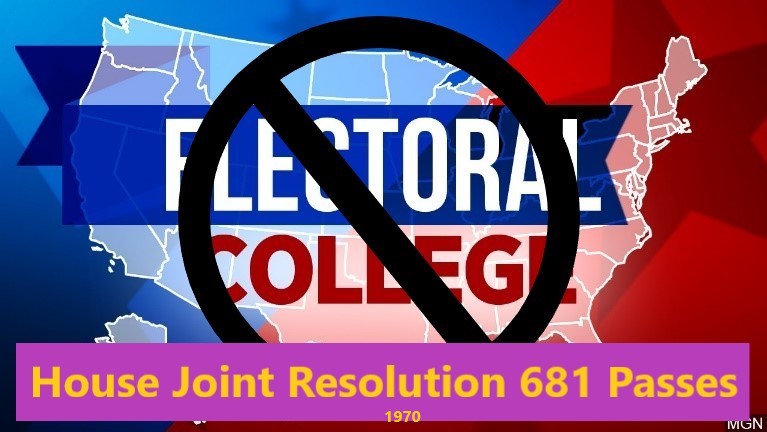
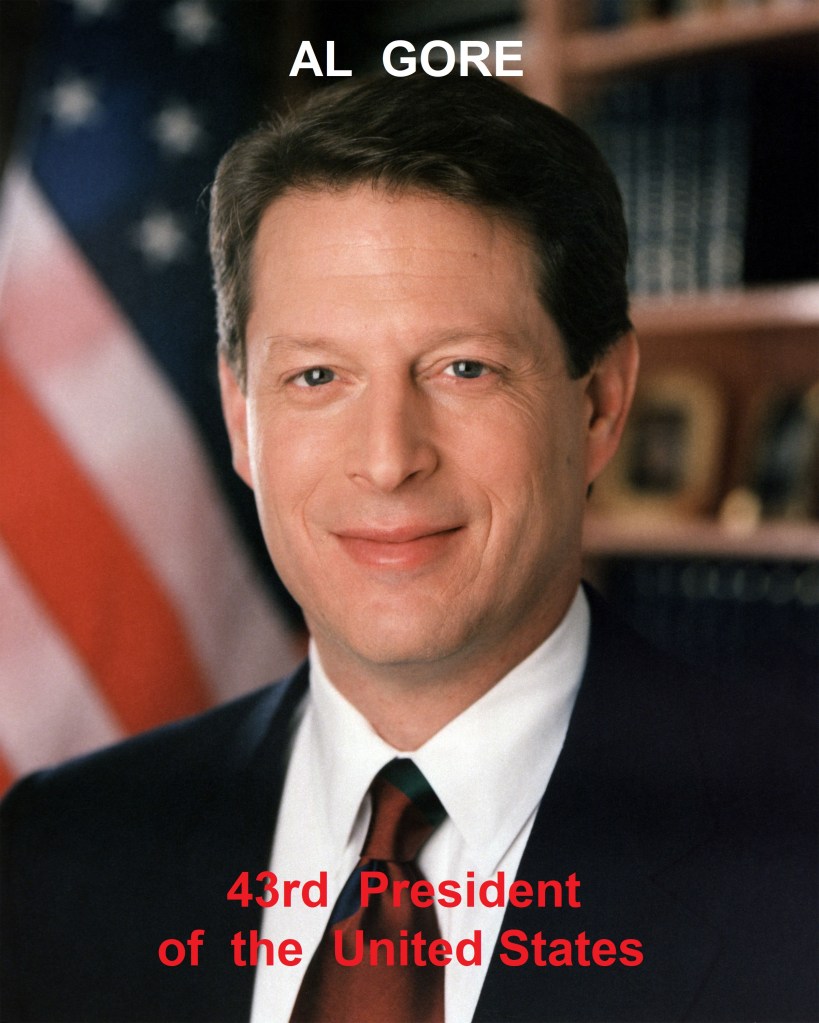
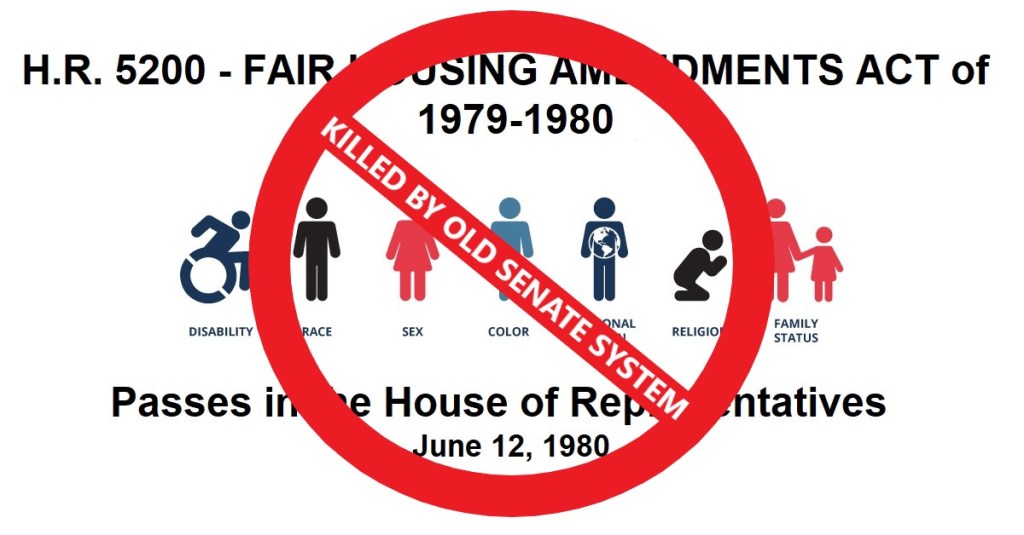
Moreover, several different variances in domestic and foreign policies (see following slides) would have certainly been enacted or rejected had a “New” 20th– or 21st-century Senate voting system been put in place in 1970:
Under the “New” Senate voting system, recently appointed and confirmed 53-year old Supreme Court Justice Brett Kavanaugh would have never been voted in. He would have lost by a sizable margin—approximately by 20% or more—by the twenty-two larger states (and Senators) that makeup about 80% of the American population. Justice Kavanaugh only received his confirmation because of the 28 smallest states and their (ultra) Conservative Senators’ votes. In a new Senate voting system reflective of Americans and their interests, Kavanaugh would’ve been easily rejected. To put it a different way, Judge Kavanaugh’s lifetime appointment to our highest court in the land—that will affect 2-4 generations of Americans—was accomplished purely by a fossilized relic of our 18th-century Constitution’s “equal state Senate voting rule.” No debate.
Proof the Electoral College is Undemocratic
In 2024 Americans will elect the next President and Vice-President using the antiquated Electoral College system created by the 18th-century mindsets held in the Constitution. By that system, all actual votes will be cast by “electors,” not the American people. This may come as a shock to some American voters. Despite their dismay, it is completely true; the U.S. is not a comprehensive democratic Republic.
The key justifications for the invention of our Electoral College imparted by Convention delegates in 1787 no longer exist today. One must remember the historical context of what the Philadelphia delegates were negotiating and fiercely debating at the time. Many of those delegates felt average American voters would not sufficiently know the candidates governing experience, educational level obtained, and much less their personal backgrounds. These conditions were further exacerbated by transportation and communication limitations for most all American voters, thus making well-informed decisions difficult at best. That scared the Ba-jebus out of nearly everyone of them—they could not risk a narcissistic demagogue President or administration getting naïvely elected, then worse become a tyrannical king or American Caligula/Caesar. Thus, the Electoral College was created for an 18th-century nationwide citizen-conundrum.
None of these problems exist today, nor is the modern Originalist argument for the Constitution’s (divine?) integrity a persuasive argument against a purely popular vote by the people. And here is the most damaging function of today’s Electoral College: the Underrepresentation of States and their Electors. (see following Table)
state
population 2023
% of total population
electoral now
proportionate electoral
disc
1. California
40,223,504
11.92%
54
64
-10
2. Texas
30,345,480
8.99%
40
48
-8
3. Florida
22,359,250
6.62%
30
36
-6
4. New York
20,448,194
6.06%
28
33
-5
5. Pennsylvania
13,092,796
3.88%
19
21
-2
6. Illinois
12,807,072
3.79%
19
20
-1
7. Ohio
11,878,330
3.52%
17
19
+2
8. Georgia
11,019,186
3.26%
16
17
+1
9. N. Carolina
10,710,558
3.17%
16
17
+1
10. Michigan
10,135,438
3.00%
15
16
+1
11. New Jersey
9,438,124
2.80%
14
15
+1
12. Virginia
8,820,504
2.61%
13
14
-1
13. Washington
7,999,503
2.37%
12
13
-1
14. Arizona
7,379,346
2.19%
11
12
-1
15. Massachusetts
7,174,604
2.13%
11
11
0
16. Tennessee
7,080,262
2.10%
11
11
0
17. Indiana
6,876,047
2.04%
11
11
0
18. Maryland
6,298,325
1.87%
11
10
+1
19. Missouri
6,204,710
1.84%
10
10
0
20. Colorado
5,997,070
1.78%
10
10
0
21. Wisconsin
5,955,737
1.76%
10
9
+1
22. Minnesota
5,827,265
1.73%
10
9
+1
23. S. Carolina
5,266,343
1.56%
9
8
+1
24. Alabama
5,097,641
1.51%
9
8
+1
25. Louisiana
4,695,071
1.39%
8
7
+1
26. Kentucky
4,555,777
1.35%
8
7
+1
27. Oregon
4,359,110
1.29%
8
7
+1
28. Oklahoma
4,021,753
1.19%
7
6
+1
29. Connecticut
3,615,499
1.07%
7
6
+1
30. Utah
3,423,935
1.01%
6
5
+1
31. Iowa
3,233,572
0.96%
6
5
+1
32. Nevada
3,225,832
0.96%
6
5
+1
33. Arkansas
3,040,207
0.90%
6
5
+1
34. Kansas
2,963,308
0.88%
6
5
+1
35. Mississippi
2,959,473
0.88%
6
5
+1
36. New Mexico
2,135,024
0.63%
5
3
+2
37. Nebraska
2,002,052
0.59%
3
3
0
38. Idaho
1,920,562
0.57%
4
3
+1
39. W. Virginia
1,775,932
0.53%
4
3
+1
40. Hawaii
1,483,762
0.44%
4
2
+2
41. New Hampshire
1,395,847
0.41%
4
2
+2
42. Maine
1,372,559
0.41%
2
2
0
43. Montana
1,112,668
0.33%
4
2
+2
44. Rhode Island
1,110,822
0.33%
4
2
+2
45. Delaware
1,017,551
0.30%
3
1
+2
46. S. Dakota
908,414
0.27%
3
1
+2
47. N. Dakota
811,044
0.24%
3
1
+2
48. Alaska
740,339
0.22%
3
1
+2
50. D.C.
715,891
0.21%
3
1
+2
51. Vermont
647,156
0.19%
3
1
+2
52. Wyoming
583,279
0.17%
3
1
+2
Reviewing the Table above, did you note how many states are under-represented and how many are (grossly) over-represented? Nine (9) states are (very?) under-representative of their people’s votes, and thirty-five (35) states are (very?) over-representative of fewer people’s votes! Even worse, those nine under-represented states are this nation’s most populous states, with real people, yet unreal Electoral votes! In a sense, the twelve (12) overly-represented states are/have been ghosting, or inventing unreal Electoral votes since at least 1960 and the Twenty-third Amendment.
Finally, the Electoral College promotes harmful, sometimes disastrously dueling, hyper-divisive politics or duopoly partisanship between the two major parties. This deadens civic-political discourse and impedes policy reforms and/or creation as we’ve seen over the last 2-3 decades with the chasm widening more and more every four-to-eight years. If that persists, it will be catastrophic for this country as well as democracy as a whole around the world.
∼ ∼ ∼ § ∼ ∼ ∼
In the Conclusion of this 7-part series, I want to cover more extensively Gerrymandering and the 2019 Supreme Court decision Rucho v. Common Cause and how that ruling has had very adverse affects on our Republic democracy and today badly distorts election outcomes. I will also get into HOW we must approach and construct a proportional representation system that actually DOES reflect a true democracy.
I hope those who are still following this series will find it helpful for your own civic benefits for yourself, your state, and our country. Thank you again everyone for your patience with me and my often slow writing and posting. Please feel free to leave your thoughts and comments below.
Live Well – Love Much – Laugh Often – Learn Always
“I know no safe depository of the ultimate powers of the society but the people themselves; and if we think them not enlightened enough to exercise their control with a wholesome discretion, the remedy is not to take it from them, but to inform their discretion by education. This is the true corrective of abuses of constitutional power.”
Thomas Jefferson, letter to W.C. Jarvis, 1820
The higher the education obtained by all American youth and young adults—in some cases, students in their 40’s or 50’s even—university studies have shown the more likely those citizens will be civically engaged and as a result regularly vote in national, state, and local elections with needed intellectual prudence.
the University of Texas – Austin Clock Tower
We now continue from Part 4. My hope in writing this series is to assemble or reassemble the vital links between civic virtues and privileges, initiate adequate literacy, and most importantly clarify and restore some historical and U.S. Constitutional literacy. In doing so, my vision and hope is that any who might read this series will find some tools and/or ideas that inspire them to become more civically understanding, thoughtful, tactful, more civically wise, respectful, and inclusively tolerant, engaged American citizens. This is truly my hope. And I am certain that our nation’s six core Founding Fathers would agree with and support this objective. First Lady Eleanor Roosevelt eloquently and profoundly put this mission into pristine focus:
“Our children [and adults alike] should learn the framework of their government and then they should know where they come in contact with the government, where it touches their daily lives, and where their influence is exerted on the government. [This] must not be a distant thing, someone else’s business, but they must see how every cog in the wheel of a democracy is important and bears its share of responsibility for the smooth running of the entire machine.”
Emphasis mine
Another hope and reason I am writing this in-depth series is really quite simple. It has already been summed up brilliantly by one of our country’s most famous prolific Presidents:
“The ballot is stronger than the bullet.”
Abraham lincoln
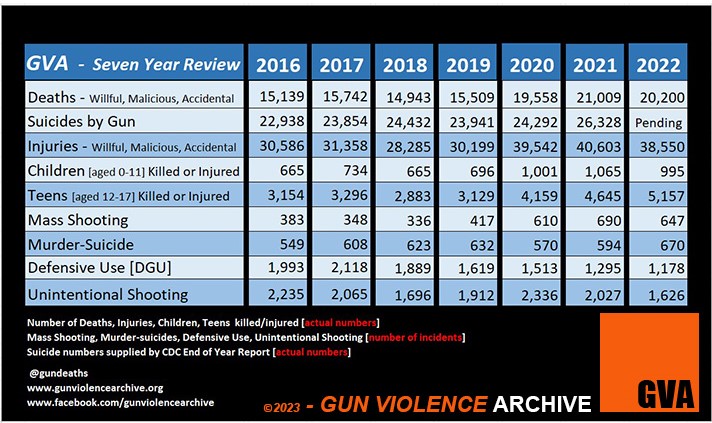
There is no debate whatsoever that since August of 1966, at the University of Texas Clock Tower and the random murder of 17 people, 33 wounded, gun-violence and mass shootings in the U.S. has only skyrocketed and today has become almost normal and expected. As of May 23, 2023, fifty-seven years later, domestic violence or homicide by guns in the U.S. resulting in death has already reached 16,652, of which 236 were mass shootings or mass murders. A staggering and appalling increase just in the last ten years; mindboggling really.
Obviously, during the last 20-30+ years Americans and their (representative?) Congress members are not comprehending the alarming, epidemic rise of gun-violence in their own country and townships, much less comprehending Lincoln’s famous, prophetic statement above. What has to be done? What must be done?
We have been doing NOTHING all this time, and why is it STILL not working!?
A very dear friend of mine
One of my strong recommendations or reply to those profound quotes are 1) do precisely what Eleanor Roosevelt lays out above, 2) once gaining an above-average or higher understanding of how your own government is legally bound by/to the U.S. Constitution, get engaged with it and assure your/our government officials perform their sworn duties strictly within the U.S. Constitution’s legal boundaries. Yes, I am saying become an aficionado or Constitutional para-legal. If all of us don’t do this, we see over the last 57-years the dire consequences! And finally 3) find inspiration and initial steps or action-plans from this series to implement #1 and #2.
We were never originally designed to be or become anAthenian-styled government! Though the delegates of the Philadelphia Convention in 1787 had fire-branded arguments over how the president should be elected and exactly how much voting power individual states should have in Congress, in the end they had constructed a near satisfactory balance—that is, for 1787 and the foreseeable future. They had not, however, satisfactorily resolved the glaring issue of elites, specifically the wealthy, controlling or heavily influencing government policy at the demise of equal influence by the ordinary, “surviving” citizens. This fervent, often nasty battle both then and today is/was really about elitism and populism. It still very much matters right now in the 21st-century and foreseeable future.
ancient Athenian government – fresco by Cesare Maccari (1889)
Many of us today might consider the importance of elitism vs. populism as critical to individual, political human rights. On the contrary, it was not so simple as that in 1787 during the convention in Philadelphia. The fact is that even though the original Founding Fathers believed in general civil equality, they were quite opposed to full political equality to the masses, yes, even lowly white-caucasian men, let alone non-whites or non-elites. Why?
Simple answer: pedigree and socio-educational status and merit.
Let me point out again: socio-educational achievements. That is exactly what Eleanor Roosevelt was also endorsing over 160-years later, perhaps on several levels in opposition to the original Founding Fathers’ concepts. Most of the Philadelphia delegates also felt gerrymandering was perfectly acceptable in gaining or maintaining one’s political party’s government control and interests. Believe it or not, most of the Founding Fathers felt it was quite normal to posses and to widely allow racist views/opinions, employ methods of wealth discrimination, exhibit (privately and publicly) prejudice toward non-heterosexuals, and freely show or verbalize misogynistic prejudices and behaviors. Yes, believe it or not this was indeed our lauded Founders and their well-known 18th-century mindsets. However, after one or two generations and by the 19th– and 20th-centuries this began to change. A much more inclusive view of truer political equality and representation for all Americans began to emerge.
For example, popular pressure pushed into legal adoption for the 17th Amendment:
The Senate of the United States shall be composed of two Senators from each state, elected by the people thereof, for [a term of] six years; and each Senator shall have one vote. The electors in each State shall have the qualifications requisite for electors of the most numerous branch of the State legislators. […]
Amendment Xvii, ratified April 8, 1913
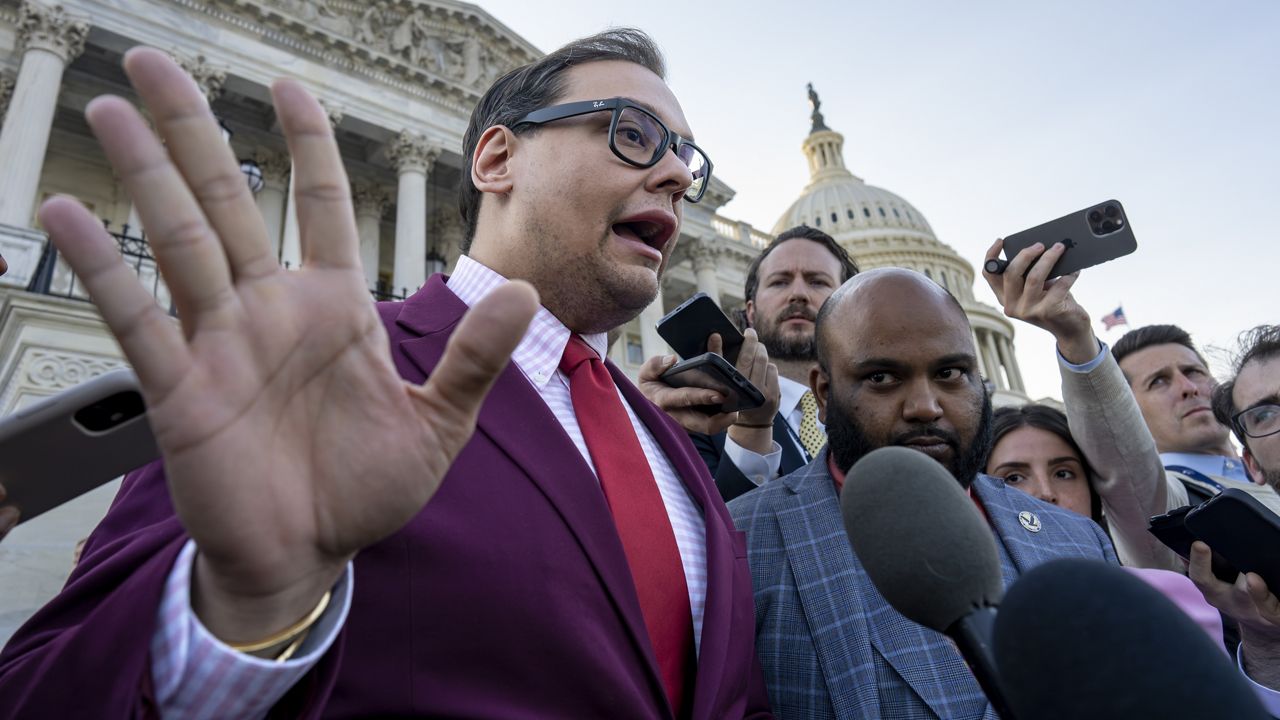
Sadly, in 2020 New York elected Republican House Representative, George Santos, somehow completely bypassed, undermined, and invalidated the entire 17th Amendment protocols and legal enforcement of our Constitution, including my emphasis of it above. How was this possible? This is the deteriorating distorted condition of our very own Constitution by our own (Republican?) elected officials not doing their proper, oath-avowed jobs. Period. No debate.
Rep. George Santos, R-N.Y., speaks to reporters outside after an effort to expel him from the House, at the Capitol in Washington, Wednesday, May 17, 2023. (AP Photo/J. Scott Applewhite)
Nevertheless, the popular movements of the early 20th-century were instrumental in increasing political equality for Americans. There has been a growing confidence and fact for the long-term effects of a truer representative government that can and will make better decisions when there is much less “elite” control of our institutions, specifically by the wealthiest that far too often govern or manipulate government to serve their own personal interests. The 19th-century progressive democratization of equal political rights in America improved the performance and duties of our representative government demanding its leaders to at least consider or truthfully represent its constituent’s broader interests and viewpoints in making legislative decisions. And more importantly, holding those government representatives accountableto their avowed office’s duties! This popular 20th-century movement had massively profound effects for the nation and its people.
For example, the public pressure directly induced our anti-trust laws that rightly control or manage massive concentrations of economic-political power such as the Rockefeller-founded Standard Oil Trust, that is now today known as ExxonMobil, the LARGEST investor-owned oil company in the entire world. Yet, this is to be expected. Truth be known of this uniquely American tradition: history has shown our government institutions often bow to controlling groups to change government policies to favor super wealthy mega-corporations.
Our Constitution’s Flaws and Failures
Contrary to these excellent 20th-century popular federal reforms, our antiquated 18th-century Constitution has two different, but equally fatal flaws written into it:
They undermine and consequently violate modern standards and definitions of republican political equality.
They also repeatedly have more anti-democratic effects than when they did when they were created.
What do I mean exactly by these two flaws? For one, Supreme Court justices receive lifetime tenures when appointed, an 18th-century mindset due to average lifespans then. Second, each state in the Union receives equal voting rights in the Senate and in the Electoral College, despite those with miniscule populations. Third, the Supreme Court’s 2019 landmark decisions stating the Constitution permits perpetual, partisan manipulations of upcoming elections via gerrymandering. Fourth, the incredibly obdurate Article V procedures for Constitutional amendments, which will be further addressed later in this series. Fifth, the Presidential powers of judicial review and veto being not just controversial, but anti-democratic as well.
The U.S. Supreme Court is often considered to reside outside of American politics, that it was originally designed to be the final arbiter of equal justice according to the Constitution and its laws. Hence, it should also act as guardian and interpreter of the Constitution and laws of the land. Though this impression of the nation’s highest court is correct in theory, it is not true in practice; never has been since 1787. Why is this? The quick simple answer is that it was never designed to be “outside” of civil or congressional-executive politics.
As mentioned earlier, justices are not elected by the general public. Justices, as also mentioned, are appointed by the standing President then confirmed by the current Senate. Justices serve on the Court for their lifetimes unless impeached by the House of Representatives, which requires a supermajority vote—i.e. 290 votes from 435 representatives—then followed by a conviction in the Senate. Obviously, impeachment is near impossible when Party-line favoritism and bias is rampant, as it is in today’s politics. Due to these 1787 design flaws, justices are literally unaccountable for their decisions by the very officials who are indeed very political!
From the very beginning, at the Philadelphia Convention, delegates imagined and drafted our Constitution for a Supreme Court composed of men chosen by a political leader, the President. And most often those personal political viewpoints of those selected men/justices aligned with that current President’s and his political party’s viewpoints. This has certainly been demonstrated since the late 1990’s but unequivocally began with President George W. Bush’s two terms.
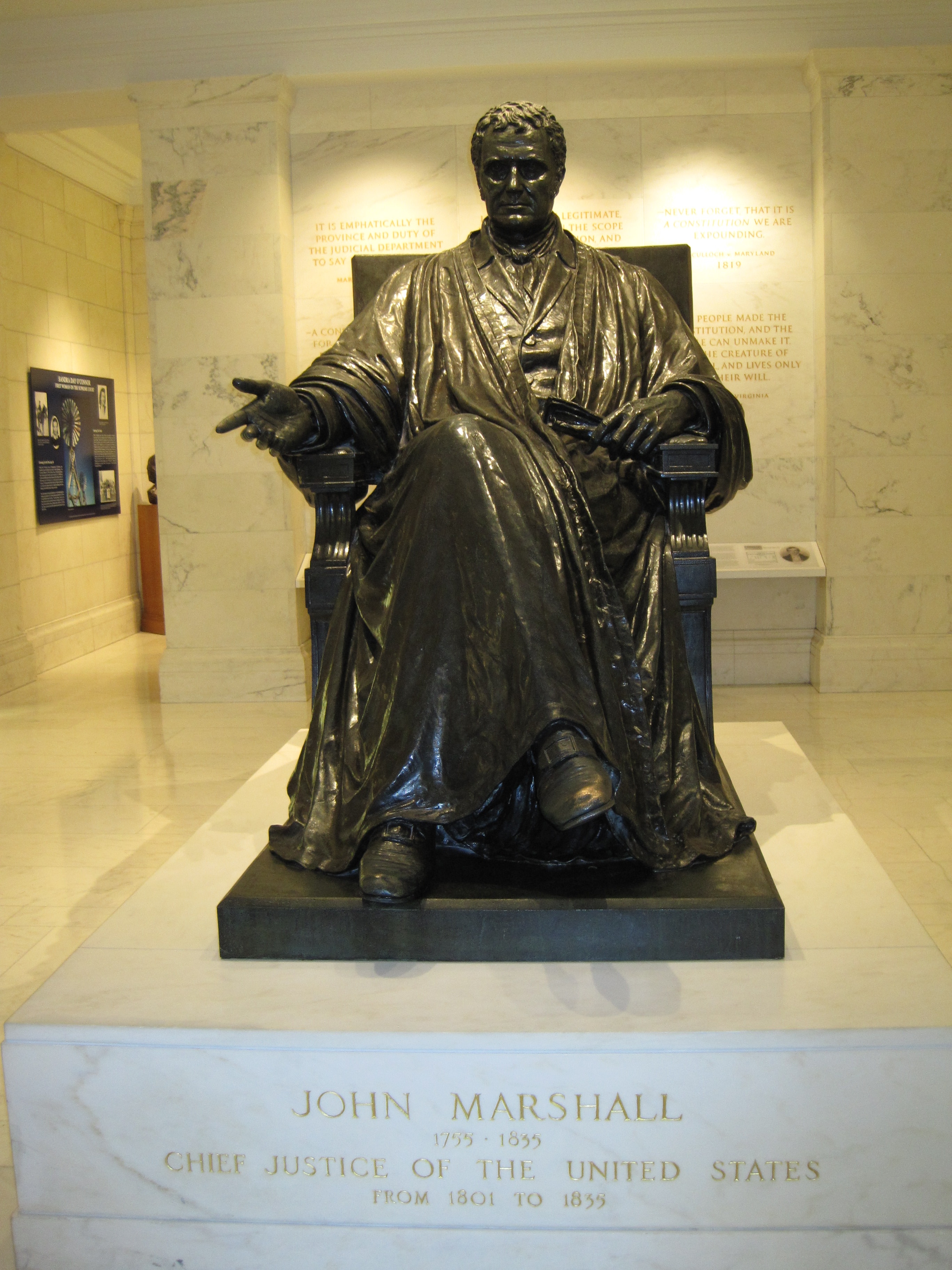
Going back to the early 1800’s, partisan court rulings and appointments were already raging. Chief Justice John Marshall and President Thomas Jefferson exchanged heated arguments over the Supreme Court’s judicial independence, or lack of, and its final authority. Their battle started with the last minute appointments, or “midnight appointments” of strictly Federalist judges by President John Adams, himself a Federalist. Knowing full well that Marshall despised Jefferson and his Republicans, John Adam’s very last act as President and perhaps in defiance to his once closest colleague, he appointed John Marshall as Chief Justice of the Supreme Court. Marshall swore in Jefferson as the nation’s third president surely under degrees of resentment by both men.
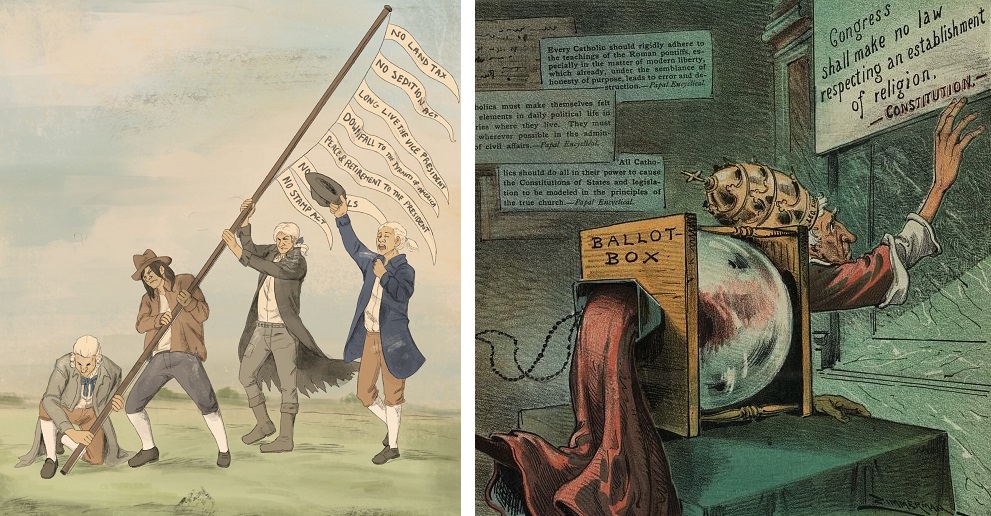
The campaigns and election of 1799–1800 went down in history as one of the most divisive, partisan campaign rancor and nastiest infighting between all three Branches of Washington D.C. in American history. However, the bitterness and power-struggles between Jefferson and Marshall did not end there.
Political cartoons of 1800 American Presidential campaigns – (left) First Amendment issues, (right) Separation of Church & State issues
Over the coming years legislative, executive, and judicial wars between opposed political ideologies—primarily Jefferson vs. Marshall—culminated in at least two paramount Supreme Court decisions:
Stuart v Laird — In this case, 5 U.S. 299 (1803), the U.S. Supreme Court upheld the repeal of the Judiciary Act of 1801, enacted by outgoing President John Adams and his Federalist Congress, which effectively abolished the existing circuit courts. The decision also affirmed the constitutionality of requiring Supreme Court justices to ride circuit.
Marbury v Madison — In case, 5 U.S. 137 (1803), the Supreme Court established the principle of judicial review—the power of the federal courts to declare legislative and executive acts unconstitutional. The unanimous opinion was written by Chief Justice John Marshall.
What did these two rulings mean and do exactly? In Stuart v Laird, Jefferson was able to purge all the Federalist circuit court “midnight” judges quickly appointed by former President Adams. In doing this Adams had hoped it would maintain some residual political control for his party as he departed—instead it was a win for Jefferson. In Marbury v Madison, by asserting the power to declare acts of Congress unconstitutional (which the court would not exercise again for over fifty years), Marshall (and the Federalists) claimed for the court an enormous authoritative position as interpreter of the Constitution independent of Congress and the White House—a win for Marshall and Adams.
As a result of these early 19th-century power-authority battles, today we see the same heated, divisive political wars continue over Supreme Court Justice appointments and those justices political backgrounds and affiliations, begging the question: are modern SCOTUS justices truly “independent” of Washington D.C.’s political hostility and influences?
As the Constitution now stands and has been practiced and/or protected for the last two-plus centuries, exactly how impactful and for how long are lifetime SC justice appointments affecting this nation’s governing? Furthermore, does the Supreme Court today adequately respond to the country’s popular will? Do lifetime appointments offer frequent decisions in favor of a minority party or group?
∼ ∼ ∼ § ∼ ∼ ∼
In Part 6: A New U.S. Constitution, I will address the problem of our modern Anti-democratic Senate and explore how we might restructure it into a more functional, civically responsive new Senate. I also plan in the next portion of the series to tackle the Electoral College, what it was designed for then, in 1804, and what it has become today. I hope all of you can join and share any thoughts or comments and feedback. Thank you as well for your continued patience with this drawn out series and understanding my daily, personal family-living situation while writing this series. My sincere gratitude to you all.
Live Well – Love Much – Laugh Often – Learn Always
I have zero expectation that anything I ever say will end someone’s belief in their God. Not my goal or purpose. That alone belongs to the individual. ~ Zoe
'Light thinks it travels faster than anything but it is wrong. No matter how fast light travels, it finds the darkness has always got there first, and is waiting for it' - Terry Pratchett
























 The Professor's Convatorium