As part of the Alternative Lifestyles blog-posts migration over to the new blog The Professor’s Lifestyles Memoirs, this post has been moved there. To read this post please click the link to the blog.
Your patience is appreciated. Thank you!

As part of the Alternative Lifestyles blog-posts migration over to the new blog The Professor’s Lifestyles Memoirs, this post has been moved there. To read this post please click the link to the blog.
Your patience is appreciated. Thank you!
(paragraph break)
I had my ego handed to me on a skewer recently and soon politely stitched back together by some wonderful ladies. Though it was sometimes grimacing to read, hear, and own, getting rightly challenged is always a good life-lesson. Two worthy friendly intuitives were Victoria of Victoria NeuroNotes, and Ruth of Out From Under the Umbrella. Please take a few minutes to hop over and browse their excellent and provactive blogs.
(paragraph break)
* * * * * * * * * *
The discussion and padded verbal wrestling was over a critical, rampant social problem that must be addressed and improved. What is the social problem you ask? Blatant and subtle sexism in our cultures.
A number of people shy away from controversial issues; disagreeing can be exhausting, no doubt. Many times we allow our natural emotional defenses to bow-up because let’s face it, being shaken or jolted from your comfort zone is not often thrilling. Yet, in contrast, would permanent stagnation be the best disposition in a world constantly morphing and changing with people morphing and changing to adapt, survive, and succeed? Not to me. For me stagnation is smelly-risky, and intellectually and spiritually monotonous. Luckily, utilizing weighted physical, mental, and emotional workouts makes us stronger and wiser. Unfortunately, in zero-gravity the human mind, body, and heart weakens and becomes feeble!
There is a term and practice in one of my alternative lifestyles called sensory deprivation. It is sometimes called perceptual isolation. Though in my mind there are correlations between pin-the-tail-on-the-donkey or hide-n-seek, with sensory deprivation used in S.S.C. BDSM, this post is not about the lifestyle; so bear with me a minute while I elaborate.
Basically, sensory deprivation is the deliberate reduction or removal of stimuli from one or more of the senses. Simple devices such as blindfolds or hoods and earmuffs can cut-off sight and hearing respectively, while more complex devices can also cut-off the sense of smell, touch, taste, thermoception (heat-sense), and ‘gravity’. Sensory deprivation has been used in various alternative medicines, as well as in psychological experiments (e.g., Google isolation tank).
 Like it or not, sensory deprivation has tremendous human benefits! A big one has nothing to do with my alternative lifestyle and yet it is actually promoted, albeit indirectly, in several therapeutic fields and practices. Most knowledgeable people already recognize that when one of the five human senses is non-functioning, the other four and the brain try to compensate. The compensation by the vigorous working senses are typically proportional in counterbalancing the lost sense or senses. Occasionally that compensation goes beyond normal expectations and so offers an otherwise new unknown level of stimulus. The human body’s adaptability from crisis is an astonishing kinetic work of art or horror when it has (or doesn’t have) the proper time to adjust, create, or regenerate! Here is a question to consider…
Is sensory compensation much different in common daily social interaction, private or public?
When I took my bumps and bruises from Ruth’s two blog-posts and comments, and Victoria’s triggered exception about my inappropriate (private and public) sexist comment to her, I got a sand-paper lesson in flirting etiquette! And no matter how much I attempted to prove my intended fictitious jesting and poking, I couldn’t change what had been written under the influence of… animated egomania. My emergency iodine applications turned out to be (ugh!) industrial-grade salt in her eyes and opened wound. What I needed was deflation. I NEEDED AND DESERVED MY REPRIMAND.
Listen men, more specifically heterosexual men, there is a clear and undeniable line, verbally and non-verbally, that you/we are NOT supposed to cross or violate. Period. But wait, there’s more! Even if she initially hints or invites the crossing of a cloudy grey-line, you are still completely responsible for everything you say or do in response as long as you both are alive, or Stage 3 Alzheimer’s sets in. 😉 Humor aside, do we grasp the full breath of what that means!? We cannot go back in time and change words and actions — human time-travel may NEVER be discovered — so it should go without saying! But hello, it needs repeating and it needs reinforced teaching until stuck and sticks permanently…
Consider and choose your words and actions very precisely.
In fact, become a Master and Gentleman of Impeccable Etiquette — start now! Sorry, we will never have the perpetual Get Out of Jail Free card.
In hindsight, I broke one of my/our cardinal rules in the lifestyle and didn’t even realize it until Victoria then Ruth called me on it. My nature, personality, and lifestyle-mantra of 25+ years has been/is to be acutely aware and in-tune with my woman’s present and future condition. To a different extent that is also true to female friends, and I effed it up.
To be a principled advocate and model of my lifestyles publicly, the last people I need to harm are polite innocent outsiders or guests. Like it or not, first impressions are important, perhaps massive. Plain and simple, first, second, third, and later impressions show your intended guest how much you respect and value them. In my emergency attempts to spit-n-polish my foyer, I became the bumbling ice-skater who fell flat on his face! Tah-dah! 
Two of my most memorable, successful, soul-mate-bonding long-term romances started without sight of each other. In fact, for the first three months of romance #1 we did not lay eyes on each other. It helped that we lived over 300-miles apart and both VERY busy single parents. The second romance was 20-days without physically meeting. Sight deprivation caused our early relationship to under compensate the often human eye-of-distortion or optical illusions that can (and often) prematurely grip us too tight, while allowing the more enduring (more reliable?) remaining senses to over compensate, or heighten. We willingly forced ourselves to learn each other through listening and speaking only. Certain deprivations for an extended length of time pays huge dividends! I recommend it for all new romances; better yet, it might be ideal to start without any optical illusions, literally and then metaphorically.
Here is my little suggestion to shrink (pun intended) social sexism by men, particularly men who are totally typically visual-dependent…or should I say blinded? 😛
One clever way to redirect is by having a blind date, literally! Did you know that there are restaurants who serve a four-five course dinner for two in total darkness? Yep, you can’t even see your own hands! Opaque – Dinner in the Dark is one such experience. Think how many preconceived fears, expectations, and optical facades get eliminated. In the circus of modern romance that’s three major minefields, GONE! And imagine the quirky fun making a mess of things together. HAH! You two get ahead of the love-game! But don’t limit this novel idea to romantic couples only! The experience can be enjoyed by all type relations and dynamics!
In every small or big challenge lies the seed of equal or greater opportunity!
To wet your appetites and spark your courage, this movie clip is from About Time, the 2013 film which ranks in my all-time Top 5 (maybe top 3) best films ever! Aside from its cinematic value and profound storyline, this scene demonstrates in a normal public setting the fun and impact that optical deprivation can bring to a friendship or romance. Watch…
So…in the context of sexism, how well can sensory deprivation help you in blindly discovering and enhancing parts about someone outside of their physical appearance, or beyond optical illusions? Could the discoveries be positive? Negative? Both? Neither? What are some other positive deprivations? When might deprivations become negative?
(paragraph break)ass
**For more darkside restaurants go here: Dining In The Dark: Top 10 Pitch Black Restaurants
(paragraph break)
Live Well — Love Much — Laugh Often — Learn Always
(paragraph break)

Blog content with this logo by Professor Taboo is licensed under a Creative Commons Attribution-NonCommercial 4.0 International License.
Permissions beyond the scope of this license may be available at https://professortaboo.com/.
I have done a horrible job of staying on top of my blog here and following the many blogs I enjoy following. For those of you here now who haven’t forgotten about me, THANK YOU! I appreciate so much your loyalty! I will jump over to your blogs no matter how hectic my summer schedule becomes or has surprisingly become despite what I thought would be a relaxing, blog-writing and commenting summer break. Grrrrrrr!
* * * * * * * * * *
As my family and I approach my Dad’s 24th anniversary of passing away to suicide, today I want to reflect back on one of his most memorable, most classically funny moments he and my grandfather made for me and my family. This is one I have never forgotten.
 My Grandpa Bonnet had a wonderful simple sense of humor. It was that humor you find in small country Texas towns from farmers, ranchers, and cowboys. As long as I had known my Grandpa Bonnet, nothing ever seemed to get under his skin or ruffle his feathers because he could always find some comical interpretation to life’s curve-balls. Everyone in my family loved it, my Dad especially. Granny Bonnet, not so much. Even if Granny Bonnet was in a tirade, Grandpa would find the humor in something. Many times it egged-on Granny making us begin to chuckle under our breath hoping she would not see or hear us. It was hilarious, especially when Granny finally left the room!
One holiday weekend myself, my sister, Mom, Dad, Granny Bonnet, and Grandpa Bonnet all climbed into Grandpa’s 1963 yellow Chevy Impala. I can’t remember now where we were going – it didn’t matter then – but it couldn’t have been too far because McDade was a tiny remote town in central Texas where they had lived for several years. McDade was famous because of the twin-knob hills in the distance where a famous wild-west shoot-out took place, not too unlike what happens today in our great “free” Lone-Star-for-a-reason state (wink).
My sister, Mom, and Granny were sitting in the back seat. Dad and I sat up front with Grandpa, who was driving. I wasn’t real sure why all the women sat in the back that day, but now that I’m older, wiser, and an eighth-generation Texan, I now have a very good idea. But on this day, and hindsight being 20/20, I would have been more than happy to be in the trunk!

Blind squirrel!
It was well after 12-noon, a pleasant summer evening, and we were on one of the many two-lane-only state highways in the middle of nowhere near McDade. Grandpa loved to talk and tell his simple stories. Granny also liked to talk, non-stop, but not in story-form. Her chatter was everything that was wrong or could go wrong, remarkably and often circling back to Grandpa. Granny Bonnet was the epitome of an incessant worry-wart. As I reached my teen-years, I began to see clearly why Grandpa Bonnet had such a fantastic sense of humor and thick skin.
The first sign our “family drive” was to be exciting was when we approached something centered in the middle of the highway and unflinching. My Grandfather and Dad noticed it. It was a squirrel sitting up on its hind-legs seemingly as brave (or stupid) as squirrels-in-the-road can be. In fact, I thought it was a fake stuffed-animal it was so perfectly still. Grandpa began talking to the rodent like a Squirrel-whisperer, “Move little guy. You better move!” Nothing. The idiot squirrel just sat there like a stone statue. My sister in the back seat sat up, amazed that it wouldn’t run off. She too begged it to run. We were only seconds away now…Grandpa kept a steady 55 mph, not slowing down one bit. We approached, Grandpa centered his yellow Impala straight at it, I thought so he could pin it to the radiator or hood!? My eyes widened and the gasps began. Still that damn stupid animal would not budge! The women began screaming at Grandpa in horror “STOP! STOP Grandpa!” as we drove over it, but Grandpa only chuckled more with each closing foot! “Murderer!” I heard my sister yell. I waited to hear the thumps underneath the floorboard trickling from front, right down our shoe-soles to the back.
Total silence.
Then EVERYONE, including Grandpa, jerked our heads and gaping mouths rearward to see the carnage…
And as if to say “I won!” that squirrel sat exactly where he stood, unmoved, unscathed! It was the most astonishing death-wish-gone-wrong I’d ever seen. It was impossible for anyone to express this miracle of life because Granny was screaming undecipherable words at Grandpa even my Mom had never heard! I stared at Grandpa and he just chuckled at every sentence Granny tried to complete. I looked over at my Dad and he was doing the same thing, but face forward to escape Granny’s verbal wrath. Swept up by the moment, I let burst my laughter too. Now Granny was getting furious with anyone in the front seat!
As we continued down the two-lane-only highway, without missing a beat or miles per hour, Grandpa just HAD to share his newly discovered squirrel-stew recipe. Talk about the live definition of inciting, Grandpa had decades of experience and the war-medals to prove it (wink)! It was all my Dad could do not to multiply the soft mumbled jokes coming from Grandpa. In the front seat, one joke would lead to another simple story. In the back seat, more high-pitched cackling with each non-response from Grandpa – he was in the middle of a story! Grandpa would face my Dad and I while talking, making sure we could hear him. The more Granny bitched at Grandpa, the more Grandpa would chuckle and grin at us to make louder his point.
 Right about that moment I noticed things hitting and pinging the underside of the car. I sat way up to get a better view, “now what!?” Ahead was a slow drifting right-curve, not sharp, but nonetheless going in a direction that was clearly not straight. I looked up at Grandpa and he was waist-deep in his story, trying to keep at least an equal decibel level to Granny, Mom, and my sister in back, but looking uninterrupted at my Dad. I snapped back to the highway in front, that was less in front. I looked back at Grandpa trying to impolitely interrupt him politely! I snapped my head to Dad; did he see my face at all!?
Um, is anyone else scared shitless as I am right now!? Hello!
Our fast-moving Chevy Impala was now ever-so-slightly beginning to lean left as the highway ever-so-gradually moved to the right! It had become so loud between Granny’s verbal tirade at Grandpa and Grandpa’s grand story about squirrel barbecuing, that no one could hear the gravel hitting the tires and floorboard! I glanced back to Dad – perhaps to take one last look at him in life – and as Grandpa drew a breath and Granny was exhausted, just as calm and serious as an airline pilot preparing everyone for impact, my Dad said…
“Mr. Bonnet,” and my Dad pointed forward, “Is that the McDade water-tower up ahead?”
Grandpa looked, why yes it was…and in that instance the right-side tires fell off the shoulder and gravel began shooting out everywhere! He jerked the steering wheel right and corrected our direction from bumpy doom into cedar-fence posts, to the intended path of proper motor vehicles with just a few clumps of grass packed in the front bumper; the cows would never miss! Saved!
Grandpa began laughing uncontrollably! Shocked, I couldn’t decide if he was laughing so hard at my Dad’s question, or if he was laughing more at Granny’s renewed vocabulary at him. We must have heard thirty different versions of “You’re suppose to look at the road when you drive Felix, not get us splattered with the cows!” Needless to say, there was no silence all the way home. And I’ve never seen my Grandpa grin at me so much for so long a drive. Normal? I imagine so after some of the words and phrases I learned from Granny. Insane? Hell yeah! Between stoned-up squirrel, squirrel barbecuing, shifty highways, a furious non-stop cackling old Granny, and two adult men laughing in the face of vehicular off-roading disaster and the back-seat narrative that went with it? Yeah, totally insane, but totally rad!
Miss those new moments Dad, but I keep ones like this forever. Thank you.
(paragraph break)
Live Well — Love Much — Laugh Often — Learn Always
(paragraph break)

This work by Professor Taboo is licensed under a Creative Commons Attribution-NoDerivs 3.0 Unported License.
Permissions beyond the scope of this license may be available at https://professortaboo.wordpress.com.

Most coveted trophy in all of sports
There is an irrational sports mentality in America that the National Football League (NFL), or National Basketball Association (NBA), or Major League Baseball (MLB), and their televised “world championships” are the biggest spectacle in sporting events in the world. This is strictly an American invention, however. It does not exist anywhere except within the lower 48-states. The reality is this: the NFL, NBA, and MLB pale and pale greatly when put next to FIFA’s World Cup tournament and championship every four years. But certainly don’t take my word for it. Let’s look at these numbers.
(line break)
* * * * * * * * * *
A London, UK-based media company called Initiative, Futures sport + entertainment, a firm that publishes reports and research on all and any sporting events, states “Soccer’s domination of global TV viewing is now complete.” According to Initiative, in 2009 the NFL’s Super Bowl XLIII was knocked off its most-viewed-event-in-the-world perch. This television topple has been coming since at least 2002, and immeasurably and arguably well before 2000.
Let’s start with the size of leagues or associations by the number of teams and their fans. These will strictly be men’s sports.
In the NFL there are 32 teams that play for the Super Bowl Championship. In the NBA there are 30 teams that play for the NBA Championship. In MLB there are also 30 teams that play for the World Series Championship. These three American professional sports have a total of 92 teams playing for three different championships. Now let us examine FIFA, or the Fédération Internationale de Football Association.
 For just over three years, 226 national teams all over the world (as of 2014) compete for inclusion into the opening group-play in the FIFA World Cup tournament held every four years. That is over 7-times larger than the NFL and nearly 8-times larger than the NBA and MLB association and league respectively. But this comparison isn’t quite accurate; it doesn’t portray the true size of professional soccer players and their pro teams in each of those 226 FIFA nations.
FIFA is comprised of six (6) futebol, or soccer associations, represented by individual continents. The CAF (Confederation of African Football) comprises 54 national teams, each of those nations with professional leagues of teams/clubs totaling approximately 408 teams within those 54 nations; each team with an approximate roster of 22-25 players. Additionally, the 408 teams are merely the Top professional teams in the continent’s Top Leagues. There are typically lower 2nd and 3rd division leagues, or more, on each continent.
The next continental association, in alphabetical order, is the AFC (Asian Football Association) comprising 47 national teams. Within the 47 member nations, there are approximately 248 clubs/teams playing in AFC’s Top professional leagues; again, with approximately 22-25 players per roster. Once again, there are typically lower 2nd and 3rd division leagues as well.
UEFA (Union of European Football Associations) is the marquee FIFA association in the world, as well as the richest. It comprises one of the two elite Top footballing associations of the world with 54 member nations. Inside of the 54 nations consists approximately 871 Top professional teams/clubs with typically 4 to 5 lower divisions. And remember from here on out, each club’s roster consists of a minimum 22-25 players!
It is worth noting that with each of these national teams and each of these local or regional club-teams within each nation comes a passionate loyal following of fans five to fifteen times larger than the club’s roster! I dare you to try and do that math.
The next FIFA association continent is CONCACAF (Confederation of North, Central America and Caribbean Association Football) with 45 member nations. The United States is a member of this association. Within these 45 nations are approximately 155 teams/clubs playing in their Top professional leagues. And from here on out remember there are typically a minimum of 2 to 3 or more lower divisions.
Next is the OFC (Oceania Football Confederation) comprising 16 member nations with approximately 30 teams/clubs competing in Top professional leagues within these 16 nations.
CONMEBOL (Confederacion Sudamericana de Futbol), or commonly the South American Football Confederation, consists of 10 member nations. This confederation is the world’s second elite association next to UEFA. It has a staggering 1,931 teams/clubs competing in each nation’s Top professional leagues.
 All in all, and if you were not tracking the total number of club teams within each nation in their Top professional leagues (i.e. not including all lower divisions), the approximate total of teams/clubs fielding players who dream about an individual chance to participate in the world’s ultimate sporting spectacle in their lifetime… conservatively it is approximately 3,643 teams/clubs dwindled down to 226 national teams, over a 3-year period, to play together for just two months, every four years. If we multiply those 3,643 teams with their faithful fans, say 5-times the 25-man roster of the club (91, 075 pro players) multiplied by the average soccer stadium capacity of 40,000 spectators, that bare-bone minimum fan-base equals almost 146-million live spectators. But this is a very conservative figure. According to FIFA.com “Facts and Figures”, an estimated 715.1 million fans watched on TV the 2006 World Cup Championship final in Germany; 3.18 million attended the 64 matches of the tournament. And these figures do not include various viewing-venues across the host nation.
The real scale of this sport during the World Cup tournament – not just by persons inside the stadiums but on television, viewing-venues, and now over the internet – is near incomprehensible in size, popularity, and economic revenues. And it is taking place again this June 2014.
In this day and age of sports, soccer is king of mega business: a global industry with a wide spectrum of television contracts and lucrative merchandising deals which generate hundreds of billions of dollars annually. A number of clubs around the world now rank among the highest earning wealthiest sports teams on Earth. However, as quickly as revenues roll-in, they are paid right back out to multi-million dollar player contracts, signing fees and bonuses.
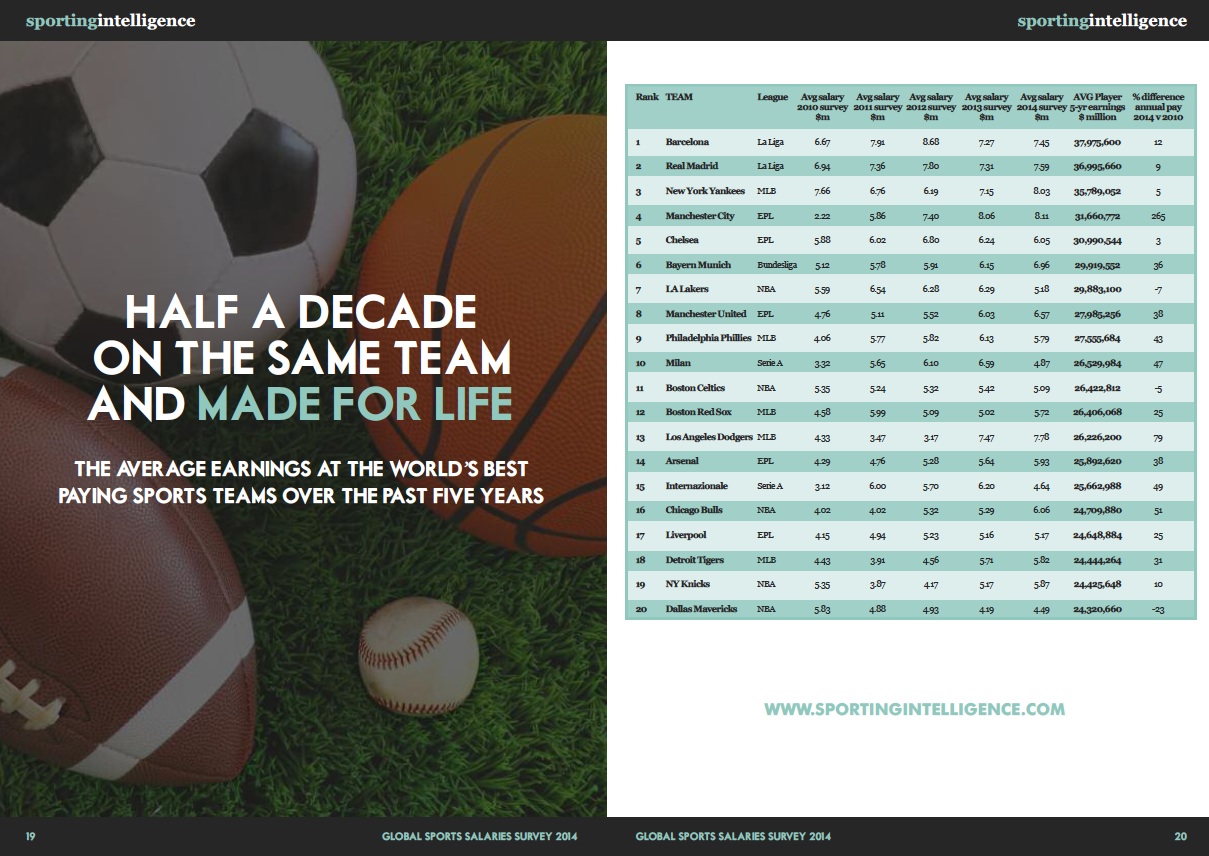
 ESPN Magazine recently reported (April 2014) the Top 25 highest-paid athletes in the world – their endorsements are not included. Of the Top 5, three are soccer players: Cristiano Ronaldo ($50.2M) of Real Madrid FC, Lionel Messi ($50.1M) FC Barcelona, and Zlatan Ibrahimovic ($35M) of Paris Saint-Germain. According to Sportingintelligence’s Global Sports Salaries Survey (April 2014), Manchester City FC of the English Premier League, is the world’s best paid team paying out an average salary of $172,508 per week to its first-team players. Of the world’s Top 5 highest-paying sports teams, Spanish La Liga giants Real Madrid and Barcelona round out fourth and fifth at $161,373 per week and $158,397 per week respectively. The average professional athlete contract is 5-years. In this latest edition of the Global Sports Salaries Survey (GSSS), it provides a list of 100 teams paying out the most money per average first-team player over five years:
“The eye-watering sums on offer in elite European football [i.e. Barcelona FC] and in the major sports leagues in America effectively mean that a single five-year deal should provide enough money to setup a player for life. Real Madrid have the next highest five-year total: $41M per player on average, followed by the Yankees ($39.7M), then Manchester City ($35M), and Chelsea FC ($34.3M).”
The last table-graphic shown in the GSSS article (below image) is particularly enlightening for American sports fans. It shows that of the Top 20 five-year earnings for first-team players of all major sports around the world, HALF of them (10) are soccer teams/clubs. Of the remaining 10 sports, only five are NBA teams and four are MLB teams. National Football League teams do not make the list at all until No. 93: the Dallas Cowboys.
 The primary reason soccer tops most team and player-salary lists is that almost ALL POSITIONS on the playing field are important (probably critical) for the organization to be successful and profitable. Soccer is, as well as basketball and hockey, are true team sports. In the sports of MLB and the NFL, that is not the case. The pitcher or pitching staff and quarterback are the critical positions influencing or controlling most dynamics of the game. Those players earn monumentally more money than their other teammates. It is also the reason why the Chicago Blackhawks of the NHL are 20 places higher than the first NFL team, the Cowboys.
Do these numbers explain why soccer unites more of the world than any other sport on the planet? What about the emotion, the passion of its fans?
What does it mean when one asks the question, “What is the most popular sport in the world?” Does it mean the sport most-watched, most-played, or perhaps the wealthiest based on revenue? Yes to all three. I have done the research and spent the time answering this question, and if you choose to search for the answer as well, you will find the majority of polls and surveys will all say the same thing: soccer.
Why is soccer the king of all sports on the planet and has been for many decades? The passion of its fans is certainly one reason. If you’ve never been to a major soccer game in Europe or South America, among singing dancing fans, you are missing out on a life-time experience like no other. Want a taste?
The wonderful atmosphere of top-flight soccer matches are finally growing in the United States. When the U.S. Men’s National Team qualified for the World Cup in Brazil this summer, listen and watch how 40,000+ fans in Seattle, WA – some of the most excitable fans in the nation – celebrated the 3-year achievement:
But simply being amongst a mass of dancing singing humanity is only part of the experience. Understanding what the world’s greatest players do on the field with that ball, as an 11-man team, explains why it is called and known all around the globe as “the beautiful game.” Soccer is a worldwide language; the most popular language spoken in a multitude of dialects. As a naïve outsider and at first glance, an American might think the world’s passion for soccer is overly simple, unimpressive. One might write it off as a dull 90-minute game with an average score-line of 0-to-0 or 2-to-1 most games. But that impression would be from a grossly uninformed unimaginative closed-mind.
Yes, the world’s love of the game is indeed simple: the action is non-stop; the 22 players improvise tactics in the middle of a flowing game performing spectacular feats of athleticism and skills. But the passion goes much deeper for more complex reasons. The great Brazilian star Pelé describes the game as being so infused in many countries that over time the sport is not just a pastime, but has morphed into a reflection of national character. With the diversity of global geographies and cultures come distinctive playing-styles. These national styles have produced some of the most riveting, most brilliant moments in soccer history! Take a look at these six clips, considered by many footballing fans as the greatest World Cup moments and goals:
World Cup Final 1970 – Brazil’s Carlos Alberto’s goal
World Cup Group-play 1970 – England’s Gordon Banks’ save vs. Pelé
World Cup 1982 – The heavily favored-to-win squad of Brazil: “Ballet with the Ball – A Love Story”
World Cup Qualifier 2001 – England’s goal frenzy vs. Germany
World Cup 2006 – The Tournament’s Best
World Cup 2010 – Top 10 Goals
(line break)
One of the most exquisite skills a world-class soccer player can master is the art of dribbling. The game’s biggest stars have signature tricks and moves to beat their opponent. In real time it is a blur, gone in one or two seconds. But the amount of training and practice required to use them in the game is mind-boggling. Watch these élite players from around the world showcase their best tricks and define why this game of soccer is so worshiped around the globe.
(line break)
 In 1992 in the country of Ivory Coast in West Africa, the Ivorians were so determined to have their national team win the African Nations Cup that the government’s sports minister enlisted a battalion of fétisheurs – juju men – to place on the team a supernatural advantage against rival Ghana. When the minister later broke promises of payment to the fétisheurs, they in turn placed a hex on the Ivorian team, which then went on a ten-year spell of losing results. When the defense minister desperately sought to make amends with the witch doctors, offering cases of liquor and large money bags, the hex was lifted. Almost immediately the team did a 180 and qualified for the 2006 World Cup.
In Spain, where soccer is so dramatic it is often described as theater, a Spanish novelist writes his obsession with the beautiful game this way:
“Once you’ve fallen into the game, there is no getting out… [stats] will tell you almost nothing about the game itself. The player who actually wins the game may be the one who moves into space at the opposite side of the field, drawing a defender, forcing a new configuration upon the defense and making virtually inevitable a goal that was before impossible, but no one – not even he – may be aware of this. It’s all narrative, and thus subjective: Each game is a story, a sequence of ambivalent metaphors, a personal revelation couched in the idiom of the faith. No game I know of is so dependent upon such flowing intangibles as “pattern” and “rhythm” and “vision” and “understanding.” Which may all be illusions. And at the same time it is a very simple game: like dreams, almost childlike.”
 In today’s Croatia, soccer is a form of group therapy which bore a new nation. A match between Zagreb’s Dinamo and Belgrade’s Red Star in 1990 marked the beginning of Croatia’s war for independence. After the opening whistle at kickoff, fans from both teams clashed in the stadium stands, as well as onto the field. A Serb-dominated police force began beating Croatian spectators while allowing Serbian fans to run freely. This ignited the already boiling-over tensions in what was then Yugoslavia. Upon witnessing a Serb-policeman wail on a fallen Dinamo fan, midfielder Zvonimir Boban rushed and karate-kicked the officer (image above left), and later became a Croatian national hero of their independence movement. In one of the biggest upsets in World Cup lore, Croatia beat powerhouse Germany in the 1998 World Cup Quarterfinals and then went on to win third place by beating an equally stacked Netherlands 2 – 1. After the match, Croatians flooded the town squares and streets in adulation and song. On television, many reporters interviewed grown men who couldn’t stop bawling. Courtney Angela Brkic, a Croatian author, stated that “not since the declaration of independence, had so much unified celebration been seen. Now no one could deny Croatia its place on the map.”
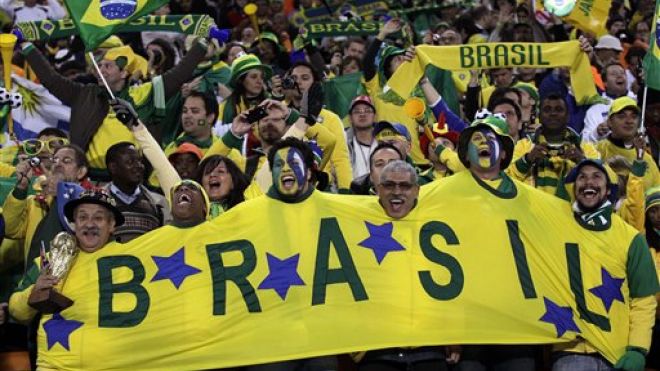 In Brazil, the only nation to have won the World Cup five times and the only national team to have appeared in all World Cup tournaments since its start in 1930, soccer is an ideology and state religion. Nowhere in the world does a nation try so hard to play the game so beautifully as Brazilians. And that is why Brazilian players are so loved around the world by so many fans and top leagues. The Brazilian national team has never been ranked world-wide below No. 10, a record untouched by any other soccer nations. Their fans do the Samba non-stop for ninety plus minutes as their players do indescribable tricks and feats between all ten of their team’s players. It is why Brazil, on any continent, is always the beloved overdog of every World Cup. They are the only favorite that is always a favorite.
If you cannot make it to games in Brazil this summer, the next best thing is to find a local pub or bar with an international flavor and history that will be televising the tournament. I guarantee the place will be raucous and rocking with national team fans. I always try to find a Brazilian restaurant-bar; the atmosphere is utterly electric, colorful, and beautiful. I will most certainly support my U.S. National Team, but unfortunately their odds of advancing out of the early group stage are minimal against the exceptional likes of Portugal, Ghana, and Germany. Nevertheless, the spectacle of the game will be phenomenal and the skills and creativity of the world’s best players on the world stage will be unparalleled. Be a part of it. Be united with the rest of the world for two memorable incredible months!
U.S. Soccer: We Are Going to Brazil
(paragraph break)
This work by Professor Taboo is licensed under a Creative Commons Attribution-NoDerivs 3.0 Unported License.
Permissions beyond the scope of this license may be available at https://professortaboo.wordpress.com.
Did you know that if planet Earth were invaded by angry hungry aliens from a distant Death Star ship, the best offering to avoid possible violence or slavery believe it or not would be to hand over our silicon-based sand and rocks? Which way do all of our planets in our Solar System rotate? Have you ever wondered why comets such as Halley’s Comet, Pons-Gambart, and Ikeya-Zhang Comets take 75, 188, and 366 earth-years respectively to come around?
Questions like these and their answers fascinated me camping outside as a boy looking up into the night sky with astonishment. How far away is that star, I would ask myself, which lead to another question and another. Limitless.
* * * * * * * * * *
To enlarge click image
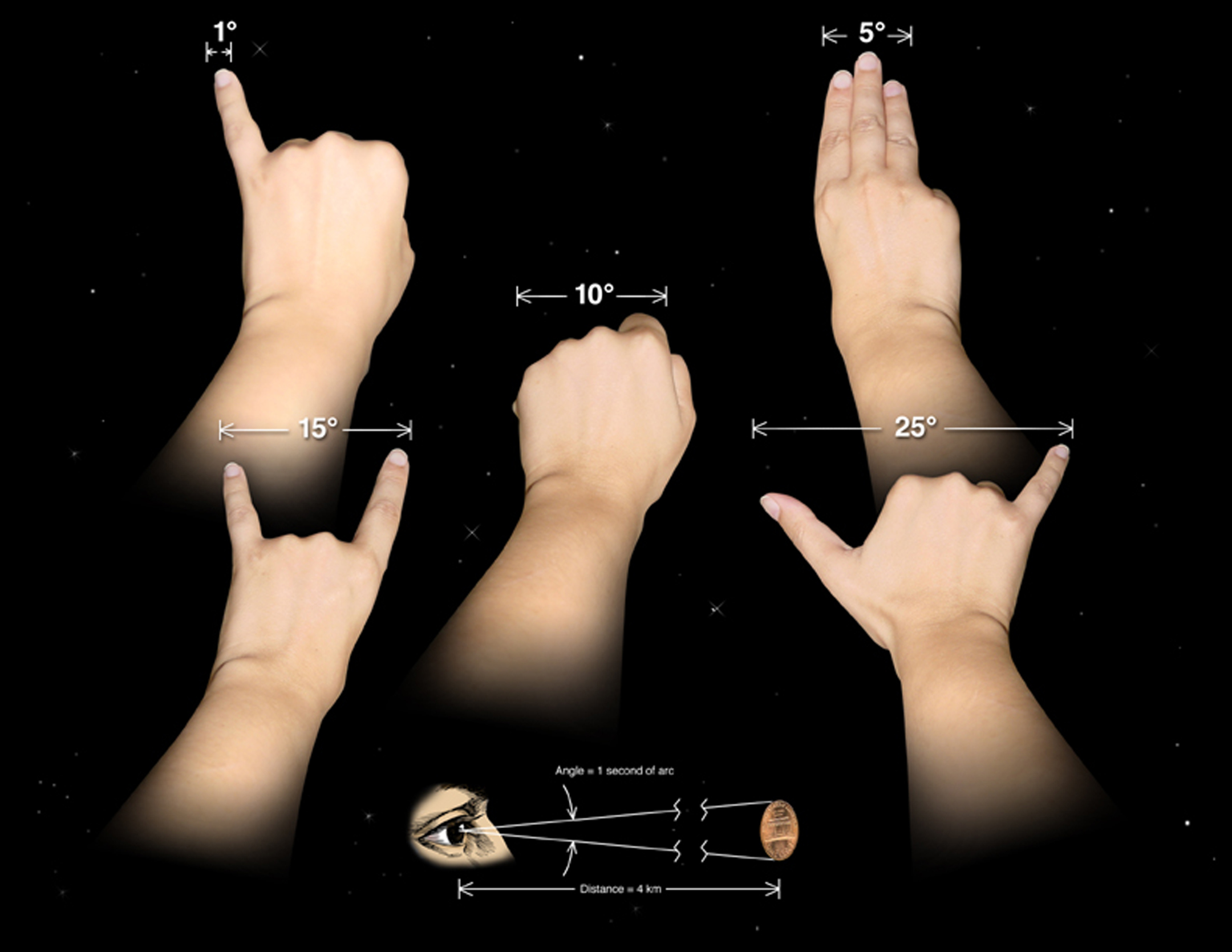
A 100-foot telescope and multi-million dollar observatory are not necessary to begin an intermediate knowledge of the celestial. Your outstretched arm, hand and fingers can suffice in determining an object’s angular size. Clamp your hand in a fist. Across your knuckles is about 10 degrees. Don’t believe me? Taking that fist and starting at the horizon count how many “fisted-hands” it takes to count upwards to straight up, or zenith (the top of the sky). It will be about nine hands, or 90 degrees. Three fingers together are about 5 degrees across and one finger, like the pinky finger, will be about 1 degree. A full moon then, when using this form of measurement will be about a half-degree (0.5°).
Finding the position of an object in the sky is a bit more difficult. If you don’t carry around a Cross Staff, or Astrolab, or even what amateur golfers use today: a GPS app; if you can find due north then you can still navigate the sky with your hand. The azimuth, or angular measurement parallel to the horizon in a spherical coordinate system, determines the cardinal points: north, south, east, and west. North is of course 0 degrees, east will be 90 degrees, south is 180 degrees, and due west will be 270 degrees. The angle above the horizon will be, you guessed it, altitude. Keeping our basic sky-gazing simple, when measuring from the horizon to the zenith, only 0-90 degrees is needed. Now you have the quickest most convenient tools to examine the never-ending sky.
A simple pair of binoculars can reveal more of the heavens beyond your naked eye. If you surveyed the full moon, you could easily find many craters or the four brightest moons of Jupiter. With the same binoculars you might be able to find Saturn’s brightest and biggest moon: Titan. If you want to see even more of the night sky, you will have to have binoculars stronger than 7x (times); in other words massively big and expensive type binoculars that will require a tripod or something steady and stationary to mount your 8x plus binoculars. Beyond high-powered binoculars gets us into complex telescopes and well beyond the scope of this post.
* * * * * * * * * *
Some star-maps, a flashlight, items to keep you comfortable or warm, and some patience will be all you need to find stars, constellations, and other sorted celestial performers. The further away from light-pollution you can get (i.e. large towns or cities) the better. Finding cardinal points is easiest with a compass or map; they both work fine. If you can remember where on the horizon the Sunset took place, then you have a general idea which direction is west. Keep in mind though the seasonal factors: during winter the Sun recedes a little south of due west and during summer it sets a little north of due west. In spring and fall, the Sun sets quite close to due west.
 If you can view your sky maps with a red-lighted flashlight, then your pupils won’t close up in its light. A normal white flashlight will cause your views from map-to-sky and back again to be greatly hindered by your widening and retracting pupils causing delays in their adjustments and testing your patience. Having red-lenses to cover the bulb or flashlights using a “red-LED” bulb can be purchased at most camping-sporting stores. Also, when you’ve been out a few times and can easily locate previous stars and/or constellations, moving on to unexplored areas becomes quicker and easier as your mapping-spotting skills improve.
One more star-gazing tip: A clear sky is usually pretty cold relative to your latitude. The further away you are from the equator, the colder the clear sky will be and the quicker your sitting-still body will get. Dress warmer than normal, a toboggan or hat might be good, and even bring along a Thermos of hot soup or tea, or as I often do, a warm stout toddy! If you want to “impress” a certain co-stargazer, bring along reclining folding-chairs and a quilt. He or she will be in for a superb relaxing long evening of fun.
The following four seasonal sky maps are near 35 degrees north latitude in North America; in other words, a straight line from Lompoc, CA to Fayetteville, NC. Sky maps from your particular location can be found on the internet or from a local nearby planetarium store. The six bi-monthly descriptions below are incorporated into the flow or movement of the sky maps.
Sirius: The Five-month King of Stars
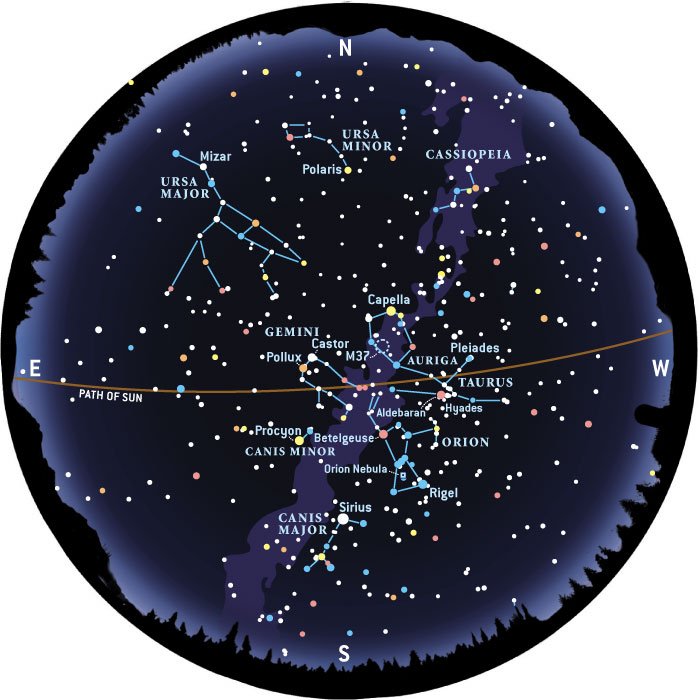
This map shows the winter sky at 2am December 1; midnight January 1; and 10pm February 1. Image – Roen Kelly, astronomy.com
From late December through mid-April, in the southeasterly sky, the brightest star of all stars in our sky is Sirius. It is the brightest because it is the closest star to Earth: about 8-light years away and closing. Yes, you read correctly, Sirius is getting closer to our Solar System and will be noticeably brighter in about 50,000 to 60,000 years. After that it will begin moving away, but for the next 200,000 years or so it will always be the King of All Stars. During winter and spring Sirius is a great reference point if you are just starting out as a new astronomer.
Serving King Sirius and moving to the west and slightly up is his Viceroy Rigel, then further up are Viceroys Betelgeuse (better known as Beatlejuice), Procyon to the east, and finally back toward the west and near straight up is Aldebaran. Straight up, or near zenith, and more north is his lone Viceroy Capella. These five stars represent magnitudes about 2.5 times less than Sirius but are so bright they can all be spotted in a large city with light-pollution. King Sirius’ “court” is the primary reason the winter skies are the favorite season for stargazers; they jump out to you!
Galaxies Galore and A New Prince
Heading into spring (March – early May) you’ll notice that Sirius and his viceroys have moved toward the western horizon. Back to the southern horizon is a darker starless sky by comparison. Yet due east near the horizon comes the newest viceroy or Prince: Arcturus which has been led by the largest cluster of galaxies – almost halfway up to the zenith – called the Virgo Clusters. They include more than 1,300 galaxies. Off toward the north and halfway to zenith you can find the Big Dipper.
Another Viceroy and King Sirius Departs

1am March 1; 11pm April 1; 9pm May 1. Add one hour for daylight-saving time. Image – Roen Kelly, astronomy.com
While Sirius drops down behind the western horizon and Procyon and Capella soon follow, the newest member to the court arrives: Viceroy Vega. Almost to the northeastern horizon, Vega’s brightness equals that of his predecessors and brings with him the Northern Cross with Deneb (touching the horizon) as its crown. It is now May through early July. Move to the southeastern horizon close to Earth’s surface, and the claws of Scorpius have appeared with Antares as its heart. Near the zenith sits Arcturus, 2nd in command for about two-plus months, while Sirius vacations in his summer palace doing “unseen” kingly jollies for the next four.
The Milky Way’s Majesty

1am June 1; 11pm July 1; 9pm August 1. Add one hour for daylight-saving time. Image – Roen Kelly, astronomy.com
July and August are the best times to see the center of our galaxy particularly with binoculars. Like a following royal parade, Vega brings along in the eastern sky not only Altair, a star slightly brighter than the previous Deneb, but also the globular-cluster M13 near zenith, and the star-clusters M11, M39, and the best clusters M6 and M7. And as if that wasn’t enough, the nebulas M8, M20, and M17 between Scorpius and Sagittarius to the south (about 10° up from horizon), round off the fat center of our majestic Milky Way.
Fall’s Tranquility?
The gaudiness of summer and the Milky Way drift into the southwest horizon causing many astronomers to say the night sky is the tamest from September through late October. It is perhaps no coincidence then that fall and October are celebrated as Halloween, or hallow the dead and dying. The Viceroy Arcturus has all but vanished behind the western horizon, leaving only Prince Vega near the zenith. The return of Capella and the first of King Sirius’ court are probably not yet visible to the northeast. A seemingly dark “blanket” ensues.
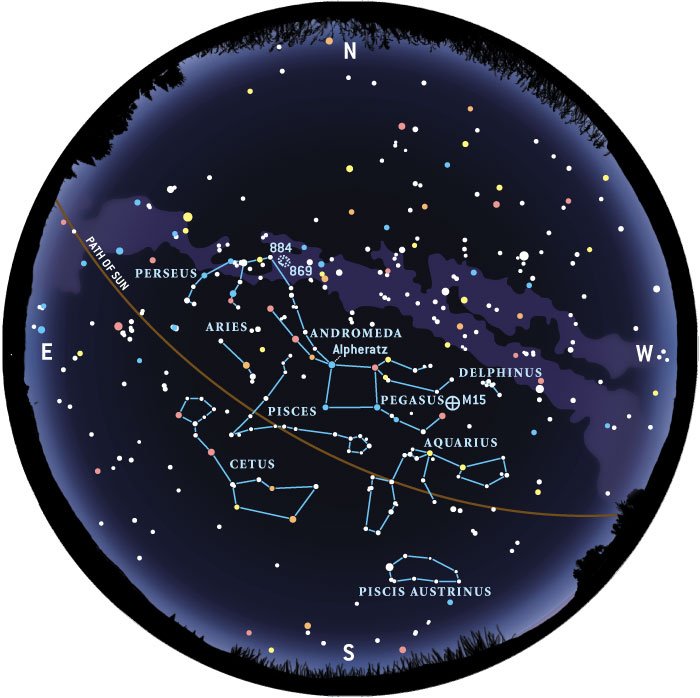
1am September 1; 11pm October 1; 9pm November 1. Add one hour for daylight-saving time. Image – Roen Kelly, astronomy.com
Not to worry, as all great exciting events take place to the south – sexual overtones intended – magnitude 1.16 star Fomalhaut rises out of Earth’s vagina to remind us that with persistence comes birth… and for better or worse, MANY MORE THINGS to come! Can I get an Amen!? Because Fomalhaut is the lone bright star in this part of the sky, many space agencies and orbital spacecraft engineers use the star as a point of reference for their machines. Their computerized satellites or crafts are programmed to find Fomalhaut and then align themselves. There is less of a chance for other mistaken bright stars nearby; a computer optic no-brainer if you will.
Because the heavens are darkest during this time of year, many scientist and expert stargazers use their high-powered telescopes to search out darker phenomena. This goes to show that a certain darkness is needed to truly see the stars.
The Mira and Algol Light Show
As King Sirius’ court of brightest stars rise again in the east, with a set of binoculars (certainly a telescope) a dance or battle can be seen more clearly between two stars; technically between the star Mira “The Wonderful” and the double-star system Algol “The Winking Demon.”
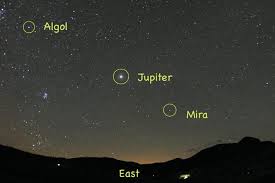 Mira is in the middle of Cetus the Whale, a quiet faint constellation of stars about 45 degrees up from the southeast horizon between Aquarius (to the southwest) and Orion (to the lower east) and the returning Aldebaran, Rigel, and Betelgeuse. Mira fades from a semi-bright magnitude 2 to a very dim magnitude 10 in less than eleven months. Mira means “the Wonderful” in Arabic and signifies her dramatic leaving and return. This happens due to her near-death lifespan and being unstable, pulsating prior to burn-out. When Mira is big and cool, most of its light is only visible in the infrared spectrum. When she is small and hot, she radiates most of her light at the far end of the visible spectrum; red in a telescope. Mira has quite possibly already turned into a planetary nebula then white dwarf, but we won’t witness this for another 35,000 Earth-years because she is about 350-light years away.
Algol in Arabic means “the Demon” and they called the double-star system this because astonishingly one star eclipses the other every 2.87 days! This makes its brightness dip from a 2.2 magnitude to a 3.5 magnitude creating the winking demons. This change can be seen by the naked eye. Algol can be located up about 60 degrees from the easterly approaching the zenith during mid-November to mid-January.
* * * * * * * * * *
Other Resources
As you may have noticed, it is impossible to include all the major fascinating parts of stargazing and our cosmos in a 1,000 word blog-post – the commonly recommended length. This post is around twice that long. Therefore, I am including further website resources to explore should you want to know more, even become a well-informed astronomer.
www.astronomy.com The site I used for the sky maps.
www.darksky.org
www.science.nasa.gov
www.skyandtelescope.com
www.hubblesite.org
For the serious star-preneur, astronomy software for purchase:
Starry Night – www.starrynight.com
The Sky – www.bisque.com for the mega-serious!
(paragraph break)
P.S. To answer the two initial questions in the beginning all our planets rotate counter-clockwise around the Sun. And about those once-in-a-lifetime comets and why they take so long to return and why they keep coming back… it is because of our Sun’s gravitational control. It extends out to the Kuiper Belt which is well beyond the outer planet Neptune, or about 2.8 billion miles from our Sun. Perspective: and our Sun is one of the smallest Suns in the galaxy and cosmos!
(paragraph break)
This work by Professor Taboo is licensed under a Creative Commons Attribution-NoDerivs 3.0 Unported License.
Permissions beyond the scope of this license may be available at https://professortaboo.wordpress.com.
Divergent Thoughts on Life, Love and Death
life and other weird stuff
Seeking Dialogue to Inform, Enlighten, and/or Amuse You and Me
Storytelling, short stories, fable, folk tales,...
Writing writing and more writing
Analysis & Discussion For Political Uncertainty
I have zero expectation that anything I ever say will end someone’s belief in their God. Not my goal or purpose. That alone belongs to the individual. ~ Zoe
A photo journal of my interests from one extreme to the other.
Cogito Ergo Sum
by Wendy Waters
Understanding the psychology that drives our politics
Ponder(verb) to weigh in the mind; to view with deliberation; to examine carefully; to consider attentively
'Light thinks it travels faster than anything but it is wrong. No matter how fast light travels, it finds the darkness has always got there first, and is waiting for it' - Terry Pratchett
writing on human security
Living and Learning
Some prefer the comfort of Faith. I prefer the cold, hard Truth.
By Keith Goode aka Ken Thackerey
I don’t want to start a class war; it started a long time ago and, unfortunately, we lost.
Searching for truth while leaving tradition behind.
Questioning the conventional wisdom
 The Professor's Convatorium