Reading Once Unreadable Ancient Scrolls

This is groundbreaking news for science and most of all for future rewriting, reexamining, and changing historical “traditions” into historical facts and more compelling plausibilities. What is remarkably ironic is that this technology has been introduced by an American computer scientist named Brent Seales, who is also an evangelical Christian. I wonder if he fully realizes what he has ushered in?

∼ ∼ ∼ § ∼ ∼ ∼

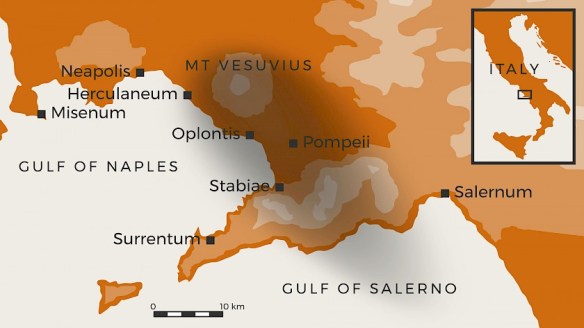
In the 1730’s Italian well-diggers hit and stumbled across an ancient Roman villa. Over the next three decades as commissioned by the King of France, two engineers headed up the excavations of the villa and its contents. They eventually uncovered over 1,800 papyri scrolls from 1st century CE Roman life prior to the 79 CE eruption of Mount Vesuvius just a few kilometers away. Like all the inhabitants of Herculaneum, items such as papyri scrolls were either vaporized or incinerated under the 300+ degree Celsius (≅ 600 Fahrenheit) heat blast. These scrolls managed to be only charred due to various storing techniques that the Villa’s owner (probably the father-in-law of Julius Caesar, Lucius Calpurnius Piso Caesoninus) maintained for his large library. Nevertheless, for the next 250-years after their discovery scientists assumed their words would be impossible to ever read. They had attempted to carefully unravel some, but only turned them into fragments and dust; certainly more undecipherable.

Vesuvius-79 CE eruption

Fast forward to the computer age…

Later, while earning his doctorate, at the University of Wisconsin, [Seales] became fascinated with “computer vision,” and began writing algorithms to convert two-dimensional photographs into 3-D models—a technique that later enabled vehicles such as Mars rovers, for example, to navigate terrain on their own. Seales went to work at the University of Kentucky in 1991, and when a colleague took him along to the British Library to photograph fragile manuscripts, Seales, captivated by the idea of seeing the unseeable, found the challenge thrilling.

From there Seales continued improving upon the improvements of computed tomography (CT).

He began to experiment with a medical-grade computed tomography (or CT) scanner, which uses X-rays to create a three-dimensional image of an object’s internal structure. First, he tried imaging the paint on a modern rolled-up canvas. Then he scanned his first authentic object—a 15th-century bookbinding thought to contain a fragment of Ecclesiastes hidden inside. It worked.

…to read the full Smithsonian article click here

Fast forward thirteen more years. Once pulling out or highlighting the metal-laden letters within the scrolls, how does one go about unwrapping them on their proper page in correct order? Seales admitted that at the time that process was just simply beyond their algorithms.

What makes virtual unwrapping such a complex challenge is that, even if you imaged the inside of a rolled-up scroll written in ink that glowed brightly in scans, you would still only see a dizzying mess of tightly packed letters floating in space, like a three-dimensional jigsaw puzzle—but without a final picture to use as a guide. To decipher that jumble of letters, Seales’ key innovation was to develop software to locate and model the surface layer within a wound-up scroll, which analyzes each point in as many as 12,000 cross-sections. Then he looks for density changes that correspond to the ink, and applies filters or other techniques to increase the contrast of the letters as much as possible. The final step is to figuratively “unroll” the image for reading.

multi-spectral imagingNow today with phase-contrast tomography in combination with X-ray phase-contrast tomography (for carbons), then mapping all the images the scrolls are virtually unfurled to read the full texts:

After Seales returned to Kentucky, he and his colleagues spent months mapping all of the available 2-D images onto the 3-D template produced by the Artec Space Spider. This past March, they returned to Oxford to present the results on a big screen to a packed conference room. At such a high-resolution, the charred papyrus resembled a dark-brown mountain range as seen from above, with lines of text snaking over the ridges and peaks. There was a gasp from the audience as Seales’ student Hannah Hatch rotated the image, then zoomed into creases and peeked over folds, flipping seamlessly between high-resolution photographs, infrared images and even the disegni drawings—all matched up to the 3-D template.

Now that this proven scientific method, via subatomic physics to be exact, for reading once unreadable brittle ancient scrolls has been established, it has unsurprisingly caused a frenzy in scholarly paleographical circles.

Successfully reading Herculaneum scrolls could trigger a new “renaissance of classical antiquity,” says Gregory Heyworth, a medievalist at the University of Rochester in New York. He points out that virtual unwrapping could be applied to countless other texts. In Western Europe alone, he estimates, there are tens of thousands of manuscripts dating from before A.D. 1500—from carbonized scrolls to book covers made from older, glued-together pages—that could benefit from such imaging.

“We’d change the canon,” Heyworth says. “I think the next generation is going to have a very different picture of antiquity.”

A very different picture of antiquity“? Hah! True, but an interesting way of putting it. I’d say not necessarily different, but more importantly accurate rather than on biased pseudo-traditions. This is why science works better for the benefit of humanity. It need not be feared, unless there is something(s) shameful to hide.

————

Live Well — Live Scientifically — Love Much — Laugh Often — Learn Always

Creative Commons License
Blog content with this logo by Professor Taboo is licensed under a Creative Commons Attribution-NonCommercial 4.0 International License.
Permissions beyond the scope of this license may be available at https://professortaboo.com/contact-me/.

Every 405,000 Years

Geo-core samplesFor decades astronomers have theorized that like our Moon impacts our tides, over tens of thousands of years our closest and largest planets in our solar system (Venus and Jupiter) have influenced Earth’s climate. Since Serbian astrophysicist Milutin Milanković hypothesized his Earth orbital-cycles of variations in the 1920’s affected Earth’s climates, there simply hasn’t been any sufficient physical proof for his cycles theory. Until last month.

With the further advanced technology and methodologies used on geological formations and strata (magnetostratigraphy) in correlation with the Newark–Hartford APTS (Astrochronostratigraphic Polarity Timescale) published May 7, 2018 in the Proceedings of the National Academy of Sciences, now:

…provide[s] empirical confirmation that the unimodal 405-kiloyear orbital eccentricity cycle reliably paces Earth’s climate back to at least 215 million years ago, well back in the Late Triassic Period.

This conclusion was based on the geological research of three different cores:  two from two different sites of ancient lake beds in New Jersey and New York, and one rock core 1,500-feet long from the Arizona’s Petrified Forest National Park.

The geologists noticed that lake sediment cores would disclose a consistent pattern of ancient lakes drying up then refilling over the course of hundreds of thousands of years forming different geological strata. This suggested cyclical changes in climate. The difficulty was that at the time they lacked the extensive methods to accurately date those climatic shifts. Fortunately, the Arizona Petrified Forest core, contained layers of ash from volcanic eruptions. These could definitely be dated because they contained radioisotopes.

Scientists compared and aligned the Arizona core dates to the NJ-NY ancient lake cores using bands found in all of the cores, indicating reversals in Earth’s magnetic fields. Yes, “reversals”! This allowed them to more precisely study the records. The analysis then demonstrated that the climate swings did indeed take place every 405,000 years for at least the last 215-million years, which is back through the Late Triassic Age when dinosaurs walked the Earth.

What does all this have to do exactly with Venus and Jupiter? Understanding gravitational forces by mass, Venus — the closest planet to us at 24-million miles — tugs us slightly closer to the Sun, and Jupiter — the largest planet in our solar system at 318-times more massive than Earth — tugs us slightly further from the Sun. At the peaks of those infrequent elliptical orbits, Earth has indeed historically experienced (the last 215-million years) hotter summers and colder winters with more extreme times of rain-flooding and dryer droughts

antarctic ice-strata

Antarctic ice strata also determines Earth’s climate millions of years in the past

Dr. Dennis Kent at Columbia and Rutgers Universities, specializing in paleomagnatism, states:

Scientists can now link changes in the climate, environment, dinosaurs, mammals and fossils around the world to this 405,000-year cycle in a very precise way. The climate cycles are directly related to how the Earth orbits the sun and slight variations in sunlight reaching Earth lead to climate and ecological changes.

Beyond Earth’s ancient past and astrophysics this study is a substantial breakthrough for the methods in which geologists are able to date cores and present a reliable more accurate timeline of Earth’s geologic past. It will also assist in many other scientific domains!

Paleontologist of the University of Edinburgh, Dr. Steve Brusatte:

[With the aid of APTS and newest magnetostratigraphy it] is a really important study for clarifying the Triassic timescale and untangling the sequence of events that occurred as Pangea began to split up and the dinosaurs originated and then diversified. It’s mostly a study of how to tell geological time rather than of how changes in climate relate to evolution.

Most people want to know the more immediate concern: Where are we currently in the Venus-Jupiter climate-cycle? And could Venus’ and Jupiter’s tug-cycles be responsible for our current climate-changes?

Bad news climate-change deniers. Astronomers and astrophysicists calculate that we are about in the middle of the 405k cycle. Earth’s orbit is very close to circular, not elliptical, and presently not near enough to cause disruptions in climate or global warming. The changes we have been experiencing come from some 238-years of outsized human output and input in the release of greenhouse gasses.

———

Live Well — Love Much — Laugh Often — Learn Always

Creative Commons License
Blog content with this logo by Professor Taboo is licensed under a Creative Commons Attribution-NonCommercial 4.0 International License.
Permissions beyond the scope of this license may be available at https://professortaboo.com/contact-me/.

Phenomenological Primitive Cognition

I am taking a brief pause from my 4-5 week (so far) MASSIVE project (Page) I’m currently working on to share this wonderful blog-post from a blogger I follow. I think some of you would really enjoy it, as I did.

———

∼ ∼ ∼ § ∼ ∼ ∼

Crossing Cognitive Chasms with P-prims.” He begins…

Apparently, roughly 10% of humans still believe that the Earth is larger than the Sun. Do they believe this because they haven’t been properly educated? Possibly. Do they believe this because they’re stupid? Probably not.

In fact, the most likely explanation is that the individuals concerned just haven’t thought that much about it. The Earth looks big; the Sun looks like a small disc in the sky; ergo, the Sun is smaller than the Earth.

The individuals are relying on what Andrea diSessa (1988) would call a phenomenological primitive or p-prim: “These are simple abstractions from common experiences that are taken as relatively primitive in the sense that they generally need no explanation; they simply happen.”

What is a p-prim (phenomenological primitive)?


More from E=mc2andallthat

One of the concepts I took away from E=mc2’s excellent post was that so very much of our own perspective, our own measurements, are greatly influenced by our own TINY experiences and background compared to all other perspectives and measurements. Fascinatingly, E=mc2 used a science lab experience of heat radiation emitters and absorbers to support and explain various applications:

…a substance [or idea, or behavior] that is good at one thing can also be good at its opposite.

Be sure to click on his “Father Dougal” video-link! Hahaha!

Does it benefit someone and humanity when one person or a large group maintain a fairly stable cognition of opposites so that each can be understood more deeply and appreciated fairly? Personally, I am very, very fond of my habit of continually understanding and appreciating my good and my evil, as well as others who like crossing that chasm! 🤩 😈

What are your thoughts?

———

Live Well — Love Much — Laugh Often — Learn Always

Creative Commons License
Blog content with this logo by Professor Taboo is licensed under a Creative Commons Attribution-NonCommercial 4.0 International License.
Permissions beyond the scope of this license may be available at https://professortaboo.com/contact-me/.

Brain Secretion Byproducts

“God” is a secretion of the human brain, says Michael McGuire and Lionel Tiger.

 † † † § † † †

In their 2010 book “God’s Brain,” McGuire and Tiger strongly suggest and demonstrate that the concept of God, or a God, is a byproduct of human cerebral secretions. Historically the various divine tenets, revelations, traditions, and expressions of social orders around the world are encapsulated from that specific culture’s or civilization’s perceived, geographical, organizational needs not just for survival, but for their perceived perpetuation, then recorded and implemented in a Code of Principles relevant to their time-period. McGuire and Tiger state there is simply no compelling evidence for any type of cosmic, monistic Being manipulating us and Earth’s events.

Now that Homo sapiens are more evolved, at least intellectually and socially no matter the multitude of progressive and digressing methods, historically speaking have our cerebral secretions of Gods and religions been helpful? On a micro scale Tiger has an intriguing perspective on the question:

I found Tiger’s elaboration of the individual and social functionality of ‘optimism’ or hope — that it seems to be a useful tool for survival and perhaps for thriving throughout life — to be of special interest. Why? Because its use requires no patent or jurisdiction other than culturally, in a specific time-period to a specific locale. How is trust defined by those people and their circumstance? One thing is evident, none of this religious human behavior can be adequately or universally traced to one source.

On a macro scale E.O. Wilson of Harvard University (retired) goes in a different direction. Organized religion has a dark side and ugly track-record.

[Intent of religious deities have] “been perverted many times in the past — used, for example, to argue passionately for colonial conquest, slavery, and genocide. Nor was any great war ever fought without each side thinking its cause transcendentally sacred in some manner or other.”

Hence, this could beg the question:  Have we modern humans evolved or should we humans further evolve to a more practical, more progressive new social Code of Principles? What are/would those principles based upon? How many social affiliations should/can a human(s) be involved? Are the affiliations beneficial or detrimental to them and their family? Non-family? Do you already have affiliations and belief-systems that are more highly evolved than others?

(paragraph break)

 † † † § † † †

I think whether you agree or disagree with Tiger’s assessments of transcendental beliefs or empirical biological consequences concerning the origin of God and religions, it is paramount to develop and maintain a certain amount of scrutiny, or neutrality, or critical-thinking when considering this source or that source and its mechanisms.

Critical-thinking is not to be confused with agitation, or argumentative, or a personal attack upon someone. Critical-thinking actually helps us acquire more knowledge, expose ignorances, refines our theories, improves collaboration and construction, and strengthens or weakens premises for what they are. I feel one of the most beneficial aspects of applied critical-thinking is that it promotes “thinking outside the box,” a very healthy form of human empowerment and creativity. These two conditions are not achieved to their fullest in a restrictive or constraining closed-system typically preached and protected by religions. They are best achieved in environments of freedom of thought and scrutiny, as well as positive support for a person’s and all person’s natural-born abilities. Agree? Disagree? Why or why not? Share your thoughts below.

Live Well — Love Much — Laugh Often — Learn Always

(paragraph break)

Creative Commons License
Blog content with this logo by Professor Taboo is licensed under a Creative Commons Attribution-NonCommercial 4.0 International License.
Permissions beyond the scope of this license may be available at https://professortaboo.com/contact-me/.

Martian Laws

If the oxygenator breaks down, I’ll suffocate. If the water reclaimer breaks down, I’ll die of thirst. If the Hab breaches, I’ll just kind of implode. If none of those things happen, I’ll eventually run out of food and starve to death. So yeah. I’m fucked.

They say once you grow crops somewhere, you have officially colonized it. So, technically, I colonized Mars. In your face, Neil Armstrong!

I’m going to have to science the shit out of this.

I blew myself up. Everything went great right up to the explosion.

∼ ∼ ∼ ∼ § ∼ ∼ ∼ ∼

Botanist Mark Watney is a fantastic character in the 2015 film “The Martian.” The movie is one of my all-time favorites. Those are just a few of the classic lines Watney stated while stranded, alone, on Mars, trying to survive for another 4-years, minimum. Complicated? Daunting? Yeah, to say the least. And that’s strictly concerning the human needs of Martian explorers and colonists, which by the way were not just Americans.

The Martian - base stationEarth-bound nations and their people have a long, long history of fighting each other and not getting along. What happens on Mars, or any celestial body, when Earthly independent nations with their own agendas start mixing with or conflicting with foreign foreign agendas? Watney indeed talked about those guidelines in the film, that applied back on Earth and Earth’s orbits, but what about on Mars?

In an October 2017 article on Smithsonian.com, writer Gbenga Oduntan probes into these issues with some questions regarding the governing of activity on and around Mars. I find it all intriguing because by 2022 and 2028 these manned Mars expeditions will become reality.

Psychological Factors

Mars is around 34.2 million miles away from Earth, which means it would take a manned spacecraft between 150-300 days — depending on the speed of the launch, the alignment of Earth and Mars, and the trajectory of the journey the spacecraft takes — to reach the red planet. The human physiological challenges of a year in spaceflight are numerous. If the trip doesn’t kill you or drive you insane, living on Mars might. The emotional stressors of being away from Earth are perhaps more numerous. Then consider living on an unforgiving, uncooperative alien planet and all sorts of further complexities compound manned expeditions.

[after Mindy has discovered that Watney may be alive]
“Can you imagine what he’s going through up there? I mean, he’s 50 million miles away from home. He thinks he’s totally alone. He thinks we gave up on him. What does that do to a man, psychologically? What the hell is he thinking right now?” — Vincent Kapoor, The Martian

Mars_Voyage_habitat

click here to enlarge

Experts at NASA’s Goddard Space Flight Center and Planetary Science Institute say helping boost the astronaut’s morale on the journey and on the surface of Mars would be the need to have enough living-space and good food for them to garden. Crops from “green walls” could supplement their space-food diet. Of course loading up the spacecraft with these pseudo-Earth human comforts and needs means a heavier payload, more fuel, and more cost considerations. Humans on Earth and in most governed states are required to pass tests to be issued operator licenses for autos and machinery. What sort of licensing tests should there be for Mars? These are only a few of the material, legal, and psychological challenges of manned spaceflights to Mars.

Policing and Martian Rights

The appropriate and safe activity on Mars and her two moons Phobos and Deimos will be practically endless. How should it be governed and policed? What should be permitted for states and corporations like Elon Musk’s SpaceX? Certain manufacturing of drugs and materials requiring sterile atmospheres could be done in space stations. Space and Mars discoveries under present laws can be patented and commercialized. Hence, what should be the legitimacy of Martian mining?

As laws stand now, conducting expeditions for the sake of science and sustenance for Martian missions are granted. However, creating property rights over celestial resources are not. This means the commercial extraction of resources back to Earth is illegal until international space treaties are updated. Unfortunately, history has shown that cooperation between opposing nations has often been hit or miss to put it mildly. It is likely that new laws and treaties for property and resources 34-million miles away will be ignored by Martian workers and their employers. Just ask the Native Americans of the U.S. Like the California Gold Rush of 1848 and the Oklahoma Land Rush of 1889, the U.S. and Luxembourg have made attempts already to gain appropriation of natural resources in space. Essentially the two countries are preparing to issue Carte Blanche to private companies for winner-takes-all acquisitions.

The Intergovernmental Agreements of 1988 and 1999 drawn up for the Columbus Space Station Project then the current International Space Station offer civil and criminal jurisdiction for all nations participating in space exploration. Parties to these agreements set out to govern the conduct and ramifications of international operating environments, particularly concerning the ESA’s (European Space Agency) eleven independent member states. Yet, even the totality of these agreements and policies in several instances are not fully elaborated, they do provide a compass for a comprehensive legal framework that can serve as an example for international space law and a forward-looking view to new developments.

Watney-Space Pirate

“Mark Watney:  Space Pirate.”

Nonetheless, it has become tradition that astronauts, cosmonauts, etc, are almost always subordinate to the hierarchical authority of one commander from their native registered country. That commander’s authority is usually cut-and-dry; final. Like in the naval traditions of hierarchy the ship’s captain has full and ultimate command and it is his/her responsibility for the care and safety of crew and passengers or “space colonists.” These past command traditions and roles will need modernizing however, for space travel and celestial population and survival.

Current Space Station Laws

“I’ve been thinking about laws on Mars. There’s an international treaty saying that no country can lay claim to anything that’s not on Earth. By another treaty if you’re not in any country’s territory, maritime law applies. So Mars is international waters. Now, NASA is an American non-military organization, it owns the Hab. But the second I walk outside I’m in international waters. So Here’s the cool part. I’m about to leave for the Schiaparelli Crater where I’m going to commandeer the Ares IV lander. Nobody explicitly gave me permission to do this, and they can’t until I’m on board the Ares IV. So I’m going to be taking a craft over in international waters without permission, which by definition… makes me a pirate.

Mark Watney: Space Pirate.

As Watney illustrates, there are a plethora of complexities not only aboard a space station orbiting Earth or Mars, but just as many complexities surround stations on the surface of Mars that need to be spelled out. According to the Outer Space Treaty, Mars belongs to everybody back on Earth. Nobody can “own” a celestial body. Today private companies on Earth can go to Mars whenever they choose, construct permanent habs, and start new Martian societies, as long as they do so under the Outer Space Treaty’s laws and bylaws. For good or bad this also includes weaponry. Those operations are not allowed to interfere with operations of others on Mars or in space. As Watney correctly alluded, maritime laws, at least for now, are applicable examples. But as was also touched on, including other independent nations to Martian activities and things are not so clear-cut, yet.

Here in the U.S. if you want to put a satellite into orbit, you must first obtain permission from the federal government. Depending on what activity will be done in space you must get further permission or license to do such activity. However, move outside of Earth-orbit and there are no current licensing agencies to supervise legal ramifications of celestial colonization. Space tourism by private companies has been on the rise for several years so governments are going to have to sort out licensing protocols very soon.

colonizing Mars - NGM

click here to enlarge

Like any new, untouched, pristine area or park, opening them up to the general public means human trash and contamination. The Outer Space Treaty specifically states this activity or behavior by humans or business entities is prohibited and it includes our contaminating microbes. Yet, here’s the Catch-22. Private or government spacecraft, by order of the OST, are required to decontaminate their ships as best as possible before sending and/or arriving on foreign planets. But humans are near impossible to decontaminate because our health depends on these microbes. Places on Mars or on other celestial bodies that may contain water or forms of frozen water and liquids or once did must receive the highest protections and laws possible. Even the most thoroughly decontaminated vessels may need banning from specific areas. Let’s keep in mind though that these laws, their jurisdiction, and enforcement in the end fall only under the U.S. flag. International space cooperation and collaboration among nations and peoples will see unchartered territory in the coming decades. Can it be made easier or harder? How so and how not?

Once again, there will always be titans of commerce who scream about “bureaucratic red-tape” and their (unfounded?) feeling of repression toward “human progress and developement” while their greed lurks in the wings waiting to pounce. History is saturated with these exploitations of resources at the expense of the bio-eco systems and/or the lives of lower-class vulnerable humans. Why would space, Mars, and beyond be any different?

Like 15th century European Empires discovering the New World bringing with them their way of life, materials, waste, and weapons, space debris around Earth-orbits today is already well past a point of substantial risks of collisions. It is only a matter of time before damage to a space station, human injury or loss of life caused by congested operations, overcrowding, trash, and debris will lead to legal and/or political conflicts. How soon should Earth’s international space community hash-out these very real future events? Is it even possible? Will it be easy or hard?


Live Well — Love Much — Laugh Often — Explore & Learn Always

Creative Commons License
Blog content with this logo by Professor Taboo is licensed under a Creative Commons Attribution-NonCommercial 4.0 International License.
Permissions beyond the scope of this license may be available at https://professortaboo.com/contact-me/.