As I watched one night the 6-part series “The Men Who Built America” on the History Channel, I kept saying to myself What has changed in our socio-economic America today? The answer is a lot…and not much. Watch the following 4-min video clip to get an idea why much has changed and not changed:
aragraph separation)
Resting on Star-Spangled Laurels
Ask most Americans on the streets today who Cornelius Vanderbilt, John Rockefeller, Andrew Carnegie, J.P. Morgan, and Henry Ford were and what they meant to America and you will get a variety of answers – although many could describe briefly some connection to Ford Motor Company, Chase Morgan, and Carnegie Hall in New York City. Beyond those mutterings, the depth and accuracy might be in question. However, ask the same question to Donald Trump, Jerry Jones, the Waltons of Walmart, Bill Gates, or Sumner Redstone and they will give you a hyper-patriotic narrative of how these progenitors founded and built the greatest economic nation in the world. In the annals of Western capitalism, Carnegie, Ford, Morgan, Rockefeller, and Vanderbilt are the founding demigods.
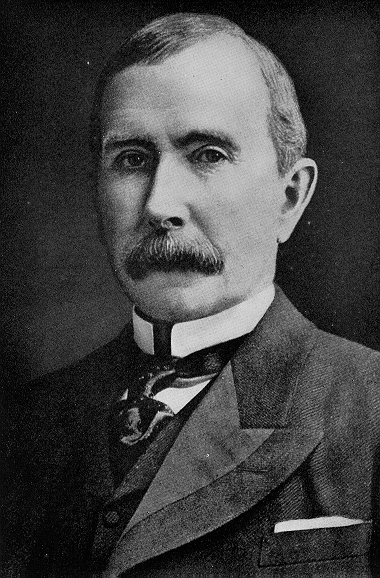
John D. Rockefeller, 1888
By the age of retirement all five of these 19th century business-moguls’ fortunes made up anywhere between 1-3% of America’s GDP by a single person. Those five net worth’s have been adjusted for today’s 2000 dollars, but the amounts are incomprehensibly staggering. Vanderbilt’s estimate: $140 – $180 billion dollars. Rockefeller’s estimate: $392 – $663 billion dollars. Carnegie’s estimate: almost $300 billion. Ford’s estimate: $188 billion. Morgan’s final net worth was divided between several holdings but his estate was estimated to be worth about $68 million at death. If 1-3% of the economy of America – one of the world’s richest nations – consisted of five men, then that is perhaps the truest definition of oligarchynot democracy. J.P. Morgan’s wealth was so vast that during the economic panic of 1893, President Grover Cleveland borrowed from him in order to restore the nation’s treasury.
How was it possible for a handful of entrepreneurs to accumulate such epic wealth during sixteen national recessions (1865 to 1933) as well as the Great Depression of 1929? I will attempt to answer this question simply.
Do not mistake this web blog as promoting Karl Marx or Vladimir Lenin economics. There is nothing inherently wrong with making and earning money for quality work. What is under question, however, is how efficiently and fairly that economy — which provides the wealth — is working as a whole and perpetuating itself. Despite the great success of these five American entrepreneurs, the “machine” from which they profited broke-down sixteen times. Those failures in a long line of many failures as recently as 2008, are what is in question. Why does our “strongest nation in the world” economy and government keep failing?
I am a lifetime sports fan. One way to answer the question is to use a sports analogy. Pick your favorite sports team, the team you grew up watching with family or friends. The team’s performance should elicit some level of passion inside. You’ve always wanted them to perform well, maybe even win several championships. When your team is playing say in the playoffs, do you feel that referees or umpires are necessary? Why are they necessary? No fans, or for that matter no team players or coaches on the competing rosters cheer for the referees or umpires. Why is that? We like them when they punish or discipline our opponent, but we dislike them when they punish or discipline our favorite team. Why are the referees and umpires needed for the games?
From a biased point-of-view the answer is obvious: we want them there so that our opponents won’t cheat or win the game unfairly. But from an objective standpoint, we need them there to ensure a “fair or level playing field” for both teams, correct? Imagine what the games would be like if there were no referees or umpires. Cheating, even intentional maiming would no doubt take place. Whether we like referees and umpires or not, we need them so the games can be won or lost fairly. Well, in economics and social policy the government is no different: we need a strong government to ensure that the game of economics and social policy are fairly played.
During the era of Vanderbilt, Rockefeller, Carnegie, Morgan, and Ford there were weak referees or umpires, and in several cases no referees or umpires at all. Even though the United States grew into the most powerfully economic and productive nation on the globe after 1870, doing it inside an unrestrained ungoverned free-market economy it eventually led to the worst economic and social collapse in modern history: the Great Depression and two world wars. Is that performance really deserving of grand boasting and fan-fare? Resting on the laurels of post-1870 Wild West growth is at the same time condoning unfettered greedy oligarchists and market manipulation. Domestic and global economics today are much more complex and dynamic than antiquated 19th and 20th century philosophies can manage and diluting the power of the referees and umpires (i.e. our government) is a sure way of returning to another Great Depression.
Let’s look more closely at what outdated economic systems, still pushed today by some American parties, nurture over several generations.
Fallacies of Incentive-Opportunity Economics
Some political parties and economists today swear by and blow their Reaganomicsbugle, or trickle-down economics as the best economic system. Another more modern name for this system is incentive economics. Within this philosophy its adherents proclaim that inequality is a natural product of its efficiency: some will produce more than others. Proponents of incentive economics (primarily those from the political right) argue that if programs and policies redistribute wealth, then it will deconstruct incentives and motivation toward efficiency. They also argue that if we focus too much on disparity of outcomes, i.e. a growing gap between socio-economic classes, especially over one year or a four-year presidential administration, then the public is missing the bigger better picture. What is more important, they proclaim, is only lifetime inequality and how much more opportunity is created. In other words, there is a natural trade-off of the-haves and the-have-nots based on efficiency as if it is “natural selection” of the strongest over the weakest or genius over ignorance. They add that private wealth created by opportunity and perfect competitive economies will soon feed or trickle-down into social returns for the less fortunate. But for the last four to five decades this simply hasn’t been the case.
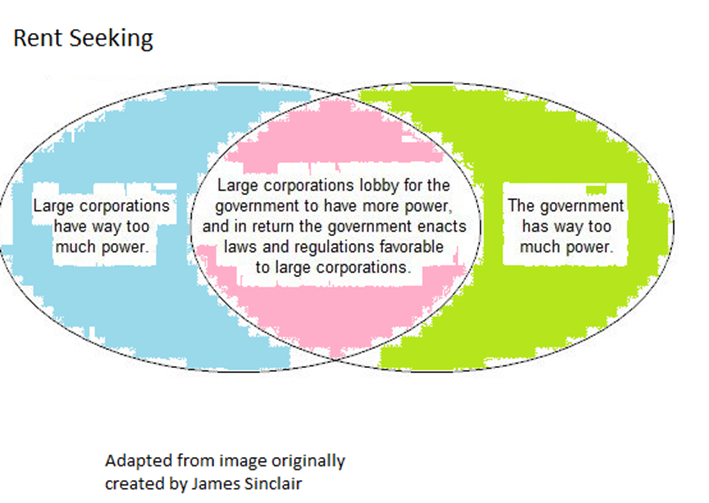
Remember the definition of rent-seeking from the earlier post Productive Inequality? It said when a company, organization, or individual uses their resources to obtain economic gain from others without reciprocating any benefits back to society through wealth creation…this is called rent-seeking. For the last several decades declining public investment, declining support for public education, distortions of the true health of our economy, declining worker morale and labor fairness, have all contributed to a widened gap between the top 1% and 10% from the middle and bottom economic percentile. Redistributing wealth and opportunities would reduce inequality and increase efficiency, the exact opposite of what the Right contends.
Both the lack of wealth and minimization of risk available to the lower 99% – 90% are two major market failures of our capital economy. Consequently, this lays the burden of upward economic mobility on parental wealth; in other words, what their parents can or cannot provide through digressing public education and their work income. And too often in the lower economic third both parents are working for wages that hardly keep up with inflation. The Right consistently underestimates these failures.
Stronger or weaker team?
The Right also consistently overestimates the benefits of incentive pay. Before revealing the true risks of incentive pay, what does the term mean? Barron’s Business Dictionary states it is a wage system that rewards a worker for productivity above an established standard and within a defined time period. It is often called pay for performance. Many incentive pay schemes are used by corporations each with varying success rates, or resulting in higher worker productivity. However, history has repeatedly shown that the schemes can also come with many counterproductive results. Take for instance the program at Hewlett-Packard in the 1990s (click here for the CBS News article). After setting up pay-for-performance schemes across thirteen or more American production sites, most of the HP worker-teams outperformed management’s projections costing the corporation excessive payouts. As a result, HP management made the goals higher and harder to achieve. This move had the exact opposite effect. Teamwork within the nationwide teams declined, primarily because self-interest dominated over corporate gains. Why do you think this happened?
Another example of failed incentive pay schemes but using instead a disciplinary fine, or negative reinforcement, to stimulate better results as told by Joseph Stiglitz:
“…a cooperative day center had a problem with certain parents’ picking up their children in a timely way. It decided to impose a charge, to provide an incentive for them to do so. But many parents, including those who had occasionally been late, had struggled to pick up their children on time; they did as well as they did because of the social pressure, the desire to do “the right thing,” even if they were less than fully successful. But charging a fee converted a social obligation[teamwork] into a monetary transaction. Parents no longer felt a social responsibility, but assessed whether the benefits of being late were greater or less than the fine. Lateness increased.”
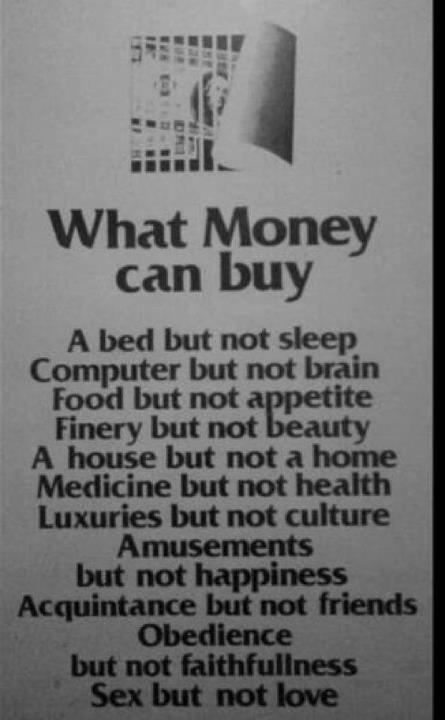
This begs the question, why is an extrinsic monetary reward scheme imperfect? Because it is human nature to be socially connected; it is a primal instinct…for most, and in the end it often outweighs individual, secluding self-interest. What is the point of an opulent palace with opulent toys on a grossly opulent island, if there is no one at all to enjoy it with? Stiglitz goes on to write:
“The reason that[incentive pay] economic theory failed to gauge accurately the effectiveness of team incentives is that it underestimated the importance of personal connectiveness. Individuals work hard to please others in their team – and because they believe it is the right thing to do. Economists overestimate, too, the selfishness of individuals (though there is considerable evidence that economists are more selfish than others, and that economics training does make individuals more selfish over time)[particularly when resources, opportunities, and rewards are scarce/hoarded; ala the 2012 film The Hunger Games]. It is thus perhaps not surprising that firms owned by their workers – and who therefore share in the profits – have performed better in the crisis and laid off fewer employees.”
All four must be equally balanced
Many incentive pay schemes will never be able to fully ignite the best of human-worker performance because often monetary rewards, extrinsic gains, fall short of a greater good. Why? Because all four types of human motivation (table on right) must be as closely balanced as possible for a person to be peacefully satisfied. This is just as true in economic and political laws and policies.
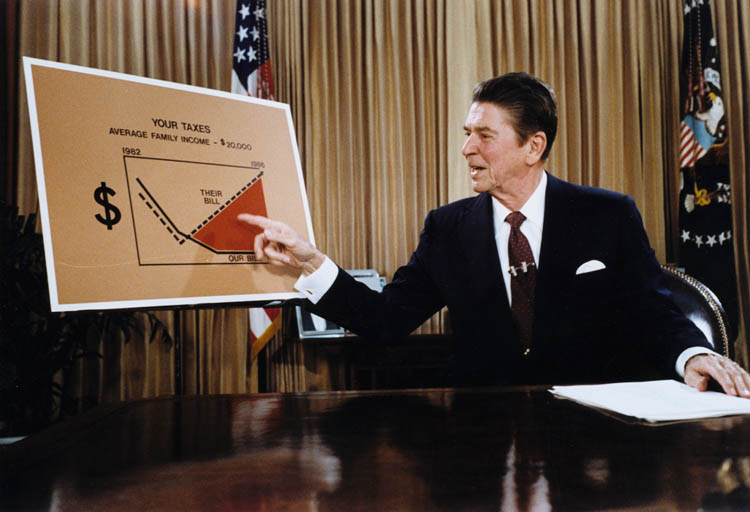
As a result of the Right’s shortsightedness, i.e. underestimating the real costs of socio-economic inequality and overestimating the costs of fixing it through progressive taxation and public spending, America needlessly spins its congressional and executive wheels in gridlocked hyper-partisanship eventually invoicing her 90 percentile taxpayers. President Reagan pushed for a less progressive tax system, lowering taxes on the top 1 and 10 percent, claiming that would raise more funds due to increased saving and worker productivity. He was incorrect: tax revenues plummeted. H.W. Bush’s cuts had the same effect: an increased deficit. During President Clinton’s administration, taxes were raised on the top percentile and the United States enjoyed a brief time of rapid growth and a minor decrease in economic inequality. Then George W. Bush entered office and…well, we had the 2008 financial crisis in which the majority of Americans, indeed the lower poorer classes, are still suffering. Naturally, the Right contends that if the marginal Americans paid 100% of their taxes, then “incentives” for the public would be harmfully weakened. But this claim is really nothing more than crying wolf. Stiglitz points out:
“…University of California professor Emmanuel Saez, Thomas Piketty of the Paris School of Economics, and Stefanie Stantcheva of the MIT Department of Economics, carefully taking into account the incentive effects of higher taxation and the societal benefits of reducing inequality, have estimated that the tax rate at the top should be around 70 percent – what it was before President Reagan started his campaign for the rich.”
What many on the Right fail to recognize in their economic, social, and political theories and/or systems is that no one succeeds on their own. They fail to recognize that a more level playing field, a more fair game if you will, almost always produces more efficiency, more brilliance, and a higher quality of life for a greater number, which in turn nurtures itself. A healthier “team” is a more productive successful team; and when these healthy teams are playing other healthy teams on a fair game-field with strong powerful referees or umpires, the “game”…the economy is brilliant! Therefore in return, the players, the coaches, the fans, everyone benefits and is more motivated to excellence.
On the other hand, an economic theory/system of scarcity and hoarding, i.e. weak public spending and regressive taxation for the strong/resourceful, is actually the antithesis of motivation-for-excellence; it too often maligns individual behavior to succeed-at-all-costs. Survival-of-the-Fittest economics does not encourage unity, particularly in times of severe crisis, and does not encourage real democracy. Thank the good stars that most human beings need MORE than just extrinsic rewards and require equally intrinsic rewards, if not more. But oh dear, that would mean less egocentrism, less arrogance, less consumption, and more community, more intimate connectivity, more humbleness, and a more permeable comfort zone to name a few life-changes. I feel there are many who are simply terrified of this idea, unfortunately, but I can hope.
Retrieving the American Dream
Joseph Stiglitz and those economists inside his camp have several profound ideas, policies, and reformations that will return America to its former collective glory. To share these here would extend this blog series by two or three more; a length I have no time to carry out and likely readers and visitors here will have no patience with. Hence, I will only recommend strongly that everyone purchase The Price of Inequality and read it, study it, and digest it. If you wish to better understand what has happened and will continue to happen to our American economy and social classes, and avoid being a naïve puppet in a oligarchial corporate capitalist show in a failing free-market economy, then it is a must read!
Here is the pressing question: Is the American dream still alive? Is the American dream still available? More importantly, is the American dream available to all as our “pledge of allegiance” implies? The present fifth version, which Congress passed in 1954, states in the last half “…one nation, under God, indivisible, with liberty and justice for all.” How accurately does this pledge reflect America today? How does one measure its accuracy?
Surprisingly perhaps to most, measuring America’s success of “…with liberty and justice for all” is quite easy. In modern statistical tables, polls, experiments, or graphs all mathematicians will say that the greater the data collected, the more accurate the results. Take for example a simple school student-poll on say thermostat comfort of the buildings. Of a student body of 700 students, would the pollers achieve an accurate reflection of their student body if they obtained 150 student opinions? Of course not; a poll of exactly 700 students would be the most accurate. This statistical truth is always the case whether one is measuring ten people or elements, or whether measuring 314 million.
This statistical truth therefore applies to larger numbers or polls, like the world (see earlier postThe Land of Opportunity?for a comprehensive indicator of America’s global standing). In order to get a truly accurate and objective reflection, we must include the rest of similar industrialized nations, and to be most accurate all other non-industrialized nations. But this raises more complex dynamics that in some cases go beyond economic, social, and political elements I have covered in this series of three web-blogs. Fortunately, this formula…this gauge of happiness, justice, and liberty for all is not exclusively owned by one person, one group, or even one nation. It is collective and shared. The discouraging reality is that on the American horizon – and maybe the world horizon too – this Collective Goodness Gauge, if you will, is constantly threatened. My next and last web-blog in this series, A Collective Imperative, will examine these threats and how to fight its extinction.
Is inequality necessary to provide people with incentive? Does the fear of failure, foreclosure, unemployment, bankruptcy, or government welfare and food stamps make people impassioned to succeed? Another way to ask this question is this way: Is the fear of shame, by family, by society, by the status quo a necessary motivator in a free-market society? No. Histories of great civilizations promoting inequality are laden with economic and societal collapses that show otherwise. Advocates of traditional free-enterprise, or capitalism, often argue that if a nation does not have total economic freedom and the correlated supporting government policies (small government), then that is a blatant step toward communism or socialism. These arguments cloud and grossly oversimplify our current crisis and the causes.
The Power of an Illusion
Having much less inequality does not equate to socialism or communism. On the contrary, less inequality (but not full equality) for the mid-term and long-term improves a nation’s gross domestic product (GDP). When citizens have incentives based on real hopes and realized achievements due to accessible social educational tools, workforce opportunities, and economic mobility, a country’s GDP is more stable and more efficient. Honestly, it is a simple sports concept: a well-oiled, concerted team is stronger and more successful than a fragmented, polarized team of hyper-competitive individuals. What makes this simple sports concept embarrassing, perhaps even deplorable, is when a team owner, or team captain claim and receive bonuses above and beyond the actual performance or decline – in some cases disaster – of the organization or team. Yet in the 2008 financial plunge, CEOs and their élite echelon did just that while the expendable lower workers lost their jobs and homes. Do not mistake this philosophy of the nation’s business élite as necessary incentive compensation schemes. It is merely guaranteed high compensation for good performance or bad performance; a handout for the CEO title, not the performance of his firm.
Political economists tend to place the fault of America’s growing inequality on various market or policy-factors not aligned with their own party. However, singling out one or two spokes in a failing wheel does not address the functionality or non-functionality of the remaining spokes, or the wheel as a whole. Yes, changes in computer technology created a change in skill-biased technology. Yes, the weakening of labor unions and less-scrutinized executive pay has contributed. The role of financialization in a global economy has contributed. Joseph Stiglitz, author of The Price of Inequality and Nobel Prize winner in economics feels, however, this tunnel-vision is missing the bigger picture. He states that if any of these factors were central:
“…we don’t have to sit idly by and accept the consequences. Greed may be an inherent part of human nature, but that doesn’t mean there is nothing we can do to temper the consequences of unscrupulous bankers who would exploit the poor [and uneducated] and engage in anti-competitive practices. We can and should regulate banks, forbid predatory lending, make them accountable for their fraudulent practices, and punish them for abuses of monopoly power.”
Stiglitz goes on to elaborate several other contributive forces and how to “temper” or punish abuses, but he later notes that growth in America’s financial sector as a spoke, or portion of the total U.S. income, has clearly added to increased inequality, i.e. “to both the wealth created at the top and the poverty at the bottom.” As I will point out below, the movement and growth of inequality and increased disparity was no accident; financial executives knew beforehand what was likely to occur.
The exceptional 2011 film “Margin Call” which portrays the beginning hours of the 2008 crisis.
Is wealth always the reward of hard work and resilience? Is wealth always determined by an individual’s time-invested: 70-hour, 80-hour work weeks, or 7-days a week, 50 weeks of the year? Of course not! If this were true, then we could conclude that wealthy drug-cartels are wonderful “hard workers”. Yet, this is a logic still promoted and distorted by age-old political campaigns. In the kindergarten and elementary classrooms, these tales of rags-to-riches by hard persistent work ring true, but in the arena of highly intelligent, misguided or non-violent orators of political-business eloquence, it requires an equal amount of sleuth by 70% of a disadvantaged common population.
Less Inequality Equals Less Volatility
No matter what the various causes of our economic crisis, all of them must be addressed. Stiglitz references another accomplished economist, James K. Galbraith, professor from the University of Texas at Austin. Galbraith goes into detail about why instability is directly and closely linked with high inequality, particularly in global financialization. The U.S. economy is naturally a major component in the world market, and it follows then that U.S. economic policy-makers are also major components. After researching and compiling some 50-years of data, both European and U.S. economic data, his striking discovery shows that in economies that are more egalitarian have markedly lower unemployment and hence lower inequality. But I must allow Mr. Galbraith to explain his discovery in his own words. Below is his four-part interview series discussing his book, Inequality and Instability, which precisely explains why the United States must become more egalitarian to avoid future civil collapse and revolt.
Why does any of this matter? Of what importance or impact will this analysis have on my life and my family? That answer is simple: association. You are associated with this life, with this planet, with your countrymen, with your parents and with your offspring. And you have a choice to make that association better than when you found it or became part of it, or you have the choice to ignore it or oppose it. Either way, you are associated. The question then becomes what part, what role are you going to play?
Philosophical questions aside, the more related question here to this 3-part blog/post is Are you interested in perpetual wealth-accumulation for yourself, or are you interested in making this world and those around you a happier place? One outlook is egocentric, the other is altruistic.
The Fallacy of “Productive Inequality”
As I alluded to in my previous two paragraphs, everything is connected or associated. One person’s words and actions will affect or be felt by those around them. The interactions within a family will affect families next door, or coworkers, or fellow schoolmates. Naturally, this explains why the Department of Health & Human Services quarantines major viral infections: to decrease the outbreak. The point being here is that inequality (moral or economic) leads to instability, and instability leads to unemployment, and unemployment leads to weak local and national output, which in turn leads to weak demand or stagnation, which leads to recession…and that ironically, over the long-term increases the risks on the wealth the egocentrics accumulated. However, it is not enough for me to spout-off personal opinions, substantiated or not by history, facts, or reliable sources. I must show that I have done the homework, or at least a large part of the homework. Thus, let me again turn to Nobel Prize winner, Joseph Stiglitz.
“Beyond the costs of the instability to which it gives rise, there are several other reasons why high inequality – the kind that now characterizes the United States – makes for a less efficient and productive economy. We discuss in turn (a) the reduction in broadly beneficial public investment and support for public education, (b) massive distortions in the economy (especially associated with rent seeking), in law, and in regulations, and (c) effects on workers’ morale and on the[problematic myth]of “keeping up with the Joneses”[or a consumer-driven society].
Let’s look more closely at the three reasons Stiglitz puts forth.
Declining Public Investment and Support for Public Education
We all know that an automobile will not run without fuel. We know that without the apple there is no applesauce. Without the photon particle, there are no vibrant visible colors. A basic principle in economics 101 is that the private-sector cannot be successful without an efficient active public-sector, and vice-versa. However, these two sectors cannot fully function by themselves or necessarily in conjunction. There needs to be rules-of-the-game established to keep the markets and sectors playing fairly. This is where government is vital. It makes sure that the infrastructure stays fair and healthy.
A flourishing industrialized nation requires public investment: roads, scientific research, civil services such as ambulances and ER services, police and prisons, firehouses staffed with firemen, seaports, airports, and basic quality education. These are just a few of the investments needed for a modernized society to remain peaceful and progressive. Leaving these public-sectors to the whims of the “free-markets” or a private investor will and has led to declining investment. The consequences of public under-investment are a heightened risk and paranoia on the part of the private-sector, as I alluded to earlier. A neutral entity, the government, must be actively involved to keep the playing-field, the economy fair and efficient. There has to be a healthy stable balance between BOTH sectors. Otherwise, the common workers (the 70% population) have less incentive, perhaps no incentive to patriotically work for the whole, much less the upper percentile.
During the periods of good sufficient public investment, the United States as well as the world reaped the benefits of government-sponsored research, health, and education! Some examples in research during the 20th century: information technology, internet, and biotechnology. In health: immunizations, declines in heart disease, safer healthier foods, cleaner drinking water, public waste, motor-vehicle safety, family planning, healthier child-bearing and hence lower infant mortality rates, and infectious disease control. In education, these fields mentioned could not have been possible without good-to-great public investment. Yet, at the current rate of public investment these great innovations are becoming fewer and far between. Stiglitz warns:
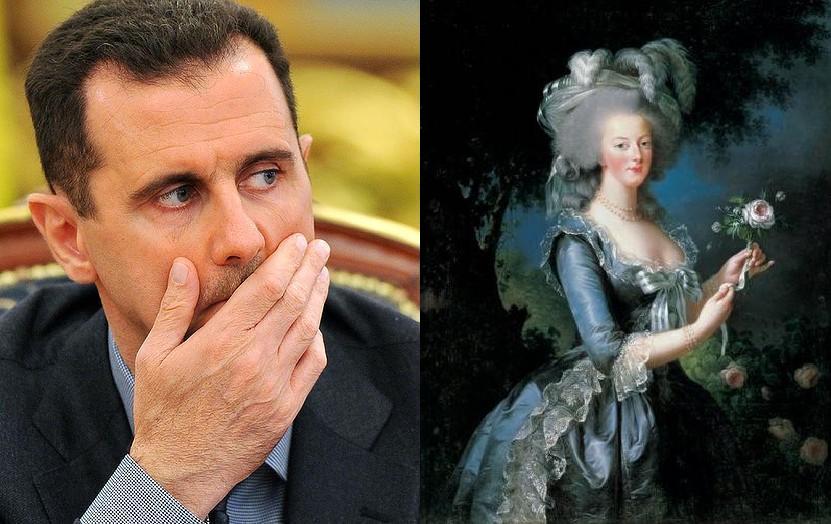
“Our failure to make these critical public investments should not come as a surprise. It is the end result of a lopsided wealth distribution in society. The more divided a society becomes in terms of wealth, the more reluctant the wealthy are to spend money on common needs. The rich don’t need to rely on government for parks or education or medical care or personal security. They can buy all these things for themselves. In the process, they become more distant from ordinary people[ala Syrian President al-Assad or French Queen Marie Antoinette].
The wealthy also worry about a strong government – one that could use its power to adjust the imbalances in our society by taking some of their wealth and devoting it to public investments that would contribute to the common good or that would help those at the bottom[or their perceived competitors/threats?]. While the wealthiest Americans may complain about the kind of government we have in America, in truth many like it just fine: too gridlocked to redistribute, too divided to do anything but lower taxes.”
Public education, it’s funding and performance is one of the hottest most controversial issues in modern America. Although our nation’s educational system has evolved well since 1870, there is no silver-bullet policy or program – nor has there been a policy-program – that can get perfect results. Perfect, or near perfect results happen on an individual and family unit basis. The rhetoric of school reform frequently overlooks the impact of individual, family, business owners, and educators on determining educational results. If an adolescent chooses to play Xbox instead of doing homework or studying, no amount of educational reform or opportunity will meet the desired results – and sadly, parents let their/our future-citizens do this. Quality education requires personal and family initiative, a characteristic that is infamously difficult to create or impose.
Where individual or family initiative is not the problem, however, lays the construction area of public investment. Ignoring this resource has grave mid and long-term social and economic consequences. “When we diminish equality of opportunity,” writes Stiglitz, “we are not using one of our most valuable assets – our people – in the most productive way possible.” In the earlier blog-post, The Land of Opportunity?, I conveyed how bleak higher-education and wage-mobility existed in America for children of impoverished and middle-income parents. The cost of college tuition is rising faster than median incomes. This begs the question, are student loans the golden-brick road to opulence? No. Once again, the financial sector is wrought with oppressive interest rates and perverse incentives. And from this money-trap comes a slew of further unregulated abuses.
In 1976, and again in 1984, lawmakers in Congress made it increasingly harder for college graduates to discharge student loans in bankruptcy. This had the adverse affect of lenders executing no responsibility to decide whether the educational institutions would provide a degree that would truly enhance their future income. Still later in 2005 with the Bankruptcy Abuse Prevention and Consumer Protection Act, Congress made it near impossible to discharge any student loan – federal or private – unless the borrower was able to prove in court (more money expended) a severe health or work disability. This made student loan discharges the same debt as criminal fines or child support fines. These acts were all lobbied through by the financial sector. During these four decades the for-profit college and universities, with wealthy executives and endowments, blocked all attempts to regulate and hold accountable these same institutions to extensive countermeasures upon exploitative recruiting of students from low-educated poor families, thus making them ineligible for loans.
There is another after-shock of decreasing public education support and declining wage-mobility. Imagine yourself inside one of these low-income, low-educated homes just described. You naturally want your children to attend quality schools in order to have a reasonable chance, or better, to gain admission into a quality university, which in turn increases their chances of becoming a well paid worker or business owner. But to better these chances both parents must work more to make ends meet. As a result, the family spends less time together. Now you are unable to supervise this student or other children in their studies. These families must make difficult compromises, and often those compromises lead to social misconduct or crimes.
Distortions of the Economy
Many of our childhood games teach a basic concept: he who gains the most resources at their disposal has the best chances of winning. As we mature in life we realize that unlike the start of these childhood games, where all players begin on a level-playing field, this concept doesn’t reflect real-life circumstances. This series of blogs expands on this social reality. Our reality is very well documented throughout a plethora of historical civilizations during several centuries. And though our American heritage states “that all men are created equal….” even this famous document was written when slavery and slave-rights in America spoke otherwise. Equality, though the ideal, is most often created. In political marketing – also known as lobbying – it is no different. Gift-wrapped equality does not fall from the sky. It must be created and guarded.
OpenSecrets.org is a Washington D.C. research group which traces funds in federal politics and its correlation and effects on government policies and elections. Corporations, labor unions, and various organizations spend billions to lobby Congress and federal agencies. Since 2008 over $3.3 billion dollars have been spent compared to $1.44 billion in 1998; an average $1.66 million increase every year. And there have been no less than 10,408 lobbyists over this 14-year span; topping out so far at 14,849 in 2007. What industries or sectors are spending the most in lobbying? From first to sixth over the last 14 years, pharmaceuticals/health-products was the biggest spender (13 of the 14 years), followed by insurance, electric utilities, business associations, computers/internet, and oil-gas respectively. Reflecting on these spent resources, Stiglitz writes, “The main distortion to our political system [and consequently our inequality]; the main loser, our democracy.”
What happened to our economy was not unforeseen, uncontrollable market forces. This recession/depression was created. In order to better understand how it was created, an important business-tactic must first be explained: rent-seeking.
Investopedia.com is an internet-based group of writers from various economic and investment fields. Their website defines rent-seeking as such:
“When a company, organization or individual uses their resources to obtain an economic gain from others without reciprocating any benefits back to society through wealth creation. An example of rent-seeking is when a company lobbies the government for loan subsidies, grants or tariff protections. These activities don’t create any benefit for society, they just redistribute resources from the taxpayers to the special-interest group.”
Rent seeking distorts our real economy in several different ways. Executives and corporations who have learned well to rent seek, reap magnificent financial reward. The accolades and bonuses that they receive may be enormous, however this does not necessarily reflect the social contributions from these rewards; they may not even be beneficial. The distortions come in a variety of sectors in our economy: post-undergraduate talent, public services, technology and telecommunications, business finance, and one of the most subtle and maligned of distortions, the environment and its resource depletion to name just six.
Prior to the 2008 crisis the nation’s college graduates sought employment in many professions; such as, research and development, medicine, public services such as government, firemen or law enforcement, or teaching future generations in schools and universities. However, at the same time an increasing amount of bright graduates were recruited into business finance and investments. Released in February 2000, during the peak of the tech-boom, the U.S. Bureau of Labor & Statistics’ Occupational Outlook Handbook and Career Guide to Industries (USBLS) showed the five fastest growing occupations being projected from 1998 through 2008 were computer engineers (the most), then computer support specialists, systems analysts, database administrators, and desktop publishing specialists respectively. Financing and investments were ranked 20th. Business executives did not make the projection-list. The same report released in February 2004 showed the 21 of the 30 fastest growing occupations to be again in the computer-related fields but also in health-related fields. Yet, about this time the USBLS began reporting employment change by salary, i.e. movement in labor by salaries. In that 2004 report the professional management, business and financial services (including banking) projections were among the best and rising. The same reports released in December 2007 showed significant increases and rises in employment change by salaries projected in the business-financial services with the most in management at almost a 78% change, the highest of all.
Rent seeking is also prevalent in both the health care sector and the telecommunications sector. There is a pill for every imaginable ailment in existence. Pharmaceutical companies now spend enormous amounts of money on marketing to doctors to prescribe their pills and patients to consume them that research, by comparison, has become one of their smallest business expenses. The majorities of their “research” are spent in generic forms of their brand drugs with minor differences, but nonetheless divide the profits of their rival labs of the same successful drug. This rent seeking takes away huge amounts of salaries for real research, real investments, and real productivity and places it in the pockets of executives and shareholders. One quick example of rent seeking in telecommunications would be how “quickly” 10-month old, 1-year or 2-year old cell phones are simply outdated and can no longer function properly with “changing technology or services”. Therefore, the provider can “only offer a new and improved” phone or package, generally more per month with a new complex contract. The micro-processing company Intel has done this since at least Windows 3.1 was popular; a once industry-leading Microsoft product.
As mentioned before, rent seeking practices come in more subtle forms such as in environmental deterioration and depletion. Using the economic successes and profits of our nation’s environmental resources to pad the GDP (Gross Domestic Product) numbers does not reflect the costs to the environment over the long-term. Oil, water, natural gas, coal, and so on is not sustainable growth. There is most certainly a diminished wealth of the nation’s resources. Yet, as of today there is no metric indicator of this cost. Why? The oil, coal, or energy firms lobby and fight hard to block government reports, indicators, indices and green accounts because they would be invoiced for extracting a non-renewable resource from our country’s resources; a cost that would cut their excessive profits. But by not charging the oil, coal, and gas companies a non-sustainability charge, the American government (and average citizen) are giving the corporations an indirect subsidy, favorable tax treatment, and a valuable product well below fair-market prices! Therefore, one primary aim of rent seeking people and companies are to shape laws and government regulations to their own bottom-line. Once again, this distorts the true health of the economy.
Worker-morale and the Ever-Elusive Joneses
In order for a worker to labor most efficiently and most loyally, they must believe they are achieving a comfortable future. This means they must feel they are being treated fairly by their employer. Certainly one would agree that an unmotivated, under-nourished worker is less productive. Education experts and scientists have long known that hunger and inadequate nutrition hinder learning. These were the clear theories of the late 19th and early 20th centuries. But today, the efficiency of worker morale is more complex.
When the general population experiences anxiety over such worries as losing their home, or “Can I provide my children with a quality education to enable them a prosperous life?”, or “Can I survive beyond retirement age?” these questions reduce workplace efficiency. But not only does the psychology reduce workplace efficiency, it also impairs the impoverished to analyze properly the choices that might improve their situation. As the cliché goes, they are living from hand-to-mouth, firmly in the here-and-now. When one lives in this type of daily stress, it can and often does lead to desperate and irrational decisions. Harvard economist Sendhil Mullainathan and psychologist Eldar Shafir thoroughly explain this behavioral thinking:
Naturally, this expenditure of physical and cognitive energy by poor or middle-class workers will also hinder the achievement of new improved skills and knowledge. If this condition persists throughout a nation, productivity will grow slower, and hence the long-term growth of the economy is unstable as well as unsustainable. And too often over the last decade or so, if a corporation was performing unsatisfactorily, even near bankruptcy, the common worker, not the high-level executives/owners, bore the punishment of lay-off, pay-cuts, or termination.
Joseph E. Stiglitz describes more poignantly the importance of labor fairness in recent economic experiments:
“Or take another[experiment], involving a group of workers performing a similar job. One might have expected that increasing the wages of some and lowering that of others would increase productivity of the higher-wage worker, and lower that of the lower-wage workers in offsetting ways. But economic theory – confirmed by the experiments – holds that the decrease in productivity of the low-wage worker is greater than the increase in productivity of the high-wage worker, so total productivity diminishes.”
Yet is this experimental result all that surprising? When the greater good for the greatest number is continuously ignored or discriminated against in unfair free-market practices and deregulation, the final result is economic recession or collapse.
There is also deeper psychology involved with rent seeking practices within societal inequality that may not be clearly understood. When we were all young children, there was always some hero or heroes we aspired to be. When I was a youth and on into my teenage years, I was utterly fascinated and enthralled by the fighter pilots of World War II and their magnificent planes. To this day, I still have a very high regard for those daring men constantly putting their lives in harm’s way to preserve basic human rights around the globe, often for less fortunate people they had never met, nor would they meet.
In today’s American economic policy and politics, many tax-paying citizens aspire to the upper middle-class, or even the top 10% or 20% financially and their standard of living. We have seen so far in this article and my previous articles (Oversimplification 2012 and The Land of Opportunity?) how much inequality affects a nation’s economy and efficiency. Though the popular Trickle-down economic philosophy of many conservative élite is a fanciful fabrication and illusion, trickle-down psychology is tremendously real. The bottom percentile in our society know and accept that dreams of opulence in the top percentile are fantasies. However, those in the lower middle, center, and upper middle have serious hopes of attaining the American Success Dream; into the top 20%, 10%, or 1%. These dreams are sometimes referred to as keeping up with the Joneses.
There is a perfectly good explanation as to why on a scale of global comparison, the United States is one of the busiest and hardest working societies on the planet: consumerism. And to keep up appearances with those around us in our communities, many Americans must live beyond their means.
The April 2012 edition of the World Economic Outlook Databasepublished by the International Monetary Fund (IMF) reported the Top 10 industrialized, or advanced economies of the world. Of course, the U.S. was a member. However, this listing does not show all industrialized-advance economies in the world which provides a more balanced point-of-view. There are 35 nations classified as advanced economies. The United States ranks in the top four in most databases. According to theBusiness Insider, April 13, 2011 and the OECD (the Organization for Economic Cooperation & Development), the U.S. ranks 9th out of 35 nations as the hardest working nation in the world. With that said, Stiglitz offers refinements as to the differences between America’s work rate and the rest of the world:
“Many years ago Keynes[i.e. John Maynard Keynes]posed a question. For thousands of years, most people had to spend most of their time working just to survive – for food, clothing, and shelter. Then, beginning with the Industrial Revolution, unprecedented increases in productivity meant that more and more individuals could be freed from the chains of subsistence living. For increasingly large portions of the population, only a small fraction of their time was required to provide for the necessities of life. The question was, How would people spend the productivity divided?
The answer was not obvious. They could decide to enjoy more and more leisure, or they could decide to enjoy more and more goods. Economic theory provides no clear prediction, though one might have assumed that reasonable people would have decided to enjoy both more goods and more leisure. That is what happened in Europe. But America took a different turn – less leisure (per household, as women joined the labor force) and more and more goods.
America’s high inequality – and individuals’ sensitivity to others’ consumption – may provide an explanation. It may be that we are working more to maintain our consumption relative to others, and that this is a rat race, which is individually rational but futile in terms of the goal that it sets for itself. Adam Smith pointed out that possibility 250 years ago: “this general scramble for preeminence, when some get up, others must necessarily fall undermost.”[A mentality abundantly demonstrated in our American professional sports: victory at all costs, while heads roll soon after failure; screams of “clean house!” prevail]While there is no “right” answer to Keynes’s question according to standard economic theory, there is something disturbing about America’s answer. Individuals say they are working so hard for the family, but as they work so hard there is less and less time for the family, and family life deteriorates. Somehow, the means prove inconsistent with the stated end.”
Joseph Stiglitz, John M. Keynes, Adam Smith, and other economists point out an implicit warning. The U.S. population makes up between 3.8% and 4.5% of the world’s total population. Yet, as such a small percentage of the world, Americans consume the most electricity, the most corn, much of the coal (2nd to China), the most natural gas, fourth in wheat consumption, an inordinate amount of oil by comparison – leading in the depletion of energy resources. Not only is there no denying that the U.S. is an economy firmly driven in consumerism, we take the cake and the party too, yet make up a mere 4% of the world population. This is an ASTONISHING fact! That Americans are an Earth-devouring people might be an understatement.
We have touched on various causes of our country’s growing inequality and how distortions of our economic health has made it worse, and how declining public investment will further the problem, and how our illustrious free-market economy was supposed to be envied by the world…has become an illusion that is rearing its ugly head. In my next post/article on this subject: Unveiling Incentive-Opportunity Fallacies, it needs to be shown that the direction our social and economic state is headed, is eerily reminiscent of the decline and fall of Rome. As the gap between socio-economic classes widen, and proclaimed “opportunities” and “incentives” of the Right turn into a thin smoke, just like the upper Roman classes and the bottom Roman percentile polarized (e.g. the Occupy Wall Street movement) America will see its democracy crumble unless some well-proven social, political, economic regulations, and more progressive-taxation packages are implemented or revamped.
I hope that the 2012 November elections – and later elections – are seen this way by the 70% – 90% of Americans. Otherwise, there could very well be another second falling of “Rome” in North America.
For an excellent overview of America’s inequality and severe polarization, watch the documentary Patriocracy by Brian Malone. It is an accurate portrayal of how today’s American generation is no longer the greatest generation who adapted, compromised, and labored generally as United, but instead has become the greediest, egocentric generation rendering our government dysfunctional and society hyper-polarized.
As some of you are aware, I teach 4th through 12th grade Special-Ed science, social studies, and secondary career development at a charter school. Close to two-thirds of our students are either wards-of-the-state and/or special-needs. Due in part to the nation-wide recession and severe federal-state education cuts and the increasing gap of social-economic inequality in America (families in poverty vs. families with great wealth), my workload and hours are increasing between 25-30% for the 2012-2013 school year. However, my meek salary and annual increase has been frozen – while our cost-of-living continues to run free like a gorilla in a banana farm. Even more astonishing, the social expenditures to address and manage our nation’s growing impoverished families – the exact families my students come from – are dropping through the basement in alarming amounts.
I am not blowing a horn that many haven’t already heard: America is in a very serious economic and social crisis! But what I would like to convey is a re-evaluation of a socio-economic system that like the Roman Empire, is heading toward collapse.
Here is a crash-course in basic social sciences.
From Tribe to Modern Civilization…and Back?
All people on this planet have the same basic needs for food, water, clothing, and shelter. People everywhere live in families, or primary groups, and they get these needs in one of two ways: in a way that is individually and socially beneficial, or in a way that is damaging socially and eventually to themselves, i.e. illegally according to the group’s/society’s laws-of-behavior. The methods of obtaining these basic life-needs are directly proportional to a society’s advancement or decline in relation to available resources; or in an advanced civilization, the opportunities available. I would like to elaborate on this basic social equation.
Advancement in a civilization can be categorized in six stages essentially developing for the greater good. Decline in a civilization is the reverse of these stages coupled with and caused by increased crime, civil revolt, and/or war(s), and deteriorate the greater good. In my diagram Development of Civilization right, the United States is by global comparisons clearly in the last blue stage. However, most indicators show that we are digressing, not only by global rankings but by our own domestic indicators as well.
The Human Development Index (HDI) is an index created by the United Nations Development Program to measure development of all member nations according to a composite indicator of life-expectancy (healthcare), educational attainment for youth and adults (primary, secondary, and tertiary programs & literacy rates), and finally individualincome-wealth (Per capita gross domestic product). According to the index covering 1975 to 2005, a thirty-year period, you might be surprised that the United States does not rank in the top 10. Over the scope of annual indices the U.S. ranks higher. However, a 30-year scope shows a trend. Here are the rankings:
Iceland
Norway
Australia
Canada
Ireland
Sweden
Switzerland
Japan
Netherlands
France
Finland
United States
Life-expectancy is directly related to a society’s or nation’s healthcare system. In the 1975 Human Development Index the United States ranked sixth barely above Norway; a real fall in less than one family generation for one of the most advanced civilizations. However, this 30-year index doesn’t paint the whole picture. The World Health Organization (WHO) published a ranking in 2000 of the world’s health systems. Out of 190 nations the U.S. ranked 37th. The 2000 report was WHO’s last publishing due to vast complexities in compilation. The Common Wealth Funddid a study of 19 industrialized nations on deaths considered amenable to healthcare before the age of 75. In their 2002-2003 study the U.S. ranked 14th. Yet, the U.S. ranks 1st or 2nd worldwide in total expenditures toward healthcare as a percentage of its GDP according to WHO. To put it another way, in Italy, Hong Kong, France, or Japan, citizens pay much less for noticeably better overall healthcare.
The attainment of education is also directly related to a nation’s social and economic development or decline. Education and literacy directly affect a civilization’s progress. If literacy and education are stable and improving, so goes the civilization. If education and literacy are unstable and declining, so goes the de-civilization of its people. According to the Organization for Economic Cooperation and Development (OECD) the U.S. ranked 16thworldwide for literacy (reading, math, & science above 15 yrs old) in 2000, ranked 27th in 2006, and 23rd by 2011 according to UNESCO. A muddling in the mid to low 20’s will not improve over future generations unless attainment of quality education by our general population improves. This in turn requires tax revenues as well as a proportionate per capita GDP. But this is not happening. Though America is one of the wealthiest nations in the world, the overall American standard of living has been in serious decline since at least 1981.
A dysfunctional healthcare system and underfunded public education system will have tragic implications for American society. Joseph E. Stiglitz is the 2001 Nobel Prize winner in economics. He writes in The Price of Inequality: How Today’s Divided Society Endangers Our Future:
The consequences of pervasive and persistent poverty and long-term underinvestment in public education and other social expenditure [healthcare] are also manifest in other indicators that our society is not functioning as it should: a high level of crime, and a large fraction of the population in prison. While violent-crime statistics are better than they were at their nadir (in 1991), they remain high, far worse than in other advanced industrial countries, and they impose large economic and social costs on our society. Residents of many poor (and not so poor) neighborhoods still feel the risk of physical assault. It’s expensive to keep 2.3 million people [illiterate or semi-illiterate] in prison. The U.S. incarceration rate of 730 per 100,000 people (or almost 1 in 100 adults), is the world’s highest and some nine to ten times that of many European countries. Some U.S. states spend as much on their prisons as they do on their universities.
As I mentioned earlier, a civilization on the decline has increased crime intertwined with widening social and economic wealth-to-poverty levels. When the opportunities for socio-economic advancement are hard, few and far between for a country’s impoverished, or semi-bankrupt per capita GDP families making only $41,890 per year in 2005, obtaining basic or moderate life-needs turns immoral or criminal. At least two sets of statistics indicate this trend.
Generation Extreme – Death Rates of Young People
This bleak outlook doesn’t improve. In 2011 the Murdoch Children’s Research Institute and University of Melbourne published a table ranking 28 industrialized – or modernized – civilizations according to their mortality rate of 10 to 24 year olds per 100,000 population by traffic accidents, violence, suicide, and “other” causes. Sadly, it ranks the United States first in all four categories, with the most glaring difference being deaths by violence, out doing the other 27 countries substantially.
One way or another these numbers can be attributed to any combination of three variables: lack of happiness, lack of education, and lack of social-balance. And these three factors are derived from available or unavailable resources and opportunities.
A Growing Popularity toward Immorality and Crime
Get a stout cocktail, this statistic doesn’t paint a pretty picture either. In 2007 the United Nations Development Program (UNDP) released statistical data regarding nation’s prison populations and incarceration rates. Once again the U.S. ranks first, or highest in number of prisoners per 100,000 population. Our total prison population is nearly three times higher as the second highest nation Russia.
One indicator of the immorality rate is hate crime statistics. In 1990 Congress enacted the FBI Hate Crimes Statistics Act but not all states reported during the following five years. In 1996 all fifty states reported their data. Here are those results for the following 14-year period shown in the table.
As the data indicates, religious, ethnic/national origin, and sexual orientation are and have been on a steady climb. A statistic I do not need to illustrate is America’s appalling divorce rate (over 50% in 2010). For the sake of time, I will also not include incidents of domestic-family violence not related to racial, religious, ethnic/national origin, sexual orientation, or physical-mental disability. These cases are typically attributed in various combinations to psychological, psychiatric, and drug-abuse or addiction. Naturally the treatment and management of these problems goes back to available healthcare, and on a broader scale education, employment/unemployment, and overall happiness.
I stated earlier that the United States is on a path to socio-economic collapse, remarkably like the great Roman Empire. The familiar cliché history repeats itself, could not be truer here. Yet, many Americans believe we are the strongest wealthiest nation on earth of which all nations should model themselves. True, but only on the surface and ONLY in the top 1 percent of the population or the top 10% at best. The lower 90-99% has seen their standard of living erode frankly. Nobel Prize winner Joseph Stiglitz describes our historic predicament strikingly Romanesque:
If struggling poor families get our sympathy today, those at the top increasingly draw our ire. At one time, when there was a broad social consensus that those at the top earned what they got, they received our admiration. In the recent crisis, however, bank executives received outsize bonuses for outsize losses, and firms fired workers, claiming they couldn’t afford them, only to use the savings to increase executive bonuses still more. The result was that admiration at their cleverness turned to anger at their insensitivities…
…We described earlier the huge gap between CEO pay and that of the typical worker – more than 200 times greater – a number markedly higher than in other countries (in Japan, for instance, the corresponding ratio is 16 to 1) and even markedly higher than it was in the United States a quarter century ago. The old U.S. ratio of 30 to 1 now seems quaint by comparison…
…What’s worse, we have provided a bad [model], as executives in other countries around the world emulate their American counterparts. The UK’s High Pay Commission reported that the executive pay at its large companies is heading toward Victorian levels of inequality, vis-à-vis the rest of society (though currently the disparity is only as egregious as it was in the 1920’s). As the report puts it, “…publicly listed companies sets a precedent, and when it is patently not linked to [overall] performance, or rewards [overall] failure, it sends out the wrong message and is a clear symptom of market failure.”
If you are familiar with ancient Roman civilization, or even Victorian civilization in Europe, then you are also familiar with the stark inequality of their respective populations. Both Rome and the great British Empire of the 18th century CE crumbled under this bloated weight of inequality. Rome vanished and Britain to a mere semblance of its former glory. Obviously at the risk of oversimplification, this socio-economic inequality is the consequence of the denial of the altruistic and philanthropic system of the Greatest Good for the Greatest Number lifestyle. I will return to this concept later, but first I want to explain another accurate form of socio-economic performance.
The Gini Coefficient (illustrated left) measures the degree of inequality of the distribution of family income within a nation. Basically, a gini coefficient of zero indicates perfect equality, and a gini coefficient of one represents a maximum inequality of incomes. Nations with coefficients of 0.3 or below are considered mostly equal. Nations with coefficients of 0.5 or above are considered mostly unequal. If you have finished your stout cocktail, pour another because this U.S. comparison to the rest of the world is going to break your heart.
According to the 2011CIA World Factbook – Gini Index, the United States ranks practically the same as Cameroon (Africa) and Uruguay (South America). Stiglitz puts it in these terms: “According to UN data, we are slightly more unequal than Iran and Turkey, and much less equal than any country in the European Union.” Our actual CIA World Factbook ranking has us at 95th, behind the likes of not only Cameroon but Uganda, Nicaragua, Vietnam, Mongolia, and Pakistan to name a few.
The Indicators Re-examined
Performances of family income inequality don’t tell the entire story. The Land of Opportunity’s real story may in fact be much worse than these numbers are indicating. For example, in other modern European civilizations their people do not worry about how to pay medical expenses, or how to afford taking care of their elderly parents, or how their children will receive a well-funded education. Attaining all these social benefits are viewed as a basic human right! In other advanced nations, the citizens put a heavy emphasis on hard work at a job, but they do not worry so much if they lose their job because their unemployment programs are good. In these advanced countries, homeowners do not concern themselves with foreclosure anywhere near as much as Americans. Social and economic insecurity for lower-class and middle-class Americans has become the rule-of-thumb. And if these international comparisons bear some level of truth, the United States is worse off than it prefers to portray itself.
If the picture is not quite in focus, then Stiglitz concludes these performance indicators this way:
Recent U.S. income growth primarily occurs at the top 1 percent of the income distribution.
As a result there is growing inequality.
And those at the bottom and in the middle are actually worse-off today than they were at the beginning of the century.
Inequalities in wealth are even greater than inequalities in income.
Inequalities are apparent not just in income but in a variety of other variables that reflect standards of living, such as insecurity [fear and sadness] and health.
Life is particularly harsh at the bottom – and the recession made it much worse.
There has been a hollowing out of the middle class.
There is little income mobility – the notion of America as a land of opportunity is a myth.
And America has more inequality than any other advanced industrialized country, it does less to correct these inequalities, and inequality is growing more than in many other countries.
As the American Conservative Right describes this socio-economic outlook, even Mitt Romney, these facts are inconvenient to them and should be whispered in private. There is no need to point out what sectors of the American population the phrase “American Conservative Right” refers. However, the philosophy they cherish, project, and protect is essentially no different from Ancient Rome’s and Victorian Britain’s elite. The proverbial phrases “You need money to make money” and “the rich are getting richer and the poor poorer” are simply true today.
Greatest Good for the Greatest Number
One could argue that the concept of the greatest good for the greatest number is socialism and its initiative found in communism. This type of argument is frequently revealed in American Conservative Right rhetoric. Not surprisingly, you also discover that the Conservative Right has a majority of religious-political advocates, many from various forms of Christianity (and a growing population of Islam). I find this social-political position utterly fascinating and in alarming conflict with the founding principles of the very same theology (and scriptural basis) they proclaim membership. For a more in depth look at this background, read my April 2011 article Constantine: Christianity’s True Catalyst/Christ. It and its references bring to light the utter success that the Judeo-Jesus movement of the 1st century CE was in reality a welfare-system phenomena for Rome’s grossly outsized and mistreated poor; ironically, not unlike the heading of America’s social-economic system.
Simply and factually put, the philosophy-turning-lifestyle of the Greatest Good for the Greatest Number has been preached, taught, prophesied, born-out, died-for, whatever the case, in just about all of history’s great reformers. From Gautama Buddha in c. 563 BCE to Martin Luther King, Jr. in 1968, one theme stands out from all their wisdom: there is something more and larger than yourself. What can you imagine as this theme’s reciprocal, or antithesis? Think of as many possible oppositions as you can.
The fall of Rome c. 455 CE
Now synthesize your list of oppositions into a summation. It should reflect an inflated ego, whether it is one, many, or a system, it carries with it an awareness and action for self and for few – as well as those who benefit our self. It also carries with it a reduced lack of awareness and action for the whole system – as well as those who we tolerate and/or are intolerant. When viewed in this light, the inequality that is today’s America is absolutely no different from ancient Rome or Victorian Britain. You have the superior and the inferior, and the two should remain mostly separate. The inferior are such because they are illiterate. They lack a good education because it is next to impossible to attain. The inferior are diseased because of their illiteracy and lack of medical treatment because it is next to impossible to attain. The inferior are unskilled workers because of their illiteracy to understand the complex nuances of business and ingenuity, and to gain this understanding is next to impossible without heavy coin.
Is my America-Rome analogy that far-fetched? Your response should turn to civil action; we do live in a country that OFFERS a model of social-political freedom. I come from a family and middle-class background that worked and works its ass off to gain a little more of the American dream. During my generation, and perhaps during my children’s generation, we have seen those opportunities all but vanish. My children and I face almost exactly what my grandparents faced during the Great Depression and World War II. As a boy then, my father faced strict food and material rations for over fourteen years! Our current Great Recession, economists state, began in 2007. Here we are in mid-2012, five years later.
Whatever your situation, I will repeat what I said at the start.
Due in part to the nation-wide recession and severe federal-state education cuts and the increasing gap of social-economic inequality in America (families in poverty vs. families with great wealth), my workload and hours are increasing between 25-30% for the 2012-2013 school year. However, my meek salary and annual increase has been frozen – while our cost-of-living continues to run free like a gorilla in a banana farm. Even more astonishing, the social expenditures to address and manage our nation’s growing impoverished families – the exact families my students come from – are dropping through the basement in alarming amounts. Let me reiterate:
The social expenditures to address and manage our nation’s growing impoverished families – the exact families my students come from – are dropping through the basement in alarming amounts, even disappearing!
And by the way, our enrollment/placement of special-needs students are increasing (and therefore class sizes with fewer teachers) because several identical charter schools in the region had to close their doors due to funding cuts.
In the boom years before the 2007-08 crisis, the top 1 percent seized more than 65% of the gain in total national income. And while the GDP grew, most American citizens saw their standard of living fall into the basement. In 2010, as the nation floundered to stay afloat, the 1 percent (even the top 10%) gained 93% of the additional income created in the so-called recovery. As those at the top continue to enjoy the best healthcare, education, and benefits of wealth in a Reagan-freed-market system, they often fail to realize that, as Rome’s elite fatally ignored, “their fate is bound up” Stiglitz highlights, “with how the other 99 percent live.”
No matter the social, economic, or intellectual differences, we ALL need each other and MUST find and implement civilized efficient, evolving, fair systems toward the Greatest Good for the Greatest Number, or we will go down in history as the 2nd Rise and Fall of the 2nd Roman Empire.
I am in the process of intently reading three superb books on America’s current anemic social and economic position. By what I have read so far, all three of these books speak directly to my deep concern for our country’s doomed path of progression: exclusivism; unless this path changes. Following are some reviews of these books.
A forceful argument against America’s vicious circle of growing inequality by the Nobel Prize–winning economist.
The top 1 percent of Americans control 40 percent of the nation’s wealth. And, as Joseph E. Stiglitz explains, while those at the top enjoy the best health care, education, and benefits of wealth, they fail to realize that “their fate is bound up with how the other 99 percent live.”
Stiglitz draws on his deep understanding of economics to show that growing inequality is not inevitable: moneyed interests compound their wealth by stifling true, dynamic capitalism. They have made America the most unequal advanced industrial country while crippling growth, trampling on the rule of law, and undermining democracy. The result: a divided society that cannot tackle its most pressing problems. With characteristic insight, Stiglitz examines our current state, then teases out its implications for democracy, for monetary and budgetary policy, and for globalization. He closes with a plan for a more just and prosperous future.
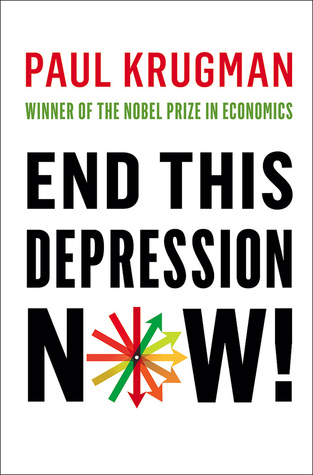
The other two books in which I am engrossed are the Nobel Prize Winner in Economics, Paul Krugman’s End This Depression Now and the book I am foaming at the mouth to finish, It’s Even Worse Than It Looks by co-authors Thomas Mann and Norman Ornstein.
The Great Recession is more than four years old—and counting. Yet, as Paul Krugman points out in this powerful volley, “Nations rich in resources, talent, and knowledge—all the ingredients for prosperity and a decent standard of living for all—remain in a state of intense pain.”
How bad have things gotten? How did we get stuck in what now can only be called a depression? And above all, how do we free ourselves? Krugman pursues these questions with his characteristic lucidity and insight. He has a powerful message for anyone who has suffered over these past four years—a quick, strong recovery is just one step away, if our leaders can find the “intellectual clarity and political will” to end this depression now.
And on Mann’s and Ornstein’s book —
Acrimony and hyper-partisanship have seeped into every part of the political process. Congress is deadlocked and its approval ratings are at record lows. America’s two main political parties have given up their traditions of compromise, endangering our very system of constitutional democracy. And one of these parties has taken on the role of insurgent outlier; the Republicans have become ideologically extreme, scornful of compromise, and ardently opposed to the established social and economic policy regime.
In It’s Even Worse Than It Looks, congressional scholars Thomas Mann and Norman Ornstein identify two overriding problems that have led Congress—and the United States—to the brink of institutional collapse. The first is the serious mismatch between our political parties, which have become as vehemently adversarial as parliamentary parties, and a governing system that, unlike a parliamentary democracy, makes it extremely difficult for majorities to act. Second, while both parties participate in tribal warfare, both sides are not equally culpable. The political system faces what the authors call “asymmetric polarization,” with the Republican Party implacably refusing to allow anything that might help the Democrats politically, no matter the cost.
With dysfunction rooted in long-term political trends, a coarsened political culture and a new partisan media, the authors conclude that there is no “silver bullet” reform that can solve everything. But they offer a panoply of useful ideas and reforms, endorsing some solutions, like greater public participation and institutional restructuring of the House and Senate, while debunking others, like independent or third-party candidates. Above all, they call on the media as well as the public at large to focus on the true causes of dysfunction rather than just throwing the bums out every election cycle. Until voters learn to act strategically to reward problem solving and punish obstruction, American democracy will remain in serious danger.
As I have written about adequately throughout my WordPress blog, exclusivism, elitism, and mob-egotism seriously, seriously threaten modern democracies and ultimately this planet. Apparently Stiglitz, Krugman, Mann, and Ornstein would more less agree, particularly in a socio-economic context. Ah, humbly I need to restate that: I apparently agree with them. Or perhaps the five of us all agree.
But I will not jump too hastily to conclusions. I will completely finish these three fine works and THEN incorporate their problem-identifications, solutions, and ideals into my views and opinions for a better nation and world. Come to think of it, I can probably merge polyamory and the open-swinger lifestyle (grinning and laughing) into my viewpoint as well!
I have zero expectation that anything I ever say will end someone’s belief in their God. Not my goal or purpose. That alone belongs to the individual. ~ Zoe



 This work by Professor Taboo is licensed under a Creative Commons Attribution-NoDerivs 3.0 Unported License. Permissions beyond the scope of this license may be available at https://professortaboo.wordpress.com.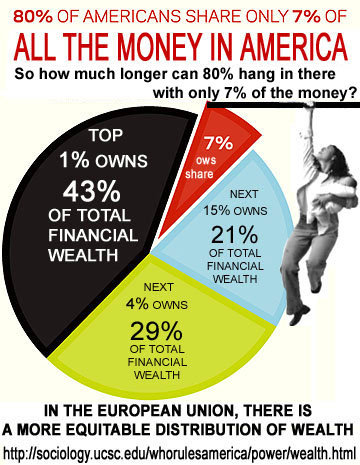




 As some of you are aware, I teach 4th through 12th grade Special-Ed science, social studies, and secondary career development at a charter school. Close to two-thirds of our students are either wards-of-the-state and/or special-needs. Due in part to the nation-wide recession and severe federal-state education cuts and the increasing gap of social-economic inequality in America (families in poverty vs. families with great wealth), my workload and hours are increasing between 25-30% for the 2012-2013 school year. However, my meek salary and annual increase has been frozen – while our cost-of-living continues to run free like a gorilla in a banana farm. Even more astonishing, the social expenditures to address and manage our nation’s growing impoverished families – the exact families my students come from – are dropping through the basement in alarming amounts.
 Advancement in a civilization can be categorized in six stages essentially developing for the greater good. Decline in a civilization is the reverse of these stages coupled with and caused by increased crime, civil revolt, and/or war(s), and deteriorate the greater good. In my diagram Development of Civilization right, the United States is by global comparisons clearly in the last blue stage. However, most indicators show that we are digressing, not only by global rankings but by our own domestic indicators as well.
 Generation Extreme – Death Rates of Young People
 One indicator of the immorality rate is hate crime statistics. In 1990 Congress enacted the FBI Hate Crimes Statistics Act but not all states reported during the following five years. In 1996 all fifty states reported their data. Here are those results for the following 14-year period shown in the table.
 If you are familiar with ancient Roman civilization, or even Victorian civilization in Europe, then you are also familiar with the stark inequality of their respective populations. Both Rome and the great British Empire of the 18th century CE crumbled under this bloated weight of inequality. Rome vanished and Britain to a mere semblance of its former glory. Obviously at the risk of oversimplification, this socio-economic inequality is the consequence of the denial of the altruistic and philanthropic system of the Greatest Good for the Greatest Number lifestyle. I will return to this concept later, but first I want to explain another accurate form of socio-economic performance.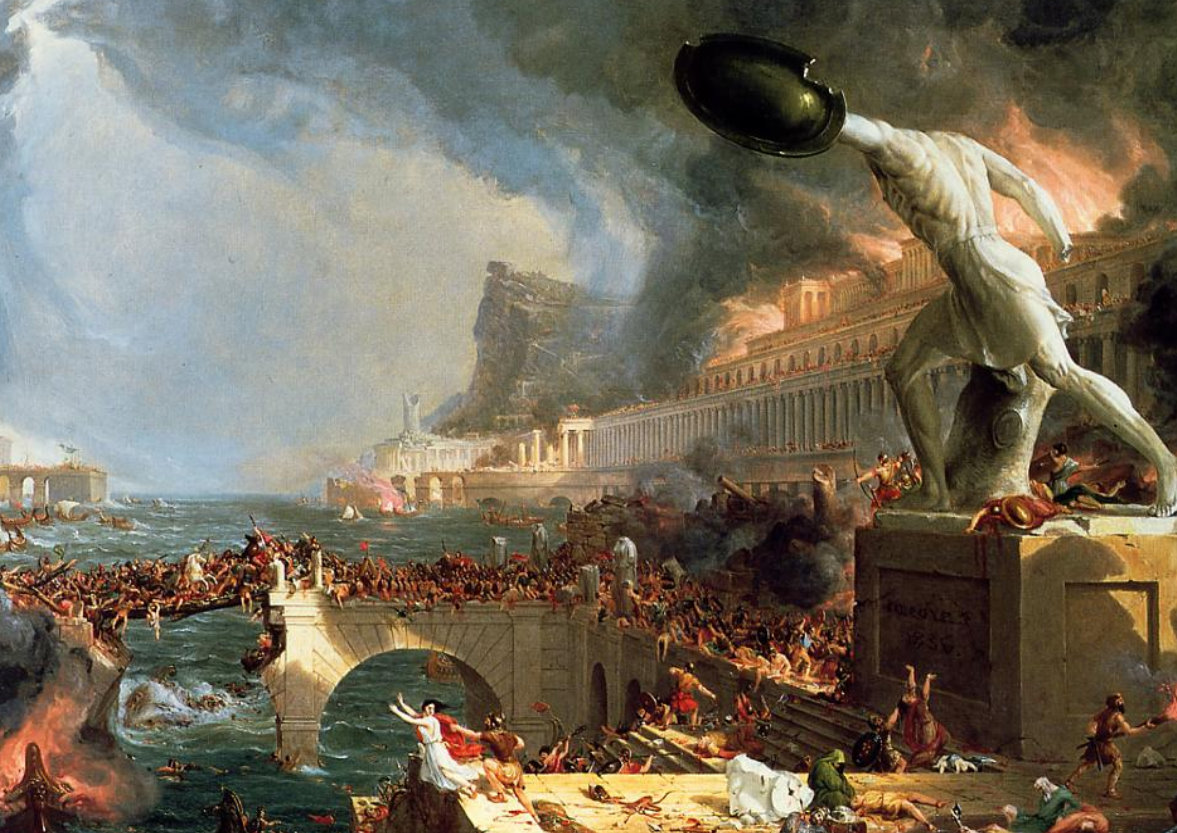
A forceful argument against America’s vicious circle of growing inequality by the Nobel Prize–winning economist.
The Great Recession is more than four years old—and counting. Yet, as Paul Krugman points out in this powerful volley, “Nations rich in resources, talent, and knowledge—all the ingredients for prosperity and a decent standard of living for all—remain in a state of intense pain.”
With dysfunction rooted in long-term political trends, a coarsened political culture and a new partisan media, the authors conclude that there is no “silver bullet” reform that can solve everything. But they offer a panoply of useful ideas and reforms, endorsing some solutions, like greater public participation and institutional restructuring of the House and Senate, while debunking others, like independent or third-party candidates. Above all, they call on the media as well as the public at large to focus on the true causes of dysfunction rather than just throwing the bums out every election cycle. Until voters learn to act strategically to reward problem solving and punish obstruction, American democracy will remain in serious danger.