For most of my adult life I have had great respect and adoration for America’s elite historians. Some of the first that come to mind are Doris Kearns Goodwin, John Meacham, Annette Gordon-Reed, Douglas Bradburn, David McCullough, and several others. I follow most all of them and have read many of their published books. Sometimes another historian enters the limelight of American political history and/or journalism. One such historical journalist was recently a guest on The Late Show with Stephen Colbert. His name? John Dickerson, a frequent guest on Colbert’s shows.
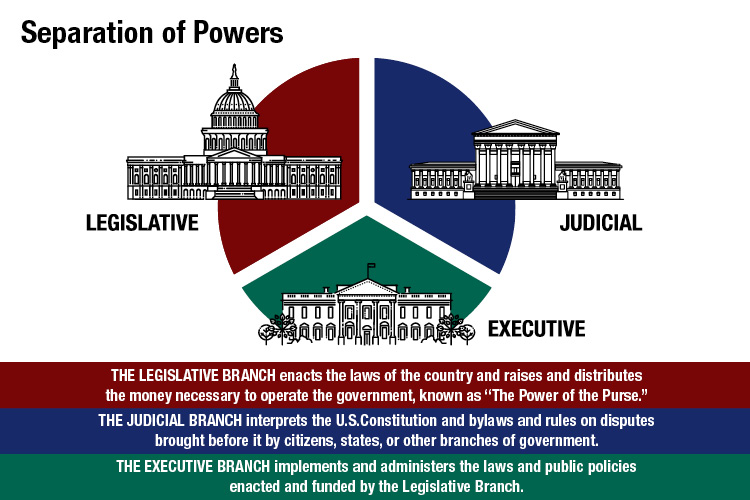
The meaning of Separation of Powers as our Core Founding Fathers intended in the late 18th-century
But sadly, this original design by our Founding Fathers (above image) no longer exists today. Try hard to find its current virtues, the applications, the execution and equal humble moderation. You won’t find it under this administration. They could care less about it.
Dickerson summed up superbly on the Colbert late show aired February 25, 2026, with exactly why the cogs and wheels of our federal government today are falling off, broken, and disintegrating… or “obliterated” to use an overkill abused White House word of late. And the prime example, the prime felon and demolisher—no pun intended on the East Wing of the White House—was made bare and obvious with the supposed State of the Union Lies and Address delivered February 24, 2026, to the American public. I highly recommend watching John Dickerson’s interview, answers, and explanations of just how monumentally President tRump and his MAGA cult followers are comprehensively missing the Venezuelan and American boat, so to speak:
If any of you cannot watch the interview on YouTube because of “location restrictions,” then try this option with some transcript reading:
It is finally here, finally published, the final part of my 7-part seriesA New U.S. Constitution. It has been a long time coming hasn’t it? My apologies for its delay. When I began this series in September and October 2022 I had no idea it would be delayed repeatedly due to my living situation these last four years. I had little idea just how busy I was to become.
But that is life, is it not? Frequently we have unexpected, unforeseen events and circumstances throughout our journey that can redirect one’s daily life or turn it upside down completely. That is precisely what happened to me: my Mom’s severe dementia became Early Alzheimer’s Disease. And my daily/nightly schedule is dominated by her needs and care between 10-14 hours per day and night, 365, no breaks except when she’s away on an infrequent 5-night respite for my sanity. As many of you know, the disease only gets worse. It is this prognosis and reality that has derailed my previous free-time and efforts to completing this series in a timely manner.
Even so, enough about lost time and her disease and on to the conclusion of A New U.S. Constitution.
When we left off with Part 6, I stated that in this part I would delve into the detailed problems of Gerrymandering, the conclusion, and consequently gerrymandering was further exacerbated by the 2019 Supreme Court ruling of Rucho v. Common Cause. That SCOTUS decision had tremendous detrimental affects on this republic democracy causing distortions upon election outcomes today. I also stated in Part 6 that this nation’s citizens, along with our public officials at state and federal levels, must construct a 21st-century electing system that allows proportional representation. Proportional representation reflects the correct definition of a republic democracy, the one that most all of our Founding Fathers intended within the Charters of Freedom.
Gerrymandering Under the Microscope
Generally speaking, gerrymandering in the United States is the long standing practice of drawing, or redrawing, geographical boundaries of electoral districts in an intended manner that gives your political party a clear advantage over your (hated?) political rivals, i.e. partisan gerrymandering. In this way it can also (greatly?) dilute the voting power of undesirable ethnic and/or linguistic minority groups opposing your political party, i.e. racial gerrymandering. This legalized political and racial discrimination during elections was begun in 1812 with a law enacted by Massachusetts Governor Elbridge Gerry. So… what is gerrymandering in a more specific, explicit form?
Today, this legalized discrimination and partitioning of registered U.S. voters, or to-be registered voters, looks like this in 2011 to the present day:
…in states where Republicans drew the [geographical] lines, they won 72% of the [legislative] seats with just 53% of the [total] votes [cast]; in states where Democrats drew the lines, they won 71% of the seats with just 56% of [total] votes [cast].
— Lawrence Lessig, “Republic, Lost: How Money Corrupts Congress“, p. 27.
State government trifectas is a popular term that describes one political party’s control and domination over 1) a state’s governorship and both chambers of the state’s legislature, i.e. 2) the senate chamber and 3) the house chamber, thus making the trifecta. “As of September 18, 2024, there are 23 Republican trifectas, 17 Democratic trifectas, and 10 divided governments where neither party holds trifecta control” according to BallotPedia.org. For at least six years from 2015 until 2021, then later fortified over the Trump years (2017–2021), the Mitch McConnell years (1985–2024)—now Senate Minority Leader—the Republican domination through gerrymandering, and today through Senator McConnell, has greatly strengthened partisan and racial gerrymandering in many states, 28-states out of 50 to be precise. And it is well-known what political-racial minority group in America has been losing ground the last 40-years: white voters. Yet, remarkably white American voters maintain disproportionate control and power in most state legislatures, particularly in states with sparse population densities, or a few people living on large swathes of land.
This glaring imbalance begs the question, at least for me… Today, do our state and federal governments represent actual American citizens/voters, the people, or do they represent land-sizes, great non-human areas, non-voters and wealthy business-corporations? The latter, which is to say 18th-century early 19th-century farmers, large plantation owners, etc., represented what the United States was in the distant past, barring of course mega-wealthy corporations. However, in 21st-century America, democracy should represent the former, that is to say the live and breathing individual American humans, voters, citizens, and their economic GDP contributions just as equally, if not more, but not a business entity such as corporate America. But to the demise of our democracy today Americans are being less and less represented by their governments and politicians. Today, it is not an actual representation of the American populous, individual citizens. And that folks, is NOT a republic democracy in its purest raw form.
A study in 2019 revealed that over the past few election decades, gerrymandering had shifted election outcomes for as many as 59-60 of 435 legislative seats in the House of Representatives. That is a significant shift given the wide ethnic cultural diversity of the American population, i.e. nonwhites. Gerrymandering causes several major controversies about whether or not we truly are a republic democracy, as we publicly proclaim to the world, and perhaps the biggest controversy is whether our Founding Fathers intended us to be back in 1781–1800 (i.e. bound to and living in the 18th-century accordingly) or rather progressing along with the times, with the living, not the dead.
The Rucho v Common Cause SCOTUS Decision
You can easily Google or search on your own what the Rucho v Common Cause Landmark Supreme Court decision was all about. However, in my own opinion and background in American history, Social Studies, and U.S. federal and state government as a former certified/licensed educator/teacher, I would personally declare that the Supreme Court’s decision was a disgraceful cop-out. As Wikipedia (and others) define the landmark decision, it was:
[As the Court determined] partisan gerrymandering may be “incompatible with democratic principles”, the federal courts cannot review such allegations, as they present nonjusticiablepolitical questions outside the jurisdiction of these courts.
And yet, one of the U.S. Supreme Court’s basic duties is to do exactly what they claimed they couldn’t do, “review allegations” dealing with our Constitution’s “democratic principles.” And over the last 245-years of this country’s existence, that is precisely what the Supreme Court was created to do and to have legal oversight over the legislative and executive branches, i.e. Checks and Balances! They cowardly copped-out on their sworn responsibility to properly interpret the spirit of our Charters of Freedom and how they apply, and specifically our federal Constitution’s interpretation and application. Here is what happened in 2016 in the words of George W. Van Cleve:
In Rucho, plaintiffs in two companion cases—one from North Carolina and one from Maryland—challenged those states’ congressional district maps as unconstitutional partisan gerrymandering. The facts of Rucho provide good examples of gerrymandering. In North Carolina, Republicans who controlled its state legislature had redrawn its congressional district boundaries to maintain a 10-3 Republican congressional seat advantage, despite the fact that just a few years previously Democratic candidates had received a majority of the statewide congressional vote. In 2016, North Carolina Republicans won 10 out of 13 seats despite receiving only 53 percent of the statewide vote; in 2018, they won 9 out of 12 districts with 50 percent of the vote.
— Rucho, Kagan, Justice, dissent (joined by all minority Justices), 139 S. Ct. 2484, 2509-11.
Essentially, today’s gerrymandering is no different than adjusting the rules, or rigging the game to your favor in order to win as many times as possible. I ask you, is that a pure fair market, an equal playing field for everyone in a supposedly free-enterprise capitalistic model that so many radical patriots here today rave about and proclaim as their “democracy, freedom, and liberty?” No, it is not. It is nothing but cheating in order to gain an upper-hand over your opponents. That is not a republic democracy.
And yet, the Supreme Court cowardly washed their hands of responsibility toward Constitutional limits to get in bed with partisan and racial gerrymandering, no matter how enormously it distorts, maligns fair election outcomes. In 2019 the Supreme Court succumbed to ideological lines of pressure instead of to the U.S. Constitution, the rule of objective law, and they handed power over to partisan, discriminatory prejudices of geographic gerrymandering. And yet still, our Constitution does indeed contain very specific provisions that allow the court oversight, supervisory authority over fair or unfair elections. The SCOTUS blatantly ignored it.
Justice Kagan’s vigorous—indeed scathing—dissent in Rucho, written on behalf of four justices, insisted that the Constitution required an end to partisan gerrymandering because it violated several provisions of the Constitution and directly undermined democracy.
— George W. Van Cleve, “Making a New American Constitution.” Maroon Bells Press. Kindle Edition, 2020
Furthermore, Kagan’s dissent argues that our long history of partisan racial gerrymandering has always been based upon the majority, and that is completely irrelevant. Why? Because the practice of gerrymandering completely FAILS to meet the modern, proper democratic standards of what it means to be truly a republic democracy. One must remember that we are no longer living in the late 18th-century!
However, the Rucho v Common Cause Supreme Court decision has even further ramifications for our future elections and the views, the positions and roles of the Supreme Court in our correct interpretations of our Constitutional system, not just in the 18th-century, but more importantly the 21st-century! Remember, Thomas Jefferson and the other five core Founding Fathers all agreed that:
The question Whether one generation of men has a right to bind another, seems never to have been started either on this or our side of the water. Yet, it is a question of such consequences as not only to merit decision, but place also, among the fundamental principles of every government. The course of reflection in which we are immersed here on the elementary principles of society has presented this question to my mind; & that no such obligation can be so transmitted I think very capable of proof. I set out on this ground, which I suppose to be self-evident, ‘that the earth belongs in usufruct to the living’: that the dead have neither powers nor rights over it.
The very basic legislative essentials of our Constitution and other sacred democratic documents were all designed to be adjusted, to be tweaked, to be updated as necessary, to present times and conditions—not bound by or to the dead. Therefore, let us fully understand the many curses of political and racial gerrymandering discrimination we have presently:
Gerrymandering is an important factor in preventing the emergence of such national proportional representation. It helps block changes in the partisan balance in government office holding even if developing a better balance between the major parties is what many, or perhaps even most, voters in our divided country would prefer. By preventing a partisan balance that reflects voters’ choices, it also hinders the development of more bipartisan, consensus policies by the national government, something many voters would quite likely also prefer. Notably, however, the Court’s [2019] decision—and even the minority’s sharp challenge to it—both also effectively sanction our existing majoritarian electoral system, i.e., a two-party system that political scientists agree effectively discourages require proportional representation of minority parties.
— George W. Van Cleve, “Making A New American Constitution,” Maroon Bells Press. Kindle Edition, 2020
Proportional Representation – What Is It?
Throughout human history—going back many 100,000 years—humans have always had self-imposed biases and prejudices. Hence, it is no surprise that the concept of proportional representation in one’s ruling government has vehement proponents and vehement detractors based upon their own (unfounded?) biases and lifetime experiences. Or the same could be said based upon legitimate data and objective human experiences too. What is well-known and proven is that proportional representation may or may not always represent the majority opinion. That is not a bad thing.
Whether the diverse political-social landscape is or is not representing many viewpoints, the fact that its condition offers choices, choices other than one single dominant ideology (that could very well be evil and horrendous for the common good), a wider range of concepts will more often than not give civilizations more choices for a greater good. What MUST be present in a pure election system and governing is free civil discourse. Without free civil discourse, civilizations are destined for total collapse. Ideologies only represent a theory, something that is not tested or reflective of actual human experience. In other words, a concept-theory or ideology may not represent actual data, evidence, or real-life experiences of very actual living. That life-void is possibly a delusion, a life experience that only exists in one person’s own head. It simply does not represent the majority of experiences by humans.
So to be clear, our need, NO… our perceived requirement to think outside of our own selfish needs for a greater good, a greater nation, a noble concept that our own individual biases, our own individually centered ideals have to exist with multiple choices, with answers and consequences that sometimes make us uncomfortable, make us feel awkward, but done so in order to benefit those outside of ourselves. Our electoral system should be no different; we MUST allow it to function outside of individual biases, ideologies, and our own tiny miniscule perceptions.
Inside that framework, the entire election system can be freely examined outside of the political influences and enormous vested interests of our existing major political parties and their millions-billions of dollars that influence minds like a cancer. And even more significant, we should objectively examine our unelected Supreme Court Justices, whose SCOTUS members are political biased theoreticians and who have never had to face an election, much less run a federal government.
In the end, our Constitution’s major political institutions are irreparably flawed as is the basis for a modern representative government. Our current institutions do not provide for adequate representation of the national popular will, for two reasons.
First, they do not meet modern standards for democratic representation. Our constitution now provides increased “generation-spanning” political power to Presidents and the Supreme Court. More significantly it also allows both the presidency and the Senate to be controlled by minority parties. Further, the Constitution, as now interpreted, allows unfettered gerrymandering to continue and permit the two major parties to exclude minority voices entirely from representation in Congress. That is the antithetical definition of democracy.
Second, under our current Constitution’s rules, presidential elections and the operations of Congress increasingly distort the popular will in ways that the Founding Fathers did not foresee, and could not have possibly foreseen the very probable consequences. They would not have approved this by any means. The Constitution’s major institutions have failed, as a basis for representative government, and non-participatory Americans have willing allowed this. So apparently, it would seem, nothing can be done to remedy any of these growing shortcomings by means of free-standing constitutional amendments, by which a pure republic democracy could in fact change. However, this couldn’t be further from the truth. A new Constitutional Convention could and will instead be necessary to cure us of these dysfunctional conditions.
Why do so many average Americans not know this? I have that answer.
One, for the last 3-4 decades Americans and one specific American political party has relentlessly attacked our public school systems in history, social studies, and state-federal government. These four areas of general middle-school and high school curriculums have been so reduced that American teenagers, now adults, have little clue as to what the core Founding Fathers intended for their nation. Most American 1st thru 12th grade public educational institutions exclude these four VITAL areas of American history/government. In private, religiously associated school curriculums these subject areas are non-existent. The Judeo-Christian (Greek, not Mishnaic Hebrew that was Jesus/Yeshua) Bible and its theological doctrines, are forced-taught… oppressively and relentlessly to indoctrinate. The GOP dresses up their prejudicial attacks via “school vouchers” for families of religious extremists.
Secondly, far too many American voters do not participate in their own governing, the very basic national privilege and virtue (or gift?) that our democracy still (barely) provides to them. Sad, very sad.
Nevertheless, there is still a chance for us to save this sinking ship that is American democracy. But the only way this can happen is for average Americans to seize their given rights as citizens to self-determine how they will be governed by participating in elections AND just as important, engage with their state and federal officials regularly. And vote, of course. If this is not done by at least 70% of our population, then this country is doomed, guaranteed. Unfortunately, for several decades, voter turnout rates have been around 32%–46% give or takes 0.5-1.5 percent points. Yes, that figure is well beyond appallingly dismal. No wonder this country is in the state that it is.
Live Well – Love Much – Laugh Often – Learn Always
Never before in our country’s 247-year history has a Speaker of the House been ousted, removed, and forced to vacate. In a vote of 216 to 210, Speaker Kevin McCarthy has been (for the moment) terminated for NOTbeing the Speaker of the House chamber! He was not the House Speaker for the Republican party, but by bound duty the Speaker of the U.S. House of Representative to legislate and get bills, acts, and appropriations done. That was his sworn duty. Period. According to a majority of his own House Republicans, he failed and failed miserably.
Since this historic vote took place earlier this afternoon, I’ve watched and heard many interviews with Republican Representatives by the mainstream news outlets, and all of the Republican Reps kept trying to harp on the national debt of $31.4–$33 trillion. It is the typical deflect and divert tactic away from the sheer chaos today’s Republican party is in… and it is their own fault, their own catastrophe they themselves created in 2010–2016.
But nonetheless, let’s look much closer, much deeper into the context of their panicked response to McCarthy’s removal: the national debt and deficitthat supposedly, according to them, was caused by Democratic administrations. Grab the microscopes.
According to the Pew Research Center, a reliable established goliath in research reporting and objective fact-checking, there are five (5) facts about our accumulation of national debt that the mainstream news outlets rarely get in-depth about.
The federal government’s total public debt stood at just under $31.46 trillion as of Feb. 10th, 2023. Nearly all of that debt – about $31.38 trillion – is subject to the statutory debt limit.
For several years, the nation’s debt has been bigger than its gross domestic product (GDP). Read the Pew article for more in-depth details.
21.8% of the public debt, or $6.87 trillion, is owned by another arm of the federal government itself. This includes Medicare; specialized trust funds, such as those for highways and bank deposit insurance; and civil service and military retirement programs. But the biggest chunk of those “intragovernmental holdings” belongs to Social Security.
The Federal Reserve System is the single largest holder of U.S. government debt. The Fed bought Treasuries in massive quantities during the COVID-19 pandemic in an effort to keep the U.S. economy from buckling under the strain of shutdowns and quarantines.
Servicing the debt is one of the federal government’s biggest expenses. Most of this spending is on veterans’ benefits and services due to wars in Afghanistan and Iraq, which is more than it will spend on elementary and secondary education, disaster relief, agriculture, science and space programs, foreign aid, and natural resources and environmental protection.
The national debt has grown significantly since the early 1980s under both Republican and Democratic administrations.
The largest percentage increases to the debt occurred under Presidents Ronald Reagan and George W. Bush, both of whom enacted tax cuts that led to large deficits.[…]
Flashpoints that greatly contributed to the debt over the past 50 years include the wars in Iraq and Afghanistan, the 2008 financial crisis and the 2020 COVID-19 pandemic — the latter two prompting sweeping stimulus measures from Congress that cost trillions of dollars.
And let me add to the last point of the COVID-19 pandemic, our administration at that time, the GOP and tRump, did very little (if anything substantial) for the preparation of this country to go to WAR against a highly contagious, lethal biological virus! I repeat, tRump and his administration never took the pandemic and public health and safety measures seriously. Hence, look what happened.
Therefore my fellow Americans, when you are bombarded by political party rhetoric and propaganda on this nation’s debt and deficit like those heard today from the House chamber members scrambling and panicking to put out all the fires caused by their own Party, look deeper, look much closer into the factual data. THAT is where you will find the nectar and honey of what they speak about truthfully, or lie about, or divert with vague ambiguous half-truths.
Live Well – Love Much – Laugh Often – Learn Always
“My definition of a free society is a society where it is safe to be unpopular.” — Adlai Stevenson
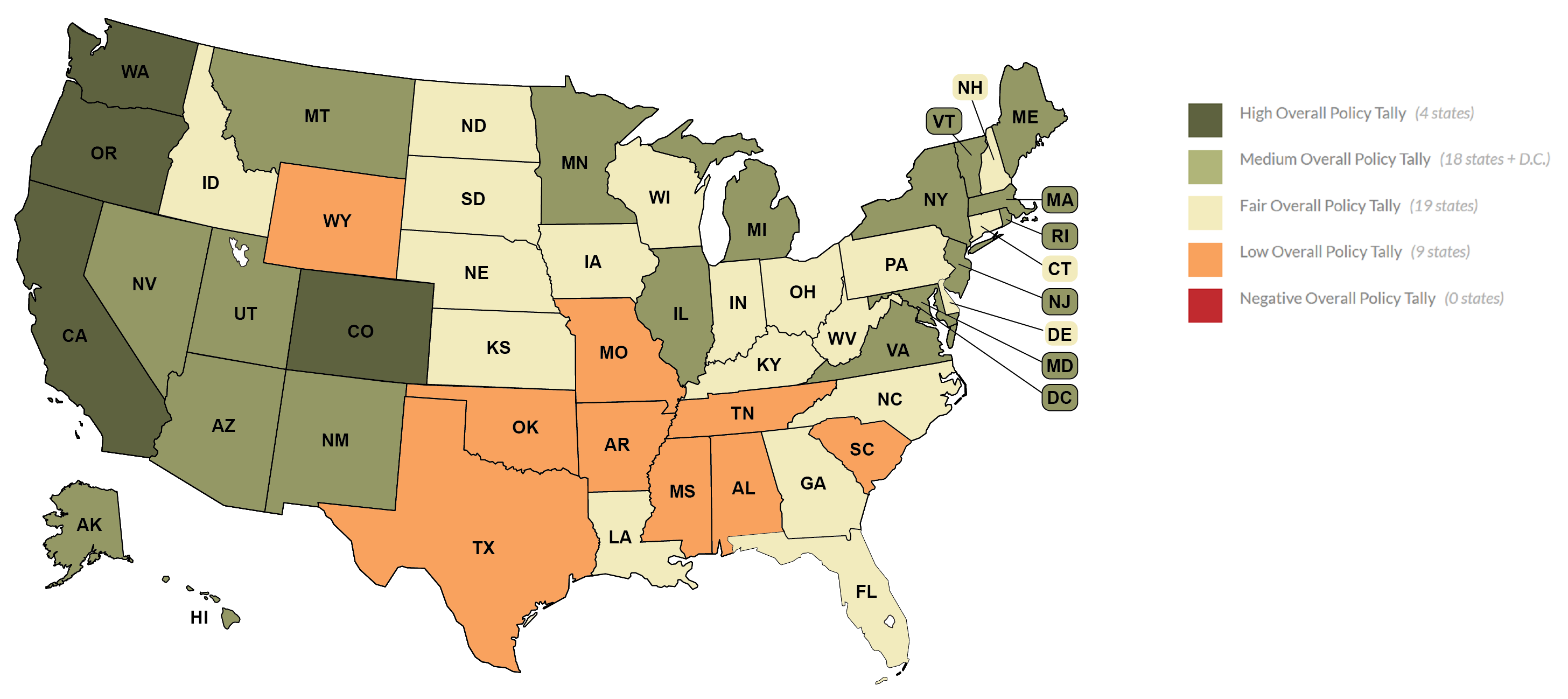
As of August 7, 2023, the Movement Advancement Project (MAP) released its annual scorecard for each of the U.S. state’s democracy rating. As I alluded to in my previous blog-post and its comments, my home state of Texas has been passing legislation over the last two–three years which suppress the votes of non-white, anti-conservative, less-advantaged Texans or making easy convenient access to voting stations, and actual voting, increasingly difficult. Over the last 5-7 years it has been ever harder for myself to vote and/or register to vote, and I am a well-educated white man! Now riddle me that one please!
Nevertheless, I was quite interested in knowing what Texas’ scorecard reveals. Not much of a surprise to me our democracy tally has been rated “Low” (in the orange) scoring 6.5 out of 33.5 points. Personally, that’s a fair score given how noticeably more difficult it has become for me—a college educated white man—to vote or re-register to vote after my frequent moves between Dallas and Kerrville, TX for Mom’s declining dementia, and to get this year (as well as 4-yrs ago) a new renewed driver’s license. By the way, have I told you that I am an 8th-generation white Texan with no criminal record or outstanding warrants, fines, over 42-years of employment and paying my share of taxes over those 42-years? Eighth-generation means my family was here in Texas BEFORE it was annexed by the United States in 1845!
As far as MAP’s “Who Votes” and “How to Vote,” two of the three main metrics for scoring, yet again, no surprise whatsoever for Texas’ abysmal ratings: Who Votes — a -0.5/5 and How to Vote — a -0.75/5. Our highest ratings? “Election Security” 4 out of 6, and “Voting in Person” 2.5 out of 5.5. Both of those better scores, yet still weak, I have explained their difficulty mediocrity in detail over the last decade. “Election Security” is cryptic Conservative code for Much Harder to Vote and “Voting in Person” means Hard Registering to Vote, respectively.
Curious to know what four states rate the highest in democracy’s election laws and policies according to MAP? Yes, you read that correctly, only 4 states out of 50, or just 17% of our population of 332-million Americans reside in a state with high-levels of democracy. Let me repeat, just seventeen percent of Americans! Here are those highly democratic republic states:
Washingtonwith31out of 33.5
Coloradowith 30out of 33.5
Californiawith 29.5out of 33.5
Oregonwith 26out of 33.5
Let’s see who the last four states of the Union are with the most undemocratic elections and policies:
47. Tennesseewith 5.5out of 33.5 48. Arkansaswith 5.5out of 33.5 49. Mississippiwith 4.0out of 33.5 50. Alabamawith 3.25out of 33.5
What percentage of the American population do these four states make up? The answer: almost 6%of the American population.
The bottom-line is and what these numbers show when one reviews the entire fifty states on the MAP’s website is that a large portion of the American 50-states and their populations are NOT truly, purely democratic in their elections and policies. I don’t know about you, but I find these facts disturbing, alarming, and they need to be confronted and addressed not just by each individual (legal) American citizen, but also by your district’s House of Representatives and your district’s Senators! Are we not a Constitutional Republic democracy as written in our Charters of Freedom by all six (6) of the Core Founding Fathers? Yes, of course. Then WHY do twenty-nine (29) of our fifty states score a measly grand tally of just 16.75 (or lower) out of 33.5 democracy data-points? Those scores are abysmal!
What has happened to democracy in the United States to rate that horribly on the major points of what defines a TRUE democracy?
Try to Live Free – Love Much – Laugh Often – Learn Alot More
The Senate of the United States shall be composed of two Senators from each State, elected by the people thereof, for six years; and each Senator shall have one vote. The electors in each State shall have the qualifications requisite for electors of the most numerous branch of the State legislatures.
— 17th amendment to u.s. Constitution, ratified april 8, 1913
The main issue and problem for what the 17th Amendment attempted to correct for Congress, specifically for the Senate, was that Article 1, Section 3, Clauses 1 and 2 of the 1787 Constitution dictated that each state legislature appointed its own two state Senators for an initial six-year term. Regardless of the state’s population size, each state was entitled to two senators with two “equal” votes in the federal Congress. This helped reassure anti-federalists of the time, and previously covered in Part 5 of this series, that an overly centralized power-base like the federal government would not devour state’s powers but instead provide an oversight to the House of Representatives whose members were elected by popular vote by their state’s citizens.
Across the aisle, opponents countered the anti-federalist argument that within such a circle of powerful state legislatures, there existed two primary problems: 1) legislative corruption influenced by monetary gains and interests, and 2) electoral deadlocks paralyzing necessary legislations for all the people’s interests. And since the Amendments’ 1913 ratification another major problem now persists: no reelection term-limits for Senators (see Table below)—essentially an identical chronic problem today with Supreme Court Justices’ lifetime terms. Notice the lengths of service for these 25 Senators:
25 Longest Serving U.S. Senators To-Date*
senators
dates of service
length of service
Robert C. Byrd (D-WV)
Jan 3, 1959–Jun 28, 2010
51 years, 5 months, 26 days
Daniel K. Inouye (D-HI)
Jan 3, 1963–Dec 17, 2012
49 years, 11 months, 15 days
Patrick J. Leahy (D-VT)
Jan 3, 1975–Jan 3, 2023
48 years
Strom Thurmond (D, R-SC)
Dec 14, 1954–Apr 4, 1956 and Nov 7, 1956–Jan 3, 2003
47 years, 5 months, 8 days
Edward M. Kennedy (D-MA)
Nov 7, 1962–Aug 25, 2009
46 years, 9 months, 19 days
Chuck Grassley (R-IA)
Jan 3, 1981-present
42 years, 1 month, 7 days
Orrin G. Hatch (R-UT)
Jan 3, 1977–Jan 3, 2019
42 years
Carl T. Hayden (D-AZ)
Mar 4, 1927–Jan 3, 1969
41 years, 10 months
John C. Stennis (D-MS)
Nov 5, 1947–Jan 3, 1989
41 years, 1 month, 29 days
Ted Stevens (R-AK)
Dec 24, 1968–Jan 3, 2009
40 years, 10 days
Thad Cochran (R-MS)
Dec 27, 1978–Apr 1, 2018
39 years, 3 months, 6 days
Fritz Hollings (D-SC)
Nov 9, 1966–Jan 3, 2005
38 years, 1 month, 25 days
Mitch McConnell (R-KY)
Jan 3, 1985–present
38 years, 1 month, 7 days
Richard B. Russell, Jr. (D-GA)
Jan 12, 1933–Jan 21, 1971
38 years, 10 days
Russell B. Long (D-LA)
Dec 31, 1948–Jan 3, 1987
38 years, 3 days
Francis E. Warren (R-WY)
Nov 18, 1890–Mar 3, 1893 and Mar 4, 1895-Nov 24, 1929
37 years, 4 days
James O. Eastland (D-MS)
Jun 30, 1941–Sep 28, 1941 and Jan 3, 1943–Dec 27, 1978
As with the transgenerational power-hold Supreme Court Justices currently possess over the American people, the Senate and Senator votes today have an even more detrimental, anti-democratic effect than they did in 1788 to 1913. With modern and recent service-lengths averaging between 35–47 total years; about 45-years of one political (partisan?) ideology or covering about two generations of Americans. Consequentially, the U.S. Senate has become a major roadblock to effective, efficient, critical governing to protect the American people during times of economic and/or public safety and general health, even sometimes life or death, e.g. COVID-19. The Senate simply does not move fast enough for modern forms of crises management. Furthermore, the lethargic 21st-century Senatorial condition confers spurious political advantages to small tiny states, their senators, and their 18th-century Constitutional, economic-corporate and political dominance which is gifted in gratis by two equal votes regardless of state size.
During the 1787 Philadelphia Convention and the drafting of our Constitution, many of the Founders recognized what the Connecticut Compromise would do, at least over a period of time. They could not have been more correct. As the overall population of the U.S. has reached nearly 337-million today, it means the smaller, tinier states have gained more federal money and more authority in the Senate as well as more weight in the Electoral College over the last 235-years. Both James Madison and James Wilson ardently opposed the Connecticut Compromise, and Wilson specifically spelled out that ‘equal state Senate votes would mean that a minority of voters could block the will of the majority,’ or of the American people. And this is exactly what has happened in today’s Congress.
The twenty-eight smallest states of the Union today, representing 20% of the American population, have 56% of the votes in the Senate. This disparity and distortion over two centuries now is precisely why the increased voting strength between states with wealth and population versus those without and much smaller populations has occurred, and as a result, the majority receives less and less federal representation. This is also reflected in many state governments as well. With each passing decade the Constitution’s 18th-century “minoritarian” equal state-voting principle impacts national policies and allocation of funds more and more, too often at the expense of the greater American good.
A “New” Senate: Reflecting the Popular Will
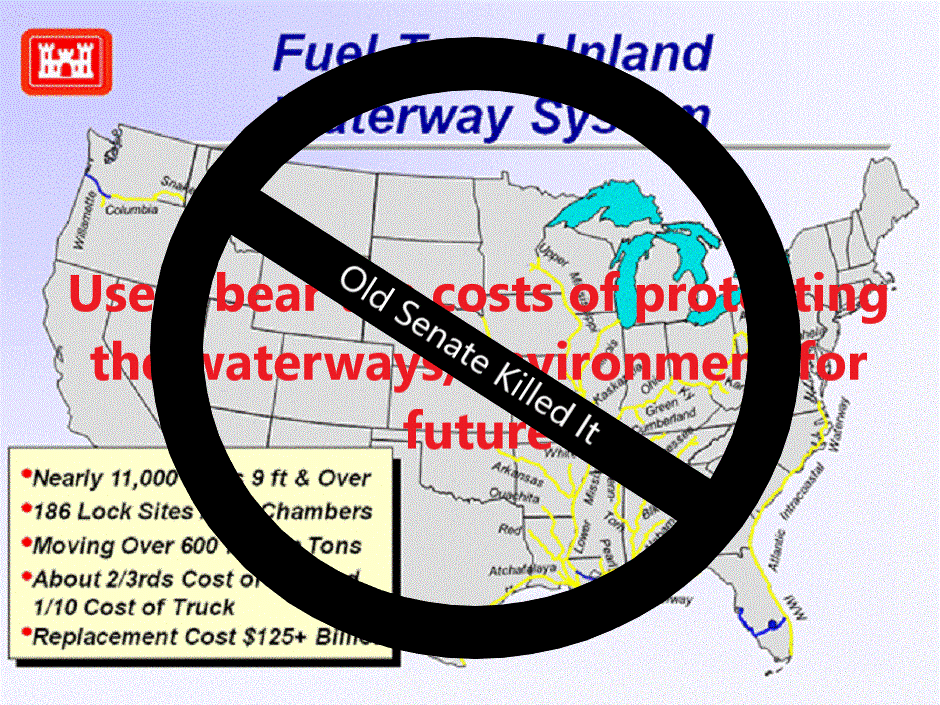
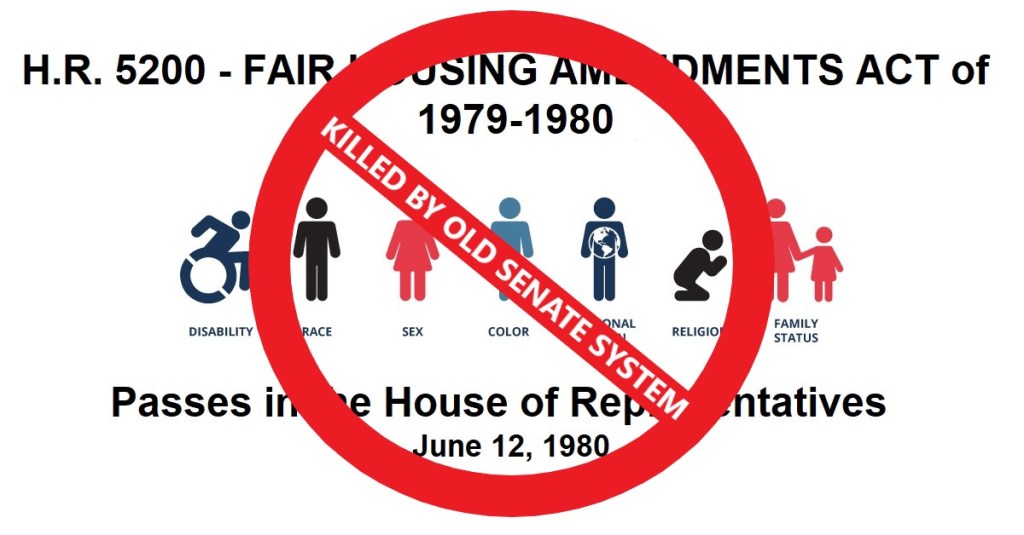
The better welfare of the greater national good and a more truer Republic democracy by a new Senate-voting system significantly outweighs the aforementioned flaws, disparity, and distortions of keeping the 18th-century system. If this New Senate were structured primarily on the state’s population, and to a lesser extent say the smaller-sized states’ X-quotient of wealth and resources toward the national well-being, surely this would offer a more equitable system assuring the overall national popular will was more realized. To demonstrate this reform, the following two slideshows illustrate just how a reimagined, past Senate voting would’ve substantially changed our last twenty-plus years of national policies, some of which our “Old Senate” system has had (very?) harmful consequences.
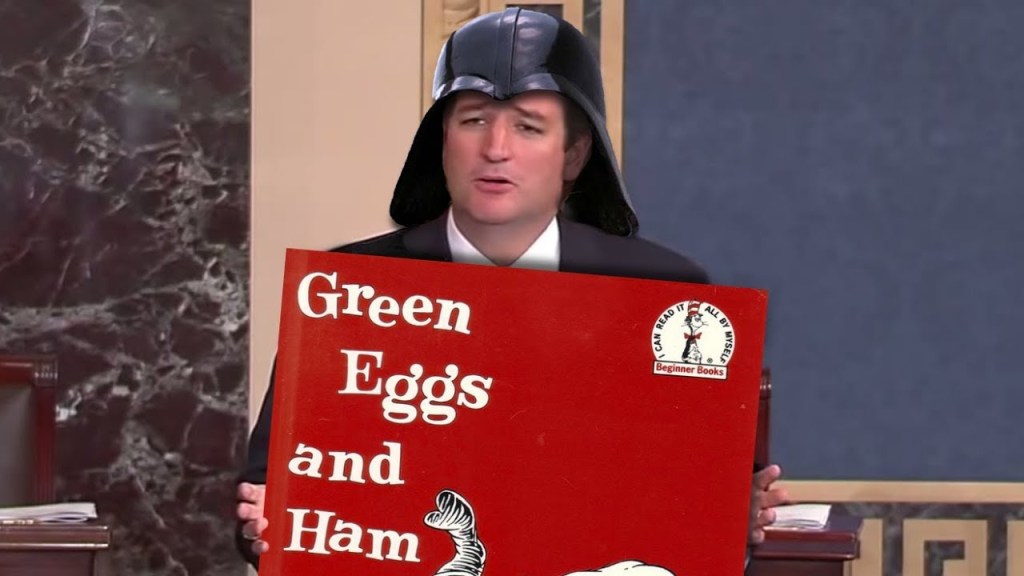
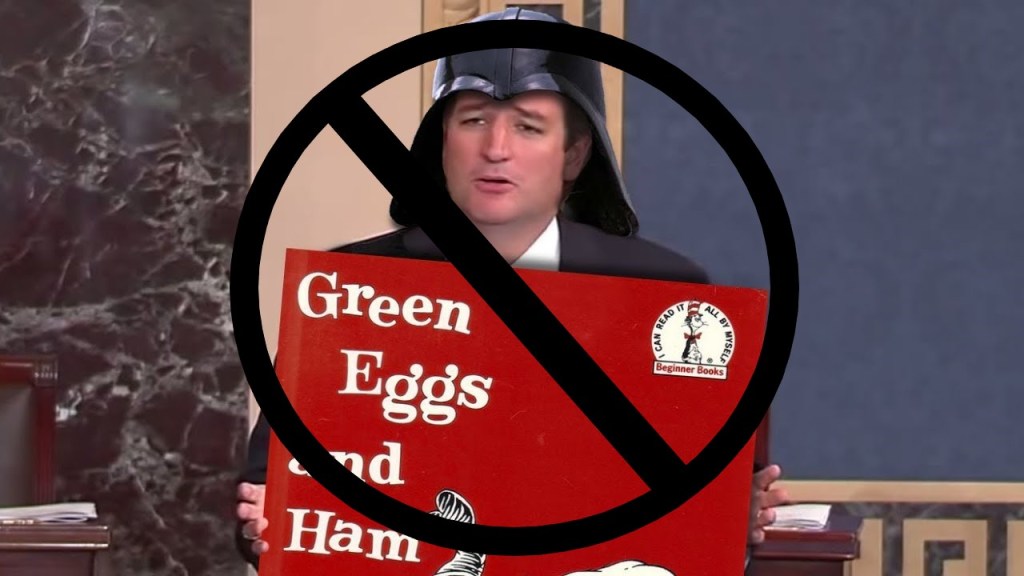
No Senate filibustering after John Calhoun (1840’s) or Ted Cruz (2013) stopping the Senate vote!
Moreover, several different variances in domestic and foreign policies (see following slides) would have certainly been enacted or rejected had a “New” 20th– or 21st-century Senate voting system been put in place in 1970:
Under the “New” Senate voting system, recently appointed and confirmed 53-year old Supreme Court Justice Brett Kavanaugh would have never been voted in. He would have lost by a sizable margin—approximately by 20% or more—by the twenty-two larger states (and Senators) that makeup about 80% of the American population. Justice Kavanaugh only received his confirmation because of the 28 smallest states and their (ultra) Conservative Senators’ votes. In a new Senate voting system reflective of Americans and their interests, Kavanaugh would’ve been easily rejected. To put it a different way, Judge Kavanaugh’s lifetime appointment to our highest court in the land—that will affect 2-4 generations of Americans—was accomplished purely by a fossilized relic of our 18th-century Constitution’s “equal state Senate voting rule.” No debate.
Proof the Electoral College is Undemocratic
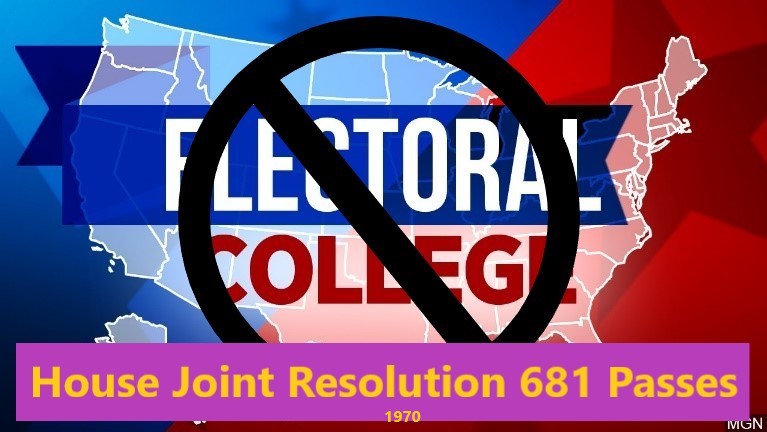
In 2024 Americans will elect the next President and Vice-President using the antiquated Electoral College system created by the 18th-century mindsets held in the Constitution. By that system, all actual votes will be cast by “electors,” not the American people. This may come as a shock to some American voters. Despite their dismay, it is completely true; the U.S. is not a comprehensive democratic Republic.
The key justifications for the invention of our Electoral College imparted by Convention delegates in 1787 no longer exist today. One must remember the historical context of what the Philadelphia delegates were negotiating and fiercely debating at the time. Many of those delegates felt average American voters would not sufficiently know the candidates governing experience, educational level obtained, and much less their personal backgrounds. These conditions were further exacerbated by transportation and communication limitations for most all American voters, thus making well-informed decisions difficult at best. That scared the Ba-jebus out of nearly everyone of them—they could not risk a narcissistic demagogue President or administration getting naïvely elected, then worse become a tyrannical king or American Caligula/Caesar. Thus, the Electoral College was created for an 18th-century nationwide citizen-conundrum.
None of these problems exist today, nor is the modern Originalist argument for the Constitution’s (divine?) integrity a persuasive argument against a purely popular vote by the people. And here is the most damaging function of today’s Electoral College: the Underrepresentation of States and their Electors. (see following Table)
state
population 2023
% of total population
electoral now
proportionate electoral
disc
1. California
40,223,504
11.92%
54
64
-10
2. Texas
30,345,480
8.99%
40
48
-8
3. Florida
22,359,250
6.62%
30
36
-6
4. New York
20,448,194
6.06%
28
33
-5
5. Pennsylvania
13,092,796
3.88%
19
21
-2
6. Illinois
12,807,072
3.79%
19
20
-1
7. Ohio
11,878,330
3.52%
17
19
+2
8. Georgia
11,019,186
3.26%
16
17
+1
9. N. Carolina
10,710,558
3.17%
16
17
+1
10. Michigan
10,135,438
3.00%
15
16
+1
11. New Jersey
9,438,124
2.80%
14
15
+1
12. Virginia
8,820,504
2.61%
13
14
-1
13. Washington
7,999,503
2.37%
12
13
-1
14. Arizona
7,379,346
2.19%
11
12
-1
15. Massachusetts
7,174,604
2.13%
11
11
0
16. Tennessee
7,080,262
2.10%
11
11
0
17. Indiana
6,876,047
2.04%
11
11
0
18. Maryland
6,298,325
1.87%
11
10
+1
19. Missouri
6,204,710
1.84%
10
10
0
20. Colorado
5,997,070
1.78%
10
10
0
21. Wisconsin
5,955,737
1.76%
10
9
+1
22. Minnesota
5,827,265
1.73%
10
9
+1
23. S. Carolina
5,266,343
1.56%
9
8
+1
24. Alabama
5,097,641
1.51%
9
8
+1
25. Louisiana
4,695,071
1.39%
8
7
+1
26. Kentucky
4,555,777
1.35%
8
7
+1
27. Oregon
4,359,110
1.29%
8
7
+1
28. Oklahoma
4,021,753
1.19%
7
6
+1
29. Connecticut
3,615,499
1.07%
7
6
+1
30. Utah
3,423,935
1.01%
6
5
+1
31. Iowa
3,233,572
0.96%
6
5
+1
32. Nevada
3,225,832
0.96%
6
5
+1
33. Arkansas
3,040,207
0.90%
6
5
+1
34. Kansas
2,963,308
0.88%
6
5
+1
35. Mississippi
2,959,473
0.88%
6
5
+1
36. New Mexico
2,135,024
0.63%
5
3
+2
37. Nebraska
2,002,052
0.59%
3
3
0
38. Idaho
1,920,562
0.57%
4
3
+1
39. W. Virginia
1,775,932
0.53%
4
3
+1
40. Hawaii
1,483,762
0.44%
4
2
+2
41. New Hampshire
1,395,847
0.41%
4
2
+2
42. Maine
1,372,559
0.41%
2
2
0
43. Montana
1,112,668
0.33%
4
2
+2
44. Rhode Island
1,110,822
0.33%
4
2
+2
45. Delaware
1,017,551
0.30%
3
1
+2
46. S. Dakota
908,414
0.27%
3
1
+2
47. N. Dakota
811,044
0.24%
3
1
+2
48. Alaska
740,339
0.22%
3
1
+2
50. D.C.
715,891
0.21%
3
1
+2
51. Vermont
647,156
0.19%
3
1
+2
52. Wyoming
583,279
0.17%
3
1
+2
Reviewing the Table above, did you note how many states are under-represented and how many are (grossly) over-represented? Nine (9) states are (very?) under-representative of their people’s votes, and thirty-five (35) states are (very?) over-representative of fewer people’s votes! Even worse, those nine under-represented states are this nation’s most populous states, with real people, yet unreal Electoral votes! In a sense, the twelve (12) overly-represented states are/have been ghosting, or inventing unreal Electoral votes since at least 1960 and the Twenty-third Amendment.
Finally, the Electoral College promotes harmful, sometimes disastrously dueling, hyper-divisive politics or duopoly partisanship between the two major parties. This deadens civic-political discourse and impedes policy reforms and/or creation as we’ve seen over the last 2-3 decades with the chasm widening more and more every four-to-eight years. If that persists, it will be catastrophic for this country as well as democracy as a whole around the world.
∼ ∼ ∼ § ∼ ∼ ∼
In the Conclusion of this 7-part series, I want to cover more extensively Gerrymandering and the 2019 Supreme Court decision Rucho v. Common Cause and how that ruling has had very adverse affects on our Republic democracy and today badly distorts election outcomes. I will also get into HOW we must approach and construct a proportional representation system that actually DOES reflect a true democracy.
I hope those who are still following this series will find it helpful for your own civic benefits for yourself, your state, and our country. Thank you again everyone for your patience with me and my often slow writing and posting. Please feel free to leave your thoughts and comments below.
Live Well – Love Much – Laugh Often – Learn Always
I have zero expectation that anything I ever say will end someone’s belief in their God. Not my goal or purpose. That alone belongs to the individual. ~ Zoe
'Light thinks it travels faster than anything but it is wrong. No matter how fast light travels, it finds the darkness has always got there first, and is waiting for it' - Terry Pratchett












 The Professor's Convatorium