For those of you who are utterly fascinated (like me) with Earth’s most resilient creatures — no, humans are not even close — the Meloidae take survival and reproduction to an all new high… or rather a cunning, evil low may be the correct designation. If you think politicians or double-agents are unscrupulous, then you don’t know much about these ingenious Coleoptera. No, not Cleopatra, Coleoptera… though the behavioral similarities are clearly there.
Beware of Seductive Female…
Coleoptera Meloidae
Bees. Yes, seductive fake female bees! Or perhaps I could have left-off “bees”. HAH! But let’s not go there, yet. But I do want to talk about perfumes… seductive perfumes!
The larvae of the Blister Beetle, after they are hatched, must immediately seek food. But they do not seek out just any menu. They want a specific 5-star platinum dinning establishment with an unforgettable experience, AND they want and will be chauffeured there! Men, married men, husbands with a pregnant wife or newborns… does this sound familiar? How do these newly born larvae do it? As the below video will show, their genetic coding makes them work as one team, climb to the top of a blade of grass or leaf, clump together, then the Coup d’état… they lure an unsuspecting (horny) male Digger-bee, and do it with specialized perfume, or pheromones! Again, sound familiar? Talk about the greatest STD. Wow! Guys, this totally redefines the need for super safe sex!
(paragraph break)
What Can We Learn From Blister Beetles?
Having a background in psych counseling and assessment, as well as certified 4th through 8th grade teacher in all core subjects with a deep fondness for science and social studies (history), my students have always enjoyed relating or connecting Earth science and its creatures to self or to us. Invariably the bored middle school kids ask the question… How does this effect me or help me in life? Well my little unknowing enquiring mind, it does in many ways. Case and point: the Blister Beetle.
Male Digger-bee with stowaways
Ever heard of the adage “If it seems too good to be true, then it probably is” or its gullible opposite “Never look a gift horse in the mouth“? Those two phrases and similar ones carry a lot of wisdom. As many a magician have demonstrated over the centuries, our eyes can be easily deceived. Our ears and nose can be fooled as well, to a lesser extent. Obviously, the “perfumed pheromones” these meloidae larvae ooze, cause much “male digger-bee intoxication” and I believe mimic other species’ perfumes! I’ve fallen prey to different parfums enivrants as many times as these male digger-bees! And I’d wager I have hit the ground, once or twice, much harder than these gullible lads!
Our judgement and perceptions (of self and others) can be quite flawed. Only through periods of time — sometimes years, and in the case of humanity, centuries or millenia — and through trial and error do we learn from events and our mistakes. Hopefully not fatal mistakes. Therefore, it really behooves us flawed humans (and hetero males?) to consider situations with as much cognitive examination as with emotion, especially impulsive emotion. Easier said than done, right? Particularly when some of us are genetically wired to feel and feel strongly, or to find and love, and love strongly. Believe me, I have wrestled with this advice for much of my life, as my recent posts about my daughter, marriages and divorces, and the nature of love can greatly attest!
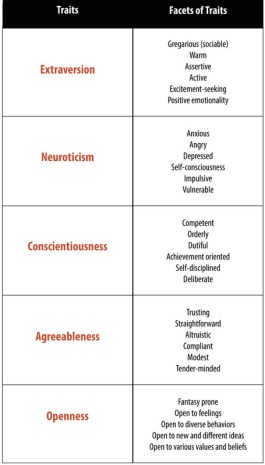
Five-Factor Model – courtesy of noboproject.com
All of us, every single human being alive, are inextricably connected to this planet and its life-giving (and taking) environments and creatures. We absolutely can learn from all the animals, how they survive, adapt, evolve, and especially reproduce, even from the aversely simpatico relationship of Blister Beetles and Digger bees.
Subtraits of the Big Five – courtesy of noboproject.com
In modern psychology, Machiavellianism (and this beetle) is one of three personality traits of the Dark Triad; dark meaning malevolent manifestations. Essentially it is behavior exhibited by a high drive to achieve at the expense of or disregard to others. Clearly this is the female Blister Beetle’s — and her offspring’s — motivation and behavior. What I find fascinating is the question “Are there Blister Beetles among us as humans?” Is it simply genetic programming in order to survive and perpetuate the species and they cannot CHOOSE morality… the “higher road”? Or are there always choices between species; in other words, species who are inferior deserving of extinction and those as superior who deserve to live and survive? Are we talking about humans or beetles? Humanity’s long long history of wars and genocide speak volumes of this Genetics versus Morality judgement. As much as Blister Beetles have a very high regard for self and their offspring, I think humans do too… particularly certain males. By default I must reluctantly include myself in that gender. 😦
In Wikipedia’s description of Mechaiavellianism, the section on human relations with other personality traits, I found to be uncomfortably familiar. Are you familiar with the HEXACO model? I wasn’t until I began comparing this beetle’s behavior with similarities to other Earth species, which I typically like to do as a good (Freethinking Humanist) science teacher. See the three figures of the HEXACO “Big Five” tables.. Where do you think your (self?) personality falls?
Traits beyond Five-Factor Model – courtesy of noboproject.com
Personally, I see the Blister Beetle’s Machiavellianism within several primate species, especially certain Homo sapiens. Would you agree or disagree? Why or why not? Are we products of our DNA or of our environment, or a little of both? Are you a Blister Beetle or a Digger bee. Or if you’d like to protect your true identity (like I do here!) you can simply comment about these cunning little insects and their larvae. 😈
(paragraph break)
Live Well — Love Much — Laugh Often — Learn Always
It is astonishing as well as alarming! Doha, Qatar, one of many “Emerald Cities” in the Persian Gulf springing up from hot sand into vast riches of oil and gas then spectacular skyscrapers is since the early 2000’s, mostly empty. That’s right, 90% empty! And the reasons are telling!
But before examining the reasons, let’s first review where we left off in El Dorado — Part I… since it has been almost two months and nine other posts since I published it.
* * * * * * * * * *
American workers between the age of 25-54 work an average 63 hours per week, 7 days a week, equating to almost 9-hours per day. Of all Western nations this work-rate is the highest among industrialized countries. This obsession to work looks like this: their 7-day work week earns them an average wage of $47,000 per year, or $14.35/hour and this wage often does not come with medical-health benefits from the employer — most American low-wage jobs don’t. Therefore, factor in that deduction from $14.35/hour and you only begin to see the real picture for much of the American workforce.
At the other end of the spectrum you have attorneys at-law, the highest wage-earners, making between $105,000 to $192,000 per year (in the 48 conjoined states) according to the American Bar Association 2011. This job-sector also has the nation’s highest rates of depression and suicide, along with American teachers, counselors, and executive assistants, respectively. What is more bewildering is that universities across the United States “report steady or increased enrollment into their law schools and medical schools, and not so surprising decreased enrollment into their schools of education and counseling.” The steady or increasing numbers to law schools and the declining numbers into teaching or counseling classrooms are directly related to their average salaries.
Fortunately, this subtle American tragic disunion has an upside… which I will get to momentarily.
Visions of World Grandeur
Tamim bin Hamad Al Thani – Emir of Qatar
Accounting history has shown over the last two decades that to host a FIFA World Cup is extremely stimulating for a country’s economy, employment, its leadership, and world image. The spectacle of the four-week tournament includes 32 different nations and their raving fans, unimaginable TV exposure and revenues, exceptionally high tourism revenue, fan sites and events at each game just outside of stadiums, all-encompassing millions upon billions of dollars. Glitz, glamour, and metaphorical-gold abound! Not surprising, the bidding war for the 2022 World Cup was fierce between the U.S., Japan, and Qatar, with Qatar coming out as the highly controversial winner. As mentioned, Doha, the capital of Qatar, will host several of the games. The Qatari ruling family (Emirs, Faisals or Kings), the house of Al-Thani, began in 2010-11 implementing very bold construction plans for a “New Qatar” as a whole, but in particular the FIFA game-venues throughout the eastern portion of the country as the chance to awe not only the sports world, but the entire modern world after the games. Qatar shipped in thousands of foreign workers and erected several “Emerald Cities” the world would envy!
Why then, as of October 2014, is the capital Doha 90% empty?
BQDoha.com (Business Qatar) explains three primary causes and symptoms to Doha’s emptiness. One — overcrowded cramped housing. The average person, mostly foreign construction workers, live with other families or individuals in “villas” — many semi-dilapidated buildings — partitioned into family-sections in order that landlords turnover a bigger profit. Two — a wait-and-watch holdout policy by landlords for the foreign corporate residents. Landlords can better gouge big corporations for higher rent and get the rent in one lump sum for a 3-year contract on average. And Three — a saturation of aggressive street peddlers disguised as “real estate brokers” but paid by landlords discreetly. Rents quoted by these illegal peddlers are high to pad their finder’s fee and compensation. From these three causes follow symptoms of a city and nation struggling with traditions, expatriates, and modernism heavily pushed by the Emir and extremely wealthy faisal families-business élite. A quick read of The New York Times Middle East beat-writer Anthony Shadid’s November 2011 article, shows how the capital city, its nation and upper-elite, versus its common people are sharply contrasted behind the imposing Emerald City façade. Visions of world notoriety and wealth come only from a tiny privileged percentage of Qataris.
The United States has its fair share of Emerald Cities too: Detroit, Michigan and Cleveland, Ohio are two most notable emptying facades out of several.
Getting Behind the Glittering Veil
In Part I of El Dorado I touched on the highly clever, complex marketing schemes (Ponzi Schemes?) America’s upper 10% and corporate executives promote to consumers — extensive details of the schemes were found in five previous posts. But rather than hunting and gutting the schemers, I want to delve into the uneducated gullible consumer’s mind; why do they/we swallow El Dorado hook, line, and sinker? Why does one incessantly chase Emerald City citizenship with big eyes and panting breath? Probably five reasons:
Values
Goals/Dreams
Respect of Peers
Learned Skills
Time and one’s concept of it
What do you value in life? What activities do you enjoy most? If you are unable to satisfy your value-systems, what goals or dreams do you have in order to work for and satisfy your values? Typically, we all value the respect of someone: our parents, spouse or intimate partner, coach or boss, a fan-base or maybe the approvals and recommendations of institutions or associations, like universities or writers guild. Everyone seeks some degree of respect from others. What skills or talents have you been taught? Are those skills considered excellent? Average? Evaluated by whom? Certainly everyone cannot be self-proclaimed tycoons, right? Therefore, respect and skills are irrevocably linked.
Perhaps the most significant reason one seeks El Dorado-Emerald City citizenship is their concept of time. In Western industrialized nations, the average lifespan is 78-years; for women 81-82 years. Depending on where you are born and to what parents may dictate how much time you have to obtain the coveted citizenship, march through the golden gates, and into worldly bliss. Then again, many believe existence does not end at 78 or 82 years. For them it might be eternal and as such feel much less pressure to pass through those gates — atheists and deists may not bother with citizenship-anxiety at all. Eat, drink, and be very merry might be all that matters to them — a lifestyle this Bohemian doesn’t scuff off but happily joins on several occasions!
These five above appetites that hungry consumers have are well-known and pandered to by the Kings and Queens of El Dorado and Emerald City. Their accompanying marketing departments probably know even better. Fortune 100 companies pay millions, maybe billions, to the élite Top marketing firms or internal departments to CREATE insatiable consumer appetites! For a population that doesn’t have easy access to alternative lifestyles’ skills or services (such as, living off-the-grid), or the matching business-marketing masters degrees or PhD’s, the consumer’s future is an increasing metaphorical obesity epidemic. The gourmet chefs of this buyer buffet — the Fortune 100 or 500 businesses and executives — won’t ever stop crowding your table and plates with “masterpieces” unless you break the trance and walk away by your own will-power!
The New Tiny Living Tiny House Movement
Click to enlarge – image courtesy of TheTinyLife.com
The Wall Street Crisis of 2007-08 and to an extent America’s metaphorical appetite for obesity, jump-started the Tiny Living Tiny House Nation and Movement as an alternative to high-debt living and mortgages which greatly limit owner’s freedoms and R&R in a hectic ultra-competitive free-market economy. From 1978 to 2007 the average size of new single-family American home grew from 1,780 sq. feet to almost 2,500 sq. feet. With that growth followed all accessory businesses such as landscaping and home-improvement. By the time President Ronald Reagan finished his last term in 1989 and put into law his Tax Reform Act of 1986, the make-it-bigger home market fly-wheel was at full-speed-ahead until it hit the granite wall in 2007.
Today, on top of the purchase-price, down payment, principle paid, interest after-tax, taxes and home insurance, maintenance, and major repairs and/or improvements, the final amount out-of-pocket for a typical single-family home reaches over $1-millionfor a 30-year term. If you are the 76% – 90% portion of the typical American family earning between $35k – $50k annually, where is the fiscal wisdom in living so far out of your means?
The fantastic people at TheTinyLife.com offer home-buyers interested in more freedom, more time, more environmentally conscious, more fiscally responsible, just more modesty and simplicity for hectic lives by liberating themselves from America’s bigger-is-betterGAUDINESS! It’s just smarter.
For most Americans 1/3 to 1/2 of their income is dedicated to the roof over their heads; This translates to 15 years of working over your life time just to pay for it and because of it 76% of Americans are living paycheck to paycheck. — TheTinyLife.com
Please stop by their website to learn the brilliance in unburdening yourself from the modern home-building, home-improvement marketing schemes that imprison and overload many nose-diving Americans. Wise up!
Labor of Survival, Status, or of Love?
It is perhaps the most introspective questions we ask ourselves: Am I working to survive? Am I working to gain status? Am I not “working” because I love my job? In which group do you fall? In which one would you rather be?
Finding our bearings through these questions and possibly changing our heading in today’s labor and social environment can seem daunting. Marketing impulse-triggering wizards with million-dollar Ivy League business degrees wickedly cleverly pull at our heart-strings. But the consequences of not checking your bearings and heading could prove to be much worse on one’s emotional, spiritual, and physical health. It would be wise to ask yourself at least twice a year, What am I laboring for and will it be worth it come retirement? For many Americans “retirement in luxury” is a distant fantasy due to a lifetime of survival mode and seemingly never-ending self-sacrifice. If this is the case, maybe a second and third question should be asked… Where is the majority of my paycheck(s) going? Are those credits bearing valuable fruit or evaporating, or padding a total stranger’s pocketbook?
Laboring for status is perhaps the greatest American trickster scheme. It can at first be mistaken for love. There’s no better example of this than in the top four U.S. sports markets. Coaches, General Managers, Athletic Directors, and finally the players (with the exception of NCAA collegiate athletes) face the very real possibility that their employment or their role will be terminated or replaced by another every year, sometimes less than a year! In the NFL (National Football League), the #1 most popular sport in America, a head coach lasts an average of 38-months. NFL General Managers last a bit longer at 44-months. In the MLB (Major League Baseball), the #2 sport in America, a Manager/Coach lasts about 24-months. And unless players in both the NFL or MLB are tagged franchise-players, they stay only 24-months on average with one team. Athletic Directors with NCAA Division I universities enjoy more stability and longevity at 7.5 years on campus, but over the last decade this average has steadily dropped due to collegiate sports (and revenues) becoming more widely competitive. There has also been increased mobility or transfers by NCAA football and baseball players for improved exposure to NFL and MLB scouts, especially in baseball given its now global appeal. In the NBA (National Basketball Association), the #4 most popular sport (along with auto-racing), staff and player positions and vacancies have become a near non-stop marry-go-round with replacements, no check that, scapegoats… with an average stay of only 9-months; the NBA season is only 6-months long.
What does all this mean? In the American sports culture it means one thing: winning championships or very least, consistent playoff births. Status. Nothing else matters; truly a What-have-you-done-for-me-lately intolerance. Just how much does the American sports world permeate American occupational and economic culture? Answer: Factor in all games and events, merchandise, and other incidental sports activities, and the dollar figure goes easily into the upper billions! Yes, 60.9% of American sports fans, i.e. the men, fantasize and live vicariously through their favorite pro and collegiate athletes and spend royally to feel and look like them.
According to Forbes.com and NSGA.org (National Sporting Goods Association), every year Americans spend around $43-billion on retail sporting goods such as gear and equipment, logo’d-apparel of their team(s), not counting game or season tickets. Sports gambling, e.g. fantasy leagues, rake in $20-billion from American sports fans in a $400-billion dollar sports gambling industry. Parents of little American athletes spend $300-million a year for various league registrations, uniform fees, etc, then the figure leaps to $900-million per year for goods, incidentals, and travel for their athletic kids. Let’s not forget how much companies spend on TV advertising, and fans on Pay-per-View events; that figure is in excess of $10-billion per year.
Those dollar figures beg many serious questions, not the least of which is why do American taxpayers bitch and whine about taxes and tax-levels, the national deficit, poorly run government programs, and struggling public infrastructure when clearly the private sector, i.e. businesses and individuals, spend over $474-billion dollars PER YEAR on sporting entertainment alone? Should I remind us of what those same entities spend on real estate, homes, home-improvement, home accessories, and automobiles to park in the two-car garages? No? Then at least remember $474+ billion dollars annually just on entertainment.
A laboring of love is generally accepted, or should be, as the way to live. Though by the time I reached my 30’s or 40’s, with a marriage or two, and then children — you know, after all the trials and tribulations getting through my teens and twenties — the light-bulb didn’t come on…I was halfway finished with my life! Time to get serious and ask myself those hard questions. I won’t bog you readers down with another convincing argument (wink) of why a life of experience, experience with others, with the ones you care for deeply and go through thick-n-thin with to come out singing and dancing… is the way to go. No, I hope all of you can grasp and understand what Albert Einstein profoundly distinguished:
“Strive not to be a success, but rather to be of value.” — Albert Einstein
For those who might need a hint, Dr. Albert distinguished two opposite concepts in just those twelve simple words. The first-hand experience to love and be loved is the best labor in life, not status or success. I would add to Einstein’s point that modesty and moderation will limit, even save one from the dangers and risks of metaphorical and yes, literal obesity.
Hidden city and legend of El Dorado
These are very difficult concepts to execute for many Americans because we are surrounded and bombarded by remade patriotic 19th and 20th century cheers of Seek in earnest El Dorado and you will find and sit on its throne. But the more feasible reality involves your immediate and intermediate circles of influence and experience. Beyond those lines, beyond those outlands are the experiences and lives meant for others, not just you. Everyone has a “sandbox” to build and play inside, but the walls enclosing your sandbox should never be inflexible nor perpetually expanding or worse, imperializing. Am I saying humanity as a whole should not collaborate for an improved more healthy sustainable self and planet? Not in the least, no. However, if every single human is supposed to build their own El Dorado, then it seems to me we will all manifest Aristotle’s fabled King Midas of Phyrgia turning everything, including ourselves, into unsustainable useless gold with 7.4 billion King Midas’s running around atop 7.4 billion useless thrones ruling an unsustainable golden rock-planet of 7.4 billion useless Phyrgia kingdoms! One fashion color and one fashion color only! One texture and one texture only! One food group and one food group only! Eeeeek…
Is that the life on El Planedo you want to live?
(paragraph break)
Live Well — Love Much — Laugh Often — Learn Always
Gaily bedight, A gallant knight, In sunshine and in shadow, Had journeyed long, Singing a song, In search of Eldorado.
But he grew old— This knight so bold— And o’er his heart a shadow— Fell as he found No spot of ground That looked like Eldorado.
And, as his strength Failed him at length, He met a pilgrim shadow— ‘Shadow,’ said he, ‘Where can it be— This land of Eldorado?’
‘Over the Mountains Of the Moon, Down the Valley of the Shadow, Ride, boldly ride,’ The shade replied,— ‘If you seek for Eldorado!’
— Eldorado, by Edgar Allan Poe
(paragraph break)
My wonderful daughter is soon graduating from four years of university. I could not be more proud. I reflect back to the summer of her upcoming freshman year and the many questions and discussions we had about what major to pursue and study. It is perhaps one of many far-reaching decisions facing all undergraduates. For some, it is a time of the highest anxiety they must address in their budding lives. I know, I’ve been there. Many of us have been there, right?
In a modern economy and job-market that has increasingly become highly specialized the last three decades, a new graduate likely wants to make a decent high wage to at least have the ability to pay-down college debts. While examining today’s competitive labor market, it isn’t much of a stretch or mystery to conclude that once your vocation has been decided, the choice could very well set in concrete the next 10-20 years of your working life, years that cannot be refunded! Oh and by the way, the job-market is usually dictated by what finicky consumers want and how they spend their incomes. Mix into that career-path-anxiety healthy doses of follow-your-heart advice, which often does not translate to 6-digit paychecks, and a college graduate begins perspiring and shaking. Oh and by the way, since 1995 the U.S. median income for four-year college graduates has remained pretty constant at about $47k per year according to the National Center for Education Statistics. Unless a new graduate with 3 or 4-years of tuition-debt lands a minimum annual income of around $70k to $80k quickly, they will not be able to keep up with inflation, cost-of-living with rent or a mortgage, likely loan interest, let alone raising toddlers, they will NOT be able to get ahead on $47k per year. If they are financially frugal and wise, they must put those dreams on hold until that high-wage career is landed, if it is landed. Enter more stress.
A career-path is indeed a huge ordeal and can possibly make or break a person. It is not to be taken lightly. But what are the driving forces behind the decision? What sort of life will those driving forces actually create? (line break)
* * * * * * * * * *
We now live in a part of the world, the Western Hemisphere, where wide choices of labor are unparalleled in the history of civilizations. At first glance, one would think this is a good thing. On many levels the advancements in medicine or technology, to name two, are indeed far and beyond other progressive ages of the past. They are two of many explanations for the planet having close to 7.3 billion humans to date; a number close to the tipping-point of what Earth can sustain. Why?
Two major factors have been the social evolutions of increased democracy and wide-spread education. These two alone have contributed greatly to the end of feudalism and eventually ushered in the Industrial Revolution leading workers out of the fields and into mass urbanization. Families went from hard subsistent living to higher social mobility and liberation in the span of one century! But with so much labor and social change come newer problems; some with hints and roots of old problems.
In the West where much of these advancements have taken place, workers are the unhappiest since the end of World War II. In two of the continents of labor-liberation, over two-thirds of Europeans — primarily in central and southern Europe — are dissatisfied with their jobs according to OPP Unlocking Potential in Oxford, U.K. In America 52.3% are unhappy — all of those workers being in the middle and lower incomes of the nation — and the happiness-scale has been falling since 2011 according to the New York-based non-profit research group The Conference Board.
Modern Kings and Queens
The foundation of the Industrial Revolution was laid by ideals and theories published in the late 1700’s. Economists David Hume and Adam Smith, along with botanist Henri-Louis Duhamel du Monceau, combined to create the earliest stages of manufacturing by the Division of Labour. Essentially this philosophy means turning a product or service from start to finish by one person/family, instead into many phases done by multitudes — highly specialized worker ants/bees, if you will — for the sake of Queen and country…and job-security. Today, those Queens, Kings, and countries are business corporations.
Balsa Muisca (Muisca raft) figure, Bogotá, Columbia; the symbol & origin of the El Dorado legend
Since the 1950’s and certainly after the Great Recession of 2008, as the previous stats indicated, Hume’s, Smith’s, and Monceau’s economic philosophy no longer satisfies the common-worker in the West. Very soon the same will be said, if not already, in the Middle and Far East. Indeed, the basic material needs of modern Western civilizations have been met post-WW2, or at least made more easily available to the less-privileged. However, with more freedom, more liberties, more competition, comes more and more shrewd marketing schemes and modern funding into Special Interest groups pressurizing all levels of legislation by those who stand to lose much more. In million and billion-dollar economics, ethical integrity by the major players becomes a risk they cannot or will not take and the winds of change apply only to an upward swerve of their bottom-line.
Yes, incomes and wages in Europe and North America over the last two centuries have been rising. They have reached their highest points in history for more than just the nobility and the wealthy few. Yet, it stops there. Along with clever complex psychological marketing, the average life-satisfaction surveys, or well-being stats, are surprisingly still flat; especially the last thirty-years! What has happened?
“I came to get gold, not to till the soil like a peasant.” — Hernán Cortés
In 1504 the collapse of the Aztec Empire of central Mexico marked the beginning of Imperial Spain’s Golden Age, literally. Cortés and his Conquistadors made off with wagon-loads of gold and silver catapulting he and his men — who back home had little to lose — into a new socio-economic class otherwise unobtainable. With that new status came not only heightened respect and popularity, but their native Empire’s greatest glory and colonial land expansion. What followed in the 1600’s changed the world forever: the Age of Exploration. For the peasants and servants of 17th century Europe, the hope of an entirely new life with riches either in land or wealth, or both, was too great to pass up. They came to The New World by the never-ending boat-loads.
Many immigrants were unaware of the great risks blinded by the glitter of the legendary stories. Disease, hunger, and angry natives protecting their homelands put the new settlers in harms way and the expeditions literally as do-or-die endeavors. In the modern era, the similar reckless obsession, perhaps disguised as the dream, is the amount of time American workers spend on the job. The Bureau of Labor Statistics reports in 2013 that the average U.S. employee between age 25 and 54 works almost 9-hours a day, 7-days a week, for a total work-week of 63 hours; the most out of all industrialized nations.
The highest-earning occupation in the U.S., attorneys-at-law, have the highest rate of depression and suicide as reported by magazine Psychology Today and a 1990 John Hopkins University study of 100 occupations. Perhaps shocking or not so shocking, lawyers are followed next by teachers and counselors, then secretaries according to the Journal of Occupational and Environmental Medicine 1990. Yet, still today universities across the U.S. report steady or increased enrollment into their law schools and medical schools, and not so surprising decreased enrollment into their schools of education (NTP 2013 Title II Reports) and counseling (BLS 2014 Occupational Employment). Care to guess why?
The dream of El Dorado has been the most commonly propogated and sought-after-dream sold to the masses by the Queens and Kings of the world. My 4-part blog-series Oversimplification 2012, as well as The Land of Opportunity? post, both address this modern El Dorado scheme in-depth. Fortunately, a new growing trend for more purpose in life beyond simply wealth and success is emerging. In my next post, El Dorado – Part II, I will explore further how and why the trend is growing, and warn against the biggest counterfeits of “a better El Dorado life.“
Have you discovered an empty “El Dorado” recently? How did you uncover the mythical town?
(paragraph break)
Live Well — Love Much — Laugh Often — Learn Always
My Mom and I have a chronic skit. Recently they are centered around the operation of her newest cell phone. The year before it was the operation of her new Dell desktop computer, the modem, router, printer, and the cosmic-concept of wifi communication. Before that, the new HD television and the list goes on. In a repeating rhetorical exercise over the years, one of my first questions to her is usually, “Have you read the manual yet?” She knows it’s coming at some point, so she intentionally tries to sound smart, using big techy words (that are a bit outdated), to divert the inevitable question. Numerous quippy comical jabs at each other follow, always ending in laughter. I’ve become comfortable and overly entertained with this predictable cycle. It’s always provided us several big smiles.
But that’s my mother. It doesn’t always go so well in the real world, does it? (line break)
* * * * * * * * * *
Understanding the mechanics has so many applications in life. One common and popular application would be with your automobile(s) and driving. To get from point A to point B it is important to understand the operation of your vehicle and traffic tips and laws. Many might say it’s critical, myself included. When instructing me on the extra tips, knowledge, and nuances of driving — the stuff the nearby DMV does not cover — my father would often preempt our lesson saying “a vehicle is a lethal weapon.” Stark perspective gained Dad, thank you. He used the same type of instruction about guns, rifles, firing them, and storing them.
Like myself, most of us men grew up learning and doing the outdoor chores: mowing, edging, trimming, etc. In one particular instance when I was 13-14 years old, my father saw the perfect opportunity to teach me about the love-hate marriage between me and forces bigger than me; unseen misunderstood forces that can really hurt. I posted about this lesson (Click here) if you care to read about it in more detail. To earn a little cash I would sometimes do our next-door neighbor’s yard while they were out-of-town. I had to use their lawn equipment unless I wanted to pay rent to use Dad’s. No way! Profit, profit, maximize profits was my youthful M.O.! Cha-ching!
Their grass-edger was mechanical, a 1-cylinder driven blade on the side, as opposed to our edger, a half-moon blade I’d have to step on every 8-12 inches in the gap between concrete and grass. Starting the neighbor’s mechanical edger was a breeze, as I imagined all the dollar bills being stacked in my hand. You pull the string just like our lawn mower. Turning it off, however, was a mystery to me. I went and got Dad to show me how. With their edger you had to push this L-shaped piece of metal onto the spark-plug to short out the electric current to the cylinder. Pffft, easy. I reached down to that piece of metal, pushed it firmly onto the spark-plug…WHAAM! I was nearly knocked to my ass! With the biggest white-eyes I looked up at Dad, bewildered. “What happened!?” I had done exactly what he told me! Dad pointed at the still running edger, “Turn it off.” I thought to myself, maybe I didn’t hold it on the spark-plug long enough. WHAAM! Once again I was nearly knocked off my feet. Now with tears in my eyes I looked up at Dad’s unphased expression… “Turn it off son.” The third time I tried to hold the metal-breaker down even longer — only making the pain worse and my muscles begin to quiver. I was on the verge of bawling when I looked at Dad’s unchanged expression.
I could not bring myself to try a fourth time. When Dad realized I couldn’t, he calmly pointed to my other hand holding the metal handle-bar. “Move that hand to the rubber-grip,” he explained “then turn it off.” The damn beast died immediately.
Forces unseen, misunderstood, and bigger than me. Check. (line break)
Medical doctors and EMT’s must understand the mechanics of the human body to prolong lives. Marriage, love, relationships are no different. In order to communicate well with our loved ones, not only must we learn the basics of language to be understood, equally we must understand the mechanics of how others use it. Honestly, we should want to be experts at it, both parts, and not just to get by and leave it in the grey! The mechanics of parenting and raising children are perhaps even more important and more demanding than communicating and understanding adults, do you agree? Dad was a hardened cattle-hand and rice farmer, degreed in mechanical engineering from U.T. in Austin, former U.S. Marine, and well versed in precise communication. In his own way, correct or not, my father also knew how to use non-verbal mechanics to teach me one invaluable (life-saving?) lesson about electricity that I can never forget. There are times when simple words will not convey the magnitude.
So why, in the settings of community, conversation, love, family, SOCIAL-MEDIA, or government and politics, are we ever content with just the bare basic mechanics of dialogue which often fall into the fog of ambiguity?
A recent example…
A good friend of mine posted on a popular social-media website (FB) a picture I felt, and obviously he did to, conveyed the absence or ineptitude of federal legislation to stay on top of Wall Street and the activity of billion-dollar interest-earning corporations. The image is above.
The message resonates deeply with me because I am and have been an educator — 5th thru 8th grade Generalist and passionate about Social Studies and Science. Our young students, primary, secondary, and certainly college, are our nation’s hope and future. They are the potential leaders for our own children and grandchildren! The image has a lot of truth to it. This was my comment about it to my friend:
“Many a wise man have stated correctly that you give a man too much power or money, sooner or later both WILL corrupt him. History has proven the same in organizations or empires, particularly those who grow obese and disengaged from the very hands who fed them. Perhaps it is time to promote the eternal value of collective virtues rather than beguiled individual “success” or wealth. Foolish is the CEO and 1-percent who believe their ivory tower was built solely by their hands alone. Everyone enters this world from the womb of need and then one day leaves it in hospice. Never forget your REAL place in this world.
That’s my version, the short one.“
Then a complete stranger to me chimed in… from here forward named Cymbal:
Cymbal: “So people aren’t successful because of their own efforts. Spoken like a true Marxist.”
Myself:“Strive not to be a success, but rather to be of value.” — Albert Einstein
Myself:“The difference between “success” and “value” is an ocean. Wouldn’t you agree Kelly?”
Cymbal: “Lol.. project much?”
Jax Jacqueline: “Most of the ppl now would be way better off going to one of the countries that now offers free college for Americans.”
Myself: “Jax, which not surprisingly explains why many nations, particularly the northern European countries, are ranked ABOVE the U.S. in a plethora of educational and quality-of-life tables. For example: http://www.oecdbetterlifeindex.org/“
Cymbal: “Yea I’m sure life is so much better in Poland than in the US. Or by quality of life do you mean tax payer provided services?”
Cymbal continued his snippy semi-rude remarks despite my words. For the complete debate-dialogue (if it can be called that), click here. Click the image to enlarge.
Whether someone had the more convincing argument or position is not my concern here. My point is the minefield created between foreign parties or people, including on social-media, when lazy content basic dialogue and mechanics exist. Furthermore, what vibrates and disturbs that minefield, making it more volatile, occurs when one or both parties fail to rebalance their talking with listening, or in this case reading the entirety. It follows that the level beneath a statement(s) on the conversation-blueprint if you will, is understanding the mechanics and dynamics of the whole machine to appropriately operate it. Or in my painful childhood case, knowing How To Operate A Mechanized Electrical Edger!
I could write several posts about the enormous importance of civil debate or dialogue. Its use carries over into a long list of daily, human interactions, and the acute awareness of self. But I will spare all of you the laborious hours (laughing permitted) and skip the list. I do, however, want to share some film clips from two Directors who more eloquently express what it is I am trying to communicate. First, Stephen Spielberg. The dramatic scene is in two separate YouTube clips, in the following order. I beg you, watch both fully…
Without a doubt, Thaddeus Stevens’ 1865 speech to the House regarding slavery is today a foregone conclusion: the majority of Americans prohibit it. Yet, almost 150 years later Americans and our judicial courts are still dealing with various forms of racism, e.g. Ferguson, MO., modern-day George Pendletons in the Lincoln clips. Representative Stevens might well exclaim today, “How can I hold that all men are created equal when here before me stands…the gentleman from Ohio, proof that some men are inferior, endowed by their Creator with dim wits…” but in the end, even Pendletons deserve some dignity and respect (before the law) if one must rip it from the deepest abyss of their human decency… it must be done! Right there, THAT is why professional, refined dialogue and the fortitude to understand ALL the mechanics and dynamics of a message or issue, are paramount to the survival and civility of a species… a species which is expected to be superior on this planet. Verbal abuse, violence, or war can never breach that sacred articulation.
In colonial America there was never a more charged, igniting relationship between statesmen which evolved into an endearing lifelong friendship than between Thomas Jefferson and John Adams. How did these two highly intelligent juxtaposed men coexist? By superb discourse and acute listening; skills requiring great effort, time, and exposure to diversity. Who is the other Director who so eloquently portrays this point? This is a scene from Tom Hooper of the HBO Mini-series and the Pulitzer Prize book, John Adams. Ben Franklin is played by Tom Wilkinson, John Adams by Paul Giamatti, and Thomas Jefferson by Stephen Dillane:
Adams and Jefferson were two gifted communicators and more gifted debaters, each giving deserved respect to the other.
When I happily watch this seven-part mini-series over and over, I sometimes ask myself, who else can I note with such remarkable oratory and writing talent? The late Nelson Mandela or Mahatma Gandhi come to mind. Another is former four-star General and Secretary of State, Colin Powell. Perhaps a no-brainer would be the 16th U.S. President, Abraham Lincoln. And not to forget great women, Eleanor Roosevelt and Marie Colvin, to name just two, stand out to me as superb speakers. How much more peaceful and enriched would our earthly experience be if 50, 60, or 80% of a population earned and acquired the same skills? Would more embarrassment or conflict be averted? I should think laughing would be more common, even epidemic, if human discourse were an art en masse and not an anomaly. (line break)
It has become my impression since the dawn of the internet, especially now with social-media addicts and a world fast becoming more Wifi connected, that an increasing number of people (at least in Texas and parts of America where I’m exposed) are lazily content with quick elementary dialogue and mechanics. For some time now I have been one of those nauseated with my speaking and writing skills, and trying to advance them in earnest. There is still much room for improvement. And what of acronyms? Unless mankind has mastered infallible telepathy or they are the codes of action used in live military combat where half-seconds count, acronyms are the epitome of lethargy anywhere else. I would be thrilled if proven wrong!
In a routine of convenience, impatience, and fundamentalism, mastering advanced language mechanics cannot be understated. Why? One noble reason is to have the ability of recognizing immoral and/or unethical rhetoric and manipulation — remind you of anyone or group in a particular field(?) — then protecting the greatest good for the greatest number. With each passing decade it is not enough to simply be free.
Two quotes I am fond of apply this idea…
“Patterning your life around other’s opinions is nothing more than slavery.” – Lawana Blackwell
“My definition of a free society is a society where it is safe to be unpopular.” – Adlai Stevenson
Whether it’s good or not, we are inextricably tied to our fellows, our countrymen, our colleagues, our bosses, our coworkers, on many levels. Obviously we are inextricably tied to our spouses, our parents, our children, our siblings, even extended family. But it goes further. Modern genetics and DNA research has all but proven this: globally there is less than a one-percent difference in all of us; every living human being. In many contexts we are all connected. What we choose to do with those vast similarities and their interactions hinges on how well or how poorly we express ourselves and strive to understand what we hear or read. We will either be progressive and ingenious with dignity given and received, or we will be digressing, destructive, divisive, and impatiently ignorant, subtly devoid of common decency. No matter how annoyed I might get with a “Cymbal,” I must strive to find the strength and patience to coexist with them, and the respectful (eloquent) dialogue vital in the temporary struggle, always.
What sort of world do you live for, fight for, are willing to die for? Is your World Operator’s Manual small and unchanging, or perpetually growing? Let me put a different lens on the question: Is your Family Operator’s Manual small and unchanging, or perpetually growing? Do you have a library of manuals? Is the library designed to expand or remain stagnate collecting dust? The word for today is Impermanence! Actually, is it not 365 days a year? Maybe the question should be “Are you and I keeping up?”
I have on my bathroom mirror this sticky note: WOMS? It means World Operator’s Manual Status. I pronounce it “WHUM-s”; what’s my WHUM-s status, to remind me daily to find more strength, energy, and patience to understand the mechanics. Do I want to be slammed to the ground in tears by a motorized-edger, or would I rather learn how to wisely operate it and create a beautiful lawn and garden?
Can you use an upgrade in your oral and writing skills, beyond the high school level? Name one or two specific areas and the context below.
(paragraph break)
Live Well — Love Much — Laugh Often — Learn Always
The state of meditation is a powerful vessel. A connected state-of-mind and body to dimensional existence is about as meaningful a life as a person can reach; an altered or altering consciousness. But a person cannot reach that point solo. We also need the right surroundings. (line break)
* * * * * * * * * *
image Vladstudio
Growing up I loved playing my drum-set. In our downstairs playroom I had my 15-piece drum kit setup along with our band’s Peavey amps. Plugged-in to those Peavey amps was my stereo. Through my stereo I played the songs from epic rock-metal bands with more epic – so I thought – drummers. And within moments of beating the skins, high-hat, bass drum, and cymbals…I was there. Much of the sessions I would reach a heart-rate and drive that I could barely hold my sticks from the perspiration. I eventually had to place a fan on top of my bass drum to help cool my frenzied journey. I would reach such a vibrational rhythmic state of meditation that I can only describe as fluid between here and there. My sense of place and time, aside from the rhythm and beat, was lost; oblivious to anything in the house or outside it. It was there that my expression, my place in the moment and in the world, was most creative and most lucid. It was – and to this day as well – my way of belonging.
The years from 1990 to 1995 were the most devastating and most life-changing years of my life. Here’s a summary: My father committed suicide, my girlfriend-turned-fiancé abandoned me and our 2-year relationship without a single verbalized explanation, I was arrested by law-enforcement, I walked out of my wonderful psych-hospital job-career and out of my half-completed master’s program at my seminary, my daughter was born, a 5-month marriage ended, and I moved back to my hometown. Often during those years I sought the solace in the one place I knew I could find it. One song I’d play over and over and over, and behind my drums I’d play along…let go of my nagging thoughts and find my place of belonging. It was the only song, music, and lyrics that would make sense to me where I could find my father and my daughter, both of whom were no longer with me.
I have since learned that finding the place of belonging is sometimes very difficult, even tragic. But having survived it all, I have discovered just how powerful the state-of-belonging and connecting can impact not just a life, my life, but life around us. This is how I’ve equated it in my mind. As the lyrics of the song go…
If you open your mind[and soul]…You won’t rely on open eyes to see
My painful and beautiful journey would not have been possible if I had not had three critical travel-items: my parents and extended family, a creative growth-model of education taught by my father supported by my mother, and then finally love. These three integral parts must continue with us into adulthood. They must evolveand growin order to best manage in life the inevitable change and unexpected plot-twists!
If you have those three flexing growing components in your life – each illustrated mathematically by dividing 100 into 3 parts – the number cannot be emptied but goes on and on ad infinitum. For me, Fibonacci’s Sequence, or Golden Ratio, would be the counter-part, if you comprehend my wackiness.
The three parts each need more than just the mind or cerebral cortex. They need feelings. They need the freedom of fluid creative passion! Nature and the Universe (Multiverse) already create then modify, refine, then create more and so on like the Golden Ratio. Human DNA, generation to generation, does the same thing. As highly intelligent feeling beings, we have the passions to ignite life. If fortunate enough to have loving, nurturing yet non-oppressive parents and family, then we are given the early tools to ignite a significant belonging life…not just for ourselves, but equipped to provide a general blueprint for others too!
If this parental-family environment is taughtthroughout the primary and secondary schooling – in other words explained via the table below – empowering the child and adolescent, then the state of belonging can be perpetuated outside of self.
Assuming you are allowed how to think rather than told what to think, then a once very successful American icon spoke these words of enormous spiritual-cerebral wisdom to take on your journey:
“Whether you think you can or you think you cannot – you’re right.” – Henry Ford
If a young mind and heart are constantly denied the means to freely express, create, and recreate, learn and relearn for an eventual greater good, passing on a new fluid blueprint, then it would seem ironically, one becomes entrapped in the past. That is most unnatural. Ford recognized the power of self-actualization learned through and from our environment. In other words, there is a connection between us and everything around us. But there is more Henry – another force that is just as fluid.
Ford’s imparted partial-truth cannot be fully owned without the sticky fuel of feelings and love-ingredients to energize it. There are some things that can’t be taught. They must be realized. Though it had a compass rose, I was given my blank map. The natural aether in the lucid state of vibrant rhythmic meditation is an individual journey…for me discovered during my youth, rediscovered in my darkest hours, and now openly shared in wisdom and passion. It is my primal home away from “home,” where I truly belong.
I swim in it regularly.
(paragraph break)
Live Well * Love Much * Laugh Often * Learn Always
I have zero expectation that anything I ever say will end someone’s belief in their God. Not my goal or purpose. That alone belongs to the individual. ~ Zoe
'Light thinks it travels faster than anything but it is wrong. No matter how fast light travels, it finds the darkness has always got there first, and is waiting for it' - Terry Pratchett











 The Professor's Convatorium