2017: Our Past, Present, & Forecast

Surprise! I am not a fan of horse-blinders, headless ostriches, or one-tree forests. I am not a fan of shallow, baseless rhetoric or opinion unless it is cleverly woven with satire and parody. Nor am I a fan of closed systems and strong-armed boxing in. Are you asking “What on Earth is he going on about?” Fair question.

What 2017 will become for Americans, and hopefully to a minimal extent the world, will be or has been partly determined by 2015-16, the state-of-the-Union and its unionists today, and what will result in 2018 and 2019 based on the past and present. This is the final post from the previous:  2016: Cries for Mutiny.

* * * * * * * * * *
(line break)

The Past Two Years

2015 and 2016 in America saw many economic, political, social, and scientific headlines, many good as there were bad. Following are some of the biggest and in my opinion most impactful relative to the well-being of all U.S. citizens and citizens to be.

Racism, lethal violence, and gun-control, and so by default our nation’s outrageous incarceration rate, seems to never go away. The mass shootings at Emanuel AME Church in Charleston, SC and the Pulse nightclub in Orlando, FL, a popular LGBT club, were two of the deadliest shootings in recent history. The Charleston Church shooting was reportedly motivated by a 21-year old white supremacist charged with 33 counts including murder, firearms charges, and federal hate-crime charges. The murderer’s beliefs prompted continued debate over the state’s long history of flying the 19th century Confederate Battle Flag atop the state capitol building. This shooting and other similar shootings in the U.S. including the Pulse nightclub—and Roseburg, Lafayette, Chattanooga, Planned Parenthood, San Bernardino—ignited again the still never-ending controversy of racism and gun-control.

blm-march

The phrase Black Lives Matter became a common trending 2015 hashtag on social media following events such as the death of 25-year old Freddie Gray while in custody. Increased police violence and killing continued throughout 2016, primarily toward or effecting African-Americans, shockingly suggesting that the end of the American Civil War in 1865, the ratification of the 13th Amendment also in 1865, then decades later historical victories by the Civil Rights Movement of the 1960’s and 70’s never happened! It seriously begs the question whether basic human rights in America have really taken firm roots after 151 years!

On a high note, in 2015 June 26th, the White House vowed its support for the Supreme Court’s landmark decision in favor of marriage equality for same-sex couples. President Obama remarked:

“In my second inaugural address, I said that if we are truly created equal, then surely the love we commit to one another must be equal as well. It is gratifying to see that principle enshrined into law by this decision.”

But American history has shown that simple moral, ethical equality for all is still far from established, practiced, and protected within our national borders, e.g. Texas Rep. Andrew Murr in my previous post. And America is not always so embracing when it comes to foreigners and foreign affairs, despite what Lady Liberty is supposed to symbolize to the world.

refugees-in-slovenia

The European refugee crisis from war-torn nations like Syria have been an embarrassing blemish across Lady Liberty and all Americans. Tens of thousands of people fleeing from the Middle East and Africa learned harshly just how paranoid and apathetic the United States has become. Germany, Sweden, and the U.K. on the other hand opened up their arms wide taking in far more than President Obama’s plan to allow 10,000. Other foreign aid into those warring nations reached all-time highs and lows for the international community despite U.S. peace and refusal talks. Yet, these refugee figures come out of European and American sources — the numbers are anywhere between 1.1 to 4.4 million refugees in African nations, ironically where some of the poorest nations in the world are located. Hmmmm.

The U.S. economy made several headlines as well, no surprise given the upcoming Presidential primaries and election in 2016. The federal deficit indeed shrunk over 2015. The final figures came in at $439 billion, about $45 billion less than in 2014. Employment rose, unemployment fell, and for the first time in the past 7-years, 2015’s real hourly pay climbed faster than 2%. Good news, yes. However, America’s widening zip code inequality continued to rise as poverty and a lack of upward mobility became not just social and economic problems, they became bigger geographical ones too. American living standards only saw limited gains creating a false illusion of recovery. This was reflected by a contraction of aggregate supply rather than a strong expansion of demand, all according to the Brookings Institute. Therefore, now is an easy segway into America’s federal politics and “Election 2016″… a campaign year that would go down in history as infamous, to put it mildly.

In an April 2015 two-minute video, Democrat Hillary Clinton announced her anticipated second run for president. With Democratic candidates Sanders and Clinton set, the race for the Republican nomination became a wild free-for-all. Another Bush from Florida entered the race, Jeb Bush, along with no less than 15 others, including the TV-reality star and business mogul Donald Trump. From that point on, the fiery “You’re Fired!” TV personality turned the campaigns into polarizing, even comical, reality shows. Soon after, as if to get in line for the next blockbuster show, rapper Kanye West proclaimed he would run in the 2020 presidential election. Why not! Come one, come all. No experience necessary.

In November 2016, what can only be described as a stunning outcome, Trump won not the popular vote, but the Electoral College vote to become the 45th President of the United States. Yes, the rest of the world was shocked, not shocked, and Vladimir Putin and Russia loved it.

In late 2016 the Brookings Institute spoke about Trump’s economic team forecasting doubled long-term GDP as “unrealistic.”

“Labor force growth is slowing to a crawl. The population is aging, the dramatic advance of women into the labor market is waning, and male participation has been declining for decades. We will be lucky if the labor force grows by 0.5 percent a year. That means labor productivity growth would have to grow by 3 percent a year.  Over the past decade, it grew by just over 1 percent.  So the Trump administration seems to be assuming that they can more than double productivity growth. So, is a near-doubling of the GDP growth rate realistic? No. But even if it were, it would be less important than ensuring that whatever growth we have is more equally distributed. But let’s assume we can bump up the growth rate.  Even then, unless something is done to ensure that growth is more broadly distributed, the average American is unlikely to benefit very much. This lesson was reinforced recently by the release of new data showing that, on average, if you were born in 1940, you had a 90 percent chance of being better off than your parents, but the odds fell to 50 percent if you were born in the 1980s. Both lower growth and rising inequality contributed to this depressing story for today’s younger generations. In addition, the study—by Raj Chetty and colleagues—found that more equally distributing growth would be more effective at improving the average person’s life chances than simply restoring GDP growth to its golden years’ rate. In fact, in today’s lopsided economy, it would take a growth rate of more than 6 percent to revive the income trajectories experienced by middle class children in 1940.”

But don’t fret too much America. There are some very bright spots from 2015-16!

shattered-chromosome

A shattered chromosome cured a woman of her immune disease then reassembled. This is known as chromothripsis, possibly paving the way for therapies against a variety of human diseases. 2015 saw the dawn of gene editing, the rise of immunotherapy and the first hints of a drug to slow the pace of Alzheimer’s disease. NASA’s Kepler telescope found 1,284 new planets of which nine could plausibly support human life. About 800-million years ago a slight genetic mutation lead to multicellular life on Earth. An ancient molecule known as GK-PID was discovered to be the reason single-celled organisms on Earth started evolving into multicellular organisms we have today. In mathematics a new prime number was discovered, further expanding and enhancing encryption programming:  the Great Internet Mersenne Prime Search. Then perhaps one of the biggest headline for medical science in 2016 was made by the Stanford University School of Medicine! Stem cells injected into stroke patients re-enabled patients to walk again.

cryptotora_thamicola

Finally and on the faith vs. science debate, cavefish were found that could walk up walls. This showed similarities to four-limbed vertebrates. The New Jersey Institute of Technology discovered a Taiwanese Cavefish that is capable of walking up walls with the same anatomical movement as any present-day amphibian or reptile. And in the state of Utah, the Black Dragon Canyon rock-art debate was finally solved! Due to pterosaur fossils being found in the area, young-Earth creationists — who believe our planet to be only 6,000 to 10,000 years old — have relentlessly cited the rock-painting as proof that humans and the winged reptiles had walked the region together. Archaeological chemist Dr. Marvin Rowe using a photographic enhancement program known as DStretch and a technique called x-ray fluorescence,” completely debunked the creationist’s claim of the art.

There were many, many more major breakthroughs in medicine, history, and science for 2015-16 that simply could not all be listed here. Apologies.

The Present

The reviews are mixed about 2017. No surprise, right? It’s only January.

However, from a U.S. economic standpoint, the fiscal outlook for America’s “new POTUS” plans are not promising, says the Brookings Institute, and it is likely to get worse soon.

“The Committee for a Responsible Federal Budget estimates that Trump’s tax and spending proposals – the latter including replacing the Affordable Care Act, modifying Medicaid, boosting military spending, and enacting savings in non-defense programs – imply that the debt will rise to 105 percent of GDP by 2026. The CRFB report leaves out any estimate of increased infrastructure spending, which Trump has said he would like to increase by roughly $1 trillion over a decade. Including that would add further to the debt figures.”

From a political standpoint, never before has the spirit of true, pure equality for ALL Americans been so threatened (e.g. 2016: Cries for Mutiny), arguably weakened the last 2-3 decades. Racism and hate-crimes littered our nation’s news media and if 2015-16 is any barometer, it isn’t going away anytime soon in 2017. For here and now and the sake of time, I am going to focus on sex-gender identities only.

sex-gender-equality_graphic

Notwithstanding the obvious growing social trend of sex-gender equality across many states, the political-Conservative representation and processes, for various reasons, progressed at snail-paces. It took the highest court in the land, the Supreme Court, after four pivotal landmark decisions—Lawrence v. Texas (2003), United States v. Windsor (2013), Hollingsworth v. Perry (2013), and Obergefell v. Hodges (2015)—to make same-sex marriage legal in all 50 states. Can you say it took not an act of Congress, but the gavel of the Supreme Court to finally follow its majority of people!?

From the social and scientific standpoints then, the future in America has wider glimmers of hope. Since 1991 the work of doctors and scientists — like Dr. Simon LeVay and medical/university colleagues across Massachusetts and New York with their supporting universities and clinics through 2001 — has led to the progression and evolution of tangible better understandings of sex-gender dynamics. For example, in 2006 the Council for Responsible Genetics reported:

“We are sexual beings, yet this does not mean that we are born homosexual, bisexual, or heterosexual. Our sexual expression can change over time, towards different people, through different experiences. A lack of understanding about this type of human variability often leads to a perspective that our genes define who we are.

…Yet a narrow focus on the variability of sexual expression threatens to cloud the issue altogether. Without giving proper attention to the mutability of human sexual expression, questions regarding its origins and character cannot be answered. Without giving proper attention to the mutability of human sexual expression, questions regarding its origins and character cannot be answered.”

Brief on Sexual Orientation and Genetic Determinism, May 2006, citation Jan. 5, 2017 at http://www.councilforresponsiblegenetics.org/ViewPage.aspx?pageId=66

Then by 2015 more results were in…

“For men, new research suggests that clues to sexual orientation may lie not just in the genes, but in the spaces between the DNA, where molecular marks instruct genes when to turn on and off and how strongly to express themselves.”

In individuals, said [UCLA molecular biologist Tuck C.] Ngun, the presence of these distinct molecular marks can predict homosexuality with an accuracy of close to 70%.

Researchers working in the young science of epigenetics acknowledge they are unsure just how an individual’s epigenome is formed. But they increasingly suspect it is forged, in part, by the stresses and demands of external influences. A set of chemical marks that lies between the genes, the epigenome changes the function of genetic material, turning the human body’s roughly 20,000 protein-coding genes on or off in response to the needs of the moment.

“Our best guess is that there are genes” that affect a man’s sexual orientation “because that’s what twin studies suggest,” said Northwestern University psychologist J. Michael Bailey, who has explored a range of physiological markers that point to homosexuality’s origins in the womb. But the existence of identical twin pairs in which only one is homosexual “conclusively suggest that genes don’t explain everything,” Bailey added.”

Scientists find DNA differences between gay men and their straight twin brothers, by Melissa Healy – LA Times, October 2015

Stepping back from any one tree and examining the genetic or epigenetic forest strongly suggests that ancient and long-standing social-theological traditions of strictly an unbending binary paradigm in post-modern Europe and modern America are fast fading into fallacy. For the future growth of higher human virtues and education, this is great news!

ngm_genders

This very month one of the most iconic American magazines, National Geographic, released their double-issues on the gender revolution. Since I can remember over the last 25+ years, this bold highly controversial step by a world-renown organization is long overdue in the U.S.! It paints the reality of the changing social stigma of sex-gender identity bringing it to our public squares to define the correct precise terms so misunderstood, and looks closely at the cultural, political, social, and most importantly the biological aspects! These are must copies for your personal library.

Topics the magazines cover include Helping Families Talk About Gender, Girls, Boys, and Gendered Toys, the power and influence of our society’s binary Color Code on American children, a deeper look into children’s animated films of popular characters:  Who’s the Fairest?, a detailed graph of Where In the World Are Women and Men Most-and Least-Equal, candid first-hand reports from 9-year olds around the globe of How (in their countries) Gender Affects Their Lives, Rethinking Gender: Can Science Help Us Navigate?, and then the lengthy article, Making A Man: How Does A 21st-century Boy Reach Manhood? that I found astonishing. And those articles and graphs are merely the first-half of the first magazine!

“Enveloped by the men of his family and Hasidic faith, Levi Tiechtel celebrates his 13th birthday at his bar mitzvah in Queens, New York. For millenia, Jews have been performing this ritual, which commemorates the [supposed] age when a male becomes accountable for his own actions and sins.”

Making A Man: How Does A 21st-century Boy Reach Manhood?, January 2017 National Geographic, pp 86-87.

From 800 BCE Sparta to 1930 Italy and United States, “cultures have devised [not genetics or epigenetics necessarily] myriad practices and rituals to make boys into men. The methods — often secret and sacred — vary widely and continually evolve, says cultural anthropologist Gilbert Herdt. But they also share some universal themes that broadly reflect a community’s values and the roles its men are expected to play.” At such a young malleable age, in several cultures around the world, America included, it makes the decision to conform or not conform daunting or near impossible until perhaps an older age of increased independence and exposure to the world’s endless variety.

The Possible-Probable Forecast
us-map-state-flags

Based on what I’ve written in this post and previous posts, my life experiences as an 8th-generation Texan as well as American, my 28-year futebol-soccer career across 4-of-the-6 inhabitable continents exposed and engrossed to a multitude of native cultures, the copiousness and curse of the internet, and my unconventional journey from young agnostic, to evangelical-fundamental Reformed theology with church leadership and practice, back toward a Freethinking Humanist today… and now an evolving, learning, and hopefully teaching social-sciences from basic chemistry to Quantum Physics, I would say the next 2-6 years in the United States looks promising through several lenses on the social and scientific fronts, but ominous on the economic and political battlefields. Why?

After 241-years as a nation and about 182 for Texas, we have nurtured the freedom to continually push the envelope of social refinement and scientific exploration, granted in pockets of the country, while also nurturing the fear of change and the consumer rewards of self-reliance and exclusion. When we examine the entire American forest over the lifetime of our nation, we stand at a pivotal ridge on our future’s horizon. Either we embrace a bigger global community, reverse the return or nuisance of old uncivilized ideologies which have crept or will creep back in, and instead keep pushing the scientific thresholds… else we risk increased fragmentation, polarization, and socioeconomic collapse in  a few more generations, if not sooner.

I hope my seat behind this windshield and the view through my/our rearview mirror is different or temporarily malfunctioning! (half laughing, half nervous)

Tell me your thoughts and suggestions below. Whether you are American or not, I’d like to read them.

(paragraph break)

Live Well — Love Much — Laugh Often — Learn Always

Creative Commons License
This work by Professor Taboo is licensed under a Creative Commons Attribution-NonCommercial-NoDerivatives 4.0 International License.
Permissions beyond the scope of this license may be available at www.professortaboo.com/contact-me/.

Origins and Orthodoxy

The six of us were all sitting around the kitchen table discussing time-travel and the effects of gravity on time itself. A good friend of the family repeated once again what she had stated earlier, “It is all merely philosophy and theory.” The word speculation would probably have been another word she would have approved and used. My political and respectful(?) response was “But how will we learn and know if we don’t GET OUT THERE and collect the actual data?” She agreed.

You see, our sweet good friend comes from a long maternal ancestral line of Protestant evangelical fundamental Christian indoctrination. She has not known any other lifestyle or worldview her entire life of 32-years. Because of this and also where I currently reside — the Hill Country towns of central Texas and nearer a few of my extended family — I am confronted daily or weekly with this religious mindset and way of life which they automatically assume to be true and right from generations after generations, after generations. I ask… should we not get out there, explore, examine, scrutinize, and always ask the hardest questions in order to arrive at the most plausible truths? I think so.

From 1983 to 2002 “getting out there” was exactly what I set out to do regarding a real God, the Christian bible, then the Hebrew bible, and more recently the Quran. This post and some of my other related blog-posts are what I discovered over those 19-years and counting. This post is another condensed study and research from those years based on 20 scholars listed in this supporting Bibliography Library-Page, as well as my personal experiences with fundamental Christian evangelists, extended family, apologists and one particular Hindi futeboller from Kashmir, India. My purpose for writing another post about biblical fundamentalism, particularly Christian, is simple. Share with the public and anyone interested just how few questions are asked about the roots of earliest Christianity under the contextual dominance of the early through late epochs of the Imperial Roman Empire. It is safe to assume that mainstream Christianity, if not church leadership too, are naïve of their own faith’s history and origins.
(line break)

* * * * * * * * * *
(line break)

The Nature of God?

How does a person learn who God is, what She/He/It is like, and how do we know it is truly God and not some imposter or auditory or visual hallucination? This question of course presupposes that a God exists in the first place. Ignoring this a priori step in the process of logic and reasoning would be a serious mistake. However, for the sake of time and subject matter, I will not go into the existence or non-existence of God. For a plethora of reasons much of the world believes God or a Supreme Being exists anyway.

Therefore, assuming a God(s) does exist, how can we know this God? Morgan Freeman’s recent National Geographic mini-series The Story of God was pretty well received by audiences and critics as Freeman and his team traveled the world gathering various cultural perspectives of God. I Google-searched the question “How can we know God?” and it returned these first 10 resources, out of about 483,000,000 results:

“How to Know God Personally —

What does it take to begin a relationship with God? Devote yourself to unselfish religious deeds? Become a better person so that God will accept you?

You may be surprised that none of those things will work. But God has made it very clear in the Bible how we can know Him.

The following principles will explain how you can personally begin a relationship with God, right now, through Jesus Christ…”

(from the Campus Crusade for Christ International website)

From the Joyce Meyer Ministries website “Everyday Answers”…

“There was a time in my life when I struggled with all types of fears and insecurities, constantly worried about the future, my job, my ministry, and my family. Needless to say, I wasn’t really enjoying my life!

However, over time, the Lord helped me to change… and He helped me understand an important key to truly enjoying life. It all begins with what the apostle Paul says in Philippians 3:10… something I believe we should all pray regularly…

“[For my determined purpose is] that I may know Him [that I may progressively become more deeply and intimately acquainted with Him…understanding the wonders of His person more strongly and more clearly]…” (AMP).”

From the Got Questions Ministries website

“How can I get to know God better?” —

Answer: Everyone knows that God exists. “God has made it plain” that He is real, “for since the creation of the world God’s invisible qualities—his eternal power and divine nature—have been clearly seen, being understood from what has been made, so that people are without excuse” (Romans 1:19-20). Some try to suppress the knowledge of God; most try to add to it. The Christian has a deep desire to know God better (Psalm 25:4). — by J.I. Packer

(the next 7 paragraphs reference the Christian bible 13-times)

From the In Touch Ministries website

“Getting To Know God” —

Did you know God wants to show you more of Himself every day? Does your time with the Lord revitalize you, or does it feel more like a ritualistic experience? In Hosea 6:6, God is clear: “I delight in loyalty rather than sacrifice, and in the knowledge of God rather than burnt offerings.”

(the next 6 directives reference the Christian bible 3-times)

From the Every Student website

“What does it take to begin a relationship with God? —

Wait for lightning to strike? Devote yourself to unselfish religious deeds? Become a better person so that God will accept you? NONE of these. God has made it very clear in the Bible how we can know Him. This will explain how you can personally begin a relationship with God, right now…”

(the rest of the page references the Christian bible 16-times)

And jumping to the 10th result on the Harvest Ministries website

“Know God —

You were created to know God in a personal way—to have a relationship with Him, through His Son, Jesus Christ. How do you start a relationship with God?”

(the following 4 step procedure references the Christian bible in every step)

peggy-and-godNoticing the pattern? The bible, the bible, the bible, and repeatedly the bible apparently has all the answers to knowing God. There doesn’t seem to be any tangible physical meeting of God where you actually see God, or hear Her/His/Its voice, you cannot call God up for an interview, nor is there a global standard of where to find God or how to find God’s collective global nature from any of these websites… except, in the Bible.

This has been my own experience when asking faith-followers these questions about God. In other words, the more people asked, there seems to be more than just one simple version of God! Hmmm. Maybe what should be asked is what “version” of God is most popular in the world?

According to www.Adherents.com and other sources, the world’s largest religion by population is Christianity (2.1 billion), followed by Islam (1.5 billion), then the Non-religious or unaffiliated (1.1 billion), Hinduism (900 million), Chinese Traditional (394 million), and Buddhism at 376 million respectively. As a result of popularity then, let’s look more closely at the Christian version of knowing God. How can it be done?
(line break)

Divine Revelation?

Throughout the lore and archaeological evidence of humans, when a divine spirit or Supreme Beings disclosed themselves to people, or something about existence, or about the world, in theological terms that is often defined as revelation. Because video and audio technology did not exist 50,000 years ago when forms of verbal human language began, and institutionalized morality only began long after around 10,200 BCE in the Neolithic Period, we cannot know the types of divine revelations that took place. Prior to the start of human writing (cuneiform) 5,000 years ago or around 3,000 BCE, there was still no video or audio technology available to literally record gods or God. Only rituals, song and dance, and oral traditions passed to descendants in various chiefdoms and tribes in ancient Egypt, Sumeria, and Mesopotamia were the way to know about God or gods.

Kesh-temple-hymn-tablet

Kesh Temple Hymn tablet

Today, one of the oldest known religious texts is the Kesh Temple Hymn from ancient Sumer which dates to around 2,600 BCE. Yet, other than Sumerian admonishments the hymn offers only glimpses and inference into their gods. The other oldest religious text — the Egyptian Pyramid Texts — was carved into the walls of the pyramids at Saqqarah and date to around ca. 2400–2300 BCE. However, these Egyptian texts do not reveal any specific ways to know the gods other than again by inference.

As a result of very very ancient oral traditions or storytelling, and very ancient cuneiform inferences, both from an area of the ancient world covering over 1.5 million sq. miles, how then do Christians today really know God? Are all of them experts in palaeography and epigraphy and their interpretations? Of course not. Do they speak regularly with those deceased Neolithic Sumerian, Egyptian, Mesopotamian storytellers, or ancient Hebrew, Arabian, or Greek orators? Of course not. It would be wise, therefore, to better understand what exactly it is and why Christians place so much unquestioning faith and belief in 1) a religion based on ancient storytelling, 2) widespread fluid (imprecise) cuneiform art, 3) a couple or three very small Hebrew tribes from the ancient Middle East, and followed by 4) more letters and stories about a man’s life and teachings recorded 60 to 110 years AFTER the actual events occurred in the 2nd century CE.

Fertile Crescent

The Fertile Crescent

Yet, despite this precarious framework of revelation, a great number of evangelical fundamental Christians would disagree with my above assessment. Why?
(line break)

Special Communion

They disagree because they and apparently 2.1 billion in the world proclaim that God CAN be known. They disagree because God has made Herself/Himself/Itself available to be communed with through two or more methods. If anyone can list and explain more than these two methods, please feel free to share in the comments below! Nevertheless, take a large enough sample of those 2.1 billion Christ-believers — similar to hearing a complete sentence on the trading-floor of the New York Stock Exchange during heavy screaming — and one can start to narrow the methods down. I will borrow from Theopedia.com to explain…

  • General Communion/Revelation – “Also known as Universal revelation, general revelation deals with how God can be understood through his creation. More specifically, this can be manifest in physical nature, human nature, and history.
  • Special Communion/Revelation – “is distinguished from general revelation in that it is direct revelation from God. Examples include God’s direct speech to various people (e.g., prophets; cf. 2 Peter 1:20-21), the incarnation (cf. Hebrews 1:1-2), and the Bible. Such revelation is sufficient to communicate the gospel, unlike general revelation, and thus salvation is possible only through special revelation.

Is General Communion/Revelation adequate to authenticate evidence of a God as Christians claim from Romans 1:19-20? The controversy over this religious tenet versus human reasoning (science?) started way before 2nd century CE Christianity and as early as the 7th century BCE in Mesopotamia by Assyrian and Babylonian astronomers.

Total-lunar-eclipse-moonThe lethal controversy was over the purpose or reason for lunar eclipses. The Assyrian-Babylonian priests believed that lunar eclipses were evil omens and vindictive restlessness of the gods directed against their kings. However, due to hundreds of centuries of recorded astronomical data, by the 1st century BCE Babylonian astronomers knew an upcoming lunar eclipse would happen on May 28th, 585 BCE at sunset. In fact, their mathematical calculations were accurate within a couple of minutes! The astronomers had calculated the 18 year and 11.3 day (223 synodic month) interval between lunar eclipses. This suggested that the eclipses had a natural (scientific) cause. If lunar eclipses were predictable, then the Babylonians could appoint a temporary king (likely through coercion) who would accept the horrible wrath of the gods, thus saving the real king from a death-omen.
The most famous controversy of church tenets versus human reasoning and mathematics was between Galileo Galilei (1564-1642 CE) and the second organized Christian church, the Roman Catholic Church. As most already know, Galileo was tried and convicted as a heretic by the church for his correct Heliocentric system of our solar system. It made no difference though, God’s Holy Church and Testaments infallibly ruled. It wasn’t until over 350 years after Galileo’s death that the church addressed their ‘mishap‘:

“… Pope John Paul II gave an address on behalf of the Catholic Church in which he admitted that errors had been made by the theological advisors in the case of Galileo. He declared the Galileo case closed, but he did not admit that the Church was wrong to convict Galileo on a charge of heresy …”
National Center for Biotechnology Information, October 1992

Therefore, given that the physical world has not and cannot be wholly described at a moment in time as monistic evidence, or substance monism/Neoplatonism, for evidence of God — i.e. one creation by one source during the sixth day of creation while new species are being discovered and others going extinct every decade or century — this leaves us with only Special Communion/Revelation to know God.

As stated by Theopedia and most Christian-believers, Special Communion/Revelation is their firm foundation for knowing and experiencing the Judeo-Christian God. This communion has three components:

  1. Direct speech – through past and present prophets carried by the Holy Spirit (2 Peter 1:20-21).
  2. The Incarnation – through the birth, life, crucifixion, and resurrection of Christ (Hebrews 1:1-2).
  3. Holy Bible – a communal collection of ancient writings breathed by God which comprise the sixty-six books of both the Old Testament and the New Testament.

For the sake of my reader’s time and mine, I will make brief comments on the first two special-revelation components which I hope will cause anyone to examine or reexamine their dubious implications. Following those comments we will finally delve into the origins and developments of the Christian Bible.

joshua-jerichoDirect speech
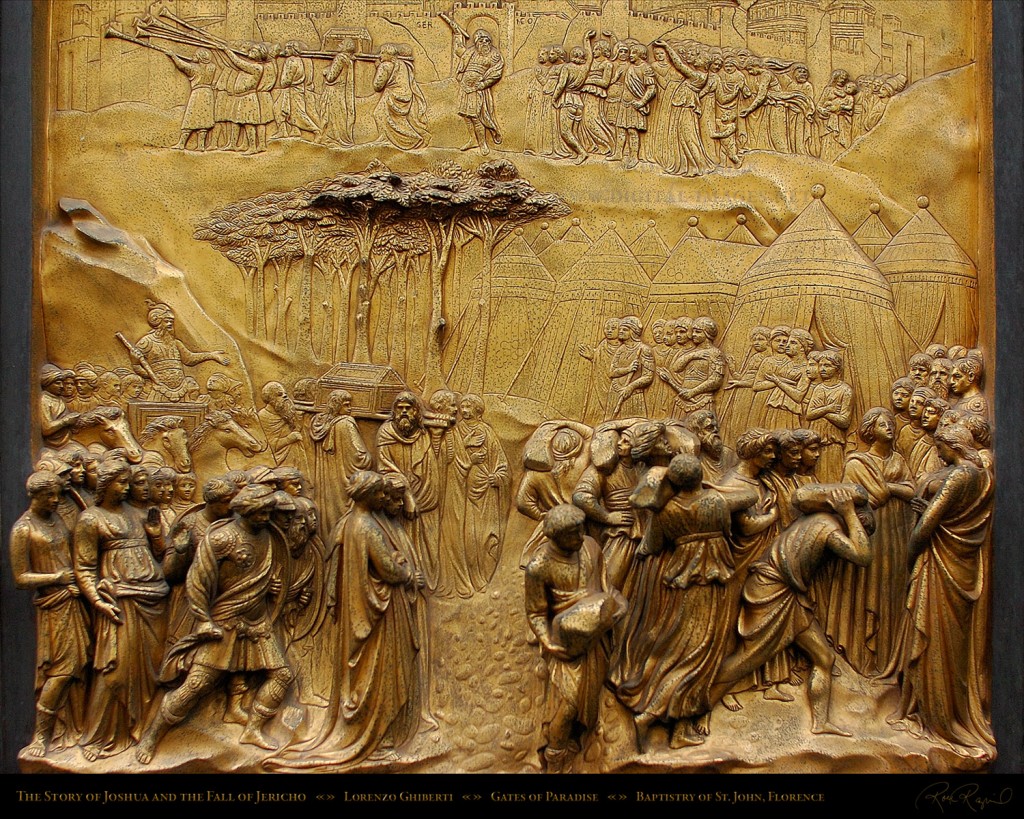
By popular definition prophets hear or sense the voice of God directly then obey. Innumerable documented examples reside both in ancient and modern history. About 1,550 BCE the prophet Joshua was told by God to go conquer the land and people across the Jordan River (Joshua 1:1-6), killing all the men, women, and children (Joshua 6:21). After Jericho was razed, on the further commands of God Joshua then razed the town of Ai, killing 12,000 men and women (Joshua 8:24-28). Genocide is not the only command by God either, mass suicide is also spoken by God to the more faithful zealous followers. At the fortress of Masada in 73 CE led by the apocalyptic prophet Eleazar ben Yair, though details are debateable, 960 Jewish revolutionaries committed suicide/murder for their God rather than endure enslavement by Rome.

Jones-Koresh

Jones (left) and Koresh

In modern history three iconic prophets also followed God’s direct speech for mass suicide of all their most faithful zealous followers. They do not need any elaboration here. They were Jim Jones in Jonestown, Guyana (Nov. 1978) of 918 followersnearly 300 were childrenMarshall Applewhite in Rancho Santa Fe, CA (March 1997) convincing 39 followers, and David Koresh in Waco, TX (April 1993) leading 85 followers — 22 of them children/teenagers — to their mass suicide/incineration.

In a 2007 co-authored article by Erich Follath (diplomatic journalist), Manfred Müller, Ulrich Schwarz (theologian), and Stefan Simons (Spiegel Online correspondent) entitled Following Divine Orders which focuses on the Age Old irresistible appeal of religiosity for fanatics, or rather those who are not moderate or “luke warm” about their beliefs:

“According to the three Abrahamic faiths, God only revealed the truth about Himself, humankind and the world to their respective religion; it is therefore recorded separately in their holy scriptures: the Hebrew Bible (the Torah, or Old Testament to Christians), the Christian New Testament and the Islamic Koran.

These [bibles] contain countless contradictions. Both the Koran and the Bible’s Old and New Testaments bear witness to a good and merciful God. They urge humans to live in peace and harmony. This is reflected most clearly in the instruction attributed to Jesus in the Hebrew Bible: “Love thy neighbor as thyself.

But these messages of brotherhood clash with sentiments that condone intolerance and violence: “For I came to set a son against his father, a daughter against her mother …“; “Anyone who loves his father or mother more than me is not worthy of me“; “Do not think that I came to bring peace on Earth. I did not come to bring peace but a sword.” The prophet Mohammed also delivered harsh threats from Allah: “Fear the fire prepared for the infidels.

Throughout history, the Abrahamic religions’ claim of absolute authority has exerted an irresistible appeal on fanatics, encouraging them to impose their own faith on nonbelievers and dissidents alike – if need be by using fire and the sword. To this day, nearly all religions supply the kindling that fuels wars and acts of persecution, sparks torture and murder, and inflames ethnic hatred. Examples abound: the bloody wars between Hindus and Muslims in India, or the enmity between Muslims and Christians in Indonesia.

For centuries, it seemed that the Abrahamic religions had come to terms with – and discarded – extremism. In the case of Christianity, this dates back to the Enlightenment, when the symbiosis between church and state collapsed and a new system of ethics emerged – one that was independent of faith in God and derived solely from social consensus.”

Those above examples of ancient and modern direct divine revelation seriously beg the questions What exactly is the Holy Spirit and how is it (a prophet) accurately tested for authenticity? Anyone who wishes to answer these questions, good luck! I do NOT envy you. There are as many various definitions of the Holy Spirit/False Prophet debate by Christians as there are species and sub-species in the animal kingdom! It is truly unimaginable. Suffice it to say here that almost all Christ-believers, scholars and laypersons alike, ultimately and exclusively refer to their Bibles for definitive Holy Spirit or non-Holy Spirit answers. Naturally, that only leads to more questions. Therefore, “direct speech” is not a religious consensus to really knowing God.

Greek-soccer-fans

Greek soccer fans

It is worth mentioning, the fields of psychology, neurology, and sociology have many theoretical studies associating heightened religious behaviour due to Temporal lobe epilepsy and minor forms of schizophrenia, and sociologists have found that social God-constructs can persuade individuals into states of euphoria because of large numbers of people acting together in a strongly shared belief — crowd psychology or mass hysteria, also known as Mass Psychogenic Disorder/Hysteria. Huge sporting events are good examples of this phenomena. Extreme isolation can have similar effects of hyper-religiosity and paranormal hallucinations, sometimes negative.

The Incarnation
In theological terms, this is simply God in and as Jesus Christ; both God and man simultaneously. The first grave problem with this Christian doctrine is that it is based upon only “Christian-biased” historical sources and traditions riddled with inconsistencies. In other words, who and what Jesus of Nazareth was historically between 6-4 BCE and 30-36 CE, the generally agreed upon lifespan, cannot be verified with absolute certainty outside of the Christian Synoptic Gospels. Many Christian apologists vehemently claim that writings by Flavius Josephus, Pliny the Younger, and Tacitus are non-Christian evidence for the historicity of Jesus. F. Josephus, however, was not completely unbiased about the new Jesus-Movement called The Way by Judean-Christians; he too was involved in 1st century CE Jewish Messianism as a Pharisee. Pliny and Tacitus were indeed Roman and non-Christian, but their very brief mentions are about Christians as a whole, rather than a biography about a specific person named Jesus.

Therefore, the best that Christian-believers can hope for regarding an actual verifiable incarnation of God through Jesus of Nazareth is by Christian scribes and followers 30-90 years after his death based on oral-storytelling traditions. That is the closest that honest scholarship can provide at this time, and beyond that is a question of individual faith within crowd psychology. This now leaves us only with the Bible… what the doctrines of Direct speech and The Incarnation frequently must reference anyway.
(line break)

The Canonical Bible

Many modern Christians are unaware of the origins, early development, and the 2nd and 3rd century CE controversies surrounding the final compilation of their Bibles. Some believers might even think their bible suddenly dropped out of heaven long long ago after God finished writing the 66 books, never thinking to ask “Why just 66 books? Why not 40 or 10 simple books?” And honestly, orthodoxed American society today, including many Christians, know very little of the ancient world of Jesus, the Levant, and the Fertile Crescent.

First_century_Iudaea_province

click here to enlarge

The birthplace of Jesus was Judea, the Jewish province ruled by Rome. Divided by intense religious factionalism, the people of Judea, as well as Galilee, Idumea, Nabatea, and Perea were anxiously awaiting the arrival of the Messiah and God’s salvation. First century CE Romans would have encountered a large mix of traditions and philosophies in this world. The Hebrews had for many centuries suffered foreign invasions and been harshly buffeted by powerful external cultural forces. The most potent of these was Alexander the Great’s Greek civilization supported by several centuries of Hellenistic overlords in Egypt and Syria.

The Jews in these regions were divided over subjects ranging from the legitimacy of the priesthood to the acceptance of certain books into the Hebrew Canon. The Essenes rejected the priesthood entirely. Samaritans formulated their own unique doctrines. Various cadres of Jewish zealots pledged themselves to the expulsion of the Romans. Sadducees made up their prestige with the aristocratic clans making up the priesthood in Jerusalem and exclusive supervision of the Temple. They rejected the books of the Prophets and Writings and also became more ingratiated with Herod and Roman governors who eventually granted them local rule in the Sanhedrin. The Pharisees were more progressive than the Sadducees in that they not only accepted those books, but also believed in angels, demons, resurrection, and — like the Essenes and other groups — passionately in the coming of the Messiah, e.g. the Apostle Paul. The Pharisees also had grown a body of unrecorded commentary on Hebrew Scriptures and rulings by Jewish sages. This was intended to help Jews adapt the ancient Law of Moses to the circumstances of their own time.

Essentially, roots of the Christian New Testament began during this period of great Jewish disunity, alienation, isolation, and confusion before anything Christian was written down. Once Christ-followers began recording an anthology or testaments of Jesus’ parables, prophetic and wisdom teachings, and exhortations — by around 150 CE (over a century after Jesus’ death) — there was no less than 42 testaments or gospels for Christian teachings which were freely circulating as opposed to just 27-books in today’s New Testament. The formulation of the Hebrew Bible, i.e. the Old Testament, went through similar reconfigurations between 500 BCE and 70 CE, i.e. approximately 600 years!

Naturally, all this diversity and variety of who and what the Nazarene was caused more confusing fractures among outlying Christians and Judean-Christians for centuries! It is like trying to answer What is an American?” today in one single description from 324+ million citizens. To learn more about the various origins of Nazarene-Nasorean-Nasara-Nazirite, go here to my bibliography subpage: The Nasara-Nazirites.

map_Roman-Empire_14-117CE

1st & 2nd century Roman Empire

Authoritative or Not Authoritative? 
For over three and a half centuries (between 337 and 389 years!) after Jesus’ death, there existed no standardized written collection about Jesus’ ministry or precisely what he did or taught. Everything known about him (and not known) was by word-of-mouth across 2,000 sq. miles. What is more dubious and astounding is that what little there was written down about Jesus’ message was by a foreigner, a Hellenistic Pharisee named Saul of Tarsus who had never once met Jesus in the flesh, in person. No surprise, after Saul’s ‘paranormal conversion‘ to “The Way” on the road to Damascus, he fell into serious conflict with the Council of Jerusalem headed by Jesus’s next-in-line brother James, Peter, Cornelius, and other Judean-Christian leaders who had personally known Jesus quite well compared to Saul. Yet, today Pauline-Christianity (aka Saul) predominates the New Testament, seminaries, and modern churches. James Tabor, professor in the Department of Religious Studies at the University of North Carolina at Charlotte, writes about this heavy influence from a near total stranger to the Jerusalem leaders… and their and Jesus’ Neo-Jewish teachings. Tabor states:

The fundamental doctrinal tenets of Christianity, namely that Christ is God “born in the flesh,” that his sacrificial death atones for the sins of humankind, and that his resurrection from the dead guarantees eternal life to all who believe, can be traced back to Paul — not to Jesus…

In contrast, the original Christianity before Paul is somewhat difficult to find in the New Testament, since Paul’s 13 letters predominate and Paul heavily influences even our four Gospels. Fortunately, in the letter of James, attributed to the brother of Jesus, as well as in a collection of the sayings of Jesus now embedded in the Gospel of Luke (the source scholars call Q), we can still get a glimpse of the original teachings of Jesus…

What we have preserved in this precious document is a reflection of the original apocalyptic proclamation of Jesus: the “Gospel of the kingdom of God” with its political and social implications.
Christianity Before Paul, The Huffington Post, November 2012 cited Aug. 16, 2016 at http://www.huffingtonpost.com/james-d-tabor/christianity-before-paul_b_2200409.html

With this and other additional alternative extant evidence, one has to ask “What formula was used some 300-years later to configure and reconfigure the vast oral and written testaments/gospels of Jesus?” Hitherto is a list of the most significant testaments/gospels about Jesus of/the Nazareth/Nazarene out of approx. 130 known writings not present in the New Testament today:

Non-Canonical Writings (Incomplete)

For a more complete list of the many known writings of Jesus and his earliest followers, go to the NNU Wesley Center’s page of Non-Canonical Literature.

(paragraph break)

Apostolic Fathers and the Canon Formula

Signs that much of these various Jesus-literatures had been accepted as authoritative by church leaders and early Christian congregations as early as the 1st and 2nd centuries CE appear in the letters of the Apostolic Fathers. During these centuries of the new upcoming churches, no official creed or universally accepted liturgy existed. In the following paragraphs, notice the similarities from the first churches to modern-day Christian churches.

The biggest and most heated controversy was a newer version of an old Jewish sectarian problem:  Are the Hebrew Laws, Prophets, and Writings above, below, or void in light of Paul’s Hellenistic teachings — deeds or faith? Another ongoing spinoff debate was the Gnostic challenge:  There are two dualistic worlds and two Gods, and there was no Incarnation, explained as follows:

  • The World of Darkness was created by an inferior God, the Hebrew God, and so the Hebrew scriptures were rejected or severely de-emphasized.
  • Material aspects of this Dark World, including the human body, were burdens that humanity was forced to endure by the Hebrew God.
  • The World of Light and Knowledge was ruled by a Supreme Being. Salvation was possible only through gnosis of this divine world and the Supreme Being’s mysteries, but salvation was available only to some, not all. Some Gnostics had a three-tiered class system too.
  • There was No Incarnation because he was not the Son of the inferior Hebrew God, nor did he become a man, suffer human pain, or die on a cross. Resurrection was merely a spiritual linking of the soul with the World of Light and had nothing to do with a human body.

Because Pauline Orthodoxy had the support of Rome, Constantinople, Alexandria, and Antioch, and their power and influences of those churches and bishops, by the 4th century CE the Gnostics would quickly be labelled heretics and harshly hunted down and most all their holy literature burned. With the four strongest episcopal sees in the Roman Empire, Ignatius, Clement of Rome, Polycarp, Hermas, and their colleagues along with their heavy power and influence… the weaker episcopal sees around the Empire and the remaining Jewish-Christians in and around Jerusalem simply could not stand up to the might of Hellenistic Constantinian Rome.
(line break)

Victors and Emperors Always Make the “Authoritative” Laws and Histories

Walter Benjamin posited that “History is written by the victors.” Historical records of major social, national, economic, ethnic, or religious upheavals and cleansings bear this philosophy out to some/large degrees. And so with his maternal-influenced-miracle-based sanction of the “official” Christianity, Emperor Constantine not only led the Roman Empire, but was also Head (Pope?) of the Church. He called for unity as a whole within the Church and agreement on its scriptures. Easier said than done inside one of history’s largest empires.

There were no less than seven failed attempts to form an official universal Bible. On the eighth failed attempt by Eusebius of Caesarea at the request of Emperor Constantine, Eusebius’ rejection of the popular Gospel of Peter, Gospel of Thomas, Gospel of Matthias; the Acts of Andrew, of Paul and of John; the Shepard of Hermas, the Epistle of Barnabas; the Didache, 1 and 2 Clement; and the Apocalypse of Peter… got his configuration rejected (see Table of Canonical Debate below). His reasons for classifying certain texts as questionable or spurious had revealed the basic formula for inclusion. Probably more important for him was a writing’s perceived apostolic authorship, though its antiquity and orthodoxy were also of significant consequence. Study closely the following table…

Table Canonical Debate

Athanasius of Alexandria wrote his Easter letter to the churches and monasteries in his diocese identifying the books they were to include in the testaments. Athanasius was one of the more flamboyant patriarchs. He was exiled from his pentarchy five times leading back to the Council of Nicaea due to his unyielding defense and decisions to compromise with other Roman patriarchs (which at times included Eusebius) over controversial points of Christian doctrine. His canon had been later confirmed by the church in Rome in 405 CE, in 393 at Hippo Regius in North Africa, and in Carthage twice, in 397 and then again after the growing Gnostic churches in 419 CE in reaction to the intensifying debate regarding James, Jude, and Hebrews. The Syrians used the Diatessaron as their canon for another 50-years. The Ethiopian church continues to this day to recognize a book of Clement and several other non-canonical books of liturgy. Though the various pentarchy churches had made ground toward unity, it is important to know they were never in absolute agreement on the New Testament canon and Christian doctrines.

Notice from the above Table how even the seven Patriarchs, who were themselves understudies to the Apostolic Fathers, after 300 years still did NOT completely agree on what God’s Son, the Messiah, and the new and old messages was suppose to mean to all people. Yet Constantine, his bishops, and propraetors had to have orthodoxy — a long standing Greco-Roman political tradition.

It wasn’t until around 400-419 CE and centuries of compromise and more compromise that the final configuration of the Christian New Testament was officially closed — closed by the declaration of the Emperor, put into law, and enforced by the torches and swords of his Roman Legions. For a God who is proclaimed as omnipotent, omniscient, and infallible, and whose traits are “proven” in the special revelations of the Canonical Bible, raises the glaring question:

Why was there three centuries of confusion, fracturing, and compromise among its early most prolific theologians… and even still to this day!?

(line break)
For Jews and Christians alike, study of the Scriptures has often been an end to itself — a simple act of devotion — rather than an exercise in absolute truth. These peaceful moderates likely realize today that human interpretation, interpolation, and orthodoxy (individual or group) cannot create an inerrant testimony of the nature of a God, nor of the full nature and teachings of a Jew named Jesus based from ancient oral traditions and differing literature spread over multiple centuries… or from differing regional cultures over 2,000 sq. miles. From an early date, believers then also began to scrutinize the Bible for what it had to say to their own generation and community along with their prolific leaders. Exegesis back then was done for purposes of preaching, pastoral care, formulating codes of behavior, and finding answers to theological and ethical questions not explicitly addressed by the texts.

As it happens today, inevitably back in Antiquity, disagreements arose — over importance of texts, their relative authority to the community, how to account for known inconsistencies and contradictions, and how to explain confusing biblical stories. Like our dear family friend in the kitchen at the beginning, both sides of the debates were probably saying to each other, “Your posture is all merely philosophy and theory.” But orthodoxy nonetheless developed, often based on a pseudo-definite set of human-like rules or patterns regarding multiple meanings and levels of meaning. To imagine there to be just one universal way, one universal lifestyle, one universal truth (e.g. John 14:6), one universal orthodoxy extracted from these millenia of “divine revelations” then and now… is not only an attempt to force a square peg into a round hole, but it is a blatant denial and/or ignorance of historical facts, wide-ranging scholarly critical thinking, reasoning, and probability, and/or a lack of deeper persistent curiosity.
(line break)

Or it could be only tunnel-vision “faith.” Right? (wink)

(paragraph break)

Live Well — Love Much — Laugh Often — Learn Always

Blog-posts for additional information:

Constantine: Christianity’s True Catalyst/Christ
The Suffering Messiah That Wasn’t Jesus
Correcting the Gospels of Jesus
Masada, Texas: How Egos and History Repeat
The “Holy” River

Creative Commons License
This work by Professor Taboo is licensed under a Creative Commons Attribution-NonCommercial-NoDerivatives 4.0 International License.
Permissions beyond the scope of this license may be available at www.professortaboo.com/contact-me/.

Circus of Recycling – Part III

The last Part from the Circus of Recycling – Part II and I.
(line break)

* * * * * * * * * *

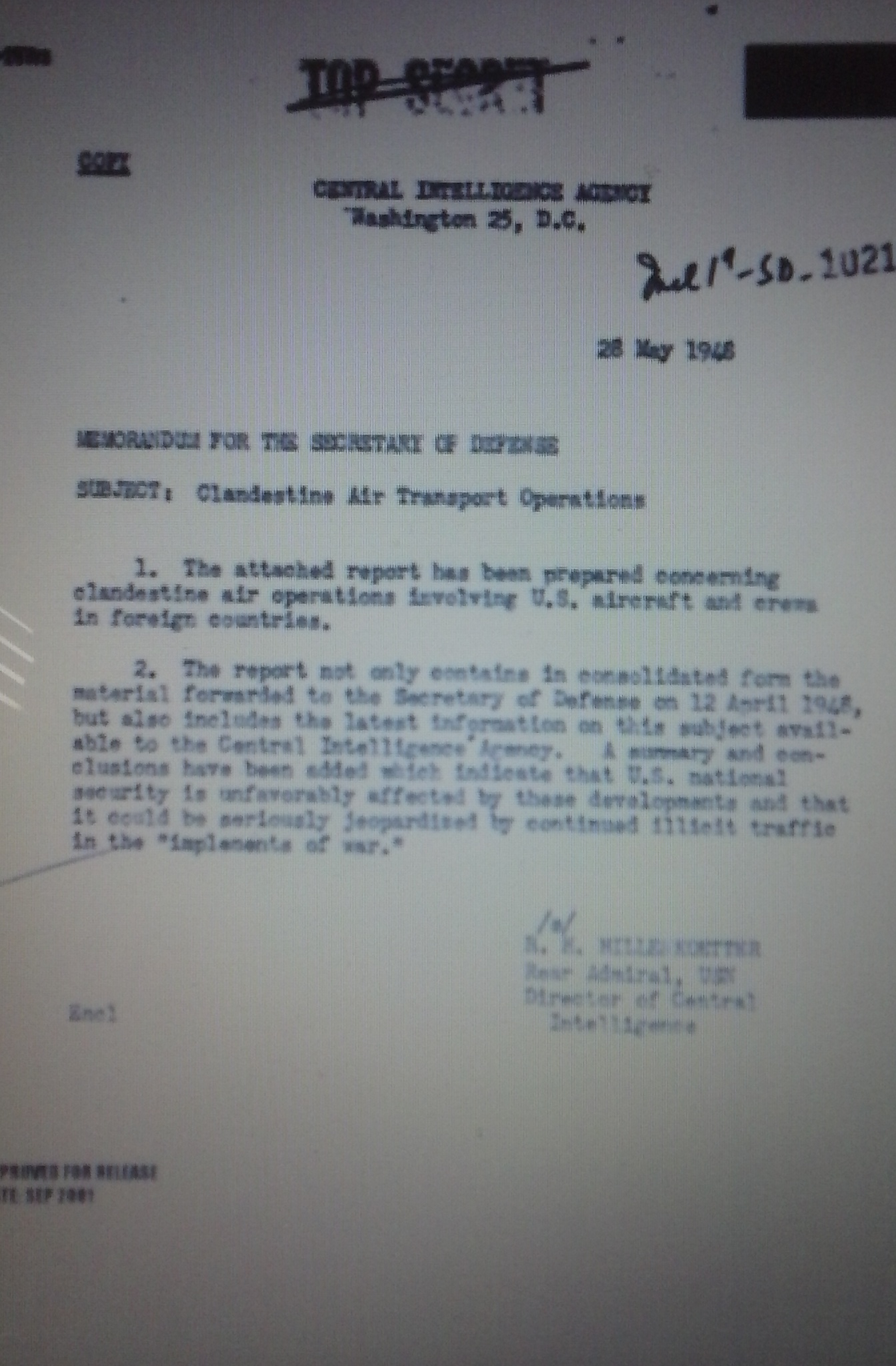
CIA Memo 655104p1

R.H. Hillenkoetter, “Memorandum for the Secretary of Defense: Subject: Clandestine Air Transport Operations” CIA, May 28, 1948.

Full CIA Memorandum for the Secretary of Defense

* * * * * * * * * *

In the art of modern intelligence and counter-intelligence, implementing multiple cloaks are quite useful. Creations of illusion are not magical, or mystical, but they are hints of planned suggestion and a keen understanding of human nature. One of the most historic and prolific examples of intel and counter-intel, or disinformation, was Operation Bodyguard used by the Allies in WWII to hide and deceive the German High Command of the time and place of the 1944 D-Day Normandy invasion. For the removal of Palestinians from the U.N. partitioned land, villages, and homes for Zionist Israel occupation, in comparison there was little difference.

As already examined in the previous Part II, the amount of U.S. funding mobilized for the creation, resettlement, and defense of the new state of Israel was well-organized and well cloaked. Between 1939 and May 1948 the Jewish Agency for Israel raised $3.5 trillion in today’s dollars (New York Times, August 10, 1961). And this agency is simply one Zionist organization out of many more. With the money raised the arms smuggling by The Sonneborn Group – Institute to the Haganah in Palestine followed (see CIA Memorandum above). There was still one major issue, or cloak to be devised. With the Nazis destroyed, the majority of surviving Jews throughout Europe wanted to remain and rebuild their lives. Rabbi Klaussner, a Zionist in charge of displaced persons in post-WWII Europe, reported the difficulty to the Jewish American Conference May 2, 1948…

“I am convinced people must be forced to go to Palestine… We must, instead of providing ‘displaced persons’ with comfort, create the greatest possible discomfort for them.”
What Price Israel?, Alfred H. Lilienthal, Infinity Publishing; Anniversary edition (March 1, 2004)

Hence, the underground campaign of “Chomer ‘Enoshi Tov” began.
(line break)

European Refugee Camps Create Palestinian Refugee Camps
(line break)

If you are curious by what is meant by the Hebrew “Chomer ‘Enoshi Tov“, then the perfect expert to ask is Noam Chomsky. In a 2014 interview he used the term while discussing the Jewish Holocaust:

“Well the translation of the title [ed. Chomer Enoshi Tov] would be something like “Good Human Material.” What [Yosef Grodzinsky] means is that the Zionist emissaries had a doctrine that able-bodied men and women between 18 and 35 had to be compelled to go to Palestine where they would be cannon-fodder for the coming conflict. Now the others they didn’t care much about and even undermined efforts to save children and so on. Well, all of this was going on in the immediate wake of the holocaust involving the survivors. No concern about them. You look through the 1950s, there’s virtually no discussion of the holocaust.”

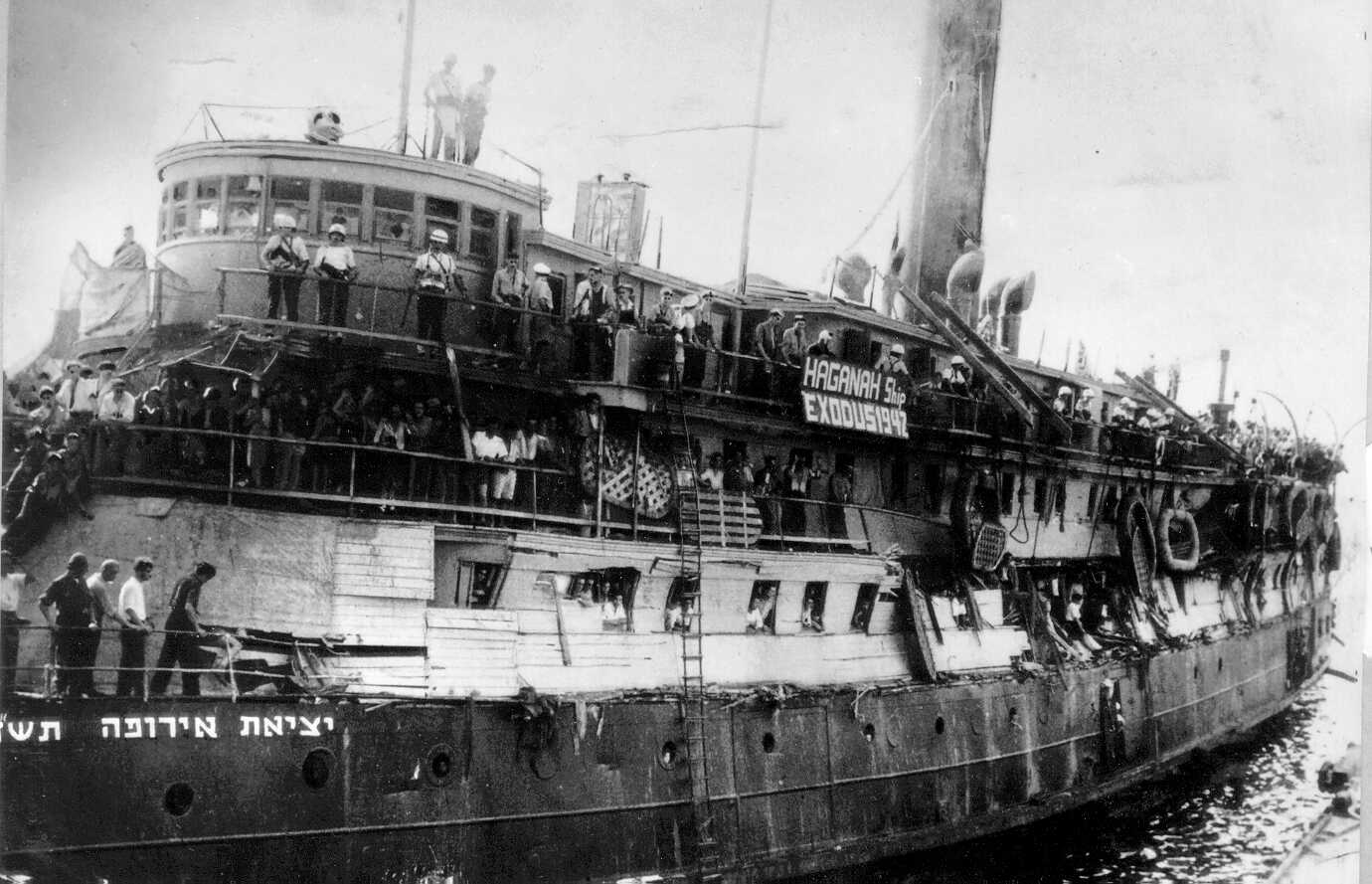
Exodus_1947_after_British_takeover

British containment of the SS Exodus, 1947

“Good Human” cannon-fodder for the conquest of Palestine and the independence and defense of Israel. Ben-Gurion, Rabbi Klaussner, and many other Zionist envoys would use this phrase repeatedly regarding the repopulation of Palestine.

From 1934 as part of the long maritime trail of Jewish refugees escaping Nazi Germany to Palestine, the S.S. Exodus in July 1947 had carried the most passengers, 4,515 Jewish refugees, until the Atzmaut in January 1948. And as Noam Chomsky correctly explains above, in popular American media and literature from 1947 to 1958, no one was interested in the Holocaust until the 1960’s when the fate of world perception and acceptance of Israel hung in the balance. When the film Exodus had hit American theaters in 1960, the general perception began to significantly change. Although Leon Uris’s 1958 bestseller inspired the film, the actual events were far less extraordinary than the book and film both glamorized.

The late Hebrew University of Jerusalem professor of sociology, Baruch Kimmerling, corrects and expounds the misguided literary and cinematic portrayals:

“When the [SS Exodus] embarked, the UN Special Committee on Palestine was holding discussions and Ben-Gurion, the head of the Jewish Agency, the primary governing body of the state-in-formation, felt that the plight of Jewish refugees in Europe needed to be dramatized in order to attract more sympathy for the Jewish struggle over Palestine. The British authorities had refused to let the immigrants disembark in Palestine, or even to take refuge in transitional camps in Cyprus, forcing the boat to be redirected back to Germany. To prevent such a ghastly outcome, Zionist leader Chaim Weizmann persuaded the French Prime Minister, Leon Blum, to host the refugees. Ben-Gurion rejected this solution out of hand, and the poor survivors remained on board for seven months.
Israel’s Culture of Martydom, by Baruch Kimmerling, The Nation, Dec. 22, 2004. http://www.thenation.com/article/israels-culture-martyrdom/

And further, more accurate events are just as astonishing…

“Ben-Gurion’s insensitivity was rooted in his “Palestine-centric” attitude, best exemplified by his 1938 remark that “if I knew it was possible to save all children of Germany by their transfer to England and only half of them by transferring them to the Land of Israel, I would choose the latter, because we are faced not only with the accounting of these children but also with the historical accounting of the Jewish people.” This was not merely a rhetorical declaration. Grodzinsky tells us with great pain how Ben-Gurion and other Zionist leaders vetoed the immigration of 1,000 orphans, who were in physical and emotional danger as a result of the harsh winter of 1945, from the camps in Germany to England, where the Jewish community had managed to secure them permits. Another group of roughly 500 children of camp inhabitants was barred, after Zionist intervention, from reaching France, whose rabbinical institutions had offered them safe haven.”
Ibid.

To add further insult to the plight of Jewish-European Holocaust refugees, few American and Western European newspaper and radio consumers were informed at the time that many of the Exodus passengers had applied for immigration visas to the United States (denied by Zionists) and/or many more were simply wanting to settle in more peaceful countries — a state of affairs Palestine certainly could not claim. Israel was anything but peaceful.

In the end, however, Ben-Gurion’s and Zionism’s propaganda scheme succeeded despite Jewish-European refugees being sick of war, fighting, and concentration-refugee camps and hundreds to thousands had become anti-Zionists!

The Giyus and The Sieff Group

As mentioned before, the ingathering of Jews into Palestine was not going to Zionist expectations; not enough Jewish-European DP’s were flocking voluntarily in rapid waves to the new Israel state. The slow low numbers would not survive the continued Arab conflicts. What was needed to abate Jewish war-fears was a growing army, the Israeli Defense Force (IDF), to wage the conflicts. Because Americans and European Jews would never agree to or publicly side with another militaristic conflict, Zionist came up with an alternative target:  the most desperate of Jewish DP’s. In 1947 these men and their families were still residents of WWII refugee camps throughout Europe. Immediately the American Jewish Joint Distribution Committee implemented a $25-million IDF recruitment campaign. On this campaign David Ben-Gurion and Chief of Staff Israel Galili reported…

“The manpower shortage for the fighting army forced modifications in the illegal immigration plan.

…New operational orders were issued: No more boats to bring homeless refugees to a safe haven. From the moment Ben-Gurion’s new orders were sent to the Mossad people in France through Shadmi, the decisions of the February 29th convention in Paris (with Ha’apaláh, B’richáh, and Haganáh delegates) were getting into effect. Haganáh and Mossad took upon themselves the task of moving fifteen thousand Jews of draft age and capability from Europe to Palestine by May 15th. Quotas were imposed on organizers in the various countries, aimed at carrying out the plan to bring in five thousand in March and April, and another ten thousand in May. Mossad people actually received stricter orders: From this moment on, no immigrants who lacked military capability were to be brought to Palestine. “We need only persons who fit the Haganáh,” wrote Ben-Gurion and Galili to commanders of Mossad in Europe.”
In the Shadow of the Holocaust: The Struggle between Jews and Zionists in the Aftermath of World War II, by Yosef Grodzinsky, Monroe, ME: Common Courage Press, 2004, pp. 187-188.

But this campaign failed, badly.

“Upon being called to fulfill “their duty” and join the IDF… most Jewish DPs were reluctant. A failed voluntary draft drive (to which less than 0.3 percent of the DP population volunteered) led to compulsory conscription.”
Ibid, p. 226.

Mossad-Haganah fighters-1947

Mossad-Haganah fighters, 1947 – Wikipedia

This conscription was called Giyus, and any draft evaders were treated very harshly. Giyus-evaders were blacklisted, fired from jobs, given heavy fines, evicted from their living quarters, food rations cut, and yes, even beaten (Ibid, p. 199). This is quite extraordinary when these “draftees” had never even lived in Palestine, much less became combat soldiers for a foreign nation which did not exist in 1947 and early 1948!

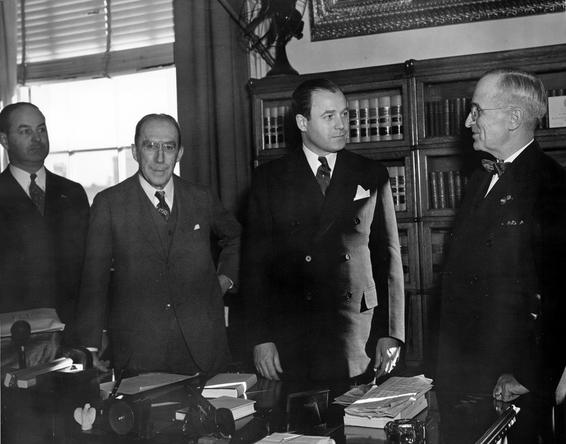
With perpetual Arab-Zionist conflict in Palestine greatly hindering war-efforts, on July 27, 1943, Great Britain and the U.S. State Department came very close to issuing a “reverse Balfour” resolution if the covert Zionist activities didn’t cease. When a Zionist group — which included the aforementioned David Niles (White House official under Roosevelt and Truman), and David Lilienthal (chairman of the Tennessee Valley Authority), Ben Cohen (White House staff), Robert R. Nathan (economist in Dept. of Commerce), and Harvard graduate David Ginsberg (assistant from the Securities and Exchange Commission during Roosevelt’s New Deal plan) all known as The Sieff Group — got wind of the Balfour reversal…

…they took immediate action with further coalition help from Felix Frankfurter, Henry Morgenthau, Jr., Bernard Baruch and others, and effectively killed the reversal.
Israel in the Mind of America, by Peter Grose, New York, NY: Knopf Doubleday, 1st ed., 1983, p. 177, 178-182.

(line break)
The 1949 Palestinian-Arab Refugee Crisis

James G. McDonald was the U.S. envoy to Palestine regarding the Zionist-Arab conflict and the growing displacement of Arab families. Authors Ilan Pappe and Rosemarie Esber describe it as Israel’s ethnic expulsion and cleansing of Palestine. But McDonald reported the crisis in 1948 to President Truman this way:

“The Arab refugee tragedy is rapidly reaching catastrophic proportions and should be treated as a disaster… Of approximately 400,000 refugees approaching winter, with cold heavy rains will, it is estimated, kill more than 100,000 old men, women and children who are shelterless and have little to no food.”
Fallen Pillars: U.S. Policy towards Palestine and Israel since 1945, by Donald Neff, Reprint Ed. Washington D.C.: Institute for Palestine Studies, 2002, p. 68.

From 400,000 refugees in 1948 the numbers jumped to approximately 750,000 in 1949. Many of them fled to neighboring Arab countries. U.S. foreign diplomats in Cairo, Egypt and Amman, Jordan reported that their two countries were so overcrowded with starving weak Palestinian families, their already inundated almost non-existent resources were pushed to near collapse.

Remarkably those Arab states continued to donate some $11-million to refugee aids. The U.S. Department of State tracked these activities from April to December 1948 stating:

“This sum, in light of the very slender budgets of most of these governments, is relatively enormous.

…the total direct relief offered.. by the Israeli government to date consists of 500 cases of oranges. Meanwhile, Israel had acquired formerly Palestinian-owned properties worth at least $480 million.”
Ibid, pp. 69, 72.

Palestinian refugees_Amman_1949

Palestinian refugees in Amman, 1949

President Truman naively believed the Zionist-lead Israeli state could coexist in Palestine with Arabs as a single state of shared power. But Truman’s 1948 Presidential election had also been bought for him by American Zionist leaders and their organization’s funding and was under heavy pressure to immediately recognize the nation of Israel to the world DESPITE equally heavy opposition by the State Department. Truman tried to persuade Israel to allow Arab refugees to return to their original homes under this coexisting belief and had Mark Ethridge negotiate it. After being continually refused by Israel, Ethridge very disgusted reported to the State Department “What I can see is an abortion of justice and humanity to which I do not want to be midwife…” (Ibid p. 75).

Finally the State Department had one last card to play:  the $49-million of unallocated funds from an Export-Import Bank loan to Israel. They threatened to stop it unless Israel allowed at least 200,000 Arab refugees to return to Palestine. When the U.S. coordinator on Palestine Refugee Matters delivered the threat to an angry Israeli ambassador, he returned to his office and in less than an hour received a notification from the White House that Truman was dissociating himself from any withholding of the Ex-Im Bank loan.
(line break)

U.S. Popular Media Post-1953 to Today

(line break)
If you understand what is meant by the concept “a conflict of interest,” then one doesn’t have to search too far to find Zionist backgrounds or sway in key areas. As noted earlier in Part II, Zionist knew how to exploit the basic nature of the American political system including the intimate relationship it had with media sources influencing popular public opinion or pressure.

A noteworthy example of Zionist influence on American media is the acclaimed academic and co-writer co-creator to the U.N. Charter, Virginia Gildersleeve. Her struggle against the creation of Israel is one as well dramatized as David and Goliath, but was nowhere near as popular or familiar in 1930’s – 1940’s America, not even into the 1950’s.

Gildersleeve-Virginia-C

Virginia Gildersleeve

When Gildersleeve wrote in defense of human rights and humanitarian action for Palestine, and for Palestinian families to be allowed to return to their homes and villages, a widespread campaign was launched against her, stereotyping her work as “anti-Semitic” as Zionists pandered upon Holocaust sympathies. Toward the end of her exceptional career she devoted herself to human rights in the Middle East testifying before Congressional committees, even directly lobbying President Truman to rectify the horrible neglect and violations taking place in Palestine, but to no avail. In her memoirs she wrote the defeats…”[were attributed to] the Zionist control of the media of communication.

Zionist control was indeed apparent. A study of 1917 news coverage of WWI and post-war reparations (the contentious roots of the Balfour Declaration) revealed that editorial opinion leaned heavily in favor of the Zionist posture. This continued into the 1920’s. Political analyst and author Kathleen Christison writes…

“…editorials and news stories alike applauded Jewish enterprise, heralding a Jewish return to Palestine as ‘glorious news.’

The relatively heavy press coverage is an indicator of the extent of Zionist influence even in this early period. One scholar has estimated that, as of the mid-1920s, approximately half of all New York Times articles were placed by press agents, suggesting that U.S. Zionist organizations may have placed many of the articles on Zionism’s Palestine endeavors.”
Perceptions of Palestine: Their Influence on U.S. Middle East Policy, by Kathleen Christison, 1st Ed. Berkeley, CA: University California Press, 2000, p. 40.

In 1953 author Alfred Lilienthal described the sweeping capture of American newspapers, magazines, and radio stations as remarkably complete. Their “…stories as well as editorial columns, gave primarily the Zionist views of events before, during, and after partition.” The Saturday Evening Post came under ruthless attack by Zionists for publishing an article by Milton Mayer criticizing Jewish nationalism as overly zealous. Secretary of State George C. Marshall, after threatening Israel’s callous treatment of Palestinians, severely underestimated the American Zionist media networks’ ability to hide opposing views to the conflict.

In a March 1949 study by the Department of State it revealed that the general American public was “unaware of the Palestine refugee problem, since it has not been hammered away at by the press or radio.” Most Americans were consumed by the threat of Soviet communism and the cold war, fed of course by most all major news mediums. Completing his book Palestine Is Our Business, author, Yale alum, and distinguished archaeologist Millar Burrows — also Vice-President of the National Committee to Combat Anti-Seminism — wrote:

“A terrible wrong has been done to the native people of [Palestine]. The blame for what has happened must be distributed among all concerned, including ourselves.

…the [counter]plan for Palestine advocated by the Arabs was a democracy with freedom of religion and complete separation of religion and the State, as in this country.

All the Arab refugees who want to return to their homes must be allowed and helped to do so, and must be restored to their own villages, houses, and farms or places of business, with adequate compensation from the Government of Israel for destruction and damage.”
Palestine Is Our Business, by Millar Burrows, Philadelphia, PA: Westminster Press, 1949, p. 11, 131, 154.

As a result of his book, the American Zionist Council published and distributed articles slandering Burrows’ work as “an anti-Semitic opus.

Dorothy Thompson – “Woman of the Year”

dorothy-thompson

Dorothy Thompson, c. 1937

She was often called “The First Lady of American Journalism” and considered by many colleagues a trailblazer in the field, Dorothy Thompson also made Time magazine’s 2nd most popular woman in America behind Eleanor Roosevelt. Because of Thompson’s poignant criticism of Adolph Hitler’s methods and rise to power while reporting in Germany, she was banned from the country. Upon returning to the U.S., she began writing a very popular syndicated column called “On the Record” which often delivered crisp, outspoken and politically centered analysis of current issues. In her advocacy for the relief of Jews in Europe and Nazi Germany, especially as a woman, Thompson naturally became a celebrity in American journalism, particularly with Zionist. The 1942 box-office hit film by George Stevens “Woman of the Year” with Katharine Hepburn and Spencer Tracy was based upon Thompson’s career. A Broadway play was also made about Thompson played by Lauren Bacall.

Effected by Holocaust atrocities and married at the time to a Hungarian Jewish husband (Josef Bard), Thompson at first favored the creation of the state of Israel in Palestine… until she physically went there herself in 1945. Thompson reversed her pro-Zionist position to a pro-Arab pro-Palestinian one, and what resulted was a complete fall from historical stardom. In his April 2015 article on Mondoweiss.net Gil Maguire gives tribute to Thompson writing…

“Dorothy Thompson’s [career] is truly a remarkable story.  Her apex was probably 1948 when Claire Booth Luce and others wanted her to run for president.  She’d been one of Zionism’s most famous and influential spokesmen.  Her defection, in 1949, created great anger in the Jewish/Zionist communities, and in few short years her career was in tatters and her influence largely gone. Today, Dorothy Thompson is virtually unknown and unremembered.  This fascinating woman who deserves to be an icon of the feminist movement, is rarely, if ever, mentioned as an important female historical figure.”

In the 1950 documentary “Sands of Sorrow” produced by the Council for the Relief of Palestine Arab Refugees, Thompson speaks specifically about the conditions of Palestinian Arab refugee camps. Sadly, in speaking out against Zionism and its conquest and occupation of Palestine, Dorothy Thompson was methodically erased from history.

There is a modern effort to bring back to public light Dorothy’s work in a documentary film entitled “The Silencing – Of Dorothy Thompson” by Alternate Focus. Below is a 4-minute teaser of the upcoming film…


(line break)

* * * * * * * * * *

To conclude this 3-part series I want to repeat a quote I often use which makes a point about sources; that is sources of information we accept, or internalize, or prefer, or for better or for worse… take as gospel. It goes like this:

“To be ignorant of what occurred before you were born
is to remain always a child.”
— Marcus Tullius Cicero

(line break)
But those words of wisdom are not enough. How does one learn whether they have been taught and raised by a family, community, and nation that is on the ‘right side of history’? How can one, as can be humanly possible, decide what is right or wrong as a 4-year old? Or a 10-year old, or even a 19-year old? There is probably no one, perfect, across-the-board answer at any select moment of time and place. However, over time and with the evolution of the collective human brains, greater degrees of right and wrong, and almost right and almost wrong do indeed surface. Yes, many of them are through trial and error, but many are also learned through honest in-depth comparing and contrasting. This comparing-contrasting technique should also include subject matter one might find uncomfortable or offensive — this is truer analysis and broader critical-thinking.

There is however, an identifiable flaw or possible flaw in that process.

Through acts of violence, death, and literal or metaphorical cutting-out-tongues or amputating the ability to write, and so on, that could or does distort history and data which then leads to contaminated conclusions — it becomes even HARDER to decipher ‘the full real story‘. Why? Most often history is written by the Victors and one must dig deeper, literally and metaphorically, to hear, read, and digest the “losers” side of the story. Not too many people I know care to do that sort of legwork-homework.

Coming full circle now, on the historical subject of Easter/Eostre weekend at Starbucks in Part I and then the expansive factors and influences of WWI and WWII Zionist activities and counter-activities for the planned creation of Israel in Part II and III, we’ve discovered a broader lesser-known backdrop (if any at all) of modern Middle Eastern affairs, turmoil, and continued conflict. Obtaining this wider vivid picture created from high-zoom capabilities with multi-colored, multi-textured, multi-layered, more accurate honest representations cannot be achieved with one single camera, from one single angle, or one single frame. One must explore. One must experiment, usually multiple times, to capture the perfect image.

I dare say that my well-intended but very misinformed Fundy-Evangelist that evening at Starbucks likely “faithfully” believed one image, one angle from one camera was all his life and America needed when it came to world politics, religion and terrorism. Please, please don’t make that mistake! Completing difficult intensive homework in school or college should never stop after the graduation.

I welcome any thoughts or questions below. Otherwise, thank you for reading these three rather long extensive posts.

Live Well — Love Much — Laugh Often — Learn Always

(paragraph break)

Creative Commons License
Blog content with this logo by Professor Taboo is licensed under a Creative Commons Attribution-NonCommercial 4.0 International License.
Permissions beyond the scope of this license may be available at https://professortaboo.com/.

Circus of Recycling – Part II

This is the continuation from Part I and will examine the next four additional areas of how and why the United States and the United Nations were pawns for Zionist Judaism’s conquest and occupation of Palestine.
(line break)

* * * * * * * * * *

Self-determination. What does it mean? The fast answer is “the freedom to make your own choices.” Sure that’s a true pure definition… if one lives on an island in the Pacific and no other human beings are on the island. Is that a very comprehensive definition and representation of real life? Not really. The Merriam-Webster dictionary has another definition:  the people of a territorial unit to determine their own future political status. Better? Yes and no. I would imagine this extended definition raises more questions than it answers. The principle of self-determination according to these definitions seem well and good, but the practice of self-determination in life and the world, even within family dynamics, is not so cut-and-dry. Taking these two definitions to a macro-scale or global-scale, and the waters begin to get quite muddy; in some cases, sludge or quicksand.

“The UN Charter clarifies two meanings of the term self-determination. First, a state is said to have the right of self-determination in the sense of having the right to choose freely its political, economic, social, and cultural systems. Second, the right to self-determination is defined as the right of a people to constitute itself in a state or otherwise freely determine the form of its association with an existing state. Both meanings have their basis in the charter (Article 1, paragraph 2; and Article 55, paragraph 1). With respect to dependent territories, the charter asserts that administering authorities should undertake to ensure political advancement and the development of self-government (Article 73, paragraphs a and b; and Article 76, paragraph b).”
Encyclopædia Britannica Online, s. v. “self-determination”, accessed April 05, 2016, http://www.britannica.com/topic/self-determination.

A better definition don’t you think? Not really…
(line break)

Paris Peace Conference of 1919
(line break)

Paris Peace Conference_1919

1919 Paris Peace Conference

After the defeat of the European Central Powers in World War I, the victors of the Allied and Associated Powers met in Paris, France to address and discuss the fate of those beaten nations (peoples) and their territories. The Central Powers primarily consisted of the Ottoman Empire, Germany, Austria-Hungary, and Bulgaria. Both the Germans and the Ottomans had colonies in Asia and Africa as well. See world map below.

Two new terms or principles are introduced into future world conferences over nations or “territories” and their defeated peoples:  1) trusteeship, and 2) mandate.

Trusteeship — a defeated nation’s territories and it peoples, that are considered unable to govern themselves, are entrusted to another state which was victorious.
Mandate — a victorious trustee-nation receives a mandate to rebuild the defeated territory creating the necessary foundations for self-determination and independence.

Post WW1 world map

Map of World War I. The Allies are depicted in green, the Central Powers in orange, and neutral countries in grey.

All very simple, right? No. The above world map is of July 1914, at the beginning of World War I. The Paris Peace Conference begins in January 1919. When the some 25 nations around the world — representing a global jury — participating in the post-war conference convened, they were unaware of the Sykes-Picot Agreement of May 1916, when the outcome of the war was still far from certain. It was signed by Sir Mark Sykes of Great Britain and François Georges-Picot of France with the assent of imperial Russia. Why is this highly volatile monkey-wrench important? Because as early as November 1915 Sykes and Picot, with the knowledge of Tsar Nicholas II of Russia, began negotiating how the Ottoman Empire would be divided up if defeated. Key leaders and nations in East Europe, the Near and Middle East… who had sacrificed their soldiers and resources into the war against the Central Powers — including against fellow Muslim Arabs — and with certain major political “promises” given to them by Western powers for siding with them… were never notified of this secret agreement.

“This secret arrangement conflicted in the first place with pledges already given by the British to the Hāshimite dynast Ḥusayn ibn ʿAlī, sharif of Mecca, who was about to bring the Arabs of the Hejaz into revolt against the Turks on the understanding that the Arabs would eventually receive a much more important share of the fruits of victory. It also excited the ambitions of Italy, to whom it was communicated in August 1916, after the Italian declaration of war against Germany, with the result that it had to be supplemented, in April 1917, by the Agreement of Saint-Jean-de-Maurienne, whereby Great Britain and France promised southern and southwestern Anatolia to Italy. The defection of Russia from the war canceled the Russian aspect of the Sykes-Picot Agreement, and the Turkish Nationalists’ victories after the military collapse of the Ottoman Empire led to the gradual abandonment of its projects for Anatolia. The Arabs, however, who had learned of the Sykes-Picot Agreement through the publication of it, together with other secret treaties of imperial Russia, by the Soviet Russian government late in 1917, were scandalized by it, and their resentment persisted despite the modification of its arrangements for the Arab countries by the Allies’ Conference of San Remo in April 1920.”
— Encyclopædia Britannica Online, s. v. “Sykes-Picot Agreement”, accessed April 05, 2016, http://www.britannica.com/event/Sykes-Picot-Agreement.

FaisalPartyAtVersailles

Arab Delegation to Paris

No one from the West bothered to ask the peoples of these “minor” territories or their leaders how they wished themselves to be self-determined or governed.

*Sidenote — For an exceptional more comprehensive perspective of pre, World War I, and post-WWI, watch Al-Jazeera’s World War One Through Arab Eyes.

U.S. President Woodrow Wilson and the State Department was sympathetic to the Arab cause presented by Emir Prince Faisal, however, the American delegation to Paris, along with heavy support from the U.S. Senate in Congress and a delegation of Jewish Zionists attending — which incidentally included U.S. Supreme Court Justices Louis Brandeis and Felix Frankfurter, and officials from the WZO — had already outmaneuvered Wilson and the State Department as well as several prominent American Christian leaders, such as Harry E. Fosdick and Henry S. Coffin, both who firmly opposed Zionism and a state of Israel in Palestine. With the Sykes-Picot Agreement and the Balfour Declaration, both done privately years before with France and Great Britain, President Wilson tried one more tactic:  send a commission to Palestine to examine the Palestinian Mandate in person.

King-Crane Commission

Many American students, history teachers, or the general public know anything about the King-Crane Commission to Palestine in 1919. The purpose of the commission was to learn, from Syrians and Palestinians living there, the attitudes and real viability for “resettling” their land and homes. After interviewing the inhabitants between June 10 and July 21, 1919, also entitled Inter-Allied Commission on Mandates in Turkey, the commission reported that if a Jewish state were created in Palestine, it would accomplish only:

“…the gravest trespass upon the civil and religious rights of existing non-Jewish communities in Palestine,” [and subjecting them] “…to steady financial and social pressure to surrender the land, would be a gross violation of the principle [of self-determination] and of the peoples’ rights…”

“…the well-being and development [by the existing inhabitants formed] a sacred trust [where those present peoples should become free and their national governments] should derive their authority from the initiative and free choice of the native populations.”

[The report continues stating that following meetings with Jewish representatives who made it clear that]“the Zionists looked forward to a practically complete dispossession of the present non-Jewish inhabitants of Palestine…”

The report ended stating that in order for dispossession to take place, armed force would be required and unavoidable, so the commission urged the Peace Conference to dismiss the Zionist proposals stating “the project for making Palestine distinctly a Jewish commonwealth should be given up.

A digital copy of the entire report can be viewed and read here: King-Crane Commission Report, submitted by Charles R. Crane and Henry Churchill King, 28 August 1919.

President Wilson’s and the King-Crane Commission’s efforts would be heavily suppressed and for naught due to the publicity power wielded by Brandeis, Frankfurter, Chaim Weizmann, the WZO and Yiddish newspapers, further backed by their associated U.S. Senators in D.C. All combined they simply buried the above report.

The en mass immigration of Jews to Palestine commenced. Consequently, the four continents, arguably the world, were pushed on turbulent bloody hyper-convoluted paths for centuries to come.

Inspiration or Coercion?

After the newly formed (Western) League of Nations made it acceptable for Jews to migrate to Palestine, most less-Zionistic Jews at the time felt little need to go. This is clearly evident by a plethora of documented cases, but for the sake of your time I list three below.

U.S. Supreme Court and ZOA vs. Gibson — From 1919 to 1924 Hugh S. Gibson was the U.S. Ambassador to Poland. Most of his work there was to accurately assess Poland’s needs for self-determination in the immediate wake of WWI and how the U.S. could help. Back home in American newspapers were numerous stories of anti-Semitic violence throughout Poland. After investigating the alleged incidents and severities, Gibson reported to William Castle and the State Department that the American news articles of “Polish militarism, anti-Semitism and expansionism” were over estimated and in a personal letter to his mother wrote: “These yarns are exclusively of foreign manufacture for anti-Polish purposes.” (Hoover Institution, HGP, Box 17, f. William R. Castle, 1920 and Hoover Institution, HGP, Box 24, Diaries, f. Mary K. Simons-Gibson, 1919)

When Supreme Court Justice Brandeis and ZOA delegate Frankfurter were made aware of Gibson’s dispatches, they both demanded a meeting with him. Gibson described their meeting this way accusing him that:

“I had done more mischief to the Jewish race than anyone who had lived in the last century. They said… that my reports on the Jewish question had gone around the world and had undone their work… They finally said that I had stated that the stories of excesses against Jews were exaggerated, to which I replied that they certainly were and I should think any Jew would be glad to know it.”
— Fallen Pillars: U.S. Policy towards Palestine and Israel since 1945. Reprint Ed. Washington D.C.: Institute for Palestine Studies, 2002, p. 20

Hugh_Gibson

Ambassador to Poland, Hugh S. Gibson

Gibson also noted that Frankfurter alluded to him that if he continued writing such reports, Zionists would block his upcoming Ambassador’s confirmation by the U.S. Senate. By May 1924 Gibson was reassigned as U.S. Minister to Switzerland.

1930’s Germany and Zionism — Unlike the inaccurate news reports of anti-Semitic violence in Poland, the rise of the German National Socialist Workers Party (Nazis) certainly gave cause to Jews in Germany to flee for their lives. President Franklin D. Roosevelt took action to help on two separate occasions:  in 1938 and 1943. The British tried to follow suit in 1947. Morris Ernst – International Envoy for Refugees for Roosevelt, and Harry N. Howard – U.S. State Department Near East, both wrote about American-British efforts to welcome in near 1-million Jews from Eastern Europe:

“…active Jewish leaders [in the U.S.] decried, sneered and then attacked me as if I were a traitor. At one dinner party I was openly accused of furthering this plan of freer immigration [into the U.S.] in order to undermine political Zionism… Zionist friends of mine opposed it.” Ernst continued writing that the Jewish leadership in America were “little concerned about human blood if it is not their own.”

“…there was discussion of liberalizing American immigration laws in this period.” Harry Howard states in a 1950 interview, “The Zionists opposed that liberalization on the ground that this would not be a solution as far as they were concerned. They wanted a political, not necessarily a humanitarian, solution — that is, they wanted a state.”

By 1949 the Israeli Premier David Ben-Gurion admitted the in-gathering of Jews into Palestine was not going well. He “urged U.S. parents to send their children to Israel for permanent settlement.” And “even if they decline to help us, we will bring the youth to Israel.

In the 1960 July issue of The Spectator magazine, journalist Erskine Childers wrote discussing in detail the talks between FDR, Britain, Ernst, and the Jewish DP’s (Displaced Persons) from Europe…

“…[Zionist sabotaging] was done by seeing to it that Western countries did not open their doors, widely and immediately, to the inmate of the DP camps.”

“It is incredible that so grave and grim a campaign has received so little attention in accounts of the Palestine struggle — it was a campaign that literally shaped all subsequent history. It was done by sabotaging specific Western schemes to admit Jewish DPs.”

THughes-36

image courtesy of Timothy Hughes Rare & Early Newspapers

Hate Attacks on Iraqi Jews Faked? — By 1949-50 Iraqi Jews were either being coerced out of the country or due to economic conditions willing to consider immigration to Palestine, or both. Due to the ancient history of exiles and the Jewish Diaspora, Zionists had fervent inspirations to persuade Iraqi Jews to Palestine. Many Iraqi Jews were not that motivated to leave their current homes. Rabbi Sassoon Khadourie, Chief Rabbi of Iraq, spoke about covert Zionist bombings during Operation Ezra and Nehemiah to Israel from Iraq. Although counterarguments spoke of Sassoon being a propaganda puppet for pro-British Iraqi Prime Minister Nuri al-Said, in his last weeks and days before dying in 1971 Rabbi Khadourie never recanted his statements. However, the former CIA operative Wilbur Crane Eveland to the Middle East, specifically Iraq in 1950-53, reappraised his life and work in his book Ropes of Sand he writes about the synagogue bombings as…

“…attempts to portray the Iraqis as anti-American and to terrorize the Jews”

“Soon leaflets began to appear urging Jews to flee to Israel… most of the world believed reports that Arab terrorism had motivated the flight of the Iraqi Jews whom the Zionists had ‘rescued’ really just in order to increase Israel’s Jewish population.”

Both of these men are joined in agreement by many authors and journalists. Naeim Giladi, a Jewish-Iraqi author, describes the consensus of his colleagues reappraisals…

“I write about what the first prime minister of Israel [Ben-Gurion] called ‘cruel Zionism.’ I write about it because I was part of it. Jews from Islamic lands did not emigrate willingly to Israel. Jews killed Jews.”

“…[Zionist] Jews on numerous occasions rejected genuine peace initiatives from their Arab neighbors.”

As can be expected inside the political game of counter-intelligence and disinformation, Zionist organizations and prominent members cried then and will cry today ‘forms of anti-Semitism.‘ I invite YOU to decide after examining all the relevant information now available.

Now for a brief respite from endless strife, I give some comic relief for you…

Alright, now back to business. We can laugh and enjoy life afterwards.
(line break)

The Modern Israeli Lobby on Harry S. Truman
(line break)

She is a prolific author, noted educator and academic, and has achieved prominence as a historian of the United States and its Jewish Americans. Naomi W. Cohen has been published several times over, but in her 2003 book The Americanization of Zionism, 1897-1948, she writes:

“Although Brandeis participated in the negotiations with England leading to the Balfour Declaration, his primary focus after [World War I] shifted from political to “pragmatic” or “practical” Zionism. Active behind the scenes and with his lieutenants throughout the decade, he encouraged American Jewish investment in the physical upbuilding of Palestine. That emphasis, also adopted by the ZOA, well suited the shift of world Zionism into its second phase, “Palestinianism”.” (p. 7)

As Europe began sliding back to political, ethnic, and economic turmoil in the 1920’s and 30’s, general American sentiment wanted nothing to do with their constant problems. In contrast to that U.S. sentiment, however, were American Zionist activists, Cohen explains, and their leaders maneuvering to divert polarizing Zionism into covert Palestinianism:

“…the retreat to Palestinianism wasn’t all bad. Coping with antisemitism, which increased in the 1920s, and with the grim conditions spawned by the Great Depression of the 1930s, American Jews dared not risk any major outbursts about Jewish statehood from their non-Jewish fellow Americans. Within American Jewish circles, Palestinianism, far less strident than political Zionism, permitted the spread of a “quiet” Zionism in synagogues and Jewish schools.” (p. 8)

AZEC rally_NY_1945

AZEC Madison Square Garden rally, NY Sept 1945

Special interest groups, otherwise known as lobbies, play an important and controversial role in American politics and legislation. American Zionism recognized this tool early on and by 1943 was one of the most well-funded lobbies in the U.S. due in no small part to Rabbi Abba Hillel Silver. He created the American Zionist Emergency council (AZEC) and by the middle of WWII when buying a 5-pound bag of flour was 0.25-cents, the AZEC had a budget of $500,000. Its fundraising umbrella was the United Jewish Appeal which gained financial resources of $14 million in 1941 and $150 million by 1948 — four times more than the Red Cross received in donations from all Americans; in today’s dollars:  $1.5 billion. In 1945 when Hillel Silver was made aware of a British move against Zionism…

“AZEC booked Madison Square Garden, ordered advertisements, and mailed 250,000 announcements — the first day. By the second day they had organized demonstrations in 30 cities, a letter-writing campaign, and convinced 27 U.S. Senators to give speeches.”

“Grassroots Zionist action groups were organized with more than 400 local committees under 76 state and regional branches. AZEC funded books, articles and academic studies; millions of pamphlets were distributed. There were massive petition and letter writing campaigns. AZEC targeted college presidents and deans, managing to get more than 150 to sign one petition.”
— Against Our Better Judgement, by Alison Weir, CSI Publishing, San Bernadino, CA: 2014, p. 37

This level of organization and swift action would make any of today’s wealthy Washington D.C. lobbies green with envy. If political leverage is the goal, then understanding the ropes and pulleys of our U.S. government and how to activate them for specific interests, then 1940’s AZEC’s and their UJA umbrella is a superb blueprint to follow.

Harvesting American Christianity

Today, Jews and Christians have a convenient interest in the other’s historical background. The relationship has certain mutual dynamics which are readily exploitable. This was no less true in the decades before, during, and after World War II. Hillel Silver, Louis Brandeis, AZEC, and other Zionists, including Felix Frankfurter, recognized this avenue toward a stronger Israel in Palestine as a significant long-term role. Heading up this push would be the original American Palestine Committee founded by Emanuel Neumann, later known in 1946 as the American Christian Palestine Committee (ACPC). The primary goal of the ACPC was to harness a group of prominent Christian Americans in moral and political support of Zionism…

“The initial impetus was given late in 1942 by prominent Protestants such as Reinhold Niebuhr, S. Ralph Harlow, Henry A. Atkinson, Daniel A. Poling, and Paul Tillich. Working with them as liaison with the Emergency Committee for Zionist Affairs were Milton Steinberg and Philip Bernstein, who enjoyed the full cooperation of Stephen S. Wise and Emanuel Neumann.

The Christian Council emphasized the need to destroy racial and religious discrimination and to demand justice for the Jewish people everywhere, but it considered Zionist objectives in Palestine the paramount goal and the basic solution to Jewish national homelessness. The council strove to gain the sympathy of churchmen and clergy by organizing conferences, arranging seminars, and publishing literature. The influence it exerted was out of proportion to its relatively limited membership.”
— Encyclopaedia of Zionism and Israel (ed. Patai), accessed April 10, 2016, http://www.iahushua.com/Zion/zionhol10.html

While American Protestant and Catholic leaders and their followers were being cuddled by Zionists at home, the reality in 1947-48 Palestine was bloody and covert. Palestinian Christians and Muslims, their institutions, churches, and mosques were attacked by Israeli militants. Citing a June 1948 report from the Haganah/IDF operations:

“The Christian “exodus” from the Holy Land can be traced to 1948, when more than 750,000 Palestinians were forced from their homes by the creation of the State of Israel. With hundreds of Palestinian villages destroyed and at least half of the indigenous population displaced to refugee camps internally or in neighboring countries, Christians and Muslims — whose roots in the Holy Land stretched back for centuries — suffered the same fate.”
— What sparked the Christian exodus from the Holy Land?, Institute for Middle East Understanding, 2012, accessed April 10, 2016, http://imeu.org/article/christians-in-the-holy-land-under-israeli-siege

This sort of harassment, attacks, and human-rights violations by Zionist-Israeli operations on Palestinians still continue to this day along with America’s political Right and U.S. military support.

President Harry Truman is Bought

Truman_with_Senators_McGrath_and_Green

Truman with Senators McGrath and Green, c. 1948

Howard McGrath was the Chairman of the Democratic Party from 1947-49 and bluntly informed Abraham Feinberg and other Zionist supporters that President Truman cannot possibly win the 1948 election against Dewey unless he sees the American people, stating:

“The President [Truman] has to make a trip from coast to coast. He wants to do it by train, he wants to see the people, and there is no money.”

“I [Feinberg] had to get back to New York and I got up. I was the youngest of the group, and maybe for that reason the brashest. I said, “Howard, the President has done a great deal for my people. I feel that we owe him a great deal. We certainly owe him a chance, and I will pledge on behalf of Ed Kaufmann and myself that within two weeks we’ll have $100,000 towards this [train]trip.”

“I [Feinberg] had already got the commitments for the $100,000 from people around the country, all of whom understood that without Truman, Israel would have had very difficult days and times trying to even come into existence. As that train went into towns where there were Jewish communities, I arranged that a Jewish delegation would ask to see the President and be received on the train and that, in as many cases as possible, they would bring him donations above these original commitments. So, the trip was a triumphant trip from his point of view as a politician, forgetting the money, He was right when he said, “If I see the people, I can be elected.” And that made the difference. He often said, “If not for my friend Abe, I couldn’t have made the trip and I wouldn’t have been elected.”
— Harry S. Truman Library and Museum, “Abraham Feinberg Oral History Interview” by Richard McKinzie, August 23, 1973. http://www.trumanlibrary.org/oralhist/feinberg.htm – Accessed April 17, 2016, sections 22-24

Zionist Militarism and Conquest of Palestine

By 1952 Feinberg was found by the CIA to be smuggling arms into Israel for Jewish fighters against Palestine, and by 1970 also found by the FBI to be a long-term Soviet spy inside the U.S. and Washington D.C. government. With this type covert aid since 1946 to Israeli fighters, 33 massacres of Palestinian men, women, and children commenced:

This slideshow requires JavaScript.

When Israel’s War of Nationalism had officially ended (1944-1952), 750,000 Palestinians were horribly expelled and in those 33 villages in the slide show above, Red Cross workers first on the scenes of atrocities stated the aftermath “reminded them of Nazi S.S. troops they had seen in Athens, Greece.
(line break)

Pressuring the U.N. General Assembly
(line break)

During the spring of 1947 after Britain was exhausted with problems and conflicts of increased Jewish immigrations into Palestinian lands, Great Britain dumped the problem onto the United Nations. A committee was formed known as the U.N. Special Committee on Palestine (UNSCOP) to propose resolutions. It consisted of 11 member nations. Two initial solutions were proposed, both rejected by the Arab coalition who proposed a third solution:  a single secular democratic state in Palestine with citizens receiving equal rights. Zionists vehemently rejected it. By the fall of ’47 when it became clear Resolution 181 did not have the required two-thirds vote to pass,  Zionists members began an intense campaign to sway U.N. delegates to vote for the passing of R-181.

Carlos_Romulo

Philippine U.N. delegate Gen. Carlos Romulo

As this 1982 New York Times magazine article describes (p. 6 and previous), delegates from Liberia, Greece, Cuba, Costa Rica, Haiti, and the Philippines were targets of high value. Liberia stood to lose Harvey Firestone’s increased rubber expansion plan which made up the bulk of the Liberian economy. Wives of a number of Caribbean nation delegates received mink coats from Macy’s — offended, the wife of Cuban delegate returned hers. President Jose Figueres of Costa Rica reportedly received a blank checkbook. Haiti had been promised economic aid but it became conditional on their partition vote of yes. Seven different bills for the Philippines were in deliberation in the U.S. Congress at the time and Supreme Court Justice Felix Frankfurter, ten Senators, and Truman’s domestic advisor Clark Clifford strongly advised President Manuel Roxas that their bills would take the highest priority if the Philippine delegate reversed his position against the partition resolution. Just months earlier the delegate from the Philippines General Romulo made a passionate speech against partitioning saying…

“…it is clear to the Philippine Government that the rights conferred by mandatory power, even if subsequently confirmed by an international agreement, do not vitiate the primordial right of a people to determine the political future and to preserve the territorial integrity of its native land.

We cannot believe that the majority of this General Assembly would prefer a reversal of this course. We cannot believe that it would sanction a solution to the problem of Palestine that would turn us back on the road to the dangerous principles of racial exclusiveness and to the archaic doctrines of theocratic governments.”
— United Nations General Assembly, A/PV. 124, 26 November 1947 https://unispal.un.org/DPA/DPR/unispal.nsf/0/1BCE87E6077A1A0685256CE70075D5BE Accessed April 18, 2016

Count Folke Bernadotte a few months before his death (Getty Images)

Count Folke Bernadotte months prior to murder (Photo by Frank Scherschel//Time Life Pictures/Getty Images)

Twenty-four hours later during voting, the Philippine delegate (not General Romulo) voted for the partition resolution. Three days later the General Assembly adopted R-181 (II). Immense Zionist pressure during these weeks leading up to November 29, 1947 are held in high esteem by Zionists and radical Israelis today.

Within just months of the U.N. partition adoption, Israeli forces expelled over 413,000 Palestinian people from their homes. Fighting soon erupted and the U.N. had another Nazi-Juden problem, but under a different guise:  “Israel Independence.” A U.N. committee requested again the expert negotiating services of Count Folke Bernadotte of Sweden, who had previously and successfully rescued thousands of Jews from Nazi concentration camps, to bring a ceasefire to the Arab-Israeli conflict. However, two months after his first and only proposal for peace, Bernadotte was assassinated September 17, 1948 by Jewish-Lehi terrorists. This Sept. 1995 Washington Report reviews the details of Bernadotte’s efforts and murder.

* * * * * * * * * *

Next in Part III we conclude the origins, occupation, and conquest of Palestine by comparing WWII refugee camps in Europe into new ones in Palestine, and finally examine the popular U.S. media and public perception post-1953 up to our present day to end the 3-part series. Meanwhile, please feel free to share your thoughts about this widely unknown subject of almost 70-years of Israeli occupation in Palestine.

(paragraph break)

Creative Commons License
Blog content with this logo by Professor Taboo is licensed under a Creative Commons Attribution-NonCommercial 4.0 International License.
Permissions beyond the scope of this license may be available at https://professortaboo.com/.

The Circus of Recycling – Part I

As the Easter weekend ended, I had once again come through the annual quagmire of suspicious historical thickening and recycled storytelling.

No, this post is not about the increasingly needed awareness and action of local and global conservation; though I wish it were. Recycling is highly beneficial for our planet and certainly requires non-stop reminding, teaching, promoting, and implementing on wider scales by everyone. But this post will not be that. No, the post will be about repetition, about repackaging worn out fossilized traditions. If anything, it should be a challenge, an “I dare you!” for many to drop their pretense. This post will be about the complete irony of a great number of humans resisting or denying change while also existing in the very state of endless change. As Heraclitus wisely concluded, “No man ever steps in the same river twice, for it’s not the same river and he’s not the same man.” And Socrates reinforced, that living “the unexamined life is not worth living.

Every Spring Without Fail

I was at the local Starbucks to continue reading my new book by neurologist Dr. Simon LeVay, Gay, Straight, and the Reason Why: The Science of Sexual Orientation. Since it was a comfortable cool evening, I thought I’d lounge at an outside table with my book and Caffè Americano. I hadn’t realized I chose a table near a church group. I assume they noticed my book and its title. Otherwise, I’m not sure what motivated them to strike-up (politely) conversation. We exchanged our pleasantries and preferences about the various coffee and beverage choices. The older gentleman of the group seemed to have another question.

eostreOver the years the discussions usually go something like this as did this one… “What are your plans for Good Friday and Easter weekend?” I respond, My kids are grown now so no need for fun rabbits and Easter-egg hunting. Their face appears more curious. “What Easter Sunday service will your family attend?” they ask with some reserved excitement. Not wanting to risk their invitation to their church service, followed by my decline and learned explanation, I simply reply I don’t have a specific Eostre location to celebrate the Pagan festival. And there it is… their puzzled, blank, momentary silent stare. One might think their curiosity has now rendered them speechless, right? Wrong.

I am now confronted with the choice to either let the naïvety perpetuate, or determine how much time they REALLY and truly want to invest into highly probable and highly plausible (near accurate?) history. Hmmm.

However, in this particular instance their next question was a new variation of the same agenda. It was not the usual “so you’re not a Christian? Why not?” or “Would you like to come with us to our sunrise service?” or the popular “For God so loved the world that He gave His only begotten…” lah-de-dah who eventually was crucified, buried, and rose from the dead days later. No, this question took a slightly different twist.

Have you not heard” he began to explain “that the resurrection of Jesus Christ is the one divine miracle that distinguishes Christianity above all other beliefs?” My eyebrows raised into my forehead and a big grin took over my cheeks. Suddenly the song by The Clash leaps into my head, that well-known guitar strum opens, then… Should I Stay or Should I Go? I sigh, That is quite a bold claim I tell him modestly with a chuckle.

(In my head… I guess I’m staying, huh?)

It is bold because it is true” he answers. “Extraordinary events are very difficult for many to understand,” he continued “but God’s Word and promises, revealed in Scripture, fortunately make it easy as well as true.” My brain is going 90-to-nothing and all I could muster was Really? I wasn’t sure where to start! The explicit and implied presuppositions were everywhere flying out of his mouth and brain!

Yes” he told me, “and many hearts are too hardened to hear God’s Word and promises” I let him go on “…and some softer hearts respond immediately!” Now I’m thinking two different scenarios here. One, what type of “heart” does he think I have? And two, what is the difference (his definition) between a soft heart and a hardened heart? Drum roll please.

Irving TX mosque protestors

Protestors at Irving, Texas mosque – Nov. 2015

Since I suspected the gentleman was not a cardiologist and could offer very little knowledge on my own heart through his obvious clairvoyance, I chose number two. What is your explanation of a soft heart versus a hardened heart? I’m thinking I will dread having asked my hearty question. In my head I beg, please sir, answer cholesterol or too many ice-cones?

No such luck. “The soft hearted have been chosen by God’s Holy Spirit. In Hebrews” he began “God said, ‘…make sure brothers and sisters that none of you have a sinful, unbelieving heart that turns away from the living God.’” He was on a roll. “‘Encourage one another daily…so none of you will become hardened by sin’s deceitfulness. We have come to share in Christ.’” With a slight grin I ask, Should I assume then you are massaging my soft or hardened heart? A loaded question, right? I did manage a laugh from him and two others of the group.

Before he could answer and start again, I quickly asked,

Up in Irving and Richardson, Texas a group of “Christian Patriots”, I’ll call them, stood outside Muslim mosques with slandering picket-signs, in camo-fatigues and semi-automatic rifles. Who has the “hardened hearts”? The American Muslims attending their mosque, or those wailing Christian Patriots with displaced trigger fingers?

I think the gentleman’s response was something like “the history between God, Abraham, Isaac, and Ishmael answers the big question:  God’s favor.” The man’s biblical knowledge was good and so far correct. He went on… “In Genesis 16 an angel of God told Sarah, Abraham’s wife, that Ishmael and his descendants would be in disfavor of God. It would be Isaac, son of Abraham and Sarah, that would inherit all of Abraham’s, and therefore God’s blessings.” Then I added, And Ishmael would simply father a great nation of wild men full of justifiable animosity!Well yeah, more less” he said a little surprised by my apparent bible knowledge. “Since then,” the man continued “the Near and Middle East have been in constant conflict. They have hardened hearts to the purpose and salvation of Christ’s death and resurrection.” Yes, my eyes popped out like bowling balls as well… WOW! You just made a huge leap! I said startled. I asked:

Don’t you think the conflict today — well, for that matter, since the first Catholic Crusade in 1099 — is a culmination of the 1917 Balfour Declaration, the 1947 U.N. Partition Resolution #181, the United State’s ongoing military and economic support for the Israeli Occupation of Palestine!? And as if some 3,000 years of “Divine disfavor” and mistreatment on Ishmael’s descendants weren’t enough, the U.S. has and will commence necessary warfare and occupation on any Near and Middle Eastern countries, their sacred homelands, should our foreign interests be perceived as threatened, ala Iraq in 2003?

Geez, I really do empathize with their animosity!

It didn’t matter that my intended reaction from him was unsuccessful, it didn’t fit his intended result. He paid me a polite compliment for my history lesson, perhaps to patronize, but he returned to what he really wanted to achieve, “If you decide you’d like to attend a different sort of Easter service,” he reached into his satchel “here is my business card with our church’s address.” I smiled warmly That’s not necessary. Thank you. But the determined evangelist left his card on the table anyway.

After 20-minutes or so chatting with this gentleman, I asked myself why do so many (Texans) people care little about verified and most plausible history, especially that of Antiquity? Am I the only person to comprehend the concept:  Pop(ular) history is always written by the Victors — in this case, not the last remaining holdouts of 2nd century Jerusalem-Palestinia nor post-4th century Alexandria?

Class, Students…Take Your Seats

Since I have covered numerous times on my blog the wrong and unreliable history and construction of the Christian Canonical New Testament, I will not expound or repeat those posts here. I will make, however, one very important point in regard to the “story” of Jesus’ resurrection…the modern asserted purpose of Easter.

It is critical for the average indifferent reader of the New Testament crucifixion and resurrection story to know that the four synoptic gospels were not written in the same monastery room simultaneously — or within days or weeks of each other — by four specific authors or apostles. Furthermore, most all expert palaeographers agree that 1) the gospels proceed from oral traditions, 2) their language is from the primitive Aramaic form, and 3) the transliteration, mutation, and copying of the oral Aramaic tradition into the Greek Gospels took place some 70-80 years AFTER the crucifixion. Yet, with all the relevant scientific evidence as to reliable dating each of the four gospels, one must remember too that by 70 CE there were no living survivors personally acquainted with eyewitnesses to the crucifixion or possible resurrection. Only word-of-mouth from synagogue and household to synagogue and household were these stories passed on for 6-8 decades.

james tabor

Dr. James Tabor

With that Dr. James Tabor and the vast majority of other historians and scholars of Antiquity agree that the Gospel of Mark copies are the oldest and first written accounts of Jesus’ events. What makes this dating so paramount is that in the first written account of Jesus’ crucifixion and supposed resurrection is… there is NO RESURRECTION story in Mark! My evangelist gentleman at Starbucks had his story/facts wrong and disordered. Truly, the very last passages simply stop after Mary Magdalene and her female companions see Jesus’ tomb opened and emptied with a young man — not an angel — standing at the entrance. Out of astonishment and fear they fled from the tomb and said absolutely nothing! End of story (Mark 16:6-8). Dr. Tabor explains the massive implications for the validity of resurrection forgery stories thereafter in this article:  The “Strange” Ending of the Gospel of Mark and Why It Makes All the Difference. As it is, Easter is merely an ancient pagan festival.

Nevertheless, should you desire to read-up and possibly rethink on such a pivotal time in Western civilization’s social and literary history, I’ve provided the below list/links:

What I would now like to tackle are the little known historical factors about modern Jerusalem, Israel, and Palestine and the justifiable animosity some Muslims, Arabs, and Palestinians harbor toward all of the Western Allied victors of World War I. I’d wager that many of you had/have no clue.

Some Bullets for Buster-ing
(line break)

A rundown of the Jerusalem historical timeline from my March 2014 post Religious Imperialism Alive Still and Dr. Juan Cole’s ten historical reasons why Jerusalem is not Israel’s to occupy… deserves a quick revisit.

  • The ancient geographical history of Judaism begins in Mesopotamia, loosely modern-day Iraq and Syria, not Jerusalem or the Levant.
  • The settlement of Jerusalem was named in honor of Shalim, (salem) from the Canaanite religious pantheon, found on inscriptions in Syria. Modern Judaism wrongly translates the word as City of Peace, and has romanticized its historical context as their own at the exclusion of Palestinians, Syrians, Lebanese, and Jordanians.
  • Strictly from Biblical sources, i.e. not from additional independent sources, Judaism (a monotheistic religion) asserts that the prophet Moses led slaves inside ancient Egypt to the Sinai Peninsula. The only archeological evidence of a monotheistic worship happening inside Jerusalem doesn’t take place until around 1000 BCE.  All evidence prior to 1000 BCE clearly demonstrates common Canaanite deities were worshiped.
  • There is no definitive independent proof that Jerusalem was even inhabited between 1000 and 900 BCE by any particular people or tribes.
  • A Jewish group known as the Hasmoneans did rule Jerusalem briefly between 168 and 37 BCE.  This is a grossly different time span (almost a 2,200 year difference) from what Zionist Judaism claims:  3000 BCE to present? Beginning in 637 CE, the Muslim Arabs put siege to Jerusalem and conquered it a year later.  They ruled until 1099 CE when all the European Crusaders took it. It is at this point when the Jewish and Muslim inhabitants of Jerusalem fought side-by-side but were horrifically murdered in mass by Christian Crusaders.
  • Perhaps the most notable part of Jerusalem’s history is in 136 CE after the Bar Kochba revolt against Roman authority failed.  Some of the Jews in Jerusalem remained, but firmly under the rule of Rome and then Byzantium.  Many converted to Christianity to escape the harsh oppression.  After 638 CE and the Arab Muslim invasion, 90% of Jerusalem converted to Islam!  Thereafter, the entire region was almost exclusively Muslim for the next 1,300 plus years.  Palestinians are the legitimate descendants of Jerusalem, Eastern Israel, and the region!
  • In 1947 the virtual city and region of peace was completely turned upside down.  Despite the historical and archeological chronicle of Judaism, the United Nations enacted the Partition Plan for Palestine following World War II and under sympathy of the Jewish Holocaust.
  • Past and present Israeli governments have not been united, much less consistent, about how East Jerusalem and the West Bank should be settled and managed once they were taken over.  Comically, this is reminiscent of Judaism’s long history of sectarian division and fragmentation going all the way back to 37 CE.
  • The archeological record and linguistic history of Jerusalem and the Levant show who has the most legitimate claim to sovereignty from best to least, in chronological order listed below, by the number of years settled:
    1. Muslims – they ruled it and built it for at least 1,191 years.
    2. Egyptians – ruled it as a vassal state for several centuries in the 2nd millennium BCE.
    3. Italians – ruled it for about 445 years until the fall of the Roman Empire in 450 CE.
    4. Iranians – ruled for 205 years under the Achaemenid Empire, for three years as a Parthian-Hasmonean vassal state, and for 15 years under the Sassanids.
    5. Greeks – ruled it for over 160 years, counting the Ptolemys and Seleucids as Greek empires.  If this period is counted as Egyptian and Syrian, that adds significantly to an Egyptian claim while introducing a Syrian one!
    6. Byzantines (Greeks/Turks) – ruled it for 188 years, however if one considers the heir to be Greece and add the time Hellenistic dynasties ruled, that gives Greece almost 350 years of ruling Jerusalem.
    7. Iraq– the Assyrian and Babylonian Empires ruled Jerusalem for 183 years, though adding the Ayyubid Empire (Saladin’s dynasty) who were Kurds from Iraq, ruled for 730 years bringing the total reigning years up to that point to a whopping 913 years!
    8. JEWS finally we arrive to the people who have the LEAST claim for Jerusalem and much/most of Palestine.  The Hasmoneans ruled as a vassal state under Parthia for 131 years. These are not the same people commonly known as Canaanites or Hebrews. Those are much later terms. There are at least two general classifications: Proto-Sinaitic and Proto-Canaanite, roughly the descendants of Egyptians to the far south, not Judea.
  • In the end, the only real claim Judaism has for Jerusalem and a state of Israel is based subservient to Persians, Greeks, and Romans when they ruled Palestine.

That said and established, now to take a 2-part look at how the United States, and by default its people, were a pawn used in the 1948 Israeli occupation of Palestine. If anything, the Hebrew history, their own biblical history has them originating in Egypt. Perhaps modern Zionist Jews should return there? Their own legacy supposedly begins in Egyptian empire, so try to create your political “nation” around and along the Nile River. That is much more historically accurate and logical. But in 1947-48 they did not choose there. Why not? They did consider, of all crazy places, the state of Texas in the U.S.A., but decided against Texas. Why?

* * * * * * * * * *
(line break)

The U.S. and Israel Meet
(line break)

His name was Theodor Herzl. An Austrian-born European journalist, Herzl founded the Zionist Movement in 1897 called the World Zionist Organization and its first Zionist Congress. After its inception the WZO experienced unprecedented growth in just two years from representing 117 groups to 900 groups world-wide. Their first order of business was to start a Jewish state somewhere in the world. They consider at least four locations throughout four different continents, including Texas, but eventually decided on Jerusalem and Palestine even though Palestine in 1899 was already inhabited by 93-96% non-Jews all living in overall peace between the 7th century CE until 1920 when Great Britain took it as compensation from WWI and the Ottomans.

theodor herzl

Theodor Herzl

With 99% of Palestinian land owned by Christians and Muslims, the WZO had a serious obstacle in the way of their new Israel state. Dr. Israel Scheib (later Eldad) was a philosopher and member of the Zionist Movement, specifically the Lehi group. Despite being born in Pidvolochysk, Galicia — an area in the former Austro-Hungarian Empire now in modern day western Ukraine — Dr. Scheib wrote…

“Israel is the Jew’s land… It was never the Arabs land, even when virtually all of its inhabitants were Arab. Israel belongs to four million Russian Jews despite the fact that they were not born here. It is the land of nine million other Jews throughout the world, even if they have no present plans to live in it.”

Several other high-ranking WZO members speak the same language. Scheib’s and other sources can be provided if necessary.

Max Nordau is the next pivotal player. In the Maccabaean, Vol. 7 (1904), Nordau was quoted as saying “Zionism’s only hope is the Jews of America.” He was a close associate to Theodor Herzl. They are both initiates in the galvinization of American-based Zionist organizations in New York City, Boston, Philadelphia, Cleveland, Milwaukee, Chicago, and Baltimore by the start of the 20th century. By 1918 Nordau, Scheib, and Herzl had helped generate over 200,000 Zionists in America. At the end of 1923 every New York Yiddish news press except one was Zionist, reaching 535,000 families in 1927. By 1948 Zionist numbers swelled to near 1-million.

Merely reaching ordinary American citizens, however, was not sufficient. Through most of President William Taft’s administration (1909-1913), American Zionist organizations began their inroads into Congress influencing Senators and House Representatives about the plight and goal for an Israeli state. Unlike Congressional officials, U.S. State Department positions were not dependent on public votes and campaign donations. Therefore, State Department officials had the advantage of more objective thinking and reasoning for the people rather than a tiny group working for domestic or foreign entities. Here we have the first serious opposition to Zionism. Correspondence after correspondence, year after year, U.S. statesmen and military advisors under Taft repeated, ‘Zionism runs counter to U.S. interests and principles.’ But they would not be deterred.

In 1912 the Zionist Literary Society approached the Executive office directly for endorsement. Secretary of State Philander Knox flat out refused them audience, saying:

“The problems of Zionism involve certain matters primarily related to the interests of countries other than our own.”
Fallen Pillars: U.S. Policy towards Palestine and Israel since 1945, by Donald Neff, Washington D.C.: Institute for Palestine Studies, 2002

In that same year the Zionist went directly to prominent Harvard Law graduate Louis D. Brandeis who would later become a Supreme Court Justice in 1916.

Into the U.S. Supreme Court

louis brandeis

Justice Louis Brandeis

Though Brandeis’ Kentucky parents raised Louis as secular, in 1912 he converted to Zionism. Two years later he became the Director of the international Zionist Central Office which had recently moved from Germany to the United States. By most accounts and biographies, Justice Brandeis is held in high esteem. Yet, when his extra activities are put under microscope with Felix Frankfurter — later to become appointed Associate Supreme Court Justice by Franklin D. Roosevelt — evidence begins to paint a different picture.

Historian Bruce A. Murphy, an acclaimed judicial biographer of American Constitutional law and politics, wrote in his 1982 book The Brandeis/Frankfurter Connection: The Secret Political Activities of Two Supreme Court Justices

“In one of his most unique arrangements in the Court’s history, Brandeis enlisted Frankfurter, then a professor at Harvard Law School, as his paid political lobbyist and lieutenant. Working together over a period of 25 years, they placed a network of disciples in positions of influence, and labored diligently for the enactment of their desired programs. This adroit use of the politically skillful Frankfurter as intermediary enabled Brandeis to keep his considerable political endeavors hidden from the public.”
The Brandeis/Frankfurter Connection, by Bruce Murphy, New York, Oxford UP, 1982, p. 10, 44

Murphy continued writing that Brandeis mentioned their arrangement to “another Zionist lieutenant — Court of Appeals Judge Julian Mack.” This book would earn Murphy the Certificate of Merit from the American Bar Association. Then and today, these types of activities and associations, intentionally hidden ones at that, would have been considered highly unethical for a Federal Justice. The fact that Brandeis and Frankfurter hid them is indication they knew they were unethical as well.

Because Theodor Herzl, Israel Scheib, Max Nordau, Louis Brandeis, and Felix Frankfurter realized over two decades, they would need a more extensive wider-web of key people in key positions to harness American support for an Israel state. But key U.S. federal offices and agencies were staunchly opposed to such obvious public efforts and very risky affairs abroad. As a result, they would have to go clandestine but efforts would have to appear upfront as humanitarian, as educational, and culturally uniting. Where best to begin their foreign interests in America? In the bosom of her most prestigious campuses: the Ivy League. Of course.

The Undisclosed ‘Other’ Menorah Society of Harvard

Professor at Hebrew University of Jerusalem Dr. Sarah Schmidt first published an article in the American Jewish Historical Quarterly in 1978 reviewing the society saying “The image that emerges of the Parushim is that of a secret underground guerilla force determined to influence the course of events in a quiet, anonymous way.” Peter Grose, writer and former editor to the New York Times and ironically a Zionist sympathizer, also reported on a branch of the Menorah Society at Harvard in 1984 writing that Justice Brandeis was a leader in “an elitist secret society called the Parushim, the Hebrew word for ‘Pharisees’ and ‘separate,’ which grew out of Harvard’s Menorah Society.” Grose goes on to report that Brandeis used the Parushim  “as a private intellectual cadre, a pool of manpower for various assignments.

Julian_William_Mack_c1912

Associate Justice Julian Mack

During Woodrow Wilson’s Presidential campaign of 1912, Wilson was impressed by Brandeis’ abilities and accomplishments to make business moguls and government officials accountable to the public. They both shared very similar views on social and economic policies, and completely agreed that federal government should stay out of the national economy. This friendship would eventually foster Brandeis’ appointment by Wilson to the Supreme Court in 1916. Reluctantly, however, Brandeis had to withdraw from all his private clubs and associations, as was the ethical standards against conflicts of interest. Two years later when the multiple branches of the Federation of American Zionists reorganized, renamed as Zionist Organization of America, Brandeis was elected an honorary President and coincidentally(?) Harvard Law graduate Julian W. Mack elected as acting President. But privately Louis Brandeis did not abandon his ZOA lieutenants and friend Julian Mack.

“Through his lieutenants, [Brandeis] remained the power behind the throne.”
— Fallen Pillars: U.S. Policy towards Palestine and Israel since 1945, by Donald Neff, Washington D.C.: Institute for Palestine Studies, 2002, p. 59-60

“At Brandeis’ behest, Frankfurter also became involved with American Zionism. In 1917 Frankfurter accompanied Ambassador Henry Morgenthau to Turkey and Egypt to see what could be done for the settlements in Palestine during the World War. Frankfurter also attended the peace conference in Paris as a representative of the American Zionist movement and as a liaison for Brandeis.”
Jazz Age Jews, by Michael Alexander, Princeton, NJ: Princeton UP, 2001, p. 91

Sarajevo_Funeral

Funeral of Archduke Ferdinand & wife Sophie, Sarajevo, 1914

Despite the opposition by American Jewish anti-Zionist, the ZOA and American Zionist memberships grew dramatically during World War I. One particular anti-Zionist according to Jews Against Zionism by Thomas A. Kolskey (p. 25) wrote of the movement, it is “a foreign, un-American, racist, and separatist phenomenon.” When one today considers the 19th century seeds and roots of Zionism, i.e. Eastern Europe and specifically Vienna, Austria, they will find those seeds and roots in the heart of the Balkans conflict of 1912-13. When Archduke Franz Ferdinand of Austria-Este was assassinated, World War I broke out. Zionism was born out of this deep historical Near Eastern-European crisis, losses, exiles and Diaspora, and the unwavering belief that Jerusalem and Palestine will forever be their homeland which continued through World War II and continues today.

On a sidenote correlating to my earlier Starbuck’s encounter above, Dr. Sarah Schmidt reviews the work of Timothy Weber, President of the Memphis Theological Seminary, regarding how the late 20th century friending of American evangelicals by the state of Zionist Israel, and continued today, was a natural eschatological fit for both. Since the end of WWI the two are synonymous with Fundamentalism. I highly recommend reading Schmidt’s short review:  Dangerous Friends – How Evangelicals Became Israel’s Best Friend. How the two want “God’s plan for mankind” to become fulfilled, will or should horrify the world.

* * * * * * * * * *

World War I and the Balfour Declaration
(line break)

From the earliest stages of the Ottoman Empire’s decline, Zionist recognized that their weak global positioning required the backing of a superpower. They had tried to sequester the help of the Ottoman’s who controlled Palestine at the time, but by 1912 the Ottomans had only illusionary power over their distant provinces. They turned to the British. However, like the Ottomans the British were less than enthusiastic about their cause.

lord arthur balfour

Lord Arthur Balfour

In 1916 the war was going very poorly for the British. In one day alone in 1916 the British lost 57,470 soldiers in the Battle of the Somme. Now the Zionist had their leverage. Since pushing religious and idealist arguments upon the British Parliament hadn’t worked previously, pushing the power and influence of American Zionist to bring the United States into the war had much more punch. They promised the British they could bring the U.S. into the war on the side of the British under one condition:  give full support of a Jewish home in Palestine afterwards. Thus, in 1917 British Foreign Minister Lord Balfour wrote a letter to Zionist leader Baron L.W. Rothschild promising Great Britain would sympathize…

“…with Jewish Zionist aspirations which has been submitted to, and approved by, the Cabinet.

His Majesty’s Government view with favour the establishment in Palestine of a national home for the Jewish people, and will use their best endeavors to facilitate the achievement of this object, it being clearly understood that nothing shall be done which may prejudice the civil and religious rights of existing non-Jewish communities in Palestine or the rights and political status enjoyed by Jews in any other country.

I should be grateful if you would bring this declaration to the knowledge of the Zionist Federation.”

Because 92% of all Palestinians were non-Jews in 1917, the U.S. State Department always saw the creation of a Jewish state there as nothing less than building a powder-keg and lighting the fuse. Zionist always had their counter-punch to any resistance to a state of Israel in Palestine as plain and simply ‘blatant anti-Semitism.’

Because Zionist sentiment was growing in America with powerful proponents as Brandeis, Mack, Nordau, and Schieb, along with growing ZOA memberships, the State Department considered alternative actions. One of these plans, though a long shot, was a separate U.S.-Ottoman peace. To explore this slim possibility the State Department sent an emissary, Ambassador Henry J. Morgenthau, to Turkey to discuss. However, Felix Frankfurter became part of the delegation and ultimately became a staunch opponent. He eventually persuaded Morgenthau to abandon all efforts for a separate non-British U.S.-Ottoman peace. All subsequent complaints of Zionist sabotage were answered as ‘blatant anti-Semitic rhetoric.

By war’s end, Jewish Zionist would have their necessary superpower support and begin the dismissal and removal of some 750,000+ Muslim and Christian Arabs.

For a more in-depth examination into the earliest origins of Zionist Israel, watch the acclaimed documentary “1913: Seeds of Conflict.” And be sure to go to its official website for excellent complimentary history, here.

* * * * * * * * * *

In the upcoming Part II of The Circus of Recycling, these four topics: the Paris Peace Conference of 1919, the Modern Israeli Lobby & Harry S. Truman, the buckling of the U.N. General Assembly in 1947, and Zionist Militarism and the Conquest of Palestine… will be the next critical topics covered.

(paragraph break)

Creative Commons License
Blog content with this logo by Professor Taboo is licensed under a Creative Commons Attribution-NonCommercial 4.0 International License.
Permissions beyond the scope of this license may be available at https://professortaboo.com/.