The “Holy” Rivers

VaranasigangaThe Ganges River (or Ganga) in India has been the longest holiest river in any religion.  Hinduism spans almost three millennia in the history of humanity and it is the longest surviving religion on the planet with more than 950 million followers.  The Ganges River bears huge religious significance to the Hindu religion.  The Goddess Ganga originates from the Gangotri glacier in the Hindu Himalayan mountains 13,451 feet above sea level and flows an incredible 1,569 miles to the Bay of Bengal.  For 420 million people the river sustains life in the form of food, water, bathing, and agricultural irrigation.  As a river the Ganges contributes to more than 25% of India’s total water resources.  It is the ONLY River in the world with such a massive impact and significance on so many lives.

The religious significance of the Ganges River to her people/followers cannot be overstated.  Subhamoy Das from India writes from Ganga: Goddess of the Holy River:

“Hindus believe that rituals performed by the river Ganga multiply in their blessedness.  The water of Ganges, called ‘Gangajal’ (Ganga = Ganges; jal = water), is held so sacred that holding this water in hand no Hindu dares to lie or be deceitful.  The ‘Puranas’ or ancient Hindu scriptures say that the sight, the name, and the touch of Ganga cleanses one of all sins and taking a dip in the holy Ganga bestows heavenly blessings.  The ‘Narada Purana,’ prophesied pilgrimages in the present Kali Yuga to the Ganges will be of utmost importance.”

But the river is even more than just blessings and cleansings.  Being on the banks of the Ganges has spiritual significance too:

“The land over which Ganga flows is regarded as hallowed ground. It is believed that those who die around this river reach the heavenly abode with all their sins washed away.  The cremation of a dead body at the banks of Ganga or even casting the ashes of the deceased in its water is thought auspicious and leads to the salvation of the departed.  The famous Ganga Ghats of Varanasi and Hardwar are known for being the holiest funeral detestation of the Hindus.”

Today’s River Ganges

This slideshow requires JavaScript.

Over at least the last four centuries the Holy River has become the most polluted river in the world.  The very children, who suckle from her spiritual nipples, turn around and contaminate the very milk from which they suck oblivious to how tainted their holy water has become from the headwater of the Himalayas to the poisonous outfall into the Bay of Bengal.

Five major facts from a native Indian about the Holy Ganges River:

The religious, social, economic, and ecological impact of the Ganges River is so significant that should nothing be done to resolve its crisis, the devastation would reach most of the developed world on several major levels.  Whether the river can be considered as holy and pure is an entirely different debate.  Environmentally the river has become a major crisis.  But the point of this post is not to address the obvious pollution of the river — the Indian people and their government must act — instead, the Ganges River will be my metaphor.

Before you read further, take a minute to ask and try to answer this question:  What has been the cause of the great river’s condition?  How many causes can you list?

* * * * * * * * * *

Like the Holy Ganges River – the Neolithic epigraphs (c. 9,800 BCE), shrines and figurines, then the practices, shrines, figurines, and epigraphs of the Indus Valley, Mesopotamia and Ancient Egypt (3,300 – 1,300 BCE), the earliest compositions of the Brahmanas (Hinduism) around 800 BCE, the recordings of Confucianism, Zoroastrianism, and Buddhism between 551 – 300 BCE, the Hebrew/Judaic (150 BCE) and Roman/Christian fragmented scriptures, or bible passages (c. 300 CE), and finally the Arabian/Muslim Quran (c. 640 CE) – have all traveled through time, collected various modifiers, additives, or contaminates, all resulting in significant derivatives from the original purest water.  Click here for a more extensive timeline.

One would think that a youthful candidate-believer might think twice before drinking the, let’s say, multifarious water, right?

Wrong.

Studies done from 2007 through 2011 in 40 countries around the world, including the United States show that the rational choice to adhere to a religion is heavily self-centered, not theological, not necessarily empirical, or not even miraculous, but instead based on the question, what will the decision cost ME?

One could then argue that the decision to adhere to a religion or religious lifestyle does involve adequate cognitive skills of survival servitude to peace and passivity, a noble cause; however, it lacks in higher rational thought and objective empirical simulation to achieve truth – that is cumulative truth for greater good as well as for a greater number.

dirty-water-glassJust because everyone seems to have a pet rock or smoke cigarettes doesn’t mean it is best for 7.46 billion plus humans.  It is probably the result of clever glamorous sales and marketing, or because the ramifications of swallowing the hook, line, and sinker river water have yet to play out.

But the tragedy irony of it all is that the holy river and the tributaries that feed her have been around for thousands of years collecting billions of ingredients.  Worse yet, millions of consumers of the holy water have known of its additives, modifiers, and contaminants for well over two centuries and still choose to bathe in it, drink from it, and distribute it.  Let’s take a brief look at the various faith-stages downstream and their purity.  However, for the sake of time, space, and effort I will not delve into the more peaceful tolerant religions (e.g. Buddhism) and their holy texts, but instead concentrate on the three major Abrahamic religions historically rout with violence and intolerance.

I have purposely put the following three Abrahamic religions in chronological order, top to bottom, oldest to newest because they all originate from ancient oral Judaism and earlier Neolithic practices.  And like the Varanasi portion of the Ganges River, which originates from the Kanpur region, which originates before it in the Nepal Himalayas, so too Christianity, and more so Islam, are distant derivatives of oral Judaism.

Judaism – The Hebrew Scriptures
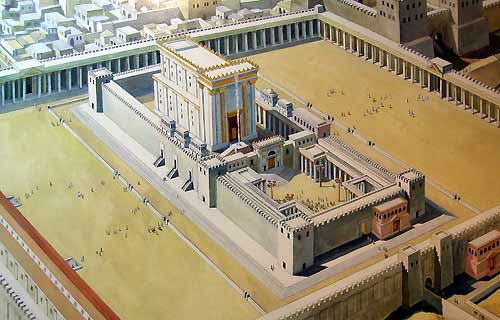
1st Temple of Solomon

1st Temple of Solomon

The earliest written stories or narrations of the oral traditions of the Jewish people span about 13 centuries.  Today’s Hebrew bible probably reached its current form in the 2nd century CE.  What is less well-known today is that in ancient Palestine, or the “Promised Land” to the Jews by the Hebrew God, writing was restricted to the rich nobility, governors, and high priests.  It was also much too expensive for the illiterate masses which saw writing as magical and a gift from the gods; a long-held social tradition of governing.  Manuscripts were the guarded knowledge of political and religious elites who were believed by the less educated commoners to be divine.  William Schniedewind, the Kershaw Chair of Ancient Eastern Mediterranean Studies and Professor of Biblical Studies and Northwest Semitic Languages at UCLA, speaks about the formation of the early Hebrew Scriptures this way:

“Most biblical literature was written long before [586 – 539 BCE, the Babylonian exile]However, the priests who took over the leadership of the Jewish community during this period preserved and edited biblical literature.  Biblical literature became a tool that legitimated and furthered the priests’ political and religious authority.”

Notice he states “…preserved and edited” the manuscripts.  Whether for political, economic, or religious status, oral stories put into biblical literature was contaminated edited by human priests-kings and their scribes.  Therefore, it should be asked are the following passages from the Hebrew Bible a reflection of God, or a reflection of human writers/editors and their perceptions of their life and their world?

“Treat the Midianites as enemies and kill them.” (Num. 25:16-17)

“Go back and forth killing your brother and friend and neighbor” (Exod. 32:27)

“Slaughter old men, young men and maidens, women and children” (Ezek. 9:6)

“I will wipe humankind…from the face of the Earth.” (Gen. 6:7)

“Kill all the boys. And kill every woman who has slept with a man” (Num. 31:17)

“Put to death men and women, children and infants” (1 Sam. 15:2-3)

And these six passages are just a small sampling of the Hebrew God portrayed in the Hebrew Scriptures.  There are many more.  One could compare this God to Satan or Hitler rather than a Father-figure with eternal love.  But if the Jewish God is based on sacred ancient traditions and scriptures, and these passages were purposely kept and passed-on by the educated religious élite over 13 centuries as “sacred”, then can this trait of the Hebrew God ever be overlooked?  It begs the question, is it any wonder why Palestine, Syria, Jordan, Lebanon, Israel, Egypt, and Iraq have been at war, or at least political enemies, for 2,000 years?  They follow a violent, jealous, dividing, warring God!  Why?

Under this light, my metaphor – the holy Ganges River – has its early tributaries contaminated and we are not even past the first third of the river-timeline.

Christianity – The Gospels, Acts, Epistles and Apocalypse

Even though the Christian New Testament is the contaminated offspring of the above Hebrew Scriptures, traditions, monotheism, and laws, their decrees of adherence cannot be misunderstood.  For instance:

“Jesus said to him, “I am the way, the truth, and the life. No one comes to the Father except through Me.”” (John 14:6)

Tomb of the Garden, Jerusalem

Tomb of the Garden, Jerusalem

In case there might be the slightest doubt of the implications of this verse (one of several), according to the early Judaic-Christian élite gospel writers, who many followers today believe are the inspired direct (God-breathed) words of the one and only almighty God, anyone other than a publicly proclaimed, spirit-filled Christian, has no entitlement, no ear to or heart from the one and only God in Heaven.  In other words, this Christian God embitters and ignores everyone on Earth who isn’t “Christian.”  Where does this theology originate I wonder?

Because the Christian-faith is downstream of Hebrew theology and Scripture over several centuries and cultural influences, here are a few problematic scriptural tenets:

Who, if any, have ever seen God?
“No one has seen God at any time…” (John 1:18)

“But on the nobles of the children of Israel He did not lay His hand. So they saw God, and they ate and drank.” (Exodus 24:11)

“So Jacob called the place Peniel:  “For I have seen God face to face, and my life is preserved.”” (Gen. 32:30)

Does this God love or hate sinners?
“For God so loved the world that He gave His only begotten Son, that whoever believes in Him should not perish, but have everlasting life.” (John 3:16)

“For You are not a God who takes pleasure in wickedness, nor shall evil dwell with You.  The boastful shall not stand in Your sight; You hate all workers of iniquity.” (Psalm 5:4-5)

How does one acquire eternal salvation?
“For by grace you have been saved through faith, and that not of yourselves; it is the gift of God, not of works, lest anyone should boast.” (Eph. 2:8-9)

“And if by grace, then it is no longer of works; otherwise grace is no longer grace…” (Rom. 11:6)

“You see then that a man is justified by works, and not by faith only.” (James 2:24)

Is a sinful creature created by a sinful Creator?
“(for you shall worship no other God, for the Lord, whose name is Jealous, is a jealous God),” (Exo. 34:14)

“Now the works of the flesh are evident, which are: adultery, fornication, uncleanness, lewdness, idolatry, sorcery, hatred, contentions, jealousies, outbursts of wrath, selfish ambitions, dissensions, heresies,” (Gal. 5:19-20)

If it isn’t apparent that the Christian New Testament has far too many baffling ancient oral and written tenets passed down to it from several writers from several centuries, then click here for a more complete (1,588 to be exact) list of contradictions.

It should come as no surprise that the Christian gospels, acts, and epistles – the Varanasi portion of the holy Ganges River if you will – cannot possibly be the pure perfect water of life and salvation as the original Neolithic, Indus, Mesopotamian, or Egyptian headwaters.  Or is “purest water” even possible?  Those four earliest civilizations didn’t have alphabets!  Communication was done by voice, song, body/hand motions, and epigraphs; a much more emotional form of communication primarily for governing, protection, and survival.

Islam – The Quran and Hadith

Dome of the Rock, Jerusalem

Dome of the Rock, Jerusalem

I go on record admitting that as a Westerner, born in the United States and having traveled to most of the world EXCEPT Asia and those portions of northern and eastern Africa that are Muslim, I have a very limited understanding and knowledge of primary Islam.  Therefore, it is quite difficult to get a concise consensual explanation of Islam from various sources in the West.  Yet, this quandary falls in line with the point of this post:  with so vast and so old a plethora of tributaries feeding the Ganges River, and Islam being at or near the river’s outfall of Abrahamic religions and tenets, it should not be surprising.  Islam too is not a monolithic religion and no one Muslim behaves as another.  Yes, the river has become quite convoluted now.

Nevertheless, I want to be as fair and objective as possible.  And who better to explain Islam than thousands of Muslims in a Gallup International poll inside 35 predominantly Muslim countries, and released by Unity Productions Foundation:

Another popular explanation of primary Islam is the plaque or card-flyer composed by Enver Musad in 1995 called The Truth About Islam.  You may find it here.  Unfortunately, like all the major world religions, not every Muslim adheres to one summary or interpretations of the Quran…again, supporting this post.

For the sake of time, space, and effort I will again condense the stigmas of Islam down to my three major issues:

#1 – Islam’s earliest traditions and tenets come from contaminated problematic roots, as I’ve already explained.

#2 – The status and role of women (Sharia) in many Muslim countries.
It was only as recent as May 2005 (effective in 2007) that Kuwait allowed their women the right to vote and contest elections; and Kuwait is considered one of the more Westernized Islāmic nations.  Most Muslim nations still do not give women political or social equality; a practice which has apparently continued since about 640 CE after the Quran was written.  Why has it taken Muslim men some 1,400 years to interpret the Quran and resolve this?  Then again, it has taken the Christian world almost as long to rectify it as well.  Ah, the woes of an entirely contaminated holy river.

Corporal punishment of “rebellious” women has been a widely accepted practice based upon chapter 4, verse 34 of the Quran for centuries.  However, only over the last several decades has it come under intense scrutiny.  A simple Googling of the verse (e.g. WikiIslam’s translation) demonstrates the confusion among Muslim scholars.  Whether it is now changing or not doesn’t compare to the 1,400 years of cultural Sharia, i.e. the upstream waters.

#3 – How same-sex equality is viewed by Islam and the Quran.
The International Lesbian and Gay Association (ILGA) list countries that enforce corporal punishment or imprisonment upon same-sex relationships and activities; the majority are Muslim countries.

As I’ve inferred in a couple of my posts and directly challenged scientifically the errancy of anti-same-sex, pro inequality groups and laws in my post Sexual & Gender Ambiguity: My Once Gross Ignorance, I take serious issue with any group or nation that allows the violation of personal civil-rights to choose their sexual activity or partner regardless of gender.  There simply isn’t the scientific facts to support such bigotry, hate, or even passive intolerance.  Typically, the language of fervent religiosity, whether Jew, Christian, or Muslim, is evidently “above” mundane mortal science; as if Scripture and theology are impregnable and infallible.  Science is sub-standard and unable to emit truths about this life, this planet, and its brilliant inhabitants.

At least the holy Scriptures of the three major Abrahamic religions all agree on the dubious “abomination.”  Specifically in the Quran, Sura 4:20-21, 7:80-84, 11:78-81, 26:162-168, 27:55-57, and 29:28-31 all generally infer separation from God and society.  The Muslim Hadith (sayings attributed to Muhammad but not broadly endorsed as authentic by all Muslim scholars) is more pronounced on its abomination and punishment according to Sharia.  At the very least, Islamic culture and society is intolerant of same-sex behaviors and relationships.  This position is entirely because it is the offspring of Christianity and Judaism, the upstream.  These three issues are just a sampling of other problematic edicts I find with Islam and monotheistic faiths.

* * * * * * * * * *

You might be asking why any of this is relevant.  It is relevant because most of the domestic and world political and social problems, including atrocities, are caused by ignorance ill-founded prejudices, elitism, segregation, and egocentric trans-generational teaching of those three ill-conceptions.  Religious elitism, often discreetly projected behind political or military agendas, has fueled most of humanity’s darkest most horrid events and eras.

Assuming the a priori condition of a God, one God does indeed exist, an additional question that bears equal importance is this:  If you proclaim intimate knowledge of and experience with a one and only God in Heaven, then specifically and unanimously(?) how has this knowledge and experience come to you?

To my knowledge there are only two methods of revelation and experience from an unseen spirit-God(1) miraculous or paranormal experience(s), or (2) through their faith’s biblical scriptures and other followers.  Based on these two methods, it begs the following question:  Which is most reliable and most believable?

In my personal experience, when followers/believers are questioned about their biblical foundations of faith, they eventually – sometimes quickly or slowly based upon their apologetic savvy – resort to the “miraculous or paranormal” experience, which is not only harder to acutely examine by unaffiliated outsiders, but just as difficult for the believer/follower to explain!  Why is this?  It is exhausting because the vast majority of miraculous/paranormal experiences are extremely unique to that one person’s life, personality, and immediate environs, and in almost all cases those experiences are different from other followers/believers.

This does not mean those experiences are untrue or any less valuable to the world and life of others – especially if they turn the person into a more loving giving human being for a greater number of people – and this is fine. It becomes highly individualized, which should be an attached liability clause upon its veracity. Hence, it should be kept strictly an individual “faith.” But pushing (forcing?) it beyond that does make it impossible to standardize, prove, or unite “one true religious faith” – the one lie belief that has bred immeasurable death and suffering throughout all of mankind’s history!  The thousands upon thousands of various sects and denominations of the world’s faiths bear witness that there is not and never has been one true faith.

With regard to a scriptural foundation, I have adequately shown the futility in portraying a unanimous, in-perfect-harmony life with all other “identical believers”.  I have also written two historically-centered posts (view the History category for those posts, especially Constantine: Christianity’s True Catalyst/Christ, The Suffering Messiah That Wasn’t Jesus, and Correcting the Gospels of Jesus) illuminating the less-known cultural and political factors influencing early Christianity during and after the sacking of Jerusalem in 69-70 CE by the Roman legions and Empire.

All world religions have their time-specific, contributing cultural, political, and economic influences upon their infancy and roots.  Interestingly, they often have less to do with miraculous, 1-in-a-million “divine events” or teachings, and more to do with mere survival or progressive status.  Think about that.

This returns us to my metaphor…

The Greek philosopher Heraclitus of Ephesus

The Greek philosopher Heraclitus of Ephesus

The Greek philosopher Heraclitus once said, “No man ever steps in the same river twice, for it’s not the same river and he’s not the same man.”  He could not have been more accurate, both in the literal sense of a river and in the story of man and man’s perception of the world told through his many varied religious faiths and just as many deconstructions and reconstructions of spiritual truth.  Like a river, the religious water has never been the same, never as “pure” as the headwater.  There are as many contaminants as there are purifiers and certainly no river is better or untouched than another.

Besides, water is only one small eco-system in an infinite table of macro-systems in an even larger more infinite cosmos of systems.  As I continue to traverse this Ganges River, I repeatedly ask why the big puppet shows about a mythical deity no one group of puppeteers can define with harmony or consensus.   Though Heraclitus taught his principle over 2,500 years ago, it rings truer today among naïve, unexamined fundamental religiosity.

(paragraph break)

Addendum — After chatting with a blog-friend about this post, I realized the importance, no the paramount risk, we as Americans, as well as the human race, will one day face if we (Americans particularly) do NOT throw out our imperialistic, colonialist mentality (revolutionary heritage?) regarding foreign policy and perceptions.  As the excellent video Inside Islam reports, as true as our domestic problems will become EVERYONE’S problems nationally, it is just as true globally with all races, all religions, all nationalities — because due to our insatiable imposing colonial-imperial self-interested heritage, ala the 1948 creation of Israel in Palestine as one example, we must NOW deal with the fires, the monsters America helped create around the world…not treating “them” Arab foreigners as ourselves or without full respect, without the highest tolerance and dignity offered.

On that note, and as I hoped I have conveyed, our personal, national, or “religious” differences are a result of our own pollution, contamination, and apathy, ignorance, violence… whether passive or direct.  Let’s disarm ourselves by simply starting ‘at the Himalayas’.  Or better yet, start with the Universe/Multiverse and cosmos, the onset, the dawn, the time and space before time and space, which much later feeds the Himalayas, which feeds the “Ganges”.

“Hello.  I am a human-being from planet Earth.  How can we collaborate and serve each other?”

Peace for you and all.

(paragraph break)

Live Laugh Love

(paragraph break)

Creative Commons License
This work by Professor Taboo is licensed under a Creative Commons Attribution-NoDerivs 3.0 Unported License.
Permissions beyond the scope of this license may be available at https://professortaboo.wordpress.com.

Fail Better

Oliver Napoleon Hill, one of America’s greatest writers about self-improvement, motivation, and success once said “In every adversity lies the seed of an equal or greater opportunity.”  In achieving a difficult goal, Hill conceptualized that the greatest reward was not in reaching the goal, but instead was in the will to continue in the face of growing doubts bred from failures.  Most importantly to note is that Hill did not state “failure.”  Critical to his concept was the kinetic word “failures.”

Everyone can make a long list of failures throughout their life; hopefully.  If all hopes and dreams were easily gained, they would have little satisfaction and soon be forgotten.  But it is the exhausting roads and persistent belief that with each setback, with each refinement of imperfection and expectation that create the most astonishing most memorable life experiences – to perhaps cauterize a realization that life and death work together, not in conflict.  Neither need be feared.  Contrary to antiquated religious teachings, no ‘stand-in’ is required, no depraved condition exists within us unless it is taught, accepted or internalized, and manifested as less-than capable by one’s self-will and surrounded environment chosen.  No, quite the opposite should be taught:  failures are a good option!

Care to revisit some famous failures that came with some spectacular silver linings?

1492 – Geneon explorer Christopher Columbus never did make it to India’s spices and wealth, but instead found much more; so much more that it changed the entire world. *

1804-06 – Cartographers and explorers Lewis and Clark set out to find a water passage from Midwest America to the Pacific Ocean.  No such route exists, however, they documented the land, people, plants and animals which led to the bargain-basement steal of the Louisiana Purchase. *

1896 – Nineteenth century German engineer Otto Lilienthal first pioneered glider-flight that soon inspired the Wright brothers to powered-flight in America.  Days later Lilienthal was killed in a flying accident attempting to perfect his glider. *

1937 – During the latter stages of Women’s Suffrage, aviatrix Amelia Earhart vanished while attempting to fly around the Earth’s equator.  Regarding women’s rights she was quoted earlier saying, “[women’s] failure must be but a challenge to others.” *

1940 – The Tacoma Narrows Bridge had only been completed 4-months prior to its collapse due to high winds.  Wind impact had not yet been fully understood during construction.  Following bridge designs around the world included stabilizing measures and construction. *

1946-56 – Discovery of the 972 texts of the Dead Sea Scrolls at Khirbet Qumran, Israel, convincingly showed a much more comprehensive portrait and subsequently more diverse Second Temple Jerusalem than was traditionally portrayed in the canonical Christian Gospels; further confirming the truer nature of Judaism as opposed to the warring oppressive Greco-Roman version of later early-Christian groups closer to Rome.  For one example of the two 1st century CE severe divergences, read Sign of Jonah in Talpiot Tomb confirmed just this year.

1970 – The Apollo 13 lunar mission failed due to an oxygen tank explosion lethally damaging the flight crew’s breathing system and service module.  However, with ingenious adaptation and resourcefulness NASA brought all astronauts back home safely and with several critical later spacecraft changes. *

1991 – Locking eight scientists in a sealed terrarium called Biosphere 2 did not go as planned:  food shortages, bad air, and “crazy ants” cut it short.  Columbia University then the University of Arizona has since used it for successful eco-bio research. *

1993 – The Apple Newton is recognized as Apple Corporation’s biggest failure.  The personal electronic assistant expired after 6-years of mediocre sales, but led the way for today’s highly popular iPad. *

1998 – NASA launched the Mars Climate Orbiter to examine the Martian climate.  After a 287-day journey and over-budget costs the probe likely incinerated in the Martian atmosphere.  The problem?  NASA used the metric system in its designs, but the engineering team at Lockheed Martin used English units of measure.  Now regular Martian orbiters and land-rovers explore the red planet with feasible developing plans of mining, colonization, and making Mars a leap-frog point into deeper parts of our solar system. *
[ * – National Geographic Magazine, Sept. 2013]
[paragraph break]

On a more personal level, an intimate level, these concepts are ever truer for our relationships, especially in marriage and parenting a family.  Some of our best virtues can be born and honed with a marital partner and raising messy failing succeeding children.  And the more the better!

Failure and success coexist.  Though we may have been taught they are dire enemies, they are really identical twins from the same mother:  a life and death well-made and well told.

If you can keep your head when all about you
  Are losing theirs and blaming it on you,
If you can trust yourself when all men doubt you,
  But make allowance for their doubting too;
If you can wait and not be tired by waiting,
  Or being lied about, don’t deal in lies,
Or being hated, don’t give way to hating,
  And yet don’t look too good, nor talk too wise:

If you can dream—and not make dreams your master;
  If you can think—and not make thoughts your aim;
If you can meet with Triumph and Disaster
  And treat those two impostors just the same;
If you can bear to hear the truth you’ve spoken
  Twisted by knaves to make a trap for fools,
Or watch the things you gave your life to, broken,
  And stoop and build ’em up with worn-out tools:

If you can make one heap of all your winnings
  And risk it on one turn of pitch-and-toss,
And lose, and start again at your beginnings
  And never breathe a word about your loss;
If you can force your heart and nerve and sinew
  To serve your turn long after they are gone,
And so hold on when there is nothing in you
  Except the Will which says to them: ‘Hold on!’

If you can talk with crowds and keep your virtue,
  Or walk with Kings—nor lose the common touch,
If neither foes nor loving friends can hurt you,
  If all men count with you, but none too much;
If you can fill the unforgiving minute
  With sixty seconds’ worth of distance run,
Yours is the Earth and everything that’s in it,
  And—which is more—you’ll be a Man, my son!

If — by Rudyard Kipling

[paragraph break]

How many wonderful failures have you made this week?  Was one of them epic?  Profound?

[paragraph break]
Creative Commons License
This work by Professor Taboo is licensed under a Creative Commons Attribution-NoDerivs 3.0 Unported License.
Permissions beyond the scope of this license may be available at https://professortaboo.wordpress.com.
Of Envy and Its Guises

According to Webster’s New World College Dictionary, envy is defined as 1. a feeling of discontent and ill-will because of another’s advantages, possessions, etc.; resentful dislike of another who has something that one desires.  2. desire for some advantage, quality, etc. that another has.  3. an object of envious feeling; and so on as described in the definition.  I have a particular interest in number two:  “desire for some advantage, quality… that another has.”

As I wrote about in my previous post She Was A Knockout, I have been visiting my new orthodontist for major dental work.  My orthodontist is a very pleasant, kind, engaging man in his late sixties and probably on the verge of his retirement.  In fact, after he is finished with me I am sure he could easily retire!

washing-feet-jesusYou might already know, Texas is considered on the fringe of the southern bible-belt.  In some places – like this small southwest Texan town I’m temporarily in – at times you’d think it was firmly in the deep ultra-conservative south.  Everyone knows everyone according to two badges:  what 1,000 acre ranch you own or its family you hale from, and what Christian church you attend.  With those badges come the assumption that on either Saturday afternoon/evening, or Sunday morning, you along with everyone else in town are sitting in a pew; when you’re not in the pew then you are “spreading the Good News!” during the other remaining six days or at least talking about how great the “news” and life is…or I should say, reborn life.

All throughout his office and patient rooms are table-top statues (image above) with no inscriptions but which clearly depict a familiar scene and New Testament story:  Mary the prostitute or a disciple kneeling down washing Christ’s feet.  Up on several walls and on several counters are negative (as opposed to photographic positive) shapes that when closely examined spell “Jesus.”

I am humored by his obvious proclamations.  After all, it is his office and patient rooms…..that he leases from the property management and owners.  And he and his practice, fortunately for him, do reside in a country of religious freedom and speech.  Like him, I am certainly grateful for that privilege.  I smile thinking that as his paying patient, I must represent Jesus in those statues!  Oh no, wait a minute!  Could I be the prostitute, or rather gigolo paying my growing dental bill in whatever manner works!?  I could easily be enslaved to my dentist for several years after all the services rendered!

Like Penis-Envy But Really God-Envy

A submissive gladly shows service to her Dom/Master

A submissive gladly shows service to her Dom/Master

On that note, I have this itching urge to share another interpretation of those many statuettes thoughtfully placed in each of their locations.  It is this:  Did you know that this statue also symbolizes the servitude of a submissive to their Dom, Domme, or Master in the BDSM lifestyle?  I chuckle inside imagining their expressions.  And then my warped sense of humor whispers to me:  this is like penis-envy, except in this office it is God-envy.  I realize my itching ill-expressed humor might exact many more extractions of teeth if I don’t guard my tongue.  I repress.

So you might be asking, what does this have to do with envy?  Bear with me.

As my dentist popped his rubber gloves to work inside my mouth, we got sidetracked by my curiosity to his two digital clocks in the room.  I explained to him (with intended humor) the big one displayed the room temperature, barometric pressure, and weirdly 6:35pm Sunday.  That cannot be so because my appointment was for 8:30am Monday; I was on time.  Furthermore, there is no place on Earth where it was presently 6:37pm Sunday…so I ask you Dr. Einstein – that is the name I’ll give him here to protect his innocence – have you invented a patient room and chair capable of time-travel?  He played along.

But then our conversation turned.  He mentioned that my astrological sign/reading for the day might be treacherous (being in his office laid back in the chair) as he smirked.  And before I could play along with his wit, he quickly retracted his comment apologizing for mocking a system that is a bunch of hogwash and that he doesn’t believe in any of that stuff.  Then he continued, That stuff [astrology] is demonic!  And then he quickly apologized again and stated he should not have said that either because I might like it or believe in it!

Now I’m really enjoying The Orthodontic Squirm Show!  And then he digs his hole deeper and asks me Do you like that stuff?  Do you believe it?

Let me say here, that earlier itch on his statuettes, never wanted to be scratched SO BAD as it did with that question!

Given my situation and trust in his upcoming surgical expertise with my mouth and teeth, I answered, I love space exploration, cosmology, astrophysics, and quantum mechanics.  He replied But that has nothing to do with astrology.  I know it doesn’t I answered.  I hoped he was witty enough to understand my read-between-the-lines answer.  I was not going to give him the satisfaction of knowing one way or the other if his fumbling had been intrusive or not, even though it wasn’t in the least.  But….Let him sweat!

* * * * * * * * * *

In almost every case, I have never been offended or put off by Christian evangelicals or proselytizing, or even self-perceived prophets.  The kind folks that clutter their front yards with crosses representing Calvary don’t really bother me either.  Having grown up in Texas, having spent two and a half years in seminary myself and four years at a Christian liberal arts college and then five years as a deacon and singles ministry leader all in Mississippi, I know the canonical New Testament teachings and doctrines very, very well.  Those evangelicals, or proselytizers, or prophets, or simple common folk proclaiming Good News are actually obeying quite well what scripture teaches ALL followers to go and do…daily with humility.  I greatly admire their obedience and courage even though I thoroughly disagree with their foundations for doing it.

So why do they do it?

In my mind and reasoning, they are unaware (or in denial) of how amputated, and how misconceived – and maligned through Greco-Roman lenses and traditions – the stories and passages of their bible was canonized versus the real historical events and context of their Savior Yeshua.  Those historical facts are apparently boring and unnecessary.  So I ask myself again, why do they do it so faithfully?  Then the light bulb turns on.  God-envy.

The human brain and body is a remarkable coping mechanism to the sometimes brutal unexplainable force of life.  So we envy those who seem to lift themselves above the pain and chaos and offer a form of hope (and power?), peace, and order.  Fortunately, there are a plethora of successful ways of achieving the happier life or a less anxiety-ridden life and subsequent conquest of death WITHOUT surrendering your soul and innate gifts to an ancient proxy shrouded in Greco-Roman traditions.  In the doctrines of mainstream Christianity that “surrendering” is referred to as humanity’s total depravity.

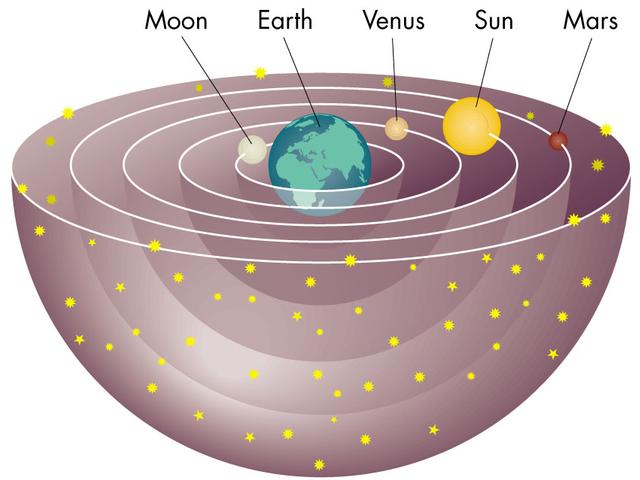
Geocentric2

Geocentrism/Egocentrism formerly taught by the Roman Church…which begat all later Christian churches today.

Consequently, and to humanity’s detriment for two plus millennia, mainstream Christian doctrines don’t teach self-reliance, self-empowerment or self-actualization because that was not the Greco-Roman way of control and imperialism during the formation of the canonical New Testament; so we envy its Messiah…a greatly diluted form of individual potential.

I wonder if my orthodontist knows that it is because of astrology and other fields of science that mankind successfully navigated the vast oceans, understood when crops needed to be planted and harvested, that the Earth circles the Sun and not the Sun/cosmos circling Man’s planet, or more importantly three Eastern Arabian kings bearing royal gifts followed a great Supernova in the night sky — which astrologers and cosmologists have determined was not in the month of December — with navigation built upon centuries of incredible Arabian-Persian science and astrology?  What do you think?

(paragraph separation)

Footnote – If interested in the historical context of the Greco-Roman deification of Yeshua of Nazareth, start with my post Constantine:  Christianity’s True Catalyst/Christ or the other The Suffering Messiah That Wasn’t Jesus.  For further reading and understanding of Yeshua’s/Jesus’ deep Jewish-Roman world, I recommend Dr. James Tabor’s work and website at The Jewish Roman World of Jesus.  It is an excellent highly informative site of overlooked context by today’s Roman Catholic and Protestant churches.

(paragraph separation)

Live Laugh Love

(paragraph separation)

Creative Commons License This work by Professor Taboo is licensed under a Creative Commons Attribution-NoDerivs 3.0 Unported License. Permissions beyond the scope of this license may be available at https://professortaboo.wordpress.com.

DRD4-7R

orchid

Orchid?

No, it is not a new type of iPhone, or video recorder, or measurement, or even the launch code for your nearby missile silo.  Give up trying to guess what DRD4-7R is because it is so small, so tiny, that you will never touch it.  It could be inferred that cats have it, but that assumption would fall short when they returned home, every time.  No, it is not explicitly manifested in any animal on Earth and it cannot be found in any plant or stone.  But it is indeed part of our human wiring.

Many times throughout my adult life I have asked myself Why am I so intrigued with new things, new places, new feelings, and new people?  Why do I start to get restless over a long period of time seeking new adventures?  I accepted long ago that I have this Marco Polo type personality; I love to inquire.  I love to explore!  Why?  If you understand the purpose and nuances of goalkeepers in sports, like hockey or my lifetime sport soccer, then you’ll understand this one:  why did I choose to, no persisted in playing the position of goalkeeper?  What sane person wants objects hurled or kicked at them hard?  Then the other day I read a fascinating article in the January 2013 issue of National Geographic magazine ironically asking and answering my same questions!  This totally explains my addiction to everything National Geographic!  More please!  I read further.  Ah, dopamine.  It’s the dopamine!  Hmm, duh.

Or dandelion?

Or dandelion?

For those of you with a slight variant of dopamine than perhaps I and others may have, dopamine “is a neurotransmitter that helps control the brain’s reward and pleasure centers.  Dopamine also helps regulate movement and emotional responses, and it enables us not only to see rewards, but to take action to move toward them.  Dopamine deficiency results in Parkinson’s Disease, and people with low dopamine activity may be more prone to addiction.  The presence of a certain kind of dopamine receptor is also associated with sensation-seeking” according to Psychology Today.  Not so coincidentally, though I am not an “addict,” several of my extended family members are addicts…as well as my sister.  I guess I selfishly stole most of it from mother’s womb before my sister could snatch any.  I know she’ll argue this, but I was always quicker than her!  And not surprisingly, several laboratory studies in Europe, Israel, and the U.S. have found that a lack of the 7R variant is linked to depression or lower motivation.  I found this result very interesting.

As I continued to read, in my mind all the dots — from the broad picture down to the microscopic — were connecting and making perfect sense; perfect harmony like a homecoming.  But not permanent!  A homecoming and going!  And my fascination with bird cages — naturally with an open door or no door — now made sense too.

Orchids versus Dandelions

Am I an orchid thriving in stimulating environments, or am I a dandelion that manages to adapt and survive in harsh environments?

Perhaps the better question would be could there be hybrids of the two?  David Dobbs has written several articles on this gene and the genetic-cultural roots of human temperament, and is the writer of this National Geographic article that has captivated me.  He explains:

“If an urge to explore rises in us innately, perhaps its foundation lies within our genome.  In fact, there is a mutation that pops up frequently in such discussions:  a variant of a gene called DRD4, which helps control dopamine, a chemical brain messenger important in learning and reward.  Researchers have repeatedly tied the variant, known as DRD4-7R and carried by roughly 20 percent of all humans, to curiosity and restlessness.  Dozens of human studies have found that 7R makes people more likely to take risks; explore new places, ideas, foods, relationships [guilty in the 1st degree there!], drugs, or sexual opportunities [should I say it again?]; and generally embrace movement, change, and adventure.  Studies in animals simulating 7R’s actions suggest it increases their taste for both movement and novelty.  (Not incidentally, it is also closely associated with ADHD.)”

"Take one 10mg tablet once daily; for severe cases take with liquor in a Hazmet suit."

“Take one 10mg tablet once daily; for severe cases take with liquor in a Hazmat suit.”

In another March 2012 article on Wired.com, Dobbs further explains:

“This revisionist hypothesis is known variously as the sensitivity hypothesis, the differential susceptibility hypothesis, or the orchid-dandelion hypothesis — a term that Thomas Boyce and Bruce Ellis coined based on the vernacular Swedish term “dandelion children,” who seem to grow up okay in almost any environment; to that they added “orchid children,” who thrive under good care but wilt under bad. It is a young hypothesis, hatched 15 years ago and obscure for most of that time. But in the last two or three years it has gained enormous traction, spreading through behavioral genetics, child development, and anthropology.”

At this point in my reading and research I feel as if I’m reading parts of my biography or journal called This Is Who I Am and Why.  It helps me at least process further and understand so many how’s and why’s, like Why have I been single unmarried most of my life?  Have I not been hanging around long enough in the right flower or weed gardens!?  Does this explain my need for Zyrtec at certain times and circumstances of the year! Geeezzzz.  It does make sense:  like a love-hate thing for the beauty of new outdoor places, but then you discover all the annoying bugs, insects, reptiles, and yes, inevitably Medusa!  No, I’m kidding…..about nature’s creatures.  Hah!

On a serious note however, geneticist are also associating the 7R variant, and another:  the 2R, back to our ancient ancestors in Africa 70,000 – 50,000 years ago.  For a quick tutorial read my post Our Family Reunion.

Anthropologists suggest that this minority of humans are the reason mankind migrated out of Africa; to find new sources of food and a different way of life.  Scientist do know that astronauts or cosmonauts, or whatever title the sponsoring group bestows on their explorers/adventurers, 7R is definitely found in their genetic code.  They are the risk-reward breed and today they are found in many walks of life.  On a spectrum left to right 1 through 5, left being pure orchids (1)….right being pure dandelions (5), I am firmly a two if not one-and-a-half.  I most definitely get restless after long periods of routine.  I am not saying I am ADHD and can’t focus — on the contrary I am very task-oriented — but I am most certainly not a permanent settler!  This is probably why I have some, umm, excuse me….(ahhh-CHOU!) dandelion in me:  I am happy to adapt….to what I want to adapt to….and as long as a few other Bohemians are around, then I will be first in line!  Let’s go!

Are you an orchid or a dandelion?  Or perhaps something in between?  And why?

(paragraph separation)

FootnoteFor the full Dobbs National Geographic magazine article, go to this link:  Restless Genes

Live Laugh Love

(paragraph separation)

Creative Commons License
This work by Professor Taboo is licensed under a Creative Commons Attribution-NoDerivs 3.0 Unported License.
Permissions beyond the scope of this license may be available at https://professortaboo.wordpress.com.

My Heretical Heritage

family treeBefore the 15th century word heretics had become common in Europe, three centuries earlier there was one group of non-conformists around the southeastern town of Lyon, France known as “the poor of Lyons” or the Waldensians.  In the literature of the time these “heretics” followed the teachings of a man known variously as Valdes, Valdesius, Valdensius, and Waldo (Valdo) from the city of Lyons.  Their apparent break from mainstream Catholicism began in about 1170 CE not because they gave up a life of comfort and wealth – in medieval Europe this was quite popular and common – but because Waldo began translating the Holy Scriptures into common speech and then allowed lay people to read it and share it anywhere.

Chambons, Italy

Chambons, Italy

If anyone is aware and knowledgeable of medieval Europe and the stranglehold the Roman Catholic Church and Vatican had over its parishioners and daily life, then you know the punishment for dissension or heresy was no slap-on-the-hand.  If the fathers or bishops deemed your behavior severe, you could lose your life or soul, or both.  The practices of Waldo and his followers was ecclesiastical usurping:  no one other than the church pontiffs could interpret and teach the Bible.  This crime was punishable by excommunication.  These are the times my maternal ancestors come from:  Waldensians:  the Bonnet clan of Chambons-Mentoulles of Cluson Valley, Italy and Lyon, France.

* * * * * * * * * *

Waldensian children were not spared

Waldensian children were not spared – Piedmont

Groups of “heretics” began surfacing all over 12th and 13th century Europe as the Vatican and Pope Lucias III persecuted such dissension more and more.  Many groups, including my ancestors, went into hiding or fled.  My ancestors eluded numerous arrests and escaped massacre after massacre.  During the late 1400’s several groups were fleeing into parts of Switzerland, and Germany, then Prussia the eventual birthplace of the Protestant Reformation.  By 1532 because of many doctrinal similarities the Waldensians officially joined the European Reformation inside congregations of Presbyterian and Calvinist churches.  The Bonnet clan (pronounced Bonné) and others found refuge in the Cluson Valley just outside of Turin.  They would soon be tracked down there.

The Catholic Duke of Savoy located the Waldensians (also known as the Vaudois) in the Piedmont region of Italy in April 1655.  This is known as the Piedmont Easter Massacre.  The English poet John Milton pinned a sonnet about the slaughter:

“Avenge, O Lord, thy slaughtered saints, whose bones
Lie scattered on the Alpine mountains cold,
Even them who kept thy truth so pure of old,
When all our fathers worshiped stocks and stones;

Forget not: in thy book record their groans
Who were thy sheep and in their ancient fold
Slain by the bloody Piedmontese that rolled
Mother with infant down the rocks. Their moans

The vales redoubled to the hills, and they
To Heaven. Their martyred blood and ashes sow
O’er all th’ Italian fields where still doth sway

The triple tyrant; that from these may grow
A hundredfold, who having learnt thy way
Early may fly the Babylonian woe.”

Elisabeth Charlotte

Elisabeth Charlotte

The Bonnet clan once again escaped…miraculously.  By 1699 persecutions and inquisitions by the Papacy and King Louis XIV forced my ancestors into hiding and fleeing again.  They settled their families in Charlottenberg, Germany outside of Koblenz.  There were 91 families remaining of Waldensians and Huguenot refugees from Italy, all welcomed by the Countess Elisabeth Charlotte Melander von Holzapfel-Schaumburg of Prussia (whew, say that 3-times fast!).  The hills and castles still exist there today as the town of Holzappel, Germany.

The late 17th century found many agricultural and economic hardships, even for The Poor of Lyons who graciously chose a modest frugal life focusing on others.  During the decades of 1830 to 1840, many Waldensians and Prussians had heard about and read about the ease of acquiring land deeds in a place called The Republic of Texas across the Atlantic Ocean.  The government there was ambitiously seeking Europeans of non-Spanish origin to come settle throughout central Texas.  Texas was near bankruptcy after fighting Mexico for independence and desperately sought to grow and stimulate their economy.  Johann Holzapfel from Charlottenberg had already started the immigration from Prussia, to Antwerp, Belgium, and on to Galveston, Texas in 1844.  My direct ancestor Philipp Daniel Bonnet (sometimes spelled Phillip) arrived at the port of Indianola, Texas in 1845 just months before the Republic was annexed into the United States.

Grave_Philipp Daniel BonnetMuch of the settlements of central Texas are of European heritage, particularly German.  The group of Prussians my family followed were the ones who founded New Braunfels, Texas.  Two generations later my great, great, great, great, great (five greats) grandfather Henry Daniel Bonnet moved to Austin, Texas and helped construct our state capitol building; little to no work could be found as New Braunfels and the surrounding towns had become over-populated with European immigrants seeking employment, land, and religious freedom.  My mother’s ancestors and family still populate several towns around Austin, including inside its city-limits.

* * * * * * * * * *

During the flow of immigration into 19th century Texas, my paternal ancestors arrived as well.  Not as much (or as detailed) is known about my father’s ancestors.  Perhaps they were not as fortunate inside the kill-infested parts of Catholic Europe.  However, and to my good fortune obviously, the few migrated to, settled and stayed near Galveston.  My paternal grandfather and grandmother are also of German-French heritage:  Miller (Mueller), Konzack, both German on his side, and Tacquard (French) on her side.  This side of my family is understandably much more distrustful of large organized religious institutions.

I remember my paternal grandfather had a strong independent personality.  He was one of few sons that had graduated from the University of Houston working most of his adult life at a chemical refinery.  Not surprisingly my father was agnostic.  His mother, my grandmother, I remember had a most kind gentle demeanor with a little pizzazz that shined on the dance floor.  She was an intermediate school teacher her entire life.  Both naturally loved family life and had unbelievable work ethics; they had to coming from and living through two world wars.

The most precious memories I have of my childhood and adolescence was the never-ending fun me and my cousins would have during family barbecues,  beer drinking (by adults of course! Well…), music and dancing on top of the saw-dusted pavilion or barn floor.  It was no surprise to me either, that in my same spiritual journey, why or how my two families found each other and became attracted.  The historical and genetic record fits nicely onto a most intriguing suspenseful family tree of how I came to be.

Magnolia bloom

Magnolia bloom

I was born into the best two families – deeply bound in an intimate, intense, painful, passionate yet supportive SURVIVING two families – a person could ever wish for.  It makes perfect sense why I have such deep Bohemian Free-thinking humanist-caring tendencies!  And I thank God…no, correction…the family tree that I come from such an incredible history!  I can picture my paternal grandmother teaching my father “We will teach you how to think, and not what to think” and my father passing down the same principle to me.  Decades later my mother, working at Southwestern Bell Telephone in Austin, meets my father on a blind date, he a part-time engineering student at the University of Texas in Austin and putting himself through college while working for an electrical company.  No surprise, there was a familiar (or familial) chemistry.  About four years later cupid’s arrow found its mark and at the risk of stating the obvious…so did my Dad!

One of my dad’s favorite trees was the evergreen magnolia tree, especially when it bloomed.  The flowers have a distinct smell, like fresh sweet lemonade.  He, myself and my sister planted one in the front yard.  When I last drove by the home of my youth, it had grown to some 40-50 feet into the sky.  I could only imagine how the neighborhood smelled when it bloomed.

As the past weekend of resurrection stories and folklore prevailed, my larger perspective was much more personal, much more caring in small ways, like a close family who, to understate, has learned in so many ways over so many generations the real-life meaning of Easter.

(paragraph separation)

Live Laugh Love

(paragraph separation)

Creative Commons License
This work by Professor Taboo is licensed under a Creative Commons Attribution-NoDerivs 3.0 Unported License.
Permissions beyond the scope of this license may be available at https://professortaboo.wordpress.com.