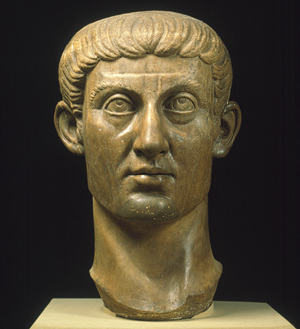
An American Icon

US Secretary of State Colin Powell (2001-2005)

I recently finished what the Los Angeles Times Book Review wrote about General Colin Powell‘s book My American Journey – Colin Powell:

Powell heroically turns racial maelström to magnificence, conquering bigotry to shine the often diminished brilliance of black life into foreign lands and into closed minds closer to home.  In the magical arc of Powell’s triumphant patriotism, Frederick Douglass elbows Thomas Jefferson for a spot at Eisenhower’s side.

Colin Powell was not simply a soldier who dedicated most of his life to serving a cause and creed.  Yes, he is an American, but he is a black American who grew up lower-class in an immigrant family with simple dreams and very little means in the South Bronx of New York City.  The color of his skin or his spiritual affiliation he made absolutely irrelevant, and Powell proved they didn’t matter.  He went about his early life-challenges, through his Army Ranger training and service, through serving in Vietnam, Panama, and the Gulf War; then National Security Advisor to President Reagan, Chairman of the Joint Chiefs of Staff to President George H.W. Bush and President Clinton, and finally to the U.S. Secretary of State under George W. Bush…all in a way that easily could have handed him the Presidency of the United States.  An utterly remarkable and practically incomparable resume and dossier.

If General Powell had run for President three or four times ala FDR, my loyal support would have entailed twelve or sixteen years.  And I am not a Republican or Democrat, or Episcopalian in the least.  The man is plain and simple a leader for humanity who with dignity fulfilled his sworn commitments in spite of a less-than infatuated service with President George W. Bush, Vice-President Dick Cheney, and Secretary of Defense Donald Rumsfeld.  The Bush Administration’s approach to the second Iraqi War and invasion sold to the American public, an even more controversial mishandling of terrorist prisoners at Guantanamo Bay and Abu Ghraib, eventually forced Powell out of favor with the Presidential Administration and Capital Hill politics altogether.  Had he not given his sworn oath to fulfill his duties, Powell would have resigned well before 2005.

Powell & Clinton support DADT repeal on Meet The Press September 2010

As much as I greatly admire this man, we do have one difference; one rather big difference.  General Powell was one of the contributors to the military’s “Don’t Ask, Don’t Tell”DADT policy that did not address the full gay-lesbian problem within U.S. military personnel.  Due to the immense complexity of the problem, particularly with housing homosexuals and bisexuals with conservative hyper-phobic heterosexual personnel, Powell typically danced around the debates until 1993.  During the first weeks of Bill Clinton’s entrance into the White House, Clinton made the sexual-orientation the preliminary focus of his campaign promises to supporters.  Given Powell’s background and military service, he understandably had a difficult time making such hullabaloo over what he considered a personal concealment issue.  Yet, following his logic then all military personnel should hide any of their personal religious beliefs as well.  Imagine how that would go over?  Powell shrunk toward desensitization.  In the latter third of his autobiography he sometimes argued that the civil-rights movements for African-Americans in the 1960’s and ’70s were not at all one-in-the-same.  For me, they are definitely one-in-the-same.  Colin Powell’s transition from a Cold War, Vietnam military America into a late 20th and 21st century political American was for him unprecedentedly timid on civil rights and sexual-orientation.  No surprise really, Powell is the stereotypical 4-star General born to be a warrior’s leader.  His soldier mold should not detract, however, from his very real social consciousness; a tuning-fork never louder than during 9/11, the war on terrorism, and America’s military invasion into Iraq for weapons of mass destruction.

I have often heard the cliché “There a two subjects never to get into during formal dinners with dinner guests:  religion and politics.” or something like that.  However, during the few times it was unavoidable, I was surprised how few people knew that Colin Powell was never a Republican.  Most armchair political critics believe with no basis that he was Republican.  He was and always had been a military man first serving the call and duties of his nation; it just so happened that his Capital Hill positions were with three Republican presidential administrations.  The nine months with Clinton’s administration everyone counts as merely a changing of the Guard.  No matter what political party the White House might have been, he saw the invitation as a call to duty he must accept.  Powell writes:

Because I express these beliefs [strong free-enterprise without government interference in entrepreneurial vitality except to protect public safety & prevent distortions of competition by labor or industry] …some people have rushed to hang a Republican label around my neck.  I am not, however, knee-jerk antigovernment.  Government helped my parents by providing cheap public subway systems so they could get to work, and public schools for their children, and protection under the law to make sure their labor was not exploited.

The great domestic political challenge of our time is to reconcile the necessity for fiscal responsibility with the explosive growth in entitlement programs, including Social Security and Medicare, which the needy and the middle-class rely on so heavily.

Until our leaders are willing to talk straight to the American people and the people are willing to accept hard realities, no solution will be found to relieve our children and grandchildren of the crushing debt that we are currently amassing as their inheritance.

While the current call for “less government” is justified, in one role I want government to be vigorous and active, and that is in ensuring the protection of the Constitution to all Americans.

The hard-won civil rights legislation of the 1960s, which I benefited from, was fought for by presently derided liberals, courageous leaders who won these gains over the [Republican] opposition …hiding behind transparent arguments of “states’ rights” and “property rights.”

I have listened to die-hard Republicans call Powell a traitor, that he had lost most of the respect gained from Republicans with Reagan and H.W. Bush.  As much flak as Powell took from the political right, he reminds us that he is not a Democrat either.  “Neither of the two major parties” he writes “fits me comfortably in its present state.”  Powell holds no reservations on either party’s short-comings, “I distrust rigid ideology from any direction, and I am discovering that many Americans feel just as I do.  The time may be at hand for a third major party to emerge to represent this sensible center of the American political spectrum.”  This is exactly why I have great respect for this man.  He is in several ways an unswaying Free-Thinker according to his own conscience and duty to his nation.

I am troubled by the political passion of those on the extreme right who seem to claim divine wisdom on political as well as spiritual matters.  God provides us with guidance and inspiration, not a legislative agenda.  I am disturbed by the class and racial undertones beneath the surface of their rhetoric.  On the other side of the spectrum, I am put off by patronizing liberals who claim to know what is best for society but devote little thought to who will eventually pay the bills.  I question the priorities of those liberals who lavish so much attention on individual license and entitlements that little concern is left for the good of the community at large. 

When 9/11 hit the American homeland, Powell was thrown into an explicit forefront forcing him not only to lead an immediate response on terrorism, but also draw lines in the Oval Office about how best to make that response.  It would prove more than daunting.
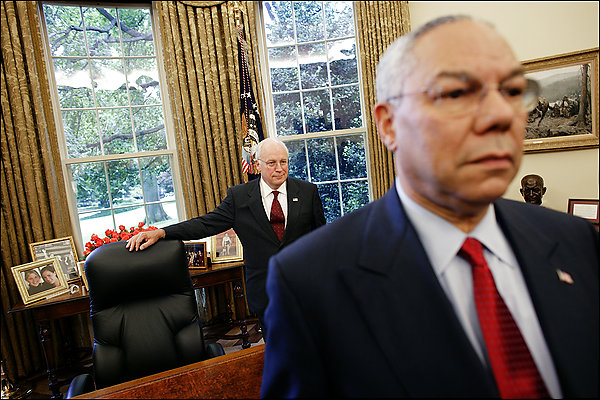
VP Cheney & SOD Rumsfeld bypassed completely Powell & Rice but also U.S. & International laws

Based on his autobiography and interviews since the book’s completion in 1995, it is inferred that Colin gained a sour taste for Republican politics his last two years in Washington D.C.  Father Bush’s most highest approval ratings came during the First Gulf War with General Norm Schwarzkopf and General Powell.  The military duo’s superbly created multi-coalition forces put the United States in favor with most of the peaceful nations.  George W. Bush most assuredly recognized later  in 2001 an opportunity when considering Democratic support.  Powell, however, could not have realized what limited roles he would be subjected to in September 2001 when George W. faced the most horrific attack since Pearl Harbor.  After all, it was more the H. W. Bush family who were very grateful for Colin’s loyal support, not the son.  By 2003 it was clear there was no real room in the White House for one more dominant Alpha-male.  H. W. Bush sentiments went only so far with war-waging Rumsfeld, Cheney, and Paul Wolfowitz.  Of those three cabinet members, Rumsfeld had the only military service with just 3 years.  And none of them possessed the international diplomatic dossier during global conflicts as did Colin Powell.

The general from the South Bronx had unprecedented foreign diplomatic experience due to his long illustrious military career; the First Gulf War being his highest accolade.  The ease and speed at which the United States, Great Britain, and more importantly Arab-Muslim nations were able to remove Saddam Hussein’s army from Kuwait is due in large part (in American terms) to Powell’s polished political understanding of world conflicts and their delicate intricacies.  Any political or military expert today will agree that had Powell and H.W. Bush not consulted and requested Arab-Muslim nations get significantly involved in Saddam Hussein’s removal and later treatment after, Western military machines blasting into Kuwait and engaging Hussein’s Republican Guard would have been diplomatic global suicide.  With Geneva Convention articles and multiple allies both in Europe and the Middle East, had America not taken consideration of coalition ideals it would have turned the Gulf conflict into a Holy War between invading Westerners and highly motivated non-Iraqi militant Muslims.  Therefore, ten years later after his father, George W. Bush’s top officials had a goldmine in Colin Powell; it would be a no-brainer that Powell’s experience and advice would be a necessity, correct?

Addendum 2/14/2015 — the YouTube video of a documentary on Powell’s political relationships with alpha-males Dick Cheney, Donald Rumsfeld, and former President George W. Bush has been deleted and removed. In its place I’ve selected this short clip regarding the Iraqi intelligence fiasco.

Secretary of State Albright

What many head-hunting Washington politicians were losing in their emotional rhetoric to bring quick justice for the 9/11 murders, were Colin Powell’s long-term warnings of more American lives lost via our military.  These were going to be the very men and women who will potentially pay the last sacrifice.  Few lynch-mob mentalities remember how Powell had long valued the service and sacrifice our military personnel and families make in wartime.  Stepping back to 1997, Powell was almost livid after a comment made by Madeleine Albright in a National Security Team meeting about President Clinton’s election campaign promises to Bosnian Serbs committing genocide.

Powell’s views had not changed one bit since H.W. Bush’s meetings on how to deal with Bosnia.  Colin strongly advised only two realistic responsive options:  either limited air strikes around Sarajevo risking civilian casualties or heavy bombing of Serbs in the theaters of conflict.  But Powell emphasized that neither of these options guaranteed a Serbian change of behavior; only military troops on the ground could do that.  Powell kept reiterating that with air strikes or bombing, Serbian militias would simply hide their tanks and artillery in or around civilian populations and buildings — much like militant terrorists do today.  Powell therefore constantly pushed for a clear political aim first before committing our military men and women.  History had proven to America that military action without a consensus political goal costs too many American lives.  The debate exploded when Madeleine Albright asked Powell, “What’s the point of having this superb military that you’re always talking about if we can’t use it?”  Powell responds this way in his autobiography:

I thought I would have an aneurysm.  American GI’s were not toy soldiers to be moved around on some sort of global game board.  I patiently explained [to Albright and team members] that we had used our armed forces more than two dozen times in the preceding three years of war, peacekeeping, disaster relief, and humanitarian assistance.  But in every one of those cases we had had a clear goal and had matched our military committment to the [political] goal.  As a result, we had been successful in every case.  I told Ambassador Albright that the U.S. military would carry out any mission it was handed, but my advise would always be that the tough political goals had to be set first.

Former NSC member Tony Lake, and member during Vietnam, supported Colin’s position and said “You know, Madeleine, the kinds of questions Colin is asking about goals are exactly the ones the military never asked during Vietnam.”  Several months after 9/11 the ignorance of side-stepping Powell’s wealth of diplomatic and military experience becomes much worse.  The real murderers of 9/11 were all dead; killed in each plane crash.  Therefore, how to deal with the people, organizations, or nations who assisted the dead terrorist pilots are of such paramount importance in a global arena that any violent retaliatory response could have profound consequences in American lives.  The following two clips from the 2008 documentary film Torturing Democracy portrays just how nonconcurrent, devoid of Powell, and with little to no consideration for the global impact the clandestine U.S. response to the War On Terrorism and prisoners was begun by four men in a matter of weeks.


America is now approaching 10 years of war in Afghanistan and Iraq since 9/11.  The longest period of war ever in our nation’s history.  Has the fervor of the radical militant terrorists and insurgents in Afghanistan and Iraq been completely eradicated?  No.  Did treatment of pre-trial detainees or prisoners aid in shortening the 10 year war in Afghanistan or Iraq?  Certainly not.  If anything, we have given them more inspiration and shown the world that America is not so much a beacon of light for human rights according to the Geneva Convention — we have become similar to the terrorists themselves.  Colin Powell tried to push home U.N. sensitivities on Capital Hill.  But four Alpha-males in the Bush administration prolonged immeasurably the war on terrorism and so we continue to pay the price in American lives and in fatherless, son-less, daughter-less, spouse-less families.  Not gaining first the full participation of moderate, peaceful, allied Muslim nations was a costly multi-dimensional human and economic Bush-Cheney-Rumsfeld-Wolfowitz mistake.  Current economic defense spending, which compounds the federal deficit today, bears witness to a war waged prematurely without multi-lateral international support to help bear the costs.

The Private Life of Colin Powell

Founder Colin Powell & Chairwoman Alma Powell

Now that Colin Powell is out of federal politics he has dedicated his time and energy to mentoring and educating America’s youth through his cross-sectored program, America’s Promise Alliance.  For many years during and after his political career in Washington D.C., Powell spoke repeatedly about us addressing America’s socio-economic problems as a caring “family” member and citizen of the United States.  Powell sees a serious need in teaching young Americans to benefit from past mistakes, to offer educational and career opportunities for at-risk youth, and continue the civil fight for social and economic parity in America.  He states in no uncertain terms who must mentor this philosophical action:  every single parent in the nation as a Big Citizen.

We can’t just sit around waiting for government to solve some of these intractable social problems that we’ve had for years.  Government has a role to play.  It is time for all of us to live up more fully to the concept of citizenship.  And for those of us who as citizens of this nation have been blessed with treasure, and wealth, and good position, and comfortable homes, and all the blessings of this land, to be a good citizen, to be a big citizen, requires you to do more in the way of sharing with those who are in need.  So that a family that has three wonderful children ought to try to see if they could find three hours a week to share that life with a kid in need who doesn’t have a mentor, who doesn’t get to play in Little League and do the other things that we take for granted.  Somebody in that family who might go tutor a school on an afternoon off from a job, and we’re encouraging corporations to give them that afternoon off.  And so that’s what we mean by big citizenship.

During a 1998 interview for the Academy of Achievement in Washington D.C., Colin was asked to comment about one of his most favorite quotes by the Greek historian Thucydides:  “Of all manifestations of power, restraint impresses men most.”  Powell responded in agreement saying…

One of the great strengths of America, and the reason we are held in such high regard throughout the world, is that people trust our power, and they trust the way in which we use our power.  The more powerful you are, the more people want to trust you with that power.  They would hate to not trust you with that power.

CNN State of the Union

With the advent of mass social networking, Colin Powell was asked in his January 2011 interview on State Of The Union with Candy Crowley, his thoughts on the technological Genie-out-of-the-bottle boom with Facebook, Twitter, and thousands of blog sites, in light of the recent Tucson, AZ shooting tragedy that took six lives and wounded 13 including U.S. Representative Gabrielle Gifford.  Crowley asked, “Did you see a message about this country in those shootings, or did you just see a random, senseless act of violence?  Powell agreed going on to say:

“…in the process of thinking it through and looking at it, everybody started to speak about civility.  That’s a good subject for us to talk about because there has crept in our society and our public dialogue a coarseness, a nastiness, an attack of people who don’t share the same views as you do.  And not just attacking the policies but attacking the individual.  He’s a communist.  He’s a socialist.  He’s un-American.  He ought to be thrown out.  All sorts of nastiness.  And it is not just politicians who are doing this to each other, and, frankly, politics has always been a contact sport in this country.  I mean, they did this back in the 17th and 18th Century, but with all of the cable channels and talk radio and blogs, especially blogs, where people can be anonymous with their nastiness, I think has caused a level of coarseness in our society that we’ve all got to think about.  And politicians should think about it.  All leaders in every aspect of American society should think about it.  And I think television needs to give this some thought.  A lot of this is frankly coming through on television.

I think you can’t put the information revolution back in the bottle. That’s out of the question. But at the same time, we can just act more responsibly in the language we use with each other. And we need to start pushing back on some of the more extreme language that we hear on radio or we see on television or we hear from our politicians.  The reason they do it is because we accept it as people.  So I think the American people have got to start demanding more of our public officials and of the media that is trying to come into our homes every evening.  But, unfortunately, there is a certain attraction to this kind of dialogue.

…the other thing is, with so much information available to us, you can just stay in your little stovepipe of information and only listen to others and talk to others and reflect the views of others who think just like you.  And so we’re not broadening our knowledge base too often by all of the information that’s available. We’re becoming even more stuck in that segment of the knowledge base that reflects our views.

If there are two words that accurately describe General Colin Powell’s sentiment for his nation, they are limitless gratitude.  Despite his skin color and challenges as such growing up, the painful segregation dealt him in the 1960s while serving his country during Vietnam, or the treatment and disregard he received during his service under President George W. Bush including far right-winged Republicans, Colin Powell exudes an American statesman consumed not by a global or national entitlement of arrogance, but instead remains socially conscious, humble and indebted.  It is no wonder why he was held with such high esteem by the international community.

Many Bush-era officials nicknamed Powell “The Reluctant Warrior“, a title in my mind not entirely negative.  Fortunately, those U.S. officials and all anti-Powell advocates represent less than 1% of the informed global population.  In international circles — a greater and more accurate plum-line — Colin Powell is considered the “Neo-Thucydides” — a fiscal humanitarian first, a stoic warrior last.  I couldn’t agree more.

Creative Commons License
This work by Professor Taboo is licensed under a Creative Commons Attribution-NoDerivs 3.0 Unported License.
Permissions beyond the scope of this license may be available at https://professortaboo.wordpress.com.

It Can Be Done

The Five Nations International Space Station with docked NASA Shuttle

In Celebration of the Shuttle Program’s Last Flight

Once bitter rivals during the Cold War, in 1992 Russia and the United States decided to put aside their historical differences and nuclear weapons and begin a collaborative effort in space exploration for the benefit of humanity.  Over the last ten years the International Space Station has been crewed by astronauts from over 23 different nations all working side-by-side toward the understanding of geo-orbital life and eventually the human colonization of space.  The ISS and its multi-national crews, supporting staffs in five different countries, and national agencies, as well as private international corporations and investors show beautifully that humanity can indeed exist not only in peace, but as brothers and sisters toward common goals; yes, even from a planet sometimes gripped by hate, separatism, elitism, and death to each other.  The ISS is truly one of mankind’s greatest beacons of hope, brilliance, and inspirations.  Perhaps a large neon sign could be placed on the station’s exterior that lights up:

Welcome to our new home!  We are human beings from the planet Earth.  How may we serve each other?

The U.S. Defense budget, however needed, is one of our nation’s most largest budgets and dwarfs the NASA budget.  The same is likely true for other first and second-world nations.  Enjoy this following NASA video of human collaboration in its most magnificent form and imagine if you will what is possible if all people and all nations, no matter what their origin, gender, race, ethnicity, or sexual orientation, if MORE unified efforts were made preparing and accomplishing for human survival on an environmentally unstable challenged planet.  The ISS proves it is more than just possible!

If you would like to watch the ISS or NASA Shuttle across your sky, here is the link to find what dates, times, and elevation you will be able to spot them.  Click here.  You must be early and know somewhat precisely where to look because they are traveling so fast the viewing window is only about 2-5 minutes before they disappear over the horizon!

(paragraph separation)

Creative Commons License
This work by Professor Taboo is licensed under a Creative Commons Attribution-NoDerivs 3.0 Unported License.
Permissions beyond the scope of this license may be available at https://professortaboo.wordpress.com.

Canaanites Killed & Removed From Native Lands

Modern day Jerusalem from the Mount of Olives

This short blog was inspired by Silk over at her site Silk Road Visions – And Writings In the Sand.  The true finishing of this subject is at her WordPress blog — use the link provided below.

I have often wondered why after World War 2 the Allied powers removed the Palestinians to give their land to the Israelis, who had been homeless since, well your guess or research might be as good as mine.  Since about the 11th century BCE Israel has not existed as a nation as we define a nation today.  Hebrew-speaking people have been among the Babylonians, Persians, Greeks, Romans, Sassanians, and Byzantines subject to these empires, but during those many centuries they were not a kingdom with borders in the terms of today’s United Nations — for a quick overview:  Zionism and the British Mandate.

Why did the Israelis deserve their own nation with borders anymore than say….the Native American Indians?  America’s Manifest Destiny wasn’t too unlike Hitler’s “Final Solution” for the Jews.  Was it because of the atrocities they suffered at the hands of the Nazis?  Yes, the Jews suffered treatment as subhuman and put in concentration camps for systematic extermination by Hitler’s SS.  This is certainly a noble reason for the United States to fight and die in Europe — we did the same thing (well, in principle) in Iraq against Saddam Hussein in 2003 with Operation Iraqi Freedom.  President Hussein was known to have exterminated many of his Muslim enemies inside Iraq.  He had also  fought a long war against his neighbor Iran and those fellow Muslims.  However, I have always questioned WHY the United States does not do the same for other atrocities in any other nation around the world?  Point and case, the killing of Tibetans and the removal and exile of the Dali Lama by the Chinese communists.  Why didn’t we go to war against China for the sake of those Tibetans and their destroyed monasteries?  Was it because Tibet and Buddhism had no crude oil to supply the energy-hungry and booming victorious economies?  And if my religious biblical history serves me correctly, did not the land around Jerusalem belong to Canaan and its native people, and before them the Akkadians who took it from nomadic tribes in the 24th century BCE?

A volatile multi-relgious Jerusalem where everyone believes they belong there.

It seems to me that if the Western Hemisphere of nations (formerly under Greek then Roman rule historically) follow this U.N. logic, then the United States along with member nations of the U.N. must return lands taken by conquerors going back to pre-written languages BEFORE the “Bibles” of the Hebrews, Egyptians, Samaritans, and so on and so on, ad infinitum!  Indeed, at some point this logic becomes ludicrous and  is not a legitimate foundation anytime, anywhere.  More recently and more easily rectifiable the question becomes What justification did the non-Arab nations of the U.N. have to throw-out the Palestinians in 1947-1949?  I am very curious to read your thoughts and comments about this question and justification, or lack of justification.

As I mentioned at the outset, this blog was inspired by the wonderful blogger Silk at Silk Road Visions.  I strongly urge you to hop over there and read this excellent perspective on how in my humble view Western Imperial arrogance will always fuel radical jihadists, or simply sustain fragile relations with any Islamic nation.

The Karmic Wheel * America, Christianity and the State of Israel.

(paragraph break)
Creative Commons License
This work by Professor Taboo is licensed under a Creative Commons Attribution-NoDerivs 3.0 Unported License.
Permissions beyond the scope of this license may be available at https://professortaboo.wordpress.com.

The Suffering Messiah That Wasn’t Jesus

I recommend reading my earlier blog-post:  Constantine: Christianity’s True Catalyst/Christ before starting this one to gain a little perspective of 1st century Jerusalem under the Roman Empire’s sphere of influence, in particular the influence of Emperor Constantine.

The canonical-Gospel writers paint a different picture of Jesus’ life and death than what the surrounding historical traditions of the period paint.  Around most of Judaism’s various sects, including the Diaspora, and throughout post-Davidic traditions, the modern story of a suffering Messiah was supposedly unheard of until after Jesus’ death; a unique tragedy.  Most New Testament Christian scholars argue that a suffering Messiah was completely uncommon in the time prior to Jesus’ life or during his life.  Prior to Jesus’ birth in 4 BCE, claims as the Messiah or the arrived Savior/Redeemer of David’s oppressed people are mentioned in the Gospels, e.g. Matthew 24 and Mark 13, Luke 3: 14-16, 22: 66-68, 24: 46 and John 7: 42, and 12: 34.  It is inferred from these passages that Messianic expectancy was active and alive among all Jews for a very long time.  But not a suffering or crucified Messiah.  This was the apparent reason the canonical-Gospel Jesus was such a controversy during his life among fellow Jews.  This has been the traditional Christian view since the Apostle Paul’s first letters and public preaching.  But this is not the entire picture.

What isn’t widely known today is that there is strong evidence of at least two suffering Messiahs PRIOR to Jesus.  As a matter of fact, contrary to the Greco-Roman Gospel traditions, the story of a suffering Messiah was much more common around the empire and outlying trade routes than Constantine’s bishops would have been comfortable tolerating or allowing.

David Jeselsohn and the Gabriel’s Revelation Stone

Did you know that Flavius Josephus, the Jewish-Roman historian that many Christian apologists reference, writes about two earlier Messiahs other than Jesus?  Simon of Peraea and Athronges were both claimants and both killed by the Romans.   Following the death of Jesus there were as many as four further claimants by 70 CE, then two more by 135 CE (see Wikipedia’s page on Jewish Messiah Claimants). Addendum — on May 25th, 2018 at 11:30am CDT, I revisited the above Wikipedia link/list and it has been noticeably rewritten and/or changed since May 2011. The most obvious, significant change is the removal of all (3-4?) Messiah-claimants prior to Jesus of Nazareth. Wikipedia does allow “anyone” in the world to edit its pages. Certainly do your own research, but I’ve found another link demonstrating Messiahs before Jesus. Click here or here for two links to begin your research, or go to any large public library.

Interestingly, Josephus names Roman emperor Vespasian as one of the Messianic claimants.  This unusual designation by a Jewish-Roman historian indicates an established trend of Rome’s ruling figures to keep strict control of outer provinces, including Judea, by any means necessary even if it meant hijacking their Messianic traditions and making it their own; something Constantine turned into reality 255 years later.  What is important to note here is in a region such as 1st century Judea and Jerusalem who constantly rebelled against their rulers in Rome, the context of those unsuccessful rebel-Messiahs were intentionally handled and later scripted with Roman interests in mind, NOT local Jewish interests.

Messianic traditions were not exclusive to Judaism.  The traditions already existed in Hinduism, Buddhism, Taoism, and Zoroastrianism, religions founded well before Constantine’s Christianity began.  This makes Messianic expectations in whatever form common and not unique by the time Jesus arrives in Jerusalem.  The last aforementioned religion is of particular interest.  Zoroastrianism was founded between 1500-1200 BCE by the Persian prophet Zarathustra in what is now modern-day Iran.  Many Antiquities and religious scholars trace ‘anointed King’ traditions back to Zoroastrian stories.  As the kingdoms of Judea and Israel were often conquered by near eastern empires then exiled to foreign lands, inevitably some of the victors beliefs and traditions are assimilated into each other.  This morphing is widely accepted by historians.  Dr. Abraham Valentine Williams Jackson, an American specialist on Indo-Iranian languages writes:

“The typical passage is found in the Hþtokht Nask (Yt. 22. 1-36; and compares Vistþsp Yasht, Yt. 24. 53-64). For the first three nights after the breath has left the body the soul hovers about the lifeless frame and experiences joy or sorrow according to the deeds done in this life. On the dawn of the fourth day the soul takes fight from earth…”

Note: compare this to the crucifixion of Jesus on Good Friday, and his resurrection on Monday (the dawn of the fourth day).

“The author has attempted in his article in the Biblical World to show how much the Messiah-idea in Judaism and the Saoshyant-idea in Mazdaism, probably taught by Zarathushtra himself, resemble each other.”

“The similarity between it (the Zoroastrian doctrine of the future life and the end of the world) and the Christian doctrine is striking and deserve more attention on the side of Christian theology, even though much has been written on this subject.”

Zarathustra, founder of Zoroastrianism, born approx 6th century BCE

American archaeologist and historian James H. Breasted found:

“There is plenty of evidence that the post-exilic religious development of the Hebrews was affected by the teachings of Zarathushtra, and that among the international influences to which the development of Hebrew morals was exposed, we must include also the teachings of the great Medo-Persian Prophet.”

“It was not until the rise of the Chaldean power (Neo-Babylonian) in the 6th century B.C. and the subsequent supremacy of the Persians after Cyrus, that the Babylonians disclosed outstanding intellectual interests and their noble astronomers laid the foundations upon which the astronomical sciences of the Greeks was later built up.”

English-born political philosopher John N. Gray and author of the book Near Eastern Mythology states:

“The Persians had their own mythology, or rather their own conception of the natural and supernatural order, formulated by the religion of Zarathushtra. This cosmic philosophy, influenced by Babylonian astronomy, had an effect on late Jewish thought and Messianic expectations.”

Writing down or documenting events was typically expensive and reserved mostly for select specialized individuals in 1st century Palestine and Judea.  Naturally, the spoken word or public speaking was commonly used regarding news-worthy stories or to do commercial business.  It is well established that the three common languages around 1st century Jerusalem were Greek (Roman), Hebrew (Jews), and Arabic (near eastern empires).  Jesus most definitely spoke Arabic and Hebrew, and likely knew enough Greek to get by (for further reading see Aramaic language-Imperial Aramaic).  It is conceivable that Jesus’ Arabian-Jewish heritage played a significant part in his own Messianic projection but also signifies that Messianic traditions were not exclusive to Judaism and equally likely they were brought to Judaism.

In July 2008 The New York Times released a news article Ancient Tablet Ignites Debate on Messiah and Resurrection raising questions about the uniqueness of the traditional Christian Messiah, as well as the validity of the canonical-Gospel’s rendition of the resurrection selected by Constantine’s bishops.  When Antiquities collector David Jeselsohn purchased the tablet, he had no clue of its origins or implications.  The writing on the stone dates to the latter part of the 1st century during other Dead Sea literature of the time and prior to the birth of Jesus.  It is referred to as The Jeselsohn Tablet or Gabriel’s Revelation Stone.  The controversy among scholars of biblical archaeology lies in one specific line of the tablet.  National Geographic Expedition Week aired this episode about the tablet (below in two parts):

Go to this webpage for the next part Lessons from Another Messiah.  It could not be embedded here; my apologies.

It is important to keep in mind that after the three Jewish rebellions of 66-70 CE, 115-117 CE, and 132-135 CE much of the Hebrew speaking population of Judea was wiped-out and with it widespread spoken traditions of a Messiah.  From these fragmented remnants sprang the diverse earliest Jewish-Christians which eventually spread into an eastern empire social welfare system by the time of Trajan and on into Constantine’s reign.

With the exception of line 80 enough of the tablet is legible to know its meaning

With the combination of the Jeselsohn Tablet and the surfacing of original 1st century BCE Jewish Messianic traditions (e.g. Dead Sea Scrolls), it is becoming more clear that the Greco-Roman version of Christianity founded by Constantine’s bishops reflects only small portions of Judaic Messianism in its true eschatological forms.  What does this mean then to modern Christianity?

Dr. Israel Knohl of the Hebrew University in Jerusalem (and in above videos) is part of a group of Jewish historians and theologians that concentrate on reestablishing Jesus’ Jewish roots, in particular to the teachings of Hillel, a 1st century BCE liberal Jewish rabbi.  Because of the linguistic dating of the Jeselsohn Tablet it falls nicely into place with Hillel, and probably well-known to an adolescent Jesus.  If the tablet does indeed end up predating Jesus (as of Sept. 2019 most scholars have determined it is authentic and it does predate Jesus) and the scientific community are able to determine that one “lost” Hebrew letter, the implications on traditional Christianity are profound on many levels.  The most significant of these effects would be on the resurrection and ascension of Jesus being based on an earlier Jewish Messianic story (Simon of Peraea) and not on any real events.  Other effects would be on Christian exclusivity, atonement, salvation, incarnation, the Holy Trinity, and the virgin birth…all misrepresented by Constantine’s bishops.  Dr. Israel Knohl describes it this way:

“This should shake our basic view of Christianity.  Resurrection after three days becomes a motif developed before Jesus, which runs contrary to nearly all scholarship.  What happens in the New Testament was adopted by Jesus and his followers based on an earlier messiah story. … [Jesus’] mission is that he has to be put to death by the Romans to suffer so his blood will be the sign for redemption to come.  This is the sign of the son of Joseph.  This is the conscious view of Jesus himself.  This gives the Last Supper an absolutely different meaning.  To shed blood is not for the sins of people but to bring redemption to [the nation of] Israel.

This sheds new light on the messianic activity of Jesus.  It proves that the concept of the messiah was already there before Jesus. … This is evidence that the idea of a suffering messiah, put to death and coming back to life after three days was known to at least a group of Jews.”

Robert H. Eisenman

Due to the might and influence of the Roman Empire upon its conquered, uncovering the real roots of Christianity, or more accurately Jewish-Christianity, has been by the hands of modern-day science and academia.  In their acclaimed books James the Brother of Jesus by Robert H. Eisenman and The Lost Christianities by Bart D. Ehrman, both authors portray 1st century Jerusalem struggling to maintain its religious integrity while subjected to Messianic Zionism and Roman oppression.  After the deaths of Simon of Peraea, Anthronges, and Jesus the Nasoraean, religious historians know there was a group of Jews within and around Jerusalem that followed closely rabbi Hillel’s Messianic interpretations.  This group would have included Mary the mother of Jesus, Mary Magdalene, close followers/disciples of Jesus and siblings including next in command, James.  These Jews are sometimes called Ebionites.  They believed Jesus was fully human and a prophet or great teacher, but completely rejected the idea of Jesus as God or the Son of God.  It is these very Ebionites that the Herod-ian Jews of Palestine labeled as apocalyptic Messiah-militants and by extension not in the best interest of Rome.  And interestingly Eisenman connects the Herodian Saul’s denunciation of old school circumcision-Judaism in Galatians 3 and 6:12 — remarkably a coincidental “evil” twin of the “Opposition Movement” of Essenes, Zealots, Sicarii, Nasoraeans, and Ebionites referenced by Josephus documenting the Jewish revolts — as practically identical to Saul of Tarsus, aka the Apostle Paul to the Greek Christians that Roman bishops favored.  It is right there that the difference between Jewish-Hillel-Simon-Jesus Messianism begins to compete with a Herod-Paul-Ignatius-Tertullian-Constantine Christianity over two and a half centuries…and loses in the end to mighty Rome.  The birth, appetite and growth of anti-Semitism was then unleashed in its bloody ferocity.

Bart D. Ehrman

With a historically accurate perspective on 1st century Jewish Messianic traditions and the Roman armies’ destruction of the Jewish Revolts and near annihilation of its Messianic rebels, it is not unrealistic to conclude that by the 3rd century CE the original context and purpose of Jesus’ life and death took on an entirely different meaning.  As I mentioned in my earlier blog Constantine: Christianity’s True Catalyst/Christ, it was a customary Greco-Roman method to govern its foreign provinces by any means necessary, especially when your mission is to reunite the Eastern Roman Empire with the Western Roman Empire.  Whether the Jeselsohn Tablet proves that Simon of Peraea was the first real suffering Messiah or not, or the bishops of Nicaea either got it all wrong or purposefully deified their own version of a Christ (Greek Apotheosis) through their canonical-New Testament, there is enough real evidence showing that the gap between our modern Christ — birthed from Constantine’s unification program — resembles little of its supposed Messianic prophetic fulfillment in light of the real Jewish Messianic traditions prior to Jesus.

(paragraph separation)

Creative Commons License
This work by Professor Taboo is licensed under a Creative Commons Attribution-NoDerivs 3.0 Unported License.
Permissions beyond the scope of this license may be available at https://professortaboo.wordpress.com.

Constantine: Christianity’s True Catalyst/Christ

The time is 283 CE and Roman Emperor Carus, having defeated the Germanic tribes in Gaul (France & Germany) and the Sarmatians (southern Russia & Ukraine) turns his legions eastward to meet the constant and growing threat of the Persian Empire.  Emperor Carus’ predecessors had seen Rome’s borders crumbling under constant invasion from barbarian forces, while Rome’s corrupt politicians ate away at the empire’s civil infrastructure.  Upon his departure Marcus Numerius Carus left his eldest son Carinus in Rome to manage the western part of the empire, while taking his next son Numerian with him to the east.  A few months later Emperor Carus dies, marking the end of a barely whole and united Rome for more than half a century.  From a social and political standpoint, Rome needed an enormous MIRACLE to have any hope of returning to her former power and glory.  Enter Flavius Valerius Aurelius Constantinus Augustus.

Emperor Constantine I

Since 286 CE there were no less than nine power-hungry men vying for the Roman throne, including Constantine.  The empire was already split in half and always on the brink of further fragmentation.  Assassinations of emperor’s were practically a yearly event or threat.  In the West, Constantine commanded the largest Roman army successfully keeping the barbarian hordes in check.  His next adversary was his old nemesis in the eastern empire, Galerius.  The doubts and questions of Constantine’s noble legitimacy to rule haunted him all of his military-political career, fueled by Galerius and other ambitious royalty.  As a result, Constantine had to repeatedly ride the coat-tails of his father to secure his climb towards Caesar Augustus, the official title of Emperor.  Once his father was deceased, Constantine’s future was anything but certain…unless he captured the hearts of the masses.

Taking a brief step back in time to early 2nd century CE and the Roman province of Bithynia in modern-day Turkey, how did a small floundering Jewish reform movement turn into one of the world’s largest religions today?  The simple answer:  Four historical events and Constantine’s recognition of the greatest political opportunity.

The first event is Pliny the Younger being appointed new governor of Bithynia by Emperor Trajan.  While they are cleaning up the mismanagement of funds, Pliny is presented with a nagging yet intriguing civil problem.  His guards bring to him a ragged non-violent group of Jesus-followers who irritate their neighbors.  Their complaint to Pliny is that the Roman temples are empty because these Christians refuse to pay homage to the gods or to the emperor.  By law this belligerence makes it a criminal matter.  Pliny is in an unheard of quandary so he writes about it to Emperor Trajan in Rome.  In his letter he writes that after his interrogation, “I discovered nothing more than an innocuous superstition.  They take an oath, but not an oath to do anything bad, rather an oath only to be good. Not to defraud people. Not to do anything evil.”  For Pliny’s complete letter to Trajan about this matter, click here.

How Emperor Trajan and Pliny handle this civil problem is critical because it will set a precedent in the future for the rest of the empire.  Trajan recognizes this and so commands Pliny, “Sounds suitable to me, but don’t go out looking for these Christians, and if you get some anonymous charges against people don’t take that too seriously. We don’t want to set any bad precedents here.”  At this period in the Roman empire “Christian” problems are isolated and insignificant.  The provincial governors treat them as the typical squabbling among Jews about their one God; imperial law does not restrict or condemn the plethora of religions and their sub-sets within her vast borders.  However, for the sake of civil peace, governors must punish them as criminals, some to be executed as examples, when the belligerence reaches large numbers.  What is critical to recognize here is what Pliny stated indirectly to Trajan: these “Christians” serve a sort of social welfare system for their own that the Roman treasury and soldiers would otherwise have to resolve.

The second historical event is the increasing number of martyrs from the new reformed Jewish faith turned Greek by public orators such as Saul of Tarsus, aka the Apostle Paul, and their Gentile (i.e. non-Jewish) followers.  For centuries Judaism is itself a sectarian religion of many off-shoots.  Saul’s version follows this historical tradition.  Constantine, finding himself very much the new reformer, needs only to look back about 60 years to Emperor Decius’ failed solution and those emperors who followed him to realize that persecuting and making martyrs of  popular religious and civil groups backfires.  History has shown time and time again that when you have a crumbling and corrupt system of rule, those citizens without basic needs and rights WILL rise up and revolt against those rulers and aristocracy with power and wealth!  The Principate Era of the Roman Empire (44 BCE – 305 CE) was no different.

There are too many martyrs around the world in history to name them all.  Yet a perfect example of this is our own Martin Luther King, Jr., during our 1960’s civil-rights movement.  Ironically, what has now happened to the name and image of Reverend King since his death?  Martyrdom is one of the surest ways to inject anti-establishment courage into the masses.  The important point to remember here is that leading up to Constantine’s rise to power, there had been no sure method to lower the civil unrest, the constant battering on all frontiers by invading armies, spiraling inflation, and internal governmental instability from Rome down to all the distant provinces…except perhaps one.

The third event becomes Constantine’s imperial endorsement of the new faith as Rome’s official religion.  What the average proclaimed Christian today does not know about their own faith is the widely variant stories and teachings of their own martyr Jesus of Nazareth.  Surprisingly or not, during the lives of the first  twelve followers to the next generations, the meanings and purpose of Jesus’ teachings were hotly debated!  Twenty or thirty years after Paul’s death, pockets of early Christians — primarily throughout North Africa and southern Palestine — had a vastly different version of Jesus-reforms than what Christians to the north in modern-day Turkey taught about their Saviour’s message.  By the time Constantine is near a position to seize complete control of both the Western Empire and Eastern Empire, Christians are fighting other Christians over doctrine.  There existed no less than forty-five gospels of Jesus circulating throughout the empire.  Biblical historians categorize them as the Synoptic Gospels, the Apocryphal Gospels, the Non-canonical Gospels, the Jewish Gospels, and the Gnostic Gospels.

There is little difference in these heated debates in 3rd and 4th century Roman politics, than there are now in American social-political ideological debates.  It is important to note here that within the context of Rome’s 4th century rebirth hanging in the balance, Constantine has a vision but does not know how to interpret it.  He consults a nearby bishop who from his own subjective experience tells him that based on the testaments and interpretations of Jesus’ meaning and purpose he adheres, Constantine’s vision is “remarkably identical” to King David’s rise to power and rule of Israel.  This bishop convinces Constantine that he alone is like Christianity’s and Rome’s redemptive savior.  This persona fits very nicely into Rome’s long history of divine Emperors.  A new righteous Holy Roman Empire lies waiting to start and with imperial/federal funding, bishops also seize the opportunity to wipeout their own religious adversaries in the empire’s southern provinces, (modern-day Egypt, and Saudi Arabia) as well as those ‘ungodly followers‘ of Jesus’ blood-brother James in and around Jerusalem; i.e. Jewish Palestinian Christians.

Here begins the empire-wide Christianization, or more accurately Constanti-nization of Roman culture that eventually fathers if you will, the Vatican and the Roman Catholic Church.  Prior to these uniquely connected events, what was once simply a small Jewish reform movement begun by a prolific teacher (e.g. Martin Luther King, Jr., Gandhi, Buddha, Mohammed, et al) would have likely faded into obscurity.  But such was the power, wealth, symbol and influence of the Roman Empire likened to such empires as Alexander the Great or Genghis Khan.  The endorsement of such empires to a religious or social reform movement essentially guarantees its life forever…or until at least the next reform.  One lesson here remains true:  History (or perhaps truth?) is always written by the victors.

The fourth and last event that shot Christianity to a global religion was the wide appeal of a new socialism under centuries of Roman oppression.  As a strict hierarchical and patriarchal system with the emperor at the very top of the pyramid…for the impoverished, low-class citizens, blessings and the good-life never made it all the way down to them.  In these early Christian communities, we see a social class that invites you into equality.   We see the lowliest lifted to status and dignity, the hungry know where to be fed, the sick know where to have hands layed on them to be healed, and the widowed know where to go to be cared for without having to go into prostitution.  What has developed within the empire is a welfare institution on the local and providential levels.  It is impossible to attribute the success of Christianity solely to its spiritual message; it is undeniably a well-planned community welfare system.  In no other time in Rome’s long history has its common population been offered a profound sense of belonging.

With Constantine’s imperial backing of the new Greek-Jesus movement, with the extermination of the Roman Church’s biggest threats to solidarity (the Gnostic Christians), another ingredient put Christianity firmly on the road to total dominance.  Roman aristocracy was slowly disappearing and the social landscape among the major Roman cities saw massive influxes of immigrants.  On top of this, plagues and famine were rampant throughout 2nd and 3rd century Roman life.  Modern demographers report that if there is a survival rate of only one tenth among one segment of the population than another segment when a massive die off occurs, then in a very short time a group that was once a minority can ‘miraculously’ become the majority.  Here is a big part of what had happened with Christian Roman populations, particularly in the major cities.

Finally, without the growing translations of the Jewish Bible into the Greek language, without the Jewish Diaspora synagogues sprinkled all over the Mediterranean coastline, Christianity would NOT have spread so vastly.  Christianity and the idea of Jewish Israel is inseparable.  It is by the lifelines of these Diaspora synagogues that Christianity flourishes.  Most of Christianity’s concepts of one God as Creator, the Kingdom of God, righteousness and blessings from God are given through Israel and her social system, all come from a long-established Judaic Diaspora all over the Roman world.  Socially and theologically Christianity does not distinguish itself from Judaism.  In fact, it never can because it must lay claim to Judaism’s even longer established Messianic traditions and Jesus’ legitimacy to the House of King David — exactly like Roman emperors have always had to do.  These events are not ‘miraculous‘, they are not a one-in-a-million chance, they are simply historical sociopolitical traditions of Rome and Judaism later hyper-illustrated by opportunistic leaders manipulating stories and systems to sustain their own social status and lifestyle in the face of civil and imperial collapse.  This is not an imaginative attack.  It is simply well-documented academic Roman and Judaic history.

The Original Jesus Message and Purpose Lost?

The might and extent of Roman social and political influence on western civilization cannot be over emphasized.  When that influence is accurately understood, then it is not much of a stretch to conclude that the centuries of Rome’s ruling philosophy shaped Christianity’s last religious doctrines and more importantly, its theology.

Today, two forms of Roman imperial governing are commonly unknown by conservative Christian fundamentalist; this certainly includes Tea Party members and advocates.  They are this:  1) Homeland municipal and provincial governing methods and principles — i.e. the Italian peninsula and bordering provinces, and 2) Foreign municipal and provincial government methods and principles.  To assume that these two different Roman civil policies were identical or similar, is a practice in ignorance.  To assume those Roman policies did not play a significant role in 325 CE at the Council of Nicaea and formulation of a unified single-minded Christian Church headquartered in Rome, is a practice in denial.  One need only ask, where is one of the world’s largest Christian denominations located, and how did it reach so vast a population?  The answer is NOT a purely “divine” one in today’s definition.  The answer is found in the context of 4th century Roman civil policy and reform by Constantine and his Holy Roman court of bishops.

Roman homeland civil policy essentially is intolerable of foreign social policies.  It segregated, centralized, and excluded contrary to the original rising Jesus-reform movement.  If those foreign policies do indeed have elements beneficial to the Empire and its interests, then they were modified and incorporated, BUT with traditional Greco-Roman flavors; more to the point, inserting the typical traditional man-to-god mythology.  This Roman hijacking resembles foundationally little of the original Jewish Messianic traditions of which Jesus of Nazareth is inexplicably teaching from, and gives his life to reform!  However, to Constantine and his holy bishops, this removal and transformation of Jewish Messianic tradition has no relevance to their Greco-Roman agenda.  They must save the crumbling empire!

This Greco-Roman agenda I feel needs more explanation, however, due to the length of this post I may write another separate post covering the Roman hijacking of a Jewish-reform movement.

[Posted May 11, 2011:  The Suffering Messiah That Wasn’t Jesus…is further elaboration on Jesus’ lost Jewish Messianic roots]

One cannot help but seriously wonder, that if the prolific reformer Jesus of Nazareth returned to this earth to check his movement’s accomplishments, his first shocking question would be “What has happened to the Jewish welfare and social reforms I taught and died for?”  One honest answer would be that it got lost, transformed, modified into a Greek-Roman facsimile, that followed a long-established civil and imperial method of Roman centralized control and management necessary to protect and sustain the Empire’s interests.  Today, all Christian denominations and off-shoots were fathered by the Vatican…and in turn fathered by Constantine.  The whereabouts of the original martyr Jesus of Nazareth and his true message got buried under the Roman machine not only in 66-70 and again in 132-135 CE, but almost forever at the Council of Nicaea….ALMOST.

If you would like to read further on this period of early Christianity and Rome’s major influence to its success, I recommend this website with its acclaimed scholars and supporting bibliographies:

From Jesus to Christ: The First Christians by PBS television’s Frontline

For an excellent additional expansion on the post-325 CE Christian church (i.e. the Roman Catholic Church) and how institutionalized religion becomes fear-based totalitarianism, I highly recommend Carol Leigh Rice’s article Origins of Totalitarianism – The Cathars and the Catholic Church.  Her article modernizes what Constantine began.

Addendum March 3, 2015 — Unfortunately Carol Leigh Rice’s superb article is temporarily down as she is moving to a new host-domain. She promises me that when it is all back up, I’ll be one of the first to know and of course I’ll pass it on here. Apologies.

(paragraph separation)

Creative Commons License
This work by Professor Taboo is licensed under a Creative Commons Attribution-NoDerivs 3.0 Unported License.
Permissions beyond the scope of this license may be available at https://professortaboo.wordpress.com.