As part of the Alternative Lifestyles blog-posts migration over to the new blog The Professor’s Lifestyles Memoirs, this post has been moved there. To read this post please click the link to the blog.
Your patience is appreciated. Thank you!
As part of the Alternative Lifestyles blog-posts migration over to the new blog The Professor’s Lifestyles Memoirs, this post has been moved there. To read this post please click the link to the blog.
Your patience is appreciated. Thank you!
The state of meditation is a powerful vessel. A connected state-of-mind and body to dimensional existence is about as meaningful a life as a person can reach; an altered or altering consciousness. But a person cannot reach that point solo. We also need the right surroundings.
(line break)
* * * * * * * * * *
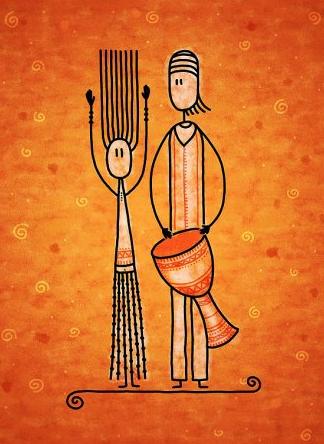
image Vladstudio
Growing up I loved playing my drum-set. In our downstairs playroom I had my 15-piece drum kit setup along with our band’s Peavey amps. Plugged-in to those Peavey amps was my stereo. Through my stereo I played the songs from epic rock-metal bands with more epic – so I thought – drummers. And within moments of beating the skins, high-hat, bass drum, and cymbals…I was there. Much of the sessions I would reach a heart-rate and drive that I could barely hold my sticks from the perspiration. I eventually had to place a fan on top of my bass drum to help cool my frenzied journey. I would reach such a vibrational rhythmic state of meditation that I can only describe as fluid between here and there. My sense of place and time, aside from the rhythm and beat, was lost; oblivious to anything in the house or outside it. It was there that my expression, my place in the moment and in the world, was most creative and most lucid. It was – and to this day as well – my way of belonging.
The years from 1990 to 1995 were the most devastating and most life-changing years of my life. Here’s a summary: My father committed suicide, my girlfriend-turned-fiancé abandoned me and our 2-year relationship without a single verbalized explanation, I was arrested by law-enforcement, I walked out of my wonderful psych-hospital job-career and out of my half-completed master’s program at my seminary, my daughter was born, a 5-month marriage ended, and I moved back to my hometown. Often during those years I sought the solace in the one place I knew I could find it. One song I’d play over and over and over, and behind my drums I’d play along…let go of my nagging thoughts and find my place of belonging. It was the only song, music, and lyrics that would make sense to me where I could find my father and my daughter, both of whom were no longer with me.
I have since learned that finding the place of belonging is sometimes very difficult, even tragic. But having survived it all, I have discovered just how powerful the state-of-belonging and connecting can impact not just a life, my life, but life around us. This is how I’ve equated it in my mind. As the lyrics of the song go…
If you open your mind [and soul]…You won’t rely on open eyes to see
My painful and beautiful journey would not have been possible if I had not had three critical travel-items: my parents and extended family, a creative growth-model of education taught by my father supported by my mother, and then finally love. These three integral parts must continue with us into adulthood. They must evolve and grow in order to best manage in life the inevitable change and unexpected plot-twists!
If you have those three flexing growing components in your life – each illustrated mathematically by dividing 100 into 3 parts – the number cannot be emptied but goes on and on ad infinitum. For me, Fibonacci’s Sequence, or Golden Ratio, would be the counter-part, if you comprehend my wackiness.
The three parts each need more than just the mind or cerebral cortex. They need feelings. They need the freedom of fluid creative passion! Nature and the Universe (Multiverse) already create then modify, refine, then create more and so on like the Golden Ratio. Human DNA, generation to generation, does the same thing. As highly intelligent feeling beings, we have the passions to ignite life. If fortunate enough to have loving, nurturing yet non-oppressive parents and family, then we are given the early tools to ignite a significant belonging life…not just for ourselves, but equipped to provide a general blueprint for others too!
If this parental-family environment is taught throughout the primary and secondary schooling – in other words explained via the table below – empowering the child and adolescent, then the state of belonging can be perpetuated outside of self.

Assuming you are allowed how to think rather than told what to think, then a once very successful American icon spoke these words of enormous spiritual-cerebral wisdom to take on your journey:
“Whether you think you can or you think you cannot – you’re right.” – Henry Ford
If a young mind and heart are constantly denied the means to freely express, create, and recreate, learn and relearn for an eventual greater good, passing on a new fluid blueprint, then it would seem ironically, one becomes entrapped in the past. That is most unnatural. Ford recognized the power of self-actualization learned through and from our environment. In other words, there is a connection between us and everything around us. But there is more Henry – another force that is just as fluid.
Ford’s imparted partial-truth cannot be fully owned without the sticky fuel of feelings and love-ingredients to energize it. There are some things that can’t be taught. They must be realized. Though it had a compass rose, I was given my blank map. The natural aether in the lucid state of vibrant rhythmic meditation is an individual journey…for me discovered during my youth, rediscovered in my darkest hours, and now openly shared in wisdom and passion. It is my primal home away from “home,” where I truly belong.
I swim in it regularly.
(paragraph break)
Live Well * Love Much * Laugh Often * Learn Always
(paragraph break)

This work by Professor Taboo is licensed under a Creative Commons Attribution-NoDerivs 3.0 Unported License.
Permissions beyond the scope of this license may be available at https://professortaboo.wordpress.com.

Most coveted trophy in all of sports
There is an irrational sports mentality in America that the National Football League (NFL), or National Basketball Association (NBA), or Major League Baseball (MLB), and their televised “world championships” are the biggest spectacle in sporting events in the world. This is strictly an American invention, however. It does not exist anywhere except within the lower 48-states. The reality is this: the NFL, NBA, and MLB pale and pale greatly when put next to FIFA’s World Cup tournament and championship every four years. But certainly don’t take my word for it. Let’s look at these numbers.
(line break)
* * * * * * * * * *
A London, UK-based media company called Initiative, Futures sport + entertainment, a firm that publishes reports and research on all and any sporting events, states “Soccer’s domination of global TV viewing is now complete.” According to Initiative, in 2009 the NFL’s Super Bowl XLIII was knocked off its most-viewed-event-in-the-world perch. This television topple has been coming since at least 2002, and immeasurably and arguably well before 2000.
Let’s start with the size of leagues or associations by the number of teams and their fans. These will strictly be men’s sports.
In the NFL there are 32 teams that play for the Super Bowl Championship. In the NBA there are 30 teams that play for the NBA Championship. In MLB there are also 30 teams that play for the World Series Championship. These three American professional sports have a total of 92 teams playing for three different championships. Now let us examine FIFA, or the Fédération Internationale de Football Association.
 For just over three years, 226 national teams all over the world (as of 2014) compete for inclusion into the opening group-play in the FIFA World Cup tournament held every four years. That is over 7-times larger than the NFL and nearly 8-times larger than the NBA and MLB association and league respectively. But this comparison isn’t quite accurate; it doesn’t portray the true size of professional soccer players and their pro teams in each of those 226 FIFA nations.
FIFA is comprised of six (6) futebol, or soccer associations, represented by individual continents. The CAF (Confederation of African Football) comprises 54 national teams, each of those nations with professional leagues of teams/clubs totaling approximately 408 teams within those 54 nations; each team with an approximate roster of 22-25 players. Additionally, the 408 teams are merely the Top professional teams in the continent’s Top Leagues. There are typically lower 2nd and 3rd division leagues, or more, on each continent.
The next continental association, in alphabetical order, is the AFC (Asian Football Association) comprising 47 national teams. Within the 47 member nations, there are approximately 248 clubs/teams playing in AFC’s Top professional leagues; again, with approximately 22-25 players per roster. Once again, there are typically lower 2nd and 3rd division leagues as well.
UEFA (Union of European Football Associations) is the marquee FIFA association in the world, as well as the richest. It comprises one of the two elite Top footballing associations of the world with 54 member nations. Inside of the 54 nations consists approximately 871 Top professional teams/clubs with typically 4 to 5 lower divisions. And remember from here on out, each club’s roster consists of a minimum 22-25 players!
It is worth noting that with each of these national teams and each of these local or regional club-teams within each nation comes a passionate loyal following of fans five to fifteen times larger than the club’s roster! I dare you to try and do that math.
The next FIFA association continent is CONCACAF (Confederation of North, Central America and Caribbean Association Football) with 45 member nations. The United States is a member of this association. Within these 45 nations are approximately 155 teams/clubs playing in their Top professional leagues. And from here on out remember there are typically a minimum of 2 to 3 or more lower divisions.
Next is the OFC (Oceania Football Confederation) comprising 16 member nations with approximately 30 teams/clubs competing in Top professional leagues within these 16 nations.
CONMEBOL (Confederacion Sudamericana de Futbol), or commonly the South American Football Confederation, consists of 10 member nations. This confederation is the world’s second elite association next to UEFA. It has a staggering 1,931 teams/clubs competing in each nation’s Top professional leagues.
 All in all, and if you were not tracking the total number of club teams within each nation in their Top professional leagues (i.e. not including all lower divisions), the approximate total of teams/clubs fielding players who dream about an individual chance to participate in the world’s ultimate sporting spectacle in their lifetime… conservatively it is approximately 3,643 teams/clubs dwindled down to 226 national teams, over a 3-year period, to play together for just two months, every four years. If we multiply those 3,643 teams with their faithful fans, say 5-times the 25-man roster of the club (91, 075 pro players) multiplied by the average soccer stadium capacity of 40,000 spectators, that bare-bone minimum fan-base equals almost 146-million live spectators. But this is a very conservative figure. According to FIFA.com “Facts and Figures”, an estimated 715.1 million fans watched on TV the 2006 World Cup Championship final in Germany; 3.18 million attended the 64 matches of the tournament. And these figures do not include various viewing-venues across the host nation.
The real scale of this sport during the World Cup tournament – not just by persons inside the stadiums but on television, viewing-venues, and now over the internet – is near incomprehensible in size, popularity, and economic revenues. And it is taking place again this June 2014.
In this day and age of sports, soccer is king of mega business: a global industry with a wide spectrum of television contracts and lucrative merchandising deals which generate hundreds of billions of dollars annually. A number of clubs around the world now rank among the highest earning wealthiest sports teams on Earth. However, as quickly as revenues roll-in, they are paid right back out to multi-million dollar player contracts, signing fees and bonuses.
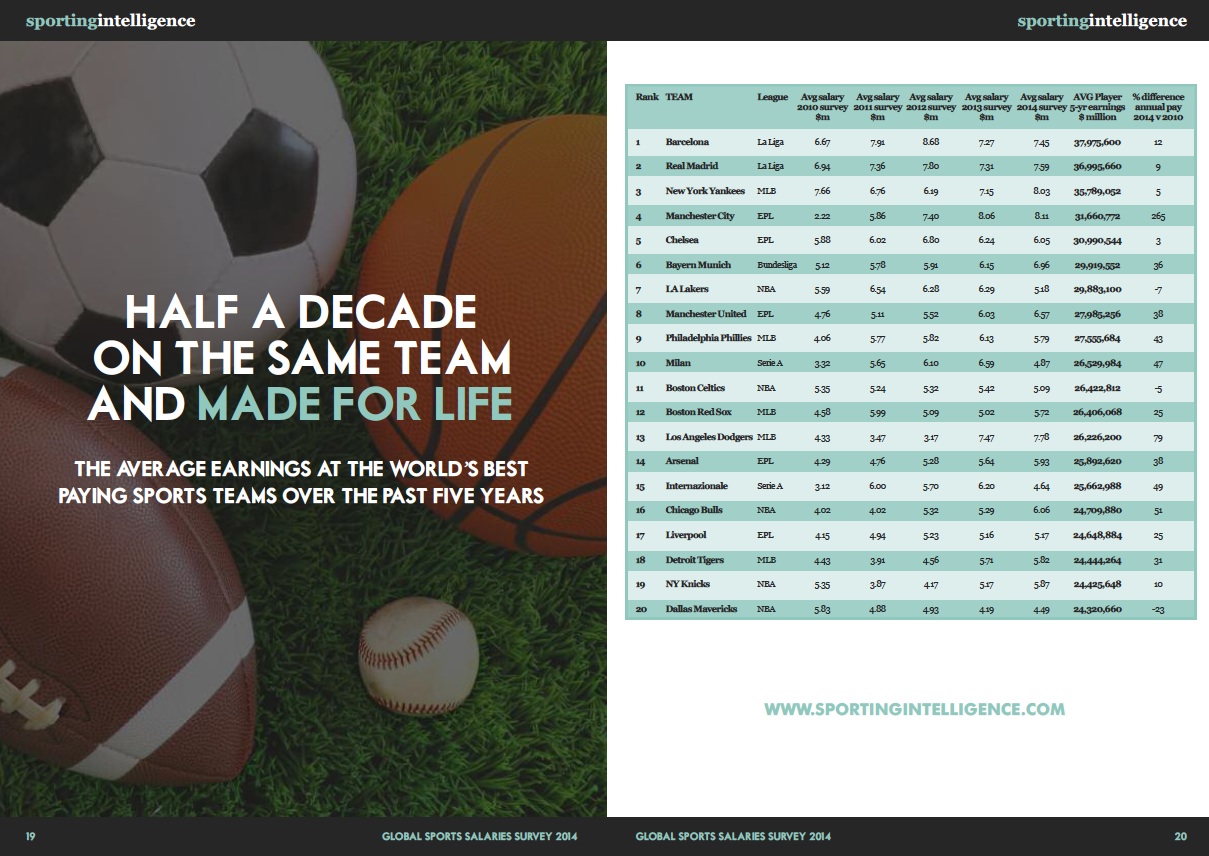
 ESPN Magazine recently reported (April 2014) the Top 25 highest-paid athletes in the world – their endorsements are not included. Of the Top 5, three are soccer players: Cristiano Ronaldo ($50.2M) of Real Madrid FC, Lionel Messi ($50.1M) FC Barcelona, and Zlatan Ibrahimovic ($35M) of Paris Saint-Germain. According to Sportingintelligence’s Global Sports Salaries Survey (April 2014), Manchester City FC of the English Premier League, is the world’s best paid team paying out an average salary of $172,508 per week to its first-team players. Of the world’s Top 5 highest-paying sports teams, Spanish La Liga giants Real Madrid and Barcelona round out fourth and fifth at $161,373 per week and $158,397 per week respectively. The average professional athlete contract is 5-years. In this latest edition of the Global Sports Salaries Survey (GSSS), it provides a list of 100 teams paying out the most money per average first-team player over five years:
“The eye-watering sums on offer in elite European football [i.e. Barcelona FC] and in the major sports leagues in America effectively mean that a single five-year deal should provide enough money to setup a player for life. Real Madrid have the next highest five-year total: $41M per player on average, followed by the Yankees ($39.7M), then Manchester City ($35M), and Chelsea FC ($34.3M).”
The last table-graphic shown in the GSSS article (below image) is particularly enlightening for American sports fans. It shows that of the Top 20 five-year earnings for first-team players of all major sports around the world, HALF of them (10) are soccer teams/clubs. Of the remaining 10 sports, only five are NBA teams and four are MLB teams. National Football League teams do not make the list at all until No. 93: the Dallas Cowboys.
 The primary reason soccer tops most team and player-salary lists is that almost ALL POSITIONS on the playing field are important (probably critical) for the organization to be successful and profitable. Soccer is, as well as basketball and hockey, are true team sports. In the sports of MLB and the NFL, that is not the case. The pitcher or pitching staff and quarterback are the critical positions influencing or controlling most dynamics of the game. Those players earn monumentally more money than their other teammates. It is also the reason why the Chicago Blackhawks of the NHL are 20 places higher than the first NFL team, the Cowboys.
Do these numbers explain why soccer unites more of the world than any other sport on the planet? What about the emotion, the passion of its fans?
What does it mean when one asks the question, “What is the most popular sport in the world?” Does it mean the sport most-watched, most-played, or perhaps the wealthiest based on revenue? Yes to all three. I have done the research and spent the time answering this question, and if you choose to search for the answer as well, you will find the majority of polls and surveys will all say the same thing: soccer.
Why is soccer the king of all sports on the planet and has been for many decades? The passion of its fans is certainly one reason. If you’ve never been to a major soccer game in Europe or South America, among singing dancing fans, you are missing out on a life-time experience like no other. Want a taste?
The wonderful atmosphere of top-flight soccer matches are finally growing in the United States. When the U.S. Men’s National Team qualified for the World Cup in Brazil this summer, listen and watch how 40,000+ fans in Seattle, WA – some of the most excitable fans in the nation – celebrated the 3-year achievement:
But simply being amongst a mass of dancing singing humanity is only part of the experience. Understanding what the world’s greatest players do on the field with that ball, as an 11-man team, explains why it is called and known all around the globe as “the beautiful game.” Soccer is a worldwide language; the most popular language spoken in a multitude of dialects. As a naïve outsider and at first glance, an American might think the world’s passion for soccer is overly simple, unimpressive. One might write it off as a dull 90-minute game with an average score-line of 0-to-0 or 2-to-1 most games. But that impression would be from a grossly uninformed unimaginative closed-mind.
Yes, the world’s love of the game is indeed simple: the action is non-stop; the 22 players improvise tactics in the middle of a flowing game performing spectacular feats of athleticism and skills. But the passion goes much deeper for more complex reasons. The great Brazilian star Pelé describes the game as being so infused in many countries that over time the sport is not just a pastime, but has morphed into a reflection of national character. With the diversity of global geographies and cultures come distinctive playing-styles. These national styles have produced some of the most riveting, most brilliant moments in soccer history! Take a look at these six clips, considered by many footballing fans as the greatest World Cup moments and goals:
World Cup Final 1970 – Brazil’s Carlos Alberto’s goal
World Cup Group-play 1970 – England’s Gordon Banks’ save vs. Pelé
World Cup 1982 – The heavily favored-to-win squad of Brazil: “Ballet with the Ball – A Love Story”
World Cup Qualifier 2001 – England’s goal frenzy vs. Germany
World Cup 2006 – The Tournament’s Best
World Cup 2010 – Top 10 Goals
(line break)
One of the most exquisite skills a world-class soccer player can master is the art of dribbling. The game’s biggest stars have signature tricks and moves to beat their opponent. In real time it is a blur, gone in one or two seconds. But the amount of training and practice required to use them in the game is mind-boggling. Watch these élite players from around the world showcase their best tricks and define why this game of soccer is so worshiped around the globe.
(line break)
 In 1992 in the country of Ivory Coast in West Africa, the Ivorians were so determined to have their national team win the African Nations Cup that the government’s sports minister enlisted a battalion of fétisheurs – juju men – to place on the team a supernatural advantage against rival Ghana. When the minister later broke promises of payment to the fétisheurs, they in turn placed a hex on the Ivorian team, which then went on a ten-year spell of losing results. When the defense minister desperately sought to make amends with the witch doctors, offering cases of liquor and large money bags, the hex was lifted. Almost immediately the team did a 180 and qualified for the 2006 World Cup.
In Spain, where soccer is so dramatic it is often described as theater, a Spanish novelist writes his obsession with the beautiful game this way:
“Once you’ve fallen into the game, there is no getting out… [stats] will tell you almost nothing about the game itself. The player who actually wins the game may be the one who moves into space at the opposite side of the field, drawing a defender, forcing a new configuration upon the defense and making virtually inevitable a goal that was before impossible, but no one – not even he – may be aware of this. It’s all narrative, and thus subjective: Each game is a story, a sequence of ambivalent metaphors, a personal revelation couched in the idiom of the faith. No game I know of is so dependent upon such flowing intangibles as “pattern” and “rhythm” and “vision” and “understanding.” Which may all be illusions. And at the same time it is a very simple game: like dreams, almost childlike.”
 In today’s Croatia, soccer is a form of group therapy which bore a new nation. A match between Zagreb’s Dinamo and Belgrade’s Red Star in 1990 marked the beginning of Croatia’s war for independence. After the opening whistle at kickoff, fans from both teams clashed in the stadium stands, as well as onto the field. A Serb-dominated police force began beating Croatian spectators while allowing Serbian fans to run freely. This ignited the already boiling-over tensions in what was then Yugoslavia. Upon witnessing a Serb-policeman wail on a fallen Dinamo fan, midfielder Zvonimir Boban rushed and karate-kicked the officer (image above left), and later became a Croatian national hero of their independence movement. In one of the biggest upsets in World Cup lore, Croatia beat powerhouse Germany in the 1998 World Cup Quarterfinals and then went on to win third place by beating an equally stacked Netherlands 2 – 1. After the match, Croatians flooded the town squares and streets in adulation and song. On television, many reporters interviewed grown men who couldn’t stop bawling. Courtney Angela Brkic, a Croatian author, stated that “not since the declaration of independence, had so much unified celebration been seen. Now no one could deny Croatia its place on the map.”
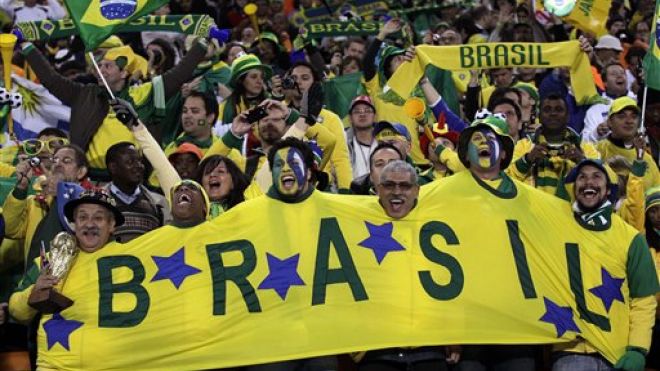 In Brazil, the only nation to have won the World Cup five times and the only national team to have appeared in all World Cup tournaments since its start in 1930, soccer is an ideology and state religion. Nowhere in the world does a nation try so hard to play the game so beautifully as Brazilians. And that is why Brazilian players are so loved around the world by so many fans and top leagues. The Brazilian national team has never been ranked world-wide below No. 10, a record untouched by any other soccer nations. Their fans do the Samba non-stop for ninety plus minutes as their players do indescribable tricks and feats between all ten of their team’s players. It is why Brazil, on any continent, is always the beloved overdog of every World Cup. They are the only favorite that is always a favorite.
If you cannot make it to games in Brazil this summer, the next best thing is to find a local pub or bar with an international flavor and history that will be televising the tournament. I guarantee the place will be raucous and rocking with national team fans. I always try to find a Brazilian restaurant-bar; the atmosphere is utterly electric, colorful, and beautiful. I will most certainly support my U.S. National Team, but unfortunately their odds of advancing out of the early group stage are minimal against the exceptional likes of Portugal, Ghana, and Germany. Nevertheless, the spectacle of the game will be phenomenal and the skills and creativity of the world’s best players on the world stage will be unparalleled. Be a part of it. Be united with the rest of the world for two memorable incredible months!
U.S. Soccer: We Are Going to Brazil
(paragraph break)
This work by Professor Taboo is licensed under a Creative Commons Attribution-NoDerivs 3.0 Unported License.
Permissions beyond the scope of this license may be available at https://professortaboo.wordpress.com.
I love my teaching job for moments like these:
Last week I had to pull an 8th grade boy aside to address his ‘cocky’ bullying. It became quickly apparent that his version of “a man” was arrogant hyper-testosterone peacocking. Where or how he learned it didn’t matter. What did matter was the chip on his shoulder.
I shared with him a lesson I learned when I was about his age about “being a man.” It was taught to me by a REAL man who had it taught to him…
Tearing down people’s lives, maiming them, or even taking life is easy and over-glorified; it requires about as much “manhood” as a gorilla picking up a stick or rock. But helping put lives back together or literally saving them takes an immeasurable amount of manhood. There is no comparison!
[Boy], if you must “stand out,” then stand out with and for the ones who can’t. Choose the harder higher road, not the easiest, and then you’ll understand what it is to be a real man.
Some great examples of “Real Men”…
(paragraph break)
This work by Professor Taboo is licensed under a Creative Commons Attribution-NoDerivs 3.0 Unported License.
Permissions beyond the scope of this license may be available at https://professortaboo.wordpress.com.
As part of the Alternative Lifestyles blog-posts migration over to the new blog The Professor’s Lifestyles Memoirs, this post has been moved there. To read this post please click the link to the blog.
Your patience is appreciated. Thank you!
Divergent Thoughts on Life, Love and Death
life and other weird stuff
Seeking Dialogue to Inform, Enlighten, and/or Amuse You and Me
Storytelling, short stories, fable, folk tales,...
Writing writing and more writing
Analysis & Discussion For Political Uncertainty
I have zero expectation that anything I ever say will end someone’s belief in their God. Not my goal or purpose. That alone belongs to the individual. ~ Zoe
A photo journal of my interests from one extreme to the other.
Cogito Ergo Sum
by Wendy Waters
Understanding the psychology that drives our politics
Ponder(verb) to weigh in the mind; to view with deliberation; to examine carefully; to consider attentively
'Light thinks it travels faster than anything but it is wrong. No matter how fast light travels, it finds the darkness has always got there first, and is waiting for it' - Terry Pratchett
writing on human security
Living and Learning
Some prefer the comfort of Faith. I prefer the cold, hard Truth.
By Keith Goode aka Ken Thackerey
I don’t want to start a class war; it started a long time ago and, unfortunately, we lost.
Searching for truth while leaving tradition behind.
Questioning the conventional wisdom
 The Professor's Convatorium