My Mom is probably in her last few days or weeks—1-3 weeks?—to live so I have been extremely busy with all sorts of legal preparations, Last Will & Testament, medical power of attorney “Do Not Resuscitate” preparations, and then as you might imagine… a ton more tasks, preparations to move again soon, etc., etc., et al. It might not settle back to normal for some time now. 🤷♂️
Mom/Esther circa 2007?Mom & I – Kerrville Ren Festival – Jan 2023
Until the next update… whenever that might be.
Live Well – Love Much – Laugh Often – Learn Always – Celebrate All Human Organic Experiences – Do Not Take for Granted the Human Element of Life!
Many didn’t think it would happen. Hell, I didn’t think it would happen. I had accepted the real possibility that I would live out my life single, unmarried, with no Soul Mate until my last breath. Alone. Then the Universe decided to throw me a lit stick of dynamite last summer and fall and I could not put the fuse out!
Sandy’s genealogy and heritage is Irish (Lyle) and Scottish (Stewarts). I like Celtic and Gaelic culture even though I am definitely Franco-German (Bonet/Bonnet on maternal side, Konzack-Miller on paternal side). We both love silver, not gold. Perfecto!
🧨BOOM! As Sandy and I reconnected more and more every third day, then every other day, then every single day/night multiple times, laughing with each other non-stop that my face-cheeks would begin hurting and my ribs sore, we began to talk on deeper levels. It had always been super easy to communicate together. We have known each other as the best of friends (only) for just over 45-years!
Sandy was my very first therapist after my father’s suicide in July 1990. Sandy was married to her first husband then, of 12-years. I was too busy being a hot metrosexual man, 😈😉semi-pro footballer, while working toward my master’s degree in counseling and therapy, exactly what Sandy finished doing in early 1990. However, Dad’s suicide change everything. My whole world was upside down for the next three or four years. I moved back to Dallas, Texas. Sandy moved to Atlanta, Georgia, and we lived our separate lives, but always staying in touch; and yes, always laughing together.
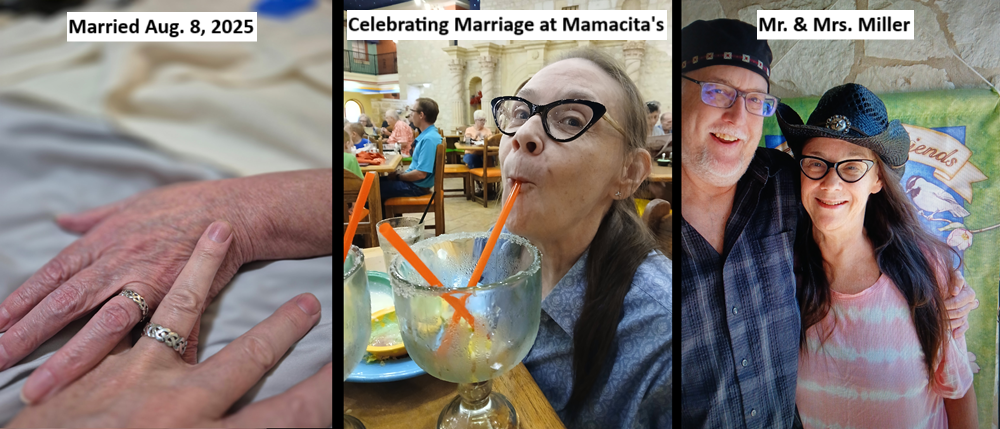
By late November 2024 everything was falling perfectly into place for us. We discussed many times how convenient it would be to get married and both of us not be alone, dying single. She’s 62 (March 29th) and I am 62 (January 4th), three months her senior. She doesn’t like it when I bring that up. 😄 Sandy is quite independent, self-confident always, articulates her thoughts and feelings exceptionally well, and has a fabulous sense of humor and quick wit. My Mom absolutely adores her and Sandy loves Mom since she has lost both her parents. It all just made sense. There was no point in putting it off any longer. Justice of the Peace William “Bill” Ragsdale of Kerr County married us. He made the disastrous mistake of calling Sandy, Sandra, as her legal name and driver’s license read. JoP Ragsdale therefore made a Johnny-on-the-Spot, special adjustment to our marital vows:
We both chuckled every time he said, “Bubba.”
As the legal document indicates, we were husband and wife at 3:23pm CST, August 8, 2025.
Now comes the big, big move for her from Chattanooga, Tennessee, next month and her storage unit filled with all her furniture from her two-story house when she was married—all of it very nice and beautiful furniture and two queen beds, etc. Ugh. 🙄 But honestly, I don’t see any of this being difficult, overly stressful, or untimely. As a matter of fact, in the 45-years we’ve been great friends we have not had one single fight, not even a little spat! This amazes us both, but it is so because we are both excellent, articulate communicators with non-aggressive, pro-positive verbal exchanges without sacrificing brutal honesty. This has always been our best talent/gift together from day one in August 1981. 😍😁
Both of us are excited and looking forward to our lives together full of fun, laughter, and perfect, affectionate communication, the cornerstone of any healthy, long-term relationship and marriage. ❣️💞 😁
Live Well – Love Much – Laugh Often – Learn Always
I want to share some very happy good news for me that was sort of unexpected. Yet, it is worth a blog-post for sure.
I struggled with whether or not to write about it due to my last crushing love-loss with Jodi Kasten. However, at the risk of jinxing these past two weeks, it seems once again that this spectacular, peculiar, sometimes harsh Universe has brought love into my life once again. Sandy is her name. We have been the best of closest friends for over 44-years since our time at university in 1981–1985.
Sandy and I have reconnected recently, last November I think, and it has been like we’ve never lost touch. We just instantly picked-up right where we left off the last time we talked. The most refreshing part of our long, long close friendship was how easily we laugh together! It is often nonstop for hours. While Sandy was here March 22nd thru April 5th, my jaw muscles were literally sore every single day and night because of my incessant smiling and laughing! One night I had to take pain relievers because my cheek and jaw muscles hurt so much. 😄 It was insanely fun!
Now that she is back home in Chattanooga, Tennessee, our lives have returned to a boring normal, too quiet around the house, and me and my “one man show” with no help caring for Mom. Sandy was a massive help to me emotionally, mentally, and when possible physically with tasks—I wasn’t alone in the least. It was euphoric if I’m honest. I miss her. I really do miss her now.
We are already planning for her to fly back out here, perhaps May 24th(?) and staying for three or four weeks that go round. Two weeks this last visit went by way too fast for us. Did I say how much I miss her? Sandy was my first therapist-counselor right after my Dad’s suicide and funeral. She helped me through a LOT of crap emotionally and mentally in 1990. She was a superb therapist and deservedly licensed with a Master’s degree in psychotherapy in family counseling. And we had been great platonic friends all through college at Belhaven University, Jackson, Mississippi. We never really lost touch, just got busy with separate lives, family, blah, blah, blah.
But after this last visit here with Mom and I, it was obvious how good, how close, how sound our close friendship has developed all the best qualities for something more significant. It is an easy, natural fit. We are discussing finding our Justice of the Peace her next time out here. I’ll say this with utter confidence… it will be difficult NOT to marry given what has been easily built over 44-years. To me it seems like a no-brainer.
To be continued… 😁😍
Live Well – Love Much – Laugh Often – Learn Always
Feeling nostalgic today. Feeling somewhere else, and not here, wishing for another time, a more euphoric place where I felt… at home—understood in all possible ways by those who had come into my life… and are now gone from my life. So I post this, I play this special song. It was shared with me by two past Soul Mates/Twin Flames.
This song is also on my page The Bohemian, under my About page. I am a kindred spirit of Bohemia, the French tenets of which I descend from my mother’s side are Creativity, Love, Merriment, Experimentation, Art, and the arousal of all the human Senses. My Bohemian side says:
If I had to give a quick summary of myself, it would be “Bohemian Drummer Living and Musing A Different Beat.”
[…]
This belief in integrity and the intense desire for creative freedom often leads to a threadbare existence. Perhaps this material poverty (or ‘simplicity’ as Thoreau would say) leads to the archetypal Bohemian, wild at heart and empty of pocket.
The two Soul Mates/Twin Flames who shared this song with me and meant for me?
There was a boy A very strange enchanted boy They say he wandered very far Very far Over land and sea
A little shy And sad of eye But very wise was he
And then one day One magic day he passed my way And while we spoke of many things Fools and kings This he said to me
The greatest thing You’ll ever learn Is just to love And be loved in return
And then one day One magic day he passed my way And while we spoke of many things Fools and kings This he said to me
The greatest thing you’ll ever learn Is just to love And be loved In return
Is it coincidence, random one-in-billion serendipity when we encounter a soul mate/twin flame? Or… is it something more?
Running a few errands out and about yesterday in our small rural town of high winds, dust and dirt, arid temps, and persistent drought. I was waiting for my car to be vacuumed, washed, and waxed in the lobby’s waiting area. I soon noticed how many other customers were uninterested in human engagement, not even a quick 30-second courteous or comical exchange. Why? They were all engrossed in their cell phones and a few with ear-buds plugging their ears. Yes, even the elderly there were consumed with their phones. That was a surprise to me.
Heard a song this morning. I hadn’t heard it in a long time. It reminded me of this poem about connection, of authenticity, of vulnerability, of personal growth by acute introspection and extrospection. It goes something like this:
It doesn’t interest me what you do for a living. I want to know what you ache for and if you dare to dream of meeting your heart’s longing.
It doesn’t interest me how old you are. I want to know if you will risk looking like a fool for love, for your dream, for the adventure of being alive.
It doesn’t interest me what planets are squaring your moon. I want to know if you have touched the center of your own sorrow, if you have been opened by life’s betrayals or have become shriveled and closed from fear of further pain.
I want to know if you can sit with pain, mine or your own, without moving to hide it, or fade it, or fix it.
I want to know if you can be with joy, mine or your own; if you can dance with wildness and let the ecstasy fill you to the tips of your fingers and toes without cautioning us to be careful, be realistic, and remember the limitations of being human.
It doesn’t interest me if the story you are telling me is true. I want to know if you can disappoint another to be true to yourself. If you can bear the accusation of betrayal and not betray your own soul. If you can be faithless and therefore trustworthy.
I want to know if you can see Beauty even when it is not pretty every day. And if you can source your own life from its presence.
I want to know if you can live with failure, yours and mine, and still stand at the edge of the lake and shout to the silver of the full moon, ‘Yes!’
It doesn’t interest me to know where you live or how much money you have. I want to know if you can get up after the night of grief and despair, weary and bruised to the bone and do what needs to be done to feed the children.
It doesn’t interest me who you know or how you came to be here. I want to know if you will stand in the center of the fire with me and not shrink back.
It doesn’t interest me where or what or with whom you have studied. I want to know what sustains you from the inside when all else falls away.
I want to know if you can be alone with yourself and if you truly like the company you keep in the empty moments.
— The Invitation by Oriah Mountain Dreamer
It is fine and good sometimes to remind myself of these poetic words and musical lyrics to find tranquility and peace.
Oh, the song I heard this morning?
Live Well – Love Much – Laugh Often – Learn Always
I have zero expectation that anything I ever say will end someone’s belief in their God. Not my goal or purpose. That alone belongs to the individual. ~ Zoe
'Light thinks it travels faster than anything but it is wrong. No matter how fast light travels, it finds the darkness has always got there first, and is waiting for it' - Terry Pratchett






 The Professor's Convatorium