DRD4-7R

orchid

Orchid?

No, it is not a new type of iPhone, or video recorder, or measurement, or even the launch code for your nearby missile silo.  Give up trying to guess what DRD4-7R is because it is so small, so tiny, that you will never touch it.  It could be inferred that cats have it, but that assumption would fall short when they returned home, every time.  No, it is not explicitly manifested in any animal on Earth and it cannot be found in any plant or stone.  But it is indeed part of our human wiring.

Many times throughout my adult life I have asked myself Why am I so intrigued with new things, new places, new feelings, and new people?  Why do I start to get restless over a long period of time seeking new adventures?  I accepted long ago that I have this Marco Polo type personality; I love to inquire.  I love to explore!  Why?  If you understand the purpose and nuances of goalkeepers in sports, like hockey or my lifetime sport soccer, then you’ll understand this one:  why did I choose to, no persisted in playing the position of goalkeeper?  What sane person wants objects hurled or kicked at them hard?  Then the other day I read a fascinating article in the January 2013 issue of National Geographic magazine ironically asking and answering my same questions!  This totally explains my addiction to everything National Geographic!  More please!  I read further.  Ah, dopamine.  It’s the dopamine!  Hmm, duh.

Or dandelion?

Or dandelion?

For those of you with a slight variant of dopamine than perhaps I and others may have, dopamine “is a neurotransmitter that helps control the brain’s reward and pleasure centers.  Dopamine also helps regulate movement and emotional responses, and it enables us not only to see rewards, but to take action to move toward them.  Dopamine deficiency results in Parkinson’s Disease, and people with low dopamine activity may be more prone to addiction.  The presence of a certain kind of dopamine receptor is also associated with sensation-seeking” according to Psychology Today.  Not so coincidentally, though I am not an “addict,” several of my extended family members are addicts…as well as my sister.  I guess I selfishly stole most of it from mother’s womb before my sister could snatch any.  I know she’ll argue this, but I was always quicker than her!  And not surprisingly, several laboratory studies in Europe, Israel, and the U.S. have found that a lack of the 7R variant is linked to depression or lower motivation.  I found this result very interesting.

As I continued to read, in my mind all the dots — from the broad picture down to the microscopic — were connecting and making perfect sense; perfect harmony like a homecoming.  But not permanent!  A homecoming and going!  And my fascination with bird cages — naturally with an open door or no door — now made sense too.

Orchids versus Dandelions

Am I an orchid thriving in stimulating environments, or am I a dandelion that manages to adapt and survive in harsh environments?

Perhaps the better question would be could there be hybrids of the two?  David Dobbs has written several articles on this gene and the genetic-cultural roots of human temperament, and is the writer of this National Geographic article that has captivated me.  He explains:

“If an urge to explore rises in us innately, perhaps its foundation lies within our genome.  In fact, there is a mutation that pops up frequently in such discussions:  a variant of a gene called DRD4, which helps control dopamine, a chemical brain messenger important in learning and reward.  Researchers have repeatedly tied the variant, known as DRD4-7R and carried by roughly 20 percent of all humans, to curiosity and restlessness.  Dozens of human studies have found that 7R makes people more likely to take risks; explore new places, ideas, foods, relationships [guilty in the 1st degree there!], drugs, or sexual opportunities [should I say it again?]; and generally embrace movement, change, and adventure.  Studies in animals simulating 7R’s actions suggest it increases their taste for both movement and novelty.  (Not incidentally, it is also closely associated with ADHD.)”

"Take one 10mg tablet once daily; for severe cases take with liquor in a Hazmet suit."

“Take one 10mg tablet once daily; for severe cases take with liquor in a Hazmat suit.”

In another March 2012 article on Wired.com, Dobbs further explains:

“This revisionist hypothesis is known variously as the sensitivity hypothesis, the differential susceptibility hypothesis, or the orchid-dandelion hypothesis — a term that Thomas Boyce and Bruce Ellis coined based on the vernacular Swedish term “dandelion children,” who seem to grow up okay in almost any environment; to that they added “orchid children,” who thrive under good care but wilt under bad. It is a young hypothesis, hatched 15 years ago and obscure for most of that time. But in the last two or three years it has gained enormous traction, spreading through behavioral genetics, child development, and anthropology.”

At this point in my reading and research I feel as if I’m reading parts of my biography or journal called This Is Who I Am and Why.  It helps me at least process further and understand so many how’s and why’s, like Why have I been single unmarried most of my life?  Have I not been hanging around long enough in the right flower or weed gardens!?  Does this explain my need for Zyrtec at certain times and circumstances of the year! Geeezzzz.  It does make sense:  like a love-hate thing for the beauty of new outdoor places, but then you discover all the annoying bugs, insects, reptiles, and yes, inevitably Medusa!  No, I’m kidding…..about nature’s creatures.  Hah!

On a serious note however, geneticist are also associating the 7R variant, and another:  the 2R, back to our ancient ancestors in Africa 70,000 – 50,000 years ago.  For a quick tutorial read my post Our Family Reunion.

Anthropologists suggest that this minority of humans are the reason mankind migrated out of Africa; to find new sources of food and a different way of life.  Scientist do know that astronauts or cosmonauts, or whatever title the sponsoring group bestows on their explorers/adventurers, 7R is definitely found in their genetic code.  They are the risk-reward breed and today they are found in many walks of life.  On a spectrum left to right 1 through 5, left being pure orchids (1)….right being pure dandelions (5), I am firmly a two if not one-and-a-half.  I most definitely get restless after long periods of routine.  I am not saying I am ADHD and can’t focus — on the contrary I am very task-oriented — but I am most certainly not a permanent settler!  This is probably why I have some, umm, excuse me….(ahhh-CHOU!) dandelion in me:  I am happy to adapt….to what I want to adapt to….and as long as a few other Bohemians are around, then I will be first in line!  Let’s go!

Are you an orchid or a dandelion?  Or perhaps something in between?  And why?

(paragraph separation)

FootnoteFor the full Dobbs National Geographic magazine article, go to this link:  Restless Genes

Live Laugh Love

(paragraph separation)

Creative Commons License
This work by Professor Taboo is licensed under a Creative Commons Attribution-NoDerivs 3.0 Unported License.
Permissions beyond the scope of this license may be available at https://professortaboo.wordpress.com.

Let Your Fears Go

Sunlounger+feat+Zara+shah++zara

Sunlounger & Zara Taylor

As my previous post stated, I have done a lot of work outdoors.  Some of it enjoyable and some of it down right exhausting.  Up, down, up, down…kneel, squat, bend over (don’t let your imaginations go there!), then repeat.  Yet what has made it all more a labor of love and not just labor has been the addition of my music.  My vocal trance music which is energizing and upbeat with gorgeous vocals and addicting rhythms.  The addicting rhythms are most definitely the cause of my many sore stiff shoulder muscles and abs!  Ah, the wonderful pain that is good and healthy!  It is welcomed soreness that some of you, like me, who have been and a part of the BDSM lifestyle can deeply understand.  In the lifestyle it is described as flying or sub-space; a natural euphoric high of neurons, hormones, and soulful dimensions.  And my music lifts me and launches me there every time.  Here is one of those tracks that propels me, especially at the 5:25 mark building up to the 7:08 mark…oh my frickin GOD that part puts me in a timeless oblivious place!

My favorite part of Zara’s lyrics:

Just let your fears go
You might find your way back home
Let your fears go
You might find that you’re not alone.

One of my favorite quotes I reference many times and which means so much to me is “Fear stifles, courage fulfills.”  Four simple words with enormous power!  Think about it.  And in this case while this fantastic song plays, FEEL IT!

(paragraph separation)

Live Laugh Love

(paragraph separation)

Working Waggle Dancers

IMAGE_098

The pond and piles of leaves. Click for larger image.

Raking and picking up the fall live-oak leaves has been overdue.  Not only that but living on top of a hill with never-ending breezes blowing the tiny leaves into the waterfall and pond, add to and make the job more tedious and longer!  Then it soon reaches the filter which protects the pump, which quickly needs cleaning too!  Last week and this week I have been Yard Man, Pond-n-Pump Man, and like the honey bees we have around, doing it all under the influence and motivation of my loud vocal trance music and the smell of jasmine:  the Dancing Yard Pond-n-Pump Man.  I must admit, there might be a better way of completing these spring chores, but for me there’s no other enjoyable way of doing them.

IMAGE_097As I was cleaning out the pond, treating the water with algae killer, and rebuilding the goldfishes’ rock covered hideaway, I could not help noticing the number of honey bees buzzing me.  They didn’t seem to be as interested in me as they were the water and Lilly-flowers; no need for alarm.  They are worker bees obeying their Queen to go out, seek and find the stuff of food and honey for the hive.  Such is the system of life in springtime.  But curiously when I was at my laptop adjusting the volume from loud to louder, four to six of those buzzers were buzzing my speakers, sometimes the laptop.  I thought “Now that is curious!”  Why were they so interested in my speakers?  Or were they interested in what was coming out of my speakers?  Then I thought “Hah!  They must be Vocal Trance and dance lovers just like me!”  And that’s when it hit me…. bees communicate with each other by specific dances and by the flapping (or buzzing) of their wings:  vibrations/sound waves.

I, like the bees, was working harder by my music and its vibrations.

While I continued to clean the pond and sit next to my music on the laptop to take breathers, I had no reason to be bothered by the honey bees.  In a sense, we were both doing the same work, for our home/hive.  We were dancing busy bees.  We would come over to the music, feel it, and be re-energized.  Then it was back to dancing…. back to work.

Being the inquisitor that I am, I decided to lookup how honey bees communicate with each other.  Scientists have learned that bees talk to each other in remarkably similar ways humans do.  Of their five senses, honey bees communicate through pheromones and choreography.  Think about it, other than talking, how do we like to communicate when we are out in public?  Certain perfumes and cologne mix well with our body’s skin oils, or pheromones.  Other than talking, how else do we communicate?  By how we move.  Honey bees tell each other where a food source is by doing a waggle dance.  All the worker bees (or in this case, dancing bees) pick up on it.  For people our motions and manners convey who we are and what we are doing.  Honey bees are not much different.

Our jasmine vine and blossoms

Our jasmine vine and blossoms

Speaking of attractive smells, there was a spot in the yard I particularly liked to work and work slowly.  It was downwind of the jasmine vines.  If you have not smelled fresh jasmine blooms, then you are missing out on one of nature’s sweetest addicting aromas you’ll ever have the pleasure of inhaling.  Whoa!  I asked myself, is there a way to bottle this or roll it and smoke it?  Or put it in a low-burning oil fragrance bowl?  Holy cow, is there a support group Jasmine-Anonymous for jasmine addicts?  Because I’ll become a lifer!  And no surprise, guess who else enjoyed the blossoms?  My waggling work buddies the honey bees.

As a young boy growing up who had to rake and pick up all the leaves in our huge yard, and inevitably come down with allergies and sinus drainage and swelling, I never looked forward to or enjoyed early spring.  However, this time was very different.  This time I could blast my inspiring music, work and dance with the bees, and the entire time take big whiffs of jasmine like I was inhaling that cigarette after incredible sex.  Though I don’t smoke, I know smokers know what I’m talking about.

In a weird way I want the work to go slowly.  I’m enjoying it.  I guess you would have to be here to understand.

(paragraph separation)

Creative Commons License
This work by Professor Taboo is licensed under a Creative Commons Attribution-NoDerivs 3.0 Unported License.
Permissions beyond the scope of this license may be available at https://professortaboo.wordpress.com.

After Dark

Milky Way in clear skies in remote America

When the sun’s light completely recedes, I bet you had no idea that with your naked eyes or a pair of inexpensive binoculars you can gaze upon constellations, nebulas, star clusters, planets, double stars, and even one galaxy that is only two million light-years away.  With summer approaching many might be traveling west to our National Parks where very little to no extraneous light washes out the splendor of our night-time cosmos.  This post is Part One of a three-part series.  Check back later for part two.

Our moon is one of the brightest objects to gaze, however, there are many others.  Our surrounding atmosphere has several phenomena and all the planets can be seen with the naked eye or binoculars except Pluto.  Asteroids, meteors, and comets can be detected as well.  And even further away you can spot star clusters, nebulas, and constellations including that one galaxy 2-million light-years away.  Yet, most star-gazers do not realize there is a nightly twilight phenomena which is closer than our moon.  It is closer than our own atmosphere.  It is Earth’s shadow.

Just as the Sun sets look opposite of it (easterly) close on the horizon.  Within minutes you will start to see a dark blue band begin to rise just above the horizon.  This is when the band is darkest.  As it starts to move upward, it will fade, until it disappears into the night sky at the ending of twilight.  This dark band marks the edge of the shadow of Earth’s horizon.  Red light from our Sun illuminates our atmosphere above the band.  The band is blue due to the blue part of sunlight which has been scattered into the shadow by dust particles.  If you see Earth’s shadow vividly, then there is little dust or humidity in the air.

We are of course inside the Milky Way galaxy.  The Milky Way is approximately 80,000 to 100,000 light-years across!  Our Sun rests 30,000 to 35,000 light-years from the center.  There are more than 1,000 clusters of stars within our galaxy, all of which are easily visible with binoculars.  Beyond the Milky Way is a bunch of empty space, and then a lot more galaxies.  The Milky Way is part of a group of galaxies called the Local Group and the flagship of this group is the Great Andromeda Galaxy.  The Andromeda Galaxy is so large and massive that it is the only galaxy we can see with the naked eye.  Out beyond our Local Group are more clusters of galaxies, as many as you could ever count in 50 lifetimes!  In fact, it makes no difference what direction you look with whatever size telescope you view, all you can see are galaxy upon galaxies.

Stargazing Basics

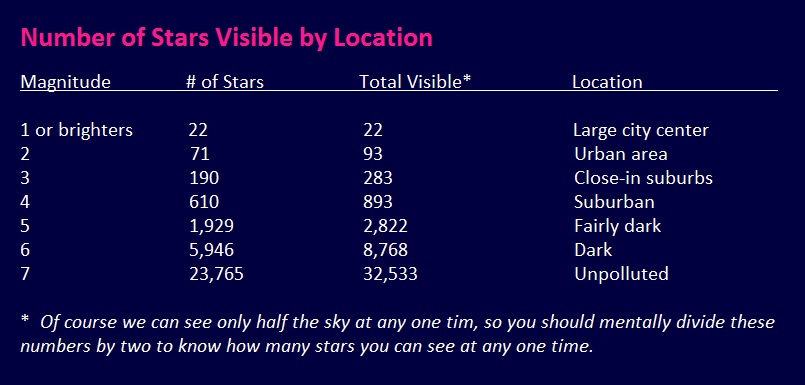
Visible Stars TableOne or three nights of viewing the night sky will not turn you into an expert astronomer.  However, there are four basic principles to help you and your fellow sky troopers understand what you’re viewing in the after hours.

BRIGHTNESS  The brightness of a particular star is measured by its magnitude.  Its magnitude is governed by how bright it actually is and how far away it is from Earth.  The brightest star in our night sky, Sirius, shines at a magnitude of 1.4, but its actual brightness is much less.  It is less because it is very close to Earth, just a mere 8.2 light-years away.  How exactly is magnitude determined?  It depends on your location.  If you are inside or near a large city, your 22 visible stars will be only a 1-magnitude or brighter.  On average, stars of the 2nd magnitude are actually 2.5 times dimmer than those of the 1st magnitude, and so on down the line.  In a moderately dark sky, you can view stars of about the 5th magnitude.  On super dark nights (no moon) we can most likely find 6th and 7th magnitude stars (see table above).

COLOR  A star’s color can reveal a lot about its nature.  Generally speaking, the more blue a star appears, the hotter it is, and the redder it is, the cooler it is.  We typically do not see stars easily with our naked eye, but the colors are a lot more obvious through binoculars.  And kids see star colors a lot better than adults.

EVERYTHING’S MOVING  It takes at least 15 minutes for our eyes to adjust to the darkness.  During that time, pick the brightest object you can see near one of the horizons.  Take note of its position relative to a tall tree, mountaintop, or building.  Once your eyes have adjusted, notice the object is moving up if you’re looking east, down if you’re looking west, or mostly left to right if you’re looking south.

DISTANCE  Because outer space is so unimaginably vast, it makes little sense to measure distances in miles or kilometers.  Instead, astronomers use how far the speed of light travels in an amount of time.  The Moon is about 240,000 miles away, but astronomers say it is 1 1/3 light-seconds away.  Our Sun is 93,000,000 miles away, but 500 light-seconds, or 8 1/2 light-minutes away.  When Jupiter is closest to Earth, it is 35 light-minutes away; in other words, when its reflection reaches us we are seeing 35 minutes into Jupiter’s past.  Now here is a mind-blower:  astronomers have determined that our Universe is approximately 13.8 billion years old.  What this means is we cannot see any further than 13.8 billion light years beyond Earth, because the light from whatever’s farther out hasn’t had time to reach our eyes yet!

Celestial Assembly

Looking up into the night sky it seems as if everything is painted onto an enormous black sphere that’s far away.  Astronomers call this the celestial sphere and find positions on it in similar ways we denote positions here on Earth.  There is a celestial equator too, just like the Earth’s equator but projected up onto the celestial sphere.

Image courtesy of burro.astr.cwru.edu

Seasonal Big Dipper. Image courtesy of burro.astr.cwru.edu

As mentioned earlier, objects appearing to move in the sky from night to night (or, in the case of meteors and man-made satellites, a lot faster), are all inside our Solar System.  To us, our Sun appears to move across the sky along a line we call the ecliptic.  This term is used because eclipses of the Sun and Moon are related to this line.  Tomorrow evening April 25th, 2013 there is a partial lunar eclipse.  Since the nine planets all move in nearly the same plane as the Earth’s orbit around the Sun, they too appear to move about the night sky near the ecliptic.  This is why on star maps they include the ecliptic as the narrow yellow belt.

Most modern astronomers do not use identifiable constellations such as the Big Dipper or Little Dipper to locate objects.  There are 88 recognized constellations that divide up the sky, many of which we never see here in the United States.  They are too far south.  Here in the northern hemisphere there is about 25% of the sky that is invisible to us.  For example, Americans cannot see the Southern Cross.  Only people close to the equator in tropical latitudes in the northern hemisphere can view the Southern Cross for a few brief hours during winter and spring.  Conversely, for viewers in places like Australia, they never see the northernmost 25% of our sky or the Big and Little Dippers which Ferris-wheel around Polaris, the North Star.

Cassiopeia as seen by naked eye

Cassiopeia as seen by naked eye

Just as southern constellations never rise above our horizon, others never set.  Even when the day’s Sun is drowning out the stars, there are constellations which despite the season never vanish.  These are called circumpolar constellations.  As seen in the image above, the Big Dipper is always visible to us in the northern hemisphere 24/7.  During the Fall it is just above the horizon and in Spring highest above the horizon.  For thousands of years ancient travelers of both land and sea used these circumpolar anchors to guide their way.  They too used the “dippers” to orient themselves, but often they included the constellation CassiopeiaCassiopeia is always opposite the Big Dipper and is noted for its “W” shape.

Most all of the constellations tell a story, a mythical story of the ancients.  This is why so many are fond of astronomy and stargazing:  you can impress your friends with stories of gods and goddesses behaving badly or saving mankind.

Well before the time of TV and video games, ancient cultures had to find their amusement wherever they could.  These myths, given by the stars to mankind, were most definitely the plots and schemes of the first “soap operas.”  Because most of Earth’s landmass lies in the northern hemisphere, the southern constellations represent scientific tools which seafaring navigators used.  And, of course, the 12 constellations that hug our ecliptic are the signs of the zodiac in astrology.

Some constellation figures like the Egyptian Orion, are fairly convenient to recognize, and others are simply “gap-fillers.”  And despite those old stories reminding us of a bunch of angry child-like behaving deities, they are fun to share and find in the night sky.  They connect us to our distant past.  And if your friends, spouse or romantic lover isn’t that impressed by your vast knowledge of the sky, these cultural backgrounds are certainly justification for learning the constellations.  No one should presume they can actually trace out a “reclining virgin” (aroused for an evening) when you are looking at the constellation Virgo!  One must know what you are looking at and how to find it if you are to be a true romantic lover!

* * * * * * * * * *

In Part Two of this series, I will give a quick guide to the remarkable celestial shows and events arriving between 2013 and 2015.  Grab your drinks, popcorn, lounge-chairs, and stargazing buddy.  It’s going to be quite a show!

Creative Commons License
This work by Professor Taboo is licensed under a Creative Commons Attribution-NoDerivs 3.0 Unported License.
Permissions beyond the scope of this license may be available at https://professortaboo.wordpress.com.

Rhythms

There is perhaps no other auditory rhythm or pulse that reaches me as deep as music and its beat.  The connection I feel, the alluring sound just captivates my senses like a euphoric drug!  It is and has been my drug-of-choice for some thirty-five plus years.  And then descending from a long line of family who religiously dance… it is no wonder why I spend hours upon hours on the dance floor.  As I write this post I am listening to one of my favorite DJ’s in Dallas:  Per, who is a regular at The Church.  Like Per, I too am moved by Synth-Pop or Future-Pop, a European industrial-electronic-trance genre.  Here is one of his sets he played at The Church:

I’ve had technical issues with the SoundCloud player so if it isn’t loading up, click here to go to Per’s set.

The ChurchHave you ever danced so much and for so long that by 4 or 5 a.m. you are so exhausted that seconds after you sit or lay down you just slip into a deep slumber?  If not, then I highly recommend you do it.  It is like the deepest restful sleep you’ve possibly ever had.  You lay there knowing you have been rebalanced, reconnected with Earth and the Multiverse.  Not only do you “return home” but, it is a fantastic cardio workout!  Something I’ve quoted before deserves repeating:

Here is the mystery: If the rhythm is right, if the translation between inner mood and the drum membrane are perfect, then you know it instantly. “Ah, this goes with my body tempo, this connects how I feel today, how fast my heart is beating, what my thoughts are, what my hands feel like.”

When the rhythm is right you feel it with all your senses, every corner of your soul and being. You don’t fight it, but instead allow yourself to be propelled and consumed by its insistent yet familiar feeling.  All sense of the present moment disappears, the normal categories of time become meaningless.

We live on a planet of rhythm and time.  A planet that completes its cycle around the sun every 365 days, with a moon that cycles around us every 28 days, and we rotate around our own axis every 24 hours.  These cosmic cycles and our bodily ones, all connected to the circadian dance of day and night.  The mystery of rhythm and time found for a moment in the soul’s drum.  When it is right, you feel it with all your senses, every thread of your being.  It is the ‘sweet spot’ of connection.

Let your soul and body be carried away with the rhythm; feel it…drift, move.  You will not regret it.  No matter what anyone thinks, it is natural, it is genetic.  Dance together as partners or dance solo.  It makes no difference.  Just connect.  Let the rhythm take over, close your eyes, and move, dance like no one is watching.

(paragraph separation)

Live Laugh Love

(paragraph separation)

Creative Commons License
This work by Professor Taboo is licensed under a Creative Commons Attribution-NoDerivs 3.0 Unported License.
Permissions beyond the scope of this license may be available at https://professortaboo.wordpress.com.