(paragraph separation)
This brings new meaning to “SHUT UP and lay there!” Can anyone relate?
(paragraph separation)
(paragraph separation)
This brings new meaning to “SHUT UP and lay there!” Can anyone relate?
(paragraph separation)
(paragraph separation)
 As some of you are aware, I teach 4th through 12th grade Special-Ed science, social studies, and secondary career development at a charter school. Close to two-thirds of our students are either wards-of-the-state and/or special-needs. Due in part to the nation-wide recession and severe federal-state education cuts and the increasing gap of social-economic inequality in America (families in poverty vs. families with great wealth), my workload and hours are increasing between 25-30% for the 2012-2013 school year. However, my meek salary and annual increase has been frozen – while our cost-of-living continues to run free like a gorilla in a banana farm. Even more astonishing, the social expenditures to address and manage our nation’s growing impoverished families – the exact families my students come from – are dropping through the basement in alarming amounts.
I am not blowing a horn that many haven’t already heard: America is in a very serious economic and social crisis! But what I would like to convey is a re-evaluation of a socio-economic system that like the Roman Empire, is heading toward collapse.
Here is a crash-course in basic social sciences.
All people on this planet have the same basic needs for food, water, clothing, and shelter. People everywhere live in families, or primary groups, and they get these needs in one of two ways: in a way that is individually and socially beneficial, or in a way that is damaging socially and eventually to themselves, i.e. illegally according to the group’s/society’s laws-of-behavior. The methods of obtaining these basic life-needs are directly proportional to a society’s advancement or decline in relation to available resources; or in an advanced civilization, the opportunities available. I would like to elaborate on this basic social equation.
 Advancement in a civilization can be categorized in six stages essentially developing for the greater good. Decline in a civilization is the reverse of these stages coupled with and caused by increased crime, civil revolt, and/or war(s), and deteriorate the greater good. In my diagram Development of Civilization right, the United States is by global comparisons clearly in the last blue stage. However, most indicators show that we are digressing, not only by global rankings but by our own domestic indicators as well.
The Human Development Index (HDI) is an index created by the United Nations Development Program to measure development of all member nations according to a composite indicator of life-expectancy (healthcare), educational attainment for youth and adults (primary, secondary, and tertiary programs & literacy rates), and finally individual income-wealth (Per capita gross domestic product). According to the index covering 1975 to 2005, a thirty-year period, you might be surprised that the United States does not rank in the top 10. Over the scope of annual indices the U.S. ranks higher. However, a 30-year scope shows a trend. Here are the rankings:
Life-expectancy is directly related to a society’s or nation’s healthcare system. In the 1975 Human Development Index the United States ranked sixth barely above Norway; a real fall in less than one family generation for one of the most advanced civilizations. However, this 30-year index doesn’t paint the whole picture. The World Health Organization (WHO) published a ranking in 2000 of the world’s health systems. Out of 190 nations the U.S. ranked 37th. The 2000 report was WHO’s last publishing due to vast complexities in compilation. The Common Wealth Fund did a study of 19 industrialized nations on deaths considered amenable to healthcare before the age of 75. In their 2002-2003 study the U.S. ranked 14th. Yet, the U.S. ranks 1st or 2nd worldwide in total expenditures toward healthcare as a percentage of its GDP according to WHO. To put it another way, in Italy, Hong Kong, France, or Japan, citizens pay much less for noticeably better overall healthcare.
The attainment of education is also directly related to a nation’s social and economic development or decline. Education and literacy directly affect a civilization’s progress. If literacy and education are stable and improving, so goes the civilization. If education and literacy are unstable and declining, so goes the de-civilization of its people. According to the Organization for Economic Cooperation and Development (OECD) the U.S. ranked 16th worldwide for literacy (reading, math, & science above 15 yrs old) in 2000, ranked 27th in 2006, and 23rd by 2011 according to UNESCO. A muddling in the mid to low 20’s will not improve over future generations unless attainment of quality education by our general population improves. This in turn requires tax revenues as well as a proportionate per capita GDP. But this is not happening. Though America is one of the wealthiest nations in the world, the overall American standard of living has been in serious decline since at least 1981.
A dysfunctional healthcare system and underfunded public education system will have tragic implications for American society. Joseph E. Stiglitz is the 2001 Nobel Prize winner in economics. He writes in The Price of Inequality: How Today’s Divided Society Endangers Our Future:
The consequences of pervasive and persistent poverty and long-term underinvestment in public education and other social expenditure [healthcare] are also manifest in other indicators that our society is not functioning as it should: a high level of crime, and a large fraction of the population in prison. While violent-crime statistics are better than they were at their nadir (in 1991), they remain high, far worse than in other advanced industrial countries, and they impose large economic and social costs on our society. Residents of many poor (and not so poor) neighborhoods still feel the risk of physical assault. It’s expensive to keep 2.3 million people [illiterate or semi-illiterate] in prison. The U.S. incarceration rate of 730 per 100,000 people (or almost 1 in 100 adults), is the world’s highest and some nine to ten times that of many European countries. Some U.S. states spend as much on their prisons as they do on their universities.
As I mentioned earlier, a civilization on the decline has increased crime intertwined with widening social and economic wealth-to-poverty levels. When the opportunities for socio-economic advancement are hard, few and far between for a country’s impoverished, or semi-bankrupt per capita GDP families making only $41,890 per year in 2005, obtaining basic or moderate life-needs turns immoral or criminal. At least two sets of statistics indicate this trend.
 Generation Extreme – Death Rates of Young People
This bleak outlook doesn’t improve. In 2011 the Murdoch Children’s Research Institute and University of Melbourne published a table ranking 28 industrialized – or modernized – civilizations according to their mortality rate of 10 to 24 year olds per 100,000 population by traffic accidents, violence, suicide, and “other” causes. Sadly, it ranks the United States first in all four categories, with the most glaring difference being deaths by violence, out doing the other 27 countries substantially.
One way or another these numbers can be attributed to any combination of three variables: lack of happiness, lack of education, and lack of social-balance. And these three factors are derived from available or unavailable resources and opportunities.
Get a stout cocktail, this statistic doesn’t paint a pretty picture either. In 2007 the United Nations Development Program (UNDP) released statistical data regarding nation’s prison populations and incarceration rates. Once again the U.S. ranks first, or highest in number of prisoners per 100,000 population. Our total prison population is nearly three times higher as the second highest nation Russia.
 One indicator of the immorality rate is hate crime statistics. In 1990 Congress enacted the FBI Hate Crimes Statistics Act but not all states reported during the following five years. In 1996 all fifty states reported their data. Here are those results for the following 14-year period shown in the table.
As the data indicates, religious, ethnic/national origin, and sexual orientation are and have been on a steady climb. A statistic I do not need to illustrate is America’s appalling divorce rate (over 50% in 2010). For the sake of time, I will also not include incidents of domestic-family violence not related to racial, religious, ethnic/national origin, sexual orientation, or physical-mental disability. These cases are typically attributed in various combinations to psychological, psychiatric, and drug-abuse or addiction. Naturally the treatment and management of these problems goes back to available healthcare, and on a broader scale education, employment/unemployment, and overall happiness.
I stated earlier that the United States is on a path to socio-economic collapse, remarkably like the great Roman Empire. The familiar cliché history repeats itself, could not be truer here. Yet, many Americans believe we are the strongest wealthiest nation on earth of which all nations should model themselves. True, but only on the surface and ONLY in the top 1 percent of the population or the top 10% at best. The lower 90-99% has seen their standard of living erode frankly. Nobel Prize winner Joseph Stiglitz describes our historic predicament strikingly Romanesque:
If struggling poor families get our sympathy today, those at the top increasingly draw our ire. At one time, when there was a broad social consensus that those at the top earned what they got, they received our admiration. In the recent crisis, however, bank executives received outsize bonuses for outsize losses, and firms fired workers, claiming they couldn’t afford them, only to use the savings to increase executive bonuses still more. The result was that admiration at their cleverness turned to anger at their insensitivities…
…We described earlier the huge gap between CEO pay and that of the typical worker – more than 200 times greater – a number markedly higher than in other countries (in Japan, for instance, the corresponding ratio is 16 to 1) and even markedly higher than it was in the United States a quarter century ago. The old U.S. ratio of 30 to 1 now seems quaint by comparison…
…What’s worse, we have provided a bad [model], as executives in other countries around the world emulate their American counterparts. The UK’s High Pay Commission reported that the executive pay at its large companies is heading toward Victorian levels of inequality, vis-à-vis the rest of society (though currently the disparity is only as egregious as it was in the 1920’s). As the report puts it, “…publicly listed companies sets a precedent, and when it is patently not linked to [overall] performance, or rewards [overall] failure, it sends out the wrong message and is a clear symptom of market failure.”
 If you are familiar with ancient Roman civilization, or even Victorian civilization in Europe, then you are also familiar with the stark inequality of their respective populations. Both Rome and the great British Empire of the 18th century CE crumbled under this bloated weight of inequality. Rome vanished and Britain to a mere semblance of its former glory. Obviously at the risk of oversimplification, this socio-economic inequality is the consequence of the denial of the altruistic and philanthropic system of the Greatest Good for the Greatest Number lifestyle. I will return to this concept later, but first I want to explain another accurate form of socio-economic performance.
The Gini Coefficient (illustrated left) measures the degree of inequality of the distribution of family income within a nation. Basically, a gini coefficient of zero indicates perfect equality, and a gini coefficient of one represents a maximum inequality of incomes. Nations with coefficients of 0.3 or below are considered mostly equal. Nations with coefficients of 0.5 or above are considered mostly unequal. If you have finished your stout cocktail, pour another because this U.S. comparison to the rest of the world is going to break your heart.
According to the 2011 CIA World Factbook – Gini Index, the United States ranks practically the same as Cameroon (Africa) and Uruguay (South America). Stiglitz puts it in these terms: “According to UN data, we are slightly more unequal than Iran and Turkey, and much less equal than any country in the European Union.” Our actual CIA World Factbook ranking has us at 95th, behind the likes of not only Cameroon but Uganda, Nicaragua, Vietnam, Mongolia, and Pakistan to name a few.
Performances of family income inequality don’t tell the entire story. The Land of Opportunity’s real story may in fact be much worse than these numbers are indicating. For example, in other modern European civilizations their people do not worry about how to pay medical expenses, or how to afford taking care of their elderly parents, or how their children will receive a well-funded education. Attaining all these social benefits are viewed as a basic human right! In other advanced nations, the citizens put a heavy emphasis on hard work at a job, but they do not worry so much if they lose their job because their unemployment programs are good. In these advanced countries, homeowners do not concern themselves with foreclosure anywhere near as much as Americans. Social and economic insecurity for lower-class and middle-class Americans has become the rule-of-thumb. And if these international comparisons bear some level of truth, the United States is worse off than it prefers to portray itself.
If the picture is not quite in focus, then Stiglitz concludes these performance indicators this way:
As the American Conservative Right describes this socio-economic outlook, even Mitt Romney, these facts are inconvenient to them and should be whispered in private. There is no need to point out what sectors of the American population the phrase “American Conservative Right” refers. However, the philosophy they cherish, project, and protect is essentially no different from Ancient Rome’s and Victorian Britain’s elite. The proverbial phrases “You need money to make money” and “the rich are getting richer and the poor poorer” are simply true today.
One could argue that the concept of the greatest good for the greatest number is socialism and its initiative found in communism. This type of argument is frequently revealed in American Conservative Right rhetoric. Not surprisingly, you also discover that the Conservative Right has a majority of religious-political advocates, many from various forms of Christianity (and a growing population of Islam). I find this social-political position utterly fascinating and in alarming conflict with the founding principles of the very same theology (and scriptural basis) they proclaim membership. For a more in depth look at this background, read my April 2011 article Constantine: Christianity’s True Catalyst/Christ. It and its references bring to light the utter success that the Judeo-Jesus movement of the 1st century CE was in reality a welfare-system phenomena for Rome’s grossly outsized and mistreated poor; ironically, not unlike the heading of America’s social-economic system.
Simply and factually put, the philosophy-turning-lifestyle of the Greatest Good for the Greatest Number has been preached, taught, prophesied, born-out, died-for, whatever the case, in just about all of history’s great reformers. From Gautama Buddha in c. 563 BCE to Martin Luther King, Jr. in 1968, one theme stands out from all their wisdom: there is something more and larger than yourself. What can you imagine as this theme’s reciprocal, or antithesis? Think of as many possible oppositions as you can.
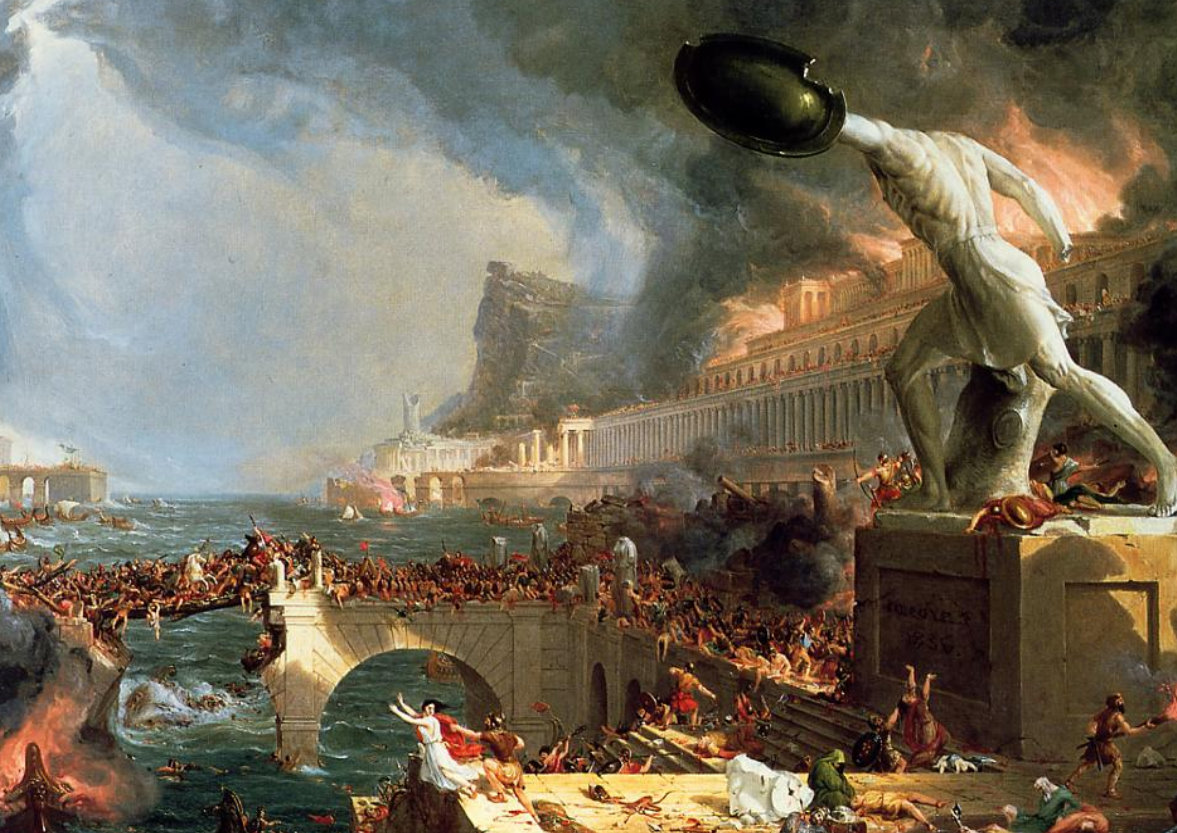
The fall of Rome c. 455 CE
Now synthesize your list of oppositions into a summation. It should reflect an inflated ego, whether it is one, many, or a system, it carries with it an awareness and action for self and for few – as well as those who benefit our self. It also carries with it a reduced lack of awareness and action for the whole system – as well as those who we tolerate and/or are intolerant. When viewed in this light, the inequality that is today’s America is absolutely no different from ancient Rome or Victorian Britain. You have the superior and the inferior, and the two should remain mostly separate. The inferior are such because they are illiterate. They lack a good education because it is next to impossible to attain. The inferior are diseased because of their illiteracy and lack of medical treatment because it is next to impossible to attain. The inferior are unskilled workers because of their illiteracy to understand the complex nuances of business and ingenuity, and to gain this understanding is next to impossible without heavy coin.
Is my America-Rome analogy that far-fetched? Your response should turn to civil action; we do live in a country that OFFERS a model of social-political freedom. I come from a family and middle-class background that worked and works its ass off to gain a little more of the American dream. During my generation, and perhaps during my children’s generation, we have seen those opportunities all but vanish. My children and I face almost exactly what my grandparents faced during the Great Depression and World War II. As a boy then, my father faced strict food and material rations for over fourteen years! Our current Great Recession, economists state, began in 2007. Here we are in mid-2012, five years later.
Whatever your situation, I will repeat what I said at the start.
Due in part to the nation-wide recession and severe federal-state education cuts and the increasing gap of social-economic inequality in America (families in poverty vs. families with great wealth), my workload and hours are increasing between 25-30% for the 2012-2013 school year. However, my meek salary and annual increase has been frozen – while our cost-of-living continues to run free like a gorilla in a banana farm. Even more astonishing, the social expenditures to address and manage our nation’s growing impoverished families – the exact families my students come from – are dropping through the basement in alarming amounts. Let me reiterate:
The social expenditures to address and manage our nation’s growing impoverished families – the exact families my students come from – are dropping through the basement in alarming amounts, even disappearing!
And by the way, our enrollment/placement of special-needs students are increasing (and therefore class sizes with fewer teachers) because several identical charter schools in the region had to close their doors due to funding cuts.
In the boom years before the 2007-08 crisis, the top 1 percent seized more than 65% of the gain in total national income. And while the GDP grew, most American citizens saw their standard of living fall into the basement. In 2010, as the nation floundered to stay afloat, the 1 percent (even the top 10%) gained 93% of the additional income created in the so-called recovery. As those at the top continue to enjoy the best healthcare, education, and benefits of wealth in a Reagan-freed-market system, they often fail to realize that, as Rome’s elite fatally ignored, “their fate is bound up” Stiglitz highlights, “with how the other 99 percent live.”
No matter the social, economic, or intellectual differences, we ALL need each other and MUST find and implement civilized efficient, evolving, fair systems toward the Greatest Good for the Greatest Number, or we will go down in history as the 2nd Rise and Fall of the 2nd Roman Empire.

(paragraph separation)

This work by Professor Taboo is licensed under a Creative Commons Attribution-NoDerivs 3.0 Unported License.
Permissions beyond the scope of this license may be available at https://professortaboo.wordpress.com.
As part of the Alternative Lifestyles blog-posts migration over to the new blog The Professor’s Lifestyles Memoirs, this post has been moved there. To read this post please click the link to the blog.
Your patience is appreciated. Thank you!
I am in the process of intently reading three superb books on America’s current anemic social and economic position. By what I have read so far, all three of these books speak directly to my deep concern for our country’s doomed path of progression: exclusivism; unless this path changes. Following are some reviews of these books.
A forceful argument against America’s vicious circle of growing inequality by the Nobel Prize–winning economist.
The top 1 percent of Americans control 40 percent of the nation’s wealth. And, as Joseph E. Stiglitz explains, while those at the top enjoy the best health care, education, and benefits of wealth, they fail to realize that “their fate is bound up with how the other 99 percent live.”
Stiglitz draws on his deep understanding of economics to show that growing inequality is not inevitable: moneyed interests compound their wealth by stifling true, dynamic capitalism. They have made America the most unequal advanced industrial country while crippling growth, trampling on the rule of law, and undermining democracy. The result: a divided society that cannot tackle its most pressing problems. With characteristic insight, Stiglitz examines our current state, then teases out its implications for democracy, for monetary and budgetary policy, and for globalization. He closes with a plan for a more just and prosperous future.
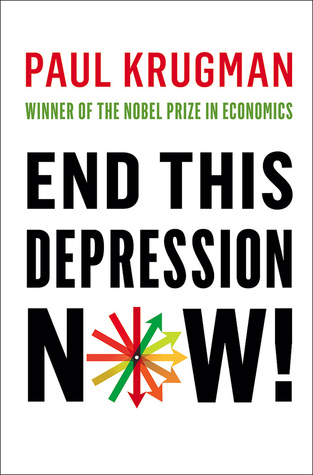
The other two books in which I am engrossed are the Nobel Prize Winner in Economics, Paul Krugman’s End This Depression Now and the book I am foaming at the mouth to finish, It’s Even Worse Than It Looks by co-authors Thomas Mann and Norman Ornstein.
The Great Recession is more than four years old—and counting. Yet, as Paul Krugman points out in this powerful volley, “Nations rich in resources, talent, and knowledge—all the ingredients for prosperity and a decent standard of living for all—remain in a state of intense pain.”
How bad have things gotten? How did we get stuck in what now can only be called a depression? And above all, how do we free ourselves? Krugman pursues these questions with his characteristic lucidity and insight. He has a powerful message for anyone who has suffered over these past four years—a quick, strong recovery is just one step away, if our leaders can find the “intellectual clarity and political will” to end this depression now.
And on Mann’s and Ornstein’s book —
Acrimony and hyper-partisanship have seeped into every part of the political process. Congress is deadlocked and its approval ratings are at record lows. America’s two main political parties have given up their traditions of compromise, endangering our very system of constitutional democracy. And one of these parties has taken on the role of insurgent outlier; the Republicans have become ideologically extreme, scornful of compromise, and ardently opposed to the established social and economic policy regime.
In It’s Even Worse Than It Looks, congressional scholars Thomas Mann and Norman Ornstein identify two overriding problems that have led Congress—and the United States—to the brink of institutional collapse. The first is the serious mismatch between our political parties, which have become as vehemently adversarial as parliamentary parties, and a governing system that, unlike a parliamentary democracy, makes it extremely difficult for majorities to act. Second, while both parties participate in tribal warfare, both sides are not equally culpable. The political system faces what the authors call “asymmetric polarization,” with the Republican Party implacably refusing to allow anything that might help the Democrats politically, no matter the cost.
With dysfunction rooted in long-term political trends, a coarsened political culture and a new partisan media, the authors conclude that there is no “silver bullet” reform that can solve everything. But they offer a panoply of useful ideas and reforms, endorsing some solutions, like greater public participation and institutional restructuring of the House and Senate, while debunking others, like independent or third-party candidates. Above all, they call on the media as well as the public at large to focus on the true causes of dysfunction rather than just throwing the bums out every election cycle. Until voters learn to act strategically to reward problem solving and punish obstruction, American democracy will remain in serious danger.
As I have written about adequately throughout my WordPress blog, exclusivism, elitism, and mob-egotism seriously, seriously threaten modern democracies and ultimately this planet. Apparently Stiglitz, Krugman, Mann, and Ornstein would more less agree, particularly in a socio-economic context. Ah, humbly I need to restate that: I apparently agree with them. Or perhaps the five of us all agree.
But I will not jump too hastily to conclusions. I will completely finish these three fine works and THEN incorporate their problem-identifications, solutions, and ideals into my views and opinions for a better nation and world. Come to think of it, I can probably merge polyamory and the open-swinger lifestyle (grinning and laughing) into my viewpoint as well!
Stay tuned!
Since posting this in April 2011, it has been my most popular blog with over 11,000 views so far. It seems a good idea to reblog it since intersex births and sexual orientations are commonly misunderstood or avoided, or worse… attacked.
In my archaic way of thinking, or perhaps as my conservative culture taught me, I thought that a boy was a boy not only by how similar he acted among me and other boys, but also because of his genitalia. And a girl was a girl not only by how similar she acted among other girls, but because of her genitalia as well. It all seemed pretty obvious and quite simple, so I thought for more than 30 years.
A few years ago my mother informed me of the death of a dear family friend and halfway-house mother to my sister of addiction and innumerable relapses. She had been there for my mom and other women countless times as my sister fought her disease on the losing end. This woman had been a pillar of hope and therapy in the community for battered, abused women, and many typically in chemical addiction. I was unaware that she had been what is often termed as an “intersexed baby”; a prenatal condition I knew absolutely nothing about. Subsequently, this not-so-rare occurrence completely overhauled my views on sexual orientation, “same-sex” marriage, and gender identity.
 Exact numbers of intersexed births are difficult to determine due to the lack of a humane dignifying definition of what physically should be considered normal or abnormal. The ignorance and social stigma the condition carries with it is as much a part of the difficulty as the collective understanding by medical science. Despite the ongoing studies one thing is quite clear. Sexual orientation, same-sex marriage, and gender identity IS NOT a social-religious debate, period.
Here is some perspective. It is commonly accepted in the medical community that on a global scale there are likely as many intersexed births as there are Jews. It is more common than multiple-sclerosis. More specifically, according to the Intersex Society of North America, about one in 100 births are intersexed or do not fall under “standard” male or female identity. One in 1,666 births has no clear XX or XY chromosome structure. For a more expansive report of all types of intersex conditions visit the ISNA (http://www.isna.org/faq/frequency) website. With chromosome structures outside of the traditional gender dichotomy, how can sexual or gender identity ever be separated from a genetic hard-wiring? Intersexed people could not have made the presumed adolescent or adult choice in “un-Godly perversion” if their condition formed in the womb. As such, social political shaming of these people can never be justified by any ideology. In fact, under such an archaic model one could argue that the molecular, biological, hormonal embryonic designing of intersex babies is from God’s workshop. Think about those implications.
The available prenatal and neonatal hormonal development studies are showing that aside from physical conditions, the development of testosterone and estrogen levels, or the under-developed levels, can sometimes vary widely. Pediatric and adolescent psychology has shown that intersex patient’s social behavior are indeed influenced by the relative levels of these and other gender hormones not necessarily specific to their external natal anatomy. A wonderful comprehensive article on the intricacies of intersexed births by Joy A. Bilharz can be found in her scholarly report (Click here). I highly recommend reading it two or three times. With this medical knowledge, it is not a stretch by any means to theorize, if not conclude, that there are smaller variations hormonally and neurologically in the general “natural” population that despite their social catch-all external anatomy, internally their gender development is different starting at conception.
For me, this is obvious: The rigid binary sexual-gender identification models many Americans have must be trashed for a more biologically, chromosome-informed model for not only political-legal reasons, but more importantly for humane reasons. However, the LGBT and intersex communities must avoid pendulum-mania. Elitism would certainly hamper hard fought gains. As Joy Bilharz notes,
The transgender movement…is attempting to breakdown the boxes into which people are pigeonholed on the basis of actual or presumed characteristics. Unfortunately, however, it has shown itself to be as exclusive and intolerant in many respects as the society whose values it rejects. This may represent the radical beginning typical of most social movements and it certainly doesn’t represent all of those who see themselves as transgendered. On the other hand, an attempt to bring all sex and gender and sexual minorities under a single umbrella of “queerness” can also be seen as having a homogenizing effect that creates discord within the category as different groups jockey for leadership positions or stake out their exclusive turf.
From a legal-political standpoint, I encourage the intersex/LGBT community to show first and foremost that they have something very unique to offer society without segregating it. A tall order in some cases, yes. But remember, men like myself, however fortunate to have grown up in a Humanist home, who are heterosexual and unaware that there are truly MORE flavor’s of ice cream than simply vanilla or chocolate. Since the condition did not directly affect my family, I was a product of our society’s concealment-approach to intersex and sexual orientation.
In defense of those like me, it is mindful to remember the “democracy” the United States of America was founded and later built upon: primarily European theological and social doctrines, which traditionally ostracized non-Catholics, or non-Protestants, or non-Christians who challenged or questioned them. Do not despair. Our nation’s brief history is laden with violent civil-rights movements that took many decades and generations to change legally. Fortunately, they did happen. One day, hopefully soon, ignorance will once again be overcome.
[Later addition] Our wonderful close family friend had told my Mom that for her entire life she felt her doctor and parents made the wrong gender choice for her at birth. She never felt as if she was female. Her social assimilation growing up was often unbearable at times eventually leading to prescription drug addiction, alcoholism, and illegal drug addiction. Thankfully, by her late thirties she turned her life around with large support by chemical dependency programs but most of all the support by other intersex support groups. As a result, she became the Director of no less than four women’s halfway-houses! Listening to my mother speak so fondly about her, I cannot help but wonder what mental and emotional state my Mom might otherwise be in, much less my sister. Thank all goodness in this Universe that someone so special and unique as her was THERE for us….us “standard” humans who too often treat people like her politically and socially as sub-human.
If this blog has piqued your interest, let me know and begin your own study of the subject. Start perhaps with Wikipedia’s basic overview: http://en.wikipedia.org/wiki/Sexual_differentiation#Hormonal_differentiation. I think you will find how much you DIDN’T know.
This work by Professor Taboo is licensed under a Creative Commons Attribution-NoDerivs 3.0 Unported License.
Permissions beyond the scope of this license may be available at https://professortaboo.wordpress.com.
Divergent Thoughts on Life, Love and Death
life and other weird stuff
Seeking Dialogue to Inform, Enlighten, and/or Amuse You and Me
Storytelling, short stories, fable, folk tales,...
Writing writing and more writing
Analysis & Discussion For Political Uncertainty
A photo journal of my interests from one extreme to the other.
Cogito Ergo Sum
by Wendy Waters
Understanding the psychology that drives our politics
Ponder(verb) to weigh in the mind; to view with deliberation; to examine carefully; to consider attentively
writing on human security
Living and Learning
Some prefer the comfort of Faith. I prefer the cold, hard Truth.
By Keith Goode aka Ken Thackerey
I don’t want to start a class war; it started a long time ago and, unfortunately, we lost.
Questioning the conventional wisdom
Don't ask me to be an idiot
Exploring the mystical and rational while expanding common spiritual ground among caring people
One minute info blogs escaping the faith trap