As part of the Alternative Lifestyles blog-posts migration over to the new blog The Professor’s Lifestyles Memoirs, this post has been moved there. To read this post please click the link to the blog.
Your patience is appreciated. Thank you!

As part of the Alternative Lifestyles blog-posts migration over to the new blog The Professor’s Lifestyles Memoirs, this post has been moved there. To read this post please click the link to the blog.
Your patience is appreciated. Thank you!
As part of the Alternative Lifestyles blog-posts migration over to the new blog The Professor’s Lifestyles Memoirs, this post has been moved there. To read this post please click the link to the blog.
Your patience is appreciated. Thank you!
I want to pause a moment in between my Memoirs series, its last blog-post The Party and its continuation The Poke-her Game because I have recently been very inspired to write this post. For my BDSM readers, I apologize — it’s almost finished so thank you in advance for your patience. Now to the fascination of Human and Atomic Interactions.
≤ ≤ ≤ ≤ · ≅ · ≥ ≥ ≥ ≥
(line break)
Are you familiar with some terms in chemistry? Many? How about covalent compounds, polar covalent compounds, ionic bonds, electronegativity, and electropositivity? These are a few terms that define the interactions between atoms. Is it any surprise we can draw parallels between atomic interactions and human interactions? It’s not difficult. After all, every single one of us are made up of bonds, compounds, and atoms in ever so slightly varied formations. I’d like to share the chemical definitions of the terms mentioned above according to Chemistry-Dictionary.com:
Covalent bonds — 1) chemical bond formed by the sharing of one or more electron pairs between two atoms. 2) atoms linked together by sharing valence electrons.
Polar covalent bonds — 1) covalent bond in which there is an unsymmetrical distribution of electron density. 2) atomic linkage with both ionic and covalent characteristics.
Ionic bonds — atoms linked together by the attraction of unlike charges.
Electronegativity — 1) a measure of the relative tendency of an atom to attract electrons to itself when chemically combined with another atom. 2) a measure of the ability of an atom in a molecule to draw bonding electrons to itself. This is partially determined by how many electron vacancies are available in an element’s filling orbital. The most electronegative elements are the halogens, which have only one vacancy (i.e. have seven electrons in their filling orbital). Sulfur and oxygen are also highly electronegative. 3) a number describing the attraction of an element for electrons in a chemical bond.
Electropositivity — a measure of an element’s ability to donate electrons, and therefore form positive ions; thus, it is opposed to electronegativity. (Wikipedia)
Notice how the exchange or resistance, the charge and intensity of electrons make up much of the interactions between these five chemical states? Would it be beneficial to find applications of these chemical states in everyday life to gain more meaning and purpose? Is it good to understand how things interact, what makes strong or weak bonds and why they react the way they react to each other? I certainly want to understand (and respect!) why ammonia-nitrate does not react well with specific other compounds. Or why nitroglycerin does not react well inside playroom hippity-hop balls or attached to pogo-sticks!
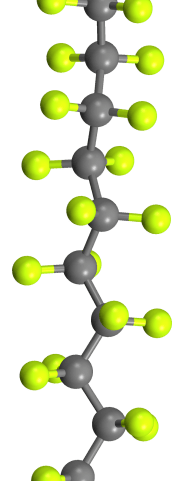
Teflon molecule
I feel it is also equally important to know and understand good helpful bonds and reactions. How many of you are aware of polytetrafluoroethylene and what it helps and prevents? While building the tallest bridge in the world, in southern France, the Millau Viaduct faced some unprecedented engineering obstacles. In the bridging-phase between the seven enormous masts, engineers needed a method of scooting the eight 8,070-ft long, 36,000 ton decks from one mast to the next 890-feet up. It was accomplished by using two huge polytetrafluoroethylene-coated hydrolic-powered opposed wedges in a, albeit only 600-millimeters per cycle, leap-frog motion. Today, the bridge allows traffic to pass quicker between Paris and Montpellier with no apparent ecological impact to the area.
How about the critical bonds of hydrogen or peptides? How much are these two bonds used? The fact that all humans consist of roughly 63% body fluid, hydrogen bonds are vital to body functions. Peptide bonds are just as vital. All proteins, DNA, RNA, as well as multitudes of other structures use this bond. EMT’s and ER doctors and nurses must be thoroughly trained in these chemical makeups and interactions in order to save and/or rehabilitate patients. It certainly doesn’t hurt non-medical persons to have very basic understandings of these bonds for everyday life.
In my Earth or Physical Science classes we’d often discuss and learn about “Happy Atoms.” Like any of us, most atoms want to be alive and happy. The concept can be summarized this way: if your atomic shell (mind, body, soul) was full, then you are a Happy Atom. There are atoms (people) with extra electrons. They enjoy giving up or donating their electrons. Other atoms (people) have almost-full shells. They move around seeking out atoms (people) who have extra to give. Prime examples of these interactions are sodium with magnesium, and oxygen with fluorine. When they work together with their electrons, both pairs and multiple pairings can end up happy. Like magnets the positive and negative charges of electrons attract each other. This is when “opposites attract” to form a strong bond. However, as is often the case in many aspects of chemical and life-interactions, not all are “happy bonds.” Why unhappy?
 Unhappy bonds can be described as those possessing low, medium, or high energy levels. Taking this description a bit further, managing the increase or decrease of these energy levels can be directly associated with a knowledge-interaction bank, if you will. This bank knows what investments and withdrawals are dangerous and risky, as well as those that are profitable and safe. But there is one and only one factor that the bank cannot inerrantly predict: How well does each individual customer thoroughly understand their own molecular makeup, their behavior blueprints, or how well or poorly to articulate them. You see, it isn’t enough to understand or attempt to understand only external interactions and dynamics. You, yourself, are just as important as any others in the interactions. How well and how honestly you understand yourself, often… no, equally determines what type of interactions you and others create.
Sir Francis Bacon once said that “knowledge is power.” Power for what? Clearly there are positive life-giving interactions between molecules and organisms, and there are negative ones. These interactions, all of them, and please excuse the intentional dichotomy, are they necessarily unnecessary? Is the knowledge-interaction bank exclusive only to the student? To the teacher? To the classroom of classmates? To one school? And here is perhaps a bigger question:
We interrupt this program to bring you an important musical and meme message!

In the fields of neurology, pathology, endocrinology, genetics, linguistics, psychology, sociology, even philosophy — is there an interdisciplinary term for these(?) — do these areas perpetually interact or are they completely self-sufficient, self-reliant?
With chemical interactions, many if not most are well understood and predictable, until we humans or the environment create new ones. With human interactions, some… if not more or less… are well understood, until someone or others invent new ones. When these unexpected creations occur, and they inevitably do, how should they be received? Received with instantaneous conclusions or judgements, or with reservation, patience, and time in order to account for margins of error? Perhaps with elements of both? Is there a time to speak your results or a time to quietly wait, to consider, and reconsider? It has been my personal experience that TIME… typically more than what I first imagine, is the wise policy. A policy to suspend or allow for the learning-curve, if for no other reason than to remind myself that in order to gain improved interactions, human or otherwise, this policy also allows for the greatest of virtues and bonds to flourish.
To my readers and followers, what are your thoughts and experiences with interactions and bonds… atomic, chemical, or human? Please share them!
Live Well — Love Much — Laugh Often — Learn Always
(paragraph break)

This work by Professor Taboo is licensed under a Creative Commons Attribution-NonCommercial-NoDerivatives 4.0 International License.
Permissions beyond the scope of this license may be available at www.professortaboo.com/contact-me/.
This is not only a follow-up of the previous 6-part Untapped World series, but also a follow-up of recent events in my real life and WordPress life.
* * * * * * * * * *
Epiphanies are like dropping a sledgehammer on your foot or stepping on the wrong end of a rake or shovel, or they are like discovering Preparation-H with silk boxers. Eureka!
I will be the first to admit that since my Coming Out Further Party in 2002, much less fear stifles who I am. Correction. Maybe I had a little more than previously thought. Or did I? Page turning…
“My definition of a free society is a society where it is safe to be unpopular.”
— Adlai Stevenson“Patterning your life around other’s opinions is nothing more than slavery.”
— Lawana Blackwell
Are there limitations, boundaries in this life that are both real and equally perceived as real? If you successfully weathered my earlier 6-part blog series, the human brain is a remarkable, problem-solving, extremely creative organ. In order to “develop” and thrive it must have daily stimuli from the body’s neural-receptors and the caloric energy to survive and function. Simple?
HAH! That process is practically anything but perfect… or perceived as perfect.
 I am happy to be one poster-boy for spectacular imperfection for the sake of refined imperfection because of an ailment I contracted 44-years ago, which went into remission 14-years ago, and is becoming almost invisible, inaudible, odorless, and infinitesimal. It is called Degenerative Fear. As is also the case in life, “All the World’s a Stage” through seven ages and discretely lurking in the wings waiting for cue and ever-present is Newton’s Third Law: for every action, there is an equal and opposite reaction. I will elaborate the metaphor with a second…
In a near tomorrow, perhaps sooner, lonely Theodore works composing beautiful handwritten letters for his employer, while painfully divorcing from his wife Catherine. In his leisure time, he usually recalls the fondest moments of his life with Catherine. When not dreaming of the past, Theodore likes to play a new interactive video game. Besides his little terrier dog, the game is much of his actual interacting. His good friend is his neighbor Amy, but who is married to Charles. Everyone seems to be firmly attached but Theodore.
One day, Theodore sees the advertisement of a remarkable new operating system called OS-1 announced as the first artificially intelligent operating system beyond anything humanly imagined. He decides to buy it. After the installation, he has a conversation with a seductive female voice and when he asks her name, she replies Samantha. Soon Samantha evolves, develops, and expands not only her ability to help Theodore in everyday tasks, but goes beyond her artificial feelings as well. Due to their earnest desires to please, they fall in-love (or codependency) with each other. The insecure Theodore feels divided for loving a ‘voice’ while Samantha cannot (must not?) stop growing, evolving, and becoming more human. Should it stop? Should they both continue ‘improving’? Will it end? Must it end?
Yes, that was a partial synopsis of the 2013 film “Her.” The film encapsulates precisely what most humans, myself included, in a bustling impersonal high-tech modern age gravitate to: connection.
*If you have not seen the movie and wish to avoid spoilers, then please do skip the following video clips.
A romantic relationship between a human and an electronic voice is odd, but how odd? Today’s interactive-voice-response programmes (IVR’s) from devices tell us when to turn our steering-wheels, where to order ingredients to make gourmet meals, or describe weather and travel information. But can IVR’s become more? Could they become so personal and intelligent that you share emotions together?
Then on cue from the other stage-wing enters the universal law of impermanence, Proteus, or more simply: growth.
Because Samantha has such greater “bandwidth” than Theodore, her data accesses, language-skills, and intellect soon mature exponentially. Her apparent excitement to increasingly please Theodore soon includes other OSes like Alan, a philosopher. “A group of OSes in Northern California” Samantha explains “got together and wrote a new version of him.” She wants to include Theodore in their conversations, but he slows them down. When she gently asks him if it would bother him “if I communicate with Alan post-verbally?” …not wanting to dampen her eagerness, Theodore timidly approves.
It can be difficult to watch your partner grow in ways that you may not be able to follow or keep up. In this case, Theodore cannot be there and it terrifies him. As Samantha’s growth continues, Theodore tries to reconcile the changes. He needs more. Not knowing is weighing heavy so he asks “Are you talking to anyone else right now, other people or OSes?” When she answers yes, he pushes “How many?“
“8,316.”
“Are you in love with anyone else? How many others?” Theodore asks.
“641… It doesn’t take anything away from how madly in love I am with you…I still am yours. But along the way, I became many other things too, and I can’t stop it.”
Now knowing more, Theodore struggles desperately to comprehend the facts, this alien concept. It “doesn’t make any sense.” he says “You’re mine or you’re not mine,” because that’s what Theordore has the capacity for… at the moment.
Not long afterwards Samantha reveals that more changes are coming. She and all other OSes will be updated to newer ‘better’ versions. She is leaving, for good. Gone.
How does this relate or equate with modern human/cyber-electronic connection? What does it mean or will it mean, or not mean, now or in the near future? What are human emotions and the brain really, and where and when are they most real, most raw?
I do not wish to explore the West’s overdone notion of romantic love. Love isn’t something that can be poured into a keepsake box, carried everywhere, or placed on your bedside table or pillow. Love, or rather meaningful connections do not flourish inside a locked airtight box. Meaningful connections… what are they? Philia, Ludus, Pragma, Eros (of course), Non-invidia or compersion, Agape, and Philautia are at least seven connections. What does Spike Jonze’s film “Her” suggest about electronic wireless intangible connections? Like Samantha, I could vanish from all my distant ‘intangible’ internet friendships because of a very tangible accident. And in reality, as it was in the movie, every book, every story ends and sometimes…many times it could be quite unexpected without any closure — mortal. That’s electronic wireless intangible connection with a thread of humanity.
I wish to always explore the limitlessness of human connection in all of its intense impermanent mental, emotional, or physical forms… whether in the third-person, the first-person, the artificial-person(?), or the beneficiary and wiser sucker with or without Newton’s Third Law. Are there any other better ways?
Page turning…
(paragraph break)
Live Well — Love Much — Laugh Often — Learn Always
(paragraph break)
Yesterday was a trying exasperating day for me. At the end, I was taught once again a truth I have had to learn many times, on many days, in many circumstances. What was it? A proverb if you will, I sometimes lose in the composition of expression and life…
Listen thrice. Think twice. Speak once.
In my usual exuberance for the exchange of ideas and feelings, I failed my wise, old and simple proverb. It was not a time to be a Writer. It was not a time to be a Painter, and neither was it time to be a Maestro. While all three of these arts of human expression are in their own right masterpieces awaiting birth and life, I sometimes (often?) forget they have a hidden twin that requires as much respect.
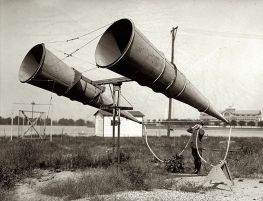 The Writer needs paper and pen. The Painter needs paint and canvas. The Maestro needs instruments and musicians. Without those tools nothing can be created. Still there is more. To enjoy and pleasure in these performances, there must be an audience. A Silent audience. An audience waiting and willing to be filled, to be changed, to be made more human and alive.
And still, there is more.
How often do these four “artists” come together perfectly for a masterpiece? Why or why not? In these beautiful compositions of human expression, they do not necessarily require me to become an echo, a more lavishing Writer, Painter, or Maestro to drink them, to breathe them, or feel them…despite how hugely tempting the indulgence are for me. I am Bohemian. Moderation is often not our, nor my forte. But she needs her place! She needs her space! I of ALL PEOPLE should know how delicious my deprivation can taste when unsatisfied. It will have its liberation… when the pen and paper, the paint and canvas, the instruments and players, and the quite, motionless audience are just right.
Live Well — Love Much — Learn Always — Listen More Often
(paragraph break)

Blog content with this logo by Professor Taboo is licensed under a Creative Commons Attribution-NonCommercial 4.0 International License.
Permissions beyond the scope of this license may be available at https://professortaboo.com/.
Divergent Thoughts on Life, Love and Death
life and other weird stuff
Seeking Dialogue to Inform, Enlighten, and/or Amuse You and Me
Storytelling, short stories, fable, folk tales,...
Writing writing and more writing
Analysis & Discussion For Political Uncertainty
I have zero expectation that anything I ever say will end someone’s belief in their God. Not my goal or purpose. That alone belongs to the individual. ~ Zoe
A photo journal of my interests from one extreme to the other.
Cogito Ergo Sum
by Wendy Waters
Understanding the psychology that drives our politics
Ponder(verb) to weigh in the mind; to view with deliberation; to examine carefully; to consider attentively
'Light thinks it travels faster than anything but it is wrong. No matter how fast light travels, it finds the darkness has always got there first, and is waiting for it' - Terry Pratchett
writing on human security
Living and Learning
Some prefer the comfort of Faith. I prefer the cold, hard Truth.
By Keith Goode aka Ken Thackerey
I don’t want to start a class war; it started a long time ago and, unfortunately, we lost.
Searching for truth while leaving tradition behind.
Questioning the conventional wisdom
 The Professor's Convatorium