El Dorado – Part II

View-of-Doha-Skyscrapers

Doha, Qatar

It is astonishing as well as alarming! Doha, Qatar, one of many “Emerald Cities” in the Persian Gulf springing up from hot sand into vast riches of oil and gas then spectacular skyscrapers is since the early 2000’s, mostly empty. That’s right, 90% empty! And the reasons are telling!

But before examining the reasons, let’s first review where we left off in El Dorado — Part I… since it has been almost two months and nine other posts since I published it.

* * * * * * * * * *

American workers between the age of 25-54 work an average 63 hours per week, 7 days a week, equating to almost 9-hours per day. Of all Western nations this work-rate is the highest among industrialized countries. This obsession to work looks like this: their 7-day work week earns them an average wage of $47,000 per year, or $14.35/hour and this wage often does not come with medical-health benefits from the employer — most American low-wage jobs don’t. Therefore, factor in that deduction from $14.35/hour and you only begin to see the real picture for much of the American workforce.

At the other end of the spectrum you have attorneys at-law, the highest wage-earners, making between $105,000 to $192,000 per year (in the 48 conjoined states) according to the American Bar Association 2011. This job-sector also has the nation’s highest rates of depression and suicide, along with American teachers, counselors, and executive assistants, respectively. What is more bewildering is that universities across the United States “report steady or increased enrollment into their law schools and medical schools, and not so surprising decreased enrollment into their schools of education and counseling.” The steady or increasing numbers to law schools and the declining numbers into teaching or counseling classrooms are directly related to their average salaries.

Fortunately, this subtle American tragic disunion has an upside… which I will get to momentarily.

Visions of World Grandeur

Emir of Qatar

Tamim bin Hamad Al Thani – Emir of Qatar

Accounting history has shown over the last two decades that to host a FIFA World Cup is extremely stimulating for a country’s economy, employment, its leadership, and world image. The spectacle of the four-week tournament includes 32 different nations and their raving fans, unimaginable TV exposure and revenues, exceptionally high tourism revenue, fan sites and events at each game just outside of stadiums, all-encompassing millions upon billions of dollars. Glitz, glamour, and metaphorical-gold abound! Not surprising, the bidding war for the 2022 World Cup was fierce between the U.S., Japan, and Qatar, with Qatar coming out as the highly controversial winner. As mentioned, Doha, the capital of Qatar, will host several of the games. The Qatari ruling family (Emirs, Faisals or Kings), the house of Al-Thani, began in 2010-11 implementing very bold construction plans for a “New Qatar” as a whole, but in particular the FIFA game-venues throughout the eastern portion of the country as the chance to awe not only the sports world, but the entire modern world after the games. Qatar shipped in thousands of foreign workers and erected several “Emerald Cities” the world would envy!

Why then, as of October 2014, is the capital Doha 90% empty?

BQDoha.com (Business Qatar) explains three primary causes and symptoms to Doha’s emptiness. Oneovercrowded cramped housing. The average person, mostly foreign construction workers, live with other families or individuals in “villas” — many semi-dilapidated buildings — partitioned into family-sections in order that landlords turnover a bigger profit. Twoa wait-and-watch holdout policy by landlords for the foreign corporate residents. Landlords can better gouge big corporations for higher rent and get the rent in one lump sum for a 3-year contract on average. And Threea saturation of aggressive street peddlers disguised as “real estate brokers” but paid by landlords discreetly. Rents quoted by these illegal peddlers are high to pad their finder’s fee and compensation. From these three causes follow symptoms of a city and nation struggling with traditions, expatriates, and modernism heavily pushed by the Emir and extremely wealthy faisal families-business élite. A quick read of The New York Times Middle East beat-writer Anthony Shadid’s November 2011 article, shows how the capital city, its nation and upper-elite, versus its common people are sharply contrasted behind the imposing Emerald City façade. Visions of world notoriety and wealth come only from a tiny privileged percentage of Qataris.

The United States has its fair share of Emerald Cities too:  Detroit, Michigan and Cleveland, Ohio are two most notable emptying facades out of several.

Getting Behind the Glittering Veil

In Part I of El Dorado I touched on the highly clever, complex marketing schemes (Ponzi Schemes?) America’s upper 10% and corporate executives promote to consumers — extensive details of the schemes were found in five previous posts. But rather than hunting and gutting the schemers, I want to delve into the uneducated gullible consumer’s mind; why do they/we swallow El Dorado hook, line, and sinker? Why does one incessantly chase Emerald City citizenship with big eyes and panting breath? Probably five reasons:

  1. Values
  2. Goals/Dreams
  3. Respect of Peers
  4. Learned Skills
  5. Time and one’s concept of it

What do you value in life? What activities do you enjoy most? If you are unable to satisfy your value-systems, what goals or dreams do you have in order to work for and satisfy your values? Typically, we all value the respect of someone:  our parents, spouse or intimate partner, coach or boss, a fan-base or maybe the approvals and recommendations of institutions or associations, like universities or writers guild. Everyone seeks some degree of respect from others. What skills or talents have you been taught? Are those skills considered excellent? Average? Evaluated by whom? Certainly everyone cannot be self-proclaimed tycoons, right? Therefore, respect and skills are irrevocably linked.

ringing alarm clockPerhaps the most significant reason one seeks El Dorado-Emerald City citizenship is their concept of time. In Western industrialized nations, the average lifespan is 78-years; for women 81-82 years. Depending on where you are born and to what parents may dictate how much time you have to obtain the coveted citizenship, march through the golden gates, and into worldly bliss. Then again, many believe existence does not end at 78 or 82 years. For them it might be eternal and as such feel much less pressure to pass through those gates — atheists and deists may not bother with citizenship-anxiety at all. Eat, drink, and be very merry might be all that matters to them — a lifestyle this Bohemian doesn’t scuff off but happily joins on several occasions!

These five above appetites that hungry consumers have are well-known and pandered to by the Kings and Queens of El Dorado and Emerald City. Their accompanying marketing departments probably know even better. Fortune 100 companies pay millions, maybe billions, to the élite Top marketing firms or internal departments to CREATE insatiable consumer appetites! For a population that doesn’t have easy access to alternative lifestyles’ skills or services (such as, living off-the-grid), or the matching business-marketing masters degrees or PhD’s, the consumer’s future is an increasing metaphorical obesity epidemic. The gourmet chefs of this buyer buffet — the Fortune 100 or 500 businesses and executives — won’t ever stop crowding your table and plates with “masterpieces” unless you break the trance and walk away by your own will-power!

The New Tiny Living Tiny House Movement

TinyHouses-Infographic

Click to enlarge – image courtesy of TheTinyLife.com

The Wall Street Crisis of 2007-08 and to an extent America’s metaphorical appetite for obesity, jump-started the Tiny Living Tiny House Nation and Movement as an alternative to high-debt living and mortgages which greatly limit owner’s freedoms and R&R in a hectic ultra-competitive free-market economy. From 1978 to 2007 the average size of new single-family American home grew from 1,780 sq. feet to almost 2,500 sq. feet. With that growth followed all accessory businesses such as landscaping and home-improvement. By the time President Ronald Reagan finished his last term in 1989 and put into law his Tax Reform Act of 1986, the make-it-bigger home market fly-wheel was at full-speed-ahead until it hit the granite wall in 2007.

Today, on top of the purchase-price, down payment, principle paid, interest after-tax, taxes and home insurance, maintenance, and major repairs and/or improvements, the final amount out-of-pocket for a typical single-family home reaches over $1-million for a 30-year term. If you are the 76% – 90% portion of the typical American family earning between $35k – $50k annually, where is the fiscal wisdom in living so far out of your means?

The fantastic people at TheTinyLife.com offer home-buyers interested in more freedom, more time, more environmentally conscious, more fiscally responsible, just more modesty and simplicity for hectic lives by liberating themselves from America’s bigger-is-better GAUDINESS! It’s just smarter.

For most Americans 1/3 to 1/2 of their income is dedicated to the roof over their heads; This translates to 15 years of working over your life time just to pay for it and because of it 76% of Americans are living paycheck to paycheck.
— TheTinyLife.com

Please stop by their website to learn the brilliance in unburdening yourself from the modern home-building, home-improvement marketing schemes that imprison and overload many nose-diving Americans. Wise up!

Labor of Survival, Status, or of Love?

It is perhaps the most introspective questions we ask ourselves: Am I working to survive? Am I working to gain status? Am I not “working” because I love my job? In which group do you fall? In which one would you rather be?

OLYMPUS DIGITAL CAMERAFinding our bearings through these questions and possibly changing our heading in today’s labor and social environment can seem daunting. Marketing impulse-triggering wizards with million-dollar Ivy League business degrees wickedly cleverly pull at our heart-strings. But the consequences of not checking your bearings and heading could prove to be much worse on one’s emotional, spiritual, and physical health. It would be wise to ask yourself at least twice a year, What am I laboring for and will it be worth it come retirement? For many Americans “retirement in luxury” is a distant fantasy due to a lifetime of survival mode and seemingly never-ending self-sacrifice. If this is the case, maybe a second and third question should be asked… Where is the majority of my paycheck(s) going? Are those credits bearing valuable fruit or evaporating, or padding a total stranger’s pocketbook?

Laboring for status is perhaps the greatest American trickster scheme. It can at first be mistaken for love. There’s no better example of this than in the top four U.S. sports markets. Coaches, General Managers, Athletic Directors, and finally the players (with the exception of NCAA collegiate athletes) face the very real possibility that their employment or their role will be terminated or replaced by another every year, sometimes less than a year! In the NFL (National Football League), the #1 most popular sport in America, a head coach lasts an average of 38-months. NFL General Managers last a bit longer at 44-months. In the MLB (Major League Baseball), the #2 sport in America, a Manager/Coach lasts about 24-months. And unless players in both the NFL or MLB are tagged franchise-players, they stay only 24-months on average with one team. Athletic Directors with NCAA Division I universities enjoy more stability and longevity at 7.5 years on campus, but over the last decade this average has steadily dropped due to collegiate sports (and revenues) becoming more widely competitive. There has also been increased mobility or transfers by NCAA football and baseball players for improved exposure to NFL and MLB scouts, especially in baseball given its now global appeal. In the NBA (National Basketball Association), the #4 most popular sport (along with auto-racing), staff and player positions and vacancies have become a near non-stop marry-go-round with replacements, no check that, scapegoats… with an average stay of only 9-months; the NBA season is only 6-months long.

What does all this mean? In the American sports culture it means one thing: winning championships or very least, consistent playoff births. Status. Nothing else matters; truly a What-have-you-done-for-me-lately intolerance. Just how much does the American sports world permeate American occupational and economic culture? Answer:  Factor in all games and events, merchandise, and other incidental sports activities, and the dollar figure goes easily into the upper billions! Yes, 60.9% of American sports fans, i.e. the men, fantasize and live vicariously through their favorite pro and collegiate athletes and spend royally to feel and look like them.

According to Forbes.com and NSGA.org (National Sporting Goods Association), every year Americans spend around $43-billion on retail sporting goods such as gear and equipment, logo’d-apparel of their team(s), not counting game or season tickets. Sports gambling, e.g. fantasy leagues, rake in $20-billion from American sports fans in a $400-billion dollar sports gambling industry. Parents of little American athletes spend $300-million a year for various league registrations, uniform fees, etc, then the figure leaps to $900-million per year for goods, incidentals, and travel for their athletic kids. Let’s not forget how much companies spend on TV advertising, and fans on Pay-per-View events; that figure is in excess of $10-billion per year.

Those dollar figures beg many serious questions, not the least of which is why do American taxpayers bitch and whine about taxes and tax-levels, the national deficit, poorly run government programs, and struggling public infrastructure when clearly the private sector, i.e. businesses and individuals, spend over $474-billion dollars PER YEAR on sporting entertainment alone? Should I remind us of what those same entities spend on real estate, homes, home-improvement, home accessories, and automobiles to park in the two-car garages? No? Then at least remember $474+ billion dollars annually just on entertainment.

A laboring of love is generally accepted, or should be, as the way to live. Though by the time I reached my 30’s or 40’s, with a marriage or two, and then children — you know, after all the trials and tribulations getting through my teens and twenties — the light-bulb didn’t come on…I was halfway finished with my life! Time to get serious and ask myself those hard questions. I won’t bog you readers down with another convincing argument (wink) of why a life of experience, experience with others, with the ones you care for deeply and go through thick-n-thin with to come out singing and dancing… is the way to go. No, I hope all of you can grasp and understand what Albert Einstein profoundly distinguished:

“Strive not to be a success, but rather to be of value.”
Albert Einstein

For those who might need a hint, Dr. Albert distinguished two opposite concepts in just those twelve simple words. The first-hand experience to love and be loved is the best labor in life, not status or success. I would add to Einstein’s point that modesty and moderation will limit, even save one from the dangers and risks of metaphorical and yes, literal obesity.

El-Dorado

Hidden city and legend of El Dorado

These are very difficult concepts to execute for many Americans because we are surrounded and bombarded by remade patriotic 19th and 20th century cheers of Seek in earnest El Dorado and you will find and sit on its throne. But the more feasible reality involves your immediate and intermediate circles of influence and experience. Beyond those lines, beyond those outlands are the experiences and lives meant for others, not just you. Everyone has a “sandbox” to build and play inside, but the walls enclosing your sandbox should never be inflexible nor perpetually expanding or worse, imperializing. Am I saying humanity as a whole should not collaborate for an improved more healthy sustainable self and planet? Not in the least, no. However, if every single human is supposed to build their own El Dorado, then it seems to me we will all manifest Aristotle’s fabled King Midas of Phyrgia turning everything, including ourselves, into unsustainable useless gold with 7.4 billion King Midas’s running around atop 7.4 billion useless thrones ruling an unsustainable golden rock-planet of 7.4 billion useless Phyrgia kingdoms! One fashion color and one fashion color only! One texture and one texture only! One food group and one food group only! Eeeeek…

Is that the life on El Planedo you want to live?

(paragraph break)

Live Well — Love Much — Laugh Often — Learn Always

(paragraph break)

Creative Commons License
Blog content with this logo by Professor Taboo is licensed under a Creative Commons Attribution-NonCommercial 4.0 International License.
Permissions beyond the scope of this license may be available at https://professortaboo.com/.

El Dorado – Part I

Gaily bedight,
A gallant knight,
In sunshine and in shadow,
Had journeyed long,
Singing a song,
In search of Eldorado.

But he grew old—
This knight so bold—
And o’er his heart a shadow—
Fell as he found
No spot of ground
That looked like Eldorado.

And, as his strength
Failed him at length,
He met a pilgrim shadow—
‘Shadow,’ said he,
‘Where can it be—
This land of Eldorado?’

‘Over the Mountains
Of the Moon,
Down the Valley of the Shadow,
Ride, boldly ride,’
The shade replied,—
‘If you seek for Eldorado!’

Eldorado, by Edgar Allan Poe

(paragraph break)

My wonderful daughter is soon graduating from four years of university. I could not be more proud. I reflect back to the summer of her upcoming freshman year and the many questions and discussions we had about what major to pursue and study. It is perhaps one of many far-reaching decisions facing all undergraduates. For some, it is a time of the highest anxiety they must address in their budding lives. I know, I’ve been there. Many of us have been there, right?

career compassIn a modern economy and job-market that has increasingly become highly specialized the last three decades, a new graduate likely wants to make a decent high wage to at least have the ability to pay-down college debts. While examining today’s competitive labor market, it isn’t much of a stretch or mystery to conclude that once your vocation has been decided, the choice could very well set in concrete the next 10-20 years of your working life, years that cannot be refunded! Oh and by the way, the job-market is usually dictated by what finicky consumers want and how they spend their incomes. Mix into that career-path-anxiety healthy doses of follow-your-heart advice, which often does not translate to 6-digit paychecks, and a college graduate begins perspiring and shaking. Oh and by the way, since 1995 the U.S. median income for four-year college graduates has remained pretty constant at about $47k per year according to the National Center for Education Statistics. Unless a new graduate with 3 or 4-years of tuition-debt lands a minimum annual income of around $70k to $80k quickly, they will not be able to keep up with inflation, cost-of-living with rent or a mortgage, likely loan interest, let alone raising toddlers, they will NOT be able to get ahead on $47k per year. If they are financially frugal and wise, they must put those dreams on hold until that high-wage career is landed, if it is landed. Enter more stress.

A career-path is indeed a huge ordeal and can possibly make or break a person. It is not to be taken lightly. But what are the driving forces behind the decision? What sort of life will those driving forces actually create?
(line break)

* * * * * * * * * *

We now live in a part of the world, the Western Hemisphere, where wide choices of labor are unparalleled in the history of civilizations. At first glance, one would think this is a good thing. On many levels the advancements in medicine or technology, to name two, are indeed far and beyond other progressive ages of the past. They are two of many explanations for the planet having close to 7.3 billion humans to date; a number close to the tipping-point of what Earth can sustain. Why?

Two major factors have been the social evolutions of increased democracy and wide-spread education. These two alone have contributed greatly to the end of feudalism and eventually ushered in the Industrial Revolution leading workers out of the fields and into mass urbanization. Families went from hard subsistent living to higher social mobility and liberation in the span of one century! But with so much labor and social change come newer problems; some with hints and roots of old problems.

In the West where much of these advancements have taken place, workers are the unhappiest since the end of World War II. In two of the continents of labor-liberation, over two-thirds of Europeans — primarily in central and southern Europe — are dissatisfied with their jobs according to OPP Unlocking Potential in Oxford, U.K. In America 52.3% are unhappy — all of those workers being in the middle and lower incomes of the nation — and the happiness-scale has been falling since 2011 according to the New York-based non-profit research group The Conference Board.

Modern Kings and Queens

The foundation of the Industrial Revolution was laid by ideals and theories published in the late 1700’s. Economists David Hume and Adam Smith, along with botanist Henri-Louis Duhamel du Monceau, combined to create the earliest stages of manufacturing by the Division of Labour. Essentially this philosophy means turning a product or service from start to finish by one person/family, instead into many phases done by multitudes — highly specialized worker ants/bees, if you will — for the sake of Queen and country…and job-security. Today, those Queens, Kings, and countries are business corporations.

eldorado-gold

Balsa Muisca (Muisca raft) figure, Bogotá, Columbia; the symbol & origin of the El Dorado legend

Since the 1950’s and certainly after the Great Recession of 2008, as the previous stats indicated, Hume’s, Smith’s, and Monceau’s economic philosophy no longer satisfies the common-worker in the West. Very soon the same will be said, if not already, in the Middle and Far East. Indeed, the basic material needs of modern Western civilizations have been met post-WW2, or at least made more easily available to the less-privileged. However, with more freedom, more liberties, more competition, comes more and more shrewd marketing schemes and modern funding into Special Interest groups pressurizing all levels of legislation by those who stand to lose much more. In million and billion-dollar economics, ethical integrity by the major players becomes a risk they cannot or will not take and the winds of change apply only to an upward swerve of their bottom-line.

Yes, incomes and wages in Europe and North America over the last two centuries have been rising. They have reached their highest points in history for more than just the nobility and the wealthy few. Yet, it stops there. Along with clever complex psychological marketing, the average life-satisfaction surveys, or well-being stats, are surprisingly still flat; especially the last thirty-years! What has happened?

I came to get gold, not to till the soil like a peasant.
— Hernán Cortés

In 1504 the collapse of the Aztec Empire of central Mexico marked the beginning of Imperial Spain’s Golden Age, literally. Cortés and his Conquistadors made off with wagon-loads of gold and silver catapulting he and his men — who back home had little to lose — into a new socio-economic class otherwise unobtainable. With that new status came not only heightened respect and popularity, but their native Empire’s greatest glory and colonial land expansion. What followed in the 1600’s changed the world forever:  the Age of Exploration. For the peasants and servants of 17th century Europe, the hope of an entirely new life with riches either in land or wealth, or both, was too great to pass up. They came to The New World by the never-ending boat-loads.

Many immigrants were unaware of the great risks blinded by the glitter of the legendary stories. Disease, hunger, and angry natives protecting their homelands put the new settlers in harms way and the expeditions literally as do-or-die endeavors. In the modern era, the similar reckless obsession, perhaps disguised as the dream, is the amount of time American workers spend on the job. The Bureau of Labor Statistics reports in 2013 that the average U.S. employee between age 25 and 54 works almost 9-hours a day, 7-days a week, for a total work-week of 63 hours; the most out of all industrialized nations.

The highest-earning occupation in the U.S., attorneys-at-law, have the highest rate of depression and suicide as reported by magazine Psychology Today and a 1990 John Hopkins University study of 100 occupations. Perhaps shocking or not so shocking, lawyers are followed next by teachers and counselors, then secretaries according to the Journal of Occupational and Environmental Medicine 1990. Yet, still today universities across the U.S. report steady or increased enrollment into their law schools and medical schools, and not so surprising decreased enrollment into their schools of education (NTP 2013 Title II Reports) and counseling (BLS 2014 Occupational Employment). Care to guess why?

The dream of El Dorado has been the most commonly propogated and sought-after-dream sold to the masses by the Queens and Kings of the world. My 4-part blog-series Oversimplification 2012, as well as The Land of Opportunity? post, both address this modern El Dorado scheme in-depth. Fortunately, a new growing trend for more purpose in life beyond simply wealth and success is emerging. In my next post, El Dorado – Part II, I will explore further how and why the trend is growing, and warn against the biggest counterfeits of “a better El Dorado life.

Have you discovered an empty “El Dorado” recently? How did you uncover the mythical town?

(paragraph break)

Live Well — Love Much — Laugh Often — Learn Always

(paragraph break)

Creative Commons License
Blog content with this logo by Professor Taboo is licensed under a Creative Commons Attribution-NonCommercial 4.0 International License.
Permissions beyond the scope of this license may be available at https://professortaboo.com/.
A Collective Imperative

(paragraph break)

If a free society cannot help the many that are poor,
it cannot save the few who are
rich.
— John F. Kennedy

(paragraph break)

[This is the fourth and final segment of a series continuing from part 3 – Unveiling Incentive-Opportunity Fallacies] (paragraph separation)

(paragraph break)

* * * * * * * * * *

What is excessiveness?  The dictionary defines it this way:  exceeding a normal, usual, reasonable, or proper limit.  Historians have sometimes defined it as out Herod Herod.  Lord Salisbury in Shakespeare’s King John perhaps described it better as painting the lily:

Therefore, to be possess’d with double pomp,
To guard a title that was rich before,
To gild refined gold, to paint the lily,
To throw a perfume on the violet,
To smooth the ice, or add another hue
Unto the rainbow, or with taper-light
To seek the beauteous eye of heaven to garnish,
Is wasteful, and ridiculous excess.

Every single human being requires a handful of necessities:  water, food, climate-control, and shelter.  To what extent or elaboration those four basic needs are fulfilled, can be averaged at any location, and thus a global standard can be determined.  One and perhaps a minimum of two of these basic life-needs are in finite supply and crisis on our planet.

Fair warning for those who are sensitive to or bothered by grim facts of nature, our planet, and other human groups, self-discretion should be considered.  What follows, in my opinion, needs to be at least made aware and considered by everyone on Earth.

(paragraph break)

* * * * * * * * * *

What do you think would happen if when you turned open your faucet and nothing came out?  How long could you survive without water?  Now, what do you think would happen if your entire city was without water or operating sewage?  What would happen if a nation lost its water and sewage?  There is no water to feed crops or gardens; no clean water to drink.  Are you getting the picture?  If not, let’s hear the alarming projections some scientists, scholars, and professional experts are reporting.  Sorry this alarming documentary is an hour-and-a-half long, but it needs to be shared:

If you still feel this is not a problem for you and your children and grandchildren, you should have your ears examined.  If you feel resource conservation is a form of socialism or communism, then you are in delusional denial.

Excessive opulence or resource hoarding is no different a global footprint than spending or consuming recklessly; they both accomplish the same singularity:  proportionate risk.  The more excessive, the more risk; the more risk, the more excessiveness to avoid it.  As a species, if not as Americans, we need to…no, we must greatly refine our life-ambitions and the education of those ambitions and their purpose.

But let’s pause a moment and analyze where most Americans have headed since 1870 and are currently heading.

1870 – 1900:  The Gilded Age

Mark Twain
Mark Twain

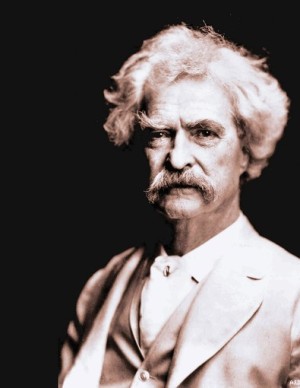
Much pride and boasting has been made of America’s age of industrialization, that it was the catalyst that put the nation in the same discussion of the world’s greatest empires.  Yet of our nation’s 12-million families then, 11-million earned less than $1,200 per year; of this group the average annual income was $380, well below the poverty line.  In today’s CPI dollars (the purchasing power of goods and services produced in the 1890 economy) that is $9,890 per year per household.  In his book The Gilded Age: A Tale of Today, Mark Twain wrote of the day’s barons and tycoons, What is the chief end of man?—to get rich.  In what way?—dishonestly if we can; honestly if we must.

Though pre-1920 U.S. economic reports are less comprehensive as post-1920, Benjamin Schwarz of the World Policy Institute and Executive Editor of World Policy Journal writes in his 1995 New York Times article By 1890, the richest 12-percent of households owned about 86-percent of the country’s wealth.

1890 – 1920:  Progressive Era

The Roaring Twenties

In 1910 the average annual household income was $574 per year.  In today’s CPI dollars that is $14,300 per year per household.  During this era America’s top 1-percent owned about 40-50 percent of the nation’s wealth and the top 10-percent fluctuated around 70-percent until President Theodore Roosevelt began his anti-trust legislation and wealth redistribution via progressive taxation.

1920 – 1929:  The Roaring Twenties

The average annual household income was $1,407 per year in 1920.  In today’s CPI dollars that is $16,100 per year per household.  In 1922 America’s top 1-percent owned 37% of the nation’s wealth; a slight change in years following Teddy Roosevelt’s administration.  America’s middle-class indeed experienced a relative age of prosperity during the Roaring Twenties due to the automobile industry which fed industries such as oil, road-construction, tourism, manufacturing, and electric-power.

1929 – 1941:  The Great Depression

the-great-depression

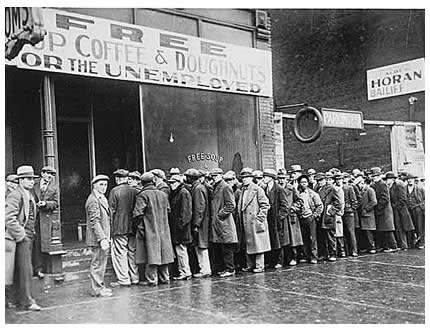
The average annual household income in 1930 was $1,388.  By 1940 it had dropped to $1,315.  In today’s CPI dollars that is $19,100 and $21,500 per year per household respectively.  America’s top 1-percent in 1933 owned 33% of the nation’s wealth and 36.4% in 1939 demonstrated the upper-upper class comfortably rode out the stock market crash of ‘29.  Unemployment for the nation’s middle class was at 25% and especially higher in heavy industries such as lumbering and agricultural exports in cotton, wheat, and tobacco.  Fortunately, from a purely economic standpoint, another world war was on the horizon ready to put Americans, particularly women, back to work on a road to bigger prosperity than the Roaring Twenties.

1945 – 1973:  Postwar Prosperity – The Golden Era

The average annual household income was $3,180 in 1950 ($30,300 in 2012 CPI) and $4,816 in 1960 ($37,300 in 2012 CPI), a significant increase in just 10-years.  Middle-class Americans also enjoyed a bigger piece of the nation’s wealth:  70.2% in 1945 and 73% in 1949 while America’s top 1-percent saw their portion drop again to 29.8% and 27% respectively.  Yet, it is this Golden Era that firmly placed the United States as a world power and dominant economy.  As more and more Americans gained more wealth and more income, the nation experienced its most prolific prosperity to-date.  How it happened will be examined shortly.

The American Dream
The American Dream. Notice the ethnicity?

When Dwight Eisenhower took office (1953-1961) the nation was going through another recession post-Korean War causing a decline in the nation’s GDP.  This resulted in middle-America having less of the nation’s wealth over a 16-year period down to 65%, while America’s top 1-percent relished in increases back up to 34.4% of the nation’s total wealth in 1965.

By 1970 the average annual household income was $7,494 or about $44,300 in today’s CPI dollars; another notable increase in 10-years.  As the Golden Era drew to a close and the Cold War and Vietnam festered, President Lyndon Johnson’s Great Society programs increased lower and middle-America’s wealth to 71% while America’s top 1-percent saw theirs fall to 29% of the nation’s wealth.  However, hard times were just around the corner for most Americans.

1970 – 1976:  Age of Stagflation

Image Time Warner
Image Time Warner

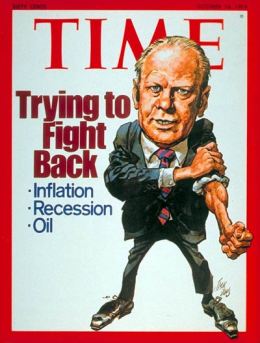
In 1973 the average annual household income was $9,037 or approximately $46,700 per household in today’s CPI dollars.  The nineteen-seventies became known economically as the Age of Stagflation.  The 25-year U.S. economic growth post-WW2 had stagnated to a crawl, and prices in goods and services rose annually in the double-digits from 10% in 1973 to 18% in 1979.  Due to poor performances on Wall Street, America’s top 1-percent saw their share of the nation’s wealth drop to the lowest in history:  19.9%.  Yet, middle-America enjoyed the highest ever share of the country’s wealth at 80%.

The eras of suburbanization in the 50’s and 60’s, however, had significant consequences in the 70’s.  The migration of tens of millions of middle-Americans (most of them White), moving to newly developing suburban towns meant getting to work in cities went from public transit to private vehicles.  This in turn caused America to become heavily dependent on foreign oil.  The long-term varied ripple effect of suburbanization cannot be overemphasized, one of which is our bigger footprint on environmental and global issues.

Wolff Table 1 Wealth

1976 – 1992:  Gilded Age Returns and Reaganomics

Reagan addresses Congress 1981 (Wikipedia)

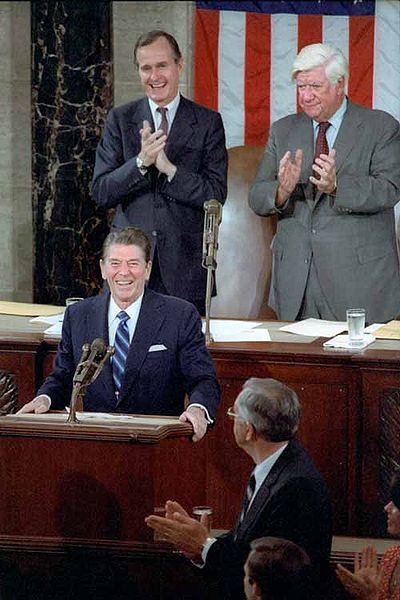
From 1976 to 1988 the average annual household income was $11,080 or about $44,700 in 2012 CPI dollars – yes, a $2,000 drop from the previous 3-years – to $25,167 or about $48,800 in 2012 CPI dollars; just above break-even from 1976.  To combat the stagflation of the 70’s, government deregulation along with personal and business tax cuts gained popularity.  As it turned out most of the tax breaks, along with deregulating helped America’s upper-classes.

Additionally, defeats of labor unions – unions made possible by Teddy Roosevelt reforms with long histories of keeping big-businesses from corruption and abuse of workers – also fattened the pockets of America’s top 1-percent by going from 19.9% ownership of the nation’s wealth to having 35.7% by 1989.  By 1992 the AAHI (average annual household income) was $28,870 or about $47,200 in 2012 CPI dollars; another drop from 1988.  While middle-America struggled, the top 1-percent in America owned a rising 37.2% of the nation’s total wealth.

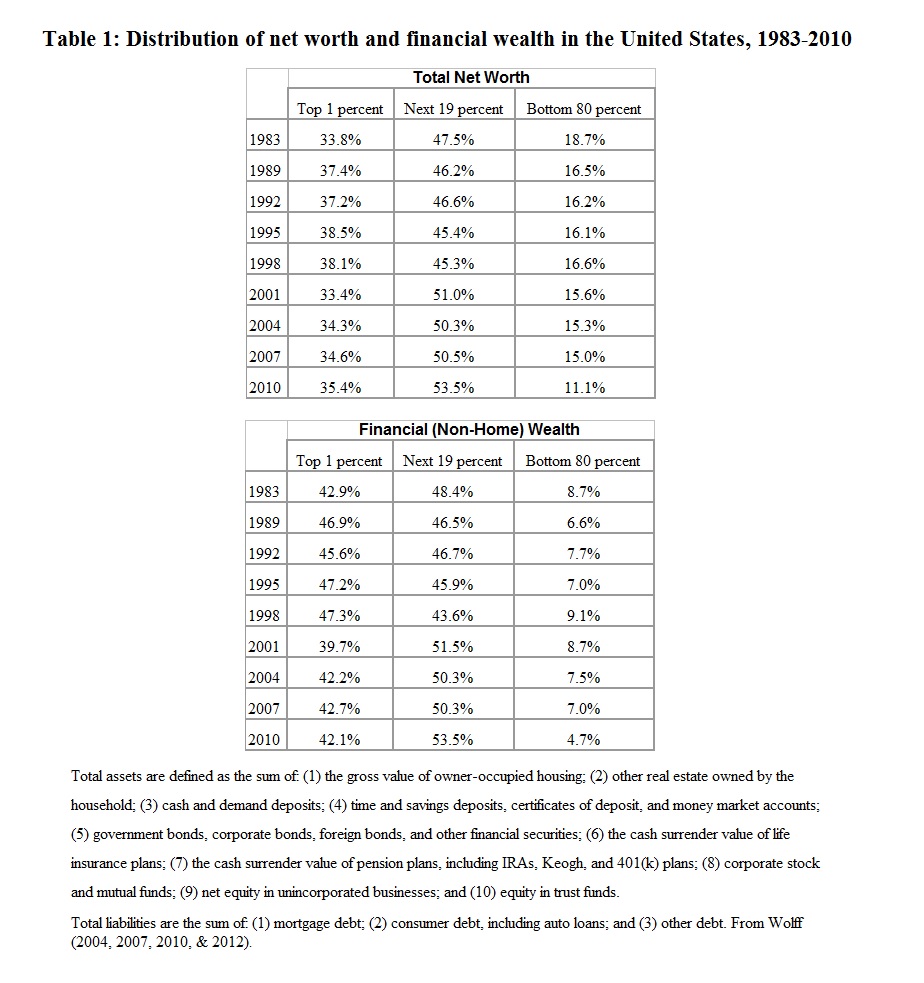
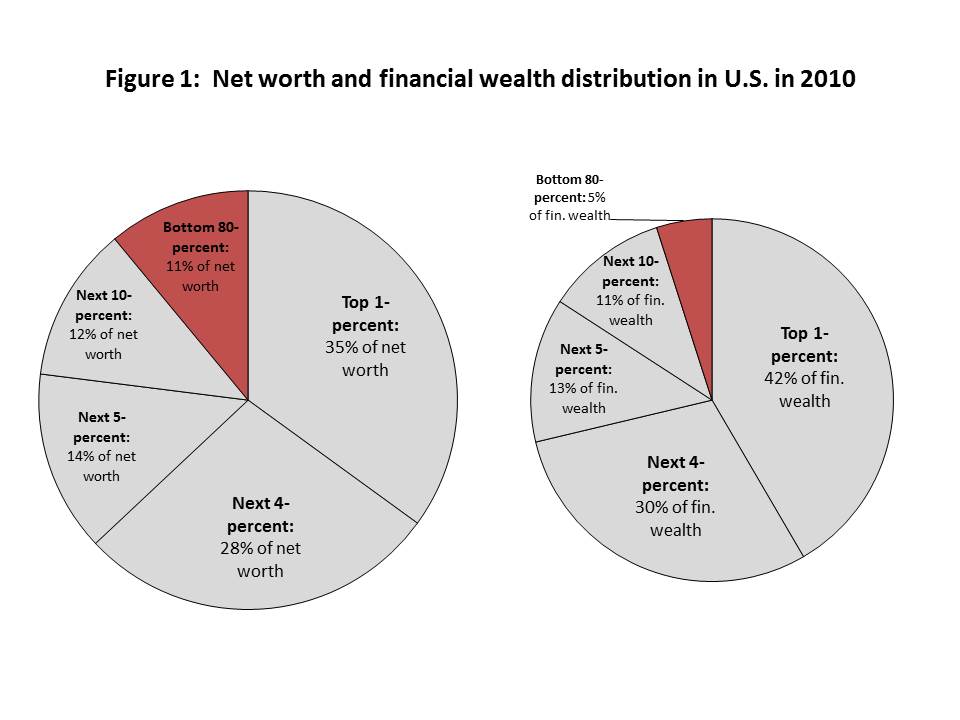
Beginning in 1983 economist Edward Wolff has tracked America’s net wealth and financial (non-home) wealth distributions.  As Table 1 above and Figure 1 below show, it is an increasingly bleak outlook for the majority of Americans.

Figure 1 Net & Financial Dist
Click image for larger view

1990 – Present:  Globalization and World Superpower

The 1990’s will be compared to the prosperity of the 1920’s and the 1960’s.  But as a whole is that what the data reveals?  The AAHI was $32,558 in 1995 or about $49,000 in 2012 CPI dollars and America’s top 1-percent enjoyed another increase in the owned wealth of the nation at 38.5%.  For six brief years (1994-2000) the economy saw rises in the national debt, the stock market, and the GDP while inflation plateaued and unemployment dropped below 5% because of the Dot-com Boom.  Economist and civilians alike agree that the growth explosion was mostly a result of workplace computerization.  But the good times would come to an end in 2001.

Map of the world wide web
Map of the world wide web 1990-2000

A constant influx of immigrants seeking the American Dream, an American economy becoming one of the major players in a growing global economy, a false sense of security in the housing market, and numerous corporate scandals in the energy and finance sectors due to previous government deregulating, all contributed to the tipping-point by 2007.  The AAHI in 2000 was at $40,418 or $53,900 in 2012 CPI dollars and the top 1-percent in America saw their portion in the nation’s wealth drop to 33.4% due to a sharp declining stock market worsened by the attacks of 9/11.  There is another set of globalization dynamics that added to the plight of middle-America.

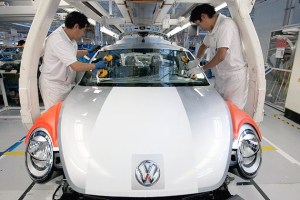
With the exodus of American jobs like cheaper electronics, fashion, shoes, and toys moving to developing nations, middle-Americans watched as their job and salary-leveraging also weakened with fewer lateral or upper employment positions.  Then jobs in TV, auto, steel, and home-furnishing manufacturing followed.  With those positions gone abroad, the American job-market went from high-paying management positions to simple service-industry low-paying positions which certainly need no college degree.  This move marked the boom of trade-school certifications for a growing electronic blue-collar job-market.

manufacturing_mexico
Why Mexico is becoming a global manufacturing power – Bloomberg Businessweek article

The domino-effect of American digitization, the snowballing Internet, and high-speed networks spreading to all corners of the globe have combined to gorge the growing socio-economic gap wider and deeper.  In 2007 the AAHI was $48,332 ($53,500 in 2012 CPI dollars) eaten-up by inflation and the cost-of-living.  Meanwhile, the top 1-percent owned a steady 34.6% of the nation’s wealth.  The lap of luxury doesn’t stop there.  With the creation of a connected more global economy today, along with new multiple global opportunities and substantially lower-wages to foreign workers, it should come as no surprise what sector of the American population currently enjoys the fruits-of-foreign-labor.

The World’s 200 Richest People(s):

The most industrialized developed countries in the world by population-size are in Europe according to the 2013 United Nations Human Development Report.  Of the top 10 nations with the highest Human Development Index (HDI), six of them are in Europe (see Report).  One might infer from that list then that many of the world’s wealthiest people reside in those countries or at least in Europe.  You would be wrong.

Of the 200 richest people in the world as of 2012, 61 of them (or 31%) are citizens of the United States.  What is perhaps unexpected is where the second richest group of people call home.  Of the next 139, 20 of them (or 10%) are Russian, ironically a former part of the old communist U.S.S.R.  The next 26 richest people come from Germany (13) and Brazil (13) at 7% and 6.5% respectively.  To see the world’s wealth and what portion of it is owned by the wealthiest 200, see the pie-chart below.  For the most current world ranking of the world’s wealthiest as ranked by Bloomberg click here.

Wealthiest 200 pie-chart

As the largest population of one of the most modern industrialized nations – currently 314 million and growing – the United States has the largest percentage of the population with the smallest percentage of the nation’s wealth.  Since 1983, as seen in Wolff’s two Tables above, it has decreased every single year.  To put this disparity succinctly, in terms of financial eggs-in-a-basket the top 1-percent own 35% of all privately held stock, 62.4% of all business equity, and 64.4% of financial securities in America.  Is it any wonder why middle-American taxpayers were held for ransom in 2008 to bailout our own mega-banks and financial firms, mega-auto companies, and integral government-sponsored entities?  The top 1 and 10-percent held the nation by the balls.  Sit down, it get’s more alarming.

largeextremeinequalitychart

The top 10-percent own 81% to 94% of all American bonds, trust funds, stocks, and business equity, and nearly 80% of all commercial real estate.  The real value of financial wealth is determined by control of income-producing assets; assets that can absorb recessions or devastating irreparable depressions.  Therefore, it is reasonable to conclude that 10% of Americans own the United States.  Talk about utter investment stupidity in placing the nation’s “eggs” in one or two baskets!  There is no way to sugar-coat it.  Perhaps Abraham Lincoln’s Gettysburg Address should be rewritten to reflect today’s socio-economic times:  Government of the 10-percent, by the 10-percent, for the 10-percent.

Land of the Few, Home of the Lavish

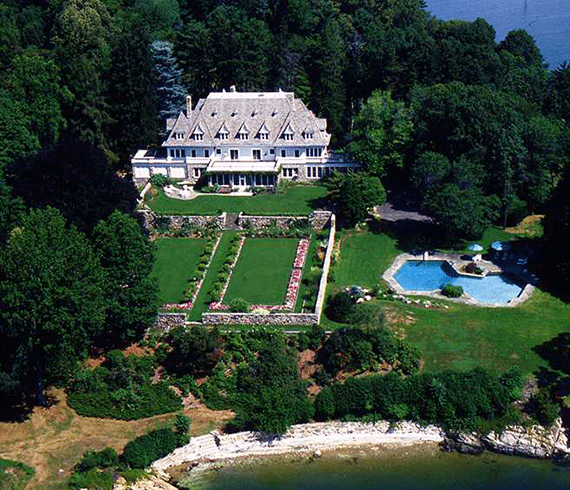
Listed at $190-million, Copper Beech Farm in Greenwich, Connecticut is the most expensive home in America.  Built in 1896 and previously owned by the Greenway family of U.S. Steel with Andrew Carnegie as well as timber tycoon John Rudey, it has over 13,000 square feet on 50 waterfront acres with spectacular views of Long Island Sound.  As a French Renaissance style home with 12 bedrooms, wine cellar, a 75-foot outdoor pool, a grass tennis court, a large formal arboretum, two greenhouses, and private apple orchard, accessible by a 1,800-foot private driveway.  Oh, and the property includes two offshore islands.

Copper Beech - Greenwich, CT
Copper Beech – Greenwich, CT

Copper Beech Farm is simply one home of over 100 homes priced above $10-million.  From 2005 through 2012 Greenwich, CT has been ranked as the best wealthiest place to live in the U.S., the “Biggest Earner” per household in the U.S., and #1 wealthiest residents per capita in the nation.  Many of the residents are Wall Street hedge fund managers, writes Nina Munk of Vanity Faire Magazine, and “of the $1.2 trillion currently invested worldwide, approximately one-tenth, or $120-billion, is now managed out of Greenwich alone, according to Hedge Fund Research, Inc.”  Munk also reports that four of the richest 400 Americans live in Greenwich and three of those are hedge fund managers.  One Greenwich real-estate broker reported these four residents will drop five to eight-million dollars without a second thought.  Some even a lot more.

Almost As Big as the Taj Mahal –
To judge by the number of swollen, over ambitious mansions rising from lots in Greenwich these days, you’d almost think we were back in the 1910’s and 20’s – except that this time round the lots are small, and the houses are almost on top of one another.  “Years ago, wealthy houses were hidden in the rear of properties after long driveways…and no one ever built to the maximum allowable square footage,” remarked Diane Fox, long time director of Greenwich’s Planning and Zoning Department, in an e-mail to me.  “Today all big houses want to be seen from the road.””

Munk’s article of Greenwich’s rich and lavish also mentions that one interior designer installed broadloom carpet at $74,000 for one bedroom, and drapes and curtains at $20,000 to $25,000 for one bedroom.  You read it right, one bedroom.

Why is this level of wealth and excessive opulence worth mentioning?

Because today American legislation, political campaigns, and economic policies resemble little of what they did six decades ago.  In 2010 the U.S. Supreme Court allowed American corporations, including those owned by the top 1 and 10-percent of the nation, the opportunity of donating vast financial resources for political candidates and their election campaigns; “resources” with millions of dollars beyond what any individual voters could organize.  Remember, 80 to 90 percent of Americans hold or own just 4.7% of the nation’s financial wealth.  The political phrase in the 1940’s and 50’s “one person, one vote” means today “one dollar, one vote.”  That 2010 decision sets the stage for a class of super-wealthy political campaigners to push (as if a majority of individual voters) their one-dimensional political-economic interests:  enhancing their profits and revenues.

A Communal America is Imperative

This four-part series has not been about political, economic, or social envy.  It seems the bottom 99% or 90% are for the most part not jealous of America’s gazillionaires or their social contributions and hard-earned incomes.  What this four-part series has been about though is political fairness, representation, and efficiency.  As discussed in part two Productive Inequality, rent-seeking moves wages and wealth from the bottom and middle classes to the top 10 and 1-percent while distorting the “free market” in favor of some and to the detriment of most.  More “efficient” policies of the market matter for a more equitable distribution of national wealth.  Improper policies (e.g. of the last 32-years) lead to a less efficient economy and a growing divide between socio-economic classes.

Strength in lots of Einsteins!

It is a fairly simple overall concept.  When our society is sufficiently (even abundantly) funded in infrastructure, education, research, and technology, these vital areas of a thriving economy offer hope and security to ordinary citizens.  The majority of Americans, the bottom 90%, will actually SEE and experience for themselves what the U.S. Constitution, the Statue of Liberty, and all other symbols of democracy, equality and fairness are really made of… not just “promised” or rhetorically talked about on TV.  Those principles would be available to a vast number in society in an efficient dynamic economy.  Even the top 1-percent would benefit when the capabilities of so many quality workers and citizens are not wasted but fully utilized.  It’s a concept of not just strength in numbers, but strength in well-educated, ingenious, motivated Einstein numbers!  There is a huge difference between the two.  The difference is not just inclusive, but very alien to exclusive.

In his superb book The Price of Inequality:  How Today’s Divided Society Endangers Our Future, Nobel Prize winner in economics Joseph Stiglitz gives a superbly educated agenda on exactly how American government and her 314-million citizens can avoid falling into the same death-trap history’s great empires and their leaders fell into.  If you would like to read an outline of his proposed extensive agenda, click here.

My own meek semi-educated ideas of how not to follow, for instance, the Roman Empire’s demise or the former Soviet Union’s, or the more recent countries of Egypt, Tunisia, and Syria… are this:

What is the reading on your/our Collective-Goodness-Gauge?  What is the health of your/our common welfare, our passion for civic responsibility and the well-being of the persons near us?

These are NOT just social questions!  More importantly they are political and economic questions too.  As the French political philosopher Alexis de Tocqueville noticed about the nature of American society in 1835, freedom (or individualism) can be a tricky balancing act within democracy.  Some “individualized” Americans independent of a majority often have the pragmatic realization that looking after the welfare of others is not only good for the soul, but is equally good for business and wealth.  Stiglitz elaborates on this truth wonderfully:

“The top 1 percent have the best houses, the best educations, the best doctors, and the best lifestyles, but there is one thing that money doesn’t seem to have bought:  an understanding that their fate is bound up with how the other 99 percent live.  Throughout history, this has been something that the top 1 percent eventually do learn.  Often, however, they learn it too late.”

Americans together
…no matter class or status

The Roman Empire, Egypt, Tunisia, and Syria are just four examples to what Stiglitz refers.  The former Soviet Union is an example of no individualism when no single “part” is allowed to reach its full brilliance and potential for the benefit of the whole; the other extreme.  Both ends of the economic-socio-political spectrum REQUIRE resource investments and management from every single citizen.  The stable “middle” if you will, has a steady balanced, efficient, fair, and equal flow of civic investment.  Any one mechanism cannot efficiently coexist without the other efficient mechanisms. So…

If the United States wishes to return as one of the best symbols of freedom, liberty, democracy, and equality for all, then reaching that efficient balanced middle is an imperative collaborative, collective return to a well-managed, well-governed, wealth-balanced cause.

* * * * * * * * * *

Further information —

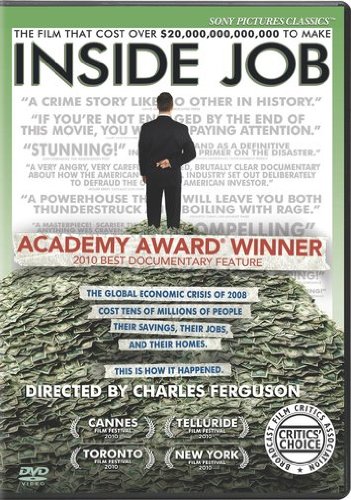
Inside Job

(paragraph break)

(paragraph break)

Creative Commons License This work by Professor Taboo is licensed under a Creative Commons Attribution-NoDerivs 3.0 Unported License. Permissions beyond the scope of this license may be available at https://professortaboo.wordpress.com.

Unveiling Incentive-Opportunity Fallacies

[This post is a continuation of the article-blog Productive Inequality]

(paragraph separation)

As I watched one night the 6-part series “The Men Who Built America” on the History Channel, I kept saying to myself What has changed  in our socio-economic America today?  The answer is a lot…and not much.  Watch the following 4-min video clip to get an idea why much has changed and not changed:

aragraph separation)

Resting on Star-Spangled Laurels

Ask most Americans on the streets today who Cornelius Vanderbilt, John Rockefeller, Andrew Carnegie, J.P. Morgan, and Henry Ford were and what they meant to America and you will get a variety of answers – although many could describe briefly some connection to Ford Motor Company, Chase Morgan, and Carnegie Hall in New York City.  Beyond those mutterings, the depth and accuracy might be in question.  However, ask the same question to Donald Trump, Jerry Jones, the Waltons of Walmart, Bill Gates, or Sumner Redstone and they will give you a hyper-patriotic narrative of how these progenitors founded and built the greatest economic nation in the world.  In the annals of Western capitalism, Carnegie, Ford, Morgan, Rockefeller, and Vanderbilt are the founding demigods.

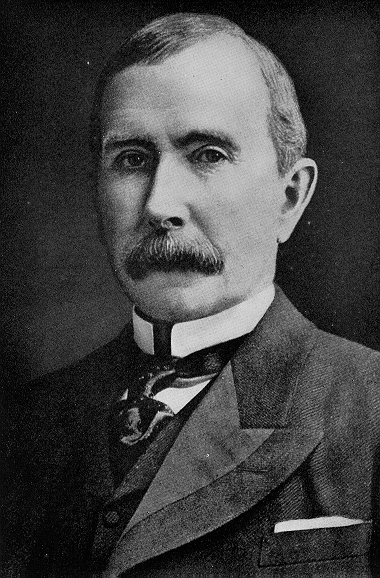
John D. Rockefeller, 1888

By the age of retirement all five of these 19th century business-moguls’ fortunes made up anywhere between 1-3% of America’s GDP by a single person.  Those five net worth’s have been adjusted for today’s 2000 dollars, but the amounts are incomprehensibly staggering.  Vanderbilt’s estimate:  $140 – $180 billion dollars.  Rockefeller’s estimate:  $392 – $663 billion dollars.  Carnegie’s estimate:  almost $300 billion.  Ford’s estimate:  $188 billion.  Morgan’s final net worth was divided between several holdings but his estate was estimated to be worth about $68 million at death.  If 1-3% of the economy of America – one of the world’s richest nations – consisted of five men, then that is perhaps the truest definition of oligarchy not democracy.  J.P. Morgan’s wealth was so vast that during the economic panic of 1893, President Grover Cleveland borrowed from him in order to restore the nation’s treasury.

How was it possible for a handful of entrepreneurs to accumulate such epic wealth during sixteen national recessions (1865 to 1933) as well as the Great Depression of 1929?  I will attempt to answer this question simply.

Do not mistake this web blog as promoting Karl Marx or Vladimir Lenin economics.  There is nothing inherently wrong with making and earning money for quality work.  What is under question, however, is how efficiently and fairly that economy — which provides the wealth — is working as a whole and perpetuating itself.  Despite the great success of these five American entrepreneurs, the “machine” from which they profited broke-down sixteen times.  Those failures in a long line of many failures as recently as 2008, are what is in question.  Why does our “strongest nation in the world” economy and government keep failing?

I am a lifetime sports fan.  One way to answer the question is to use a sports analogy.  Pick your favorite sports team, the team you grew up watching with family or friends.  The team’s performance should elicit some level of passion inside.  You’ve always wanted them to perform well, maybe even win several championships.  When your team is playing say in the playoffs, do you feel that referees or umpires are necessary?  Why are they necessary?  No fans, or for that matter no team players or coaches on the competing rosters cheer for the referees or umpires.  Why is that?  We like them when they punish or discipline our opponent, but we dislike them when they punish or discipline our favorite team.  Why are the referees and umpires needed for the games?

From a biased point-of-view the answer is obvious:  we want them there so that our opponents won’t cheat or win the game unfairly.  But from an objective standpoint, we need them there to ensure a “fair or level playing field” for both teams, correct?  Imagine what the games would be like if there were no referees or umpires.  Cheating, even intentional maiming would no doubt take place.  Whether we like referees and umpires or not, we need them so the games can be won or lost fairly.  Well, in economics and social policy the government is no different:  we need a strong government to ensure that the game of economics and social policy are fairly played.

During the era of Vanderbilt, Rockefeller, Carnegie, Morgan, and Ford there were weak referees or umpires, and in several cases no referees or umpires at all.  Even though the United States grew into the most powerfully economic and productive nation on the globe after 1870, doing it inside an unrestrained ungoverned free-market economy it eventually led to the worst economic and social collapse in modern history:  the Great Depression and two world wars.  Is that performance really deserving of grand boasting and fan-fare? Resting on the laurels of post-1870 Wild West growth is at the same time condoning unfettered greedy oligarchists and market manipulation.  Domestic and global economics today are much more complex and dynamic than antiquated 19th and 20th century philosophies can manage and diluting the power of the referees and umpires (i.e. our government) is a sure way of returning to another Great Depression.

Let’s look more closely at what outdated economic systems, still pushed today by some American parties, nurture over several generations.

Fallacies of Incentive-Opportunity Economics

REAGANMONEYSPEECH2

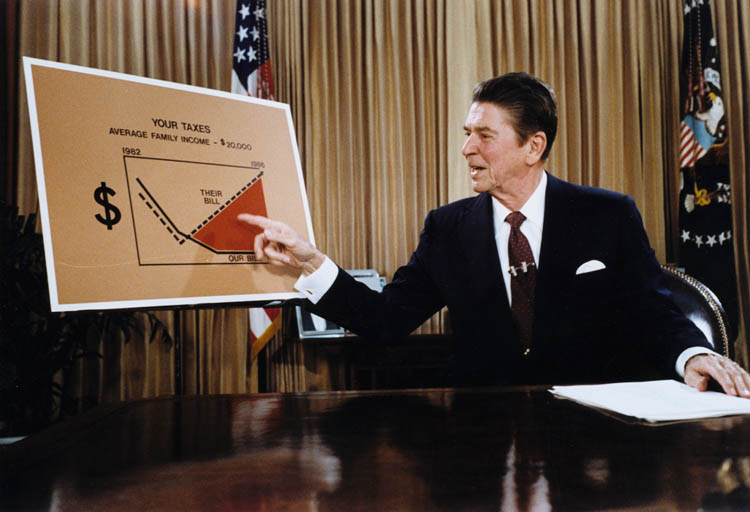
Some political parties and economists today swear by and blow their Reaganomics bugle, or trickle-down economics as the best economic system.  Another more modern name for this system is incentive economics.  Within this philosophy its adherents proclaim that inequality is a natural product of its efficiency:  some will produce more than others.  Proponents of incentive economics (primarily those from the political right) argue that if programs and policies redistribute wealth, then it will deconstruct incentives and motivation toward efficiency.  They also argue that if we focus too much on disparity of outcomes, i.e. a growing gap between socio-economic classes, especially over one year or a four-year presidential administration, then the public is missing the bigger better picture.  What is more important, they proclaim, is only lifetime inequality and how much more opportunity is created.  In other words, there is a natural trade-off of the-haves and the-have-nots based on efficiency as if it is “natural selection” of the strongest over the weakest or genius over ignorance.  They add that private wealth created by opportunity and perfect competitive economies will soon feed or trickle-down into social returns for the less fortunate.  But for the last four to five decades this simply hasn’t been the case.

Remember the definition of rent-seeking from the earlier post Productive Inequality?  It said when a company, organization, or individual uses their resources to obtain economic gain from others without reciprocating any benefits back to society through wealth creation…this is called rent-seeking.  For the last several decades declining public investment, declining support for public education, distortions of the true health of our economy, declining worker morale and labor fairness, have all contributed to a widened gap between the top 1% and 10% from the middle and bottom economic percentile.  Redistributing wealth and opportunities would reduce inequality and increase efficiency, the exact opposite of what the Right contends.

Both the lack of wealth and minimization of risk available to the lower 99% – 90% are two major market failures of our capital economy.  Consequently, this lays the burden of upward economic mobility on parental wealth; in other words, what their parents can or cannot provide through digressing public education and their work income.  And too often in the lower economic third both parents are working for wages that hardly keep up with inflation.  The Right consistently underestimates these failures.

Stronger or weaker team?

The Right also consistently overestimates the benefits of incentive pay.  Before revealing the true risks of incentive pay, what does the term mean?  Barron’s Business Dictionary states it is a wage system that rewards a worker for productivity above an established standard and within a defined time period.  It is often called pay for performance.  Many incentive pay schemes are used by corporations each with varying success rates, or resulting in higher worker productivity.  However, history has repeatedly shown that the schemes can also come with many counterproductive results.  Take for instance the program at Hewlett-Packard in the 1990s (click here for the CBS News article).  After setting up pay-for-performance schemes across thirteen or more American production sites, most of the HP worker-teams outperformed management’s projections costing the corporation excessive payouts.  As a result, HP management made the goals higher and harder to achieve.  This move had the exact opposite effect.  Teamwork within the nationwide teams declined, primarily because self-interest dominated over corporate gains.  Why do you think this happened?

Another example of failed incentive pay schemes but using instead a disciplinary fine, or negative reinforcement, to stimulate better results as told by Joseph Stiglitz:

“…a cooperative day center had a problem with certain parents’ picking up their children in a timely way.  It decided to impose a charge, to provide an incentive for them to do so.  But many parents, including those who had occasionally been late, had struggled to pick up their children on time; they did as well as they did because of the social pressure, the desire to do “the right thing,” even if they were less than fully successful.  But charging a fee converted a social obligation [teamwork] into a monetary transaction.  Parents no longer felt a social responsibility, but assessed whether the benefits of being late were greater or less than the fine.  Lateness increased.”

This begs the question, why is an extrinsic monetary reward scheme imperfect?  Because it is human nature to be socially connected; it is a primal instinct…for most, and in the end it often outweighs individual, secluding self-interest.  What is the point of an opulent palace with opulent toys on a grossly opulent island, if there is no one at all to enjoy it with?  Stiglitz goes on to write:

“The reason that [incentive pay] economic theory failed to gauge accurately the effectiveness of team incentives is that it underestimated the importance of personal connectiveness.  Individuals work hard to please others in their team – and because they believe it is the right thing to do.  Economists overestimate, too, the selfishness of individuals (though there is considerable evidence that economists are more selfish than others, and that economics training does make individuals more selfish over time) [particularly when resources, opportunities, and rewards are scarce/hoarded; ala the 2012 film The Hunger Games].  It is thus perhaps not surprising that firms owned by their workers – and who therefore share in the profits – have performed better in the crisis and laid off fewer employees.”

All four must be equally balanced

Many incentive pay schemes will never be able to fully ignite the best of human-worker performance because often monetary rewards, extrinsic gains, fall short of a greater good.  Why?  Because all four types of human motivation (table on right) must be as closely balanced as possible for a person to be peacefully satisfied.  This is just as true in economic and political laws and policies.

As a result of the Right’s shortsightedness, i.e. underestimating the real costs of socio-economic inequality and overestimating the costs of fixing it through progressive taxation and public spending, America needlessly spins its congressional and executive wheels in gridlocked hyper-partisanship  eventually invoicing her 90 percentile taxpayers.  President Reagan pushed for a less progressive tax system, lowering taxes on the top 1 and 10 percent, claiming that would raise more funds due to increased saving and worker productivity.  He was incorrect:  tax revenues plummeted.  H.W. Bush’s cuts had the same effect:  an increased deficit.  During President Clinton’s administration, taxes were raised on the top percentile and the United States enjoyed a brief time of rapid growth and a minor decrease in economic inequality.  Then George W. Bush entered office and…well, we had the 2008 financial crisis in which the majority of Americans, indeed the lower poorer classes, are still suffering.  Naturally, the Right contends that if the marginal Americans paid 100% of their taxes, then “incentives” for the public would be harmfully weakened.  But this claim is really nothing more than crying wolf.  Stiglitz points out:

“…University of California professor Emmanuel Saez, Thomas Piketty of the Paris School of Economics, and Stefanie Stantcheva of the MIT Department of Economics, carefully taking into account the incentive effects of higher taxation and the societal benefits of reducing inequality, have estimated that the tax rate at the top should be around 70 percent – what it was before President Reagan started his campaign for the rich.”

What many on the Right fail to recognize in their economic, social, and political theories and/or systems is that no one succeeds on their own.  They fail to recognize that a more level playing field, a more fair game if you will, almost always produces more efficiency, more brilliance, and a higher quality of life for a greater number, which in turn nurtures itself.  A healthier “team” is a more productive successful team; and when these healthy teams are playing other healthy teams on a fair game-field with strong powerful referees or umpires, the “game”…the economy is brilliant!  Therefore in return, the players, the coaches, the fans, everyone benefits and is more motivated to excellence.

On the other hand, an economic theory/system of scarcity and hoarding, i.e. weak public spending and regressive taxation for the strong/resourceful, is actually the antithesis of motivation-for-excellence; it too often maligns individual behavior to succeed-at-all-costs.  Survival-of-the-Fittest economics does not encourage unity, particularly in times of severe crisis, and does not encourage real democracy.  Thank the good stars that most human beings need MORE than just extrinsic rewards and require equally intrinsic rewards, if not more.  But oh dear, that would mean less egocentrism, less arrogance, less consumption, and more community, more intimate connectivity, more humbleness, and a more permeable comfort zone to name a few life-changes.  I feel there are many who are simply terrified of this idea, unfortunately, but I can hope.

Retrieving the American Dream

Joseph Stiglitz and those economists inside his camp have several profound ideas, policies, and reformations that will return America to its former collective glory.  To share these here would extend this blog series by two or three more; a length I have no time to carry out and likely readers and visitors here will have no patience with.  Hence, I will only recommend strongly that everyone purchase The Price of Inequality and read it, study it, and digest it.  If you wish to better understand what has happened and will continue to happen to our American economy and social classes, and avoid being a naïve puppet in a oligarchial corporate capitalist show in a failing free-market economy, then it is a must read!

class_saying_pledge

Here is the pressing question:  Is the American dream still alive?  Is the American dream still available?  More importantly, is the American dream available to all as our “pledge of allegiance” implies?  The present fifth version, which Congress passed in 1954, states in the last half “…one nation, under God, indivisible, with liberty and justice for all.”  How accurately does this pledge reflect America today?  How does one measure its accuracy?

Surprisingly perhaps to most, measuring America’s success of “…with liberty and justice for all” is quite easy.  In modern statistical tables, polls, experiments, or graphs all mathematicians will say that the greater the data collected, the more accurate the results.  Take for example a simple school student-poll on say thermostat comfort of the buildings.  Of a student body of 700 students, would the pollers achieve an accurate reflection of their student body if they obtained 150 student opinions?  Of course not; a poll of exactly 700 students would be the most accurate.  This statistical truth is always the case whether one is measuring ten people or elements, or whether measuring 314 million.

This statistical truth therefore applies to larger numbers or polls, like the world (see earlier post The Land of Opportunity? for a comprehensive indicator of America’s global standing).  In order to get a truly accurate and objective reflection, we must include the rest of similar industrialized nations, and to be most accurate all other non-industrialized nations.  But this raises more complex dynamics that in some cases go beyond economic, social, and political elements I have covered in this series of three web-blogs.  Fortunately, this formula…this gauge of happiness, justice, and liberty for all is not exclusively owned by one person, one group, or even one nation.  It is collective and shared.  The discouraging reality is that on the American horizon – and maybe the world horizon too – this Collective Goodness Gauge, if you will, is constantly threatened.  My next and last web-blog in this series, A Collective Imperative, will examine these threats and how to fight its extinction.

(paragraph separation)

Live Laugh Love

(paragraph separation)

Creative Commons License This work by Professor Taboo is licensed under a Creative Commons Attribution-NoDerivs 3.0 Unported License. Permissions beyond the scope of this license may be available at https://professortaboo.wordpress.com.

The Price of Exclusivism

I am in the process of intently reading three superb books on America’s current anemic social and economic position.  By what I have read so far, all three of these books speak directly to my deep concern for our country’s doomed path of progression:  exclusivism; unless this path changes.  Following are some reviews of these books.

A forceful argument against America’s vicious circle of growing inequality by the Nobel Prize–winning economist.

The top 1 percent of Americans control 40 percent of the nation’s wealth. And, as Joseph E. Stiglitz explains, while those at the top enjoy the best health care, education, and benefits of wealth, they fail to realize that “their fate is bound up with how the other 99 percent live.”

Stiglitz draws on his deep understanding of economics to show that growing inequality is not inevitable: moneyed interests compound their wealth by stifling true, dynamic capitalism. They have made America the most unequal advanced industrial country while crippling growth, trampling on the rule of law, and undermining democracy. The result: a divided society that cannot tackle its most pressing problems. With characteristic insight, Stiglitz examines our current state, then teases out its implications for democracy, for monetary and budgetary policy, and for globalization. He closes with a plan for a more just and prosperous future.

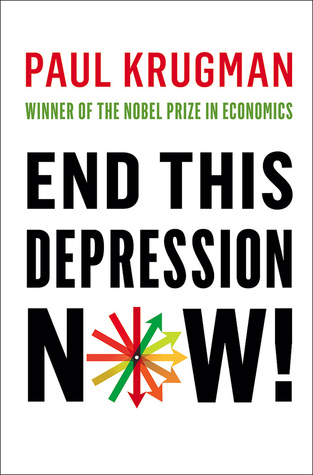
The other two books in which I am engrossed are the Nobel Prize Winner in Economics, Paul Krugman’s End This Depression Now and the book I am foaming at the mouth to finish, It’s Even Worse Than It Looks by co-authors Thomas Mann and Norman Ornstein.

The Great Recession is more than four years old—and counting. Yet, as Paul Krugman points out in this powerful volley, “Nations rich in resources, talent, and knowledge—all the ingredients for prosperity and a decent standard of living for all—remain in a state of intense pain.”

How bad have things gotten? How did we get stuck in what now can only be called a depression? And above all, how do we free ourselves? Krugman pursues these questions with his characteristic lucidity and insight. He has a powerful message for anyone who has suffered over these past four years—a quick, strong recovery is just one step away, if our leaders can find the “intellectual clarity and political will” to end this depression now.

And on Mann’s and Ornstein’s book —

Acrimony and hyper-partisanship have seeped into every part of the political process. Congress is deadlocked and its approval ratings are at record lows. America’s two main political parties have given up their traditions of compromise, endangering our very system of constitutional democracy. And one of these parties has taken on the role of insurgent outlier; the Republicans have become ideologically extreme, scornful of compromise, and ardently opposed to the established social and economic policy regime.

In It’s Even Worse Than It Looks, congressional scholars Thomas Mann and Norman Ornstein identify two overriding problems that have led Congress—and the United States—to the brink of institutional collapse. The first is the serious mismatch between our political parties, which have become as vehemently adversarial as parliamentary parties, and a governing system that, unlike a parliamentary democracy, makes it extremely difficult for majorities to act. Second, while both parties participate in tribal warfare, both sides are not equally culpable. The political system faces what the authors call “asymmetric polarization,” with the Republican Party implacably refusing to allow anything that might help the Democrats politically, no matter the cost.

With dysfunction rooted in long-term political trends, a coarsened political culture and a new partisan media, the authors conclude that there is no “silver bullet” reform that can solve everything. But they offer a panoply of useful ideas and reforms, endorsing some solutions, like greater public participation and institutional restructuring of the House and Senate, while debunking others, like independent or third-party candidates. Above all, they call on the media as well as the public at large to focus on the true causes of dysfunction rather than just throwing the bums out every election cycle. Until voters learn to act strategically to reward problem solving and punish obstruction, American democracy will remain in serious danger.

As I have written about adequately throughout my WordPress blog, exclusivism, elitism, and mob-egotism seriously, seriously threaten modern democracies and ultimately this planet.  Apparently Stiglitz, Krugman, Mann, and Ornstein would more less agree, particularly in a socio-economic context.  Ah, humbly I need to restate that:  I apparently agree with them.  Or perhaps the five of us all agree.

But I will not jump too hastily to conclusions.  I will completely finish these three fine works and THEN incorporate their problem-identifications, solutions, and ideals into my views and opinions for a better nation and world.  Come to think of it, I can probably merge polyamory and the open-swinger lifestyle (grinning and laughing) into my viewpoint as well!

Stay tuned!