The six of us were all sitting around the kitchen table discussing time-travel and the effects of gravity on time itself. A good friend of the family repeated once again what she had stated earlier, “It is all merely philosophy and theory.” The word speculation would probably have been another word she would have approved and used. My political and respectful(?) response was “But how will we learn and know if we don’t GET OUT THERE and collect the actual data?” She agreed.
You see, our sweet good friend comes from a long maternal ancestral line of Protestant evangelical fundamental Christian indoctrination. She has not known any other lifestyle or worldview her entire life of 32-years. Because of this and also where I currently reside — the Hill Country towns of central Texas and nearer a few of my extended family — I am confronted daily or weekly with this religious mindset and way of life which they automatically assume to be true and right from generations after generations, after generations. I ask… should we not get out there, explore, examine, scrutinize, and always ask the hardest questions in order to arrive at the most plausible truths? I think so.
From 1983 to 2002 “getting out there” was exactly what I set out to do regarding a real God, the Christian bible, then the Hebrew bible, and more recently the Quran. This post and some of my other related blog-posts are what I discovered over those 19-years and counting. This post is another condensed study and research from those years based on 20 scholars listed in this supporting Bibliography Library-Page, as well as my personal experiences with fundamental Christian evangelists, extended family, apologists and one particular Hindi futeboller from Kashmir, India. My purpose for writing another post about biblical fundamentalism, particularly Christian, is simple. Share with the public and anyone interested just how few questions are asked about the roots of earliest Christianity under the contextual dominance of the early through late epochs of the Imperial Roman Empire. It is safe to assume that mainstream Christianity, if not church leadership too, are naïve of their own faith’s history and origins.
(line break)
* * * * * * * * * *
(line break)
The Nature of God?
How does a person learn who God is, what She/He/It is like, and how do we know it is truly God and not some imposter or auditory or visual hallucination? This question of course presupposes that a God exists in the first place. Ignoring this a priori step in the process of logic and reasoning would be a serious mistake. However, for the sake of time and subject matter, I will not go into the existence or non-existence of God. For a plethora of reasons much of the world believes God or a Supreme Being exists anyway.
Therefore, assuming a God(s) does exist, how can we know this God? Morgan Freeman’s recent National Geographic mini-series The Story of God was pretty well received by audiences and critics as Freeman and his team traveled the world gathering various cultural perspectives of God. I Google-searched the question “How can we know God?” and it returned these first 10 resources, out of about 483,000,000 results:
“How to Know God Personally —
What does it take to begin a relationship with God? Devote yourself to unselfish religious deeds? Become a better person so that God will accept you?
You may be surprised that none of those things will work. But God has made it very clear in the Bible how we can know Him.
The following principles will explain how you can personally begin a relationship with God, right now, through Jesus Christ…”
(from the Campus Crusade for Christ International website)
From the Joyce Meyer Ministries website “Everyday Answers”…
“There was a time in my life when I struggled with all types of fears and insecurities, constantly worried about the future, my job, my ministry, and my family. Needless to say, I wasn’t really enjoying my life!
However, over time, the Lord helped me to change… and He helped me understand an important key to truly enjoying life. It all begins with what the apostle Paul says in Philippians 3:10… something I believe we should all pray regularly…
“[For my determined purpose is] that I may know Him [that I may progressively become more deeply and intimately acquainted with Him…understanding the wonders of His person more strongly and more clearly]…” (AMP).”
From the Got Questions Ministries website…
“How can I get to know God better?” —
Answer: Everyone knows that God exists. “God has made it plain” that He is real, “for since the creation of the world God’s invisible qualities—his eternal power and divine nature—have been clearly seen, being understood from what has been made, so that people are without excuse” (Romans 1:19-20). Some try to suppress the knowledge of God; most try to add to it. The Christian has a deep desire to know God better (Psalm 25:4). — by J.I. Packer
(the next 7 paragraphs reference the Christian bible 13-times)
From the In Touch Ministries website…
“Getting To Know God” —
Did you know God wants to show you more of Himself every day? Does your time with the Lord revitalize you, or does it feel more like a ritualistic experience? In Hosea 6:6, God is clear: “I delight in loyalty rather than sacrifice, and in the knowledge of God rather than burnt offerings.”
(the next 6 directives reference the Christian bible 3-times)
From the Every Student website…
“What does it take to begin a relationship with God? —
Wait for lightning to strike? Devote yourself to unselfish religious deeds? Become a better person so that God will accept you? NONE of these. God has made it very clear in the Bible how we can know Him. This will explain how you can personally begin a relationship with God, right now…”
(the rest of the page references the Christian bible 16-times)
And jumping to the 10th result on the Harvest Ministries website…
“Know God —
You were created to know God in a personal way—to have a relationship with Him, through His Son, Jesus Christ. How do you start a relationship with God?”
(the following 4 step procedure references the Christian bible in every step)
 Noticing the pattern? The bible, the bible, the bible, and repeatedly the bible apparently has all the answers to knowing God. There doesn’t seem to be any tangible physical meeting of God where you actually see God, or hear Her/His/Its voice, you cannot call God up for an interview, nor is there a global standard of where to find God or how to find God’s collective global nature from any of these websites… except, in the Bible.
This has been my own experience when asking faith-followers these questions about God. In other words, the more people asked, there seems to be more than just one simple version of God! Hmmm. Maybe what should be asked is what “version” of God is most popular in the world?
According to www.Adherents.com and other sources, the world’s largest religion by population is Christianity (2.1 billion), followed by Islam (1.5 billion), then the Non-religious or unaffiliated (1.1 billion), Hinduism (900 million), Chinese Traditional (394 million), and Buddhism at 376 million respectively. As a result of popularity then, let’s look more closely at the Christian version of knowing God. How can it be done?
(line break)
Divine Revelation?
Throughout the lore and archaeological evidence of humans, when a divine spirit or Supreme Beings disclosed themselves to people, or something about existence, or about the world, in theological terms that is often defined as revelation. Because video and audio technology did not exist 50,000 years ago when forms of verbal human language began, and institutionalized morality only began long after around 10,200 BCE in the Neolithic Period, we cannot know the types of divine revelations that took place. Prior to the start of human writing (cuneiform) 5,000 years ago or around 3,000 BCE, there was still no video or audio technology available to literally record gods or God. Only rituals, song and dance, and oral traditions passed to descendants in various chiefdoms and tribes in ancient Egypt, Sumeria, and Mesopotamia were the way to know about God or gods.
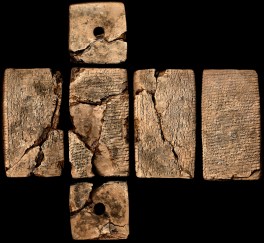
Kesh Temple Hymn tablet
Today, one of the oldest known religious texts is the Kesh Temple Hymn from ancient Sumer which dates to around 2,600 BCE. Yet, other than Sumerian admonishments the hymn offers only glimpses and inference into their gods. The other oldest religious text — the Egyptian Pyramid Texts — was carved into the walls of the pyramids at Saqqarah and date to around ca. 2400–2300 BCE. However, these Egyptian texts do not reveal any specific ways to know the gods other than again by inference.
As a result of very very ancient oral traditions or storytelling, and very ancient cuneiform inferences, both from an area of the ancient world covering over 1.5 million sq. miles, how then do Christians today really know God? Are all of them experts in palaeography and epigraphy and their interpretations? Of course not. Do they speak regularly with those deceased Neolithic Sumerian, Egyptian, Mesopotamian storytellers, or ancient Hebrew, Arabian, or Greek orators? Of course not. It would be wise, therefore, to better understand what exactly it is and why Christians place so much unquestioning faith and belief in 1) a religion based on ancient storytelling, 2) widespread fluid (imprecise) cuneiform art, 3) a couple or three very small Hebrew tribes from the ancient Middle East, and followed by 4) more letters and stories about a man’s life and teachings recorded 60 to 110 years AFTER the actual events occurred in the 2nd century CE.
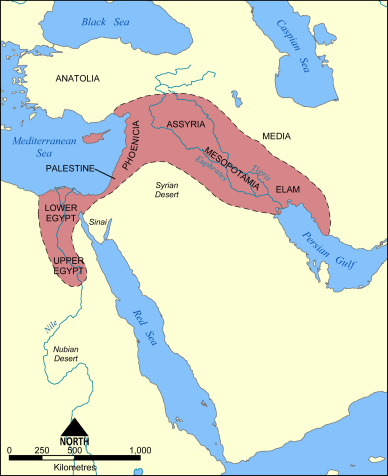
The Fertile Crescent
Yet, despite this precarious framework of revelation, a great number of evangelical fundamental Christians would disagree with my above assessment. Why?
(line break)
Special Communion
They disagree because they and apparently 2.1 billion in the world proclaim that God CAN be known. They disagree because God has made Herself/Himself/Itself available to be communed with through two or more methods. If anyone can list and explain more than these two methods, please feel free to share in the comments below! Nevertheless, take a large enough sample of those 2.1 billion Christ-believers — similar to hearing a complete sentence on the trading-floor of the New York Stock Exchange during heavy screaming — and one can start to narrow the methods down. I will borrow from Theopedia.com to explain…
- General Communion/Revelation – “Also known as Universal revelation, general revelation deals with how God can be understood through his creation. More specifically, this can be manifest in physical nature, human nature, and history.“
- Special Communion/Revelation – “is distinguished from general revelation in that it is direct revelation from God. Examples include God’s direct speech to various people (e.g., prophets; cf. 2 Peter 1:20-21), the incarnation (cf. Hebrews 1:1-2), and the Bible. Such revelation is sufficient to communicate the gospel, unlike general revelation, and thus salvation is possible only through special revelation.“
Is General Communion/Revelation adequate to authenticate evidence of a God as Christians claim from Romans 1:19-20? The controversy over this religious tenet versus human reasoning (science?) started way before 2nd century CE Christianity and as early as the 7th century BCE in Mesopotamia by Assyrian and Babylonian astronomers.
 The lethal controversy was over the purpose or reason for lunar eclipses. The Assyrian-Babylonian priests believed that lunar eclipses were evil omens and vindictive restlessness of the gods directed against their kings. However, due to hundreds of centuries of recorded astronomical data, by the 1st century BCE Babylonian astronomers knew an upcoming lunar eclipse would happen on May 28th, 585 BCE at sunset. In fact, their mathematical calculations were accurate within a couple of minutes! The astronomers had calculated the 18 year and 11.3 day (223 synodic month) interval between lunar eclipses. This suggested that the eclipses had a natural (scientific) cause. If lunar eclipses were predictable, then the Babylonians could appoint a temporary king (likely through coercion) who would accept the horrible wrath of the gods, thus saving the real king from a death-omen.
The most famous controversy of church tenets versus human reasoning and mathematics was between Galileo Galilei (1564-1642 CE) and the second organized Christian church, the Roman Catholic Church. As most already know, Galileo was tried and convicted as a heretic by the church for his correct Heliocentric system of our solar system. It made no difference though, God’s Holy Church and Testaments infallibly ruled. It wasn’t until over 350 years after Galileo’s death that the church addressed their ‘mishap‘:
“… Pope John Paul II gave an address on behalf of the Catholic Church in which he admitted that errors had been made by the theological advisors in the case of Galileo. He declared the Galileo case closed, but he did not admit that the Church was wrong to convict Galileo on a charge of heresy …”
— National Center for Biotechnology Information, October 1992
Therefore, given that the physical world has not and cannot be wholly described at a moment in time as monistic evidence, or substance monism/Neoplatonism, for evidence of God — i.e. one creation by one source during the sixth day of creation while new species are being discovered and others going extinct every decade or century — this leaves us with only Special Communion/Revelation to know God.
As stated by Theopedia and most Christian-believers, Special Communion/Revelation is their firm foundation for knowing and experiencing the Judeo-Christian God. This communion has three components:
- Direct speech – through past and present prophets carried by the Holy Spirit (2 Peter 1:20-21).
- The Incarnation – through the birth, life, crucifixion, and resurrection of Christ (Hebrews 1:1-2).
- Holy Bible – a communal collection of ancient writings breathed by God which comprise the sixty-six books of both the Old Testament and the New Testament.
For the sake of my reader’s time and mine, I will make brief comments on the first two special-revelation components which I hope will cause anyone to examine or reexamine their dubious implications. Following those comments we will finally delve into the origins and developments of the Christian Bible.
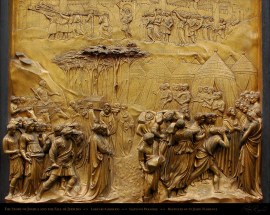 Direct speech
By popular definition prophets hear or sense the voice of God directly then obey. Innumerable documented examples reside both in ancient and modern history. About 1,550 BCE the prophet Joshua was told by God to go conquer the land and people across the Jordan River (Joshua 1:1-6), killing all the men, women, and children (Joshua 6:21). After Jericho was razed, on the further commands of God Joshua then razed the town of Ai, killing 12,000 men and women (Joshua 8:24-28). Genocide is not the only command by God either, mass suicide is also spoken by God to the more faithful zealous followers. At the fortress of Masada in 73 CE led by the apocalyptic prophet Eleazar ben Yair, though details are debateable, 960 Jewish revolutionaries committed suicide/murder for their God rather than endure enslavement by Rome.

Jones (left) and Koresh
In modern history three iconic prophets also followed God’s direct speech for mass suicide of all their most faithful zealous followers. They do not need any elaboration here. They were Jim Jones in Jonestown, Guyana (Nov. 1978) of 918 followers — nearly 300 were children — Marshall Applewhite in Rancho Santa Fe, CA (March 1997) convincing 39 followers, and David Koresh in Waco, TX (April 1993) leading 85 followers — 22 of them children/teenagers — to their mass suicide/incineration.
In a 2007 co-authored article by Erich Follath (diplomatic journalist), Manfred Müller, Ulrich Schwarz (theologian), and Stefan Simons (Spiegel Online correspondent) entitled “Following Divine Orders“ which focuses on the Age Old irresistible appeal of religiosity for fanatics, or rather those who are not moderate or “luke warm” about their beliefs:
“According to the three Abrahamic faiths, God only revealed the truth about Himself, humankind and the world to their respective religion; it is therefore recorded separately in their holy scriptures: the Hebrew Bible (the Torah, or Old Testament to Christians), the Christian New Testament and the Islamic Koran.
These [bibles] contain countless contradictions. Both the Koran and the Bible’s Old and New Testaments bear witness to a good and merciful God. They urge humans to live in peace and harmony. This is reflected most clearly in the instruction attributed to Jesus in the Hebrew Bible: “Love thy neighbor as thyself.“
But these messages of brotherhood clash with sentiments that condone intolerance and violence: “For I came to set a son against his father, a daughter against her mother …“; “Anyone who loves his father or mother more than me is not worthy of me“; “Do not think that I came to bring peace on Earth. I did not come to bring peace but a sword.” The prophet Mohammed also delivered harsh threats from Allah: “Fear the fire prepared for the infidels.“
Throughout history, the Abrahamic religions’ claim of absolute authority has exerted an irresistible appeal on fanatics, encouraging them to impose their own faith on nonbelievers and dissidents alike – if need be by using fire and the sword. To this day, nearly all religions supply the kindling that fuels wars and acts of persecution, sparks torture and murder, and inflames ethnic hatred. Examples abound: the bloody wars between Hindus and Muslims in India, or the enmity between Muslims and Christians in Indonesia.
For centuries, it seemed that the Abrahamic religions had come to terms with – and discarded – extremism. In the case of Christianity, this dates back to the Enlightenment, when the symbiosis between church and state collapsed and a new system of ethics emerged – one that was independent of faith in God and derived solely from social consensus.”
Those above examples of ancient and modern direct divine revelation seriously beg the questions What exactly is the Holy Spirit and how is it (a prophet) accurately tested for authenticity? Anyone who wishes to answer these questions, good luck! I do NOT envy you. There are as many various definitions of the Holy Spirit/False Prophet debate by Christians as there are species and sub-species in the animal kingdom! It is truly unimaginable. Suffice it to say here that almost all Christ-believers, scholars and laypersons alike, ultimately and exclusively refer to their Bibles for definitive Holy Spirit or non-Holy Spirit answers. Naturally, that only leads to more questions. Therefore, “direct speech” is not a religious consensus to really knowing God.

Greek soccer fans
It is worth mentioning, the fields of psychology, neurology, and sociology have many theoretical studies associating heightened religious behaviour due to Temporal lobe epilepsy and minor forms of schizophrenia, and sociologists have found that social God-constructs can persuade individuals into states of euphoria because of large numbers of people acting together in a strongly shared belief — crowd psychology or mass hysteria, also known as Mass Psychogenic Disorder/Hysteria. Huge sporting events are good examples of this phenomena. Extreme isolation can have similar effects of hyper-religiosity and paranormal hallucinations, sometimes negative.
The Incarnation
In theological terms, this is simply God in and as Jesus Christ; both God and man simultaneously. The first grave problem with this Christian doctrine is that it is based upon only “Christian-biased” historical sources and traditions riddled with inconsistencies. In other words, who and what Jesus of Nazareth was historically between 6-4 BCE and 30-36 CE, the generally agreed upon lifespan, cannot be verified with absolute certainty outside of the Christian Synoptic Gospels. Many Christian apologists vehemently claim that writings by Flavius Josephus, Pliny the Younger, and Tacitus are non-Christian evidence for the historicity of Jesus. F. Josephus, however, was not completely unbiased about the new Jesus-Movement called The Way by Judean-Christians; he too was involved in 1st century CE Jewish Messianism as a Pharisee. Pliny and Tacitus were indeed Roman and non-Christian, but their very brief mentions are about Christians as a whole, rather than a biography about a specific person named Jesus.
Therefore, the best that Christian-believers can hope for regarding an actual verifiable incarnation of God through Jesus of Nazareth is by Christian scribes and followers 30-90 years after his death based on oral-storytelling traditions. That is the closest that honest scholarship can provide at this time, and beyond that is a question of individual faith within crowd psychology. This now leaves us only with the Bible… what the doctrines of Direct speech and The Incarnation frequently must reference anyway.
(line break)
The Canonical Bible
Many modern Christians are unaware of the origins, early development, and the 2nd and 3rd century CE controversies surrounding the final compilation of their Bibles. Some believers might even think their bible suddenly dropped out of heaven long long ago after God finished writing the 66 books, never thinking to ask “Why just 66 books? Why not 40 or 10 simple books?” And honestly, orthodoxed American society today, including many Christians, know very little of the ancient world of Jesus, the Levant, and the Fertile Crescent.
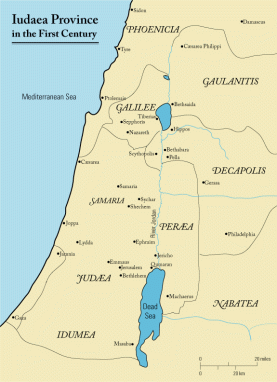
The birthplace of Jesus was Judea, the Jewish province ruled by Rome. Divided by intense religious factionalism, the people of Judea, as well as Galilee, Idumea, Nabatea, and Perea were anxiously awaiting the arrival of the Messiah and God’s salvation. First century CE Romans would have encountered a large mix of traditions and philosophies in this world. The Hebrews had for many centuries suffered foreign invasions and been harshly buffeted by powerful external cultural forces. The most potent of these was Alexander the Great’s Greek civilization supported by several centuries of Hellenistic overlords in Egypt and Syria.
The Jews in these regions were divided over subjects ranging from the legitimacy of the priesthood to the acceptance of certain books into the Hebrew Canon. The Essenes rejected the priesthood entirely. Samaritans formulated their own unique doctrines. Various cadres of Jewish zealots pledged themselves to the expulsion of the Romans. Sadducees made up their prestige with the aristocratic clans making up the priesthood in Jerusalem and exclusive supervision of the Temple. They rejected the books of the Prophets and Writings and also became more ingratiated with Herod and Roman governors who eventually granted them local rule in the Sanhedrin. The Pharisees were more progressive than the Sadducees in that they not only accepted those books, but also believed in angels, demons, resurrection, and — like the Essenes and other groups — passionately in the coming of the Messiah, e.g. the Apostle Paul. The Pharisees also had grown a body of unrecorded commentary on Hebrew Scriptures and rulings by Jewish sages. This was intended to help Jews adapt the ancient Law of Moses to the circumstances of their own time.
Essentially, roots of the Christian New Testament began during this period of great Jewish disunity, alienation, isolation, and confusion before anything Christian was written down. Once Christ-followers began recording an anthology or testaments of Jesus’ parables, prophetic and wisdom teachings, and exhortations — by around 150 CE (over a century after Jesus’ death) — there was no less than 42 testaments or gospels for Christian teachings which were freely circulating as opposed to just 27-books in today’s New Testament. The formulation of the Hebrew Bible, i.e. the Old Testament, went through similar reconfigurations between 500 BCE and 70 CE, i.e. approximately 600 years!
Naturally, all this diversity and variety of who and what the Nazarene was caused more confusing fractures among outlying Christians and Judean-Christians for centuries! It is like trying to answer “What is an American?” today in one single description from 324+ million citizens. To learn more about the various origins of Nazarene-Nasorean-Nasara-Nazirite, go here to my bibliography subpage: The Nasara-Nazirites.

1st & 2nd century Roman Empire
Authoritative or Not Authoritative?
For over three and a half centuries (between 337 and 389 years!) after Jesus’ death, there existed no standardized written collection about Jesus’ ministry or precisely what he did or taught. Everything known about him (and not known) was by word-of-mouth across 2,000 sq. miles. What is more dubious and astounding is that what little there was written down about Jesus’ message was by a foreigner, a Hellenistic Pharisee named Saul of Tarsus who had never once met Jesus in the flesh, in person. No surprise, after Saul’s ‘paranormal conversion‘ to “The Way” on the road to Damascus, he fell into serious conflict with the Council of Jerusalem headed by Jesus’s next-in-line brother James, Peter, Cornelius, and other Judean-Christian leaders who had personally known Jesus quite well compared to Saul. Yet, today Pauline-Christianity (aka Saul) predominates the New Testament, seminaries, and modern churches. James Tabor, professor in the Department of Religious Studies at the University of North Carolina at Charlotte, writes about this heavy influence from a near total stranger to the Jerusalem leaders… and their and Jesus’ Neo-Jewish teachings. Tabor states:
The fundamental doctrinal tenets of Christianity, namely that Christ is God “born in the flesh,” that his sacrificial death atones for the sins of humankind, and that his resurrection from the dead guarantees eternal life to all who believe, can be traced back to Paul — not to Jesus…
In contrast, the original Christianity before Paul is somewhat difficult to find in the New Testament, since Paul’s 13 letters predominate and Paul heavily influences even our four Gospels. Fortunately, in the letter of James, attributed to the brother of Jesus, as well as in a collection of the sayings of Jesus now embedded in the Gospel of Luke (the source scholars call Q), we can still get a glimpse of the original teachings of Jesus…
What we have preserved in this precious document is a reflection of the original apocalyptic proclamation of Jesus: the “Gospel of the kingdom of God” with its political and social implications.
— Christianity Before Paul, The Huffington Post, November 2012 cited Aug. 16, 2016 at http://www.huffingtonpost.com/james-d-tabor/christianity-before-paul_b_2200409.html
With this and other additional alternative extant evidence, one has to ask “What formula was used some 300-years later to configure and reconfigure the vast oral and written testaments/gospels of Jesus?” Hitherto is a list of the most significant testaments/gospels about Jesus of/the Nazareth/Nazarene out of approx. 130 known writings not present in the New Testament today:
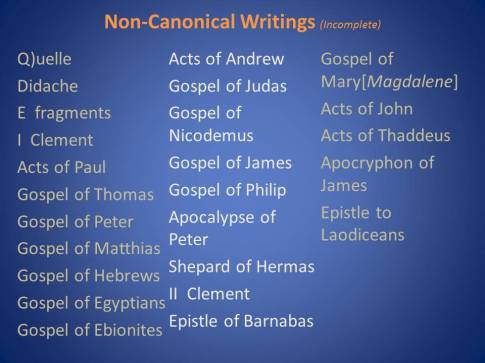
For a more complete list of the many known writings of Jesus and his earliest followers, go to the NNU Wesley Center’s page of Non-Canonical Literature.
(paragraph break)
Apostolic Fathers and the Canon Formula
Signs that much of these various Jesus-literatures had been accepted as authoritative by church leaders and early Christian congregations as early as the 1st and 2nd centuries CE appear in the letters of the Apostolic Fathers. During these centuries of the new upcoming churches, no official creed or universally accepted liturgy existed. In the following paragraphs, notice the similarities from the first churches to modern-day Christian churches.
The biggest and most heated controversy was a newer version of an old Jewish sectarian problem: Are the Hebrew Laws, Prophets, and Writings above, below, or void in light of Paul’s Hellenistic teachings — deeds or faith? Another ongoing spinoff debate was the Gnostic challenge: There are two dualistic worlds and two Gods, and there was no Incarnation, explained as follows:
- The World of Darkness was created by an inferior God, the Hebrew God, and so the Hebrew scriptures were rejected or severely de-emphasized.
- Material aspects of this Dark World, including the human body, were burdens that humanity was forced to endure by the Hebrew God.
- The World of Light and Knowledge was ruled by a Supreme Being. Salvation was possible only through gnosis of this divine world and the Supreme Being’s mysteries, but salvation was available only to some, not all. Some Gnostics had a three-tiered class system too.
- There was No Incarnation because he was not the Son of the inferior Hebrew God, nor did he become a man, suffer human pain, or die on a cross. Resurrection was merely a spiritual linking of the soul with the World of Light and had nothing to do with a human body.
Because Pauline Orthodoxy had the support of Rome, Constantinople, Alexandria, and Antioch, and their power and influences of those churches and bishops, by the 4th century CE the Gnostics would quickly be labelled heretics and harshly hunted down and most all their holy literature burned. With the four strongest episcopal sees in the Roman Empire, Ignatius, Clement of Rome, Polycarp, Hermas, and their colleagues along with their heavy power and influence… the weaker episcopal sees around the Empire and the remaining Jewish-Christians in and around Jerusalem simply could not stand up to the might of Hellenistic Constantinian Rome.
(line break)
Victors and Emperors Always Make the “Authoritative” Laws and Histories
Walter Benjamin posited that “History is written by the victors.” Historical records of major social, national, economic, ethnic, or religious upheavals and cleansings bear this philosophy out to some/large degrees. And so with his maternal-influenced-miracle-based sanction of the “official” Christianity, Emperor Constantine not only led the Roman Empire, but was also Head (Pope?) of the Church. He called for unity as a whole within the Church and agreement on its scriptures. Easier said than done inside one of history’s largest empires.
There were no less than seven failed attempts to form an official universal Bible. On the eighth failed attempt by Eusebius of Caesarea at the request of Emperor Constantine, Eusebius’ rejection of the popular Gospel of Peter, Gospel of Thomas, Gospel of Matthias; the Acts of Andrew, of Paul and of John; the Shepard of Hermas, the Epistle of Barnabas; the Didache, 1 and 2 Clement; and the Apocalypse of Peter… got his configuration rejected (see Table of Canonical Debate below). His reasons for classifying certain texts as questionable or spurious had revealed the basic formula for inclusion. Probably more important for him was a writing’s perceived apostolic authorship, though its antiquity and orthodoxy were also of significant consequence. Study closely the following table…

Athanasius of Alexandria wrote his Easter letter to the churches and monasteries in his diocese identifying the books they were to include in the testaments. Athanasius was one of the more flamboyant patriarchs. He was exiled from his pentarchy five times leading back to the Council of Nicaea due to his unyielding defense and decisions to compromise with other Roman patriarchs (which at times included Eusebius) over controversial points of Christian doctrine. His canon had been later confirmed by the church in Rome in 405 CE, in 393 at Hippo Regius in North Africa, and in Carthage twice, in 397 and then again after the growing Gnostic churches in 419 CE in reaction to the intensifying debate regarding James, Jude, and Hebrews. The Syrians used the Diatessaron as their canon for another 50-years. The Ethiopian church continues to this day to recognize a book of Clement and several other non-canonical books of liturgy. Though the various pentarchy churches had made ground toward unity, it is important to know they were never in absolute agreement on the New Testament canon and Christian doctrines.
Notice from the above Table how even the seven Patriarchs, who were themselves understudies to the Apostolic Fathers, after 300 years still did NOT completely agree on what God’s Son, the Messiah, and the new and old messages was suppose to mean to all people. Yet Constantine, his bishops, and propraetors had to have orthodoxy — a long standing Greco-Roman political tradition.
It wasn’t until around 400-419 CE and centuries of compromise and more compromise that the final configuration of the Christian New Testament was officially closed — closed by the declaration of the Emperor, put into law, and enforced by the torches and swords of his Roman Legions. For a God who is proclaimed as omnipotent, omniscient, and infallible, and whose traits are “proven” in the special revelations of the Canonical Bible, raises the glaring question:
Why was there three centuries of confusion, fracturing, and compromise among its early most prolific theologians… and even still to this day!?
(line break)
For Jews and Christians alike, study of the Scriptures has often been an end to itself — a simple act of devotion — rather than an exercise in absolute truth. These peaceful moderates likely realize today that human interpretation, interpolation, and orthodoxy (individual or group) cannot create an inerrant testimony of the nature of a God, nor of the full nature and teachings of a Jew named Jesus based from ancient oral traditions and differing literature spread over multiple centuries… or from differing regional cultures over 2,000 sq. miles. From an early date, believers then also began to scrutinize the Bible for what it had to say to their own generation and community along with their prolific leaders. Exegesis back then was done for purposes of preaching, pastoral care, formulating codes of behavior, and finding answers to theological and ethical questions not explicitly addressed by the texts.
As it happens today, inevitably back in Antiquity, disagreements arose — over importance of texts, their relative authority to the community, how to account for known inconsistencies and contradictions, and how to explain confusing biblical stories. Like our dear family friend in the kitchen at the beginning, both sides of the debates were probably saying to each other, “Your posture is all merely philosophy and theory.” But orthodoxy nonetheless developed, often based on a pseudo-definite set of human-like rules or patterns regarding multiple meanings and levels of meaning. To imagine there to be just one universal way, one universal lifestyle, one universal truth (e.g. John 14:6), one universal orthodoxy extracted from these millenia of “divine revelations” then and now… is not only an attempt to force a square peg into a round hole, but it is a blatant denial and/or ignorance of historical facts, wide-ranging scholarly critical thinking, reasoning, and probability, and/or a lack of deeper persistent curiosity.
(line break)
Or it could be only tunnel-vision “faith.” Right? (wink)
(paragraph break)
Live Well — Love Much — Laugh Often — Learn Always
Blog-posts for additional information:
—Constantine: Christianity’s True Catalyst/Christ
—The Suffering Messiah That Wasn’t Jesus
—Correcting the Gospels of Jesus
—Masada, Texas: How Egos and History Repeat
—The “Holy” River

This work by Professor Taboo is licensed under a Creative Commons Attribution-NonCommercial-NoDerivatives 4.0 International License.
Permissions beyond the scope of this license may be available at www.professortaboo.com/contact-me/.

Professor T:
















 The Professor's Convatorium
