What is excessiveness? The dictionary defines it this way: exceeding a normal, usual, reasonable, or proper limit. Historians have sometimes defined it as out Herod Herod. Lord Salisbury in Shakespeare’s King John perhaps described it better as painting the lily:
Therefore, to be possess’d with double pomp, To guard a title that was rich before, To gild refined gold, to paint the lily, To throw a perfume on the violet, To smooth the ice, or add another hue Unto the rainbow, or with taper-light To seek the beauteous eye of heaven to garnish, Is wasteful, and ridiculous excess.
Every single human being requires a handful of necessities: water, food, climate-control, and shelter. To what extent or elaboration those four basic needs are fulfilled, can be averaged at any location, and thus a global standard can be determined. One and perhaps a minimum of two of these basic life-needs are in finite supply and crisis on our planet.
Fair warning for those who are sensitive to or bothered by grim facts of nature, our planet, and other human groups, self-discretion should be considered. What follows, in my opinion, needs to be at least made aware and considered by everyone on Earth.
(paragraph break)
* * * * * * * * * *
What do you think would happen if when you turned open your faucet and nothing came out? How long could you survive without water? Now, what do you think would happen if your entire city was without water or operating sewage? What would happen if a nation lost its water and sewage? There is no water to feed crops or gardens; no clean water to drink. Are you getting the picture? If not, let’s hear the alarming projections some scientists, scholars, and professional experts are reporting. Sorry this alarming documentary is an hour-and-a-half long, but it needs to be shared:
If you still feel this is not a problem for you and your children and grandchildren, you should have your ears examined. If you feel resource conservation is a form of socialism or communism, then you are in delusional denial.
Excessive opulence or resource hoarding is no different a global footprint than spending or consuming recklessly; they both accomplish the same singularity: proportionate risk. The more excessive, the more risk; the more risk, the more excessiveness to avoid it. As a species, if not as Americans, we need to…no, we must greatly refine our life-ambitions and the education of those ambitions and their purpose.
But let’s pause a moment and analyze where most Americans have headed since 1870 and are currently heading.
1870 – 1900: The Gilded Age
Mark Twain
Much pride and boasting has been made of America’s age of industrialization, that it was the catalyst that put the nation in the same discussion of the world’s greatest empires. Yet of our nation’s 12-million families then, 11-million earned less than $1,200 per year; of this group the average annual income was $380, well below the poverty line. In today’s CPI dollars (the purchasing power of goods and services produced in the 1890 economy) that is $9,890 per year per household. In his book The Gilded Age: A Tale of Today, Mark Twain wrote of the day’s barons and tycoons, “What is the chief end of man?—to get rich. In what way?—dishonestly if we can; honestly if we must.”
Though pre-1920 U.S. economic reports are less comprehensive as post-1920, Benjamin Schwarz of the World Policy Institute and Executive Editor of World Policy Journal writes in his 1995 New York Times article “By 1890, the richest 12-percent of households owned about 86-percent of the country’s wealth.”
1890 – 1920: Progressive Era
The Roaring Twenties
In 1910 the average annual household income was $574 per year. In today’s CPI dollars that is $14,300 per year per household. During this era America’s top 1-percent owned about 40-50 percent of the nation’s wealth and the top 10-percent fluctuated around 70-percent until President Theodore Roosevelt began his anti-trust legislation and wealth redistribution via progressive taxation.
1920 – 1929: The Roaring Twenties
The average annual household income was $1,407 per year in 1920. In today’s CPI dollars that is $16,100 per year per household. In 1922 America’s top 1-percent owned 37% of the nation’s wealth; a slight change in years following Teddy Roosevelt’s administration. America’s middle-class indeed experienced a relative age of prosperity during the Roaring Twenties due to the automobile industry which fed industries such as oil, road-construction, tourism, manufacturing, and electric-power.
1929 – 1941: The Great Depression
The average annual household income in 1930 was $1,388. By 1940 it had dropped to $1,315. In today’s CPI dollars that is $19,100 and $21,500 per year per household respectively. America’s top 1-percent in 1933 owned 33% of the nation’s wealth and 36.4% in 1939 demonstrated the upper-upper class comfortably rode out the stock market crash of ‘29. Unemployment for the nation’s middle class was at 25% and especially higher in heavy industries such as lumbering and agricultural exports in cotton, wheat, and tobacco. Fortunately, from a purely economic standpoint, another world war was on the horizon ready to put Americans, particularly women, back to work on a road to bigger prosperity than the Roaring Twenties.
1945 – 1973: Postwar Prosperity – The Golden Era
The average annual household income was $3,180 in 1950 ($30,300 in 2012 CPI) and $4,816 in 1960 ($37,300 in 2012 CPI), a significant increase in just 10-years. Middle-class Americans also enjoyed a bigger piece of the nation’s wealth: 70.2% in 1945 and 73% in 1949 while America’s top 1-percent saw their portion drop again to 29.8% and 27% respectively. Yet, it is this Golden Era that firmly placed the United States as a world power and dominant economy. As more and more Americans gained more wealth and more income, the nation experienced its most prolific prosperity to-date. How it happened will be examined shortly.
The American Dream. Notice the ethnicity?
When Dwight Eisenhower took office (1953-1961) the nation was going through another recession post-Korean War causing a decline in the nation’s GDP. This resulted in middle-America having less of the nation’s wealth over a 16-year period down to 65%, while America’s top 1-percent relished in increases back up to 34.4% of the nation’s total wealth in 1965.
By 1970 the average annual household income was $7,494 or about $44,300 in today’s CPI dollars; another notable increase in 10-years. As the Golden Era drew to a close and the Cold War and Vietnam festered, President Lyndon Johnson’s Great Society programs increased lower and middle-America’s wealth to 71% while America’s top 1-percent saw theirs fall to 29% of the nation’s wealth. However, hard times were just around the corner for most Americans.
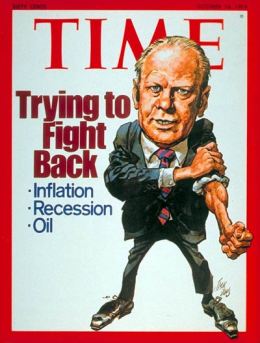
1970 – 1976: Age of Stagflation
Image Time Warner
In 1973 the average annual household income was $9,037 or approximately $46,700 per household in today’s CPI dollars. The nineteen-seventies became known economically as the Age of Stagflation. The 25-year U.S. economic growth post-WW2 had stagnated to a crawl, and prices in goods and services rose annually in the double-digits from 10% in 1973 to 18% in 1979. Due to poor performances on Wall Street, America’s top 1-percent saw their share of the nation’s wealth drop to the lowest in history: 19.9%. Yet, middle-America enjoyed the highest ever share of the country’s wealth at 80%.
The eras of suburbanization in the 50’s and 60’s, however, had significant consequences in the 70’s. The migration of tens of millions of middle-Americans (most of them White), moving to newly developing suburban towns meant getting to work in cities went from public transit to private vehicles. This in turn caused America to become heavily dependent on foreign oil. The long-term varied ripple effect of suburbanization cannot be overemphasized, one of which is our bigger footprint on environmental and global issues.
1976 – 1992: Gilded Age Returns and Reaganomics
Reagan addresses Congress 1981 (Wikipedia)
From 1976 to 1988 the average annual household income was $11,080 or about $44,700 in 2012 CPI dollars – yes, a $2,000 drop from the previous 3-years – to $25,167 or about $48,800 in 2012 CPI dollars; just above break-even from 1976. To combat the stagflation of the 70’s, government deregulation along with personal and business tax cuts gained popularity. As it turned out most of the tax breaks, along with deregulating helped America’s upper-classes.
Additionally, defeats of labor unions – unions made possible by Teddy Roosevelt reforms with long histories of keeping big-businesses from corruption and abuse of workers – also fattened the pockets of America’s top 1-percent by going from 19.9% ownership of the nation’s wealth to having 35.7% by 1989. By 1992 the AAHI (average annual household income) was $28,870 or about $47,200 in 2012 CPI dollars; another drop from 1988. While middle-America struggled, the top 1-percent in America owned a rising 37.2% of the nation’s total wealth.
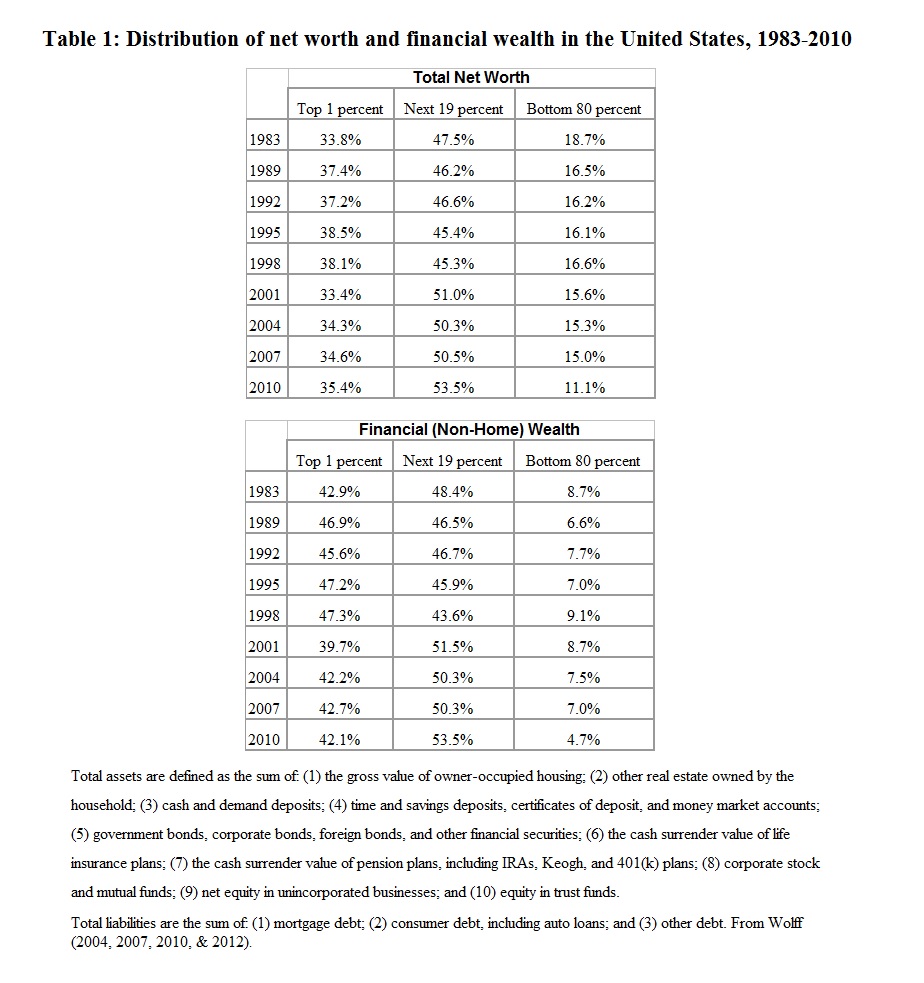
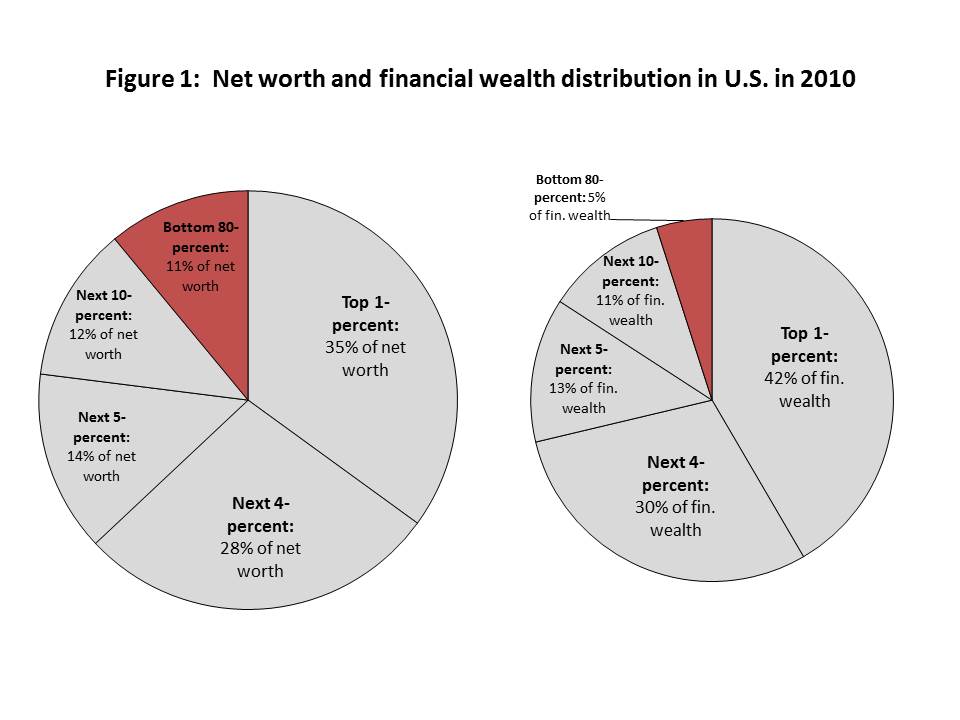
Beginning in 1983 economist Edward Wolff has tracked America’s net wealth and financial (non-home) wealth distributions. As Table 1 above and Figure1 below show, it is an increasingly bleak outlook for the majority of Americans.
Click image for larger view
1990 – Present: Globalization and World Superpower
The 1990’s will be compared to the prosperity of the 1920’s and the 1960’s. But as a whole is that what the data reveals? The AAHI was $32,558 in 1995 or about $49,000 in 2012 CPI dollars and America’s top 1-percent enjoyed another increase in the owned wealth of the nation at 38.5%. For six brief years (1994-2000) the economy saw rises in the national debt, the stock market, and the GDP while inflation plateaued and unemployment dropped below 5% because of the Dot-com Boom. Economist and civilians alike agree that the growth explosion was mostly a result of workplace computerization. But the good times would come to an end in 2001.
Map of the world wide web 1990-2000
A constant influx of immigrants seeking the American Dream, an American economy becoming one of the major players in a growing global economy, a false sense of security in the housing market, and numerous corporate scandals in the energy and finance sectors due to previous government deregulating, all contributed to the tipping-point by 2007. The AAHI in 2000 was at $40,418 or $53,900 in 2012 CPI dollars and the top 1-percent in America saw their portion in the nation’s wealth drop to 33.4% due to a sharp declining stock market worsened by the attacks of 9/11. There is another set of globalization dynamics that added to the plight of middle-America.
With the exodus of American jobs like cheaper electronics, fashion, shoes, and toys moving to developing nations, middle-Americans watched as their job and salary-leveraging also weakened with fewer lateral or upper employment positions. Then jobs in TV, auto, steel, and home-furnishing manufacturing followed. With those positions gone abroad, the American job-market went from high-paying management positions to simple service-industry low-paying positions which certainly need no college degree. This move marked the boom of trade-school certifications for a growing electronic blue-collar job-market.
Why Mexico is becoming a global manufacturing power – Bloomberg Businessweek article
The domino-effect of American digitization, the snowballing Internet, and high-speed networks spreading to all corners of the globe have combined to gorge the growing socio-economic gap wider and deeper. In 2007 the AAHI was $48,332 ($53,500 in 2012 CPI dollars) eaten-up by inflation and the cost-of-living. Meanwhile, the top 1-percent owned a steady 34.6% of the nation’s wealth. The lap of luxury doesn’t stop there. With the creation of a connected more global economy today, along with new multiple global opportunities and substantially lower-wages to foreign workers, it should come as no surprise what sector of the American population currently enjoys the fruits-of-foreign-labor.
The World’s 200 Richest People(s):
The most industrialized developed countries in the world by population-size are in Europe according to the 2013 United Nations Human Development Report. Of the top 10 nations with the highest Human Development Index (HDI), six of them are in Europe (see Report). One might infer from that list then that many of the world’s wealthiest people reside in those countries or at least in Europe. You would be wrong.
Of the 200 richest people in the world as of 2012, 61 of them (or 31%) are citizens of the United States. What is perhaps unexpected is where the second richest group of people call home. Of the next 139, 20 of them (or 10%) are Russian, ironically a former part of the old communist U.S.S.R. The next 26 richest people come from Germany (13) and Brazil (13) at 7% and 6.5% respectively. To see the world’s wealth and what portion of it is owned by the wealthiest 200, see the pie-chart below. For the most current world ranking of the world’s wealthiest as ranked by Bloomberg click here.
As the largest population of one of the most modern industrialized nations – currently 314 million and growing – the United States has the largest percentage of the population with the smallest percentage of the nation’s wealth. Since 1983, as seen in Wolff’s two Tables above, it has decreased every single year. To put this disparity succinctly, in terms of financial eggs-in-a-basket the top 1-percent own 35% of all privately held stock, 62.4% of all business equity, and 64.4% of financial securities in America. Is it any wonder why middle-American taxpayers were held for ransom in 2008 to bailout our own mega-banks and financial firms, mega-auto companies, and integral government-sponsored entities? The top 1 and 10-percent held the nation by the balls. Sit down, it get’s more alarming.
The top 10-percent own 81% to 94% of all American bonds, trust funds, stocks, and business equity, and nearly 80% of all commercial real estate. The real value of financial wealth is determined by control of income-producing assets; assets that can absorb recessions or devastating irreparable depressions. Therefore, it is reasonable to conclude that 10% of Americans own the United States. Talk about utter investment stupidity in placing the nation’s “eggs” in one or two baskets! There is no way to sugar-coat it. Perhaps Abraham Lincoln’s Gettysburg Address should be rewritten to reflect today’s socio-economic times: “Government of the 10-percent, by the 10-percent, for the 10-percent.”
Land of the Few, Home of the Lavish
Listed at $190-million, Copper Beech Farm in Greenwich, Connecticut is the most expensive home in America. Built in 1896 and previously owned by the Greenway family of U.S. Steel with Andrew Carnegie as well as timber tycoon John Rudey, it has over 13,000 square feet on 50 waterfront acres with spectacular views of Long Island Sound. As a French Renaissance style home with 12 bedrooms, wine cellar, a 75-foot outdoor pool, a grass tennis court, a large formal arboretum, two greenhouses, and private apple orchard, accessible by a 1,800-foot private driveway. Oh, and the property includes two offshore islands.
Copper Beech – Greenwich, CT
Copper Beech Farm is simply one home of over 100 homes priced above $10-million. From 2005 through 2012 Greenwich, CT has been ranked as the best wealthiest place to live in the U.S., the “Biggest Earner” per household in the U.S., and #1 wealthiest residents per capita in the nation. Many of the residents are Wall Street hedge fund managers, writes Nina Munk of Vanity Faire Magazine, and “of the $1.2 trillion currently invested worldwide, approximately one-tenth, or $120-billion, is now managed out of Greenwich alone, according to Hedge Fund Research, Inc.” Munk also reports that four of the richest 400 Americans live in Greenwich and three of those are hedge fund managers. One Greenwich real-estate broker reported these four residents will drop five to eight-million dollars without a second thought. Some even a lot more.
“Almost As Big as the Taj Mahal – To judge by the number of swollen, over ambitious mansions rising from lots in Greenwich these days, you’d almost think we were back in the 1910’s and 20’s – except that this time round the lots are small, and the houses are almost on top of one another. “Years ago, wealthy houses were hidden in the rear of properties after long driveways…and no one ever built to the maximum allowable square footage,” remarked Diane Fox, long time director of Greenwich’s Planning and Zoning Department, in an e-mail to me. “Today all big houses want to be seen from the road.””
Munk’s article of Greenwich’s rich and lavish also mentions that one interior designer installed broadloom carpet at $74,000 for one bedroom, and drapes and curtains at $20,000 to $25,000 for one bedroom. You read it right, one bedroom.
Why is this level of wealth and excessive opulence worth mentioning?
Because today American legislation, political campaigns, and economic policies resemble little of what they did six decades ago. In 2010 the U.S. Supreme Court allowed American corporations, including those owned by the top 1 and 10-percent of the nation, the opportunity of donating vast financial resources for political candidates and their election campaigns; “resources” with millions of dollars beyond what any individual voters could organize. Remember, 80 to 90 percent of Americans hold or own just 4.7% of the nation’s financial wealth. The political phrase in the 1940’s and 50’s “one person, one vote” means today “one dollar, one vote.” That 2010 decision sets the stage for a class of super-wealthy political campaigners to push (as if a majority of individual voters) their one-dimensional political-economic interests: enhancing their profits and revenues.
A Communal America is Imperative
This four-part series has not been about political, economic, or social envy. It seems the bottom 99% or 90% are for the most part not jealous of America’s gazillionaires or their social contributions and hard-earned incomes. What this four-part series has been about though is political fairness, representation, and efficiency. As discussed in part two Productive Inequality, rent-seeking moves wages and wealth from the bottom and middle classes to the top 10 and 1-percent while distorting the “free market” in favor of some and to the detriment of most. More “efficient” policies of the market matter for a more equitable distribution of national wealth. Improper policies (e.g. of the last 32-years) lead to a less efficient economy and a growing divide between socio-economic classes.
Strength in lots of Einsteins!
It is a fairly simple overall concept. When our society is sufficiently (even abundantly) funded in infrastructure, education, research, and technology, these vital areas of a thriving economy offer hope and security to ordinary citizens. The majority of Americans, the bottom 90%, will actually SEE and experience for themselves what the U.S. Constitution, the Statue of Liberty, and all other symbols of democracy, equality and fairness are really made of… not just “promised” or rhetorically talked about on TV. Those principles would be available to a vast number in society in an efficient dynamic economy. Even the top 1-percent would benefit when the capabilities of so many quality workers and citizens are not wasted but fully utilized. It’s a concept of not just strength in numbers, but strength in well-educated, ingenious, motivated Einstein numbers! There is a huge difference between the two. The difference is not just inclusive, but very alien to exclusive.
In his superb book The Price of Inequality: How Today’s Divided Society Endangers Our Future, Nobel Prize winner in economics Joseph Stiglitz gives a superbly educated agenda on exactly how American government and her 314-million citizens can avoid falling into the same death-trap history’s great empires and their leaders fell into. If you would like to read an outline of his proposed extensive agenda, click here.
My own meek semi-educated ideas of how not to follow, for instance, the Roman Empire’s demise or the former Soviet Union’s, or the more recent countries of Egypt, Tunisia, and Syria… are this:
What is the reading on your/our Collective-Goodness-Gauge? What is the health of your/our common welfare, our passion for civic responsibility and the well-being of the persons near us?
These are NOT just social questions! More importantly they are political and economic questions too. As the French political philosopher Alexis de Tocqueville noticed about the nature of American society in 1835, freedom (or individualism) can be a tricky balancing act within democracy. Some “individualized” Americans independent of a majority often have the pragmatic realization that looking after the welfare of others is not only good for the soul, but is equally good for business and wealth. Stiglitz elaborates on this truth wonderfully:
“The top 1 percent have the best houses, the best educations, the best doctors, and the best lifestyles, but there is one thing that money doesn’t seem to have bought: an understanding that their fate is bound up with how the other 99 percent live. Throughout history, this has been something that the top 1 percent eventually do learn. Often, however, they learn it too late.”
…no matter class or status
The Roman Empire, Egypt, Tunisia, and Syria are just four examples to what Stiglitz refers. The former Soviet Union is an example of no individualism when no single “part” is allowed to reach its full brilliance and potential for the benefit of the whole; the other extreme. Both ends of the economic-socio-political spectrum REQUIRE resource investments and management from every single citizen. The stable “middle” if you will, has a steady balanced, efficient, fair, and equal flow of civic investment. Any one mechanism cannot efficiently coexist without the other efficient mechanisms. So…
If the United States wishes to return as one of the best symbols of freedom, liberty, democracy, and equality for all, then reaching that efficient balanced middle is an imperative collaborative, collective return to a well-managed, well-governed, wealth-balanced cause.
I’ve been spending 6-10 hours a day studying, reading, studying more, taking practice tests, reading, then studying more for the last five or six weeks minimum! I am really really fidgety and want to get up, Rise and let my “responsible” side give way to my primal pinned-up dancing side. So I spin the volume-knob clockwise…move…and jump, and bounce away in the rhythms. Care to join me?
Phoenix from the Flames (Omnia & The Blizzard Remix) featuring Justine Suissa.
There was so much to doubt
and as you kept me out
I wouldn’t let you go.
I rushed to your defence but nothing made much sense
so much I didn’t know.
But I can’t face my life without you
and now I know the whole truth.
The demon that’s to blame
and every day that I’m without you
I know that you’ll pull through like a phoenix from the flames.
The journey will give rise to those who criticise
and fail to lend a hand
may all the while unkind and cast a stone half blind
find ways to understand.
But I can’t face my life without you
and now I know the whole truth.
The demon that’s to blame
and every day that I’m without you
I know that you’ll pull through like a phoenix from the flames.
It’s like the suns come out and I’ve been here before
and now your coming back home
coming home to me.
(paragraph break)
The Great Divide (Radio Edit) by Velvetine
Walls around your heart
I wanna get in
I wanna know you
You’re scared to lose it all
I know who you’ve been
But I’ll take a chance on you.
You fight the light
You push it away
You’re gone with the wind at the end of the day
But where are you going?
You play it safe
So there’s nothing to win
I wanna come closer but you won’t let me in
I wanna go where you’re going.
Pull me in tonight and stay forever
I wanna know the secrets of your heart.
Let’s begin tonight
It’s now or never
Love won’t happen till you try to cross the great divide.
For astronomers, cosmologists, astrophysicists, or the amateur stargazer, the years 2013, 2014, and 2015 are three of the more active years for Earth’s heavens, the Moon, and our solar system! In Part One I covered some stargazing basics, how the night sky is arranged in our two hemispheres and some short history behind the naming of two constellations Orion and Virgo. In this second part let’s explain why these next three years are so extraordinary.
The Celestial Shows Are Here!
The Imaginarium of Doctor Parnassus
The Ringmaster opens, “Ladies and gentlemen, boys and girls, turn your eyes to the heavens! The most extraordinarily rare spectacular-spectacular is happening for the next three years!”
2013
Earlier this year between March and April the comet Pan-STARRS was visible with a good pair of binoculars or amateur telescope. However, in an area of medium-to-heavy light-pollution Pan-STARRS would have been hard to locate. May 24th through 30th you would have watched Mercury, Venus, and Jupiter dance around each other in the west-northwest twilight sky shortly after sunset. Every evening they were changing positions noticeably with Venus and Jupiter separated by about 1-degree on May 28th and Venus outshining Jupiter by six times.
On June 23rd at 6:00 a.m. CDT, the moon was as close to Earth as it will ever be in 2013 and at 6:32 a.m. it was brightest and fullest, known affectionately as a Super Moon. Larger than normal ranges in ocean tides occurred for several days. In 2014 it will arrive even closer than this year.
August 12th will be the annual Perseid Meteor Shower. At a rate of up to 90-meteors-per-hour it is considered one of the best displays of meteors for a single observer. Summer campers love the annual shower as it resembles a non-stop array of white bottle-rockets everywhere in the night sky.
Mid-November through December is perhaps the biggest event in astronomy for 2013. The Comet ISON will travel less than 750,000 miles above our sun’s surface, making it a very bright “sungrazer” on Nov. 28th, Thanksgiving Day in the U.S. ISON could very well be easily visible in broad daylight at its closest point to the sun. Then ISON will travel toward Earth getting as close as 40-million miles in December. Because the comet will be ideally placed in the morning and evening sky from the Northern Hemisphere, it will most likely be one of the most watched and photographed comets of all time.
The entire month of December will be a stargazer’s extravaganza! Venus will put on the most brilliant “evening star” show of 2013 and 2014 combined; evening or morning…doesn’t matter. She fills the southwestern sky for 3 hours of bravos after sundown in early December, and 1.5 hours after sundown by New Year’s Eve. And if that were not enough, a crescent moon will pass above and to the right of the goddess Dec. 5th and on the 6th she will give her grand finale! She will not be as spectacular again until 2021.
On December 13th and 14th a most entertaining show will take place: the Geminid Meteor Shower. Most astronomers and meteorists give it top accolades as it surpasses even the brilliance and reliability of August’s Perseid annual showers. Our near full moon will dilute most of the smaller fainter meteors, however, right after the moon sets (4:30 a.m. EDT), it will leave the sky completely dark for an hour or so, and that is your chance to witness as much as 2 meteor sightings per minute, or 120 per hour! Indeed, the night sky will look like an American 4th of July fireworks show!
2014
March 27th Perihelion – Comet Holmes. After almost two days in Oct. 2007, the Holmes comet became a half-million times brighter on its way to becoming the largest object in our solar system. Yes, larger than our Sun. Comet Holmes will be one of the more spectacular comets at its perihelion in 2014.
Path of Comet 209P/LINEAR
March 29th Perihelion – Comet Faye. Discovered in 1844 by a French astronomer it is a periodic comet but will be minor in comparison to the year’s other comets.
May 6th Perihelion – Comet 209P/LINEAR. If astronomers are correct, Earth will pass through the tail of 209P/Linear on its way back out from the Sun between 7:00 a.m. and 8:00 a.m. GMT on May 24th, resulting in a meteor storm of 100-400 meteors per hour. Canada and the U.S. will have the best viewing. This date is a must on your calendar!
August 10th – Super Moon. “According to NASA, a full moon at perigee is up to 14% larger and 30% brighter than one at its farthest point, or apogee. The full Moon, occurring less than one hour away from perigee, is a near-perfect coincidence that happens only every 18 years or so.” [Wikipedia]
Possible view of Comet C/2013-A1 from NASA Mars rover
August 12th – 14th will be the annual return of the Perseids Meteor Shower and its 60-meteors per hour at its peak on the 13th and 14th. Some of the early and late meteors arrive from July 23rd through Aug. 22nd. It radiant point, or source spot, will be in the Perseus constellation in the northeast sky after midnight.
October 19th – 25th is shaping up to be the biggest event of 2014: Comet C/2013-A1, aka Siding Spring. Astronomers currently calculate a 1 and 8,000 chance that C/2013-A1 will hit the surface of Mars on Oct. 19th. The comet will pass, following its normal path, about 73,000 miles from the surface of Mars. As the date nears and further observations are made, scientists will refine the orbit predictions. Nevertheless, preparations are already being made to develop high-tech observations both around Mars as it approaches the planet, and on Earth as it approaches the Sun. Mars vs. C/2013-A1 comet.
December 13th – 14th and the annual Geminids Meteor Shower won’t be as spectacular as 2013, but it will produce about 60 multicolored meteors per hour at the peak on the 13th and 14th. The radiant point or source spot will be in the Gemini constellation in the eastern sky after midnight.
RosettaEuropean spacecraft. In January 2014 Rosetta will awake from hibernation to fire-up its engines and get within 3,000 km of comet CG as it starts its return orbit back to our Sun. In 2010 Rosetta flew within 3,000 km of asteroid Lutetia closely examining its surface and makeup. Since then Rosetta has been cruising through the deepest parts of our solar system – a billion kilometers from the Sun – where that distance generates such little solar power she had to go into hibernation until comet CG approached. In January 2014 after Rosetta nears CG, it will literally harpoon it so it can place the robot Philae on its surface. As comet CG returns to our solar system to head towards our Sun, Philae will send scientific data back to Earth.
2015
January 30th Perihelion – Comet 7P/Pons-Winnecke. The Pons-Winnecke comet is a Near Earth Comet (NEC) and will pass Earth’s surface only about 3.5 million miles away, or about fifteen times the distance to the Moon. It probably won’t be visible by the naked eye, but a good pair of binoculars will assist in seeing this faint comet that comes around every 6.36 years.
February – Dawn spacecraft. NASA’s Dawn spacecraft is the first of its kind to use the highly efficient ion propulsion engine. Ion thrust engines must be in an environment devoid of any other ionized particles – deep space is the perfect example of such an ideal environment for this engine system. During February Dawn will rendezvous with one of two large asteroids (Vesta in 2012 and Ceres) classified as dwarf planets in the asteroid belt between Mars and Jupiter. Dawn will spend several months examining Ceres and its surface sending back to Earth the first close-up images of a dwarf planet in our Solar System.
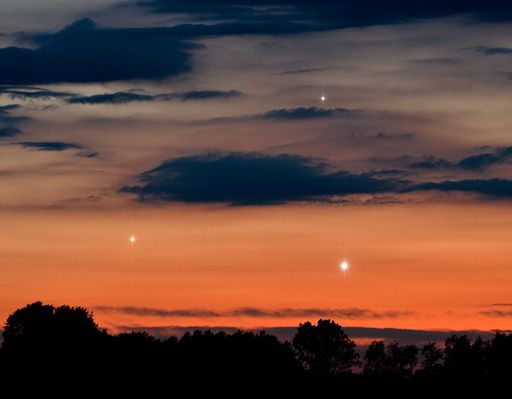
February 22nd – The Union of Venus and Mars. Conjunctions of planets are rare events and occur only when the very long large planets and their orbits seem to join or cross. Like lovers, Venus and Mars will be within a half degree of each other in the western sky just after sunset.
March 2nd Perihelion – Comet d’Arrest. Discovered in 1851, the d’Arrest comet has an orbital period of 6.54 years around the Sun so it is a frequent visitor. Like Pons-Winnecke it too will be very faint to the naked eye.
July 14th – New Horizons spacecraft. Launched in January 2006, NASA’s spacecraft New Horizons arrives at the dwarf planet Pluto and its moons after a nine and a half-year journey. It will capture the first close-up images of the planet and moons then continue out to the Kuiper-belt for images of icy objects at the outer edge of our Solar System.
August 12th – 14th is again the annual Perseids Meteor Shower. See 2014 information above.
2015 conjunction will look like this May 2013 conjunction!
October 28th – Planetary Ménage à Trois. A conjunction of three planets is very rare event and will be quite the spectacle in the early morning eastern sky before sunrise. Venus, Mars, and Jupiter will be in a tight 1-degree triangle of consummation!
November 17th – 18th is the return of the Leonids Meteor Shower with an average of 40 meteors per hour at its peak. During its 33-year cyclic peak hundreds of meteors are produced per hour. This last occurred in 2001. Some of its early arriving then late arriving meteors can be seen between Nov. 13th and 20th. The radiant point can be found in the constellation Leo after midnight.
December 13th – 14th is again the annual Geminids Meteor Shower. See 2014 information above.
(paragraph separation)
“Perchance to Dream”
It will be a 1-in-a-million lifetime jaw-dropping event to see. Well, actually in less than 1-million years. Yes, sadly we won’t be around to witness it, but the Betelgeuse Supernova will be brighter, much brighter than our own full Moon! It will be easily visible in daytime for several months so don’t be fooled into thinking it’s the second coming with another Star of Bethlehem, but instead the wonder of the cosmos with the Star of Betelgeuse!
The star is well-known among avid stargazers because it is the second brightest star in the Orion constellation and because of its size, color, and placement. It is the red supergiant star in Orion’s “right shoulder” and ranks as the eighth brightest star in our entire night sky. For some perspective, Betelgeuse is so huge that if it were our own Sun, its outer edges would touch Jupiter! It is approximately 640 light years away from our Sun. If it were to explode at night in our lifetime, it might look something like this…
Cosmologists and astronomers predict it will go super-nova in 1-million years or less because it is a “runaway star”. In other words, due to its super size and mass, it will burn-up, collapse on itself, and create such an explosion that from even 640 light years away, it will be well beyond the brightest super-nova EVER recorded in Earth’s history! If you can imagine any major global event throughout all of history, Betelgeuse will dwarf that. For those several months, Earth’s night sky will seem like endless twilight until sunrise! Wouldn’t that be the most remarkable thing in life to witness?
* * * * * * * * * *
In the final part of this three-part series, I will explain how simple tools and methods can map the night sky, locate major seasonal celestial highlights and their historical backgrounds, and explain why and how humanity will gaze the heavens just as the ancients did without any man-made light-pollution. If you have enjoyed this part, please let me know by commenting, and check-in every so often for Part 3.
After many years of practice, there are certain types who have mastered the art of shit-pushing and some who have not. A quick menagerie of the art…
(line break)
One of my favorite caught-in-the-act corrections: “I wasn’t kissing your wife Sir. I was whispering in her mouth!” Then find the nearest exit.
Two industries that most everyone would agree shovel out “pretty” bullshit on a regular basis have to be financial investment companies and sales personnel. Hello Ma’am, you will be amazed by this latest iPhone…a must have! Just $299 or $39 for 48 months for FAST 4G speeds and a ba-jillion apps you’ll probably never use! Or Sir, you are going to be blown away by our new-fangled Hedge-that-Risk-Away fund with a simple monthly direct-debit from your checking account, plus initiation fees, handling, commission, and risk-management fees!
Sound familiar?
I could never be an aggressive sales rep and survive unless I was selling donated organs to terminally ill patients and their families. But there are some who can make the stinkiest bullshit smell like a rose garden. And then there are those whose art is necessary, beneficial yet tragic.
The Clean-up Crew
Imagine living in a community that has no trash pickup and disposal, running indoor water/plumbing, no dishwashers, and no washing machines. Would you cleanup after yourself, in every manner? Would you cleanup after others, in every way?
Clean-up crew hard at work
Next time you are served a meal you cringe over, think twice about it because there are insects that would have a feast on your waste. Actually, they do feast…and not just after humans. Wherever there is fecal waste, there are most likely dung beetles. They are life’s natural cleanup crew and they are remarkably resourceful. They are tumblers, they are spelunkers, and they are dwellers. They make the most of human or animal waste.
Dung beetles are a critical part of nature’s biocycle. By eating and burying feces, dung beetles recycle vital nutrients into the soil and bury waste that otherwise attracts disease-carrying pests such as flies. They also help new trees grow. For example, in the rain forest, monkeys eat fruit where seeds are sometimes undigested. When the dung beetle arrives at the aftermath, it packs up the feces into a ball, seeds and all, rolls it away and buries it. Soon after up sprouts a new tree! On a given night, one dung beetle can roll and bury up to 250 times its own weight in shit! Imagine that workout.
But these hardworking necessary beetles don’t have it easy.
Shit-pushing Is No Walk in the Park
Every morning as part of my workout, I briskly walk 2-miles; one mile down, one mile up. The hilltop I live on has about a 23-degree steep grade up or down for about 70-80 yards. As I’m heading down the hill one morning, I notice in the middle of the drive a dung beetle perilously rolling his dung-ball across the cement. Every so often he struggled to keep his dung-ball from turning down the steep hill. Watching this beetle toil for his hard-earned shit, I couldn’t help but sympathize with his adversity. I watched in amazement and suspense. What would come of this beetle’s precarious effort? Would he succeed and beat the odds? Or would I be witness to horrific shit and beetle carnage? The cliff-hanger moment was building with every revolution of his dung-ball.
The hill of dung carnage; blood & beetle parts edited out to protect the weak-stomachs.
He crossed the midway point of the drive still pumping those hind-legs over his neatly packed shit. Five more feet to go. Can he do it? Four feet. I find myself cheering him on. Three and a half. Then he and his shit-ball hit a bump. Should I intervene like the hand-of-God, showing mercy and compassion for the shit this beetle has put up with? NO FRICKING WAY! And then as my questions of shit-miracle-ing lingered, everything went south….literally. I began laughing my ass off. Everything was out of control. The “wheels came off” but the rolling kept going, and going, and going! If Herbert Morrison of the Hindenburg disaster had been there he would have screamed “Oh the Bee-manity!“
Sorry. I should be more compassionate. I should pay homage to this epic dung-beetle’s demise. Let us bow our heads.
He was a brave shit artist. The bravest I had ever seen. He hung on to his shit-ball for five, maybe six revolutions down that hill-of-no-return! Finally, the cruel speed and momentum….perhaps a killer dizzying headache too separated this warrior from his meal. He tumbled two or three times behind that ball before coming to a most abrupt end. In his never-say-die attitude, he scrambled to gain his senses, and immediately went searching for his runaway shit-ball. But it was too late. I watched that ball roll down the hill…way down the hill about 50 yards – two state lines in beetle distance – before bouncing off the drive into the ditch and disappearing in the grass. It was gone. Done. This dung-expert had lost his shit.
* * * * * * * * * *
As utterly hilarious as I found this dung-beetle carnage to be, I had to find the teaching moment: what is the moral of this story?
No matter how good or pretty smelling it is…don’t push your shit up hill. You might lose it and it will come rolling back on you.
What moral of the story can you apply? Let me hear them all.
(paragraph separation)
Footnote – on a cool etymology note, it has been recently discovered that these dung-beetles navigate their dung-balls by the stars in the Milky Way galaxy; their GPS if you will. Click here.
I have zero expectation that anything I ever say will end someone’s belief in their God. Not my goal or purpose. That alone belongs to the individual. ~ Zoe
'Light thinks it travels faster than anything but it is wrong. No matter how fast light travels, it finds the darkness has always got there first, and is waiting for it' - Terry Pratchett





















 The Professor's Convatorium
