By now you have likely heard or read about the fake Dead Sea Scrolls or forgeries inside the recently opened Museum of the Bible in Washington D.C. The museum was built and stocked by retail chain Hobby Lobby owner and multi-billionaire, evangelical Steve Green. What many might not know or have forgotten is that this foolery is not the first time Steve Green has knowingly bought and promoted fake, fraudulent artifacts from the Classical and Antiquity Eras in the Near East. Similar to the 19th-century Old West medicine and “miracle elixirs” touring-shows of magical tricks, musical acts, jokes, and fantastical storytelling, smarter discerning people today can certainly argue that Mr. Green has an addictive sweet-tooth for fantasy and hoaxes.
In 2011 a FedEx package from an Israeli antiquities dealer labelled “hand-crafted clay tiles” with a stated worth of less than $300 drew the suspicious attention of U.S. Customs officials. They opened it and instead of home or bathroom decor it was 300 cuneiform clay tablets in Assyrian and Babylonian languages stolen in great numbers during the U.S.-Iraqi War and its aftermath over the last few decades then sold on the black market.
In 2014 while visiting the Vatican’s Verbum Domini II exhibit of antique Bibles and Bible-related artifacts, an Italian papyrus expert immediately noticed a tattered fragment containing verses from Galatians 2 written in Coptic. It was being sold on eBay many months earlier by a Turkish dealer known to be unreliable and dishonest. Several of his colleagues believed he was a smuggler of anything that would sell to evangelical buyers, fake or otherwise.
Both the clay tablets and the papyrus were dubiously purchased and owned by Steve Green.
This month Steve Green’s Museum of the Bible was forced to publicly acknowledge that five (and probably seven) of their “Dead Sea Scrolls” are forgeries. Continued scientific examinations on the museum’s remaining scrolls, perhaps other artifacts if the Greens allow, will probably reveal more similar results. Why? Because from 2009 to 2014 word spread rapidly throughout Antiquities dealers (of any sort) in the Near East that authorized dealers of the multi-billionaire Green family were purchasing around 40,000 ancient biblical-religious artifacts for their future museum in Washington D.C. This whirlwind of money and hyper fast-track purchases ignited a buzz in the market never before seen. The New York Times in 2010 reported “[t]he buying[had] also spawned some skepticism about the overall quality of purchases made in such rapid-fire style.”
“The Hobby Lobby of Biblical Fakes n Frauds” in Washington D.C.
Joel S. Baden of the Yale University School of Divinity described Green’s incompetent acquisitions this way:
Every antiquities seller knew the Greens were buying everything and not asking questions about anything.
Aside from the hap-hazard amateur acquisition methods the Greens employed, there is another serious problem: the unprincipled, unethical intent to show in their museum fraudulent items as factual originals rather than labeling them modern replicas.
These practices by the Greens soon put them in the cross-hairs of the U.S. Justice Department. Hobby Lobby had to pay a $3-million fine as well as surrender and return the thousands of illegally acquired ancient artifacts from Iraq that were knowingly smuggled into the U.S. by Mr. Green. The Hobby Lobby tycoon, however, has his evangelical agenda working in several other areas of public life.
The Greens have spent massive amounts of money to confuse, redefine, and rewrite our clear Constitutional lines between church and state and their separation. In the 2014 Supreme Court decision of Burwell vs Hobby Lobby, “closely held for-profit” corporations like Hobby Lobby can refuse their employed women contraceptive medicines and/or care which was once mandated by the 2010 Affordable Care Act. The Greens have also funded a controversial nation-wide Biblical curriculum for American public schools as well as dumped millions into private Fundamentalist Christian institutions and colleges domestically and abroad. But this is not all.
The executive director of the Society for Biblical Literature, John Kutsko, speaks to this evangelical corporate movement with heightened concern:
There is no such thing as ‘the’ Bible… We[Americans]are a melting pot, and there are many religions here[…]The[Green’s]museum could be a showcase for how we and our texts are different and can coexist peacefully. That would be a wonderful message to bring to bear, particularly in the environment we live in, an environment of absolutists and polarization.
But that is not Green’s intentions as evidenced by his artifact purchases and practices.
There is another disturbing concern: the simple truth. There are a large number of historical, biblical, archaeological, paleographical, and other scholars and experts, all of which have many decades of study and acclaimed lifetime careers that know too well how “pseudo-biblical archaeology” is replete with amateur scams, frauds, and wild claims meant to prove to buyers and audiences, at least through misleading visuals, that stories in the Bible are historically accurate when in fact they are not. These same scholars and academics are just as bothered by the man hired as the Bible museum’s director who was former director of the outlandish Creation Museum in Kentucky. This further undermines the museum’s credibility. And still there is more disturbing news.
The museum blatantly misleads, even lies about recent American history. In a dramatic promotional video for the museum it alleges that the Founding Fathers designed our government and civil culture to be Bible-centered; that is Christian-centered. The video states that George Washington himself said:
It is impossible to rightly govern the world without God and the Bible.
The Fred W. Smith National Library for the Study of George Washington in Mount Vernon, VA (click here) is a resource for “scholarly research about George Washington and the Founding Era, while collecting original Washington books and manuscripts.“ The library has already determined beyond doubt that this is a misquote or complete fabrication. When Mr. Green and his leadership team were presented with this correction, he was unphased, indifferent and insisted that our U.S. government was purposefully created as Bible-centered; that is Christian-centered. In my May 2015 blog-post The Mistaken Identity of the U.S. I go into great detail — from months and years of research utilizing resources like the Smith National Library – George Washington — about how this belief or fable Mr. Green persists in propagandizing is unfounded and simply not true.
At a 2014 interview at the Vatican, Steve Green imparted a rallying call to Christians, especially evangelicals that “The fact of the matter is, the[Bible] is under assault today.” It seems to Mr. Green and many Fundy-Evangelical Christians that there are other ways of starting and fighting a Holy War, or Jihad as the militant Islamists would call it, and it is covertly changing this democracy into a theocracy by whatever means necessary, similar again to Islamic nations of today. Based on Steve Green’s practices and museum, theocracizing includes smuggling, deception, diversion, well-funded propaganda that rivals even Joseph Goebbels’ tactics, and most of all the M.O. that the end always justifies the means. Principles of accuracy, due process, fact-verifying, truth or pro-truthiness, doesn’t matter. Force the “right end” to happen whatever the cost, literally.
Mr. Green seems ignorant of his unethical track-record. Being forthright from the very beginning will always be more valuable, more historic to the greater good and demonstrate higher levels of dignity and honor. So I say to all concerned, be astute and warned when you happen upon any involvement with Hobby Lobby or the Museum of the Bible: their owner, Steve Green, continuously exhibits that he possesses none of the great noble virtues.
∼ ∼ ∼ § ∼ ∼ ∼
Now, if you are one for euphoric feel-good truths, fly-by-night veracity, and fantastical stories hyping life-changing memories in this life and the next, this is for you: 😎
————
Live Well — Love Much — Laugh Often — Learn Always
“Justice demands that that barbaric superstition should be opposed; and it is to the interest of the state not to regard that Jewish mob which at times breaks out in open riots… […]
At one time the Jewish people took up arms against the Romans; but the gods showed how little they cared for this people, suffering it to be conquered and made tributary.” — Cicero, “Pro Flacco” Ch. 28, 59 BCE
————
∼ ∼ ∼ § ∼ ∼ ∼
The deep permeation of Greek culture into Judaism and the Near and Middle East during late Classical Antiquity cannot be overstated. It was profound. It made its way into early Christianity and into Saul’s Stoic-Gnostic theology. But lets backup a bit first.
The centuries following Alexander the Great’s epic conquests, expansion, and planting of Hellenistic culture throughout the Near East and across the Western hemisphere saw the remarkable flourishing of philosophy, science, art, and governing. It was during the Hellenistic period (323 – 31 BCE) that Archimedes of Syracuse wrote the Earth-changing treatise “On Floating Bodies,” known today in physics as the Archimedes’ Principle. Then Aristarchus formulated the first recorded heliocentric theory, which of course asserted that Earth revolved around the sun. During the Hellenist period, several art forms became less mythological and more realistic, more practical. The most important thing in life, said Epicurus, was the pursuit and attainment of the individual’s pleasure and happiness, known as hedonism, while Stoic philosophy became more mainstream and accessible, including to women, unheard of in many empires around the world then and now.
Hellenism carried over well into the European Middle Ages. Hellenic Jews welcomed Greek influences, represented primarily by the Temple Sadducees. However, traditional or conservative Jews represented by the sects of Pharisees and Essenes in synagogues around the empire, saw Hellenism’s infiltration in some respects as an abomination of God’s Law and Temple. A side-by-side comparison of the two juxtaposed cultures, Mosaic Judaism and Hellenism, points out four major differences:
Alexander’s Hellenistic culture was very tolerant of native customs and beliefs. In fact, new Greco-Roman kingdoms often assimilated parts of the indigenous practices as it suited the empire’s needs. Hence, further examination of the Judaic and Hellenic cultures (distinguished above) shows when there is intolerance to flexibility, compromise, wisdom, or adaptability, one small ring or just one person flies off the handle in one or both cultures, the constant tension becomes a ticking time-bomb. Click here for a revealing Jewish rendition of how an ancient Greek and Hebraic Jew might have discussed their religions in the 1st-century CE.
Let’s return to middle-Hellenism. Enter the false rumor in 168 BCE that Seleucid king Antiochus IV was killed in Egypt. Bitter, disgruntled, and deposed High Priest Jason/Jesus rounds up a Jewish army to attack ascending High Priest Menelaus in Jerusalem. Angry that the Jews started a civil war in his kingdom, Antiochus came down harshly on the Jews executing thousands and banning the practice of their religion forcing them to worship Zeus instead. His heavy bloody hand only infuriated more Jews and thus began the Maccabean Revolt.
During these cultural clashes and shifts, brief independence under the Hasmoneans, other military conquests, defeats, exiles, dispersions into slavery, intermarriages, and mixed offspring, Jews were increasingly mixed into Hellenistic ideals that also reached into their religion, particularly Greek Stoic philosophy. For Pharisaic and Essene Jews, including two centuries later Jewish-Essene Jesus (Part II), this became a sharp schism inside Judaism. But for Saul of Tarsus and Rome in the mid-1st century CE and the destruction of the Jerusalem Temple and last remnants of radical Jewish resistance by the Sicarii at Masada (73 – 74 CE), it was an opportunity for both Hellenism and Saul to rewrite history. The history, not Messianic Jewish history.
Herodian Saul and Hellenism Victorious
Explicit facts about Saul’s/Paul’s family, his Jewish [sic] heritage, and educational backgrounds [sic] (Part I) as well as his involvement in Jewish Merkavah and/or Heikhalat mysticism (Intro to Part II) are masked at best. Most of what is known comes strictly from his 7 – 12(?) canonical epistles and Acts. All of these biblical texts must be read under the overwhelming shadow of the Roman-Hellenist Patristic authorities, editors, and copyists. Why? Between 70 CE and 787 CE (over 700-years!) they had complete and total control of what would become “traditional Christianity.”
Fortunately, for the modern neutral and astute reader of earliest Christianity the canonical NT (the mask) is by no means the only source to gain a more realistic, more accurate picture. It is not a fixed mask. In fact, extra, independent sources that are available (among others) come from a large corpus of Jewish scrolls written between the 4th-century BCE and 5th-century CE found just outside of Jerusalem! They are the Dead Sea Scrolls (DSS) from Qumran. They offer us an almost stunningly vivid background and context of Second Temple Judaism/Messianism and Sectarianism of late Classical Antiquity in the Levant and around Jerusalem. This 700-year era written about in the DSS from a non-Roman non-Patristic standpoint is an unprecedented broader look into the very soil, seeds, and roots from which earliest Jewish-Christianity sprang. The DSS are an untouched, pure Jewish-Messianic, independent lens on Hellenistic-Herodian Judaism, on Hellenistic Rome and her eventual, Imperial, Pauline Christ-cult.
Publication of Post-1957 Discovered Scrolls Withheld The first scrolls were discovered in 1946 and ’47. More caves and scrolls were discovered in 1948 – ’49, then more still from 1950 – ’56 totaling over 980 texts from twelve (12) different caves. The first complete photographs (in infrared) of all the texts were made between 1952 – 1967 including the newly discovered scrolls and fragments post-1957. However, due to the political and religious implications of what these texts held, several of the scrolls and fragments were withheld from publication for 30-40 years by a small circle of “established scholars” or what several outsider-scholars have called “The DSS Academic Curia.” The Curia was led by French Dominican priest Roland de Vaux and consisted of just three Hebrew scholars, Józef Milik, John M. Allegro, and John Strugnell.
By 1956 problems were broiling inside the Curia and outside by historical and biblical scholars wanting access to the DSS. Allegro put the ego-driven controversy quite succinctly in his letter to de Vaux:
It’s a pity that you and your friends cannot conceive of anything written about Christianity without trying to grind some ecclesiastical or non-ecclesiastical axe.
For an outdated, brief introduction about these controversies you can go to this 1993 New York Times article, The Dead Sea Scrolls: Fragile and Remarkable, specifically the 17th paragraph.
Was Saul A Herodian-Jew and Not A Pharisaic-Jew? If the only testaments you read are the canonical Epistles of Saul/Paul and Acts of the Apostles, of course you’d simply conclude that Saul was “a Hebrew among Hebrews,” descended from the tribe of Benjamin, and educated by Gamaliel in the acclaimed Beit Hillel. But Josephus, the Pseudo-Clementines, and Epiphanius offer a compelling refraction of Saul’s Epistles and his related passages in Acts that with the three aforementioned sources tell a different background and family of Saul-Paul.
In many past blog-posts (e.g. The Incarnation of G-Man) I have made the distinction between Greco-Roman deification or Apotheosis, and Second Temple Jewish Messianism. The two adversaries can never be ignored. This clear distinction can also be appropriately applied geographically in the eastern portions of the Late-Republic to Imperial-Principate Roman Empire (c. 133 BCE – 284 CE).
From the slides above we see a macrocosm of Hellenism’s expansion and permeation of the entire Mediterranean Basin begun by the Greek Empire and then by the end of the 1st-century BCE, Rome’s version and reinvention of its allure until the eventual decline throughout the 4th and 5th-centuries CE. If you’d like to see the slides independently and enlarged, click here. Rome and her Hellenistic culture gradually swallowed up almost all Sectarian, Torah-loving (Jewish-Essene Jesus) Judaism/Messianism. This extermination of revolutionary Palestinian Messianism was completed after the fall of Masada in 74 CE when the DSS were hidden in the 12 various caves around Qumran. For almost 1,900 years the only Judaism and Christianity the world would ever know was Messiah-killing Hellenistic Judaism or Hellenistic-Roman Christianity… until 1946.
Through the Herodian dynasty (37 BCE – 44 CE) to the complete control of Judea, Samaria, and Idumea by the Roman Empire (44 – 136 CE), most traditional Law-oriented Jews in the Levant had very little patience for Hellenistic Overseas Jews and their distorted ideas and teachers of either a corrupted Temple, Torah, and Messiah(s). They were often referred to as “The Enemy” by Palestinian Jews/Messianism. Saul was clearly an “Enemy” and he knew it. Compare:
Have I now become your enemy by telling you the truth? — Galatians 4:16
You adulterous people, don’t you know that friendship with the [Hellenic] world means enmity against God? Therefore, anyone who chooses to be a friend of the [Hellenic]world becomes an enemy of God. — James 4:4
It is widely accepted that Saul authored Galatians. The epistle of James has traditionally been attributed to James, the brother of Jesus, or at least pseudonymous to him. James’ audience was clearly the Palestinian Messianic followers or otherwise known as Judaeo-Christians. When comparing the two we can infer the stark differences between Overseas Judaism/Messianism and that of Palestinian Judaism/Messianism. And how badly Saul was treated in Syrian and Palestinian synagogues attests to this schism. There’s more.
Terminology like the Enemy, the Liar or Spouter of Lies, Man of Lying, Comedian of Lying (i.e. epileptic?), and some others, was strongly applied to the adversary of “The Righteous Teacher” within the Palestinian Movement and the DSS at Qumran. Saul/Paul again shows familiarity with these terms. In fact, he references them repeatedly in Gal. 1:20, 2 Corinthians 11:31, and Romans 9:1 (to name just three) that he was not “a Liar“ or he “does not lie.” This explicitly implies that his groups/churches there have been told that Saul of Tarsus deceives and maligns.
“The Enemy” terminology is also quite strong and prevalent in the Pseudo-Clementines. For example, in Homilies in the apparent Epistle of Peter to James the brother in Jerusalem:
For some from among the Gentiles have rejected my legal preaching, attaching themselves to certain lawless and trifling preaching of the man who is my enemy. […]
[The Gentile Enemies] transform my words by certain various interpretations, in order to the dissolution of the law. […]
…the law of God which was spoken by Moses, and was borne witness to by our Lord… for thus he spoke: “The heavens and the earth shall pass away, but one jot or one tittle shall in no wise pass from the law.” (quoting Matt. 5:18)— Homilies, Epistle of Peter to James,Ch. 2
Dr. Bart Ehrman describes the significance of this Epistle of Peter to James as a Palestinian counter-balance to the Hellenic canonical NT and Acts of the Apostles:
This book provides the counter-view to that found in the New Testament book of Acts, where Paul and Peter are thought to be completely on the same side and simpatico on every major issue. Not according to this short letter. Here Peter and James are the heroes of the faith, and Paul is the great enemy. — Bart Ehrman Blog, “Another Forgery in the Name of Peter, April 2013, accessed Oct. 11, 2018
There have been several religious-historical scholars that theorize Simon Magus (of Acts 8) and Saul of Tarsus are one in the same. Accepting this theory is not unreasonable. Consider these side-by-side teachings reported by Irenaeus in his Against Heresies I.23.3 and Saul’s in Galatians:
The two comparisons are practically identical. And thus in the Pseudo-Clementine Recognitions 1 Ch. 70, Palestinian Judaism/Messianism did not hold Hellenic Saul/Paul in any high esteem due to what he incited earlier at the Temple against James the brother of Jesus regarding “sacrifices” and how Temple worship was conducted by Herodian Priesthood, the two biggest conflicts of the time between Overseas Hellenic Judaism and Palestinian Judaism/Messianism:
While he was thus speaking, and adding more to the same effect, and while James the bishop was refuting him, he began to excite the people and to raise a tumult, so that the people might not be able to hear what was said. Therefore he began to drive all into confusion with shouting, and to undo what had been arranged with much labour, and at the same time to reproach the priests, and to enrage them with revilings and abuse, and, like a madman… […]
Then others also, seeing him, were carried away with like readiness. Then ensued a tumult on either side, of the beating and the beaten. Much blood is shed; there is a confused flight, in the midst of which that enemy attacked James, and threw him headlong from the top of the steps; and supposing him to be dead, he cared not to inflict further violence upon him. — Tumult Raised by Saul, Recognitions Book 1 Ch. 70
Saul is saved from this scene by a troop of Roman soldiers, oddly enough protection Jews rarely received unless of Roman aristocracy. Read what even Episcopalian/Catholic ordained Dr. Taylor R. Marshall points out about Saul-Paul of Tarsus here. It is a remarkable read! Furthermore, in the Epiphanius traditions, e.g. Anabathmoi Jacobou or “The Ascents of Jacob,” Saul has a large entourage of Greek-Romans and Roman troops with him during his trip through Caesarea (the seat of the Herodian family by then) then on to Jerusalem to test the recent ban against Herodians and foreigners inside the Temple Mount by, most assuredly, the “zealot” tradition-minded (Jamesian?) Priesthood. This is telling. A simple Hellenist-Jew was never accorded that level of Roman pomp or protection. I ask, is it really anymore compelling why Saul’s true background was so clouded, so overlooked centuries later?
Is there more to Saul’s repulsive reception by Palestinian Judaism/Messianism? Actually there is enough to at the very least question Saul’s true origins, if not rewrite them.
Aside from the angry mob who attacks Saul while trying to enter the Temple in Acts 21:27-29, how Saul acquired his “Roman citizenship” was a very peculiar, suspicious accession. None of the original “Apostles” were ever given Roman citizenship. None of the previously ruling Maccabees were ever awarded citizenship. However, Herodian Jews did indeed receive Roman citizenry. Ironically, Saul himself supports this method of Roman-Herodian citizenship:
Greet Apelles, the approved in Christ. Greet those who are of the household of Aristobulus. Greet Herodion, my kinsman. — Romans 16:10-11
Dr. Robert Eisenman of Cornell, New York, and Columbia Universities closely examines this possible/probable Saul bloodline saying:
Here, he refers to his “kinsman Herodion,” i.e., “The Littlest Herod” (obviously the son of the Roman Governor Felix mentioned above and the Herodian Princess Drusilla, killed in the eruption of Vesuvius at Pompeii) — whom he introduces with an allusion to another person with a name popular among Herodians, “Aristobulus,” i.e., “the Household of Aristobulus” in Romans 16:10. The “Aristobulus” referred to here may or may not be the “Aristobulus the son of Agrippa I’s brother Herod of Chalcis” mentioned above — the husband of that Salome who plays such a key role, according to Gospel portraiture, in the death of John the Baptist — both of whom advertise themselves on the reverse of their Lesser Armenian Kingdom coinage in “Asia” what “Great Lovers of Caesar” they were! That Paul has powerful relatives of this kind in Jerusalem with a direct entree to the Roman Governor and Soldiery is made crystal clear too by Acts 23:16 which refers — following his rescue by said Troops preceding this — to the role his “nephew” (“his sister’s son”) played in this affair while declining to specifically name him! — Eisenman, Robert. Breaking the Dead Sea Scrolls Monopoly: A New Interpretation of the Messianic Movement in Palestine
This would explain neatly and nicely why Saul/Paul was so unwelcomed in Palestinian Judaism/Messianism (e.g. Antioch, Damascus) and in Jerusalem by the real students/disciples (pillars) of Jesus who actually knew, lived with, and traveled with him in person. But as my above maps illustrate, in the end for true historicity it did not matter that Palestinian Judaism-Messianism (Jesus’ reforms and teachings) would be lost under Rome’s power and glory. The expansive swallowing effect of Hellenism all throughout the Mediterranean Basin, then adopted by the Roman Empire, and in time absorbed the Overseas (Diaspora) Judaism, Palestinian Law-oriented Judaism/Messianism — the movement begun by Jewish-Essene Jesus that failed — was a doomed minority movement. Plain and simple, becoming an uncomfortable friend to Rome, i.e. Hellenic Apotheosis and Pauline-Christ, had a much better allure than being her nagging, failing enemy.
Accordingly Saul’s Christ-cult was Embraced By Hellenic Pagans/Gentiles Well before Saul was born and came on the scene, for about two centuries Jewish Synagogues had opened up their worship and teaching to the Gentile/Pagan world with the incorporation of Hellenistic literature and philosophy. This is attested in the Gospels (Matt. 23:15). Uncircumcised, God-fearing Gentile-Jews were already part of many synagogues and communities. This is confirmed in the Talmud. What was typically the confusion about this controversial topic was the naïvety of protecting the Torah and its study, versus the study of the seven Noachian commandments available to all people. The very fact that Saul was unaware of these distinctions — especially claiming Benjamite-Hebrew heritage! — smacks of his highly suspect (fraudulent?) origins or at least implies he is a Herodian-Jew, an outsider, mentally lost and ignorant of these established Jewish practices!
Furthermore, what would the best alternative approach for the centuries-later Hellenic Patristic Fathers to a failed Messiah, who never returns, and the related Messianic prophecies also fail? Dr. James Tabor answers this superbly with his 1997 presentation to the American Academy of Religion Annual Meeting here. This is another excellent read!
In a nutshell, Torah-loving, Law-abiding Jewish-Essene Jesus in Palestine was not teaching a diluted, distorted Judaism like was practiced by Hellenic, Herodian pseudo-Jews. When constantly rejected and persecuted by those Torah-abiding Jews in synagogues across the Empire, particularly Palestinian Messianic Jews in the Levant, Saul was forced to reinvent his TL-epileptic “divine revelations” into his own Roman-Christ, his own Roman-church, and his own Roman-Hellenic theology. With his background in mysticism and elements/themes of Gnostic Philo-philosophical strands, the Gentile-pagans (non-Jews) — who couldn’t understand the complicated, law-ridden Jewish practices and customs in the first place — were very open to his “new” religious cult. It appealed more to their Hellenic lifestyle and thinking: God’s blessings and salvation were available to everyone if the death of Christ was embraced, death to this world was embraced, and steadfast blind “faith” in these two precepts (since they were unsupportable anyway) granted one’s spiritual entrance into God’s Kingdom of Earth and Heaven.
Thereafter, pagan Pauline Christology was born and still exists today as a antiquated, never-ending complexity of diverse, dis-unified theology and distorted practices called Christianity.
∼ ∼ ∼ § ∼ ∼ ∼
Feel free to share your thoughts and/or questions below over this 5-part series. Kind thanks for your patience and time during this series and its demands to research, authoring, and publishing. It is appreciated. 🙂
Post script — For more details about how and why Christianity is comprehensively problematic, unravels, and collapses on numerous counts beyond its founder Saul of Tarsus, go to my page: Why Christianity Will Always Fail.
“Do not give what is holy to dogs, and do not throw your pearls before swine, or they will trample them under their feet, and turn and tear you to pieces.” — Jesus, Matthew 7:6
————
∼ ∼ ∼ § ∼ ∼ ∼
Certainly a strong command to his disciples and words of warning to the crowd listening to Jesus on the Mount. To a modern reader a very ambiguous verse/sermon typical of cryptic non-Messianic Jesus, but it aligns with quasi-Sectarian Essene-Jesus. How so?
The first generation Tannaitic traditions in the Jewish Mishnah (20 BCE – 80 CE) can give some context to the language of this sermon. Three key identifiers can be correctly deciphered out of the loose Greek Matthew translation. They are dogs, pearls, and pigs or swine. In the Tannaitic Mishnah dogs represent Gentile idolaters that “when driven by hunger, tears and devours young lambs.” Pearls represent the rabbinical interpretations and discourse of the Torah, something precious and costly. Rabbis did not teach secrets of the Torah to Gentiles. And pigs/swine were always implied as the Romans as verified in Cicero’s “Divinatio in Caecilium.” Therefore, with this more unambiguous vocabulary, here is the proper Tannaitic version of Matthew 7:6:
Do not give what is holy to Gentile idolaters, and do not throw your Torah-secrets before the Romans, or they will trample them under their feet, and turn and tear you to pieces.
Jewish-Essene Jesus further supports this new redone, unambiguous verse in Matthew 10:5-6 and 15:26. At the least, Jewish-Essene Jesus is teaching the crowd and his disciples a passive walk and love in the Torah and to never force the coming Kingdom of God (on Earth) onto Gentiles or Romans if they are not interested. This was not what Saul began teaching and it got Saul into lots of harsh trouble.
In 2 Corinthians 11:24-32 we see that Saul faced quick persecution by Jews after his “vision-revelation” and upon arriving in Damascus. More persecution from 2 Cor. 9 and Acts 16:22. Then he faced opposition from Jewish-Jesus’ immediate disciples, their disciples, and James the Brother of Jesus (Acts 15 and 21; Gal 2; James 2 vs Eph 2?). Not only is the harsh resistance inferred from the canonical NT, it is also confirmed by Eusebius’ Pamphilius, Iraneus’ Against Heresies, Origen’s Against Celcus, and Clement of Rome’s Recognitions that Saul’s early hardships were in both the Jewish and Jesus camps.
Clearly apparent is that Saul wasn’t following established Jewish proselytizing methods in the Didacheadopted from the Synagogue’s “Two Ways,” nor was he following Jesus’ disciples’ methods. Saul was just doing and teaching whatever he interpreted from his own seizures, very much like modern psych-patients do during and after their episodes. Consequently, Saul was viewed as attacking, if not at minimum undermining, both Judaism and the nascent Jesus-Movement authorities, the “pillars” (Gal. 2:9). Despite there existing today more details about Saul’s many disputes with both Jews in the Synagogues and the surviving pillars and disciples of Jesus’ closest followers, we are also able to decipher a much better idea of how and why Saul became the Spouter of Lies or if not, certainly treated as an Apostate.
Saul’s Two-Pronged Hellenic Attack on Jesus’ Judaism
Whether Saul/Paul realized it or not, he fueled and fanned the fiery, growing anti-Semitism between his Hellenic Rome and Judaism. He accomplished this in at least two different ways: 1) his conflicts with the Torah, part of Jesus’ core teaching, and its expanded Essene-Jesus function within Judaism in general, and 2) antinomianism which further fueled Jewish hate, and by default undermined Jesus’ principle of mutual love.
A Necessary Reminder First It must be remembered when reading the epistles traditionally ascribed to Saul, only seven of the 14 are agreed upon by most Christian and non-Christian scholars as genuinely Saul’s letters. Two letters/epistles are evenly disputed and four are considered pseudographic, or written later by supporters of Saul. The true author of Hebrews is now considered unknown by almost all biblical scholars. There are also some known lost epistles mentioned in other epistles. The very oldest surviving codex of epistles by Saul (Papyrus 46) covers only from Romans 5:17 through Hebrews, 1 Corinthians, 2 Corinthians, Ephesians, Galatians, Philippians, Colossians, and ends in 1 Thess. 5:28. Papyrus 46 is from c. 200 CE, about 35-60 years after Saul’s earliest letters. From this papyrus biblical scholars know the scribe(s) made minor errors and miscalculations. What does this mean for us here?
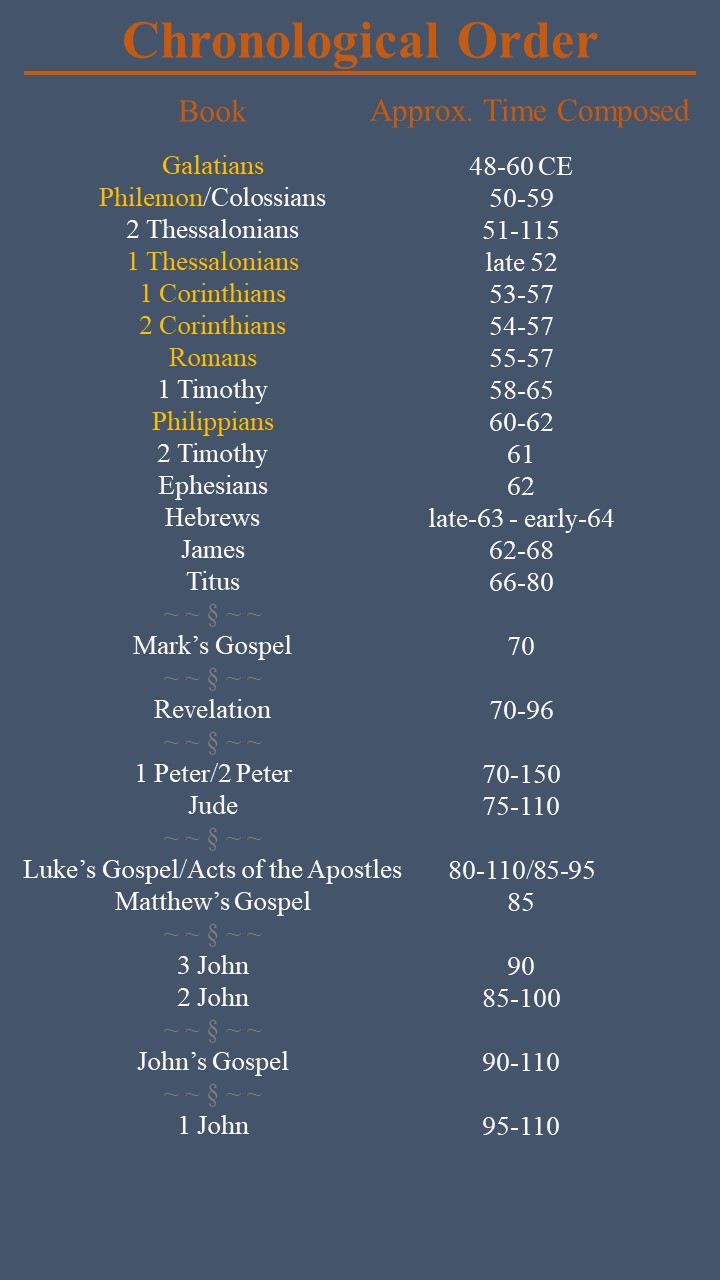
Saul’s “genuine” letters (in gold below) and those two evenly disputed cannot be considered beyond a shadow of a doubt, 100% authentic words of Saul. Simple later “traditions” do not make a manuscript error-free. The later the copy, the higher the odds it was later tampered with or erroneously copied. Once again, the chronological order of Saul’s letters:
Notice that the letter to the Galatians could have been written around 60 CE. This is important to remember. As we continue, what will also become glaringly obvious was just how horribly the 2nd- and 3rd-century CE New Testament compilers/scribes and the Hellenist “Patristic Fathers” (and therefore all their descendant “Fathers”) turned their 4th – 5th-century canonical NT into a mishmash of nonsense; a complete cluster (tr)uck! Frankly, it’s bad and poorly constructed by men who knew too little about Sectarian Judaism/Messianism and its precise Second Temple intent. How did the Hellenistic Fathers get it all wrong?
Saul’s Conflicts & Confusion with the Torah and Judaism While in Lycaonia of Asia Minor (Turkey), following the laws of the Torah, Saul circumcised his new disciple Timothy:
Paul came to Derbe and then to Lystra, where a disciple named Timothy lived, whose mother was Jewish and a believer but whose father was a Greek. The believers at Lystra and Iconium spoke well of him. Paul wanted to take him along on the journey, so he circumcised him because of the Jews who lived in that area, for they all knew that his father was a Greek. (Acts 16:1-3)
Not only did 1st-century Greeks/Hellenists despise the Jewish custom of circumcision, but based on Saul’s other vehement teachings against the Law/Torah (Colossians 2), was this a blatant contradiction of himself? Now suddenly this Saul-behavior seems to align with Jewish-Essene Jesus’ teaching (Matt. 5 and Luke 16)! Why now are there exceptions to what Jewish-Jesus taught and Saul taught? The Hellenistic canonical NT is completely silent.
Leave it to an 18th-century Rabbi to possibly sort out this one (of many) problematic, contradiction in the NT and with Saul. Rabbi Jacob Emden was considered one of the most acclaimed Rabbis for over three centuries. Many Rabbis considered him a Maimonides reincarnated. Here is Rabbi Emden’s clarification; my inserts [ ] and emphasis:
Christian scholars have assumed from certain passages in the Gospels that [Jesus] wished to give a new Torah to take the place of the Torah of Moses. How could [Jesus] then have said explicitly that he comes only to fulfill it? But it is as I have said earlier — that the writers of the Gospels never meant to say that the Nazarene came to abolish Judaism, but only that he came to establish a religion for the Gentiles from that time onward. Nor was it new, but actually ancient; they being the Seven Commandments of the Sons of Noah, orchildren of Noah, which were forgotten. The Apostles of the Nazarene then established them anew. However, those born as Jews, or circumcised as converts to Judaism (Ex. 12:49; one law shall be to him that is home-born, and unto the stranger) are obligated to observe all commandments of the Torah without exception.— Rabbi Yaakov Emden, “Seder Olam Rabbah Vezuta” Hamburg, 1757
However, does this 18th-century Jewish Rabbinical extrapolation solve the many other problems in Saul’s epistles? After 200, 400, 2000 years why hasn’t this confusion and/or contradiction been fixed? Christians and Christianity has always blamed the Jews for killing Jesus. Why do so many Christians over the many centuries think that to be true? The answer? It began with Saul of Tarsus:
“You suffered from your own people the same things those churches suffered from the Jewswho killed the Lord Jesus“ (1 Thess. 2:14b-15a)
And then antisemitic hostility continued more forcefully with the Patristic Fathers:
“Accordingly, these things have happened to you in fairness and justice, for you [Jews] have slain the Just One…”— Justin Martyr, “Dialogue with Trypho” chapter 16
Blaming the Jews for Jesus’ execution was perpetuated all throughout the Crusades, the Medieval Era and into the modern era even to the Holocaust. But it started with Saul. However, it is most clear in the much later written four Gospels (Matthew 26:57-68, 27:25; Mark 15:8-15; Luke 23:3-23; John 8:31-47, 18:29-40, 19:6-15) representing the fuller Hellenistic retrograde takeover of a failed(?) Jewish Messiah (Gospel-Jesus was never clear about this title) and rewriting the legend into a successful Roman Messiah with some Greek-Gnostic mysticism (Saul) interwoven. Examples of Gnostic and Sectarian mysticism?
Saul completely revamped, reinterpreted the ritual meaning of baptism. Immersing one’s self into baths or rivers was to him no longer a rite of cleansing and regeneration as Jews and Jewish sects such as the Essenes symbolized (Jewish-Jesus as well), for Saul it was a pseudo-death to the world and transformation into a spiritual resurrection with Christ (Romans 6:1-10). For Saul, the Lord’s Supper/Last Supper was a mystical magical union in Christ’s blood and body. This mimics exactly the Mithraic ceremony in the blood and body of Mithra. Justin Martyr even wrote the ritual was identical to early Christianity’s Last Supper ritual. Of course, Martyr was very biased to his own personal beliefs. The point is that the Mithraic ritual was also magical-mystical and hinted of Hellenic Gnosticism and Jewish Mysticism.
Saul’s new teachings, sacraments and “mysteries” (1 Cor. 10:20-21; Rom. 1:18-32; 1 Thess. 4:5; 1 Thess. 1:9-10; Rom. 8:28-30, 9) which brought so many hardships upon himself from both Jews and new Judaeo-Christians (Essenes too), was teaching one thing: Christ’s death. It was teaching atonement through his death and failure that put all believers perfectly right for God’s coming Kingdom of Paradise. It wasn’t righteous behavior and it wasn’t even faith in an all-forgiving, all-loving Father/God that achieved salvation. It was only Christ’s mystical judicial death. Experiencing that “death” and rebirth through a mystical and/or neurological state of mind (TL-epilepsy?) was how a Gentile became saved. The problem and confusion for Saul — a Hellenistic “mystic” — was that his path to salvation was NOT the path Jewish-Jesus taught in his real life, according to all extant sources: Gospels, non-canonical testaments, and the Dead Sea Scrolls (Essenes) combined.
Saul’s Antinomianism and More Jewish Hatred Aside from the obvious fact few people rarely want or desire to be on the losing end of an event or organization, or repeatedly associated with a defeated and crumbling existence no matter what time-period it occurs, Saul’s letters progressively over time taught (see above image) further and further demarcation, even defamatory alienation, from all things Jewish by c. 55 – 57 CE when he wrote his letter to the Romans. Several biblical scholars like S.G.F. Brandon, F.C. Baur, and Barrie A. Wilson, chronologically follow Saul’s journeys, compared and contrasted to what was reported about him in Acts decades later, and quite clearly notice (as I do) his rising, antagonizing frustration with the losingpeople, or team if you will. Take 1 Thessalonians, 1 Corinthians and 2 Corinthians (with regard to Jews) and compare them to Romans and Ephesians(?) — and if Galatians was actually found to be written c. 60 CE — and Galatians 3, one cannot escape Saul’s antinomianism and anger toward authoritative Jews, Rabbis, and the Torah.
Focal-fractal seizures of TLE
Let’s not lose sight, however, of the forest because of those few trees Saul insisted on playing with — with lighter-fluid, gas cans, and matches — dramatically (mystically) coming from his “divine revelations” via TL-epilepsy. They were given only to him, and yet not first to Jesus’ closest disciples/students, or let alone any of God’s first chosen people of tiny nomadic Israel. Why the trickery? Or rather why the perpetual antinomianism necessary for the endless kinetic cycle of life, death, and evolution to which all things submit? Consider this…
Because Saul somehow deemed himself the procurator-divine-mediator for all Gentile humanity without pre-approval or preliminary discussion with any other authorities (i.e. Jerusalem Council) or proof, why and/or what made his antinomianism become popular and successful in the end? Why has any antinomian or monistic movement any better or worse than any others in the past? Was it because at that time in history (68 – 180 CE) it was the pinnacle, the most glorious days of the Hellenistic Roman Empire? Was it because of some ancient and contemporary tradition that the Latin God(s) favored the bold, victorious, and popular culture/lifestyle as Virgil poetically wrote in his Aeneid? And more apparent, the Latin God(s) did not favor losers or the constantly losing Jews. Pagan Rome held all the winning cards.
In Part IV, I will spell out how Saul — by going to the Hellenistic Roman Gentiles — in light of his challenges, antagonism, and disrespect to long-established Second Temple Judaism/Messianism and Sectarianism, was simply seeking larger psychological approval, acceptance, from his known tiny world. He wanted/needed validation for his ailment, his TL-epilepsy (revelations?), and his unconventional background in Merkavah/Heikhalat mysticism which almost all of his conventional (sane?) Jews rejected. So can one single man with TL-epilepsy dictate what sort of life was right, was best, and would be the most fulfilling presently or in the afterlife… for the entire world and all of humanity for all of time?
Until the next part, please feel free to again share your thoughts, ideas, or questions below.
Did Saul and Jesus teach two fundamentally different religions? ————
This is the question I pose to anyone who professes belief in the Christian canonical New Testament. When one closely compares Saul’s epistles and “Christ” — six epistles which are probably not authored by Saul — with the Jewish-Jesus and the Gospel-Jesus, the differences will shock many Christians. If one made a list of everything Saul denotes Jesus did, stated, and experienced from birth to death, they would indeed be shocked by just how little Saul mentions; it’s near nothing. Yet, that isn’t really the controversy. The shock is about what Jewish-Jesus and Gospel-Jesus taught about his God and His coming kingdom and whether that aligned with what Saul taught about his God and His kingdom.
Saul’s “Christ” vs. the Jewish-Jesus
As I expounded in the previous post Saul the Apostate – Intro to Part II, a necessary segue into this post, we must read the Gospels with high-def glasses and critical caution. An astute reader of the New Testament will always be cognizant of the demonstrated problems and failures of the reliability in the canonical Hellenic Gospels. This doesn’t necessarily mean we cannot decipher who the Jewish-Jesus was, the quasi-Sectarian from Galilee, or what he was preaching. As Dr. Bart Ehrman describes in a number of his blog-posts, “…there were lots and lots of sources[oral traditions], from the early days of the Christian movement, some of them coming straight out of Aramaic-speaking Palestine…“ of which “many independent [oral traditions] saying similar things about the man Jesus“ made it into (albeit partially) later Jewish and Hellenic Christian writings. Hence, when one inclusively considers without nepotism all possible sources of a Jewish-Jesus, a general, historical caricature does emerge.
In his Sermon on the Mount (Beatitudes) and later speaking to his students/disciples, generally regarded by scholars as probable words from Jewish-Gospel Jesus, he was reportedly known to teach his followers that they must reach higher Halakha righteousness and purity, as well as greater mutual love for each other deeper than the Pharisees practiced (Matthew 5:20; 18:4-5). Jesus, being an exceptional follower of the Torah, the Mosaic Law, was pulling directly from his sectarian teachings in Deut. 6:4-6 and Lev. 19:18, key components of Essene practice. Another Essene practice followed and taught by Jesus was that of the core principle of non-resistance to evil which was found exemplary in his Synagogues and the Talmud Mishnah:
Those who are insulted but do not insult, hear themselves reviled without answering, act through love and rejoice in suffering, of them the Writ saith, But they who love Him are as the sun (Judges 5:31) when he goeth forth in his might. — Shabbat 88b
Those who practiced this two-fold Mosaic concept better than the Pharisees, Jesus taught, would be saved from judgment when evil (Rome) was overthrown and the Son of Man soon returned within one or two generations, tops. In other words, approximately in 80 CE to perhaps 140 CE. That was what Jesus promised (Matt. 18:11-12, 18:8-9; Luke 13:28-29, 14:15-24) followed by such ‘an abundance of over-sized grapes and fruits for the Essenic-Mosaic righteous worthy of the greatest banquet in Paradise’ (Papias, in Irenæus, “Against Heresies,” Book V. Ch. 33—34). This was the Kingdom of God that Jewish-Gospel Jesus taught.
Was this what Saul of Tarsus preached? No.
The core, the marrow of Saul’s teachings in public and his epistles to his various 1st-century new Gentile-Jewish churches and Jewish synagogues was encapsulated in many of his passages, but very concisely in 1 Corinthians 15:3-5:
For I delivered to you as of first importance what I also received, that Christ died for our sins according to the Scriptures, and that He was buried, and that He was raised on the third day according to the Scriptures, and that He appeared to Cephas, then to the twelve.
Saul’s followers must believe through faith in “Christ’s” death for sins and his resurrection to be saved from impending judgment. Keeping the Jewish law (Halakha), he taught, would not make believers right with God. Only those who believe in “Christ’s” death and resurrection, then baptized, will join God in Paradise (1 Thess. 4; Romans 8). Here was Saul’s four essential elements of salvation: faith, Christ’s death, his resurrection, and baptism. However, because it was heavy on mystical “faith” galvanized by his TL-epilepsy visions-revelations, as discussed in the previous posts, unsurprisingly and from a neurological-psychiatric standpoint Saul’s Christ was at the expense of common sense and rational reasoning. Dr. Bart Ehrman says regarding this fundamental difference of true readiness for God’s soon to come kingdom…
Should a person follow the Jewish Law or not? Jesus thought the answer was yes — this was the core of his teaching. Paul thought the answer was no — doing so would not allow one to be saved. So that’s a stark difference, right? Quite possibly. But on the other hand, Jesus did not think that the scrupulous following of the law (as preached by the Pharisees) was what God desired; and Paul certainly did not think that people should go about breaking the law (committing adultery, or murder, or false witness, etc). So are they fundamentally different or not?
One way to answer the question: what did a person need to do to be saved? For Jesus, it was repenting and keeping the law as God instructed (with the love commandments). But Paul does not say much about repentance and thought that keeping the law would decidedly not bring salvation. What mattered was [Christ’s] death and resurrection, something that the historical Jesus almost certainly did not talk about. — The Bart Ehrman Blog, March 2016, “Do Paul and Jesus Represent Fundamentally Different Religions,” accessed September 16, 2018
Son of Man
Another stark difference between the two men’s teachings was who was the Son of Man, who was the Messiah—that is the Messiah of Second Temple Judaism/Sectarianism. The Jewish-Gospel Jesus was either cryptic about who it was — due to Rome’s well-known policies against rebel kings — or denied it and spoke as if it was not himself. Saul, on the other hand, unequivocally teaches Christ was the Son of Man and Messiah. For me, in light of my two previous posts and these further comparisons, the two men are clearly in fundamental opposition. Saul’s Christ was not what Jesus the Galilean taught.
Saul’s Two-Pronged Hellenic Attack on Jesus’ Judaism
Whether Saul/Paul realized it or not, he fueled and fanned the fiery, growing anti-Semitism between his Hellenic Rome and Judaism. He accomplished this in at least two different ways: 1) his conflicts with the Torah, part of Jesus’ core teaching, and its expanded Essene function within Judaism in general, and 2) antinomianism which further fueled Jewish hate, and by default undermined Jesus’ principle of mutual love. The details and support for these two combined Saul attacks will come in Part III of Saul the Apostate.
From a few different passages in Saul’s epistles we are able to find an intrinsic animosity toward the Torah and mainstream Judaism of which Jesus was not advocating. These I will address in the next post. But the one specific passage that drives the wedge deep between the two opposed religions was found here with my inserts [ ] and emphasis to help clarify:
If you have died with Christ to the elementary principles of the world, why, as if you were living in the world, do you submit yourself to [Torah] decrees, such as, “Do not handle, do not taste, do not touch!” (which all refer to things destined to perish with use) — in accordance with the commandments and teachings of men? These are matters which have, to be sure, [to be without any doubt!] the appearance of wisdom in a self-made religion and self-abasement and severe treatment of the body, but are of no value against fleshly indulgence. — Colossians 2:20-23
This is further evidence of a different Kingdom of God than what Jewish-Gospel Jesus was teaching. Jewish-Jesus would not have preached this and Saul’s animosity for fellow Jews does not align with Jesus’ great commandment of two Golden Rules: the unbounded love for God and each other. ‘The Law[the Torah]and the Prophets’ Jesus taught ‘hinge on these two principles.‘ No wonder the Jewish-Jesus disciples/apostles had serious belligerent problems with Saul (e.g. Acts 15:39a and Galatians 2:11-21). The conflict and confusion between the two fundamentally different Kingdoms of God and their principal doctrines of impending judgment-readiness, exacerbated by the failure or mis-identification of Jewish-Jesus as the Messiah was the dual spark to a 400-year and counting, unstoppable schism. What? Yes.
After Saul’s death and all of the disciples’/apostles’ deaths, and more so the deaths of the first generation “Patristic Fathers,” or earliest Church Fathers such as Clement of Rome, Ignatius of Antioch, Polycarp of Smyrna, and Marcion of Sinope, what Jewish-Jesus promised had not happened. What followed was the 3rd and 4th generation Hellenist Roman Fathers retro-fitted, revamped, rewritten, and reinterpreted Jewish-Gospel Jesus’ failed kingdom into Saul’s anti-Semitic Christ-kingdom, a spiritual awakening or rebirth not of this Earth, but of TL-epileptic mysticism and visions.
In the next post I will examine four particular passages in Saul’s epistles that were tampered with or reframed by the later Church Fathers to spiritualize Jesus’ death and Saul’s Christ. Also how Saul enamored the Hellenist Gentiles to his new-fangled “die in order to live” spiritualized mysticism perceived during his epileptic seizures.
UntilPart III,please feel free to share your thoughts, ideas, or questions below.
“Boasting is necessary, though it is not profitable; but I will go on to visions and revelations of the Lord. I know a man in Christ who fourteen years ago— whether in the body I do not know, or out of the body I do not know, God knows—such a man was caught up to the third heaven. And I know how such a man—whether in the body or apart from the body I do not know, God knows—was caught up into Paradise and heard inexpressible words, which a man is not permitted to speak.” — 2 Corinthians 12:1-4
————
To review, in Part I of this series I introduced epilepsy, Simple Focal Seizure and temporal lobe epilepsy (TLE) specifically, some accounts of this disease/disorder both in ancient and modern history, and some broader context for Saul’s (Paul the Apostle) drastic 180° turnaround toward Jesus’ The Way sect or disciples/students in and around 1st-century CE Syro-Palestine while on his way to Damascus. The Christian Bible(s) are full of various accounts of epileptic “visions” or revelations in both Old and New Testaments, e.g. 2 Kings 3:11-15 to name one. But the passage most glaring and most telling for Saul’s hopeless, embarrassing ailment of TLE are the above verses in his second letter to the Corinthians. With these verses I wish to further substantiate Saul’s condition as temporal lobe epilepsy, or form(s) of it as the ailment varies case to case, yet still within the taxonomy of epilepsy.
As I briefly mentioned to Infidel753 in my comments of Part I, there were practices by Bronze Age Jewish Mystics (later Kabbalah) using two techniques: Merkavah (moderate, safe) and Heikhalat (intensive, more dangerous). During Second Temple Judaism, particularly the Pharisaic sects and their sub-sects, Merkavah mysticism was mainstream because of the high-risks of extreme ecstasy or depressive paranoia of Heikhalat followed by being generally labeled a heretic and/or possessed by demons by colleagues and the public. There was a lot less control over Heikhalat types of visions or revelations, naturally too in the cases of “fall down” epileptic seizures. One of the “visions” or non-bodily states Heikhalat mystics would try to achieve and experience by chanting, reciting divine names, and with magical hymns was ‘ascending to a system of heavens or paradise (ecstasy) and antechambers surrounding the divine.’ This is in all likelihood what Saul/Paul refers to in verses 2 and 4 above “caught up to the third heaven” and “caught up into Paradise” inside his dramatic and unconventional visions/seizures. It’s perfectly reasonable to say that Saul, having suffered his epilepsy for much of his life, most likely including in Tarsus and Jerusalem during his educational youth, would have felt much more “accepted” in Heikhalat Jewish mysticism and of the school of Bet Shammai, as opposed to Bet Hillel or the moderates and Merkavah mystics.
It deserves noting too that Merkavah mysticism along with Hillelite ideology aligns almost perfectly with Hellenism and Neoplatonism. This gives good reason for later 3rd – 4th-century Hellenistic Patristic authorities supervising the composition of the New Testament canon to retrograde(change) or retrofit Saul’s education to Hillel, Gamaliel, and Pharisaic references in Acts, 2 Timothy and Philippians — more recognizable by Hellenistic Gentiles (perhaps rural, average Jews too) — rather than to his less auspicious, more volatile background, seizures, and short-temper of Shammai-Heikhalat teaching, behaviors and praxis inferred in Galatians and Philippians. With the latter, people in Cilicia, Syro-Palestine, Judah, and Galilee would’ve literally spat upon Saul as a perceived demonic, shameful spectacle; something Saul alludes to often in his letters.
Furthermore, and to conclude the topic of Saul’s epilepsy (TLE), increasing studies and breakthroughs over the last four centuries into the recognition of, causes, education of, and the treatment management of TLE, have led medical neurologists, psychiatrist, and clinical pathologists as well as related researchers to compile a rich neurobiological encyclopedia of epilepsy and the Sacred Disease. Two are of particular importance with regard to Saul and other famous and infamous historical figures: St. Paul and temporal lobe epilepsy by D. Landsborough, and Epilepsy and Mysticism by Dr. Javier Alvarez-Rodriguez. I recommend at least browsing over these two very informative medical journal articles to see why it is very plausible, if not near certain, that Saul/Paul, the founder of Christianity, was an epileptic pseudo-Jewish mystic with frequent seizures.
∼ ∼ ∼ § ∼ ∼ ∼
The Gospel-Jesus vs. the Jewish-Jesus
Before any viable discussion can be made about Saul/Paul in correlation to Jesus, or as I sometimes refer to him the quasi-Sectarian Jesus/Yeshua, the discussion has to begin under a cloud of complex, convoluted, and sometimes suspicious literary sources from a very tumultuous, violent, and politically militarily volatile period in late-Republic and Principate-Imperial Rome. This goes equally for the Christian — including the Christian clergy and apologists — and the non-Christian or Secularist. This is not to say that plausible even highly certain conclusions cannot be made, but it is to say that an equitable playing field with equitable rules and protocols should and must exist for all parties and positions. Who wants to start a game where opponents or an opponent begins with multiple points, scores, or goals before one even gets onto the field, right?
One of the immediate problems modern New Testament readers face are that the books or the Gospels, Acts, Epistles, and Revelation are not in chronological order. To make matters worse, the time-gaps in between the books, events and person(s) they narrate are as long as a decade, half, a full-century, or more than a century in elapsed time. This speaks volumes, or to some degree, as to why the Hellenistic Church Fathers would choose to order them (27 manuscripts/traditions out of some 45-50+ available) instead of a simple linear timeline reflecting a more objectively honest cause-and-effect, start, middle, and end. An astute and attentive NT reader/researcher would soon learn that one reason the Gospels are in the front/beginning (of many reasons) is because they originate exclusively by oral-sayings passed around in Sectarian homes and Jewish Synagogues with few actual c. 35-65 CE papyri manuscripts similar to Q-source. Below is a side-by-side comparison of the Greek-Patristic (Hellenic) canonical NT order and the best chronological order of it by general consensus…
Here’s the bigger question or concern, it is estimated that Jesus was executed about 30-33 CE. The very first Gospel of Mark was composed c. 70 CE, about 40-years after Jesus’ execution. There are somewhere between 10-40 years between Mark’s Gospel and Luke’s, around 5 for Matthew’s and Luke’s, and 5-15 between John’s and Matthew’s. All of Saul’s Epistles come well before any of the Gospels and Saul doesn’t concern himself in the least with anything about Jesus’ incarnate birth, teachings, supernatural healings, or trial and execution except the “resurrection” of Christ, strictly his Christ in his epileptic visions. Apparently to Saul/Paul nothing matters in c. 36-48 CE about God’s Sacrificial Lamb for the entire world except the meaning of the/his “resurrection.” Why 40-60 years later are Jesus’ Gospels, teachings suddenly critical to record? Most historical-biblical scholars reason that it was because of many questions and challenges over the decades to the validity of a Messianic anointing and the actual nature and purpose of Jesus the Galilean. What was it and what were they exactly that should make this Galilean stand out? There was no unanimous agreement. In fact, very little for at least 300-years. I repeat: THREE HUNDRED YEARS.
Yet, there is still another monumental concern/question. The oldest copy of the Gospel of Mark, or the earliest narrative of Jesus’ execution and burial, has nothing about a later “resurrection” and appearances. The Codex Vaticanus, Mark’s Gospel, stops at 16:8, Jesus’ burial and empty tomb. Was it the correct tomb? Verses 9—20 were later additions to later copies of Mark’s Gospels, some short, some long. In fact, certainty of any “resurrection” cannot be obtained from the Gospel of Mark. This is not debatable.
These two strange, troublesome failures anomalies regarding the shuffling of books and the reliability of the Gospel narratives must be kept in mind when reading their “traditional” words and teachings of Jesus the Galilean. These NT and Gospel conundrums make finding what Jesus actually said and taught, and their intentions, difficult at best. Therefore, it is quite judicious that you the reader clearly distinguish a Gospel-Jesus versus a Jewish-Jesus. Dr. Lawrence Schiffman explains the necessity of the distinction with my own inserts [ ] and emphasis for clarification:
Early Christianity seems to have combined the apocalyptic view of the sects with a heavy emphasis on the Davidic [Hellenic] Messiah, apparently the hallmark of the Pharisaic [Jewish] approach. From this combination emerged a concept that the Messianic era was in fact at hand as Jesus was [re]identified as the Davidic [Hellenic] Messiah. When his mission failed to bring about the expected results foretold in the Hebrew prophets, nascent [Hellenic] Christianity revised those prophecies through the medium of exegesis and so was able to preserve the concept of the [Jewish] Messiahship of Jesus despite the disappointment.
That is a good general description capturing the context of the Hellenic Gospel-Jesus. Schiffman goes on:
[Hellenic] Christianity went even further and saw the Messiah as a divine or semi-divine being [Greek apotheosis]. Soon [Hellenic] Christianity abrogated Jewish law and so took the steps which would separate it decidedly from Judaism. When this breach became fully apparent, the [Hellenic] Christians realized the deep gulf separating them from Judaism and began to shift their mission toward the gentiles. The Christian view that Jewish law had been abrogated served to make [Hellenic] gentile Christianity a realistic possibility.
Dr. Schiffman guides us into a deeper contextual understanding of the motives or intentions behind the Patristic shuffling of the canonical Hellenic New Testament despite the fact that Saul/Paul was spreading an implicitly and sometimes explicitly interpolation, or spin if you will, independent of Jewish-Jesus’ life and death. One further note deserves mentioning. It is my personal opinion and conclusion that the primary cause of the earliest divisions, ambiguity, fallacies, and confusion of the Christian Church and its Apostolic Fathers at 7-21 different Ecumenical Councils over some 400-years can be linked directly to Saul the Apostate. For further consideration of this problematic ambiguity first, below are popular manuscripts not included in today’s NT:
From this muddied, murky, dubious situation of 1st and 2nd-century CE Christianity, what the earliest Fathers debated with approximate dates:
With these table-images it is clearly deduced that the what, who, and why of Jesus the Galilean, after just 30-40 years of his execution, became a symbol of clashing cultures, amalgamated stories and myths, resulting in heated often violent splintering. Saul widens the growing gulf between Judaism and his mystical Hellenism and ultimately with Rome—more anti-Semitism. The sharp contempt was frankly accelerated, not resolved, by Saul of Tarsus, his TL-epilepsy, and personal Shammaite(?) misanthropy.
Saul’s “Christ”
New Testament scholar Dr. Bart Ehrman of the University of North Carolina at Chapel Hill, in his June 2016 blog-post Was Paul the Founder of Christianity? writes:
But [Jesus’] public ministry was not the core of [later] Christian belief. Instead, the core of Christianity is the belief in his death and resurrection. And this is what Paul preached, not what Jesus preached. So that even if Jesus’ life and teachings are important to Jews or Gentiles, they are not really what Christianity hinges upon.
Because of Saul’s background influenced by and under Jewish Merkavah and/or Heikhalat mysticism, catalyzed by his TL-epilepsy, Saul’s Christ was part Meṭaṭron and part Akteriel of Sophian Gnosticism. Quite intriguingly in Jewish mysticism the natures and purposes of Meṭaṭron (Mithra) and Christ (Saul’s vision) are interchangeable, synonymous as defined here. Note in the Britannica Encyclopedia link the part about “…[Meṭaṭron is]as Enoch after his bodily ascent into heaven. He is commonly described as a celestial scribe recording the sins and merits of men, as a guardian of heavenly secrets, as God’s mediator with men, as the “lesser Yahweh,” as the archetype of man, and as one “whose name is like that of his master.”
Now, compare Jewish Merkavah-Heikhalat mysticism above to Saul’s interpolations of Christ in his epistles…
Woven throughout these mystical concepts is Israel’s ancient Zoroastrian divine spirit, Philo of Alexandria’s divine spirit in his work “That the Worst is Wont to Attack the Better” (IX.30), or here Saul’s Holy Spirit.
Coming up in Part II of Saul the Apostate I will begin to further compare and contrast Saul’s Christ to the obscured Jewish-Jesus and popular Hellenic Gospel-Jesus. Meanwhile, please feel free to again share your thoughts, ideas, or questions below.



 At a 2014 interview at the Vatican, Steve Green imparted a rallying call to Christians, especially evangelicals that “The fact of the matter is, the [Bible] is under assault today.” It seems to Mr. Green and many Fundy-Evangelical Christians that there are other ways of starting and fighting a Holy War, or Jihad as the militant Islamists would call it, and it is covertly changing this democracy into a theocracy by whatever means necessary, similar again to Islamic nations of today. Based on Steve Green’s practices and museum, theocracizing includes smuggling, deception, diversion, well-funded propaganda that rivals even Joseph Goebbels’ tactics, and most of all the M.O. that the end always justifies the means. Principles of accuracy, due process, fact-verifying, truth or pro-truthiness, doesn’t matter. Force the “right end” to happen whatever the cost, literally.