Some Chicken Soup

It might be a tiny consolation to intelligent college-degreed Americans that tRump did not win decisively the U.S. popular vote Nov. 8th. As of 12:45pm CST today it was 48% to 48%. But that will not change what has begun happening for the next 4-years.

Let me first preface my initial thoughts. I am a political Independent who thoroughly evaluates ALL candidates and their background, experience, and track-record. I pay no attention to public campaigns and even less attention to the media-TV propaganda circus. Using websites like ProCon.org and other non-profit 501(c)(3) nonprofit nonpartisan public charities that provide well-sourced pro, con, and related research enabling what I think are very well-informed decisions. That said…

If you thought Hillary Clinton’s blunders in Washington D.C. were indications of serious character flaws for the Oval Office or how well or poorly to handle affairs in our nation’s capitol, on Capitol Hill, and out in the daunting international arena… we have just elected an immature 70-year old racist-misogynist with 1) a less-than-poised-mouth President, 2) with absolutely NO GOVERNING EXPERIENCE WHATSOEVER running the affairs of one of the world’s biggest, most influential nations in 3) extremely diverse global affairs with 4) a Congress that Constitutionally controls one-third of the total power between the three branches — 5) which is an entirely DIFFERENT beast than the private sector — of which 6) this man also has ZERO EXPERIENCE doing, ever!!! Now riddle me that!?

At least our Constitutional checks and balances are one more consolation for me and most definitely for our foreign allied nations and neutrals that are in as much dumb-founded shock as I am.

colin-powell-hrI like to consider myself a calm, reasonable man with above-average capability for critical-thinking skills, appropriate de-escalation methods — from my years in the Psych/A&D and Crisis treatment field — college-degreed with additional 18-hours graduate studies, and a deep passionate fondness for history and social sciences resulting in 5-years of general and Special Ed public teaching. This is why I have a high respect and admiration for retired 4-star general and former Secretary of State Colin Powell. He is the consummate embodiment of stoic diplomacy coupled with first-hand experience in war and world conflict. What I admire most about the esteemed Colin Powell is how he conducted himself during America’s most polarized tumultuous times:  Vietnam, the invasion of Kuwait & subsequent First Iraqi War, and 9/11. If those three “tests” were any indication and model of how to manage diplomacy, politicians, and the dynamics of crisis, then Powell passes with stellar excellence! Magna Cum Laude, if you will. Two of many of my favorite Colin Powell quotes…

“Experts often possess more data than judgment.”

“Avoid having your ego so close to your position that when your position falls, your ego goes with it.”

What is further mind-boggling to me is that Colin Powell, though technically a Moderate, aligned himself politically with the Republican party — why was the G.O.P. unable to find anyone in 2014-16 resembling or somewhat-resembling the experience and exemplary poise of Powell(?), even someone with just HALF of his Capitol Hill savvy anywhere in this nation of 325-million!? Here is a very good Sept. 2016 New York Times article by Michael Shear about what Powell thinks of our two main Presidential candidates (Click here). I think Powell is spot on, knows what he is saying, and has the experience to back it up. Period.

Finally, what I will never be able to wrap my head around is how an American “democracy” gave tRump enough support (only 48%) to cause our Electoral College to actually put this no-experience-whatsoever man into the White House. Maybe this short video will help explain to the rest of the world how this happened. Click the link below…

http://www.nytimes.com/video/us/politics/100000004757868/the-electoral-college-explained.html

Or maybe that doesn’t help at all and only confuses our allies and neutrals.

I do know this for those of you in foreign countries, those delegates in the Electoral College are our previously elected House Representatives and Senators from our 50 states, who are representative of our state’s two bipartisan parties and lesser extent third parties. But these “delegates” don’t get into office without being first elected by registered voters in their respective state. In other words, some/much of what happens or doesn’t happen on the Federal level hinges on what informed, or less-informed, or ignorant registered voters do and don’t do (i.e. active, inactive, or unregistered voters) on the municipal, county, district or precinct, and state levels FIRST!

Ultimately, there are only six groups to praise or blame for the U.S.A.’s political Electoral College success or failure (e.g. Abraham Lincoln and Richard Nixon, respectively):

  • Well-educated, well-informed registered ACTIVE voters
  • Well-educated, well-informed registered INACTIVE voters
  • Poorly educated, poorly informed registered ACTIVE voters
  • Poorly educated, poorly informed registered INACTIVE voters
  • Well-educated, well-informed unregistered voters
  • Poorly educated, poorly informed unregistered voters

Naturally, the origins and causes of the above six American groups are an entirely different discussion and personal blog-post for which I currently have no desire nor energy to write. But hey, we all now have 4-years to think about and deal with it. This is the bed we’ve made for ourselves, now we must sleep in it.  — says with sad dejection

Chicken soup anyone?

(paragraph break)

Creative Commons License
This work by Professor Taboo is licensed under a Creative Commons Attribution-NonCommercial-NoDerivatives 4.0 International License.
Permissions beyond the scope of this license may be available at www.professortaboo.com/contact-me/.

MIA

seacrhing-for-cluesWhere have I gone you ask? Let me see how to briefly answer 😉 without sacrificing the most relevant points while still making sense.

As the school year drew to an end and closed for the summer June 6th, I fully expected to have the free time to comfortably and earnestly blog. I was looking forward to completing about 2-3 posts per month! I have about eight posts started and outlined a dozen more topics I’m excited to get posted… in all of my categories.

But as I settled in my summer home in the Hill Country, my own wishes and plans went quickly out the window. Unless you’re an island unto yourself… life, family, and career sometimes have little regard for one’s petty personal desires. HAH!

Life

If I choose to keep writing my blog-posts, I will have only short 30-60 minute windows early early in the mornings when no one else is up. This is honestly a welcomed peaceful quite-time ritual:  a wave of the flower garden’s watering-wand brings showers to Black-chinned hummingbirds, infrequently the Ruby-throated or Rufous hummingbirds, buzzing down darting in and out of the spray… often no more than 3-feet away from my nose. Four out of five of these mornings have the cool southerly or southwesterly breezes blowing through our hilltop oasis. As I’m writing this (and not outside) I notice our nearby roadrunner (Geococcyx californianusfamily trots from one end of the yard to the other. This is the prelude of a day in nature’s front-row that is never the same from previous A.M. shows. This is the “life” I would give up if I were to focus on my blogging and all of you. Hmmm, the quandaries. 😉

Family

For two weeks I’ve had my 14-year old son with me. It has been great and rejuvenating rekindling our relationship, again. I haven’t seen him since Xmas 2014 and then before that Spring Break 2014. We talk on the phone biweekly, sometimes more. It isn’t the same though; touching, seeing each other’s expressions, hugging, mean so much more with more lasting impressions. But the landmass of Texas is more than huge — which did allow he and I to talk the drive back, and talk, and talk, and talk five hours, the entire return trip. However, despite that immeasurable profit, traveling expenses are higher when hotel rooms must be included with food and fuel costs. For the last 13-years I’m the one that must and has foot the entire bill if I want to see my children which has made visitations difficult.

The time with my son is precious and highly needed, if not at least for my sake and sanity. And my newly married 21-year old daughter and her husband came to visit last weekend for 2-nights, 3-days! You couldn’t chisel the smiles off my face I was so thrilled! As I wrote a couple of months ago in my post And It Begins, my relationship with my daughter was put on hold 13-years ago when she, her brother, mother and step-father moved from the DFW area to Houston. My face-to-face time with my kids becomes, has become even more priceless. This is the current positive side of “Family.”

I was not told that my sister — an addict, recovering & relapsing the last 35+ years NEEDING to be either in a halfway house or inpatient dual-diagnosis hospital — moved into my mother’s home last December. I am not going to go into the many problems this lumps onto my widowed mother of 76-years living in her 3,000 sq. ft. ranchita on 13-acres and all the daily weekly chores, tasks, and projects a property that size requires… FROM RELIABLE helpers/workers/family members!!! I guess I did go into it a little detail, huh? This is why my Mom never told me she moved in. Instead of being upset and irate last winter, now I’m even more upset and irate when upon my arrival I assessed and determined how horribly behind all the chores, tasks, and projects have fallen and some not even started the last 7-months! Yet, that’s not all of it!

She wants to put on the market and sell the house and property by the end of August… of 2015! *large exhale*

Wonderful, beautiful, fun, responsible family! 🙂

Unreliable, unpredictable, over-weight & smoking, clinically depressed family in dire need of professional help, not resort accommodations! 😦

Family.

Career

The last two years the Texas Board of Education along with their conservative legislative constituents in Austin, will have their specialized curriculums implemented this 2015-16 school year. The most significant changes in the state-wide curriculum will be in the science and social studies/history textbooks and standards (visit New Texas Curriculum Standards and New BOE Chairman for more info).

The circus will return!

The Professor’s circus will return!

These social conservative changes force me to reevaluate my personal conviction of “let the PARENTS aid their children in deciding religious and political debates.” My job responsibility is to offer the various perspectives, that information and data, monitoring student’s performance and proper objectivity. Unfortunately, now that the Texas GOP remains in office with more conservatives seated in our state Congress along with continued conservatives appointed on the Board of Education, as a Freethinking Humanist my convictions and conscience are increasingly challenged putting my performance-reviews further under the microscope by my supervisors and superiors. It doesn’t help either that I’m only a 5-year experienced teacher… easily replaced by a biased Christian-conservative teacher with 10-15 years experience. This past spring I’ve begun considering a career change, more like a career return to the psych/A&D field of therapy, crisis management, and guidance. In 1989-91 I was in the field and doing exceptionally well.

Hence, the tedious, enormous task of job-searching begins simultaneously with everything mentioned above. HAH!

What It All Means

It means simply my enjoyment of writing and blogging will be suspended, or very infrequent until further notice. It has taken me almost 2-weeks just to finish this post! I know all of you are crying and mourning my absence and thought-provoking posts. It is hard, I know. I’m sorry. But this shall one day pass. 😉

Meanwhile, please feel free to read and/or visit my other posts, both old and recent. Comment if you’d like. I will log-in two or three times a week to check for new comments and suggestions for my Us and Them page.

Until then…

(paragraph break)
Live Well — Love Much — Laugh Often — Learn Always

Creative Commons License
Blog content with this logo by Professor Taboo is licensed under a Creative Commons Attribution-NonCommercial 4.0 International License.
Permissions beyond the scope of this license may be available at https://professortaboo.com/.

El Dorado – Part II

View-of-Doha-Skyscrapers

Doha, Qatar

It is astonishing as well as alarming! Doha, Qatar, one of many “Emerald Cities” in the Persian Gulf springing up from hot sand into vast riches of oil and gas then spectacular skyscrapers is since the early 2000’s, mostly empty. That’s right, 90% empty! And the reasons are telling!

But before examining the reasons, let’s first review where we left off in El Dorado — Part I… since it has been almost two months and nine other posts since I published it.

* * * * * * * * * *

American workers between the age of 25-54 work an average 63 hours per week, 7 days a week, equating to almost 9-hours per day. Of all Western nations this work-rate is the highest among industrialized countries. This obsession to work looks like this: their 7-day work week earns them an average wage of $47,000 per year, or $14.35/hour and this wage often does not come with medical-health benefits from the employer — most American low-wage jobs don’t. Therefore, factor in that deduction from $14.35/hour and you only begin to see the real picture for much of the American workforce.

At the other end of the spectrum you have attorneys at-law, the highest wage-earners, making between $105,000 to $192,000 per year (in the 48 conjoined states) according to the American Bar Association 2011. This job-sector also has the nation’s highest rates of depression and suicide, along with American teachers, counselors, and executive assistants, respectively. What is more bewildering is that universities across the United States “report steady or increased enrollment into their law schools and medical schools, and not so surprising decreased enrollment into their schools of education and counseling.” The steady or increasing numbers to law schools and the declining numbers into teaching or counseling classrooms are directly related to their average salaries.

Fortunately, this subtle American tragic disunion has an upside… which I will get to momentarily.

Visions of World Grandeur

Emir of Qatar

Tamim bin Hamad Al Thani – Emir of Qatar

Accounting history has shown over the last two decades that to host a FIFA World Cup is extremely stimulating for a country’s economy, employment, its leadership, and world image. The spectacle of the four-week tournament includes 32 different nations and their raving fans, unimaginable TV exposure and revenues, exceptionally high tourism revenue, fan sites and events at each game just outside of stadiums, all-encompassing millions upon billions of dollars. Glitz, glamour, and metaphorical-gold abound! Not surprising, the bidding war for the 2022 World Cup was fierce between the U.S., Japan, and Qatar, with Qatar coming out as the highly controversial winner. As mentioned, Doha, the capital of Qatar, will host several of the games. The Qatari ruling family (Emirs, Faisals or Kings), the house of Al-Thani, began in 2010-11 implementing very bold construction plans for a “New Qatar” as a whole, but in particular the FIFA game-venues throughout the eastern portion of the country as the chance to awe not only the sports world, but the entire modern world after the games. Qatar shipped in thousands of foreign workers and erected several “Emerald Cities” the world would envy!

Why then, as of October 2014, is the capital Doha 90% empty?

BQDoha.com (Business Qatar) explains three primary causes and symptoms to Doha’s emptiness. Oneovercrowded cramped housing. The average person, mostly foreign construction workers, live with other families or individuals in “villas” — many semi-dilapidated buildings — partitioned into family-sections in order that landlords turnover a bigger profit. Twoa wait-and-watch holdout policy by landlords for the foreign corporate residents. Landlords can better gouge big corporations for higher rent and get the rent in one lump sum for a 3-year contract on average. And Threea saturation of aggressive street peddlers disguised as “real estate brokers” but paid by landlords discreetly. Rents quoted by these illegal peddlers are high to pad their finder’s fee and compensation. From these three causes follow symptoms of a city and nation struggling with traditions, expatriates, and modernism heavily pushed by the Emir and extremely wealthy faisal families-business élite. A quick read of The New York Times Middle East beat-writer Anthony Shadid’s November 2011 article, shows how the capital city, its nation and upper-elite, versus its common people are sharply contrasted behind the imposing Emerald City façade. Visions of world notoriety and wealth come only from a tiny privileged percentage of Qataris.

The United States has its fair share of Emerald Cities too:  Detroit, Michigan and Cleveland, Ohio are two most notable emptying facades out of several.

Getting Behind the Glittering Veil

In Part I of El Dorado I touched on the highly clever, complex marketing schemes (Ponzi Schemes?) America’s upper 10% and corporate executives promote to consumers — extensive details of the schemes were found in five previous posts. But rather than hunting and gutting the schemers, I want to delve into the uneducated gullible consumer’s mind; why do they/we swallow El Dorado hook, line, and sinker? Why does one incessantly chase Emerald City citizenship with big eyes and panting breath? Probably five reasons:

  1. Values
  2. Goals/Dreams
  3. Respect of Peers
  4. Learned Skills
  5. Time and one’s concept of it

What do you value in life? What activities do you enjoy most? If you are unable to satisfy your value-systems, what goals or dreams do you have in order to work for and satisfy your values? Typically, we all value the respect of someone:  our parents, spouse or intimate partner, coach or boss, a fan-base or maybe the approvals and recommendations of institutions or associations, like universities or writers guild. Everyone seeks some degree of respect from others. What skills or talents have you been taught? Are those skills considered excellent? Average? Evaluated by whom? Certainly everyone cannot be self-proclaimed tycoons, right? Therefore, respect and skills are irrevocably linked.

ringing alarm clockPerhaps the most significant reason one seeks El Dorado-Emerald City citizenship is their concept of time. In Western industrialized nations, the average lifespan is 78-years; for women 81-82 years. Depending on where you are born and to what parents may dictate how much time you have to obtain the coveted citizenship, march through the golden gates, and into worldly bliss. Then again, many believe existence does not end at 78 or 82 years. For them it might be eternal and as such feel much less pressure to pass through those gates — atheists and deists may not bother with citizenship-anxiety at all. Eat, drink, and be very merry might be all that matters to them — a lifestyle this Bohemian doesn’t scuff off but happily joins on several occasions!

These five above appetites that hungry consumers have are well-known and pandered to by the Kings and Queens of El Dorado and Emerald City. Their accompanying marketing departments probably know even better. Fortune 100 companies pay millions, maybe billions, to the élite Top marketing firms or internal departments to CREATE insatiable consumer appetites! For a population that doesn’t have easy access to alternative lifestyles’ skills or services (such as, living off-the-grid), or the matching business-marketing masters degrees or PhD’s, the consumer’s future is an increasing metaphorical obesity epidemic. The gourmet chefs of this buyer buffet — the Fortune 100 or 500 businesses and executives — won’t ever stop crowding your table and plates with “masterpieces” unless you break the trance and walk away by your own will-power!

The New Tiny Living Tiny House Movement

TinyHouses-Infographic

Click to enlarge – image courtesy of TheTinyLife.com

The Wall Street Crisis of 2007-08 and to an extent America’s metaphorical appetite for obesity, jump-started the Tiny Living Tiny House Nation and Movement as an alternative to high-debt living and mortgages which greatly limit owner’s freedoms and R&R in a hectic ultra-competitive free-market economy. From 1978 to 2007 the average size of new single-family American home grew from 1,780 sq. feet to almost 2,500 sq. feet. With that growth followed all accessory businesses such as landscaping and home-improvement. By the time President Ronald Reagan finished his last term in 1989 and put into law his Tax Reform Act of 1986, the make-it-bigger home market fly-wheel was at full-speed-ahead until it hit the granite wall in 2007.

Today, on top of the purchase-price, down payment, principle paid, interest after-tax, taxes and home insurance, maintenance, and major repairs and/or improvements, the final amount out-of-pocket for a typical single-family home reaches over $1-million for a 30-year term. If you are the 76% – 90% portion of the typical American family earning between $35k – $50k annually, where is the fiscal wisdom in living so far out of your means?

The fantastic people at TheTinyLife.com offer home-buyers interested in more freedom, more time, more environmentally conscious, more fiscally responsible, just more modesty and simplicity for hectic lives by liberating themselves from America’s bigger-is-better GAUDINESS! It’s just smarter.

For most Americans 1/3 to 1/2 of their income is dedicated to the roof over their heads; This translates to 15 years of working over your life time just to pay for it and because of it 76% of Americans are living paycheck to paycheck.
— TheTinyLife.com

Please stop by their website to learn the brilliance in unburdening yourself from the modern home-building, home-improvement marketing schemes that imprison and overload many nose-diving Americans. Wise up!

Labor of Survival, Status, or of Love?

It is perhaps the most introspective questions we ask ourselves: Am I working to survive? Am I working to gain status? Am I not “working” because I love my job? In which group do you fall? In which one would you rather be?

OLYMPUS DIGITAL CAMERAFinding our bearings through these questions and possibly changing our heading in today’s labor and social environment can seem daunting. Marketing impulse-triggering wizards with million-dollar Ivy League business degrees wickedly cleverly pull at our heart-strings. But the consequences of not checking your bearings and heading could prove to be much worse on one’s emotional, spiritual, and physical health. It would be wise to ask yourself at least twice a year, What am I laboring for and will it be worth it come retirement? For many Americans “retirement in luxury” is a distant fantasy due to a lifetime of survival mode and seemingly never-ending self-sacrifice. If this is the case, maybe a second and third question should be asked… Where is the majority of my paycheck(s) going? Are those credits bearing valuable fruit or evaporating, or padding a total stranger’s pocketbook?

Laboring for status is perhaps the greatest American trickster scheme. It can at first be mistaken for love. There’s no better example of this than in the top four U.S. sports markets. Coaches, General Managers, Athletic Directors, and finally the players (with the exception of NCAA collegiate athletes) face the very real possibility that their employment or their role will be terminated or replaced by another every year, sometimes less than a year! In the NFL (National Football League), the #1 most popular sport in America, a head coach lasts an average of 38-months. NFL General Managers last a bit longer at 44-months. In the MLB (Major League Baseball), the #2 sport in America, a Manager/Coach lasts about 24-months. And unless players in both the NFL or MLB are tagged franchise-players, they stay only 24-months on average with one team. Athletic Directors with NCAA Division I universities enjoy more stability and longevity at 7.5 years on campus, but over the last decade this average has steadily dropped due to collegiate sports (and revenues) becoming more widely competitive. There has also been increased mobility or transfers by NCAA football and baseball players for improved exposure to NFL and MLB scouts, especially in baseball given its now global appeal. In the NBA (National Basketball Association), the #4 most popular sport (along with auto-racing), staff and player positions and vacancies have become a near non-stop marry-go-round with replacements, no check that, scapegoats… with an average stay of only 9-months; the NBA season is only 6-months long.

What does all this mean? In the American sports culture it means one thing: winning championships or very least, consistent playoff births. Status. Nothing else matters; truly a What-have-you-done-for-me-lately intolerance. Just how much does the American sports world permeate American occupational and economic culture? Answer:  Factor in all games and events, merchandise, and other incidental sports activities, and the dollar figure goes easily into the upper billions! Yes, 60.9% of American sports fans, i.e. the men, fantasize and live vicariously through their favorite pro and collegiate athletes and spend royally to feel and look like them.

According to Forbes.com and NSGA.org (National Sporting Goods Association), every year Americans spend around $43-billion on retail sporting goods such as gear and equipment, logo’d-apparel of their team(s), not counting game or season tickets. Sports gambling, e.g. fantasy leagues, rake in $20-billion from American sports fans in a $400-billion dollar sports gambling industry. Parents of little American athletes spend $300-million a year for various league registrations, uniform fees, etc, then the figure leaps to $900-million per year for goods, incidentals, and travel for their athletic kids. Let’s not forget how much companies spend on TV advertising, and fans on Pay-per-View events; that figure is in excess of $10-billion per year.

Those dollar figures beg many serious questions, not the least of which is why do American taxpayers bitch and whine about taxes and tax-levels, the national deficit, poorly run government programs, and struggling public infrastructure when clearly the private sector, i.e. businesses and individuals, spend over $474-billion dollars PER YEAR on sporting entertainment alone? Should I remind us of what those same entities spend on real estate, homes, home-improvement, home accessories, and automobiles to park in the two-car garages? No? Then at least remember $474+ billion dollars annually just on entertainment.

A laboring of love is generally accepted, or should be, as the way to live. Though by the time I reached my 30’s or 40’s, with a marriage or two, and then children — you know, after all the trials and tribulations getting through my teens and twenties — the light-bulb didn’t come on…I was halfway finished with my life! Time to get serious and ask myself those hard questions. I won’t bog you readers down with another convincing argument (wink) of why a life of experience, experience with others, with the ones you care for deeply and go through thick-n-thin with to come out singing and dancing… is the way to go. No, I hope all of you can grasp and understand what Albert Einstein profoundly distinguished:

“Strive not to be a success, but rather to be of value.”
Albert Einstein

For those who might need a hint, Dr. Albert distinguished two opposite concepts in just those twelve simple words. The first-hand experience to love and be loved is the best labor in life, not status or success. I would add to Einstein’s point that modesty and moderation will limit, even save one from the dangers and risks of metaphorical and yes, literal obesity.

El-Dorado

Hidden city and legend of El Dorado

These are very difficult concepts to execute for many Americans because we are surrounded and bombarded by remade patriotic 19th and 20th century cheers of Seek in earnest El Dorado and you will find and sit on its throne. But the more feasible reality involves your immediate and intermediate circles of influence and experience. Beyond those lines, beyond those outlands are the experiences and lives meant for others, not just you. Everyone has a “sandbox” to build and play inside, but the walls enclosing your sandbox should never be inflexible nor perpetually expanding or worse, imperializing. Am I saying humanity as a whole should not collaborate for an improved more healthy sustainable self and planet? Not in the least, no. However, if every single human is supposed to build their own El Dorado, then it seems to me we will all manifest Aristotle’s fabled King Midas of Phyrgia turning everything, including ourselves, into unsustainable useless gold with 7.4 billion King Midas’s running around atop 7.4 billion useless thrones ruling an unsustainable golden rock-planet of 7.4 billion useless Phyrgia kingdoms! One fashion color and one fashion color only! One texture and one texture only! One food group and one food group only! Eeeeek…

Is that the life on El Planedo you want to live?

(paragraph break)

Live Well — Love Much — Laugh Often — Learn Always

(paragraph break)

Creative Commons License
Blog content with this logo by Professor Taboo is licensed under a Creative Commons Attribution-NonCommercial 4.0 International License.
Permissions beyond the scope of this license may be available at https://professortaboo.com/.

El Dorado – Part I

Gaily bedight,
A gallant knight,
In sunshine and in shadow,
Had journeyed long,
Singing a song,
In search of Eldorado.

But he grew old—
This knight so bold—
And o’er his heart a shadow—
Fell as he found
No spot of ground
That looked like Eldorado.

And, as his strength
Failed him at length,
He met a pilgrim shadow—
‘Shadow,’ said he,
‘Where can it be—
This land of Eldorado?’

‘Over the Mountains
Of the Moon,
Down the Valley of the Shadow,
Ride, boldly ride,’
The shade replied,—
‘If you seek for Eldorado!’

Eldorado, by Edgar Allan Poe

(paragraph break)

My wonderful daughter is soon graduating from four years of university. I could not be more proud. I reflect back to the summer of her upcoming freshman year and the many questions and discussions we had about what major to pursue and study. It is perhaps one of many far-reaching decisions facing all undergraduates. For some, it is a time of the highest anxiety they must address in their budding lives. I know, I’ve been there. Many of us have been there, right?

career compassIn a modern economy and job-market that has increasingly become highly specialized the last three decades, a new graduate likely wants to make a decent high wage to at least have the ability to pay-down college debts. While examining today’s competitive labor market, it isn’t much of a stretch or mystery to conclude that once your vocation has been decided, the choice could very well set in concrete the next 10-20 years of your working life, years that cannot be refunded! Oh and by the way, the job-market is usually dictated by what finicky consumers want and how they spend their incomes. Mix into that career-path-anxiety healthy doses of follow-your-heart advice, which often does not translate to 6-digit paychecks, and a college graduate begins perspiring and shaking. Oh and by the way, since 1995 the U.S. median income for four-year college graduates has remained pretty constant at about $47k per year according to the National Center for Education Statistics. Unless a new graduate with 3 or 4-years of tuition-debt lands a minimum annual income of around $70k to $80k quickly, they will not be able to keep up with inflation, cost-of-living with rent or a mortgage, likely loan interest, let alone raising toddlers, they will NOT be able to get ahead on $47k per year. If they are financially frugal and wise, they must put those dreams on hold until that high-wage career is landed, if it is landed. Enter more stress.

A career-path is indeed a huge ordeal and can possibly make or break a person. It is not to be taken lightly. But what are the driving forces behind the decision? What sort of life will those driving forces actually create?
(line break)

* * * * * * * * * *

We now live in a part of the world, the Western Hemisphere, where wide choices of labor are unparalleled in the history of civilizations. At first glance, one would think this is a good thing. On many levels the advancements in medicine or technology, to name two, are indeed far and beyond other progressive ages of the past. They are two of many explanations for the planet having close to 7.3 billion humans to date; a number close to the tipping-point of what Earth can sustain. Why?

Two major factors have been the social evolutions of increased democracy and wide-spread education. These two alone have contributed greatly to the end of feudalism and eventually ushered in the Industrial Revolution leading workers out of the fields and into mass urbanization. Families went from hard subsistent living to higher social mobility and liberation in the span of one century! But with so much labor and social change come newer problems; some with hints and roots of old problems.

In the West where much of these advancements have taken place, workers are the unhappiest since the end of World War II. In two of the continents of labor-liberation, over two-thirds of Europeans — primarily in central and southern Europe — are dissatisfied with their jobs according to OPP Unlocking Potential in Oxford, U.K. In America 52.3% are unhappy — all of those workers being in the middle and lower incomes of the nation — and the happiness-scale has been falling since 2011 according to the New York-based non-profit research group The Conference Board.

Modern Kings and Queens

The foundation of the Industrial Revolution was laid by ideals and theories published in the late 1700’s. Economists David Hume and Adam Smith, along with botanist Henri-Louis Duhamel du Monceau, combined to create the earliest stages of manufacturing by the Division of Labour. Essentially this philosophy means turning a product or service from start to finish by one person/family, instead into many phases done by multitudes — highly specialized worker ants/bees, if you will — for the sake of Queen and country…and job-security. Today, those Queens, Kings, and countries are business corporations.

eldorado-gold

Balsa Muisca (Muisca raft) figure, Bogotá, Columbia; the symbol & origin of the El Dorado legend

Since the 1950’s and certainly after the Great Recession of 2008, as the previous stats indicated, Hume’s, Smith’s, and Monceau’s economic philosophy no longer satisfies the common-worker in the West. Very soon the same will be said, if not already, in the Middle and Far East. Indeed, the basic material needs of modern Western civilizations have been met post-WW2, or at least made more easily available to the less-privileged. However, with more freedom, more liberties, more competition, comes more and more shrewd marketing schemes and modern funding into Special Interest groups pressurizing all levels of legislation by those who stand to lose much more. In million and billion-dollar economics, ethical integrity by the major players becomes a risk they cannot or will not take and the winds of change apply only to an upward swerve of their bottom-line.

Yes, incomes and wages in Europe and North America over the last two centuries have been rising. They have reached their highest points in history for more than just the nobility and the wealthy few. Yet, it stops there. Along with clever complex psychological marketing, the average life-satisfaction surveys, or well-being stats, are surprisingly still flat; especially the last thirty-years! What has happened?

I came to get gold, not to till the soil like a peasant.
— Hernán Cortés

In 1504 the collapse of the Aztec Empire of central Mexico marked the beginning of Imperial Spain’s Golden Age, literally. Cortés and his Conquistadors made off with wagon-loads of gold and silver catapulting he and his men — who back home had little to lose — into a new socio-economic class otherwise unobtainable. With that new status came not only heightened respect and popularity, but their native Empire’s greatest glory and colonial land expansion. What followed in the 1600’s changed the world forever:  the Age of Exploration. For the peasants and servants of 17th century Europe, the hope of an entirely new life with riches either in land or wealth, or both, was too great to pass up. They came to The New World by the never-ending boat-loads.

Many immigrants were unaware of the great risks blinded by the glitter of the legendary stories. Disease, hunger, and angry natives protecting their homelands put the new settlers in harms way and the expeditions literally as do-or-die endeavors. In the modern era, the similar reckless obsession, perhaps disguised as the dream, is the amount of time American workers spend on the job. The Bureau of Labor Statistics reports in 2013 that the average U.S. employee between age 25 and 54 works almost 9-hours a day, 7-days a week, for a total work-week of 63 hours; the most out of all industrialized nations.

The highest-earning occupation in the U.S., attorneys-at-law, have the highest rate of depression and suicide as reported by magazine Psychology Today and a 1990 John Hopkins University study of 100 occupations. Perhaps shocking or not so shocking, lawyers are followed next by teachers and counselors, then secretaries according to the Journal of Occupational and Environmental Medicine 1990. Yet, still today universities across the U.S. report steady or increased enrollment into their law schools and medical schools, and not so surprising decreased enrollment into their schools of education (NTP 2013 Title II Reports) and counseling (BLS 2014 Occupational Employment). Care to guess why?

The dream of El Dorado has been the most commonly propogated and sought-after-dream sold to the masses by the Queens and Kings of the world. My 4-part blog-series Oversimplification 2012, as well as The Land of Opportunity? post, both address this modern El Dorado scheme in-depth. Fortunately, a new growing trend for more purpose in life beyond simply wealth and success is emerging. In my next post, El Dorado – Part II, I will explore further how and why the trend is growing, and warn against the biggest counterfeits of “a better El Dorado life.

Have you discovered an empty “El Dorado” recently? How did you uncover the mythical town?

(paragraph break)

Live Well — Love Much — Laugh Often — Learn Always

(paragraph break)

Creative Commons License
Blog content with this logo by Professor Taboo is licensed under a Creative Commons Attribution-NonCommercial 4.0 International License.
Permissions beyond the scope of this license may be available at https://professortaboo.com/.

Influences Upon the Majority

texas babyIn my previous post Out-of-Wedlock Babies, Texas gubernatorial candidate and state Attorney General Greg Abbott, along with current governor Rick Perry, appealed to the Fifth Circuit Court of Appeals defending the state’s ban on same-sex marriage arguing that “unions that do not result in pregnancy… do not ensure economic growth and the survival of the human race.”  Somehow both politicians connected out-of-wedlock babies to same-sex marriages into their argument.  “Texas’s marriage laws are rationally related to the state’s interest in reducing unplanned out-of-wedlock births.”  This in turn reduces “the costs that those births impose on society.”  I am going to attempt to show how detached Greg Abbott and Rick Perry are and have been from national heterosexual trends and worse, their own state’s alarming heterosexual trends, as well as the state’s rising educational and social inequalities.

Unplanned Births – National vs. Texas Numbers

I can’t help but ask myself why I am addressing economic and social consequences by heterosexual individuals, when the original debate is supposed to be about homosexual marriage.  I guess the simple vague answer is I am attempting to decipher Abbott’s and Perry’s Defense of Moral Prosperous Texas argument.  That’s the best I can do.  Here goes.

United States –
The average American home today looks nothing like it did fifty-years ago, even twenty-years ago.  According to the Center for Disease Control and Prevention (CDC) in collaboration with the National Vital Statistics System (NVSS) 2013-Table 16 p.70, in 1970 of every 1,000 U.S. births by women age 15-44 years old, 26.4% were unwedded, 44.3% in 1995, and 45.3% in 2012.  Of those births, 22.4% were unwed teens age 15-19 in 1970, 43.8% in 1995, and 26.7% in 2012.  The largest number of unwed women in an age group of those three time-periods were women age 20-24 years old in 1970 (38.4) and 1995 (68.7), but age 25-29 in 2012 at 67.2% — see table below.  These are the national numbers and age trends.
Table 1-Unwed Births US

Texas –
Finding the Texas data was more difficult.  Nonetheless, I did manage to find limited hard data for the twenty-two-year period 1990-2012 from the CDC and NVSS (Table 89).  Unfortunately, if you’re a die-hard political Texas Conservative, all the unwed childbearing data falls exactly during George W. Bush’s, Rick Perry’s, and Greg Abbott’s times in office.
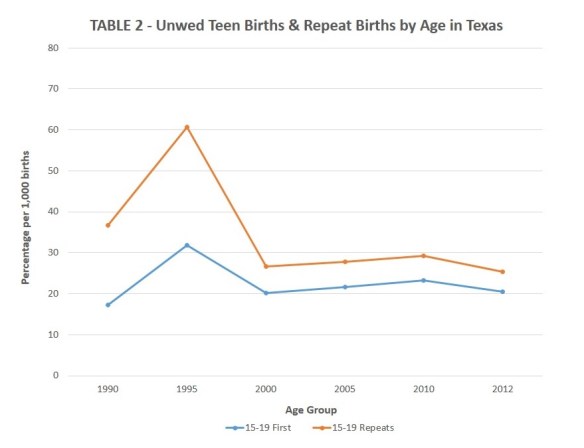
Table 2-Unwed Births Texas

In 2000 in Texas, for every 1,000 births by women, 30.5% were unwed and 15.3% of those were teenaged mothers.  In 2009 in Texas, 42.4% were unwed and 13.3% of those were teen-mothers.  In 2011 in Texas, 35.8% were unwed mothers and according to The National Campaign to Prevent Teen and Unplanned Pregnancy in Washington D.C., Texas ranks 47th out of 50 in teen-pregnancy rates and ranks 37th out of 50 in rate of decline in teen-pregnancy between 1988-2010.
Table 3-Unwed Births Texas vs US

Over a 22-year span, why is Texas not keeping up with well over half the nation in reducing unwed pregnancies and births, especially with teens?

Sex-Education

If a people wish to reduce the number of unplanned pregnancies, particularly with teenagers, if for no other reasons than to counter the dollar impact upon a state’s economic interests, rational thought would say educate thoroughly and broadly those kids and their parents.  But that’s rational thought, not Texas GOP policy mandates.

A Brief Political History of Texas –
Since 1994 the Texas Congress, or both the House of Representatives and Senate, has firmly been held by the conservative Republican party.  Governor Ann Richards lost her bid for re-election with her Democratic party against Republican candidate George W. Bush.  Once Governor Bush won his 1998 re-election in a landslide victory across the entire state’s races, the Republican tsunami had begun.  By 2002 after twice redrawing congressional districts that favored Republican candidates (map below), and despite federal judge’s ruling for the status quo, in unprecedented fashion Gov. Perry and his party controlled both chambers of the Texas Congress since Civil War Reconstruction.  Today Texas is considered one of the most puritan conservative Republican states in the nation’s history.
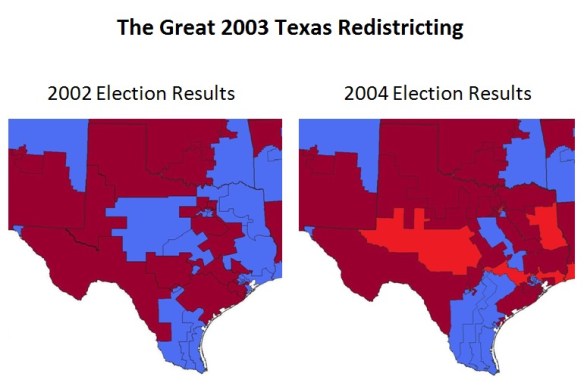
Comparison of U.S. House election results for Texas in 2002 and 2004 after the creation of new boundaries for congressional districts following mid-term redistricting in 2003. Blue denotes a Democratic hold, dark red denotes a Republican hold, and light red denotes a Republican pickup. (Wikipedia)

Comparison of U.S. House election results for Texas in 2002 and 2004 after the creation of new boundaries for congressional districts following mid-term redistricting in 2003. Blue denotes a Democratic hold, dark red denotes a Republican hold, and light red denotes a Republican pickup. (Wikipedia)

Texas Teens Today –
Conservative Texas politicians, especially those in rural and suburban areas, are quick to sound their bull-horns for the right to bear arms, to laugh in the face of taxes, and to defend infinite individual freedom until their dying breath and stand by it all with unflinching fervor.  The same fervor exists for sex-education, but for the last twenty-three Republican years with ghastly disheartening results.

Quite ironically Governor George W. Bush embraced President Bill “Unfaithful” Clinton’s multi-million dollar sex-abstinence-only campaign in the mid-90’s then further funded it and passed it when elected the 43rd U.S. President.  Governor Rick Perry, anxious to make his mark in history, rallied his very powerful pro-life allies to sweeten the funding pot and by 2009, 94% of all Texas public schools were teaching abstinence-only, in other words the only choice available, while completely eliminating any and all alternative education to sex – see spike in Texas unwed births, Table 2.  The repercussions of these political mandates have had a massive economic impact not only on federal tax funding dollars, but Texas taxpayers as well.  In this time period, Texas has been one of the largest recipients of federal sex-education funding, at $1.5 billion granted for abstinence-only programs.  According to the U.S. Sexuality Information and Education Council, in 2009 alone Texas received $10-million to teach and promote abstinence-only sex-education in public schools.  From 2008 to 2011 the Texas Department of State Health Services has rung-up $23.3 million in Rick Perry’s and Greg Abbott’s total-abstinence-only programs.  These figures become significant when in the next ten years Texas makes-up over one-tenth of the U.S. population and continues to be the 2nd highest GDP-state in the nation.  Fair warning America!

What have been the results of Texas’s single-choice just-say-no sex-education?  Texas now has the third highest rate of teenage births in the nation, and the second highest rate of repeat births to teenage girls (Table 3 above)!  What does this look like compared to the world’s highest teenage birth rates?  See Table 4.  It’s ugly.
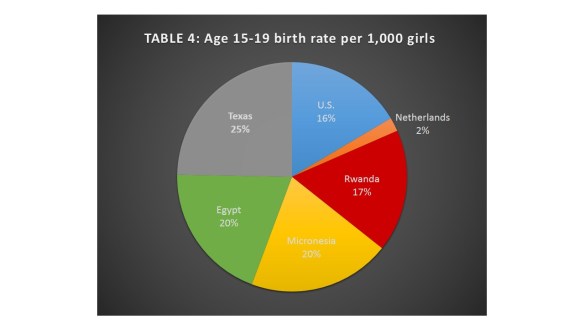
Table 4-TX vs NationsIf there is one glaring point that the Texas Congress and Governors Bush, Perry, and favored candidate Greg Abbott have demonstrated over the last two decades are that “Out-of-Wedlock Babies” are and have been a heterosexual problem not a homosexual one.  And channeling federal and state resources into abstinence programs such as “Worth the Wait”, or “Speedy the Sperm” (an 18-foot classroom model with shark-like teeth), or “Woman Dry, Sperm Die”, clearly fails miserably while billions of federal tax dollars go squandered.  Period.

So why have Texas voters been so ignorantly stubborn for so long in putting in and keeping those failing policies and programs?

The Influences

With 268,581 square miles within its borders and three of the top ten largest metropolitan areas in the United States, Texas is one of the most diverse states in the Union as far as geography, people, culture, and economies.  However, this diversity doesn’t necessarily translate over to its politics.

Six Influences on Texas Voters

Family – Generally children grow up thinking, behaving, and living similar to their parents despite any disagreements or generation gaps.  Except perhaps for families below the poverty line, this general rule holds true in Texas.  The family is typically the most influential and most enduring influence upon a young adult’s civil views and life.  As the child ages their attitudes can diverge from those of their parents, but the core values and influence basically remain.  This is of course true throughout America, however, inside Texas it tends to be more so due to the state’s “Lone Star” history, of which I’ll address later.  Another influence is how the Texas family values higher education and if it’s a viable opportunity.  Below is a comparison of levels of education for Texans versus the national averages from CensusScope.org and the U.S. Census Bureau.  Cost, financial aid, and income are additional factors toward under-graduate degrees.
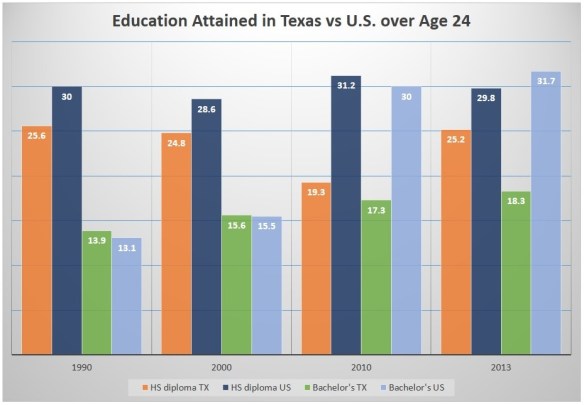
Table 5-Levels of TX Ed vs USGender – Due to the climate of the early 20th century in America, moving from patriarchal dominance toward more equality – Women’s Suffrage Movement – Texas was the first Southern state to ratify the nation’s 19th Amendment giving women the right to vote.  However, amending the Texas Constitution to reflect the national winds of change proved to be a much harder task for Texas suffragists.  Only after it was clear the changes and amendments would succeed in Washington D.C. in 1920, Texas — being one of the original eleven Confederate states — and Texan anti-suffragists fought the amendment to the last day.

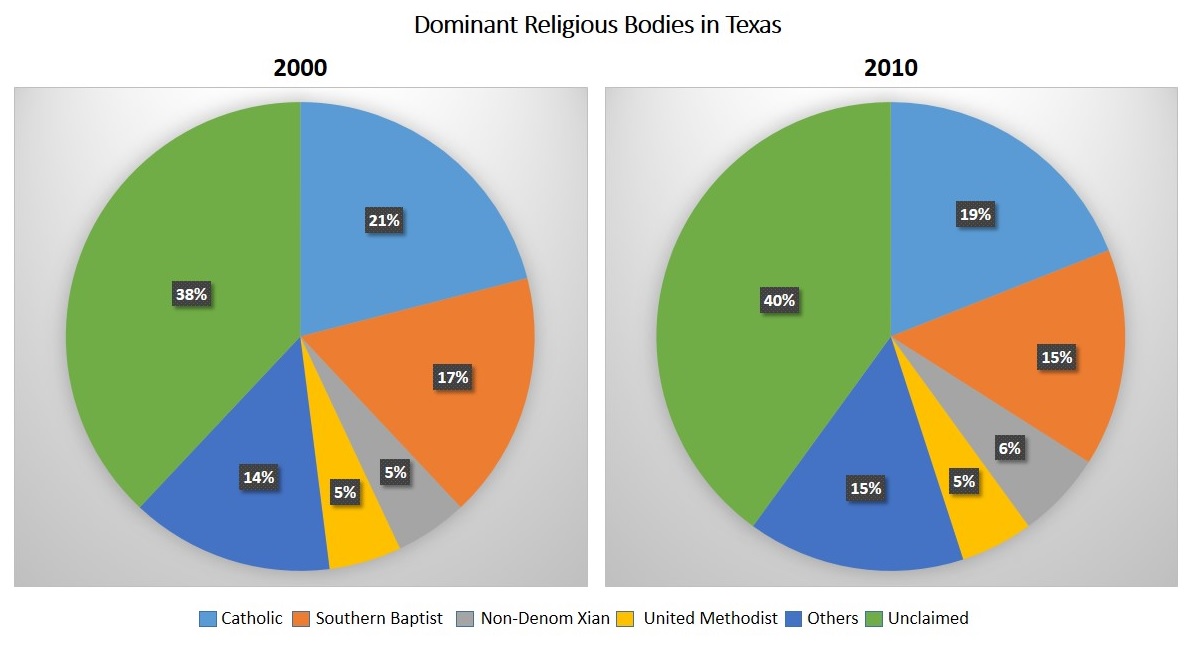
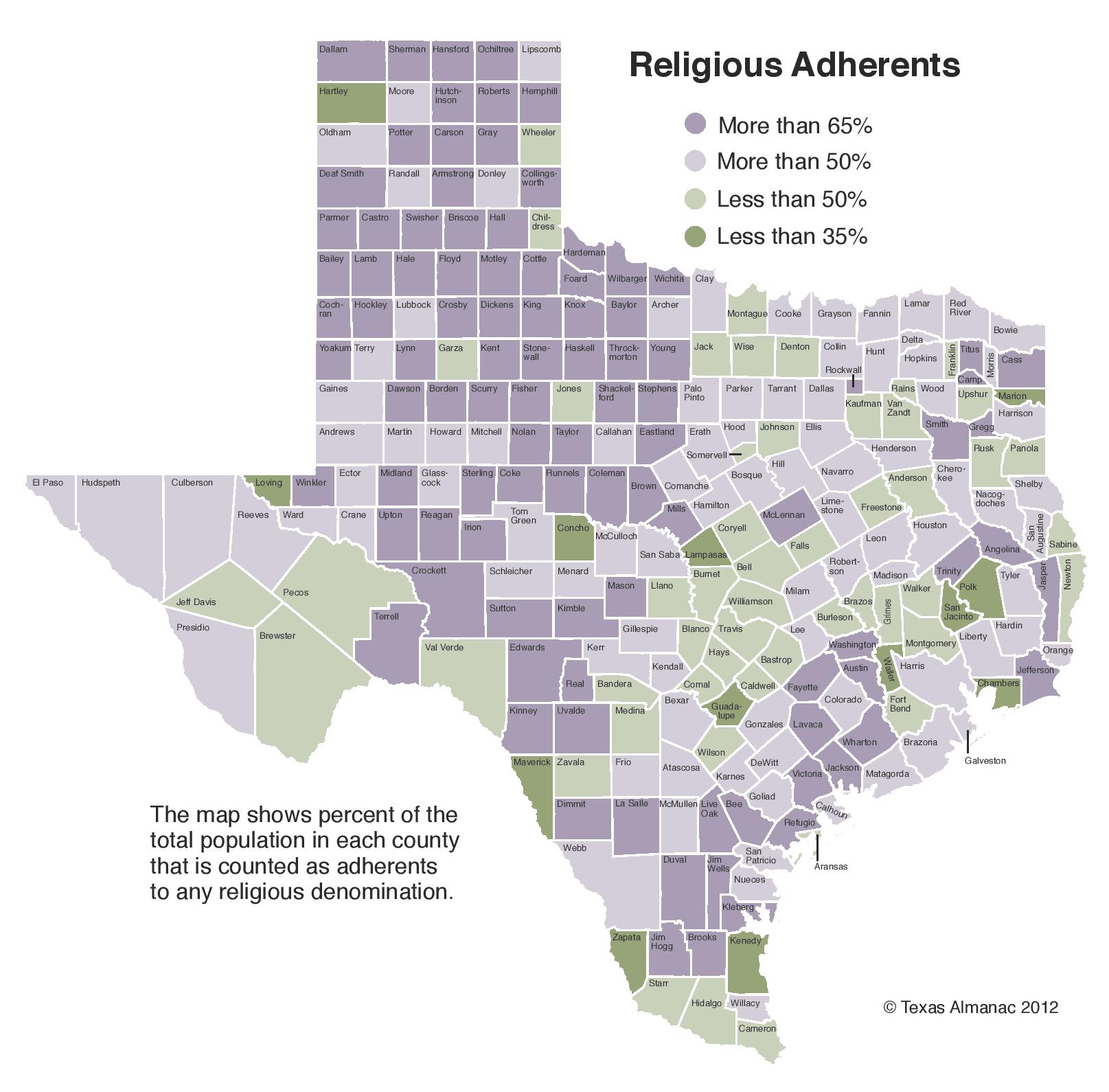
Religion – Naturally religious affiliation will be influenced by a child’s parents.  Typically those values carry over into young adulthood until the young adult becomes more exposed to Texas’ diversity, maybe the world’s as well, and those views may then be modified.  As of the 2010 TSHA Almanac, 60% of Texans are religiously affiliated or attending members.  The Chart and Maps below show specific breakdowns.
Dominant Religious Bodies in Texas

TX Dominant Faiths by County

TX Religious Adherents by County

With regard to sex-education and out-of-wedlock births, religion definitely influences most young adults.  As the chart and maps above indicate, Texas’ religious 34% are primarily Catholic and Southern Baptist, two faiths with traditionally rigid black-or-white guidelines on sex-education:  one choice, total abstinence until marriage.
Teen birth-rates per county 2010

Teen birth-rates per county 2010

Race and Ethnicity – As a general historical rule African-Americans and Latinos have been politically liberal.  Since before 1990 the racial and ethnic makeup of Texas has changed.  From the 2000 census the Latino population made up 63.5% of the state’s population growth and is expected to surpass the white non-Hispanic population by 2014.  The Charts below show specific changes and breakdowns from U.S. Census Bureau data tables.
TX Population by Race 1990-2013For the sixth and last influence, along with addressing the “Lone Star” tradition and origin, I will also draw the connections from race-ethnicity to family economics, and how those three dynamics construct the Texas political culture.

Region – As was clear in the above two Texas maps of religious dominance, a Texan’s regional location plays a big part in their employment-type and therefore income, two significant factors in their political tendencies.  The Map below illustrates the political areas by county across the state and further expounds Texas’ economic culture and is directly connected to political affiliations.

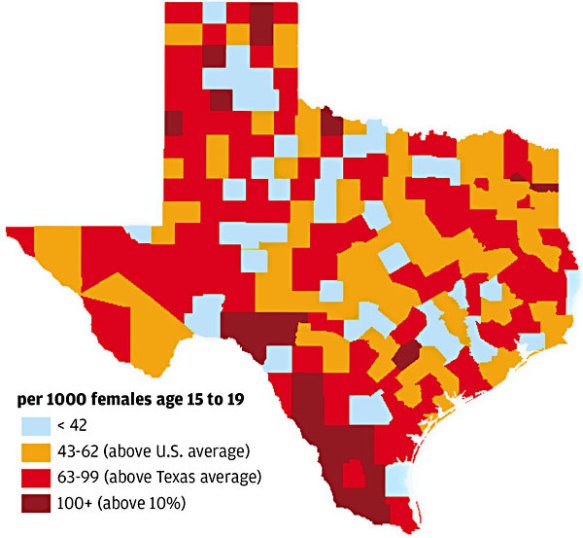
Note the political counties to other counties by educational attainment, and teen birth rate maps

Note the political counties to other counties by educational attainment, and teen birth rate maps

Political and Economic Culture – Since Texas became part of the U.S. (1845) it has had two political sub-cultures:  Traditionalists and Individualists.  Both still survive and thrive today in various forms and greatly influence(d) Texas politics.

In pre-Civil War Texas Traditionalists made-up just a few agricultural families with large land-grants and several hundred slaves, and hence came to dominate state politics.  During and after Reconstruction Jim Crow laws were passed to limit freed slaves from Texas public services.  This limiting carried over into literacy tests, grandfather clauses, poll-taxes, and all-white primaries, further hampering minority voting rights.  Texas Traditionalism is reflected today in economic and social conservatism.  In the Rio Grande Valley the Patronage System still prevails in civil business and management.  Religious groups influence government policies in the state’s Blue Laws, liquor laws, and gambling regulations.  Several powerful families in Texas still influence state politics such as the Hunts, Bush’s, Bass, Perry’s, Crows, Dewhurst’s, and of course maverick Clayton Williams.

The Individualists echo Texas’ long history as a colony of Spain then Mexico.  Having “inherited”(?) Spanish land-grants, Mexicans as well as Eastern-American settlers flocked to Texas for the cheap land and early economic stimulus policies by both the U.S. and Mexico.  This lead to revolution and upon achieving independence from Mexico – with covert American support – individuals began implementing more economic stimulus policies for the upstart government with more land-grants or with basement prices.  This sub-culture lingers in today’s Texas politics in four major limiting ways:

  1. Congress meets only biennially
  2. Legislators can only receive pay-increases if the state Constitution is amended
  3. The Governor has very limited budgetary and appointment/removal powers
  4. Judiciary process is complex and in a multi-tiered structure

Texas has extremely favorable laws and attitudes toward big-business and business owners in three major ways:

  1. No personal income tax
  2. No corporate income tax
  3. Employment At-Will doctrine

For much of Texas’ history, its Economy has been driven by three industries:  oil, livestock, and cotton and similar cash-crops.  This shouldn’t come as a surprise given the state’s acquired landmass.  For the better part of the last century Texas oil production and refinery was the bulk of the economy.  By the 1980’s oil and natural gas production made-up around one-third of the economy and job market.  Then came 1986, the crash of oil prices, followed by the state’s national-leading bank, savings, and loan crashes, causing mass job losses and bankruptcies statewide.

Livestock production has always dominated the revenues of Texas.  Texas livestock and its byproducts make up about two-thirds of the state’s economic revenue and ranks first in the nation in livestock production.  This industry’s influence is reflected in the state’s private land-holder percentage.  Of the state’s 268,581 square miles of land, 95% is privately owned.  With the state’s continued population growth, it’s a matter of time before controversial issues ignite, if they haven’t already, and another political tsunami rolls through.

Cotton and other cash-crops are major contributors to the Texas economy.  Since 1880 Texas has led the nation in cotton production with over 25% grown, produced, and exported from Texas.  Corn, hay, soybeans, pecans, citrus fruits, and peanuts are the state’s other high-revenue crops.  These industries still employ a large number of blue-collar workers with a growing mix of Latinos the last decades.

Part of the recent economic winds-of-change come in the Services and Technology sectors, Dell Computers for example.

Both above political sub-cultures and the state’s economic environment have delightful attractive benefits to individuals and families, but not for everyone.  They have some unfavorable civil and social side-effects and influences as well.

The Polarizing of Texas
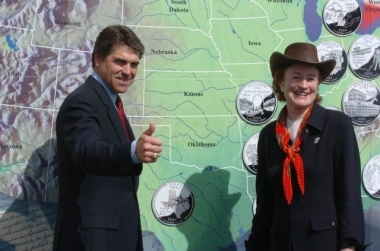
TXquarter-unveiling2004

Gov. Rick Perry unveils the new 2004 Texas state quarter

As touched on earlier, Texas has begun to change.  With change there is inevitably friction and controversy, particularly from the state’s Traditionalists and Individualists and their long-standing way of Lone Star life.

In 2004, as the U.S. Mint was continuing its nationwide state-to-state release of new quarters representing each of the fifty states, Governor Perry remarked about the state’s nickname and meaning at the unveiling of the U.S. “Texas” quarter in Austin, TX:

Today it becomes official: Texas’ rich and vivid history will gain even greater currency as the Lone Star of Texas becomes a regular feature in the pockets and purses of Americans from sea to shining sea.  On one side will be the face of George Washington, and on the other side a renowned symbol of Texas Independence.  The Lone Star is one of the most identifiable symbols of Texas, and a historic representation of the independent spirit of our people.  Its origins can be traced back to the movement for independence, and its continued presence today reminds people that Texans are a different breed, set apart by their fierce individualism and their unrelenting desire for freedom.

2004 Texas state Quarter

2004 Texas state Quarter

That is the short, proud, Conservative public version of the story behind the symbol and nickname.  The broader more diverse representation is a bit different.

As a Texas certified teacher of all four core subjects, including my passion Social Studies/History, and as an eighth-generation Texan, I feel I too have a more balanced version of Texas Then and Now to share.  As noted, many Texans are proud, proud of their heritage, proud of the state’s size, proud of the state’s influence on national politics, national economic revenues, and the state’s implied attitude We Can Take It or Leave It – “It” being the United States as a whole.  Yes, as Governor Perry’s speech above indicates, Texas fervor for individualism, independence, and freedoms are alive and well today.  At least in his party’s mind and business circles it is.

The less exaggerated version of Texas history, particularly its independence from Mexico, i.e. the distinction between Texians and Tejanos, is a lesser-known side to the territory’s colonists and their struggle (or fight) to make a peaceful prosperous living.  Of the fourteen historic leaders (Giants of the Texas Republic) of early Texas, only two of them were actually born and raised in Texas – Bexar, or today San Antonio – and therefore are/were prominent Tejanos.  Eleven other Giants, who also represented their deep American ideologies, were all Texians, or immigrants from the United States enamored by the territory’s “cheap” opportunities.  Sam Houston, Stephen F. Austin, Mirabeau Lamar, William Travis, Davy Crockett, James Bowie, Thomas Rusk, Anson Jones, Edward Burleson, David Burnet, all hailed from east of the Mississippi River.  However, the Tejanos of early Texas – namely Juan Seguin and José Navarro – relentlessly sought to ease tensions between their Mexican heritage and principles, and the “Texian Giants” from the east.  Of course, that couldn’t did not happen.  The meaning of “Lone Star State” is actually more an American-Andrew Jackson political movement westward than a true Texas-Tejano story.  It is the commonly enduring, though very porous, Anglo-American extrapolation of Texas history.
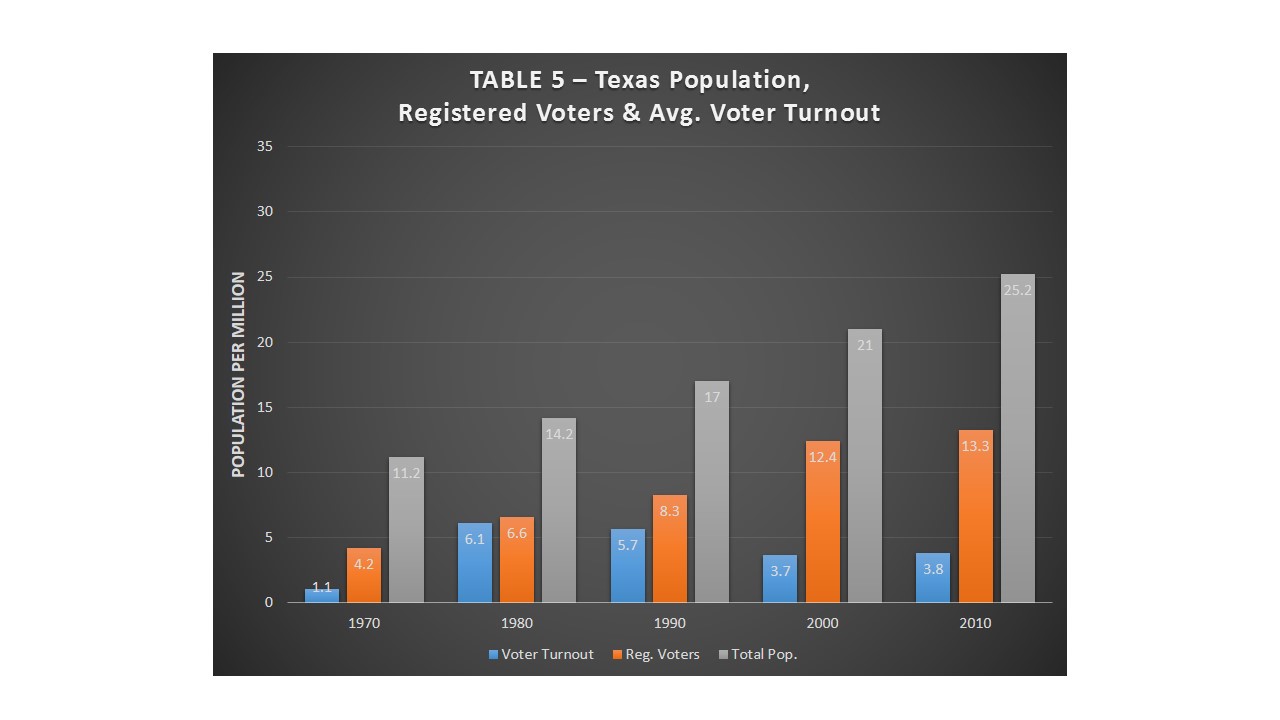
Table 6-Pop-Vreg-VturnoutDue to a 178-year “entrepreneur” spirit of Texas and six major influences upon its social, political, and economic culture which divides as much as it invigorates, Texas has one of the lowest voter turnout rates, particularly for state and local primaries and runoffs (see Table 5 above) for the last five decades.  Why the despondency?

I’ve given ample assessments of the factors that go into Texas’ diverse cultural and political climate.  Now I will give one last factor that plays a big part in Texas’ complex economic climate and therefore its voter climate:  education.

Percent 9th Graders Finish etc

A History of Educational Polarization in Texas

A particular answer to Texas’ consistently poor voter turnout rate overly argued hundreds of times by both political parties is illegal immigrants.  While this may be true, partially true, or hardly true, the data and facts paint a much bigger problem.  In a comprehensive study by TG Research and Analytical Services (2014), Texas ranks in the bottom tenth of U.S. states among 9th graders who graduate from high school or college on time – Table above.  Comparatively Texas has a high-rate of students exiting the higher-education pipeline toward post-secondary degrees beginning in 7th grade up to college freshmen (see Table Texas Student Pipeline, p. 73).  Texas is below the national pace to meet projected targets for Hispanic enrollment according to a June 2013 study by the Texas Higher Education Coordinating Board (THECB), p. 19 – and the Texas Hispanic population has been the state’s fastest growing race for the last 20-30 years!  And the most telling of all studies and data?  College completion rates are noticeably lower in Texas than the U.S. average and have lagged behind national averages (U.S. Census Bureau – Current Population Survey) for at least the last decade.
Undergrad Completion Rate by Race, Texas vs U.S. Age 18-64

In my estimation these educational indicators explain in large part why the majority of Texas citizens (registered or not) have little motivation or skilled capacity to stamp their voice at voting booths.  This is also a national trend, particularly in the young adult ranks.  With that aside, the politics of modern Texas along with the economic urbanization of new industries and increased mechanization of agriculture, all converge demanding a college-educated (or higher) workforce.  Furthermore, the current higher-educated sector in Texas, i.e. the white-non-Hispanic Traditionalists and Individualists, hold and have held the key socio-economic and political positions in the state.  It is no leap of reason that “knowledge” and a quality education provides an advantage, and power.  The influences upon voters doesn’t end there.  One more factor deserves attention.

The cost of attaining a college-degree or higher is difficult at best for Texas families hovering around the poverty line, UNLESS financial aid (grants and loans) is accessible.  However, wading through all possible financial aid programs and conditions can be daunting and frightening for impoverished parents or non-Caucasian parents with or without a high school diploma.  What I found interesting in my research and preparation on this subject, is that Texas relies very heavily on federal aid for college admissions; significantly more so than its own state or institution’s aid.  That aid is also in the form of interest-bearing loans, not grants.  Federal grants for college-bound students have been steadily declining over the years.
Direct Student Aid by Source TX vs US

Direct Student Aid by Type 91-92, 11-12Assuming some of you have read this far, dissecting and deciphering the Texas and federal programs/conditions would need another two or three separate posts minimum, of which I or likely you have no time to read.  Semi-apologetically I will skip it.  But it is reasonable to conclude that for a state that prides itself on self-reliance, self-motivation, and self-direction, a Lone Star if you will, it sure leans heavily – at least for the last decade – on 49 other states to help.

* * * * * * * * * *

If Texas continues on its twenty-year path of rising educational and economic disparity, by 2040-2050 Texas will no longer be capable of supplying an adequately educated work force for employers and businesses that demand college-degreed-or-higher employees they need to remain competitive, innovative, and profitable.  The option for those future Texans?  Low-pay undesirable service jobs with little to no vertical movement.  Texas, this trend must be reversed!

Cutting or limiting the scope of broad education, including sex-education, as Rick Perry and Greg Abbott have done over their political terms, only handicaps Texas’ future generations.  Cutting or limiting a diverse education and experience among all types of Peoples – including the LGBT communities which by the way empowers students and young adults to better address and manage social, political, and economic factor — will actually handicap future young Texans.  The repercussions of bias, limited, inflexible, faith-based social and political polices and mandates in 1990-2010 were far more reaching than Texas voters could’ve possibly imagined.

What Next?

Voter ID TestIn a north Texas-based Star-Telegram January 2014 interview, Steve Murdock, a former Texas state demographer and director of the U.S. Census Bureau, offering causes for Texas’ increasing wealth inequality explained “if we don’t [correct] educational levels, Texas will be poorer and Texas will be less competitive”.  The same can be said about Texas’ socio-economic issues exacerbated by decades of GOB faith-based politics (Good Ole Boy).

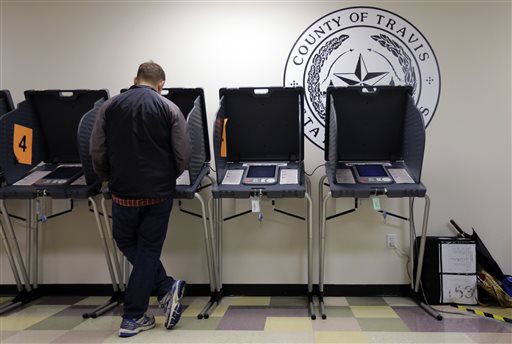
A new generation of Texans, a more diverse population of Texans – though not so highly educated by national percentages – have a golden opportunity this November to reverse Texas’ decades of spiraling downward turns in education…ALL FORMS of education!  Getting to the voting booths – and out of people’s bedroom (heterosexuals) and personal life-choices – is the easiest first step, reversing our abysmal voter-turnout rate.

I am one eighth-generation Texan who wants that to happen and permanently.

(paragraph break)

Live Well — Love Much — Laugh Often — Learn Always

(paragraph break)

Creative Commons License
This work by Professor Taboo is licensed under a Creative Commons Attribution-NoDerivs 3.0 Unported License.
Permissions beyond the scope of this license may be available at https://professortaboo.wordpress.com.