El Dorado – Part I

Gaily bedight,
A gallant knight,
In sunshine and in shadow,
Had journeyed long,
Singing a song,
In search of Eldorado.

But he grew old—
This knight so bold—
And o’er his heart a shadow—
Fell as he found
No spot of ground
That looked like Eldorado.

And, as his strength
Failed him at length,
He met a pilgrim shadow—
‘Shadow,’ said he,
‘Where can it be—
This land of Eldorado?’

‘Over the Mountains
Of the Moon,
Down the Valley of the Shadow,
Ride, boldly ride,’
The shade replied,—
‘If you seek for Eldorado!’

Eldorado, by Edgar Allan Poe

(paragraph break)

My wonderful daughter is soon graduating from four years of university. I could not be more proud. I reflect back to the summer of her upcoming freshman year and the many questions and discussions we had about what major to pursue and study. It is perhaps one of many far-reaching decisions facing all undergraduates. For some, it is a time of the highest anxiety they must address in their budding lives. I know, I’ve been there. Many of us have been there, right?

career compassIn a modern economy and job-market that has increasingly become highly specialized the last three decades, a new graduate likely wants to make a decent high wage to at least have the ability to pay-down college debts. While examining today’s competitive labor market, it isn’t much of a stretch or mystery to conclude that once your vocation has been decided, the choice could very well set in concrete the next 10-20 years of your working life, years that cannot be refunded! Oh and by the way, the job-market is usually dictated by what finicky consumers want and how they spend their incomes. Mix into that career-path-anxiety healthy doses of follow-your-heart advice, which often does not translate to 6-digit paychecks, and a college graduate begins perspiring and shaking. Oh and by the way, since 1995 the U.S. median income for four-year college graduates has remained pretty constant at about $47k per year according to the National Center for Education Statistics. Unless a new graduate with 3 or 4-years of tuition-debt lands a minimum annual income of around $70k to $80k quickly, they will not be able to keep up with inflation, cost-of-living with rent or a mortgage, likely loan interest, let alone raising toddlers, they will NOT be able to get ahead on $47k per year. If they are financially frugal and wise, they must put those dreams on hold until that high-wage career is landed, if it is landed. Enter more stress.

A career-path is indeed a huge ordeal and can possibly make or break a person. It is not to be taken lightly. But what are the driving forces behind the decision? What sort of life will those driving forces actually create?
(line break)

* * * * * * * * * *

We now live in a part of the world, the Western Hemisphere, where wide choices of labor are unparalleled in the history of civilizations. At first glance, one would think this is a good thing. On many levels the advancements in medicine or technology, to name two, are indeed far and beyond other progressive ages of the past. They are two of many explanations for the planet having close to 7.3 billion humans to date; a number close to the tipping-point of what Earth can sustain. Why?

Two major factors have been the social evolutions of increased democracy and wide-spread education. These two alone have contributed greatly to the end of feudalism and eventually ushered in the Industrial Revolution leading workers out of the fields and into mass urbanization. Families went from hard subsistent living to higher social mobility and liberation in the span of one century! But with so much labor and social change come newer problems; some with hints and roots of old problems.

In the West where much of these advancements have taken place, workers are the unhappiest since the end of World War II. In two of the continents of labor-liberation, over two-thirds of Europeans — primarily in central and southern Europe — are dissatisfied with their jobs according to OPP Unlocking Potential in Oxford, U.K. In America 52.3% are unhappy — all of those workers being in the middle and lower incomes of the nation — and the happiness-scale has been falling since 2011 according to the New York-based non-profit research group The Conference Board.

Modern Kings and Queens

The foundation of the Industrial Revolution was laid by ideals and theories published in the late 1700’s. Economists David Hume and Adam Smith, along with botanist Henri-Louis Duhamel du Monceau, combined to create the earliest stages of manufacturing by the Division of Labour. Essentially this philosophy means turning a product or service from start to finish by one person/family, instead into many phases done by multitudes — highly specialized worker ants/bees, if you will — for the sake of Queen and country…and job-security. Today, those Queens, Kings, and countries are business corporations.

eldorado-gold

Balsa Muisca (Muisca raft) figure, Bogotá, Columbia; the symbol & origin of the El Dorado legend

Since the 1950’s and certainly after the Great Recession of 2008, as the previous stats indicated, Hume’s, Smith’s, and Monceau’s economic philosophy no longer satisfies the common-worker in the West. Very soon the same will be said, if not already, in the Middle and Far East. Indeed, the basic material needs of modern Western civilizations have been met post-WW2, or at least made more easily available to the less-privileged. However, with more freedom, more liberties, more competition, comes more and more shrewd marketing schemes and modern funding into Special Interest groups pressurizing all levels of legislation by those who stand to lose much more. In million and billion-dollar economics, ethical integrity by the major players becomes a risk they cannot or will not take and the winds of change apply only to an upward swerve of their bottom-line.

Yes, incomes and wages in Europe and North America over the last two centuries have been rising. They have reached their highest points in history for more than just the nobility and the wealthy few. Yet, it stops there. Along with clever complex psychological marketing, the average life-satisfaction surveys, or well-being stats, are surprisingly still flat; especially the last thirty-years! What has happened?

I came to get gold, not to till the soil like a peasant.
— Hernán Cortés

In 1504 the collapse of the Aztec Empire of central Mexico marked the beginning of Imperial Spain’s Golden Age, literally. Cortés and his Conquistadors made off with wagon-loads of gold and silver catapulting he and his men — who back home had little to lose — into a new socio-economic class otherwise unobtainable. With that new status came not only heightened respect and popularity, but their native Empire’s greatest glory and colonial land expansion. What followed in the 1600’s changed the world forever:  the Age of Exploration. For the peasants and servants of 17th century Europe, the hope of an entirely new life with riches either in land or wealth, or both, was too great to pass up. They came to The New World by the never-ending boat-loads.

Many immigrants were unaware of the great risks blinded by the glitter of the legendary stories. Disease, hunger, and angry natives protecting their homelands put the new settlers in harms way and the expeditions literally as do-or-die endeavors. In the modern era, the similar reckless obsession, perhaps disguised as the dream, is the amount of time American workers spend on the job. The Bureau of Labor Statistics reports in 2013 that the average U.S. employee between age 25 and 54 works almost 9-hours a day, 7-days a week, for a total work-week of 63 hours; the most out of all industrialized nations.

The highest-earning occupation in the U.S., attorneys-at-law, have the highest rate of depression and suicide as reported by magazine Psychology Today and a 1990 John Hopkins University study of 100 occupations. Perhaps shocking or not so shocking, lawyers are followed next by teachers and counselors, then secretaries according to the Journal of Occupational and Environmental Medicine 1990. Yet, still today universities across the U.S. report steady or increased enrollment into their law schools and medical schools, and not so surprising decreased enrollment into their schools of education (NTP 2013 Title II Reports) and counseling (BLS 2014 Occupational Employment). Care to guess why?

The dream of El Dorado has been the most commonly propogated and sought-after-dream sold to the masses by the Queens and Kings of the world. My 4-part blog-series Oversimplification 2012, as well as The Land of Opportunity? post, both address this modern El Dorado scheme in-depth. Fortunately, a new growing trend for more purpose in life beyond simply wealth and success is emerging. In my next post, El Dorado – Part II, I will explore further how and why the trend is growing, and warn against the biggest counterfeits of “a better El Dorado life.

Have you discovered an empty “El Dorado” recently? How did you uncover the mythical town?

(paragraph break)

Live Well — Love Much — Laugh Often — Learn Always

(paragraph break)

Creative Commons License
Blog content with this logo by Professor Taboo is licensed under a Creative Commons Attribution-NonCommercial 4.0 International License.
Permissions beyond the scope of this license may be available at https://professortaboo.com/.

Influences Upon the Majority

texas babyIn my previous post Out-of-Wedlock Babies, Texas gubernatorial candidate and state Attorney General Greg Abbott, along with current governor Rick Perry, appealed to the Fifth Circuit Court of Appeals defending the state’s ban on same-sex marriage arguing that “unions that do not result in pregnancy… do not ensure economic growth and the survival of the human race.”  Somehow both politicians connected out-of-wedlock babies to same-sex marriages into their argument.  “Texas’s marriage laws are rationally related to the state’s interest in reducing unplanned out-of-wedlock births.”  This in turn reduces “the costs that those births impose on society.”  I am going to attempt to show how detached Greg Abbott and Rick Perry are and have been from national heterosexual trends and worse, their own state’s alarming heterosexual trends, as well as the state’s rising educational and social inequalities.

Unplanned Births – National vs. Texas Numbers

I can’t help but ask myself why I am addressing economic and social consequences by heterosexual individuals, when the original debate is supposed to be about homosexual marriage.  I guess the simple vague answer is I am attempting to decipher Abbott’s and Perry’s Defense of Moral Prosperous Texas argument.  That’s the best I can do.  Here goes.

United States –
The average American home today looks nothing like it did fifty-years ago, even twenty-years ago.  According to the Center for Disease Control and Prevention (CDC) in collaboration with the National Vital Statistics System (NVSS) 2013-Table 16 p.70, in 1970 of every 1,000 U.S. births by women age 15-44 years old, 26.4% were unwedded, 44.3% in 1995, and 45.3% in 2012.  Of those births, 22.4% were unwed teens age 15-19 in 1970, 43.8% in 1995, and 26.7% in 2012.  The largest number of unwed women in an age group of those three time-periods were women age 20-24 years old in 1970 (38.4) and 1995 (68.7), but age 25-29 in 2012 at 67.2% — see table below.  These are the national numbers and age trends.
Table 1-Unwed Births US

Texas –
Finding the Texas data was more difficult.  Nonetheless, I did manage to find limited hard data for the twenty-two-year period 1990-2012 from the CDC and NVSS (Table 89).  Unfortunately, if you’re a die-hard political Texas Conservative, all the unwed childbearing data falls exactly during George W. Bush’s, Rick Perry’s, and Greg Abbott’s times in office.
Table 2-Unwed Births Texas

In 2000 in Texas, for every 1,000 births by women, 30.5% were unwed and 15.3% of those were teenaged mothers.  In 2009 in Texas, 42.4% were unwed and 13.3% of those were teen-mothers.  In 2011 in Texas, 35.8% were unwed mothers and according to The National Campaign to Prevent Teen and Unplanned Pregnancy in Washington D.C., Texas ranks 47th out of 50 in teen-pregnancy rates and ranks 37th out of 50 in rate of decline in teen-pregnancy between 1988-2010.
Table 3-Unwed Births Texas vs US

Over a 22-year span, why is Texas not keeping up with well over half the nation in reducing unwed pregnancies and births, especially with teens?

Sex-Education

If a people wish to reduce the number of unplanned pregnancies, particularly with teenagers, if for no other reasons than to counter the dollar impact upon a state’s economic interests, rational thought would say educate thoroughly and broadly those kids and their parents.  But that’s rational thought, not Texas GOP policy mandates.

A Brief Political History of Texas –
Since 1994 the Texas Congress, or both the House of Representatives and Senate, has firmly been held by the conservative Republican party.  Governor Ann Richards lost her bid for re-election with her Democratic party against Republican candidate George W. Bush.  Once Governor Bush won his 1998 re-election in a landslide victory across the entire state’s races, the Republican tsunami had begun.  By 2002 after twice redrawing congressional districts that favored Republican candidates (map below), and despite federal judge’s ruling for the status quo, in unprecedented fashion Gov. Perry and his party controlled both chambers of the Texas Congress since Civil War Reconstruction.  Today Texas is considered one of the most puritan conservative Republican states in the nation’s history.

Comparison of U.S. House election results for Texas in 2002 and 2004 after the creation of new boundaries for congressional districts following mid-term redistricting in 2003. Blue denotes a Democratic hold, dark red denotes a Republican hold, and light red denotes a Republican pickup. (Wikipedia)

Comparison of U.S. House election results for Texas in 2002 and 2004 after the creation of new boundaries for congressional districts following mid-term redistricting in 2003. Blue denotes a Democratic hold, dark red denotes a Republican hold, and light red denotes a Republican pickup. (Wikipedia)

Texas Teens Today –
Conservative Texas politicians, especially those in rural and suburban areas, are quick to sound their bull-horns for the right to bear arms, to laugh in the face of taxes, and to defend infinite individual freedom until their dying breath and stand by it all with unflinching fervor.  The same fervor exists for sex-education, but for the last twenty-three Republican years with ghastly disheartening results.

Quite ironically Governor George W. Bush embraced President Bill “Unfaithful” Clinton’s multi-million dollar sex-abstinence-only campaign in the mid-90’s then further funded it and passed it when elected the 43rd U.S. President.  Governor Rick Perry, anxious to make his mark in history, rallied his very powerful pro-life allies to sweeten the funding pot and by 2009, 94% of all Texas public schools were teaching abstinence-only, in other words the only choice available, while completely eliminating any and all alternative education to sex – see spike in Texas unwed births, Table 2.  The repercussions of these political mandates have had a massive economic impact not only on federal tax funding dollars, but Texas taxpayers as well.  In this time period, Texas has been one of the largest recipients of federal sex-education funding, at $1.5 billion granted for abstinence-only programs.  According to the U.S. Sexuality Information and Education Council, in 2009 alone Texas received $10-million to teach and promote abstinence-only sex-education in public schools.  From 2008 to 2011 the Texas Department of State Health Services has rung-up $23.3 million in Rick Perry’s and Greg Abbott’s total-abstinence-only programs.  These figures become significant when in the next ten years Texas makes-up over one-tenth of the U.S. population and continues to be the 2nd highest GDP-state in the nation.  Fair warning America!

What have been the results of Texas’s single-choice just-say-no sex-education?  Texas now has the third highest rate of teenage births in the nation, and the second highest rate of repeat births to teenage girls (Table 3 above)!  What does this look like compared to the world’s highest teenage birth rates?  See Table 4.  It’s ugly.
Table 4-TX vs NationsIf there is one glaring point that the Texas Congress and Governors Bush, Perry, and favored candidate Greg Abbott have demonstrated over the last two decades are that “Out-of-Wedlock Babies” are and have been a heterosexual problem not a homosexual one.  And channeling federal and state resources into abstinence programs such as “Worth the Wait”, or “Speedy the Sperm” (an 18-foot classroom model with shark-like teeth), or “Woman Dry, Sperm Die”, clearly fails miserably while billions of federal tax dollars go squandered.  Period.

So why have Texas voters been so ignorantly stubborn for so long in putting in and keeping those failing policies and programs?

The Influences

With 268,581 square miles within its borders and three of the top ten largest metropolitan areas in the United States, Texas is one of the most diverse states in the Union as far as geography, people, culture, and economies.  However, this diversity doesn’t necessarily translate over to its politics.

Six Influences on Texas Voters

Family – Generally children grow up thinking, behaving, and living similar to their parents despite any disagreements or generation gaps.  Except perhaps for families below the poverty line, this general rule holds true in Texas.  The family is typically the most influential and most enduring influence upon a young adult’s civil views and life.  As the child ages their attitudes can diverge from those of their parents, but the core values and influence basically remain.  This is of course true throughout America, however, inside Texas it tends to be more so due to the state’s “Lone Star” history, of which I’ll address later.  Another influence is how the Texas family values higher education and if it’s a viable opportunity.  Below is a comparison of levels of education for Texans versus the national averages from CensusScope.org and the U.S. Census Bureau.  Cost, financial aid, and income are additional factors toward under-graduate degrees.
Table 5-Levels of TX Ed vs USGender – Due to the climate of the early 20th century in America, moving from patriarchal dominance toward more equality – Women’s Suffrage Movement – Texas was the first Southern state to ratify the nation’s 19th Amendment giving women the right to vote.  However, amending the Texas Constitution to reflect the national winds of change proved to be a much harder task for Texas suffragists.  Only after it was clear the changes and amendments would succeed in Washington D.C. in 1920, Texas — being one of the original eleven Confederate states — and Texan anti-suffragists fought the amendment to the last day.

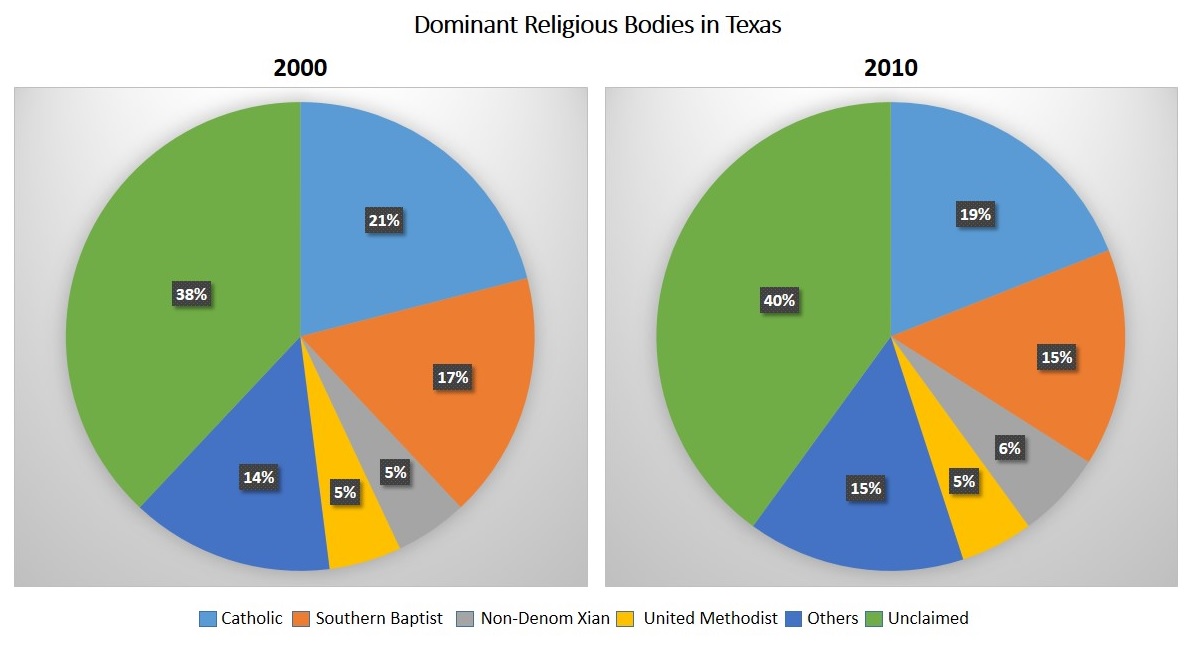
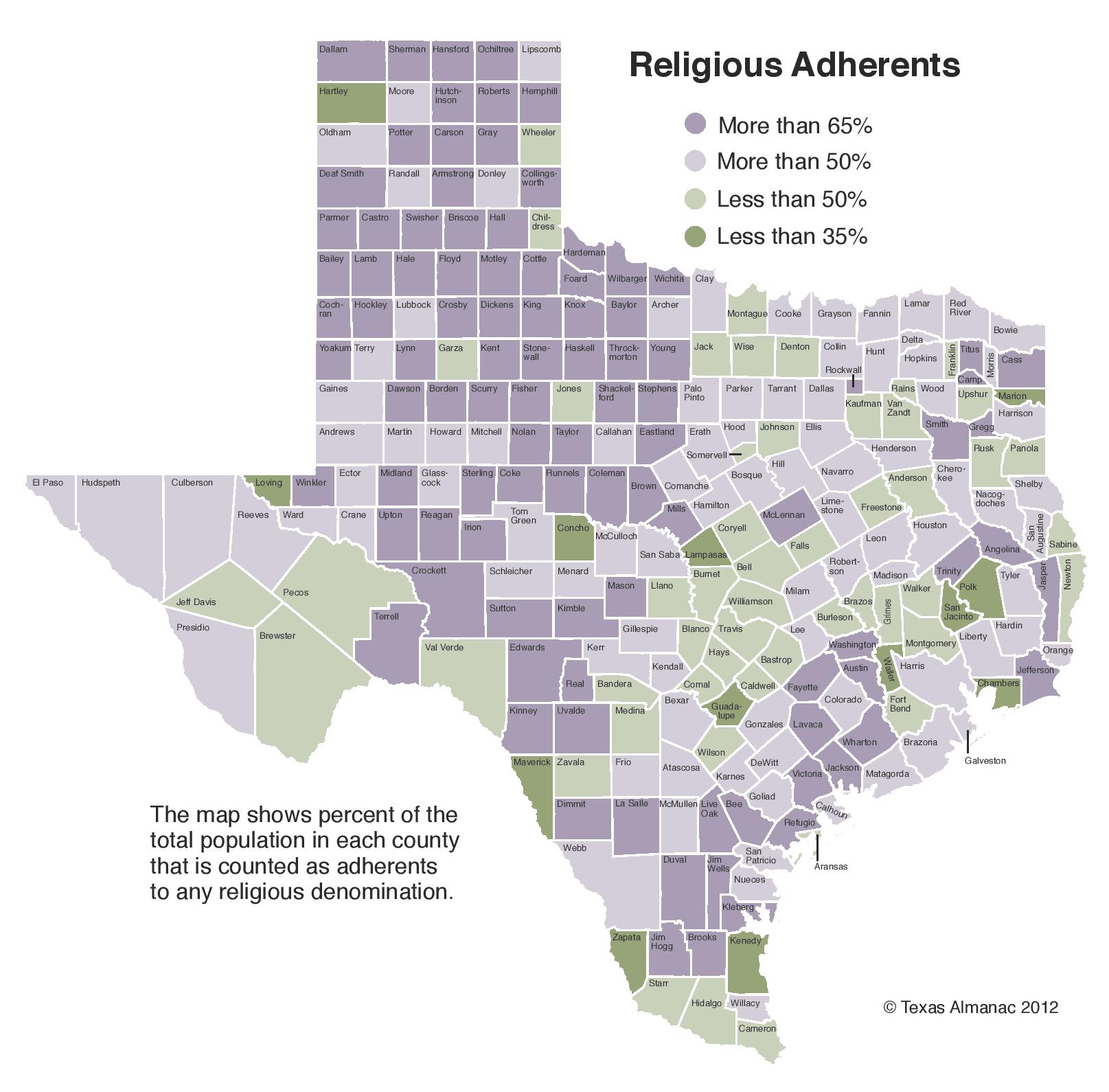
Religion – Naturally religious affiliation will be influenced by a child’s parents.  Typically those values carry over into young adulthood until the young adult becomes more exposed to Texas’ diversity, maybe the world’s as well, and those views may then be modified.  As of the 2010 TSHA Almanac, 60% of Texans are religiously affiliated or attending members.  The Chart and Maps below show specific breakdowns.
Dominant Religious Bodies in Texas

TX Dominant Faiths by County

TX Religious Adherents by County

With regard to sex-education and out-of-wedlock births, religion definitely influences most young adults.  As the chart and maps above indicate, Texas’ religious 34% are primarily Catholic and Southern Baptist, two faiths with traditionally rigid black-or-white guidelines on sex-education:  one choice, total abstinence until marriage.

Teen birth-rates per county 2010

Teen birth-rates per county 2010

Race and Ethnicity – As a general historical rule African-Americans and Latinos have been politically liberal.  Since before 1990 the racial and ethnic makeup of Texas has changed.  From the 2000 census the Latino population made up 63.5% of the state’s population growth and is expected to surpass the white non-Hispanic population by 2014.  The Charts below show specific changes and breakdowns from U.S. Census Bureau data tables.
TX Population by Race 1990-2013For the sixth and last influence, along with addressing the “Lone Star” tradition and origin, I will also draw the connections from race-ethnicity to family economics, and how those three dynamics construct the Texas political culture.

Region – As was clear in the above two Texas maps of religious dominance, a Texan’s regional location plays a big part in their employment-type and therefore income, two significant factors in their political tendencies.  The Map below illustrates the political areas by county across the state and further expounds Texas’ economic culture and is directly connected to political affiliations.

Note the political counties to other counties by educational attainment, and teen birth rate maps

Note the political counties to other counties by educational attainment, and teen birth rate maps

Political and Economic Culture – Since Texas became part of the U.S. (1845) it has had two political sub-cultures:  Traditionalists and Individualists.  Both still survive and thrive today in various forms and greatly influence(d) Texas politics.

In pre-Civil War Texas Traditionalists made-up just a few agricultural families with large land-grants and several hundred slaves, and hence came to dominate state politics.  During and after Reconstruction Jim Crow laws were passed to limit freed slaves from Texas public services.  This limiting carried over into literacy tests, grandfather clauses, poll-taxes, and all-white primaries, further hampering minority voting rights.  Texas Traditionalism is reflected today in economic and social conservatism.  In the Rio Grande Valley the Patronage System still prevails in civil business and management.  Religious groups influence government policies in the state’s Blue Laws, liquor laws, and gambling regulations.  Several powerful families in Texas still influence state politics such as the Hunts, Bush’s, Bass, Perry’s, Crows, Dewhurst’s, and of course maverick Clayton Williams.

The Individualists echo Texas’ long history as a colony of Spain then Mexico.  Having “inherited”(?) Spanish land-grants, Mexicans as well as Eastern-American settlers flocked to Texas for the cheap land and early economic stimulus policies by both the U.S. and Mexico.  This lead to revolution and upon achieving independence from Mexico – with covert American support – individuals began implementing more economic stimulus policies for the upstart government with more land-grants or with basement prices.  This sub-culture lingers in today’s Texas politics in four major limiting ways:

  1. Congress meets only biennially
  2. Legislators can only receive pay-increases if the state Constitution is amended
  3. The Governor has very limited budgetary and appointment/removal powers
  4. Judiciary process is complex and in a multi-tiered structure

Texas has extremely favorable laws and attitudes toward big-business and business owners in three major ways:

  1. No personal income tax
  2. No corporate income tax
  3. Employment At-Will doctrine

For much of Texas’ history, its Economy has been driven by three industries:  oil, livestock, and cotton and similar cash-crops.  This shouldn’t come as a surprise given the state’s acquired landmass.  For the better part of the last century Texas oil production and refinery was the bulk of the economy.  By the 1980’s oil and natural gas production made-up around one-third of the economy and job market.  Then came 1986, the crash of oil prices, followed by the state’s national-leading bank, savings, and loan crashes, causing mass job losses and bankruptcies statewide.

Livestock production has always dominated the revenues of Texas.  Texas livestock and its byproducts make up about two-thirds of the state’s economic revenue and ranks first in the nation in livestock production.  This industry’s influence is reflected in the state’s private land-holder percentage.  Of the state’s 268,581 square miles of land, 95% is privately owned.  With the state’s continued population growth, it’s a matter of time before controversial issues ignite, if they haven’t already, and another political tsunami rolls through.

Cotton and other cash-crops are major contributors to the Texas economy.  Since 1880 Texas has led the nation in cotton production with over 25% grown, produced, and exported from Texas.  Corn, hay, soybeans, pecans, citrus fruits, and peanuts are the state’s other high-revenue crops.  These industries still employ a large number of blue-collar workers with a growing mix of Latinos the last decades.

Part of the recent economic winds-of-change come in the Services and Technology sectors, Dell Computers for example.

Both above political sub-cultures and the state’s economic environment have delightful attractive benefits to individuals and families, but not for everyone.  They have some unfavorable civil and social side-effects and influences as well.

The Polarizing of Texas
TXquarter-unveiling2004

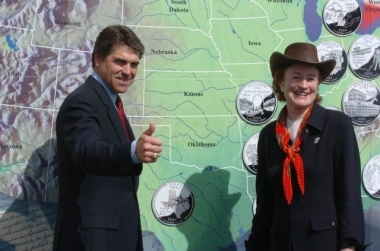
Gov. Rick Perry unveils the new 2004 Texas state quarter

As touched on earlier, Texas has begun to change.  With change there is inevitably friction and controversy, particularly from the state’s Traditionalists and Individualists and their long-standing way of Lone Star life.

In 2004, as the U.S. Mint was continuing its nationwide state-to-state release of new quarters representing each of the fifty states, Governor Perry remarked about the state’s nickname and meaning at the unveiling of the U.S. “Texas” quarter in Austin, TX:

Today it becomes official: Texas’ rich and vivid history will gain even greater currency as the Lone Star of Texas becomes a regular feature in the pockets and purses of Americans from sea to shining sea.  On one side will be the face of George Washington, and on the other side a renowned symbol of Texas Independence.  The Lone Star is one of the most identifiable symbols of Texas, and a historic representation of the independent spirit of our people.  Its origins can be traced back to the movement for independence, and its continued presence today reminds people that Texans are a different breed, set apart by their fierce individualism and their unrelenting desire for freedom.

2004 Texas state Quarter

2004 Texas state Quarter

That is the short, proud, Conservative public version of the story behind the symbol and nickname.  The broader more diverse representation is a bit different.

As a Texas certified teacher of all four core subjects, including my passion Social Studies/History, and as an eighth-generation Texan, I feel I too have a more balanced version of Texas Then and Now to share.  As noted, many Texans are proud, proud of their heritage, proud of the state’s size, proud of the state’s influence on national politics, national economic revenues, and the state’s implied attitude We Can Take It or Leave It – “It” being the United States as a whole.  Yes, as Governor Perry’s speech above indicates, Texas fervor for individualism, independence, and freedoms are alive and well today.  At least in his party’s mind and business circles it is.

The less exaggerated version of Texas history, particularly its independence from Mexico, i.e. the distinction between Texians and Tejanos, is a lesser-known side to the territory’s colonists and their struggle (or fight) to make a peaceful prosperous living.  Of the fourteen historic leaders (Giants of the Texas Republic) of early Texas, only two of them were actually born and raised in Texas – Bexar, or today San Antonio – and therefore are/were prominent Tejanos.  Eleven other Giants, who also represented their deep American ideologies, were all Texians, or immigrants from the United States enamored by the territory’s “cheap” opportunities.  Sam Houston, Stephen F. Austin, Mirabeau Lamar, William Travis, Davy Crockett, James Bowie, Thomas Rusk, Anson Jones, Edward Burleson, David Burnet, all hailed from east of the Mississippi River.  However, the Tejanos of early Texas – namely Juan Seguin and José Navarro – relentlessly sought to ease tensions between their Mexican heritage and principles, and the “Texian Giants” from the east.  Of course, that couldn’t did not happen.  The meaning of “Lone Star State” is actually more an American-Andrew Jackson political movement westward than a true Texas-Tejano story.  It is the commonly enduring, though very porous, Anglo-American extrapolation of Texas history.
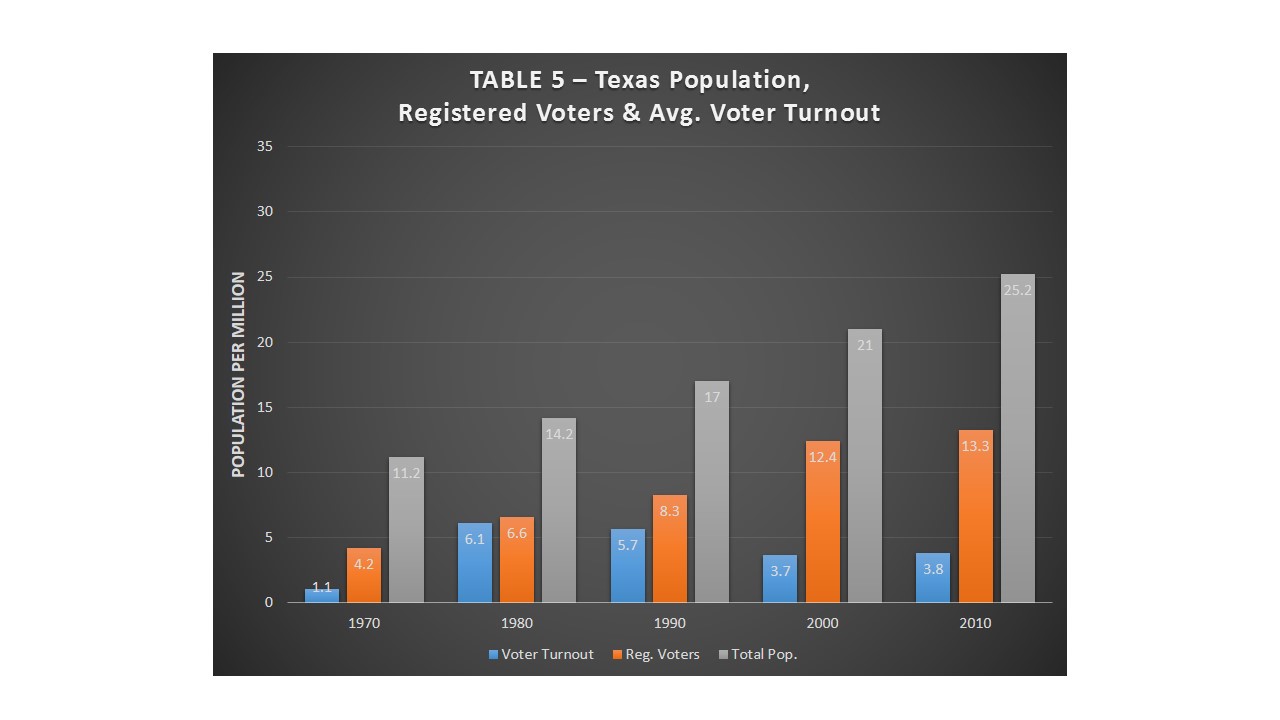
Table 6-Pop-Vreg-VturnoutDue to a 178-year “entrepreneur” spirit of Texas and six major influences upon its social, political, and economic culture which divides as much as it invigorates, Texas has one of the lowest voter turnout rates, particularly for state and local primaries and runoffs (see Table 5 above) for the last five decades.  Why the despondency?

I’ve given ample assessments of the factors that go into Texas’ diverse cultural and political climate.  Now I will give one last factor that plays a big part in Texas’ complex economic climate and therefore its voter climate:  education.

Percent 9th Graders Finish etc

A History of Educational Polarization in Texas

A particular answer to Texas’ consistently poor voter turnout rate overly argued hundreds of times by both political parties is illegal immigrants.  While this may be true, partially true, or hardly true, the data and facts paint a much bigger problem.  In a comprehensive study by TG Research and Analytical Services (2014), Texas ranks in the bottom tenth of U.S. states among 9th graders who graduate from high school or college on time – Table above.  Comparatively Texas has a high-rate of students exiting the higher-education pipeline toward post-secondary degrees beginning in 7th grade up to college freshmen (see Table Texas Student Pipeline, p. 73).  Texas is below the national pace to meet projected targets for Hispanic enrollment according to a June 2013 study by the Texas Higher Education Coordinating Board (THECB), p. 19 – and the Texas Hispanic population has been the state’s fastest growing race for the last 20-30 years!  And the most telling of all studies and data?  College completion rates are noticeably lower in Texas than the U.S. average and have lagged behind national averages (U.S. Census Bureau – Current Population Survey) for at least the last decade.
Undergrad Completion Rate by Race, Texas vs U.S. Age 18-64

In my estimation these educational indicators explain in large part why the majority of Texas citizens (registered or not) have little motivation or skilled capacity to stamp their voice at voting booths.  This is also a national trend, particularly in the young adult ranks.  With that aside, the politics of modern Texas along with the economic urbanization of new industries and increased mechanization of agriculture, all converge demanding a college-educated (or higher) workforce.  Furthermore, the current higher-educated sector in Texas, i.e. the white-non-Hispanic Traditionalists and Individualists, hold and have held the key socio-economic and political positions in the state.  It is no leap of reason that “knowledge” and a quality education provides an advantage, and power.  The influences upon voters doesn’t end there.  One more factor deserves attention.

The cost of attaining a college-degree or higher is difficult at best for Texas families hovering around the poverty line, UNLESS financial aid (grants and loans) is accessible.  However, wading through all possible financial aid programs and conditions can be daunting and frightening for impoverished parents or non-Caucasian parents with or without a high school diploma.  What I found interesting in my research and preparation on this subject, is that Texas relies very heavily on federal aid for college admissions; significantly more so than its own state or institution’s aid.  That aid is also in the form of interest-bearing loans, not grants.  Federal grants for college-bound students have been steadily declining over the years.
Direct Student Aid by Source TX vs US

Direct Student Aid by Type 91-92, 11-12Assuming some of you have read this far, dissecting and deciphering the Texas and federal programs/conditions would need another two or three separate posts minimum, of which I or likely you have no time to read.  Semi-apologetically I will skip it.  But it is reasonable to conclude that for a state that prides itself on self-reliance, self-motivation, and self-direction, a Lone Star if you will, it sure leans heavily – at least for the last decade – on 49 other states to help.

* * * * * * * * * *

If Texas continues on its twenty-year path of rising educational and economic disparity, by 2040-2050 Texas will no longer be capable of supplying an adequately educated work force for employers and businesses that demand college-degreed-or-higher employees they need to remain competitive, innovative, and profitable.  The option for those future Texans?  Low-pay undesirable service jobs with little to no vertical movement.  Texas, this trend must be reversed!

Cutting or limiting the scope of broad education, including sex-education, as Rick Perry and Greg Abbott have done over their political terms, only handicaps Texas’ future generations.  Cutting or limiting a diverse education and experience among all types of Peoples – including the LGBT communities which by the way empowers students and young adults to better address and manage social, political, and economic factor — will actually handicap future young Texans.  The repercussions of bias, limited, inflexible, faith-based social and political polices and mandates in 1990-2010 were far more reaching than Texas voters could’ve possibly imagined.

What Next?

Voter ID TestIn a north Texas-based Star-Telegram January 2014 interview, Steve Murdock, a former Texas state demographer and director of the U.S. Census Bureau, offering causes for Texas’ increasing wealth inequality explained “if we don’t [correct] educational levels, Texas will be poorer and Texas will be less competitive”.  The same can be said about Texas’ socio-economic issues exacerbated by decades of GOB faith-based politics (Good Ole Boy).

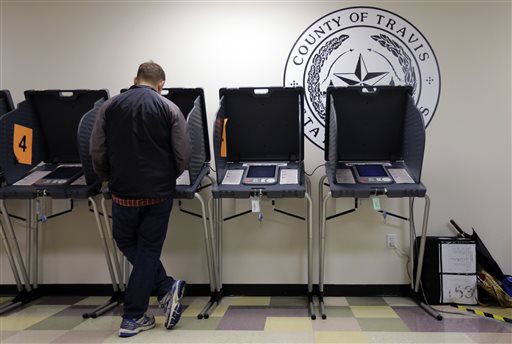
A new generation of Texans, a more diverse population of Texans – though not so highly educated by national percentages – have a golden opportunity this November to reverse Texas’ decades of spiraling downward turns in education…ALL FORMS of education!  Getting to the voting booths – and out of people’s bedroom (heterosexuals) and personal life-choices – is the easiest first step, reversing our abysmal voter-turnout rate.

I am one eighth-generation Texan who wants that to happen and permanently.

(paragraph break)

Live Well — Love Much — Laugh Often — Learn Always

(paragraph break)

Creative Commons License
This work by Professor Taboo is licensed under a Creative Commons Attribution-NoDerivs 3.0 Unported License.
Permissions beyond the scope of this license may be available at https://professortaboo.wordpress.com.

Flux

perpetuum mobileIt has been nearly two months since posting last. The other weekend I packed-up…again, and again returned to the DFW metroplex as I’ve done the last three Septembers, to once again substitute-teach in three different school districts while tutoring 3-4 nights a week. I have become a good walking definition of fluid. I’m sure the Lakota Indians, or the Comanche Indians, or any tribes of the Plains which followed the buffalo, would undoubtedly take great admiration in my transience. I know what it means to have mind over matter, but I have learned even more what it means to be a visitor; a grateful visitor.

Continual movement is said to be healthy for the mind and body. Exercise and do it regularly, and you minimize or alleviate many illnesses and recurring ailments. From a purely metabolic, intestinal, or cardiovascular point-of-view, flow is good — very good. In that light, I am doing well. Yet, I miss my time writing and posting here. How then is that good? Why can’t I write and post while driving, moving, teaching for 9 hours then tutoring the last 3 waking hours of the day or while sleeping or eating? Footnote: that was the device of “literary dramatization.” But I hope you catch my point. This will be an update-post, not my usual egocentric cerebral literary stimulation my millions of readers and followers have come to enjoy here — yes, laughing is permitted.

After three summers of moving and fighting to remain determined in my pursuit of full-time teaching-mentoring in one of two fantastic districts, the kinks in my armour are beginning to show. I am questioning whether I should continue pursuing traditional teaching. The pursuit is becoming financially and physically unsustainable. Redirection is inevitable and considering another path and its consequences has been one of many thieves of my blogging time. Though these three years have been mentally and emotionally frustrating, in contrast they have taught me to realize the benefits.

Failure Is Not An Option?

My father raised me to not be a quitter. If you are a regular visitor to this blog, or privileged to know me personally over many years (wink), then you find the previous sentence very ironic. I do. Loyalty, determination, commitment, were all daily lessons; pillars of character that my father lived and taught until July 1990 when he quit. That particular month and year those pillars became further and less defined to me simultaneously. Yes, notice the irony again. Right there is the paradox of life; of how two distinct concepts actually become one harmonious system. If I’ve lost you, bear with me.

drill-sergeant-screamingWhat does it mean to never give up? Go down fighting? Have faith all things workout in the end? The answers are typically admirable noble traits taught through the ages, especially in professional sports, used to motivate underdogs. Those battle cries and speeches are well and good, but I have found them to be incomplete. Admittedly, I am growing weary of knocking and banging on assistant principal’s doors only to be told in the end “Thank you but no thank you.” I can hear my Dad’s voice, “do not give up! Do not quit!” Find more doors to bang on! And after my knuckles become blue or bleeding, the question eventually becomes what do I need to do differently, because this horse has been beaten pretty dead.

Why do I keep doing the same thing repeatedly for the same result merely for the sake of not quitting? I laugh, where is the glory in that? Why am I afraid of giving up or failing? In hindsight, I think what I SHOULD actually be afraid of is paralysis! Paralysis to adapt and change. Be more flexible and much less rigid in a Universe of flux! You see, those dramatic motivational speeches and battle cries are for the moment, like a narrow lens, and do not address or capture our origin of fear. If fear, disguised as failure or quitting, is allowed to become over inflated, it will enslave me and influence, perhaps dictate, my decisions. I would imagine that leads to a life of knee-jerk reactions. Sign around neck reads: This person kicks frequently. Stand close at your own risk!

Ugh, not good. Not for me.

The Illusion of “Complete”

In his theory of special relativity, Albert Einstein proved that time as we perceive it does not exist. Events occurring at the same time for one observer could occur at completely different times for another observer. That implies there is really no beginning or no end, just varying observers and various speeds of movement. A beginning and an end are illusions created by our brains to cope and survive in our self-aware world of experiences. All things emerge and all things decay. But all things will change forms. Over a century of science has shown on a microscopic or atomic level all things are moving, emerging and decaying, but they are at speeds and levels unseen by our naked eye. For example, our Sun is burning out, but in our lifetime it doesn’t seem to be.  The seven continents are surrounded by seas and oceans, but there were not seven before, and there will not be in the future.  Everything is constantly emerging and decaying. Perhaps the above sub-title should not read The Illusion of Complete, but instead The Reality of Incomplete.

Below are some pictures of my current home. Is my life at the moment really that bad?

This slideshow requires JavaScript.

At this point I ask myself, what feels better…what gives me more hope and confidence, and less fear? Is it the battle-cry meaning of “Never say die, failure is not an option,” or The Reality of Incomplete? I know exactly what I would choose. One offers potential doom, disappointment, or pain, the other a never-ending story. One is fiction, the other reality. One stressful, the other calming.

In my procession of perspective I have come to realize there is still more, always. My situation is not complete, nor is my development. Is it ever? Is it wise to assume an experience has only a singular interpretation, one ending? Mmm, the paradox and irony continues.

Side-effects of Flux

I did not come from a wealthy family.  However, we certainly did not grow up in poverty. This middle ground has afforded me in my later years a simultaneous appreciation for what is had and what is not had. When one is required to move efficiently and often, you soon wise-up to what you really need to live adequately or comfortably, and what you don’t need. You learn what is fluff or extra weight, and what is truly important. half fullLiving in an RV for nine months then traveling over 300 miles to live for three months in relative luxury, soon teaches these gratitudes. My current life of embraced gratitudes are sometimes challenged or reinforced when others, with a different value-system, try to convince me my way of life is sub-standard or unappealing. I beg to differ. They’ve forgotten that all things change, both quickly and/or very slowly, both with intent, and just as much for them as for me.

My current occupational pursuits coupled with their illusive rewards, do not tell the whole story. I have found enormous amounts of value and gratitude for what I HAVE discovered, what I have gained. What I certainly know is that my story does not have an ending, and no destiny is set, especially mine. I can either work with it, embrace it, understand it, or I can fight it and be perpetually frustrated, angered, and bitter with myself and those around me. No, I have much to be thankful for.

I choose to be flexible, adaptable within my current means and unknown untapped means! Besides, am I not a visitor here? Am I not ultimately just passing through in this form? With that said and a grin, this is how I choose to end this post:

To Be Continued

(paragraph break)

Creative Commons License
This work by Professor Taboo is licensed under a Creative Commons Attribution-NoDerivs 3.0 Unported License.
Permissions beyond the scope of this license may be available at https://professortaboo.wordpress.com.

Real Men

I love my teaching job for moments like these:

Last week I had to pull an 8th grade boy aside to address his ‘cocky’ bullying.  It became quickly apparent that his version of “a man” was arrogant hyper-testosterone peacocking.  Where or how he learned it didn’t matter.  What did matter was the chip on his shoulder.

I shared with him a lesson I learned when I was about his age about “being a man.”  It was taught to me by a REAL man who had it taught to him…

Tearing down people’s lives, maiming them, or even taking life is easy and over-glorified; it requires about as much “manhood” as a gorilla picking up a stick or rock. But helping put lives back together or literally saving them takes an immeasurable amount of manhood.  There is no comparison!

[Boy], if you must “stand out,” then stand out with and for the ones who can’t.  Choose the harder higher road, not the easiest, and then you’ll understand what it is to be a real man.

Some great examples of “Real Men”…

This slideshow requires JavaScript.

(paragraph break)
Creative Commons License
This work by Professor Taboo is licensed under a Creative Commons Attribution-NoDerivs 3.0 Unported License.
Permissions beyond the scope of this license may be available at https://professortaboo.wordpress.com.

What’s My Story?

image Wikipedia

image Wikipedia

I was shocked when I read her email.  I had never received any type of correspondence like it from any politician, ever!  Wendy Davis, who is running for Texas State Governor next year, asked me what my story was.  She asked, “What challenges do you and your family face?  What issues should be addressed to strengthen our families?”  For the last five years her running opponent, Greg Abbott, the Texas State Attorney General since 2002, has been anything but cordial, sympathetic, or hopeful toward me; just cold and impersonal.  If there are those who have not heard of Greg Abbott, then my point is made.

Like Wendy Davis, some human beings would take a few minutes to ask questions like, What’s going on with these issues?  How did things get to this point?  What can we do to improve things?  Wow.  Imagine that, a politician who wants to know and listen to the nuts-and-bolts of a situation and its causes, its factors from the actual people affected!  What an invitation!  What an opportunity!

This is what I told her…
(paragraph break)

Wendy, I am a two-years unemployed certified 4-8 General Ed, Special Ed (pending) teacher, father of a 2nd year college daughter, and 12-year old son who live over 300-miles away and I briefly see maybe twice a year.  In the summer of 2012 my charter school where I taught – whose student body was 82% Special Needs and a third were wards of the state from horrific homes and circumstances – lost four of its six major funding grants.  Education cuts were not only happening nationwide, but just as much statewide.  As a result, our school resources were severely stretched or eliminated.  These cuts included much-needed hiring of additional qualified staff, aides, and most importantly certified teachers for the increased numbers of Special Ed students coming in from other nearby closing schools AND the result of marketing and attracting more Special Ed students necessary to keep our two meager remaining grants for 2013.  The federal and state cuts also meant no annual 2% – 3% pay raises for any current teachers and staff; I was grossing $31,380 per year (or $2,080 a month, or barely $13/hour after automatic child support garnishments) for 60-70 hours minimum per week of work.  Need I get into net earnings minus healthcare pay-deductions and cost of living expenses?  The math is depressing.

One assessment some schools and districts use to monitor their teacher’s development and well-being, especially those on campuses teaching behavioral-emotional Special Needs students and wards-of-the-state, is a stress-anxiety assessment.  At the end of the school year, I scored in the upper 10% at risk; almost “Highly at Risk” for accelerated health deterioration.

My At Risk for health deterioration was compounded monthly by financial and legal pressures from the Texas Child Support Services and the state Attorney General’s Office.  During my annual checkup at the doctor’s office, he told me flat-out I need to find a different job; a job where I at least had the time (somewhere in the 24-hours) to exercise and relieve the stress.  This was my response to him:

If I quit my job doctor, I only compound my problems.  If I fall behind even two months unemployed, the Texas Attorney General’s Office report those failures immediately to all credit bureaus.  Sometimes it is less than two months.  Most all potential employers today use an extensive background check – especially for teachers – as well as credit checks which are used for financial decisions and interest rates, let alone everything else creditors, lenders, businesses, etc, etc. families, parents, and me, the non-custodial parent, struggle with and fight to stay afloat month-to-month.  I don’t know Doc what the answer is.  This was his reply:  “As long as you understand the health consequences if SOMETHING doesn’t give.”

For the 2011-2012 school year I taught 5th – 8th Social Studies, 5th – 8th Enhanced Learning Lab (elective), 9th – 12th Career Tech (elective), and assistant coach athletics for after-school activities.  In late summer my charter school informed me that for the coming 2012-2013 school year, I would have to teach 4th – 8th grade Science and Social Studies of which all periods would have 2 or 3 grade levels of the subject in the same classroom.  For you readers who are not teachers or familiar with Texas state curriculum and standards, every single grade level in science is a different development module with some crossovers.  In Social Studies, 4th graders cover basic Texas history, 5th graders cover basic American history, 6th graders cover basic World history, 7th graders cover more-advanced Texas history, and 8th graders cover more-advanced American history.  The only crossover I would be afforded to ease the 35%-40% workload increase would’ve been 4th and 7th, and 6th – 8th.  And as a reminder, almost half of each class are Special Needs wards-of-the-state students.  Myself and other teachers had no aids because there was no money to pay for them, and that would be the case again for the upcoming bigger classes for the upcoming year.

Wendy-DavisAs most people are aware, our public education systems have gone through needed reform.  Some of it has been successful and improved.  However, there is obviously much more work to be done and equalities protected!  More importantly, radical state and federal funding cuts only exacerbate the problems and worse put at great risk our country’s future leaders and skilled educated collaborating future government officials and citizens.  Public education is not and never has been “secular brainwashing or compromise.”  Those speculations are left to individual homes and parents, not public schools.  Public education is and has been primarily for those children and adolescents who come from not-so-advantaged homes, even severely impoverished, to have a decent chance of becoming a productive future citizen and not an expensive public liability in prisons, mental institutions, or rehab clinics; all of which require MORE taxpayer dollars in the long run.  Yes, a headache  can be cured by decapitation (i.e. conservative-pushed cuts), but is it productive change?  Is it “economic/fiscal responsibility” on all levels?  No.
(paragraph break)

I resigned in August 2012.  Today, I am still unemployed as a certified General and Special Ed teacher.  I spend an average of 12-18 hours a day seeking and completing long extensive applications for teaching positions in districts that haven’t been so severely hit by funding cuts.  Meanwhile, each month I receive a cold, unconcerned collection statement from the Attorney General’s Office showing in bold type my higher rising balance plus interest.  Like a home mortgage or auto loan, this monthly defaulting is reported to all credit bureaus.  Should my arrears reach $10,000 my case will go into the Enforcement Stage and a warrant for my arrest will be issued.  DeAnna Shields, a Killeen, Texas web-radio talk show host, student of mental health studies, parent, and U.S. Army Widow volunteer, writes a telling article about Texas Child Support laws from Greg Abbott’s office on CNN’s iReport.  Read it here.

Wendy Davis, clearly I am and have felt the detrimental effects of a plunging credit score and unemployment.  I wonder how jail time would affect my job search.  Thank you so much for asking about my story Wendy!  A little digging, a little personal human interaction, a little effort to understand the long-term effect of lawmaking goes a very long way.  I really hope next year I will be addressing you as Governor Davis!

Signed,
Unemployed Texas Special-Ed Teacher

(paragraph break)

Post-script — “Greg Abbott leads Wendy Davis by single digits” — Politico, 10/2/2013.  If you are interested, here is her campaign website:  http://www.wendydavistexas.com/

(paragraph break)
Creative Commons License
This work by Professor Taboo is licensed under a Creative Commons Attribution-NoDerivs 3.0 Unported License.
Permissions beyond the scope of this license may be available at https://professortaboo.wordpress.com.