Saul the Apostate – Part III

Continuing from Part II

————

“Do not give what is holy to dogs,
and do not throw your pearls before swine,
or they will trample them under their feet,
and turn and tear you to pieces.”
— Jesus, Matthew 7:6

————

∼ ∼ ∼ § ∼ ∼ ∼

Certainly a strong command to his disciples and words of warning to the crowd listening to Jesus on the Mount. To a modern reader a very ambiguous verse/sermon typical of cryptic non-Messianic Jesus, but it aligns with quasi-Sectarian Essene-Jesus. How so?

sermon-on-mount

The first generation Tannaitic traditions in the Jewish Mishnah (20 BCE – 80 CE) can give some context to the language of this sermon. Three key identifiers can be correctly deciphered out of the loose Greek Matthew translation. They are dogs, pearls, and pigs or swine. In the Tannaitic Mishnah dogs represent Gentile idolaters that “when driven by hunger, tears and devours young lambs.Pearls represent the rabbinical interpretations and discourse of the Torah, something precious and costly. Rabbis did not teach secrets of the Torah to Gentiles. And pigs/swine were always implied as the Romans as verified in Cicero’s “Divinatio in Caecilium.” Therefore, with this more unambiguous vocabulary, here is the proper Tannaitic version of Matthew 7:6:

Do not give what is holy to Gentile idolaters, and do not throw your Torah-secrets before the Romans, or they will trample them under their feet, and turn and tear you to pieces.

Jewish-Essene Jesus further supports this new redone, unambiguous verse in Matthew 10:5-6 and 15:26. At the least, Jewish-Essene Jesus is teaching the crowd and his disciples a passive walk and love in the Torah and to never force the coming Kingdom of God (on Earth) onto Gentiles or Romans if they are not interested. This was not what Saul began teaching and it got Saul into lots of harsh trouble.

In 2 Corinthians 11:24-32 we see that Saul faced quick persecution by Jews after his “vision-revelation” and upon arriving in Damascus. More persecution from 2 Cor. 9 and Acts 16:22. Then he faced opposition from Jewish-Jesus’ immediate disciples, their disciples, and James the Brother of Jesus (Acts 15 and 21; Gal 2; James 2 vs Eph 2?). Not only is the harsh resistance inferred from the canonical NT, it is also confirmed by Eusebius’ Pamphilius, Iraneus’ Against Heresies, Origen’s Against Celcus, and Clement of Rome’s Recognitions that Saul’s early hardships were in both the Jewish and Jesus camps.

Clearly apparent is that Saul wasn’t following established Jewish proselytizing methods in the Didache adopted from the Synagogue’s Two Ways,” nor was he following Jesus’ disciples’ methods. Saul was just doing and teaching whatever he interpreted from his own seizures, very much like modern psych-patients do during and after their episodes. Consequently, Saul was viewed as attacking, if not at minimum undermining, both Judaism and the nascent Jesus-Movement authorities, the “pillars” (Gal. 2:9). Despite there existing today more details about Saul’s many disputes with both Jews in the Synagogues and the surviving pillars and disciples of Jesus’ closest followers, we are also able to decipher a much better idea of how and why Saul became the Spouter of Lies or if not, certainly treated as an Apostate.

Saul’s Two-Pronged Hellenic Attack on Jesus’ Judaism

Whether Saul/Paul realized it or not, he fueled and fanned the fiery, growing anti-Semitism between his Hellenic Rome and Judaism. He accomplished this in at least two different ways: 1) his conflicts with the Torah, part of Jesus’ core teaching, and its expanded Essene-Jesus function within Judaism in general, and 2) antinomianism which further fueled Jewish hate, and by default undermined Jesus’ principle of mutual love.

A Necessary Reminder First
It must be remembered when reading the epistles traditionally ascribed to Saul, only seven of the 14 are agreed upon by most Christian and non-Christian scholars as genuinely Saul’s letters. Two letters/epistles are evenly disputed and four are considered pseudographic, or written later by supporters of Saul. The true author of Hebrews is now considered unknown by almost all biblical scholars. There are also some known lost epistles mentioned in other epistles. The very oldest surviving codex of epistles by Saul (Papyrus 46) covers only from Romans 5:17 through Hebrews, 1 Corinthians, 2 Corinthians, Ephesians, Galatians, Philippians, Colossians, and ends in 1 Thess. 5:28. Papyrus 46 is from c. 200 CE, about 35-60 years after Saul’s earliest letters. From this papyrus biblical scholars know the scribe(s) made minor errors and miscalculations. What does this mean for us here?

Saul’s “genuine” letters (in gold below) and those two evenly disputed cannot be considered beyond a shadow of a doubt, 100% authentic words of Saul. Simple later “traditions” do not make a manuscript error-free. The later the copy, the higher the odds it was later tampered with or erroneously copied. Once again, the chronological order of Saul’s letters:
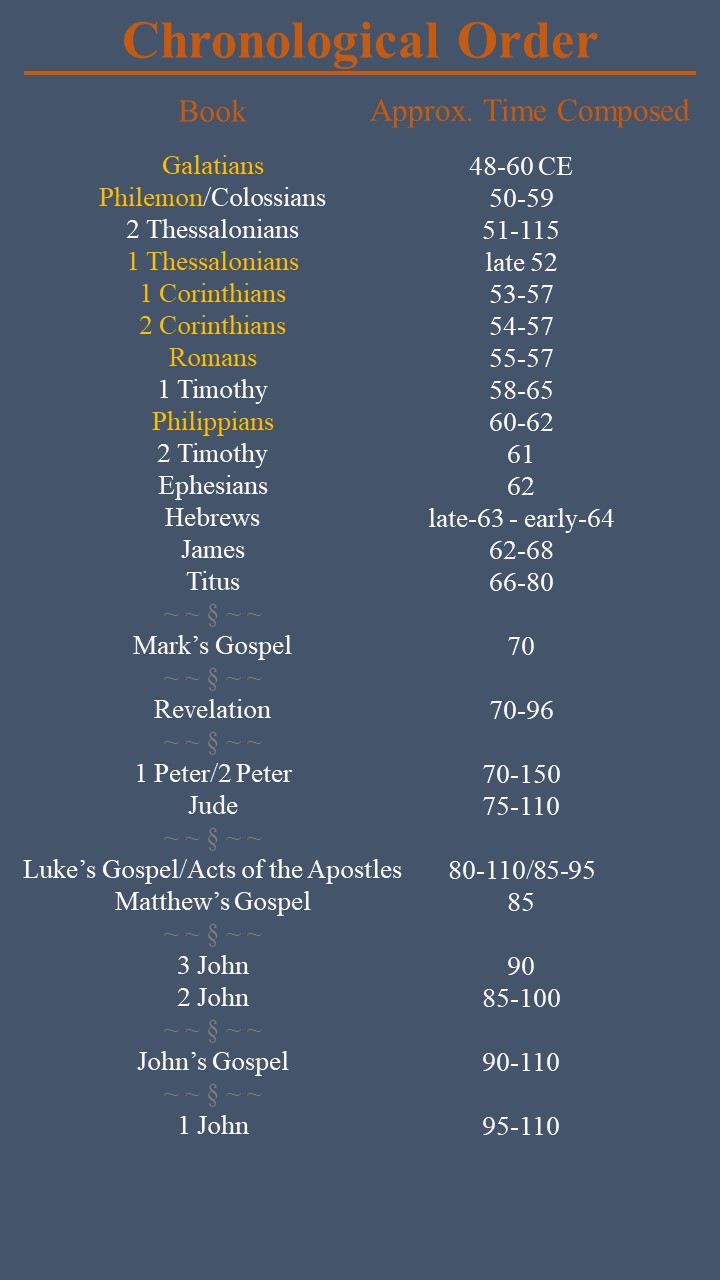
Chronological Order Canon

Notice that the letter to the Galatians could have been written around 60 CE. This is important to remember. As we continue, what will also become glaringly obvious was just how horribly the 2nd- and 3rd-century CE New Testament compilers/scribes and the Hellenist “Patristic Fathers” (and therefore all their descendant “Fathers”) turned their 4th – 5th-century canonical NT into a mishmash of nonsense; a complete cluster (tr)uck! Frankly, it’s bad and poorly constructed by men who knew too little about Sectarian Judaism/Messianism and its precise Second Temple intent. How did the Hellenistic Fathers get it all wrong?

Saul’s Conflicts & Confusion with the Torah and Judaism
While in Lycaonia of Asia Minor (Turkey), following the laws of the Torah, Saul circumcised his new disciple Timothy:

Paul came to Derbe and then to Lystra, where a disciple named Timothy lived, whose mother was Jewish and a believer but whose father was a Greek. The believers at Lystra and Iconium spoke well of him. Paul wanted to take him along on the journey, so he circumcised him because of the Jews who lived in that area, for they all knew that his father was a Greek. (Acts 16:1-3)

Not only did 1st-century Greeks/Hellenists despise the Jewish custom of circumcision, but based on Saul’s other vehement teachings against the Law/Torah (Colossians 2), was this a blatant contradiction of himself? Now suddenly this Saul-behavior seems to align with Jewish-Essene Jesus’ teaching (Matt. 5 and Luke 16)! Why now are there exceptions to what Jewish-Jesus taught and Saul taught? The Hellenistic canonical NT is completely silent.

Leave it to an 18th-century Rabbi to possibly sort out this one (of many) problematic, contradiction in the NT and with Saul. Rabbi Jacob Emden was considered one of the most acclaimed Rabbis for over three centuries. Many Rabbis considered him a Maimonides reincarnated. Here is Rabbi Emden’s clarification; my inserts [ ] and emphasis:

Christian scholars have assumed from certain passages in the Gospels that [Jesus] wished to give a new Torah to take the place of the Torah of Moses. How could [Jesus] then have said explicitly that he comes only to fulfill it? But it is as I have said earlier — that the writers of the Gospels never meant to say that the Nazarene came to abolish Judaism, but only that he came to establish a religion for the Gentiles from that time onward. Nor was it new, but actually ancient; they being the Seven Commandments of the Sons of Noah, or children of Noah, which were forgotten. The Apostles of the Nazarene then established them anew. However, those born as Jews, or circumcised as converts to Judaism (Ex. 12:49; one law shall be to him that is home-born, and unto the stranger) are obligated to observe all commandments of the Torah without exception. Rabbi Yaakov Emden, “Seder Olam Rabbah Vezuta” Hamburg, 1757

However, does this 18th-century Jewish Rabbinical extrapolation solve the many other problems in Saul’s epistles? After 200, 400, 2000 years why hasn’t this confusion and/or contradiction been fixed? Christians and Christianity has always blamed the Jews for killing Jesus. Why do so many Christians over the many centuries think that to be true? The answer? It began with Saul of Tarsus:

“You suffered from your own people the same things those churches suffered from the Jews who killed the Lord Jesus (1 Thess. 2:14b-15a)

And then antisemitic hostility continued more forcefully with the Patristic Fathers:

“Accordingly, these things have happened to you in fairness and justice, for you [Jews] have slain the Just One…” Justin Martyr, “Dialogue with Trypho” chapter 16

Blaming the Jews for Jesus’ execution was perpetuated all throughout the Crusades, the Medieval Era and into the modern era even to the Holocaust. But it started with Saul. However, it is most clear in the much later written four Gospels (Matthew 26:57-68, 27:25Mark 15:8-15Luke 23:3-23John 8:31-4718:29-40, 19:6-15) representing the fuller Hellenistic retrograde takeover of a failed(?) Jewish Messiah (Gospel-Jesus was never clear about this title) and rewriting the legend into a successful Roman Messiah with some Greek-Gnostic mysticism (Saul) interwoven. Examples of Gnostic and Sectarian mysticism?

Saul completely revamped, reinterpreted the ritual meaning of baptism. Immersing one’s self into baths or rivers was to him no longer a rite of cleansing and regeneration as Jews and Jewish sects such as the Essenes symbolized (Jewish-Jesus as well), for Saul it was a pseudo-death to the world and transformation into a spiritual resurrection with Christ (Romans 6:1-10). For Saul, the Lord’s Supper/Last Supper was a mystical magical union in Christ’s blood and body. This mimics exactly the Mithraic ceremony in the blood and body of Mithra. Justin Martyr even wrote the ritual was identical to early Christianity’s Last Supper ritual. Of course, Martyr was very biased to his own personal beliefs. The point is that the Mithraic ritual was also magical-mystical and hinted of Hellenic Gnosticism and Jewish Mysticism.

Saul’s new teachings, sacraments and “mysteries” (1 Cor. 10:20-21; Rom. 1:18-32; 1 Thess. 4:5; 1 Thess. 1:9-10; Rom. 8:28-30, 9) which brought so many hardships upon himself from both Jews and new Judaeo-Christians (Essenes too), was teaching one thing:  Christ’s death. It was teaching atonement through his death and failure that put all believers perfectly right for God’s coming Kingdom of Paradise. It wasn’t righteous behavior and it wasn’t even faith in an all-forgiving, all-loving Father/God that achieved salvation. It was only Christ’s mystical judicial death. Experiencing that “death” and rebirth through a mystical and/or neurological state of mind (TL-epilepsy?) was how a Gentile became saved. The problem and confusion for Saul — a Hellenistic “mystic” — was that his path to salvation was NOT the path Jewish-Jesus taught in his real life, according to all extant sources:  Gospels, non-canonical testaments, and the Dead Sea Scrolls (Essenes) combined.

Saul’s Antinomianism and More Jewish Hatred
Aside from the obvious fact few people rarely want or desire to be on the losing end of an event or organization, or repeatedly associated with a defeated and crumbling existence no matter what time-period it occurs, Saul’s letters progressively over time taught (see above image) further and further demarcation, even defamatory alienation, from all things Jewish by c. 55 – 57 CE when he wrote his letter to the Romans. Several biblical scholars like S.G.F. Brandon, F.C. Baur, and Barrie A. Wilson, chronologically follow Saul’s journeys, compared and contrasted to what was reported about him in Acts decades later, and quite clearly notice (as I do) his rising, antagonizing frustration with the losing people, or team if you will. Take 1 Thessalonians, 1 Corinthians and 2 Corinthians (with regard to Jews) and compare them to Romans and Ephesians(?) — and if Galatians was actually found to be written c. 60 CE — and Galatians 3, one cannot escape Saul’s antinomianism and anger toward authoritative Jews, Rabbis, and the Torah.
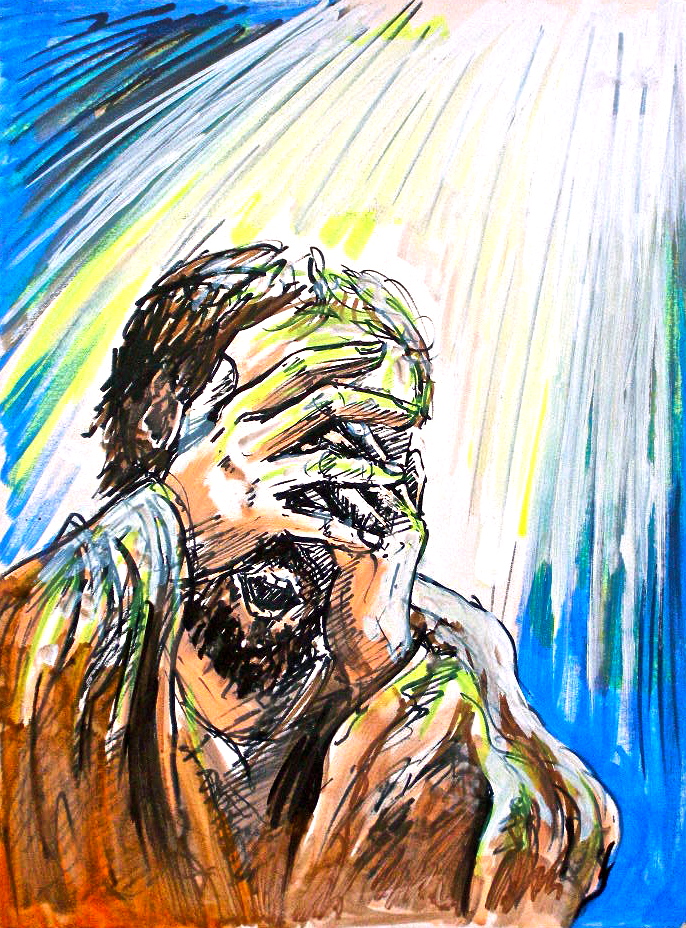
Saul's Epilepsy
Focal-fractal seizures of TLE

Let’s not lose sight, however, of the forest because of those few trees Saul insisted on playing with — with lighter-fluid, gas cans, and matches — dramatically (mystically) coming from his “divine revelations” via TL-epilepsy.  They were given only to him, and yet not first to Jesus’ closest disciples/students, or let alone any of God’s first chosen people of tiny nomadic Israel. Why the trickery? Or rather why the perpetual antinomianism necessary for the endless kinetic cycle of life, death, and evolution to which all things submit? Consider this…

Because Saul somehow deemed himself the procurator-divine-mediator for all Gentile humanity without pre-approval or preliminary discussion with any other authorities (i.e. Jerusalem Council) or proof, why and/or what made his antinomianism become popular and successful in the end? Why has any antinomian or monistic movement any better or worse than any others in the past? Was it because at that time in history (68 – 180 CE) it was the pinnacle, the most glorious days of the Hellenistic Roman Empire? Was it because of some ancient and contemporary tradition that the Latin God(s) favored the bold, victorious, and popular culture/lifestyle as Virgil poetically wrote in his Aeneid? And more apparent, the Latin God(s) did not favor losers or the constantly losing Jews. Pagan Rome held all the winning cards.

In Part IV, I will spell out how Saul — by going to the Hellenistic Roman Gentiles — in light of his challenges, antagonism, and disrespect to long-established Second Temple Judaism/Messianism and Sectarianism, was simply seeking larger psychological approval, acceptance, from his known tiny world. He wanted/needed validation for his ailment, his TL-epilepsy (revelations?), and his unconventional background in Merkavah/Heikhalat mysticism which almost all of his conventional (sane?) Jews rejected. So can one single man with TL-epilepsy dictate what sort of life was right, was best, and would be the most fulfilling presently or in the afterlife… for the entire world and all of humanity for all of time?

Until the next part, please feel free to again share your thoughts, ideas, or questions below.

————

Creative Commons License
This work by Professor Taboo is licensed under a Creative Commons Attribution-NonCommercial-NoDerivatives 4.0 International License.
Permissions beyond the scope of this license may be available at www.professortaboo.com/contact-me/.

Being Natural

A brief interruption of my current, “serious” blog-series to get a little more… human. Natural.

∼ ∼ ∼ § ∼ ∼ ∼

It is very simple. And you’ll never understand if you don’t get out and swim in the marrow of life.

There was a boy
A very strange, enchanted boy
They say he wandered very far
Very far, over land and sea
A little shy and sad of eye
But very wise was he

And then one day,
A magic day he passed my way
While we spoke of many things
Fools and Kings
This he said to me

The greatest thing you’ll ever learn
Is just to love and be loved in return. — Eden Ahbez

————

Live Well — Laugh Often — Love Much — Learn Always

Creative Commons License
Blog content with this logo by Professor Taboo is licensed under a Creative Commons Attribution-NonCommercial 4.0 International License.
Permissions beyond the scope of this license may be available at https://professortaboo.com/contact-me/.

Saul the Apostate – Part II

Did Saul and Jesus teach two fundamentally different religions?
————

This is the question I pose to anyone who professes belief in the Christian canonical New Testament. When one closely compares Saul’s epistles and “Christ” — six epistles which are probably not authored by Saul — with the Jewish-Jesus and the Gospel-Jesus, the differences will shock many Christians. If one made a list of everything Saul denotes Jesus did, stated, and experienced from birth to death, they would indeed be shocked by just how little Saul mentions; it’s near nothing. Yet, that isn’t really the controversy. The shock is about what Jewish-Jesus and Gospel-Jesus taught about his God and His coming kingdom and whether that aligned with what Saul taught about his God and His kingdom.

Saul’s “Christ” vs. the Jewish-Jesus

As I expounded in the previous post Saul the Apostate – Intro to Part II, a necessary segue into this post, we must read the Gospels with high-def glasses and critical caution. An astute reader of the New Testament will always be cognizant of the demonstrated problems and failures of the reliability in the canonical Hellenic Gospels. This doesn’t necessarily mean we cannot decipher who the Jewish-Jesus was, the quasi-Sectarian from Galilee, or what he was preaching. As Dr. Bart Ehrman describes in a number of his blog-posts, …there were lots and lots of sources [oral traditions], from the early days of the Christian movement, some of them coming straight out of Aramaic-speaking Palestine… of which many independent [oral traditions] saying similar things about the man Jesus made it into (albeit partially) later Jewish and Hellenic Christian writings. Hence, when one inclusively considers without nepotism all possible sources of a Jewish-Jesus, a general, historical caricature does emerge.

In his Sermon on the Mount (Beatitudes) and later speaking to his students/disciples, generally regarded by scholars as probable words from Jewish-Gospel Jesus, he was reportedly known to teach his followers that they must reach higher Halakha righteousness and purity, as well as greater mutual love for each other deeper than the Pharisees practiced (Matthew 5:20; 18:4-5). Jesus, being an exceptional follower of the Torah, the Mosaic Law, was pulling directly from his sectarian teachings in Deut. 6:4-6 and Lev. 19:18, key components of Essene practice. Another Essene practice followed and taught by Jesus was that of the core principle of non-resistance to evil which was found exemplary in his Synagogues and the Talmud Mishnah:

Those who are insulted but do not insult, hear themselves reviled without answering, act through love and rejoice in suffering, of them the Writ saith, But they who love Him are as the sun (Judges 5:31) when he goeth forth in his might. — Shabbat 88b

Those who practiced this two-fold Mosaic concept better than the Pharisees, Jesus taught, would be saved from judgment when evil (Rome) was overthrown and the Son of Man soon returned within one or two generations, tops. In other words, approximately in 80 CE to perhaps 140 CE. That was what Jesus promised (Matt. 18:11-12, 18:8-9; Luke 13:28-29, 14:15-24) followed by such ‘an abundance of over-sized grapes and fruits for the Essenic-Mosaic righteous worthy of the greatest banquet in Paradise’ (Papias, in Irenæus, “Against Heresies,” Book V. Ch. 3334). This was the Kingdom of God that Jewish-Gospel Jesus taught.

greatest essene commandment(s)

Was this what Saul of Tarsus preached? No.

The core, the marrow of Saul’s teachings in public and his epistles to his various 1st-century new Gentile-Jewish churches and Jewish synagogues was encapsulated in many of his passages, but very concisely in 1 Corinthians 15:3-5:

For I delivered to you as of first importance what I also received, that Christ died for our sins according to the Scriptures, and that He was buried, and that He was raised on the third day according to the Scriptures, and that He appeared to Cephas, then to the twelve.

Saul’s followers must believe through faith in “Christ’s” death for sins and his resurrection to be saved from impending judgment. Keeping the Jewish law (Halakha), he taught, would not make believers right with God. Only those who believe in “Christ’s” death and resurrection, then baptized, will join God in Paradise (1 Thess. 4; Romans 8). Here was Saul’s four essential elements of salvation:  faith, Christ’s death, his resurrection, and baptism. However, because it was heavy on mystical “faith” galvanized by his TL-epilepsy visions-revelations, as discussed in the previous posts, unsurprisingly and from a neurological-psychiatric standpoint Saul’s Christ was at the expense of common sense and rational reasoning. Dr. Bart Ehrman says regarding this fundamental difference of true readiness for God’s soon to come kingdom…

Should a person follow the Jewish Law or not? Jesus thought the answer was yes — this was the core of his teaching. Paul thought the answer was no — doing so would not allow one to be saved. So that’s a stark difference, right? Quite possibly. But on the other hand, Jesus did not think that the scrupulous following of the law (as preached by the Pharisees) was what God desired; and Paul certainly did not think that people should go about breaking the law (committing adultery, or murder, or false witness, etc). So are they fundamentally different or not?

One way to answer the question: what did a person need to do to be saved? For Jesus, it was repenting and keeping the law as God instructed (with the love commandments). But Paul does not say much about repentance and thought that keeping the law would decidedly not bring salvation. What mattered was [Christ’s] death and resurrection, something that the historical Jesus almost certainly did not talk about. The Bart Ehrman Blog, March 2016, “Do Paul and Jesus Represent Fundamentally Different Religions,” accessed September 16, 2018 

silhouette of essene
Son of Man

Another stark difference between the two men’s teachings was who was the Son of Man, who was the Messiah—that is the Messiah of Second Temple Judaism/Sectarianism. The Jewish-Gospel Jesus was either cryptic about who it was — due to Rome’s well-known policies against rebel kings — or denied it and spoke as if it was not himself. Saul, on the other hand, unequivocally teaches Christ was the Son of Man and Messiah. For me, in light of my two previous posts and these further comparisons, the two men are clearly in fundamental opposition. Saul’s Christ was not what Jesus the Galilean taught.

Saul’s Two-Pronged Hellenic Attack on Jesus’ Judaism

Whether Saul/Paul realized it or not, he fueled and fanned the fiery, growing anti-Semitism between his Hellenic Rome and Judaism. He accomplished this in at least two different ways:  1) his conflicts with the Torah, part of Jesus’ core teaching, and its expanded Essene function within Judaism in general, and 2) antinomianism which further fueled Jewish hate, and by default undermined Jesus’ principle of mutual love. The details and support for these two combined Saul attacks will come in Part III of Saul the Apostate.

From a few different passages in Saul’s epistles we are able to find an intrinsic animosity toward the Torah and mainstream Judaism of which Jesus was not advocating. These I will address in the next post. But the one specific passage that drives the wedge deep between the two opposed religions was found here with my inserts [ ] and emphasis to help clarify:

If you have died with Christ to the elementary principles of the world, why, as if you were living in the world, do you submit yourself to [Torah] decrees, such as, “Do not handle, do not taste, do not touch!” (which all refer to things destined to perish with use) — in accordance with the commandments and teachings of men? These are matters which have, to be sure, [to be without any doubt!] the appearance of wisdom in a self-made religion and self-abasement and severe treatment of the body, but are of no value against fleshly indulgence. — Colossians 2:20-23

This is further evidence of a different Kingdom of God than what Jewish-Gospel Jesus was teaching. Jewish-Jesus would not have preached this and Saul’s animosity for fellow Jews does not align with Jesus’ great commandment of two Golden Rules: the unbounded love for God and each other. ‘The Law [the Torah] and the Prophets’ Jesus taught ‘hinge on these two principles.‘ No wonder the Jewish-Jesus disciples/apostles had serious belligerent problems with Saul (e.g. Acts 15:39a and Galatians 2:11-21). The conflict and confusion between the two fundamentally different Kingdoms of God and their principal doctrines of impending judgment-readiness, exacerbated by the failure or mis-identification of Jewish-Jesus as the Messiah was the dual spark to a 400-year and counting, unstoppable schism. What? Yes.

After Saul’s death and all of the disciples’/apostles’ deaths, and more so the deaths of the first generation “Patristic Fathers,” or earliest Church Fathers such as Clement of Rome, Ignatius of Antioch, Polycarp of Smyrna, and Marcion of Sinope, what Jewish-Jesus promised had not happened. What followed was the 3rd and 4th generation Hellenist Roman Fathers retro-fitted, revamped, rewritten, and reinterpreted Jewish-Gospel Jesus’ failed kingdom into Saul’s anti-Semitic Christ-kingdom, a spiritual awakening or rebirth not of this Earth, but of TL-epileptic mysticism and visions.

In the next post I will examine four particular passages in Saul’s epistles that were tampered with or reframed by the later Church Fathers to spiritualize Jesus’ death and Saul’s Christ. Also how Saul enamored the Hellenist Gentiles to his new-fangled “die in order to live” spiritualized mysticism perceived during his epileptic seizures.

Until Part III, please feel free to share your thoughts, ideas, or questions below.

————

Creative Commons License
This work by Professor Taboo is licensed under a Creative Commons Attribution-NonCommercial-NoDerivatives 4.0 International License.
Permissions beyond the scope of this license may be available at www.professortaboo.com/contact-me/.

Saul the Apostate – Intro to Part II

“Boasting is necessary, though it is not profitable;
but I will go on to visions and revelations of the Lord.
I know a man in Christ who fourteen years ago—
whether in the body I do not know, or out of the body I do not know,
God knows—such a man was caught up to the third heaven.
And I know how such a man—whether in the body
or apart from the body I do not know,
God knows—was caught up into Paradise
and heard inexpressible words,
which a man is not permitted to speak.”

— 2 Corinthians 12:1-4

————

To review, in Part I of this series I introduced epilepsy, Simple Focal Seizure and temporal lobe epilepsy (TLE) specifically, some accounts of this disease/disorder both in ancient and modern history, and some broader context for Saul’s (Paul the Apostle) drastic 180° turnaround toward Jesus’ The Way sect or disciples/students in and around 1st-century CE Syro-Palestine while on his way to Damascus. The Christian Bible(s) are full of various accounts of epileptic “visions” or revelations in both Old and New Testaments, e.g. 2 Kings 3:11-15 to name one. But the passage most glaring and most telling for Saul’s hopeless, embarrassing ailment of TLE are the above verses in his second letter to the Corinthians. With these verses I wish to further substantiate Saul’s condition as temporal lobe epilepsy, or form(s) of it as the ailment varies case to case, yet still within the taxonomy of epilepsy.

As I briefly mentioned to Infidel753 in my comments of Part I, there were practices by Bronze Age Jewish Mystics (later Kabbalah) using two techniques:  Merkavah (moderate, safe) and Heikhalat (intensive, more dangerous). During Second Temple Judaism, particularly the Pharisaic sects and their sub-sects, Merkavah mysticism was mainstream because of the high-risks of extreme ecstasy or depressive paranoia of Heikhalat followed by being generally labeled a heretic and/or possessed by demons by colleagues and the public. There was a lot less control over Heikhalat types of visions or revelations, naturally too in the cases of “fall down” epileptic seizures. One of the “visions” or non-bodily states Heikhalat mystics would try to achieve and experience by chanting, reciting divine names, and with magical hymns was ‘ascending to a system of heavens or paradise (ecstasy) and antechambers surrounding the divine.’ This is in all likelihood what Saul/Paul refers to in verses 2 and 4 above caught up to the third heaven” and “caught up into Paradise” inside his dramatic and unconventional visions/seizures. It’s perfectly reasonable to say that Saul, having suffered his epilepsy for much of his life, most likely including in Tarsus and Jerusalem during his educational youth, would have felt much more “accepted” in Heikhalat Jewish mysticism and of the school of Bet Shammai, as opposed to Bet Hillel or the moderates and Merkavah mystics.

It deserves noting too that Merkavah mysticism along with Hillelite ideology aligns almost perfectly with Hellenism and Neoplatonism. This gives good reason for later 3rd – 4th-century Hellenistic Patristic authorities supervising the composition of the New Testament canon to retrograde (change) or retrofit Saul’s education to Hillel, Gamaliel, and Pharisaic references in Acts, 2 Timothy and Philippians — more recognizable by Hellenistic Gentiles (perhaps rural, average Jews too) — rather than to his less auspicious, more volatile background, seizures, and short-temper of Shammai-Heikhalat teaching, behaviors and praxis inferred in Galatians and Philippians. With the latter, people in Cilicia, Syro-Palestine, Judah, and Galilee would’ve literally spat upon Saul as a perceived demonic, shameful spectacle; something Saul alludes to often in his letters.

Furthermore, and to conclude the topic of Saul’s epilepsy (TLE), increasing studies and breakthroughs over the last four centuries into the recognition of, causes, education of, and the treatment management of TLE, have led medical neurologists, psychiatrist, and clinical pathologists as well as related researchers to compile a rich neurobiological encyclopedia of epilepsy and the Sacred Disease. Two are of particular importance with regard to Saul and other famous and infamous historical figures:  St. Paul and temporal lobe epilepsy by D. Landsborough, and Epilepsy and Mysticism by Dr. Javier Alvarez-Rodriguez. I recommend at least browsing over these two very informative medical journal articles to see why it is very plausible, if not near certain, that Saul/Paul, the founder of Christianity, was an epileptic pseudo-Jewish mystic with frequent seizures.

∼ ∼ ∼ § ∼ ∼ ∼

The Gospel-Jesus vs. the Jewish-Jesus

Before any viable discussion can be made about Saul/Paul in correlation to Jesus, or as I sometimes refer to him the quasi-Sectarian Jesus/Yeshua, the discussion has to begin under a cloud of complex, convoluted, and sometimes suspicious literary sources from a very tumultuous, violent, and politically militarily volatile period in late-Republic and Principate-Imperial Rome. This goes equally for the Christian — including the Christian clergy and apologists — and the non-Christian or Secularist. This is not to say that plausible even highly certain conclusions cannot be made, but it is to say that an equitable playing field with equitable rules and protocols should and must exist for all parties and positions. Who wants to start a game where opponents or an opponent begins with multiple points, scores, or goals before one even gets onto the field, right?

One of the immediate problems modern New Testament readers face are that the books or the Gospels, Acts, Epistles, and Revelation are not in chronological order. To make matters worse, the time-gaps in between the books, events and person(s) they narrate are as long as a decade, half, a full-century, or more than a century in elapsed time. This speaks volumes, or to some degree, as to why the Hellenistic Church Fathers would choose to order them (27 manuscripts/traditions out of some 45-50+ available) instead of a simple linear timeline reflecting a more objectively honest cause-and-effect, start, middle, and end.  An astute and attentive NT reader/researcher would soon learn that one reason the Gospels are in the front/beginning (of many reasons) is because they originate exclusively by oral-sayings passed around in Sectarian homes and Jewish Synagogues with few actual c. 35-65 CE papyri manuscripts similar to Q-source. Below is a side-by-side comparison of the Greek-Patristic (Hellenic) canonical NT order and the best chronological order of it by general consensus…

Canon-Chronologoical Comparison

Here’s the bigger question or concern, it is estimated that Jesus was executed about 30-33 CE. The very first Gospel of Mark was composed c. 70 CE, about 40-years after Jesus’ execution. There are somewhere between 10-40 years between Mark’s Gospel and Luke’s, around 5 for Matthew’s and Luke’s, and 5-15 between John’s and Matthew’s. All of Saul’s Epistles come well before any of the Gospels and Saul doesn’t concern himself in the least with anything about Jesus’ incarnate birth, teachings, supernatural healings, or trial and execution except the “resurrection” of Christ, strictly his Christ in his epileptic visions. Apparently to Saul/Paul nothing matters in c. 36-48 CE about God’s Sacrificial Lamb for the entire world except the meaning of the/his “resurrection.” Why 40-60 years later are Jesus’ Gospels, teachings suddenly critical to record? Most historical-biblical scholars reason that it was because of many questions and challenges over the decades to the validity of a Messianic anointing and the actual nature and purpose of Jesus the Galilean. What was it and what were they exactly that should make this Galilean stand out? There was no unanimous agreement. In fact, very little for at least 300-years. I repeat:  THREE HUNDRED YEARS.

Yet, there is still another monumental concern/question. The oldest copy of the Gospel of Mark, or the earliest narrative of Jesus’ execution and burial, has nothing about a later “resurrection” and appearances. The Codex Vaticanus, Mark’s Gospel, stops at 16:8, Jesus’ burial and empty tomb. Was it the correct tomb? Verses 9—20 were later additions to later copies of Mark’s Gospels, some short, some long. In fact, certainty of any “resurrection” cannot be obtained from the Gospel of Mark. This is not debatable.

These two strange, troublesome failures anomalies regarding the shuffling of books and the reliability of the Gospel narratives must be kept in mind when reading their “traditional” words and teachings of Jesus the Galilean. These NT and Gospel conundrums make finding what Jesus actually said and taught, and their intentions, difficult at best. Therefore, it is quite judicious that you the reader clearly distinguish a Gospel-Jesus versus a Jewish-Jesus. Dr. Lawrence Schiffman explains the necessity of the distinction with my own inserts [ ] and emphasis for clarification:

Early Christianity seems to have combined the apocalyptic view of the sects with a heavy emphasis on the Davidic [Hellenic] Messiah, apparently the hallmark of the Pharisaic [Jewish] approach. From this combination emerged a concept that the Messianic era was in fact at hand as Jesus was [re]identified as the Davidic [Hellenic] Messiah. When his mission failed to bring about the expected results foretold in the Hebrew prophets, nascent [Hellenic] Christianity revised those prophecies through the medium of exegesis and so was able to preserve the concept of the [Jewish] Messiahship of Jesus despite the disappointment.

That is a good general description capturing the context of the Hellenic Gospel-Jesus. Schiffman goes on:

[Hellenic] Christianity went even further and saw the Messiah as a divine or semi-divine being [Greek apotheosis]. Soon [Hellenic] Christianity abrogated Jewish law and so took the steps which would separate it decidedly from Judaism. When this breach became fully apparent, the [Hellenic] Christians realized the deep gulf separating them from Judaism and began to shift their mission toward the gentiles. The Christian view that Jewish law had been abrogated served to make [Hellenic] gentile Christianity a realistic possibility.

Dr. Schiffman guides us into a deeper contextual understanding of the motives or intentions behind the Patristic shuffling of the canonical Hellenic New Testament despite the fact that Saul/Paul was spreading an implicitly and sometimes explicitly interpolation, or spin if you will, independent of Jewish-Jesus’ life and death. One further note deserves mentioning. It is my personal opinion and conclusion that the primary cause of the earliest divisions, ambiguity, fallacies, and confusion of the Christian Church and its Apostolic Fathers at 7-21 different Ecumenical Councils over some 400-years can be linked directly to Saul the Apostate. For further consideration of this problematic ambiguity first, below are popular manuscripts not included in today’s NT:

Non-Canonical Writings (Incomplete)

From this muddied, murky, dubious situation of 1st and 2nd-century CE Christianity, what the earliest Fathers debated with approximate dates:

Table Canonical Debate

With these table-images it is clearly deduced that the what, who, and why of Jesus the Galilean, after just 30-40 years of his execution, became a symbol of clashing cultures, amalgamated stories and myths, resulting in heated often violent splintering. Saul widens the growing gulf between Judaism and his mystical Hellenism and ultimately with Rome—more anti-Semitism. The sharp contempt was frankly accelerated, not resolved, by Saul of Tarsus, his TL-epilepsy, and personal Shammaite(?) misanthropy.

Saul’s “Christ”

New Testament scholar Dr. Bart Ehrman of the University of North Carolina at Chapel Hill, in his June 2016 blog-post Was Paul the Founder of Christianity? writes:

But [Jesus’] public ministry was not the core of [later] Christian belief. Instead, the core of Christianity is the belief in his death and resurrection. And this is what Paul preached, not what Jesus preached. So that even if Jesus’ life and teachings are important to Jews or Gentiles, they are not really what Christianity hinges upon.

Because of Saul’s background influenced by and under Jewish Merkavah and/or Heikhalat mysticism, catalyzed by his TL-epilepsy, Saul’s Christ was part Meṭaṭron and part Akteriel of Sophian Gnosticism. Quite intriguingly in Jewish mysticism the natures and purposes of Meṭaṭron (Mithra) and Christ (Saul’s vision) are interchangeable, synonymous as defined here. Note in the Britannica Encyclopedia link the part about “…[Meṭaṭron is] as Enoch after his bodily ascent into heaven. He is commonly described as a celestial scribe recording the sins and merits of men, as a guardian of heavenly secrets, as God’s mediator with men, as the “lesser Yahweh,” as the archetype of man, and as one “whose name is like that of his master.

Now, compare Jewish Merkavah-Heikhalat mysticism above to Saul’s interpolations of Christ in his epistles…

Woven throughout these mystical concepts is Israel’s ancient Zoroastrian divine spirit, Philo of Alexandria’s divine spirit in his work “That the Worst is Wont to Attack the Better” (IX.30), or here Saul’s Holy Spirit.

Coming up in Part II of Saul the Apostate I will begin to further compare and contrast Saul’s Christ to the obscured Jewish-Jesus and popular Hellenic Gospel-Jesus. Meanwhile, please feel free to again share your thoughts, ideas, or questions below.

————

Creative Commons License
This work by Professor Taboo is licensed under a Creative Commons Attribution-NonCommercial-NoDerivatives 4.0 International License.
Permissions beyond the scope of this license may be available at www.professortaboo.com/contact-me/.

Saul the Apostate — Part I

Medical doctors and neurologists today call it a Simple Focal Seizure or Focal Seizure without loss of consciousness. The World Health Organization states approximately 50-million people worldwide have one of the many forms of epilepsy. It is the most common neurological disease on the planet and has been since it was first recognized in about 4500 BCE by ancient Indian Vedic medicine described as ‘apasmara’ which means ‘loss of consciousness’. Here is what a brief Simple Focal Seizure looks like from the epileptic’s viewpoint:

On exhibit in the British Museum in London are Babylonian tablets that detail accounts of epilepsy (over 40 tablets total) of Babylonian medicine going back as far as 1067 BCE. It records many of the various forms of epilepsy we recognize today. Depending on the ancient culture, these seizures were regarded either as divine visions and revelations from god(s) or from demonic/evil possessions. In the ancient world this condition was widely known as the Sacred Disease or Holy Disease for its bizarre supernatural spectacle of manifestations from its victims. Throughout most of history we have account after account after account, in all cultures and places on Earth, of people, often labeled Mystics, with the exact same symptoms and behaviors of any one of the forms of epilepsy. Benedetta Carlini (1591–1661) a Catholic nun, the Norwegian Wise-Knut (1792–1876), and many modern accounts dating from the 18th and 19th centuries to the present day. NPR’s show All Things Considered did a series on the Sacred Disease reporting that based now on modern neurology asks the question Are Spiritual Encounters All In Your Head?

What is becoming more clear is that epileptic divine hallucinations were simply a commonplace neurological disorder in the Late-Stone, Bronze, and Iron Age and still occurs today around the world. They all stem from various causes (traumas?) in the (diseased? malformed?) temporal lobes of the human brain called TLE.

∼ ∼ ∼ § ∼ ∼ ∼

With the above video in mind, we read in Acts 9:3-9:

As he neared Damascus on his journey, suddenly a light from heaven flashed around him. He fell to the ground and heard a voice say to him, “Saul, Saul, why do you persecute me?”

“Who are you, Lord?” Saul asked.

“I am Jesus, whom you are persecuting,” he replied. “Now get up and go into the city, and you will be told what you must do.”

The men traveling with Saul stood there speechless; they heard the sound but did not see anyone. Saul got up from the ground, but when he opened his eyes he could see nothing. So they led him by the hand into Damascus. For three days he was blind, and did not eat or drink anything.

Paul clearly shrank from his Judaic duties in the present Earthly life for defeat to it, to the pleasures and “evils” of which he begged relief. This state of mind and physical disease is preserved in The Acts of Paul and Thecla:

“A man of moderate stature, with crisp [scanty] hair, crooked legs, blue eyes, large knit brows, and long nose, at times looking like a man, at times like an angel, Paul came forward and preached to the men of Iconium: ‘Blessed are they that keep themselves chaste [unmarried]; for they shall be called the temple of God. Blessed are they that mortify their bodies and souls; for unto them speaketh God. Blessed are they that despise the world; for they shall be pleasing to God. Blessed be the souls and bodies of virgins; for they shall receive the reward of their chastity.'”

From his letters to the Galatians and Corinthians we can glean that untreated these “visions” persisted throughout his life. What is generally unknown about Saul of Tarsus and must not be ignored when considering his “new mystical Covenant” are his familial and cultural background and education. Many modern Christians do not fully realize that Saul never met Jesus face-to-face. He never spoke with Jesus in person outside of his own epileptic seizures.

Saul the Hellenist, Not Rabbinical-Israelite Scholar
Hellenism
Fatalism & cynicism – hallmarks of Hellenic philosophy

Saul claims he was born of Jewish parents in the Roman Province of Cilicia in its capital Tarsus. Since 333 BCE with Alexander the Great’s conquest of Anatolia, Cilicia became deeply absorbed in Greek culture. By the early 1st-century CE the province was heavily Hellenistic. In Romans 11:1 and Philippians 3:5, assuming these verses are genuinely Saul’s/Paul’s words, nowhere in Jewish Rabbinical history is there a tribal list or ancestry of Benjamin in existence at that time, not even rumors. Though it is claimed in Acts 22:3 that his rabbinic studies were under Gamaliel in Jerusalem, none of his ascribed writings and arguments in the Christian New Testament are Gamaliel or rabbinic in nature. However, with regard to his education and exposure in the Hillel school, Saul/Paul would have learned classic Hellenistic literature, ethics, and philosophy (Stoicism) and these influences do indeed reveal themselves in all his ascribed letters, especially from the Hellenistic Book of Wisdom and other Apocrypha, as well as Philo of Alexandria who is the father of harmonizing Greek philosophy with the Jewish Torah; both are transparent in Saul’s writings. And Saul’s infatuation with mysteries and the Spirit of God through tongues, supernatural powers, sacraments, and fatalism can be directly traced to the Gnostic lore of Alexandria and the Corpus Hermeticum, specifically the Poimandres.

The shocking point here to be understood in correlation to his ascribed epistles in the New Testament is that Saul (the Apostle Paul) was a Greco-Roman educated epileptic, not a rabbinical Jew from the tribe of Benjamin.

Earliest Animosity for Jews

Perhaps it is not coincidental that some of the earliest recorded accounts of anti-Semitism began in Alexandria, Egypt in 270 BCE by the Ptolemaic Egyptian priest Manetho. Another was an edict issued by Antiochus Epiphanes that was so harsh it began the uprisings in Judea (170–167 BCE) then led to the Maccabean Revolt of 167–160 BCE. Philo of Alexandria recorded in his Against Flaccus that in 38 CE in Alexandria thousands of Jews were massacred probably and partly because they were seen as misanthropes. When Rome conquered and occupied Syro-Palestine, Jewish dissent and rebellions were practically a weekly/monthly problem for all the Roman Emperors and Provincial Governors. This irritation and news traveled fast throughout the eastern empire and back to Rome through all ports and trade routes including southern Cilicia.

Today all Rabbinical and Jewish scholars agree that Saul’s/Paul’s conception of life was not the least bit Jewish. It was much more Hellenistic with theosophical (Gnostic) undertones. And by all extant accounts of Saul’s writings he never aligned with doctrines of any 1st-century CE rabbinical schools. Saul was what we might call today a religious entrepreneur and product of his Hellenistic culture and education.

Jesus and His Sectarian Judaism

If you want a full and accurate understanding of the wider historical context of 1st-century Judaism/Messianism — in which Jesus was born into and for several eschatological reasons became a significant historical figure — you are not going to obtain it from the four Gospels. To gain that broader more precise picture of Jesus’ world (and Saul’s/Paul’s later) we must go outside the canonical New Testament. A number of historical developments contribute to just how divided, how polarized the various Hebrew sects had become and why, while subjugated under the rule and law of the Ptolemies (Egypt), Seleucids (Syrian), and finally Imperial Rome. Many military analyst/historians say Sectarianism was the biggest reason why the Jews lost the wars (66-70 CE to Rome) against these enemies; they were too divided about how to achieve God’s Israelite Kingdom on Earth and what their many ambiguous Messianic claimants should be and not be. Much worse for the Hebrews, it was never a black-or-white argument. Jesus (then Saul/Paul) only further complicated the turmoil. Dr. Lawrence H. Schiffman, Professor of Jewish Studies at New York University and an expert in the Dead Sea Scrolls, Judaism in Late Antiquity, History of Jewish Law, and Talmudic literature, summarizes:

The issue was never whether or not to reject outside influence. The question was rather whether to assimilate some elements not considered harmful or to allow the wholesale entry of foreign elements into the way of life of the Jews. Those seeking exclusive worship of God in both the biblical and Hellenistic periods felt that adoption of foreign elements without restriction was nothing more than apostasy and the abandonment of Judaism. Others, against whom our sources so often polemicize, disagreed.

Philo_Alexandria
Philo of Alexandria

After four major defeats and exiles, it was a constant struggle and identity crisis for Israel against change (how to avoid it) and for survival; a nagging fear of increasing dilution (Diaspora) into complete obscurity and non-existence. In a nutshell, this was Second Temple Judaism, Messianism, and Sectarianism.

Most are familiar with the Sadducees and the Pharisees. They were quite embroiled in Hasmonean provincial politics. But by comparison there was another major Jewish sect called the Essenes, sometimes considered a branch of the Pharisees, who were much more ascetic, holy, and followed Levitical purity to the letter. Their rigid intensity to this simple piety often put them at odds with Greco-Roman culture, but more so the Pharisees who the Essenes saw as too lax and had allowed Hellenistic behaviors and philosophy to corrupt long-held Mosaic Laws. Among the Essenes many virtues that Pliny, Josephus, and Philo, among others, mention is their love for all of humanity, including enemies. Other minor Jewish sects were the Samaritans, Ebionites, Falashas, Dosetai, and others. It is Philo of Alexandria that demarcates a variation of Essenes called the Therapeutaeor ‘contemplative Essenes’ in his De Vita Contemplativa. This is what makes late Second Temple Judaism/Messianism so unique, an anomaly, and consequentially ignored by Western civilization and especially modern Christianity.

Aside from the amalgamate legends surrounding Jesus’ birth and his erroneous ancestry, one of the two most paramount characteristics overlooked or missed by Christian scholars, seminaries, and apologists was Jesus’ quasi-sectarianism and his Haggadah practices. Underneath the intentional obscuring or naïvety of Jesus’ Judaism in the canonical Gospels — in particular his Essenism (“The Way”), pseudo-Pharisaic, Ebionite, Nazarean/Nasorean, and Haggadah teachings and practices — emerges an outspoken Galilean man of the people, but oddly not of the Hasmoneans, Samaritans, or any Roman aristocracy. Jesus did not care for all humanity, particularly Samaritans (Matthew 10:5-6), if we are to believe the Gospels as reliable and not tampered with. This was in no way Saul’s Christ. And Saul cannot possibly comprehend any of these complex characteristics of Jesus simply from epileptic seizures nor from his background.

In Intro to Part II of Saul the Apostate I will set the table for how Saul’s/Paul’s mysticism thoroughly distorts Jesus’ teachings and intentions for Israel’s Kingdom of God that comes later in Part II, how he further widens the growing gulf between Judaism and Hellenism and ultimately with Rome, how his gnosis revives Persian dualism in his Christology, or Neo-Zoroastrianism if you like, and later in Part IV finally how he was able to enamor the Hellenist Gentiles to his new-fangled “die in order to live” spiritual mysticism perceived during his epileptic seizures.

Meanwhile, please feel free to share your thoughts, ideas, or questions below about the epileptic Apostate named Saul.

————

Creative Commons License
This work by Professor Taboo is licensed under a Creative Commons Attribution-NonCommercial-NoDerivatives 4.0 International License.
Permissions beyond the scope of this license may be available at www.professortaboo.com/contact-me/.