Conclusion: A New U.S. Constitution

It is finally here, finally published, the final part of my 7-part series A New U.S. Constitution. It has been a long time coming hasn’t it? My apologies for its delay. When I began this series in September and October 2022 I had no idea it would be delayed repeatedly due to my living situation these last four years. I had little idea just how busy I was to become.

But that is life, is it not? Frequently we have unexpected, unforeseen events and circumstances throughout our journey that can redirect one’s daily life or turn it upside down completely. That is precisely what happened to me: my Mom’s severe dementia became Early Alzheimer’s Disease. And my daily/nightly schedule is dominated by her needs and care between 10-14 hours per day and night, 365, no breaks except when she’s away on an infrequent 5-night respite for my sanity. As many of you know, the disease only gets worse. It is this prognosis and reality that has derailed my previous free-time and efforts to completing this series in a timely manner.

Even so, enough about lost time and her disease and on to the conclusion of A New U.S. Constitution.

When we left off with Part 6, I stated that in this part I would delve into the detailed problems of Gerrymandering, the conclusion, and consequently gerrymandering was further exacerbated by the 2019 Supreme Court ruling of Rucho v. Common Cause. That SCOTUS decision had tremendous detrimental affects on this republic democracy causing distortions upon election outcomes today. I also stated in Part 6 that this nation’s citizens, along with our public officials at state and federal levels, must construct a 21st-century electing system that allows proportional representation. Proportional representation reflects the correct definition of a republic democracy, the one that most all of our Founding Fathers intended within the Charters of Freedom.

Gerrymandering Under the Microscope

Generally speaking, gerrymandering in the United States is the long standing practice of drawing, or redrawing, geographical boundaries of electoral districts in an intended manner that gives your political party a clear advantage over your (hated?) political rivals, i.e. partisan gerrymandering. In this way it can also (greatly?) dilute the voting power of undesirable ethnic and/or linguistic minority groups opposing your political party, i.e. racial gerrymandering. This legalized political and racial discrimination during elections was begun in 1812 with a law enacted by Massachusetts Governor Elbridge Gerry. So… what is gerrymandering in a more specific, explicit form?

Today, this legalized discrimination and partitioning of registered U.S. voters, or to-be registered voters, looks like this in 2011 to the present day:

Lawrence Lessig, “Republic, Lost: How Money Corrupts Congress“, p. 27.

State government trifectas is a popular term that describes one political party’s control and domination over 1) a state’s governorship and both chambers of the state’s legislature, i.e. 2) the senate chamber and 3) the house chamber, thus making the trifecta. “As of September 18, 2024, there are 23 Republican trifectas, 17 Democratic trifectas, and 10 divided governments where neither party holds trifecta control” according to BallotPedia.org. For at least six years from 2015 until 2021, then later fortified over the Trump years (2017–2021), the Mitch McConnell years (1985–2024)—now Senate Minority Leader—the Republican domination through gerrymandering, and today through Senator McConnell, has greatly strengthened partisan and racial gerrymandering in many states, 28-states out of 50 to be precise. And it is well-known what political-racial minority group in America has been losing ground the last 40-years: white voters. Yet, remarkably white American voters maintain disproportionate control and power in most state legislatures, particularly in states with sparse population densities, or a few people living on large swathes of land.

This glaring imbalance begs the question, at least for me… Today, do our state and federal governments represent actual American citizens/voters, the people, or do they represent land-sizes, great non-human areas, non-voters and wealthy business-corporations? The latter, which is to say 18th-century early 19th-century farmers, large plantation owners, etc., represented what the United States was in the distant past, barring of course mega-wealthy corporations. However, in 21st-century America, democracy should represent the former, that is to say the live and breathing individual American humans, voters, citizens, and their economic GDP contributions just as equally, if not more, but not a business entity such as corporate America. But to the demise of our democracy today Americans are being less and less represented by their governments and politicians. Today, it is not an actual representation of the American populous, individual citizens. And that folks, is NOT a republic democracy in its purest raw form.

A study in 2019 revealed that over the past few election decades, gerrymandering had shifted election outcomes for as many as 59-60 of 435 legislative seats in the House of Representatives. That is a significant shift given the wide ethnic cultural diversity of the American population, i.e. nonwhites. Gerrymandering causes several major controversies about whether or not we truly are a republic democracy, as we publicly proclaim to the world, and perhaps the biggest controversy is whether our Founding Fathers intended us to be back in 1781–1800 (i.e. bound to and living in the 18th-century accordingly) or rather progressing along with the times, with the living, not the dead.

The Rucho v Common Cause SCOTUS Decision

You can easily Google or search on your own what the Rucho v Common Cause Landmark Supreme Court decision was all about. However, in my own opinion and background in American history, Social Studies, and U.S. federal and state government as a former certified/licensed educator/teacher, I would personally declare that the Supreme Court’s decision was a disgraceful cop-out. As Wikipedia (and others) define the landmark decision, it was:

And yet, one of the U.S. Supreme Court’s basic duties is to do exactly what they claimed they couldn’t do, “review allegations” dealing with our Constitution’s “democratic principles.” And over the last 245-years of this country’s existence, that is precisely what the Supreme Court was created to do and to have legal oversight over the legislative and executive branches, i.e. Checks and Balances! They cowardly copped-out on their sworn responsibility to properly interpret the spirit of our Charters of Freedom and how they apply, and specifically our federal Constitution’s interpretation and application. Here is what happened in 2016 in the words of George W. Van Cleve:

Rucho, Kagan, Justice, dissent (joined by all minority Justices), 139 S. Ct. 2484, 2509-11.

Essentially, today’s gerrymandering is no different than adjusting the rules, or rigging the game to your favor in order to win as many times as possible. I ask you, is that a pure fair market, an equal playing field for everyone in a supposedly free-enterprise capitalistic model that so many radical patriots here today rave about and proclaim as their “democracy, freedom, and liberty?” No, it is not. It is nothing but cheating in order to gain an upper-hand over your opponents. That is not a republic democracy.

And yet, the Supreme Court cowardly washed their hands of responsibility toward Constitutional limits to get in bed with partisan and racial gerrymandering, no matter how enormously it distorts, maligns fair election outcomes. In 2019 the Supreme Court succumbed to ideological lines of pressure instead of to the U.S. Constitution, the rule of objective law, and they handed power over to partisan, discriminatory prejudices of geographic gerrymandering. And yet still, our Constitution does indeed contain very specific provisions that allow the court oversight, supervisory authority over fair or unfair elections. The SCOTUS blatantly ignored it.

George W. Van Cleve, “Making a New American Constitution.” Maroon Bells Press. Kindle Edition, 2020

Furthermore, Kagan’s dissent argues that our long history of partisan racial gerrymandering has always been based upon the majority, and that is completely irrelevant. Why? Because the practice of gerrymandering completely FAILS to meet the modern, proper democratic standards of what it means to be truly a republic democracy. One must remember that we are no longer living in the late 18th-century!

However, the Rucho v Common Cause Supreme Court decision has even further ramifications for our future elections and the views, the positions and roles of the Supreme Court in our correct interpretations of our Constitutional system, not just in the 18th-century, but more importantly the 21st-century! Remember, Thomas Jefferson and the other five core Founding Fathers all agreed that:

Thomas Jefferson, in a personal letter to James Madison, Sept. 6, 1789.

The very basic legislative essentials of our Constitution and other sacred democratic documents were all designed to be adjusted, to be tweaked, to be updated as necessary, to present times and conditions—not bound by or to the dead. Therefore, let us fully understand the many curses of political and racial gerrymandering discrimination we have presently:

George W. Van Cleve, “Making A New American Constitution,” Maroon Bells Press. Kindle Edition, 2020

Proportional Representation – What Is It?

Throughout human history—going back many 100,000 years—humans have always had self-imposed biases and prejudices. Hence, it is no surprise that the concept of proportional representation in one’s ruling government has vehement proponents and vehement detractors based upon their own (unfounded?) biases and lifetime experiences. Or the same could be said based upon legitimate data and objective human experiences too. What is well-known and proven is that proportional representation may or may not always represent the majority opinion. That is not a bad thing.

Whether the diverse political-social landscape is or is not representing many viewpoints, the fact that its condition offers choices, choices other than one single dominant ideology (that could very well be evil and horrendous for the common good), a wider range of concepts will more often than not give civilizations more choices for a greater good. What MUST be present in a pure election system and governing is free civil discourse. Without free civil discourse, civilizations are destined for total collapse. Ideologies only represent a theory, something that is not tested or reflective of actual human experience. In other words, a concept-theory or ideology may not represent actual data, evidence, or real-life experiences of very actual living. That life-void is possibly a delusion, a life experience that only exists in one person’s own head. It simply does not represent the majority of experiences by humans.

So to be clear, our need, NO… our perceived requirement to think outside of our own selfish needs for a greater good, a greater nation, a noble concept that our own individual biases, our own individually centered ideals have to exist with multiple choices, with answers and consequences that sometimes make us uncomfortable, make us feel awkward, but done so in order to benefit those outside of ourselves. Our electoral system should be no different; we MUST allow it to function outside of individual biases, ideologies, and our own tiny miniscule perceptions.

Inside that framework, the entire election system can be freely examined outside of the political influences and enormous vested interests of our existing major political parties and their millions-billions of dollars that influence minds like a cancer. And even more significant, we should objectively examine our unelected Supreme Court Justices, whose SCOTUS members are political biased theoreticians and who have never had to face an election, much less run a federal government.

In the end, our Constitution’s major political institutions are irreparably flawed as is the basis for a modern representative government.  Our current institutions do not provide for adequate representation of the national popular will, for two reasons. 

  1. First, they do not meet modern standards for democratic representation.  Our constitution now provides increased “generation-spanning” political power to Presidents and the Supreme Court.  More significantly it also allows both the presidency and the Senate to be controlled by minority parties.  Further, the Constitution, as now interpreted, allows unfettered gerrymandering to continue and permit the two major parties to exclude minority voices entirely from representation in Congress. That is the antithetical definition of democracy.
  2. Second, under our current Constitution’s rules, presidential elections and the operations of Congress increasingly distort the popular will in ways that the Founding Fathers did not foresee, and could not have possibly foreseen the very probable consequences. They would not have approved this by any means.  The Constitution’s major institutions have failed, as a basis for representative government, and non-participatory Americans have willing allowed this. So apparently, it would seem, nothing can be done to remedy any of these growing shortcomings by means of free-standing constitutional amendments, by which a pure republic democracy could in fact change. However, this couldn’t be further from the truth. A new Constitutional Convention could and will instead be necessary to cure us of these dysfunctional conditions.

Why do so many average Americans not know this? I have that answer.

One, for the last 3-4 decades Americans and one specific American political party has relentlessly attacked our public school systems in history, social studies, and state-federal government. These four areas of general middle-school and high school curriculums have been so reduced that American teenagers, now adults, have little clue as to what the core Founding Fathers intended for their nation. Most American 1st thru 12th grade public educational institutions exclude these four VITAL areas of American history/government. In private, religiously associated school curriculums these subject areas are non-existent. The Judeo-Christian (Greek, not Mishnaic Hebrew that was Jesus/Yeshua) Bible and its theological doctrines, are forced-taught… oppressively and relentlessly to indoctrinate. The GOP dresses up their prejudicial attacks via “school vouchers” for families of religious extremists.

Secondly, far too many American voters do not participate in their own governing, the very basic national privilege and virtue (or gift?) that our democracy still (barely) provides to them. Sad, very sad.

Nevertheless, there is still a chance for us to save this sinking ship that is American democracy. But the only way this can happen is for average Americans to seize their given rights as citizens to self-determine how they will be governed by participating in elections AND just as important, engage with their state and federal officials regularly. And vote, of course. If this is not done by at least 70% of our population, then this country is doomed, guaranteed. Unfortunately, for several decades, voter turnout rates have been around 32%–46% give or takes 0.5-1.5 percent points. Yes, that figure is well beyond appallingly dismal. No wonder this country is in the state that it is.

The Professor’s Convatorium © 2023 by Professor Taboo is licensed under CC BY-NC-ND 4.0 
SCOTUS Have Lost Their Minds

∼ ∼ ∼ § ∼ ∼ ∼

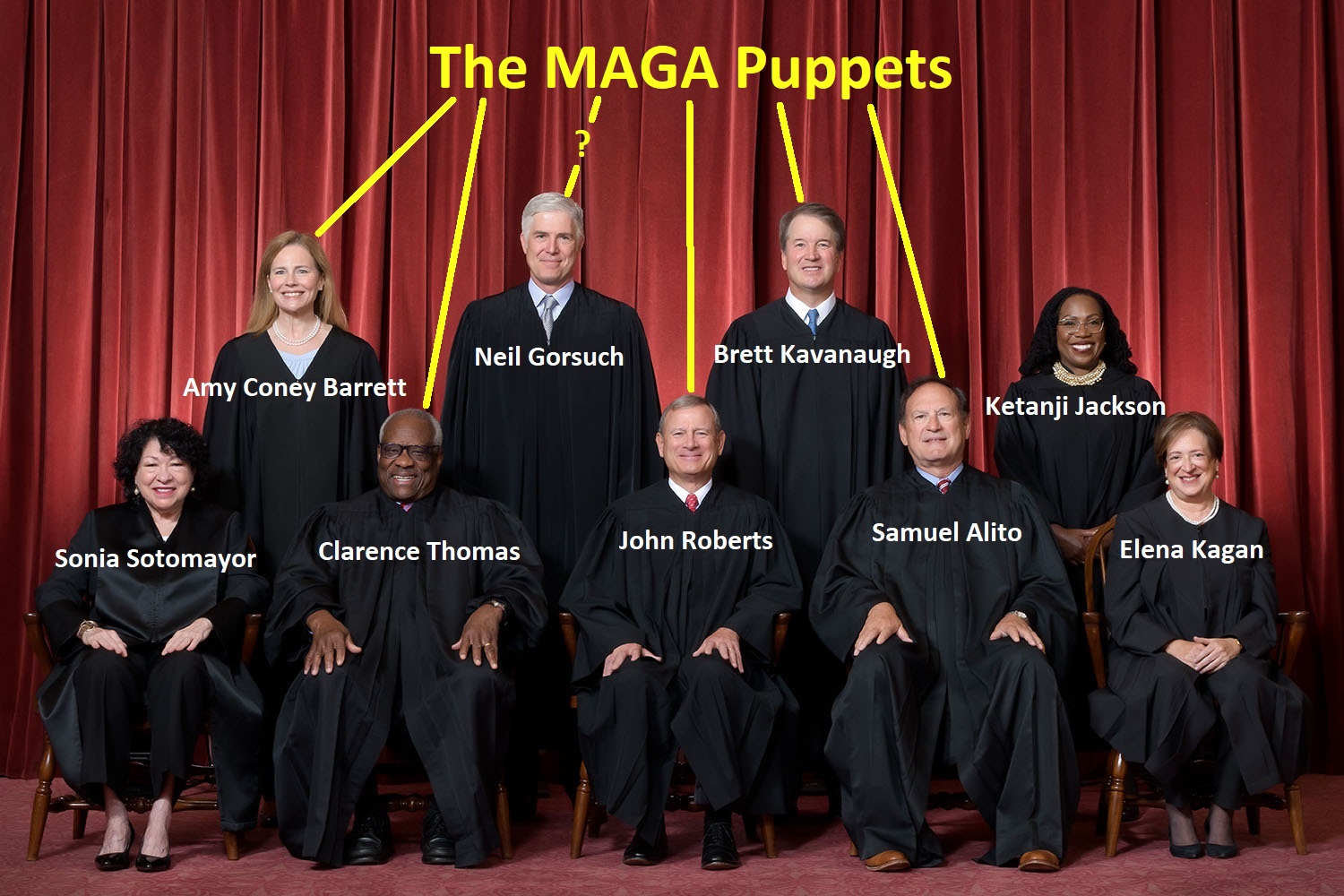
There are five (5), maybe six (6), U.S. Supreme Court Justices that have literally lost their minds and abandoned the core foundations of our sacred Charters of Freedom, the precedents, and what it means contextually to live and govern a nation by laws, not personal opinions or beliefs. Who are the “rogue” federal justices? They are from most radical (MAGA puppets) first, to least conservative at the end:

  • Samuel A. Alito – appointed under George W. Bush’s administration.
  • Clarence Thomas – appointed under George H.W. Bush’s administration.
  • Neil Gorsuch – appointed under Trump’s administration.
  • Amy Coney Barrett – appointed under Trump’s administration.
  • Brett Kavanaugh – appointed under Trump’s administration.
  • John Robertsthe least radical, appointed under George H.W. Bush’s administration.
Chief Justice Roberts’ Supreme Court, October 2022

The other three justices which are not ultra Conservative or extreme radical are Ketanji Jackson, Elena Kagan, and Sonia Sotomayor, the most liberal according to Axios. What is the obvious indication that these five justices (six?) have completely lost their way and forsaken their Constitutional vows? Read this…

On Thursday, April 25th, 2024, a Trump lawyer argued to the Supreme Court justices that “the president could assassinate a political rival and be immune from prosecution.” But the most shocking, appalling part of this brazen claim is that the five (six?) MAGA Supreme Court justices agreed with him! 😲

Assassinations of political rivals or enemies today happen in countries like Russia (Vladimir Putin & Alexei Navalny), Venezuela (Nicolás Maduro), Saudi Arabia (Mohammed bin Salman), Syria (Bashar al-Assad), or China, if one speaks out publicly against Xi Jinping and his communist government, you disappear in prison for life. But this isn’t supposed to happen in the United States. Our Founding Fathers clearly designed our nation to be ruled and governed by the law, not anarchy, authoritarianism, or societal trends or ideologies.

Furthermore, when the U.S. declared its independence to Great Britain in 1776 then drafted and ratified its Constitution in 1788, it was with the full intention of moving away from the kings, rulers, and despots of unstable colonial Europe.

Thomas paine, a core founding father
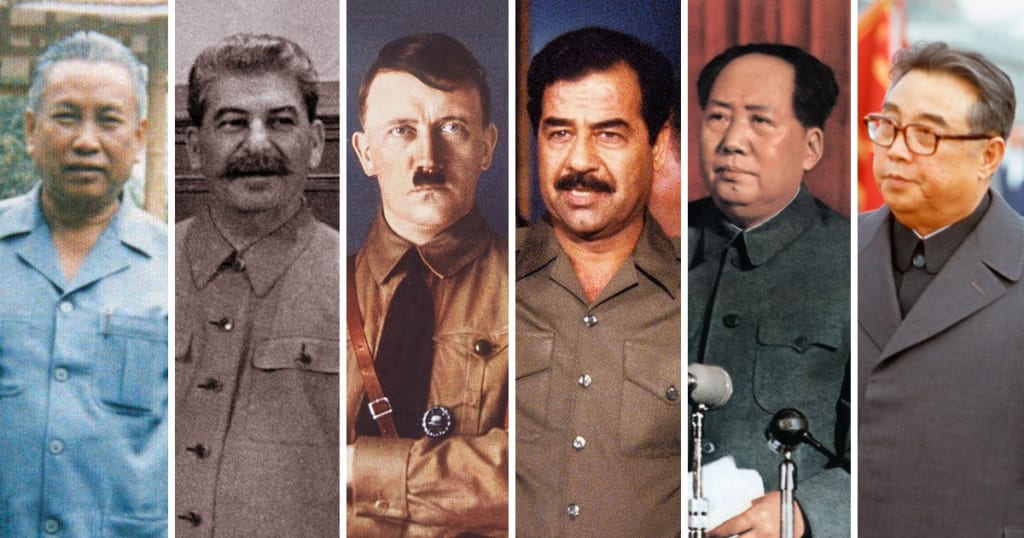
Left to right: Pol Pot, Josef Stalin, Adolf Hitler, Saddam Hussein, Mao Zedong, and Kim Il-Sung

When I was a 4th thru 8th grade History-Social Studies teacher in 2010–2014, I often did a role-playing activity for my 8th graders called “Rule of Law or Rule of Man.” All my students would receive a Post-It note with words or phrases such as:

Public SafetyDissentDictator
Executive BranchConstitutionLiberty
AnarchyConsensusFreedom
Inalienable RightsFairnessProtest
ProtectionLawyerMob
GangCourtPrison
ResponsibilityLegislative BranchViolence
HedonismDemocracyEquality
AbuseSeparation of PowersSelfishness
InequalityChecks & BalancesJudicial Branch
Independent JudiciaryBest Interest of CountryBest Interest of One Person

After giving each student about 5-minutes to consider what their Post-It note says, then have them put their Post-It note in the correct column of the Big Chart which is divided in two: Rule of Law on the left; Rule of Man on the right.

Once all students have placed their note in one of the columns—it’s possible that some notes can be in either column, hence ‘on the line’—then ask the 8th-graders to make a consensus classroom definition of the Rule of Law and the Rule of Man. Next would be a set of discussion questions. For example:

  • When and where did our system of law originate and how?
  • How do laws today affect each of us daily?
  • What functions do laws serve in our society?
    • Be sure to discuss at least nine sub-topics of this question.
  • Are there flaws in our system of law? How are they resolved?
  • What role does our government’s Separation of Powers play in ensuring adherence to the Rule of Law?
  • Why is an Independent Judiciary fundamental to the Rule of Law?
  • It has been said for over 235 years that based on our Constitution, we are “a nation of laws, not people.” What does that mean?
  • Why is it so critically important to be well educated about our Founding documents and Founding Fathers like the Declaration of Independence and the Constitution?
  • Why is it critically important all Americans, especially our elected officials, follow the Rule of Law?

These are just a sampling of the important questions I would’ve asked my 8th-grade students. I would also have my students role-play in groups of 3-to-6 students per group assigning one of them to be the group Director. Following are a sample of the role-playing scenarios students would play:

  • Scenario #1 — “Brown vs Board of Education,” Little Rock, Arkansas. This case involved the Equal Protection Clause of the Fourteenth Amendment.
  • Scenario #2 — “Mapp vs Ohio,” Cleveland, Ohio. This case involved seized evidence without a legal search warrant was deemed inadmissible in state courts according to the Fourth Amendment.
  • Scenario #3 — “Gideon vs Wainwright,” Panama City, Florida. This case involved the Circuit Court judge denying Clarence Gideon his right to a state attorney to represent him when he couldn’t afford one himself, according to the Sixth Amendment.

And here is the real gut-punch scenario for the 8th-grade students:

  • Scenario #4 — This scenario is based on the Watergate scandal. The Constitution states that an Executive (like the U.S. President) who puts himself/herself above the law and deliberately abuses his or her powers of office may be impeached and even sent to prison. President Richard Nixon obstructed legal proceedings into the scandal by refusing to comply to the special prosecutor’s demands for Nixon’s wire-tapping tapes. Nixon resigned from office before he could be convicted. SCOTUS determined that Executive Privilege was not and is not limitless.

From this above 8th-grade classroom activity you might have deduced that the Separation of Powers was specifically designed by the Core Founding Fathers to protect against one office, one person, one branch of government seizing total or near-total, authoritarian power. Even 8th-graders, and 9th-graders to 12th-graders grasp and understand these basic Constitutional principles. They all know what a bully is like in the school yard and if not stopped what will eventually happen.

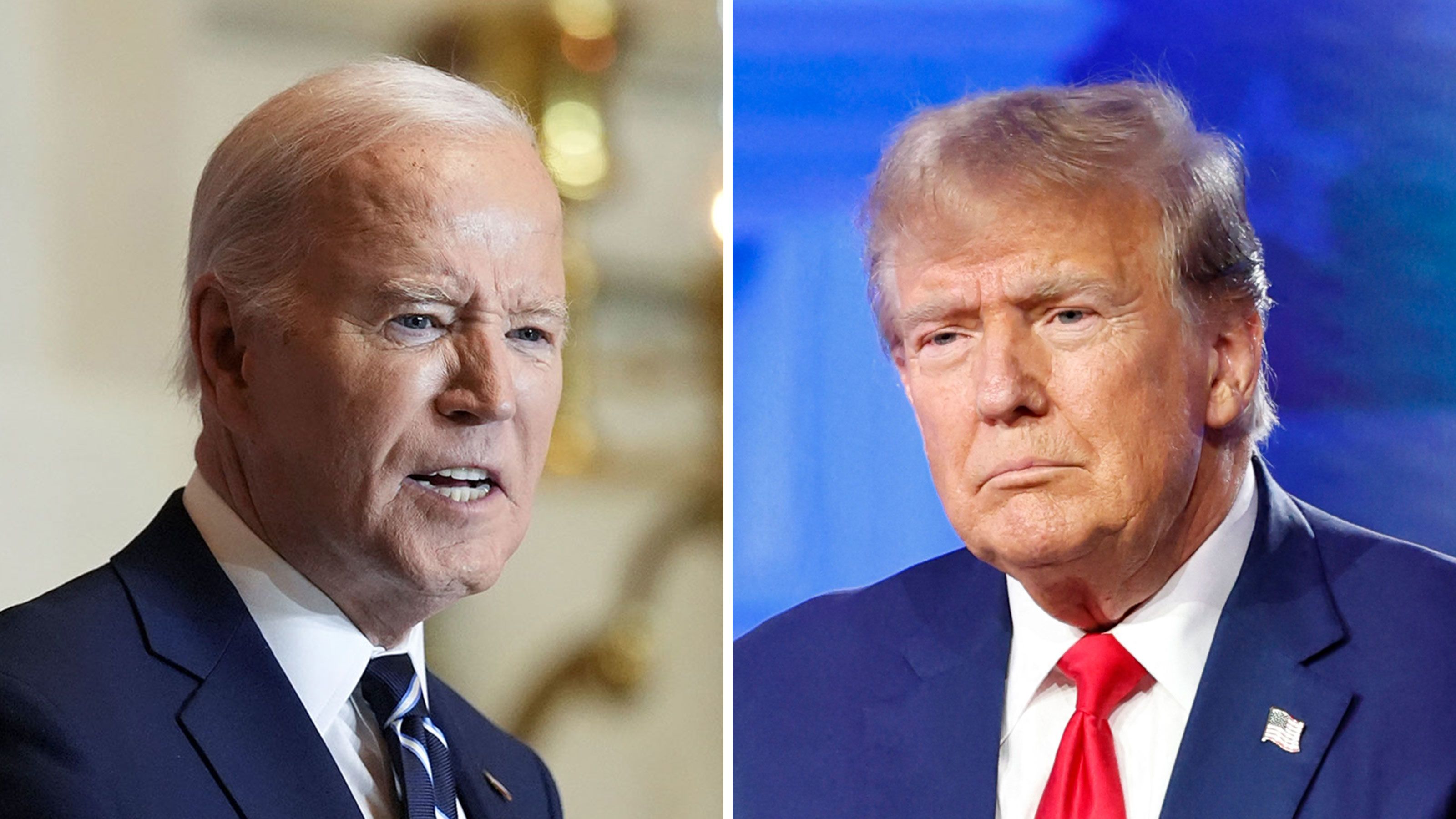
Yet, there is a sizable U.S. contingent within our state and federal governments as well as in the Supreme Court and within the general public who fail to comprehend, protect, and enforce this core Constitutional precept against bullies! Their deliberant naïvety is appalling as well as deeply disturbing. This November Americans might well be adding another man to the above image of history’s most infamous dictators: Donald J. Trump.

Some food for thought and debate…

Should this Trump lawyer’s and the supporting MAGA Supreme Court Justices’ logic somehow prevail and win out for a President’s total immunity to assassinate, should President Joe Biden consider assassinating Donald Trump? After all, you can’t have it both ways or apply the law when it suits you best and disregard it when it doesn’t. Why shouldn’t Biden entertain the idea of erasing Trump while he is the sitting President? Or why not imprison Trump in some remote Siberian location just as Vladimir Putin, Nicolás Maduro, Mohammed bin Salman, Bashar al-Assad, and Xi Jinping all do with regularity? If it is legal for Trump to do it, then it follows that Biden can do it.

What has Trump stated publicly and explicitly he will do if put back into the White House? Here are just three Project 2025 action plans, out of a litany of others, which he and MAGA Republicans promise to execute beginning in January 2025:

  • Incite violence against anyone, including political opponents, he deems a threat to his ambitions. Trump hasn’t just verbalized this intent, he has actually done it. Just last month Trump posted on his social media platform a video of President Biden hog-tied in the back of a pickup truck, bound and gagged with what appears to be a bullet-hole in his head. Regular threats such as these against the POTUS is in fact a crime.
  • Completely overhaul and dismantle civil service positions to favor his political allies that will loyally do his biddings. Within Project 2025 there is already a documented plan to replace thousands of agency employees with his own loyal sycophants, then undo hundreds of environmental protections and reduce even more civil rights for Americans.
  • Turn the FBI and other law enforcement agencies into his personal police state and imprison—just like Putin did with Alexei Navalny—all political or social opponents he deems a threat to himself. These are Trump’s words verbatim, “If I happen to be president and I see somebody who’s doing well and beating me very badly, I say, ‘Go down and indict them.’ They’d be out of business.

Anyone with a quality, fair and well-rounded education of American history and American government must admit that the above rhetoric and promises made by Trump 2024 and his MAGA cult members/minions, including 5-6 Supreme Court Justices, flies in the face of everything this nation was founded on by our six core Founding Fathers and the Charters of Freedom they drafted and the states ratified.

I cannot stress enough nor vehemently enough just how monumental this November will be. Not just for the future of the United States, but also the world. Mark my words right now, if the Orange Orangutan Baby gets back into the Oval Office, that is the beginning of the end of this democratic republic from which we may never recover.

The Professor’s Convatorium © 2023 by Professor Taboo is licensed under CC BY-NC-ND 4.0 
Unsung Heroes


Or perhaps “Rarely Sung Heroes” in these modern times of growing (or struggling?) decency in the United States. I say that with caution and some hesitation. Let me explain.

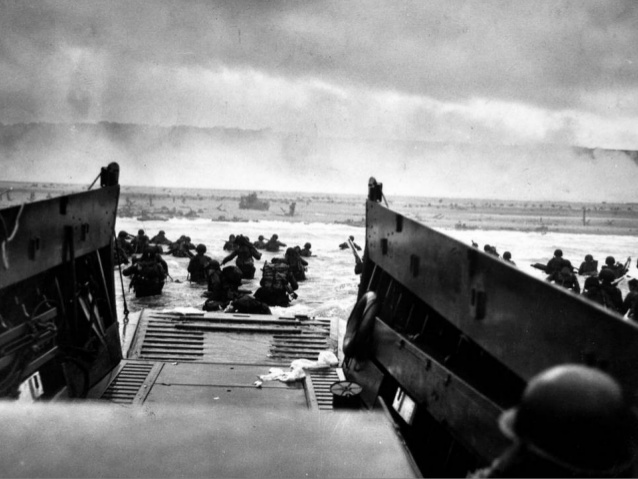
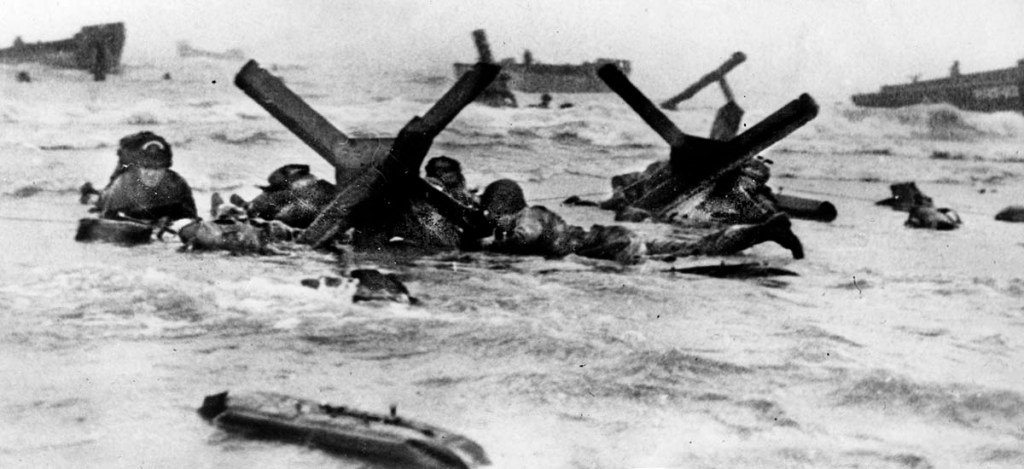
Back on June 6, 2019, the 75th Anniversary of D-Day in Normandy, France honoring all the Allied soldiers who participated, fought, died, and survived in that historic amphibious invasion to liberate Nazi Europe, I published my blog-post Five Hundred Yards. It was my attempt for readers to bring an acute perspective and emotion what the landings on Omaha Beach was like that June morning for the thousands of 17-, 18-, 19- and 20-year old boys had gone through as they hit the water or beach. If you have the opportunity to read or reread Five Hundred Yards, please do. It will set the stage and context for this post.

Some/Many caucasian Euro-American descendants born and living in our 50-states today have a generic, basic knowledge of how indigenous North American peoples/Indians were either exterminated, moved from their homelands, or abusively treated and deceived by the U.S. government, military, and new settlers between 1778 and 1911, during the official existence of the United States. Between 1539 and 1774 thousands upon thousands of Indigenous peoples were massacred by European colonists and their armed forces. By far the biggest killer of North American Indians were all the lethal diseases European colonists/invaders brought within them and spread. Ironically, similar to what former President Trump accused the Chinese of doing with COVID-19. Nevertheless, it is estimated that from the Pre-Columbian Era (1325–1492) to the final massacre in 1911 in Washoe County, Nevada, between 95,000,000 to 114,000,000 Native American people, that’s millions not thousands, were wiped out by Europeans.

Despite this horrific background and constant inhumane atrocities committed upon them by Europeans and Euro-American descendants, during our first and second European World Wars more than 12,000 Native American Indians fought in Europe for the U.S. in World War I. More than 44,000 fought for the U.S. in World War II. Keep in mind, this is only one to three generations after the exterminations and removals from their own ancestral homelands over a 600-year timespan. Think about that. The numbers of your own people gradually and drastically dying, massacred, and disappearing all around you. With that in mind, these Native American men who, like their African-American WW1 and WW2 military counterparts, volunteered to go fight and risk their lives on a far away continent for a nation who at the time and well before did not love them or treat them as equals and far from justly. Nor did this nation welcome their survivors home as heroes the same as their own caucasian Euro-Americans and yet still went and did their patriotic (tribal) duty and did it bravely, honorably as the warriors they had always been.

I want to commemorate in a small way those Normandy, D-Day Native American warriors who did not come home, those who were wounded and maimed, and those who survived the entire war who did come back home, but nonetheless were still scarred and mentally wounded by those 2–3 years in Nazi Europe. Scarred perhaps too by six centuries of war upon their people by Europeans and Euro-Americans. Here is one of many partial accounts of that June morning on Omaha Beach, 1944 by Army Medic and 19-year old Private of Fox Company in the 16th Infantry Regiment, 1st Division who were the first frontline units to hit Omaha Beach.

In my June 6, 2019 blog-post Five Hundred Yards, I wrote about how many casualties were sustained by the first wave hitting the beach or head-high water of Omaha in the first 15-minutes and hour of landing. What I didn’t mention in that blog-post was that decades later German Wehrmacht testimonies stated they were firing their MG-42’s, 5cm and 8cm mortars, and rocket-launching Nebelwerfers so much, non-stop that the barrels were all overheating, even when they rotated them with extra barrels they had, 3-4 extras in some units. The German gun-crews were astonished by how many Allied soldiers kept coming and falling, coming and falling, over and over, endlessly as they quickly exhausted their entire stores of ammunition. On the American side with the 1st Division known as “The Big Red One,” they sustained over 2,000 casualties in the first hour of landings.

One particular Army Medic who was one of 14 total Medics in his regiment made it far enough up the 300-400 yards of flat beach and took cover. However, as he looked back from where he had come he realized he was all alone. No one in his company had made it safely as far as he had. He then noticed many of his fellow infantrymen lying on the beach wounded, screaming, and in the rising tide carrying their 60-75 lbs of gear, most were struggling or unable to pull themselves up the sand so as not to drown. Without hesitation he ran back some 300-400 yards again under heavy fire with his two satchels of medical supplies to those wounded and drowning, pulling many of them 10-11 yards up on the beach and began giving first aid. Another Corp man reported to his officers that this one Medic pulled about eighteen wounded out of the water that were twice or three-times his size and their uniforms and gear heavily soaked. Charles Norman Shay is a Penobscot Indian from the state of Maine and was that one remarkable Army Medic. He tells in his own words what happened:

“The seas were red with the blood. At the very beginning, it was difficult for me to witness so much carnage. I had to push what I was experiencing out of my mind, so I could function the way I was trained to function. Then I was able to operate effectively and even saved a few lives. I have always been proud to be a medic. It’s a special privilege.”

Shay remembers cradling those critically wounded to give them some comfort. When he found one he recognized, badly wounded with an open abdomen, he stayed with Private Edward Morozewicz, one of his closest friends, to ease him in his last few breaths. In 2017 Shay visited Morozewicz’s family, making sure they knew of Edward’s courage. Charles participated in a special ceremony honoring his fellow fallen medic. Shay still questions why he lived when Morozewicz and most of his unit were killed. “I knew [Edward] was slowly dying. I bandaged his wounds and gave him morphine. But I knew there was no help for him, says a somber Shay.

Most of the American 1st and 29th Division’s first waves onto Omaha Beach perished, cut-down and slaughtered by the precise, heavily supplied and experienced 352nd German Infantry Division. The 352nd was assembled with many battle-tested soldiers pulled from worn-out or disbanded Wehrmacht divisions that had served on the Eastern front in Russia. By 12-noon on D-Day over half the men and most of the officers in Shay’s Company were either seriously wounded or dead. Up to 3,000 Allied troops died, and some 9,000 were injured or classified as missing that day, unidentifiable, or lost to the sea. Of Shay’s Regimental Medical Detachment of 42 medics, seven were killed and 24 severely wounded. After so many of his regiment and company fell or were killed, he later struggled many times with Survivors Remorse.

“My heart breaks for those mothers who prayed for their brave sons but never welcomed their sons home again,” says Shay wiping away a tear. “I can never forget the men who never had the chance to experience life as it was meant to be, a wife and a family, but instead were destined to depart this life in some far-off [European] land.”

Shay often says it was random, crazy luck that he survived D-Day, the rest of the war, and later the Korean War that he volunteered for service just five years later. After the war in Europe ended, the U.S. Army awarded Shay a Silver Star for his actions, and the French government appointed him a Chevalier of the Légion d’honneur, the highest honor given to non-citizens of France. But despite those medals this humble Penobscot Indian veteran always refers back to fellow warriors who paid the ultimate price and sacrifice for their country, homeland, Native tribes and family. Shay says there were many just like him.

Recently there has been new memorials and ceremonies finally recognizing the heroic contributions and sacrifices of Native American WW2 veteran warriors. Charles Shay makes annual trips back to Normandy to pay his ceremonial respects and honor his fellow Indians lost there with Eagle feathers, sage, and tobacco. He does so to bring heightened awareness to the younger public, particularly back in the United States. He lets his fellow Indian warriors lost, buried there under row after row of white crosses that they are not forgotten.

In the Normandy American Cemetery at least 29 Native American soldiers are buried. In the Brittany American Cemetery at least nine Native American soldiers are buried. And at the Utah Beach American Cemetery 30 Comanche soldiers, Code Talkers, from the Oklahoma Reservation are memorialized there. According to Dr. Harald E. L. Prins, an anthropologist and researcher at Kansas State University, 175 Native American soldiers landed on Omaha Beach on D-Day. Over 75-years later only around 55 have been identified.

For an extensive telling of Shay’s gallant service on D-Day go here. Many of the past stories of that day in June, a lot of the later accompanying military field narratives describing the Omaha ordeal are sanitized versions of the original field unit notes. And as S.L.A. Marshall writes for The Atlantic magazine in his provocative, transparently graphic article First Wave at Omaha Beach, he says even “Cornelius Ryan’s epic film The Longest Day misses the essence of the unfiltered Omaha story.” I highly recommend his article.

It is my opinion, reflecting back this June 6th, 2021 anniversary of D-Day, given these Native American warriors pre-war histories they had every justifiable reason not to lift a finger for a white-man’s faraway war. They did not have to do any patriotic service for a 1940’s Euro-American country that treats them and had treated them as second- or third-class people without the same identical privileges and human rights afforded White America. Today, I think these Native American warriors are overdue, deserving the utmost respect, honor, and ceremony up to or beyond any other homage given to any Euro-American veterans of any U.S. wars! May they all receive many sacred Eagle feathers, burnt sage, and tobacco so all of their spirits rest in peace and receive (at minimum) equal remembrance and honor by all Americans; every single one of us without exception. Unmeasurable gratitude for all of you Native American warrior veterans of the U.S. Armed Forces, past and present.


Creative Commons License

Blog content with this logo by Professor Taboo is licensed under a Creative Commons Attribution-NonCommercial 4.0 International License.
Permissions beyond the scope of this license may be available at https://professortaboo.com/contact-me/.

Third Monday

Dad's note - c. 1958

Dad’s note – c. 1958

On the third Monday of every January, we remember and celebrate one of America’s greatest civil rights warrior Martin Luther King, Jr. Today I reflect back on a handwritten note my Uncle gave me not too long ago. It was written by my Dad in about 1955-1962 when he was a young man from tiny Alta Loma, TX and headed off to the University of Texas Austin. I never knew this note existed until my Uncle — a close dear brother-in-law to my father — brought it to me and shared its context. It meant a lot to my Uncle because my father meant a lot to him. Uncle Dale and my Dad had enormous mutual respect and fondness for each other. They saw eye-to-eye on many social and political issues of the day. It feels right to share the note here today. It is entitled “Children Learn What They Live” by Dorothy Law Nolte, a popular American writer and family counselor of my Dad’s era. A picture of the note is above.

I remember throughout my childhood all the way up through my senior year of high school, Dad would often tell me that people are not born to hate, not born to kill, and not born to discriminate unless they are taught to do it and surrounded by it. That was not, he would adamantly explain, the definition of true freedom, true liberty, true equality in which our nation was supposedly founded! Furthermore, those three principles do not fully exist if it is not safe for someone here to be unpopular, like Martin Luther King, Jr. in the 60’s. If only one person in society is scared for their life or safety, for merely being different or thinking different, then the whole society IS NOT a free one. It is something less or worse.

It is amazing, probably appalling, that since 1775 and the words of our Declaration of Independence that “all men are created equal“, since 1863 and again the same words from our Emancipation Proclamation, since the hundred years of Jim Crow Laws from 1866 to 1965 which after 1776 should have never existed, since the 1900’s and Women’s Suffrage, and then still today in the 21st century, the United States is STILL dealing with forms of inequality and civil rights violations. A foreigner looking in to our shores — with our Statue of Liberty in the foreground — would quite rightly scream, HOW IS THAT POSSIBLE!?

To that foreigner I would respond ashamed repeating what my father taught me… “because it is still being taught.” Hate, violence, killing, discrimination, prejudice, bigotry, elitism, and divisiveness are all taught. It starts with the parents and family, then the immediate community, and if unchecked, continues through following generations. It is there at the roots and in those hearts that it must be untaught and the cycle broken.

Happy MLK Day everyone! And please remember the cost and continuing responsibility required to protect our fragile freedom, liberty, and equality for not just a few, or those in distant lands, but for ALL Americans right here within our own national borders! We’ve progressed a bit in 240 years, but we still have a ways to go!

(paragraph break)

Live Well — Love Much — Laugh Often — Learn Always

(paragraph break)
Creative Commons License
Blog content with this logo by Professor Taboo is licensed under a Creative Commons Attribution-NonCommercial 4.0 International License.
Permissions beyond the scope of this license may be available at https://professortaboo.com/.

A Collective Imperative

(paragraph break)

If a free society cannot help the many that are poor,
it cannot save the few who are
rich.
— John F. Kennedy

(paragraph break)

[This is the fourth and final segment of a series continuing from part 3 – Unveiling Incentive-Opportunity Fallacies] (paragraph separation)

(paragraph break)

* * * * * * * * * *

What is excessiveness?  The dictionary defines it this way:  exceeding a normal, usual, reasonable, or proper limit.  Historians have sometimes defined it as out Herod Herod.  Lord Salisbury in Shakespeare’s King John perhaps described it better as painting the lily:

Therefore, to be possess’d with double pomp,
To guard a title that was rich before,
To gild refined gold, to paint the lily,
To throw a perfume on the violet,
To smooth the ice, or add another hue
Unto the rainbow, or with taper-light
To seek the beauteous eye of heaven to garnish,
Is wasteful, and ridiculous excess.

Every single human being requires a handful of necessities:  water, food, climate-control, and shelter.  To what extent or elaboration those four basic needs are fulfilled, can be averaged at any location, and thus a global standard can be determined.  One and perhaps a minimum of two of these basic life-needs are in finite supply and crisis on our planet.

Fair warning for those who are sensitive to or bothered by grim facts of nature, our planet, and other human groups, self-discretion should be considered.  What follows, in my opinion, needs to be at least made aware and considered by everyone on Earth.

(paragraph break)

* * * * * * * * * *

What do you think would happen if when you turned open your faucet and nothing came out?  How long could you survive without water?  Now, what do you think would happen if your entire city was without water or operating sewage?  What would happen if a nation lost its water and sewage?  There is no water to feed crops or gardens; no clean water to drink.  Are you getting the picture?  If not, let’s hear the alarming projections some scientists, scholars, and professional experts are reporting.  Sorry this alarming documentary is an hour-and-a-half long, but it needs to be shared:

If you still feel this is not a problem for you and your children and grandchildren, you should have your ears examined.  If you feel resource conservation is a form of socialism or communism, then you are in delusional denial.

Excessive opulence or resource hoarding is no different a global footprint than spending or consuming recklessly; they both accomplish the same singularity:  proportionate risk.  The more excessive, the more risk; the more risk, the more excessiveness to avoid it.  As a species, if not as Americans, we need to…no, we must greatly refine our life-ambitions and the education of those ambitions and their purpose.

But let’s pause a moment and analyze where most Americans have headed since 1870 and are currently heading.

1870 – 1900:  The Gilded Age

Mark Twain
Mark Twain

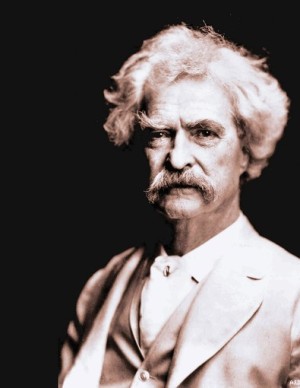
Much pride and boasting has been made of America’s age of industrialization, that it was the catalyst that put the nation in the same discussion of the world’s greatest empires.  Yet of our nation’s 12-million families then, 11-million earned less than $1,200 per year; of this group the average annual income was $380, well below the poverty line.  In today’s CPI dollars (the purchasing power of goods and services produced in the 1890 economy) that is $9,890 per year per household.  In his book The Gilded Age: A Tale of Today, Mark Twain wrote of the day’s barons and tycoons, What is the chief end of man?—to get rich.  In what way?—dishonestly if we can; honestly if we must.

Though pre-1920 U.S. economic reports are less comprehensive as post-1920, Benjamin Schwarz of the World Policy Institute and Executive Editor of World Policy Journal writes in his 1995 New York Times article By 1890, the richest 12-percent of households owned about 86-percent of the country’s wealth.

1890 – 1920:  Progressive Era

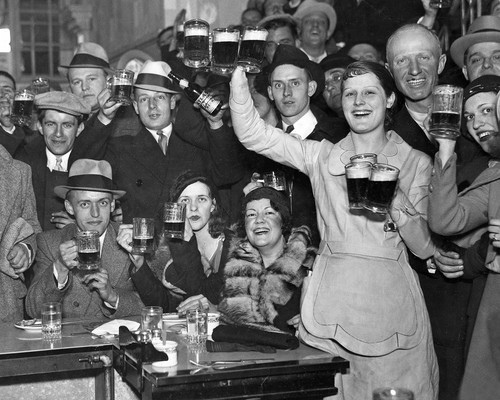
The Roaring Twenties

In 1910 the average annual household income was $574 per year.  In today’s CPI dollars that is $14,300 per year per household.  During this era America’s top 1-percent owned about 40-50 percent of the nation’s wealth and the top 10-percent fluctuated around 70-percent until President Theodore Roosevelt began his anti-trust legislation and wealth redistribution via progressive taxation.

1920 – 1929:  The Roaring Twenties

The average annual household income was $1,407 per year in 1920.  In today’s CPI dollars that is $16,100 per year per household.  In 1922 America’s top 1-percent owned 37% of the nation’s wealth; a slight change in years following Teddy Roosevelt’s administration.  America’s middle-class indeed experienced a relative age of prosperity during the Roaring Twenties due to the automobile industry which fed industries such as oil, road-construction, tourism, manufacturing, and electric-power.

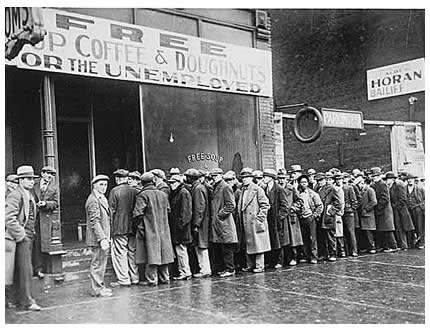
1929 – 1941:  The Great Depression

the-great-depression

The average annual household income in 1930 was $1,388.  By 1940 it had dropped to $1,315.  In today’s CPI dollars that is $19,100 and $21,500 per year per household respectively.  America’s top 1-percent in 1933 owned 33% of the nation’s wealth and 36.4% in 1939 demonstrated the upper-upper class comfortably rode out the stock market crash of ‘29.  Unemployment for the nation’s middle class was at 25% and especially higher in heavy industries such as lumbering and agricultural exports in cotton, wheat, and tobacco.  Fortunately, from a purely economic standpoint, another world war was on the horizon ready to put Americans, particularly women, back to work on a road to bigger prosperity than the Roaring Twenties.

1945 – 1973:  Postwar Prosperity – The Golden Era

The average annual household income was $3,180 in 1950 ($30,300 in 2012 CPI) and $4,816 in 1960 ($37,300 in 2012 CPI), a significant increase in just 10-years.  Middle-class Americans also enjoyed a bigger piece of the nation’s wealth:  70.2% in 1945 and 73% in 1949 while America’s top 1-percent saw their portion drop again to 29.8% and 27% respectively.  Yet, it is this Golden Era that firmly placed the United States as a world power and dominant economy.  As more and more Americans gained more wealth and more income, the nation experienced its most prolific prosperity to-date.  How it happened will be examined shortly.

The American Dream
The American Dream. Notice the ethnicity?

When Dwight Eisenhower took office (1953-1961) the nation was going through another recession post-Korean War causing a decline in the nation’s GDP.  This resulted in middle-America having less of the nation’s wealth over a 16-year period down to 65%, while America’s top 1-percent relished in increases back up to 34.4% of the nation’s total wealth in 1965.

By 1970 the average annual household income was $7,494 or about $44,300 in today’s CPI dollars; another notable increase in 10-years.  As the Golden Era drew to a close and the Cold War and Vietnam festered, President Lyndon Johnson’s Great Society programs increased lower and middle-America’s wealth to 71% while America’s top 1-percent saw theirs fall to 29% of the nation’s wealth.  However, hard times were just around the corner for most Americans.

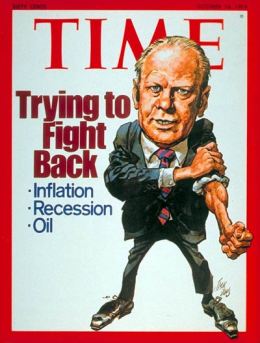
1970 – 1976:  Age of Stagflation

Image Time Warner
Image Time Warner

In 1973 the average annual household income was $9,037 or approximately $46,700 per household in today’s CPI dollars.  The nineteen-seventies became known economically as the Age of Stagflation.  The 25-year U.S. economic growth post-WW2 had stagnated to a crawl, and prices in goods and services rose annually in the double-digits from 10% in 1973 to 18% in 1979.  Due to poor performances on Wall Street, America’s top 1-percent saw their share of the nation’s wealth drop to the lowest in history:  19.9%.  Yet, middle-America enjoyed the highest ever share of the country’s wealth at 80%.

The eras of suburbanization in the 50’s and 60’s, however, had significant consequences in the 70’s.  The migration of tens of millions of middle-Americans (most of them White), moving to newly developing suburban towns meant getting to work in cities went from public transit to private vehicles.  This in turn caused America to become heavily dependent on foreign oil.  The long-term varied ripple effect of suburbanization cannot be overemphasized, one of which is our bigger footprint on environmental and global issues.

Wolff Table 1 Wealth

1976 – 1992:  Gilded Age Returns and Reaganomics

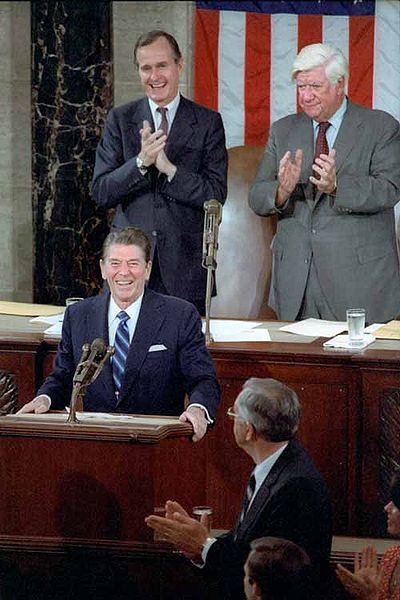
Reagan addresses Congress 1981 (Wikipedia)

From 1976 to 1988 the average annual household income was $11,080 or about $44,700 in 2012 CPI dollars – yes, a $2,000 drop from the previous 3-years – to $25,167 or about $48,800 in 2012 CPI dollars; just above break-even from 1976.  To combat the stagflation of the 70’s, government deregulation along with personal and business tax cuts gained popularity.  As it turned out most of the tax breaks, along with deregulating helped America’s upper-classes.

Additionally, defeats of labor unions – unions made possible by Teddy Roosevelt reforms with long histories of keeping big-businesses from corruption and abuse of workers – also fattened the pockets of America’s top 1-percent by going from 19.9% ownership of the nation’s wealth to having 35.7% by 1989.  By 1992 the AAHI (average annual household income) was $28,870 or about $47,200 in 2012 CPI dollars; another drop from 1988.  While middle-America struggled, the top 1-percent in America owned a rising 37.2% of the nation’s total wealth.

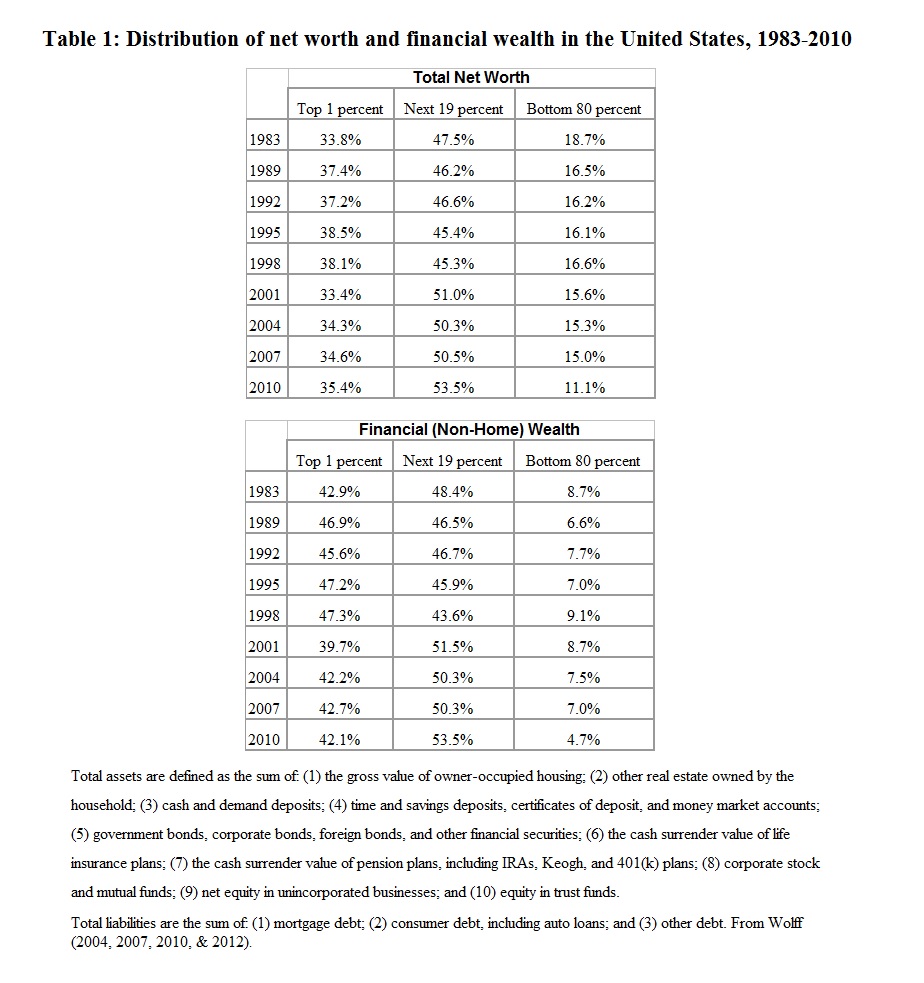
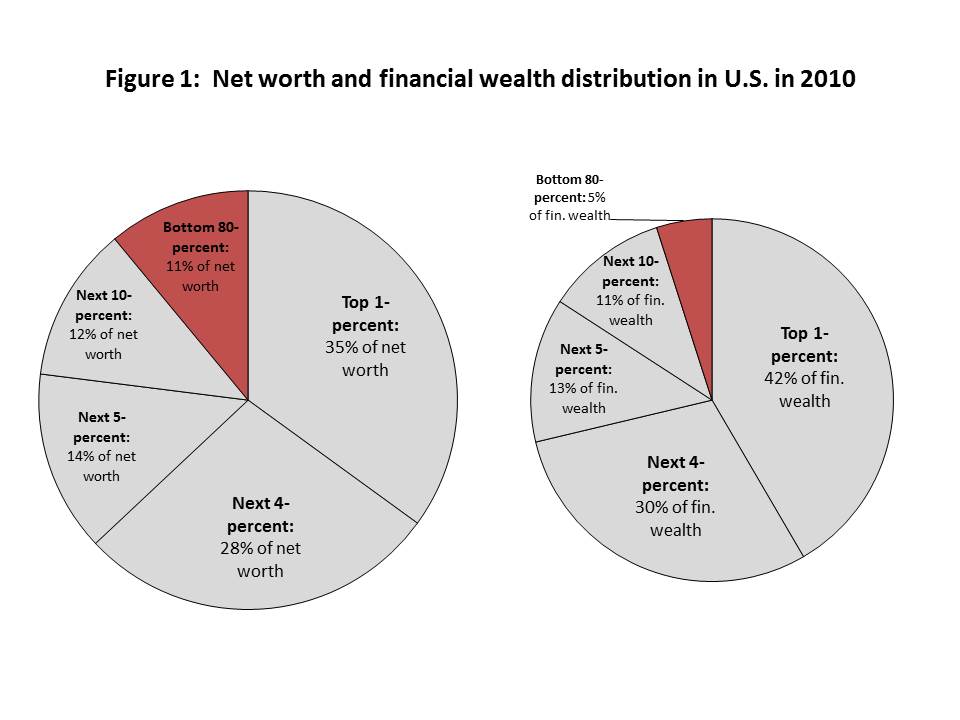
Beginning in 1983 economist Edward Wolff has tracked America’s net wealth and financial (non-home) wealth distributions.  As Table 1 above and Figure 1 below show, it is an increasingly bleak outlook for the majority of Americans.

Figure 1 Net & Financial Dist
Click image for larger view

1990 – Present:  Globalization and World Superpower

The 1990’s will be compared to the prosperity of the 1920’s and the 1960’s.  But as a whole is that what the data reveals?  The AAHI was $32,558 in 1995 or about $49,000 in 2012 CPI dollars and America’s top 1-percent enjoyed another increase in the owned wealth of the nation at 38.5%.  For six brief years (1994-2000) the economy saw rises in the national debt, the stock market, and the GDP while inflation plateaued and unemployment dropped below 5% because of the Dot-com Boom.  Economist and civilians alike agree that the growth explosion was mostly a result of workplace computerization.  But the good times would come to an end in 2001.

Map of the world wide web
Map of the world wide web 1990-2000

A constant influx of immigrants seeking the American Dream, an American economy becoming one of the major players in a growing global economy, a false sense of security in the housing market, and numerous corporate scandals in the energy and finance sectors due to previous government deregulating, all contributed to the tipping-point by 2007.  The AAHI in 2000 was at $40,418 or $53,900 in 2012 CPI dollars and the top 1-percent in America saw their portion in the nation’s wealth drop to 33.4% due to a sharp declining stock market worsened by the attacks of 9/11.  There is another set of globalization dynamics that added to the plight of middle-America.

With the exodus of American jobs like cheaper electronics, fashion, shoes, and toys moving to developing nations, middle-Americans watched as their job and salary-leveraging also weakened with fewer lateral or upper employment positions.  Then jobs in TV, auto, steel, and home-furnishing manufacturing followed.  With those positions gone abroad, the American job-market went from high-paying management positions to simple service-industry low-paying positions which certainly need no college degree.  This move marked the boom of trade-school certifications for a growing electronic blue-collar job-market.

manufacturing_mexico
Why Mexico is becoming a global manufacturing power – Bloomberg Businessweek article

The domino-effect of American digitization, the snowballing Internet, and high-speed networks spreading to all corners of the globe have combined to gorge the growing socio-economic gap wider and deeper.  In 2007 the AAHI was $48,332 ($53,500 in 2012 CPI dollars) eaten-up by inflation and the cost-of-living.  Meanwhile, the top 1-percent owned a steady 34.6% of the nation’s wealth.  The lap of luxury doesn’t stop there.  With the creation of a connected more global economy today, along with new multiple global opportunities and substantially lower-wages to foreign workers, it should come as no surprise what sector of the American population currently enjoys the fruits-of-foreign-labor.

The World’s 200 Richest People(s):

The most industrialized developed countries in the world by population-size are in Europe according to the 2013 United Nations Human Development Report.  Of the top 10 nations with the highest Human Development Index (HDI), six of them are in Europe (see Report).  One might infer from that list then that many of the world’s wealthiest people reside in those countries or at least in Europe.  You would be wrong.

Of the 200 richest people in the world as of 2012, 61 of them (or 31%) are citizens of the United States.  What is perhaps unexpected is where the second richest group of people call home.  Of the next 139, 20 of them (or 10%) are Russian, ironically a former part of the old communist U.S.S.R.  The next 26 richest people come from Germany (13) and Brazil (13) at 7% and 6.5% respectively.  To see the world’s wealth and what portion of it is owned by the wealthiest 200, see the pie-chart below.  For the most current world ranking of the world’s wealthiest as ranked by Bloomberg click here.

Wealthiest 200 pie-chart

As the largest population of one of the most modern industrialized nations – currently 314 million and growing – the United States has the largest percentage of the population with the smallest percentage of the nation’s wealth.  Since 1983, as seen in Wolff’s two Tables above, it has decreased every single year.  To put this disparity succinctly, in terms of financial eggs-in-a-basket the top 1-percent own 35% of all privately held stock, 62.4% of all business equity, and 64.4% of financial securities in America.  Is it any wonder why middle-American taxpayers were held for ransom in 2008 to bailout our own mega-banks and financial firms, mega-auto companies, and integral government-sponsored entities?  The top 1 and 10-percent held the nation by the balls.  Sit down, it get’s more alarming.

largeextremeinequalitychart

The top 10-percent own 81% to 94% of all American bonds, trust funds, stocks, and business equity, and nearly 80% of all commercial real estate.  The real value of financial wealth is determined by control of income-producing assets; assets that can absorb recessions or devastating irreparable depressions.  Therefore, it is reasonable to conclude that 10% of Americans own the United States.  Talk about utter investment stupidity in placing the nation’s “eggs” in one or two baskets!  There is no way to sugar-coat it.  Perhaps Abraham Lincoln’s Gettysburg Address should be rewritten to reflect today’s socio-economic times:  Government of the 10-percent, by the 10-percent, for the 10-percent.

Land of the Few, Home of the Lavish

Listed at $190-million, Copper Beech Farm in Greenwich, Connecticut is the most expensive home in America.  Built in 1896 and previously owned by the Greenway family of U.S. Steel with Andrew Carnegie as well as timber tycoon John Rudey, it has over 13,000 square feet on 50 waterfront acres with spectacular views of Long Island Sound.  As a French Renaissance style home with 12 bedrooms, wine cellar, a 75-foot outdoor pool, a grass tennis court, a large formal arboretum, two greenhouses, and private apple orchard, accessible by a 1,800-foot private driveway.  Oh, and the property includes two offshore islands.

Copper Beech - Greenwich, CT
Copper Beech – Greenwich, CT

Copper Beech Farm is simply one home of over 100 homes priced above $10-million.  From 2005 through 2012 Greenwich, CT has been ranked as the best wealthiest place to live in the U.S., the “Biggest Earner” per household in the U.S., and #1 wealthiest residents per capita in the nation.  Many of the residents are Wall Street hedge fund managers, writes Nina Munk of Vanity Faire Magazine, and “of the $1.2 trillion currently invested worldwide, approximately one-tenth, or $120-billion, is now managed out of Greenwich alone, according to Hedge Fund Research, Inc.”  Munk also reports that four of the richest 400 Americans live in Greenwich and three of those are hedge fund managers.  One Greenwich real-estate broker reported these four residents will drop five to eight-million dollars without a second thought.  Some even a lot more.

Almost As Big as the Taj Mahal –
To judge by the number of swollen, over ambitious mansions rising from lots in Greenwich these days, you’d almost think we were back in the 1910’s and 20’s – except that this time round the lots are small, and the houses are almost on top of one another.  “Years ago, wealthy houses were hidden in the rear of properties after long driveways…and no one ever built to the maximum allowable square footage,” remarked Diane Fox, long time director of Greenwich’s Planning and Zoning Department, in an e-mail to me.  “Today all big houses want to be seen from the road.””

Munk’s article of Greenwich’s rich and lavish also mentions that one interior designer installed broadloom carpet at $74,000 for one bedroom, and drapes and curtains at $20,000 to $25,000 for one bedroom.  You read it right, one bedroom.

Why is this level of wealth and excessive opulence worth mentioning?

Because today American legislation, political campaigns, and economic policies resemble little of what they did six decades ago.  In 2010 the U.S. Supreme Court allowed American corporations, including those owned by the top 1 and 10-percent of the nation, the opportunity of donating vast financial resources for political candidates and their election campaigns; “resources” with millions of dollars beyond what any individual voters could organize.  Remember, 80 to 90 percent of Americans hold or own just 4.7% of the nation’s financial wealth.  The political phrase in the 1940’s and 50’s “one person, one vote” means today “one dollar, one vote.”  That 2010 decision sets the stage for a class of super-wealthy political campaigners to push (as if a majority of individual voters) their one-dimensional political-economic interests:  enhancing their profits and revenues.

A Communal America is Imperative

This four-part series has not been about political, economic, or social envy.  It seems the bottom 99% or 90% are for the most part not jealous of America’s gazillionaires or their social contributions and hard-earned incomes.  What this four-part series has been about though is political fairness, representation, and efficiency.  As discussed in part two Productive Inequality, rent-seeking moves wages and wealth from the bottom and middle classes to the top 10 and 1-percent while distorting the “free market” in favor of some and to the detriment of most.  More “efficient” policies of the market matter for a more equitable distribution of national wealth.  Improper policies (e.g. of the last 32-years) lead to a less efficient economy and a growing divide between socio-economic classes.

Strength in lots of Einsteins!

It is a fairly simple overall concept.  When our society is sufficiently (even abundantly) funded in infrastructure, education, research, and technology, these vital areas of a thriving economy offer hope and security to ordinary citizens.  The majority of Americans, the bottom 90%, will actually SEE and experience for themselves what the U.S. Constitution, the Statue of Liberty, and all other symbols of democracy, equality and fairness are really made of… not just “promised” or rhetorically talked about on TV.  Those principles would be available to a vast number in society in an efficient dynamic economy.  Even the top 1-percent would benefit when the capabilities of so many quality workers and citizens are not wasted but fully utilized.  It’s a concept of not just strength in numbers, but strength in well-educated, ingenious, motivated Einstein numbers!  There is a huge difference between the two.  The difference is not just inclusive, but very alien to exclusive.

In his superb book The Price of Inequality:  How Today’s Divided Society Endangers Our Future, Nobel Prize winner in economics Joseph Stiglitz gives a superbly educated agenda on exactly how American government and her 314-million citizens can avoid falling into the same death-trap history’s great empires and their leaders fell into.  If you would like to read an outline of his proposed extensive agenda, click here.

My own meek semi-educated ideas of how not to follow, for instance, the Roman Empire’s demise or the former Soviet Union’s, or the more recent countries of Egypt, Tunisia, and Syria… are this:

What is the reading on your/our Collective-Goodness-Gauge?  What is the health of your/our common welfare, our passion for civic responsibility and the well-being of the persons near us?

These are NOT just social questions!  More importantly they are political and economic questions too.  As the French political philosopher Alexis de Tocqueville noticed about the nature of American society in 1835, freedom (or individualism) can be a tricky balancing act within democracy.  Some “individualized” Americans independent of a majority often have the pragmatic realization that looking after the welfare of others is not only good for the soul, but is equally good for business and wealth.  Stiglitz elaborates on this truth wonderfully:

“The top 1 percent have the best houses, the best educations, the best doctors, and the best lifestyles, but there is one thing that money doesn’t seem to have bought:  an understanding that their fate is bound up with how the other 99 percent live.  Throughout history, this has been something that the top 1 percent eventually do learn.  Often, however, they learn it too late.”

Americans together
…no matter class or status

The Roman Empire, Egypt, Tunisia, and Syria are just four examples to what Stiglitz refers.  The former Soviet Union is an example of no individualism when no single “part” is allowed to reach its full brilliance and potential for the benefit of the whole; the other extreme.  Both ends of the economic-socio-political spectrum REQUIRE resource investments and management from every single citizen.  The stable “middle” if you will, has a steady balanced, efficient, fair, and equal flow of civic investment.  Any one mechanism cannot efficiently coexist without the other efficient mechanisms. So…

If the United States wishes to return as one of the best symbols of freedom, liberty, democracy, and equality for all, then reaching that efficient balanced middle is an imperative collaborative, collective return to a well-managed, well-governed, wealth-balanced cause.

* * * * * * * * * *

Further information —

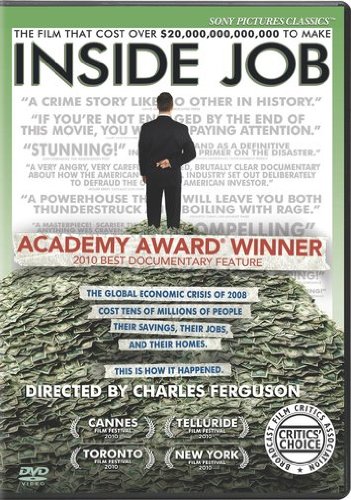
Inside Job

(paragraph break)

(paragraph break)

Creative Commons License This work by Professor Taboo is licensed under a Creative Commons Attribution-NoDerivs 3.0 Unported License. Permissions beyond the scope of this license may be available at https://professortaboo.wordpress.com.