Leonard R. Rogers was the subject of a 1954 article called “Boss Of Million Dollar Firm At Age Of 21 Is No Pipe Dream.” Rogers, whose company was responsible for 75 per cent of America’s business in tobacco pouches, was radically revamping the mega-corporation. When Rogers took over the company founded 50 years earlier by his grandfather he quickly realized that some of the long time company executives knew nothing about anything that was happening outside their department (bubble). Thus, he made the decision to re-organize the company by rolling heads and dissolving positions, i.e. Too many chiefs and not enough indians.
Human towers in the traditional Catalan Festival
“Too many chiefs and not enough Indians” was also the phrase my father liked to use. When we were down in Brazoria County, Texas, working my paternal grandparents cattle and land during one or two of the 3-4 holidays of the year, every one of my cousins, myself, and all my uncles and one aunt of the family had/wanted to accomplish all the needed and necessary work and never-ending repairs as efficiently as possible given the usually short few days everyone had while there. With so many cousins running around wanting to play or do our own “work tasks,” that was when he’d often use the phrase on us. I have to note here, however, that with his family the chief-indian concept reflected more the later 1996 concept “It Takes A Village” by Hillary Clinton. His family had rotating or periodic leadership and supporting roles. Everyone had to do and know all positions and their functions. Dad said it many times during my school and select-league soccer games he’d attend when we’d play bad or lose.
In the exceptional 2008 animated film WALL-E, Earth has become a trashed garbage planet due to unfettered free-enterprise which led to human hyper-consumption of everything corporate manufacturers and retailers convinced and sold the poorly educated masses they HAD to have to be “truly happy.” The upper-echelon executives left Earth on giant starliners and charged lower-echelon humans the same type of prices they charged for all their earthly GNP goods. As a result of the never-ending, rising land-fills from impulsive, Keeping Up with The Jones consumers they ironically created, Earth was no longer inhabitable. The starliner Axiom returns to Earth to retrieve another garbage compactor EVE that is not functioning. WALL-E becomes a stow-away onboard the Axiom and when he finally sees his predecessors/creators, humans. Every single one of them are grossly obese, immobile, and totally dependent on automation to do everything for them — the consequence of widespread chief-dome and no one wanting to rotate into the support roles, the blue-collar roles, the farmer roles, the plumber and garbage roles, or janitor roles. The ‘indians‘ roles.
All the chieftain-humans on the starliners had become slaves to convenience, leisure and having anyone or everything robotic perform all the daily, humdrum labor they themselves were too lazy to do. It was below them and their pay-grade.
Slavery. Oh the irony. In 1835 Alexis de Tocqueville, a French historian and political scientist, wrote a book about the young United States of America while examining a spreading trend of democracy and equality in Europe as well as North America. The book was Democracy in America and Tocqueville was intrigued by America’s system of governing and its nurturing of individualism. He thought the U.S. was a leading example of liberty, equality, a stable economy, and governing in action. He noted too how popular its churches were to social life. Yet, with all those “good marks,” he couldn’t help but notice how a freedom-loving nation despicably treated Native American Indians and African slaves. With all the theoretical perks of democracy, capitalism, and individualism, Tocqueville warned that too much equality would or could lead to intellectual dilution and a mediocrity of majority rule. Regarding independent, provocative thought, theory, and debate he wrote:
The majority has enclosed thought within a formidable fence. A writer is free inside that area, but woe to the man who goes beyond it, not that he stands in fear of an inquisition, but he must face all kinds of unpleasantness in every day persecution. A career in politics is closed to him for he has offended the only power that holds the keys.
On the other hand, the pendulum can swing too far the other way to plutarchy and oligarchy if there is an insufficient, low-quality public education system and lack of economic opportunities/mobility to hedge against such tyrannies. If or when that occurs, some “individualized” Americans independently wealthy and above a struggling majority — what is currently the case in America today — often have the delayed pragmatic realization that looking after the welfare of others is not only good for the soul, but actually is equally good for their business and wealth. Those individualized elite who never realize this profound truth, eventually watch their empire and ivory towers crumble. Just ask the Roman Empire’s aristocracy, ask the 18th century opulent French monarchs such as Louis XVI and Marie Antoinette, or ask those executive heads of Leonard R. Rogers’ mega-tobacco corporation, or let’s ask a modern, Nobel Prize winning economist Joseph Stiglitz:
The top 1 percent have the best houses, the best educations, the best doctors, and the best lifestyles, but there is one thing that money doesn’t seem to have bought: an understanding that their fate is bound up with how the other 99 percent live. Throughout history, this has been something that the top 1 percent eventually do learn. Often, however, they learn it too late.
Tocqueville had a lot to say about the bright and dark sides of “democracy” in 1835. I think he still has a lot to say about it today, along with WALL-E, Leonard Rogers, and my Dad. Everyone deserves the right to be well-educated, helped and prepared by a team/village for their rotation as a chief and as an indian. When you stand-in and walk in someone else’s shoes, that is when understanding begins. That is when appreciation begins. That is when compassion and empathy begins. That is when true empowerment with humility begins.
(paragraph break)
Live Well — Love Much — Laugh Often — Learn Always
Perception. Deception. Human gullibility. Swiss and American marketing equals tears.
In Texas there are many days throughout the seasons where the gusty winds blow around high levels of pollen, cedar, weed, and other allergenic particles. For those with sinus issues or dry eyes, this can make certain days wiping your eyes and nose until you turn into Rudolph the reindeer and other days like you just departed a showing of Old Yeller or The Boy in the Striped Pyjamas. When you try and speak you sound as if the only orifice functioning is your conflicted retarded mouth that desperately wants more air rather than bellowing out moose mating calls. Mariah the Allergy Queen comes hunting eyes and noses we bawl a song for thee…
Mariah makes the moosy sounds So folks out here are dyin’ Mariah, O, Mariah There ain’t no words a lyin’ I’m snotty can’t you see Please blow my nose for me!
Get the picture?
Time for relief and an immediate trip to the pharmacy and/or grocery store, right? For contact lens wearers like myself, we require specialized eye-drops suitable for our high-tech lenses. It can’t be just any drops. It’s very technical ophthalmology. It is the difference between beautiful soothed eyes or swollen, bloodshot zombie eyes. Despite the urgency for the best correct solution, the selection demands careful decision-making skills.
You enter the store and THIS is what your screaming eyes see and snorty nose sniffles at:
Hell or paradise? America loves choices! This is a parade and epitome of American capitalism, marketing, and consumerism at its best. Everything imaginable for what you need and don’t need! They should put up a sign: “Hope you have a full afternoon to READ everything! Thank you for your business!” Aww, the store and product manufacturers want me to stay and spend hours perusing their packaged cornucopia layers. How nice.
But beware! Clever mischief is afoot.
Things are not always as they seem… or presented. On the shelf. Of eye-catching vistas. For your examination, Exhibit A:
Exhibit A — notice the number of ounces
When searching for a product’s volume, or weight, or item numbers within, for the best buy for your buck, many times (all the time?) a shopper must be equally an expert in forensic sleuthing and a brilliant mathematician in conversions. And this is why, Exhibit B:
Exhibit B — notice the length of the cap
One particular component of these pictures you cannot detect — because a customer cannot open the box without buying the product first — is the thickness of the plastic bottle compared to the perceived volume for the package/box and height of the bottle. Now, for all this show and pomp and circumstance for an enormously spectacular allergenic eye-relief, here is what 0.5 fluid ounces really looks like:
Exhibit C — 0.5 fluid ounces next to a U.S. quarter
Now for the price of these eye-relief drops packaged in an oversized box, in a distorted container with a gargantuan cap and thick plastic bottle. Drum roll please… $8.25 to $10.50!
I wonder, what is the breakdown of that price for packaging, containing, for the Swiss parent-company Novartis, and the maker Alcon, let alone the retail store? Do I want to know?
Please hand me the crate of tissues. Here is truly where my tears of pain are required!
(paragraph break)
Live Well — Love Much — Laugh Often — Learn Always
I have to pause (again) my current 4-part series, Games of Unknowledging, for this one very important thermometer on life; a happy, thriving, giving life that most doctors, therapists, and altruists would also consider a most important check-up. I promise my next post will be the conclusion. Promise!
∼ ∼ ∼ § ∼ ∼ ∼
How we define our worth often hinges on what others around us say and do, or don’t say and don’t do, correct? Afterall, how can our own self-perception be accurate, honest, and objective if we have nothing to compare by? What constitutes worth and what exactly are those litmus tests that define it? Are they accurate? How much attention and energy should we give to our worth, its creation and its perpetuation? Peter Gabriel had something to say, or rather sing about self-worth in his 1986 hit “Big Time,” remember?
No matter how we choose to measure our own worth, there are fluctuating degrees of external feedback we seek, consciously or subconsciously, and this can be healthy and/or unhealthy.
In our modern age of booming technology, something seemingly new every month, sporting frantic paces, competition, and only 24-hours in a day to get it, manage it and finish it, sometimes at the expense of restful sleep, the insatiable beast of technological-consumerism demands ever-growing absorption. I’m not sure how aggressive it is in other countries, but in the U.S. it’s not just fierce, it has reached the intrusive levels of addiction. Tristan Harris with web-portal Big Think:
So… how do you define your self-worth? One way? Two, three or four different ways? Share your thoughts about how to define self-worth, I’d like to know them.
(paragraph break)
Live Well — Love Much — Laugh Often — Learn Always
“The greatest enemy of knowledge is not ignorance, it is the illusion of knowledge.” — Stephen Hawking
(paragraph break)
How much do we know? How much do we not know? How much or how little should we know or shouldn’t know? Why do we either know it or don’t know it? What creates ignorance, keeps it alive, hidden, distorted, or used for political-military purposes?
Agnotology, according to Wikipedia, is a recent new field of study about culturally induced ignorance or doubt. Renown cosmologist and theoretical physicist Stephen Hawking (above) sums up our task well. In our current age of technological devices and data, the internet (particularly social media) and the speedy access to and dissemination of information, as well as the instability or unavailability of quality broader education, it has become more paramount than ever before in human history for us to recognize, grapple, dissect, and understand exactly what state, who for, and how well knowledge and ignorance coexist or are imbalanced, and if it is significant or insignificant and why. (line break)
∞ ∞ § ∞ ∞
Ignorance is generated in many various forms. Naivety, neglect or apathy, myopia, secrecy, disinformation, extinction, censorship or suppression, faith, and forgetfulness. They are all sources and surrogates of ignorance. By it’s very definition it permeates many recognized and unrecognized domains. Writing about women’s rights and their social issues past and present, Penn State University’s Dr. Nancy Tuana says:
“…it is important that our epistemologies not limit attention simply to what is known or believed to be known. If we are to fully understand the complex practices of knowledge production and the variety of features that account for why something is known, we must also understand the practices that account for not knowing, that is, for our lack of knowledge about a phenomena or, in some cases, an account of the practices that resulted in a group unlearning what was once a realm of knowledge. In other words, those who would strive to understand how we know must also develop epistemologies of ignorance.”
Dr. Tuana has several poignant scholarly publications about the epistemology of ignorance, especially regarding women’s treatment throughout human history. I will be diving into and swimming in her research and philosophies later in Part II of this series.
Perhaps for now it is best to start with general taxonomies of ignorance (the horse) before diving into the depths of the key agents of modern ignorance I personally want to cover in later parts (the cart).
General Classifications of Ignorance
Native or Innocent State is the first class and it defines ignorance that is a deficit to overcome, or something to grow out of, as a naive child would eventually learn that getting 8-hours of sleep per day is actually beneficial in the long-term, or that lying necessarily leads to more lying.
Time and Mental Constraints is the next class. We cannot possibly study and understand all things. We must leave some alone, select what subjects deserve our needs and attention. As a result, this form of ignorance is a product of inattention and can be lost for a period of time or forever.
Moral-Exemplary Caution is the third class and it includes ignorance for the sake of survival, protections, or mental, physical, and emotional stability. For example, jurors in court for a criminal case are strongly urged to remain ignorant (unbiased) to publicized facts, rumors, opinions, or news stories about their case. The various cinema movie-ratings by the Motion Picture Association of America currently have five designations for films suited to particular age groups. Which uranium and plutonium combinations are highly classified so as not to fall into the wrong unethical hands. And certain forms of torture on prisoners have specific classifications.
Strategic Subterfuge is the last classification of ignorance and the hardest to detect in real-time. Two prime examples of strategic subterfuge would be the World War II Allied Manhattan Project from 1942-46 and Operation Fortitude/Bodyguard in 1943-44, both highly successful webs of deception that shortened the war with Germany and Japan.
There are times and conditions that do warrant ignorance — it is not always bad. And yet, these four classes of ignorance give rise to other important questions. For instance: Are there other sorts of events/conditions that ignorance creates which we might be unaware? When and how does knowledge create ignorance? What other forms of resistance, tradition, inattention, apathy, calculation, or distraction creates more ignorance? When does ignorance generate confidence, timidity, or arrogance, even megalomania? Because of ignorance what patterns of competence or disability are thereby brought into existence?
I hope to answer some of these questions, but I will also leave it to you my readers to answer some yourselves.
Bias and Concealment
One of the most catastrophic probabilities facing humanity is climate change. In few other global crises has there been more profound, proliferated bias and concealment than on climate change.
They are the world’s most distinguished minds of geophysics, meteorology, atmospheric science, geography, and other disciplines and they comprise the IPCC. Their studies and publications encompass the work of over 800 scientists and over 1,000 peer-reviewers from 130 nations around the world. Inside the U.S. the American Geophysical Union, the American Meteorological Society, and the American Association for the Advancement of Science have all ratified their findings. Abroad, the National Academies of Sciences in Brazil, Canada, China, France, Germany, Italy, Japan, Russia and three others also verified and confirmed the IPCC’s findings. See consensus image below.
Despite the fact that worldwide theory, evidence, and consensus support the claim that anthropogenic global warming is underway, there is a remarkably high number of doubters, particularly in the U.S., that believe these reports are inaccurate, acts of worldwide(?) political-economic conspiracy, or completely fabricated. How is this possible? Six reasons, says Erik M. Conway and Naomi Oreskes.
The Six Main Cold War Contenders
It could be convincingly argued that there are only two or three main contenders against climate change science, but Conway and Oreskes reveal all major contenders and their interconnected allies during the Cold War, an era of mega-business and even bigger deep-pocketed business moguls. Would you consider these six listed below having direct and indirect mutual interests?
The George C. Marshall Institute — was founded by Robert Jastrow, Frederick Seitz, and William Nierenberg. The institute’s influence and popularity on post-war policy, Congress, and public opinion cannot be overstated. It was originally formed to streamline national security and defense policies in the Cold War against the Soviet Union. Its public mission statement at the time was “to encourage the use of sound science in making public policy about important issues for which science and technology are major considerations.” However, after the end of the Cold War the institute turned its attention to environmental issues receiving major funding from oil and gas corporations like Exxon-Mobil, at least $715,000 between 1998 and 2008. In 2001 after only 5-months as executive director, Matthew B. Crawford resigned explaining “[the Institute] is fonder of some facts than others.“
April 1983 issue
Robert Jastrow — a planetary physicist and lead scientist with NASA, Jastrow, along with Seitz, Nierenberg, and Siegfried Fred Singer, together headed all major skepticism to climate change and other health and environmental crises between 1982 to the 2000’s. How these four scientists are closely connected will be covered below.
Strategic Defense Initiative (SDI) — SDI was a proposed missle-defense “shield” with orbiting space-lasers presented in March 1983 by President Ronald Reagan. When 6,500 academic scientists unionized to not accept or solicit any government funds for the program, Robert Jastrow was so furious that he rallied several well-known scientists of specific fields within the Defense Department and the military-scientific community to combat SDI opposition via the George C. Marshall Institute. He would also accuse the Union of Concerned Scientists, a big challenger to SDI, of being agents for Mikhail Gorbachev and the Soviets.
Big Tobacco — Fortune 100 tobacco corporations like R.J. Reynolds Tobacco Company (aka Nabisco Group Holdings) spent $45-million between 1979 and 1989 toward finding and publishing evidence or arguments casting doubts about cancer, heart disease, and other smoking-related adverse effects, cases and deaths with their supporting research and publications. The principle advisor for these doubt-publications: the aforementioned Frederick Seitz.
Acid Rain — is contaminated rainfall from sulfate emissions from power-plants and nitrous emissions from auto exhausts. In 1970, 1977, and 1990 emission standards legislation addressed and updated this growing atmospheric contaminants begun by the Clean Air Act of 1963. Just these measures, from the already established scientific studies and results, took as they say, acts of Congress, over a 50-year period to be adopted! Oh, and the aforementioned S. Fred Singer and Reagan’s White House stalled reports from OSTP, the Office of Science and Technology Acid Rain Panel in which Singer served.
Chlorinated Fluorocarbons (CFCs) — sulfate emissions and nitrous emissions soon lead to higher public awareness of refrigerators, AC units, hair spray, and other various stratospheric contaminants which deplete the ozone layer, known as CFC’s. In 1995 Sherwood Rowland, Mario Molina, and Paul Crutzen won Nobel Prizes for their contributions in Chemistry identifying the damaging effects of CFC’s to the ozone layer. The twice aforementioned S. Fred Singer argued against these men and afterwards even to Congress opposing their findings!
The Impact of These Tactics
During the 1992 mid-term elections, Republican pollster and media advisor Frank Luntz sent out a memo instructing federal Republican candidates to implement the political counter-strategy of scientific uncertainty:
“The scientific debate remains open.
…you need to continue to make the lack of scientific certainty a primary issue in the debate.” — “The Luntz Research Companies – Straight Talk”, p. 137, http://www2.bc.edu/~plater/Newpublicsite06/suppmats/02.6.pdf – See also Mooney, The Republican War
A 2007 Gallup poll showed that 60% of Americans believed global warming was happening, which meant too that 40% felt there was still “a lot of disagreement among scientists.” Yet, in fact by 1979 — 28-years earlier! — scientists around the globe were increasingly unanimous that what Charles David Keeling had proven about rising CO² in the 1960’s was increasing more in the ’70s. Surveys of the scientific literature worldwide from 1965 to 1979 found only 7 articles predicting cooling and 44 predicting warming. What is also strangely peculiar is that the bulk of the scientific work was done in the U.S. As of March 2016 little has changed in the public eye at only 64% believing it is happening. Why the snail’s pace? No surprise, it isn’t a quick easy answer, but there are two major contributing factors: 1) the IPCC with the Kyoto Treaty (and Doha Treaty) and 2) the Republican-held U.S. Senate ten out of the twelve relevant years concerning the 1997 Byrd-Hagel Resolution (S. Res. 98).
Since 1990 the Intergovernmental Panel on Climate Change (IPCC) along with the World Meteorological Organization (WMO) and their scientists from 191 member nations and territories, found irrefutable cumulative evidence of global warming. In 1997 a protocol for fighting global warming and reducing greenhouse gas concentrations, the Kyoto Protocol, was adopted in Kyoto, Japan based on the consensus of these scientists around the world and how to reduce and reverse the effects of human-sourced causes. Sadly, the U.S. Senate voted on July 25, 1997 (95 to 0) rejecting this protocol if it did not impose firm emissions limits on the developing nations like India or the People’s Republic of China, both major sources of carbon dioxide emissions along with the United States. This S. Resolution 98 effectively shut-down the Kyoto Treaty before President Clinton could have an opportunity to push for ratification. As of today, the U.S. is the only major industrialized nation refusing participation in the Kyoto and Doha agreements.
After many articles in Business Investor’s Weekly, Forbes Magazine, and The Wall Street Journal S. Fred Singer continually challenged the work of these scientists around the world including those winning the Nobel Prize, others did so as well, mimicking Singer such as political scientist Bjørn Lomborg. Four renown scientists countered Singer and Lomborg with their publication “Misleading Math About the Earth” in January 2002. John Bongaarts, John Holdren, Thomas Lovejoy, and Stephen Schneider demonstrated that the majority of Lomborg’s citations were not from reputable scientific sources, but media-entertainment articles and non-scientific publications. But the damage and impact of the media onslaught had been done. Time Magazine named Lomborg one of the most influential thinkers of 2004.
The Cold War “old guard,” the market fundamentalists, the paranoid contrarians like Singer, Jastrow, Seitz, and Nierenberg saw any challenge or questioning of America’s proud free-market system as anti-capitalist, pro-communist, pro-socialist, and pro-regulatory on suffocating scales! Thus, without the broader information of evidence, data, and pure science from all points, favorable and oppositional, too many doubts were biasedly cast about the science and scientists. Capitalism triumphed over Soviet communism, but now it has to rectify its own excessive waste and impact on the ecosystems. Leave it to the mega-corporations of the world and it goes unchanged and buried. Though unfettered sourcing of our planet’s fossil-fuels was our “free lunch,” our Industrial Revolution, and our two World Wars, followed by the prosperity of the 1950’s, 60’s and 70’s, global warming is now the rising bankrupting unreckoned invoice. The accumulated interest, charges, and principle-balance could have and should have been confronted and corrected during the last 50+ years. Instead, warehouses of well-funded doubt and unknowledging were produced in its place.
∞ ∞ § ∞ ∞
In Part II of Games of Unknowledging, I will delve into the widely used, but less known exercises of Manufactured Uncertainty, some Women’s Rights and Equality (or non-rights and inequality), and the lost worlds and knowledge of Abortifacients. I do hope you’ll return for it.
Live Well — Love Much — Laugh Often — Learn Always
As part of the Alternative Lifestyles blog-posts migration over to the new blog The Professor’s Lifestyles Memoirs, this post has been moved there. To read this post please click the link to the blog.
I have zero expectation that anything I ever say will end someone’s belief in their God. Not my goal or purpose. That alone belongs to the individual. ~ Zoe
'Light thinks it travels faster than anything but it is wrong. No matter how fast light travels, it finds the darkness has always got there first, and is waiting for it' - Terry Pratchett

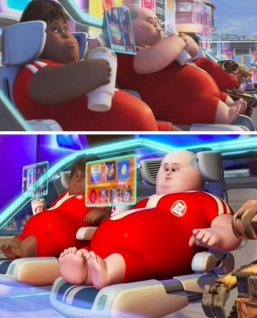 Earth on giant starliners and charged lower-echelon humans the same type of prices they charged for all their earthly GNP goods. As a result of the never-ending, rising land-fills from impulsive, Keeping Up with The Jones consumers they ironically created, Earth was no longer inhabitable. The starliner Axiom returns to Earth to retrieve another garbage compactor EVE that is not functioning. WALL-E becomes a stow-away onboard the Axiom and when he finally sees his predecessors/creators, humans. Every single one of them are grossly obese, immobile, and totally dependent on automation to do everything for them — the consequence of widespread chief-dome and no one wanting to rotate into the support roles, the blue-collar roles, the farmer roles, the plumber and garbage roles, or janitor roles. The ‘indians‘ roles.
 On the other hand, the pendulum can swing too far the other way to plutarchy and oligarchy if there is an insufficient, low-quality public education system and lack of economic opportunities/mobility to hedge against such tyrannies. If or when that occurs, some “individualized” Americans independently wealthy and above a struggling majority — what is currently the case in America today — often have the delayed pragmatic realization that looking after the welfare of others is not only good for the soul, but actually is equally good for their business and wealth. Those individualized elite who never realize this profound truth, eventually watch their empire and ivory towers crumble. Just ask the Roman Empire’s aristocracy, ask the 18th century opulent French monarchs such as Louis XVI and Marie Antoinette, or ask those executive heads of Leonard R. Rogers’ mega-tobacco corporation, or let’s ask a modern, Nobel Prize winning economist Joseph Stiglitz:




 The Professor's Convatorium