Escaping Earth & Negligence

Image credit: Thamrongpat Theerathammakorn / EyeEm via Getty Images

Earth.

She has been our only home for well over 250,000+ years. Life and living organisms, however, have been on Earth the last 3.7 billion years, as microbes. But the history of living organisms on our planet has never been a guarantee, nor has it been perpetual.

Texas is experiencing record breaking triple digit temperatures never before seen in June. And traditionally the months of July and August are intolerably sweltering, even life-threatening if outside too long. Also, it is well documented how UNreliable our Texas electric grid is during extreme temps. Very little has changed since February 2021 when we lost our entire power grid statewide.

On a global scale there have been five mass extinction events during Earth’s 4.54 billion year history. The most catastrophic extinction to date, 250 million years ago, wiped out 96% of marine life and 70% of land species. It would be millions of years for these lifeforms to recover.
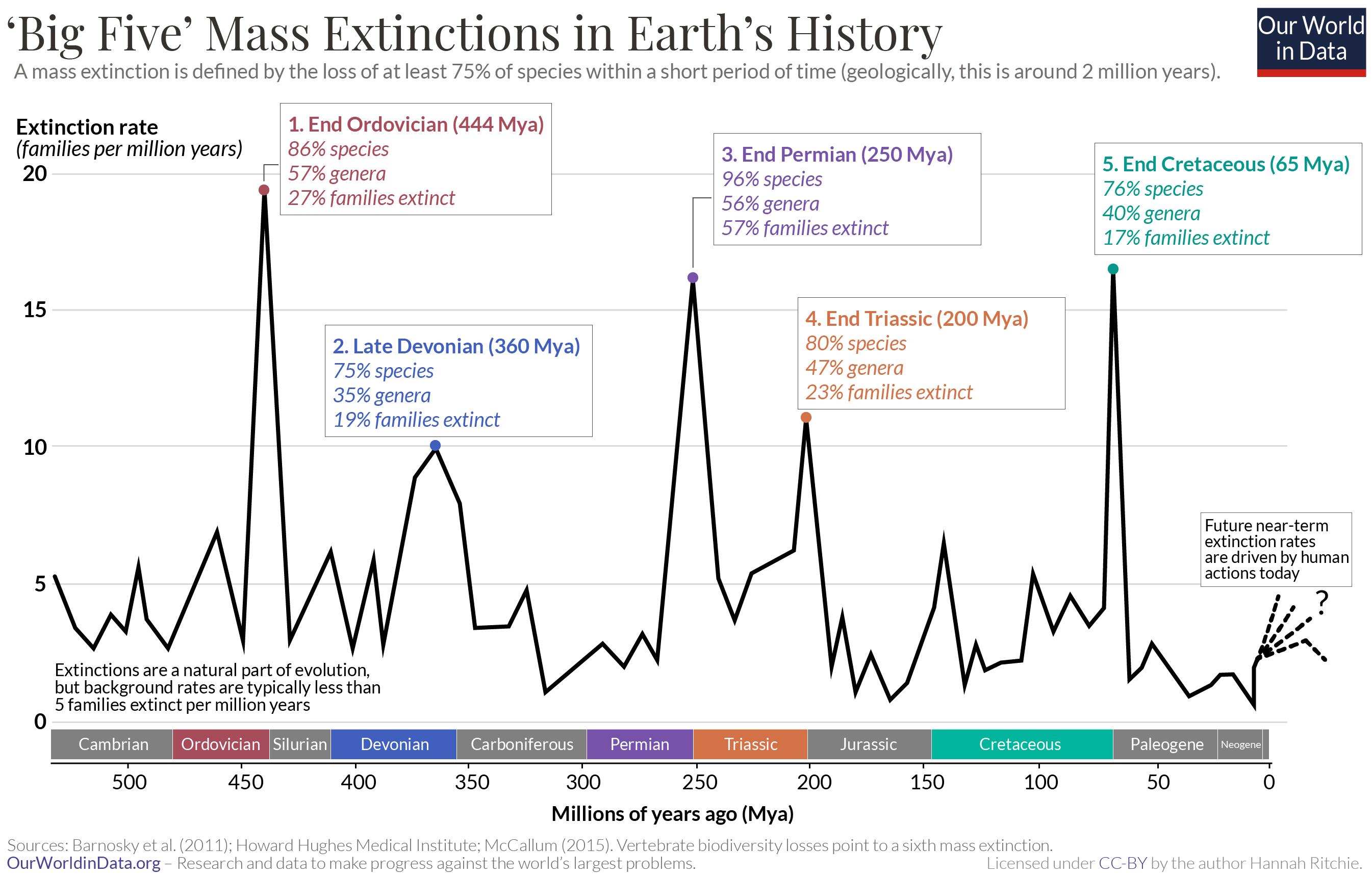
Big Five Mass Extinctions on Earth — ourworldindata.org

Is there a sixth extinction event happening now? Most scientists around the globe say yes, absolutely. I must agree with them. All five of these past extinction events were not triggered or caused by any living species on Earth. They were the consequence of terrestrial and cosmic forces, very rare and random occurrences. The current sixth extinction event, however, is intentionally self-inflicted.

Not to make light of our dire predicament, but one must admit that the 21st-century human race is no different than the fat, arrogantly smirking, boiling frog in the sauce pan. For the last 50-years we were warned repeatedly over and over and over again by expert scientists that this extinction event would indeed happen if we did not diminish then rid ourselves of fossil fuel addiction. It might now be too late to save ourselves from ourselves, save our ecosystems, our animal kingdoms, and our one and only home we have ever known.

What must be done… right away, immediately, with much haste?

∼ ∼ ∼ § ∼ ∼ ∼

The National Oceanic and Atmospheric Administration (NOAA) published a report in April 2023 stating that three key gases—carbon dioxide, methane, and nitrous oxide—which contribute to dangerous Greenhouse effects rose sharply in 2022 to levels never before seen or ever recorded.

The same warnings and alarms were announced as far back as the 1970’s and into the early ’80s that human industrial activity, mining, drilling, and pollution was a one-way ticket to extinction of species on the planet if not all living species. Now, almost five decades later very little, if anything, has changed with human activity and consumption. In fact, the data from NOAA shows it’s worse, much worse.
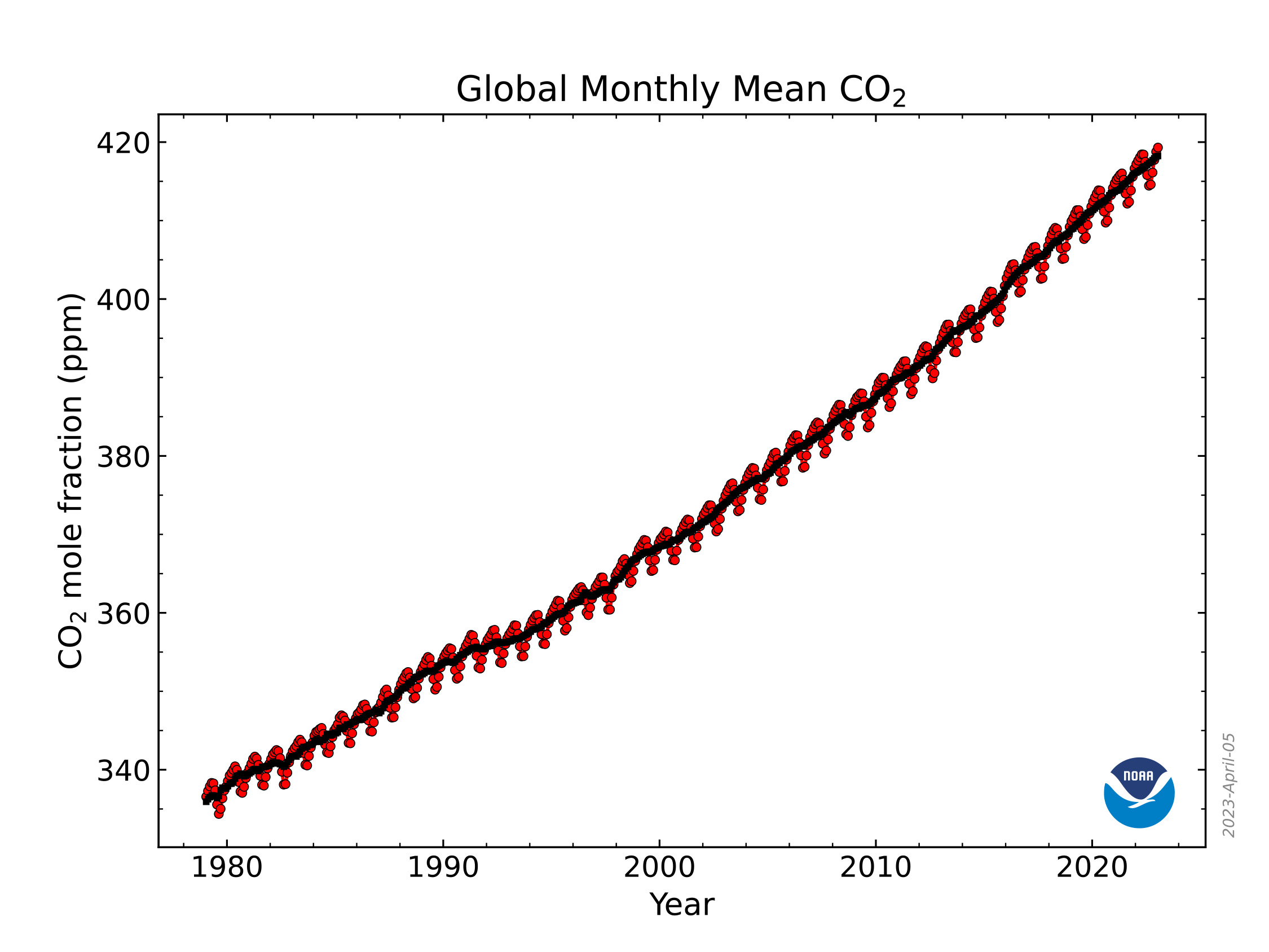
The Global Monitoring Division of NOAA/Earth System Research Laboratory has measured carbon dioxide and other greenhouse gases for several decades at a globally distributed network of air sampling sites. This graph shows monthly mean abundance of carbon dioxide globally averaged over marine surface sites. (Image credit: NOAA Global Monitoring Laboratory)

Because of the factual apologue earlier of the boiling frog, the human race must do everything possible to find another home planet. It is our only hope, if we want to save our species and some of the animal kingdom. We’ve destroyed and ignorantly neglected far too much, for far too long, toward saving this planet. It is over. We waited too long, too stupidly to do anything significant to change Earth’s demise. It’s time to get off our asses and take drastic measures, worldwide.

What has to be done, now?

Because science and her expert scientists always ask What if… what is possible? What isn’t possible, now? we do have answers to save ourselves, or at least some humans and some animals and plants. It is only a matter of applying our intelligence and ingenuity and totally abandon Bronze Age religious myths and tales of self-fulfilling prophecies of Armageddon or the End Times. Hah! Right. 🙄🤦‍♂️ Another boiling frog.

Every single day astrophysicists and cosmologists with NASA and the European Space Agency are locating numerous exoplanets for humans to colonize. The nearest habitable planet within a goldilocks zone—i.e. a planet that orbits a star/sun within an ideal distance to possess H2O and an atmosphere of oxygen and nitrogen protected from solar radiation—is 4.2 light years from Earth. That is 4.514 trillion miles away. A very, very long distance away. Easily more than two or three lifetimes away. It is called Proxima Centauri b.
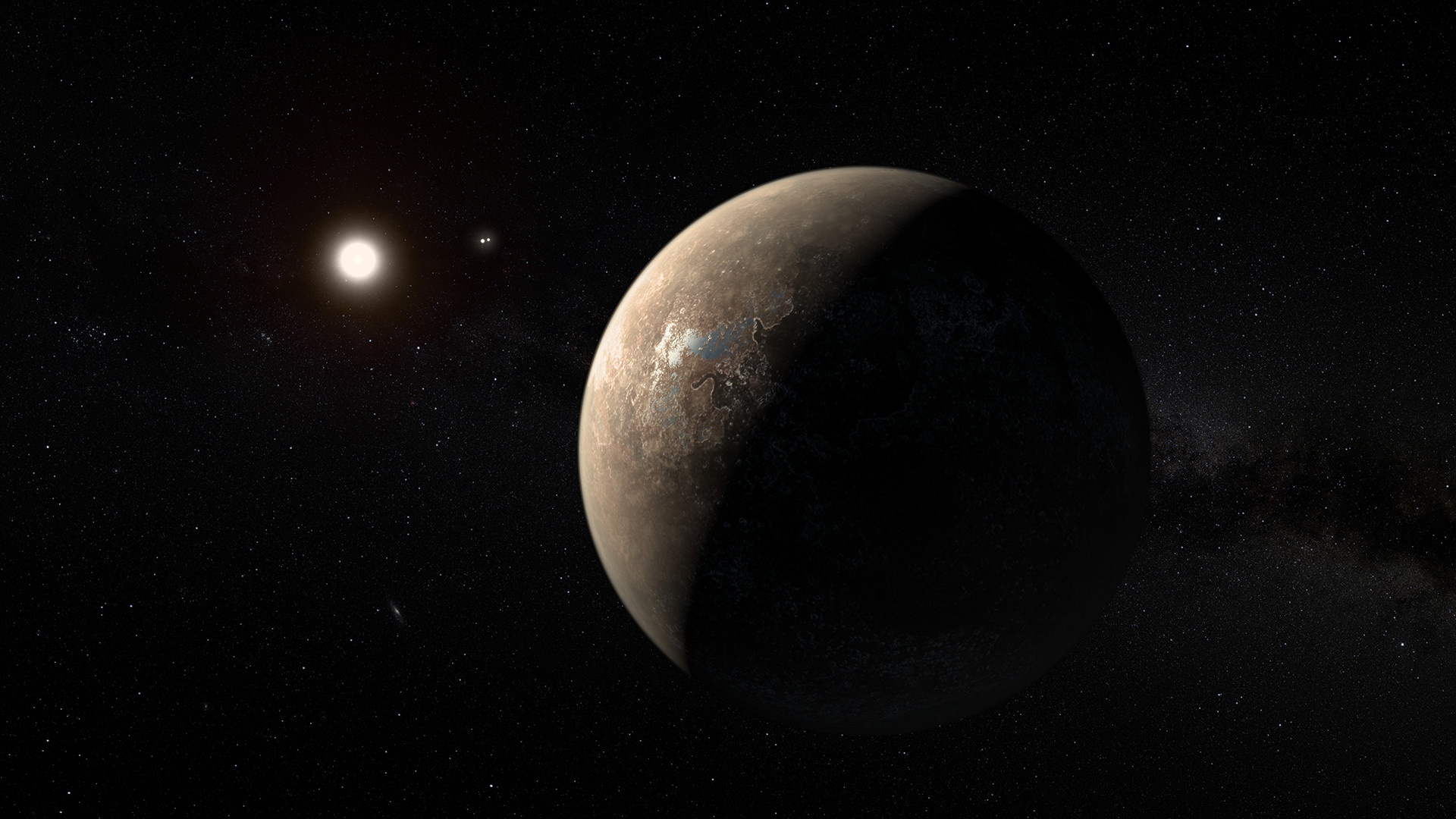
The exoplanet Proxima Centauri b, 4.2 light years away from Earth

Needless to say, if humans are to colonize an interstellar exoplanet, we must deal with its atmosphere, whatever it may consist of or not, and grow plants, trees, and animals necessary to sustain human life. Today, humanity has no other choices. It must be done and done immediately. It might still be too late. But we MUST act right now!

So… where would we go? Proxima B is the best destination right now. And there are a few other exoplanets to target. But they are further away than 4.2 light years. A staggering 25-trillion miles away (rough average) is no simple trip for a few hundred or thousands of human astronauts/cosmonauts and colonists. Planets within our own solar system are not ideal for human/animal habitation. They are extreme to say the least; nightmares actually.

Mars is perhaps a good “launching point” into interstellar space, but no more than a leaping point. Our Milky Way galaxy has over 300-billion stars with innumerable exoplanets within the ideal goldilocks zone. And there are at least over 2-trillion galaxies in the observable universe. This offers untold, unimaginable sorts of human opportunity to save ourselves and our basic way of life. To date, scientists have discovered about 3,000+ exoplanets within the ideal goldilocks zone of a star/sun.

The Red Planet Mars as a launching colony?

But if these habitable “New Earths” like Proxima B are 4.2 light years away and more, how can we possibly get there in a relatively safe and reasonable time? And does humanity truly grasp the reality of how very grim our survival and future of our children, grandchildren, and descendants actually are here on Earth? To leave Earth it will require no less than a global collaboration. Are we mature and advanced enough to do this… now? Do we really have a choice?

Astroscience, their scientists, physicists, and engineers from around the world have already taken up this challenge to save humanity, some animal kingdoms, and our vital ecosystems for human life.

Interstellar Travel

With our outdated rocket propellants (Saturn 5 at 24,000 mph), reaching Proxima B would take us over 120,000 years to reach. Completely out of the question given the apathetic disaster humans have created for ourselves here on Earth. We require more. We require better advancements.

Former NASA shuttle astronaut Franklin R. Chang-Diaz, founder of the Ad Astra Rocket Company in Houston, Texas, has developed the first phase of interstellar travel for humans. Plasma.

Charged gas particles such as plasma possess much more energy than our current rocket propulsion. It basically works like this: gas is compressed into a cavity/chamber. Inside the cavity is an antenna that shines radio waves throughout therefore turning the gas into highly charged plasma (3-5 million degrees), similar to lightening bolts in thunderstorms. A magnetic field directs the charged plasma to the smaller rear nozzle or cone of the engine creating a remarkable thrust never before harnessed by humans. With this level of propulsion spacecraft would be able to achieve speeds 10-times faster than current rocket engines. This gets us to Mars in as little as 39-days as opposed to 9-months with 1950’s – 1960’s engines. However, even with this propulsion system it would take us about 2,000 years to reach Proxima B.

Dr. Chang-Diaz states his plasma engine is not the system to take us to Proxima B, but would be the precursor to a later system more advanced and high-powered than his plasma rocket. We need technology that is even faster than plasma engines.

At the University of California Santa Barbara a team led by professor and astrophysicist Philip Lubin is developing a rocket system powered only by light. With this technology they calculate they can send a spacecraft to Proxima B in just 20-years. Light transfers energy into a panel of veins which push it forward just as its momentum carries it through air and space. Light from our own Sun has been propelling the Japanese experimental spacecraft IKAROS for over 12-years. Based on this technology Dr. Lubin’s plan is to have a six mile long array of satellite dishes and/or solar rays from our Sun directing light particles onto a spacecraft sail propelling it through interstellar space. When focused onto the sail it will accelerate the craft to 1/5th the speed of light. Yes, you read that correctly: 1/5th the speed of light.
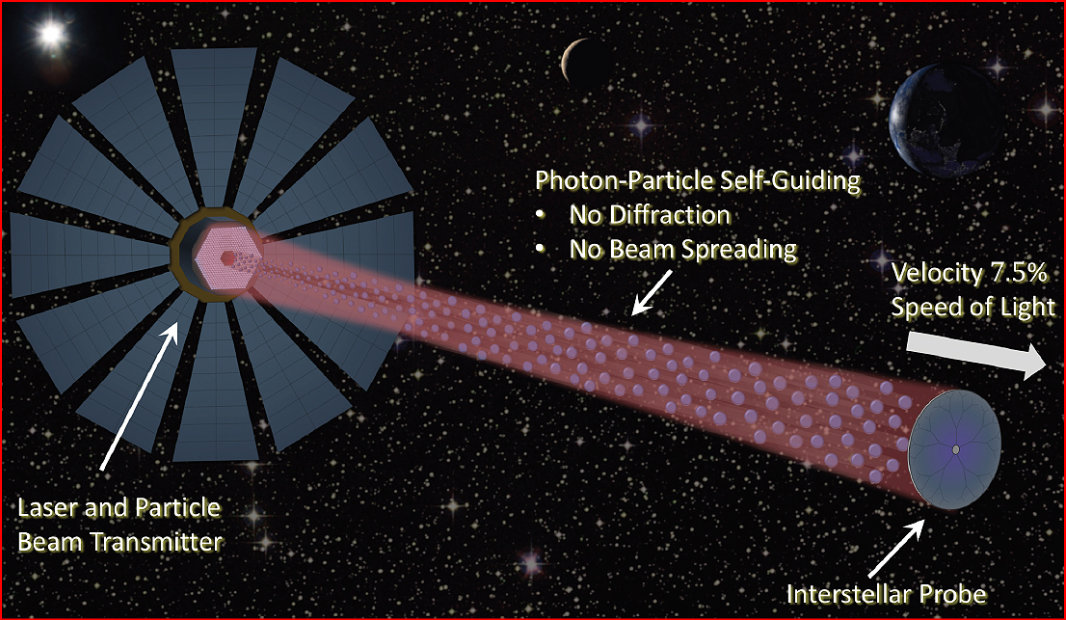
Light and/or laser propulsion for interstellar deep space travel — image by NASA

There are innumerable propulsion systems in development across the U.S. and Europe that can offer the speeds required for exoplanet colonization in reasonable timeframes.

The initial phase of this journey would be exploratory in nature to determine how viable Proxima B would be to sustain life, specifically human, animal, and plant life to eventually colonize the “New Earth” planet. But with these technological advancements come other questions and issues. How will we choose these intergalactic human space travelers? What qualities, backgrounds, skills, and talents will be needed to travel such long distances, one-way distances? How many human space-travelers should be aboard these spacecrafts?

It is very well-known that for a species to avoid extinction, biological and genetic diversity is a must. The first Proxima B colonists must be at least in the several hundreds if not thousands of human space-goers. The same applies for animals, plants, and microbes. And these missions will require several follow-up trips. We cannot expect to send 8.1 billion humans in two or three costly trips. This will undoubtedly raise many skills, experience, and moral questions such as: Who deserves to go and survive? Who deserves to stay on a dying planet like Earth?
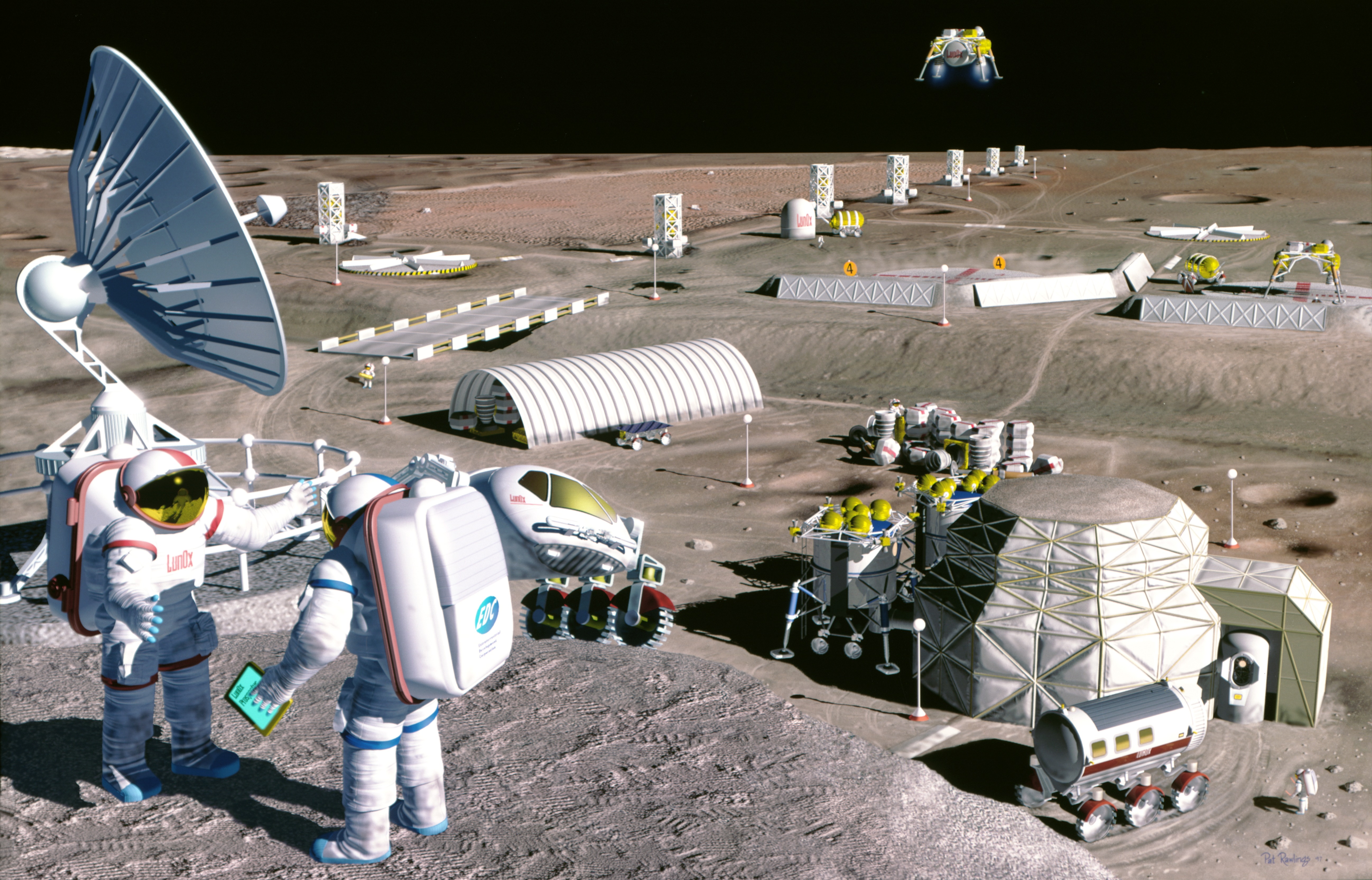
Artist rendition of a near future Moon colony — Wikipedia

Former NASA astronaut and 211-day ISS resident, Mike Barratt, says that these first, second, and third generation Proxima B colonists will have to be proficient in English and Russian languages. There’s the very first hurdle: American and Russian relations. The next hurdle is selecting the choice explorers, the choice pioneers, and then the choice colonists. Almost all astrophysicists and botanists explain that these initial generations will be critical to colonizing any New Earth exoplanet and sustaining life.

How many intergalactic human travelers will be needed to start life on Proxima B? The answer to that question becomes merely genetic and biological. If there is not enough genetic variation among the first generations of Proxima B crews, their odds of surviving the hazards of interstellar space and a new planet are drastically reduced. Does this mean we must hand pick our BEST human travelers with the BEST genetic and biological qualities? In doing so does this pose a moral bias, an unnatural selection of “better humans” over lesser, disadvantaged humans?

Population geneticist, Dr. Brandie Smith, states that in order for the human species to have a decent chance of survival and sustained life on an alien New Earth planet, they must be among a large, random selection of a highly varied genetic human population. The issue in this selection process is that humans do not know which genes and DNA to select for colonizing an alien planet, its environment and climate, and its resources which need to be used and consumed. Human specimens seen as “the best” here on Earth may not be suitable for a largely unknown exoplanet 4.2 light years away with completely different environmental factors and forces. Hence, the first generations to Proxima B must be in the upper hundreds or thousands to achieve genetic diversity. Protecting their bodies in the hostile environs of deep space will also be paramount. Radiation exposure is a continual, nemesising threat to deep space travelers along with extreme temperatures and very long spells of zero gravity.

Ethnic and genetic diversity is a must for human colonists to survive on alien exoplanets

At the NASA Johnson Space Center in Houston, Texas, every American astronaut returning from a long stay in the ISS is studied extensively for many months for the effects of zero gravity and any radiation exposure on the human body. In order to counter the negative effects of weightlessness on the human body, ISS crews are required to exercise a minimum of 2.5 hours daily—jogging, lifting, and pushing the cardiovascular system to safe levels so that muscle and bone mass loss are minimized. But even this regular routine is not enough when they return to Earth.

Landing on a distant planet after some 20-years in interstellar travel in their weakened, fragile condition, Proxima B colonists would struggle immensely to construct anything, let alone a new human civilization. ISS astronauts and cosmonauts who have been in zero gravity over 100–200 days return to Earth with the physical coordination and balance of a young 2-3 year old toddler. It takes at least 5-months for them to recover to 85% to 90% of their normal adult physiology; 6-8 months to return to 100% functionality.

Supplies to Last During Travel & On A New Earth

Food and life support systems would also have to safely last the long duration in deep space travel. That is an enormous engineering and supply nightmare, even for just 40-50 travelers, let alone 1,000+ astronauts and cosmonauts. As mentioned earlier, prolonged radiation exposure to human DNA leads to lethal cancers and birth defects to eventual Proxima B babies. How do human space travelers avoid deadly radiation and pack enough supplies, for 1,000+ space-farers, for 20–23 years in hostile interstellar travel?

Dutch pharmacologist Robert Henning, who has worked closely with the European Space Agency for the last several years, believes he has found the answer to deep space human hibernation that would save on the massive volume of food and supplies (and weight), and also protect human astronauts and cosmonauts from lethal radiation exposure: hydrogen sulfide.

Like the marmot, the arctic ground squirrel, the brown bear, and the dwarf lemur, these mammals and many more all hibernate to survive months of frigid winter conditions. This cuts back on their energy consumption during months of severe food scarcity. The breathing slows, as well as the heartbeat, and the metabolic rate all reduce by as much as 98%. Needed oxygen during non-winter months is replaced by hydrogen sulfide. Henning admits that H2S is not as efficient as oxygen, but he uses a similar chemical to put human cells into hibernation. What’s more exceptional is that when Henning exposes these hibernating human cells to lethal doses of radiation the DNA is unchanged, undamaged. His compound can safeguard the Proxima B crews from crippling and deadly cancerous radiation. Two more exceptional benefits of deep space hibernation are 1) the significant reduction of psychological stressors of long-term isolation in confined quarters and 2) mitigating the aging process of conscious travel over extreme distances.

However, new solutions to unknown complicated problems are rarely failproof over repeated attempts or journeys. There are and will be, hopefully minimal, unexpected consequences. Yet, historically with any explorations into unchartered, potentially hazardous frontiers, when was “failproof” guaranteed?

Robert Henning also acknowledges that even though he has the chemical compound to put human deep space travelers into hibernation, he does not have a solution to bringing them out of it and when to do so. NASA and the ESA have yet to devise a reliable solution either. However, there has been recent studies and findings by astrobiologists and biomedical engineers utilizing a wearable ultrasound transducer. From Associate Professor Hong Chen and research associate Yaoheng (Mack) Yang, both at Washington University St. Louis’ (MO) School of Engineering and School of Medicine respectively, describe their non-invasive technique:

Although we predict that Proxima B will have similar Earth-like conditions such as a breathable atmosphere, rocky planet (minerals and other natural resources), liquid water both on the surface and underground, slightly more gravitational pull or weight due to its mass, the exoplanet will not be identical to Earth. Proxima B will have many unknown challenges for long-term survival there.

What if Proxima B does not have an atmosphere—oxygen, carbon, hydrogen, nitrogen, and sulfur—to support human habitation or in bulk—nitrogen, phosphorous, potassium as must have elements, then calcium, magnesium, and sulfur as secondary elements—to grow healthy plants? These seven elements are critical to human and vegetation to promote and sustain life. If there are none of these elements or very little of them in the atmosphere, then what are the alternatives?

In Oracle, Arizona, at Biosphere 2, a totally self-contained, University of Arizona research lab facility to quantify the devastation and consequences of human-caused Climate Change on Earth as well as what might be possible to grow on distant exoplanets, they may have some answers. Here in enclosed domes scientists experiment and ask What can be done on/in an unsuitable, non-Earth hostile atmosphere? Since 1986 they have been compiling results of their totally sealed environment—from Earth’s currently poor, deteriorating conditions—to determine what could be constructed, maintained, and expanded on a planet like Proxima B.
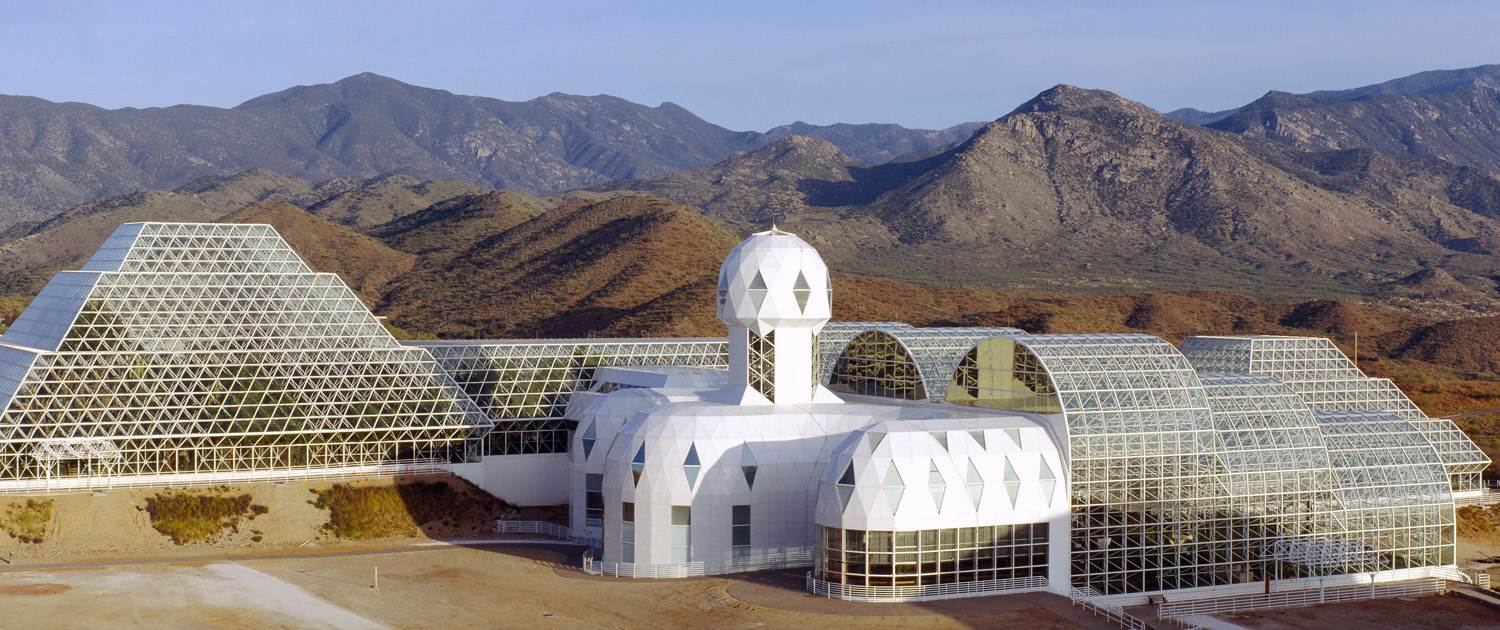
Biosphere 2 in Oracle, AZ

Under the seven glass biodomes are an ocean/sea, a mangrove wetland, a tropical rainforest, a Savannah grassland, and a fog desert. These recreated ecosystems demand an enormous amount of engineering and heavy manmade materials for their proper climates and long-term survival. Obviously, the colossal scale to make and support these biome ecosystems would be impossible to transport 4.2 light years away, or further, in an interstellar spaceship with very limited cargo space and 1,000+ crewmembers. Ah, but there is a highly industrious, foraging, building insect species here on Earth that just might be the initial solution to this monumental exoplanet challenge.

At the Kennedy Space Center in Florida, senior technology engineer Rob Mueller has developed a probable solution to large scale exoplanet biome construction: swarmies. Or another description would be swarming ants.

Mueller’s team at NASA have developed stand-alone, robotic ant-like, foraging hunters in the form of small 4-wheeled rovers, hundreds and hundreds of them. These swarmies carry lifting-claws and mineral sensors to excavate necessary resources to mine then build a basic first-stage colony for later arriving space crews. Once building materials have been identified by the swarmies their digital white pebbles and bread-crumb trail (Hansel & Gretel) is transmitted to the excavating machines called RASSOR’s. These larger mining machines collect the exoplanet’s natural resources (e.g. regolith) to be converted into bricks, mortar, rebar, polymer rope, many materials that can be used to build early stage biomes, living quarters, supply warehouses, et al.

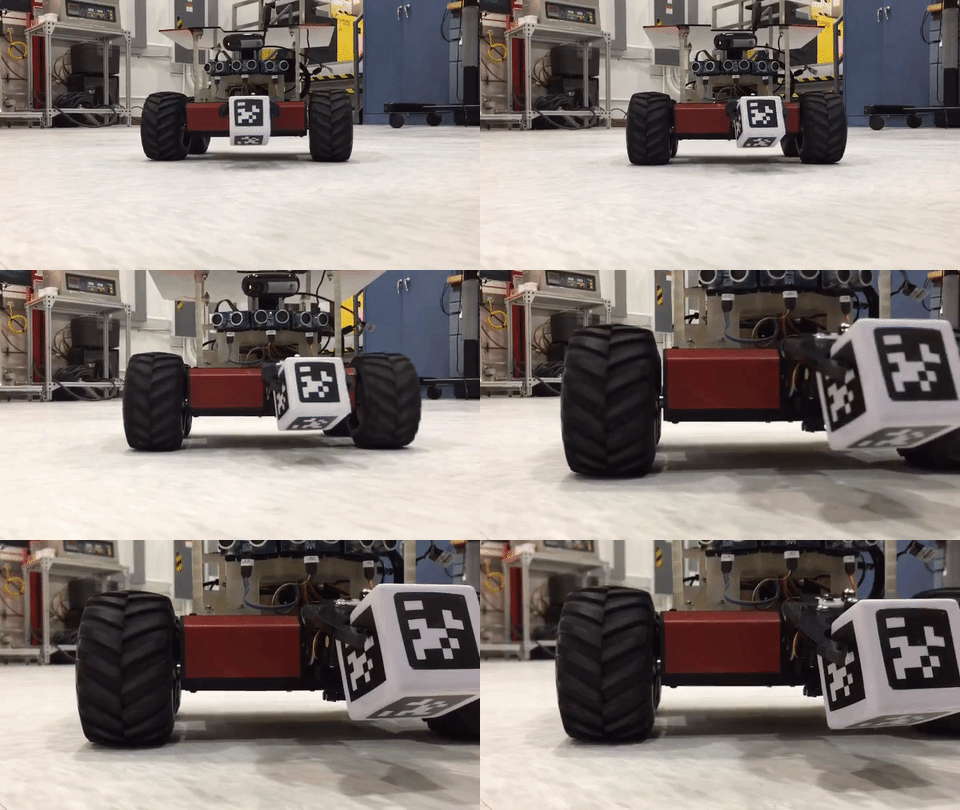
Mueller’s team have also developed a fully automated, stand-alone production/assembly line for our own Moon, Mars, and Proxima B when these raw materials are brought by the RASSOR’s for final manufacturing. By utilizing the mineral resources already present on the exoplanets, costs in weight, fuel, building supplies and materials for intergalactic space travel-colonization to Proxima B and beyond is drastically cut and minimized. Shipping all of these cargos from Earth or even our Moon would be prohibitive and unrealistic.

The ideas and imaginations of going to and building another human, animal, and plant-sustained civilization on a New Earth are no longer fantasies of science-fiction. These are not just achievable, they are now obtainable. But we are quickly running out of time, “time” to save some humans and remnants of this deteriorating, dying planet caused by human activity and many decades of lethargic negligence. Our survival is in the stars, not here.

If We Don’t Outlaw Climate Change Pollutants

For the next 10–50 years the human race, as a whole, MUST act and act aggressively right away. If not as a collective species, then at minimum every single 1st-world and stable 2nd-world nation must act as one! The bad health and condition of our planet is much, much worse than previously forecasted in the 1970’s, 80’s, or 90’s.

In addition to our fast shrinking polar icecaps, melting glaciers, warming oceans, more extreme weather events, and unstable atmosphere—to name only five frequently occurring events—one example of the fast decaying health of Earth is currently close to home for me: the Gulf of Mexico.

Since at least 2018 the Mississippi River Watershed has been washing enormous amounts of man-made nutrients into the Gulf of Mexico, particularly high amounts of nitrogen and phosphorus. These exorbitant amounts of nitrogen and phosphorus and other chemicals come from increased heavy rains and melting snow over lawns, farmlands, sewage treatment plants, chemical refineries, and other sources into all the Mississippi River’s tributaries, then into the Mississippi and finally into the Gulf of Mexico.
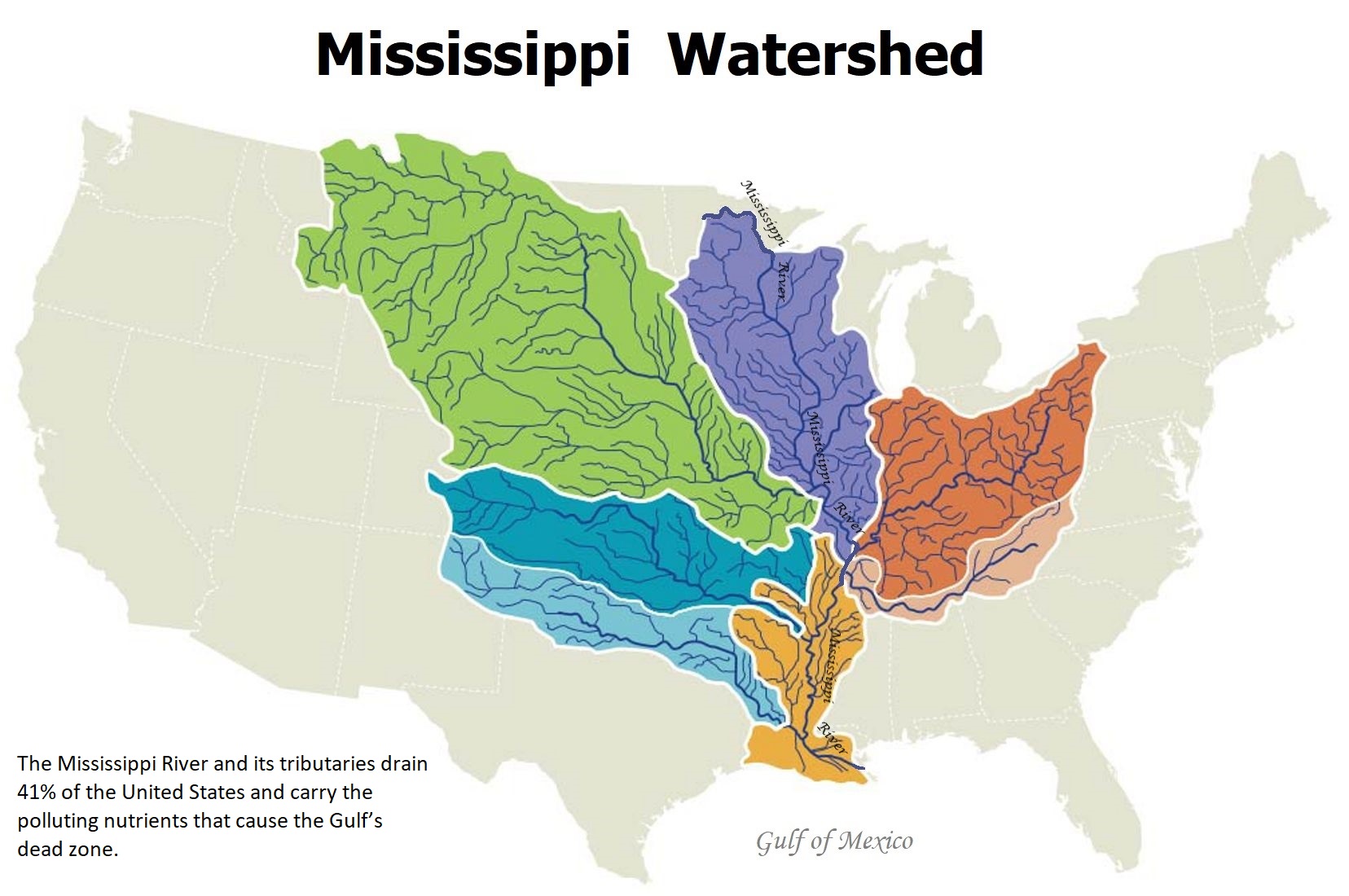
When these man-made nutrient pollutants empty into the Gulf, they trigger algae blooms that choke off oxygen in water making it very difficult, if not impossible, for marine life to survive. The impact has a negative domino effect on other ecosystems and industries. Read this report from The Nature Conservancy for more details on these severe impacts.

national oceanic atmospheric administration, “NOAA forecasts above-average summer ‘dead zone’ in Gulf of Mexico” – june 13, 2024

Examine this 37-year data collection of the Gulf’s Dead Zone Hypoxia Area below. Then imagine the 2024 forecast (5,827 sq miles) in the first image and at the far right, second image:
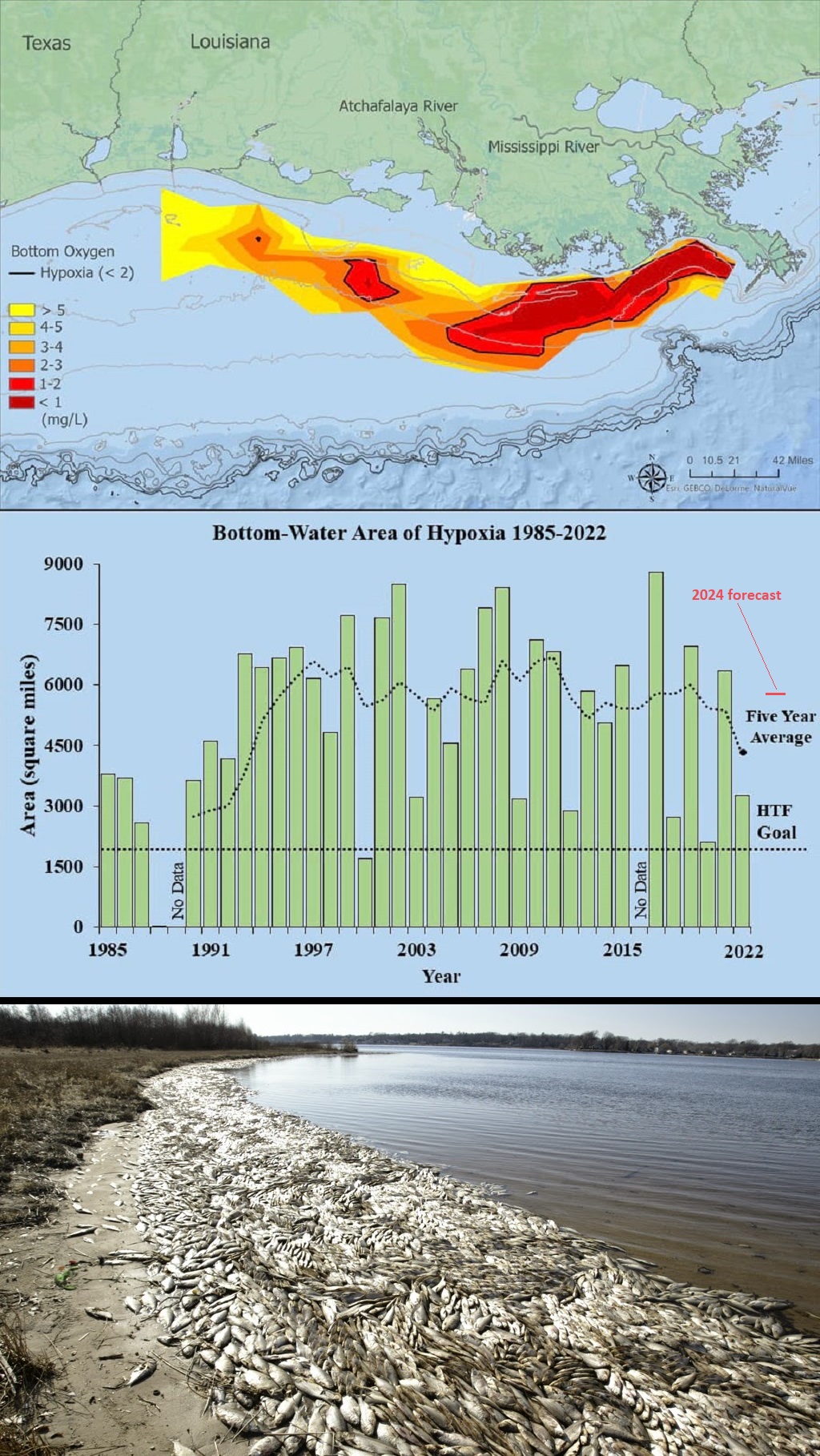
And the killed fish in bottom image are just one species of marine life

Humans, people of Earth, it is way beyond time to halt being indifferent, apathetic, self-arrogant or intentionally ignorant of what we have been doing to our one and only planet for over 50-years, technically though since 1800 and the Industrial Revolution.

Here is a short quiz: List everything humans have done the last two centuries to curb, to slow, to stop consuming/using Climate Change pollutants. List everything even in the last century or half century. What significant actions or deterrents have we, our governments, our corporations, and privately at home done that has slowed catastrophic, extinction causing climate events? Did you use two hands? One hand to name them all? Have all the well-known extreme weather events and consequences of them, e.g. hurricanes, typhoons, flooding, droughts, bigger tornadoes, animal and plant extinctions, extreme temperatures, famine, plagues, pandemics, etc., have they decreased or reversed the last 100- or even 50-years?

It does not take a genius or even an intelligent person to fully realize and admit that what humans have been doing daily the last two centuries, especially since the end of World War II, and continue to not do… is nowhere near enough. And denying or going about business as usual, day in and day out as if nothing is happening or has happened… is NOT working. In fact, the planet is much, much worse than it was in 1760, 1830, 1945, 1990, or even 2000. Wake up world, or your habitat, your own kitchen and pantry, your very existence will soon be completely destroyed. Stop the negligence and outlaw climate change pollutants. Now.

Then, get on our collective horses and giddy up, and find fast a New Earth. At this current rate the clock is at 11:54pm and will not stop ticking until 12:01am. The end of Earth. Is there honestly another alternative? Can we happy(?) boiling frogs get ourselves out of the saucepan we keep inflaming hotter and hotter?

Further reading:
Antartica Ice Sheet — Researchers Have New Melting Concerns

Death Valley Heat — Could Temps Break New Records?

More Records Broken — Daily, Monthly Records Shattered

The Professor’s Convatorium © 2023 by Professor Taboo is licensed under CC BY-NC-ND 4.0 

Earth: She Gives, She Takes

Just like as in a nest of boxes round,
Degrees of sizes in each box are found:
So, in this world, may many others be
Thinner and less, and less still by degree:
Although they are not subject to our sense,
A world may be no bigger than two-pence.
Nature is curious, and such works may shape,
Which our dull senses easily escape:
For creatures, small as atoms, may there be,
If every one a creature’s figure bear.
If atoms four, a world can make, then see
What several worlds might in an ear-ring be:
For, millions of those atoms may be in
The head of one small, little, single pin.
And if thus small, then ladies may well wear
A world of worlds, as pendents in each ear.

—— Margaret Cavendish,Of Many Worlds in This World

This slideshow requires JavaScript.

Music: “Ocean” by Azam Ali & Loga Ramin Torkian from the album, Lamentation of Swans:  A Journey Towards Silence

————

Live Well — Love Much — Laugh Often — Learn Always

Creative Commons License
Blog content with this logo by Professor Taboo is licensed under a Creative Commons Attribution-NonCommercial 4.0 International License.
Permissions beyond the scope of this license may be available at https://professortaboo.com/contact-me/.

Every 405,000 Years

Geo-core samplesFor decades astronomers have theorized that like our Moon impacts our tides, over tens of thousands of years our closest and largest planets in our solar system (Venus and Jupiter) have influenced Earth’s climate. Since Serbian astrophysicist Milutin Milanković hypothesized his Earth orbital-cycles of variations in the 1920’s affected Earth’s climates, there simply hasn’t been any sufficient physical proof for his cycles theory. Until last month.

With the further advanced technology and methodologies used on geological formations and strata (magnetostratigraphy) in correlation with the Newark–Hartford APTS (Astrochronostratigraphic Polarity Timescale) published May 7, 2018 in the Proceedings of the National Academy of Sciences, now:

…provide[s] empirical confirmation that the unimodal 405-kiloyear orbital eccentricity cycle reliably paces Earth’s climate back to at least 215 million years ago, well back in the Late Triassic Period.

This conclusion was based on the geological research of three different cores:  two from two different sites of ancient lake beds in New Jersey and New York, and one rock core 1,500-feet long from the Arizona’s Petrified Forest National Park.

The geologists noticed that lake sediment cores would disclose a consistent pattern of ancient lakes drying up then refilling over the course of hundreds of thousands of years forming different geological strata. This suggested cyclical changes in climate. The difficulty was that at the time they lacked the extensive methods to accurately date those climatic shifts. Fortunately, the Arizona Petrified Forest core, contained layers of ash from volcanic eruptions. These could definitely be dated because they contained radioisotopes.

Scientists compared and aligned the Arizona core dates to the NJ-NY ancient lake cores using bands found in all of the cores, indicating reversals in Earth’s magnetic fields. Yes, “reversals”! This allowed them to more precisely study the records. The analysis then demonstrated that the climate swings did indeed take place every 405,000 years for at least the last 215-million years, which is back through the Late Triassic Age when dinosaurs walked the Earth.

What does all this have to do exactly with Venus and Jupiter? Understanding gravitational forces by mass, Venus — the closest planet to us at 24-million miles — tugs us slightly closer to the Sun, and Jupiter — the largest planet in our solar system at 318-times more massive than Earth — tugs us slightly further from the Sun. At the peaks of those infrequent elliptical orbits, Earth has indeed historically experienced (the last 215-million years) hotter summers and colder winters with more extreme times of rain-flooding and dryer droughts

antarctic ice-strata

Antarctic ice strata also determines Earth’s climate millions of years in the past

Dr. Dennis Kent at Columbia and Rutgers Universities, specializing in paleomagnatism, states:

Scientists can now link changes in the climate, environment, dinosaurs, mammals and fossils around the world to this 405,000-year cycle in a very precise way. The climate cycles are directly related to how the Earth orbits the sun and slight variations in sunlight reaching Earth lead to climate and ecological changes.

Beyond Earth’s ancient past and astrophysics this study is a substantial breakthrough for the methods in which geologists are able to date cores and present a reliable more accurate timeline of Earth’s geologic past. It will also assist in many other scientific domains!

Paleontologist of the University of Edinburgh, Dr. Steve Brusatte:

[With the aid of APTS and newest magnetostratigraphy it] is a really important study for clarifying the Triassic timescale and untangling the sequence of events that occurred as Pangea began to split up and the dinosaurs originated and then diversified. It’s mostly a study of how to tell geological time rather than of how changes in climate relate to evolution.

Most people want to know the more immediate concern: Where are we currently in the Venus-Jupiter climate-cycle? And could Venus’ and Jupiter’s tug-cycles be responsible for our current climate-changes?

Bad news climate-change deniers. Astronomers and astrophysicists calculate that we are about in the middle of the 405k cycle. Earth’s orbit is very close to circular, not elliptical, and presently not near enough to cause disruptions in climate or global warming. The changes we have been experiencing come from some 238-years of outsized human output and input in the release of greenhouse gasses.

———

Live Well — Love Much — Laugh Often — Learn Always

Creative Commons License
Blog content with this logo by Professor Taboo is licensed under a Creative Commons Attribution-NonCommercial 4.0 International License.
Permissions beyond the scope of this license may be available at https://professortaboo.com/contact-me/.

2017: Our Past, Present, & Forecast

Surprise! I am not a fan of horse-blinders, headless ostriches, or one-tree forests. I am not a fan of shallow, baseless rhetoric or opinion unless it is cleverly woven with satire and parody. Nor am I a fan of closed systems and strong-armed boxing in. Are you asking “What on Earth is he going on about?” Fair question.

What 2017 will become for Americans, and hopefully to a minimal extent the world, will be or has been partly determined by 2015-16, the state-of-the-Union and its unionists today, and what will result in 2018 and 2019 based on the past and present. This is the final post from the previous:  2016: Cries for Mutiny.

* * * * * * * * * *
(line break)

The Past Two Years

2015 and 2016 in America saw many economic, political, social, and scientific headlines, many good as there were bad. Following are some of the biggest and in my opinion most impactful relative to the well-being of all U.S. citizens and citizens to be.

Racism, lethal violence, and gun-control, and so by default our nation’s outrageous incarceration rate, seems to never go away. The mass shootings at Emanuel AME Church in Charleston, SC and the Pulse nightclub in Orlando, FL, a popular LGBT club, were two of the deadliest shootings in recent history. The Charleston Church shooting was reportedly motivated by a 21-year old white supremacist charged with 33 counts including murder, firearms charges, and federal hate-crime charges. The murderer’s beliefs prompted continued debate over the state’s long history of flying the 19th century Confederate Battle Flag atop the state capitol building. This shooting and other similar shootings in the U.S. including the Pulse nightclub—and Roseburg, Lafayette, Chattanooga, Planned Parenthood, San Bernardino—ignited again the still never-ending controversy of racism and gun-control.

blm-march

The phrase Black Lives Matter became a common trending 2015 hashtag on social media following events such as the death of 25-year old Freddie Gray while in custody. Increased police violence and killing continued throughout 2016, primarily toward or effecting African-Americans, shockingly suggesting that the end of the American Civil War in 1865, the ratification of the 13th Amendment also in 1865, then decades later historical victories by the Civil Rights Movement of the 1960’s and 70’s never happened! It seriously begs the question whether basic human rights in America have really taken firm roots after 151 years!

On a high note, in 2015 June 26th, the White House vowed its support for the Supreme Court’s landmark decision in favor of marriage equality for same-sex couples. President Obama remarked:

“In my second inaugural address, I said that if we are truly created equal, then surely the love we commit to one another must be equal as well. It is gratifying to see that principle enshrined into law by this decision.”

But American history has shown that simple moral, ethical equality for all is still far from established, practiced, and protected within our national borders, e.g. Texas Rep. Andrew Murr in my previous post. And America is not always so embracing when it comes to foreigners and foreign affairs, despite what Lady Liberty is supposed to symbolize to the world.

refugees-in-slovenia

The European refugee crisis from war-torn nations like Syria have been an embarrassing blemish across Lady Liberty and all Americans. Tens of thousands of people fleeing from the Middle East and Africa learned harshly just how paranoid and apathetic the United States has become. Germany, Sweden, and the U.K. on the other hand opened up their arms wide taking in far more than President Obama’s plan to allow 10,000. Other foreign aid into those warring nations reached all-time highs and lows for the international community despite U.S. peace and refusal talks. Yet, these refugee figures come out of European and American sources — the numbers are anywhere between 1.1 to 4.4 million refugees in African nations, ironically where some of the poorest nations in the world are located. Hmmmm.

The U.S. economy made several headlines as well, no surprise given the upcoming Presidential primaries and election in 2016. The federal deficit indeed shrunk over 2015. The final figures came in at $439 billion, about $45 billion less than in 2014. Employment rose, unemployment fell, and for the first time in the past 7-years, 2015’s real hourly pay climbed faster than 2%. Good news, yes. However, America’s widening zip code inequality continued to rise as poverty and a lack of upward mobility became not just social and economic problems, they became bigger geographical ones too. American living standards only saw limited gains creating a false illusion of recovery. This was reflected by a contraction of aggregate supply rather than a strong expansion of demand, all according to the Brookings Institute. Therefore, now is an easy segway into America’s federal politics and “Election 2016″… a campaign year that would go down in history as infamous, to put it mildly.

In an April 2015 two-minute video, Democrat Hillary Clinton announced her anticipated second run for president. With Democratic candidates Sanders and Clinton set, the race for the Republican nomination became a wild free-for-all. Another Bush from Florida entered the race, Jeb Bush, along with no less than 15 others, including the TV-reality star and business mogul Donald Trump. From that point on, the fiery “You’re Fired!” TV personality turned the campaigns into polarizing, even comical, reality shows. Soon after, as if to get in line for the next blockbuster show, rapper Kanye West proclaimed he would run in the 2020 presidential election. Why not! Come one, come all. No experience necessary.

In November 2016, what can only be described as a stunning outcome, Trump won not the popular vote, but the Electoral College vote to become the 45th President of the United States. Yes, the rest of the world was shocked, not shocked, and Vladimir Putin and Russia loved it.

In late 2016 the Brookings Institute spoke about Trump’s economic team forecasting doubled long-term GDP as “unrealistic.”

“Labor force growth is slowing to a crawl. The population is aging, the dramatic advance of women into the labor market is waning, and male participation has been declining for decades. We will be lucky if the labor force grows by 0.5 percent a year. That means labor productivity growth would have to grow by 3 percent a year.  Over the past decade, it grew by just over 1 percent.  So the Trump administration seems to be assuming that they can more than double productivity growth. So, is a near-doubling of the GDP growth rate realistic? No. But even if it were, it would be less important than ensuring that whatever growth we have is more equally distributed. But let’s assume we can bump up the growth rate.  Even then, unless something is done to ensure that growth is more broadly distributed, the average American is unlikely to benefit very much. This lesson was reinforced recently by the release of new data showing that, on average, if you were born in 1940, you had a 90 percent chance of being better off than your parents, but the odds fell to 50 percent if you were born in the 1980s. Both lower growth and rising inequality contributed to this depressing story for today’s younger generations. In addition, the study—by Raj Chetty and colleagues—found that more equally distributing growth would be more effective at improving the average person’s life chances than simply restoring GDP growth to its golden years’ rate. In fact, in today’s lopsided economy, it would take a growth rate of more than 6 percent to revive the income trajectories experienced by middle class children in 1940.”

But don’t fret too much America. There are some very bright spots from 2015-16!

shattered-chromosome

A shattered chromosome cured a woman of her immune disease then reassembled. This is known as chromothripsis, possibly paving the way for therapies against a variety of human diseases. 2015 saw the dawn of gene editing, the rise of immunotherapy and the first hints of a drug to slow the pace of Alzheimer’s disease. NASA’s Kepler telescope found 1,284 new planets of which nine could plausibly support human life. About 800-million years ago a slight genetic mutation lead to multicellular life on Earth. An ancient molecule known as GK-PID was discovered to be the reason single-celled organisms on Earth started evolving into multicellular organisms we have today. In mathematics a new prime number was discovered, further expanding and enhancing encryption programming:  the Great Internet Mersenne Prime Search. Then perhaps one of the biggest headline for medical science in 2016 was made by the Stanford University School of Medicine! Stem cells injected into stroke patients re-enabled patients to walk again.

cryptotora_thamicola

Finally and on the faith vs. science debate, cavefish were found that could walk up walls. This showed similarities to four-limbed vertebrates. The New Jersey Institute of Technology discovered a Taiwanese Cavefish that is capable of walking up walls with the same anatomical movement as any present-day amphibian or reptile. And in the state of Utah, the Black Dragon Canyon rock-art debate was finally solved! Due to pterosaur fossils being found in the area, young-Earth creationists — who believe our planet to be only 6,000 to 10,000 years old — have relentlessly cited the rock-painting as proof that humans and the winged reptiles had walked the region together. Archaeological chemist Dr. Marvin Rowe using a photographic enhancement program known as DStretch and a technique called x-ray fluorescence,” completely debunked the creationist’s claim of the art.

There were many, many more major breakthroughs in medicine, history, and science for 2015-16 that simply could not all be listed here. Apologies.

The Present

The reviews are mixed about 2017. No surprise, right? It’s only January.

However, from a U.S. economic standpoint, the fiscal outlook for America’s “new POTUS” plans are not promising, says the Brookings Institute, and it is likely to get worse soon.

“The Committee for a Responsible Federal Budget estimates that Trump’s tax and spending proposals – the latter including replacing the Affordable Care Act, modifying Medicaid, boosting military spending, and enacting savings in non-defense programs – imply that the debt will rise to 105 percent of GDP by 2026. The CRFB report leaves out any estimate of increased infrastructure spending, which Trump has said he would like to increase by roughly $1 trillion over a decade. Including that would add further to the debt figures.”

From a political standpoint, never before has the spirit of true, pure equality for ALL Americans been so threatened (e.g. 2016: Cries for Mutiny), arguably weakened the last 2-3 decades. Racism and hate-crimes littered our nation’s news media and if 2015-16 is any barometer, it isn’t going away anytime soon in 2017. For here and now and the sake of time, I am going to focus on sex-gender identities only.

sex-gender-equality_graphic

Notwithstanding the obvious growing social trend of sex-gender equality across many states, the political-Conservative representation and processes, for various reasons, progressed at snail-paces. It took the highest court in the land, the Supreme Court, after four pivotal landmark decisions—Lawrence v. Texas (2003), United States v. Windsor (2013), Hollingsworth v. Perry (2013), and Obergefell v. Hodges (2015)—to make same-sex marriage legal in all 50 states. Can you say it took not an act of Congress, but the gavel of the Supreme Court to finally follow its majority of people!?

From the social and scientific standpoints then, the future in America has wider glimmers of hope. Since 1991 the work of doctors and scientists — like Dr. Simon LeVay and medical/university colleagues across Massachusetts and New York with their supporting universities and clinics through 2001 — has led to the progression and evolution of tangible better understandings of sex-gender dynamics. For example, in 2006 the Council for Responsible Genetics reported:

“We are sexual beings, yet this does not mean that we are born homosexual, bisexual, or heterosexual. Our sexual expression can change over time, towards different people, through different experiences. A lack of understanding about this type of human variability often leads to a perspective that our genes define who we are.

…Yet a narrow focus on the variability of sexual expression threatens to cloud the issue altogether. Without giving proper attention to the mutability of human sexual expression, questions regarding its origins and character cannot be answered. Without giving proper attention to the mutability of human sexual expression, questions regarding its origins and character cannot be answered.”

Brief on Sexual Orientation and Genetic Determinism, May 2006, citation Jan. 5, 2017 at http://www.councilforresponsiblegenetics.org/ViewPage.aspx?pageId=66

Then by 2015 more results were in…

“For men, new research suggests that clues to sexual orientation may lie not just in the genes, but in the spaces between the DNA, where molecular marks instruct genes when to turn on and off and how strongly to express themselves.”

In individuals, said [UCLA molecular biologist Tuck C.] Ngun, the presence of these distinct molecular marks can predict homosexuality with an accuracy of close to 70%.

Researchers working in the young science of epigenetics acknowledge they are unsure just how an individual’s epigenome is formed. But they increasingly suspect it is forged, in part, by the stresses and demands of external influences. A set of chemical marks that lies between the genes, the epigenome changes the function of genetic material, turning the human body’s roughly 20,000 protein-coding genes on or off in response to the needs of the moment.

“Our best guess is that there are genes” that affect a man’s sexual orientation “because that’s what twin studies suggest,” said Northwestern University psychologist J. Michael Bailey, who has explored a range of physiological markers that point to homosexuality’s origins in the womb. But the existence of identical twin pairs in which only one is homosexual “conclusively suggest that genes don’t explain everything,” Bailey added.”

Scientists find DNA differences between gay men and their straight twin brothers, by Melissa Healy – LA Times, October 2015

Stepping back from any one tree and examining the genetic or epigenetic forest strongly suggests that ancient and long-standing social-theological traditions of strictly an unbending binary paradigm in post-modern Europe and modern America are fast fading into fallacy. For the future growth of higher human virtues and education, this is great news!

ngm_genders

This very month one of the most iconic American magazines, National Geographic, released their double-issues on the gender revolution. Since I can remember over the last 25+ years, this bold highly controversial step by a world-renown organization is long overdue in the U.S.! It paints the reality of the changing social stigma of sex-gender identity bringing it to our public squares to define the correct precise terms so misunderstood, and looks closely at the cultural, political, social, and most importantly the biological aspects! These are must copies for your personal library.

Topics the magazines cover include Helping Families Talk About Gender, Girls, Boys, and Gendered Toys, the power and influence of our society’s binary Color Code on American children, a deeper look into children’s animated films of popular characters:  Who’s the Fairest?, a detailed graph of Where In the World Are Women and Men Most-and Least-Equal, candid first-hand reports from 9-year olds around the globe of How (in their countries) Gender Affects Their Lives, Rethinking Gender: Can Science Help Us Navigate?, and then the lengthy article, Making A Man: How Does A 21st-century Boy Reach Manhood? that I found astonishing. And those articles and graphs are merely the first-half of the first magazine!

“Enveloped by the men of his family and Hasidic faith, Levi Tiechtel celebrates his 13th birthday at his bar mitzvah in Queens, New York. For millenia, Jews have been performing this ritual, which commemorates the [supposed] age when a male becomes accountable for his own actions and sins.”

Making A Man: How Does A 21st-century Boy Reach Manhood?, January 2017 National Geographic, pp 86-87.

From 800 BCE Sparta to 1930 Italy and United States, “cultures have devised [not genetics or epigenetics necessarily] myriad practices and rituals to make boys into men. The methods — often secret and sacred — vary widely and continually evolve, says cultural anthropologist Gilbert Herdt. But they also share some universal themes that broadly reflect a community’s values and the roles its men are expected to play.” At such a young malleable age, in several cultures around the world, America included, it makes the decision to conform or not conform daunting or near impossible until perhaps an older age of increased independence and exposure to the world’s endless variety.

The Possible-Probable Forecast
us-map-state-flags

Based on what I’ve written in this post and previous posts, my life experiences as an 8th-generation Texan as well as American, my 28-year futebol-soccer career across 4-of-the-6 inhabitable continents exposed and engrossed to a multitude of native cultures, the copiousness and curse of the internet, and my unconventional journey from young agnostic, to evangelical-fundamental Reformed theology with church leadership and practice, back toward a Freethinking Humanist today… and now an evolving, learning, and hopefully teaching social-sciences from basic chemistry to Quantum Physics, I would say the next 2-6 years in the United States looks promising through several lenses on the social and scientific fronts, but ominous on the economic and political battlefields. Why?

After 241-years as a nation and about 182 for Texas, we have nurtured the freedom to continually push the envelope of social refinement and scientific exploration, granted in pockets of the country, while also nurturing the fear of change and the consumer rewards of self-reliance and exclusion. When we examine the entire American forest over the lifetime of our nation, we stand at a pivotal ridge on our future’s horizon. Either we embrace a bigger global community, reverse the return or nuisance of old uncivilized ideologies which have crept or will creep back in, and instead keep pushing the scientific thresholds… else we risk increased fragmentation, polarization, and socioeconomic collapse in  a few more generations, if not sooner.

I hope my seat behind this windshield and the view through my/our rearview mirror is different or temporarily malfunctioning! (half laughing, half nervous)

Tell me your thoughts and suggestions below. Whether you are American or not, I’d like to read them.

(paragraph break)

Live Well — Love Much — Laugh Often — Learn Always

Creative Commons License
This work by Professor Taboo is licensed under a Creative Commons Attribution-NonCommercial-NoDerivatives 4.0 International License.
Permissions beyond the scope of this license may be available at www.professortaboo.com/contact-me/.

Stay or Go?

(paragraph break)

Nothing is so dangerous to the progress of the human mind than to assume that our views of science are ultimate, that there are no mysteries in nature, that our triumphs are complete and that there are no new worlds to conquer.
Humphry Davy

(line break)

My youth soccer head coach obviously didn’t want me to leave our U-17 team or the south Dallas league in which I had played the last eight seasons accumulating notoriety, awards, and trophies both for myself, him, and the team. But the fact remained:  in 1980 the OCSA paled compared to the NDCCCL of north Dallas-Plano. In south Dallas I was only a semi big fish in a small pond. I knew too well that if I were to have a chance to play at the highest levels possible, I had to travel over 20-miles there and back, 2-3 times a week and every weekend where the top flight players, teams, and coaches were competing; it had to be done.

If my parents and I had listened to many of the naysayers, I wouldn’t have achieved a sizable college soccer scholarship, been mentored and coached by two world-class former pro goalkeepers, started all four collegiate years, awarded MVP and All-Tournament Team in the 1982-83 NAIA National Championship tournament, awarded one NAIA Honorable Mention All-American (sophomore year), one NAIA second-team All-American (junior year), and two first-team All-American awards by the NSCAA and NAIA my final year, then I likely could not have gone on to a rewarding pro and semi-pro career the next 11-years on three foreign continents then back to the U.S., retiring in 1996.

I can gratefully and humbly say through firsthand experience that sometimes (many times?) the rewards are so worth the risks.

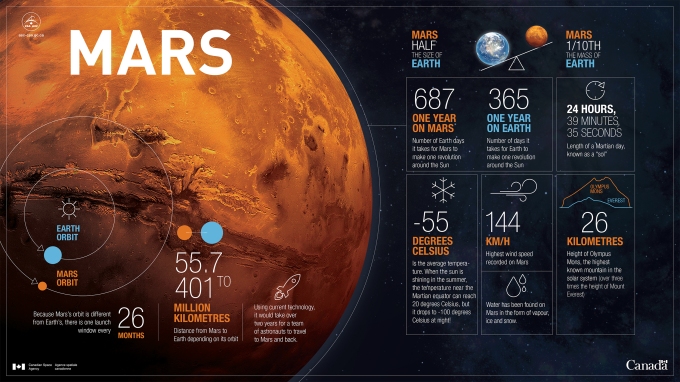
In the course of human endeavors of progress, better understanding, advancement, and evolving and promoting our species, we have reached another crossroads:  interplanetary exploration and colonization. Mars. Should we do it? Should we stay put or should we go?

Because of the upcoming 6-part National Geographic Channel  series Mars premiering Nov. 14, 2016, I stumbled into an intriguing discussion with a good friend of mine about colonizing the nearby distant planet. Though he is a big Star Trek fan and all for space exploration, my friend had some valid points. Here’s how the banter went:

Friend:
A crappy Earth with problems would be better than Mars, Moon Colonies, etc. The only viable solution is a nearby habitable planet very similar to Earth. If we had the technology to colonize & terraform, we certainly would be advanced enough to heal our own planet. There are too many things we are interdependent on to leave Earth behind just yet. Besides distance, even an Earth-like twin planet would have many hidden obstacles to colonization.

mars-by-the-numbersProfessor T:
Similar warnings were also given to Magellan, Dias, Drake, Vespucci, Pizarro, Erik-the-Red, Ulfsson, Herjólfsson, Zheng He, and several others. Why did they not listen? (wink)

Friend:
LOL! That’s nowhere close to being equitable. Not apples and oranges! Apples and iPhones! It’s not a warning, it’s simply thinking ahead. I am by no means well versed but I know enough that Space is even less hospitable than Mother Nature here on Earth. If you saw The Martian, read the book, then listen to the author as he explains in interviews what he had to extrapolate technology wise and fudge(!) just to make that story work.

Professor T:
Not really arguing your very valid points. But like the Serengeti wildebeests, gazelles, zebras, buffalos, etc, that annually cross the Grumeti River which they all know is FULL of hungry happy crocodiles and almost certain DEATH… yet they cross it, and many/most of those migrating animals cross multiple times in their lifetimes! Now explain to me why it is human nature and animal nature to constantly take risks, including paramount life-threatening risks!? (wink)

Friend:
You are definitely from the Berenstain Bears timeline.

Professor T:
Bwahaha! Are you implying that I enjoy children’s storybooks and such pleasure might reflect a similar intellectual capacity!!!!? Then if so, you’d be correct Sir. (wink)

Friend:
Ha, ha! No, it’s a “thing”. Google Berenstain/Berenstein Bears, Mandela phenomenon, etc. I’m just joking though.

Professor T:
By the way, as you know, I loved The Martian! Haven’t read the book yet, but the film was excellent!

Friend:
If you lived closer, I’d let you borrow my copy.

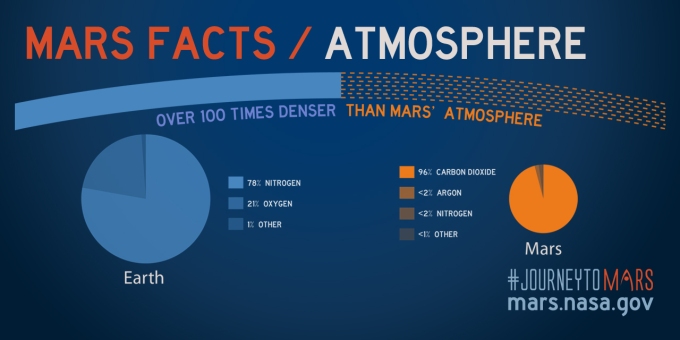
atmosphere-mars-facts

from NASA’s website http://mars.nasa.gov/

The history of human exploration is indeed littered with many failed expeditions, fatalities and disasters. Perhaps the more notable ones just on Earth were The Narváez Expedition (1527), Hudson-NW Passage Expedition (1610), The Reed-Donner Party (1846), The Franklin Expedition (1845), and the 1996 Mount Everest Party to name just five. Moving out from Earth we have the doomed space disasters of several Russian Soyuz flights, NASA’s Apollo 1 (1967) and near disasters of Apollo 13 (1970) and Gemini 8 (1966), the 2003 Colombia Space Shuttle, and of course the 1986 Challenger Space Shuttle. Why haven’t we learned that stepping outside of our cozy, known (safe?) comfort zones could turn into a debacle or fatal tragedy? What is our malfunction? (laughing)

Is there really a need for further space exploration and interplanetary colonization at the risk of more deaths? Why or why not?

(paragraph break)

Live Well — Love Much — Laugh Often — Learn Always

Creative Commons License
This work by Professor Taboo is licensed under a Creative Commons Attribution-NonCommercial-NoDerivatives 4.0 International License.
Permissions beyond the scope of this license may be available at www.professortaboo.com/contact-me/.