Games of Unknowledging – Conclusion

A Closing Preface

I must confess that four months ago when I chose to tackle this subject and new field of study for a blog-post or two—that turned out to be four—I had little idea it would be so laborious and challenging for me. Not only was it formidable over time, but it was equally demanding of quality representation, of which I feel I have failed or sacrificed in some ways. For that I apologize. I likely bit-off much more than I could chew. And though my current personal situation has made my time reading, researching, blog drafting, blog writing, and publishing difficult and quite limited, I do hope this conclusion is sufficient enough to glean from the whole, some expansion on a little known, little taught or discussed subject:  ignorance. If nothing else, I hope these four parts have invoked a deep curiosity to learn and know more about what we don’t know, for it is great, it is endless, and paradoxically attainable.

∼ ∼ ∼ § ∼ ∼ ∼

Previously in Part III, I examined the colorful ways we fabricate facts, or our conscious intentional lying, and how to discern and reveal their motives and utilization. I also covered how North and South American indigenous fossil knowledge and their worlds became lost or entirely omitted from Euro-American archaeological records. Then finished with how to understand the benefits and advantages of historical-interdisciplinary hindsight. In doing so this groundwork offers a comprehensive, enlarged intellectual body of reliable context as well as a necessary reversal of or counter to explicit and implicit ignorance in the U.S.

In this conclusion I want to very briefly touch on white, or Anglo/Caucasian ignorance, explore the social theorems of ignorance, and then ask Where are America’s public intellectuals, who might they be, and why today are they few and far between? and provide plausible answers. Let’s jump right in.
(line break)

Anglo/Caucasian Ignorance

A few summers back as my two kids, my Mom, and my sister and I were seated around the dinner table, the discussion turned to American history, a subject that mostly interested my 15-year old son, but usually made my 22-year old daughter, Mom, and sister roll their eyes. When I made my point that our nation’s White House, the Capitol building, and some other government buildings were built by African-American slaves, I got facial expressions of pause, silence, and astonishment. Their faces said it all. As a state certified educator in Texas, I was not surprised by their baffled, yet silent responses. This tidbit of historical fact and its implications generally does not make it into state-approved classroom textbooks nor is it required by the state’s core-curriculum as critical learning. Thus, we have a classic case of anglo-caucasian (white) ignorance. I rather like this introduction…

White ignorance…
It’s a big subject. How much time do you have?
It’s not enough.
Ignorance is usually thought of as the passive obverse to knowledge,
the darkness retreating before the spread of Enlightenment.
But…
Imagine an ignorance that resists.
Imagine an ignorance that fights back.
Imagine an ignorance militant, aggressive, not to be intimidated,
an ignorance that is active, dynamic, that refuses to go quietly—
not at all confined to the illiterate and uneducated but propagated
at the highest levels of the land, indeed presenting itself unblushingly
as knowledge.
Charles W. Mills

Professor of philosophy at the City University of New York, Dr. Charles W. Mills believes by clarifying and demarcating historical white domination and its ramifications, as well as examining the individual and social processes of cognition with regard to race, we can start to understand how best to achieve multiracial enlightenment that garners short-, mid-, and long-term benefits not just for a few, but for all humanity.

White Domination & Ramifications
Dr. Mills finds ten components to clarification and demarcation. I will point out four I find particularly important.

  1. Race as a cognitive phenomena historized — white domination has been and still is a social-structure, not a physio-biological structure. “Whites” did not exist in the ancient world.
  2. Leaving white paradigms — “White” in white ignorance doesn’t need to be confined to just white people. To a greater or lesser extent this has existed due to power relations and patterns of ideological hegemony.
  3. Male ignorance — ignorance of the male gender must be analyzed equally as it is far more ancient, going back to the very origins of patriarchy.
  4. Avoiding false beliefs — gaining a broader understanding of white ignorance is not only sociological, but normative too. Flawed patterns of cognition are promoted or propagandized by certain social models and group membership as are truthful-moral ones.

Individual & Social Processes of Cognition
Before getting into Dr. Mills’ work below, watch this 6-minute video. It is a prime example of Memory and Testimony discussed below and how to incorporate it into social cognition:

An examination of white supremacy and its historical dominance, injustice, and ignorance cannot be done without understanding the influences of individual and social processes of cognition. Separating out these various components can be demanding for they are in perpetual interaction with each other. For example, when an individual discerns, they do so with sensors that have been socialized. Keeping this in mind, Dr. Mills analyzes five dynamics that I will summarize:

Mercator Projection map
Mercator projection without “human” imposed borders
  1. Perception — in general, perceptions and conceptions are practically one in the same, so tightly related that often they’re indistinguishable. Individuals do not create these categories, we absorb them from our cultural contexts. Two prime examples are the world’s continents, they’re sizes, and the term savages and its origin and context. They beg the questions, Why is Europe a continent and say India or Eurasia are not? And savage originated from Anglo-French cultures in the 13th century, the Age of Exploration and Colonization by European superpowers, and implies a person/people of uncivilized, primitive, dumb behavior and inferior to the designator(s). Why is this context assigned to savage? Does it justify imperialism, conquest, and domination? The context of savage continued into the 18th century and found its way into one of our most enduring U.S. documents:

    When Thomas Jefferson excoriates the “merciless Indian Savages” in the Declaration of Independence, then, neither he nor his readers will experience any cognitive dissonance with the earlier claims about the equality of all “men,” since savages are not “men” in the full sense. Locked in a different temporality, incapable of self-regulation by morality and law, they are humanoid but not human.
    Charles W. Mills

  2. Conception — this aligns us to our known world. The unknown world, however, is assessed and judged not with the discreetly detached concept, but viewed and judged through the concept. Very rarely does an individual resist this societal bias. And here is the baffling irony of this egocentric, white-centric condition which surrounds the word savage:

    In the classic period of European expansionism, it then becomes possible to speak with no sense of absurdity of “empty” lands that are actually teeming with millions of people, of “discovering” countries whose inhabitants already exist, because the non-white Other is so located in the guiding conceptual array that different rules apply. Even seemingly straightforward empirical perception will be affected—the myth of a nation of hunters in contradiction to widespread Native American agriculture that saved the English [e.g. Jamestown] colonists’ lives, the myth of stateless savages in contradiction to forms of government from which the white Founders arguably learned, the myth of a pristine wilderness in contradiction to a humanized landscape transformed by thousands of years of labor (Jennings 1976). In all of these cases, the concept is driving the perception, with whites aprioristically intent on denying what is before them.
    Charles W. Mills

  3. Memory — it is sadly ironic that as I get to memory of the individual and/or social cognitive process that events such as those in Charlottesville, Virginia, Aug. 12th occurred. It reiterates just how crucial it is to understand the fluid interconnectedness of these five components, including memory, and how it relates to white knowing and unknowing due to denial of requisite facts. While understanding collective memory, we must also understand collective amnesia. They always go hand-in-hand. We remember the Holocaust primarily because Hitler and Nazi Germany lost the war. But what about the Pequots, the Nama, the Tasmanians, the Beothuks, the Congolese, the Hereros, or the Armenians? What about the Native American Cherokees or any of the over 200 tribes on the continent? What about 19th century antebellum slavery, killing rebellions such as Nat Turner’s, and the atrocities throughout the American Civil War? Today, over seven generations later, Americans still confront their historical identity and memory over the Standing Rock Reservation oil-pipeline and Charlottesville, VA over a Robert E. Lee statue and what it means.

    As the individual represses unhappy or embarrassing memories, that may also reveal a great deal about [their] identity, about who [they are], so in all societies, especially those structured by domination, the socially recollecting “we” will be divided, and the selection will be guided by different identities, with one group suppressing precisely what another wishes to commemorate. Thus there will be both official and counter-memory, with conflicting judgments about what is important in the past and what is unimportant, what happened and does matter, what happened and does not matter, and what did not happen at all.
    — Charles W. Mills

  4. Testimony — How do you know your exact birth date? Your knowledge of your birthday is most certainly told to you by those there in the delivery room, your mother and father, and perhaps doctors and/or nurses there at the time. Hence, your beliefs about your birth time, place, month, and year are through testimony. We are quite dependent on others for what we know and this most certainly involves elaborations of social epistemology. Those elaborations also come from other previous individual and social epistemic elaborations and so on. In cases of veracity and neutrality, it bears significant impact to ask ‘testimony by whom and for what (possible) interests gained or lost?
  5. Motivational Group Interests — these can be found in varying strengths with any political, religious, economic, and/or sports groups with common interests. What these sorts of groups demonstrate are what is commonly known in cognitive, developmental, social, clinical, and neuropsychology as hot cognition (as opposed to cold/unemotional) associated with physiological arousal responding more to environmental stimuli. Peer-assimilation is another aspect of hot cognition. This certainly applies to racial grouping and “color-blindness” as well.

Though he speaks primarily on the African-American plight in the U.S., in this following video-clip Harvard University Fellow and MIT Professor Noam Chomsky talks about white domination and racism from the historical record. This really applies to all non-whites in America and the world, does it not?


Social Theorems of Ignorance

Is ignorance simply the absence of knowledge? The sum of society’s ignorance is much greater than the sum of our knowledge. Yet, how much do we really know about social or collective ignorance? Where does social-collective ignorance come from? How much do we impose it upon someone or upon ourselves? What role does social-collective ignorance play in interactions, group relations, in institutions, in civil, business, and criminal law, and managing risks? Typically our societal norms give negative connotations to ignorance, but when might it be preferrable not to know something? Can it be a virtue?

Dr. Michael Smithson, Professor of Psychology at the Australian National University, has been working in the area of uncertainty and ignorance for many years. He takes an interdisciplinary approach to socially produced uncertainty and ignorance and believes one must begin with defining what social ignorance is and is not.

Socially Produced Ignorance: What It Is and Isn’t
Social ignorance is 1) emerging, it is 2) partially constructed by society, and it is 3) imposed. It is manipulated deliberately or as a by-product of some social movement or process. It is also typically at a macro-level of large groups within power relations. As far as how kinetic ignorance is managed (4) it is typically at the micro-level with individuals and how those individuals conceptualize, represent, negotiate, and respond to ignorance. Thus, the managing agent is often indirect or as a spectator concerning the thinking and behavior of ignorance. These are four theorems of social ignorance.

Social ignorance is not the external world and how it arises in non-social settings. For example, the non-social settings would be science and the limits of science. It also includes epistemological and religious frameworks that make assertions about non-knowledge or meta-knowledge in exogenous non-social terms. It is not a managing under kinetic ignorance either. In other words, how people/groups think and act in uncertain environments, and not artificially generated under theory.

Negotiated Ignorances
There are at least five different negotiated ignorances between social (or at least interpersonal) arrangements of ignorance. A sixth could be time, or the lack of time, to adequately understand dynamics of an event, place, or person, but for the sake of time (no pun intended), I will very briefly cover these five:

Specialization — is simply an admittance there is too much for any one person to learn everything exhaustively. Hence, spreading the perceived risks can be achieved in three ways:  1) diversified learning rather than direct or narrowed learning, 2) therefore, concurrently diversified ignorance is created, and 3) acquired knowledge is also diversified via social collaboration.

Privacy — another social ignorance arrangement which is not necessarily controlled access to information by others about self, but can also be consensual with trusted persons or experts. Secrecy is imposed unilaterally, but privacy involves levels of risk. And trust is interconnected within organized specialization.

Trust — is a state of perceived vulnerability or risk. Dr. Smithson (on Yamagishi) elaborates:

[Toshio] Yamagishi and his colleagues argue that trust and “commitment formation” are alternative ways of reducing the risk of being exploited in social interactions. Commitment formation involves the development of mutual monitoring and powers to sanction and reward each other’s behavior. However, the reduction of transaction costs in commitment formation via uncertainty reduction comes at a price, namely the difficulty and costliness in exiting from the relationship and foregoing opportunities to form other relationships. Trust, on the other hand, entails running the risk of being exploited but increases opportunities by rendering the truster more mobile and able to establish cooperative relations more quickly. Trust, therefore, is both an example of a social relation that requires tolerance of ignorance and also trades undesired uncertainty (the risk of being exploited) against desired uncertainty (freedom to seize opportunities for new relations).”

Politeness — is another example of how social relations trade on ignorance. Within formal public conversations people typically don’t expect to first place their hand on a bible and state “the truth, the whole truth, and nothing but the truth.” The strategies a talker may utilize are varied in creating disinformation, e.g. promoting a false impression of approval, or agreement, or offer tactful brevity, vagueness, or ambiguity. However, this latter strategy is not always negative because it could nurture healthy adaptability or change due to diverse interpretations.

Legitimation — social ignorance is also used in a number of facades to vindicate inaction, keeping the status quo (also known as business as usual), opportunism, evasion of responsibility or liability, and risk management strategies. Our American legal differences between civil cases versus criminal cases, as one example, are where a verdict in the former can be given on probabilities and in the latter it must be given “beyond reasonable doubt.

“Licit” actions and choices done on the basis of social ignorance are abundant in our mundane life as well. As previously discussed in this series, legitimizing high-level federal policy change, or non-change, use (abuse?) the precautionary principle, e.g. climate change counter-measures.

Is Social Ignorance Always An Insight-Deficit?
Contrary to popular belief, ignoramuses are not always at a disadvantage. There are cases where they are better off than very knowledgeable people. Case and point, if you could be told exactly when and how you were going to die, would you want to know? Why or why not? Would you want your spouse and children to know the details of your death? Why or why not? Often in the field of counseling where doctor-patient confidentiality existed, I found myself in the position of aiding social ignorance between spouses, family members, employers or a circle of friends for legitimate reasons, e.g. one spouse’s history of unfaithfulness, in order to maintain necessary therapeutic stability. Many spouses/partners don’t care to know intimate details of former lovers/spouses. Dr. Lael Schooler and Ralph Hertwig, both of the Max Planck Institute for Human Development, assert from their research that forgetting facilitates the use of inferential heuristics that also trade on environmental structures.

What I hope has been adequately conveyed here is that ignorance, particularly social ignorance, is quite prevalent. It exists practically everywhere, including with yourself.  It is predominantly socially structured. Accordingly, it deserves as much attention, monitoring, and updating as one’s repository of knowledge. This, our social and individual human ignorance-condition, I hope would conflate wise, cunning humility and not inflated arrogance. Therefore, how might we as social parts of a whole get regular checkups, quarterly or annual appraisals of our cunning humility and/or inflated arrogance? Glad you asked!

America’s Public Intellectuals – Questions

What does intellectualism mean? After this four-part series, is it possible for intellectualism to thrive and coexist with ignorance? Should that even be questioned? Can intellectualism guide ignorance and ignorance guide intellectualism offering more balance, more tolerance? In our modern age of technology and data-overload, are we too knowledgeable, too informed?

Today, we are not necessarily uninformed, but so over-informed it forces our cognitive capacities to seek out preferable trigger-topics and information that bolster our own perspective. That is most certainly a self-imposed ignorance and to degrees social ignorance. On the aforementioned section of social ignorance, sociologists define that as a neo-tribalism tagged with near-fanatical insistence on cohesion and monism in a world, its Nature and fauna that is anything but monistic or binary. Within this neo-tribalism, humans — perhaps just advanced primates at this point? — historically have resorted to bullying and moral castigation to keep their own status quo. But at what cost? Many public intellectuals agree:  the egghead is dead, replaced by chest-beating activists. That may be true.
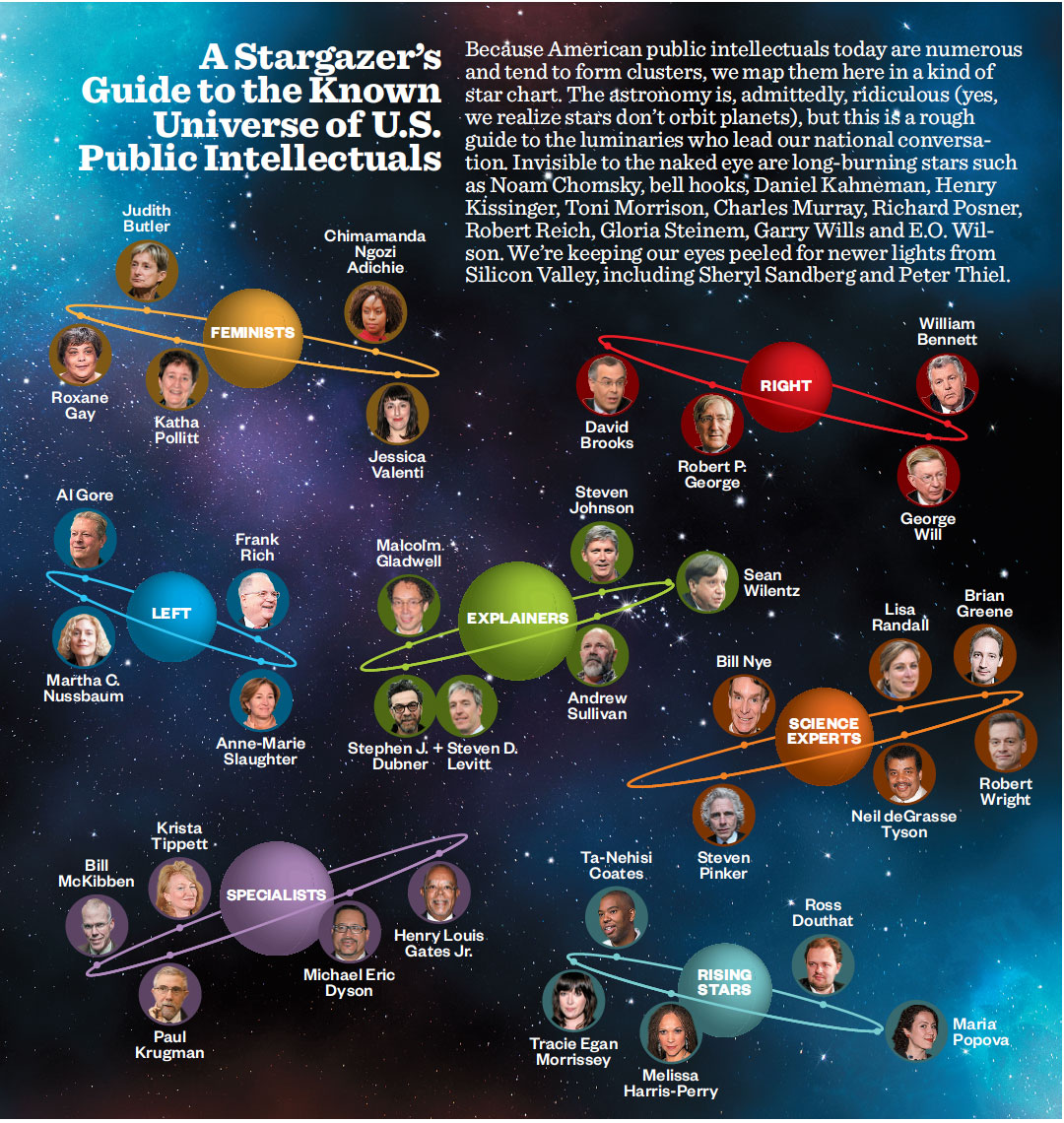
public-intellectuals-starmap
click here to enlarge

If our nation’s Founding Fathers were alive today, they would almost certainly be distraught and aghast at the loud polarity and lack of common interests. This isn’t to say those members of the 1787 Constitutional Convention, lasting a miserable 116 steamy days and nights, did not have their heated differences. Indeed they did. However, those resilient intellectuals mixed daily with their communities and adversaries; they had no choice really but to learn basic etiquette, tolerance, compromise, and mutual understanding and do it face-to-face. Those differences, conflicts, and resolutions took enormous amounts of highly skilled dialogue, negotiation, candor, and listening as they did expressing.

Fortunately, our modern intellectuals are still around, as seen in the Stargazer’s Guide image, as well as several of their interdisciplinary colleagues I’ve included throughout this four-part series. They too could easily be included on the map in their respective fields. Perhaps they are not as recognizable or accessible today because technology is increasingly finding intrusive ways to get in front of our faces and into our schedules, not weekly or daily, but hourly! Too much information-knowledge is just as bad for us individually — and potentially within a social framework of influence — as ignorance is because covertly hyper-knowledge fosters more risks that would otherwise be spread-out, diversified to minimize risks or learning-bankruptcy.

The difference between intellectualism (knowledge) then in 1787 and now (over-knowledge), as I personally see it, is that whether opposing sides embrace it or not, we know a lot less than we think we do (ignorance). Arrogance with power is the chief combatant of agnotology and collaborative progress. To remain stagnant in current knowledge without diversifying and going into the darkness of ignorance and where it leads is to risk terminal illness at the hands of Nature, predatory Nature to be specific. That assured apathy (that all is known) will be especially lethal if we do not recognize, with no exceptions, that ignorance is an equal or greater dichotomy. An egalitarian dichotomy not to be feared, but merely appreciated, explored further, confronted if necessary, and thus made more commonly defined, inclusive of both individual and social frameworks.

(paragraph break)
Live Well — Love Much — Laugh Often — Learn Always

Creative Commons License
This work by Professor Taboo is licensed under a Creative Commons Attribution-NonCommercial-NoDerivatives 4.0 International License.
Permissions beyond the scope of this license may be available at www.professortaboo.com/contact-me/.


Mind and Matter

this-is-forty

Everyone can relate to the changes our bodies traverse one decade to the next. Changes? Perhaps the better word is brawls. At thirty-nine my physician informed me in no uncertain terms what I had medically to expect and monitor by regular checkups and tests for a white male in his forties in “good health.” These tests and checkups would vary and change into my fifties in order to search for common and uncommon anomalies before they became unmanageable.

Honestly, I wondered then the benefits of telling a patient, a person, in a number of different contexts what possible ailments await them in the looming? exciting future of preventative/reactionary medicine and treatments. How much should we know? How much CAN we know? Is it possible to know too much? Is it detrimental to know too little? More importantly, what are the effects on the mind and body of “too much” or “too little“?

This past August I was forced heavily persuaded to register for a Life-Line Screening October 7th. I conceded because there was no denying my last FULL physical exam was done over 17-years ago. As a few of my blog-posts attest — e.g. Snip-Snip and Done! — I become a messy blob of shivering jello around needles, syringes and all things designed to stick in, open up, modify, simplify, or rectumfy rectify the human body. Just the name of this screening (Life-Line? Are you freakin’ serious?) frightened the SHIT out of me! I obsessed, “If they perform this god damn screening at a funeral home or next door to or near a funeral home, I was prepared to do an immediate 180° turn and sacrifice my $350 to the god and altar of Fuck That.

When my name was called by the nurse (named Temple; I kid you not) to start matters upon me, I immediately asked “When would be a good time to tell someone about my history of feinting since a boy?” With a warm grin she replied, “Oh? Now.” She was not only extremely attractive, near my own age, and chatting with a sweet sense of humor, everything seemed a silly figment of my hyper-nervous imagination with her by my side! As she took my measurements, including around my lower waist, my pulse and blood-pressure rose. Indeed, in a most natural way of course. Then she moved me to a station and chair where there was a large open-container of needles and collection tubes. Everything, inside and out of me changed. And as if that sight was not enough, she wants to take my blood-pressure before sticking me for vials of blood.

needles

I feel my palms getting clammy as she wraps the velcro-band around my bicep. Pump, pump, then the hissing… “Hmm,” she says with slight bewilderment, “that’s not so good. Is it all these needles and vials?” I inhale deeply, “They don’t help.” Temple begins giving me relaxation instructions, how to breath and to go to my “happy-place.” Umm, that would be out the nearest door… with you, I think to myself. “Okay.” I take several long deep breaths. She takes my blood-pressure a second time, then has to record it. She tells me with minor certainty “It’s a little better than before.” But waiting to be lead to the next station, she announces my name (to everyone in the church conference room) “We need to take your blood-pressure again. It’s too close to ‘Critical’.” What is going on? I think I feel better because the “needles” I perceived there were only the microneedle finger prick cases. I made it through that station with shaky flying colors!

Despite my lifelong embarrassing history of feinting around such objects in such places, there is a profound silver-lining to this post. Mind over matter, or what I’ve changed to Mind and Matter. Specifically the placebo effect on the human body and brain.

The Theater of Performance and Belief

For several thousands of years we have all engaged in a performance of relief to make us feel better. On the flip-side, we have all participated at various points in our life things we do not feel pleasurable about, but as necessary or unavoidable like I did for the Life Line Screening after 17-years. Others do it for some “expected” result. In some cases, and I’d say in most cases, we find ways to get addicted to relief… or a feeling of relief through belief of betterment even though it may never come to fruition in real life or this pre-mortem life.

Ted Kaptchuk of the Harvard Medical School says based on his decades of research that knowingly participating in a performance, which has no guaranteed desired results, activates regions of the brain to manage undesirable or pain symptoms.

“This new research demonstrates that the placebo effect is not necessarily elicited by patients’ conscious expectation that they are getting an active medicine, as long thought. Taking a pill in the context of a patient-clinician relationship — even if you know it’s a placebo — is a ritual that changes symptoms and probably activates regions of the brain that modulate symptoms.”
Dr. Ted Kaptchuk, ScienceDaily.com, Oct. 2016

placebo-effect

However, he and many medical researchers observing the placebo effect state the performance of expectation is a key component to improved symptoms or “healing” in test studies. The experiments have shown over and over that with a supportive patient-practitioner relationship, along with all the props and costumes of a medical-theatrical stage, improved or successful outcomes were induced from self-relieving, self-healing brain processes, not placebos or necessarily pharmaceuticals.

“The [theater of performance and belief, i.e. placebo] results were not surprising: the patients who experienced the greatest relief were those who received the most care. But in an age of rushed doctor’s visits and packed waiting rooms, it was the first study to show a “dose-dependent response” for a placebo: the more care people got—even if it was fake—the better they tended to fare.”
Harvard Magazine, The Placebo Phenomenon, Jan-Feb 2013

But there’s more. A related study conducted by Karin Jensen of the Karolinska Institute, Stockholm, Sweden has found it didn’t matter if the test participants experienced clearly visible or non-recognizable stimuli. According to further studies, they indicate that mechanisms responsible for placebo and nocebo effects can operate without conscious awareness of the triggering cues, i.e. theater. In other words, it is not what a person thinks will happen, it is what the non-conscious mind anticipates, despite any conscious thoughts. Dr. Jensen goes on to say…

“Such a mechanism would generally be expected to be more automatic and fundamental to our behavior compared to deliberate judgments and expectations”, says Karin Jensen. “These findings can help us explain how exposure to typical clinical environments and routines can activate powerful health improvements, even when treatments are known to be ineffective.”
Dr. Karin Jensen, Placebos Can Be Activated Unconsciously, Karolinska Institute, June 2015

Hospitals, clinics, apothecaries, even fitness gyms are common venues for the Theater of Belief. There are hundreds if not thousands of groups and locations to harness the power of expectations, all with varying levels of observable efficacy. Tanya Luhrmann of Stanford University carries this phenomenon a step further. She includes sanctuaries and congregations of “divine” worshipping…

Luhrmann suggests that “belief is natural. It comes partly from the way our minds are hardwired.” She has spent most of her professional career deconstructing people’s interaction with a divine being. Her findings say that belief-based relief/healing requires not only a good theater, a riveting story, but also the earnestness of an active listener — someone with the desire to make what is being performed and imagined FEEL real. She goes on to emphasize that “humans have the capacity to change their experience.” It is why authors of popular fiction become best-sellers literally overnight — their readers engross themselves in the story, in the theatrical performance.

Personally, I see no reason at all to exclude religious fervor for the divine, or for sacred scriptures, or for objects or miracles to be any different from the Theater of Belief at hospitals, clinics, apothecaries, fitness gyms, and yes… at churches, synagogues, or mosques.

Throw in Peer Assimilation and…
lakewood_church_interior
Lakewood Ranch Church, Branson, MO

The power of group-belief and the theater of performance, whether based in fact, placebos, or verifiable data, can be easily demonstrated by religious pilgrimages. Every year some 5-million pilgrims make the journey to Lourdes, France for the seasonal Our Lady of Lourdes’ Healings. The Black Madonna pilgrimages all over the world are another example which attracts millions of believers every year. The annual Hajj pilgrimage to Mecca, Saudi Arabia by over 2-million Muslims is one of “the five pillars of Islam.” Then the largest pilgrimage of all religions, the Maha Kumbh Mela to Allahabad, India occurs every 12-years and draws approximately 120-million Hindus. Pilgrims essentially attest to the same purpose or expectation, and ‘all are here for personal reasons, but all are here for each other as much as themselves.’ The more they feel they belong to a popular trend, the more they are convinced it comes from divine sources. If this doesn’t perhaps offer one definition of strength in numbers, then what does?

It seems that not only are you what you eat, or do, or consciously think, you can also be what you believe or expect, whether it is based on anything verifiable or not, especially if thousands or millions think and perform alike and with you, or you with them, then that performance and expectation makes it feel real for that individual! What an amazing revelation, borrowing the popular term. These neurological psychological studies can help explain why I have an aversion (to say the least) to all things designed to stick in, open up, modify, simplify, or rectum rectify the human body. But on a bigger scale these neurological psychological studies (placebos) can also explain a long long history of humanity’s most brilliant and blind, most virtuous and vile of human acts. Agreed? Disagree? Let me know below with your comments.

For further details and studies go to My Library page:  Bibliography – Mind and Matter as well as this 2001 Newsweek article.

(paragraph break)

Live Well — Love Much — Laugh Often — Learn Always

Creative Commons License
This work by Professor Taboo is licensed under a Creative Commons Attribution-NonCommercial-NoDerivatives 4.0 International License.
Permissions beyond the scope of this license may be available at www.professortaboo.com/contact-me/.

Human & Atomic Interactions

I want to pause a moment in between my Memoirs series, its last blog-post The Party and its continuation The Poke-her Game because I have recently been very inspired to write this post. For my BDSM readers, I apologize — it’s almost finished so thank you in advance for your patience. Now to the fascination of Human and Atomic Interactions.

≤ ≤ ≤ ≤ · ≅ · ≥ ≥ ≥ ≥
(line break)

Are you familiar with some terms in chemistry? Many? How about covalent compounds, polar covalent compounds, ionic bonds, electronegativity, and electropositivity? These are a few terms that define the interactions between atoms. Is it any surprise we can draw parallels between atomic interactions and human interactions? It’s not difficult. After all, every single one of us are made up of bonds, compounds, and atoms in ever so slightly varied formations. I’d like to share the chemical definitions of the terms mentioned above according to Chemistry-Dictionary.com:

Covalent bonds — 1) chemical bond formed by the sharing of one or more electron pairs between two atoms. 2) atoms linked together by sharing valence electrons.

Polar covalent bonds — 1) covalent bond in which there is an unsymmetrical distribution of electron density. 2) atomic linkage with both ionic and covalent characteristics.

Ionic bonds — atoms linked together by the attraction of unlike charges.

Electronegativity — 1) a measure of the relative tendency of an atom to attract electrons to itself when chemically combined with another atom. 2) a measure of the ability of an atom in a molecule to draw bonding electrons to itself. This is partially determined by how many electron vacancies are available in an element’s filling orbital. The most electronegative elements are the halogens, which have only one vacancy (i.e. have seven electrons in their filling orbital). Sulfur and oxygen are also highly electronegative. 3) a number describing the attraction of an element for electrons in a chemical bond.

Electropositivity — a measure of an element’s ability to donate electrons, and therefore form positive ions; thus, it is opposed to electronegativity. (Wikipedia)

Notice how the exchange or resistance, the charge and intensity of electrons make up much of the interactions between these five chemical states? Would it be beneficial to find applications of these chemical states in everyday life to gain more meaning and purpose? Is it good to understand how things interact, what makes strong or weak bonds and why they react the way they react to each other? I certainly want to understand (and respect!) why ammonia-nitrate does not react well with specific other compounds. Or why nitroglycerin does not react well inside playroom hippity-hop balls or attached to pogo-sticks!

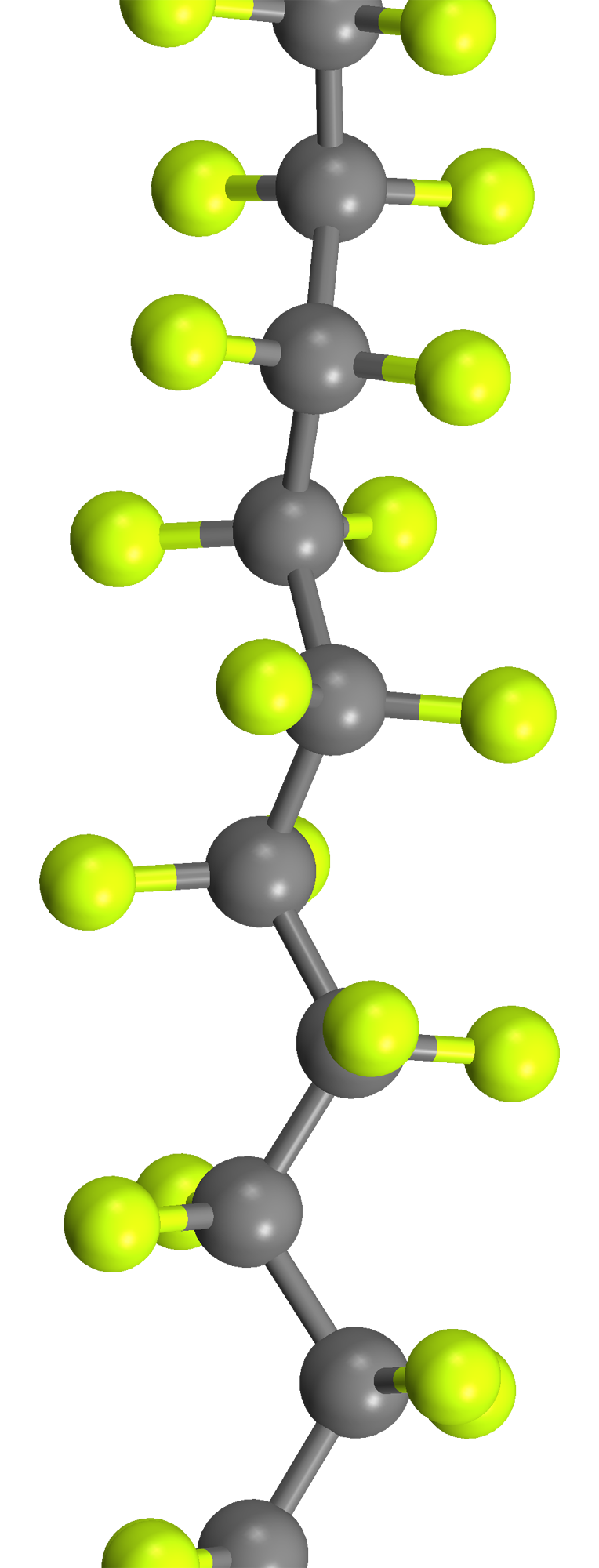
perfluorodecyl-chain

Teflon molecule

I feel it is also equally important to know and understand good helpful bonds and reactions. How many of you are aware of polytetrafluoroethylene and what it helps and prevents? While building the tallest bridge in the world, in southern France, the Millau Viaduct faced some unprecedented engineering obstacles. In the bridging-phase between the seven enormous masts, engineers needed a method of scooting the eight 8,070-ft long, 36,000 ton decks from one mast to the next 890-feet up. It was accomplished by using two huge polytetrafluoroethylene-coated hydrolic-powered opposed wedges in a, albeit only 600-millimeters per cycle,  leap-frog motion. Today, the bridge allows traffic to pass quicker between Paris and Montpellier with no apparent ecological impact to the area.

How about the critical bonds of hydrogen or peptides? How much are these two bonds used? The fact that all humans consist of roughly 63% body fluid, hydrogen bonds are vital to body functions. Peptide bonds are just as vital. All proteins, DNA, RNA, as well as multitudes of other structures use this bond. EMT’s and ER doctors and nurses must be thoroughly trained in these chemical makeups and interactions in order to save and/or rehabilitate patients. It certainly doesn’t hurt non-medical persons to have very basic understandings of these bonds for everyday life.

In my Earth or Physical Science classes we’d often discuss and learn about “Happy Atoms.” Like any of us, most atoms want to be alive and happy. The concept can be summarized this way:  if your atomic shell (mind, body, soul) was full, then you are a Happy Atom. There are atoms (people) with extra electrons. They enjoy giving up or donating their electrons. Other atoms (people) have almost-full shells. They move around seeking out atoms (people) who have extra to give. Prime examples of these interactions are sodium with magnesium, and oxygen with fluorine. When they work together with their electrons, both pairs and multiple pairings can end up happy. Like magnets the positive and negative charges of electrons attract each other. This is when “opposites attract” to form a strong bond. However, as is often the case in many aspects of chemical and life-interactions, not all are “happy bonds.” Why unhappy?

unhappy-coupleUnhappy bonds can be described as those possessing low, medium, or high energy levels. Taking this description a bit further, managing the increase or decrease of these energy levels can be directly associated with a knowledge-interaction bank, if you will. This bank knows what investments and withdrawals are dangerous and risky, as well as those that are profitable and safe. But there is one and only one factor that the bank cannot inerrantly predict:  How well does each individual customer thoroughly understand their own molecular makeup, their behavior blueprints, or how well or poorly to articulate them. You see, it isn’t enough to understand or attempt to understand only external interactions and dynamics. You, yourself, are just as important as any others in the interactions. How well and how honestly you understand yourself, often… no, equally determines what type of interactions you and others create.

Sir Francis Bacon once said that “knowledge is power.” Power for what? Clearly there are positive life-giving interactions between molecules and organisms, and there are negative ones. These interactions, all of them, and please excuse the intentional dichotomy, are they necessarily unnecessary? Is the knowledge-interaction bank exclusive only to the student? To the teacher? To the classroom of classmates? To one school? And here is perhaps a bigger question:

Is there a necessary or unnecessary learning-curve to understanding life’s interactions?
(line break)

We interrupt this program to bring you an important musical and meme message!

atoms-feelings-truth

In the fields of neurology, pathology, endocrinology, genetics, linguistics, psychology, sociology, even philosophy — is there an interdisciplinary term for these(?) — do these areas perpetually interact or are they completely self-sufficient, self-reliant?

With chemical interactions, many if not most are well understood and predictable, until we humans or the environment create new ones. With human interactions, some… if not more or less… are well understood, until someone or others invent new ones. When these unexpected creations occur, and they inevitably do, how should they be received? Received with instantaneous conclusions or judgements, or with reservation, patience, and time in order to account for margins of error? Perhaps with elements of both? Is there a time to speak your results or a time to quietly wait, to consider, and reconsider? It has been my personal experience that TIME… typically more than what I first imagine, is the wise policy. A policy to suspend or allow for the learning-curve, if for no other reason than to remind myself that in order to gain improved interactions, human or otherwise, this policy also allows for the greatest of virtues and bonds to flourish.

To my readers and followers, what are your thoughts and experiences with interactions and bonds… atomic, chemical, or human? Please share them!

Live Well — Love Much — Laugh Often — Learn Always

(paragraph break)

Creative Commons License
This work by Professor Taboo is licensed under a Creative Commons Attribution-NonCommercial-NoDerivatives 4.0 International License.
Permissions beyond the scope of this license may be available at www.professortaboo.com/contact-me/.

Starvation or Abundance?

Last October I posted a six-part blog-series Untapped Worlds in which I shared the many abundant ways for humans to find, tightly grasp, and experience the marrows of life, a fuller more impactful, vibrant, attaching life. Today I want to address a very specific part of this human experience.

For a few different reasons in different settings both in the past and lately, I have been in conversations, listening, and reading about a subject that effects all of us, every single one of us. It is very intriguing to explore and examine the various perspectives of What makes quality human intimacy. Quantity inevitably enters the discussion in some form and this is where I find the most fascinating definitions and points of views about love, sex, intimacy, and the mindsets people create for themselves. More often than not, two love-models or paradigms eventually appear. Due to my schedule this weekend, I want to just share a lens to these two models from two excellent resources on the subject of love, sex, and intimacy…

Many traditional attitudes about sexuality are based on the unspoken belief that there isn’t enough of something — love, sex, friendship, commitment — to go around. If you believe this, if you think that there’s a limited amount of what you want, it can seem very important to stake your claim to your share of it. You may believe that you have to take your share away from somebody else, since if it’s such a very good thing, someone else is probably competing with you for it (how could they!). Or you may believe that if someone else gets something, that means there must be less of it for you.

We want all of our readers to get everything they want. Here are some ideas that might help you over some of the obstacles on the path.

We call this kind of thinking “starvation economies.” People often learn about starvation economies in childhood, when parents who are emotionally depleted or unavailable teach us that we must work hard to get our emotional needs met, so that if we relax our vigilance for even a moment, a mysterious someone or something may take the love we need away from us. Some of us may even have experienced real-world hunger (if you didn’t grab first, your brother got all the potatoes), or outright neglect, deprivation, or abuse. Or we may learn starvation economies later in life, from manipulative, withholding, or punitive lovers, spouses, or friends.

The beliefs acquired in childhood are usually deeply buried and hard to see, both in individuals and in our culture. So you may have to look carefully to see the pattern. You can see it in a small way in the kind of complaining contests some people engage in: “Boy, did I have a rotten day today.” “You think your day was rotten—wait till you hear about my day!”—as though there were a limited amount of sympathy in the world and the only way to get the amount due you was to compete for it. Or remember how you have felt looking at the last piece of a very good pie, the secret salivation that made you greedy and territorial and a “selfish” person. When is it okay to want anything? People may think that if you love Bill that means you must love Mary less, or if you’re committed to your relationship with your friend you must be less committed to your relationship with your spouse. And then how do you know if you’re Number One in a partner’s heart?

This kind of thinking is a trap. We know, for example, that having a second child doesn’t usually mean that a parent loves the first child less and that the person who owns three pets doesn’t necessarily give any less care to any one of them than the person who owns one. But when it comes to sex, love, and romance, it’s hard for most people to believe that more for you doesn’t mean less for me, and we often behave as if desperate starvation is just around the corner if we don’t corner some love right now.
— The Ethical Slut: A Practical Guide to Polyamory, Open Relationships & Other Adventures

bigger-tableAn additional lens…

When they approach romantic relationships, people often fall into one of two patterns. Some follow a starvation model, and some follow an abundance model.

In the starvation model, opportunities for love seem scarce. Potential partners are thin on the ground, and finding them is difficult. Because most people you meet expect monogamy, finding poly partners is particularly difficult. Every additional requirement you have narrows the pool still more. Since relationship opportunities are so rare, you’d better seize whatever opportunity comes by and hang on with both hands—after all, who knows when another chance will come along?

The abundance model says that relationship opportunities are all around us. Sure, only a small percentage of the population might meet our criteria, but in a world of more than seven billion people, opportunities abound. Even if we exclude everyone who isn’t open to polyamory, and everyone of the “wrong” sex or orientation, and everyone who doesn’t have whatever other traits we want, we’re still left with tens of thousands of potential partners, which is surely enough to keep even the most ambitious person busy.

The sneaky thing about both models is they’re both right: the model we hold tends to become self-fulfilling. If we have a starvation model of relationships, we may tend to dwell on the times we’ve been rejected, which may lower our self-esteem, which decreases our confidence…and that makes it harder to find partners, because confidence is sexy. We may start feeling desperate to find a relationship, which decreases our attractiveness further. So we end up with less success, which reinforces the idea that relationships are scarce.

When we hold an abundance model of relationships, it’s easier to just go do the things that bring us joy, without worrying about searching for a partner. That tends to make us more attractive, because happy, confident people are desirable. If we’re off doing the things that bring us joy, we meet other people there who are doing the same. Cool! The ease with which we find potential partners, even when we aren’t looking for them, reinforces the idea that opportunities for love are abundant, which makes it easier for us to go about doing what makes us happy, without worrying overmuch about finding a partner…and ’round it goes. We think our perceptions are shaped by reality, but the truth is, the reality we get is often shaped by our perceptions (Cognitive scientists talk about confirmation bias—the tendency to notice things that confirm our ideas, and to discount, discredit or not things that don’t.).

These ideas will also influence how willing we are to stay in relationships that aren’t working for us, both directly and indirectly. If we believe relationships are rare and difficult to find, we may not give up a relationship even when it’s damaging to us. Likewise, if we believe that relationships are hard to find, that may increase our fear of being alone, which can cause us to remain in relationships that aren’t working for us.

Naturally, there’s a fly in the ointment. Sometimes the things we’re looking for, or the way we look for them, create artificial scarcity. This might be because we’re doing something that puts other people off, or because we’re looking for something unrealistic. If you’re looking for a Nobel Prize–winning Canadian supermodel with a net worth of $20 million, you might find potential partners few and far between. Similarly, if you give people the impression that you’ve created a slot for them to fit into that they won’t be able to grow out of, opportunities for relationships might not be abundant either.
— More Than Two: A practical guide to ethical polyamory

The model we hold tends to become self-fulfilling.” I could not agree more!

Returning to the point of my six-part blog-series Untapped Worlds, the majority of scientists, especially sociologists and psychologists, postulate not as a “theory” but available mechanisms of innumerable abundant ways for an intrinsic and extrinsic nirvana if you will, WITH OTHERS! Getting there is not a myth or Mount Everest! Simply rewiring and remapping the mind and body in more balance is the first step. ❤

Would you agree, add to, subtract, or disagree? Share your comments below.

(paragraph break)

Live Well — Love Much — Laugh Often — Learn Always

Creative Commons License
This work by Professor Taboo is licensed under a Creative Commons Attribution-NonCommercial-NoDerivatives 4.0 International License.
Permissions beyond the scope of this license may be available at www.professortaboo.com/contact-me/.
Untapped Worlds – Retooling

This is the fifth-part of the series continuing from Untapped Worlds — Reside and its previous four posts.
(paragraph)

The prude is in fact the libertine,
without the courage to face their naked soul.
—- A. S. Neill


Exclusion makes us suffer. Inclusion makes us thrive.
—- E. O. Wilson

(paragraph break)

(paragraph break)

performing-artsWhat does it mean to be more human? Looking back from where humans come can help. Comparing that past to where we are now helps. What would it mean to be more than human? Less than human?

If our history has shown us anything, the great and the horrid, humans must keep up, must be proficient learners, empathizers, and adapters, to best act and react, to fail better and succeed better in a world and Multiverse which perpetually challenges us every minute of every day. This inevitably means breaking old conventions and forming new healthier refined ones…even if it means our initial discomfort and ridicule, and in extraordinary cases, our imprisonment or death. To me personally, this is what it means to be human and more human.

How might we gauge our natural humanity?

Humans and Animals: The Near and Far

Perhaps a first observation can be differentiating humans from other animals starting with body structure. Even the rest of Earth’s other primates have noticeable differences to ours. But delve deeper beyond outer features and there is an overwhelming amount of continuity, until you reach the brains. At the University of Queensland in Australia, Professor of Psychology in Cognition and Evolutionary Psychology-Cognition, Dr. Thomas Suddendorf finds…

The physical similarities between humans and other mammals are quite plain. We are made of the same flesh and blood; we go through the same basic life stages. Yet reminders of our shared inheritance with other animals have become the subject of cultural taboos: sex, menstruation, pregnancy, birth, feeding, defecation, urination, bleeding, illness, and dying. Messy stuff. However, even if we try to throw a veil over it, the evidence for evolutionary continuity between human and animal bodies is overwhelming. After all, we can use mammalian organs and tissues, such as a pig’s heart valve, to replace our own malfunctioning body parts. A vast industry conducts research on animals to test drugs and procedures intended for humans because human and animal bodies are so profoundly alike. The physical continuity of humans and animals is incontestable. But the mind is another matter.

social dolphinsMany would guess our brains to be “another matter” because they are the largest on the planet. Incorrect. The human brain comes in at fourth, technically fifth place. Sperm whales have the largest at 17.5 pounds followed by blue whales at 12.5 pounds, then elephants at 10.5 pounds. In fourth place are dolphins at 4 pounds. Our brain is a distant fifth place at 2.8 average pounds. At a close sixth is the walrus at 2.4 pounds, followed by all remaining animals. Yet it isn’t size that sets us apart, but intelligence. Bertrand Russell asserted that “speech, fire, agriculture, writing, tools, and large-scale cooperation” significantly widens the gap between us and animals.

While those abilities may seem to us and our brains as “higher intelligence”– brains which are prone to deception, memory-errors, superstition, and ambiguity — closer comparisons find Russell’s claims inconclusive. I argue along with Suddendorf that moving the intelligence-bar lower, and maybe less arrogantly, we can find “parrots can speak, ants have agriculture, crows make tools, and bees [as well as ants] cooperate on a large-scale.” Nevertheless, Suddendorf also points out that in those six advanced-intelligence domains:

I’ve repeatedly found two major features that set us apart: our open-ended ability to imagine and reflect on different situations, and our deep-seated drive to link our scenario-building minds together. It seems to be primarily these two attributes that carried our ancestors across the gap, turning animal communication into open-ended human language, memory into mental time travel, social cognition into theory of mind, problem solving into abstract reasoning, social traditions into cumulative culture, and empathy into morality.

Humans are avid scenario builders. We can tell stories, picture future situations, imagine others’ experiences, contemplate potential explanations, plan how to teach, and reflect on moral dilemmas. Nested scenario building refers not to a single ability but to a complex faculty, itself built on a variety of sophisticated components that allow us to simulate and to reflect.

Though we may be the only creatures on the planet with the capacity to time-travel with our imaginations, simulate possible outcomes, and carry out mid-term and long-term plans based upon those imagined scenarios, how much of a contrast does that really create when we still know so little about aquatic mammals (not to mention those oceanic invertebrates and their languages), while the neurobiology and neurocognition of our own brains aren’t fully known? Despite his 2011 scientific misconduct in other areas, former Harvard University professor and evolutionary biologist Marc Hauser expounds on our higher-evolved cognitive abilities and notes four distinguishing abilities…

  1. Generative computation
    Humans can generate a practically limitless variety of words and concepts. We do so through two modes of operation recursive and combinatorial. The recursive operation allows us to apply a learned rule to create new expressions. In combinatorial operations, we mix different learned elements to create a new concept.
  2. Promiscuous combination of ideas
    Promiscuous combination of ideas allows the mingling of different domains of knowledge such as art, sex, space, causality and friendship thereby generating new laws, social relationships and technologies.
  3. Mental symbols
    Mental symbols are our way of encoding sensory experiences. They form the basis of our complex systems of language and communication. We may choose to keep our mental symbols to ourselves, or represent them to others using words or pictures.
  4. Abstract thought
    Abstract thought is the contemplation of things beyond what we can sense. This is not to say that our mental faculties sprang fully formed out of nowhere. Researchers have found some of the building blocks of human cognition in other species. But these building blocks make up only the cement foot print of the skyscraper that is the human mind. The evolutionary origins of our cognitive abilities thus remain rather hazy. Clarity is emerging from novel insights and experimental technologies, however.

I’d draw into further question Suddendorf’s assertion that humans have fully “moved social traditions into cumulative culture” or “moved empathy into morality” or more disconcerting, on a planet of abundant food sources, have we moved jealousy into civil negotiation and altruism, especially toward compersion and less famine? I will explore later what is meant by compersion. Hauser’s four points however, particularly #2 and #4, help us recognize the “haziness” of supreme beings without discrediting the reasons why we may never be able to claim total planetary supremacy for the foreseeable future. Maybe the smarter question is “Why seek supremacy?” Or supremacy in any context. What responsibilities come with supremacy and are human brains capable of such a lofty position? I’d also ask Why not promote more lateral mobility instead of vertical mobility? Certainly less bodies and cadavers under heavy foot with the former than the latter.

Alexander Neill meets Ed Wilson

In the previous post I introduced A.S. Neill and his unconventional approach to parenting and education. I wish to return to him and the impact of external stimuli and nourishment (and malnourishment) for the human heart and mind.

asneill_cottage-storyWhen a child is born do you consider them at that instant to be inherently good, bad, or indifferent? Immediately after an average healthy normal 9-months in the womb, is a newborn significantly altered or influenced toward goodness, evil, or apathy? Do moral and ethical measurements begin during gestation, minutes after birth, or weeks and months after birth?

Believe it or not this is a very controversial topic in parts of the human world. A. S. Neill believed the only source of humanity’s worst behaviours start with parents, then socio-familial groups (their parents), and eventually nation-state ideologies. Neill therefore began a radical form of education by opening a new type of school.  “The merits [of Summerhill School] will be the merits” he explains “of healthy free children whose lives are unspoiled by fear and hate.” Students at Summerhill are not required, forced, or coerced to attend classes. They go of their own accord because they are genuinely interested and want to learn; or they can stay away from classrooms, for years if they choose.

When I first read Neill’s school policies I was stunned. As a teacher of five years in traditional public schools, I could only relate to my students, my campuses, and my childhood as a student with other students. My boyhood schools and the schools I would later teach in classrooms would have been zoos had the students had that much freedom! When I was a school boy I probably would’ve been just as deviant. I soon recognized I now had a serious conflict — I do not believe children are inherently evil at birth, nor into their toddler years. This caused me to seriously re-evaluate major and minor aspects of my life; aspects as a father, former teacher, and active U.S. citizen! Change was again in my front door.

In an October 2011 article by The Independent (U.K.), correspondent Sarah Cassidy interviews several alumni of Summerhill School.

It is one of the most famous schools in the world; a place where every lesson is voluntary and where youngsters can vote to suspend all the rules. Founded by the liberal thinker AS Neill, Summerhill turns 90 years old this year.

Famous alumni of the democratic or “free” school include actress Rebecca de Mornay, children’s author John Burningham and Storm Thorgerson, the rock album cover designer.

Other graduates include Michael Bernal, PhD in Mathematical Physics, Hylda Sims, novelist, poet, songwriter, event organizer in greater London, and Freer Speckley, International Development consultant for online facilitation and training. Author Hussein Lucas in his book After Summerhill interviews twelve other graduates and concludes:

The key feature that sums up the distinctive nature of the Summerhill experience is the virtual absence of fear: fear of failure; fear of authority; fear of social ostracism; fear of life and the consequent failure to engage with it with a feeling of optimism and a positive outlook.

If Lucas, Summerhill School, and its graduates, as well as founder A.S. Neill don’t sum up the enormous impact of human influence and interaction on a child’s and teenager’s formative educational years, then it certainly highlights social coping mechanisms during the adult years; years rot with fears of failure, authority, ostracism, life (suicides?), agoraphobia, and pessimism. I’ve watched several of these toxins develop in my sister for 40+ years and in a span of 7-days my father’s suicide. Personally, it took about four years of therapy for me to conquer my unhealthy codependency; as opposed to much healthier forms of human connection and love. I will explore several of these forms later. Meanwhile, where do these fears originate? Are they hardwired into us prenatally or do we contract them like air pollutants when we encounter other fear-bearers? How is fear justified or unjustified?

a.s.-neill

Alexander S. Neill

The question of fear’s origins is as much a question of timing as purpose. For an adult or a person capable of self-evaluation and adequate self-reliance, fear in its most basic form is a matter of life or death. We know or have been conditioned and/or educated that running red traffic-lights at intersections is taking your life into your hands, other driver’s hands, and others inside the vehicles and of nearby innocent bystanders. We know that fire and extreme heat along with smoke inhalation will kill us. We know that various weapons will terminate life (immediately?) when put to and/or fired at the head. We know that massive brain aneurysms or coronaries usually end in quick death. We know approaching certain wild animals who are in fear for their own lives or their offspring’s, or are merely very hungry, is chancing a violent death. The “timing” of this recognition comes much later in age after conditioning or retained educated fear. They are healthy fears or respect to those specific dangerous situations learned over time, i.e. realized fears. Infants, toddlers, or adolescents have not had the luxury of time or experience to learn necessary life-or-death fears. For better or for worse, the teaching and protection for life-safety and avoiding death, or realized fears, are in the parent’s or guardian’s hands. However, there can be the improper mixing of unrealized fears with life-or-death ones. This is where A.S. Neill diverges from traditional child-rearing and education. His postures can easily traverse our age groups.

It may be no exaggeration to say that all children in our civilization are born in a life-disapproving atmosphere. The time-table feeding [the mother’s breast milk or later] advocates are basically anti-pleasure. They want the child to be disciplined in feeding because non-timetable feeding suggests orgastic pleasure at the breast. The nutriment argument is usually a rationalization; the deep motive is to mold the child into a disciplined creature who will put duty before pleasure.

Neill goes on to give specific child-student scenarios denouncing repressive conditioning to fit-in, be acceptable, and fulfill duties of the state while being ashamed of individual passions and emotions, even self-awareness. Furthermore, these “unfree” conditions repress imagination and ingenuity, the very building blocks of refinement, progressiveness, adaptation, and pragmatism.

To sum up, my contention is that unfree education results in life that cannot be lived fully. Such an education almost entirely ignores the emotions of life; and because these emotions are dynamic, their lack of opportunity for expression must and does result in cheapness and ugliness and hatefulness. Only the head is educated. If the emotions are permitted to be really free, the intellect will look after itself.

The tragedy of man is that, like the dog, his character can be molded. You cannot mold the character of a cat, an animal superior to the dog. You can give a dog a bad conscience, but you cannot give a conscience to a cat. Yet most people prefer dogs because their obedience and their flattering tail wagging afford visible proof of the master’s superiority and worth.

Much of this Western social-political thinking and lifestyle stems from Antiquity between 300 CE until, in various subtle forms, the modern 1960’s and 70’s. The mentality is known as total depravation indoctrination as taught to the world by extreme Abrahamic religions upon the uneducated illiterate subjects of the empire. Neill writes…

The problem child [and adult?] is the child who is pressured into [holiness and piety] and sexual repression. Adults take it for granted that a child should be taught to behave in such a way that the adults will have as quiet a life as possible. Hence the importance attached to obedience, to manners, to docility.

If the condition of depravity isn’t taught outright by Abrahamic clergy and churches, it is certainly perpetuated by the obsessive perfectionists or tyrants of the world intolerant of responsible and total human freedom.

“The prude is in fact the libertine, without the courage to face their naked soul.”

Indeed. And there is another renown scientist and Naturalist that would echo much of what A.S. Neill claims. He advocates a return, if not at least a constant remembrance, to who we really are and where we actually come from. His name is Harvard graduate, social-biologist, and naturalist Edward O. Wilson. In 1979 his book called On Human Nature won the Pulitzer Prize. He has since authored other acclaimed books such as The Diversity of Life, Naturalist his biography, Concilience: The Unity of Knowledge, and in 1990 co-authored and published with German behavioral and evolutionary biologist Bert Hölldobler the book The Ants that won his second Pulitzer Prize.

Advanced Social Behavior and Who Has It

Sociobiology has only recently become a scientific field of study: the mid-1970’s. E. O. Wilson defines sociobiology as “the systematic study of the biological basis of all social behavior” whether human or non-human. Because many human intellectuals and human groups regard Homo sapiens as highly advanced, Wilson’s theories and definition of sociobiology flew in the face of old “supremacy” traditions, particularly of the divine persuasion. But as I reflect back on human history, the brilliant and the atrocious, and how Homo sapiens behave toward and treat each other despite social labels and imaginative beliefs, I want to hear-out everything Wilson has to say. In fact, it might be intellectual suicide or quicker extinction not to.

eo.wilson.ants_.men

Edward O. Wilson

Earlier I compared differences between humans and animals. Bertrand Russell asserted that what sets us apart from other species was intelligence; speech, fire, agriculture, writing, tools, and large-scale cooperation or social behavior. Thomas Suddendorf further expounds that humans are avid scenario-builders and time-travellers, being able to bring into existence what our minds created in the past. And Marc Hauser asserted that with our highly cognitive brains we are able to generate complex computations, promiscuous combinations of ideas, mental symbols, and construct and contemplate abstract thoughts. Along with these advanced abilities and skills we seek to share them with our own kind in order to survive better, easier, and advance our species, especially those we love and cherish. This is called eusociality. From the field of biology, Wilson asked “Why did any animal, whether human or insect, evolve complex societies and behavior?” and from his research he defines eusociality as exhibiting three characteristics:

  1. Groups of individuals within that species living together for more than two generations.
  2. Adults caring for the young; usually intimately caring for them.
  3. They have to have a reproductive division of labor, i.e. some of those individuals in that society have to be giving up part of their longevity, perhaps, or at least reproductive capacity to serve the others; in other words, real altruism inside the group.

Out of the 10-million estimated living species on Earth, we only know about, study and understand 2-million; and of those 2-million living species, only 19 of them are truly of eusocial evolutionary lines. Sixteen of them are insects. Another aspect of eusociality in insects, like ants or bees, is that an individual serves the survival of the whole and act in almost perfect syncronization with other individuals in the entire colony, called the superorganism. This same behavior is called altruism in human contexts.

The only eusocial primates are Homo sapiens, us. Therefore, being the only primates with the advanced social behavior of eusociality coupled with highly developed cognitive skills Suddendorf and Hauser point out, can we learn anything more from the species who have been eusocial the longest, over 120-million years? Wilson thinks so. He has spent his entire life studying insects like ants. In fact, Wilson asserted in the 70’s that human social behavior, origins of human emotional mechanisms and instincts, evolved in the same ways as those other 18 eusocial species: in nature. This caused a firestorm not only among biologists, but social scientists and activists as well.

The Sociobiology Wars

In 1975 Ed Wilson suggested that social behaviors like human bonding and morality must have a biological neurological basis. They must have evolved. “The time has come” said Wilson, “for ethics to be removed temporarily from the hands of the philosophers and biologicized.” Social scientists and activists of that time did not take too kindly to his “regressive” claims. Back in the 1970’s the fields of psychology, sociology, and philosophy had fought long hard battles against late 19th century, early 20th century ideals of racism and sexism, and won or at least made progressive strides toward winning. Ed Wilson was seen as regressing backwards to those barbaric racial hierarchies and patriarchal ideologies. His naysayers at that time imagined he was attempting to revive those old discredited social systems and that human nature could only be understood through biology and genetic manipulation benefitting a race or gender.

Jonathan Haidt, social psychologist at New York University and Yale University/University Pennsylvania alumnus, explains the heated controversy Wilson found himself:

“The most sacred value of anti-racism and also related, anti-sexism was anything that remotely threatened those values would trigger a nerve and those groups would go haywire! And that’s what happened [in 1975-76]. Ed was simply saying ‘Well, maybe human nature is innate, maybe we evolved with a division of labor between men and women.’ Woah! You’re saying that there could be genetic differences between men and women!? But that could justify sexism. That could justify paying men and women differently! Therefore, it must be wrong!”

There was even a manifesto entitled Against Sociobiology written by several of Wilson’s colleagues at Harvard from their biology department denouncing Wilson’s sociobiology and that it could license racism, sexism, slavery, and genocide. Some demonstrations and picket-lines on the campus turned verbally abusive. After a class lecture Wilson gave he required a police escort out the back doors. But Wilson withstood the storm and stood his ground.

As more studies, research, and data poured in over the 1990’s and into the 21st century in the fields of psychology, genetics, anthropology, neurology, and other related fields, it seems to be increasingly plausible, Wilson says there are indeed “general properties of the way the human mind develops and children acquire culture, preferences, and biases adopted by people that have a biological nature.” If there is one benefit afforded the modern fields of psychology, genetics, anthropology, and neurology by E. O. Wilson’s battle scars, it is the free-range deeper exploration and study of human nature against the backdrop of biodiversity.

Being and Becoming More Human

A. S. Neill and E. O. Wilson have opened the roof on human nature by examining human sexuality, human aggression, human dominance, human collaboration and learning, and human emotions like fear, anger, jealousy, pride, guilt, sympathy and empathy through a biological lens.

“It is one thing to observe that we must have a human nature, quite another to discover what it is and how we came by it.

Exalted we are, written to be the mind of the biosphere without a doubt, our spirits uniquely capable of awe, and evermore breathtaking leaps of imagination. But we are still part of Earth’s fauna and flora, bound to it by emotion, physiology, and not least, deep history.”

Neill and Wilson show we are inexplicably part of the natural world. Our minds and emotions evolved in and from nature and with each other. Understanding nature and biology means understanding that evolution. That evolution began between 100,000 and 200,000 years ago on the continent of Africa.

Just as our biosphere supports us and is supported by some 10-million estimated species today in various ecosystems all over the world, paleoanthropologists have revealed we humans also come from a diverse background of at least 13 different bipedal hominids to-date: Homo sapiens likely from Homo naledi, less likely Homo neanderthalensis or Homo floresiensis, then from Homo heidelbergensis or Homo erectus, then from Homo rudolfensis or more likely Homo habilis, then Australopithecus sediba, a yet unknown or unspecified but likely Homo species now being studied, then less likely the Australopithecus garhi or A. africanus, then Kenyanthropus platyops, then Australopithecus afarensis, to finally Australopithecus anamensis from 4-million years ago and at least four more species (Ardipethicus) dating back to around 6 to 7-million years ago. Every single one of these above listed species have similar body traits to modern humans; less so further back in time, increasingly so nearing our 100,000 – 60,000 year genetic markers.

It wasn’t just the physical human form that originated in Africa. It was also our human nature; our biological-neurological natures. Today, paleoanthropologists have a much clearer picture of how our human brain developed. How the frontal lobes expanded over millions of years into the 2.8 pound mass and shape we have today. But what has been lacking in science the last several centuries has been the meaning of humanity…the origin of our social behavior. When and how did humans go from being social, like primates today, to being intensely cooperative building astounding civilizations together?

Tomasello-chimps-childrenDr. Michael Tomasello is the co-director of the Max Planck Institute for Evolutionary Anthropology in Liepzig, Germany. A Duke and University of Georgia alumnus and comparative psychologist, since the 1990’s he has studied “the unique cognitive and cultural processes that distinguish humans from their nearest primate relatives, the other great apes.” Tomasello’s work has earned him many awards, the latest being the Distinguished Scientific Contribution Award by the American Psychological Association in 2015. In his developmental research he has focused on how human children become cooperating members of cultural groups, focusing in recent years on uniquely human skills and motivations for shared intentionality: joint intentions, joint attention, collaboration, prosocial motives, and social norms. Tomasello:

“If the last common ancestor of humans and apes was like modern-day great apes, it was a pretty competitive individual. Fighting for food every day and maybe cooperating a little bit. And what had to happen in human evolution is that humans had to become more cooperative to live in the kind of societies that we live in today.”

The transition from being somewhat social and cooperative within not just familial ties, but in a small group, to being ultra social and cooperative beyond family and small groups was indeed our species greatest moment. It is exactly what removed us from the majority of all primates and other animals, and into that unique distinctive group of 19 advanced eusocial species, and arguably above those other eighteen. Ants did it about 150-million years ago. Humans followed about 1-million years ago when our ancient ancestors developed advanced cooperation defending their campsites and young. Dr. Haidt adds…

“…that transition from being like chimpanzees, that are highly social, to being eusocial, being able to work in very large groups, even with strangers, as we are doing here today. None of us are siblings, but we’re all working together really well because we got all these moral emotions. We are built for this stuff.”

Comparing today’s chimpanzees — the closest genetic relative to humans at about 0.1% difference! — with young children age 1 to 6 years in controlled experiments, time after time shows one singular significant difference in social behavior. Dr. Tomasello determined through cooperation tests one innate feature which sets us apart, as children, from chimpanzees and other apes.

“There is food on a board, and a rope is strung through [carabiners] in the board, so that if one [child or chimp] pulls, it just comes out [disconnected]…you have to pull at the same time to get the board to come inward. If you split the food, one part of the food on one side of the board and one part on the other side, both children and chimps pull it in and are quite successful. But when you pile the food in the middle, the children are still quite good at [cooperating and sharing], they take around half each, and they keep cooperating trial after trial, but with the chimpanzees, everything falls apart because the dominant takes all the food, the subordinate says, ‘What’s in it for me?’ and that’s the end of it.”

Another experiment Tomasello and the Max Planck Institute uses to demonstrate innate eusociality and altruism in human child behavior versus chimps is this fascinating 5-minute video:

A. S. Neill would be extremely pleased with these experiments, with Tomasello, and the Max Planck Institute because they show how toddlers and young children have been wired for altruism, cooperation, and fairness over hundreds of thousands of years. When the opposite behavior is exhibited — e.g. bullying, greed, debasement, psychological egoism, rational egoism — suffering ensues and it begs the question, has that person or group devolved or succumbed to very ancient primate behavior due to choice, genetics, or environment, or all three? Neill and Wilson say humans from birth cooperate instinctively. Whether we stop or continue is a question of teaching, parenting, and community. And sadly to some extent, the available (and shared) wealth and resources and ecosystems Earth abundantly provides. Here we learn what it means to be more human, or less human.

Pushing Beyond “Advanced” Homo Sapien

The term Homo sapien is derived from the Latin homo, meaning man + sapien, meaning wise or rationale. I would like for us to soon become a new species, Humana participatio. This is already happening in certain pockets of the world.

What does it mean to be the Latin Humana participatio? Well, humana is Latin for human being, and participatio means simply sharing. But the act of sharing isn’t just giving what we are or have, it is also about connecting, or in Latin connectens. Thus, I also need to state Humana connectens-participatio! What I mean by that is a sharing of our entire being and a receiving of another’s. It is a flowing two-way connection. And since all humans have the innate want to “distribute knowledge” and experience (more sharing via strong, weak, or absent interpersonal ties) as well as receive knowledge and experience from others and our world, it isn’t or shouldn’t be limited to just two-way connections, but multiple connections. After all, that is how Homo sapiens took the giant leap ahead…over all other primates! Can it be done again? More fully? Personally, I think so; much of the genetic wiring is already present.

Where can we start?

There are a number of human areas to tackle and a number of biological-ecological areas too. The biological-ecological domains are already being addressed, several with fierce opposition, like global climate change and social inequality, but the noble efforts have been recognized, awareness and education has risen, and there are changes in progress. But by comparison and contrast, those advancements seem to be the easiest of the two. They are external changes and progression, not intimate internal ones. Why are outward external issues typically addressed more quickly compared to internal intimate ones?

There seems to be at least two hurdles that give us, advanced homo sapiens, progressive problems:  1) those unrealized fears mentioned earlier, and 2) the Path of Least Resistance; in other words, simply because we are such eusocial beings, it is important that we FEEL included and not excluded by our peers…so we are greatly tempted to take or remain on the Path of Least Resistance. This sometimes (often? always?) does not bode well for progress, for needed evolution, or for dire adaptation.

On the other hand, there are many primus Humana connectens-participatis around the world without or little unrealized fears or lounging in/on the PLR. Their prominence and times around the world might surprise you…

  1. Abolitionists, or opponents to any type of human slavery; at least 70 groups worldwide and well over 260 individual leaders, historically and contemporary. Some 200 of those 260 individuals were/are not of African decent.
  2. Chinese Dissidents, or intellectuals who push the boundaries of society or criticize their governments; currently 36 individuals detained or jailed, 17 to be arrested upon return to China, 13 to be refused reentry into China, and 29to be dealt with” by the Chinese authorities and leadership.
  3. Civil Rights Leaders and their organizations; at least 126 individuals throughout history and today.
  4. Activists for Disability Rights, fighting for equal treatment for those with physical and mental disabilities; some 59 individuals.
  5. Feminists, or the advocacy of women’s political, social, and economic rights to equality with men; at least 772 advocates (male and female) from the 13th century up to today.
  6. LGBT Advocacy Groups, or social-support groups or organizations advocating equal rights for sexually non-traditional, non-binary, non-hetero relational people, couples, and groups; 13 international groups, and well over 1,000+ groups in various nations around the world and on most continents, along with twice as many individuals, and growing annually.
  7. Anti-war and Peace Groups, with over 200 anti-war organizations worldwide, past and present, and well over 300 prominent individual activists.
  8. Women’s Suffragists and Rights expands even further the Feminists list above, past and present.

As you can well see, there have been plenty of primus Humana connectens-participatis among us and there are many around us today who ignore those hurdles of unrealized fears and the temptation of the PLR. They have helped humanity push beyond our walls of 200,000 years as Homo sapien and they invite the rest of us to leap forward with them.

A Further Proposal

I mentioned earlier that there are two domains in which modern humans can influence change and progress:  A) the external and outward biological-ecological systems which truly need our utmost steadfast attention and care, and then B) the internal emotional and cognitive systems. It is the latter domain that is much less known and understood, as a group and species, and therefore by default too often falls by the wayside. If this “default” does not change in time, then it is my personal opinion that we are doing a great disservice to ourselves, our loved ones, our species, and our planet…and as a consequence we will continue to struggle or stagnate in near-primate social conundrums incapable or crippled to keep up as proficient learners, empathizers, and adapters; to best act and react, to fail better and succeed better in this beautiful daunting world and Multiverse we live on, in, and amongst. Diversity gives us the strength and higher virtues to become more human. Singularity, strict conformity, judgement, individualism makes us weaker, less human.

“Exclusion makes us suffer. Inclusion makes us thrive.”

I propose two assignments, two goals to achieve. First, learn and live compersion or higher levels of compersion. If you are a parent, you have experienced or are likely already familiar with compersion. It is the feeling of joy one has experiencing another’s joy, such as in witnessing your toddler’s joy or another’s toddler and feeling joy in response. There have been many wise axioms that expand the essence of compersion. One such adage is if you love someone/something, let it go. If it returns, it is yours. If it doesn’t, it never was. But that’s not all. It is also the feeling of joy associated with seeing and feeling a loved one love another, including your intimate partner(s) or spouse. This is perhaps one of the ultimate forms of compersion in an age-old society of restrictions and repression. What those confining social dynamics cause are unrealized potential, even brilliance and/or unknown euphoric levels of happiness, joy, and connection. Clearly what is NOT present during compersion are its opposites:  jealousy, greed, anger, verbal or physical abuse/threats, selfish-hoarding, and even hints of solipsism. Learning to better manage our “darker” emotional traits (in controlled structured environs; BDSM?) is a means to rule over them rather than they rule over us and others — when and how to switch them on and off. In some respects, those darker behaviors are used to benefit individuals and groups, much the same way an athlete and athletic teams painfully push physical and mental limits to become better.

The second assignment or goal is therefore to redefine, or retool, or liberate our lifestyle, our personality, relationships, affecting our world and environment, and our conventions, then doing the same to our deathstyle. These are the six areas I will explore in the next post of the series Untapped Worlds — Maior Liberatio. I hope that I have not encumbered your reading brains and eyes too much here, and you will join me for the next installment, the last one… I think. 😉  Meanwhile, please feel free to share your thoughts and comments on this series and post below!

(paragraph break)

Live Well — Love Much — Laugh Often — Learn Always

(paragraph break)

Creative Commons License
Blog content with this logo by Professor Taboo is licensed under a Creative Commons Attribution-NonCommercial 4.0 International License.
Permissions beyond the scope of this license may be available at https://professortaboo.com/.