Our Brains & Pastor J. Waits

Over the last week or more I have been engaging in dialogue with a pastor in Charlotte, North Carolina who pastors at an evangelical fundamentalist Baptist church. He also blogs on WordPress to further proselytize or evangelize his own world-view to a small audience of followers.

This post will address our somewhat lengthy engagements of opposing world-views on one specific post on his blog, as well as my expansions on what simply could not be sufficiently addressed on his blog in long, long comment threads. I am very certain that his small number of followers/readers, some of whom are members of his Baptist church, got extremely bored with the in-depth conversations and Scriptural theological debates we had and simply tuned out. Those discussions will get lost and buried completely in his never-ending blog-posts, never really reaching his audience’s objective minds.

But that’s modern social-media, is it not? And that is modern attention spans on the internet, is it not? Hence, my needed blog-post here… to say the many things and point out the further details that Pastor Jonathan Waits willingly refused to seriously consider. He had already decided how he would respond BEFORE our dialogue even started. If that isn’t narrow bias, then I don’t know what biasness means at all.

Our Brains & Environment Form Our Identities

Before I dive into this fascinating, heavily studied neuroscience of our human brains and the environment we often choose to experience much or most of our life, I asked Pastor Jonathan Waits what his family, educational, and occupational backgrounds entailed. This was his response:

During our somewhat lengthy dialogue about his current world-view versus mine (Secular, Freethinking Humanist), he really struggled badly trying to understand, to grasp my perspective and world-view and why I deconverted from Christianity and the ministry and missions in 1991. He just could not find a way in his brain to relate to me and my life experiences. It was stunning really, but not uncommon.

∼ ∼ ∼ § ∼ ∼ ∼

Inside every head of every human, and inside every residence on Earth is the most complex object we have discovered in the Universe: the human brain. That marvel of biology in the cranium might seem alien to us at first, but the fact is… it is us. For our entire lives hundreds of billions and billions and billions of cells have quadrillions and quadrillions of electrical synapses firing trillions of trillions of signals every second of ever minute of our entire life. For many decades (hopefully) those gooey electrical sparks make up all that we experience in life as “us.”

Billions upon billions of neural synapses in the human brain firing trillions of trillions of signals every second of our entire life

So what shapes who you become? Answer: It is about how your life/environment shapes your brain and how your brain shapes your life.

For a few millenia humankind believed a soul or a spirit, something more than mere matter, made up who you were in life. Today, that is no longer the case. Extensively understanding our identities in-depth can only be done by understanding that 3 lbs. organ in our head.

When any of us are first born we are born helpless. However, we are born with adaptable brains. For about the next two years our brains are unfinished, so human babies are born much more dependent than other mammals who are often born able to walk, swim, or stand just minutes or hours after birth. Not human babies. And yet, after those first two years of learning the very basics of our immediate environment, our infant and toddler brains allow us to develop and make neural connections based on the child’s environment. This biological and physiological strategy has made human beings one of the most adaptable and malleable species on the planet so that we can first survive, then hopefully thrive, based on our immediate and extended environment(s).

Since at least August 1966 with Charles Whitman up inside the University Texas Tower, Austin, TX, but really going back to 1885 with Sigmund Freud, humans have learned that our survival and our growth (or death) and life experiences are just as dependent on our individual brains (or brain tumors as with Whitman, 1966) as they are on our environment(s). We cannot escape the two forces, ever. Life wires up the human brain with few or many experiences in order to adapt, survive, die and/or thrive in most of Earth’s and our familial environments and then tune it up on the fly, on the job. It’s really that simple.

Developing newborn and infant brains

A newborn’s brain has the same number of neurons as an adult. However, after those first two years the neurons are quickly forming newer connections relative to their environment. This continues well into adolescence and young adulthood. By that time the developing young brain’s neuron connections have more than quadrupled—as many as 2-4 million new connections every day—by their mid-30’s all relative to that individual’s environment(s), i.e. life experiences, AND how their brain developed genetically in the womb.

After year two we become who we are not by growth or new neurons created, but by pruning back or removing what is unnecessary in order to survive, adapt, and hopefully thrive. We learn how to make our life and identity happy and happier according to our individual brains and endocrine systems; all very influenced by our immediate and (slightly?) extended environments. The field of neuroscience confirms this consistently in many case studies for a minimum of the last six decades around the world.

Our conscious experiences in life are guided NOT by monism, or even by binary constructs, but by a plethora of pluralism. Everything around us on this planet, and including all humans, is evidenced by immeasurable pluralism to the point our brains struggle with the possibilities. This is also true beyond our planet. To cope, many of us prune down or toss out entirely what is perceived as unnecessary, or harmful, or even lethal… in their own brain based upon their past and/or present environment and individual life experiences. The neural connections go from being universal to very specific of your narrowing and immediate environment(s). Our brains are wired up by our immediate or slightly extended environment. After all, we don’t know, we can’t experience what we don’t know or haven’t ever experienced.

But the outside world that forms our brain and identity is a gamble. The outside influences of our family, our immediate environment doesn’t always give the healthy stimulus our brains crave.

The Jensen Family of Milwaukee, Wisconsin

Americans Bill and Carol Jensen adopted three Romanian biologically related babies aged 4 from a poorly staffed and horrible, over filled Romanian orphanage.

During the collapse and fall of Nicolae Ceaușescu’s reign of terror from 1968 to 1989 he had created over 170,000 Romanian children orphaned by his rampant ethical cleansing throughout the country. Bill’s and Carol’s adopted Romanian children in 1996 became John, Tom, and daughter Victoria. They did not have names in the orphanage just numbers. Dr. and Professor Charles A. Nelson III of Harvard Medical School describes what it was like walking through these Romanian orphanages:

Did these small children’s behavior go beyond mere distress, neglect, and lack of human contact? Did all of this combine to physically structure their brains? Young human brains need lots of stimulus to develop. It seeks out information and experiences. If they do not receive it or don’t receive a healthy amount of diverse experiences and information, then the young brain does not know how to get wired up and developed for survival, much less to thrive. Those kids in institutions result in adult IQ’s in the 60’s and 70’s. That is terribly low for modern life and humanity. They also develop secondary, ripple-effect emotional-behavioral problems such as severe attachment or detachment issues, and show all the signs of an underdeveloped brain and EEG activity very reduced.

What many neuroscientists found along with Dr. Charles A. Nelson was that children from orphanages placed into a nurturing family before the age of two generally recovered normally. However, children placed in nurturing families after the age of two their brain development was significantly compromised or severely delayed. What do these tests and case studies reveal to us?

The answer is straight forward: the lack of diverse experiences throughout one’s developmental and adult stages leads to the human brain not wiring correctly, especially for a 20th– or 21st-century shrinking globe. As a result, the brain doesn’t receive diverse sufficient experiences, diverse sufficient information over an extended period of time to know how best to wire itself. No debate.

Dr. Nelson’s work clearly revealed that when the human brain is starved of input, of many diverse inputs it needs to fully develop, the development is stunted and ill-equipped to manage a never-ending changing, evolving diverse world, both in the human and animal kingdoms as well as in nature. The Romanian-born Jensen kids still have emotional and learning disabilities from neglect in the orphanage more than 25-years later as adults.

What we individual humans and brains experience in our younger adolescence (hormones) and young 20’s or earliest 30’s goes a long way in who we become. Those youthful years are right on schedule for a more refined/refining, changing brain. But again, this is only half the story of our human brain.

The Genetic Blueprint from Generational & One’s (In)Experience

A neuroscientific experiment called the Look At Me in a glass windowed shop on a busy street reveals compellingly how the teenage brain is wired differently than our adult brains. When adults were placed in the shop window with pedestrians stopping to stare, their heart-rates, sweat glands, and facial expressions almost never changed from before the curtain was drawn open. However, when teenagers were placed in the shop window, all monitored physical responses spiked significantly. Dr. Sanjay Gupta explains in this quick 20-minute podcast:

Basically, the big difference between a teenage, early 20’s brain and an adult brain over 30-years is the area of the brain called the medial prefrontal cortex. This area becomes active when you think about yourself, especially the emotional situation to yourself. As one grows from child to adolescence, the activity in this cortex rises peaking around 15-years of age. This is what Pastor Jonathan Waits experienced from (his own words above) 8-years old until he was a teenager surrounded by Baptist friends, family, and church members all his life. His (narrow, confined?) social involvements carried a ton of weight for him.

In most adults this response in the prefrontal cortex is modest. But in teenagers and young adults it causes intensified emotions which go into overdrive. The result is often or sometimes a high stress emotion that can greatly change the teenager’s or young adult’s life for a very long time. This is what happens to most all teenagers and young adults, including Pastor Jonathan Waits.

It isn’t simply about self-consciousness, the development of the teen and young adult brain has other consequences as well. That can include poor impulse control (temptation in theological terms), risk taking (un-Christ-like behavior), and distorted coping skills (Satan?). It has been repeatedly found in neurological studies over the decades that most of the dramatic changes of our brains have finished, but even beyond our 20’s our brains can still undergo radical physical transformations.

Reshaping Our Genetic Adult Brains

Derek O’Reilly of the Knowledge Point School, Ltd., in London, UK is the Training Master of all Black Cabs in London proper. It takes his students at least four years to complete the memory recall and pass certification for a license to drive throughout a 642 radius mile area, 24,000 streets and roads, and 50,000+ places of interest to be quickly recalled for all eventual Black Cab drivers in London. This is by far one of the world’s most difficult feats of memorization to complete.

Black Taxis wait in London, June 2014. By law, the drivers of London’s black cabs must memorize all of the city’s streets, a process that takes years of study.

This trade school’s testing and licensing of drivers made the rigorous memorization of particular interest for an international group of neurologists. The neurology group was most interested in the part of the brain called the posterior hippocampus of these students. They did brain scans before admission into the school, during training, and after graduation/licensing and found in every case that by the end of their memory-training the posterior hippocampus had literally grown larger. All the mathematical calculations, all the visualization driving, all the simulations of future routes had reshaped their brain anatomy to match their M.O., their task at hand or their personal belief system.

This means who you are and who you will be from an infant to a geriatric is a fluctuating work in progress until your very last breath. Everything we experience throughout our life will alter and structure our brain, unless of course we cower, or limit, or avoid new and different experiences that challenge our intellectual and physical comfort zones. Based on all these life experiences, many or few or none at all, will still mold and wire our brains to some great or small degree over time.

A Taliban Quran school engraining lessons through repeated citations over and over bobbing their heads up and down over their Holy Scriptures

But our brains can also change in ways we have no control over. Ways that can have a terrible impact on our personalities and how we behave socially. Epileptic seizures in young or adult people are a prime common example. Another example are children, teenagers, adults, or the elderly who suffer from a brain tumor, Parkinson’s Disease, Schizophrenia, or any number of neurological physiological disorders or diseases.

As I mentioned at the beginning of this post, Charles Whitman in August of 1966 had been a model citizen, an Eagle Scout, a former U.S. Marine honorably discharged, working in a bank while studying mechanical engineering at the University of Texas, Austin. Nothing before had ever suggested to any friends, family, or coworkers he was capable of what transpired next. Tragically that summer Whitman wrote letters about murdering his mother, wife, then his mass shooting of students under the UT Tower. Nothing prior ever pointed the UT campus or Austin Police investigators to a disturbing change in his recent personality. What happened?

With his three rifles and some two sidearm pistols, Whitman went up the tower, killed three persons inside, proceeded to the observation deck of the tower, went outside and began opening fire randomly on anyone below. He shot and killed 15 people and wounded 31 in just 96-minutes. The autopsy report later found that Whitman had a nickel-size brain tumor in the amygdala, the part of our brain that regulates fear and aggression. The pressure on Whitman’s amygdala caused a cascading flow of emotions that led him to the tragic senseless violence July 31 and August 1, 1966 which otherwise would be completely out of his previous personality. His brain matter changed and it made him change with it.

Granted the change in Charles Whitman is an extreme case, however, thousands and thousands of neurological research studies around the world since the late 19th-century show repeatedly that how our brain is developed does indeed form who we are and become in large or small degrees. Our neural networks and how they are structured make up a large part of our self-identity and our social identity. It is inescapable.

The Primary Link of It All: Memory

Brain memory is Central Command of our personality, our identity. It gives our life a unique narrative, one to be expressed, shared, with meaning or purpose unique only to our individual experiences. Unfortunately, human memory is NOT always reliable, not even by the (pre)supposed Gospel copyists/scribes. Whether it was 1st– thru 4th-century humans or 21st-century humans, our brains have not drastically changed in a mere two millenia.

Dr. Elizabeth Loftus of the University California, Irvine

If you try to think back on your 5-year old child memories, then your 13-year old teenage memories, your 27-year old memories, 45-year old memories, 60-year old memories, and perhaps your 80-year old memories, they will link back to a general theme, but neurological studies have repeatedly shown those memories factually change about every decade or less. Why? Because all of our brains have a finite number of neural connections since the age of two. Hence, we prune back or allow to fade the historical memories within weeks/months of our past events for new memories and new replacement neural connections.

Dr. Elizabeth Loftus above conducted another experiment upon 1,000+ volunteer test-subjects to determine whether it is possible to implant entirely false memories into a human’s brain? Her results and other neurologists around the world discovered: well over 65% to 75% of the test-subjects not only embraced false memory implants, but embellished them over time. Humans will weave fantasy and more sensational details into the fabric of who they are as well as those around them and what they may or may not tell you.

Then in 1957 one singular case of human memory and recall revolutionized neuroscience revealing that experiential memory is an integral part of who we become.

Henry G. Molaison 1926–2008

Henry Moliason, or H.M. as he was known by family and friends, was born in Manchester, Connecticut in February 1926. His boyhood was very typical for the time until he turned 10-years old. H.M. began to suffer minor epileptic seizures. By his 16th and 17th birthday the seizures became very severe and more incapacitating. High doses of anti-convulsion meds were no longer effective. When he turned 27 H.M. and his family accepted the then experimental surgery called bilateral medial temporal lobectomy to surgically reset several brain organs to hopefully cure his severe epileptic seizures. Despite the surgery controlling his epilepsy, the side effects removed his ability to construct new memories.
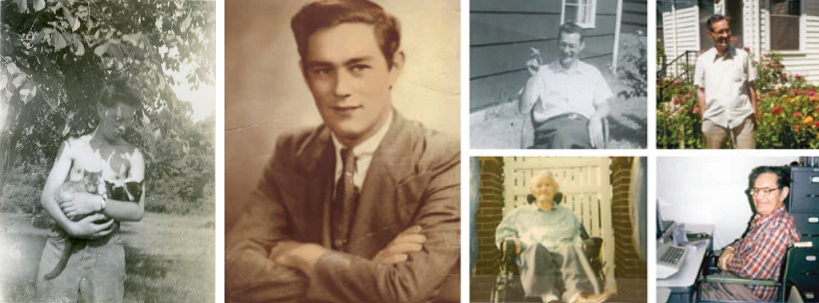
Henry G. “H.M.” Moliason through his teens, twenties, and older

For the remaining 55-years of his life H.M. could never form a single long-term memory. But there was more to his post-surgical condition. Henry was always stuck in the present moment for those last 20,075 days and nights of his life. When asked by doctors during his permanent stay at Bickford Health Care Center, Windsor Locks, CT, “What will you do tomorrow?” Henry would always answer, “Whatever is beneficial” or “I will have to see.” He was unable to recall any actual details of his activities the day before, much less 4-5 days prior. What H.M’s condition revealed for all of our human brains was profound for the field of neuroscience.

The brain regions that underpin memory are the same regions that simulate what is probable or coming next, whether tangible and/or abstract. In other words, the past and the future are creations in our individual brains.

Whoever we think we might be to ourselves and socially is an ongoing narrative. This unique individual and localized social construct starts after age two and continues non-stop until your death. This is where the popular idioms Old habits are hard to break or You can’t teach an old dog new tricks come from. Why? Because of brain degeneration such as dementia, Alzheimer’s disease, Parkinson’s disease, or Huntington’s disease as more and more people are living into their 80’s, 90’s, or 100’s. The good news is that through regular physical and mental activities into our elderly geriatric years neural brain networks can be rebuilt or better refined. This is because of Cognitive Reserves.

And now I would like to gradually navigate back toward my recent dialogues with Pastor Jonathan Waits, the Baptist minister in Charlotte, NC.

Meaning of Life vs Self-Meaning

How do the physical cells and neurons in our brains help us/me care about anything in life? Why does consciousness in all of us occur? Throughout your life you will hear, listen, and read as many theoretical explanations as there are stars in the night sky and galaxies in the Cosmos. The question of consciousness is still the greatest unsolved existential mystery of human history. The general question of “meaning” is without doubt still undefined, unanswered. However, we can say with certainty and abundant evidence that the meaning of something to you is completely defined by YOUR web of associations based on your entire history of personal experiences.

Imagine if I showed you a painting of various colors in no particular obvious pattern. Will that conjure up in your mind specific memories and ignite your imaginations? No, not likely. To you it is just a painting of colors with no particular meaning to you. But look at the two images below:

What do these two images mean to you? Do you think they will mean exactly the identical meaning you have to someone else? Why or why not?

The two flags will trigger some sort of meaning that is specific to your personal experiences. However, your experiences will never be precisely identical to someone else’s experiences nor to any number of others who look at the flags. Humans do not perceive or interpret objects as they are we perceive them, interpret them as we are. Every single one of us, including Pastor Jonathan Waits and myself, and all of you are on your specific journey, specific trajectory guided by our generational genetics, our immediate and extended social networks, and our own individual life experiences… whether many or few, wide or narrow, joyous or traumatic, boring or exciting.

As a result, every single human brain has a different neural reality and one that does not and cannot reflect one unified reality. Monism is a human coping mechanism constructed to ease our fears and insecurities about not being in total control. However, the Universe and Cosmos, and Earth itself amply shows through inference and explicitly tangible facts that they do not operate on or require one human’s or a group of humans’ invented Monism.

One of the most popular, widespread human construct of monism since the Bronze, Iron, and Classical Eras is religion’s and their endless plethora of convoluted theological constructs that have either 1) no unifying evidence or 2) very little convincing, compelling collection of evidence. This is no surprise given how the three Abrahamic religions evolved and evolved and changed and changed, some over several millenia of human history, across a vast swath of geographical, cultural, and military events and experiences. Some or many of the storied events changed many times over thousands and thousands of years and some/many which became false narratives, myths, and sensationalized legends or compounded embellishments.

No, the meaning of life and self-meaning is not that complex or confusing at all, not in the end. When “meaning” is understood primarily and/or strictly on an individual’s biological-neurological connections and social networks—tiny, small, large, or immense beyond compare—throughout their own life experiences, only then can one and millions or billions of Earthlings realize that meaning is found best within infinite pluralism as the planet, solar system, universe, and cosmos reflect and repeatedly shows us. This is what I politely and patiently tried to convey to Pastor Jonathan Waits over several days of dialogue. This has been what I always have tried to convey, to show and backup with ample broad evidence to all monistic, theistic faith-believers since 1991-92 the first months of my deconversion from Christianity.

Unfortunately, as I’ve conveyed here and I hope sufficiently, our human brains, such as Pastor Jonathan Waits’ brain or mine and yours, can be deeply programmed in unhealthy ways, in connecting neural pathways, to only perceive reality, his nearby limited reality, in just one way… monism, unbending and inflexible to the point of handicapping a fuller, more wholesome, thrilling life of unimaginable experiences, lessons, and adventures. To further demonstrate what he has done and chosen for many years surrounding himself daily with like-minded sycophants, or people who don’t challenge him or his world-view, but rather echo his world-view, I offer this blog-post. Obviously, Mr. Waits’ chosen tunnel-vision and radical narrow path is not just restrictive, limiting a more whole, sharper brain, but it can easily be defined as unhealthy, even divisive for a species that needs, even demands biologically and socially inclusion rather than exclusion.

An Epilogue

Over on his blog-site I asked Pastor Waits to freely share his background; childhood, teen and young adult background, his educational and occupational background. I was hoping it would be lengthy enough to gain a fair, accurate idea of his life experiences. Whether intentional or not it was resume-like and semi-short. I wanted more extensive background, especially many significant experiences from many continents, many nations, cultures, people and how much time was spent there experiencing different places, people, and events. His answer only told me the probable or implied story of strictly a (limited?) American experience. I have invited him to visit here and maybe change/correct my deduction of him. I hope he accepts.

I, on the other hand, as I share in/under my About menu selection, have had an unbelievable amount of life experiences during my six decades of life and in all sorts of ways and interactions! Every possible life-lesson I have absorbed and cherished has been acquired on four of the world’s six inhabitable continents: N. America, S. America, Europe, and Africa. This was possible because of my unquenchable passion for soccer or football, or futebol as it is called in Brazil. And futebol/football is a universal language no matter where you are and seamlessly connects you to anyone on any continent. I lived for a period of time and playing soccer in Brazil, West Africa, and briefly in northern-ish Europe—Belgium, Holland, Germany, and Austria. The most time I spent in those places was Rio de Janeiro, Brazil around São Cristóvão, Botafogo, and Copacabana, the heart of world-class football and festive, beautiful people! I regret that I have lost most of my Brazilian Portuguese. 😕 The two continents I have not been to or lived? Asia and Australia. I would love to change that.

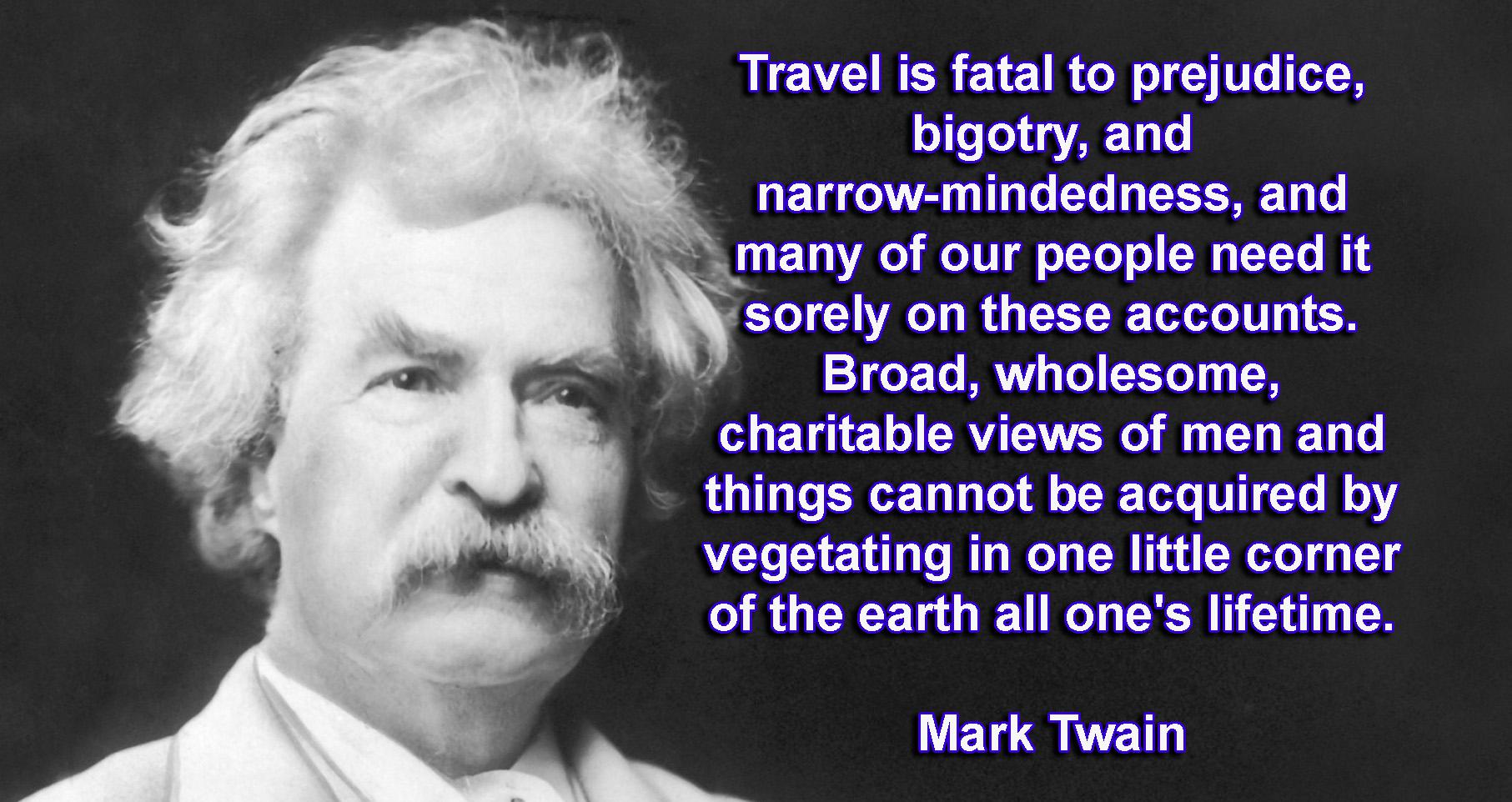
But all the places and people I have experienced along with their marvelous cultures (and footballing talents) influenced me in enormous ways helping me see, find, and embrace the goodness and wonder of humanity no matter the small differences. I would strongly encourage anyone, especially Pastor Waits or those like him to follow Mark Twain’s profound, timeless observation:
It is because of this life I have lived deeply that I am now a very happy, kind, understanding, compassionate, exploring Freethinking Humanist looking always for more enriching life experiences, good or bad, to give and/or embrace in equal measures for whomever I encounter. I think that is fair.

Why Aren’t Christians Unified?

Addendum 11/1/2024 — Pastor Jonathan Waits finally answered my invitation to visit here and comment, not here obviously, and he said this:

Unfortunately, this appears to be his regular M.O. with non-Christians who ask him, challenge him about his own world-view—he will not meet you halfway. Interpret that response/behavior as you will. I think it is indicative of his fear about his world-view when he steps outside of his personal comfort zone, his church, or his blog-followers. Being surrounded by Yes people or sycophants is risky, especially if you fortify yourself in very little diversity. It is not healthy for our brains to be trapped in a small box, never wanting or too scared to venture out.

As the popular cliché goes, You can lead a donkey to water, but you can’t make it drink, especially if it has a lifetime of only one type, one pH level of (holy?) water. 😉

The Professor’s Convatorium © 2023 by Professor Taboo is licensed under CC BY-NC-ND 4.0 

Oldest Profession in History


This will (hopefully?) be one of my shortest blog-posts in a long while. Yeah, yeah, I can hear some of my regular Followers laughing, Pffft-ing, rolling their eyes, and tossing bouquets of flowers to me on stage for my acting/writing performance of not just lying through my teeth, but flowering me about my illusions of grandeur thinking I could actually write a brief, quick blog-post. Touché. You might win. But I’m going to try. Show your kind approval and praise if I pull it off, will ya? 😉

Yesterday evening I put in a pickup order at a nearby taco-texmex restaurant that is literally 130-yards away from my complex. It’s quick and easy. It’s also a fairly popular mid-range, affordable, family restaurant chain. I was about 5-10 minutes early picking up my dinner (6:00pm). While waiting at the counter, grabbing some lime-wedges to go with my delicious Modelo Negra beers at the self-serve drinks, ice, straws, napkins, etc, wall a STUNNING curly-haired blonde, hair up in a twisty, tight black shorts, summer cork heels, and tight black halter-top, no bra because she was quite endowed and full in the bust-size… walked by, out the front door, past the two gentlemen outside with their survey-stand—for the restaurant or the strip-mall, I wasn’t sure—who couldn’t stop gawking at her as she went by and stepped into her parked navy blue or black Jeep Cherokee for something. I thought she was leaving.

Nope, after about 30-40 seconds she got out and walked back into the restaurant, by the two men again, and down the long walkway in the middle of booths/tables, and to the back near and across from the men’s and women’s restrooms. She rejoined her equally stunning dark brunette lady-friend(?) or dinner companion. She stood up, my breathing paused, and was wearing a skin-tight workout, black with blue accents (in “key places”) shorts and spandex top, also accentuating her model-esque voluptuous physique. Yes, needless to say OR to expound upon they were both hubba-hubba. Your powers of deduction are correct reading what I’m explicitly and implicitly saying and can continue on your own! I mean, everyone in the restaurant would watch them as they moved around, especially the men, much longer than the women inside, patrons or staff. I tried to not be obvious. HAH!

Within 1-2 minutes of those Lookers rejoining each other at their back booth, a young man, say late twenties, early thirties in a tight workout tank-top showing off his finely sculpted neck, shoulders, biceps, triceps, tatted-up, and most likely well-defined abs underneath walked across the entire glass window-front of the taco eatery, pulled open the door and entered. I thought to myself as I watched him, Is there a gym, yoga, boxing club in this strip-mall? No, of course not. The entire strip-mall, every single place of business was already leased. Has been for a long time. Then, instead of walking through the ordering or pickup line as I had done, that very buffed man, glued to his cell-phone as he walked by outside and now inside… went straight to the back where the two super hawt women were sitting. They began to chat, quietly, as if they had been friends for years.

Ahhh, then it all clicked. Everything made sense.

I chuckled at myself and did a mental pat-on-my-back for NOT being glaringly obvious I was taken by and intrigued(?) by the blonde I had seen first. Okay, VERY intrigued. When I was in my youth, I would have been a very gullible, horny Neanderthal boy. I readily admit it. But many life-lessons of love and eros—often not simultaneously I should confess—have since paid off for me. Saved me in some instances. Plus, at my heightened age and wisdom now, I have learned and mastered my healthy, jacked-up blood-flow that once emptied my cranium and flooded south, engorging my groins, thus incapacitating my broader, smarter, more patient cerebral cortex while ignoring the opposite, more primal creative fun cortex, which seemed to be way south. Today, these random encounters of thick eros oozing everywhere, no longer have the kryptonite impact on me they once possessed. It all strokes my ego a tiny bit, makes me proud of my maturity and wisdom presently! It’s damn near foolproof—but I’ve also learned Never say never.

As I walked out of the restaurant with my food and beers back to my residential complex, one of the earlier gentlemen outside the door there (in his 40’s or so) looked at me, I acknowledged him chuckling and said:

“I’ve rarely witnessed “female solicitation” that was so blatant, let alone when their “business manager” walks in and doesn’t bother to be discreet, glued to his phone, and sits with his two staffers, workers, I’ll say Courtesans, and all three of them pretend they own the restaurant.”

The surveyor gentleman replied “Yeah, blatant for sure, huh? It’s the oldest profession in history.

I laughed in agreement and returned a similar sentiment:

“Yep, and not that I have ever thought prostitution should be illegal. It shouldn’t at all! One way or another, we all pay for what we want; monetarily and otherwise.”

He laughed and we parted ways. I heard him say from around the corner “Ain’t that true!

Here’s my rub on life’s most ancient profession—the genders, orientations today don’t matter. Many people are more than willing to throw down loads of cash, credit, assets, emotional investment, whatever it is for that long-term, mid-term, or short-term feeling, dopamine fix all the time. Neurologically human nature will not change for many a millenia. But today, in a conservative, semi-pious or hyper-uptight pious society? There are pros and cons any way you examine it.

Legally, under our county/state marriages and family law, it costs us an insane amount, much more on all levels than you could imagine!!! That might be just fine, but it doesn’t disprove my intimate understanding of human eros and love. Some romantic relationships are great investments with very acceptable ROI’s. Others? Eh, not so much. And some are down right horrific, nasty, and disastrous in divorce court—children aside or not. Am I right or am I very right? Perhaps it is time for human society to evolve more? Be stronger and know we can learn from mistakes of the heart, mind, and the libido, huh? 😉 😛

I welcome any and all feedback, as usual. Just remember, good etiquette and be a little open-minded. A GREAT sense of humor is most definitely encouraged!


Live Well — Love Much — Laugh Often — Learn Always

Creative Commons License

This work is licensed under a Creative Commons Attribution-NonCommercial 4.0 International License.
Permissions beyond the scope of this license may be available at https://professortaboo.com/contact-me/.

21st-Century Humans More Peaceful

With utter fascination last Wednesday night Nov. 20th, I watched one of my favorite PBS shows, NOVA. The title of the show was The Violence Paradox. The one hour show investigated how over the last 200,000 years Homo sapiens as a whole are living and dying less violently. In other words, comparatively speaking in the 21st century by the compiled numbers most human beings are living and dying more peacefully than in our past.

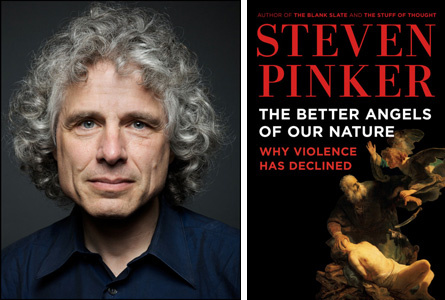
stevenpinkerIn his two published books The Better Angels of Our Nature: Why Violence Has Declined (2011) and its sequel Enlightenment Now: The Case for Reason, Science, Humanism, and Progress (2018), cognitive psychologist, linguist, and Harvard Professor Steven A. Pinker states on the show:
We’ve done something right. Let’s figure out what it is and keep doing it. The reality is that we may be living in one of the most peaceful eras in human existence. Violence has been in decline, but that just doesn’t count as news. You just never see a journalist saying, “I’m reporting live, from a country that’s at peace,” or “a school that hasn’t been shot up.” Once I stumbled upon this graph, I mentioned it in a blog post, and then I received correspondence from scholars in a variety of fields, telling me that I could’ve made an even stronger case. I saw data-set after data-set, all of which showed declines in violence, in different parts of the world, with different kinds of violence. And I realized there was a story that needed to be told.

Enlightenment Now_PinkerHowever, Pinker wants to be clear about the explicit and implicit meaning of his findings so as not to be painted as a deluded optimist.
To point out that things were worse in the past is not to say we should relax, our problems are all solved, quite the contrary. It’s by understanding how our predecessors were able to drive down rates of violence that we can be emboldened to try to drive them down even further.

And this is where I was personally intrigued! How. How has this downward trend of violence, on the global scale, been achieved? What various factors and events have contributed to humanity’s gradual increase to more peaceful existences with each other?

I found the entire 1-hour 53-minute documentary to be powerful and yes, hopeful with tangible solutions and methods offered and that are in fact tried and tested for success, offering more reasons to keep this peaceful trend rising. What I found especially intriguing from the scientific and statistical findings was of the many factors scientists have connected to violence or peace, seven modern societal conditions and their related sub-conditions which guided humans either toward, hate, prejudice, and violence, or on a path of peace, collaboration, and prosperity. They were:

  • Government or State — the rule of law kept better peace
  • The Civilizing Process — economic order went hand in hand with social norms and manners, etiquette, self-control, etc.
  • Equality — learning about others with the same experiences (with empathy below)
  • Literacy — not just reading, but how much could be read about from a diverse continent or around our diverse world (e.g. Uncle Tom’s Cabin)
  • Empathy — feeling deeply about someone else’s plight and/or prosperity (linked with equality)
  • Biggest World Powers — the top major powers/armies are not fighting, at the moment
  • Testosterone Levels — today violence is no longer an effective tool to get something done or achieve conquest as it was before. Non-violent movements are 2-3 times as successful as violent movements

However, without these seven conditions above or just two to four of them or one or more in fragile existence, the whole of a civilization could collapse, returning it/us right back to Medieval societal hardships when one ruler or small group of “Lords” could easily become sadistic tyrants willing, forcing their subordinates into heinous acts or genocide. From the show:

NARRATOR: At SWPS University, in Poland, Tomasz Grzyb and Dariusz Doliński are revisiting a famous experiment first conducted in the 1960s by the American psychologist Stanley Milgram. In the aftermath of the holocaust, Milgram wanted to understand how seemingly good people could follow terrible orders.

Just as Milgram did, the experiment starts by setting up a fake study.

TOMASZ GRZYB (SWPS University): There are two participants, and there is a guy who presents himself as a professor of psychology, and he says that, “Well, you are a participant in an experiment which is devoted to find out how memory’s working.”

NARRATOR: Grzyb is masquerading as a participant, the so-called “learner.” The other participant is the “teacher.” Grzyb pretends to memorize sets of letters, but his responses are scripted. The teacher is told that the student is hooked up to the machine, and they must administer a shock, if he answers incorrectly.

Because the experiment is highly stressful for the real subject, the so-called teacher, it’s controversial. So, it will be stopped at 150 volts, the 10th switch on the panel, which, if real, would be an extremely painful shock.

Will anyone go so high?

PBS NOVAThis experiment showed that with a powerful authority figure or figures ordering the “teacher” to commit this violence—by fear, coercion, or perhaps blackmail—of the 220 participants, about 90% of them obeyed the orders. Many of us think we would never commit such heinous crimes on another, a baby, child, or adult, but this test and others like it suggest otherwise. Similar to the soldiers of Genghis Khan or the Nazi SS of World War II, all of us have the capacity to commit heinous acts given our personal circumstances and surroundings. Peace and non-violence are not a forgone conclusion.

There were two other fascinating facts the show presented:  1) the Availability Heuristic, and 2) strong Gun Regulations, particularly on assault weapons, cut in half or more, crimes of homicide and mass killings.

Availability heuristic says that a diet of news stories will fool us into thinking that violence is much more prevalent than it really is. This is very much the case with social-media bombardments of a specific (viral?) topic. On the contrary, this very narrow propaganda or sensationalism (for revenues) does not factually represent the overall global or continental trends.

Gun regulations that are widespread and strong, e.g. in 1996 Australia, contribute to significant reductions in suicide, homicide, and mass-killing rates according to these studies, click here.

Cure Violence logoFinally, an international program called Cure Violence, ranked #9 in top 500 Non-Governmental Organizations (NGO’s) in the world, stops the spread of violence by using the methods associated with disease control. And cities around the world have turned to Cure Violence to prevent violence—from the United States to Latin America to the Middle East. One method utilized in Iraq (based upon Contact Theory) is through a football/soccer league where teams must have players of various ethnicities, religious beliefs, and/or social classes, even if historically opposed, in order to enroll and play the season. In football/soccer their are no national, ethnic or religious boundaries. Players and their families are also encouraged to socialize off the soccer pitch in restaurants and home-gatherings. The soccer league and additional off-field activities have been a huge success! How about that Ark! 😉

If you ever have the chance to watch this outstanding documentary, The Violence Paradox by PBS NOVA, I highly recommend you do it! It is well worth 2-hours of your time and undivided attention. Most of all, it shows us clearly how to understand our lesser nature for violence, but more importantly it gives us proven solutions and methods of stopping the spread of the violence disease and it becoming a repetitive epidemic.

————

Live Well — Love Much — Laugh Often — Learn Always

Creative Commons License
This work is licensed under a Creative Commons Attribution-NonCommercial 4.0 International License.
Permissions beyond the scope of this license may be available at https://professortaboo.com/contact-me/.

Not Who You Thought?

As part of the Alternative Lifestyles blog-posts migration over to the new blog The Professor’s Lifestyles Memoirs, this post has been moved there. To read this post please click the link to the blog.

Your patience is appreciated. Thank you!

Games of Unknowledging – Conclusion

A Closing Preface

I must confess that four months ago when I chose to tackle this subject and new field of study for a blog-post or two—that turned out to be four—I had little idea it would be so laborious and challenging for me. Not only was it formidable over time, but it was equally demanding of quality representation, of which I feel I have failed or sacrificed in some ways. For that I apologize. I likely bit-off much more than I could chew. And though my current personal situation has made my time reading, researching, blog drafting, blog writing, and publishing difficult and quite limited, I do hope this conclusion is sufficient enough to glean from the whole, some expansion on a little known, little taught or discussed subject:  ignorance. If nothing else, I hope these four parts have invoked a deep curiosity to learn and know more about what we don’t know, for it is great, it is endless, and paradoxically attainable.

∼ ∼ ∼ § ∼ ∼ ∼

Previously in Part III, I examined the colorful ways we fabricate facts, or our conscious intentional lying, and how to discern and reveal their motives and utilization. I also covered how North and South American indigenous fossil knowledge and their worlds became lost or entirely omitted from Euro-American archaeological records. Then finished with how to understand the benefits and advantages of historical-interdisciplinary hindsight. In doing so this groundwork offers a comprehensive, enlarged intellectual body of reliable context as well as a necessary reversal of or counter to explicit and implicit ignorance in the U.S.

In this conclusion I want to very briefly touch on white, or Anglo/Caucasian ignorance, explore the social theorems of ignorance, and then ask Where are America’s public intellectuals, who might they be, and why today are they few and far between? and provide plausible answers. Let’s jump right in.
(line break)

Anglo/Caucasian Ignorance

A few summers back as my two kids, my Mom, and my sister and I were seated around the dinner table, the discussion turned to American history, a subject that mostly interested my 15-year old son, but usually made my 22-year old daughter, Mom, and sister roll their eyes. When I made my point that our nation’s White House, the Capitol building, and some other government buildings were built by African-American slaves, I got facial expressions of pause, silence, and astonishment. Their faces said it all. As a state certified educator in Texas, I was not surprised by their baffled, yet silent responses. This tidbit of historical fact and its implications generally does not make it into state-approved classroom textbooks nor is it required by the state’s core-curriculum as critical learning. Thus, we have a classic case of anglo-caucasian (white) ignorance. I rather like this introduction…

White ignorance…
It’s a big subject. How much time do you have?
It’s not enough.
Ignorance is usually thought of as the passive obverse to knowledge,
the darkness retreating before the spread of Enlightenment.
But…
Imagine an ignorance that resists.
Imagine an ignorance that fights back.
Imagine an ignorance militant, aggressive, not to be intimidated,
an ignorance that is active, dynamic, that refuses to go quietly—
not at all confined to the illiterate and uneducated but propagated
at the highest levels of the land, indeed presenting itself unblushingly
as knowledge.
Charles W. Mills

Professor of philosophy at the City University of New York, Dr. Charles W. Mills believes by clarifying and demarcating historical white domination and its ramifications, as well as examining the individual and social processes of cognition with regard to race, we can start to understand how best to achieve multiracial enlightenment that garners short-, mid-, and long-term benefits not just for a few, but for all humanity.

White Domination & Ramifications
Dr. Mills finds ten components to clarification and demarcation. I will point out four I find particularly important.

  1. Race as a cognitive phenomena historized — white domination has been and still is a social-structure, not a physio-biological structure. “Whites” did not exist in the ancient world.
  2. Leaving white paradigms — “White” in white ignorance doesn’t need to be confined to just white people. To a greater or lesser extent this has existed due to power relations and patterns of ideological hegemony.
  3. Male ignorance — ignorance of the male gender must be analyzed equally as it is far more ancient, going back to the very origins of patriarchy.
  4. Avoiding false beliefs — gaining a broader understanding of white ignorance is not only sociological, but normative too. Flawed patterns of cognition are promoted or propagandized by certain social models and group membership as are truthful-moral ones.

Individual & Social Processes of Cognition
Before getting into Dr. Mills’ work below, watch this 6-minute video. It is a prime example of Memory and Testimony discussed below and how to incorporate it into social cognition:

An examination of white supremacy and its historical dominance, injustice, and ignorance cannot be done without understanding the influences of individual and social processes of cognition. Separating out these various components can be demanding for they are in perpetual interaction with each other. For example, when an individual discerns, they do so with sensors that have been socialized. Keeping this in mind, Dr. Mills analyzes five dynamics that I will summarize:

Mercator Projection map
Mercator projection without “human” imposed borders
  1. Perception — in general, perceptions and conceptions are practically one in the same, so tightly related that often they’re indistinguishable. Individuals do not create these categories, we absorb them from our cultural contexts. Two prime examples are the world’s continents, they’re sizes, and the term savages and its origin and context. They beg the questions, Why is Europe a continent and say India or Eurasia are not? And savage originated from Anglo-French cultures in the 13th century, the Age of Exploration and Colonization by European superpowers, and implies a person/people of uncivilized, primitive, dumb behavior and inferior to the designator(s). Why is this context assigned to savage? Does it justify imperialism, conquest, and domination? The context of savage continued into the 18th century and found its way into one of our most enduring U.S. documents:

    When Thomas Jefferson excoriates the “merciless Indian Savages” in the Declaration of Independence, then, neither he nor his readers will experience any cognitive dissonance with the earlier claims about the equality of all “men,” since savages are not “men” in the full sense. Locked in a different temporality, incapable of self-regulation by morality and law, they are humanoid but not human.
    Charles W. Mills

  2. Conception — this aligns us to our known world. The unknown world, however, is assessed and judged not with the discreetly detached concept, but viewed and judged through the concept. Very rarely does an individual resist this societal bias. And here is the baffling irony of this egocentric, white-centric condition which surrounds the word savage:

    In the classic period of European expansionism, it then becomes possible to speak with no sense of absurdity of “empty” lands that are actually teeming with millions of people, of “discovering” countries whose inhabitants already exist, because the non-white Other is so located in the guiding conceptual array that different rules apply. Even seemingly straightforward empirical perception will be affected—the myth of a nation of hunters in contradiction to widespread Native American agriculture that saved the English [e.g. Jamestown] colonists’ lives, the myth of stateless savages in contradiction to forms of government from which the white Founders arguably learned, the myth of a pristine wilderness in contradiction to a humanized landscape transformed by thousands of years of labor (Jennings 1976). In all of these cases, the concept is driving the perception, with whites aprioristically intent on denying what is before them.
    Charles W. Mills

  3. Memory — it is sadly ironic that as I get to memory of the individual and/or social cognitive process that events such as those in Charlottesville, Virginia, Aug. 12th occurred. It reiterates just how crucial it is to understand the fluid interconnectedness of these five components, including memory, and how it relates to white knowing and unknowing due to denial of requisite facts. While understanding collective memory, we must also understand collective amnesia. They always go hand-in-hand. We remember the Holocaust primarily because Hitler and Nazi Germany lost the war. But what about the Pequots, the Nama, the Tasmanians, the Beothuks, the Congolese, the Hereros, or the Armenians? What about the Native American Cherokees or any of the over 200 tribes on the continent? What about 19th century antebellum slavery, killing rebellions such as Nat Turner’s, and the atrocities throughout the American Civil War? Today, over seven generations later, Americans still confront their historical identity and memory over the Standing Rock Reservation oil-pipeline and Charlottesville, VA over a Robert E. Lee statue and what it means.

    As the individual represses unhappy or embarrassing memories, that may also reveal a great deal about [their] identity, about who [they are], so in all societies, especially those structured by domination, the socially recollecting “we” will be divided, and the selection will be guided by different identities, with one group suppressing precisely what another wishes to commemorate. Thus there will be both official and counter-memory, with conflicting judgments about what is important in the past and what is unimportant, what happened and does matter, what happened and does not matter, and what did not happen at all.
    — Charles W. Mills

  4. Testimony — How do you know your exact birth date? Your knowledge of your birthday is most certainly told to you by those there in the delivery room, your mother and father, and perhaps doctors and/or nurses there at the time. Hence, your beliefs about your birth time, place, month, and year are through testimony. We are quite dependent on others for what we know and this most certainly involves elaborations of social epistemology. Those elaborations also come from other previous individual and social epistemic elaborations and so on. In cases of veracity and neutrality, it bears significant impact to ask ‘testimony by whom and for what (possible) interests gained or lost?
  5. Motivational Group Interests — these can be found in varying strengths with any political, religious, economic, and/or sports groups with common interests. What these sorts of groups demonstrate are what is commonly known in cognitive, developmental, social, clinical, and neuropsychology as hot cognition (as opposed to cold/unemotional) associated with physiological arousal responding more to environmental stimuli. Peer-assimilation is another aspect of hot cognition. This certainly applies to racial grouping and “color-blindness” as well.

Though he speaks primarily on the African-American plight in the U.S., in this following video-clip Harvard University Fellow and MIT Professor Noam Chomsky talks about white domination and racism from the historical record. This really applies to all non-whites in America and the world, does it not?


Social Theorems of Ignorance

Is ignorance simply the absence of knowledge? The sum of society’s ignorance is much greater than the sum of our knowledge. Yet, how much do we really know about social or collective ignorance? Where does social-collective ignorance come from? How much do we impose it upon someone or upon ourselves? What role does social-collective ignorance play in interactions, group relations, in institutions, in civil, business, and criminal law, and managing risks? Typically our societal norms give negative connotations to ignorance, but when might it be preferrable not to know something? Can it be a virtue?

Dr. Michael Smithson, Professor of Psychology at the Australian National University, has been working in the area of uncertainty and ignorance for many years. He takes an interdisciplinary approach to socially produced uncertainty and ignorance and believes one must begin with defining what social ignorance is and is not.

Socially Produced Ignorance: What It Is and Isn’t
Social ignorance is 1) emerging, it is 2) partially constructed by society, and it is 3) imposed. It is manipulated deliberately or as a by-product of some social movement or process. It is also typically at a macro-level of large groups within power relations. As far as how kinetic ignorance is managed (4) it is typically at the micro-level with individuals and how those individuals conceptualize, represent, negotiate, and respond to ignorance. Thus, the managing agent is often indirect or as a spectator concerning the thinking and behavior of ignorance. These are four theorems of social ignorance.

Social ignorance is not the external world and how it arises in non-social settings. For example, the non-social settings would be science and the limits of science. It also includes epistemological and religious frameworks that make assertions about non-knowledge or meta-knowledge in exogenous non-social terms. It is not a managing under kinetic ignorance either. In other words, how people/groups think and act in uncertain environments, and not artificially generated under theory.

Negotiated Ignorances
There are at least five different negotiated ignorances between social (or at least interpersonal) arrangements of ignorance. A sixth could be time, or the lack of time, to adequately understand dynamics of an event, place, or person, but for the sake of time (no pun intended), I will very briefly cover these five:

Specialization — is simply an admittance there is too much for any one person to learn everything exhaustively. Hence, spreading the perceived risks can be achieved in three ways:  1) diversified learning rather than direct or narrowed learning, 2) therefore, concurrently diversified ignorance is created, and 3) acquired knowledge is also diversified via social collaboration.

Privacy — another social ignorance arrangement which is not necessarily controlled access to information by others about self, but can also be consensual with trusted persons or experts. Secrecy is imposed unilaterally, but privacy involves levels of risk. And trust is interconnected within organized specialization.

Trust — is a state of perceived vulnerability or risk. Dr. Smithson (on Yamagishi) elaborates:

[Toshio] Yamagishi and his colleagues argue that trust and “commitment formation” are alternative ways of reducing the risk of being exploited in social interactions. Commitment formation involves the development of mutual monitoring and powers to sanction and reward each other’s behavior. However, the reduction of transaction costs in commitment formation via uncertainty reduction comes at a price, namely the difficulty and costliness in exiting from the relationship and foregoing opportunities to form other relationships. Trust, on the other hand, entails running the risk of being exploited but increases opportunities by rendering the truster more mobile and able to establish cooperative relations more quickly. Trust, therefore, is both an example of a social relation that requires tolerance of ignorance and also trades undesired uncertainty (the risk of being exploited) against desired uncertainty (freedom to seize opportunities for new relations).”

Politeness — is another example of how social relations trade on ignorance. Within formal public conversations people typically don’t expect to first place their hand on a bible and state “the truth, the whole truth, and nothing but the truth.” The strategies a talker may utilize are varied in creating disinformation, e.g. promoting a false impression of approval, or agreement, or offer tactful brevity, vagueness, or ambiguity. However, this latter strategy is not always negative because it could nurture healthy adaptability or change due to diverse interpretations.

Legitimation — social ignorance is also used in a number of facades to vindicate inaction, keeping the status quo (also known as business as usual), opportunism, evasion of responsibility or liability, and risk management strategies. Our American legal differences between civil cases versus criminal cases, as one example, are where a verdict in the former can be given on probabilities and in the latter it must be given “beyond reasonable doubt.

“Licit” actions and choices done on the basis of social ignorance are abundant in our mundane life as well. As previously discussed in this series, legitimizing high-level federal policy change, or non-change, use (abuse?) the precautionary principle, e.g. climate change counter-measures.

Is Social Ignorance Always An Insight-Deficit?
Contrary to popular belief, ignoramuses are not always at a disadvantage. There are cases where they are better off than very knowledgeable people. Case and point, if you could be told exactly when and how you were going to die, would you want to know? Why or why not? Would you want your spouse and children to know the details of your death? Why or why not? Often in the field of counseling where doctor-patient confidentiality existed, I found myself in the position of aiding social ignorance between spouses, family members, employers or a circle of friends for legitimate reasons, e.g. one spouse’s history of unfaithfulness, in order to maintain necessary therapeutic stability. Many spouses/partners don’t care to know intimate details of former lovers/spouses. Dr. Lael Schooler and Ralph Hertwig, both of the Max Planck Institute for Human Development, assert from their research that forgetting facilitates the use of inferential heuristics that also trade on environmental structures.

What I hope has been adequately conveyed here is that ignorance, particularly social ignorance, is quite prevalent. It exists practically everywhere, including with yourself.  It is predominantly socially structured. Accordingly, it deserves as much attention, monitoring, and updating as one’s repository of knowledge. This, our social and individual human ignorance-condition, I hope would conflate wise, cunning humility and not inflated arrogance. Therefore, how might we as social parts of a whole get regular checkups, quarterly or annual appraisals of our cunning humility and/or inflated arrogance? Glad you asked!

America’s Public Intellectuals – Questions

What does intellectualism mean? After this four-part series, is it possible for intellectualism to thrive and coexist with ignorance? Should that even be questioned? Can intellectualism guide ignorance and ignorance guide intellectualism offering more balance, more tolerance? In our modern age of technology and data-overload, are we too knowledgeable, too informed?

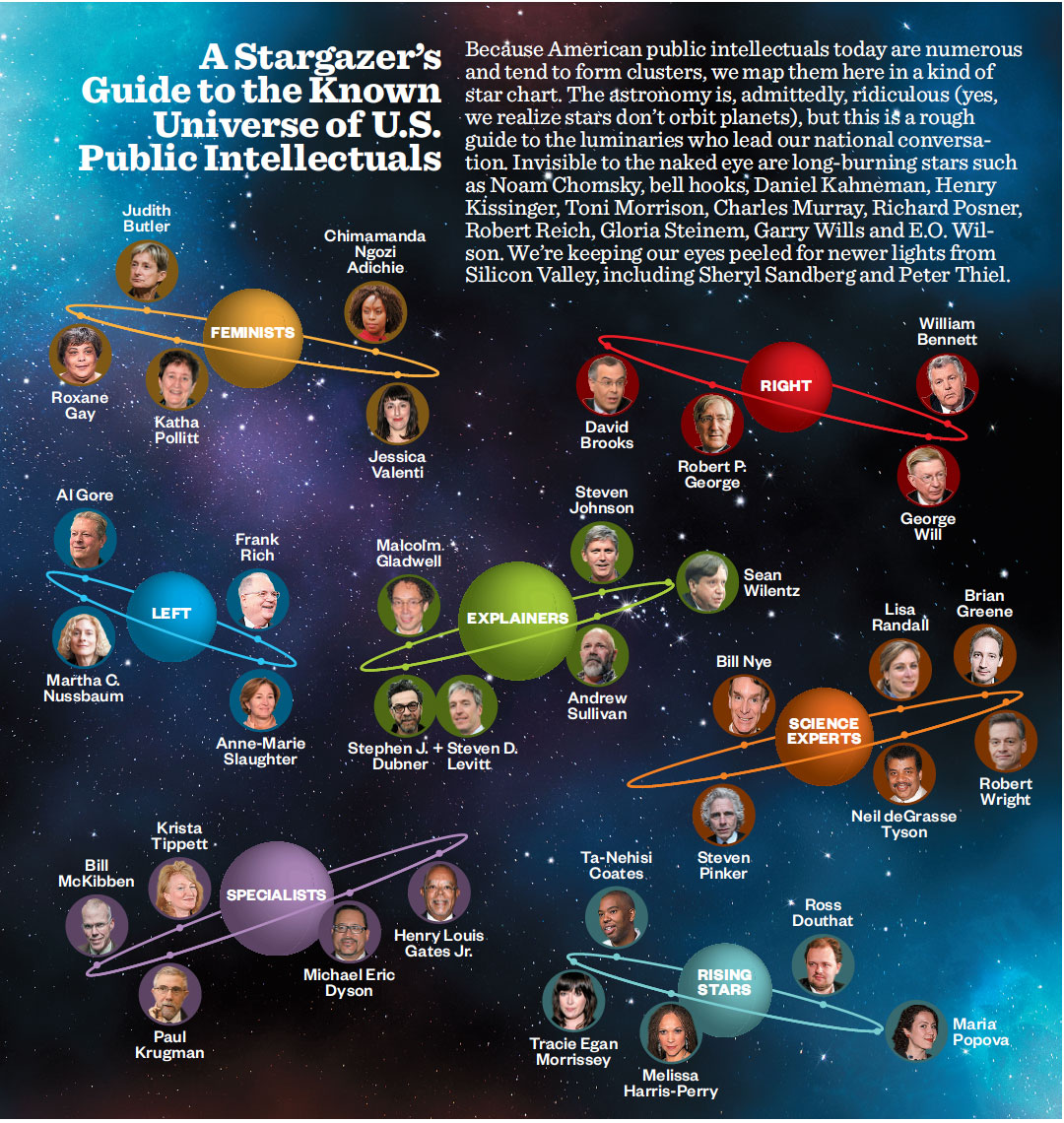
Today, we are not necessarily uninformed, but so over-informed it forces our cognitive capacities to seek out preferable trigger-topics and information that bolster our own perspective. That is most certainly a self-imposed ignorance and to degrees social ignorance. On the aforementioned section of social ignorance, sociologists define that as a neo-tribalism tagged with near-fanatical insistence on cohesion and monism in a world, its Nature and fauna that is anything but monistic or binary. Within this neo-tribalism, humans — perhaps just advanced primates at this point? — historically have resorted to bullying and moral castigation to keep their own status quo. But at what cost? Many public intellectuals agree:  the egghead is dead, replaced by chest-beating activists. That may be true.

public-intellectuals-starmap
click here to enlarge

If our nation’s Founding Fathers were alive today, they would almost certainly be distraught and aghast at the loud polarity and lack of common interests. This isn’t to say those members of the 1787 Constitutional Convention, lasting a miserable 116 steamy days and nights, did not have their heated differences. Indeed they did. However, those resilient intellectuals mixed daily with their communities and adversaries; they had no choice really but to learn basic etiquette, tolerance, compromise, and mutual understanding and do it face-to-face. Those differences, conflicts, and resolutions took enormous amounts of highly skilled dialogue, negotiation, candor, and listening as they did expressing.

Fortunately, our modern intellectuals are still around, as seen in the Stargazer’s Guide image, as well as several of their interdisciplinary colleagues I’ve included throughout this four-part series. They too could easily be included on the map in their respective fields. Perhaps they are not as recognizable or accessible today because technology is increasingly finding intrusive ways to get in front of our faces and into our schedules, not weekly or daily, but hourly! Too much information-knowledge is just as bad for us individually — and potentially within a social framework of influence — as ignorance is because covertly hyper-knowledge fosters more risks that would otherwise be spread-out, diversified to minimize risks or learning-bankruptcy.

The difference between intellectualism (knowledge) then in 1787 and now (over-knowledge), as I personally see it, is that whether opposing sides embrace it or not, we know a lot less than we think we do (ignorance). Arrogance with power is the chief combatant of agnotology and collaborative progress. To remain stagnant in current knowledge without diversifying and going into the darkness of ignorance and where it leads is to risk terminal illness at the hands of Nature, predatory Nature to be specific. That assured apathy (that all is known) will be especially lethal if we do not recognize, with no exceptions, that ignorance is an equal or greater dichotomy. An egalitarian dichotomy not to be feared, but merely appreciated, explored further, confronted if necessary, and thus made more commonly defined, inclusive of both individual and social frameworks.

(paragraph break)
Live Well — Love Much — Laugh Often — Learn Always

Creative Commons License
This work by Professor Taboo is licensed under a Creative Commons Attribution-NonCommercial-NoDerivatives 4.0 International License.
Permissions beyond the scope of this license may be available at www.professortaboo.com/contact-me/.