Just like as in a nest of boxes round, Degrees of sizes in each box are found: So, in this world, may many others be Thinner and less, and less still by degree: Although they are not subject to our sense, A world may be no bigger than two-pence. Nature is curious, and such works may shape, Which our dull senses easily escape: For creatures, small as atoms, may there be, If every one a creature’s figure bear. If atoms four, a world can make, then see What several worlds might in an ear-ring be: For, millions of those atoms may be in The head of one small, little, single pin. And if thus small, then ladies may well wear A world of worlds, as pendents in each ear.
—— Margaret Cavendish, “Of Many Worlds in This World“
This slideshow requires JavaScript.
Music: “Ocean” by Azam Ali & Loga Ramin Torkian from the album, Lamentation of Swans: A Journey Towards Silence
————
Live Well — Love Much — Laugh Often — Learn Always
Leonard R. Rogers was the subject of a 1954 article called “Boss Of Million Dollar Firm At Age Of 21 Is No Pipe Dream.” Rogers, whose company was responsible for 75 per cent of America’s business in tobacco pouches, was radically revamping the mega-corporation. When Rogers took over the company founded 50 years earlier by his grandfather he quickly realized that some of the long time company executives knew nothing about anything that was happening outside their department (bubble). Thus, he made the decision to re-organize the company by rolling heads and dissolving positions, i.e. Too many chiefs and not enough indians.
Human towers in the traditional Catalan Festival
“Too many chiefs and not enough Indians” was also the phrase my father liked to use. When we were down in Brazoria County, Texas, working my paternal grandparents cattle and land during one or two of the 3-4 holidays of the year, every one of my cousins, myself, and all my uncles and one aunt of the family had/wanted to accomplish all the needed and necessary work and never-ending repairs as efficiently as possible given the usually short few days everyone had while there. With so many cousins running around wanting to play or do our own “work tasks,” that was when he’d often use the phrase on us. I have to note here, however, that with his family the chief-indian concept reflected more the later 1996 concept “It Takes A Village” by Hillary Clinton. His family had rotating or periodic leadership and supporting roles. Everyone had to do and know all positions and their functions. Dad said it many times during my school and select-league soccer games he’d attend when we’d play bad or lose.
In the exceptional 2008 animated film WALL-E, Earth has become a trashed garbage planet due to unfettered free-enterprise which led to human hyper-consumption of everything corporate manufacturers and retailers convinced and sold the poorly educated masses they HAD to have to be “truly happy.” The upper-echelon executives left Earth on giant starliners and charged lower-echelon humans the same type of prices they charged for all their earthly GNP goods. As a result of the never-ending, rising land-fills from impulsive, Keeping Up with The Jones consumers they ironically created, Earth was no longer inhabitable. The starliner Axiom returns to Earth to retrieve another garbage compactor EVE that is not functioning. WALL-E becomes a stow-away onboard the Axiom and when he finally sees his predecessors/creators, humans. Every single one of them are grossly obese, immobile, and totally dependent on automation to do everything for them — the consequence of widespread chief-dome and no one wanting to rotate into the support roles, the blue-collar roles, the farmer roles, the plumber and garbage roles, or janitor roles. The ‘indians‘ roles.
All the chieftain-humans on the starliners had become slaves to convenience, leisure and having anyone or everything robotic perform all the daily, humdrum labor they themselves were too lazy to do. It was below them and their pay-grade.
Slavery. Oh the irony. In 1835 Alexis de Tocqueville, a French historian and political scientist, wrote a book about the young United States of America while examining a spreading trend of democracy and equality in Europe as well as North America. The book was Democracy in America and Tocqueville was intrigued by America’s system of governing and its nurturing of individualism. He thought the U.S. was a leading example of liberty, equality, a stable economy, and governing in action. He noted too how popular its churches were to social life. Yet, with all those “good marks,” he couldn’t help but notice how a freedom-loving nation despicably treated Native American Indians and African slaves. With all the theoretical perks of democracy, capitalism, and individualism, Tocqueville warned that too much equality would or could lead to intellectual dilution and a mediocrity of majority rule. Regarding independent, provocative thought, theory, and debate he wrote:
The majority has enclosed thought within a formidable fence. A writer is free inside that area, but woe to the man who goes beyond it, not that he stands in fear of an inquisition, but he must face all kinds of unpleasantness in every day persecution. A career in politics is closed to him for he has offended the only power that holds the keys.
On the other hand, the pendulum can swing too far the other way to plutarchy and oligarchy if there is an insufficient, low-quality public education system and lack of economic opportunities/mobility to hedge against such tyrannies. If or when that occurs, some “individualized” Americans independently wealthy and above a struggling majority — what is currently the case in America today — often have the delayed pragmatic realization that looking after the welfare of others is not only good for the soul, but actually is equally good for their business and wealth. Those individualized elite who never realize this profound truth, eventually watch their empire and ivory towers crumble. Just ask the Roman Empire’s aristocracy, ask the 18th century opulent French monarchs such as Louis XVI and Marie Antoinette, or ask those executive heads of Leonard R. Rogers’ mega-tobacco corporation, or let’s ask a modern, Nobel Prize winning economist Joseph Stiglitz:
The top 1 percent have the best houses, the best educations, the best doctors, and the best lifestyles, but there is one thing that money doesn’t seem to have bought: an understanding that their fate is bound up with how the other 99 percent live. Throughout history, this has been something that the top 1 percent eventually do learn. Often, however, they learn it too late.
Tocqueville had a lot to say about the bright and dark sides of “democracy” in 1835. I think he still has a lot to say about it today, along with WALL-E, Leonard Rogers, and my Dad. Everyone deserves the right to be well-educated, helped and prepared by a team/village for their rotation as a chief and as an indian. When you stand-in and walk in someone else’s shoes, that is when understanding begins. That is when appreciation begins. That is when compassion and empathy begins. That is when true empowerment with humility begins.
(paragraph break)
Live Well — Love Much — Laugh Often — Learn Always
Democracy. What does it mean? The Oxford-English dictionary defines democracy this way:
1.0 — A system of government by the whole population or all the eligible members of a state, typically through elected representatives. (1.3) The practice or principles of social equality.
Yet, it is more than that. In fact, it is a LOT MORE than that. Stanford University in a 2004 lecture for humanistic studies breaks down democracy with four pivotal elements.
A political system for choosing and replacing the government through free and fair elections.
The active participation of the people, as citizens, in politics and civic life.
Protection of the human rights of all citizens.
A rule of law, in which the laws and procedures apply equally to all citizens.
It is #3 that is the focus of my post here. But it is not the advocacy of “protection” that I’m going to address. I like a process I sometimes call Reciprocal Comprehension, or examining the positive and negative aspects of an image, in this case principles. Here is Stanford’s breakdown of #3…
In a democracy, every citizen has certain basic rights that the state cannot take away from them.
These rights are guaranteed under international law.
You have the right to have your own beliefs, and to say and write what you think.
No one can tell you what you must think, believe, and say or not say.
There is freedom of religion. Everyone is free to choose their own religion and to worship and practice their religion as they see fit.
Every individual has the right to enjoy their own culture, along with other members of their group, even if their group is a minority.
There is freedom and pluralism in the mass media.
You can choose between different sources of news and opinion to read in the newspapers, to hear on the radio, and to watch on television.
You have the right to associate with other people, and to form and joinorganizations of your own choice, including trade unions.
You are free to move about the country, and if you wish, to leave the country.
You have the right to assemble freely, and to protest government actions.
However, everyone has an obligation to exercise these rights peacefully, with respect for the law and for the rights of others.
[emphasis mine]
There is also an inferred responsibility to all law-understanding and law-abiding citizens to be informed about and keen enough to understand the difference between rhetoric/propaganda and facts/truths regarding a subject. Just because someone has the right to say whatever they want, however they want, doesn’t make it right or true. Each of us, me included, are responsible to discern what the real facts are or what the probable or highly probable facts and truths are so as to properly identify bastard muses.
Cleanth Brooks is often referred to as one of the Fathers of New Criticism. He also is credited for composing formalist criticism of literature and poetry. While being the keynote speaker at the 2011 convention of History Makers in New York City, Bill Moyers spoke these words about literature, journalism, Cleanth Brooks, and to modern social-media:
…while “most of us like to believe that our opinions have been formed over time by careful, rational consideration of facts and ideas and that the decisions based on those opinions, therefore, have the ring of soundness and intelligence,” the research found that actually “we often base our opinions on our beliefs … and rather than facts driving beliefs, our beliefs can dictate the facts we chose to accept. They can cause us to twist facts so they fit better with our preconceived notions.”
These studies help to explain why America seems more and more unable to deal with reality. So many people inhabit a closed belief system on whose door they have hung the “Do Not Disturb” sign, that they pick and choose only those facts that will serve as building blocks for walling them off from uncomfortable truths.
[…]
George Orwell had warned six decades ago that the corrosion of language goes hand in hand with the corruption of democracy. If he were around today, he would remind us that “like the rattling of a stick inside a swill bucket,” this kind of propaganda engenders a “protective stupidity” almost impossible for facts to penetrate.
[…]
The late scholar Cleanth Brooks of Yale thought there were three great enemies of democracy. He called them “The Bastard Muses”: Propaganda, which pleads sometimes unscrupulously, for a special cause at the expense of the total truth; sentimentality, which works up emotional responses unwarranted by, and in excess of, the occasion; and pornography, which focuses upon one powerful human drive at the expense of the total human personality. The poet Czeslaw Milosz identified another enemy of democracy when, upon accepting the Nobel Prize for Literature, he said “Our planet that gets smaller every year, with its fantastic proliferation of mass media, is witnessing a process that escapes definition, characterized by a refusal to remember.” Memory is crucial to democracy; historical amnesia, its nemesis.
Against these tendencies it is an uphill fight to stay the course of factual broadcasting.
I would like to personally clarify Brooks’ three bastard muses of broadcasting, or social-media, and Milosz’s amnesia muse on democracy, and modernize, more specifically distinguish, those bastard muses as opposed to the nine inspirational Greek muses.
Propagat Bastard
Propagat, or propaganda, is as most of you know a selling, marketing, or diffusion technique of hype and/or disinformation of an ideology, cause, product, or service that may not necessarily be factual or truthful. Who or what can you name, past or present, that was a masterful or sinister propaganda machinist? Here are six rules-of-thumb from one of history’s most successful propaganda campaigns by one of the world’s most elite, most notorious propagandist:
Propaganda must be carefully timed, reaching its audience ahead of competing propaganda.
Propaganda must have a theme that must be repeated over and over.
It must label events and people with distinctive phrases or slogans.
It must evoke the interest of the audience.
It must diminish anxiety.
It must be transmitted through an attention-getting communications medium.
Who was this elite propagandist? He was Nazi Germany’s and Adolf Hitler’s propaganda minister Joseph Goebbels. He was also primarily responsible for much harsher discrimination policies across continental Europe including the extermination of Jews in the Holocaust. This is the power of unchallenged, unscrutinized propaganda.
Addendum — The Pink Agendist below in comments offered an exceptional article that further reveals the spine-chilling, remarkable power of propaganda. I highly recommend reading it. Thank you Pink.
Nostalgia Bastard
Sentimentality, or as I’m calling her nostalgia, in my opinion is the most covert, the most misunderstood bastard muse. Brooks correctly describes above that it is unwarranted emotion and in excess of the occasion; it panders to a gullible human sentiment to “rewrite history” as this Vox video informs us:
Sadly, much of modern racism, discrimination, and segregation in America can be attributed to the United Daughters of the Confederacy. They’ve kept much of the old Confederate prejudices alive today.
Pornographos Bastard
Pornographos, or pornography, perhaps the antithesis of Erato, but only from a conservative, pious, or puritan viewpoint. She is derived from the Greek word Eros that in ancient Greece is historically just one of six forms of “love.” Modern-day conservatism rarely understands the full experiences of endearing Greek relationships of Antiquity.
Despite the fact that Brooks does indeed give in very few words the correct, yet truncated definition of pornography, I feel the fuller understanding of the muse Pornographos should be understood in her expansive form. Bill Moyers may have described her more fully at some other place and time, I’m not sure. But he did not elaborate or hint in this opening speech what he means by “total human personality.” That is what I wish to do.
Pornography, or Eros, belongs with another 5 or 6 siblings: Ludus, Agape, Philia, Pragma, and Philautia. The sixth sibling, in my opinion is the antithesis of jealousy: Compersion. It is unfair for societies and religious ideologies to separate out or orphan Eros (pornography). Though she can be the center of attention for a period of time and degrees of sublime endeavor, she will always be one of six sister muses. When her other six sisters are neglected, that is when habitual problems and implosion creeps in. When sexual organs and associated body parts are exploited and/or abused for the gains or pleasures of another, while at the expense or humiliation of the entire person/victim, then CLEARLY that is wrong, illegal, and detrimental to everyone involved. All become less human.
Based on what I know about Bill Moyers and what I’ve briefly read about Cleanth Brooks, this latter specified condition of an orphaned Pornography is more their “bastard” muse. It is still incomplete. Their description is the modern connotation of pornography within conservative-puritan society, but it does not represent her family of six sister muses.
Amnesia Bastard
Amnesia, or historical amnesia, is indeed an infection to democracy. On the distinctions of history, national or individual, known or unknown, there is probably no better an expert, a firsthand expert, than Czeslaw Milosz. While becoming an acclaimed poet, he survived ethnic cleansing, exiles, and two world wars in Europe and the constant annexations and occupations of his homeland by Russia/USSR twice and the Nazis occupation 1939 – 1945 during World War II. Plain and simple, the man knew much about history and truth. Milosz writes:
“The creative act is associated with a feeling of freedom that is, in its turn, born in the struggle against an apparently invisible resistance. Whoever truly creates is alone… The creative man has no choice but to trust his inner command and place everything at stake in order to express what seems to him to be true”
The 20th century culture surrounding him worshipped victorious power-versions of history, but Milosz is the artist who through his poetry worships truth. His craft allows him to save his and the reader’s soul. Perhaps the trick (or struggle) for all free citizens of democracy — the type of democracy Stanford describes above — should be which muse you fall in love with, which muse beguiles you and why, yes?
(paragraph break)
Live Well — Love Much — Laugh Often — Learn Always
As part of the Alternative Lifestyles blog-posts migration over to the new blog The Professor’s Lifestyles Memoirs, this post has been moved there. To read this post please click the link to the blog.
Previously in Part II, methods of manufacturing uncertainty and five historical cases in which doubt was produced, the ignorance surrounding women’s bodies and pleasures both lost and suppressed, and the lost knowledge and worlds of West Indian abortifacients were briefly covered. Here in Part III I would like to cover cases of artful fabricated facts or conscious lying and how it might be recognized, how indigenous fossils have become lost worlds and knowledge, and finally how understanding the benefits and advantages of historical-interdisciplinary hindsight can improve one’s bull-shit detecting skills.
Once again, I apologize for the length. I realize this Part is over 5,400 words, but its content is critical, too vastly unknown today by the general American public, that again I just couldn’t reduce the word-count anymore than I have. I hope you’ll understand why when finished reading. Thank you in advance for your patience.
∞ ∞ ∞ § ∞ ∞ ∞ (line break)
Fabricating Facts (line break)
Profiling and discerning the who(m), what, where, when, and why of fabricators, their fabrications, infection, placebos and/or actual cures for individual or humanity’s honest betterment is not a Sherlock Holmes skill-set we are born with. It takes trial and error, often MANY trials and errors, over appropriate time, and hedged by just as many or more learners and teachers. Here are some uncinematic examples of prolific fabrication…
Secret Anecdotal History In 6th century CE Palaestina Prima, Byzantine historian and scholar Procopius secretly wrote a collection of abusive defamatory works about Emperor Justinian and other aristocratic elite whom he glorified in actual published works. After his death the writings became known as Anecdotal, which means a short obscure account of an event or events often for amusement and unsubstantiated. In our case here, truthy… maybe, possibly, probably fabricated. Political anecdotes are most suitable for casting degrees of public doubt.
Benjamin Franklin’s Boston Newspaper Hoax In 1782 a Boston, MA newspaper, the Independent Chronicle, reported a Native American tribe allied with the British had committed atrocities on American frontier settlers. The hoax-article written intentionally by Benjamin Franklin was to rouse pro-American and anti-British Crown sentiments. It was a significant propaganda success and proved very beneficial at later peace negotiations with the British Ministry.
Old French Canards 17th and 18th century French tabloids, known as canards, disseminated propaganda, one about a Chilean monster being discovered and shipped to Spain. This animal supposedly had “…the head of a Fury, wings like a bat, a gigantic body covered in scales, and a dragon-like tail.” The report was completely fictitious, but nonetheless became one of the best-selling broadsides in the streets of Paris—readers couldn’t get enough of the fake-news and ate it up.
Delmer’s “Black Propaganda” Radio Show From 1941 to 1943 in Nazi-occupied Europe, Sefton Delmer, known as Der Chef, regularly broadcasted what was thought to be actual news about the war and Nazi corruption to German listeners. The German High Command tried to block the radio signal, but unsuccessfully. As a result, Der Chef — who had a Berliner accent and came across as an old high-ranking Prussian officer — disclosed negative news such as German infantry receiving infectious blood-transfusions of syphilis from captured Poles and Slavs, two ethnic classes many Nazi-Germans despised. Delmer also gossiped on the airwaves that Italian diplomats in Berlin were bedding the wives of high-ranking officials and deployed officers. Through other radio stations, he introduced a youthful Nazi named “Vicki” that spread a mixture of real news taken from intercepted German intelligence sources and invented items like a nasty outbreak of diphtheria among German children. By most accounts of the radio broadcasts, as well as his Nachrichten für die Truppe (News for the Troops) air-dropped on the Western front, Delmer’s propaganda was insidiously effective and contributed at minimum to the disintegrating cohesiveness and morale of Nazi Germany.
The King Wizard of Fabrication One of the biggest, recent fabricated-facts scheme in American history was accomplished over a seventeen-year period by Bernie Madoff. The HBO film below summarizes the impact and ripple-effects well…
Bernard L. Madoff masterminded a multi-billion dollar Ponzi-scheme, defrauding thousands of wealthy investors, over 17-years until the Wall Street market began collapsing and imploding in 2008 from a Made-off-esque, unregulated, financial culture of greed, dishonesty, and severe lack of protective measures for common Americans wanting to trust and invest in the free-enterprise market.
Why Fabricate or Lie? (line break)
The June 2017 issue of National Geographic magazine writes specifically about this common, (natural? chronic?) human condition. According to the studies and researchers the article cites, “We all lie, but not all lies are the same. People [and assemblies of people] lie and tell the truth to achieve a goal: ‘We lie if honesty won’t work,’ says researcher Tim Levine.“ This graphic vividly illustrates the percentages of 11 reasons to fabricate, grouped under four general explanations:
The NatGeo article lists many other classic falsehoods, hoaxes, identity thefts, hoodwinks, scandals, and presidential untruths which infer the symptoms, behaviors, and mechanisms that manifest at certain rates from the cognitive psychology of one or a group. Hence, in this day and age an intimate familiarity with forensic psychology can be quite useful.
Be open as well as skeptical (to necessary degrees) to all sources of information and corroboration. “When you have eliminated the impossible,“ Sir Arthur Conan Doyle wrote, “whatever remains, no matter how improbable, must be the truth“ or highly plausible, as I like to quantify. This does assist one in profiling, impeding and/or countering fabrications. In my limited subjective experience and education, I’ve learned that the larger a collective database with interdisciplinary methodologies, i.e. verifications, comparisons, variance including reasonably opposed or contrasting perspectives, offer at the moment the best hedge against fraud(s). Presently, even technology must not be solely trusted because even it has proven vulnerable — e.g. internet phishing — and Yudhijit Bhattacharjee writes, “has opened up a new frontier for deceit.“
Lost Worlds and Knowledge of Indigenous Fossils
When the word “indigenous” is used here, it often indicates those peoples living on the continents other than Europe and Eurasia in the late prehistoric period, the ancient history period, and up until the Age of Exploration/Discovery (1400’s). Here specifically I will be referring mostly to the peoples of North America during those time-periods, also known as Native American Indians.
Secondly, it is probably important to quickly review modern techniques of fossil-dating before diving into this area, lost area of Indigenous Fossils Knowledge. How do modern archaeologists and paleontologists calculate the age of fossils? They have more than a dozen very reliable methods, all able to corroborate (or not) the others. Click here to learn more from the Smithsonian’s National Museum of Natural History.
Adrienne Mayor is a research professor in the Classics-History and Philosophy of Science department at Stanford University. Her speciality is how “ancient “folk science” precursors, alternatives, and parallels [that of] modern scientific methods.“ She calls attention to five cases from Imperial Colonization to the Enlightenment where indigenous people’s knowledge of Miocene-Pleistocene fossils are completely missing in Euro-American paleo-histories. Of Mayor’s five cases, I wish to introduce these three: Mather’s Claverack Giant, Cuvier’s Mastodons, and Simpson’s Dismissals, with a very short mention of the Lakota’s Agate Springs Corkscrews.
Mather’s Claverack Giant Bear with me a moment while I state the obvious. Though the last of the Cretaceous dinosaurs went extinct over 65-million years ago, falling exactly where they were, then buried over several millenia under many levels of geology, erosion and/or excavation unearthed and still unearthed today all across the Americas. Native American Indians discovered these massive bones of giants long, long ago, countless centuries before the first Europeans set foot in the Americas. The bones became the oral traditions of the 800+ tribes (est. population of 50—100-million) on the N. American continent alone. When European settlers first heard of these bones from giants in 1705 from Iroquois, Delaware, Shawnee, Wyandot, and other tribes along the Hudson River, they had to see for themselves. Debates broke out between the Indians and European settlers over what the bones were and meant.
In 1712 Cotton Mather, a celebrated New England Puritan minister, wrote the Royal Society of London about the gigantic bones from Claverack, New York. What is a minister, a theologian doing interpreting archaeological finds? Dr. Mayor offers her expertise:
“Mather was a complex man: he demonized the “savages” as devil worshippers, but his writings show a keen interest in their knowledge of natural history, and Mather took the trouble to learn Algonquian. In his letter to the Royal Society, Mather argued that the bones belonged to a giant victim of the flood. This and similar finds in North and South America were “scientific proof” that giants had once inhabited the Americas and died when the flood inundated the whole world.”
Wanting to support his (and the world’s) Christian beliefs Mather used these Indian stories while at the same time asserting that the Albany Indian folklore was ridiculously unreliable. Though many Euro-American church ministers and theologians argued the massive bones legitimized native oral traditions of ancient giants. Adrienne Mayor:
“In contrast, Mather believed that all pagan mythology was inspired by Satan. Could the seemingly spontaneous interruptions in the letter [to the Royal Society of London] be an artifact of a collision between Mather’s faith-based belief system and his scientific impulse to be objective and inclusive by citing Indian giant legends as proof of Christian doctrine?”
Using contradiction for an end-game, Mather’s humoured dismissal of indigenous accounts further cloaked valid evidence to broader knowledge:
“With [his] decision to cancel out native fossil knowledge, Mather became the first authority on record in North America to deny Indians a role in interpreting fossil evidence. I suggest that Mather modeled his tactic on a similar strategy of the Roman historian Plutarch, whose reports of giant bones Mather cites in his letter. Plutarch described the amazing discovery of a gigantic skeleton in North Africa in the first century BC, but dismissed indigenous explanations as “fantastic legends” and scorned their language as “absolutely unpronounceable.””
Cuvier’s Mastodons Following the 18th century Euro-American indifference of indigenous explanations of enormous ancient fossils, the 19th century records and accrediting was hardly improved. In spite of Georges Cuvier‘s extensive use of both native South and North American Indian traditions of their non-whereabouts, he went against popular prejudices. Cuvier is considered the founding father of paleontology and due to his exhaustive work in comparative vertebrate anatomy, his theories of Earth’s extinction-events were often aggressively challenged by mainstream socialites claiming why God, having created all things and commanded them good, would only turn around and raze it to into the ground. Mayor explains…
“Cuvier was especially impressed with Shawnee and Delaware legends surround the “astonishing abundance” of fossils of mastodons and other mammals in the Ohio Valley. In 1762, five complete mastodon skeletons were described and measured by “les sauvages shawanais.”
The details that emerged from indigenous accounts were consistent. The giant beings had lived in the remote past but were wiped out by some violent destruction event before the era of present-day Indians: no one claimed to have seen them alive. These widespread extinction scenarios, from Peru to Canada, helped Cuvier to rule out migration and focus on catastrophic extinctions, and therefore were significant in developing the theories that established the new science of paleontology.”
Historians of paleontology today give no credit to Cuvier’s intimate deliberation over Greek and Native American fossil accounts and finds, nor any speculation of their impact on his theories. Only by reading Cuvier’s original memoirs and publications can one recognize the Native American sources. Cuvier’s modern translator, Martin J. S. Rudwick, does not disseminate any of the indigenous finds either. They’re simply ignored leading the audience to assume Euro-Americans found them.
Simpson’s Dismissals In the July 1935 issue of the Journal of Paleontology, E.M. Kindle, from Cornell and Yale Universities in geology and paleontology wrote that Native Americans deserve credit for their fossil discoveries. This was not to happen. Not then, and for the most part, not in the 21st century either. Why? In 1942 – 1943 renowned U.S. paleontologist George Gaylord Simpson vowed to keep out Native American compensation or recognition in their field of science. In two popular monographs Simpson all but blocked any exchanges between the tribes and Euro-American “finds and accounts.” G.G. Simpson maintained:
“The first vertebrate fossils to be seen by Europeans in the Western Hemisphere were mastodon bones collected by the Indians in Tlascala, and shown to Cortez’s army in 1519. A few casual finds were made in the next two centuries but these also had no sequel and cannot be called scientific discoveries.“ — Simpson, George Gaylord (1942 September). The Beginnings of Vertebrate Paleontology in North America. Abstract p. 130. Retrieved from: http://www.blc.arizona.edu/courses/schaffer/249/Ohio%20Animal/Simpson%20-%20Beginnings%20of%20VP%20in%20NA.pdf
Mayor continues about Simpson’s indifference toward indigenous involvement:
“Since there was no record of “continuous consciousness” of fossil knowledge in Indian culture, argued Simpson, their discoveries never resulted in scientific advancement and thus had “no real bearing on paleontological discovery.” Why would a towering figure like Simpson go to such lengths to deny Native Americans a role in the early history of paleontology?
Simpon’s drive to erase Indians from the story let to convoluted reasoning. In his descriptions of the historic 1739 discovery of mastodon fossils by Abenaki hunters in the French army, Simpson’s logic is torturous: “Even though Indians were probably involved in the real discovery” of the Ohio fossils, “they cannot fairly be called the discoverers.” Despite the Indians’ “absolute priority,” which has been acknowledged by French scientists since 1764, Simpson went so far as to create an ahistorical discovery scenario in order to give credit to the French commander of the expedition.”
This bias for Euro-American findings, procedures, and ingenuity Simpson ardently portrays can be further gleaned from the same web link above (Beginnings) pp. 132-138.
Agate Fossils Bed Museum, Nebraska
As in many cultures around the world, including the U.S., there are longstanding mythos of elusive, mystical spirits or angels of good, as well as evil. Have any been caught on modern video which support or prove their existence? The validity of tangible paranormal activity with the aid of advancing electronics and technology is still an emerging (scientific?) field. In the case of the Agate Fossil Beds in Nebraska, the Lakota Indians named the site “Animal Bones Brutally Scattered About” because their ancient oral traditions — like those of the desert nomadic tribes of Judean Hebrews pre-Old Testament — were legends of Unktehi, ‘evil water monsters killed by Thunder Beings‘ long ago. Lakota elders believed that disturbing the giant bones of the dead was “bad medicine.” Hence, on moral grounds, or virtuous ignorance, these details were kept not just from outsiders, but within the general tribe too.
[The silent-secret virtue] “evokes some aspects of the Puritan witch hunter Cotton Mather’s anxiety about the satanic influences of Indian fossil legends 300 years ago. Mather deliberately created ignorance as a strategic ploy borrowed from Plutarch.”
The fact that many modern place names originated from antiquity’s legends and continued into the 14th century New World and through today indicates people, no matter their continental ethnicity or methods of knowledge-preservation, observed and theorized sedimentary traces of Miocene, Pliocene, and Pleistocene life-forms before “modern” Euro-American scientific investigations officially began.
These are a few cases of lost and/or dismissed knowledge. Would interdisciplinarity help lower or uncover cases of knowledge-ignorance? Would that have positive or negative consequences on humanity’s progress? (line break)
Advantages of Historical-interdisciplinary Hindsight (line break)
A Prelude — I feel it bears importance to mention or reiterate that with regard to all hindsights of history and science there are pervasive varying degrees of knowledge and ignorance inherent in their operations. Further still, there is no one extant human activity (e.g. religion; theology and their claims) that operates with complete impunity from interdisciplinary examination, verification, and universal collaboration. No one discipline of human activity should ever be above these jurisdictions, yes, including science and history. The concession to or theft of complete impunity, with its implicit power extensions, has too often had disastrous consequences for thousands-to-millions of souls. (line break)
∞ ∞ ∞ § ∞ ∞ ∞
Ask yourself and answer this question, “Where will I be and doing what on July 15, 2023 at 12-noon?” Think about your answer for a minute before reading further.
Do you have a precise answer? Is your answer full proof and exhaustive? It might seem a silly exercise, but it does characterize several mechanisms involved in and constrained by ignorance. Dr. Alison Wylie of the University of Washington, USA, and Durham University, U.K., specializes in the epistemological unknowns of archaeology, its research ethics, and the social sciences relative specifically to feminism. It is her epistemic expertise in archaeology that I find useful in a broader spectrum. Allow me to summarize her archaeological approach to ignorance, in as few words possible, while also interjecting my own wider glimpses, then elaborate more the shadowing onto advantages of historical-interdisciplinary hindsight.
Intro: Mapping Archaeological Ignorance There are a number of factors and constraints to consider at archaeological sites when attempting to understand what is uncovered, unknown and why it might be unknown. Wylie examines several.
Epistemological Factors — a chief source of ignorance is the poverty of empirical data. For example, the scarce fossil evidence of hominid evolution compared to more plentiful prehistoric vertebrates of the Triassic through Cretaceous periods; the former strangely being significantly more recent! One might think most recent artifacts would be most plentiful. Another is technology which today can better locate, recover, analyze, and interpret data had not yet developed. Neurology and brain research are an obvious example. Epistemic deficiency isn’t the only factor; a noticeable inadequacy of theory also contributes. Observations without invigorating theoretical interpretations becomes mundane procedure. R. L. Gregory, Sir John C. Kendrew, and W. B. Webb, all contributors to the Encyclopedia of Ignorance (1977), elaborate:
[Mundane observations]“…are awash in detailed knowledge of form but not function, of correlations but not causal relations, of manifest pattern but not mechanism.”
Joined with historical-interdisciplinary hindsight, causal determinism, the language of precision, conjecture, and extraneous control, though always present everywhere, are further unpacked.
Ontological Constraints — levels of ignorance are often directly proportional to the expanding scope of knowledge, e.g. the more we know, the more we realize what we don’t know. R. W. Sperry explains this illusion of absolute certainty:
“A psychobiologist considers the implications of ongoing evolution: it “keeps complicating the universe by adding new phenomena that have new properties and new forces.” […] But the most daunting for these scientists is any phenomenon that is conditioned by human action and intention.” — Sperry, Roger W., “Problems Outstanding,” Encyclopedia of Ignorance, pp. 432-433
In gathering evidence we must factor in the projection or contamination, if you will, of the observer’s limitless ability to construct new frameworks, new twists, and new endings. From an intrinsic standpoint this is in essence theory and valuable. However, it also means exact science is impossible. That said, degrees of probabilities — the infinite divisibilities notwithstanding — can be, well, more exact when complimented with expansive historical-interdisciplinary hindsights.
Contextual & Normative Factors — standing opposed to the above factors and constraints are those doctors, scientists, and scholars who move their figurative microscopes away from ontological and epistemic ignorances, focusing instead on normative cultural, economic, and social factors. With chemical addiction general society has a complex and robust reaction to drug dependency, so much so that what defines addiction is less precise than the convictions about our knowledge of its causes. Geologists ask why is so much ignorance allowed right under our feet when scientists and engineers have been drilling in the deepest oceans with technology available for many decades? Considering epistemic, ontological, cultural, economic, and social factors within their contexts Dr. Wylie continues:
“…it is striking that these [geologists and addictionologists] do not chiefly blame biasing intrusions from outside science for the failures and limitations of inquiry they describe. […]
With the benefit of hindsight — specifically, thirty years of development in science studies — there is clearly considerable scope for asking why particular lines of evidence and theoretical insight had languished while others were avidly pursued, rebalancing the weight of the factors [above] in the direction of the political economy, the institutional structure, and the culture of the sciences in question, as well as the larger social contexts in which they operate.”
Dr. Wylie has begun inferring a symmetry thesis on ignorance she firmly believes: that contexts and factors which produce knowledge “…are quite relevant for understanding the production (and maintenance) of ignorance.” She insists that though these factors are symbiotic, we cannot always predict at any given time what all factors might be, their full impact, or the exact interactions.
How might these afflictions in archaeology or ignorance be minimized? Perhaps refining our powers of identification, a hearing the silence, if you will, can offer guidance.
Historical Silence Regarding the hazards of ignorance, the definition or composition of ignorance is inevitably sucked into battles of “objectivity” versus relativism and constructivism. The anxieties over error and ignorance, at least in archaeology admits Wylie, had created emergencies about every 30-years since these scientific disciplines began to professionalize as well as commercialize early in the 1900’s. It wasn’t until around the 1960’s that this fixation with ontological and empirical constraints on the depravity of insufficient theory shifted to political and sociocultural factors. Enter Michel-Rolph Trouillot’s study of “Silencing the Past.” Wylie finds Trouillot’s analysis of history very useful here:
“…there is no prospect, [Trouillot] argues, for eliminating the systematic ambiguities inherent in the way we use the term history to refer both to events in the past and to the narratives by which we understand the past in the present. History, the narrative, is produced at innumerable sites, few of them controlled by professional historians and all of them deeply structured by contemporary interests and power relations. What we do not know, as much as what we do know, tracks power as it operates in social contexts both past and present.”
Trouillot considers four stages of historical productions:
genesis of textual clues or traces
collection of these clues/traces into an archive
retrieval of clues/traces as facts for deposit into historical narratives
development of narratives with retrospective impact
At every juncture of the aforementioned epistemic and contextual-normative factors, coupled with the ontological constraints, these four stages symmetrically outline our knowledge and ignorance. Dr. Wylie probes these stages with three lenses.
Empirical & Ontological Factors — empirically speaking, the attrition or decay, displacement, or destruction of material traces and artifacts, as well as hyped optimism over the nature of garbage, are significant imprinting factors upon Trouillot’s first and second stages. Regarding a peoples garbage and artifacts, explains Wylie…
“…the production, consumption, circulation, and discard of material culture are as deeply structured by power relations as is the creation [and collection] of a textual record. […]
Here ontological constraints enter: what archaeologists can know (or know reliably) is conditioned by the differential survival of stone tools and metal artifacts, fired ceramics, and architectural features, by contrast, for example, [to biodegradable items].”
Michel-Rolph Trouillot
Further still, the seemingly egalitarian nature of a population’s waste or discarded items (which does provide a general theme of the people’s lives), is not represented equally from the rubble. Hence, this takes us to Trouillot’s third stage: retrieval of facts for entry into a narrative. “Here the entire spectrum of epistemic and sociopolitical factors are in play” says Wylie. What is understood about a subject is as dependent on visibility, the means to find it/study it, and manage it technologically, as it is to what the observer finds valuable. Retrieval and formation of usable facts of an archive or pool of data “…is very largely a function of what questions we know to ask and what material traces we know (how) to look for in attempting to answer them” for a narrative.
Given these considerations, factors, and constraints, archaeologists and historians alike must respect the reasonable parameters of evidence, taking care not to indulge too deeply in the forms and speculative practice of social configurations or religious dynamics, both with their hazards. Consider Diogenes of Sinope and his large wine cask—the researcher-observer may find his tub, but altogether miss its resident.
Theoretical Considerations — by the 1960’s and 70’s there was a strong reaction to the traditional skepticism of reliable archaeology. New modern archaeologists insisted the limitations of full understanding reflected, not ontological obscurity and empirical scarcity of extant clues/traces, but rather deficiencies of the valuable theories supplied to inquiry. As a result, the New-Era Archaeologists brought two strategies for redesigning Trouillot’s stages three and four to the skeptics:
reorientation of all retrieval modes: all evidence and artifacts (excavation, data analysis, survey) should be tested to problem-oriented questions, not (random?) open-ended exploration, i.e. theorem building on evidence/artifacts.
increased expansion of stage three and four: frame or rent independent background knowledge, “mid-range theory,” within and from the sociocultural contexts and norms.
Dr. Alison Wylie cram-packs her summary of these two strategies. Get your oxygen tank and mask, take a deep breath, and bear with me (and her):
“The contours of possible knowledge and probable ignorance are shaped by the resources—technical, empirical, theoretical, economic, and social—that archaeologists [and historians] recruit for the purpose of constituting facts of the past: identifying, recovering, recording material traces, and, crucially, interpreting them as evidence. What facts (of the record and of the past) archaeologists can establish has everything to do with what resources they have internally, or what connections they cultivate with the collateral fields that supply the crucial linking principles, and this is a function of institutional dynamics as much as of internal, problem, and theory-driven judgements of relevance; of conventions of authority and prestige, and the shifting availability of research funds, as well as accidents of personal interest and connection.”
As we continue analyzing the historical silences, a less-fuzzy picture is emerging. Compared to our pool of knowledge, we are finding ignorance to be atlantic! Indeed, the distant horizons where “dragons” lurk, recede and turn into minnows as we frequently embark. Not necessarily as authorities, but as explorers, finding other explorers in unchartered and newly charted seas. However, there has risen a new phenomena, a strengthening storm, if you will. It is loosely known as modernized scientific skepticism.
Sociopolitics — since the early 1980’s, with an increased fervor in the 2000’s, there has been a strengthening reaction to whether science can know and understand the past, particularly archaeology. This storm challenge is explicitly cast in sociopolitical terms, even with threads of religiosity mixed in—the Christopher Hawkes top-rung of his Inference Ladder (Evans, C. (1998). Historicism, chronology and straw men: Situating Hawkes’ ‘Ladder of inference’. Antiquity,72 (276), 398-404. doi:10.1017/S0003598X00086671). The eye of the storm is directly against Trouillot’s fourth stage, narrative construction.
These new warriors against archaeology, science, and history argue that stage-four narratives about the past are inescapable from contemporary bias and significance. Though this is a plausible, universal argument, it overlooks genre or discipline-specific credibility-tests designed to expose possible contemporary bias and significance. What exactly is meant by this?
One could characterize this modern reliability debate as Exclusion vs. Inclusion. Consider Ian Hacking’s counter-argument to these new warrior’s skepticism. In 1986 Dr. Hacking presented his lengthy essay-argument to the Canadian Journal of Philosophy, and I paraphrase:
In the field of lucrative high-stakes weapons-research, when boards and scientists target specific troubles, time and resources are not only rechanneled away from other equally bright lines of research, but future options of research are also revamped before given a chance of success. This diverting reshapes the “world of mind and technique” where science operates.
Accurate and reliable scientific research and development takes necessary time, sometimes years, and the ripple-effect of these redirections, refunding, and defunding has consequences, as Wylie explains:
“By extension, this canalization of inquiry in any one field has implications for what is or becomes possible in other fields, determining what technologies of investigation, what collateral knowledge, is available for application in the kinds of interdisciplinary exchanges that have enriched archaeology [and history] from its inception.”
The present-day skepticism and worries by new warrior-critics has formed and morphed into an implicitly uncompromising constructivism for which at its core assumes there is little archaeology, history, and sciences, perhaps even technology can exhaustively account for other than layered silences; “expansive ignorance and exuberant invention” says Wylie. Trouillot would certainly take exception to this new-age opposition and posture.
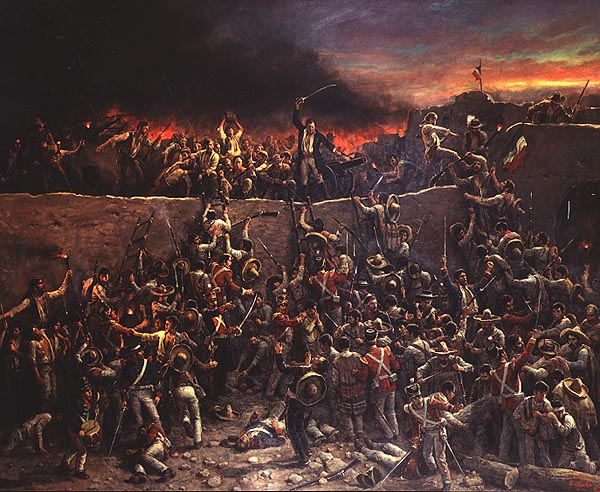
In his Silencing the Past: Power and the Production of History, Trouillot superbly uses the folklore, myths, and legends surrounding the battle of the Alamo in Texas — today and for almost two centuries a popular lucrative tourist-site and sociopolitical extension of Texas’ proud Anglo-American image, “history(?)” and heritage intensively taught throughout primary and secondary public school levels — to make the crucial point of just why strategies and credibility-tests are necessary for historical silences or ignorance. I am also inserting two pieces of embellished artwork highly treasured inside our Texas state capitol.
“The lesson of the [Alamo] debate is clear. At some stage, for reasons that are themselves historical, most often spurred by controversy, collectivities experience the need to impose a test of credibility on certain events and narratives because it matters to them whether these events are true or false, whether these stories are fact or fiction.
“Dawn at the Alamo” – click here to enlarge, Texas style
That it matters to them does not necessarily mean that it matters to us. But how far can we carry our isolationism [exclusionism]? Does it really not matter whether or not the dominant narrative of the Jewish Holocaust is true or false? Does it really not make a difference whether or not the leaders of Nazi Germany actually planned and supervised the death of six-million Jews? […]
But how much can we reduce [oversimplify, extrapolate, biasedly project] what happened? If six-million do not really matter, would two-million be enough, or would some of us settle for three-hundred thousand? If meaning is totally severed from a referent “out there,” if there is no cognitive purpose, nothing to be proved or disproved, what then is the point of the story? [Hayden] White’s answer is clear: to establish moral authority. But why bother with the Holocaust or plantation slavery, Pol Pot, or the French Revolution, when we already have Little Red Riding Hood?
“Siege of the Alamo” – click here to enlarge, Texas style
Constructivism’s[anti-science warriors’]dilemma is that while it can point to hundreds of stories that illustrate its general claim, that narratives are produced, it cannot give a full account of the production of any single narrative.[his emphasis]For either we would all share the same stories of legitimation, or the reasons why a specific story matters to a specific population are themselves historical. To state that a particular narrative legitimates particular policies is to refer implicitly to a “true” account of these policies through time, an account which itself can take the form of another narrative. But to admit the possibility of this second narrative is, in turn, to admit that the historical process has some autonomy vis-à-vis the narrative. It is to admit that as ambiguous and contingent as it is, the boundary between what happened and that which is said to have happened is necessary.
It is not that some societies distinguish between fiction and history and others do not. Rather the difference is in the range of narratives that specific collectivities must put to their own tests of historical credibility because of the stakes involved in these narratives.” — Trouillot, Silencing the Past, pp. 11-14.
And personally I would add “…must put to their own tests disclosed and compared to those of interdisciplinary credibility tests as well for increased accuracy” because of the stakes involved between fact-or-fiction!
∞ ∞ ∞ § ∞ ∞ ∞
Given the hitherto three-part coverage and hopefully amplification of some of the intricacies and mechanisms constituting knowledge-ignorance, how it’s produced, and why it has silences, it becomes clear that a form of enlarged intellectualism is presently needed, especially in the U.S., and nurturing (versus uncompromising) in the general population, or at minimum a trustin those few credible experts who have obtained it, in order to better monitor and counter severe imbalances. Therefore, in Part IV, the conclusion, I will examine social theorems of ignorance, perhaps white (yes, Caucasian/Anglo) ignorance, should time permit and you readers/followers demand it in your comments below, and then finally ask Where are America’s Public Intellectuals?… to help in this imperative movement. I hope you will join me. Meanwhile, please leave your thoughts about Part III below and I will do my best to respond. (line break)
Live Well — Love Much — Laugh Often — Learn Always
I have zero expectation that anything I ever say will end someone’s belief in their God. Not my goal or purpose. That alone belongs to the individual. ~ Zoe
'Light thinks it travels faster than anything but it is wrong. No matter how fast light travels, it finds the darkness has always got there first, and is waiting for it' - Terry Pratchett


 Earth on giant starliners and charged lower-echelon humans the same type of prices they charged for all their earthly GNP goods. As a result of the never-ending, rising land-fills from impulsive, Keeping Up with The Jones consumers they ironically created, Earth was no longer inhabitable. The starliner Axiom returns to Earth to retrieve another garbage compactor EVE that is not functioning. WALL-E becomes a stow-away onboard the Axiom and when he finally sees his predecessors/creators, humans. Every single one of them are grossly obese, immobile, and totally dependent on automation to do everything for them — the consequence of widespread chief-dome and no one wanting to rotate into the support roles, the blue-collar roles, the farmer roles, the plumber and garbage roles, or janitor roles. The ‘indians‘ roles.
 On the other hand, the pendulum can swing too far the other way to plutarchy and oligarchy if there is an insufficient, low-quality public education system and lack of economic opportunities/mobility to hedge against such tyrannies. If or when that occurs, some “individualized” Americans independently wealthy and above a struggling majority — what is currently the case in America today — often have the delayed pragmatic realization that looking after the welfare of others is not only good for the soul, but actually is equally good for their business and wealth. Those individualized elite who never realize this profound truth, eventually watch their empire and ivory towers crumble. Just ask the Roman Empire’s aristocracy, ask the 18th century opulent French monarchs such as Louis XVI and Marie Antoinette, or ask those executive heads of Leonard R. Rogers’ mega-tobacco corporation, or let’s ask a modern, Nobel Prize winning economist


 The Professor's Convatorium