That small heap of leaves and stubble, Has cost you many a weary nibble! Now you are turned out, for all your trouble, Without house or holding, To endure the winter’s sleety dribble, And hoar-frost cold.
But Mouse, you are not alone, In proving foresight may be vain: The best laid plans of mice and men Go often askew, And leave us nothing but grief and pain, For promised joy!
In less than ten days I will be moved out of our family’s rural 10-acre, 2,850 sq. ft. Ranchita home (FINALLY!), and soon be returning to my life and particular unconventional lifestyle in the enormous thriving DFW Metroplex I had over 3-years ago, of which does not and cannot exist in a tiny rural central Texas town. HAH!
Oh how I have missed my life up there, my appetites quenched up there, and my tribe up there. It has been far too long. But my strong duties to family, their well-being, and of familial values we hold from multiple generations back to 17th century Europe and nine generations here in Texas, refused to let me be so self-centered. I answered the desperate need that in the end took three long, exhausting years and every summer break the last five. It is coming to an end and very soon will be the start of the next phase of life in one of several of my cherished homes: Dallas-Fort Worth.
This slideshow requires JavaScript.
As the 5th largest metropolitan area in North America, Dallas (the bigger half shown above) has two major airports (DFW International & Love Field) that boost an eclectic world flavor, many recreational parks with 11 large lakes, arboretums, museums, sports complexes/stadiums, including a pro soccer club, and a very good, extensive public transit system for eco-friendly Green-lifers, festivals galore throughout the year, a very large Steampunk community, and an exceptionally diverse nightlife with, yes you guessed it… a gigantic alternative-lifestyles communities, events, and network found nowhere else in the state in size or participation, bar none.
Am I beyond excited? Does the tin-man have a sheet-metal cock!? Okay, back on topic.
I had planned in vain foresight to post my Excursion to Perversions — II post well before now, however, “The best laid schemes of mice and men go often askew.” Interruptions have plagued my well-intended superior blogging time and skills — ‘cept a few various comments on other blogs — at the expense of leaving all of you in but grief and pain for promised blog-joys undelivered! Ghastly I know. Thus, my apology here, now, and likely beyond the New Year’s Day and week. In many ways I will be starting a new phase, a new life in a renewed but familiar place among very familiar friends and new ones yet discovered. WordPress and personal blogging must take a temporary back seat until then.
Meanwhile, I’ll pop-in every so often, see what’s about and what trouble I can find. 😈 😉
Everyone have a safe, sensational holiday season with friends and family, and a marvelous, safe New Year’s Eve and Day! Cheers!
I must confess that four months ago when I chose to tackle this subject and new field of study for a blog-post or two—that turned out to be four—I had little idea it would be so laborious and challenging for me. Not only was it formidable over time, but it was equally demanding of quality representation, of which I feel I have failed or sacrificed in some ways. For that I apologize. I likely bit-off much more than I could chew. And though my current personal situation has made my time reading, researching, blog drafting, blog writing, and publishing difficult and quite limited, I do hope this conclusion is sufficient enough to glean from the whole, some expansion on a little known, little taught or discussed subject: ignorance. If nothing else, I hope these four parts have invoked a deep curiosity to learn and know more about what we don’t know, for it is great, it is endless, and paradoxically attainable.
∼ ∼ ∼ § ∼ ∼ ∼
Previously in Part III, I examined the colorful ways we fabricate facts, or our conscious intentional lying, and how to discern and reveal their motives and utilization. I also covered how North and South American indigenous fossil knowledge and their worlds became lost or entirely omitted from Euro-American archaeological records. Then finished with how to understand the benefits and advantages of historical-interdisciplinary hindsight. In doing so this groundwork offers a comprehensive, enlarged intellectual body of reliable context as well as a necessary reversal of or counter to explicit and implicit ignorance in the U.S.
In this conclusion I want to very briefly touch on white, or Anglo/Caucasian ignorance, explore the social theorems of ignorance, and then ask Where are America’s public intellectuals, who might they be, and why today are they few and far between? and provide plausible answers. Let’s jump right in. (line break)
Anglo/Caucasian Ignorance
A few summers back as my two kids, my Mom, and my sister and I were seated around the dinner table, the discussion turned to American history, a subject that mostly interested my 15-year old son, but usually made my 22-year old daughter, Mom, and sister roll their eyes. When I made my point that our nation’s White House, the Capitol building, and some other government buildings were built by African-American slaves, I got facial expressions of pause, silence, and astonishment. Their faces said it all. As a state certified educator in Texas, I was not surprised by their baffled, yet silent responses. This tidbit of historical fact and its implications generally does not make it into state-approved classroom textbooks nor is it required by the state’s core-curriculum as critical learning. Thus, we have a classic case of anglo-caucasian (white) ignorance. I rather like this introduction…
White ignorance… It’s a big subject. How much time do you have? It’s not enough. Ignorance is usually thought of as the passive obverse to knowledge, the darkness retreating before the spread of Enlightenment. But… Imagine an ignorance that resists. Imagine an ignorance that fights back. Imagine an ignorance militant, aggressive, not to be intimidated, an ignorance that is active, dynamic, that refuses to go quietly— not at all confined to the illiterate and uneducated but propagated at the highest levels of the land, indeed presenting itself unblushingly as knowledge. — Charles W. Mills
Professor of philosophy at the City University of New York, Dr. Charles W. Mills believes by clarifying and demarcating historical white domination and its ramifications, as well as examining the individual and social processes of cognition with regard to race, we can start to understand how best to achieve multiracial enlightenment that garners short-, mid-, and long-term benefits not just for a few, but for all humanity.
White Domination & Ramifications Dr. Mills finds ten components to clarification and demarcation. I will point out four I find particularly important.
Race as a cognitive phenomena historized — white domination has been and still is a social-structure, not a physio-biological structure. “Whites” did not exist in the ancient world.
Leaving white paradigms — “White” in white ignorance doesn’t need to be confined to just white people. To a greater or lesser extent this has existed due to power relations and patterns of ideological hegemony.
Male ignorance — ignorance of the male gender must be analyzed equally as it is far more ancient, going back to the very origins of patriarchy.
Avoiding false beliefs — gaining a broader understanding of white ignorance is not only sociological, but normative too. Flawed patterns of cognition are promoted or propagandized by certain social models and group membership as are truthful-moral ones.
Individual & Social Processes of Cognition Before getting into Dr. Mills’ work below, watch this 6-minute video. It is a prime example of Memory and Testimonydiscussed below and how to incorporate it into social cognition:
An examination of white supremacy and its historical dominance, injustice, and ignorance cannot be done without understanding the influences of individual and social processes of cognition. Separating out these various components can be demanding for they are in perpetual interaction with each other. For example, when an individual discerns, they do so with sensors that have been socialized. Keeping this in mind, Dr. Mills analyzes five dynamics that I will summarize:
Mercator projection without “human” imposed borders
Perception— in general, perceptions and conceptions are practically one in the same, so tightly related that often they’re indistinguishable. Individuals do not create these categories, we absorb them from our cultural contexts. Two prime examples are the world’s continents, they’re sizes, and the term savages and its origin and context. They beg the questions, Why is Europe a continent and say India or Eurasia are not? And savage originated from Anglo-French cultures in the 13th century, the Age of Exploration and Colonization by European superpowers, and implies a person/people of uncivilized, primitive, dumb behavior and inferior to the designator(s). Why is this context assigned to savage? Does it justify imperialism, conquest, and domination? The context of savage continued into the 18th century and found its way into one of our most enduring U.S. documents:
When Thomas Jefferson excoriates the “merciless Indian Savages” in the Declaration of Independence, then, neither he nor his readers will experience any cognitive dissonance with the earlier claims about the equality of all “men,” since savages are not “men” in the full sense. Locked in a different temporality, incapable of self-regulation by morality and law, they are humanoid but not human. — Charles W. Mills
Conception— this aligns us to our known world. The unknown world, however, is assessed and judged not with the discreetly detached concept, but viewed and judged through the concept. Very rarely does an individual resist this societal bias. And here is the baffling irony of this egocentric, white-centric condition which surrounds the word savage:
In the classic period of European expansionism, it then becomes possible to speak with no sense of absurdity of “empty” lands that are actually teeming with millions of people, of “discovering” countries whose inhabitants already exist, because the non-white Other is so located in the guiding conceptual array that different rules apply. Even seemingly straightforward empirical perception will be affected—the myth of a nation of hunters in contradiction to widespread Native American agriculture that saved the English [e.g. Jamestown] colonists’ lives, the myth of stateless savages in contradiction to forms of government from which the white Founders arguably learned, the myth of a pristine wilderness in contradiction to a humanized landscape transformed by thousands of years of labor (Jennings 1976). In all of these cases, the concept is driving the perception, with whites aprioristically intent on denying what is before them. — Charles W. Mills
Memory— it is sadly ironic that as I get to memory of the individual and/or social cognitive process that events such as those in Charlottesville, Virginia, Aug. 12th occurred. It reiterates just how crucial it is to understand the fluid interconnectedness of these five components, including memory, and how it relates to white knowing and unknowing due to denial of requisite facts. While understanding collective memory, we must also understand collective amnesia. They always go hand-in-hand. We remember the Holocaust primarily because Hitler and Nazi Germany lost the war. But what about the Pequots, the Nama, the Tasmanians, the Beothuks, the Congolese, the Hereros, or the Armenians? What about the Native American Cherokees or any of the over 200 tribes on the continent? What about 19th century antebellum slavery, killing rebellions such as Nat Turner’s, and the atrocities throughout the American Civil War? Today, over seven generations later, Americans still confront their historical identity and memory over the Standing Rock Reservation oil-pipeline and Charlottesville, VA over a Robert E. Lee statue and what it means.
As the individual represses unhappy or embarrassing memories, that may also reveal a great deal about[their]identity, about who[they are], so in all societies, especially those structured by domination, the socially recollecting “we” will be divided, and the selection will be guided by different identities, with one group suppressing precisely what another wishes to commemorate. Thus there will be both official and counter-memory, with conflicting judgments about what is important in the past and what is unimportant, what happened and does matter, what happened and does not matter, and what did not happen at all. — Charles W. Mills
Testimony— How do you know your exact birth date? Your knowledge of your birthday is most certainly told to you by those there in the delivery room, your mother and father, and perhaps doctors and/or nurses there at the time. Hence, your beliefs about your birth time, place, month, and year are through testimony. We are quite dependent on others for what we know and this most certainly involves elaborations of social epistemology. Those elaborations also come from other previous individual and social epistemic elaborations and so on. In cases of veracity and neutrality, it bears significant impact to ask ‘testimony by whom and for what (possible) interests gained or lost?‘
Motivational Group Interests — these can be found in varying strengths with any political, religious, economic, and/or sports groups with common interests. What these sorts of groups demonstrate are what is commonly known in cognitive, developmental, social, clinical, and neuropsychology as hot cognition (as opposed to cold/unemotional) associated with physiological arousal responding more to environmental stimuli. Peer-assimilation is another aspect of hot cognition. This certainly applies to racial grouping and “color-blindness” as well.
Though he speaks primarily on the African-American plight in the U.S., in this following video-clip Harvard University Fellow and MIT Professor Noam Chomsky talks about white domination and racism from the historical record. This really applies to all non-whites in America and the world, does it not?
Social Theorems of Ignorance
Is ignorance simply the absence of knowledge? The sum of society’s ignorance is much greater than the sum of our knowledge. Yet, how much do we really know about social or collective ignorance? Where does social-collective ignorance come from? How much do we impose it upon someone or upon ourselves? What role does social-collective ignorance play in interactions, group relations, in institutions, in civil, business, and criminal law, and managing risks? Typically our societal norms give negative connotations to ignorance, but when might it be preferrable not to know something? Can it be a virtue?
Dr. Michael Smithson, Professor of Psychology at the Australian National University, has been working in the area of uncertainty and ignorance for many years. He takes an interdisciplinary approach to socially produced uncertainty and ignorance and believes one must begin with defining what social ignorance is and is not.
Socially Produced Ignorance: What It Is and Isn’t Social ignorance is 1) emerging, it is 2) partially constructed by society, and it is 3) imposed. It is manipulated deliberately or as a by-product of some social movement or process. It is also typically at a macro-level of large groups within power relations. As far as how kinetic ignorance is managed(4) it is typically at the micro-level with individuals and how those individuals conceptualize, represent, negotiate, and respond to ignorance. Thus, the managing agent is often indirect or as a spectator concerning the thinking and behavior of ignorance. These are four theorems of social ignorance.
Social ignorance is not the external world and how it arises in non-social settings. For example, the non-social settings would be science and the limits of science. It also includes epistemological and religious frameworks that make assertions about non-knowledge or meta-knowledge in exogenous non-social terms. It is not a managingunder kinetic ignorance either. In other words, how people/groups think and act in uncertain environments, and not artificially generated under theory.
Negotiated Ignorances There are at least five different negotiated ignorances between social (or at least interpersonal) arrangements of ignorance. A sixth could be time, or the lack of time, to adequately understand dynamics of an event, place, or person, but for the sake of time (no pun intended), I will very briefly cover these five:
Specialization — is simply an admittance there is too much for any one person to learn everything exhaustively. Hence, spreading the perceived risks can be achieved in three ways: 1) diversified learning rather than direct or narrowed learning, 2) therefore, concurrently diversified ignorance is created, and 3) acquired knowledge is also diversified via social collaboration.
Privacy — another social ignorance arrangement which is not necessarily controlled access to information by others about self, but can also be consensual with trusted persons or experts. Secrecy is imposed unilaterally, but privacy involves levels of risk. And trust is interconnected within organized specialization.
Trust — is a state of perceived vulnerability or risk. Dr. Smithson (on Yamagishi) elaborates:
“[Toshio]Yamagishi and his colleagues argue that trust and “commitment formation” are alternative ways of reducing the risk of being exploited in social interactions. Commitment formation involves the development of mutual monitoring and powers to sanction and reward each other’s behavior. However, the reduction of transaction costs in commitment formation via uncertainty reduction comes at a price, namely the difficulty and costliness in exiting from the relationship and foregoing opportunities to form other relationships. Trust, on the other hand, entails running the risk of being exploited but increases opportunities by rendering the truster more mobile and able to establish cooperative relations more quickly. Trust, therefore, is both an example of a social relation that requires tolerance of ignorance and also trades undesired uncertainty (the risk of being exploited) against desired uncertainty (freedom to seize opportunities for new relations).”
Politeness — is another example of how social relations trade on ignorance. Within formal public conversations people typically don’t expect to first place their hand on a bible and state “the truth, the whole truth, and nothing but the truth.” The strategies a talker may utilize are varied in creating disinformation, e.g. promoting a false impression of approval, or agreement, or offer tactful brevity, vagueness, or ambiguity. However, this latter strategy is not always negative because it could nurture healthy adaptability or change due to diverse interpretations.
Legitimation— social ignorance is also used in a number of facades to vindicate inaction, keeping the status quo (also known as business as usual), opportunism, evasion of responsibility or liability, and risk management strategies. Our American legal differences between civil cases versus criminal cases, as one example, are where a verdict in the former can be given on probabilities and in the latter it must be given “beyond reasonable doubt.“
“Licit” actions and choices done on the basis of social ignorance are abundant in our mundane life as well. As previously discussed in this series, legitimizing high-level federal policy change, or non-change, use (abuse?) the precautionary principle, e.g. climate change counter-measures.
Is Social Ignorance Always An Insight-Deficit? Contrary to popular belief, ignoramuses are not always at a disadvantage. There are cases where they are better off than very knowledgeable people. Case and point, if you could be told exactly when and how you were going to die, would you want to know? Why or why not? Would you want your spouse and children to know the details of your death? Why or why not? Often in the field of counseling where doctor-patient confidentiality existed, I found myself in the position of aiding social ignorance between spouses, family members, employers or a circle of friends for legitimate reasons, e.g. one spouse’s history of unfaithfulness, in order to maintain necessary therapeutic stability. Many spouses/partners don’t care to know intimate details of former lovers/spouses. Dr. Lael Schooler and Ralph Hertwig, both of the Max Planck Institute for Human Development, assert from their research that forgetting facilitates the use of inferential heuristics that also trade on environmental structures.
What I hope has been adequately conveyed here is that ignorance, particularly social ignorance, is quite prevalent. It exists practically everywhere, including with yourself. It is predominantly socially structured. Accordingly, it deserves as much attention, monitoring, and updating as one’s repository of knowledge. This, our social and individual human ignorance-condition, I hope would conflate wise, cunning humility and not inflated arrogance. Therefore, how might we as social parts of a whole get regular checkups, quarterly or annual appraisals of our cunning humility and/or inflated arrogance? Glad you asked!
America’s Public Intellectuals – Questions
What does intellectualism mean? After this four-part series, is it possible for intellectualism to thrive and coexist with ignorance? Should that even be questioned? Can intellectualism guide ignorance and ignorance guide intellectualism offering more balance, more tolerance? In our modern age of technology and data-overload, are we too knowledgeable, too informed?
Today, we are not necessarily uninformed, but so over-informed it forces our cognitive capacities to seek out preferable trigger-topics and information that bolster our own perspective. That is most certainly a self-imposed ignorance and to degrees social ignorance. On the aforementioned section of social ignorance, sociologists define that as a neo-tribalism tagged with near-fanatical insistence on cohesion and monism in a world, its Nature and fauna that is anything but monistic or binary. Within this neo-tribalism, humans — perhaps just advanced primates at this point? — historically have resorted to bullying and moral castigation to keep their own status quo. But at what cost? Many public intellectuals agree: the egghead is dead, replaced by chest-beating activists. That may be true.
If our nation’s Founding Fathers were alive today, they would almost certainly be distraught and aghast at the loud polarity and lack of common interests. This isn’t to say those members of the 1787 Constitutional Convention, lasting a miserable 116 steamy days and nights, did not have their heated differences. Indeed they did. However, those resilient intellectuals mixed daily with their communities and adversaries; they had no choice really but to learn basic etiquette, tolerance, compromise, and mutual understanding and do it face-to-face. Those differences, conflicts, and resolutions took enormous amounts of highly skilled dialogue, negotiation, candor, and listening as they did expressing.
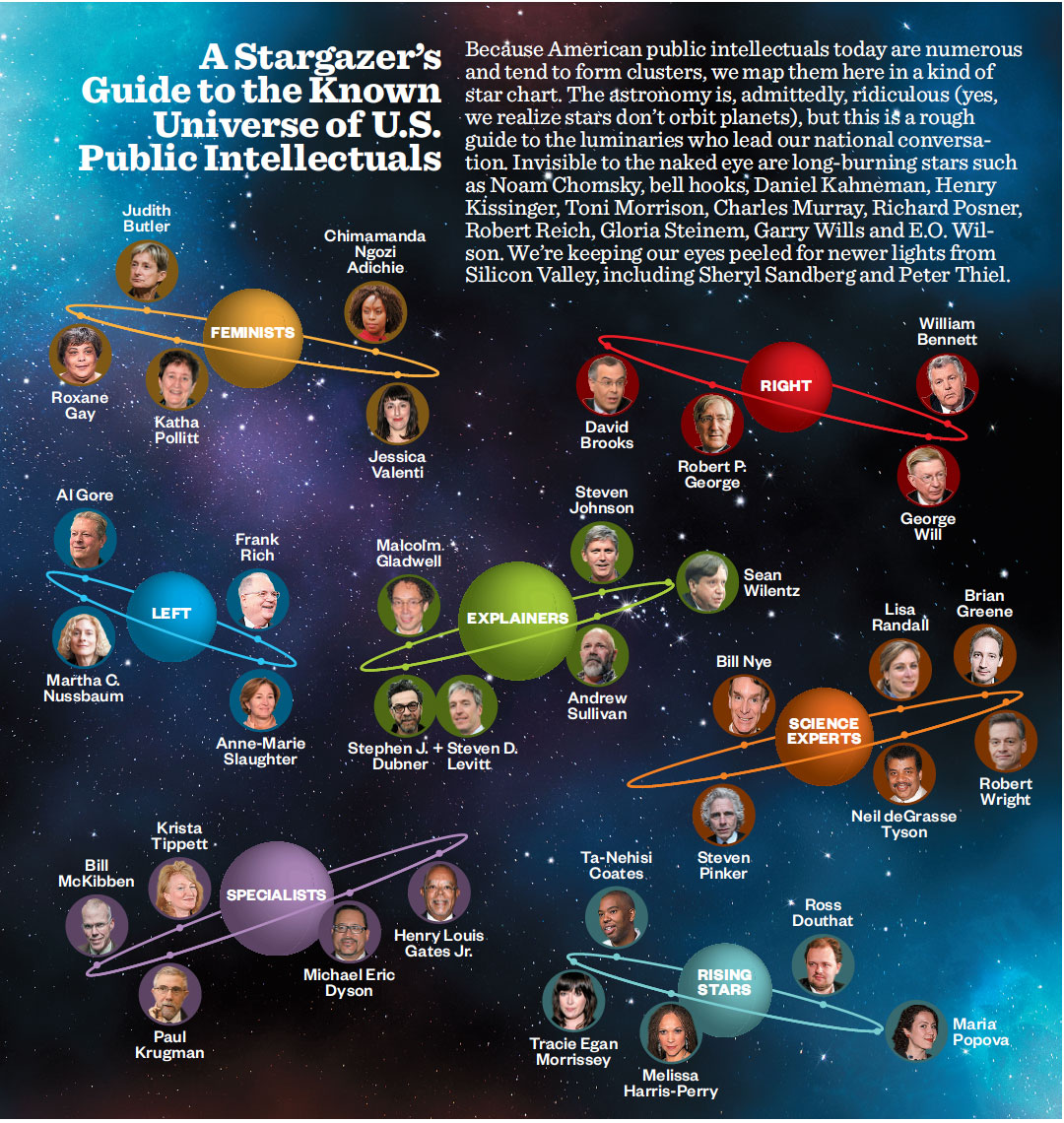
Fortunately, our modern intellectuals are still around, as seen in the Stargazer’s Guide image, as well as several of their interdisciplinary colleagues I’ve included throughout this four-part series. They too could easily be included on the map in their respective fields. Perhaps they are not as recognizable or accessible today because technology is increasingly finding intrusive ways to get in front of our faces and into our schedules, not weekly or daily, but hourly! Too much information-knowledge is just as bad for us individually — and potentially within a social framework of influence — as ignorance is because covertly hyper-knowledge fosters more risks that would otherwise be spread-out, diversified to minimize risks or learning-bankruptcy.
The difference between intellectualism (knowledge) then in 1787 and now (over-knowledge), as I personally see it, is that whether opposing sides embrace it or not, we know a lot less than we think we do (ignorance). Arrogance with power is the chief combatant of agnotology and collaborative progress. To remain stagnant in current knowledge without diversifying and going into the darkness of ignorance and where it leads is to risk terminal illness at the hands of Nature, predatory Nature to be specific. That assured apathy (that all is known) will be especially lethal if we do not recognize, with no exceptions, that ignorance is an equal or greater dichotomy. An egalitarian dichotomy not to be feared, but merely appreciated, explored further, confronted if necessary, and thus made more commonly defined, inclusive of both individual and social frameworks.
(paragraph break) Live Well — Love Much — Laugh Often — Learn Always
I have to pause (again) my current 4-part series, Games of Unknowledging, for this one very important thermometer on life; a happy, thriving, giving life that most doctors, therapists, and altruists would also consider a most important check-up. I promise my next post will be the conclusion. Promise!
∼ ∼ ∼ § ∼ ∼ ∼
How we define our worth often hinges on what others around us say and do, or don’t say and don’t do, correct? Afterall, how can our own self-perception be accurate, honest, and objective if we have nothing to compare by? What constitutes worth and what exactly are those litmus tests that define it? Are they accurate? How much attention and energy should we give to our worth, its creation and its perpetuation? Peter Gabriel had something to say, or rather sing about self-worth in his 1986 hit “Big Time,” remember?
No matter how we choose to measure our own worth, there are fluctuating degrees of external feedback we seek, consciously or subconsciously, and this can be healthy and/or unhealthy.
In our modern age of booming technology, something seemingly new every month, sporting frantic paces, competition, and only 24-hours in a day to get it, manage it and finish it, sometimes at the expense of restful sleep, the insatiable beast of technological-consumerism demands ever-growing absorption. I’m not sure how aggressive it is in other countries, but in the U.S. it’s not just fierce, it has reached the intrusive levels of addiction. Tristan Harris with web-portal Big Think:
So… how do you define your self-worth? One way? Two, three or four different ways? Share your thoughts about how to define self-worth, I’d like to know them.
(paragraph break)
Live Well — Love Much — Laugh Often — Learn Always
This past weekend was another weekend of going through Mom’s numerous closets deciding what stays and what goes. Every decision seems monumental. Every forgotten discovery the latest adventure. Discussion, ponder, story, discussion, more pondering, another story. Decision made? I’m not sure. Will this go to another closet or out into the already cluttered garage of second opinions? Her post-storied opinion, for later. Repeat.
See, Mom is sentimental. She collects things, lots of things with personal value or a unique story behind it. Then I picked “the one” up. Peculiar. Heavy without any weight. The latest frame of pictures and portraits below. “Umm, Mom! Who on Earth are these people?” I yelled. “Is there something I don’t know?” in a puzzled curious tone. “What!” she yelled back from down the hall. “Is there something you haven’t told us?“
Unknown family collage from the closet
“I don’t know what you are talking about!” she screamed back. “Right, a perfect answer” whispering under my breath. I decide I should quickly pullout my phone, snap a picture or five, maybe it was eight, and have evidence for any unforeseen future inquiries… like DNA. Any sleuthing closet-cleaner worth his gumption would do the same!
Mom arrives, “What are you yelling about?” I turn the mysterious family photos to her “WHO — are — these — people, and why are they tucked in the back of the closet!?” as I glare at her. Cue the music soundtrack…
Fade camera-shot of Mom, her mind travels back in time. Me asking lots of questions, one or two prying, wrenching, and adding commentary… the story begins.
∞ ∞ ∞ ∞ § ∞ ∞ ∞ ∞ (line break)
“Would this possibly be” I began, eyes squinted… “the lost side of the family?” My mind raced, wondering what else I might find buried in other closets. Things whispered about. Details sketchy. Silence when little ears from younger generations approach. Yep, I’ve seen it all before. As we near our final stage in life, many feel the need to get things off their chest. Finding relief, solace, truth, and a clear conscience often starts with closet doors!
Mom’s breathing became nervous, labored. “I guess now is as good a time as any, huh?” My expression was blank, unsure what to say, what to think. The air was thick, so thick that it was hard to breath thickly, let alone wonder where did I come from. Where am I going?
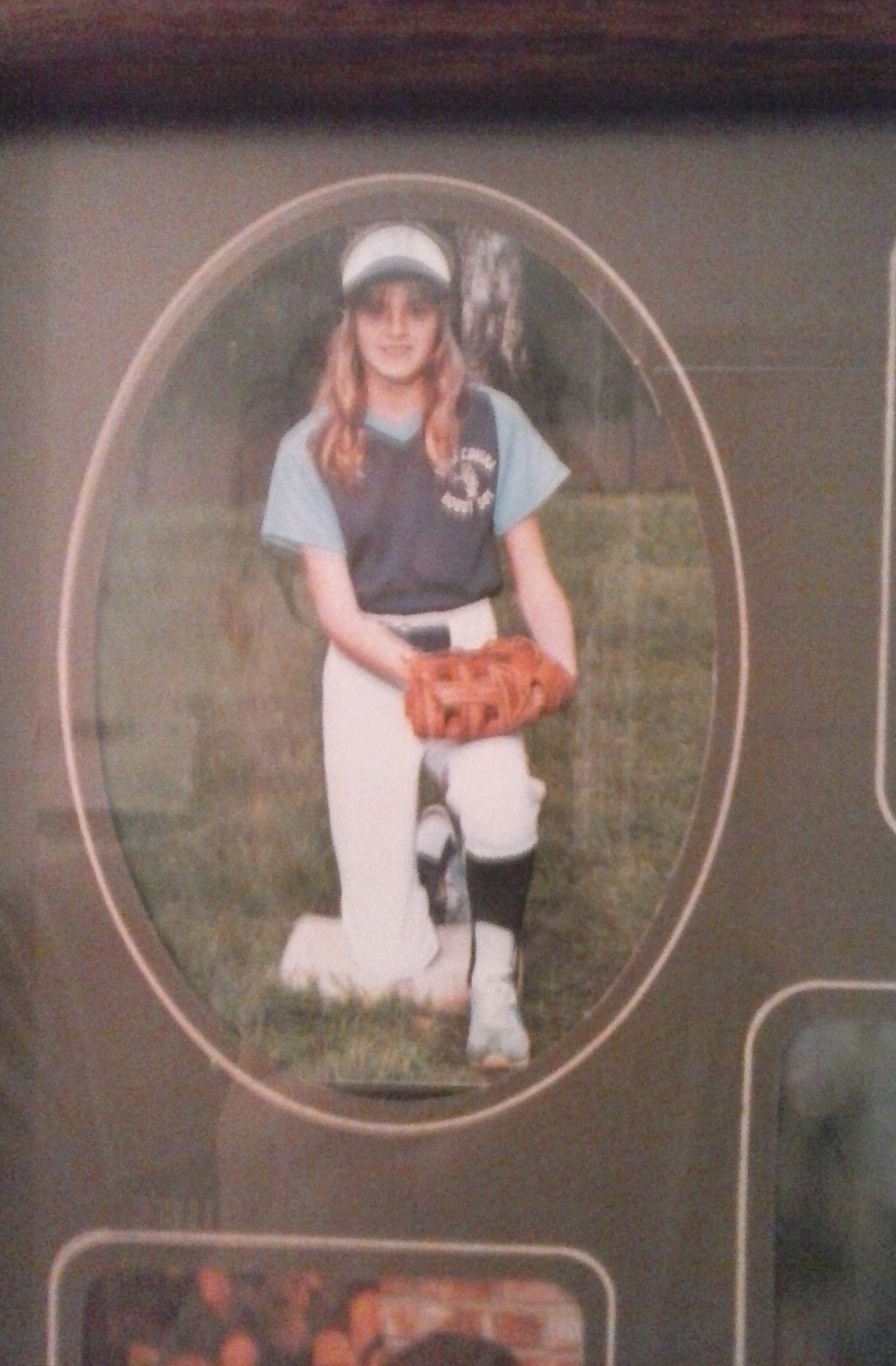
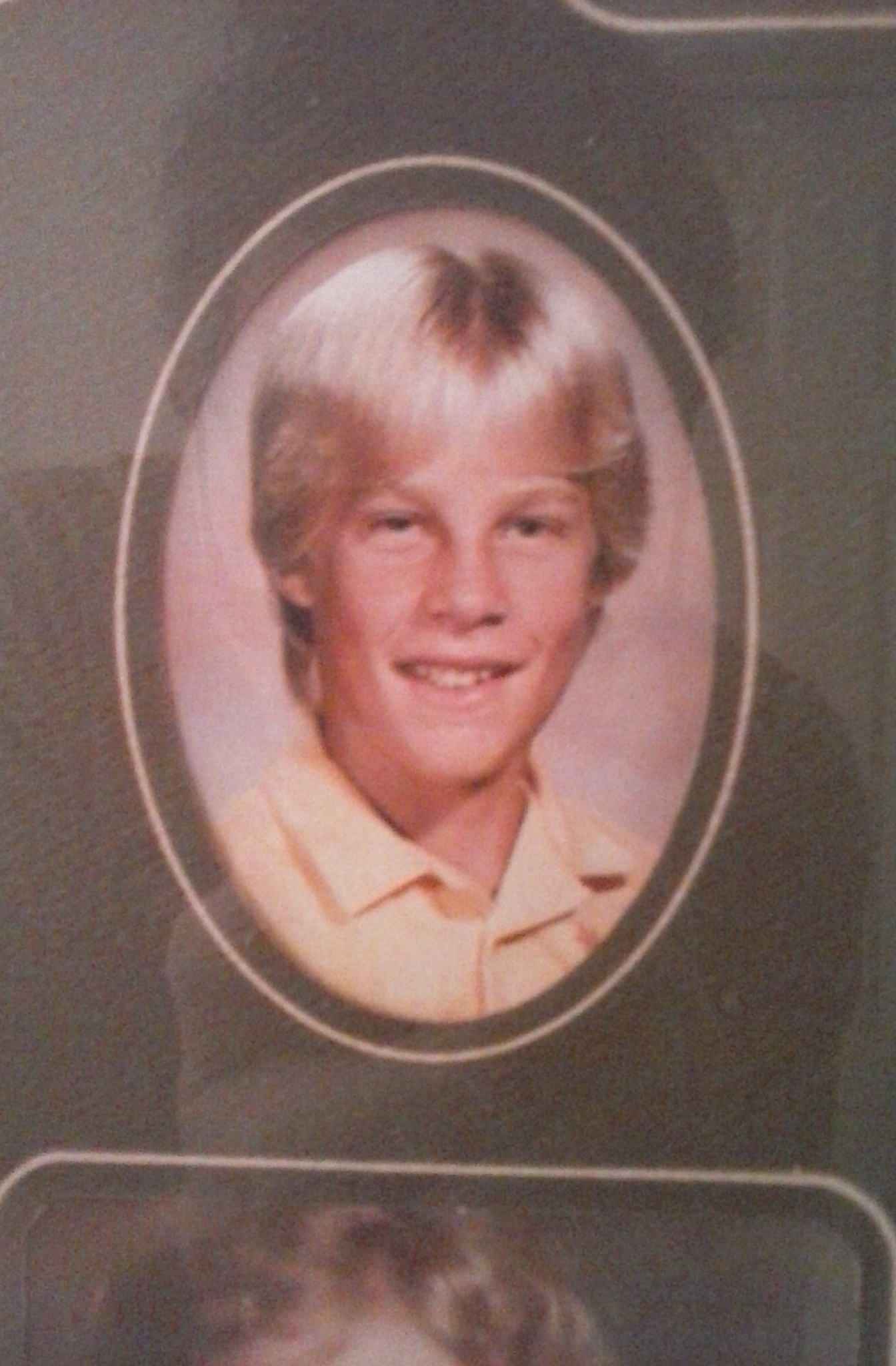
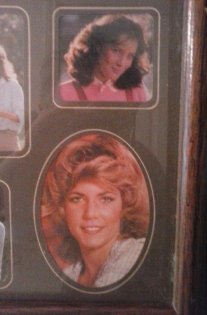
We started with my son’s aunt, Aunt “Outta-here” Audie. Most friends of the family thought she was highly athletic for a girl her age. She stood out from other girls and boys at school and on the baseball diamond. “Your son gets his baseball talent from him… I MEAN HER!” she quickly corrected. The Ozarks in Tennessee have many renown ball-players from remote hilltop, small-town families, she continued. “But I thought all of our family was either in Texas or Ohio?” She sighed, “Some things from way up in the hills and deep in the woods require… discretionary reframing.“
“Really. Isn’t that like… lying? Or at the very least… Congressional lobbying?“
A bit confused I asked “Okay, then how does Rocky Top, Tennessee fit in to all this?” A grin stretched across her face and out came “Remember I was a flight attendant. Flight attendants get around, meet many fun flyers, and pilots.” Ahh, as the cogs are spinning in my head, “That clears up a lot of things.” I want to know about the woman in the big Kentucky Derby hat.
Aunt “Mata Hari” Pearl (top) and Madame Prudence
“And is this woman of the family a lady of the night or day?” Mom giggles, “No, no, no. That’s Aunt “Mata Hari” Pearl and Madame Prudence below her.” Obviously I was close with my educated guess. Should I ask about them? Why would names like that be the least bit intriguing, right? “So… the two cancel out each other or balance each other?” Mom rolls her eyes, “Stop your accounting methods! They both have their gifted ways of civil duties.” Who was the more popular of the two I asked myself. Experience has taught me when to verbalize questions and thoughts, and when not to. This seemed to be one of those times. But wait, I did have a question!
“Which one was a flight attendant?“
“Depends what airline you flew for.” she answered half-serious. She would know too. In the 1970’s Mom worked for an airline where the stewardesses wore very short shorts, white go-go boots, and snug blouses, under a snug thin vest, and which prided itself on love, because they were based at Dallas Love Field, of course. Or was it “in love”? “In some cases it depended on who you were flying with… on private jets, like with a huge T on the tail.” Oh yes, those jets. “Stands for Trump, right?” She waved her hand at me, “No! Testosterone!” She paused, “Or is it Tonnage?“
“Tiny? Testicles?“
Earnest & Gabrielle Cleaver with little Dexter at Wisteria Lane home
We moved to the next hidden-now-found family members, Earnest and Gabrielle Cleaver with their young son Dexter (Morgan?). They seemed like the perfect suburbia couple with a very cheerful boy. “Well, at least they look pretty normal.” I told Mom. But looks can be deceiving as the cliché goes. “Yes, that’s true” she answered in a dejected tone, “until Dexter became a teenager.” I asked her what she meant. “We always thought Dexter’s fondness for knives was a boy being a boy, or the makings of a great chef.” Sure, or maybe a master outdoorsman, hunter, or…
“Then one day Mrs. Cleaver opened Dexter’s toy-trunk. Inside were all his past dolls, but not as whole dolls!” What in the world could she be saying? What she said next would make even Alfred Hitchcock green with envy; or red. “She found in each compartment tray were stacks of legs, arms, torsos” she took a deep breath, “…and heads.” With a horrified grumble I asked with a glimpse of hope “I suppose he didn’t become a mortician?“
Dexter Cleaver pre-incarceration
“Last we heard he eliminated three guards in the kitchen at the Polunsky Max-Security Unit in Livingston.” I waited, and waited some more; she stopped. “Texas?” I asked with a raised voice! She gave me this blank look then nodded. “Mr. and Mrs. Cleaver” she continued, “gave him up for adoption and foster-care we think.” I’m thinking I’m done cleaning closets around here! “Does he know us!? Does he know where anyone lives!?” I’m also thinking where the hell is my phone, car keys, and bank statement. “That’s why the lower-left picture slot is empty. They disappeared in 1977.” Well obviously it is very smart for us to hang-on to this family collage to eliminate any doubt of familial connections. “Have any authorities asked us for tongue-swabs or DNA samples for any unsolved cold cases?” Please, please say no. “Police were able to obtain a match from Uncle Wilbur.” My eyes enlarge, “Who tha hell is Uncle Wilbur!?“
“No one you know.” Well duh! Now I’m stunned. “MOM! I need to know now!” She takes another one of those deep sighs, “They found his body tied to a tree in the Crockett State Forest. That’s where they got the blood sample.” I’m still not comfortable with these answers. Surely they’ve caught him by now, “So cousin Dexter has been caught and returned to Polunsky?“
“No. I think he is still at-large.“
“Since 1977?” She gives me this scowling look, “Now be nice. Our Texas law-enforcement are super busy” she explains in gradual calming, motherly voice, “catching, arresting, and imprisoning thousands and thousands of known criminals and murderers in this state. It’s a full-time job! They’re very busy you know.” After her reassuring loyalty in police matters — where more Texans own multiple weapons of multi-functions and calibers than the National Reserve all combined — I suggest to her:
Niece Dorothy & her puppy Toto
“If you EVER hear or see anything about cousin Dexter, you tell me! Alright?” I revisit my review of the Lost/Hidden Side of the Family menagerie. What’s next? Could there be more?
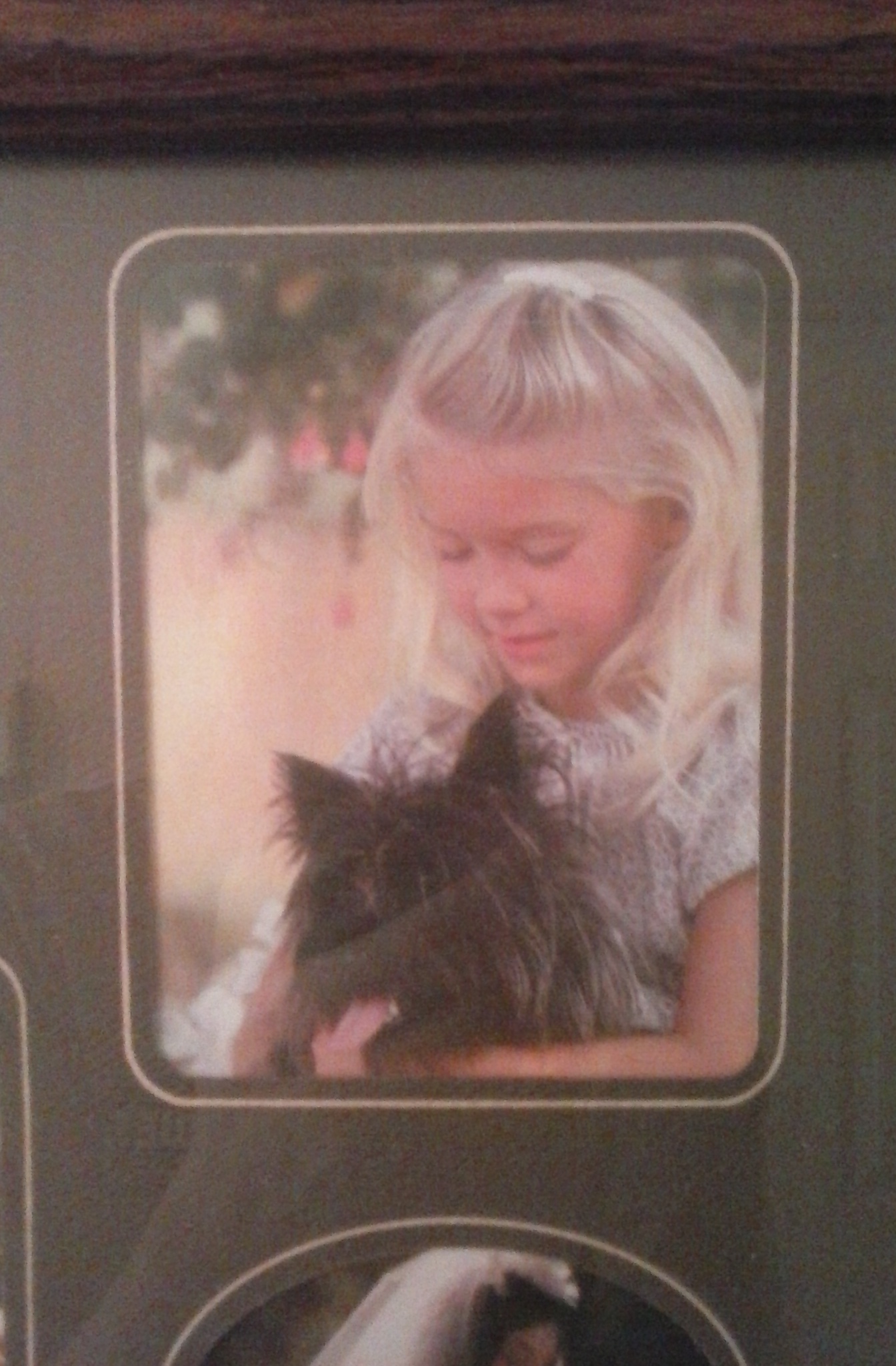
“Who’s this?” I point to the sweet little blonde girl affectionately holding the small dog. “That’s my niece Dorothy” she smiles warmly “and that is Toto.” Hah! Right. And somewhere in this closet will be flying monkeys with a total bitch from the West. Then Mom’s face turned sad and she added…
“About a year after that photo was taken” she raised her foot, “Toto chewed off three of her toes and the middle-finger of her hand.” I shrugged my shoulders and thought maybe they should give Toe-toes to cousin Dexter and start another toy-trunk collection. TV-Guide reads, “Season Premier! Epic Crime-drama expected from real-life slice ’em, dice ’em, chew ’em up Chef-n-Canine Duo!” Hmm, yeah and Season 2 in next closet!
Cousin Carrie cleaned up and purified
“Who is the Looker in the wedding dress?” Mom grimaced some as she began to answer, “That is your cousin Carrie (White?) and that is her NEWLY dry-cleaned prom dress converted to a wedding dress.” Ahh, of course it is — and is it weird that I’m attracted to my hidden, lost-and-found cousin? It’s just a picture. I must have some genes from Hilly Tops and Deep Woods Tennessee!? Is that even curable? What is wrong with me!? What else should I know (or not) about our family?
Not Aunt Bonnie and Uncle Clyde
“And that is your…” she leans over and points to the other young couple, “Aunt Bonnie and Uncle Clyde.” In a dismayed exhale I drop my head, close my eyes “No way!” Mom begins laughing “Gotcha! Relax. Their real names are G.W. and Madeline Kahn. They live somewhere in Eastern Europe.” She looks up, “Or maybe it’s Mongolia?” I start to put the picture-frame back into the closet. Once it’s out of the closet, can you put it back? Can one not know what has become knowable? Is there a pill for that? Is that what is meant by “I cannot recall” or “I can neither confirm nor deny that statement“?
“Wait! Let me guess these two.” I pick out the other brunette and blonde below her. “These two have to be Virginia and Vita Woolf-… rather Woolfenmeow! Right?” With a curious expression, “Who are they?” Cue the closet-music…
Virginia and Vita Woolfenmeow?
“Obviously our lost or hidden sultry seductresses and the 20th century’s steamiest love affair in verse, and in YOUR closet!“
Mom gave a devious smirk, “Oh? I guess you never quite know what you’ll find snooping around people’s closed doors, do ya?” She pulled down the hat box untying its fastening strings, “We all have our hats and masks we wear I suppose.” Good points. They are closed for a reason and they are worn for equal reasons. What I find curious, exhilarating, telling, shocking, or… smelly(?) IS THAT reason. What tap-dances or lurks behind?
“What’s in that box?” I inquire with hesitant suspicion. “This was Lady Chevalier d’Éon Blake’s judo black-belt she used around the necks of eleven Nazi SS commanders, deceased of course, but strangely as eunuchs, once she had them in highly vulnerable nocturnal postures.” I stared at her to see if I could catch another dubious smirk, but she was chokingly serious! “And this was your Aunt Millie ‘Boom’ Cnockaert’s wiring-kit and motorcycle goggles. They both became closest friends after the war and when…” she paused. “When what!?” I could not determine whether she was struggling to recall events, facts, news, family stories, or whether she was sorting out omissions and disclosures. Oh the things people say… or don’t say.
“When… they returned to France and Chevalier insisted on being a woman, dressing as a woman.” Whoa. Should I be proud or scared of my lost-hidden-now-found family? I want to at least lay claim to this family Believe-it-or-Not picture-collage and hang it over the fireplace mantle, or perhaps somewhere inconspicuous, say on the front or back of the coat-closet door!
“Why didn’t they come to America, the home of the free, home of the brave, civil and personal liberties galore!?” Camera-shot sharpens into focus from our time-traveling. Cue closing music soundtrack. Roll credits.
(line break)
Live Well — Love Much — Laugh Often — Learn Always — Dream
As some of you may have noticed, I have not been around WordPress and my blog as much as before. Lately, finding time to imagine, consider, research, ponder, gather images, then type away in a format and style that is minimally interesting for you and acceptable quality for me has been near non-existent. Well, not true exactly. I could do it late in the evening when I’m fatigued and must nevertheless wake just before sunrise or daybreak whether my mind and body want to or not. And since my last blog-post was June 9th you can see how well that is working. What is going on you ask as you all are banging down my front door? (sarcasm) What has changed?
Answer: Life.
Life apart from the world-wide-web. Life beyond the internet and technology. Organic life of which sometimes/often affords us little time of our own. The epilogue of one life, the pre-epilogue of another life (my life) and the prime of lives for others, loved ones. This is what has changed.
“The Earlier Revision Needs Revising”
Around 1997 shortly after marrying, Mom and her second older (and quite wealthy) husband found a luscious 2,850-ish sq. ft. Ranchita-home on 10.5 acres on top a big hill overlooking the Guadalupe River. The vistas from inside the house through 34 windows or outside on the large back-patio shaded or semi-shaded, with daily or every other day or evening southerly breezes… are the stuff of epic tranquility and living. For two hard-working retirees, it was a dream come true.
This slideshow requires JavaScript.
And then as they say, Nothing stays the same.
Mom has been widowed since 2006. For a few years after her late husband’s crippling heart-attack which put him in a wheelchair and months later his decline and death, she took the time to enjoy her life more, travel, and spend more time with good friends and family. She absolutely deserved it! She bought a newly used 32-foot RV or mobile home to travel the U.S. However, while doing these five years of domestic and world touring the home and property they loved so much became increasingly neglected. Meanwhile, one of those good male friends became a “very good friend.” They traveled together everywhere. Very good at first, but whose title gradually changed over the last four years to infrequent companion given later developments. Circumstances for romance and the altar which seemed unimportant then, became very important. Nine years later it can be deduced that Cupid’s Arrow — with attached gold ring — had in the end missed its mark.
Another development of which I have shared and posted about here a number of times is that of my sister and her 35+ years of drug addiction, rehab, relapse, law-enforcement, incarceration, repeat ad nauseam. Over the last six years this has really taken a toll on Mom’s mental and physical health. While I was up in the Dallas-Ft. Worth area teaching Special Ed, the plan for Mom, my sister (who moved to the Texas Hill Country very soon after Mom and her husband moved here), and Mom’s “very good man-friend” was to begin serious preparations from the inside of the house to the outside and all over the property to sell the house soon. Of course, the very good man-friend (living over 2-hours away) was not going to be capable of helping more than 2-times a month or less — he had to maintain his cattle ranch of 1,500 acres that he does all by himself! Therefore, in reality it was up to my perpetually recovering sister and my 76-year old Mom. HAH!
Five years later and after finishing the 2014-2015 school year in DFW, I make my summer return to help out. In complete shock I find my sister has moved in with Mom! Anyone who has dealt with acute drug-alcohol addiction of over 3-decades knows that addicts MUST BE at the very least in a daily and weekly program, routine, and support group! Mom’s hilltop retirement resort is the very last place any addict needs to be living — there has been no consistent structure and set schedule for Mom since, hell… 1995! Furthermore, she is not even close to being a qualified licensed A&D counselor! Simply put my Mom not only cannot handle my sister’s addictive pathology, manipulation, and regular relapses, she’s not mentally or emotionally strong enough or cunning enough to manage an addict! On top of this defective lousy living situation, not hardly anything is getting accomplished toward the sale of the house and property.
I become infuriated.
What soon follows about two months later is my sister’s gradual ump-teenth relapse. Due to the pressing overwhelming work and tasks that must get done first in order to sell the house and property, Mom’s inability to PUSH my sister to stay consistent and accountable to an AA/NA and MHMR (mental health rehabs) program, and her hilltop retirement resort being 4-miles outside of town making Mom her only real transportation anywhere… my sister was doomed to relapse anyway! I find out a few weeks into my return that my sister actually moved-in the previous December! By February 2016 sister has relapsed badly, again, and this time the county sheriff’s department and TDCJ (Texas Dept of Criminal Justice) are done being merciful. She is sentenced to 9-months in their penal drug-rehab program — now the only and last hope for her.
I am now BEYOND infuriated! No wonder the house and property have not been significantly maintained or prepped! I was never told because they both knew how I would react. Funny how we manifest our repeated thoughts and fears.
At the end of June 2016 while at a wine-n-snack get-together with good local friends, Mom unloads to everyone the precise timeline of her absolute move-out: April 2017 or sooner. How did we lose 5-years when she told me in December 2015 — relative to her retirement funds and trust-fund — it would last through 2021? Everything, except Social Security and her small monthly Mobile Oil pension, runs out next April. I thought my entire upper body just dropped into my stomach when she announced her deadline. This was not good at all given how much needed to be done to and inside the house. I’m thinking to myself trying not to appear distraught to everyone… What if the house doesn’t sell for what it’s worth these next 9-10 months!?
Days later I ask Mom if she’s got any better idea and plan as to where she will move and live. She is no closer to those decisions than she was a year ago. Given everything she’s had to deal with concerning my god-damn sister, it’s understandable.
The original revised plan has to be revised again.
My original plans for a continued life up in the DFW area will have to be put on hold. My regular routine to blog, consider, research, write, and comment must also be reduced or postponed.
Aging and the Aged
The end of this life is inevitable. Everyone is approaching it the day we are born and take our first breath. The average American lifespan is around 78-years old; 76 (I believe) for a man, 81-83 for a woman. Therefore, somewhere around our 40’s is the halfway point. In the better scenarios the late 40’s. As those older dear ones and loved ones begin to pass away around you, one cannot help but reevaluate, reflect, and remember what makes us truly alive so that death isn’t so painfully unwelcomed. What should our final decade of life be? Of what should it consist?
Mom, July 2014
These last four years I have noticed how much more my Mom has aged. If this rate continues, she is in her last 5-7 years — and that might be optimistic. And that reality forces me to pause and prepare. It forces me to reevaluate, reflect, and remember what, on a soulful level, is TRULY important. For that single reason… death should not be such a total stranger.
Over the last six years I have gotten to know my Mom in ways and to levels I likely would not have been able living 5-hours and 320-miles away 300-days a year. Many of those days have been fun and hilarious — her senility can be quite entertaining along with her sense of humor that has enjoyably not waned as a result. Though I am increasingly managing and helping her with her weekly and monthly responsibilities, these last couple years have noticeably aged me. For all intents and purposes, I am becoming a one-man team if not already there. And this will probably not change anytime soon, or it could change tomorrow… all things considered. (line break)
Do you have aging or aged parents? What have been or what are your experiences? How does it effect your own life? Why do family members these days live so far apart? I may not be able to quickly reply to your thoughts and comments, but I am curious to read them if you’re inclined to share!
Live Well — Love Much — Laugh Often — Learn Always
I have zero expectation that anything I ever say will end someone’s belief in their God. Not my goal or purpose. That alone belongs to the individual. ~ Zoe
'Light thinks it travels faster than anything but it is wrong. No matter how fast light travels, it finds the darkness has always got there first, and is waiting for it' - Terry Pratchett






 We started with my son’s aunt, Aunt “Outta-here” Audie. Most friends of the family thought she was highly athletic for a girl her age. She stood out from other girls and boys at school and on the baseball diamond. “





 The Professor's Convatorium