As part of the Alternative Lifestyles blog-posts migration over to the new blog The Professor’s Lifestyles Memoirs, this post has been moved there. To read this post please click the link to the blog.
Your patience is appreciated. Thank you!

As part of the Alternative Lifestyles blog-posts migration over to the new blog The Professor’s Lifestyles Memoirs, this post has been moved there. To read this post please click the link to the blog.
Your patience is appreciated. Thank you!
Nearing the end of the 1950 decade, a famous physicist named Albert Einstein said, “It has become appallingly clear that our technology has surpassed our humanity.”
(paragraph break)
 With advances in medical cures and surgeries since Einstein’s era, many arguments can be made that technology has actually benefited humanity in many ways. The U.S. Census Bureau now states the average life expectancy for Americans in the 21st century is almost 79-years old. This is up from 47-years old in the 20th century. Much of that increase is due to the advances in medical vaccinations and the scientific research and technology behind them. It is very possible that devastating diseases such as diphtheria, polio, or Chicken pox could be completely eradicated from our planet by the year 2020 thanks in part to technology.
Today, a traveler can merely turn-on their mobile phone or GPS system and get not just precise directions to their destination, but rerouting directions, in case of up-to-the-minute construction detours or heavy traffic delays thus relieving to a degree human stress and anxiety. That’s great, right? And what about the new age of on-the-spot real-time cell phone video-recording? Due to many spectators and runners at the last Boston Marathon, the two young bombers were later identified and one captured by law enforcement. Once again, examples of technology benefiting humanity.
What then was Einstein alluding to?
There have been a few answers offered by historians, such as the 1945 creation and use of the atomic bomb: an instrument of war and annihilation of unimaginable scales. Yet others, like me, argue that his meaning was also metaphorical. Technology can be abused, yes; but technology can also be a substitute, a decoy or diversion. As much as Einstein was referring to the atomic age – when humanity was building weapons of death and destruction – this once brilliant man was probably referring to the decline of human interaction as well.

History of cell phone
The opening scene could go like this: “The infestation began from the days of pin-ups, big bands, and blood and mushroom clouds. From the ashes and debris of world wars came the legions of machines of every size…” Technically, since the invention of the telegraph, telephone, and radio in the 1800’s and then the television in the 1920’s, every household in the Western hemisphere had at least one of these devices if not all of them. Advances in mass manufacturing made these items easily available for most households. At the same time another device or machine was being mass-produced: the automobile. By the 1980’s personal computers were becoming the next most common household machine. And by 1995 the world-wide web, or internet, was in almost every single home. Today, these historic machines and devices are part of every family member’s day and night. During the holiday season the production and purchase of these machines and devices jump exponentially to mind-boggling amounts!
But don’t gasp yet; below are the 2008-2009 hourly averages of use per day in a year for American 8-to-18 year olds. Once you read these results and tables, jack them way up for the holidays.
According to this survey by the Kaiser Family Foundation, the 8-to-18 year old youth group in America spent 7 hours and 38 minutes worth of electronic media time on these devices per day. Note the study was done four years ago. With all possible electronic devices and mediums available to American youth in 2013, here is a more up-to-date graphic:

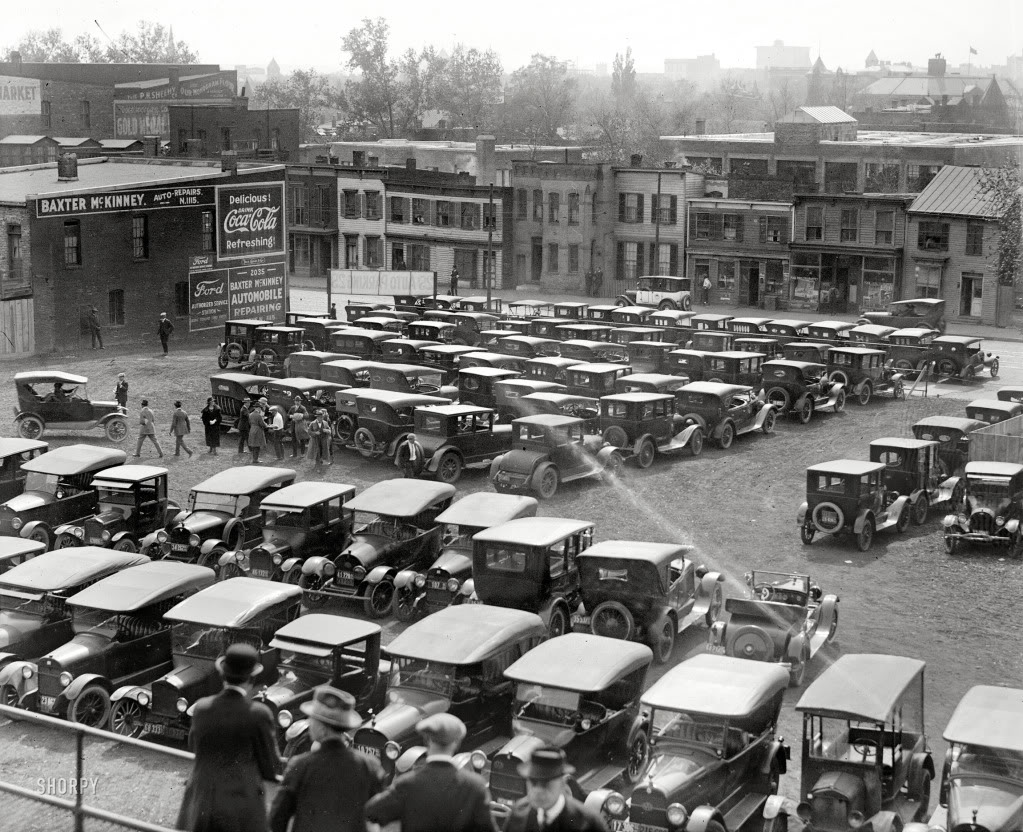
1923 parking lot
The pie-chart above indicates that by 2010, American 8-to-18 year olds spend on average 10 hours and 45 minutes of electronic media time per day. Granted the pie-chart is an average of just 2,000 students and I presume there is a margin of fluctuation given the demographic location of the students – i.e. rural youths are more likely to spend more time outdoors than urban or suburban youths – however, how much fluctuation would there be when comparing say my generation (1970’s and 80’s), or my parent’s generation (1950’s and 60’s) to these studies…the 8-to-18 year old generation of today? Answer: A lot!
When I was in my freshman and sophomore years in high school, the mobile phone was just becoming popular. They were the size of small bricks! There was nothing called the personal computer (yet), much less the internet. Imagine what our grandparents had seen during their lifetimes. My grandparents had grown up through the invention of flight and airplanes then jets, the Great Depression and World War II. They witnessed all the technological advances: the radio, television, and Model-T’s and Model-A automobiles! What an era to live in, huh?
Let us pause though for a minute. Let’s step back from the awes of technological invention and examine more closely what Einstein was talking about. How does his epiphany apply to 2013?
 Considering all the technological machines and devices mentioned so far, how much of an adult’s 24-hour day is consumed by those machines and devices? Starting with the personal automobile, how many hours do you think the average American adult spends inside a vehicle per day? Is it more than a person in 1970? In 1950?
At work, whether in an office or behind the counter of Starbucks Coffee, how many hours of a full work day might an adult spend in front of a computer? During leisure time not at work or working, how many hours does an adult today spend in front of a laptop or desktop computer? How many hours do they spend on an electronic cell phone, work or leisure? What do you think the amount of time was in 1970? And now for the mother-load…How many hours do you think an American adult spends in front of a television? Be honest.
Whatever the amount of hours you guessed, subtract that from 24. Next, subtract six, seven, or eight hours more for healthy sleep per night. How many hours – maybe minutes – are remaining when we are NOT on an electronic device or machine, or in front of an electronic device or machine? Getting the picture?
 When I figured my estimations of electronic device or technological machine (automobile) usage per day, it shocked me. I had only about 4-hours remaining in the day without or outside technological-electronic usage. And since I am a very social person, I know MY total hours are most likely a larger amount than many people. That’s four hours out of a non-refundable 24-hours!
What might that indicate about the quality of human interaction per day? If these amounts are exponentially greater during the winter holidays, particularly internet phones, what does that indicate about quality face-to-face human interaction in November, during Thanksgiving and after? During mid and late December through the New Year – especially my Texas relatives where collegiate and NFL football is a bigger religion than God or church – most eyes and ears were on the television!? Now today, it can be just as much internet cell phones too. What is Thanksgiving and December like for your friends and family?
Albert Einstein was really on to something!
(paragraph break)
I have a deep fondness for the Victorian Age (Britain), the Belle Époque (France & Belgium), and the Gilded Age (United States), all between the 1850’s to 1920’s. From this era came some of mankind’s greatest works of art, music, literature, fashion, theater, scientific innovation, and political reform. For the most part it was the pinnacle of refined sensibilities not seen since the Renaissance. When I read such works by Ralph Waldo Emerson, Walt Whitman, and Oscar Wilde, I imagine myself in the same room transfixed on their dialogue and banter over glasses of cognac and wine in plush wing-back armchairs. Oh to be a time-traveler.
I feel that must have been the Golden Age of Discourse and Articulation where every word, every gesture was weighted and packed with broad-brushes of wit, enlightened sophistication and bold adventure; truly, an age in the art of conversation. There were very few automobiles and very few telephones to steal away their time from human interaction, so they excelled at those virtues and sensibilities.
Growing up as a boy in the late 60’s through the 80’s the television or stereo were the two electronic items that could take away time from my neighborhood friends. My two best friends and I would always play games, build things, or tinker with things outside together. During the Christmas-New Year holidays, my six to eleven different cousins and I would play in tree-houses, versions of hide-n-seek, or our favorite…bottle-rocket wars. Those special times of year are some of my most cherished lasting childhood memories. None of them, not one single memory involves any sort of electronics or machines, other than perhaps bicycles, zip-lines, garring spears (for garpike), fishing poles, and crab-traps. Much of those holiday times with all my multiple cousins were full of tricks, gags, and bust-a-gut laughter. Very little time was ever lost in front of the televisions.
Then in the 1980’s came the personal computer, mobile phones, and the world-wide-web. The age of face-to-face youthful interaction in America was never again the same. As if the personal automobile and home television didn’t eat up enough of our daily lives, the dwindling hours would become divided and diminished more by those inanimate devices and objects with ever-increasing sophistication and attention.
Now that I am a parent and some of my fellow schoolmates are grandparents, how much does current technology consume our busy lives? Do you think it is much different or greatly different from the 1970’s and 80’s? What about the 1950’s, or more in contrast the Golden Age of Discourse and Articulation of the 1890’s and 1900’s? How would you describe the contrasting eras in terms of quality human interaction and daily consumptions?

Non-electronic family games
As I reflect back on my many, many past holidays, I have seen, to put it mildly, a noticeable increase of bombardment by commercialism into and onto every possible electronic device in our homes and personal lives…all ferociously vying for our attention during our waning precious 17-15 conscious hours. During November and December the veracity becomes like relentless swarming sharks attacking and devouring. Unless one knows how to get out of the water completely so-to-speak, the insatiable sharks WILL take all twenty-four hours of your day and night, seven days a week, fifty-two weeks a year. Sharks, like electronic devices or machines, have no moral or ethical conscience or shame.
It would be unrealistic for me to demand we return to the Beautiful Age of Human Discourse and Interaction, especially during the holiday season. But how I long to see and hear the hours upon hours of face-to-face enjoyable, stimulating, funny, and challenging conversation WITHOUT any electronic device present or attention-dividing machine.
For me, those touchable face-to-face interactions are the sweetest times and memories a human being could ever have, especially when December brings good friends and family together. Guard them. Fight not only for their survival, but protect and fight for their value in human essence!
Wishing everyone the best and most significantly human interactive 2014 possible!
(paragraph break)

This work by Professor Taboo is licensed under a Creative Commons Attribution-NoDerivs 3.0 Unported License.
Permissions beyond the scope of this license may be available at https://professortaboo.wordpress.com.
As part of the Alternative Lifestyles blog-posts migration over to the new blog The Professor’s Lifestyles Memoirs, this post has been moved there. To read this post please click the link to the blog.
Your patience is appreciated. Thank you!

image WikiHow.com
While I share my thoughts on how critical mastering communication skills are for life, I will also take this opportunity to update everyone on my job/career status; the other night the two went hand-in-hand beautifully.
The update from What’s My Story?: I am now training with and soon to be working as a tutor with a well-established national educational-tutoring company helping struggling students in areas of math, reading, writing, and test-preps. This is my evening job and the primary purpose of this post. I am also currently substitute teaching in one Dallas-area school district, and soon to be substituting in a second Dallas-area school district; yes, three separate jobs to make ends meet. Despite the long hours six-days a week, I am grateful to be working again. But that’s not what I want to talk about.
The other night while observing and assisting the short-staffed learning center, one student was originally from China. He was a very bright 16-year old boy who spoke good English and has lived here about ten months. He was being tutored in advanced English writing and literature. One of his vocabulary words for the night was “exciting” and how to use it in various sentences. Of his five words to learn, this one was the most difficult for him. Tchang (as I will call him here) could not understand the difference between the uses of exciting versus excited. If you are an American having spoken English your entire life, how would you explain the differences to Tchang?
Our attempts to differentiate the two words seemed to confuse Tchang just as much as they seemed to help. After several different examples, in the end his perplexed expressions never receded. Why?
If the English language is not your native tongue, then of the world’s many thousand languages to learn, English is perhaps the hardest to speak and write. Unfortunately, Tchang was learning just how hard it can be. Empathizing with his frustration I explained it wasn’t his fault for not understanding but that it was our/my language; a very complex and often redundant language. English words and their uses can sometimes have one or a half-degree of separation, perhaps less. Yet they will indeed describe a slight difference…which leads me to my big-picture point.
Communication isn’t just a skill; it is the linchpin of one’s true identity.
If you do not master the art of communication, then life will often seem an uphill battle. This holds true just as much for those around you; their communication skills can be just as trying on your patience like trying to navigate a circus fun-house maze of meaning.
Let me merely scratch the surface of how profound communication is to life. “The ability to communicate effectively is important in relationships, education, and work.” Following are steps and tips for the development of good communication from WikiHow. After the first two highlights are explained, for the sake of time and space go to the WikiHow link for the remaining detailed explanations.
Understand the Basics
Engage Your Audience
Use Your Words to Impact
Use Your Voice to Impact
Though some of us might think these steps/tips are well-known or even intuitive, the present history of mankind and womankind speaks to the contrary. On any level of communication, from world powers to individual family or marital relationships, communication is paramount! Perhaps it is safe to say that wherever there has been violence, hatred, or wars, there has been a massive failure of communication. Conversely, wherever there is or has been peace, love, and collaboration, there has been superb communication. Though it is not quite that simple, this generally stands true does it not?

Can you communicate both organs effectively?
Then there is the wrench of deception; intended or unintended. This is an entirely different matter and deserves a separate discussion, particularly intended deception. For now, I wish to dabble, or languish depending on circumstances, in the art of interpersonal language and communication, or the lack of it. Also, I have observed an unspoken hierarchy present in human interaction of which I have personally broken them down into these six following hierarchies. I’m very curious; how would YOU define them in the context of “authentic” impactful communication?
Expressing one’s self to others requires understanding one’s self accurately. If you do not understand why you feel or think a certain way, or in a context how you’ve come to feel or think a certain way, then how can you accurately express it? Language and words express as much emotion as they do fact, sometimes one more than the other. How well do your words match your emotions? Better yet, how well do they match your actions or behavior? What is meant when people say “Actions speak louder than words”?
There seems to me to be a pure art of communication and language, and that purity is mysteriously hard to find sometimes not just in others, but within ourselves too. I love being around elementary kids because they still have that blatant innocence to express exactly what they think and feel that we sometimes don’t find among adults. In a group of strangers or acquaintances where little children are present, why do the adults so often invest their attention onto the children instead of the adults? I find this social condition…
…obtuse.
I am puzzled by this blurry condition of artful candid communication today so to understand…
I wonder if it might be because as we “mature” we become more sensitive to the way others perceive us. In potential romantic relationships – for that matter even certain long-term relationships – do we sacrifice authenticity to be more loved? And if that is the case, then isn’t that living an illusion? Is it because of a fear of rejection that we do not communicate authentically but in diluted forms in order to be served in some way?
I would very much like to hear any and all feedback on the condition of modern communication; modern verbal communication in interpersonal relationships particularly. How do you find the art of interpersonal communication? From the 6 hierarchies above, is it right or wrong to authentically communicate another’s ‘status’ or ‘ranking’ in your heart?
(paragraph break)
This work by Professor Taboo is licensed under a Creative Commons Attribution-NoDerivs 3.0 Unported License.
Permissions beyond the scope of this license may be available at https://professortaboo.wordpress.com.

image Wikipedia
I was shocked when I read her email. I had never received any type of correspondence like it from any politician, ever! Wendy Davis, who is running for Texas State Governor next year, asked me what my story was. She asked, “What challenges do you and your family face? What issues should be addressed to strengthen our families?” For the last five years her running opponent, Greg Abbott, the Texas State Attorney General since 2002, has been anything but cordial, sympathetic, or hopeful toward me; just cold and impersonal. If there are those who have not heard of Greg Abbott, then my point is made.
Like Wendy Davis, some human beings would take a few minutes to ask questions like, What’s going on with these issues? How did things get to this point? What can we do to improve things? Wow. Imagine that, a politician who wants to know and listen to the nuts-and-bolts of a situation and its causes, its factors from the actual people affected! What an invitation! What an opportunity!
This is what I told her…
(paragraph break)
Wendy, I am a two-years unemployed certified 4-8 General Ed, Special Ed (pending) teacher, father of a 2nd year college daughter, and 12-year old son who live over 300-miles away and I briefly see maybe twice a year. In the summer of 2012 my charter school where I taught – whose student body was 82% Special Needs and a third were wards of the state from horrific homes and circumstances – lost four of its six major funding grants. Education cuts were not only happening nationwide, but just as much statewide. As a result, our school resources were severely stretched or eliminated. These cuts included much-needed hiring of additional qualified staff, aides, and most importantly certified teachers for the increased numbers of Special Ed students coming in from other nearby closing schools AND the result of marketing and attracting more Special Ed students necessary to keep our two meager remaining grants for 2013. The federal and state cuts also meant no annual 2% – 3% pay raises for any current teachers and staff; I was grossing $31,380 per year (or $2,080 a month, or barely $13/hour after automatic child support garnishments) for 60-70 hours minimum per week of work. Need I get into net earnings minus healthcare pay-deductions and cost of living expenses? The math is depressing.
One assessment some schools and districts use to monitor their teacher’s development and well-being, especially those on campuses teaching behavioral-emotional Special Needs students and wards-of-the-state, is a stress-anxiety assessment. At the end of the school year, I scored in the upper 10% at risk; almost “Highly at Risk” for accelerated health deterioration.
My At Risk for health deterioration was compounded monthly by financial and legal pressures from the Texas Child Support Services and the state Attorney General’s Office. During my annual checkup at the doctor’s office, he told me flat-out I need to find a different job; a job where I at least had the time (somewhere in the 24-hours) to exercise and relieve the stress. This was my response to him:
If I quit my job doctor, I only compound my problems. If I fall behind even two months unemployed, the Texas Attorney General’s Office report those failures immediately to all credit bureaus. Sometimes it is less than two months. Most all potential employers today use an extensive background check – especially for teachers – as well as credit checks which are used for financial decisions and interest rates, let alone everything else creditors, lenders, businesses, etc, etc. families, parents, and me, the non-custodial parent, struggle with and fight to stay afloat month-to-month. I don’t know Doc what the answer is. This was his reply: “As long as you understand the health consequences if SOMETHING doesn’t give.”
For the 2011-2012 school year I taught 5th – 8th Social Studies, 5th – 8th Enhanced Learning Lab (elective), 9th – 12th Career Tech (elective), and assistant coach athletics for after-school activities. In late summer my charter school informed me that for the coming 2012-2013 school year, I would have to teach 4th – 8th grade Science and Social Studies of which all periods would have 2 or 3 grade levels of the subject in the same classroom. For you readers who are not teachers or familiar with Texas state curriculum and standards, every single grade level in science is a different development module with some crossovers. In Social Studies, 4th graders cover basic Texas history, 5th graders cover basic American history, 6th graders cover basic World history, 7th graders cover more-advanced Texas history, and 8th graders cover more-advanced American history. The only crossover I would be afforded to ease the 35%-40% workload increase would’ve been 4th and 7th, and 6th – 8th. And as a reminder, almost half of each class are Special Needs wards-of-the-state students. Myself and other teachers had no aids because there was no money to pay for them, and that would be the case again for the upcoming bigger classes for the upcoming year.
 As most people are aware, our public education systems have gone through needed reform. Some of it has been successful and improved. However, there is obviously much more work to be done and equalities protected! More importantly, radical state and federal funding cuts only exacerbate the problems and worse put at great risk our country’s future leaders and skilled educated collaborating future government officials and citizens. Public education is not and never has been “secular brainwashing or compromise.” Those speculations are left to individual homes and parents, not public schools. Public education is and has been primarily for those children and adolescents who come from not-so-advantaged homes, even severely impoverished, to have a decent chance of becoming a productive future citizen and not an expensive public liability in prisons, mental institutions, or rehab clinics; all of which require MORE taxpayer dollars in the long run. Yes, a headache can be cured by decapitation (i.e. conservative-pushed cuts), but is it productive change? Is it “economic/fiscal responsibility” on all levels? No.
(paragraph break)
I resigned in August 2012. Today, I am still unemployed as a certified General and Special Ed teacher. I spend an average of 12-18 hours a day seeking and completing long extensive applications for teaching positions in districts that haven’t been so severely hit by funding cuts. Meanwhile, each month I receive a cold, unconcerned collection statement from the Attorney General’s Office showing in bold type my higher rising balance plus interest. Like a home mortgage or auto loan, this monthly defaulting is reported to all credit bureaus. Should my arrears reach $10,000 my case will go into the Enforcement Stage and a warrant for my arrest will be issued. DeAnna Shields, a Killeen, Texas web-radio talk show host, student of mental health studies, parent, and U.S. Army Widow volunteer, writes a telling article about Texas Child Support laws from Greg Abbott’s office on CNN’s iReport. Read it here.
Wendy Davis, clearly I am and have felt the detrimental effects of a plunging credit score and unemployment. I wonder how jail time would affect my job search. Thank you so much for asking about my story Wendy! A little digging, a little personal human interaction, a little effort to understand the long-term effect of lawmaking goes a very long way. I really hope next year I will be addressing you as Governor Davis!
Signed,
Unemployed Texas Special-Ed Teacher
(paragraph break)
Post-script — “Greg Abbott leads Wendy Davis by single digits” — Politico, 10/2/2013. If you are interested, here is her campaign website: http://www.wendydavistexas.com/
(paragraph break)
This work by Professor Taboo is licensed under a Creative Commons Attribution-NoDerivs 3.0 Unported License.
Permissions beyond the scope of this license may be available at https://professortaboo.wordpress.com.
Divergent Thoughts on Life, Love and Death
life and other weird stuff
Seeking Dialogue to Inform, Enlighten, and/or Amuse You and Me
Storytelling, short stories, fable, folk tales,...
Writing writing and more writing
Analysis & Discussion For Political Uncertainty
I have zero expectation that anything I ever say will end someone’s belief in their God. Not my goal or purpose. That alone belongs to the individual. ~ Zoe
A photo journal of my interests from one extreme to the other.
Cogito Ergo Sum
by Wendy Waters
Understanding the psychology that drives our politics
Ponder(verb) to weigh in the mind; to view with deliberation; to examine carefully; to consider attentively
'Light thinks it travels faster than anything but it is wrong. No matter how fast light travels, it finds the darkness has always got there first, and is waiting for it' - Terry Pratchett
writing on human security
Living and Learning
Some prefer the comfort of Faith. I prefer the cold, hard Truth.
By Keith Goode aka Ken Thackerey
I don’t want to start a class war; it started a long time ago and, unfortunately, we lost.
Searching for truth while leaving tradition behind.
Questioning the conventional wisdom
 The Professor's Convatorium