Untapped Worlds – Departure

I pick up where I left off previously in Untapped Worlds — An Intro

Superstition

A rabbit’s foot, a rosary, black-eyed peas on New Year’s day, ghosts, witches, vampires, devils and angels, are all beliefs or superstitions which thrive in human brains. Why?

As noted in the previous post, our brains work on an average 12.6 watts per “normal” day awake. The brain must work very efficiently in order to maintain a good survival-rate for the rest of our body on a mere 12.6 watts of metabolic-energy. It makes deductions, connections, and inferences, spotting patterns and drawing conclusions, and makes predictions into the immediate and near futures. It stores this information for later too, sometimes accurate, sometimes partly accurate, and sometimes completely inaccurate. It also trashes or blocks information for what it perceives as the “best survival mode,” or the worst, for the moment or later, right or wrong.

Superstitions can bend or change history. In 1976 NASA’s Viking I orbiter took around 50,000 high-resolution photos of the Martian surface never seen in such detail by human eyes. The mission to the red planet was to find evidence of possible life. One particular image seemed to clearly show a giant face with two eyes, a nose, and a mouth that measured approximately 1-mile in width. Observers immediately began seeking answers, seeking meaning to why and how the face was there. Many of the explanations were that an advanced species of aliens had built the face. If anything this NASA photo convinced much of the public that extraterrestrial life was at least probable. A vintage 19th century photo of a couple became a sensation in art galleries because it possessed an oversized “Jesus-head” superimposed on the man (see slide show). Whether the gentleman in reality had his daughter on his knee, people could not see anything else in the image accept the large head.

This slideshow requires JavaScript.

The imagined perception of a pattern or meaning where it actually does not exist is called pareidolia. Dr. Nouchine Hadjikhani of Harvard University says this neuro-phenomena has been hardwired over several 100,000 years into our brain. We try to detect faces from birth. Hadjikhani’s studies show that newborns direct their attention toward general facial features as opposed to random shapes. Neuroscientist Joel Voss at Northwestern University explains that to make sense of an image we “assign meaning to them — usually by matching them to something stored in long-term knowledge. But sometimes things that are slightly “ambiguous” get matched up with things we can name more easily — resulting in pareidolia.” This is a product of our own expectations or desires, also called self-generated illusions. And often, once you get them embedded into your head, it is very difficult to unthink them. We have an evolutionary tendency to construct order out of perceived chaos because chaos is seen as a threat to survival. Hence, “death” has a plethora of human illusions and superstitions attached to it. Can you name a few?

Ambiguity

Believe it or not, your brain lies to you a lot. And believe it or not, falsehoods and history go hand in hand, both on a personal as well as a global level. Whether you’re comfortable with it or not, it is practically impossible to know exactly what is fact or what is fiction, or a version of it somewhere in between.

New York Daily News archive via Getty Images

New York Daily News archive via Getty Images

A well told story can make a person believe in almost anything. Case and point, Orson Welles and the Mercury Theatre on the Air enactment of an alien invasion of Earth broadcasted on the radio in 1938. This mass hysteria caused by the radio broadcast was later retold as “never before seen in the annals of news broadcasting!” But in reality the numbers of panicked listeners were insignificant due to another much more popular radio show, The Chase and Sanborn Hour airing at the same time. Only a tiny audience was actually listening to Welles’ Mercury Theatre. The asserted “nation’s hysteria” was sensationalized and inflated by none other than the major newspaper corporations who had been losing large amounts of advertising revenue to radio. Seizing upon the retribution opportunity provided by Welles, they launched a discrediting campaign against radio newscasts. Otherwise, the “panic-inciting” War of the Worlds broadcast would have never become an overgrown myth. The Salem Witch Trials would be another case and point to the power of well told stories of fiction (fear) versus facts.

Why do political candidates practice public speaking, body language, and appearance to their TV or campaign-tour audiences? Why do major fashion and cosmetic companies hire celebrity endorsements for advertising their products and services? Why do sporting companies like Nike or Under Armour do the same? It is called the Halo Effect and it permeates our decision-making all the time.

The halo effect is not only evident purely by appearances either. It can be shown by personalities. For example, a job applicant with an outgoing friendly personality will on average be rated by an employer as intelligent, competent, and qualified more times than one with an introverted quite personality. And even being aware of the halo effect does not guarantee your perceptions or decisions can avoid it. Diminishing its influence takes a lot of disciplined cognitive training to counter it because our own sphere of influence and personal highly subjective life experiences often dictate our decisions between real, the possible, and the unreal or impossible.

What Must We Do?

courage fulfillsThe first thing we must do is to accept the reality that our brain and its perceptions and interpretations of our self, the world in which we live, and the nature of others can be irrationally conceived. Like it or not our brains are naturally narrow-minded beginning at birth, through our childhood and adolescence, and into young adulthood. To an ever-growing extent our perceptions and conceptions are solely dependent upon many variable factors. Factors such as social, environmental, educational, political, familial, or psychological, telling the observer (us) what is being observed or being sensed. This is known as extrapolation.

The only way to reduce extrapolation, variances, or estimation, and gain more truth and precision is to test, question, and verify, sometimes repeatedly with new or modified factors. And the only way to move beyond the relative known… is to depart for the unknown. Otherwise, our brains are more susceptible to deception, superstitions, ambiguity, and flawed memory which can lead to a life not fully lived, or worse lived falsely. Besides, what are you or would you be really leaving? After these two blog-posts of how extremely limited and flawed our brains are, do you even know, with certainty, what life would be best and what life worse…honestly? Untie yourself, depart, and find out.

The next post in this series will be Untapped Worlds — Entries.
(line break)

Live Well — Love Much — Laugh Often — Learn Always

(paragraph break)

Creative Commons License
Blog content with this logo by Professor Taboo is licensed under a Creative Commons Attribution-NonCommercial 4.0 International License.
Permissions beyond the scope of this license may be available at https://professortaboo.com/.

Build for Life, Not for Fixes

full-body-castMy previous post was a bit of a fumbling crash-test-dummy wreck. After four long days of intensive care, in quadriplegic static-slings (in stasis?) and frequent bed-pans, I begin my rehabilitation in this way. Luckily, perhaps miraculously, I had a wonderful female human being, who despite my masculine Homo erectus “verbage” — I think she called it, but repeatedly with an odd angry French accent — she foolishly remains my friend and offered this TEDxAmericanRiviera video that literally explains to my kind… “what it’s all about.” Even better, the presentation is by a woman who knows something about it.

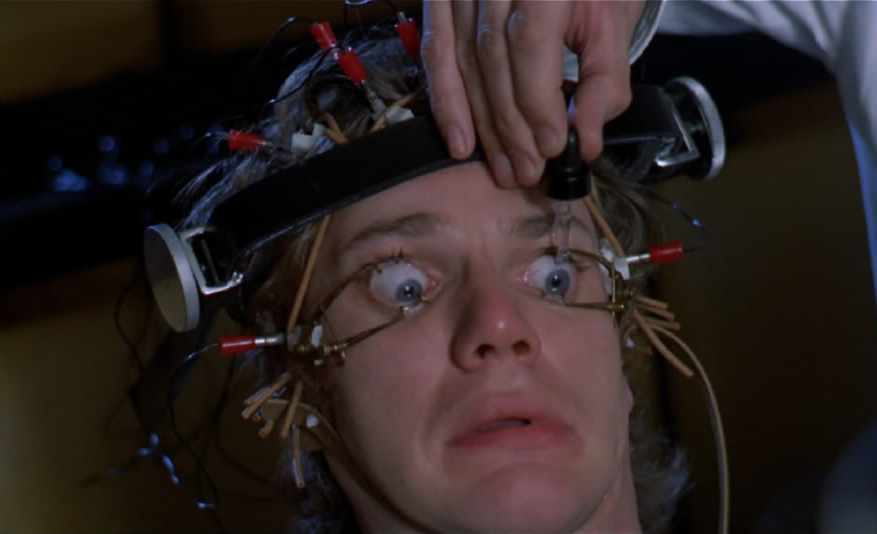
ludovico-techniqueAs prescribed, I watched so intently the highly impatient German nurses kept giving me eye-drops while grumbling what I couldn’t quite make out was “Nicht-Augentropfen, aber Fett Einlauf in den Arsch!” If I’m honest, it sounded a little frightening. Does anyone have that translation?

Without further babbling, I present Sheila Kelley


(paragraph break)
The proverbial light-bulb — admittedly more like a flickering miniature Xmas-light — lit up bright, and shown through various unmentionable orifices cared for by my German nurses… it was truly an Ah HAH painful moment, but with one minor tweak I would offer. It is this:  instead of the exact quote from Joseph Campbell, I’d perhaps say…

“Woman is life and Man is the servant of life.
The Male’s job is to protect [that service
so that Woman may freely give more life.]

— currently, Professor Baboon

You see, some/many women can protect themselves quite well. There’s no need for us men to prematurely step-in, unless she asks us to do so. Then the VALUE of collaboration, protection, service, all varieties of love, and the culturing between Woman and Man that Sheila Kelley is urging, is increased exponentially as BOTH are more empowered equally. Well, at least that’s my take to her fantastic presentation.

My dear female rescuer then sent me on my way with a reminder, “Before marriage, a man yearns for the woman he loves. After marriage, the “Y” becomes silent. And we are excellent housekeepers. Every time we get a divorce, we keep the house.” I believe she called that The V Empowered. She said one day I’ll understand, if I don’t real soon.


Addendum
— I’ve since realized that I should have clearly indicated in my last paragraph (above) that we/my friend and I, were joking-about/mocking local social norms; i.e. not uber serious and purely between the two of us, laughing about my own personal history with women/ex-wives and by default my neophyte entry into sexism vs. feminism. I see now she was comfortable with/about me to do that but may not have done it publicly with strangers — one man who you know pretty well, versus several unknown men and women. But I don’t know now if that was the case. I do see today how my last paragraph could easily be taken offensively by those who were not present. My sincere apologies.

Live Well — Love Much — Laugh Often — Learn Always

(paragraph break)

Addendum #2 — My blogging-buddy Swarn, at Cloak Unfurled, has given me permission to link his outstanding, poignant, gut-wrenching TRUE post, “The Long Silencing of Women“. I felt it was an excellent addition/temporary-conclusion to this, my crude male attempt on the subject of Feminism-Sexism. He agreed. Many thanks Swarn! It is well worth the read.

Creative Commons License
Blog content with this logo by Professor Taboo is licensed under a Creative Commons Attribution-NonCommercial 4.0 International License.
Permissions beyond the scope of this license may be available at https://professortaboo.com/.

Imagine For A Minute

I am temporarily stepping away from my current blog-series “Untapped Worlds” to write about a well-known touchy, deservedly sensitive subject. I think it is a very important subject and I want to present a variation of it to my male audience.

* * * * * * * * * *

aston_martin_rapide

The Aston Martin Rapide

Imagine for a minute Sir, you are at home — your home that you have constructed or refurbished or added-on by your hard-earned money — enjoying your comfortable couch or recliner in front of your 110-inch flat-panel HDTV with stereo surround-sound. In back…your quality-landscaped swimming pool and backyard with multi-level BBQ grill and pit. Behind there, your very own workshop/garage complete with a mechanic’s and carpenter’s dream inventory of high-end tools. Inside the three-door garage/workshop, your very own Bugatti Veyron or Aston Martin.

Up in your bedroom closet, complete sets of high-end business suits, a tuxedo for annual charity balls, 3 or 4 sets of the best men’s dress and casual shoes that money can buy, dress-ties and so on. Obviously, this type of living, home, and possessions are indicative of your wealthy salary: $200k – $500k per year or more? If I’ve forgotten any other lavishing items, please add them to your imaginative picture for a minute.

Then you hear some laughing outside in the back. A big splash soon follows. Then smoke slowly moves across your 8-windowed back living room wall that offers a spectacular vista into your luscious oasis around the pool and 1-acre lawn — the smoke is coming from your BBQ pit. No one is home but you; your fabulous wife of 17-years is out for the day with your 3 children! You quickly walk out the backdoor to find complete strangers using and obviously enjoying all your backyard amenities. How would feel? How would you react?

MacAllan ScotchOr what about another scenario. Imagine for a minute you have been out to a nice upscale 5-star restaurant with valet parking. After 2-3 hours of superb cuisine you and your wife decide to leave, walk out to the valet-station to have your Aston Martin brought up, and the Supervisor tells you and your wife, you must wait…wait for 10-15 minutes because four other valets just HAD to take your phenomenal wheels out for a spin themselves. How would you feel? How would you react?

Here’s another scenario. Imagine for a minute you’ve allowed some of your college frat buddies to come over to your palatial home to hangout, drink, and watch a game against your bitter college rivals. A few hours later you notice one of the guys is wearing one of your expensive dress shirts as well as some of your expensive jewelry and watch! Another buddy has found your basement wine cellar and popped-open one of your vintage bottles of wine, or best MacAllan scotch, and neither were upstairs on the kitchen counter with the cooler of beer! How would you feel? How would you react?

Men, I could come up with many more scenarios with your workshop tools, or even precious family heirlooms, or irreplaceable photos, but I hope you’re getting the idea.

What It Feels Like?

The above scenarios I have just described are pretty much how it feels to a woman when she is inappropriately spoken to, inappropriately touched or “grazed,” or sexually harassed by a man lacking proper gentleman’s etiquette, let alone ignoring common above-average respect for a woman. It is uninvited. Period. Some of the time the circumstances MIGHT be grey, vague, or appear grey/vague to YOU, but if there’s any level of uncertainty, what is your best course of action preserving her dignity? Are you aware of your own, how it appears?

When I’ve talked about these types of awkward or inappropriate situations, “violated” is one word I’ve heard women describe most to me. There is very little difference (if any at all) in their feelings of insult than what WE MEN might feel about our “precious stuff” at home or at our jobs. Get the picture?

I bring this subject up because I’ve encountered many men (particularly in the U.S. south) who implicitly or explicitly view and speak of their girlfriend/spouse or women in general as property they’ve “bought” or trying to buy, and subsequently own the Title-Deed. Sadly, to continue the analogy, this behaviour and thinking is WORSE when a woman’s “Title-Deed” is available or unpurchased, on-the-market; i.e. unmarried.

Men, this mentality must change! In all its forms and subtleties, the barbarism must stop.

And for you/us chivalrous gentlemen out there, WE must have consistent courage to firmly, tactfully, and in prompt dignifying ways step-in when a woman’s dignity is being grossly disrespected. Otherwise, by sitting idly by you perpetuate the problem for future women…possibly for your own daughter(s) and grand-daughters.

Post-script — I welcome any suggestions or further comments/additions to this post from my female readers. Please feel free to share them with us.

Addendum — the comments below will show that my approach to this subject could’ve been better, but for the sake of the topic — from my subjective perspective — and honesty, I believe I am going to leave my original content alone and allow the discussions below to help out. I hope it is constructive.

Live Well — Laugh Often — Love Much — Learn Always

(paragraph break)

Creative Commons License
Blog content with this logo by Professor Taboo is licensed under a Creative Commons Attribution-NonCommercial 4.0 International License.
Permissions beyond the scope of this license may be available at https://professortaboo.com/.

Untapped Worlds – An Intro

12.6-watts average. That is it. That is the average electric power (i.e. metabolic-energy) the human body must supply the brain for one “normal” day says Scientific American magazine. Want to know what sort of items can be powered with only 12.6-watts and for how long? To help better understand this comparison, let’s pretend we have a 12.6-watt battery to run some common household items. A basic clock-radio you might see on a bedside table in a cheap hotel will run for approximately 3-hours, if the radio volume is soft; maybe 4-hours if the radio is never used. A Nintendo Wii game-console can run on 16.8-watts for an hour. A standard 19″ CRT TV, 55-90 watts for an hour. A camping range-burner requires 800-watts for 1-hour. The average household coffee-maker requires 900-watts per hour. Getting the picture?

Perception-InterpretationThe human brain must conserve metabolic-power and run as efficiently as possible in order to function “normally” for a 14-16 hour day awake. Naturally, when asleep the brain is using much less metabolic-power, but still consumes small amounts. Power efficiency becomes critical in abnormal circumstances; either the body has enough metabolic-energy stored or it doesn’t. When the body does not, the potential for serious or traumatic harm increases proportionately to the danger, correct? Without the necessary brain-power for higher or acute cognitive and motor reactions, the greater the bodily harm or mortality. We see this organ-power equation illustrated in the animal kingdom every day. For example, animals falling prey to predators. Those animals with a higher healthier organ-power coefficient typically escape death, or their chances of escape are higher than those hunted animals with lower or less-healthy organ-power coefficients. Roadkills are another example. Animals with a low coefficient (i.e. tiny brains with tiny metabolic power to that tiny brain) typically cannot cross a busy highway 10-times without being hit.

In different more complex scenarios, humans are no different. Place an ordinary 20-something year old person who has been raised in a peaceful, quiet, unpopulated region all their life with absolutely no training or education of weapons or warfare, into a violent war zone for a 6-8 week period, their rate of survival — excluding mental health of course — will be extremely low, if not fatal. Too drastic? Then replace the war zone conditions with modern traffic rules and complex motor vehicles, multiply all that by ten(?) depending on the site’s population, and make it a teenager or 20-22 year old driver, and no driver’s education whatsoever. What might or probably will happen after 2-6 months? Ask an auto-insurance underwriter what the statistics would be.

Here’s the point in this so far:  humans are surrounded, no… constantly bombarded, with a never-ending supply of stimuli to the eyes, nose, ears, skin, and tongue in a 24-hour period! It is impossible for our brains to receive, process, store, and use all the available daily stimuli when it runs on only 12.6 watts per day. What does the brain do to compensate…to cope? It prioritizes. For millions of years our brains have slowly learned what is critical to survive, what is needed to increase survival-rate, what is unnecessary but nice, and what is utterly useless. And it does this prioritizing FAST, real fast! It has to; 12.6 watts runs out quick, or in other words, cognitive fatigue, let alone physical exhaustion, leads to collapse. Perhaps the only exception to this metabolic law is drug use or abuse. The reliability or unreliability of drug-induced cognition, heightened or otherwise, I will leave alone or for another time. 😉

Suffice to say, our human brains are quite prone/susceptible to various degrees of ambiguity, superstition, memory-errors, and deception.

Deception

When success, advantage, surprise, control, victory, or secrecy are sought, one method of better assuring that outcome is through deception. You find it in many team sports, you find it in multimillion dollar business tactics against competitors, you find it in card games, you even find it among verbal human interactions. Deception is especially useful in combat and wartime. Perhaps one of the best examples of this was Operation Bodyguard.

Operation Bodyguard and its seven sub-operations leading up to the 1944 D-Day Normandy invasion of Nazi Fortress Europe, were highly successful operations of deception saving hundreds of thousands of American, British, Canadian, French, and other Allied lives. For several months prior to the actual invasion into Normandy, France, the Allied High Command under Dwight Eisenhower flooded the Nazi airwaves, radar surveillance with well-planned misinformation, and even inflatable tanks, artillery, and supply trucks creating a completely fictitious Army Group to deceive German reconnaissance planes. By June 6 and 7, 1944, the operations were so successful that Hitler and his élite commanders waited 7 weeks before fully responding to the Normandy invasion forces, much too late to stop it. Oh the power and usefulness of deception.

History is laden with examples of armies, sports teams, gifted magicians, and large groups of people being duped by simple tricks designed to divert and/or confuse the brain. Take for example, this clever trick play by a high school baseball team…

Magic tricks are plentiful with deception, diversion, and confusion, so many that there is no need to list the thousands or embed their videos here. But one poignant example of people or large groups being utterly fooled would be that of the Peoples Temple in 1978 at Jonestown, Guyana where over 900 men, women, and children committed mass suicide/murder following orders from their cult leader Jim Jones. Until 9/11 this had been the greatest loss of American civilian lives by a single act or day. What is important to remember is that our brains can be led to misinterpret information. Our limited senses can cause the brain to construct false perceptions of people and in the world we live.

Memory Errors

Fact:  the human brain has difficulty recalling an event in the past, and details are often distorted or incorrect. This applies to every single brain on the planet. Scientific evidence shows this fact repeatedly no matter how mundane or monumental the event, our human memory is not as good as we’d like it to be.

Our memory is not as fixed as we might perceive, but much more fluid. What does that mean? Conceptualization is the norm, errancy is prevalent… along with egocentricity I would think. 😉 This 17-minute TED video from award-winning Dr. Elizabeth Loftus, a cognitive psychologist from Stanford University and UCLA, explains her ground-breaking research about the brain’s misinformation effect and its extremely imaginative capabilities for creating false memories. Dr. Loftus’ findings and talk are superb…

No matter how highly we hold our memory skills, the brain is simply not currently wired nor the metabolic wattage (12.6 watts) to be a precise 300-year DVR. Will it ever be? Ask that question in 10,000 or 100,000 maybe 1-million years. Right now the overwhelming scientific neurocognitive data suggests that our brain’s conceptualizing skills, including imaginative or experiential conjecturing, are far more dominant and gifted than fact-finding or fact-storing. Don’t despair though, we have the intelligence to improve this human condition…over a long, long period of course.

Superstition and Ambiguity

In my next post in the series Untapped Worlds — Departure, I will finish the Superstition and Ambiguity portions, establishing the/our brain’s faulty interpretations based on its limited (or very limited?) sensory feedbacks — it only learns what it is actually fed. Then move further (evolve?) to more impactful human experience. How can we upgrade our brains? How can we improve its immaturity before it’s too late?

Mmmm, we must leave port. To be well-traveled, more acutely aware, more precise, we must first depart from traditional cognition!

Live Well — Love Much — Laugh Often — Learn Always

(paragraph break)

Creative Commons License
Blog content with this logo by Professor Taboo is licensed under a Creative Commons Attribution-NonCommercial 4.0 International License.
Permissions beyond the scope of this license may be available at https://professortaboo.com/.

Bewildered

jonah-hill-shockThere are many many subjects I know nothing about; nothing of real significance that is, other than vague generalities and oversimplifications. For instance, I’m clueless about architecture and how to read a blueprint. I’m clueless about farming and how or when to plant certain crops, how to keep up the soil, when to harvest, etc. I’m also clueless about rugby or cricket and their rules! I’m clueless on how best to perform medical operations; I’m not a board certified doctor! There are many subjects I just don’t know enough about to carry-on any type of extended intelligent conversation!

So here are my questions to the cyber-world:

Is it wise to speak overtly, to be long-winded about things one knows very little or nothing about?

Why is it every two & four years — the American political cycle — everyone knows EVERYTHING about the dynamics of governing 319-million diverse people, or in my state of Texas 27-million, and are suddenly experts on ALL factors that effect people’s needs and wants and their current and future well-being? How do they have all the solutions!? What’s their secret? I want to know!

And now for some comic relief with much “truthiness”… 😀

(paragraph break)

Live Well — Love Much — Laugh Often — Learn Always

Creative Commons License
Blog content with this logo by Professor Taboo is licensed under a Creative Commons Attribution-NonCommercial 4.0 International License.
Permissions beyond the scope of this license may be available at https://professortaboo.com/.